PART 2: Everyone Thought the Chained Monkey Was Sleeping—Until I Saw What He Was Protecting
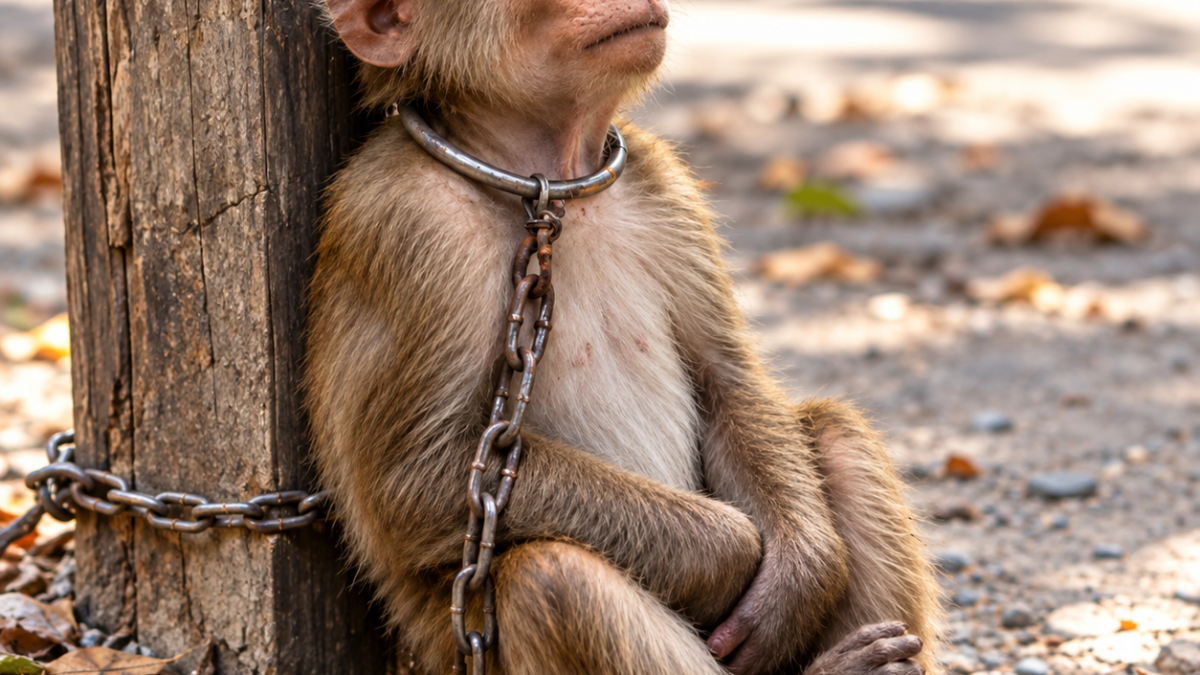
PART 2
Daniel stopped moving.
For a second, neither of us spoke.
The sound had been so faint that I almost convinced myself it was a beetle or a mouse trapped beneath the debris. Then it came again.
Scratch.
Pause.
Scratch.
The chained monkey reacted before either of us did.
His whole body changed.
His eyes opened fully.
I had spent the previous half hour wondering whether he was sick, drugged, exhausted, or simply shut down from fear. Now I saw how wrong I had been.
There was nothing absent about him.
He stared directly at Daniel’s hand.
Daniel slowly lowered the rescue hook.
“Okay,” he murmured. “I’m stopping.”
The monkey’s mouth opened, but no sound came out. He pulled at the chain once, not trying to escape from us but trying to move backward.
Toward the debris.
I looked at Daniel.
“There’s something alive under there.”
“Yeah.”
The animal-control officer, Marcus, stepped closer from the mouth of the alley.
“What did you find?”
“I don’t know yet,” I said. “Stay where you are.”
The last thing we needed was three people crowding a frightened primate with a metal collar around his neck.
I turned my attention back to him.
His eyes were enormous now.
And they were not on me.
They were fixed on that pile.
I lowered myself until I was almost sitting on the concrete.
“Whatever’s back there,” I whispered, “we’re going to be careful.”
Of course he could not understand the words.
But animals understand pace. They understand hands. Distance. Tone. They understand whether somebody is rushing toward them or giving them space.
I wanted every movement I made to tell him the same thing.
I am not taking control from you any faster than I have to.
Daniel moved the first board.
Nothing.
He moved a strip of torn plastic.
The monkey pulled the chain taut.
“Easy,” I said.
Another board came away.
Then we saw the cloth.
It was filthy, faded brown, and bunched beneath several pieces of lumber. At first I thought it was an old feed sack.
Then the cloth shifted.
Daniel stared at me.
“Oh, God.”
He dropped to one knee.
“Don’t grab it,” I said quickly.
“I’m not.”
We cleared leaves from around the cloth.
A tiny hand appeared.
Five narrow fingers curled weakly around the edge of the material.
Marcus swore under his breath behind us.
I felt something hard tighten in my chest.
“There’s another monkey.”
The larger monkey surged forward.
The collar snapped him backward so violently that I heard metal strike wood.
I flinched.
“Stop. Everybody stop.”
We froze.
He crouched low between us and the pile, breathing hard.
There was no question anymore.
He had known exactly what was underneath those boards.
He had been guarding it.
The little hand vanished back into the cloth.
I stayed on the ground.
“Daniel, blanket.”
He reached into our bag and slid one toward me.
The larger monkey watched every inch it traveled.
I let it remain beside my knee.
Then I waited.
There are moments in rescue work when doing nothing is the hardest thing you can do.
Every instinct in me wanted to rip those boards away.
I wanted to know whether the smaller animal was breathing normally, whether it was injured, whether it had been trapped there without water.
But a panicked adult primate with a chain around his neck could strangle himself in seconds.
So I sat.
One minute.
Two.
The monkey’s breathing slowed.
I moved one board.
Paused.
Moved another.
Paused again.
Finally, enough of the cloth was exposed for me to see inside.
The youngster was curled so tightly that at first I could not make out where its arms ended and its legs began.
It was much smaller than I expected.
Its face was pressed against the fabric.
Its fur was dusty and matted.
One eye opened when the light reached it, then shut again.
I swallowed.
“Daniel, call the clinic back.”
He already had his phone in his hand.
“Tell them there are two.”
The older monkey moved toward the youngster.
The chain stopped him about eighteen inches short.
That detail broke something in me.
He could get close enough to watch.
Close enough to protect the pile.
But not close enough to touch the little one.
I wondered how many times he had stretched that chain to its limit.
How many times the youngster had made a sound during the night and he had been unable to reach it.
Daniel spoke into the phone.
“Juvenile, very weak. Conscious but minimally responsive. Yes. We’re extracting now.”
I slid the blanket beneath the torn cloth instead of pulling the youngster out immediately.
The older monkey stared at my hands.
His lips pulled back.
It was the first threat display I had seen from him.
I stopped.
“I know,” I whispered. “I know.”
He made a low sound in his throat.
Not a scream.
A warning.
Daniel leaned toward me.
“Maya, you want the shield?”
“No.”
“If he lunges—”
“He can’t reach me from here.”
“That’s not what I mean.”
I knew what he meant.
If the older monkey panicked hard enough, he could injure himself against the collar.
“I’m going slower.”
I shifted the cloth another inch.
The youngster’s head rolled weakly.
That decided it.
We were out of time for negotiation.
“Daniel.”
“Ready.”
“On three, I’m taking the little one. You watch the chain. If he pulls, keep tension off the collar if you can, but do not grab him.”
“Got it.”
I looked at the older monkey once more.
“I’m sorry.”
Then I lifted.
He lunged.
The chain exploded across the concrete.
Marcus shouted behind us.
I brought the youngster against my chest and immediately backed away.
The older monkey hit the end of the chain and twisted sideways.
“Daniel!”
“I’ve got the slack!”
Daniel grabbed the chain several feet behind him, not pulling, just preventing it from wrapping around the post.
The monkey spun toward us.
I expected screaming.
Instead, he stopped.
Because the youngster moved.
A tiny hand emerged from the blanket.
The older monkey stared at it.
Everything went still.
I held the youngster where he could see.
“Look,” I said. “Look. I’ve got them.”
I deliberately kept the blanket open around the face.
The juvenile blinked.
The older monkey’s shoulders dropped.
Not completely.
But enough.
Daniel exhaled.
“Keep the little one visible.”
“I am.”
I backed up until I was beyond the reach of the chain.
Marcus brought over our soft-sided transport crate.
“Put it beside you?”
“Yes. Door open.”
I lowered the youngster onto a folded towel inside.
The little animal barely resisted.
That terrified me more than struggling would have.
A healthy juvenile monkey should not allow a stranger to pick it up without objection.
Daniel crouched near the older monkey.
“Now him.”
I nodded.
The collar was our next problem.
Up close, it was worse than I had realized.
It was not a proper animal collar. It looked like a crude metal band that had been modified with a bolt and a short length of hardware-store chain. Rust covered the outer surface. Beneath it, the fur had worn away.
The skin was red and swollen.
There were darker patches where dried blood had mixed with dirt.
Daniel looked at me.
“We’re not sliding that over his head.”
“No.”
“Bolt cutters?”
“Too close to the neck.”
Marcus said, “I’ve got small cutters in the truck.”
“Bring them, but don’t come back fast.”
He nodded and left.
I moved the transport crate until the youngster was several feet from the older monkey but still visible.
The reaction was immediate.
His eyes locked on the crate.
The youngster shifted inside.
The older monkey made the same low sound I had heard before.
This time it did not sound like a threat.
It sounded like an answer.
Daniel heard it too.
“Think they’re related?”
“I don’t know.”
“He acts like a parent.”
“Maybe.”
I did not want to assign a relationship because it made the scene more emotional.
Rescue work punishes assumptions.
Animals form bonds that do not fit human categories. Sometimes an unrelated adult becomes protective. Sometimes siblings behave like parent and child. Sometimes trauma creates attachments that are hard to interpret from a few minutes of observation.
What I knew was simpler.
He cared where that youngster was.
And he had put himself between the juvenile and us from the moment we arrived.
Marcus returned with cutters and a compact rotary tool.
The sound of the case opening made the monkey flinch.
I shook my head.
“No power tool unless we absolutely need it.”
Daniel examined the fastening.
“If I can get the bolt to turn, we might not need to cut.”
The bolt had been jammed through two overlapping pieces of metal.
There was no proper buckle.
No quick release.
Whoever had put it on him had apparently designed it to stay there.
Daniel held up a small wrench.
“Maya, I’ll need to be close.”
“I know.”
“You keep his attention?”
I moved next to the crate.
The older monkey watched me.
I opened the outer flap just enough for him to see the youngster clearly.
The little one raised its head for perhaps two seconds.
That was enough.
“Now,” I said.
Daniel moved in.
The monkey jerked as soon as the wrench touched metal.
I spoke continuously.
“Easy. Easy. I know. I know.”
Daniel turned the bolt a fraction.
Rust cracked loose.
The monkey reached toward his hand.
Daniel backed away.
We waited.
Then tried again.
The second attempt lasted three seconds.
The third lasted five.
By the sixth, Daniel had turned the nut almost halfway.
Sweat ran down the side of his face.
“How long has this thing been on him?” he whispered.
“Don’t know.”
“It’s practically fused.”
The monkey suddenly twisted his head.
Daniel pulled his hands back.
The collar scraped the injured skin.
The animal recoiled.
I saw his eyes squeeze shut.
There was no question that it hurt.
My voice came out sharper than I intended.
“We need to get it off.”
Daniel nodded.
“I’m trying.”
“I know.”
He looked at me.
“Maya.”
“What?”
“You’re shaking.”
I looked down.
He was right.
I pressed my hands against my knees.
“I’m fine.”
“No, you’re angry.”
“Of course I’m angry.”
“So am I. Don’t let that make us rush.”
That brought me back.
Daniel had a habit of saying exactly what I did not want to hear when I most needed to hear it.
I nodded.
“Okay.”
We waited another minute.
Then Daniel tried again.
This time the bolt turned.
One rotation.
Two.
Three.
The nut dropped onto the concrete.
The sound was tiny.
To me, it sounded enormous.
But the collar still did not open.
Rust had locked the two pieces together.
Daniel worked a flat tool between them.
The monkey trembled.
I opened the crate flap wider.
The juvenile looked out.
The older monkey stared.
Daniel twisted.
Metal creaked.
Then the collar opened.
For half a second, none of us seemed to understand that it had happened.
Daniel lifted the band away.
The chain slid across the concrete.
Clank.
The monkey did not move.
He remained against the post.
No collar.
No restraint.
Nothing holding him there.
Still he sat.
Daniel backed away quickly.
“Maya?”
“Give him space.”
We all retreated.
Five feet.
Then ten.
He stayed exactly where he was.
I had seen this before with animals kept in small cages. Open the door after long confinement, and sometimes they do not run.
Freedom is not always something the body understands immediately.
Sometimes the boundary remains after the metal is gone.
The youngster made a small noise inside the crate.
The older monkey’s head snapped toward it.
There.
That was the thing strong enough to pull him out of stillness.
He took one step.
Stopped.
Another.
His legs looked unsteady.
I moved the open crate toward him and then backed away.
He approached cautiously.
His hand touched the doorframe.
The juvenile shifted toward him.
He climbed inside.
The moment he reached the youngster, his entire posture softened.
He lowered his head.
The little monkey lifted one arm.
He pulled the youngster against his chest.
Nobody said anything.
Marcus looked away first.
Daniel cleared his throat.
I pressed my lips together because I did not trust myself to speak.
For nearly an hour, I had thought the older monkey’s silence meant surrender.
Now, watching him curl his body around the juvenile, I understood it differently.
He had been conserving everything he had.
Every movement.
Every reaction.
Every ounce of strength.
Not because he had stopped caring what happened.
Because he had something behind him that mattered more.
I closed the crate gently.
“We need to go.”
Daniel picked up the chain from the ground.
He looked at it for a moment, then dropped it into an evidence bag Marcus held open.
“Take the post hardware too,” I said.
Marcus nodded. “Already photographed everything.”
“Good.”
As we carried the crate toward the van, the shopkeeper who had called us stood at the end of the alley.
His name was Mr. Alvarez. I had only spoken to him briefly when we arrived.
He stared at the crate.
“There were two?”
“Yes.”
His face changed.
“I never saw the small one.”
“Neither did we.”
He looked past me toward the empty post.
“I thought that monkey was dying.”
“So did I.”
Mr. Alvarez rubbed one hand over his mouth.
“I should have called sooner.”
I had heard those words from witnesses more times than I could count.
Sometimes they were an excuse.
Sometimes regret.
Usually both.
“You called,” I said. “That matters.”
“But three days.”
I did not tell him it was fine.
Because I did not know if it was.
Instead I said, “If you remember anybody around that building—any vehicle, any person, anything unusual—tell Officer Marcus. Even if it seems unimportant.”
His eyes moved toward Marcus.
“I saw a truck.”
Marcus stepped closer.
“When?”
“The first morning. Early.”
“What kind?”
Mr. Alvarez hesitated.
“White. Old. Van maybe. I didn’t see the plate.”
“Driver?”
“I only saw somebody walking away.”
“Man or woman?”
“I think a man.”
“Think?”
Mr. Alvarez nodded.
“Dark shirt. Cap. That’s all.”
Marcus took out a notebook.
I carried the monkeys to the van.
The older one never looked at me.
He kept both arms around the youngster.
At the clinic, Dr. Lena Ortiz met us at the rear entrance.
She had treated everything from confiscated parrots to illegally kept reptiles, but one glance through the crate door wiped the usual calm expression from her face.
“How long were they there?”
“Unknown.”
“Food?”
“None visible.”
“Water?”
“None.”
“Conscious the whole time?”
“The older one, yes. The juvenile is weak.”
Dr. Ortiz crouched.
The older monkey pulled the youngster closer.
“Okay,” she said softly. “We’re not separating them until we have to.”
I felt some of the tension leave my shoulders.
“We had the same thought.”
“But we are going to have to.”
“I know.”
Both animals needed full examinations.
We could not assume the youngster’s weakness was only dehydration. We needed blood work, temperature, glucose, injury assessment, parasite screening, and a dozen other things.
But forcing an immediate separation could send both into panic.
So we started with what we could do through the crate.
Dr. Ortiz watched their breathing.
She looked at their eyes.
She photographed the older monkey’s neck.
Then she asked us to dim the examination room.
“Stress is part of the medical problem now,” she said. “Every unnecessary person leaves.”
Daniel nodded toward the hallway.
“I’ll do paperwork.”
Marcus said, “I need chain-of-custody photos.”
“Take what you need and then go.”
Neither man argued.
Within minutes, the room held only Dr. Ortiz, a veterinary technician named Kayla, me, and the monkeys.
The juvenile had begun trembling.
Dr. Ortiz noticed.
“We need fluids soon.”
“Can you do that without sedation?”
“Not safely.”
I glanced at the older monkey.
“If you take the little one out, he’s going to react.”
“I know.”
“How long?”
“For a basic stabilization exam? Ten minutes if nothing surprises us.”
Something always surprised us.
I kept that thought to myself.
Dr. Ortiz prepared a second carrier and covered three sides with towels.
“We’ll keep them within sight.”
Kayla opened the main crate.
The older monkey immediately positioned himself over the juvenile.
Dr. Ortiz waited.
Then she offered a syringe with a small amount of diluted fruit solution through the side.
He ignored it.
The juvenile sniffed.
That was encouraging.
Dr. Ortiz placed a little on a spoon.
The youngster licked once.
Then again.
“Good,” she whispered. “Very good.”
The older monkey watched the spoon.
He did not interfere.
After several minutes, we were able to guide the juvenile gently toward the divider using folded towels.
The instant space opened between them, the older monkey grabbed the youngster’s leg.
Not violently.
He simply refused to release it.
Kayla stopped.
“We can’t pull.”
“No,” I said.
Dr. Ortiz studied him.
“Let him see where we’re putting the juvenile.”
She moved the second carrier beside the first.
Kayla opened both doors.
For another minute, nothing happened.
Then the youngster crawled forward.
The older monkey’s hand slid from the leg to the ankle.
Then to the foot.
Then the fingers opened.
The juvenile entered the second carrier.
The older one rushed to the bars.
The youngster turned.
They touched fingers through the gap.
I had to look down for a second.
Dr. Ortiz noticed.
“You okay?”
“Yeah.”
“You don’t look okay.”
“I’m trying not to imagine how long they were back there.”
“Don’t.”
I looked at her.
She adjusted her gloves.
“We treat what’s in front of us first,” she said. “Questions later.”
It was the same thing Daniel had told me in the alley in different words.
I nodded.
“Right.”
The juvenile’s exam showed what we feared.
Severe dehydration.
Low blood sugar.
Underweight.
A small wound near one ankle, likely from some form of restraint or abrasion.
No major fracture.
No obvious internal bleeding.
The heart rate was elevated but stable.
When Dr. Ortiz told me that last part, I finally let myself exhale.
“Is the youngster going to make it?”
“I think so.”
“You think?”
“Maya.”
I knew better than to ask veterinarians for promises.
“I know.”
“We caught this before the animal crashed completely. That matters.”
The juvenile received warmed fluids and glucose.
Within twenty minutes, the little monkey was more alert.
Then we examined the older one.
That was harder.
The moment we moved him away from the second carrier, he fought.
Not wildly.
Strategically.
He grabbed the door.
He hooked a foot around the crate frame.
He twisted away from the towel.
Even exhausted, he was strong.
Dr. Ortiz stopped the attempt.
“We sedate.”
I hated it.
But she was right.
The neck wound needed cleaning.
We needed to know whether the metal had caused deeper tissue damage.
And after what he had endured, wrestling him into submission would only add trauma.
Once the medication took effect, he gradually stopped resisting.
His fingers were the last part of him to relax.
Dr. Ortiz lifted the hair around his neck.
Her expression hardened.
The collar had left a full ring of irritated skin, with two areas where repeated rubbing had broken the surface.
“Not fresh,” she said.
“How old?”
“Can’t give you an exact number. More than a day or two.”
“So he had that collar before the alley.”
“I’d be very surprised if he didn’t.”
There were other signs too.
Old calluses around one wrist.
A healed scar near the shoulder.
Uneven wear on several nails.
Nothing dramatic by itself.
Together, they told us he had not simply been captured that morning and tied to a post.
He had lived around restraints.
Dr. Ortiz cleaned the neck carefully.
When she finished, she stood back.
“He’s thin, but not as severely underweight as the juvenile. Dehydrated. Stressed. Mild anemia. We’ll know more when the labs come back.”
“Any infection?”
“Probably superficial around the neck. We’re treating it.”
She looked toward the second carrier.
“What interests me is the younger one.”
“What about it?”
“The juvenile is in worse nutritional condition.”
“Meaning?”
“Meaning I want to know whether the older animal was getting food while the smaller one wasn’t, or whether the size difference is exaggerating what we’re seeing.”
I thought about the alley.
The empty concrete.
The pile of boards.
The older monkey sitting in front of it.
“What if he was feeding the little one?”
Dr. Ortiz glanced at me.
“With what?”
“I don’t know.”
“Possible, but don’t build a story yet.”
There it was again.
Treat what is in front of us.
Questions later.
I hated how much discipline rescue work required.
The emotional version of me wanted immediate answers.
Who chained them?
Why hide the youngster?
Why abandon them?
Were they stolen?
Were they being used for entertainment?
Was the juvenile his offspring?
Had someone expected to come back?
The professional part of me knew none of those questions could be answered by staring at two exhausted animals in a clinic.
When the older monkey began waking from sedation, we placed the carriers together.
The juvenile had received enough fluids to sit upright.
The instant the older monkey saw that, his entire face changed.
I do not mean in the sentimental way people sometimes describe animals as smiling.
He did not smile.
He focused.
His breathing slowed.
His hand reached through the bars.
The youngster reached back.
Dr. Ortiz watched them for a long time.
Then she said, “Whatever their relationship is, we keep them together as much as medically possible.”
I nodded.
“Thank you.”
“We’re still quarantining them from every other primate.”
“Of course.”
“And no direct handling unless necessary.”
“I know.”
She gave me a look.
“What?”
“You are already attached.”
“I am not.”
“Maya.”
“I’m concerned.”
“That is the professional word for attached.”
Despite everything, I laughed.
It lasted about two seconds.
Then my phone rang.
Marcus.
I stepped into the hallway.
“What did you find?”
“Not much yet.”
My disappointment must have been obvious even over the phone.
He continued.
“We checked the building owner. Property’s been vacant seven months. Owner lives two counties away. Says he had no idea anybody was using the rear lot.”
“Locks?”
“Front is locked. Side entrance is boarded. Back area is accessible from an alley.”
“Cameras?”
“Shop across the road has one.”
My grip tightened around the phone.
“Please tell me it points toward the alley.”
“Partly.”
“Can you see who left them?”
“Maybe.”
That word was enough to get my heart moving again.
“When can you review it?”
“Owner’s pulling the footage now.”
“I’m coming back.”
“No.”
I stopped walking.
“What?”
“You have two animals in medical care.”
“And you have footage.”
“I have possible footage. Do your job. I’ll do mine.”
“I hate when people say that to me.”
“Good. Means you heard it.”
The call ended.
I stood in the hallway staring at my phone.
Daniel came around the corner carrying two cups of coffee.
He handed one to me.
“Marcus?”
“Camera footage.”
His eyebrows lifted.
“Useful?”
“Maybe.”
“That means no.”
“That means maybe.”
“It always means no.”
I drank the coffee anyway.
By late afternoon, the monkeys had been moved into the clinic’s isolation room.
We used two connected recovery enclosures so they could choose distance but remain together.
The juvenile went through the connecting door first.
The older monkey followed so closely that his chest almost touched the youngster’s back.
Then the younger one stopped.
The older monkey stopped too.
For the first time, I got a good look at them without chain, debris, or crate bars controlling the scene.
The older monkey was not large.
He had only seemed that way beside the juvenile.
He was compact, lean, and visibly tired. The raw circle around his neck stood out against his fur.
The youngster was tiny.
Too tiny.
Kayla placed food in shallow dishes—soft fruit, vegetables, and other items approved by Dr. Ortiz for gradual refeeding.
The juvenile approached first.
The older monkey did not.
He sat near the wall.
His eyes followed every person in the room.
Kayla stepped back.
The juvenile picked up a small piece of fruit.
Ate it.
Reached for another.
I smiled before I could stop myself.
“There we go.”
The older monkey still did not eat.
The juvenile carried a piece toward him.
I leaned closer to the observation window.
The youngster dropped it near his foot.
He looked down.
Then at the youngster.
Then at us.
Only when we moved farther away did he pick it up.
Daniel whispered, “Smart.”
“Terrified.”
“Both can be true.”
That evening, the lab results came back.
No immediately life-threatening infection.
No evidence of acute poisoning.
The juvenile’s blood work showed malnutrition and dehydration but nothing Dr. Ortiz believed was irreversible.
The older monkey’s results were better.
Not good.
Better.
We should have felt relieved.
Instead, Marcus called.
I answered from the clinic hallway.
“Well?”
“We have a vehicle.”
My pulse jumped.
“You can see the plate?”
“No.”
“Driver?”
“Not clearly.”
“What can you see?”
“A white cargo van enters the service lane at 4:12 a.m. Two nights before the shopkeeper called you.”
“Does somebody take the monkeys out?”
“Camera angle misses the actual post.”
I closed my eyes.
“So we have a van.”
“We have more than that. At 4:29, the van leaves.”
“Seventeen minutes.”
“Yes.”
“Anybody else enter?”
“Not on that camera.”
“So whoever was in that van probably—”
“Probably is not evidence.”
I hated that word when it came from him.
“Fine. What else?”
“There’s a partial logo on the side.”
I straightened.
“What logo?”
“Can’t read it. Looks like old lettering that was painted over.”
“Can it be enhanced?”
“We’re trying.”
“Send me a still.”
“Maya.”
“I’m not going vigilante.”
“Never said you were.”
“You thought it.”
“I absolutely thought it.”
“Send me the still.”
He sighed.
“I’ll send what I’m allowed to send after it’s documented.”
I went back into the observation room.
The older monkey was sitting upright now.
The juvenile slept pressed against his side.
His eyes were open.
He looked directly at me.
I had the strangest urge to apologize.
Not for anything I had done.
For being human, maybe.
For the collar.
For the chain.
For whoever had decided his fear was acceptable.
Instead, I sat in the chair outside the enclosure.
“I don’t know who did this to you,” I said softly. “But you’re not going back to that post.”
His eyes remained on me.
That was the first night I stayed later than I needed to.
It was not the last.
We began calling the older monkey Cedar.
The name came from Kayla, who said he needed something better in the chart than “Adult Primate A.”
The juvenile became Pip.
I objected to that one.
“Pip?” I said.
Kayla shrugged. “It’s short.”
“It sounds like a cartoon.”
“You named a raccoon Henry last month.”
“He looked like a Henry.”
“And this one looks like Pip.”
Dr. Ortiz walked past us without looking up from her tablet.
“Both names are temporary. Stop arguing.”
The names stayed.
On the second morning, Cedar drank while I was in the room.
That sounds insignificant.
It was not.
Until then, he waited for every person to leave before approaching water.
I was changing a towel outside the enclosure when I heard the bowl scrape.
I looked up.
His hand froze in the water dish.
We stared at each other.
I deliberately looked away.
A few seconds later, I heard him drink.
I kept folding towels.
When I finally glanced back, he was still at the bowl.
Pip sat beside him.
That became our pattern.
Trust arrived sideways.
Never when I reached for it.
Never when I tried to prove I was safe.
It appeared in the moments when I stopped demanding that Cedar make a decision about me.
On day three, he ate while I sat ten feet away.
On day four, he stopped moving Pip behind his body every time the door opened.
On day five, he slept with his back partly turned toward the observation window.
Daniel noticed that one.
“Look.”
“I see.”
“He couldn’t do that at the post.”
The words landed harder than he intended.
At the post, Cedar had slept—or pretended to sleep—with his body positioned between the alley and the debris.
He had never really rested.
Even with his eyes closed, he had been on watch.
Now, for the first time, he seemed to believe someone else might take a shift.
Pip improved faster.
Youth can be astonishing that way.
Once hydrated and receiving proper food, the juvenile became curious.
Everything had to be touched.
Towels.
Bowls.
A hanging enrichment rope.
The latch cover.
My shoelace when I made the mistake of standing too close to the enclosure.
Kayla laughed when Pip reached through and tugged it.
“Your friend likes you.”
“Pip likes the shoelace.”
“Same thing.”
Cedar immediately pulled Pip back from the bars.
Not roughly.
Just one hand around the youngster’s waist.
Pip protested with a squeak.
Cedar ignored it.
I smiled.
“You’re going to have your hands full.”
He stared at me as if that was already obvious.
But medically, we were not finished.
On the sixth night, Pip stopped eating.
Kayla called me at 9:40.
I was halfway home.
I turned around before she finished the sentence.
By the time I reached the clinic, Dr. Ortiz was examining the juvenile.
Cedar paced the connected enclosure.
It was the first time I had seen him move continuously.
Back wall.
Door.
Divider.
Back wall.
Door.
Divider.
His agitation filled the room.
“What happened?” I asked.
“Temperature’s up,” Dr. Ortiz said.
“How high?”
“High enough that I’m concerned.”
“Infection?”
“Could be. Could be delayed stress response. Could be gastrointestinal. We’re running tests.”
Pip lay wrapped in a towel on the exam table.
The little body looked impossibly small again.
Six days of progress vanished in my mind.
I was back in that alley, lifting dead leaves, seeing a tiny hand.
“Can Cedar see?”
“Not from there.”
“Move the exam table.”
Dr. Ortiz looked at me.
“We need room.”
“Then move the carrier.”
“Maya.”
“He’s panicking.”
“So are you.”
That shut me up.
She softened her voice.
“Let me work.”
I backed toward the wall.
“Okay.”
The next forty minutes felt longer than the entire rescue.
Pip had developed an intestinal infection.
Treatable.
That was the word Dr. Ortiz emphasized.
Treatable.
But dehydration had already weakened the juvenile, so what might have been a minor illness in a healthy animal became something we had to take seriously.
Pip needed medication and additional fluids.
Cedar needed to calm down.
We moved his enclosure closer to the exam area once the urgent procedures were finished.
The moment he saw Pip, he stopped pacing.
Just stopped.
He pressed both hands to the mesh.
Pip, still groggy, turned toward him.
Cedar made that low sound.
The one from the alley.
Pip answered with a weak chirp.
Dr. Ortiz stood beside me.
“That vocalization again.”
“You’ve heard it before?”
“Yesterday.”
“When?”
“When Kayla took Pip out briefly for weighing.”
I looked at her.
“Cedar called?”
“Something like that.”
“And Pip answered?”
“Yes.”
“So they have a contact call.”
“Possibly.”
“You’re doing the veterinarian thing.”
“I am a veterinarian.”
“The thing where you refuse to say what you obviously think.”
She smiled slightly.
“I think they’re strongly bonded. I do not know how, when, or why that bond formed.”
I looked at Cedar.
“Fair.”
Pip spent that night in the adjoining medical compartment.
Cedar slept beside the divider.
Not near it.
Against it.
At three in the morning, I woke in the chair outside the room with my neck bent at an angle that hurt for two days.
Daniel was standing in the doorway.
“What are you doing here?”
I blinked at him.
“What time is it?”
“Three twelve.”
“Oh.”
“You were supposed to go home.”
“So were you.”
“I did. Then I came back.”
“Then you don’t get to lecture me.”
He handed me coffee.
I took it.
“How’s Pip?”
“Temperature came down a little.”
“Good.”
We stood at the window.
Cedar was awake.
Of course he was.
“You know what bothers me?” Daniel said.
“What?”
“The sack.”
I looked at him.
“What about it?”
“Why was Pip inside it?”
“I’ve been wondering the same thing.”
“If whoever left them there wanted both monkeys tied up, why hide one?”
“Maybe the juvenile wasn’t supposed to be found.”
“That’s cheerful.”
“You asked.”
“Maybe Cedar dragged the sack behind the boards.”
I considered it.
“Could he reach?”
“Depends where it was originally.”
We had photographed the entire site.
I pulled up the images on my phone.
Daniel and I went through them one by one.
There was the post.
The chain.
The debris.
The broken boards.
The cloth.
Then Daniel enlarged one image.
“Look.”
I leaned closer.
A section of the cloth appeared pinched under the chain.
Not tied.
Trapped.
“What are you seeing?” I asked.
“The chain ran over the sack.”
“So?”
“So if Pip was already inside when Cedar was chained, whoever restrained him may have thrown the debris over both.”
“Or the chain shifted later.”
“Right.”
We stared at the photograph.
Neither explanation gave us much.
But it returned me to the moment Cedar grabbed the chain with both hands.
At first I had thought he was guarding the debris.
Now I wondered whether he had also learned that movement of the chain could disturb whatever was underneath it.
Perhaps every tug pulled fabric.
Perhaps every time someone touched the links, Pip moved or cried out.
Maybe that was why Cedar’s fingers tightened before he ever opened his eyes.
Not fear of the chain itself.
Fear of what the chain might do behind him.
I felt anger rise again.
Daniel saw it.
“Don’t.”
“I didn’t say anything.”
“You didn’t have to.”
He took the phone from my hand and shut off the screen.
“We still don’t know.”
“I know.”
“Say it like you mean it.”
“We still don’t know.”
“Better.”
The next morning Marcus called.
The van lead had gone nowhere.
The partial lettering did not match any current local business registration they could find.
The plate was unreadable.
No usable face appeared on camera.
Another camera two blocks away showed what was probably the same vehicle turning onto the main road, but again no plate.
“So that’s it?” I asked.
“For now.”
“Someone chained two primates behind a vacant building and disappears?”
“I didn’t say the case is closed.”
“It feels like it.”
“That’s because you want a person to be angry at.”
I said nothing.
Marcus continued.
“I understand.”
“No, you don’t.”
There was a pause.
Then he said quietly, “Last year I pulled nine dogs out of a drainage culvert. We never identified who left them.”
I closed my eyes.
“Sorry.”
“You don’t need to apologize. But sometimes we get the animal and not the answer.”
I looked through the glass at Cedar.
Pip was awake now.
Eating.
“Then we make sure the animal gets the better end of that deal.”
“That part we can do.”
Pip’s fever resolved over the next two days.
The first meal after the illness was tiny, but I watched every bite.
So did Cedar.
He had developed a habit of sitting close without interfering.
If Pip wandered too far, Cedar followed.
If a person entered, he positioned himself where he could see both the human and the juvenile.
If Pip climbed, Cedar watched from underneath.
Protective.
But not possessive.
That distinction mattered later.
At the end of the second week, we had to decide where they would go next.
The clinic was not a long-term rehabilitation facility.
Our organization had access to a licensed primate sanctuary several hours away with quarantine housing, climbing structures, veterinary support, and eventually the possibility of carefully managed social contact with other compatible animals.
Dr. Ortiz wanted them transferred.
I agreed.
Then I spent an entire evening finding reasons we should wait.
“Cedar’s neck still needs monitoring.”
“The sanctuary has a veterinarian.”
“Pip only finished medication two days ago.”
“They have an isolation unit.”
“The drive is long.”
“Three hours and forty minutes.”
“Traffic could make it five.”
“Maya.”
I stopped.
Dr. Ortiz folded her arms.
“They need more than this room.”
“I know.”
“Do you?”
I looked through the glass.
Pip was climbing the rope we had added.
Cedar sat beneath it.
The enclosure was larger than the alley.
Safer.
Warm.
Clean.
But it was still an enclosure inside a clinic.
No sunlight.
No branches.
No space to run.
The fact that something was better than a chain did not make it good enough.
“I know,” I said.
Dr. Ortiz’s expression softened.
“You did your part.”
“That sounds like goodbye.”
“It’s supposed to.”
“I hate goodbyes.”
“Then work in accounting.”
I laughed.
“I’d be terrible at accounting.”
“I know.”
The sanctuary sent two experienced primate transport specialists.
Before the transfer, one of them, Simone, spent almost an hour observing Cedar and Pip.
She did not try to interact.
She watched.
That impressed me immediately.
Finally, she asked, “Who’s the brave one?”
I pointed at Pip.
She smiled.
“I thought so.”
“Cedar looks braver.”
“No. Cedar looks responsible.”
That word stayed with me.
Responsible.
It fit him better than frightened, aggressive, submissive, or protective.
He seemed to treat the world as a collection of risks he had to manage for two animals instead of one.
Simone watched Pip swing from a rope.
“Juvenile’s going to adjust faster.”
“We’ve seen that.”
“Cedar may have a harder time.”
“Because of the chain?”
“Because of history.”
“What history?”
She glanced at me.
“The history we don’t know.”
I nodded.
That was the problem with rescued animals.
Their bodies arrived before their stories did.
Sometimes the stories never came at all.
We prepared them for transport the next morning.
Pip entered the carrier after less than ten minutes of coaxing.
Cedar refused.
Food did not work.
Waiting did not work.
Moving Pip’s carrier closer did not work.
He approached the transport crate, touched the threshold, then backed away.
Again.
And again.
Simone crouched beside me.
“Do you know how he was transported here?”
“In a crate.”
“Same type?”
“Soft-sided, smaller.”
“Maybe he’s associating this one with something else.”
The new carrier was metal.
I looked at the bars.
Then at Cedar.
The chain had been metal.
The collar.
The bolt.
The post hardware.
Almost every object that had controlled him was metal.
“Cover it.”
Simone looked at me.
“The carrier?”
“Everything except the opening.”
We draped towels over the sides and top.
The bars disappeared.
I placed Pip’s carrier near the entrance again.
Cedar approached.
Stopped.
Reached inside.
Backed away.
Then Pip made the low contact sound.
Not Cedar.
Pip.
Cedar went still.
The youngster called again.
Cedar stepped inside.
Simone quietly closed the door.
No struggle.
No panic.
He sat beside the wall facing Pip.
I felt a ridiculous amount of pride.
“Good boy,” I whispered.
Simone glanced at me.
“I know,” I said. “Primate. Not dog.”
“I wasn’t going to say anything.”
“You were thinking it.”
“I absolutely was.”
Daniel had come for the transfer.
Marcus too.
Even Mr. Alvarez showed up.
He stood near the clinic entrance holding a paper grocery bag.
“What’s that?” I asked.
“Fruit.”
I smiled.
“They have food.”
“I know.”
He looked embarrassed.
“I just thought…”
I took the bag.
“We’ll send it with the transport team.”
“Thank you.”
He glanced toward the carriers.
“They look different.”
“They are.”
“The small one is okay?”
“Much better.”
“And the other?”
“Better too.”
Mr. Alvarez nodded.
“I kept thinking about him sitting there.”
“So did I.”
“I thought he didn’t care anymore.”
I looked through the carrier door at Cedar.
“He cared a lot.”
Mr. Alvarez’s eyes lowered.
“I know that now.”
We loaded the carriers.
Before the van door closed, Pip reached through the divider toward Cedar.
Cedar leaned closer.
Their fingers touched.
Then the door shut.
The van pulled away.
I stood in the parking lot longer than I needed to.
Daniel stayed beside me.
“You going to cry?”
“No.”
“You already are.”
“I have allergies.”
“To monkeys leaving?”
“Seasonal.”
“In November?”
“Very rare condition.”
He handed me a tissue.
I took it.
For the first time since the rescue, there was nothing urgent left for me to do.
That was almost worse.
For two weeks, every day had revolved around survival.
Fluids.
Food.
Medication.
Lab results.
Temperature.
Behavior.
Sleep.
Transport.
Now the work passed to somebody else.
I went home that night and found a rust-colored stain on one of my field boots.
For a second I thought it was dirt.
Then I remembered kneeling beside the chain.
I sat on the edge of my bathtub with the boot in my hands.
That was when I finally cried.
Not dramatically.
Not for long.
I cried because I could still hear the chain hitting concrete.
I cried because I could still see Cedar sitting against that post after we removed the collar, free but unable to move until Pip made a sound.
And I cried because somewhere along the way, I had begun measuring the rescue by the wrong thing.
I had thought success would feel like finding whoever did it.
An arrest.
An explanation.
A confession.
Something that made the cruelty make sense.
We got none of those things.
We got two living animals into a van headed somewhere safer.
That had to be enough.
At least for that night.
The sanctuary sent updates almost every day during the first week.
Simone knew we were all waiting.
Day one: Both eating.
Day two: Cedar exploring after dark.
Day three: Pip attempting to dismantle enrichment feeder.
I laughed when I read that one.
Day four came with a photograph.
Cedar sat on a wooden platform near a large mesh window.
Sunlight fell across his shoulders.
Pip hung upside down from a rope above him.
I stared at the image for a long time.
There was no post behind Cedar.
No chain.
No debris.
His eyes were open.
That detail mattered more to me than anything else in the photograph.
On day six, Simone called.
My stomach tightened the moment I saw her name.
“Everything okay?”
“Yes.”
I sat down.
“You cannot start a call like that after caring for rescued animals.”
“I said hello.”
“Exactly.”
She laughed.
“I wanted to discuss Cedar’s behavior.”
“What happened?”
“He’s doing something interesting.”
“Good interesting?”
“I think so.”
She explained that staff had opened access between the indoor quarantine room and a larger protected outdoor enclosure.
Pip had gone through almost immediately.
Cedar had not.
For nearly forty minutes, he sat inside looking through the open doorway.
My chest tightened.
“The threshold thing again?”
“Maybe.”
“Did you cover anything?”
“No.”
“What happened?”
“Pip came back.”
I waited.
“Then?”
“Sat beside him for a few minutes. Went outside again. Came back. Did it four times.”
“And Cedar?”
“On the fifth, he followed.”
I smiled.
“Of course he did.”
Simone became quiet.
“Maya, there’s something else.”
My smile disappeared.
“What?”
“We reviewed the intake behavior footage.”
“Okay.”
“Cedar isn’t just following Pip.”
“What do you mean?”
“He checks exits before the juvenile uses them.”
I sat straighter.
“He what?”
“When a door opens, Cedar approaches first. Looks through. Sometimes touches the frame. Then he moves aside.”
I thought of the alley.
His body between us and the boards.
“Is that normal?”
“Protective vigilance can occur in bonded primates.”
“So you think he’s checking for danger.”
“I think he’s behaving like an animal who learned that new spaces may not be safe.”
That hurt more than I expected.
“But he still goes through?”
“Yes.”
“With Pip?”
“Yes.”
“Then that’s good.”
“It is.”
I looked at the rescue photo on my desk.
The one Marcus had sent after the evidence was processed.
The empty post.
The chain on the ground.
“What happens next?”
“We wait.”
“For?”
“For them to tell us who they are when they’re not in crisis.”
That was one of the smartest things anybody said to me during the entire case.
Trauma can disguise personality.
A terrified animal is not showing you everything it is.
Neither is a starving one.
Nor an injured one.
Nor an animal trying to keep another alive.
We had met Cedar under the worst circumstances of his life.
Maybe his stillness was not his nature.
Maybe vigilance was not his nature.
Maybe he had once been reckless.
Playful.
Annoying.
Curious.
Lazy.
Social.
We had no idea.
For the first time, I began wondering who he might become rather than only what had happened to him.
Three weeks after the transfer, I visited the sanctuary.
The quarantine building sat beyond the main facility, surrounded by tall fencing and trees.
Simone met me at the gate.
“Before you go in,” she said, “I need to manage expectations.”
“That sounds ominous.”
“It isn’t.”
“Then never start with that sentence.”
She smiled.
“I’m serious. Cedar may not react to you.”
“I know.”
“He may not recognize you in the way you’re hoping.”
“I’m not hoping for anything.”
She raised an eyebrow.
“Fine. I’m hoping for a little something.”
“You represented stress, capture, clinic procedures, transport.”
“I also brought bananas.”
“An irresistible foundation for friendship.”
We put on protective gear and entered the observation corridor.
Pip saw me first.
Or at least saw another person.
The juvenile raced along a branch, jumped to a suspended platform, and immediately began examining the zipper on Simone’s equipment pouch through the barrier.
“Still a criminal,” I said.
“Career criminal.”
“Good.”
Then I saw Cedar.
He was sitting near the far side of the enclosure.
For one horrible second, the posture punched the air out of me.
His back touched a wooden support.
His hands rested near his lap.
His head tilted slightly.
Too much like the alley.
Then he opened his eyes.
Immediately.
He looked at Simone.
Then at me.
Then he stood.
Not slowly.
Not painfully.
He walked along the platform and climbed a branch.
I realized I had been holding my breath.
Simone glanced at me.
“You okay?”
“Yeah.”
Cedar moved closer.
Not all the way.
He stopped about fifteen feet away.
Pip climbed over him.
Cedar tolerated this with the weary patience of someone who had accepted that personal space was no longer part of his life.
I laughed.
Pip grabbed his ear.
Cedar pushed the youngster’s hand away.
Pip grabbed it again.
“He does that all day,” Simone said.
“Cedar deserves hazard pay.”
“He’s gotten much more playful.”
“Cedar?”
“Mostly after dark at first. Now during the day too.”
She pointed toward a hanging feeder.
“He figured that out before any of the others we tested in that enclosure.”
“So Daniel was right.”
“About what?”
“He’s smart.”
Simone smiled.
“Very.”
We watched them for almost an hour.
Cedar never came to the barrier.
That was fine.
I had not rescued him so he would love me.
I had rescued him so he would not need me.
That distinction sounds simple until you are standing ten feet from an animal whose survival consumed weeks of your life.
Part of you wants recognition.
A look.
A gesture.
Some tiny proof that you mattered.
But animals do not owe rescuers gratitude.
Freedom from fear is enough.
Near the end of the visit, Pip climbed down and disappeared into the indoor section.
Cedar immediately looked toward the doorway.
There it was.
The check.
He crossed the platform.
Paused at the entrance.
Looked inside.
Then followed.
Simone said quietly, “Less hesitation than last week.”
“How much less?”
“First day, forty minutes. Today, maybe two seconds.”
I smiled.
“Two seconds is good.”
“Two seconds is very good.”
The investigation remained open for several more weeks.
Marcus occasionally called.
A possible van.
A possible witness.
A report of somebody who had once kept primates for entertainment.
None of it became enough to prove who had chained Cedar behind that building.
At first, every dead end made me angry.
Then one afternoon Marcus came to the rescue office carrying a clear evidence bag.
Inside was the chain.
“What are you doing with that?”
“Case evidence has been photographed and logged. This section was released.”
“Why bring it here?”
“You asked me months ago whether your organization could use it for training.”
I had forgotten.
We sometimes showed new volunteers examples of unsafe restraints.
I took the bag.
The chain looked smaller than I remembered.
That surprised me.
In the alley, it had seemed enormous.
Heavy enough to define the whole scene.
Now it was just rusted metal in plastic.
Marcus watched me.
“You sure you want it?”
“Yes.”
He nodded.
“We may never know who left them.”
“I know.”
“That used to make you yell at me.”
“I can still yell if you miss it.”
“There she is.”
I put the bag on the desk.
“Any chance the case gets solved?”
“Always a chance.”
“But?”
“But I’m not going to promise you something I can’t give.”
I appreciated that.
“What would it take?”
“A witness who remembers more. Better footage. Somebody recognizing the vehicle. Another case connecting the same person. Something new.”
“Then we keep the file.”
“We keep the file.”
Before he left, Marcus touched the evidence bag with one finger.
“You know, the first time I saw that animal, I thought he was barely conscious.”
“So did I.”
“I’ve been thinking about that.”
“Why?”
He shrugged.
“Because I’ve responded to a lot of animals that fight.”
“Me too.”
“Barking, biting, screaming, throwing themselves at cages. You notice those.”
I nodded.
“He didn’t do any of it.”
“No.”
Marcus looked toward the photograph from the sanctuary pinned above my desk.
“I wonder how many quiet ones people walk past.”
That question stayed with me longer than the investigation did.
Over the next month, Cedar and Pip completed quarantine.
Their medical results stabilized.
The wounds healed.
Cedar’s neck grew fur over the places where the collar had rubbed him raw.
Pip gained weight.
A lot of weight.
Enough that Simone sent me a message saying, Your tiny tragic orphan has become a food thief.
I replied, Best possible diagnosis.
The sanctuary then faced a harder question.
Socialization.
Primates are social animals, but introductions have to be managed carefully. Cedar and Pip were strongly bonded to each other, yet that did not guarantee they would accept unfamiliar animals.
The staff began with visual contact.
A neighboring enclosure housed two compatible rescued monkeys of the same species group, both long-term sanctuary residents.
Cedar noticed them immediately.
His first response was predictable.
He put himself between them and Pip.
Simone sent me the observation notes.
No lunging.
No screaming.
No attack display.
Just position.
Barrier.
Watch.
Pip, meanwhile, tried to approach.
Cedar blocked the way.
Pip went around him.
Cedar blocked again.
On the third attempt, Pip climbed over Cedar’s back.
I laughed so hard when I read that I had to put my phone down.
The next update came two days later.
Cedar sitting near shared barrier.
No threat display.
Pip vocalizing to neighboring animals.
Then:
Cedar responded to call from adult female in adjacent enclosure.
That one made me sit up.
I called Simone.
“What kind of response?”
“Contact vocalization.”
“The same one?”
“Similar.”
“You think he’s interested?”
“I think he remembers he’s a monkey.”
I leaned back in my chair.
For weeks, his world had seemed to contain one responsibility.
Protect Pip.
Now another animal had entered that world.
Not a human with gloves.
Not a rescuer with a crate.
Not a veterinarian.
One of his own kind.
“How did Pip react?”
“Like Pip reacts to everything.”
“Which means?”
“Immediately tried to get closer.”
“Of course.”
The gradual introduction took days.
First sight.
Then scent exchange.
Then protected contact.
Then brief supervised access.
I did not visit during the initial sessions.
Partly because I trusted the sanctuary.
Partly because I knew my presence would be another variable.
Mostly because I was afraid.
Not that Cedar would attack.
That he would fail.
I hated admitting it.
His progress had started to feel personal.
That was unfair to him.
Recovery is not a test an animal passes for the benefit of the person who rescued it.
Sometimes trauma leaves behaviors that never fully disappear.
Sometimes an animal never joins a group.
Sometimes a sanctuary enclosure is the ending, not a bridge to something more.
I knew all of that.
Still, when Simone called after the first direct introduction, I answered before the second ring.
“Well?”
“You could say hello.”
“Hello. Well?”
She laughed.
“It went well.”
“How well?”
“No injuries. No major aggression.”
“That’s your definition of well?”
“With primate introductions, yes.”
“What did Cedar do?”
“Spent the first several minutes watching.”
“That sounds familiar.”
“Then the adult female approached Pip.”
My stomach tightened.
“And?”
“Cedar stepped between them.”
“Of course.”
“But listen.”
“I’m listening.”
“He moved aside.”
I said nothing.
“On his own,” Simone continued. “No intervention. He watched her groom Pip for maybe thirty seconds.”
“And then?”
“Then he sat next to them.”
I closed my eyes.
“Seriously?”
“Seriously.”
“Did he interact with her?”
“Not much.”
“But he let her near Pip.”
“Yes.”
That was enormous.
The animal I had first met guarding a hidden juvenile from every approaching hand had decided, however cautiously, that another creature could come close.
He did not have to stand between Pip and everything anymore.
The realization hit me unexpectedly.
That was what recovery looked like for Cedar.
Not running.
Not climbing.
Not taking food.
Trusting someone else to be near the youngster.
Weeks passed.
The group expanded gradually.
Cedar remained cautious.
Pip remained Pip.
The youngster climbed everything, stole food whenever given the opportunity, and once managed to pull a keeper’s clipboard partly through the mesh before being caught.
Cedar became increasingly social with the adult female.
Simone described them one day as “quietly attached.”
I teased her.
“That doesn’t sound scientific.”
“It isn’t.”
“Dr. Ortiz would be disappointed.”
“She can file a complaint.”
The sanctuary staff never forced Cedar to become anything.
That mattered to me.
They gave him choices.
Indoor or outdoor.
High platform or low.
Social space or retreat.
Approach or distance.
For an animal whose world had once been defined by the radius of a chain, choice was rehabilitation.
Several months after the rescue, I returned again.
This time the enclosure looked different.
Not structurally.
My eyes were different.
During the first visit, I had searched constantly for signs of trauma.
Was Cedar staring at doors?
Was he guarding Pip?
Was he freezing?
Was he afraid of metal?
Now I saw other things first.
Pip chasing another juvenile along a suspended rope.
The adult female grooming Cedar’s shoulder.
Cedar stealing a piece of melon and moving to a high branch before anyone could take it.
I laughed.
“There you are.”
Simone stood beside me.
“What?”
“Nothing.”
But it was not nothing.
I had finally seen him do something selfish.
A ridiculous thing to celebrate.
He had taken food for himself.
Not watched Pip eat first.
Not scanned a doorway.
Not positioned his body between danger and the youngster.
He had grabbed melon and left.
I loved him for it.
Later that afternoon, we met with the sanctuary veterinarian.
There was discussion about whether Cedar and Pip might ever be candidates for placement in a more naturalistic protected habitat.
Release into the wild was not a simple option.
We did not know enough about their origin.
We did not know how long they had lived around humans.
We could not confirm what survival behaviors they had learned before captivity.
Dumping rescued primates into unfamiliar habitat because it sounded emotionally satisfying could kill them.
So nobody promised a dramatic release.
Instead, the plan was gradual.
More space.
A larger social group if compatible.
More natural foraging.
Less unnecessary human contact.
A life built around being primates rather than being exhibits, pets, performers, or patients.
I was satisfied with that.
More than satisfied.
I had learned something uncomfortable during those months.
People love rescue stories with clean endings.
Door opens.
Animal runs into sunset.
Bad person gets caught.
Good person cries.
Music swells.
Real rescue is rarely that neat.
Sometimes the door opens and the animal sits there because it does not understand that it can leave.
Sometimes the bad person is never identified.
Sometimes the survivor needs medication.
Quarantine.
Behavioral monitoring.
Months of patience.
Sometimes freedom begins with an animal taking two seconds instead of forty minutes to cross a threshold.
That counted too.
Before I left, Simone brought me to a storage room near the education center.
“You still have the chain?” she asked.
“At our office.”
“We’re building an exhibit about illegal wildlife confinement.”
I knew what she was asking.
My first instinct was no.
The chain belonged with us.
I had imagined using it in volunteer training.
A physical reminder.
But as I thought about it, I realized I did not need the object anymore.
I could still hear it.
That heavy metallic sound on concrete would probably stay with me forever.
“You can have it.”
“You sure?”
“Yes.”
A month later, I delivered it.
They mounted one short section behind clear acrylic.
No dramatic photographs.
No image of Cedar chained to the post.
Just the metal and a simple explanation that restraint can leave behavioral wounds long after physical injuries heal.
I stood in front of it after installation.
A family walked past.
A little girl stopped.
“What was that for?” she asked her father.
He read the sign.
His face changed.
“I think it was used to keep an animal from moving.”
The girl frowned.
“Why?”
Her father did not have an answer.
Neither did I.
I walked outside.
Cedar and Pip’s enclosure was across the sanctuary grounds.
Visitors could not approach the quarantine areas, but their new habitat could be observed from a distance through screened viewing points designed not to disturb the animals.
I found Simone there.
She handed me binoculars.
“High platform.”
I looked.
Pip was easy to find.
Always moving.
Cedar sat several feet away.
Not against anything.
No post at his back.
No wall.
Just open platform beneath him and branches overhead.
His eyes were closed.
My stomach tightened automatically.
Even after all those months, the image took me back.
Wooden post.
Metal collar.
Chain.
Still hands.
Then Pip came flying across the platform and bumped directly into him.
Cedar opened his eyes at once.
He reached out, caught the youngster by the shoulder, and pulled Pip down beside him.
Pip wriggled free.
Cedar grabbed the youngster again.
The two rolled across the platform in a brief burst of play before Pip escaped up a rope.
Cedar watched.
Then he reached for a piece of fruit beside him and ate it.
I lowered the binoculars.
Simone looked at me.
“You good?”
I nodded.
“Yeah.”
And this time I meant it.
Almost a year after the morning behind the storage building, Marcus called one final time about the investigation.
“I figured you’d want to know.”
My heart jumped despite myself.
“You found them?”
“No.”
The disappointment was immediate.
He continued before I could speak.
“We’re moving the case to inactive status unless new information comes in.”
I sat at my desk.
The sanctuary photograph was still above me.
“Okay.”
“I’m sorry.”
“Me too.”
“We kept the vehicle information flagged. If something related comes up, it can reopen.”
“I know.”
There was a pause.
“How are the monkeys?”
That question made me smile.
“Good.”
“Both?”
“Both.”
“The older one still guarding the little one?”
“Sometimes.”
“Sometimes?”
“He’s learning he doesn’t have to.”
Marcus was quiet for a moment.
“That might be better than catching the guy.”
“No.”
He laughed softly.
“Still you.”
“I want both.”
“Fair enough.”
After we hung up, I stared at the old case folder.
There were photographs I almost never opened anymore.
The original call log.
Mr. Alvarez’s statement.
Medical reports.
The blurry van.
The post.
The collar.
I had spent months thinking those pages contained the story.
They did not.
They contained the beginning.
The story was happening several hours away in an enclosure full of branches, ropes, other monkeys, stolen melon, and one juvenile who apparently considered rules a personal insult.
A few weeks later, Daniel and I drove to the sanctuary together.
He had not visited since the transfer.
The moment we reached the observation point, he lifted the binoculars.
“Which one?”
“You’ll know.”
“That’s not helpful.”
“High platform.”
He found Pip first.
“Wow.”
“Bigger, right?”
“That is not the tiny thing we pulled out of that sack.”
“No.”
“Where’s Cedar?”
“Left side.”
Daniel went quiet.
I watched his face.
He lowered the binoculars.
“His neck.”
“What about it?”
“You can’t see the mark.”
The fur had grown back completely.
I had noticed during earlier visits, but hearing Daniel say it made me look again.
He was right.
There was no visible ring.
No evidence from a distance that metal had ever been there.
Daniel raised the binoculars again.
“He looks good.”
“He does.”
Pip crossed the platform.
Cedar shifted aside.
The youngster moved past him toward the adult female.
Cedar watched.
He did not follow.
Daniel noticed.
“Is that normal?”
“For him now.”
He smiled.
“Look at that.”
We stood there in silence.
Then Pip disappeared into the branches.
Cedar remained where he was.
Months earlier, that would have been impossible.
The little one moved out of sight.
And Cedar let it happen.
He reached down.
Picked up something from the platform.
A piece of fruit, I think.
Then he turned his face toward the sun.
His eyes closed.
Daniel stiffened beside me.
I knew why.
He remembered the post too.
But this time there was no collar around Cedar’s neck.
No rusty chain disappearing beneath broken boards.
No hidden youngster he had to shield from every approaching hand.
He was simply resting.
And after everything we had misunderstood about his silence that first morning, seeing him finally able to close his eyes without guarding anything felt like the clearest ending I was ever going to get.
[END OF STORY]
:::








