PART 2: Everyone Thought She Was Pregnant—Then I Saw the Wound No One Wanted to Look At
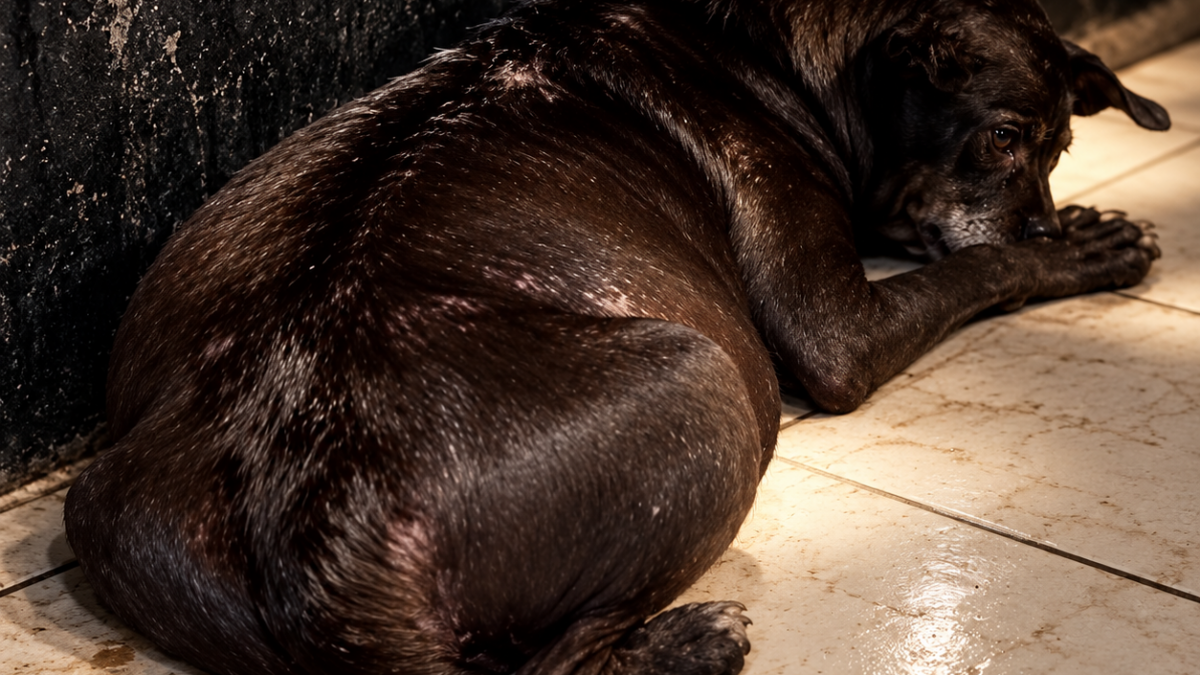
PART 2
There were no puppies.
Not one.
The veterinarian moved the ultrasound probe slowly across Isabela’s abdomen, studying the screen while I stood beside the table trying to understand what I was seeing.
Dark areas filled much of the image.
I searched for the shapes I expected to recognize.
Tiny spines.
Small skulls.
Movement.
Anything.
Nothing appeared.
The veterinarian stopped.
“Eduarda.”
I heard the change in his voice.
“What?”
He looked at me.
“She isn’t pregnant.”
I glanced at Isabela’s huge abdomen and then back at the monitor.
“That can’t be right.”
“It is.”
“Then what is all of that?”
He took a breath.
“Fluid.”
I didn’t understand immediately.
“How much?”
“We won’t know until we begin removing it. But judging by the amount of distension, potentially several liters.”
Several liters.
Inside this dog.
Isabela lay quietly beneath my hand.
I looked at the swollen belly people had been casually pointing at for days.
Maybe weeks.
Everyone had seen a pregnant stray.
What we were looking at now was a medical emergency.
“What causes this?”
“There are several possibilities,” he said. “Liver problems. Heart disease. Severe malnutrition. Low blood protein. Infection. We need bloodwork and more tests.”
“Can you fix it?”
“We can relieve the pressure. Then we find out why it happened.”
His answer frightened me.
It wasn’t yes.
But it wasn’t no.
I bent down until my face was close to Isabela’s.
“All right,” I whispered. “One problem at a time.”
She blinked slowly.
The medical team began working.
Before dealing with the fluid, they stabilized her as much as possible. She was dehydrated despite carrying an enormous amount of fluid in her abdomen. Her bloodwork showed anemia and severe nutritional problems. Her protein levels were dangerously low.
Her body had been starving while her abdomen expanded.
That knowledge made the way people had talked about her outside seem even crueler.
She wasn’t a healthy mother waiting to deliver puppies.
She was sick.
Painfully sick.
The first fluid began draining slowly.
It looked endless.
A container filled.
Then another.
I watched the size of her abdomen gradually change.
“One liter,” the technician said.
Isabela exhaled.
“Two.”
Her breathing became less strained.
“Three.”
I stared at the containers.
It was difficult to comprehend that all of that had been trapped inside her.
By the time they were finished, nearly four liters had been removed.
Four liters from a dog whose frame beneath the swelling was frighteningly thin.
When the procedure was over, Isabela looked smaller.
Fragile.
More honest somehow.
The enormous belly had hidden how badly starvation had affected her.
Her hips protruded sharply.
Her back looked narrow.
There was hardly any muscle on her legs.
But for the first time since I had met her, she was breathing without fighting for every breath.
I rested my hand against her chest.
“You feel that?”
Her eyes opened.
“You can breathe.”
Her head moved slightly toward my wrist.
It was almost nothing.
But I felt it.
The first time I had touched her on the street, she had simply endured me.
Now she was seeking contact.
Only an inch.
Maybe less.
For me, it felt enormous.
The veterinarian came back into the room.
“She isn’t out of danger.”
“I know.”
“The fluid can return.”
I nodded.
“And the tail?”
“We’re cleaning it aggressively. Some tissue is badly damaged, but I think we can control the infection.”
“Will she need surgery?”
“Possibly. Right now I don’t want to put her through anything her body can’t tolerate.”
I looked at Isabela.
“So we make her stronger first.”
“Exactly.”
That became our entire world for the next several days.
Food.
Medication.
Wound care.
Blood tests.
Rest.
Tiny victories.
Isabela didn’t understand why we kept touching the most painful part of her body. During the first cleaning after admission, she turned her head sharply and let out a low growl.
A technician instinctively stepped backward.
I didn’t blame her.
Pain changes animals.
Fear changes them even more.
I crouched near Isabela’s head.
“Look at me.”
Her eyes flicked toward mine.
“I know.”
Her breathing was fast.
“I know it hurts.”
The veterinarian continued cleaning carefully.
Isabela growled again.
But she didn’t snap.
I stroked the side of her neck.
“You’re allowed to be angry.”
That sentence came out before I really thought about it.
And as soon as I said it, I realized how much I meant it.
She was allowed to be angry.
At the wound.
At hunger.
At the people who had left her.
At every person who had walked past and decided she was somebody else’s problem.
If Isabela had bitten the entire world, part of me would have understood.
Instead, she lowered her head onto the towel.
That night I stayed longer than I had planned.
The clinic grew quiet after regular hours.
Machines beeped softly.
Somewhere in the back, another dog barked twice and stopped.
Isabela lay under a blanket.
I sat beside her kennel.
“You know,” I told her, “you fooled everybody.”
Her eyes opened.
“They thought you had puppies.”
One ear moved.
“I did too, for about five minutes.”
She watched me.
“Turns out you were carrying four liters of trouble instead.”
The corner of my mouth lifted.
It was the first time I had smiled that day.
“You don’t think that’s funny?”
Nothing.
“Fine. Tough audience.”
I reached through the kennel door.
Her nose touched my fingers.
This time it was deliberate.
I stayed perfectly still.
She sniffed me.
Then her eyes closed again.
I went home after midnight.
I barely slept.
At six the next morning, the clinic called.
My heart stopped when I saw the number.
“Is she okay?”
The technician laughed softly.
“Yes.”
I sat upright.
“What happened?”
“She ate.”
I closed my eyes.
“How much?”
“Not a lot. But she ate on her own.”
I was already getting dressed.
When I arrived, there was a small amount of food left in the bowl.
Isabela was licking the edge.
“You couldn’t wait for me?”
She looked up.
I knelt beside her.
“That was rude.”
Her tongue came out once and touched her nose.
I laughed.
It was such an ordinary thing.
A dog eating breakfast.
But rescue teaches you how sacred ordinary things can become.
A meal.
A deep breath.
A night without fever.
A wound beginning to close.
A dog deciding that a hand reaching toward her might contain kindness instead of pain.
Over the next week, Isabela gave us one small victory after another.
She began standing when she heard us entering the room.
Her appetite increased.
Her gums looked healthier.
The infection in her tail responded to treatment.
The fluid in her abdomen did return slightly, but nowhere near the original amount. With medication, nutrition, and monitoring, the veterinarians began bringing the underlying problem under control.
Then one afternoon, something happened that none of us expected.
A man came to the clinic asking for her.
I was standing near reception when I heard the receptionist say, “Which dog?”
“The brown one. Big belly. No tail.”
My entire body went cold.
I turned.
He was probably in his forties.
Baseball cap.
Dirty work boots.
Sunburned forearms.
He didn’t look worried.
He looked irritated.
“She was taken from my neighborhood,” he said.
The receptionist glanced toward me.
I walked over.
“Are you her owner?”
The man looked me up and down.
“Who’s asking?”
“The person who picked her up.”
His eyes narrowed.
“You stole my dog.”
Every conversation in the waiting room seemed to stop at once.
I kept my voice level.
“What’s her name?”
He hesitated.
That was the first thing I noticed.
Then he said, “Bella.”
“Bella?”
“Yeah.”
“How old is she?”
“Four. Maybe five.”
“What veterinarian does she normally see?”
His mouth tightened.
“I don’t keep records on me.”
“When was her last vaccination?”
“That’s none of your business.”
“It becomes my business when a dog is found with a rotting wound.”
His face changed.
The receptionist quietly reached for the phone beneath the desk.
He pointed at me.
“You don’t know what happened.”
“No,” I said. “I don’t. That’s why I’m asking.”
“She ran away.”
“When?”
“A few days ago.”
I stared at him.
“A few days?”
“Yeah.”
“Her wound isn’t a few days old.”
His jaw moved.
I stepped closer.
“She was also severely malnourished.”
“She doesn’t eat much.”
“She had nearly four liters of fluid in her abdomen.”
He looked confused.
“What?”
“She wasn’t pregnant.”
“I never said she was.”
Interesting.
Nobody at the clinic had told him that people thought she was pregnant.
I said nothing for a moment.
The man realized too late what he had done.
He folded his arms.
“Look, I came for my dog.”
“You’re not taking her today.”
His face reddened.
“You can’t keep my property.”
Property.
Not Isabela.
Not my dog.
Not Bella.
Property.
The word landed in my chest like a stone.
The receptionist said calmly, “Sir, animal control has been contacted.”
His head snapped toward her.
“For what?”
“Because the condition of the animal requires documentation before release.”
He laughed once.
It wasn’t a pleasant sound.
“This is ridiculous.”
“No,” I said. “What’s ridiculous is that she was walking around with larvae inside an open wound.”
He took a step toward me.
“You calling me an animal abuser?”
I didn’t move.
“I’m saying the dog you claim belongs to you nearly died.”
His finger rose.
“Watch yourself.”
The clinic door opened behind him.
Two men entered.
One was an animal control officer I knew.
The other was a police officer.
The man’s expression changed immediately.
That moment stayed with me.
A minute earlier he had been loud enough to fill the room.
Now he looked toward the exit.
The animal control officer introduced himself.
“We need to ask you a few questions.”
“I haven’t done anything.”
“No one said you did. We’d like to establish ownership.”
The man looked at me.
“You called them?”
“I called them the day we brought her in.”
That wasn’t entirely true.
We had filed the required report because Isabela’s injuries suggested possible cruelty or severe neglect.
But he didn’t need the distinction.
For the first time since he entered, he looked uncertain.
And I realized something.
He had expected a dog rescue.
He had not expected evidence.
Photographs had been taken the moment Isabela arrived.
The wound.
The maggots.
Her body condition.
Her abdomen.
Her bloodwork.
Everything.
We hadn’t done it because we were planning revenge.
We had done it because medical records matter.
But now those records were the difference between someone’s story and the truth.
The officer asked, “Do you have photographs of the dog from before she disappeared?”
The man shrugged.
“Probably.”
“Any veterinary records?”
“No.”
“Proof of purchase or adoption?”
“She was born at my cousin’s place.”
“Your cousin’s name?”
The man stared at him.
“Why does this feel like an interrogation?”
“Because you showed up claiming ownership of an animal with serious untreated injuries.”
“She got hurt after she escaped.”
The veterinarian stepped into the waiting room.
He had heard enough.
“That wound predates the period you’re describing.”
The man turned.
“You can’t know that.”
“Yes,” the veterinarian said. “I can.”
Silence.
The veterinarian wasn’t angry.
That made his voice more powerful.
“The tissue damage, infection, and degree of infestation are inconsistent with a fresh injury. The dog’s nutritional condition also developed over a much longer period.”
The man looked around.
Everyone was watching him.
Finally, he said, “She was always skinny.”
The veterinarian shook his head.
“No. She was medically compromised.”
“Whatever.”
The man moved toward the door.
The animal control officer stopped him.
“We still need your information.”
“I don’t have time.”
“You found time to come collect her.”
The man’s eyes went hard.
He wrote down his name.
I won’t use it here.
He doesn’t deserve to become the center of Isabela’s story.
But what happened after that visit changed everything.
The investigation began quietly.
We learned Isabela had not simply appeared on that street.
Several residents had seen the same man with her months earlier.
One woman remembered Isabela chained in a yard.
Another said she had heard a dog crying late at night.
Nobody had reported it.
That part hurt almost as much as anything else.
Not because those people were monsters.
Most weren’t.
They were ordinary people who had convinced themselves there must be an explanation.
The dog was thin?
Maybe she was naturally thin.
The dog was outside?
Maybe she preferred it.
The dog cried?
Maybe she was anxious.
The tail was injured?
Maybe the owner was treating it.
Human beings are incredibly talented at inventing explanations that allow us to continue walking.
One afternoon I returned to the street where we’d found Isabela.
I wasn’t there looking for confrontation.
I needed information.
An elderly man sitting outside a small house recognized her photograph immediately.
“Oh,” he said. “That dog.”
“You’ve seen her before?”
“For months.”
“With someone?”
He nodded toward the far end of the street.
“She used to be over there.”
I followed his gesture.
A fenced property sat behind a metal gate.
“Do you know what happened to her tail?”
His face changed.
“No.”
“But you noticed it?”
“I noticed when she stopped having one.”
My stomach tightened.
“What does that mean?”
He looked down.
“I don’t want trouble.”
“I understand.”
“No, you don’t.”
He rubbed both hands over his knees.
“People around here have to live with each other.”
“And she had to live with that wound.”
His eyes lifted toward mine.
I regretted the sharpness immediately.
He wasn’t the person I was angry at.
But Isabela’s face kept appearing in my mind.
“I’m sorry,” I said. “I just need to understand.”
The old man was quiet.
Then he sighed.
“She was tied near the back fence most days. One week I saw something wrapped around her tail. A cloth, maybe. Couple weeks later the tail looked shorter.”
“Did you see who did it?”
“No.”
“Did she receive veterinary care?”
“Not that I saw.”
“Then she disappeared?”
He nodded.
“How long before we found her?”
“Maybe ten days.”
Ten days.
The alleged owner had said she had escaped a few days earlier.
I thanked the man.
As I turned to leave, he called after me.
“Miss?”
I stopped.
“I should’ve called somebody.”
There was no defense in his voice.
Only shame.
I walked back toward him.
“You can help now.”
He gave a weak nod.
“Tell the officer what you told me.”
He did.
That night, I visited Isabela.
She was asleep when I arrived.
Her body no longer looked distorted.
Without the swollen abdomen, she seemed like a completely different dog.
But the physical transformation wasn’t what struck me.
She was sleeping on her side.
Exposed.
Relaxed.
The first night, she had curled tightly in the back of the kennel with her head raised at every sound.
Now one leg stretched across the blanket.
I opened the kennel.
Her eyes opened.
Then her body moved.
Not away.
Toward me.
“Hey, beautiful.”
She placed her head against my knee.
I sat on the floor.
For several minutes, we stayed like that.
“I met some people who remember you.”
Her ear twitched.
“Apparently you’ve got a history.”
She sighed.
“I know. Me too.”
I rubbed her neck.
“You don’t have to tell me what happened.”
Her eyes stayed closed.
“We’re going to make sure it doesn’t happen again.”
That became my promise.
Not revenge.
Not yet.
Justice.
There is a difference.
Revenge wants someone else to hurt because you hurt.
Justice says the harm stops here.
At least that was what I told myself.
Then the photographs arrived.
A neighbor had remembered an old security camera mounted above his garage.
He hadn’t checked it in months, but after animal control began asking questions, he pulled the storage card.
Most of the footage had already been overwritten.
But several clips remained.
One showed Isabela walking loose near the property roughly two weeks before we found her.
Her abdomen was already swollen.
Another showed the man we had met at the clinic opening the gate.
Isabela stood inside.
He gestured toward the street.
She didn’t move.
He walked behind her.
Seconds later, Isabela came through the gate.
The man closed it.
She stood outside staring back through the bars.
He walked away.
She remained there.
For almost four minutes.
Then she slowly turned and wandered down the road.
She hadn’t escaped.
She had been put out.
When I watched the video, something inside me changed.
I had spent days allowing room for uncertainty.
Maybe she escaped.
Maybe the owner panicked.
Maybe the wound worsened while she was missing.
Maybe.
Maybe.
Maybe.
The video killed all of those maybes.
She had been sick.
She had been injured.
And someone had opened a gate and removed the problem from his yard.
I watched the clip twice.
Then I closed the laptop.
One of the volunteers beside me said, “You okay?”
“No.”
She waited.
I looked toward Isabela’s kennel.
“But I will be.”
The investigation moved faster after that.
Animal control obtained the footage.
The clinic provided medical documentation.
Witnesses gave statements.
The former owner changed his story.
First, Isabela had escaped.
Then he claimed a family member had accidentally let her out.
When confronted with the video, he said he had only placed her outside temporarily.
He insisted he planned to bring her back in.
Four minutes became an hour.
An hour became an afternoon.
Eventually his explanations collapsed under their own weight.
What remained was very simple.
A badly injured, medically compromised dog had been deliberately left outside.
The wound had gone untreated.
Her body was severely undernourished.
And instead of getting help, the person responsible for her had abandoned her.
But while the legal case developed, Isabela had her own battle to fight.
The fluid began returning.
Not four liters.
But enough that the veterinarian frowned during an examination.
“We need to adjust her treatment.”
My stomach dropped.
“Is she getting worse?”
“Not necessarily.”
“That’s not an answer.”
He looked at me.
“No. It isn’t.”
I hated uncertainty.
With rescue, uncertainty is everywhere.
You can do everything right and still lose.
You can spend nights beside an animal, give medication on schedule, pay for specialists, follow every instruction—and a damaged body may still decide it has gone as far as it can go.
Isabela underwent additional testing.
Her liver function concerned the veterinary team, and the severe lack of protein in her blood was contributing to the fluid accumulation.
Her body had been deprived for too long.
Nutrition would help.
Medication would help.
Time might help.
Might.
I sat beside her after the tests.
“You’re making this complicated.”
She looked at me.
“I thought we had an agreement.”
Her nose moved toward the treat in my fingers.
“Oh, now you’re interested.”
I held it closer.
She took it carefully.
Her mouth brushed my fingertips.
“You’re supposed to get better.”
Another treat.
“That’s your job.”
She chewed.
“My job is worrying.”
She swallowed and looked at me expectantly.
“You’re getting very good at your job.”
I gave her another.
Within days, her appetite improved again.
Then came another problem.
Her tail wound had stopped deteriorating, but damaged tissue still needed surgical treatment.
The veterinarian wanted to wait until she was stronger.
So we waited.
Two weeks.
Then three.
Isabela gained weight slowly.
Actual weight this time.
Not fluid.
Her coat began to look healthier.
Her eyes became brighter.
She started walking short distances outside the clinic.
The first time I clipped a leash to her collar, she froze.
I immediately loosened the leash.
“Okay.”
Her head lowered.
“We don’t have to.”
I crouched beside her.
Maybe she had been dragged.
Maybe tied.
Maybe a leash represented something very different in her memory.
I didn’t know.
So I set it on the floor.
We stood there.
One minute.
Two.
She sniffed it.
Then she stepped over it.
The next day, we tried again.
This time she allowed me to clip it on, but I didn’t pull.
I followed her.
Three steps.
Then five.
A week later, Isabela walked beside me through the clinic parking lot.
A car door slammed.
She jumped.
I stopped.
Her eyes searched my face.
“It’s okay.”
She hesitated.
Then she moved closer to my leg.
That was trust.
Not the kind people like to imagine.
Not instant devotion.
Not a rescued dog understanding that humans had saved her and therefore forgiving the entire species.
Real trust is smaller.
Messier.
A frightened animal deciding, moment by moment, that perhaps this person will not hurt me.
Isabela didn’t give trust away.
She built it.
So did I.
Then, one Saturday morning, she wagged her tail.
At least, she tried.
The movement came from her whole back end.
Her hips wiggled.
The small healing area where her tail should have been moved with them.
I laughed so loudly that a technician came running.
“What happened?”
“She wagged.”
The technician stared at me.
“That’s why you screamed?”
“Yes.”
Isabela bounced once.
I put both hands on her face.
“Do it again.”
She licked my chin.
“That counts.”
The technician laughed.
“You’re ridiculous.”
“I don’t care.”
Three days later, Isabela underwent surgery.
I hated handing her over.
Logically, I knew she was safer in that operating room than almost anywhere else.
Emotionally, every part of me wanted to stay beside her.
The surgeon removed damaged tissue and carefully closed the area.
The procedure went well.
Recovery was painful.
The first night afterward, Isabela refused food.
She wouldn’t lift her head.
I sat beside her until closing.
The veterinarian told me I could go home.
I said I would.
I didn’t.
At 11:40 p.m., Isabela finally drank a little water.
At 12:15, she ate one piece of chicken from my fingers.
I cried.
Not dramatically.
Just silent tears running down my face while a tired dog chewed chicken.
She looked at me as though I was the embarrassing one.
“You’re right,” I whispered. “This is excessive.”
She swallowed.
I offered another piece.
She ate it.
“I’m still doing it.”
By morning, her appetite was better.
Within four days, she was walking comfortably.
Two weeks later, the incision was healing beautifully.
And that should have been the happiest point in the story.
It wasn’t.
Because the man who had claimed ownership filed a complaint demanding Isabela be returned.
When I received the call, I thought I had misunderstood.
“He wants what?”
The animal control officer sighed.
“He says the seizure was improper because he never surrendered ownership.”
“She was abandoned.”
“I know.”
“We have video.”
“I know.”
“We have medical records.”
“Eduarda.”
I stopped.
“We have a process.”
I hated those words.
A process.
Isabela had almost died while people trusted the process of assuming someone else would help.
Now paperwork might send her back.
“Can he get her?”
“Not today.”
“That’s not what I asked.”
“No one can promise the outcome.”
I looked through the clinic window.
Isabela was lying on a blanket chewing a toy.
For the first time in her life, maybe, she looked peaceful.
The idea of putting her into that man’s vehicle made my hands shake.
“I won’t hand her over.”
“Don’t do anything stupid.”
“I mean it.”
“So do I.”
The officer’s voice softened.
“We’re building the case. Let us build it.”
I hung up furious.
The legal hearing was scheduled several weeks later.
Until then, Isabela remained under protective custody.
The former owner hired a lawyer.
That surprised me.
Apparently, his anger at losing the dog had become more important to him than the dog had ever been.
His lawyer argued that poor people should not be criminalized for being unable to afford veterinary care.
It was an argument I would normally sympathize with.
I have known people who loved their animals deeply and still faced impossible veterinary bills.
People who sold belongings.
People who skipped meals.
People who came to rescues crying because surrendering an animal was the only way to get it lifesaving care.
Poverty is not cruelty.
But opening a gate and leaving a sick dog outside is not poverty.
Ignoring an infected wound is not poverty.
Lying about how she disappeared is not poverty.
The distinction mattered.
His lawyer also claimed the tail injury had happened after Isabela went missing.
The veterinarian’s report contradicted that.
Then the security footage contradicted his timeline.
Then witness statements contradicted his version of her previous condition.
Every story he offered created another crack.
The hearing took place on a gray morning.
I arrived early.
I wore a plain dark jacket and carried a folder I barely needed because all official evidence had already been submitted.
It gave my hands something to hold.
The former owner sat across the room.
He saw me.
I saw him.
Neither of us spoke.
Then his eyes dropped to my phone, where a photograph of Isabela was visible on the screen.
She was lying in grass with her eyes closed.
He smirked.
“You’ve made quite a show out of this.”
I stared at him.
His attorney touched his arm.
“Don’t.”
But I answered.
“A show?”
“You rescue people love drama.”
I almost laughed.
Instead I said, “She had maggots in an open wound.”
His face hardened.
“You don’t know what my life is like.”
“No.”
I took one step closer.
“But I know what hers was like.”
His attorney stood.
“Please don’t engage.”
I looked away.
That was the hardest thing I did all morning.
Not because I was afraid of him.
Because I wanted him to understand.
I wanted to take every frightened breath Isabela had made on that street and somehow force him to feel it.
Every time she had flinched.
Every hungry day.
Every hour that wound burned.
I wanted him to carry it.
But anger doesn’t work like that.
You can’t transfer suffering.
You can only decide what happens next.
Inside the hearing room, the veterinarian testified.
He described Isabela’s condition in precise medical language.
Severe abdominal distension caused by ascites.
Approximately four liters removed.
Significant malnutrition.
Anemia.
Hypoproteinemia.
An infected tail wound with necrotic tissue and myiasis.
He explained that these conditions had not developed overnight.
The former owner’s attorney asked, “Doctor, can a wound become infested with larvae quickly in warm weather?”
“Yes.”
“So it’s possible this occurred after the dog left my client’s property?”
“Some infestation could have.”
The attorney nodded as though he had scored a point.
Then the veterinarian continued.
“But the underlying wound and tissue damage were older.”
The attorney’s expression tightened.
“How old?”
“I can’t assign an exact hour or date.”
“So you don’t know.”
“I know it was not a fresh injury.”
The veterinarian did not look at the lawyer.
He looked at the judge.
“And more importantly, the wound was only one part of her condition.”
He described the malnutrition.
The ascites.
The chronic physical decline.
The lawyer tried another approach.
“Is it possible a dog could refuse food despite being offered adequate nutrition?”
“Yes.”
“Is it possible fluid buildup could happen even with an attentive owner?”
“Yes.”
“So none of these conditions automatically proves neglect.”
“Individually? No.”
The veterinarian paused.
“Together, combined with the lack of treatment and the manner in which she was abandoned? They show a dog in severe distress who required medical care and did not receive it.”
The room went quiet.
Then the video played.
I had already seen it.
Watching it in that room was different.
There was Isabela.
Swollen.
Slow.
Standing behind the gate.
The man opened it.
Motioned.
She walked outside.
He shut the gate.
Isabela turned.
She stared through the bars.
Even without sound, the moment hurt.
She waited.
The former owner shifted in his seat.
On screen, Isabela continued standing at the gate.
One minute.
Two.
Three.
Four.
Finally she lowered her head and walked away.
The judge asked, “Is that you?”
The man leaned toward the microphone.
“Yes.”
“Why did you put the dog outside?”
“She needed to go out.”
“Why close the gate?”
“She wandered.”
“She remained directly outside the gate for several minutes.”
“I figured she’d come back.”
The judge looked at him.
“Come back how?”
He didn’t answer.
“The gate was closed.”
His lawyer whispered something.
The man said, “I was going to open it later.”
“You told animal control she escaped.”
He swallowed.
“I was confused.”
“You also stated that a relative accidentally let her out.”
“I was stressed.”
The judge leaned back.
“No further explanation is necessary.”
My heart pounded.
The hearing continued for almost another hour.
It felt like six.
Then the decision came.
Isabela would not be returned.
I didn’t hear the next sentence clearly because my breath caught.
The judge continued.
Ownership was permanently transferred away from the defendant.
The cruelty and abandonment case would proceed separately.
He was ordered to pay restitution toward part of Isabela’s veterinary treatment.
And pending the final outcome of the cruelty case, he was prohibited from acquiring or keeping another animal.
I closed my eyes.
The animal control officer beside me touched my arm.
“You okay?”
I nodded.
Then I shook my head.
Then I laughed.
“I don’t know.”
Across the room, the former owner stood abruptly.
“This is insane.”
His attorney grabbed his sleeve.
The judge looked at him.
“Sit down.”
“You’re taking my dog because some rescue woman wants her.”
The room froze.
The judge’s voice changed.
“No.”
He waited until the man stopped moving.
“This court is removing the animal because the evidence shows that when she required care, you failed to provide it, and when her condition became difficult, you put her outside and closed the gate.”
The man started to speak.
The judge raised a hand.
“You want to call her your dog now.”
Silence.
“You should have treated her like your dog then.”
I will remember that sentence for the rest of my life.
Outside the courthouse, reporters weren’t waiting.
There were no crowds.
No dramatic applause.
Real justice is often much quieter than people imagine.
I stood on the courthouse steps holding a folder of documents while traffic moved through the intersection.
The sky threatened rain.
The officer walked beside me.
“Congratulations.”
“It doesn’t feel like winning.”
“No?”
I thought about it.
Then I said, “Ask me after I see her.”
Twenty minutes later, I walked into the clinic.
Isabela heard my voice before she saw me.
Her head lifted.
Then her entire body began to wiggle.
There was no tail.
It didn’t matter.
She ran toward the kennel door so quickly that her blanket folded beneath her feet.
“Open it,” I said.
The technician laughed.
“Give me a second.”
“Faster.”
The latch opened.
Isabela came straight into me.
Her front paws hit my chest.
I sat down hard on the floor.
She covered my chin with frantic, clumsy kisses.
I laughed and cried at the same time.
“All right! All right!”
She climbed halfway into my lap.
“You won.”
She licked my cheek.
“You hear me?”
Her body trembled with excitement.
“Nobody is sending you back.”
I buried my face against her neck.
“You’re safe.”
That was the moment I had been waiting to say those words without lying.
On the street, I had told her she was okay when she wasn’t.
In the car, I had told her she was safe when I couldn’t know that.
At the clinic, I had promised we would make sure it never happened again.
Now, finally, I could keep the promise.
But Isabela still needed a home.
That became the next question.
Technically, the rescue could begin searching for an adopter.
We photographed her.
We wrote a profile.
Gentle adult female.
Recovering well.
Good with calm people.
Learning to walk on leash.
Needs continued veterinary monitoring.
Loves chicken more than dignity.
That last line was mine.
Applications began arriving.
I read every one.
One family had a huge yard.
Another couple had rescued dogs before.
A retired woman wrote three pages about the two senior dogs she had cared for until their deaths.
They were good people.
Wonderful people.
And I rejected all of them.
After the sixth application, my friend looked at me.
“You know what you’re doing, right?”
“Choosing carefully.”
“No.”
She folded her arms.
“You know exactly what you’re doing.”
“I don’t.”
“You’re finding reasons she can’t go anywhere.”
“That family works ten hours a day.”
“They work from home.”
“They might stop.”
“The retired woman?”
“Too many stairs.”
“She lives in a one-story house.”
I looked down at the paperwork.
My friend smiled.
“You’re an idiot.”
“Excuse me?”
“Take her home.”
I stared at her.
“I foster.”
“Sure.”
“I don’t adopt every dog.”
“Good.”
“I can’t.”
“Why?”
I had answers.
Space.
Money.
Time.
Future rescues.
Emotional boundaries.
All reasonable.
All true.
None of them survived the image of Isabela waking up somewhere else and searching for me.
“That isn’t how rescue is supposed to work,” I said weakly.
My friend laughed.
“Dogs don’t read rescue manuals.”
That evening, I took Isabela home for a trial foster.
I told everyone it was temporary.
I told myself that too.
I put a new bed in the living room.
Bowls in the kitchen.
Medication on the counter.
A blanket near my bedroom.
Isabela entered cautiously.
She sniffed the doorway.
Then the wall.
Then the couch.
I unclipped the leash.
She stood still.
“You’re allowed.”
She looked at me.
“You can go wherever you want.”
She took three steps.
Stopped.
Looked back.
“Seriously.”
Another five steps.
By the time she reached the kitchen, she seemed amazed nobody had stopped her.
She sniffed the water bowl.
Drank.
Then she wandered back to me.
I sat on the floor.
“What?”
She placed one paw on my leg.
I stroked her face.
“Are you checking?”
She leaned closer.
“I’m still here.”
That night, I put her bed beside mine.
At 1:00 a.m., I woke up and found her sitting upright, staring toward the bedroom door.
“Isabela?”
Her ears turned.
“Come here.”
She didn’t move.
I patted the mattress, then remembered I had decided she wasn’t going to sleep in the bed.
Rules were important.
Boundaries.
Structure.
Responsible fostering.
At 1:04 a.m., Isabela was sleeping with her head on my pillow.
The next morning I woke with one of her paws against my neck.
“You’re terrible at fostering,” I told her.
She yawned directly into my face.
Within a week, she developed a routine.
Breakfast at seven.
Medication hidden in food.
Short walk.
Nap.
Follow me from room to room.
Another nap.
Stand in the kitchen whenever I opened anything, regardless of whether it contained food.
At first, sudden noises still frightened her.
A dropped pan sent her running behind the couch.
A man raising his voice outside made her freeze.
Once, when I reached quickly over her head to grab something from a shelf, Isabela collapsed toward the floor.
Not sat.
Collapsed.
Her body flattened instinctively.
I pulled my hand back.
“Oh, sweetheart.”
She stared up at me.
I sat down.
She stayed low.
“I wasn’t going to hit you.”
The words sounded useless.
Because someone had probably said gentle things before hurting her.
Dogs do not trust language.
They trust repetition.
So I didn’t reach.
I waited.
After a minute, Isabela lifted her head.
Another minute.
She crawled toward me.
Her chin rested on my knee.
I stroked her slowly.
“That wasn’t your fault.”
Her eyes softened.
“We’ll try again.”
And we did.
Hundreds of times.
A hand raised to open a cabinet.
Safe.
A broom moving across the floor.
Safe.
A door shutting.
Safe.
Footsteps behind her.
Safe.
A leash clipped on.
Safe.
A stranger entering the room.
Maybe safe.
She learned slowly.
Then suddenly.
One morning I realized she hadn’t flinched in several days.
Another afternoon I dropped my keys, and instead of running, Isabela looked at me as if I were incompetent.
Progress doesn’t always announce itself.
Sometimes fear simply stops appearing.
Her medical recovery continued too.
The fluid remained controlled.
Her blood protein improved.
Her anemia resolved gradually.
Muscle returned to her legs.
Her coat became glossy.
Her weight reached a healthy range.
The veterinary staff who had first treated her barely recognized her.
One technician crouched beside her during a follow-up appointment.
“Is this really the same dog?”
Isabela immediately tried to steal a treat from her pocket.
I laughed.
“Yes.”
“She’s bold now.”
“Unfortunately.”
Isabela looked offended.
The veterinarian examined her abdomen.
“No significant fluid.”
I exhaled.
Even after months of improvement, those words still mattered.
“And her bloodwork?”
“Much better.”
“How much better?”
He smiled.
“Eduarda.”
“I need numbers.”
“I know.”
He showed me the results.
I read them twice.
Then I looked at Isabela.
“You’re becoming annoyingly healthy.”
She leaned against my leg.
The veterinarian nodded toward her.
“Have you found an adopter?”
I looked at him.
“No.”
His mouth twitched.
“You aren’t going to.”
“What makes you say that?”
“She has your address memorized.”
I pretended not to hear him.
The cruelty case against her former owner moved forward.
I tried not to let it dominate my thoughts.
Isabela didn’t know about hearings.
She didn’t understand restitution.
She wasn’t waiting for punishment.
She cared about dinner.
Warm blankets.
Walks.
My return when I left the house.
That simplicity helped me.
But occasionally, anger resurfaced.
Especially when I received photographs from the investigation.
One showed the small area where she had apparently been kept.
A chain attached near the back wall.
An overturned bowl.
No shade over part of the enclosure.
I stared at the image too long.
Then I heard Isabela behind me.
Her nails clicked across the floor.
I closed the laptop.
She rested her chin on my thigh.
“I know.”
I scratched beneath her collar.
“You don’t live there anymore.”
That had to be enough.
The final court hearing came months after her rescue.
By then Isabela looked nothing like the dog from the evidence photographs.
I considered bringing her.
The officer advised against it.
Too stressful.
Too unnecessary.
He was right.
So Isabela stayed home with my friend.
Before leaving, I knelt in front of her.
“I’m going somewhere because of you.”
She sniffed my jacket.
“You don’t care.”
She sneezed.
“Exactly.”
I kissed her forehead.
“You’ve already won your part.”
In court, the former owner looked smaller than I remembered.
Not physically.
Just less powerful.
The first time he had entered the clinic, his anger had controlled the room.
Now the evidence controlled it.
His attorney negotiated an agreement rather than risk a harsher judgment after trial.
He accepted responsibility for animal neglect and abandonment.
The court imposed fines and restitution.
More importantly to me, he was prohibited from owning or possessing animals for a substantial period and would face additional consequences if he violated that order.
Was it enough?
Part of me said no.
There is no mathematical punishment equal to suffering.
How many dollars equal one infected wound?
How many court appearances equal ten days of abandonment?
How long should a person lose the right to own an animal after treating one as disposable?
There is no equation.
But when the judge asked the man whether he understood the order, he answered quietly.
“Yes.”
No smirk.
No threats.
No accusation that rescuers were stealing his property.
Just yes.
Outside, the animal control officer handed me a copy of the disposition.
“That’s probably the end of it.”
I looked at the paper.
“The end?”
“For the case.”
I folded it carefully.
“No.”
He raised an eyebrow.
“Her ending is better than this.”
When I returned home, Isabela was waiting behind the door.
I heard her body hit it before I got the key fully turned.
“Back up.”
She didn’t.
“Isabela.”
Her nose appeared through the opening.
“You are the worst guard dog in history.”
I squeezed inside.
She circled me.
I dropped my bag.
Then I sat on the floor.
She climbed into my lap as though she still weighed fifteen pounds.
“You want to know what happened?”
She licked my jaw.
“I’ll take that as yes.”
I put both hands around her face.
“He can’t take you.”
Her eyes stayed fixed on mine.
“He can’t do this to another dog.”
She blinked.
“And he has to help pay for the people who saved your ridiculous life.”
Isabela sneezed into my face.
I laughed.
“Exactly.”
My friend leaned against the kitchen doorway.
“Well?”
I looked up.
“It’s done.”
She smiled.
Then she pointed toward the papers on the table.
“What about those?”
I knew exactly which papers she meant.
The adoption forms.
I had filled out half of them three days earlier.
Then stopped.
Not because I was uncertain.
Because finishing them made everything real.
I picked them up.
Isabela immediately put one paw on the bottom edge.
“Get off.”
She didn’t.
“You can’t sign.”
My friend laughed.
“Maybe she’s trying.”
I pulled the paper free.
Under adopter name, I wrote mine.
My hand trembled slightly.
It was ridiculous.
I had signed medical authorizations.
Court declarations.
Emergency intake forms.
Invoices that made my bank account cry.
But this signature felt different.
I signed the final line.
My friend looked at me.
“So?”
I put down the pen.
“So what?”
“Say it.”
I looked at Isabela.
She sat beside my chair.
One ear tilted.
I smiled.
“She’s mine.”
My friend shook her head.
“No.”
“What?”
“You’re hers.”
I laughed.
“That too.”
The adoption was officially approved two days later.
There was no big ceremony.
No balloons.
No photographer.
Someone at the rescue printed a certificate.
Isabela tried to eat the corner.
I framed it anyway.
Life after that became wonderfully ordinary.
And that, more than anything, felt like victory.
Isabela learned that rain on windows wasn’t dangerous.
She learned that the vacuum cleaner was suspicious but survivable.
She discovered couches.
She discovered cheese.
She discovered that if she stared at me long enough while I ate chicken, my moral character deteriorated.
She learned the sound of my car.
She learned which drawer contained her leash.
She learned how to sleep so deeply that her legs ran through invisible dreams.
I learned things too.
I learned she hated baths but loved being dried with towels.
She liked women immediately but needed time with unfamiliar men.
She wouldn’t eat carrots unless they had touched meat first.
She preferred the left side of the couch.
And despite everything that had happened to her, she loved people.
That surprised me most.
Not indiscriminately.
Not instantly.
But she wanted to.
When visitors arrived, Isabela stayed behind me at first.
She watched.
If they ignored her and allowed her to approach, curiosity usually won.
A sniff.
Then another.
Eventually, the famous full-body wiggle.
People always laughed when they saw it.
“She’s trying to wag her tail.”
“No,” I told them. “She is wagging it.”
A tail is only one way a dog expresses joy.
Isabela used her entire body.
Months later, I returned to the neighborhood where we had found her.
This time Isabela came with me.
I almost didn’t bring her.
I worried the place might trigger fear.
But her behavior surprised me.
She stepped out of the car and sniffed the ground.
No trembling.
No hesitation.
I held the leash loosely.
“Recognize it?”
She moved toward a patch of grass.
Sniffed.
Then urinated.
I laughed.
“That’s your statement?”
She continued walking.
We passed the cracked wall where I had first seen her.
I stopped.
Isabela didn’t.
She reached the end of the leash and looked back at me.
That image hit me harder than I expected.
The first time I had seen her beside that wall, she had stood motionless while people walked past.
Now I was the one standing still.
She was ready to move forward.
“All right,” I whispered.
I followed.
The elderly man who had eventually given a witness statement was sitting outside again.
He saw us.
His mouth fell open.
“That’s her?”
I smiled.
“That’s her.”
He slowly stood.
Isabela watched him.
“Can I?”
He held out his hand but didn’t approach.
“Let her decide.”
He crouched slightly.
Isabela sniffed the air.
Then she walked toward him.
He touched her cheek.
His eyes filled.
“I’m sorry, girl.”
I looked away for a moment.
He rubbed beneath her chin.
“You look good.”
Isabela leaned closer.
The man wiped his eyes.
“I should’ve helped you earlier.”
There was nothing I could say that would change the past.
So I said the only useful thing.
“You helped when it mattered.”
He nodded.
“No. You did.”
“We all should’ve.”
He looked at me.
That was the truth I wanted people to remember.
Not that I was special.
I wasn’t.
Not that rescuers are heroes.
Most days, rescue is just ordinary people refusing to look away.
Isabela had been visible.
That was the terrible part.
She wasn’t trapped in a hidden basement.
She wasn’t lost deep in the forest.
She stood beside a public street.
People saw her enormous stomach.
They saw flies.
They saw her moving slowly.
Some may even have smelled the infection.
But seeing is not the same as acting.
We stayed on the street for only fifteen minutes.
Before leaving, I looked toward the gate shown in the security footage.
It was closed.
The yard behind it was empty.
No chain.
No dog.
Nothing.
For months I had imagined that seeing that place would make me angry.
Instead, I felt strangely calm.
The man’s punishment was not what gave me peace.
Isabela did.
She was standing beside me with clean fur, healthy weight, bright eyes, and a ridiculous pink collar someone had given her.
She was alive.
That was the revenge.
Not pain returned for pain.
Not cruelty answered with cruelty.
A dog someone had treated as disposable had become precious.
A dog left outside a closed gate now slept under blankets and complained when breakfast was five minutes late.
A body once filled with almost four liters of fluid was strong enough to run across a field.
A dog who had lowered her head when I first reached toward her now shoved her face under my hand when I stopped petting her.
That was better than revenge.
It was proof that he had failed to decide how her story ended.
Almost one year after her rescue, the veterinary clinic invited us back.
They were putting together photographs of memorable recovery cases.
When we arrived, several staff members came into the lobby.
Isabela immediately lost her mind.
Her whole back end swung from side to side.
One technician dropped to her knees.
“Look at you!”
Isabela launched herself into her arms.
The veterinarian who had drained the fluid from her abdomen stood behind them smiling.
“Still eating?”
I laughed.
“Everything.”
“Any fluid recurrence?”
“None at the last check.”
“Energy?”
“Too much.”
“Good.”
He crouched.
Isabela walked toward him and pressed her forehead against his chest.
For several seconds, he didn’t speak.
Then he looked at me.
“Do you remember the first night?”
“Yes.”
“I wasn’t sure she would make it.”
I swallowed.
“You didn’t tell me that.”
“You were already terrified.”
“I would’ve preferred honesty.”
He smiled.
“No, you wouldn’t.”
He was probably right.
A staff member brought out the intake photograph.
I hated looking at it.
There was Isabela standing on the examination table.
Huge abdomen.
Thin shoulders.
Exhausted eyes.
The wound near her missing tail covered for treatment.
Beside it, they placed a new photograph.
Isabela in the clinic garden.
Mouth open.
Tongue hanging out.
Eyes bright.
Healthy.
The contrast barely looked possible.
A young veterinary assistant stared between the photographs.
“She doesn’t even have the same expression.”
That was exactly it.
Her body had changed.
But her eyes changed more.
In the first photograph, Isabela looked as though she expected nothing.
In the second, she expected good things.
Dinner.
Walks.
Kind hands.
A ride home.
Me.
That difference can’t be measured in bloodwork.
But it may be the most important part of recovery.
The clinic gave me copies of both photographs.
I kept them.
I don’t display the first one.
But I don’t delete it either.
Some memories hurt because they need to.
Not forever.
Just enough to remind us why we acted.
On the anniversary of the day I found her, I woke to Isabela pushing her nose under my arm.
It was 5:43 a.m.
“No.”
She pushed harder.
“It is not breakfast.”
Full-body wiggle.
“Absolutely not.”
She climbed halfway on top of me.
“You were once a very polite dog.”
She licked my forehead.
“I saved you from the streets and this is how you repay me?”
Another lick.
I laughed and got out of bed.
In the kitchen, she stood beside her bowl.
I prepared breakfast.
Medication was no longer part of the routine.
Her latest examination had been excellent.
I placed the bowl down.
“Wait.”
She stared.
“Wait.”
One second.
Two.
Her body vibrated.
“Okay.”
She ate as though nobody had fed her in months.
Some memories live in muscles longer than they live in the mind.
Maybe part of Isabela would always fear an empty bowl.
So I never complained about her enthusiasm for food.
After breakfast, we walked through the neighborhood.
Morning sunlight fell across the sidewalk.
A delivery truck rumbled past.
Isabela barely noticed.
A man jogged toward us.
She looked up at him, then at me.
No fear.
We reached a small park.
I unclipped her leash inside the fenced area.
She ran.
Not fast at first.
Isabela had never become the kind of dog who sprinted recklessly.
She ran in wide circles.
Stopped to sniff.
Ran again.
Then she turned toward me.
Her ears lifted.
I opened my arms.
“Come on!”
She charged.
For a second, she looked like every dog who had ever known only happiness.
No wound.
No gate.
No hunger.
No swollen belly.
Just Isabela.
She collided with my legs and nearly knocked me down.
I grabbed her shoulders.
“You maniac.”
She panted.
I knelt.
My fingers moved automatically toward the place where her tail should have been.
The scar was covered by healthy fur now.
Only a small change in the shape of her body remained.
I remembered flies.
I remembered the smell of infection.
I remembered seeing movement inside the wound and realizing how long she must have suffered.
Then I looked at her face.
She licked my nose.
I smiled.
“Yeah.”
She tilted her head.
“We’re not going back there.”
And we never did.
There was one final development months later.
The animal control officer called me.
I almost didn’t answer because I was driving.
I pulled over.
“Everything okay?”
“Yeah. I thought you’d want to know.”
“What?”
“The former owner tried to register another dog.”
My body tightened instantly.
“What?”
“He didn’t get it.”
I exhaled.
“How did you find out?”
“The shelter ran his information.”
I closed my eyes.
The court order had worked.
Not symbolically.
Actually worked.
“Where’s the dog?”
“Still safe. Different adopter.”
I leaned back against the seat.
For a moment, I imagined another dog behind that metal gate.
Another empty bowl.
Another injury dismissed until it became unbearable.
It didn’t happen.
Because people had documented Isabela’s condition.
Because neighbors eventually spoke.
Because a clinic reported what it saw.
Because an officer followed the case.
Because a judge signed an order.
That phone call gave me something I hadn’t realized I needed.
Closure.
The punishment had never been the point.
Prevention was.
A week later, I took Isabela to the beach for the first time.
She hated the waves.
Absolutely hated them.
The first one touched her paws and she jumped backward as though the ocean had insulted her family.
I laughed so hard I had to sit down.
She glared at the water.
“Oh, you’re brave now?”
Another wave rolled in.
Isabela retreated behind me.
“Apparently not.”
We stayed far enough from the water for her dignity to recover.
She dug in the sand.
Sniffed pieces of driftwood.
Tried to steal food from a picnic blanket and was deeply offended when I stopped her.
Near sunset, I sat with her beside me.
The sky turned orange.
Isabela rested her head on my thigh.
People walked along the shoreline.
Nobody knew her story.
To them, she was simply someone’s dog.
I loved that.
For so long, her suffering had been the first thing anyone noticed.
The swollen belly.
The wound.
The missing tail.
The bones beneath her coat.
Now strangers saw a healthy brown dog wearing a pink collar.
Nothing more.
Sometimes healing means your worst day is no longer the first thing people know about you.
I ran my hand over her shoulder.
“You know what everyone thought when they first saw you?”
Her eyes stayed closed.
“They thought you were pregnant.”
One ear moved.
“Four liters.”
I shook my head.
“You really know how to make an entrance.”
She sighed.
“I know.”
The sun touched the horizon.
I thought about the woman on that street who had said she assumed somebody else was handling it.
That sentence had stayed with me.
Somebody else.
Those two words allow terrible things to continue.
Somebody else will stop.
Somebody else will call.
Somebody else knows better.
Somebody else has more time.
Somebody else will help.
But Isabela hadn’t needed somebody else.
She had needed somebody.
There is a difference.
I was not the only person who saved her.
The veterinarian saved her.
The technicians saved her.
The neighbors who eventually gave statements saved her.
The person whose security camera captured the abandonment saved her.
The officer who refused to treat her as property saved her.
The judge who looked beyond excuses saved her.
And in ways I didn’t understand until much later, Isabela saved something in me too.
Before her, I believed rescue was mostly about removing animals from bad situations.
After her, I understood that rescue is also about confronting the reasons everyone else decided not to act.
Convenience.
Fear.
Embarrassment.
Denial.
The belief that suffering isn’t serious until somebody proves it.
Isabela had nearly died in public.
That may have been the hardest truth of all.
But she also recovered in public.
People who had once passed her began asking about her.
One neighbor later volunteered with a feeding program.
Another started calling animal control when strays appeared injured instead of assuming someone else would.
The elderly man who testified began keeping the rescue’s number near his front door.
“Never again,” he told me.
Maybe that was Isabela’s revenge too.
She changed the street that ignored her.
Not through fear.
Through shame transformed into action.
Years from now, when I think about Isabela, I don’t believe the first image in my mind will be the dog beside the wall.
I think it will be a morning in my kitchen.
Sunlight through the window.
Isabela standing beside her bowl.
Healthy.
Impatient.
Safe.
Or maybe I’ll remember the beach.
The way she jumped away from the first wave.
Or the courthouse, when I heard that she would never be returned.
Or the clinic floor, when she climbed onto me after I told her she was safe.
There are many endings to a rescue story.
The medical ending.
The legal ending.
The adoption ending.
But the one I love most happened on an ordinary Tuesday.
Nothing dramatic had happened that day.
No court.
No emergency.
No veterinary appointment.
I had come home late after helping with another rescue.
The house was dark.
I opened the door quietly.
Isabela was asleep on the couch.
She didn’t hear me immediately.
For several seconds, I simply watched her.
She was stretched on her back.
Belly exposed.
Legs loose.
Completely defenseless.
Completely relaxed.
Then her eyes opened.
She saw me.
Her body began that ridiculous tail-less wag.
I dropped my keys.
“Hi.”
She rolled onto her feet.
“I’m home.”
She came toward me.
Not carefully.
Not hesitantly.
She ran.
And suddenly I understood what I was looking at.
The first day, Isabela had allowed me to touch her because she was too exhausted to move away.
Now she ran toward my hands because she knew exactly what they meant.
That was the whole story.
Not what someone did to her.
Not what the court did to him.
Not even what we did to save her.
It was what Isabela learned after surviving all of it.
A hand could hurt.
But a hand could also clean a wound.
A gate could close behind you.
But a door could open every evening when someone came home.
A bowl could stay empty.
But another could be filled every morning.
A person could abandon you.
Another could choose you.
I knelt as she reached me.
Isabela buried her face against my chest.
My arms wrapped around her.
“You’re okay,” I whispered.
This time there were no machines beside us.
No flies.
No infection.
No fluid crushing her abdomen.
No courtroom waiting to decide where she belonged.
Only a healthy dog in a quiet house.
I pulled back and looked into her eyes.
“You’re okay.”
She licked my chin.
I laughed.
“And you know it now, don’t you?”
Her entire body wagged.
Yes.
She knew.
The dog everyone had mistaken for a pregnant stray had never been carrying puppies.
She had been carrying pain.
Nearly four liters of fluid.
An infected wound.
Hunger.
Fear.
And a history none of us could completely know.
We removed the fluid.
The doctors healed the wound.
The law dealt with the person who abandoned her.
But the most important weight left her slowly.
Day by day.
The expectation that every bad thing would happen again.
And once that disappeared, the real Isabela finally had room to emerge.
Stubborn.
Funny.
Greedy for chicken.
Suspicious of ocean waves.
Completely convinced my bed belonged to her.
And loved beyond measure.
Someone once opened a gate and left her outside because caring for her had become inconvenient.
That person believed he was deciding her fate.
He wasn’t.
He was only ending his part in her life.
Isabela’s real story began when she stood trembling beside that wall and finally allowed my hand to touch her face.
It continued when four liters of fluid left her body and she took an easier breath.
It grew each time she ate another meal.
Each time she walked another step.
Each time she chose trust instead of fear.
And it didn’t end in a courtroom.
It ended where every abandoned animal deserves to end up.
Not as evidence.
Not as a victim.
Not as a sad photograph people share for a few seconds and forget.
Home.
Years later, there is still a small framed certificate hanging near my desk.
Isabela’s adoption paper.
The corner is slightly damaged where she tried to chew it.
I could replace it.
I never will.
Under my name is hers.
One signature.
One date.
One ordinary piece of paper declaring something no wound, no abandonment, and no closed gate could ever change again.
She belonged somewhere.
She always had.
It just took us too long to find each other.








