PART 2: At 71, I Went to Adopt a Happy Dog—Then I Saw the 13-Year-Old Pit Bull Who Hadn’t Left His Corner in Two Years
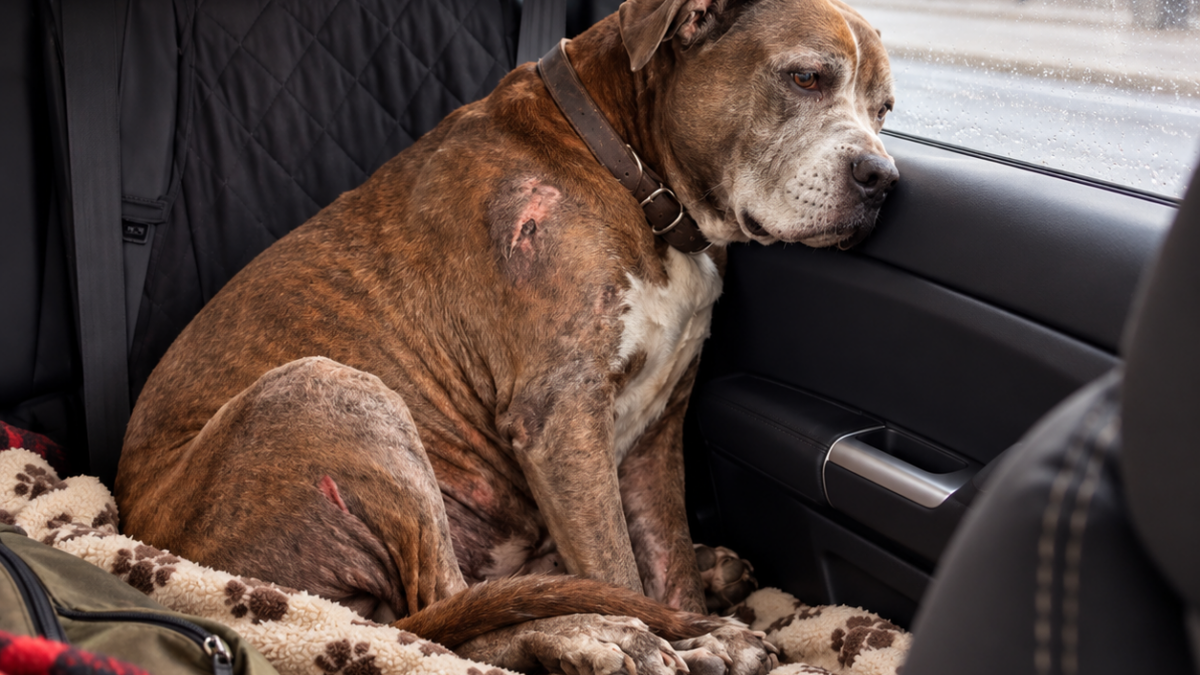
PART 2
Claire insisted that I understand what I was taking on.
She brought me into a small consultation room and closed the door behind us.
“George, Rufus has never bitten anyone. He’s never shown serious aggression. That isn’t what worries me.”
“What worries you?”
“He’s shut down.”
I waited.
She searched for the right words.
“Some animals respond to loss by becoming restless. Some bark. Some pace. Some become destructive. Rufus did the opposite. He withdrew from almost everything.”
“Does he eat?”
“Yes. Usually when no one is watching.”
“Walk?”
“Only when necessary. A few of us can get him outside, but some days he freezes at the kennel door.”
I leaned back in the chair.
“Sounds familiar.”
Claire gave me a small smile.
“This isn’t just about you rescuing him.”
“I know.”
“I mean it. People sometimes adopt an animal because they want a particular emotional experience. They want gratitude. Affection. Immediate connection. Rufus may not give you any of that.”
I thought about Margaret.
For most of our marriage, she had accused me—correctly—of believing I could repair anything with the right tool.
A broken hinge?
Screwdriver.
Leaking pipe?
Wrench.
Loose railing?
Drill.
Grief had been the first thing I encountered that couldn’t be tightened, patched, sanded, replaced, or painted over.
Maybe that was why Claire’s warning didn’t frighten me.
“I don’t need him to thank me,” I said. “I just don’t want him spending whatever time he has left staring at a concrete wall.”
Claire looked down at the paperwork.
“Then we’ll try.”
The word *try* turned out to matter.
Getting Rufus out of the kennel took nearly an hour.
Claire opened the door and clipped a leash onto his collar.
He stood, but only after several minutes.
Then he stopped at the threshold.
His entire body became rigid.
“It’s okay,” Claire whispered.
Rufus lowered his head.
She stepped back.
I knew that posture.
I had worn it myself the first time my daughter convinced me to attend a neighborhood Christmas dinner after Margaret died.
Everyone had been kind.
That almost made it worse.
Their laughter reminded me that mine felt gone.
I had stood in the doorway wanting nothing more than to return home.
So I sat down on the floor several feet from Rufus.
Claire glanced at me.
I shrugged.
“We’ve got nowhere else to be.”
For nearly fifteen minutes, nobody moved.
Then Rufus extended one paw beyond the kennel.
He paused.
Another paw followed.
By the time we reached the parking lot, the afternoon sun had broken through the clouds.
Rufus stopped again.
My old Buick was parked twenty feet away.
I opened the rear door.
He stared at it.
“No rush,” I said.
Claire had warned me that forcing him would probably make things worse, so I sat on the curb.
Rufus remained standing beside her.
Cars came and went.
People passed carrying bags of pet food and cardboard carriers.
A young couple walked out with a Labrador puppy that practically dragged them across the pavement.
For a moment, I watched them and wondered if I had made a mistake.
That was the dog I had pictured.
A wagging tail.
Bright eyes.
Joy arriving fully assembled.
Instead, I had chosen thirteen-year-old Rufus, who looked as if the weight of remembering had settled permanently across his shoulders.
Then he glanced at me.
Just once.
I patted the seat beside me.
“I’m scared too.”
Claire heard me.
She didn’t say anything.
A minute later, Rufus took one step.
Then another.
Eventually he reached the car.
He didn’t jump inside.
At his age, I wasn’t sure he could.
So Claire and I carefully helped him onto the back seat.
Before I closed the door, she handed me a folder.
“Medical records. Feeding schedule. My number is inside.”
Then she hesitated.
“There’s something else.”
She disappeared into the building and returned carrying a small cardboard box.
Written across the top in black marker were two words:
**RUFUS — PERSONAL ITEMS**
“What’s that?”
“It came with him when he was surrendered.”
I opened the lid.
Inside was an old leather collar, a frayed red bandanna, a metal food bowl, and a photograph.
I picked up the picture.
A broad-shouldered man in denim overalls stood beside a tractor.
Rufus sat beside him, younger then, his face dark instead of gray.
The man had one hand resting on Rufus’s head.
“Walter?” I asked.
Claire nodded.
“There are a few other things underneath.”
I didn’t look.
Not yet.
I closed the box.
Rufus was watching it through the car window.
His eyes had changed.
Only slightly.
But I saw it.
Recognition.
I put the box in the trunk.
Then I drove him home.
For the entire thirty-minute ride, Rufus stood with his head near the window but never looked outside.
He stared toward the front seat.
At me.
Every few minutes, I checked him in the mirror.
“You don’t know where you’re going,” I said.
His ears shifted.
“Neither do I.”
When we arrived, I opened the back door and expected another long negotiation.
Instead, Rufus stepped carefully onto the driveway.
He looked at the house.
Margaret had chosen the yellow paint twenty years earlier. I had hated it at first.
After she died, I couldn’t bring myself to change it.
Rufus sniffed the air.
Then he walked toward the porch.
Three steps.
Stop.
Two more.
Stop.
By the time we reached the front door, I felt as if we had crossed a continent.
Inside, Rufus stood in the hallway.
The house was quiet.
I suddenly became embarrassed by that quiet, as if I had invited someone into a room I had failed to prepare.
“Well,” I said, “this is it.”
Rufus walked to the living room.
He inspected the couch, the fireplace, and Margaret’s old chair.
Then he chose the farthest corner.
Of course he did.
He curled up beside the bookshelf.
For the next six hours, he barely moved.
At dinnertime, I placed food nearby.
He ignored it.
I sat at the kitchen table with a bowl of canned soup.
The chair across from me was empty.
For two years I had avoided looking directly at it.
That night, I looked.
Then I glanced into the living room.
Rufus was still in his corner.
“Some pair we make,” I muttered.
Around ten, I went upstairs.
I left a lamp on downstairs.
At midnight, I woke.
Something had disturbed me.
I listened.
A faint sound came from below.
Not barking.
Footsteps.
Slow ones.
I walked downstairs and found Rufus standing in the hallway.
He froze when he saw me.
I froze too.
For several seconds we simply stared at each other.
Then Rufus turned around and returned to his corner.
That should not have felt like progress.
But it did.
The next morning, his food bowl was empty.
I made coffee.
Out of habit, I reached for two mugs.
I stopped with my hand inside the cabinet.
For years, that mistake had ruined entire mornings.
This time, I put one mug away and poured coffee into the other.
Then I noticed Rufus watching me.
“Margaret drank hers with enough sugar to qualify as dessert,” I told him.
No response.
“She’d have liked you.”
His eyes remained on me.
That became our first routine.
Every morning, I made coffee.
Every morning, I talked.
Not because Rufus seemed interested.
Because he didn’t interrupt.
I told him about Margaret.
About our children.
About the time I backed our camper into our own mailbox.
About the argument Margaret and I had in 1987 over whether wallpaper belonged on a bathroom ceiling.
I told him things I hadn’t said aloud in years.
Rufus mostly stayed in his corner.
But after five days, the distance between his bed and the kitchen had shortened by six feet.
I knew because I measured.
Not with a tape measure.
With floorboards.
On the seventh morning, he was lying in the doorway.
On the tenth, he entered the kitchen.
On the twelfth, he accepted a piece of chicken from my hand.
I almost called Claire immediately.
Instead, I sat there with tears filling my eyes over half an ounce of cooked chicken.
Rufus swallowed it.
Then he looked at my other hand.
I laughed.
It startled both of us.
I hadn’t heard myself laugh like that in a long time.
“All right,” I said. “Don’t get greedy.”
He ate three more pieces.
Two weeks after bringing him home, I tried our first real walk.
Rufus made it to the end of the driveway.
Then he stopped.
Across the road, my neighbor, Mrs. Delaney, was watering her roses.
She spotted him.
“Well, George! Who’s your friend?”
Rufus backed toward me.
I placed my hand low against his shoulder.
“This is Rufus.”
She turned off the hose and approached, but I raised a hand.
“Give him some room.”
She stopped.
Mrs. Delaney had known me for twenty-seven years.
She looked from Rufus to me.
“Old fellow?”
“Thirteen.”
She smiled.
“So you found someone your own speed.”
“I’m seventy-one.”
“Exactly.”
I pretended to be offended.
For the first time since Margaret died, I stood on the sidewalk talking to a neighbor for twenty minutes.
Rufus stayed beside me.
That evening, something happened.
I was watching television when I felt pressure against my shoe.
Rufus had walked over from his corner.
He stood beside my chair.
His head was lowered.
Slowly, I reached down.
I scratched behind his ear.
He didn’t move away.
After a minute, his weight leaned against my leg.
My throat tightened.
“Yeah,” I whispered.
I kept scratching.
“You miss somebody too.”
His eyes closed.
That night, Rufus didn’t sleep in the living room.
He slept in the hallway outside my bedroom.
A week later, he crossed the threshold.
I bought him a thick orthopedic bed.
He ignored it.
Instead, he slept on Margaret’s side of the bedroom.
At first, that hurt.
Then, strangely, it didn’t.
It felt as if the empty space had finally been acknowledged by someone else.
Two months passed.
Spring arrived.
Rufus gained six pounds.
His coat improved.
He learned that Mrs. Delaney carried biscuits in her robe pocket.
He learned that the mailman was not an enemy.
He learned that my refrigerator opening meant opportunities.
And I learned things too.
I learned there was a farmer’s market on Saturdays because Rufus liked walking there.
I learned the park had new benches.
I learned the name of the young cashier at the hardware store.
I learned that several people on my street had been asking Mrs. Delaney whether I was all right.
For two years, I had thought nobody noticed my disappearance.
They had.
I had simply made it difficult for anyone to reach me.
One Saturday, Claire visited.
Rufus was lying on the porch beside me.
When her car pulled into the driveway, his head rose.
Claire got out slowly.
“Hi, handsome.”
Rufus stood.
She stopped walking.
So did I.
At the shelter, I had never seen him greet anyone.
Now he walked down the porch steps.
Claire knelt.
Rufus approached her.
Then he pressed his head against her chest.
Claire covered her mouth.
“Oh, Rufus.”
She wrapped both arms around him.
When she stood again, she wiped her eyes.
“I hoped he could do this.”
“Do what?”
“Come back.”
I looked at Rufus.
“He’s not all the way back.”
“No.”
“Neither am I.”
Claire smiled.
“Maybe that isn’t the goal.”
I knew what she meant.
People talked about grief as if healing meant becoming the person you had been before.
It didn’t.
Some losses rearranged the entire structure of a life.
You didn’t restore the old house.
You learned how to live in the new rooms.
Before Claire left, I remembered the cardboard box.
It was still in my hall closet.
“I never really went through his things.”
She looked surprised.
“Maybe you should.”
That evening, I carried the box into the living room.
Rufus immediately lifted his head.
I sat on the floor.
The old collar was first.
Then the bandanna.
When I held it out, Rufus stood.
He walked over and smelled it.
His entire body went still.
I watched his nose move slowly along the faded cloth.
Then he made a sound.
It was so quiet I almost missed it.
A whine.
Rufus sat beside me.
I placed the bandanna on my knee.
He rested his chin on it.
I didn’t move for several minutes.
Then I removed the photograph of Walter.
Underneath it were veterinary receipts, an old brass tag, and an envelope.
The envelope had been opened.
On the front, in handwritten ink, were the words:
**For whoever takes care of Rufus.**
My chest tightened.
Inside was a single sheet of paper.
The handwriting was uneven but legible.
It read:
*If you are reading this, something probably happened to me before it happened to Rufus.*
*He has been beside me since he was eight weeks old. He sleeps too close to the bed, hates thunder, pretends he does not like carrots, and will steal bacon if you turn your back.*
*He is not brave around fireworks.*
*He likes riding with the window cracked.*
*If I am gone, please do not let him spend the rest of his life waiting for me.*
*I have made arrangements for his care.*
*He gave me more good years than I deserved.*
*Please give him whatever good years he has left.*
*Walter Reed.*
I read the letter twice.
Then a third time.
Rufus remained beside me.
My eyes stopped on one sentence.
*I have made arrangements for his care.*
The words bothered me.
“What arrangements?” I whispered.
I called Claire.
She answered after the second ring.
“Everything okay?”
“Did you know Walter left a letter?”
“The one in the box?”
“Yes.”
“I saw it when Rufus came in.”
“It says he made arrangements for Rufus’s care.”
Silence.
“Claire?”
“I remember that line.”
“What happened to the arrangements?”
“I don’t know.”
“Who surrendered him?”
Another pause.
“Walter’s nephew.”
That was the first time I heard the name Trent Maddox.
Claire explained that after Walter died, his nephew had handled most of the estate.
According to shelter records, Trent surrendered Rufus approximately three weeks after Walter’s death.
He told staff he lived in an apartment and couldn’t keep a large dog.
That part, Claire said, had never seemed unusual.
Families surrendered animals after an owner died all the time.
“But Walter’s letter says he arranged for Rufus,” I said.
“George, that could mean anything. Maybe he meant he asked family. Maybe there was money. Maybe there wasn’t.”
“Wouldn’t the shelter have asked?”
“We did. Trent told us there was no formal plan.”
I looked at the paper.
Walter’s wording didn’t sound casual.
I had spent thirty-eight years as a municipal building inspector.
If there was one habit retirement hadn’t removed from me, it was noticing when two pieces of information didn’t fit.
“Do you have Trent’s phone number?”
“George.”
“I’m not going to do anything stupid.”
“That sentence rarely improves what comes next.”
I almost laughed.
“I only want to ask him.”
“I can’t give you private information from a surrender file.”
That was fair.
“So how do I find out?”
“Maybe you don’t.”
I looked down.
Rufus had fallen asleep with his head against my knee.
Maybe Claire was right.
Rufus was safe.
Whatever Walter had meant, it belonged to the past.
For three days, I left it alone.
Then the past came looking for us.
It happened because of a photograph.
Claire had asked permission to share a short update about Rufus on the shelter’s public page.
Nothing dramatic.
Just two pictures.
One showed him in his old kennel.
The other showed him on my porch, wearing Walter’s red bandanna, his gray face tilted toward the afternoon sun.
The caption said that after nearly two years in the shelter, thirteen-year-old Rufus had found a home.
The post spread farther than anyone expected.
Former volunteers shared it.
Then local residents.
Then a community newspaper contacted Claire.
A reporter named Julia Martinez called me.
At first, I said no.
I didn’t want attention.
Julia replied, “It isn’t really about attention, Mr. Harvington. It’s about older animals and older adopters finding each other.”
That sounded less embarrassing.
She came to the house.
Rufus surprised everyone by walking directly over and smelling her shoes.
The article ran the following Sunday.
The headline read:
**TWO YEARS AFTER LOSING HIS OWNER, SENIOR SHELTER DOG FINDS HOME WITH WIDOWER WHO UNDERSTANDS GRIEF**
Margaret would have hated the photograph of me.
She would have said my shirt needed ironing.
I cut the article out anyway.
Three days later, a black SUV stopped in front of my house.
Rufus was sleeping beside the porch.
His head rose immediately.
The driver stepped out.
Mid-forties.
Expensive sunglasses.
Pressed shirt.
He walked toward the porch without introducing himself.
Rufus stood.
The reaction was instant.
His body stiffened.
His ears went back.
Then he moved behind my chair.
I had never seen him do that.
Not once.
The man looked at him.
“So that’s where you ended up.”
I stood.
“Can I help you?”
He removed his sunglasses.
“Trent Maddox.”
The name landed heavily.
Walter’s nephew.
I didn’t invite him onto the porch.
“What do you want?”
He glanced toward Rufus.
“I saw the article.”
“So did half the county.”
“I didn’t know he was still alive.”
Something inside me hardened.
“You surrendered him.”
“I had no choice.”
“Apparently you had so little interest afterward you didn’t know whether he was alive.”
His jaw tightened.
“I came to discuss getting him back.”
For several seconds, I thought I had misheard him.
Then I laughed.
Not because anything was funny.
Because the alternative was saying something I would regret.
“No.”
“You don’t understand.”
“I understand the question.”
“Rufus belonged to my uncle.”
“Rufus belongs to me now.”
Trent stepped closer.
Rufus moved farther behind my legs.
That was enough.
“Stay where you are.”
Trent looked down.
“What?”
“You’re making him uncomfortable.”
“It’s a dog.”
That sentence told me more about Trent Maddox than everything else combined.
“No,” I said. “He’s Rufus.”
Trent sighed.
“Look, Mr. Harvington, I’m not here to fight. There were complications with my uncle’s estate. Things have changed.”
“Then talk to your lawyer.”
“I’d rather handle it privately.”
“Why?”
His expression shifted.
Only for a second.
But I saw it.
That old inspector’s instinct again.
Something didn’t fit.
“I’m willing to compensate you for your expenses,” Trent said.
“My expenses?”
“Adoption fee. Vet bills. Food. Whatever.”
“You think I’m going to sell him?”
“I think you’ve had him a few months.”
I stared at him.
Behind my leg, Rufus trembled.
That ended the conversation.
“Get off my property.”
Trent’s face changed.
“You should hear what I’m offering.”
“I already heard enough.”
“Mr. Harvington—”
“Leave.”
For several seconds, he didn’t move.
Then he put on his sunglasses.
“This may become more complicated than you think.”
I looked at him.
“It usually does when somebody begins a conversation by trying to buy something that isn’t for sale.”
He returned to his SUV.
I watched until he drove away.
Then I sat beside Rufus.
His body was still tense.
I touched his shoulder.
“What was that about?”
Rufus looked toward the road.
For the rest of that afternoon, he did something he hadn’t done since his first weeks with me.
He returned to the corner of the living room.
That frightened me more than Trent’s threat.
That night, I called Claire.
When I said Trent’s name, she went silent.
“He came to your house?”
“Yes.”
“What did he want?”
“Rufus.”
“That makes no sense.”
“He offered money.”
“For Rufus?”
“For me to give him back.”
Claire swore under her breath.
Then she apologized.
“Don’t apologize. Margaret used worse language when someone blocked our driveway.”
“I’m calling the shelter director tomorrow.”
“Do that.”
“George, the adoption was legal. Trent signed a surrender agreement transferring ownership.”
“Good.”
“But if he’s threatening legal action—”
“He didn’t say legal action.”
“What did he say?”
“That things might become complicated.”
Claire was quiet.
Then she said, “That sounds like Trent.”
“You know him?”
“I met him when Rufus came in.”
“How was Rufus that day?”
Another silence.
“I’ve never told you this.”
My grip tightened around the phone.
“Tell me now.”
“When Trent brought him in, Rufus wouldn’t get out of the vehicle. Trent became impatient.”
I stared across the room.
Rufus was lying in his corner.
“What did he do?”
“Nothing violent. But he kept pulling the leash and telling Rufus to move. Rufus was terrified. Eventually one of our staff climbed into the back and sat with him until he came out.”
“And Trent?”
“He signed the papers and left.”
“Did Rufus watch him go?”
“Yes.”
“Did Trent look back?”
Claire didn’t answer immediately.
“No.”
I closed my eyes.
For two years, I had imagined Rufus grieving only Walter.
Now I wondered whether something else had happened too.
Maybe Rufus hadn’t merely lost his person.
Maybe the last familiar person in his life had walked away from him.
Two days later, a certified letter arrived.
It came from an attorney.
Trent Maddox asserted that Walter’s estate had retained ownership of Rufus and that Trent had lacked authority to permanently transfer certain estate assets while probate remained unresolved.
Apparently, Rufus was now an “estate asset.”
I read that phrase three times.
Rufus was asleep under my kitchen table.
An estate asset.
Thirteen years old.
Gray-faced.
Afraid of thunder.
Liked bacon.
Slept on Margaret’s side of the bedroom.
An estate asset.
The letter requested that I voluntarily return him within ten business days.
I called my daughter.
Then Claire.
Then an attorney named Susan Bell, whom I knew from my years working for the city.
Susan was sixty-four and had the terrifying calm of a person who enjoyed reading contracts.
She came to my house carrying a leather briefcase and spent forty minutes reviewing the adoption paperwork.
Then she looked over her glasses.
“Did the shelter provide a signed surrender form?”
“Yes.”
“Signed by Trent?”
“Yes.”
“As executor?”
“That’s what Claire said.”
“And the shelter transferred Rufus to you after its standard legal holding requirements?”
“Yes.”
Susan nodded.
“Then Trent has a problem.”
I relaxed slightly.
“How big?”
“That depends on what he’s hiding.”
I looked at her.
“You think he’s hiding something too?”
“George, people rarely hire probate counsel to recover a thirteen-year-old dog they voluntarily surrendered two years earlier unless something changed.”
“The newspaper article.”
“Maybe.”
She picked up Walter’s letter.
“Or this.”
I had shown her the sentence about arrangements.
Susan read it again.
“Do you know who prepared Walter’s estate documents?”
“No.”
“We can find out.”
“Is that legal?”
She gave me a look.
“I’m an attorney, George.”
“I spent thirty-eight years dealing with contractors. Asking whether something is legal became a reflex.”
“Walter’s probate file is partly public record.”
She closed the folder.
“If Trent wants to call Rufus an estate asset, he may have opened a door he would rather have kept closed.”
That sentence stayed with me.
Susan requested the probate records.
What we found changed everything.
Walter Reed had not forgotten Rufus.
Not even close.
Six years before his death, Walter had updated his estate plan.
His attorney had created a legally documented pet trust.
Thirty-five thousand dollars had been designated specifically for Rufus’s housing, veterinary care, food, and reasonable expenses for whoever became his caretaker.
The trustee named in the document had originally been Walter’s sister.
She had died before Walter.
A successor provision placed responsibility with the estate’s personal representative until a replacement caretaker could be arranged.
That personal representative was Trent Maddox.
I sat at Susan’s conference table staring at the papers.
“Thirty-five thousand dollars?”
“Yes.”
“And Trent told the shelter there was no plan.”
“That appears to be what the intake record says.”
“Where’s the money?”
Susan tapped one page.
“That is the important question.”
The trust account should have contained funds for Rufus.
But the probate documents listed several distributions and expenses in ways Susan found unusual.
Nothing proved wrongdoing yet.
But enough was unclear that she recommended notifying the probate court.
I didn’t feel triumphant.
I felt sick.
For two years, Rufus had lived in a shelter kennel while money specifically intended to protect him apparently existed somewhere.
A bed had been provided for him.
A home had been planned for him.
Veterinary care had been funded.
Walter had done everything a responsible owner could reasonably do to protect the dog he loved.
And somehow Rufus still ended up alone in a concrete kennel.
I drove straight to the shelter.
Claire met me outside.
I handed her a copy of the trust.
She read the first page.
Her face went pale.
“Oh my God.”
“You asked Trent whether Walter had made arrangements?”
“Yes.”
“What exactly did he say?”
Claire thought.
“He said there was nothing useful. No caretaker. No funding. Nothing the shelter could rely on.”
I pointed at the document.
“There was thirty-five thousand dollars.”
Her eyes filled with anger.
“Rufus could have gone into long-term foster care.”
“I know.”
“We could have paid for specialized placement.”
“I know.”
“He didn’t have to spend two years here.”
“I know.”
Claire sat down hard on a bench.
For the first time since I had met her, she looked genuinely furious.
“He watched that dog refuse to leave the vehicle,” she whispered. “He knew Rufus had just watched Walter die. And he still lied?”
“We don’t know everything yet.”
She looked at me.
“You sound like a lawyer.”
“Susan is rubbing off on me.”
When I returned home, Rufus was waiting behind the front door.
Waiting.
That alone nearly broke me.
Three months earlier, he barely reacted when I entered a room.
Now his tail moved twice against the wall.
Not a full wag.
Rufus had standards.
But it was close.
I knelt.
“You know something?”
He smelled my jacket.
“Walter didn’t forget you.”
Rufus looked at me.
“He tried.”
My voice cracked.
“He tried to make sure you’d be okay.”
Rufus stepped closer.
I rested my forehead against his.
“I wish somebody could have told you that.”
The legal fight escalated quickly after that.
Susan responded to Trent’s attorney.
She rejected the demand for Rufus’s return and attached documentation of the pet trust.
Then she requested a formal accounting.
Trent withdrew his request for the dog three days later.
That should have ended it.
It didn’t.
Because now the probate court wanted answers.
So did the shelter.
So did Walter’s former attorney.
And so did I.
Trent called me directly one evening.
I almost didn’t answer.
Susan had told me to route legal matters through counsel.
But I recognized the number.
“George.”
His tone was different.
No confidence now.
No sunglasses.
No polished performance.
“What?”
“We need to stop this.”
I looked across the living room.
Rufus was asleep near the fireplace.
“Stop what?”
“The legal mess.”
“You started it.”
“I made a mistake coming to your house.”
“You made a mistake two years before that.”
“You don’t know what happened.”
“Then explain it.”
Silence.
“My uncle’s estate was complicated.”
“So you keep saying.”
“There were debts. Property taxes. Equipment loans.”
“Rufus had a separate trust.”
“It wasn’t that simple.”
“It looks fairly simple on paper.”
“You think thirty-five thousand dollars was sitting in a box with the dog’s name on it?”
“No. I think it was sitting in an account governed by documents your uncle paid an attorney to prepare.”
Trent exhaled sharply.
“You don’t understand probate.”
“You’re right. That’s why I hired someone who does.”
Another silence.
Then he said something that told me exactly what kind of man I was dealing with.
“Rufus is old, George.”
My jaw tightened.
“What does that have to do with anything?”
“Be realistic.”
“I am.”
“He probably didn’t have many years left.”
For several seconds, I couldn’t speak.
The room seemed to become very still.
Finally I said, “Walter didn’t ask you to decide whether Rufus had enough years left to matter.”
“That isn’t what I meant.”
“It’s exactly what you meant.”
“George—”
“No.”
My voice stayed quiet.
That surprised even me.
“You came to my house because you saw Rufus in a newspaper. You didn’t come because you missed him. You didn’t come because you wondered whether he was safe. You came because that article reminded somebody that Walter had made arrangements.”
Trent said nothing.
“And now you want this to disappear.”
“I want everybody to move on.”
I looked at Rufus.
“For two years, that dog couldn’t.”
I hung up.
The next morning, I told Susan everything.
She looked pleased that I hadn’t threatened him.
“I’m seventy-one, Susan.”
“That has never prevented anyone from making bad decisions.”
“Fair.”
“From now on, don’t speak to him without me.”
“Fine.”
She paused.
“George?”
“Yes?”
“You did the right thing.”
I looked away.
“This isn’t revenge.”
“No.”
“Good.”
“Why?”
“Because revenge makes people careless.”
Susan placed the probate file on her desk.
“Accountability is usually much more effective.”
I liked Susan.
The court ordered a detailed accounting.
Bank statements followed.
Then checks.
Transfers.
Receipts.
The facts emerged slowly.
After Walter’s death, Trent had gained temporary control of several estate accounts.
The pet trust funds should have remained segregated.
Instead, portions had been transferred into an estate operating account.
From there, money had been used for expenses unrelated to Rufus.
Some expenditures may have initially been explainable as administrative confusion.
Others were harder to justify.
Vehicle repairs.
Personal travel reimbursements.
A payment to a company partially owned by Trent.
Susan never allowed me to use the word “stolen.”
“Not until the court makes findings,” she said.
“What word can I use?”
“Misapplied.”
“That doesn’t sound angry enough.”
“Legal language rarely does.”
The amount associated with questionable transfers was approximately eighteen thousand dollars.
When I heard the number, I thought of Rufus’s kennel.
Two years.
Seven hundred and something nights.
Cold concrete beneath a padded shelter bed.
Strangers walking past.
Doors opening.
Doors closing.
Walter never returning.
All while money Walter had specifically reserved for his dog’s care disappeared into paperwork.
That was the part I couldn’t forgive.
But Rufus didn’t know about money.
He didn’t know about court filings.
He didn’t know what Trent had done.
His world was smaller.
And maybe wiser.
Breakfast.
Walks.
Sunlight on the porch.
The sound of my truck keys.
The exact location where I kept cheese.
He had become especially interested in cheese.
One morning, I dropped a piece of cheddar.
Rufus caught it before it hit the floor.
I stared at him.
He stared back.
“Did you just do that?”
His tail moved.
I dropped another tiny piece intentionally.
He caught that one too.
For the first time, I saw something in his eyes I had never seen before.
Mischief.
“There you are,” I whispered.
Rufus sneezed.
A month later, he barked for the first time.
I was in the backyard attempting to repair a section of fence.
Mrs. Delaney came through the side gate without warning.
Rufus gave one deep bark.
Mrs. Delaney nearly dropped her gardening gloves.
I nearly dropped my hammer.
Rufus looked equally surprised.
Then Mrs. Delaney put a hand over her heart.
“Well! Apparently the old gentleman found his voice.”
I laughed until my side hurt.
That night, I called Claire.
“He barked.”
She gasped.
“At what?”
“Mrs. Delaney.”
“Was he scared?”
“No. Just alert.”
“George, that’s huge.”
“I told him I’m charging him rent now that he’s contributing to home security.”
Claire laughed.
After we hung up, I realized something.
I had people to call now.
Claire.
Susan.
My daughter.
Mrs. Delaney.
Julia from the newspaper occasionally checked in.
My world was expanding.
Rufus’s was too.
Grief had convinced both of us that survival meant making life smaller.
Fewer places.
Fewer people.
Fewer chances to lose anything again.
But love worked in the opposite direction.
It kept adding rooms.
The court hearing was scheduled for early September.
I had no intention of attending until Susan told me I might be asked about Rufus’s condition and care.
So on the morning of the hearing, I put on the suit Margaret had bought me for our fortieth anniversary.
It barely fit.
Rufus watched from the bedroom doorway.
“You look judgmental.”
He yawned.
“Your legal strategy needs work.”
Before leaving, I knelt beside him.
“I’ll be back.”
The words struck me immediately.
Walter had probably said them a thousand times.
Maybe the morning he walked into that field.
I touched Rufus’s face.
“I mean it.”
His eyes stayed on mine.
“I’ll be back.”
The courthouse smelled exactly as courthouses always do: polished floors, old paper, coffee, and anxiety.
Trent sat at another table with his attorney.
He looked older than he had on my porch.
For a moment, I felt almost sorry for him.
Then I remembered the kennel.
The judge reviewed documents.
Attorneys spoke.
Numbers were discussed.
I was asked several questions about when I adopted Rufus, what I had been told, and whether anyone had informed me of the trust.
“No.”
“Did Mr. Maddox contact you?”
“Yes.”
“What did he initially request?”
“He wanted Rufus back.”
“Did he explain why?”
“No.”
Trent’s attorney objected to something.
The lawyers argued.
I waited.
Eventually, the court turned to the financial accounting.
I won’t pretend I understood every technical detail.
But I understood the result.
Trent had failed in his fiduciary duties.
Funds designated for Rufus’s trust had been improperly handled.
The court ordered reimbursement.
Additional accounting costs were assessed.
Trent was removed from any remaining administrative authority related to the trust.
A professional trustee would take over.
Then something happened that I hadn’t expected.
The judge looked directly at Trent.
“Mr. Maddox, animals may be treated as property under portions of our legal system, but fiduciary obligations attached to a valid trust are not optional simply because the beneficiary is an animal.”
Trent looked down.
The judge continued.
“Your uncle made his intentions clear.”
That sentence mattered to me more than the money.
Walter made his intentions clear.
He had not abandoned Rufus.
He had not forgotten.
He had not assumed somebody else would figure it out.
He had tried.
After the hearing, Trent approached me in the hallway.
Susan moved slightly closer.
Trent noticed.
“I’m not looking for trouble.”
Susan folded her arms.
“Excellent opening.”
I almost smiled.
Trent looked at me.
“I was wrong.”
I said nothing.
He glanced toward the floor.
“When Uncle Walter died, everything landed on me. The farm was losing money. There were creditors. Equipment had to be sold. I had my own business failing.”
“That explains pressure,” I said. “Not Rufus.”
“I know.”
“Do you?”
His face tightened.
“I told myself he was a dog.”
There it was.
The same thing he had said on my porch.
Only now he sounded ashamed of it.
“I told myself the shelter would place him,” Trent continued. “I thought he’d be adopted in a week.”
“You never checked.”
“No.”
“Two years.”
He swallowed.
“I know that now.”
“You could have known then.”
He nodded.
There was no defense left in him.
Part of me wanted to say something cruel.
Something he would remember.
Something that would make the ending feel fair.
Then I thought about Rufus.
He had spent two years trapped in grief.
I had spent two years doing the same.
I didn’t want to spend another minute carrying Trent Maddox around in my head.
So I said the one thing I believed Walter might have wanted someone to say.
“You don’t owe me an apology.”
Trent looked up.
“You owe Rufus.”
His eyes reddened.
I didn’t soften.
“But he doesn’t need it anymore.”
I turned away.
That was the closest thing to revenge I ever wanted.
Not ruining Trent.
Not humiliating him.
Not making him suffer.
It was knowing that the dog he had considered inconvenient had become the reason the truth came out.
Trent had tried to take Rufus back.
Instead, Rufus had forced him to face everything he had done.
A month later, the trust was formally restored.
After reimbursement, legal adjustments, and accumulated funds, enough remained to cover Rufus’s medical care for the rest of his life.
I refused compensation for food.
The trustee argued with me.
I argued back.
Finally, we compromised.
The trust would pay veterinary expenses and any specialized care Rufus needed.
Walter’s documents included another provision.
When Rufus eventually died, whatever remained in the trust would go to a local animal welfare organization.
I asked whether it could go to Claire’s shelter.
Susan reviewed the documents.
“It can.”
So we arranged it.
Walter’s money would eventually help other animals leave the same building where Rufus had waited.
That felt right.
But there was one thing I still needed to do.
I wanted to take Rufus home.
Not my home.
His first one.
Walter’s farm had been sold after his death.
Most of the acreage now belonged to a neighboring family.
The farmhouse itself stood vacant while the new owners planned renovations.
I contacted them through Susan.
I explained who I was.
More importantly, I explained who Rufus was.
The owner, a man named Daniel Coleman, answered immediately.
“Bring him.”
We chose a Saturday morning in October.
Claire came too.
I wasn’t sure I could do it alone.
When Rufus saw me take Walter’s red bandanna from the drawer, he became unusually alert.
I tied it loosely around his neck.
“You remember this?”
He smelled my hands.
The drive took forty-five minutes.
For the first half, Rufus slept.
Then something changed.
Ten miles from the farm, he lifted his head.
Five miles later, he stood.
His nose moved toward the cracked window.
My hands tightened around the steering wheel.
Claire noticed.
“You see that?”
“Yes.”
Rufus’s breathing quickened.
When I turned onto the county road, he began moving from one side of the back seat to the other.
Not frightened.
Searching.
Then the old red barn appeared beyond a line of trees.
Rufus made a sound.
A low whine.
Claire covered her mouth.
“Oh my God. He knows.”
I pulled into the gravel driveway.
Before I had fully opened the rear door, Rufus was trying to get out.
“Easy.”
His old legs hit the ground.
Then he moved faster than I had ever seen him move.
Not running exactly.
But close.
He crossed the yard.
Past the farmhouse porch.
Past an old water pump.
Toward the barn.
Claire and I followed.
Rufus stopped at the barn entrance.
He smelled the wooden post.
Then the ground.
Then he continued toward the field.
My heart began pounding.
Walter had died in a field.
I didn’t know which one.
Rufus did.
He followed an old tractor path through tall autumn grass.
Every few yards he stopped and smelled the air.
The morning was bright and cool.
Wind moved through the dry grass in long waves.
We walked almost a quarter mile.
Then Rufus stopped beneath an oak tree near a fence line.
He stood completely still.
I knew.
No one had to tell me.
“This is it,” Claire whispered.
Rufus lowered himself to the ground.
For several minutes, he did nothing.
He simply lay there.
His head rested on his paws.
His eyes faced the open field.
I sat beside him.
Claire stayed several yards away.
I pulled Walter’s letter from my jacket pocket.
I had brought it without knowing why.
Maybe now I did.
I looked at Rufus.
“I never met him.”
His ear shifted.
“But I know he loved you.”
My voice shook.
“He didn’t leave because he wanted to.”
Rufus stared across the field.
“He didn’t forget you.”
I touched the red bandanna.
“He made plans. People failed those plans. But he didn’t.”
Rufus breathed slowly.
“You waited a long time.”
My eyes filled.
“So did I.”
I looked toward the sky.
“And maybe we were both waiting for people who would’ve hated seeing us waste the rest of our lives waiting.”
Rufus lifted his head.
I smiled through tears.
“Walter would probably tell you to get up.”
I wiped my face.
“Margaret definitely would.”
Rufus stood.
Then he did something I will remember until the day I die.
He walked around me once.
Pressed his body against my side.
And wagged his tail.
Not twice.
Not the restrained little movement I had celebrated before.
A real wag.
Slow.
Heavy.
Side to side.
Claire began crying behind us.
I laughed.
“There you are.”
Rufus looked at me.
“There you are, old man.”
We stayed at the farm for two hours.
Rufus inspected the barn.
He found the exact porch step where, according to Daniel, Walter used to sit in old photographs.
He smelled the tractor shed.
He stood beside a rusty water trough.
And then, eventually, he walked back to my car on his own.
He did not turn around.
That mattered.
Some doors need to be closed carefully.
Others close themselves when you finally understand what was on the other side.
Winter arrived.
Rufus began sleeping later.
So did I.
Our morning walks became shorter.
His arthritis worsened, but the trust paid for treatment, medication, and physical therapy.
A veterinary technician taught me exercises to keep his back legs stronger.
Rufus hated the exercises.
He loved the treats afterward.
I suspected he was manipulating the system.
At Christmas, both of my children came home.
It was the first time in five years that everyone had been under the same roof.
My daughter, Emily, walked through the front door and burst into tears when she saw Rufus.
“Oh, Dad.”
“What?”
“You didn’t tell me he was this gray.”
“He finds that remark offensive.”
Rufus walked directly to her.
Emily knelt.
He put his head against her chest.
She looked at me over his back.
“You two really did find each other.”
I shrugged.
“He eats my cheese.”
“That isn’t what I meant.”
My son, Daniel, arrived with his wife and two children.
I worried the noise would frighten Rufus.
Instead, Rufus surprised us all.
My eight-year-old grandson sat on the floor.
Rufus slowly walked over.
The boy held out his hand.
Rufus smelled it.
Then he lay beside him.
Within an hour, my grandson was reading a book with one hand resting on Rufus’s shoulder.
I stood in the kitchen doorway watching them.
For years, Christmas had belonged to Margaret.
Without her, I assumed it would always feel like an imitation.
But that evening the house was loud again.
Children arguing.
Pans clattering.
My daughter telling her brother he was cutting the ham wrong.
Someone dropping a spoon.
Rufus snoring beside the table.
I looked at Margaret’s empty chair.
For once, the sight didn’t destroy me.
I could miss her and still love this.
That discovery felt almost disloyal.
Then I remembered something Margaret had once told me after her mother died.
“Grief isn’t a room you’re supposed to lock yourself inside.”
At the time, I hadn’t understood.
Now I did.
That Christmas night, after everyone went to bed, I sat beside the tree.
Rufus walked over and rested his head on my knee.
“You know,” I whispered, “I went looking for a happy dog.”
His eyes closed.
“You were terrible advertising.”
His tail tapped the rug.
I smiled.
“You think that’s funny?”
Another tap.
The following spring marked one year since I adopted him.
Claire organized a small event at the shelter for senior animals.
She asked whether Rufus and I would attend.
I agreed.
When we entered the building, Rufus stopped.
I felt the leash tighten.
His body stiffened.
For a moment, I worried I had made a terrible mistake.
Then Claire appeared at the end of the hall.
“Rufus!”
His ears rose.
He walked toward her.
Not backward.
Not toward the old kennel.
Forward.
Claire knelt and hugged him.
Several shelter employees came out.
Some had cared for Rufus during his two years there.
One man named Kevin stared at him and shook his head.
“I can’t believe it.”
“What?”
“I used to spend my lunch break sitting outside his kennel.”
Kevin rubbed Rufus’s neck.
“He never came this close.”
I looked around.
At the end of the hallway, his old kennel stood open.
Another dog occupied it now.
A nervous brown hound watched us from inside.
Rufus noticed him.
He walked closer.
The hound retreated into the corner.
I felt something twist inside me.
Rufus stood outside the door.
For a few seconds, the two dogs looked at one another.
Then Rufus lay down.
Just lay there.
No barking.
No pulling.
Eventually, the hound lifted his head.
Claire whispered, “Look at that.”
After several minutes, the hound moved one paw forward.
Then another.
Exactly as Rufus once had.
I crouched beside my dog.
“You teaching now?”
Rufus ignored me.
By the end of the event, the hound had approached the front of his kennel.
A family met him that afternoon.
Two weeks later, Claire called.
“Remember Jasper?”
“The hound?”
“He got adopted.”
I smiled.
“So Rufus has a job now.”
“He may.”
That became another chapter of our lives.
Every few weeks, we visited the shelter.
Not as some miracle cure.
Rufus couldn’t fix frightened animals.
But his calm presence helped some of them.
He would lie near kennels while volunteers read aloud.
Dogs who were nervous around people sometimes seemed less nervous around him.
A local trainer called him a “social bridge.”
I called him a retired farmer with excellent benefits.
Then came the television interview.
I resisted for three weeks.
A regional station wanted to cover the shelter’s senior-dog program and Walter’s trust.
Claire persuaded me.
“The story could help people plan for their animals.”
“Do I have to wear makeup?”
“No.”
“Then maybe.”
The interview was filmed on my porch.
Rufus slept through most of it.
The reporter asked about Trent.
I had been warned that question might come.
“What do you think should happen to people who fail animals entrusted to them?”
I looked toward Rufus.
“I think they should be held accountable.”
“Are you angry?”
“I was.”
“Not anymore?”
I thought carefully.
“Anger can keep you company for a while. But eventually it starts charging too much rent.”
The reporter smiled.
“What do you feel now?”
“Grateful.”
“For what?”
“That Rufus is here.”
I touched his head.
“That Walter’s wishes were finally honored.”
“And toward Mr. Maddox?”
I looked at the camera.
“I hope he learned that deciding something is inconvenient doesn’t make it worthless.”
That was all.
The segment aired the next week.
Walter’s former neighbors contacted the shelter.
They shared photographs.
Stories.
One woman sent a picture of Walter sitting on the tailgate of his truck with a much younger Rufus beside him.
Another remembered Rufus following the tractor.
A retired veterinarian sent copies of puppy records.
Slowly, I received pieces of the first eleven years of Rufus’s life.
I made an album.
The first photograph showed Walter holding eight-week-old Rufus against his chest.
The final page remained empty.
For a while.
Then Emily took a photograph of Rufus and me sitting beneath the oak tree at Walter’s farm.
She printed it.
I placed it on the last page.
Walter at the beginning.
Me near the end.
Rufus connecting both lives.
The months continued.
Then came the day I had been pretending would never arrive.
Rufus stopped eating breakfast.
At first, I blamed the medication.
Then age.
The veterinarian ran tests.
His kidneys were failing.
We adjusted treatment.
For several weeks, he improved.
I cooked chicken and rice.
He ate small portions.
We walked to the mailbox.
He still demanded cheese.
I convinced myself that meant we had plenty of time.
But time had never negotiated with me before.
It wasn’t going to start now.
One evening in late August, Rufus tried to stand and couldn’t.
I helped him.
His back legs trembled.
He looked embarrassed.
“Hey.”
I sat beside him.
“You carried yourself long enough.”
He leaned against me.
“We can share.”
The next morning, the veterinarian was gentle.
There were options.
But not miracles.
Comfort care.
Monitoring.
Good days and bad days.
I listened.
Then I asked the question every person with an old animal eventually has to ask.
“How will I know?”
The veterinarian looked at Rufus.
“You know him better than anyone does now.”
That word caught me.
*Now.*
Walter had known him first.
Claire had known him during the worst years.
But now Rufus was mine to understand.
I hated that responsibility.
For another month, he stayed comfortable.
We sat on the porch.
We visited the park once in a wagon Emily bought him.
Mrs. Delaney brought biscuits he wasn’t supposed to have.
I allowed it.
At thirteen—almost fifteen by then—Rufus had earned a certain amount of criminal freedom.
One Sunday morning, I woke and found him lying beside the front door.
Walter’s red bandanna was hanging from a hook above it.
Rufus looked at me.
I knew.
Not because he cried.
Not because something dramatic happened.
Because his eyes were tired.
The same eyes I had seen in the shelter.
But this time they weren’t waiting.
They were asking.
I sat beside him.
“Oh, buddy.”
His tail moved once.
I called Emily.
Then Claire.
Then the veterinarian.
We arranged for someone to come to the house the next afternoon if Rufus didn’t improve.
That gave us one day.
I considered taking him to Walter’s farm.
Then I decided against it.
He had already said goodbye there.
This was his home now.
So we spent the day doing nothing extraordinary.
That felt important.
I made eggs.
He got some.
We sat outside.
Mrs. Delaney visited.
Claire came by and lay on the floor beside him for nearly an hour.
She cried into his neck.
“You gave us quite a scare for two years,” she whispered.
Rufus licked her chin.
I had seen him lick almost no one.
Claire laughed while crying.
“Now you do that?”
That evening, Emily arrived.
She had driven three hours.
We ate dinner around my kitchen table.
Rufus slept beneath it.
For a little while, it felt like every ordinary evening I had once taken for granted.
After Emily went upstairs, I stayed with Rufus.
Around midnight, I carried his bed into my bedroom.
He couldn’t climb the stairs, so I slept downstairs beside him instead.
I placed blankets on the living-room floor.
Rufus rested his head against my chest.
I stared at the ceiling.
“You know what the worst part is?”
His breathing was slow.
“I know exactly how much this is going to hurt.”
I stroked his ear.
“And I’d still do it again.”
My throat closed.
“Every day.”
I thought about the shelter.
The corner.
The first piece of chicken.
The first bark.
Walter’s farm.
Christmas.
The courtroom.
The oak tree.
All the ordinary mornings between.
“You didn’t save me,” I whispered.
People liked saying that.
Rescue stories always needed someone to be the savior.
But that wasn’t what happened.
“You just made me start living again.”
I closed my eyes.
“And maybe I helped you do the same.”
Rufus exhaled.
His body relaxed against me.
The veterinarian arrived the following afternoon.
Emily sat on one side of Rufus.
I sat on the other.
Claire came too.
Rufus wore Walter’s red bandanna.
I held the old photograph of Walter in my pocket.
I won’t describe every moment.
Some moments belong to the people who lived them.
I will only say Rufus was not afraid.
He was home.
My hand was on his head.
Emily’s hand rested against his side.
Claire whispered that he was a good boy.
And the final thing Rufus heard from me was the same promise I wished someone could have given him after Walter died.
“You don’t have to wait anymore.”
Then he was gone.
The house became silent again.
For the first few days, that terrified me.
His water bowl was still in the kitchen.
His leash hung by the door.
I found gray hair on the couch.
At night, I woke expecting to hear his feet in the hallway.
I understood then why Rufus had spent two years in that corner.
Grief makes repetition feel like loyalty.
You think changing something means admitting the person—or animal—is truly gone.
For one week, I barely left the house.
Then Mrs. Delaney knocked on my door.
I didn’t answer.
She knocked again.
“George, I know you’re in there.”
I remained silent.
“I have pie.”
I opened the door.
She held up a container.
“Emotional blackmail,” I said.
“Effective emotional blackmail.”
She came inside.
We ate pie.
The next morning, Claire called.
I almost ignored her.
Then I answered.
“I need a favor,” she said.
“No.”
“You don’t know what it is.”
“I’m practicing boundaries.”
“There’s an old dog here.”
I closed my eyes.
“Claire.”
“I am not asking you to adopt him.”
“Good.”
“I’m asking you to sit with him.”
Silence.
“He came in yesterday. His owner went into assisted living.”
I looked toward Rufus’s empty bed.
“I can’t.”
“Yes, you can.”
“You don’t know that.”
“No.”
Her voice softened.
“But Rufus did.”
I drove to the shelter.
I told myself I would stay ten minutes.
The dog was a twelve-year-old shepherd mix named Henry.
He was lying in the back of his kennel.
I sat outside.
I didn’t touch him.
I didn’t talk much.
I simply sat.
After twenty minutes, Henry moved closer.
Then closer again.
Eventually, he lay beside the gate.
I stayed two hours.
I did not adopt Henry.
A retired nurse did three days later.
But I returned to the shelter the next week.
Then the week after that.
The remaining money from Walter’s trust transferred to the shelter after Rufus’s death.
By then, donations from people who had followed his story had grown too.
The shelter created a special program.
Temporary foster care.
Medical support.
Adoption assistance for older dogs whose owners died or became unable to care for them.
Claire asked what we should call it.
I knew immediately.
**Walter & Rufus Senior Pet Fund.**
Not mine.
Walter had planned for his dog.
Rufus had survived the failure of that plan.
Both names belonged there.
One afternoon, nearly three years after I first walked into that shelter, I stood in front of Rufus’s old kennel.
It was empty.
A small plaque had been mounted nearby.
Nothing dramatic.
Just a few lines.
**RUFUS**
**Loved first by Walter Reed.**
**Loved later by George Harvington.**
**Forgotten by neither.**
I ran my fingers over the words.
Claire stood beside me.
“You okay?”
“No.”
She waited.
Then I smiled.
“But I will be.”
She nodded.
That was something grief had finally taught me.
Being okay did not mean being untouched.
It meant learning that pain and love could occupy the same place.
I still missed Margaret every morning.
I still sometimes expected Rufus to be waiting outside my bedroom.
I still kept Walter’s letter.
But I no longer sat in an empty house believing my life had ended simply because part of it had.
A year later, on my seventy-fifth birthday, my family surprised me at home.
The house filled with grandchildren, food, arguments, laughter, and far too many candles.
Claire came.
Susan came.
Mrs. Delaney came carrying the same pie she had used to force her way into my house after Rufus died.
At some point, Emily found me standing alone on the porch.
“You okay, Dad?”
I nodded.
Then I looked toward the driveway.
A shelter van had just pulled up.
Claire stepped outside.
“George.”
I narrowed my eyes.
“What did you do?”
“Nothing.”
“That is exactly what guilty people say.”
She opened the rear door.
An elderly beagle stood inside.
Gray face.
Large brown eyes.
He looked at the yard.
Then at me.
Then back at Claire.
“No,” I said.
Claire smiled.
“I didn’t say anything.”
Emily started laughing behind me.
The beagle slowly climbed down the ramp.
He walked across the driveway.
Stopped several feet away.
Then sat.
I looked at him.
He looked at me.
“You’re not Rufus.”
His tail tapped the pavement once.
“Good.”
Another tap.
I crouched.
“I already had a Rufus.”
The beagle walked forward and smelled my hand.
His name was Charlie.
I did not adopt him that afternoon.
I waited until the next morning.
There are decisions a man should sleep on.
Charlie was eleven.
His previous owner had entered hospice.
He snored.
He hated rain.
He loved socks for reasons nobody understood.
And unlike Rufus, Charlie believed every human on earth existed primarily to admire him.
The first morning in my house, I made coffee.
Charlie sat beside the refrigerator.
“You’re very different from the last fellow.”
His tail wagged.
“He would’ve found you exhausting.”
Charlie barked.
I laughed.
Then I looked at the empty place near the kitchen doorway where Rufus used to lie.
For a second, sadness came back.
It always would.
But this time it brought something else with it.
Gratitude.
At seventy-one, I had walked into an animal shelter looking for a happy dog.
I thought happiness was something I could bring home on a leash.
I was wrong.
I found a thirteen-year-old pit bull who had spent two years staring at a wall because the person he loved had disappeared.
He was old.
He was withdrawn.
He was frightened.
He was everything I had convinced myself I didn’t want.
And he became exactly what I needed.
Rufus never replaced Margaret.
I never replaced Walter.
That wasn’t the point.
Love is not a position that becomes vacant and needs another applicant.
Walter’s place remained Walter’s.
Margaret’s remained Margaret’s.
Rufus made a new place.
So did I.
And in the end, the man who once treated Rufus as an inconvenience had to answer for the responsibilities he ignored—not because I destroyed him, threatened him, or tried to get even, but because the truth eventually became impossible to hide.
That was enough justice for me.
The better ending was what came afterward.
An old dog got a home.
An old man came out of one.
A forgotten promise was honored.
A shelter created a program that kept other senior animals from spending years waiting in corners.
And the money Walter had saved for the dog he loved continued helping animals long after both of them were gone.
Sometimes people still recognize me from the article.
They ask the same question.
“Did you rescue Rufus?”
For years, I didn’t know how to answer.
Now I do.
No.
I opened a kennel door.
Rufus walked through it when he was ready.
Then, little by little, he showed me where I had been keeping my own door closed.
And one morning, without either of us realizing exactly when it happened, we both stopped waiting for the lives we had lost.
We started living the ones we still had.
That was Rufus’s gift to me.
And as long as I keep opening that door for somebody else, I figure part of the old boy is still walking through it.








