PART 2: At 3:17 A.M., a Frozen Dog Scratched at My Door—Then I Saw What She Had Carried Through the Blizzard
PART 2
Laura stared at the blue strip in my hand for another second before she reached for the puppy.
“Keep that.”
“What?”
“The collar.”
“It could mean nothing.”
“It could.”
She held out her hand.
“But don’t throw it away.”
I slipped the nylon into the zippered pocket of my jacket.
At the time, I thought Laura was being overly cautious.
Three days later, that scrap of blue fabric would be sealed inside an evidence bag.
But first we had to keep two dogs alive.
I carried the mother to my truck while Laura held the puppy beneath her coat.
The cold was brutal.
Wind tore through the space between the house and driveway, and snow had already piled halfway up the bottom step.
The mother raised her head when Laura moved away with the baby.
Her eyes widened.
“I’ve got her,” Laura said immediately.
The dog tried to push out of my arms.
“Easy.”
“She thinks we’re separating them.”
I turned so she could see the bundle beneath Laura’s coat.
“There.”
The mother stopped struggling.
That was the first time I understood how much of her remaining strength was being held together by one thing.
Her puppy.
I put them together on the back seat.
The mother curled around the little body despite shaking so hard her teeth clicked.
Laura climbed in beside them.
“You drive.”
“You sure?”
“I’m not letting go of these two.”
I started the truck.
Our county road had been plowed sometime before midnight, but several inches had fallen since then. Drifts crossed the pavement in places. Visibility dropped to twenty or thirty feet whenever the wind gusted.
I kept the truck in four-wheel drive and rarely got above twenty-five miles an hour.
The emergency veterinary clinic was normally fifteen minutes away.
That night it took thirty-seven.
Halfway there, Laura said my name.
Something in her voice made me look in the mirror.
“What?”
“The puppy stopped moving.”
“Check her breathing.”
“I’m trying.”
“Laura?”
“I can’t tell.”
My hands tightened around the steering wheel.
“Rub her.”
“The woman said not too fast.”
“I know.”
Laura tucked the puppy more tightly against a warm towel.
The mother lifted her head and began licking the baby’s face.
“Come on,” Laura whispered.
Nothing.
The mother licked harder.
Then the puppy made a tiny squeak.
Laura let out a sound halfway between a laugh and a sob.
“She’s breathing.”
“Good.”
“Just drive.”
I drove.
The veterinary hospital had kept one emergency technician and one veterinarian overnight because of the storm.
The technician opened the side door before I finished parking.
“You called about the hypothermic dogs?”
“Yes.”
“Bring them.”
The mother was taken first.
She panicked when the technician lifted the puppy.
I had never seen an exhausted animal move so fast.
She tried to stand and nearly tore the IV catheter out before anyone had even secured it.
“Keep them together,” Laura said.
The veterinarian nodded.
“We will as much as we can.”
His name was Dr. Aaron Mitchell.
He looked to be in his late forties, with tired eyes and the calm voice of somebody who had learned that panic never improves an emergency.
He examined the puppy first.
“Female,” he said.
“How old?”
“Very young.”
He checked her gums.
“Probably less than two weeks.”
Laura looked toward the mother.
“She carried that puppy through the storm?”
“Looks like it.”
He listened to the puppy’s chest.
“Temperature is dangerously low. Blood sugar too.”
“Is she going to make it?”
“I don’t know yet.”
I hated the answer.
But I appreciated that he didn’t lie.
The mother’s temperature was low too, though not as critical. She was dehydrated, badly underweight, and had abrasions and small splits in all four paw pads.
Dr. Mitchell examined her abdomen.
“She gave birth recently.”
“To just one?”
“We can’t assume that.”
I looked at him.
“What does that mean?”
“There could have been others.”
Laura’s face fell.
“You think there are puppies somewhere in that storm?”
“I’m saying we don’t know.”
That possibility hit me harder than I expected.
I pictured several tiny bodies hidden under a porch, in a ditch, beneath an abandoned building.
“We have to look.”
“Not tonight,” Dr. Mitchell said.
“If there are more—”
“You won’t find them safely in this weather without a location.”
He was right.
I hated him for being right.
The technician started warming the puppy slowly.
The mother watched from a padded table.
Every time the baby made a sound, her ears moved.
“What do we call them?” the technician asked.
Laura looked at me.
“I don’t know.”
“You need something for the chart.”
I looked at the mother.
She had stopped shaking quite as violently.
Her reddish coat was beginning to show as the snow melted away.
“Rosie,” Laura said.
“Why Rosie?”
“She looks like one.”
That was apparently enough.
“And the baby?”
The technician held up the tiny female.
I said, “Scout.”
Laura raised an eyebrow.
“Scout?”
“She found the house too.”
Laura smiled.
“Scout.”
So for the next several hours, the medical chart said Rosie and Scout.
At 5:02 a.m., Scout’s blood sugar began rising.
At 5:40, her temperature moved out of the most dangerous range.
At 6:15, she tried to nurse.
Rosie immediately turned toward her.
The first time Scout latched, Laura covered her face with both hands.
Dr. Mitchell smiled.
“That’s a good sign.”
“How good?”
“Good enough that I’m willing to be cautiously optimistic.”
I could live with cautiously optimistic.
Then the technician asked if she could scan Rosie for a microchip.
The scanner beeped almost immediately.
Laura and I looked at each other.
“She’s chipped?”
“Yes.”
The technician read the number.
“That means we can find the owner?”
“Possibly.”
I should have felt relieved.
Instead, I remembered the blue nylon in my pocket.
Dr. Mitchell noticed my face.
“What?”
I pulled out the strip.
“This was around her neck.”
He took it.
The edge was straight.
Definitely cut.
“Did you do this?”
“No.”
Laura said, “It was there when she arrived.”
Dr. Mitchell handed it back.
“Keep it.”
The technician entered the microchip number into the database.
We waited.
A name appeared.
Megan Hart.
A phone number.
An address in a town twenty-eight miles away.
And the dog’s registered name.
Not Rosie.
Molly.
The technician dialed the number.
No answer.
She tried again.
Voicemail.
Dr. Mitchell left a message identifying the clinic and asking Megan to call immediately.
I looked at Molly.
The name felt strange at first.
She didn’t react.
Then again, she was barely awake.
Laura whispered, “Somebody’s looking for you.”
I wasn’t sure I believed that.
We left the clinic shortly after seven because the roads were becoming even worse and the vet insisted Molly and Scout would remain hospitalized.
Before we left, I crouched beside Molly.
“You did what you needed to do.”
Her eyes followed me.
“Your baby’s safe.”
I didn’t know whether dogs understood sentences.
I know she understood tone.
Her head lowered onto the blanket.
Laura and I drove home in silence.
When we reached our driveway, the storm had almost erased the tracks Molly had made coming to our porch.
I parked and stood outside for a moment.
“What are you doing?” Laura called.
“Looking.”
“For what?”
“Her trail.”
She joined me.
We could see a few shallow impressions near the steps, then nothing beyond ten feet.
Snow had covered everything.
Laura wrapped both arms around herself.
“If she came from the road, how far did she walk?”
I looked toward the white emptiness beyond our mailbox.
“Far enough to tear her feet open.”
Inside, neither of us slept.
At 8:36, my phone rang.
Unknown number.
“Hello?”
A woman spoke immediately.
“Is this Ethan?”
“Yes.”
“My name is Megan Hart. The emergency clinic called me.”
Her voice was already shaking.
“You found Molly?”
“We did.”
“Is she alive?”
“Yes.”
The sound Megan made told me more than any explanation could have.
She started crying.
“Oh my God.”
I sat down.
“Do you own her?”
The crying stopped.
“No.”
That answer changed everything.
“What do you mean?”
“She was mine. But I rehomed her fourteen months ago.”
Laura came into the kitchen.
I put the call on speaker.
Megan continued.
“I was getting divorced. I had to move into an apartment that wouldn’t allow dogs. I tried for weeks to find somewhere.”
“Who did you give her to?”
“A man named Caleb Mercer.”
Laura and I looked at each other.
“Did you know him?”
“Not personally.”
“Then why him?”
“He answered a rehoming post. He said he had property outside Cedar Ridge and had owned dogs all his life. He sent me pictures.”
“Did you transfer the microchip?”
“I gave him the paperwork. He said he would.”
Apparently he never had.
Megan’s voice cracked.
“Is she hurt?”
I explained what we knew.
Hypothermia.
Raw paws.
Malnutrition.
Recent birth.
The puppy.
Megan went silent.
“A puppy?”
“One.”
“Oh, no.”
“What?”
“He told me she was spayed.”
Dr. Mitchell had said she clearly was not.
Megan continued.
“He asked me whether she had ever had puppies. I told him no. He said it didn’t matter because he wasn’t breeding.”
A new feeling came over me.
Not fear.
Anger.
“Do you still have his messages?”
“Yes.”
“All of them?”
“I think so.”
“Don’t delete anything.”
“Why?”
I looked at the blue collar fragment on our counter.
“Because I don’t think Molly got lost.”
Megan arrived at the clinic that afternoon when the roads finally improved.
Laura and I met her there.
She was thirty-something, dark-haired, exhausted, and carrying a folder.
The moment Molly saw her through the kennel door, everything changed.
Her ears lifted.
She stood despite the bandages on her paws.
“Molly.”
Megan dropped to her knees.
Molly pushed toward her.
The sound she made was a low, broken whine I had never heard from her before.
Megan pressed both hands against the kennel door.
“I’m sorry.”
Molly licked her fingers.
“I’m so sorry.”
Nobody in the room said anything for a while.
Scout slept against Molly’s belly.
Megan stared down at her.
“She had a baby.”
Dr. Mitchell joined us.
“Do you know anything about her reproductive history?”
“She was intact when I had her. I was planning to spay her, then the divorce happened.”
“Any previous litters?”
“No.”
Megan opened her folder.
Inside were vaccination records, old veterinary records, photographs, and screenshots.
One photograph showed Molly wearing a bright blue collar.
My stomach tightened.
“Laura.”
She saw it too.
Same width.
Same color.
Same pattern.
Megan noticed.
“What?”
I showed her the strip from Molly’s neck.
Her face drained.
“That’s her collar.”
“You’re sure?”
“I bought it.”
She zoomed in on the old photo.
The stitching pattern matched.
I asked, “Would it have had an ID tag?”
“Yes.”
“With your phone number?”
“My old number and address.”
“And the collar is cut.”
Megan looked at me.
“That man took it off.”
We still didn’t know that for certain.
But the possibility had just become much harder to ignore.
Megan scrolled through messages with Caleb.
Most were old.
Pictures of Molly in a yard.
A message saying she had settled in.
Another claiming she loved his kids.
Then the messages became less frequent.
Six months earlier:
She’s doing good. Lots of energy.
Four months earlier:
Still got that vet record showing she never had pups?
Megan had answered:
No pups. Why?
Caleb:
Just wondering.
Then, six weeks before the blizzard:
Do you want this dog back?
Megan’s reply came less than two minutes later.
Yes. What happened?
Caleb:
Nothing. She’s a pain.
Megan:
I can come tomorrow.
Caleb:
Forget it.
Megan:
I’m serious. I’ll take her.
Caleb:
Already handled.
Then no more messages.
Megan looked at us.
“He blocked me after that.”
“Did you report it?”
“For what? I thought maybe he’d given her to somebody else.”
She looked at Molly.
“I should have kept trying.”
Dr. Mitchell spoke quietly.
“You didn’t abandon her in a storm.”
Megan wiped her face.
“No. I just handed her to the man who did.”
An animal control officer arrived about an hour later.
Her name was Nora Benson.
She photographed the collar fragment, copied Megan’s messages, took the microchip information, and interviewed all three of us.
Then she asked Megan the question I had been thinking.
“Did Mr. Mercer ever tell you he intended to breed Molly?”
“No.”
“Did he pay you for her?”
“No. I only wanted a good home.”
“Did you sign an ownership transfer?”
“A simple rehoming agreement.”
Megan handed it over.
There was Caleb’s name.
His address.
His signature.
The document mattered because it established legal possession.
It also gave Nora somewhere to start.
“Do not contact him,” she told us.
Megan looked angry.
“Why?”
“Because I want to hear his version before he knows what evidence we have.”
I liked Nora immediately.
She called Caleb from the clinic parking lot.
We were not allowed to listen.
She came back fifteen minutes later.
“What did he say?” I asked.
“He says Molly ran away.”
“When?”
“Three nights ago.”
I looked toward the window.
The blizzard had started the previous evening.
“So he says she was missing before the storm?”
“Yes.”
“Did he report her missing?”
“No.”
“Call shelters?”
“He says he did.”
“Which ones?”
“He couldn’t remember.”
Laura laughed once.
It wasn’t funny.
Nora continued.
“He also says he didn’t know she was pregnant.”
Megan’s hands tightened.
“He asked me about puppies.”
“I know.”
“Can you take her away from him?”
“Right now Molly is under veterinary care. We’re opening an investigation.”
“That isn’t what I asked.”
Nora looked at Megan steadily.
“No one is returning her today.”
That was enough for the moment.
Two days later, Scout began gaining weight.
Molly’s temperature normalized.
Her paws looked terrible, but none required surgery.
The bigger concern was nutrition.
Dr. Mitchell believed she had been underfed for weeks, possibly months.
Her coat hid some of it.
Once the fur dried and flattened, there was no mistaking the sharp hip bones or narrow waist.
“Could the pregnancy have caused that?” Caleb’s attorney would later ask.
Dr. Mitchell’s answer never changed.
“Pregnancy can contribute to weight loss. It does not explain this degree of poor body condition by itself.”
Caleb came to the clinic on the third afternoon.
I happened to be there.
So was Laura.
We had been approved to visit because Molly remained calmer when she saw us.
The receptionist called my name from the hall.
“Ethan?”
I stepped out.
A man in a black winter jacket stood at the desk.
Late thirties.
Broad shoulders.
Work boots.
Red face from the cold.
Beside him was another man I didn’t know.
The first one looked at me.
“You the guy who found my dog?”
I knew before he introduced himself.
“Caleb?”
“That’s right.”
The receptionist said, “Sir, I told you animal control has placed a hold—”
“I heard you.”
Caleb pointed at me.
“You took her.”
“She came to my house.”
“Four miles from my property.”
That sentence landed strangely.
I hadn’t known where Caleb lived yet.
Nora had not told me.
I glanced at Laura.
She noticed too.
I asked, “Four miles?”
Caleb’s face changed.
Barely.
“She wanders.”
“In a blizzard carrying a puppy?”
“She’s a dog.”
I stepped closer.
Laura caught my sleeve.
“Ethan.”
Caleb looked toward the treatment area.
“I’m taking her home.”
The receptionist stood.
“You cannot enter that area.”
“She’s my property.”
That word made something in me snap.
Property.
I pictured Molly on my porch, legs folding beneath her while she refused to let go of Scout.
“She walked until her paws bled.”
Caleb looked at me.
“I didn’t ask you to save her.”
The entire lobby became quiet.
Even the man beside him shifted uncomfortably.
Laura’s fingers tightened around my sleeve.
I said, “You should be very careful what you say next.”
Caleb gave a short laugh.
“Is that a threat?”
“No.”
Nora Benson appeared through the side entrance.
“It’s good advice.”
Caleb turned.
His face hardened.
“You.”
“Mr. Mercer.”
“I told you the dog ran off.”
“Yes.”
“So why are these people holding her?”
“Because she is evidence in an active animal welfare investigation.”
Caleb stared.
“Evidence?”
“Correct.”
“This is ridiculous.”
Nora held out a document.
“While you’re here, I need you to acknowledge receipt of the temporary custody notice.”
He didn’t take it.
“I’m not signing anything.”
“You don’t have to sign it for it to be valid.”
His friend whispered, “Caleb, just go.”
Caleb ignored him.
He pointed at me.
“This guy stole my dog.”
Nora said, “The dog arrived at his home at 3:17 a.m. during an active winter storm.”
“How do you know the time?”
“Doorbell camera.”
His eyes moved toward me.
I saw the thought.
Camera.
That mattered.
He stopped talking.
Nora saw that too.
“Mr. Mercer, I’ll be contacting you.”
“Talk to my lawyer.”
“I’m happy to.”
He walked out.
The second man followed.
At the door, Caleb turned back.
“Whatever happens, that puppy belongs to me too.”
Megan, who had just entered from the hallway, heard him.
She stepped forward.
“You told me you weren’t breeding her.”
Caleb froze.
Megan’s face was pale with anger.
“You told me she was going to be a family dog.”
He looked at her like he had seen a ghost.
“What are you doing here?”
“Looking at the dog I offered to take back six weeks ago.”
He glanced toward Nora.
That was enough.
Caleb walked out without another word.
Nora waited until the door closed.
Then she looked at Megan.
“Save every message.”
“I already did.”
“Good.”
The investigation might still have gone nowhere if the storm hadn’t created witnesses.
Snow remembers things.
That was how Nora described it later.
Tracks.
Plow routes.
Closed roads.
Times.
Vehicles that shouldn’t have been where they were.
The county had four plow trucks working the area between midnight and dawn.
One carried a forward-facing camera used to document road conditions.
At 1:42 a.m., the camera recorded a white Ford pickup parked partly off Pine Creek Road.
The plate wasn’t fully readable.
The company logo on the tailgate was.
MERCER HOME REPAIR.
Caleb’s business.
The truck was stopped near an access road leading to an abandoned summer campground.
The plow driver remembered it because he had slowed and asked through his radio whether the vehicle needed assistance.
Nobody answered.
Twenty-three minutes later, the same plow returned from the opposite direction.
The pickup was gone.
At 2:11, another camera mounted on the gate of a nearby equipment yard recorded a small dog moving south along Pine Creek Road.
She was carrying something.
The video was grainy.
But there was no mistaking Molly’s shape.
Or the tiny body beneath her muzzle.
Laura watched the clip beside me.
For almost thirty seconds neither of us spoke.
Then she whispered, “She carried Scout all that way.”
The equipment yard was 3.8 miles from our house.
The abandoned campground was another mile and a half north.
Nora estimated Molly had traveled at least five miles.
Maybe more.
In deep snow.
Underfed.
Recently having given birth.
Carrying a puppy.
When I heard that, I went outside behind the clinic and punched the side of a dumpster.
It hurt.
I did it again.
Laura grabbed my arm.
“Stop.”
“He left her there.”
“We don’t know that yet.”
“Yes, we do.”
“We know his truck was there.”
“During the storm.”
“I know.”
“With her.”
“We don’t have video of him putting her out.”
I pulled away.
“You sound like his lawyer.”
“No.”
Laura stood directly in front of me.
“I sound like somebody who doesn’t want you doing something stupid before Nora finishes proving it.”
I looked at my bleeding knuckles.
She was right.
Again.
I was getting tired of that.
The next evidence came from somebody I had never heard of.
His name was Tyler Ross.
He worked for Caleb part-time.
Nora called me five days after Molly arrived.
“You remember the man who came to the clinic with Mercer?”
“Yes.”
“He contacted us.”
“Why?”
“He says he wants to make a statement.”
“About what?”
Nora paused.
“The night of the storm.”
Tyler had been at Caleb’s property that afternoon finishing work on a remodeling trailer.
Molly was there.
So was Scout.
He told Nora he had seen Molly inside a plywood kennel structure behind the garage.
The temperature was falling.
Molly had one puppy beside her.
Tyler asked Caleb whether they needed to bring the dogs into the house.
Caleb said no.
Then Tyler noticed the puppy barely moving.
He told Caleb the animals needed a veterinarian.
Caleb allegedly replied, “I’m not dropping a thousand bucks on a dog that can’t make me money.”
Tyler thought he was angry.
He didn’t realize what Caleb intended to do.
Later that evening, around 11:30, Tyler received a text.
I’m done with that red dog. Somebody else can deal with her.
Tyler replied:
You taking her to county shelter?
Caleb answered:
Something like that.
Tyler had not thought much about it until he saw a local news post about a dog found during the blizzard.
The photograph showed Molly.
He recognized her.
Nora asked why he had waited several days.
Tyler answered honestly.
“Because Caleb signs my paychecks.”
Then he added, “But I kept seeing that puppy.”
The texts changed the case.
So did what animal control found behind Caleb’s house.
With evidence from the videos, Tyler’s statement, the veterinary findings, and Megan’s messages, authorities obtained permission for a welfare inspection that expanded into a formal seizure after conditions were documented.
There were seven other dogs.
Three in outdoor pens.
Two in crates inside a detached garage.
Two in the house.
Not all were starving.
That mattered.
Caleb’s defense attorney would later use it.
But several had inadequate shelter, untreated skin conditions, and no current veterinary records.
One female had mammary changes suggesting repeated breeding.
Online advertisements linked Caleb’s phone number to puppy listings going back almost two years.
Megan found one herself.
She sent it to me at 11:08 one night.
I opened the screenshot.
The listing was seven months old.
“Family-raised red mix puppies. Great temperament. Parents on site.”
There was a photograph.
Molly stood in the background.
I called Megan.
She answered immediately.
“You saw it?”
“Yes.”
“He bred her.”
“Yes.”
“He lied to me.”
I could hear her breathing.
“I gave her to him because he sent me pictures of his kids playing in the yard.”
“You couldn’t know.”
“I should have checked.”
“Megan.”
“I should have gone there.”
“You were getting divorced and losing your home.”
“That doesn’t make Molly’s life worth less.”
“No.”
I let the silence sit.
“But Caleb made the decision to lie.”
Megan started crying.
“I want him to look at her and explain it.”
He eventually had to.
Not in the way she imagined.
Molly and Scout were released from the emergency clinic after nine days.
Animal control placed them with an affiliated rescue while ownership was contested.
Laura and I applied to foster them.
Megan could have made a claim based on the outdated microchip registration, but she didn’t.
“She chose your house,” she told me.
“That doesn’t mean she chose us forever.”
Megan smiled.
“You haven’t seen the way she looks at you.”
I had.
I was trying not to think about it.
When Molly arrived back at our house, she stopped at the front walkway.
Snow remained piled along both sides.
Her ears lifted.
She sniffed.
Then she pulled gently toward the porch.
Laura laughed.
“She remembers.”
I opened the door.
Molly walked inside.
Scout was in a carrier because she was still tiny.
The moment I opened it, Molly checked her from nose to tail.
Then she inspected the mudroom.
The rug.
The laundry basket.
The kitchen.
Finally she walked back to the front door and lay down.
I stared.
“Why there?”
Laura looked at her.
“Maybe because that’s the door that opened.”
That became Molly’s place.
We bought her a bed.
She ignored it.
We moved the bed beside the front door.
She used it immediately.
Scout grew like a weed.
At three weeks she looked like a tiny stuffed animal with bad balance.
At five weeks she discovered my shoelaces.
At seven weeks she discovered that Laura screamed when puppy teeth touched her toes.
Molly watched Scout’s nonsense with the patience of a saint.
But she was different with adults.
Any unfamiliar man made her body stiffen.
A pickup truck slowing near the house sent her behind me.
The sound of a metal gate clanging made her drop low.
And blue nylon?
That surprised us.
I bought a blue leash without thinking.
The moment Molly saw it, she backed away.
I put it down.
She left the room.
Laura picked it up.
“Throw it away.”
I did.
We bought red instead.
For the first month, Molly never barked.
Not once.
Then one afternoon a delivery driver stepped onto the porch.
Molly stood between Scout and the door.
One deep bark.
I came from the kitchen.
“It’s okay.”
She looked at me.
Then at Scout.
Then back at the door.
The driver left the package and walked away.
Molly relaxed.
Laura smiled.
“She found her voice.”
The legal case moved much more slowly than Scout grew.
Caleb hired an attorney named Stephen Hale.
Hale was good.
I disliked him because he was good.
He argued that Caleb had legally acquired Molly from Megan.
True.
He argued that breeding an intact dog was not automatically cruelty.
Also true.
He argued that Molly might have escaped from the campground after Caleb stopped there for unrelated reasons.
Possible.
He argued that malnutrition after nursing could have developed for medical reasons.
Possible.
He attacked every piece separately.
That was his job.
Nora warned me not to become angry at the process.
I became angry anyway.
Then Caleb filed for return of property.
Molly.
Scout.
Two of the seized dogs he claimed were valuable breeding animals.
When I heard that phrase, I nearly lost my mind.
“Valuable breeding animals?”
Laura took the phone from me before I could call anyone.
“You are not talking to him.”
“I wasn’t.”
“You were about to.”
“I was calling Nora.”
“You were staring at Caleb’s number.”
I hated marriage sometimes.
Mostly when Laura was correct.
The custody hearing was scheduled for March.
Molly had been with us nearly three months.
By then Scout was old enough to race through the house like she had been launched from a machine.
Molly had gained fourteen pounds.
Her paws healed.
Her coat became thick and glossy.
The first time Dr. Mitchell saw her after recovery, he stared for several seconds.
“That’s the same dog?”
Molly walked straight to him.
He crouched.
“You look expensive now.”
Laura laughed.
“She’s always been expensive.”
Molly licked his chin.
The hearing took place in a small county courtroom.
I had never been in one before.
Everything felt less dramatic than television.
Fluorescent lights.
Hard benches.
Paper cups near the attorneys.
A clerk trying to fix a printer.
Caleb sat across the aisle.
He looked different without his winter jacket.
Smaller somehow.
He saw Megan.
Then me.
Then Nora.
His expression didn’t change.
The hearing concerned permanent custody of the seized animals while the cruelty case continued.
Caleb’s attorney argued first.
“Mr. Mercer acknowledges that Molly was found during severe weather, but the state has not established that he intentionally abandoned her.”
He pointed out that Caleb’s truck being near the campground proved nothing beyond presence.
He argued Tyler Ross had a motive to lie because Caleb had fired him after the investigation began.
That was true.
Tyler had lost his job.
Then Hale said something that made me grip the edge of the bench.
“The animal apparently traveled nearly six miles and successfully located shelter, which demonstrates she was ambulatory and capable of self-preservation.”
Megan whispered, “He’s using the fact she survived.”
I nodded.
I couldn’t speak.
Nora testified.
Then Dr. Mitchell.
Then Tyler.
Hale went after Tyler hard.
“You continued working for Mr. Mercer after this alleged statement?”
“Yes.”
“You accepted his money?”
“Yes.”
“You did not call police that night?”
“No.”
“You did not call animal control?”
“No.”
“You waited until after seeing a social media post?”
“Yes.”
“So your concern developed after public anger began?”
Tyler stared at him.
“My concern started when I realized which dog it was.”
“But only after the story became public.”
“Yes.”
Hale smiled slightly.
“No further questions.”
Tyler looked defeated.
Then the county attorney stood for redirect.
“Mr. Ross, why didn’t you report the text immediately?”
“Because I thought Caleb was taking her to the shelter.”
“Why?”
“Because I asked him.”
“What did he answer?”
“Something like that.”
“Did you interpret that as a shelter at the time?”
“Yes.”
“When did you learn otherwise?”
“When I saw the picture of Molly at the emergency clinic.”
“And what did you do?”
“I called animal control.”
The attorney sat down.
Simple.
Not perfect.
But believable.
Then Megan testified.
She described giving Molly to Caleb.
His promise that she would be a family pet.
His later question about breeding.
Her offer to take Molly back.
Caleb stared at the table.
Hale asked, “Ms. Hart, once you transferred the dog, you had no control over whether Mr. Mercer bred her, correct?”
Megan swallowed.
“Legally? I guess not.”
“And he never signed an agreement promising not to breed her?”
“No.”
“So your disappointment about breeding is emotional, not evidence of cruelty.”
Megan looked at him.
“No.”
Hale waited.
She continued.
“The evidence of cruelty is that he left her in a blizzard.”
“Objection.”
“Sustained.”
Megan didn’t look sorry.
I almost smiled.
Then came the video.
The snowplow footage showed Caleb’s truck.
The equipment yard showed Molly.
Hale argued that the gap between the two recordings prevented anyone from proving how she left the vehicle.
He was right again.
I started believing Caleb might actually get her back.
My stomach hurt.
Then the county attorney asked for one final piece of evidence.
A photograph.
Not dramatic.
Just a photograph from Caleb’s own phone, recovered during the welfare investigation and voluntarily provided after his attorney negotiated access to the device records relevant to the animals.
It had been taken at 1:31 a.m.
Eleven minutes before the snowplow passed.
The image showed Molly and Scout inside a plastic transport crate in the bed of Caleb’s truck.
The location data placed the photograph at his house.
The attorney displayed another image.
1:57 a.m.
Same crate.
Empty.
Location: Pine Creek campground access.
Hale stood immediately.
“The photograph does not show abandonment.”
“No,” the attorney said.
Then she displayed a text Caleb had sent Tyler at 2:02.
Done. If she’s as smart as everyone says, she’ll find somewhere.
The room changed.
That was the moment.
No shouting.
No gasp.
Just a silence so complete I could hear the heating vent.
Caleb closed his eyes.
Megan whispered, “Oh my God.”
The county attorney continued.
“Mr. Mercer’s prior position was that Molly escaped.”
Hale stood.
“My client has not testified today.”
“Correct. These are his written communications.”
The judge read the text twice.
Then looked at Caleb.
For the first time since I met him, he looked afraid.
His lawyer leaned over.
They whispered.
The judge called a recess.
In the hallway, Caleb walked past me.
He stopped.
Laura immediately moved closer.
So did Nora.
Caleb looked at me.
“Happy?”
I didn’t answer.
“You got what you wanted.”
I shook my head.
“No.”
He laughed bitterly.
“You got my dogs taken. My business is gone. Everybody in town thinks I’m some kind of monster.”
“You put her in a crate.”
He looked away.
“You drove into a blizzard.”
“I know what I did.”
“Then why did you keep lying?”
His jaw tightened.
“Because I knew nobody would care why.”
“Try me.”
For a second, I thought he’d walk away.
Instead he leaned against the wall.
“My wife left.”
I said nothing.
“Business was failing. County was already on me about the kennels. Molly had that puppy. Vet told me on the phone it could cost hundreds just to look at them, maybe thousands if something was wrong.”
“So you left them outside.”
“I wasn’t thinking.”
“You took a picture after you emptied the crate.”
His eyes met mine.
That hurt him.
Good.
“I thought somebody would find her.”
“At two in the morning?”
“There are houses down that road.”
“Five miles away.”
“She made it.”
I stepped closer.
Nora said quietly, “Ethan.”
I stopped.
Caleb continued.
“I didn’t throw her out on the interstate. I left her near a campground.”
“During a blizzard.”
“I know.”
“Carrying a newborn.”
“I know.”
“After Megan offered to take her back.”
His face hardened.
“That woman gave her away. She doesn’t get to pretend she cared.”
“She called you.”
“She wanted to judge me.”
“No.”
I shook my head.
“She wanted Molly.”
Caleb stared at me.
“You think you’re better than me because you happened to open a door?”
That question stayed with me.
Because in one way, he was right.
I wasn’t a hero.
I hadn’t climbed a mountain.
I hadn’t run into a burning building.
I heard scratching.
I opened a door.
The difference between us wasn’t courage.
It was a decision.
I said, “No.”
He frowned.
“I think Molly reached two doors that night.”
He stared.
“You closed yours.”
The courtroom door opened.
His lawyer called him.
Caleb left without answering.
The judge permanently transferred custody of the seized animals to the county rescue pending placement.
Caleb would not get Molly back.
He would not get Scout.
For the first time since 3:17 that morning, I felt like I could breathe.
The criminal case continued for another five months.
Caleb initially pleaded not guilty.
Then two more former customers came forward.
One had purchased a puppy from him that became seriously ill within forty-eight hours.
Another said Caleb refused to provide veterinary records after promising vaccinations.
Neither story alone proved what happened to Molly.
Together they helped establish the type of operation he had been running.
County inspectors documented licensing violations.
Several seized dogs required treatment for parasites, skin infections, and dental disease.
One older female had evidence of repeated pregnancies.
The case expanded.
So did Caleb’s problems.
His home repair business began losing clients after the court records became public.
I never celebrated that part.
People assume revenge feels good in every form.
It doesn’t.
Caleb had employees.
Bills.
People connected to him who had done nothing wrong.
I wanted him accountable.
I didn’t want random suffering spreading outward.
That distinction became important to me.
One afternoon Megan called.
“Have you seen what people are posting?”
“No.”
“Don’t.”
That guaranteed I looked.
People had found Caleb’s business page.
Threats.
Insults.
Promises to show up at his home.
I closed the screen.
Then I called Nora.
“Can anything be done?”
“About internet comments?”
“Some are threatening him.”
There was a pause.
“You’re calling because you’re worried about Caleb?”
“I’m worried about somebody turning this into something it isn’t.”
Nora sounded almost amused.
“You surprise me.”
“I want a judge to handle him.”
“Good.”
“I don’t want some idiot throwing a brick through his window.”
“I agree.”
The rescue released a statement asking people not to harass anyone and to allow the case to proceed through court.
I shared it.
A man commented that I was “defending an animal abuser.”
I deleted the app for a week.
Molly didn’t care about any of it.
That was refreshing.
Her world became smaller and better.
Scout.
Food.
Walks.
Laura.
Me.
The front-door bed.
By spring, she had started going into the yard alone.
The first few times she stayed within ten feet of the house.
Then twenty.
Then she discovered squirrels.
Fear temporarily lost to hatred of squirrels.
Scout followed everything Molly did.
If Molly sniffed a tree, Scout sniffed the same tree.
If Molly barked at the mail truck, Scout barked.
If Molly lay in the sun, Scout climbed directly on top of her.
One afternoon I found Molly asleep on her side while Scout used her stomach as a pillow.
I took a picture and sent it to Megan.
She replied:
That’s the dog I remember.
I called her.
“What do you mean?”
“She used to sleep exactly like that beside me.”
There was a pause.
“Before everything.”
Megan visited sometimes.
The first visits were hard.
Molly greeted her with wild excitement.
Then, after twenty minutes, returned to Laura or me.
I worried it would hurt Megan.
It probably did.
But she never made Molly choose.
One Sunday she sat on our porch while Molly slept at my feet.
“I used to think giving her away was the worst thing I ever did.”
I didn’t answer.
She looked at Scout chasing a leaf.
“Maybe it still is.”
“You found what you thought was a good home.”
“I found the first person who sounded convincing because I was desperate.”
“That’s different.”
“Not to her.”
Molly lifted her head.
Megan reached down.
Molly licked her fingers.
Megan smiled.
“She forgives faster than I do.”
“Dogs don’t keep score the way we do.”
“Maybe they’re smarter.”
The adoption became official in June.
Both dogs.
Laura insisted we keep Molly’s original name.
“She already lost enough.”
I agreed.
Scout stayed Scout.
The rescue director handed us the forms.
“Congratulations.”
Laura signed first.
Then me.
Megan signed a separate statement relinquishing any residual claim created by the old microchip registration.
When it was done, she knelt beside Molly.
“You have a home.”
Molly licked her face.
Megan laughed and cried at the same time.
Then Scout jumped on both of them.
That was Scout’s contribution to most emotional moments.
The criminal hearing came in August.
By then Caleb had changed attorneys.
He accepted a plea rather than take every charge to trial.
The agreement required him to admit that he knowingly abandoned Molly and Scout during dangerous weather without making reasonable provisions for their safety.
There were separate pleas involving the conditions of two other dogs.
The sentencing courtroom was fuller than the custody hearing.
I almost didn’t go.
Laura asked why.
“Because she’s safe.”
“That doesn’t mean the rest doesn’t matter.”
“I’m tired of him.”
“So am I.”
“Then why sit in a room with him?”
Laura looked toward Molly.
“Because someday you’ll wonder what happened.”
Again.
Right.
We went.
Caleb stood before the judge.
The prosecutor described Molly’s condition.
Body temperature.
Weight.
Injured paws.
Scout’s critically low blood sugar.
The distance Molly traveled.
The storm warning.
Then the judge asked Caleb if he wanted to speak.
His attorney whispered something.
Caleb shook his head.
Then changed his mind.
“Yes.”
He faced the judge.
“I made a bad decision.”
The prosecutor’s face remained expressionless.
Caleb continued.
“I was broke. I was behind on my mortgage. My business was failing. I had too many dogs and no money for another emergency.”
He swallowed.
“I told myself someone would find her.”
The judge asked, “Why didn’t you contact the woman who had offered to take Molly back?”
Caleb stared at the floor.
“Pride.”
That surprised me.
The judge waited.
Caleb continued.
“I didn’t want her knowing I couldn’t handle things.”
“Instead you abandoned the dog.”
“Yes.”
“In a declared winter storm.”
“Yes.”
“With a dependent puppy.”
“Yes.”
The judge leaned back.
“So your embarrassment mattered more to you at that moment than whether those animals survived.”
Caleb said nothing.
The judge repeated, “Is that accurate?”
Finally:
“Yes.”
Megan was sitting two rows ahead.
Her shoulders shook.
Not from crying.
Anger.
The sentence was not some television-style twenty-year prison term.
The law didn’t work that way.
Caleb received a suspended jail sentence conditioned on compliance, supervised probation, restitution for veterinary and rescue expenses, fines, mandatory animal-care education, and community service unrelated to direct unsupervised animal handling.
He was prohibited from owning, breeding, selling, or residing with animals for five years.
The remaining dogs were permanently surrendered.
His kennel operation was closed.
County officials revoked the permit application he had pending.
If he violated the animal restriction during probation, the suspended jail time could be imposed.
Some people thought it wasn’t enough.
Maybe they were right.
But then the judge said something that mattered more to me than the number of months.
“Mr. Mercer, the reason these animals survived does not reduce what you did.”
Caleb looked up.
The judge continued.
“The fact that Molly walked through a blizzard carrying her puppy until someone opened a door is evidence of her determination, not evidence that your conduct was harmless.”
I felt Laura take my hand.
That sentence gave Molly back something Caleb’s lawyer had tried to take from her.
Her survival belonged to her.
Not to him.
Outside court, Caleb stood alone near the steps.
People passed without speaking to him.
I intended to walk by.
He said my name.
“Ethan.”
I stopped.
Laura stayed beside me.
Caleb looked different.
Older.
“I meant what I said.”
“Which part?”
“I thought someone would find them.”
I almost became angry again.
Then I realized he wasn’t asking for forgiveness.
He looked like a man who had spent months hearing his own excuse and finally understood how weak it sounded.
I said, “Someone did.”
He nodded.
I continued.
“But Molly had to walk five miles to make your plan work.”
His eyes dropped.
“I know.”
“You should remember that.”
“I will.”
We left.
That was the last conversation I ever had with Caleb.
The seven other dogs found on his property went to rescues.
Five were adopted within several months.
The older female who had been bred repeatedly took longer.
Her name became Pearl.
Megan helped sponsor her medical care.
Eventually a retired couple adopted her.
Tyler found another job.
He apologized to me once for not speaking sooner.
I told him I wasn’t the person he owed an apology to.
A week later he donated dog food to the rescue.
Maybe that was his apology.
Nora kept the blue collar fragment until the case closed.
Then she asked whether I wanted it back.
I looked at the evidence bag.
“No.”
“Sure?”
“Yes.”
I never wanted that piece of nylon near Molly again.
She had a red collar now.
Her name.
Our number.
Scout wore green.
Laura said matching collars would be cute.
I refused.
“I need to know which lunatic I’m grabbing.”
Scout earned that description daily.
She grew into a reddish dog like Molly but with a white blaze on her chest.
By her first birthday she was almost as tall as her mother.
She still slept curled against Molly whenever the temperature dropped.
Their relationship fascinated me.
Molly had almost died protecting Scout.
Scout seemed to know none of it.
That was exactly how I wanted it.
She had no fear of snow.
The first snowfall the following winter, Scout lost her mind.
She jumped into drifts.
Buried her face.
Ran circles around the yard.
Molly stood on the porch watching.
I held my breath.
Laura noticed.
“Give her time.”
Scout charged back, covered in snow.
She bumped Molly’s shoulder.
Then ran out again.
Molly took one step.
Stopped.
Another.
Her paws touched the snow.
She looked toward the road.
I crouched near the porch.
“You don’t have to.”
Scout barked.
Molly looked at her.
Then something changed.
She stepped into the yard.
Scout ran around her.
Molly followed.
Not fast.
Not yet.
But she followed.
Five minutes later they were running.
I stood on the porch crying like an idiot.
Laura leaned against me.
“You know the neighbors can see you.”
“I don’t care.”
Molly jumped into a snowbank.
Scout tackled her.
For the first time, the thing that had nearly killed Molly became something she could play in.
That felt bigger than the court case.
Months later, the rescue asked us to bring Molly to a fundraiser.
I said no immediately.
Crowds still made her nervous.
Laura said, “Maybe just for an hour.”
We tried.
Molly surprised me.
She stayed close, but calm.
People who had followed the case recognized her.
Some cried.
Some asked to pet her.
I made every person wait for Molly to approach first.
Most understood.
One woman knelt.
Molly sniffed her.
Then leaned into her hand.
The woman whispered, “You’re the dog from the blizzard.”
Molly sneezed.
I laughed.
“She hates being famous.”
Scout adored fame.
Within ten minutes she had stolen a child’s mitten.
The rescue raised enough money that night to establish an emergency winter foster fund.
Animals found during dangerous weather could be placed quickly rather than waiting for normal foster processing.
Megan helped organize it.
Nora attended in uniform.
Dr. Mitchell brought his wife.
Even the county plow driver who had recorded Caleb’s truck came.
His name was Frank.
I had never met him.
He shook my hand.
“I wish I’d known.”
“You couldn’t.”
“I saw the truck and thought somebody was fixing a flat.”
“You radioed it in.”
“Yeah.”
“That helped.”
He looked toward Molly.
“She really walked from there?”
“Farther.”
Frank crouched when Molly approached.
“Hell of a dog.”
“Yes.”
She licked his glove.
“Hell of a dog.”
The emergency fund was named the Open Door Fund.
Laura suggested it.
I pretended not to cry when the board approved the name.
Our front door became a joke among friends.
Every stray animal within county limits, apparently, now had our address.
We fostered three dogs over the next two years.
Molly tolerated them.
Scout believed each one had arrived specifically for her entertainment.
None stayed permanently.
Laura told everyone that was because we had “developed boundaries.”
Then a thirteen-year-old beagle named Walter arrived.
Walter had arthritis.
Cataracts.
Terrible breath.
He slept eighteen hours a day.
Scout was terrified of him for reasons nobody understood.
Molly loved him.
Walter stayed.
So much for boundaries.
Life became ordinary.
That was the best part.
The court case eventually became something we talked about less.
The news posts disappeared.
People forgot Caleb’s name.
His old kennel property was sold.
I heard he moved to another county after probation ended.
Nora checked once to make sure he had not registered animals during the prohibited period.
He hadn’t.
Years later, Tyler told Megan that Caleb worked construction out west and still didn’t own dogs.
I didn’t know whether that meant he had changed.
I didn’t need to know.
Molly’s life no longer depended on him.
That was enough.
Five years after the storm, Molly began slowing down.
Not dramatically.
A little stiffness after naps.
Gray around her muzzle.
Scout remained convinced she was a puppy despite being a full-grown dog.
Walter had died the year before, old and warm in Laura’s arms.
Molly searched for him for three days.
Then she started sleeping on his bed.
One January night, the weather service issued another blizzard warning.
Laura looked at me over dinner.
“You thinking about it?”
“No.”
“You’re lying.”
“Yes.”
By ten, snow covered the road.
By midnight, the wind picked up.
Scout slept upside down on the couch.
Molly lay beside the front door.
I went to bed.
At 3:17 a.m., I woke.
Not because of scratching.
Because I had trained myself without realizing it.
I looked at the clock.
3:17.
For a moment I was back five years earlier.
The wind.
The weak sound.
The door opening.
A dog standing in snow with a puppy in her mouth.
I got out of bed.
Laura stirred.
“Where are you going?”
“Checking the door.”
She smiled without opening her eyes.
“Of course you are.”
I walked downstairs.
Molly was awake.
She lifted her head.
Snow rattled against the windows.
I sat on the floor beside her.
“You remember?”
Her tail tapped once.
Scout came stumbling from the living room and collapsed beside us.
I touched Molly’s old scarred paw pads.
They had healed years earlier.
The fur between them was gray now.
“You made it.”
Molly leaned against me.
Scout shoved her head under my other arm because attention being given to someone else was unacceptable.
I laughed quietly.
Outside, the blizzard covered the road.
Inside, Molly was warm.
That could have been the whole ending.
I would have been happy with it.
But Molly gave us four more years.
Nine years after the night she arrived, she was old.
Really old.
Dr. Mitchell estimated she was somewhere between twelve and fourteen.
Her hearing faded.
Arthritis stiffened her back legs.
Scout began waiting for her on walks.
The puppy Molly had once carried through snow now slowed down whenever her mother fell behind.
I noticed it first on a spring morning.
Scout reached the end of the driveway.
Molly was still halfway there.
Scout stopped.
Turned.
Walked back.
Then continued beside her.
I stood there with both leashes in my hand.
Laura looked at me.
“Don’t.”
“I didn’t say anything.”
“You’re making the face.”
“What face?”
“The crying face.”
“I am not.”
“You absolutely are.”
Molly’s health remained good until that autumn.
Then bloodwork showed kidney disease.
We managed it.
Special food.
Medication.
Fluids.
More veterinary visits.
Molly hated the special food almost as much as Walter had.
Scout helpfully ate whatever Molly refused.
“Not yours,” I told her.
Scout disagreed.
Molly had another good year.
Then one December morning she didn’t get up when I reached for the leash.
She looked at me.
Tried.
Her back legs failed.
I sat beside her.
“It’s okay.”
Scout paced.
Molly tried again.
“No.”
I put one hand beneath her chest.
“I’ve got you.”
The words hit me as soon as I said them.
I’ve got you.
The same thing I had told her on the mudroom floor.
I carried her outside.
She was heavier now than the nearly starved dog I had lifted nine years earlier.
Thank God for that.
She stood in the grass with my support.
Scout stayed beside her.
The veterinarian confirmed what I already knew.
Kidney failure was progressing.
Medication could buy time.
Not much.
Laura asked, “Is she suffering?”
“Not significantly today.”
“Today.”
Dr. Mitchell nodded.
“We’re getting close.”
I hated him for being honest.
Just like the first night.
We took Molly home.
For two weeks she ate chicken.
Slept by the front door.
Walked only to the edge of the yard.
Scout stopped playing.
Instead she stayed beside Molly.
One night snow began falling.
Not a blizzard.
Gentle flakes.
Molly stood at the door.
I opened it.
She stepped onto the porch.
Scout followed.
Molly stared at the snow.
Then walked down one step.
I went with her.
She moved slowly into the yard.
Scout matched every step.
At the center of the lawn, Molly stopped.
She lifted her face.
Snow landed on her muzzle.
For one second she looked young.
Not like the dog from the storm.
Like the dog she might have been before any of it happened.
I knelt beside her.
“You want to stay?”
She sat.
So I sat too.
Laura brought blankets.
We stayed outside for almost twenty minutes.
The next morning Molly refused breakfast.
Then water.
Dr. Mitchell came to our house that afternoon.
Megan came too.
She had stayed part of Molly’s life all those years.
When she entered, Molly lifted her head.
Megan sat on the floor.
“Hi, girl.”
Molly’s tail moved.
Megan cried.
“I’m so sorry I ever gave you away.”
I had heard her say versions of that for years.
This time I interrupted.
“Megan.”
She looked at me.
“You also helped save her.”
“I handed her to Caleb.”
“And then you helped prove what he did.”
She looked at Molly.
“I wish I could change the first part.”
“So do I.”
There was no point lying.
“But she got this part.”
Laura sat beside us.
Scout pressed against Molly.
Dr. Mitchell waited.
He had gray hair now.
So did Molly.
I touched her face.
“You know something?”
Her cloudy eyes met mine.
“You’re the toughest creature I’ve ever met.”
Scout licked Molly’s ear.
Molly closed her eyes.
I smiled through tears.
“You carried her five miles.”
Megan whispered, “In a blizzard.”
“Yeah.”
I rubbed Molly’s cheek.
“You found the right door.”
Dr. Mitchell gave her the sedative.
Molly relaxed slowly.
Scout curled against her stomach.
Exactly where she had slept as a puppy.
Laura put one hand over her mouth.
Megan leaned forward and kissed Molly’s forehead.
I kept my hand beneath her head.
The second injection stopped her heart peacefully.
No storm.
No freezing road.
No bleeding paws.
No cut collar.
No crate.
No man deciding her life wasn’t worth the cost.
Just home.
The front door was ten feet away.
The one she had scratched nine years earlier.
Scout stayed beside Molly after everyone else moved.
I sat with her.
For a long time.
Finally Scout looked at me.
I don’t know what dogs understand about death.
But she understood absence.
She pressed closer.
I wrapped my arm around her.
“She saved you.”
Scout rested her head on my leg.
“I know you don’t remember.”
Maybe she did in some way.
Smell.
Warmth.
A heartbeat.
The sensation of being carried through darkness.
Maybe not.
Molly had carried the memory for both of them.
After she died, I moved her bed away from the front door.
Scout dragged the blanket back the next morning.
I found her sleeping on it.
So I left it there.
Years earlier, I had thought the greatest revenge would be watching Caleb punished.
I had wanted him humiliated.
I wanted him to lose the dogs.
Lose the kennel.
Pay every bill.
Stand in court while somebody described what he had done.
Most of that happened.
It mattered.
But it wasn’t the part I remembered at the end.
His punishment lasted years.
Molly’s victory lasted longer.
She outlived the court case.
Outlived the headlines.
Outlived the evidence bag containing her cut collar.
Outlived the house where Caleb kept those kennels.
She spent nine winters in a warm home.
She raised Scout.
Mothered Walter.
Tolerated foster dogs.
Learned to play in snow.
Learned that pickup trucks could pass without stopping for her.
Learned that a front door opening could mean somebody was coming home instead of somebody taking her away.
That was the consequence Caleb could never undo.
He had treated her as something disposable.
She went on to become irreplaceable.
A few months after Molly died, the rescue invited us to the annual Open Door Fund fundraiser.
They had placed a photograph near the entrance.
Molly on our porch.
Not the first night.
Years later.
Healthy.
Red collar.
Gray around her muzzle.
Scout beside her.
Below it was a small plaque.
OPEN DOOR EMERGENCY FOSTER FUND
Established after a mother dog crossed nearly five miles during a winter storm carrying her newborn puppy to safety.
I stood in front of it too long.
Laura took my hand.
“You okay?”
“No.”
She smiled.
“Me neither.”
Megan joined us.
She looked at the picture.
“They used her good side.”
I laughed.
“She had a bad side?”
“She once ate half my couch.”
“That should’ve been in the court record.”
Scout, now almost ten, was at home because crowds tired her.
The fundraiser raised enough money that year to provide emergency shelter for twenty-three animals.
Molly never knew any of that.
She didn’t need to.
She had already done enough.
That night we returned home late.
Scout was waiting beside the front door.
I opened it.
She walked outside for a minute.
When she came back, she stopped on the welcome mat.
The exact place where Molly had stood at 3:17 that morning.
I saw it all again.
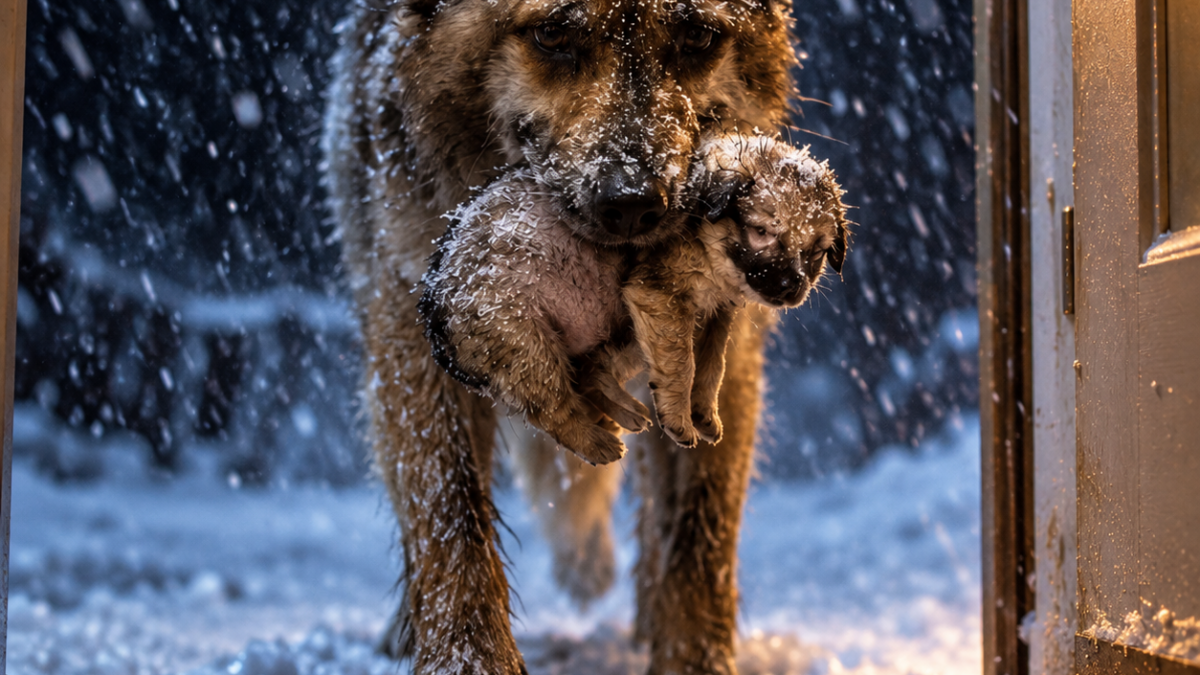
Snow frozen into fur.
Trembling legs.
One tiny paw hanging beneath Molly’s muzzle.
Those amber-brown eyes looking at me without barking, demanding, or begging.
Just waiting to see what I would do.
I used to tell people Molly saved Scout.
That was true.
Then I said she saved the other dogs Caleb had been keeping because her case led authorities to his property.
Also true.
Later, I realized she changed Megan.
She changed Tyler.
She changed our county rescue system.
She changed Laura and me.
But when I think about that night now, I don’t make it bigger than it was.
A freezing dog needed a door opened.
I happened to hear her.
That is all.
The extraordinary part happened before she reached me.
Somebody had taken away her collar.
Put her in a crate.
Driven her into a storm.
Left her miles from shelter with a newborn she could barely keep warm.
Molly could have stayed where she was.
She could have curled around Scout and stopped.
Nobody would have blamed her.
Instead, she picked up her baby.
Then she started walking.
Through wind.
Through snow deep enough to cover her paws.
Across roads.
Past dark buildings.
For mile after mile.
Until she saw our porch light.
At 3:17 a.m., she used whatever strength remained to scratch once.
Then again.
And waited.
Nine years later, after Molly was gone, Scout still slept beside that same door.
Sometimes in winter, when wind scraped branches across the porch, I would wake and look at the clock.
I never ignored the sound.
I never will.
Because once, in the middle of the worst storm I can remember, a mother arrived there carrying everything she had left in the world.
And all she needed from me was for the door to open.
[END OF STORY]








