PART 2: A Driver Hit a Mother Dog Carrying Her Puppy—Then Left Them in the Rain Like Nobody Would Care
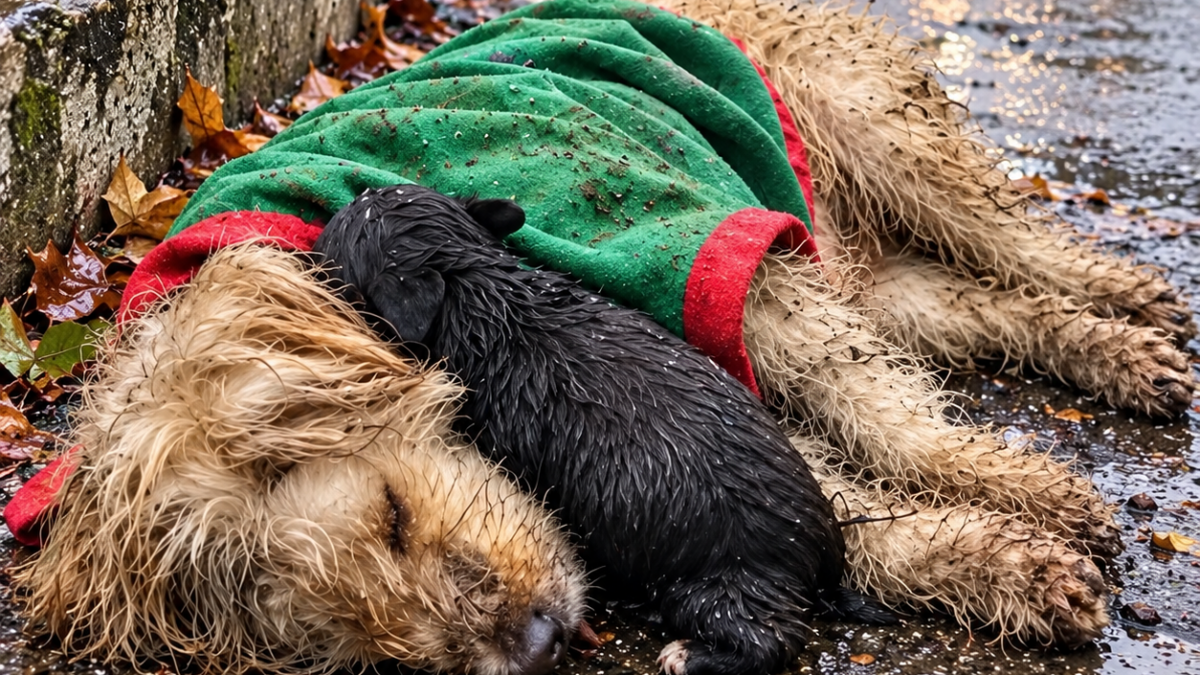
PART 2
The driver of the silver sedan kept glancing at us through the rearview mirror.
“Which clinic?”
“The emergency veterinary hospital on Jefferson.”
“That’s twenty minutes.”
“Make it fifteen.”
He looked at Natalie.
“I’ll try.”
Rain hammered the windshield.
The puppy was tucked inside my shirt because she was shaking so violently I was afraid she would become hypothermic.
Natalie lay across my lap.
I kept one hand under her head.
Her breathing came fast and shallow.
Every few seconds, her eyes opened.
“Stay with me.”
The stranger driving said, “Is she bleeding?”
“I don’t know.”
That was the terrifying part.
There wasn’t much blood on the outside.
But I knew enough about trauma to understand that sometimes the worst damage is hidden.
Internal bleeding.
A ruptured organ.
Head trauma.
A fractured pelvis.
A spinal injury.
Anything could be happening inside her.
“Come on,” I whispered.
Natalie’s eyelids fluttered.
“You carried your baby through traffic. You don’t get to quit now.”
The puppy made a tiny sound against my chest.
Natalie heard it.
Her head moved.
Barely.
But it moved toward the sound.
“She’s here,” I told her.
I pulled the puppy out just enough for Natalie to see her.
The mother’s nose twitched.
Cookie, though she didn’t have that name yet, pushed her face against Natalie’s muzzle.
Natalie tried to lick her.
She only managed to move her tongue once.
My throat closed.
“She’s okay.”
Natalie’s eyes stayed on her daughter.
“She’s right here.”
The man driving accelerated when the road cleared.
“My name’s Daniel,” he said.
It seemed strange that we were only now exchanging names.
“Maya.”
He nodded.
“You work with animals?”
“No.”
He looked surprised.
“Then how do you know what to do?”
“I don’t.”
That was the truth.
I had rescued stray cats before.
I had taken injured birds to wildlife centers.
But I wasn’t trained for this.
I was simply the person who happened to stop.
Sometimes people imagine rescue requires special courage.
It doesn’t always.
Sometimes it requires being unwilling to walk away.
We reached the hospital seventeen minutes later.
Daniel jumped out before I could open the door.
He ran inside.
Within seconds, two technicians came out carrying a stretcher.
“What happened?”
“Hit by a car.”
“How long ago?”
“Maybe twenty-five minutes.”
“Conscious?”
“Mostly.”
“Any vomiting? Seizures?”
“No.”
“Did she lose consciousness?”
“I don’t know.”
They transferred Natalie.
She cried out again.
The puppy began screaming.
“I have her,” I said.
A technician looked at the tiny animal.
“Was she hit too?”
“I don’t think so.”
“Bring her.”
We rushed inside.
The emergency room doors closed behind Natalie.
And suddenly I was standing in the reception area with a wet puppy in my arms and absolutely nothing to do.
That helplessness was worse than the rain.
A receptionist brought me a towel.
“Wrap the baby in this.”
“Thank you.”
“Are they yours?”
“No.”
“Do you know the owner?”
“No.”
She looked at me.
“So they’re strays?”
“I think so.”
“We’ll need someone to authorize treatment.”
“I’ll do it.”
She hesitated.
“There may be significant costs.”
“Do it.”
I didn’t know how I would pay.
I didn’t care yet.
“Save her.”
Daniel was still there.
He reached into his wallet.
“I have two hundred.”
I stared at him.
“You already drove us.”
“So?”
“You don’t even know me.”
He shrugged.
“I know the dog.”
He placed the money on the counter.
That moment stayed with me.
Because less than half an hour earlier, a man had refused to let Natalie into his car because he was worried about his seats.
Now a stranger was handing over money he might have needed because a dog he had never seen before was fighting for her life.
People are capable of astonishing indifference.
They are also capable of the opposite.
I signed the forms.
The puppy began licking my finger.
“You’re hungry?”
She was tiny.
Maybe five or six weeks old.
Old enough to wobble around but still young enough to need her mother badly.
A nurse took her for an examination.
I stayed in the waiting room.
My wet clothes clung to me.
My shoes squished every time I moved.
I looked ridiculous.
I felt worse.
Thirty minutes passed.
Then forty.
Daniel bought me coffee from a vending machine.
I didn’t drink it.
Finally, a veterinarian came through the doors.
“Are you the one who brought the dog in?”
I stood so fast my chair moved backward.
“Yes.”
“I’m Dr. Harris.”
“How is she?”
He held up a hand.
“She’s stable.”
The word hit me like air after being underwater.
“Stable?”
“Yes.”
“What’s broken?”
“We’re still evaluating.”
“Internal bleeding?”
“None that we can see right now.”
I covered my mouth.
“No internal bleeding?”
“So far, no.”
“What about her head?”
“She’s responsive. No obvious skull fracture. Neurologically, she’s better than I expected.”
I had been holding my breath.
I finally released it.
“Her legs?”
“That’s where I’m more concerned.”
My relief stopped.
“What’s wrong?”
“We need radiographs.”
“Can she walk?”
“Not right now.”
I looked toward the treatment doors.
“Is she paralyzed?”
“We don’t know.”
I hated those words.
Dr. Harris seemed to understand.
“Her pain is significant. Sometimes a dog refuses to use a limb because of pain, not because neurological function is lost. Let us get imaging.”
I nodded.
“And the puppy?”
“Surprisingly well.”
I laughed once.
It came out like a sob.
“She wasn’t hit?”
“No evidence of trauma.”
“She was in her mother’s mouth.”
The veterinarian’s expression changed.
“What?”
“Witnesses said Natalie was carrying her across the road.”
“Is Natalie her name?”
“No.”
It came out automatically.
Then I looked through the glass door toward the treatment area.
“I guess it is now.”
“Why Natalie?”
“My grandmother used to say Natalie meant Christmas child.”
Dr. Harris smiled faintly.
“This isn’t Christmas.”
“No.”
I thought of the way the mother had tried to turn toward her puppy despite being unable to stand.
“But she feels like somebody who deserves a new beginning.”
“Then Natalie it is.”
“And the baby?”
I looked down the hallway.
A technician was holding the puppy wrapped in a yellow towel.
The puppy had somehow gotten milk on her nose.
The technician laughed.
“She’s eating like a cookie monster.”
I smiled for the first time.
“Cookie.”
The technician looked at me.
“What?”
“That’s her name.”
Cookie.
Natalie and Cookie.
I didn’t know it then, but those names would become part of my life.
The X-rays showed no catastrophic spinal fracture.
Natalie had severe bruising, soft tissue trauma, and a small pelvic fracture, but her spine appeared intact.
There was inflammation around one hip.
She would need rest.
Pain management.
Possibly weeks before she walked normally.
But she had a chance.
A real one.
When Dr. Harris told me, my knees almost gave out.
“She’s going to live?”
“If nothing unexpected develops, yes.”
Daniel clapped one hand on my shoulder.
I turned toward him.
The man I had known for less than two hours looked as relieved as I felt.
“You hear that?” he said. “Your girl’s stubborn.”
“My girl?”
He smiled.
“You named her.”
“That doesn’t mean she’s mine.”
“Sure.”
It was the first of many times someone would tell me something about Natalie before I was ready to admit it myself.
We were allowed to see her later that night.
Natalie lay inside a padded kennel.
An IV line ran into one front leg.
Her eyes were heavy from pain medication.
Cookie had been placed in a small warmed crate beside her.
The moment Cookie saw her mother, she started crying.
Natalie’s head rose.
Every person in the room went silent.
Cookie scrambled against the side of the crate.
The technician opened it.
“Let’s see how Mom feels.”
She placed Cookie beside Natalie.
The puppy crawled forward immediately.
Natalie sniffed her.
Then she began licking Cookie’s head.
Slowly.
Weakly.
But deliberately.
Cookie pushed against her chest.
Natalie lowered her head around the puppy.
I started crying.
I tried not to.
The technician handed me tissues without saying anything.
Natalie had been unable to stand.
Unable to carry Cookie.
Unable to protect her from the crowd.
But the first thing she did when given the chance was check her baby.
“She remembers,” I whispered.
Dr. Harris stood behind me.
“Of course she does.”
Cookie curled beneath Natalie’s chin.
Natalie closed her eyes.
For the first time since I found them, neither one looked afraid.
I stayed until the clinic staff practically forced me home.
Before leaving, I asked Daniel for his number.
Not because I was trying to make a new friend.
Because I wanted to repay him.
He shook his head.
“Don’t.”
“You gave money.”
“So did you.”
“I don’t even know how much this is going to cost.”
“Then you’re going to need your money.”
I stared at him.
He walked toward his car.
“Daniel.”
He turned.
“Thank you.”
He nodded.
“Next time you see somebody standing in the rain holding an injured dog, stop.”
Then he left.
That became another sentence I never forgot.
When I reached my apartment, it was nearly 2:00 a.m.
I peeled off my soaked clothes.
My hands smelled faintly of wet fur and disinfectant.
I should have collapsed into bed.
Instead, I opened my phone.
I had almost fifty notifications.
One of the videos from the accident had been posted online.
Somebody had tagged me.
I clicked.
The footage began after Natalie had already been hit.
She lay beside the road.
Cookie cried.
People stood around.
Then I appeared, running into frame.
I nearly closed it.
Watching myself wasn’t what mattered.
Then I saw the comments.
Did anyone get the car?
Driver left.
Plate might be visible in another video.
Guy in a black SUV hit her.
No, gray crossover.
Someone said he moved the dog.
My heart started pounding.
The driver.
In the chaos of saving Natalie, I had almost forgotten about him.
Almost.
I went back through the video.
The crash itself wasn’t visible.
But a few seconds into the clip, a dark vehicle was stopped farther up the road.
The image was blurry.
A man stood beside it.
Then he returned to the driver’s side.
The vehicle pulled away.
I paused the frame.
The license plate was impossible to read.
But the rear bumper had a distinctive white sticker.
I took a screenshot.
Then another.
At 2:17 a.m., I posted a short message.
I asked anyone who had recorded the accident to save the original footage.
Not upload compressed versions.
Not edit it.
Save everything.
Dashcam footage.
Security cameras.
Store cameras.
Anything.
Then I wrote:
A mother dog was hit while carrying her puppy. The driver stopped, moved her body to the roadside and left without arranging help. I only want the facts preserved.
I did not threaten anyone.
I didn’t know who the driver was.
I didn’t even know if leaving was legally criminal where we lived.
But morally?
I knew exactly what I thought.
I finally slept around three.
At 7:12, the hospital called.
I answered before the first ring finished.
“Hello?”
“Good morning, Maya. This is Erin from the emergency clinic.”
“How is she?”
“She had a quiet night.”
That was good.
I thought.
“Is quiet good?”
“Yes.”
I sat up.
“She ate a little food.”
I smiled.
“And Cookie?”
“Cookie is excellent.”
“Excellent?”
“She thinks everyone here exists to feed her.”
“That sounds excellent.”
Erin laughed.
“We’re going to try Natalie with assisted standing later.”
My heart tightened.
“Call me.”
“We will.”
I was at the clinic before 8:00.
I brought coffee for the staff.
Not because coffee could repay saving a life.
But I didn’t know what else to do.
Natalie looked more alert.
Her eyes followed me when I entered.
“Hi.”
Her ears moved.
“You remember me?”
I crouched beside the kennel.
Her nose pushed toward my fingers.
Cookie was sleeping against her belly.
The clinic had given her a tiny blue blanket.
I opened the kennel slowly.
Natalie licked my hand.
“Well,” I whispered, “I guess we’re friends.”
She rested her chin on my wrist.
That was the moment my life changed.
Not the dramatic roadside rescue.
Not the hospital rush.
A tired mother dog placing her head on my hand.
Trust is quiet.
The most important things often are.
Later that morning, two technicians helped Natalie stand using a support sling.
Her front legs worked.
Her left rear leg trembled.
The right barely took weight.
“Come on, Mama,” one technician encouraged.
Natalie looked toward Cookie.
Cookie was in my arms.
I don’t know whether Natalie understood what we wanted.
But when Cookie squeaked, Natalie took one step.
Then another.
Her rear legs shook.
She nearly fell.
The technicians supported her.
“Good!”
Natalie panted.
One more step.
I started crying again.
Apparently, I had become a person who cried constantly.
Cookie licked my thumb.
“Your mom is showing off.”
Natalie made it four steps before they let her rest.
Dr. Harris smiled.
“That’s encouraging.”
“How long until she walks?”
“Could be days. Could be weeks.”
“But she will?”
“Based on what I’m seeing, I’m optimistic.”
I wanted to believe him.
By noon, another problem arrived.
The hospital administrator asked to speak with me.
I followed her into a small office.
She showed me the bill.
My stomach dropped.
It was already far beyond what I could comfortably afford.
And Natalie needed continued hospitalization.
Possibly rehabilitation.
Medication.
Follow-up imaging.
“I’ll pay it.”
The administrator gave me a sympathetic look.
“You don’t have to personally cover everything.”
“She doesn’t have anybody else.”
“Are you working with a rescue?”
“No.”
“You should contact one.”
I hated asking for help.
I have always hated it.
But Natalie didn’t need my pride.
She needed care.
So I called rescues.
The first was full.
The second said they could share the case but couldn’t take financial responsibility.
The third didn’t answer.
The fourth called back within twenty minutes.
A woman named Teresa listened while I explained everything.
“Send me the medical records and photos.”
“I will.”
“And Maya?”
“Yes?”
“You did the right thing.”
I closed my eyes.
“I don’t know what I’m doing.”
“Most rescuers don’t at first.”
Within hours, Teresa’s organization agreed to help fund Natalie’s care.
They also offered to take legal custody if she turned out to have an owner who couldn’t be identified.
A weight lifted.
Then my phone buzzed.
Unknown number.
I answered.
“Is this Maya?”
“Yes.”
“My name is Jordan. I saw your post.”
“Okay.”
“I have a dashcam.”
My heart stopped.
“From the accident?”
“I was two cars behind the vehicle.”
I stood.
“Did it record the impact?”
A pause.
“Yes.”
I gripped the phone.
“Can you send me the original file?”
“I can.”
“Please don’t post it publicly yet.”
“Why?”
“Because if we need police or animal control involved, I don’t want anything edited or lost.”
“You think they’re going to care?”
“I don’t know.”
That answer made me angry.
Not at him.
At the possibility that he might be right.
Still, I said, “Send it.”
The video arrived twelve minutes later.
I sat alone in the clinic hallway.
I hesitated before pressing play.
Rain covered the windshield.
Traffic moved slowly.
Ahead, a dark SUV approached the intersection.
Natalie appeared from the right.
She had Cookie in her mouth.
She stopped once.
Waited.
Then started across.
The SUV accelerated.
I actually whispered, “No.”
Even though I knew what happened.
The impact threw Natalie sideways.
Cookie flew from her mouth and rolled.
The dashcam vehicle braked.
The SUV stopped roughly thirty yards ahead.
The driver stepped out.
A man.
Baseball cap.
Dark jacket.
He walked toward Natalie.
I watched, shaking.
He grabbed her behind the shoulders.
Dragged her.
Natalie’s hindquarters scraped across the wet pavement.
Cookie ran after them.
The man pulled Natalie onto the roadside grass.
Then he looked around.
Not at Natalie.
Around.
As if checking who had seen.
He returned to his SUV.
He drove away.
I stopped the video.
I couldn’t breathe.
For several seconds, I just stared at my reflection in the black phone screen.
There was something different about seeing it.
Hearing witnesses was bad.
Imagining it was bad.
Watching someone physically drag an injured animal and then leave her beside her crying puppy was something else.
Teresa found me.
“What happened?”
I handed her the phone.
She watched.
Her face hardened.
“Save three copies.”
“I already did.”
“Good.”
“I can see part of the plate.”
She replayed the final frames.
“Not enough.”
“But maybe another camera got it.”
Teresa looked at me.
“You’re going after him.”
It wasn’t a question.
“I want him identified.”
“Why?”
I looked through the glass toward Natalie.
She was sleeping.
Cookie’s tiny body rose and fell against her.
“Because if he had called for help, I could call this an accident.”
Teresa waited.
“The collision may have been an accident.”
My voice shook.
“Leaving wasn’t.”
We contacted animal control.
An officer named Ramirez met us at the hospital that afternoon.
He watched the dashcam footage twice.
“Do you have the original?”
“Yes.”
“Witness contacts?”
“I’m collecting them.”
“License plate?”
“Partial.”
He wrote everything down.
“Do you think you can find him?” I asked.
“Maybe.”
Maybe again.
I hated maybe.
“What about nearby businesses?”
“We can request footage.”
“Can I ask them myself?”
“You can ask. But don’t harass anyone and don’t confront the driver if you find him.”
“I wasn’t planning to.”
Officer Ramirez gave me a look that suggested he didn’t entirely believe me.
He was right not to.
Part of me wanted to confront the driver.
I wanted to hold my phone in front of his face with the footage playing.
I wanted him to hear Cookie crying.
I wanted him to explain how he got back into his car.
But anger is dangerous when it starts pretending to be purpose.
So I promised.
“I won’t approach him.”
“Good.”
Then Ramirez surprised me.
He crouched beside Natalie’s kennel.
“She’s tough.”
“You like dogs?”
“I have four.”
“Four?”
“Three were supposed to be temporary.”
Teresa laughed.
“That’s how it starts.”
Officer Ramirez rubbed Natalie behind one ear.
“We’ll do what we can.”
I believed him.
The next forty-eight hours were divided between two battles.
Natalie’s recovery.
And identifying the driver.
Natalie improved first.
On the second day, she stood for nearly thirty seconds.
On the third, she took six supported steps.
By the fourth, she could walk a short distance with a sling.
Cookie followed her everywhere.
Whenever Natalie rested, Cookie crawled against her.
The staff started calling them “the twins,” despite the obvious size difference.
Cookie drank formula when Natalie needed rest, but she always returned to her mother’s side.
One afternoon, I entered the recovery room and found Cookie asleep on Natalie’s neck.
Natalie looked at me with an expression that seemed almost exhaustedly maternal.
I laughed.
“Kids.”
Her ears moved.
“I know.”
I sat beside them.
Cookie woke and climbed onto my shoe.
Natalie lifted her head.
For the first time, her tail moved.
One small wag.
Then another.
“You did not just do that.”
She wagged again.
I covered my mouth.
Teresa walked in.
“What?”
“She wagged.”
Teresa stared.
“That’s why you’re crying?”
“Yes.”
She shook her head.
“You’re hopeless.”
Maybe I was.
Meanwhile, Officer Ramirez called.
“We got another video.”
“From where?”
“Gas station near the intersection.”
“Plate?”
“Better view.”
My heart accelerated.
“Can you read it?”
“We have enough to narrow the vehicle.”
“Who is he?”
“Not yet.”
I pressed my fingers against my forehead.
“What do you need?”
“Patience.”
“I don’t have that.”
“I noticed.”
He wasn’t wrong.
The SUV was a dark gray crossover registered to several possible owners in the area.
The partial plate eliminated most.
Then a second witness came forward.
She had been stopped at the light.
She remembered a sticker on the rear window.
A local construction company.
Ramirez searched company vehicles.
Two days later, he called again.
“We have a likely vehicle.”
My entire body went cold.
“Who?”
“I can’t give you everything yet.”
“Why?”
“Investigation.”
“Ramirez.”
“Maya.”
I hated how calm he was.
“Was he driving?”
“We’re trying to establish that.”
“Where is the SUV?”
“At a residence about four miles from the crash.”
I started pacing.
“Does it have damage?”
“Yes.”
That one word changed everything.
“What kind?”
“Front bumper damage consistent with an impact.”
“Did he report an accident?”
“No.”
“Did he call animal control?”
“No.”
“Police?”
“No.”
I looked at Natalie.
She was trying to steal Cookie’s food.
“Then what else do you need?”
“Proof of who was behind the wheel.”
The answer came sooner than expected.
One of the original bystanders had filmed the man after the impact.
Not just the SUV.
His face.
The same video I had been angry about.
A person standing there filming instead of helping.
I had hated those phones.
Now one of them became evidence.
There was an irony in that I couldn’t ignore.
The footage showed the driver clearly enough for identification.
Officer Ramirez compared it with the registered owner.
Same man.
His name was Mark Ellison.
Forty-two years old.
No major criminal record.
Worked as a subcontractor.
When questioned, he initially denied hitting Natalie.
Then Ramirez showed him the gas-station footage.
Mark changed his story.
He said the dog ran in front of him.
That part may have been true.
Then he said he moved her because he didn’t want her hit again.
Also possible.
Then he claimed he thought she was dead.
That part was harder to believe.
Natalie had clearly moved in the video.
Cookie had been screaming beside her.
Finally, Mark said he panicked.
When Ramirez told me that, I laughed.
Not because it was funny.
Because it was so inadequate.
“He panicked.”
“That’s what he said.”
“So he dragged a living dog onto the grass and left?”
“Yes.”
“And Cookie?”
“He says he didn’t see the puppy.”
“He stepped around her.”
“I know.”
I clenched my jaw.
“What happens now?”
“That depends on local statutes and what prosecutors accept.”
“Can he be charged?”
“Possibly failure to report a collision involving property, depending on ownership status, and animal-related charges if they believe the abandonment after injury meets the statute.”
“That sounds weak.”
“It may feel weak.”
“She could have died.”
“I know.”
“No, you saw a video. I held her.”
Ramirez was silent.
I immediately regretted it.
“That wasn’t fair.”
“No.”
He didn’t sound angry.
“It’s also true.”
I sat down.
“I just want it to matter.”
“It does.”
“How?”
“Because we’re investigating.”
“That doesn’t undo anything.”
“No.”
Nothing ever undoes it.
That was the lesson I kept resisting.
Justice doesn’t reverse time.
It can’t put Cookie back in Natalie’s mouth before the car comes.
It can’t make the road dry.
It can’t force the driver to stop ten feet sooner.
It can’t remove pain already experienced.
The best it can do is acknowledge what happened and change what comes next.
Natalie left the hospital after six days.
She could walk slowly.
Her right rear leg still dragged slightly.
She needed strict rest.
Cookie was healthy enough to go with her.
The rescue organization offered a foster home.
I declined before Teresa finished the sentence.
“She’s coming with me.”
Teresa smiled.
“I assumed.”
“Temporarily.”
“Of course.”
“You don’t believe me.”
“Not even slightly.”
My apartment wasn’t prepared for a dog recovering from trauma and a puppy with the energy of a small tornado.
Within the first hour, Cookie peed on my rug.
Chewed a phone charger.
Climbed inside one of my shoes.
Natalie stayed close to her.
I put a large bed in the living room.
Natalie lowered herself carefully.
Cookie immediately climbed onto her back.
“You’re injured,” I told Natalie.
She looked at me.
“Set boundaries.”
Cookie bit Natalie’s ear.
Natalie sighed.
“I see parenting is going well.”
That first night, I woke at 2:30 to crying.
Cookie was standing beside Natalie’s bed.
Natalie was trying to get up.
Her hind legs slipped.
I hurried over.
“Don’t.”
Natalie looked at Cookie.
Cookie cried again.
“She’s okay.”
Natalie tried to stand.
I understood.
Cookie needed to relieve herself.
Natalie wanted to follow.
“You really are impossible.”
I helped Natalie with the support sling.
We went outside.
Rain had stopped.
The pavement still smelled wet.
The moment Natalie saw the street, she froze.
Every muscle locked.
Her breathing changed.
Cars passed at the end of the block.
Natalie stepped backward.
I crouched.
“Okay.”
She pulled.
“We’re not going anywhere.”
Cookie wandered in a circle.
Natalie’s eyes stayed on the street.
I could almost see the memory inside her.
Headlights.
Impact.
Pain.
I moved between her and the road.
“Look at me.”
She wouldn’t.
I touched her cheek.
“Natalie.”
Finally, her eyes shifted to mine.
“You don’t have to cross anything.”
Her breathing slowed.
“We’re going home.”
That became the second part of recovery.
Not bones.
Fear.
People sometimes think physical injuries are the hardest wounds.
They are often easier to understand.
A fracture has an X-ray.
A wound has stitches.
Pain has medication.
Fear hides.
For the next several weeks, Natalie refused to approach busy roads.
We never forced her.
We stood far away.
Reward.
Home.
The next day, a little closer.
Reward.
Home.
Cookie, meanwhile, feared nothing.
One afternoon she tried to chase a garbage truck.
I scooped her up.
“Your mother has enough problems.”
Natalie watched from the porch.
Cookie licked my face.
“You are going to age both of us.”
Natalie’s physical strength returned steadily.
By week three, she no longer needed the sling indoors.
By week five, she could walk around the block.
By week seven, her limp was mild.
Dr. Harris called her progress “better than expected.”
I called it Natalie being Natalie.
Then the prosecutor contacted me.
They planned to file charges connected to Mark leaving the scene and failing to secure aid after knowingly injuring the animal.
The exact legal language was complicated.
The moral language was not.
He hit her.
He knew.
He left.
The prosecutor warned me.
“Don’t expect a dramatic sentence.”
“I know.”
“First offense. No evidence he intentionally struck her.”
“I don’t want him punished for the collision.”
That surprised her.
“What do you want?”
“I want him held responsible for what happened after.”
She nodded.
“That distinction matters.”
It did.
I never wanted to turn an accident into a lie.
Natalie crossed the street unexpectedly.
The road was wet.
Visibility was poor.
Perhaps Mark couldn’t have avoided hitting her.
I wasn’t there to know.
But I had seen what he did afterward.
That was where accident ended and choice began.
The case drew local attention after the original video spread.
People wanted Mark’s name.
I refused to post it.
Teresa agreed.
“Let the legal process handle him.”
Some people online were furious.
Others threatened things I didn’t support.
Damage his car.
Show up at his house.
Make him suffer.
I deleted those comments from our rescue page.
That was not justice.
If we became cruel because he had been cruel, Natalie gained nothing.
But I did want him to see her.
Not the broken dog.
The recovering one.
I wanted him to understand exactly who he had left.
That opportunity came unexpectedly.
The preliminary hearing was scheduled ten weeks after the accident.
I attended.
Natalie stayed home.
I wasn’t going to bring her into a courthouse full of strangers.
Mark sat with his lawyer.
I recognized him immediately from the videos.
Seeing him as a real person was strange.
He looked ordinary.
That bothered me more than if he’d looked monstrous.
Monsters are easy.
Ordinary people making terrible choices are harder.
His attorney approached the prosecutor.
They spoke quietly.
Mark glanced toward me.
Our eyes met.
He looked away first.
During a recess, I walked toward a water fountain.
He was there.
Alone.
Every promise I had made about not confronting him returned at once.
I could have walked away.
I should have.
Then he said, “You’re the woman.”
I stopped.
“What woman?”
“The one who took the dog.”
I stared at him.
“I didn’t take her.”
His jaw tightened.
“You know what I mean.”
“I picked her up after you left her.”
His eyes flicked toward the courtroom.
“I didn’t know she was alive.”
I said nothing.
“You’ve seen the footage.”
“Yes.”
“It was raining. Everything happened fast.”
“Yes.”
“I panicked.”
“So I’ve heard.”
His voice became defensive.
“What would you have done?”
That question almost made me laugh.
Instead, I looked directly at him.
“I would’ve stopped.”
“I stopped.”
“You left.”
“I moved her out of traffic.”
“And left.”
“I thought somebody would help.”
There it was.
The same sentence in a different form.
Somebody.
Somebody else.
I moved a little closer.
“Do you know her name?”
He frowned.
“What?”
“Her name is Natalie.”
He looked confused.
“And the puppy you stepped around?”
His face changed.
“Cookie.”
“I didn’t see—”
“I watched the video.”
He stopped.
“She survived.”
He looked at me.
“So?”
That one word almost broke every bit of control I had.
So?
I reached for my phone.
Then I remembered the prosecutor’s warning about confrontations.
I didn’t play the video.
I opened a photograph instead.
Natalie asleep with Cookie curled against her.
I held it up.
Mark looked.
“She survived because a stranger stopped.”
His eyes remained on the photograph.
“Her pelvis was fractured.”
He swallowed.
“She couldn’t stand for days.”
“I didn’t know.”
“You chose not to know.”
His eyes lifted.
For the first time, he didn’t have an answer.
I put the phone away.
“I’m not asking you to feel what I felt.”
My voice was calmer now.
“I’m asking you to understand that once you knew you’d hit her, you had a choice.”
He looked toward the courtroom.
“And you made the easier one.”
I walked away.
My hands shook for twenty minutes.
Part of me felt satisfied.
Another part felt disappointed.
I had imagined confronting him would feel like power.
It didn’t.
Natalie lying safely at home was power.
Cookie growing was power.
That hallway was just two people standing beside a water fountain.
The prosecutor later told me Mark had agreed to a plea.
He would admit to leaving after knowingly striking the dog without making a reasonable effort to secure aid.
He would pay restitution.
Perform community service.
Complete an animal welfare course.
And his driving record would reflect the incident.
There was also a fine.
Some people online called the punishment pathetic.
Maybe they were right.
But there was one condition I cared about.
One hundred hours of his community service had to be completed through approved municipal animal welfare or public-service programs.
Not at Natalie’s rescue.
I didn’t want him anywhere near her.
But he would spend time seeing what happened when animals were hurt and humans chose to help.
That felt appropriate.
The judge asked him if he understood the plea.
“Yes.”
“Do you understand that the collision itself is not the primary conduct before this court?”
“Yes.”
“What is?”
Mark hesitated.
The judge waited.
Finally, Mark said, “Leaving.”
The courtroom was silent.
The judge nodded.
“You had an obligation to make a reasonable effort after becoming aware that your vehicle had injured an animal.”
“Yes.”
“And you failed to do so.”
“Yes.”
That was all I needed.
Not humiliation.
Acknowledgment.
After the hearing, Officer Ramirez found me outside.
“You look disappointed.”
“I don’t know what I feel.”
“He won’t go to jail.”
“I never expected that.”
“Then what did you expect?”
I looked toward the road.
“I think I wanted some moment where everything felt balanced.”
Ramirez nodded.
“Doesn’t work that way.”
“No.”
“Want to know what does work?”
“What?”
He pointed at my phone.
“Show me Natalie.”
I opened my photos.
There she was.
Standing in my kitchen.
Cookie hanging from one of her ears.
Ramirez laughed.
“That dog looks miserable.”
“Terrible life.”
We both smiled.
He handed the phone back.
“There’s your balance.”
Maybe.
At home, Natalie had become a different dog.
She still feared traffic.
But she trusted me enough to walk beside me.
Cookie grew fast.
Her paws seemed too large for her body.
She had inherited Natalie’s eyes but none of her caution.
At twelve weeks, Cookie learned how to climb onto the couch.
At thirteen, she discovered toilet paper.
At fourteen, she ate part of a veterinary invoice.
“Appropriate,” I told her.
Natalie watched from her bed.
“You raised this.”
Natalie yawned.
One day, Teresa arrived carrying adoption paperwork.
I frowned.
“What is that?”
“Cookie is old enough.”
My stomach tightened.
I had known this was coming.
“What about Natalie?”
“She can be listed too.”
I stared at her.
Teresa sat at my kitchen table.
“You’ve had them almost three months.”
“They needed time.”
“They got time.”
“Natalie still has anxiety.”
“She’ll always need someone patient.”
“Exactly.”
Teresa smiled.
“You’re not hearing yourself.”
“I can’t keep two dogs.”
“Okay.”
“My apartment is too small.”
“Okay.”
“Cookie eats furniture.”
“True.”
“I work.”
“You’ve managed.”
I crossed my arms.
“You came here to manipulate me.”
“I came here with adoption forms.”
She pushed them across the table.
I looked down.
Applicant name.
Address.
Current pets.
Experience.
I felt sick.
Cookie chased her own tail near the couch.
Natalie rested beside my foot.
“What if they’re separated?”
Teresa’s expression softened.
“We’ll try to place them together.”
“Try?”
“It’s harder to adopt two.”
“They’re bonded.”
“I know.”
“They shouldn’t be separated.”
“I agree.”
“What if nobody wants both?”
“Maya.”
I looked at her.
“You know what the solution is.”
“No.”
“Yes.”
“I rescue them. That doesn’t mean I keep them.”
“You aren’t a rescuer.”
I blinked.
“Excuse me?”
“You were a woman walking home from a grocery store.”
I stared at her.
“You became a rescuer because of them.”
She slid the forms closer.
“Maybe they already chose their home.”
I looked at Natalie.
She had fallen asleep with one paw against my shoe.
Cookie ran over and collapsed on top of her.
Natalie opened one eye.
Didn’t move.
I laughed.
Then cried.
Again.
Teresa pretended not to notice.
“Fine.”
She picked up a pen.
“Fine what?”
“I’ll apply.”
“To adopt?”
“Temporarily.”
Teresa burst out laughing.
“You cannot temporarily adopt.”
“Then the system is flawed.”
I adopted them both.
Officially.
Natalie Harper.
Cookie Harper.
I even changed my lease.
The landlord wanted an additional deposit.
Daniel—the stranger who had driven us that first night—heard through Teresa.
He sent me the exact amount of the pet deposit electronically.
I called him.
“Stop giving me money.”
He laughed.
“Too late.”
“You are impossible.”
“How’s the mom?”
“Sleeping.”
“Baby?”
“Destroying my home.”
“Sounds healthy.”
I smiled.
“Very.”
Months passed.
Natalie’s limp disappeared almost completely.
The fur on her hip grew back.
Her appetite became impressive.
Her fear of roads took longer.
We developed a ritual.
Before crossing, I stopped.
Natalie stopped.
I said, “Ready?”
She looked at me.
Then we crossed together.
At first, she trembled every time.
Then only on busy roads.
Then only when cars passed close.
One morning, almost eight months after the accident, we reached a quiet crossing.
I stopped automatically.
“Ready?”
Natalie looked ahead.
Then stepped forward before I did.
I froze.
She turned back.
Her expression seemed to say, Well?
I laughed.
“Okay.”
We crossed.
Cookie ran beside her.
At the other curb, I knelt.
“You did it.”
Natalie licked my cheek.
People walking past probably thought I was crazy.
I didn’t care.
That tiny street crossing mattered more than they could know.
Mark’s community service began around the same time.
I knew because Officer Ramirez told me.
“He’s at the county shelter twice a week.”
I stiffened.
“Why are you telling me?”
“You asked me months ago whether it would matter.”
“And?”
“One of the supervisors says he doesn’t complain.”
I wasn’t sure what to do with that information.
“I don’t want a redemption story about him.”
“I’m not giving you one.”
“Good.”
“He made a bad choice.”
“A terrible one.”
“Yes.”
Ramirez nodded.
“But accountability is supposed to change behavior.”
I understood his point.
I still wasn’t ready to care.
Then something happened that surprised me.
A letter arrived at the rescue.
It was addressed to me.
No return name.
Teresa called.
“You should come by.”
“What is it?”
“A letter.”
“From?”
“I think Mark.”
My stomach tightened.
“Throw it away.”
“I can.”
I hesitated.
“What does it say?”
“I didn’t open it.”
Of course she hadn’t.
I went to the rescue.
The envelope sat on Teresa’s desk.
I stared at it for a long time.
Then opened it.
The handwriting was uneven.
Maya,
I don’t expect you to forgive me.
I watched the video again after court. I kept telling myself I thought the dog was dead. That wasn’t true. I knew she was moving. I was scared about what would happen to me if I stayed.
At the shelter, I saw a dog brought in after being hit. A worker sat with him for two hours. Nobody knew whose dog he was.
I kept thinking about Natalie.
You were right. I chose the easier thing.
I should have called for help.
I am sorry.
There was more.
I stopped reading.
Teresa watched me.
“Well?”
I folded the letter.
“I don’t know.”
“Are you angry?”
“Yes.”
“Does the apology matter?”
I looked at the envelope.
“A little.”
That answer surprised me.
I did not forgive him that day.
Forgiveness isn’t a debt victims owe people who apologize.
But the letter changed one thing.
For months, I had imagined Mark as a man who could look at Natalie and feel nothing.
Maybe he had felt something.
Maybe fear had been stronger.
That didn’t excuse him.
But it made his failure understandable in a way that was almost more frightening.
Ordinary cowardice can cause enormous suffering.
I put the letter away.
I never replied.
I didn’t need to.
Natalie’s story was no longer connected to his decisions.
That freedom mattered.
One year after the accident, Teresa organized a small fundraiser at the rescue.
Natalie and Cookie attended.
Cookie was nearly as tall as her mother now.
She still behaved like a puppy.
Natalie had become calm around strangers.
Children approached slowly.
She accepted gentle touches.
At one point, a little girl asked why Natalie walked carefully near cars.
I crouched.
“She had an accident.”
“Did it hurt?”
“Yes.”
The girl looked horrified.
“Is she okay now?”
I smiled.
“Very.”
The child hugged Natalie’s neck.
Natalie stood perfectly still.
Cookie tried to steal the girl’s hat.
“Cookie!”
Everyone laughed.
That was what I wanted for them.
Not to become symbols forever.
Not to spend their lives representing suffering.
Just dogs.
Loved dogs.
Annoying dogs.
Dogs that stole hats and begged for chicken and took up too much space on the bed.
Toward the end of the event, Daniel arrived.
I hadn’t seen him in months.
Natalie recognized him before I did.
Her body began wagging.
He stared.
“That’s her?”
“That’s her.”
He crouched.
Natalie walked straight into his arms.
Daniel buried his face against her neck.
For several seconds, neither of us spoke.
Then he looked up.
“She remembers me?”
“I think she remembers kindness.”
His eyes became wet.
He stood quickly.
“I have allergies.”
“To dogs?”
“To emotional situations.”
I laughed.
Cookie jumped against him.
“And this monster?”
“Cookie.”
He scratched her ears.
“She’s huge.”
“She thinks she’s six pounds.”
“Don’t tell her.”
We stood beside the rescue building as the sun went down.
Daniel looked at Natalie.
“Do you ever think about that night?”
“Too much.”
“Me too.”
“You only knew us for seventeen minutes.”
He shrugged.
“Some minutes stick.”
He was right.
The anniversary ended quietly.
At home, I gave Natalie and Cookie special dinners.
Cookie finished hers in forty seconds.
Natalie took almost a full minute.
“Very refined.”
Later, they climbed onto my bed.
Both.
Despite having their own expensive beds.
I lay between them.
Cookie’s head rested on my stomach.
Natalie slept beside my shoulder.
Rain began tapping the window.
Natalie’s eyes opened.
For a moment, I worried.
Rain had once meant the road.
The crash.
Fear.
She lifted her head.
Listened.
Then put it back down.
I smiled into the darkness.
“It’s just rain.”
Her breathing slowed again.
That was healing.
Not forgetting.
Knowing the same sound no longer meant the same danger.
A few weeks later, I received another message from Officer Ramirez.
This one wasn’t about Mark.
A dog had been hit on another road.
The driver stayed.
Called police.
Wrapped the dog in a blanket.
Waited until help arrived.
The dog survived.
“Why are you telling me?” I asked.
Ramirez paused.
“The driver said he remembered hearing about Natalie.”
I didn’t speak.
“He said he wasn’t going to be the person who drove away.”
I sat down.
For a long moment, I couldn’t answer.
That was when I finally understood what justice could look like beyond punishment.
One story changes another choice.
Not always.
Not enough.
But sometimes.
Natalie’s suffering could never become good.
I refuse to romanticize pain that way.
She should never have been hit.
She should never have lain helpless beside a road.
Cookie should never have cried next to a mother who couldn’t stand.
But if people remembered that story and chose differently later, then her pain had at least forced the world to pay attention.
Two years after the accident, Natalie became a completely different dog.
Her muzzle had begun showing a few gray hairs.
Cookie remained a permanent adolescent.
One Saturday morning, we drove to a quiet lake.
Natalie hated deep water.
Cookie believed she was an Olympic swimmer.
Within five minutes, Cookie launched herself into the shallows after a stick.
Natalie barked from shore.
“She’ll come back,” I told her.
Natalie barked again.
“You really haven’t changed.”
Cookie returned carrying the stick.
Natalie inspected her immediately.
I laughed.
“You carried her through traffic once and now you think every puddle is a threat.”
Natalie licked Cookie’s face.
Cookie shook water all over both of us.
“Great.”
We spent the afternoon beneath a tree.
Cookie ran until she collapsed.
Natalie lay beside me.
I took a picture.
In it, she looked peaceful.
No one seeing that photograph would know she had once been the dog lying in the rain.
That became my favorite picture.
Not because she looked beautiful.
Because she looked ordinary.
Ordinary was the victory.
Then, three years after the accident, Natalie began slowing down.
Nothing dramatic.
She took longer getting up.
She slept more.
Dr. Harris examined her.
“Arthritis.”
My heart tightened.
“From the accident?”
“Possibly contributed to by the pelvic trauma. Could also simply be age.”
“How old do you think she is?”
“Seven? Eight? Maybe older.”
We never knew.
Stray animals carry missing years.
I started medication.
Soft bedding.
Shorter walks.
Cookie adjusted too.
When Natalie moved slowly, Cookie stayed near her.
That wild puppy had grown into a surprisingly attentive daughter.
One evening, I watched them cross the living room together.
Cookie slowed her pace to match Natalie.
Something in my chest hurt.
The relationship had reversed.
Once, Natalie had carried Cookie.
Now Cookie waited for her mother.
Years pass that way.
Quietly.
Roles change.
One rainy afternoon, almost exactly four years after I first found them, I drove home from work.
At an intersection, traffic had stopped.
My stomach tightened before I understood why.
A dog stood near the road.
No.
Two dogs.
A larger dog and a puppy.
My hands gripped the steering wheel.
For a moment, I was back there.
Rain.
Phones.
Natalie’s body.
Cookie crying.
Then a man in the car ahead of me got out.
He put on his hazard lights.
Another driver stopped traffic.
A woman approached the dogs slowly.
Someone called animal control.
Nobody filmed.
Or if they did, I didn’t notice.
People helped.
I sat in my car crying.
Not because the dogs were hurt.
They weren’t.
They were simply lost.
But the scene was everything I had once wished for.
People stopping.
Moving.
Helping first.
Maybe the world had not changed because of Natalie.
Probably not.
But mine had.
And that was enough.
That night, I sat on the floor with her.
She rested her head in my lap.
“You want to know something?”
Her eyes opened.
“You ruined me.”
Cookie looked over from the couch.
“You too.”
Cookie wagged.
“I can’t see an animal near a road without losing my mind.”
Natalie licked my hand.
“And I blame you.”
She sighed.
I smiled.
“No regrets.”
There truly weren’t.
Mark eventually finished his community service.
Ramirez told me he had continued volunteering at the county shelter once or twice a month afterward.
I said nothing.
Then I asked, “Why?”
“He says he likes walking the older dogs.”
I looked down.
I had no neat emotional response.
Part of me still remembered Natalie being dragged.
Another part understood people can be more than the worst choice they’ve made.
Forgiveness didn’t require forgetting.
Accountability didn’t require permanent hatred.
I hoped he had changed.
Not for him.
For every animal who might cross his path later.
I never contacted him.
He never contacted me again.
That was enough.
Natalie lived with me for seven more years.
Seven.
Sometimes I say that number just to remind myself how close we came to losing all of them.
Seven years of mornings.
Seven years of stolen food.
Seven years of cautious street crossings that eventually became confident ones.
Seven years of Cookie sleeping against her.
Seven years of Natalie waiting by the door when I came home.
The end came slowly.
She was old.
Her legs had weakened.
Her face was almost completely gray.
Dr. Harris had treated her since the accident.
He came to the house when the time arrived.
Cookie lay beside Natalie.
I sat on the floor.
Natalie’s head rested in my lap.
Rain was falling outside.
Of course it was.
I hated that at first.
Then I realized the rain no longer belonged to the worst night of her life.
She had lived through hundreds of rainy days afterward.
Warm.
Safe.
Loved.
I stroked her ears.
“Do you remember me?”
Her tired eyes looked up.
“I was the crazy woman in the road.”
Her tail moved once.
Even old, even weak, she could still answer me.
“I thought I saved you.”
My voice broke.
Cookie pressed closer.
“I was very full of myself.”
Dr. Harris waited quietly.
“You saved me too.”
Natalie breathed out.
I bent over her.
“I need you to know something.”
Tears fell onto her fur.
“You got Cookie across.”
I don’t know why that was the thing I needed to say.
Maybe because it had been her last mission before the car hit her.
Carry the puppy.
Get her safe.
“You did it.”
Cookie lifted her head at the sound of her name.
I touched both of them.
“She grew up.”
Natalie’s eyes stayed on mine.
“You did your job.”
I kissed her forehead.
“You can rest.”
She died with Cookie beside her and my hand over her heart.
There was no road.
No crowd.
No phones.
No fear.
Only home.
Afterward, Cookie searched for her.
That was almost harder than losing Natalie.
She checked the bedroom.
The kitchen.
Natalie’s favorite bed.
For days, Cookie slept beside the empty blanket.
I didn’t move it.
Eventually, she began sleeping beside me instead.
Grief has its own rhythm.
Dogs understand absence better than we give them credit for.
Months later, Teresa asked if I wanted another dog.
“No.”
She nodded.
“I understand.”
Two weeks later, I fostered one.
Teresa didn’t say a word.
She only smiled.
His name was Benny.
Old.
Missing an eye.
Terrified of men.
Cookie taught him how to use the dog door.
I pretended the foster arrangement was temporary.
History repeats itself in kinder ways too.
I kept Benny.
On the wall in my living room, there are three photographs.
The first shows Natalie and Cookie at the lake.
The second shows Cookie alone years later, gray beginning around her muzzle.
The third isn’t really a photograph.
It’s a screenshot.
A blurry frame from the night of the accident.
Natalie is lying beside the road.
I almost deleted it many times.
People ask why I keep it.
I don’t keep it because I want to remember her suffering.
I keep it because of what is just outside the frame.
Me.
Running toward her.
Not because I was brave.
Not because I knew what I was doing.
Because somebody had to move.
That is the part I want to remember.
When everyone is watching, move.
When someone says another person will help, move.
When helping is inconvenient, move.
When you’re afraid you’ll do the wrong thing, move carefully—but move.
Natalie taught me that.
Her life was almost reduced to a video strangers recorded beside a rainy road.
Instead, she became a mother who survived.
A dog who learned to cross streets again.
A companion who lived seven beautiful years after someone left her for dead.
And Cookie?
Cookie grew old beside me.
She never remembered that road.
At least, I hope she didn’t.
Her earliest memory may have been warmth.
Milk.
Her mother’s body beside her.
Maybe my hands.
Maybe the yellow towel at the veterinary hospital.
That thought comforts me.
Natalie carried the terrible memory so Cookie wouldn’t have to.
That’s what mothers do.
Years later, when Cookie became an old dog herself, she still slept with her nose pressed against the blanket I had once wrapped around Natalie.
I never knew whether she recognized the smell.
Maybe I only wanted to believe she did.
One evening, I sat beside her while rain fell outside.
Cookie lifted her head.
For just a second, her eyes looked so much like Natalie’s that I stopped breathing.
“Your mom was incredible.”
Cookie sighed.
“She was.”
I looked toward the photograph on the wall.
People sometimes ask me what happened to the driver.
They expect that to be the ending.
They want the punishment.
The revenge.
The moment the bad person loses and the good person wins.
For years, I thought I wanted that too.
But Mark’s fine was not the ending.
His court case was not the ending.
His apology was not the ending.
Even his years of volunteering afterward were not the ending.
Natalie was the ending.
Natalie waking in a warm bed.
Natalie watching Cookie grow.
Natalie learning not every passing car would hurt her.
Natalie sleeping through thunderstorms.
Natalie greeting Daniel years after he stopped his car for two strangers and two wet dogs.
Natalie growing gray.
Natalie dying old.
That was the revenge.
The man who left her believed, for one frightened moment, that driving away could erase his responsibility.
It didn’t.
But more importantly, leaving her did not erase her future.
She got one.
A long one.
A beautiful one.
The dog he dragged from the road became somebody’s family.
The puppy he left crying beside her grew up with her mother.
And the story he probably hoped would disappear became the story that made other drivers stop when animals needed help.
I cannot think of a punishment more complete than being proven wrong about the value of the life you walked away from.
Natalie mattered.
Cookie mattered.
They mattered when they were injured.
They mattered when they were inconvenient.
They mattered when nobody knew their names.
They mattered before anybody filmed them.
And they still mattered after the cameras were gone.
Sometimes people ask what I would change if I could relive that night.
I know the answer instantly.
I would make the car stop.
I would erase the impact.
I would take the fear out of Natalie’s eyes.
I would keep Cookie safe in her mother’s mouth until they reached the other side.
But since I cannot change that moment, there is only one thing I am grateful for.
I moved.
So did Daniel.
So did Dr. Harris.
So did Teresa.
So did Officer Ramirez.
Eventually, even the witnesses who had filmed instead of helping moved by handing over their videos.
One action led to another.
And because enough people finally moved, Natalie got up.
Not that night.
Not the next morning.
But slowly.
One shaking step at a time.
She stood.
She walked.
She crossed roads again.
She raised her daughter.
She came home.
And years later, when I think of Natalie, I no longer see her lying helplessly in the rain.
I see her running across a quiet field with Cookie beside her.
Her ears bouncing.
Her mouth open.
Her legs strong.
Her daughter chasing her.
And if I close my eyes, I can almost hear the sound that mattered more than the puppy’s cries beside that road.
Natalie’s paws hitting the grass.
Running toward me.
Because she knew she was safe.
Because she knew she was loved.
Because somebody stopped.
# A Driver Hit a Mother Dog Carrying Her Puppy—Then Left Them in the Rain Like Nobody Would Care
I still remember the sound Natalie’s puppy made beside that road.
Dozens of people saw her mother bleeding in the rain, but almost everyone reached for a phone before anyone reached for the dog.
And before that night was over, I would realize the worst part of what happened hadn’t been the crash itself.
Rain had been falling since late afternoon.
Not the gentle kind.
It came down hard enough to turn the gutters into streams and blur headlights into streaks of white across the road.
I was walking beneath the awning of a small grocery store when I heard shouting from the intersection.
At first, I thought two drivers had collided.
Then someone screamed.
“A dog!”
I stepped into the rain.
People were gathering near the curb.
Cars slowed as they passed.
A man stood in the street waving both arms, but instead of moving toward whatever had happened, most people kept their distance.
Then I saw her.
A medium-sized brown dog was lying beside the road.
Her fur was soaked against her body.
Her hind legs were stretched strangely behind her.
And beside her was a puppy so small I could have held her in one hand.
The puppy was crying.
Not barking.
Crying.
A sharp, frightened sound that cut through the rain.
I ran closer.
“What happened?”
Nobody answered immediately.
Three people were filming.
One woman held her phone directly over the injured dog.
I stared at her.
“Are you calling a veterinarian?”
She lowered the phone slightly.
“Someone probably already did.”
“Who?”
No answer.
Another man pointed toward the road.
“A car hit her.”
“Where’s the driver?”
“He left.”
I looked back at the dog.
She tried to move.
Her front paws scraped against the pavement.
Her body lifted barely an inch before collapsing again.
The puppy pressed herself against her mother’s neck.
“Oh my God.”
I knelt.
Someone behind me said, “Careful. She might bite.”
I ignored him.
The dog’s eyes were wide with pain, but when my hand moved toward her face, she didn’t snap.
She looked straight at me.
That look is still difficult for me to describe.
She was terrified.
But more than that, she seemed desperate to understand where her baby was.
The puppy climbed over her front leg.
The mother tried to turn toward her.
Her body wouldn’t cooperate.
“Sweetheart,” I whispered. “Don’t move.”
A woman near the curb said, “She was carrying the puppy.”
I turned.
“What?”
“She had the baby in her mouth when she crossed.”
Another witness nodded.
“The car came fast.”
My stomach dropped.
“She was carrying her puppy?”
The man nodded.
“The dog almost made it.”
Almost.
I looked down at the tiny animal trembling beside her.
Only minutes earlier, this mother had been using her own body to carry her daughter through the rain.
Then a vehicle had struck her.
“What happened after he hit her?”
Silence.
I looked up.
“The driver. What did he do?”
A teenager answered.
“He stopped.”
Relief came for half a second.
Then he continued.
“He pulled her off the road.”
“With his hands?”
“Yeah.”
“And then?”
“He got back in his car.”
I stared at him.
“He left?”
The boy nodded.
Something hot moved through my chest despite the cold rain soaking my clothes.
The driver had known.
He had stopped.
He had seen what he had done.
He had touched Natalie’s injured body.
And instead of getting help, he had dragged her to the roadside and driven away.
I looked around at the phones pointed toward us.
“Did anybody get the license plate?”
People exchanged glances.
One person said, “Maybe it’s on video.”
Maybe.
Meanwhile, the dog in front of me was struggling to breathe.
I took off my jacket and placed it over her.
“Does anyone have a car?”
Nobody moved.
“I need to get her to a veterinary hospital.”
A man shook his head.
“My seats will get soaked.”
For a second, I thought I had misheard him.
“Your seats?”
He looked embarrassed.
“I just had them cleaned.”
I turned away before I said something I would regret.
I slipped one arm beneath Natalie’s chest and another beneath her hips.
She cried out.
The puppy screamed.
“I know,” I whispered. “I know. I’m sorry.”
I lifted her.
She was heavier than I expected.
Not because she was large.
Because injured animals somehow carry the weight of every second you are terrified of losing them.
Someone finally handed me the puppy.
She fit against my chest.
I stood there in the rain holding both of them while cars passed.
“Please,” I shouted. “I need a ride!”
The mother’s head rested weakly against my arm.
The puppy crawled toward her.
And for several terrible minutes, not one car stopped.
Then a battered silver sedan pulled over.
The passenger window came down.
A man leaned across the seat.
“Get in.”
I didn’t ask his name.
I didn’t ask where he was going.
I climbed in with Natalie and her baby.
As the car pulled away, I looked back through the wet window at the crowd.
Some of them were still filming.
I had no idea then that one of those videos would eventually become the reason the man who left Natalie on that road could no longer pretend he had done nothing wrong.
—
**END OF FACEBOOK OPENING — APPROX. 700–800 WORDS**
—
The driver of the silver sedan kept glancing at us through the rearview mirror.
“Which clinic?”
“The emergency veterinary hospital on Jefferson.”
“That’s twenty minutes.”
“Make it fifteen.”
He looked at Natalie.
“I’ll try.”
Rain hammered the windshield.
The puppy was tucked inside my shirt because she was shaking so violently I was afraid she would become hypothermic.
Natalie lay across my lap.
I kept one hand under her head.
Her breathing came fast and shallow.
Every few seconds, her eyes opened.
“Stay with me.”
The stranger driving said, “Is she bleeding?”
“I don’t know.”
That was the terrifying part.
There wasn’t much blood on the outside.
But I knew enough about trauma to understand that sometimes the worst damage is hidden.
Internal bleeding.
A ruptured organ.
Head trauma.
A fractured pelvis.
A spinal injury.
Anything could be happening inside her.
“Come on,” I whispered.
Natalie’s eyelids fluttered.
“You carried your baby through traffic. You don’t get to quit now.”
The puppy made a tiny sound against my chest.
Natalie heard it.
Her head moved.
Barely.
But it moved toward the sound.
“She’s here,” I told her.
I pulled the puppy out just enough for Natalie to see her.
The mother’s nose twitched.
Cookie, though she didn’t have that name yet, pushed her face against Natalie’s muzzle.
Natalie tried to lick her.
She only managed to move her tongue once.
My throat closed.
“She’s okay.”
Natalie’s eyes stayed on her daughter.
“She’s right here.”
The man driving accelerated when the road cleared.
“My name’s Daniel,” he said.
It seemed strange that we were only now exchanging names.
“Maya.”
He nodded.
“You work with animals?”
“No.”
He looked surprised.
“Then how do you know what to do?”
“I don’t.”
That was the truth.
I had rescued stray cats before.
I had taken injured birds to wildlife centers.
But I wasn’t trained for this.
I was simply the person who happened to stop.
Sometimes people imagine rescue requires special courage.
It doesn’t always.
Sometimes it requires being unwilling to walk away.
We reached the hospital seventeen minutes later.
Daniel jumped out before I could open the door.
He ran inside.
Within seconds, two technicians came out carrying a stretcher.
“What happened?”
“Hit by a car.”
“How long ago?”
“Maybe twenty-five minutes.”
“Conscious?”
“Mostly.”
“Any vomiting? Seizures?”
“No.”
“Did she lose consciousness?”
“I don’t know.”
They transferred Natalie.
She cried out again.
The puppy began screaming.
“I have her,” I said.
A technician looked at the tiny animal.
“Was she hit too?”
“I don’t think so.”
“Bring her.”
We rushed inside.
The emergency room doors closed behind Natalie.
And suddenly I was standing in the reception area with a wet puppy in my arms and absolutely nothing to do.
That helplessness was worse than the rain.
A receptionist brought me a towel.
“Wrap the baby in this.”
“Thank you.”
“Are they yours?”
“No.”
“Do you know the owner?”
“No.”
She looked at me.
“So they’re strays?”
“I think so.”
“We’ll need someone to authorize treatment.”
“I’ll do it.”
She hesitated.
“There may be significant costs.”
“Do it.”
I didn’t know how I would pay.
I didn’t care yet.
“Save her.”
Daniel was still there.
He reached into his wallet.
“I have two hundred.”
I stared at him.
“You already drove us.”
“So?”
“You don’t even know me.”
He shrugged.
“I know the dog.”
He placed the money on the counter.
That moment stayed with me.
Because less than half an hour earlier, a man had refused to let Natalie into his car because he was worried about his seats.
Now a stranger was handing over money he might have needed because a dog he had never seen before was fighting for her life.
People are capable of astonishing indifference.
They are also capable of the opposite.
I signed the forms.
The puppy began licking my finger.
“You’re hungry?”
She was tiny.
Maybe five or six weeks old.
Old enough to wobble around but still young enough to need her mother badly.
A nurse took her for an examination.
I stayed in the waiting room.
My wet clothes clung to me.
My shoes squished every time I moved.
I looked ridiculous.
I felt worse.
Thirty minutes passed.
Then forty.
Daniel bought me coffee from a vending machine.
I didn’t drink it.
Finally, a veterinarian came through the doors.
“Are you the one who brought the dog in?”
I stood so fast my chair moved backward.
“Yes.”
“I’m Dr. Harris.”
“How is she?”
He held up a hand.
“She’s stable.”
The word hit me like air after being underwater.
“Stable?”
“Yes.”
“What’s broken?”
“We’re still evaluating.”
“Internal bleeding?”
“None that we can see right now.”
I covered my mouth.
“No internal bleeding?”
“So far, no.”
“What about her head?”
“She’s responsive. No obvious skull fracture. Neurologically, she’s better than I expected.”
I had been holding my breath.
I finally released it.
“Her legs?”
“That’s where I’m more concerned.”
My relief stopped.
“What’s wrong?”
“We need radiographs.”
“Can she walk?”
“Not right now.”
I looked toward the treatment doors.
“Is she paralyzed?”
“We don’t know.”
I hated those words.
Dr. Harris seemed to understand.
“Her pain is significant. Sometimes a dog refuses to use a limb because of pain, not because neurological function is lost. Let us get imaging.”
I nodded.
“And the puppy?”
“Surprisingly well.”
I laughed once.
It came out like a sob.
“She wasn’t hit?”
“No evidence of trauma.”
“She was in her mother’s mouth.”
The veterinarian’s expression changed.
“What?”
“Witnesses said Natalie was carrying her across the road.”
“Is Natalie her name?”
“No.”
It came out automatically.
Then I looked through the glass door toward the treatment area.
“I guess it is now.”
“Why Natalie?”
“My grandmother used to say Natalie meant Christmas child.”
Dr. Harris smiled faintly.
“This isn’t Christmas.”
“No.”
I thought of the way the mother had tried to turn toward her puppy despite being unable to stand.
“But she feels like somebody who deserves a new beginning.”
“Then Natalie it is.”
“And the baby?”
I looked down the hallway.
A technician was holding the puppy wrapped in a yellow towel.
The puppy had somehow gotten milk on her nose.
The technician laughed.
“She’s eating like a cookie monster.”
I smiled for the first time.
“Cookie.”
The technician looked at me.
“What?”
“That’s her name.”
Cookie.
Natalie and Cookie.
I didn’t know it then, but those names would become part of my life.
The X-rays showed no catastrophic spinal fracture.
Natalie had severe bruising, soft tissue trauma, and a small pelvic fracture, but her spine appeared intact.
There was inflammation around one hip.
She would need rest.
Pain management.
Possibly weeks before she walked normally.
But she had a chance.
A real one.
When Dr. Harris told me, my knees almost gave out.
“She’s going to live?”
“If nothing unexpected develops, yes.”
Daniel clapped one hand on my shoulder.
I turned toward him.
The man I had known for less than two hours looked as relieved as I felt.
“You hear that?” he said. “Your girl’s stubborn.”
“My girl?”
He smiled.
“You named her.”
“That doesn’t mean she’s mine.”
“Sure.”
It was the first of many times someone would tell me something about Natalie before I was ready to admit it myself.
We were allowed to see her later that night.
Natalie lay inside a padded kennel.
An IV line ran into one front leg.
Her eyes were heavy from pain medication.
Cookie had been placed in a small warmed crate beside her.
The moment Cookie saw her mother, she started crying.
Natalie’s head rose.
Every person in the room went silent.
Cookie scrambled against the side of the crate.
The technician opened it.
“Let’s see how Mom feels.”
She placed Cookie beside Natalie.
The puppy crawled forward immediately.
Natalie sniffed her.
Then she began licking Cookie’s head.
Slowly.
Weakly.
But deliberately.
Cookie pushed against her chest.
Natalie lowered her head around the puppy.
I started crying.
I tried not to.
The technician handed me tissues without saying anything.
Natalie had been unable to stand.
Unable to carry Cookie.
Unable to protect her from the crowd.
But the first thing she did when given the chance was check her baby.
“She remembers,” I whispered.
Dr. Harris stood behind me.
“Of course she does.”
Cookie curled beneath Natalie’s chin.
Natalie closed her eyes.
For the first time since I found them, neither one looked afraid.
I stayed until the clinic staff practically forced me home.
Before leaving, I asked Daniel for his number.
Not because I was trying to make a new friend.
Because I wanted to repay him.
He shook his head.
“Don’t.”
“You gave money.”
“So did you.”
“I don’t even know how much this is going to cost.”
“Then you’re going to need your money.”
I stared at him.
He walked toward his car.
“Daniel.”
He turned.
“Thank you.”
He nodded.
“Next time you see somebody standing in the rain holding an injured dog, stop.”
Then he left.
That became another sentence I never forgot.
When I reached my apartment, it was nearly 2:00 a.m.
I peeled off my soaked clothes.
My hands smelled faintly of wet fur and disinfectant.
I should have collapsed into bed.
Instead, I opened my phone.
I had almost fifty notifications.
One of the videos from the accident had been posted online.
Somebody had tagged me.
I clicked.
The footage began after Natalie had already been hit.
She lay beside the road.
Cookie cried.
People stood around.
Then I appeared, running into frame.
I nearly closed it.
Watching myself wasn’t what mattered.
Then I saw the comments.
Did anyone get the car?
Driver left.
Plate might be visible in another video.
Guy in a black SUV hit her.
No, gray crossover.
Someone said he moved the dog.
My heart started pounding.
The driver.
In the chaos of saving Natalie, I had almost forgotten about him.
Almost.
I went back through the video.
The crash itself wasn’t visible.
But a few seconds into the clip, a dark vehicle was stopped farther up the road.
The image was blurry.
A man stood beside it.
Then he returned to the driver’s side.
The vehicle pulled away.
I paused the frame.
The license plate was impossible to read.
But the rear bumper had a distinctive white sticker.
I took a screenshot.
Then another.
At 2:17 a.m., I posted a short message.
I asked anyone who had recorded the accident to save the original footage.
Not upload compressed versions.
Not edit it.
Save everything.
Dashcam footage.
Security cameras.
Store cameras.
Anything.
Then I wrote:
A mother dog was hit while carrying her puppy. The driver stopped, moved her body to the roadside and left without arranging help. I only want the facts preserved.
I did not threaten anyone.
I didn’t know who the driver was.
I didn’t even know if leaving was legally criminal where we lived.
But morally?
I knew exactly what I thought.
I finally slept around three.
At 7:12, the hospital called.
I answered before the first ring finished.
“Hello?”
“Good morning, Maya. This is Erin from the emergency clinic.”
“How is she?”
“She had a quiet night.”
That was good.
I thought.
“Is quiet good?”
“Yes.”
I sat up.
“She ate a little food.”
I smiled.
“And Cookie?”
“Cookie is excellent.”
“Excellent?”
“She thinks everyone here exists to feed her.”
“That sounds excellent.”
Erin laughed.
“We’re going to try Natalie with assisted standing later.”
My heart tightened.
“Call me.”
“We will.”
I was at the clinic before 8:00.
I brought coffee for the staff.
Not because coffee could repay saving a life.
But I didn’t know what else to do.
Natalie looked more alert.
Her eyes followed me when I entered.
“Hi.”
Her ears moved.
“You remember me?”
I crouched beside the kennel.
Her nose pushed toward my fingers.
Cookie was sleeping against her belly.
The clinic had given her a tiny blue blanket.
I opened the kennel slowly.
Natalie licked my hand.
“Well,” I whispered, “I guess we’re friends.”
She rested her chin on my wrist.
That was the moment my life changed.
Not the dramatic roadside rescue.
Not the hospital rush.
A tired mother dog placing her head on my hand.
Trust is quiet.
The most important things often are.
Later that morning, two technicians helped Natalie stand using a support sling.
Her front legs worked.
Her left rear leg trembled.
The right barely took weight.
“Come on, Mama,” one technician encouraged.
Natalie looked toward Cookie.
Cookie was in my arms.
I don’t know whether Natalie understood what we wanted.
But when Cookie squeaked, Natalie took one step.
Then another.
Her rear legs shook.
She nearly fell.
The technicians supported her.
“Good!”
Natalie panted.
One more step.
I started crying again.
Apparently, I had become a person who cried constantly.
Cookie licked my thumb.
“Your mom is showing off.”
Natalie made it four steps before they let her rest.
Dr. Harris smiled.
“That’s encouraging.”
“How long until she walks?”
“Could be days. Could be weeks.”
“But she will?”
“Based on what I’m seeing, I’m optimistic.”
I wanted to believe him.
By noon, another problem arrived.
The hospital administrator asked to speak with me.
I followed her into a small office.
She showed me the bill.
My stomach dropped.
It was already far beyond what I could comfortably afford.
And Natalie needed continued hospitalization.
Possibly rehabilitation.
Medication.
Follow-up imaging.
“I’ll pay it.”
The administrator gave me a sympathetic look.
“You don’t have to personally cover everything.”
“She doesn’t have anybody else.”
“Are you working with a rescue?”
“No.”
“You should contact one.”
I hated asking for help.
I have always hated it.
But Natalie didn’t need my pride.
She needed care.
So I called rescues.
The first was full.
The second said they could share the case but couldn’t take financial responsibility.
The third didn’t answer.
The fourth called back within twenty minutes.
A woman named Teresa listened while I explained everything.
“Send me the medical records and photos.”
“I will.”
“And Maya?”
“Yes?”
“You did the right thing.”
I closed my eyes.
“I don’t know what I’m doing.”
“Most rescuers don’t at first.”
Within hours, Teresa’s organization agreed to help fund Natalie’s care.
They also offered to take legal custody if she turned out to have an owner who couldn’t be identified.
A weight lifted.
Then my phone buzzed.
Unknown number.
I answered.
“Is this Maya?”
“Yes.”
“My name is Jordan. I saw your post.”
“Okay.”
“I have a dashcam.”
My heart stopped.
“From the accident?”
“I was two cars behind the vehicle.”
I stood.
“Did it record the impact?”
A pause.
“Yes.”
I gripped the phone.
“Can you send me the original file?”
“I can.”
“Please don’t post it publicly yet.”
“Why?”
“Because if we need police or animal control involved, I don’t want anything edited or lost.”
“You think they’re going to care?”
“I don’t know.”
That answer made me angry.
Not at him.
At the possibility that he might be right.
Still, I said, “Send it.”
The video arrived twelve minutes later.
I sat alone in the clinic hallway.
I hesitated before pressing play.
Rain covered the windshield.
Traffic moved slowly.
Ahead, a dark SUV approached the intersection.
Natalie appeared from the right.
She had Cookie in her mouth.
She stopped once.
Waited.
Then started across.
The SUV accelerated.
I actually whispered, “No.”
Even though I knew what happened.
The impact threw Natalie sideways.
Cookie flew from her mouth and rolled.
The dashcam vehicle braked.
The SUV stopped roughly thirty yards ahead.
The driver stepped out.
A man.
Baseball cap.
Dark jacket.
He walked toward Natalie.
I watched, shaking.
He grabbed her behind the shoulders.
Dragged her.
Natalie’s hindquarters scraped across the wet pavement.
Cookie ran after them.
The man pulled Natalie onto the roadside grass.
Then he looked around.
Not at Natalie.
Around.
As if checking who had seen.
He returned to his SUV.
He drove away.
I stopped the video.
I couldn’t breathe.
For several seconds, I just stared at my reflection in the black phone screen.
There was something different about seeing it.
Hearing witnesses was bad.
Imagining it was bad.
Watching someone physically drag an injured animal and then leave her beside her crying puppy was something else.
Teresa found me.
“What happened?”
I handed her the phone.
She watched.
Her face hardened.
“Save three copies.”
“I already did.”
“Good.”
“I can see part of the plate.”
She replayed the final frames.
“Not enough.”
“But maybe another camera got it.”
Teresa looked at me.
“You’re going after him.”
It wasn’t a question.
“I want him identified.”
“Why?”
I looked through the glass toward Natalie.
She was sleeping.
Cookie’s tiny body rose and fell against her.
“Because if he had called for help, I could call this an accident.”
Teresa waited.
“The collision may have been an accident.”
My voice shook.
“Leaving wasn’t.”
We contacted animal control.
An officer named Ramirez met us at the hospital that afternoon.
He watched the dashcam footage twice.
“Do you have the original?”
“Yes.”
“Witness contacts?”
“I’m collecting them.”
“License plate?”
“Partial.”
He wrote everything down.
“Do you think you can find him?” I asked.
“Maybe.”
Maybe again.
I hated maybe.
“What about nearby businesses?”
“We can request footage.”
“Can I ask them myself?”
“You can ask. But don’t harass anyone and don’t confront the driver if you find him.”
“I wasn’t planning to.”
Officer Ramirez gave me a look that suggested he didn’t entirely believe me.
He was right not to.
Part of me wanted to confront the driver.
I wanted to hold my phone in front of his face with the footage playing.
I wanted him to hear Cookie crying.
I wanted him to explain how he got back into his car.
But anger is dangerous when it starts pretending to be purpose.
So I promised.
“I won’t approach him.”
“Good.”
Then Ramirez surprised me.
He crouched beside Natalie’s kennel.
“She’s tough.”
“You like dogs?”
“I have four.”
“Four?”
“Three were supposed to be temporary.”
Teresa laughed.
“That’s how it starts.”
Officer Ramirez rubbed Natalie behind one ear.
“We’ll do what we can.”
I believed him.
The next forty-eight hours were divided between two battles.
Natalie’s recovery.
And identifying the driver.
Natalie improved first.
On the second day, she stood for nearly thirty seconds.
On the third, she took six supported steps.
By the fourth, she could walk a short distance with a sling.
Cookie followed her everywhere.
Whenever Natalie rested, Cookie crawled against her.
The staff started calling them “the twins,” despite the obvious size difference.
Cookie drank formula when Natalie needed rest, but she always returned to her mother’s side.
One afternoon, I entered the recovery room and found Cookie asleep on Natalie’s neck.
Natalie looked at me with an expression that seemed almost exhaustedly maternal.
I laughed.
“Kids.”
Her ears moved.
“I know.”
I sat beside them.
Cookie woke and climbed onto my shoe.
Natalie lifted her head.
For the first time, her tail moved.
One small wag.
Then another.
“You did not just do that.”
She wagged again.
I covered my mouth.
Teresa walked in.
“What?”
“She wagged.”
Teresa stared.
“That’s why you’re crying?”
“Yes.”
She shook her head.
“You’re hopeless.”
Maybe I was.
Meanwhile, Officer Ramirez called.
“We got another video.”
“From where?”
“Gas station near the intersection.”
“Plate?”
“Better view.”
My heart accelerated.
“Can you read it?”
“We have enough to narrow the vehicle.”
“Who is he?”
“Not yet.”
I pressed my fingers against my forehead.
“What do you need?”
“Patience.”
“I don’t have that.”
“I noticed.”
He wasn’t wrong.
The SUV was a dark gray crossover registered to several possible owners in the area.
The partial plate eliminated most.
Then a second witness came forward.
She had been stopped at the light.
She remembered a sticker on the rear window.
A local construction company.
Ramirez searched company vehicles.
Two days later, he called again.
“We have a likely vehicle.”
My entire body went cold.
“Who?”
“I can’t give you everything yet.”
“Why?”
“Investigation.”
“Ramirez.”
“Maya.”
I hated how calm he was.
“Was he driving?”
“We’re trying to establish that.”
“Where is the SUV?”
“At a residence about four miles from the crash.”
I started pacing.
“Does it have damage?”
“Yes.”
That one word changed everything.
“What kind?”
“Front bumper damage consistent with an impact.”
“Did he report an accident?”
“No.”
“Did he call animal control?”
“No.”
“Police?”
“No.”
I looked at Natalie.
She was trying to steal Cookie’s food.
“Then what else do you need?”
“Proof of who was behind the wheel.”
The answer came sooner than expected.
One of the original bystanders had filmed the man after the impact.
Not just the SUV.
His face.
The same video I had been angry about.
A person standing there filming instead of helping.
I had hated those phones.
Now one of them became evidence.
There was an irony in that I couldn’t ignore.
The footage showed the driver clearly enough for identification.
Officer Ramirez compared it with the registered owner.
Same man.
His name was Mark Ellison.
Forty-two years old.
No major criminal record.
Worked as a subcontractor.
When questioned, he initially denied hitting Natalie.
Then Ramirez showed him the gas-station footage.
Mark changed his story.
He said the dog ran in front of him.
That part may have been true.
Then he said he moved her because he didn’t want her hit again.
Also possible.
Then he claimed he thought she was dead.
That part was harder to believe.
Natalie had clearly moved in the video.
Cookie had been screaming beside her.
Finally, Mark said he panicked.
When Ramirez told me that, I laughed.
Not because it was funny.
Because it was so inadequate.
“He panicked.”
“That’s what he said.”
“So he dragged a living dog onto the grass and left?”
“Yes.”
“And Cookie?”
“He says he didn’t see the puppy.”
“He stepped around her.”
“I know.”
I clenched my jaw.
“What happens now?”
“That depends on local statutes and what prosecutors accept.”
“Can he be charged?”
“Possibly failure to report a collision involving property, depending on ownership status, and animal-related charges if they believe the abandonment after injury meets the statute.”
“That sounds weak.”
“It may feel weak.”
“She could have died.”
“I know.”
“No, you saw a video. I held her.”
Ramirez was silent.
I immediately regretted it.
“That wasn’t fair.”
“No.”
He didn’t sound angry.
“It’s also true.”
I sat down.
“I just want it to matter.”
“It does.”
“How?”
“Because we’re investigating.”
“That doesn’t undo anything.”
“No.”
Nothing ever undoes it.
That was the lesson I kept resisting.
Justice doesn’t reverse time.
It can’t put Cookie back in Natalie’s mouth before the car comes.
It can’t make the road dry.
It can’t force the driver to stop ten feet sooner.
It can’t remove pain already experienced.
The best it can do is acknowledge what happened and change what comes next.
Natalie left the hospital after six days.
She could walk slowly.
Her right rear leg still dragged slightly.
She needed strict rest.
Cookie was healthy enough to go with her.
The rescue organization offered a foster home.
I declined before Teresa finished the sentence.
“She’s coming with me.”
Teresa smiled.
“I assumed.”
“Temporarily.”
“Of course.”
“You don’t believe me.”
“Not even slightly.”
My apartment wasn’t prepared for a dog recovering from trauma and a puppy with the energy of a small tornado.
Within the first hour, Cookie peed on my rug.
Chewed a phone charger.
Climbed inside one of my shoes.
Natalie stayed close to her.
I put a large bed in the living room.
Natalie lowered herself carefully.
Cookie immediately climbed onto her back.
“You’re injured,” I told Natalie.
She looked at me.
“Set boundaries.”
Cookie bit Natalie’s ear.
Natalie sighed.
“I see parenting is going well.”
That first night, I woke at 2:30 to crying.
Cookie was standing beside Natalie’s bed.
Natalie was trying to get up.
Her hind legs slipped.
I hurried over.
“Don’t.”
Natalie looked at Cookie.
Cookie cried again.
“She’s okay.”
Natalie tried to stand.
I understood.
Cookie needed to relieve herself.
Natalie wanted to follow.
“You really are impossible.”
I helped Natalie with the support sling.
We went outside.
Rain had stopped.
The pavement still smelled wet.
The moment Natalie saw the street, she froze.
Every muscle locked.
Her breathing changed.
Cars passed at the end of the block.
Natalie stepped backward.
I crouched.
“Okay.”
She pulled.
“We’re not going anywhere.”
Cookie wandered in a circle.
Natalie’s eyes stayed on the street.
I could almost see the memory inside her.
Headlights.
Impact.
Pain.
I moved between her and the road.
“Look at me.”
She wouldn’t.
I touched her cheek.
“Natalie.”
Finally, her eyes shifted to mine.
“You don’t have to cross anything.”
Her breathing slowed.
“We’re going home.”
That became the second part of recovery.
Not bones.
Fear.
People sometimes think physical injuries are the hardest wounds.
They are often easier to understand.
A fracture has an X-ray.
A wound has stitches.
Pain has medication.
Fear hides.
For the next several weeks, Natalie refused to approach busy roads.
We never forced her.
We stood far away.
Reward.
Home.
The next day, a little closer.
Reward.
Home.
Cookie, meanwhile, feared nothing.
One afternoon she tried to chase a garbage truck.
I scooped her up.
“Your mother has enough problems.”
Natalie watched from the porch.
Cookie licked my face.
“You are going to age both of us.”
Natalie’s physical strength returned steadily.
By week three, she no longer needed the sling indoors.
By week five, she could walk around the block.
By week seven, her limp was mild.
Dr. Harris called her progress “better than expected.”
I called it Natalie being Natalie.
Then the prosecutor contacted me.
They planned to file charges connected to Mark leaving the scene and failing to secure aid after knowingly injuring the animal.
The exact legal language was complicated.
The moral language was not.
He hit her.
He knew.
He left.
The prosecutor warned me.
“Don’t expect a dramatic sentence.”
“I know.”
“First offense. No evidence he intentionally struck her.”
“I don’t want him punished for the collision.”
That surprised her.
“What do you want?”
“I want him held responsible for what happened after.”
She nodded.
“That distinction matters.”
It did.
I never wanted to turn an accident into a lie.
Natalie crossed the street unexpectedly.
The road was wet.
Visibility was poor.
Perhaps Mark couldn’t have avoided hitting her.
I wasn’t there to know.
But I had seen what he did afterward.
That was where accident ended and choice began.
The case drew local attention after the original video spread.
People wanted Mark’s name.
I refused to post it.
Teresa agreed.
“Let the legal process handle him.”
Some people online were furious.
Others threatened things I didn’t support.
Damage his car.
Show up at his house.
Make him suffer.
I deleted those comments from our rescue page.
That was not justice.
If we became cruel because he had been cruel, Natalie gained nothing.
But I did want him to see her.
Not the broken dog.
The recovering one.
I wanted him to understand exactly who he had left.
That opportunity came unexpectedly.
The preliminary hearing was scheduled ten weeks after the accident.
I attended.
Natalie stayed home.
I wasn’t going to bring her into a courthouse full of strangers.
Mark sat with his lawyer.
I recognized him immediately from the videos.
Seeing him as a real person was strange.
He looked ordinary.
That bothered me more than if he’d looked monstrous.
Monsters are easy.
Ordinary people making terrible choices are harder.
His attorney approached the prosecutor.
They spoke quietly.
Mark glanced toward me.
Our eyes met.
He looked away first.
During a recess, I walked toward a water fountain.
He was there.
Alone.
Every promise I had made about not confronting him returned at once.
I could have walked away.
I should have.
Then he said, “You’re the woman.”
I stopped.
“What woman?”
“The one who took the dog.”
I stared at him.
“I didn’t take her.”
His jaw tightened.
“You know what I mean.”
“I picked her up after you left her.”
His eyes flicked toward the courtroom.
“I didn’t know she was alive.”
I said nothing.
“You’ve seen the footage.”
“Yes.”
“It was raining. Everything happened fast.”
“Yes.”
“I panicked.”
“So I’ve heard.”
His voice became defensive.
“What would you have done?”
That question almost made me laugh.
Instead, I looked directly at him.
“I would’ve stopped.”
“I stopped.”
“You left.”
“I moved her out of traffic.”
“And left.”
“I thought somebody would help.”
There it was.
The same sentence in a different form.
Somebody.
Somebody else.
I moved a little closer.
“Do you know her name?”
He frowned.
“What?”
“Her name is Natalie.”
He looked confused.
“And the puppy you stepped around?”
His face changed.
“Cookie.”
“I didn’t see—”
“I watched the video.”
He stopped.
“She survived.”
He looked at me.
“So?”
That one word almost broke every bit of control I had.
So?
I reached for my phone.
Then I remembered the prosecutor’s warning about confrontations.
I didn’t play the video.
I opened a photograph instead.
Natalie asleep with Cookie curled against her.
I held it up.
Mark looked.
“She survived because a stranger stopped.”
His eyes remained on the photograph.
“Her pelvis was fractured.”
He swallowed.
“She couldn’t stand for days.”
“I didn’t know.”
“You chose not to know.”
His eyes lifted.
For the first time, he didn’t have an answer.
I put the phone away.
“I’m not asking you to feel what I felt.”
My voice was calmer now.
“I’m asking you to understand that once you knew you’d hit her, you had a choice.”
He looked toward the courtroom.
“And you made the easier one.”
I walked away.
My hands shook for twenty minutes.
Part of me felt satisfied.
Another part felt disappointed.
I had imagined confronting him would feel like power.
It didn’t.
Natalie lying safely at home was power.
Cookie growing was power.
That hallway was just two people standing beside a water fountain.
The prosecutor later told me Mark had agreed to a plea.
He would admit to leaving after knowingly striking the dog without making a reasonable effort to secure aid.
He would pay restitution.
Perform community service.
Complete an animal welfare course.
And his driving record would reflect the incident.
There was also a fine.
Some people online called the punishment pathetic.
Maybe they were right.
But there was one condition I cared about.
One hundred hours of his community service had to be completed through approved municipal animal welfare or public-service programs.
Not at Natalie’s rescue.
I didn’t want him anywhere near her.
But he would spend time seeing what happened when animals were hurt and humans chose to help.
That felt appropriate.
The judge asked him if he understood the plea.
“Yes.”
“Do you understand that the collision itself is not the primary conduct before this court?”
“Yes.”
“What is?”
Mark hesitated.
The judge waited.
Finally, Mark said, “Leaving.”
The courtroom was silent.
The judge nodded.
“You had an obligation to make a reasonable effort after becoming aware that your vehicle had injured an animal.”
“Yes.”
“And you failed to do so.”
“Yes.”
That was all I needed.
Not humiliation.
Acknowledgment.
After the hearing, Officer Ramirez found me outside.
“You look disappointed.”
“I don’t know what I feel.”
“He won’t go to jail.”
“I never expected that.”
“Then what did you expect?”
I looked toward the road.
“I think I wanted some moment where everything felt balanced.”
Ramirez nodded.
“Doesn’t work that way.”
“No.”
“Want to know what does work?”
“What?”
He pointed at my phone.
“Show me Natalie.”
I opened my photos.
There she was.
Standing in my kitchen.
Cookie hanging from one of her ears.
Ramirez laughed.
“That dog looks miserable.”
“Terrible life.”
We both smiled.
He handed the phone back.
“There’s your balance.”
Maybe.
At home, Natalie had become a different dog.
She still feared traffic.
But she trusted me enough to walk beside me.
Cookie grew fast.
Her paws seemed too large for her body.
She had inherited Natalie’s eyes but none of her caution.
At twelve weeks, Cookie learned how to climb onto the couch.
At thirteen, she discovered toilet paper.
At fourteen, she ate part of a veterinary invoice.
“Appropriate,” I told her.
Natalie watched from her bed.
“You raised this.”
Natalie yawned.
One day, Teresa arrived carrying adoption paperwork.
I frowned.
“What is that?”
“Cookie is old enough.”
My stomach tightened.
I had known this was coming.
“What about Natalie?”
“She can be listed too.”
I stared at her.
Teresa sat at my kitchen table.
“You’ve had them almost three months.”
“They needed time.”
“They got time.”
“Natalie still has anxiety.”
“She’ll always need someone patient.”
“Exactly.”
Teresa smiled.
“You’re not hearing yourself.”
“I can’t keep two dogs.”
“Okay.”
“My apartment is too small.”
“Okay.”
“Cookie eats furniture.”
“True.”
“I work.”
“You’ve managed.”
I crossed my arms.
“You came here to manipulate me.”
“I came here with adoption forms.”
She pushed them across the table.
I looked down.
Applicant name.
Address.
Current pets.
Experience.
I felt sick.
Cookie chased her own tail near the couch.
Natalie rested beside my foot.
“What if they’re separated?”
Teresa’s expression softened.
“We’ll try to place them together.”
“Try?”
“It’s harder to adopt two.”
“They’re bonded.”
“I know.”
“They shouldn’t be separated.”
“I agree.”
“What if nobody wants both?”
“Maya.”
I looked at her.
“You know what the solution is.”
“No.”
“Yes.”
“I rescue them. That doesn’t mean I keep them.”
“You aren’t a rescuer.”
I blinked.
“Excuse me?”
“You were a woman walking home from a grocery store.”
I stared at her.
“You became a rescuer because of them.”
She slid the forms closer.
“Maybe they already chose their home.”
I looked at Natalie.
She had fallen asleep with one paw against my shoe.
Cookie ran over and collapsed on top of her.
Natalie opened one eye.
Didn’t move.
I laughed.
Then cried.
Again.
Teresa pretended not to notice.
“Fine.”
She picked up a pen.
“Fine what?”
“I’ll apply.”
“To adopt?”
“Temporarily.”
Teresa burst out laughing.
“You cannot temporarily adopt.”
“Then the system is flawed.”
I adopted them both.
Officially.
Natalie Harper.
Cookie Harper.
I even changed my lease.
The landlord wanted an additional deposit.
Daniel—the stranger who had driven us that first night—heard through Teresa.
He sent me the exact amount of the pet deposit electronically.
I called him.
“Stop giving me money.”
He laughed.
“Too late.”
“You are impossible.”
“How’s the mom?”
“Sleeping.”
“Baby?”
“Destroying my home.”
“Sounds healthy.”
I smiled.
“Very.”
Months passed.
Natalie’s limp disappeared almost completely.
The fur on her hip grew back.
Her appetite became impressive.
Her fear of roads took longer.
We developed a ritual.
Before crossing, I stopped.
Natalie stopped.
I said, “Ready?”
She looked at me.
Then we crossed together.
At first, she trembled every time.
Then only on busy roads.
Then only when cars passed close.
One morning, almost eight months after the accident, we reached a quiet crossing.
I stopped automatically.
“Ready?”
Natalie looked ahead.
Then stepped forward before I did.
I froze.
She turned back.
Her expression seemed to say, Well?
I laughed.
“Okay.”
We crossed.
Cookie ran beside her.
At the other curb, I knelt.
“You did it.”
Natalie licked my cheek.
People walking past probably thought I was crazy.
I didn’t care.
That tiny street crossing mattered more than they could know.
Mark’s community service began around the same time.
I knew because Officer Ramirez told me.
“He’s at the county shelter twice a week.”
I stiffened.
“Why are you telling me?”
“You asked me months ago whether it would matter.”
“And?”
“One of the supervisors says he doesn’t complain.”
I wasn’t sure what to do with that information.
“I don’t want a redemption story about him.”
“I’m not giving you one.”
“Good.”
“He made a bad choice.”
“A terrible one.”
“Yes.”
Ramirez nodded.
“But accountability is supposed to change behavior.”
I understood his point.
I still wasn’t ready to care.
Then something happened that surprised me.
A letter arrived at the rescue.
It was addressed to me.
No return name.
Teresa called.
“You should come by.”
“What is it?”
“A letter.”
“From?”
“I think Mark.”
My stomach tightened.
“Throw it away.”
“I can.”
I hesitated.
“What does it say?”
“I didn’t open it.”
Of course she hadn’t.
I went to the rescue.
The envelope sat on Teresa’s desk.
I stared at it for a long time.
Then opened it.
The handwriting was uneven.
Maya,
I don’t expect you to forgive me.
I watched the video again after court. I kept telling myself I thought the dog was dead. That wasn’t true. I knew she was moving. I was scared about what would happen to me if I stayed.
At the shelter, I saw a dog brought in after being hit. A worker sat with him for two hours. Nobody knew whose dog he was.
I kept thinking about Natalie.
You were right. I chose the easier thing.
I should have called for help.
I am sorry.
There was more.
I stopped reading.
Teresa watched me.
“Well?”
I folded the letter.
“I don’t know.”
“Are you angry?”
“Yes.”
“Does the apology matter?”
I looked at the envelope.
“A little.”
That answer surprised me.
I did not forgive him that day.
Forgiveness isn’t a debt victims owe people who apologize.
But the letter changed one thing.
For months, I had imagined Mark as a man who could look at Natalie and feel nothing.
Maybe he had felt something.
Maybe fear had been stronger.
That didn’t excuse him.
But it made his failure understandable in a way that was almost more frightening.
Ordinary cowardice can cause enormous suffering.
I put the letter away.
I never replied.
I didn’t need to.
Natalie’s story was no longer connected to his decisions.
That freedom mattered.
One year after the accident, Teresa organized a small fundraiser at the rescue.
Natalie and Cookie attended.
Cookie was nearly as tall as her mother now.
She still behaved like a puppy.
Natalie had become calm around strangers.
Children approached slowly.
She accepted gentle touches.
At one point, a little girl asked why Natalie walked carefully near cars.
I crouched.
“She had an accident.”
“Did it hurt?”
“Yes.”
The girl looked horrified.
“Is she okay now?”
I smiled.
“Very.”
The child hugged Natalie’s neck.
Natalie stood perfectly still.
Cookie tried to steal the girl’s hat.
“Cookie!”
Everyone laughed.
That was what I wanted for them.
Not to become symbols forever.
Not to spend their lives representing suffering.
Just dogs.
Loved dogs.
Annoying dogs.
Dogs that stole hats and begged for chicken and took up too much space on the bed.
Toward the end of the event, Daniel arrived.
I hadn’t seen him in months.
Natalie recognized him before I did.
Her body began wagging.
He stared.
“That’s her?”
“That’s her.”
He crouched.
Natalie walked straight into his arms.
Daniel buried his face against her neck.
For several seconds, neither of us spoke.
Then he looked up.
“She remembers me?”
“I think she remembers kindness.”
His eyes became wet.
He stood quickly.
“I have allergies.”
“To dogs?”
“To emotional situations.”
I laughed.
Cookie jumped against him.
“And this monster?”
“Cookie.”
He scratched her ears.
“She’s huge.”
“She thinks she’s six pounds.”
“Don’t tell her.”
We stood beside the rescue building as the sun went down.
Daniel looked at Natalie.
“Do you ever think about that night?”
“Too much.”
“Me too.”
“You only knew us for seventeen minutes.”
He shrugged.
“Some minutes stick.”
He was right.
The anniversary ended quietly.
At home, I gave Natalie and Cookie special dinners.
Cookie finished hers in forty seconds.
Natalie took almost a full minute.
“Very refined.”
Later, they climbed onto my bed.
Both.
Despite having their own expensive beds.
I lay between them.
Cookie’s head rested on my stomach.
Natalie slept beside my shoulder.
Rain began tapping the window.
Natalie’s eyes opened.
For a moment, I worried.
Rain had once meant the road.
The crash.
Fear.
She lifted her head.
Listened.
Then put it back down.
I smiled into the darkness.
“It’s just rain.”
Her breathing slowed again.
That was healing.
Not forgetting.
Knowing the same sound no longer meant the same danger.
A few weeks later, I received another message from Officer Ramirez.
This one wasn’t about Mark.
A dog had been hit on another road.
The driver stayed.
Called police.
Wrapped the dog in a blanket.
Waited until help arrived.
The dog survived.
“Why are you telling me?” I asked.
Ramirez paused.
“The driver said he remembered hearing about Natalie.”
I didn’t speak.
“He said he wasn’t going to be the person who drove away.”
I sat down.
For a long moment, I couldn’t answer.
That was when I finally understood what justice could look like beyond punishment.
One story changes another choice.
Not always.
Not enough.
But sometimes.
Natalie’s suffering could never become good.
I refuse to romanticize pain that way.
She should never have been hit.
She should never have lain helpless beside a road.
Cookie should never have cried next to a mother who couldn’t stand.
But if people remembered that story and chose differently later, then her pain had at least forced the world to pay attention.
Two years after the accident, Natalie became a completely different dog.
Her muzzle had begun showing a few gray hairs.
Cookie remained a permanent adolescent.
One Saturday morning, we drove to a quiet lake.
Natalie hated deep water.
Cookie believed she was an Olympic swimmer.
Within five minutes, Cookie launched herself into the shallows after a stick.
Natalie barked from shore.
“She’ll come back,” I told her.
Natalie barked again.
“You really haven’t changed.”
Cookie returned carrying the stick.
Natalie inspected her immediately.
I laughed.
“You carried her through traffic once and now you think every puddle is a threat.”
Natalie licked Cookie’s face.
Cookie shook water all over both of us.
“Great.”
We spent the afternoon beneath a tree.
Cookie ran until she collapsed.
Natalie lay beside me.
I took a picture.
In it, she looked peaceful.
No one seeing that photograph would know she had once been the dog lying in the rain.
That became my favorite picture.
Not because she looked beautiful.
Because she looked ordinary.
Ordinary was the victory.
Then, three years after the accident, Natalie began slowing down.
Nothing dramatic.
She took longer getting up.
She slept more.
Dr. Harris examined her.
“Arthritis.”
My heart tightened.
“From the accident?”
“Possibly contributed to by the pelvic trauma. Could also simply be age.”
“How old do you think she is?”
“Seven? Eight? Maybe older.”
We never knew.
Stray animals carry missing years.
I started medication.
Soft bedding.
Shorter walks.
Cookie adjusted too.
When Natalie moved slowly, Cookie stayed near her.
That wild puppy had grown into a surprisingly attentive daughter.
One evening, I watched them cross the living room together.
Cookie slowed her pace to match Natalie.
Something in my chest hurt.
The relationship had reversed.
Once, Natalie had carried Cookie.
Now Cookie waited for her mother.
Years pass that way.
Quietly.
Roles change.
One rainy afternoon, almost exactly four years after I first found them, I drove home from work.
At an intersection, traffic had stopped.
My stomach tightened before I understood why.
A dog stood near the road.
No.
Two dogs.
A larger dog and a puppy.
My hands gripped the steering wheel.
For a moment, I was back there.
Rain.
Phones.
Natalie’s body.
Cookie crying.
Then a man in the car ahead of me got out.
He put on his hazard lights.
Another driver stopped traffic.
A woman approached the dogs slowly.
Someone called animal control.
Nobody filmed.
Or if they did, I didn’t notice.
People helped.
I sat in my car crying.
Not because the dogs were hurt.
They weren’t.
They were simply lost.
But the scene was everything I had once wished for.
People stopping.
Moving.
Helping first.
Maybe the world had not changed because of Natalie.
Probably not.
But mine had.
And that was enough.
That night, I sat on the floor with her.
She rested her head in my lap.
“You want to know something?”
Her eyes opened.
“You ruined me.”
Cookie looked over from the couch.
“You too.”
Cookie wagged.
“I can’t see an animal near a road without losing my mind.”
Natalie licked my hand.
“And I blame you.”
She sighed.
I smiled.
“No regrets.”
There truly weren’t.
Mark eventually finished his community service.
Ramirez told me he had continued volunteering at the county shelter once or twice a month afterward.
I said nothing.
Then I asked, “Why?”
“He says he likes walking the older dogs.”
I looked down.
I had no neat emotional response.
Part of me still remembered Natalie being dragged.
Another part understood people can be more than the worst choice they’ve made.
Forgiveness didn’t require forgetting.
Accountability didn’t require permanent hatred.
I hoped he had changed.
Not for him.
For every animal who might cross his path later.
I never contacted him.
He never contacted me again.
That was enough.
Natalie lived with me for seven more years.
Seven.
Sometimes I say that number just to remind myself how close we came to losing all of them.
Seven years of mornings.
Seven years of stolen food.
Seven years of cautious street crossings that eventually became confident ones.
Seven years of Cookie sleeping against her.
Seven years of Natalie waiting by the door when I came home.
The end came slowly.
She was old.
Her legs had weakened.
Her face was almost completely gray.
Dr. Harris had treated her since the accident.
He came to the house when the time arrived.
Cookie lay beside Natalie.
I sat on the floor.
Natalie’s head rested in my lap.
Rain was falling outside.
Of course it was.
I hated that at first.
Then I realized the rain no longer belonged to the worst night of her life.
She had lived through hundreds of rainy days afterward.
Warm.
Safe.
Loved.
I stroked her ears.
“Do you remember me?”
Her tired eyes looked up.
“I was the crazy woman in the road.”
Her tail moved once.
Even old, even weak, she could still answer me.
“I thought I saved you.”
My voice broke.
Cookie pressed closer.
“I was very full of myself.”
Dr. Harris waited quietly.
“You saved me too.”
Natalie breathed out.
I bent over her.
“I need you to know something.”
Tears fell onto her fur.
“You got Cookie across.”
I don’t know why that was the thing I needed to say.
Maybe because it had been her last mission before the car hit her.
Carry the puppy.
Get her safe.
“You did it.”
Cookie lifted her head at the sound of her name.
I touched both of them.
“She grew up.”
Natalie’s eyes stayed on mine.
“You did your job.”
I kissed her forehead.
“You can rest.”
She died with Cookie beside her and my hand over her heart.
There was no road.
No crowd.
No phones.
No fear.
Only home.
Afterward, Cookie searched for her.
That was almost harder than losing Natalie.
She checked the bedroom.
The kitchen.
Natalie’s favorite bed.
For days, Cookie slept beside the empty blanket.
I didn’t move it.
Eventually, she began sleeping beside me instead.
Grief has its own rhythm.
Dogs understand absence better than we give them credit for.
Months later, Teresa asked if I wanted another dog.
“No.”
She nodded.
“I understand.”
Two weeks later, I fostered one.
Teresa didn’t say a word.
She only smiled.
His name was Benny.
Old.
Missing an eye.
Terrified of men.
Cookie taught him how to use the dog door.
I pretended the foster arrangement was temporary.
History repeats itself in kinder ways too.
I kept Benny.
On the wall in my living room, there are three photographs.
The first shows Natalie and Cookie at the lake.
The second shows Cookie alone years later, gray beginning around her muzzle.
The third isn’t really a photograph.
It’s a screenshot.
A blurry frame from the night of the accident.
Natalie is lying beside the road.
I almost deleted it many times.
People ask why I keep it.
I don’t keep it because I want to remember her suffering.
I keep it because of what is just outside the frame.
Me.
Running toward her.
Not because I was brave.
Not because I knew what I was doing.
Because somebody had to move.
That is the part I want to remember.
When everyone is watching, move.
When someone says another person will help, move.
When helping is inconvenient, move.
When you’re afraid you’ll do the wrong thing, move carefully—but move.
Natalie taught me that.
Her life was almost reduced to a video strangers recorded beside a rainy road.
Instead, she became a mother who survived.
A dog who learned to cross streets again.
A companion who lived seven beautiful years after someone left her for dead.
And Cookie?
Cookie grew old beside me.
She never remembered that road.
At least, I hope she didn’t.
Her earliest memory may have been warmth.
Milk.
Her mother’s body beside her.
Maybe my hands.
Maybe the yellow towel at the veterinary hospital.
That thought comforts me.
Natalie carried the terrible memory so Cookie wouldn’t have to.
That’s what mothers do.
Years later, when Cookie became an old dog herself, she still slept with her nose pressed against the blanket I had once wrapped around Natalie.
I never knew whether she recognized the smell.
Maybe I only wanted to believe she did.
One evening, I sat beside her while rain fell outside.
Cookie lifted her head.
For just a second, her eyes looked so much like Natalie’s that I stopped breathing.
“Your mom was incredible.”
Cookie sighed.
“She was.”
I looked toward the photograph on the wall.
People sometimes ask me what happened to the driver.
They expect that to be the ending.
They want the punishment.
The revenge.
The moment the bad person loses and the good person wins.
For years, I thought I wanted that too.
But Mark’s fine was not the ending.
His court case was not the ending.
His apology was not the ending.
Even his years of volunteering afterward were not the ending.
Natalie was the ending.
Natalie waking in a warm bed.
Natalie watching Cookie grow.
Natalie learning not every passing car would hurt her.
Natalie sleeping through thunderstorms.
Natalie greeting Daniel years after he stopped his car for two strangers and two wet dogs.
Natalie growing gray.
Natalie dying old.
That was the revenge.
The man who left her believed, for one frightened moment, that driving away could erase his responsibility.
It didn’t.
But more importantly, leaving her did not erase her future.
She got one.
A long one.
A beautiful one.
The dog he dragged from the road became somebody’s family.
The puppy he left crying beside her grew up with her mother.
And the story he probably hoped would disappear became the story that made other drivers stop when animals needed help.
I cannot think of a punishment more complete than being proven wrong about the value of the life you walked away from.
Natalie mattered.
Cookie mattered.
They mattered when they were injured.
They mattered when they were inconvenient.
They mattered when nobody knew their names.
They mattered before anybody filmed them.
And they still mattered after the cameras were gone.
Sometimes people ask what I would change if I could relive that night.
I know the answer instantly.
I would make the car stop.
I would erase the impact.
I would take the fear out of Natalie’s eyes.
I would keep Cookie safe in her mother’s mouth until they reached the other side.
But since I cannot change that moment, there is only one thing I am grateful for.
I moved.
So did Daniel.
So did Dr. Harris.
So did Teresa.
So did Officer Ramirez.
Eventually, even the witnesses who had filmed instead of helping moved by handing over their videos.
One action led to another.
And because enough people finally moved, Natalie got up.
Not that night.
Not the next morning.
But slowly.
One shaking step at a time.
She stood.
She walked.
She crossed roads again.
She raised her daughter.
She came home.
And years later, when I think of Natalie, I no longer see her lying helplessly in the rain.
I see her running across a quiet field with Cookie beside her.
Her ears bouncing.
Her mouth open.
Her legs strong.
Her daughter chasing her.
And if I close my eyes, I can almost hear the sound that mattered more than the puppy’s cries beside that road.
Natalie’s paws hitting the grass.
Running toward me.
Because she knew she was safe.
Because she knew she was loved.
Because somebody stopped.








