PART 2: A Burned Mother Dog Dragged Three Puppies Out of the Fire—Then We Heard One More Cry Inside
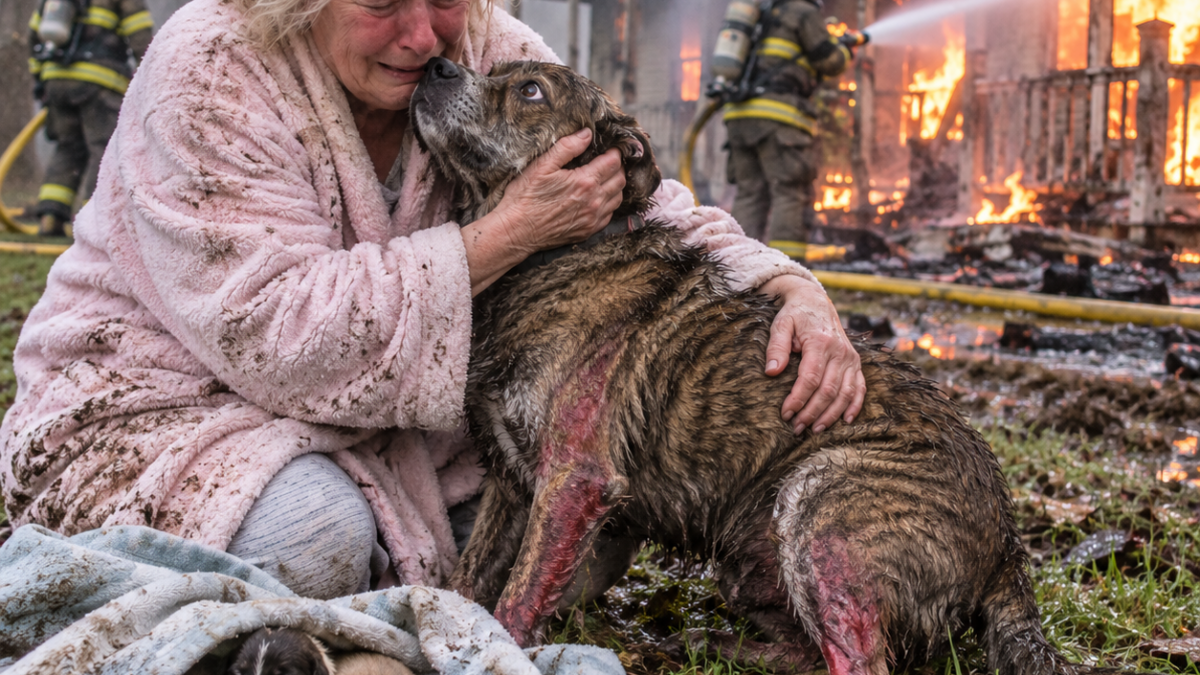
The mother dog had already run through the flames three times, and every trip back out had cost her more skin, more strength, and more of the little time she had left.
Three soot-covered puppies were alive beneath a blanket in the wet grass when we heard another tiny cry come from somewhere inside the burning kennel.
Then the injured dog counted her babies with her nose, realized exactly what we had realized, and began pulling toward the fire again.
My name is Claire Morel.
I was thirty-nine then, driving a school bus in a small village near Saumur and serving as a volunteer firefighter whenever the pager on my nightstand went off.
That morning, I didn’t need the pager.
I saw the smoke myself.
It was just before six, cold and gray, and I was driving toward the depot when I noticed a dark column rising behind Monique Lemaire’s house.
I knew Monique.
Everyone did.
She was sixty-eight, widowed, stubborn, and incapable of ignoring an animal that needed somewhere safe to sleep.
Her property was never a formal shelter.
It was simply where frightened dogs sometimes stayed between bad places and better ones.
I turned into her drive and saw her standing outside in a bathrobe, bare ankles above gardening clogs.
“Claire!”
Her face was white.
“The puppies.”
Behind the house, a small wooden kennel was burning.
“How many?”
“Four.”
Then something moved through the smoke.
A brindle female burst from the doorway carrying a puppy by the scruff.
She crossed the yard, placed the tiny body in the wet grass, touched its face with her nose, and turned around.
“No!”
I reached for her.
She slipped past me.
Back into the fire.
I called emergency dispatch while Monique wrapped the puppy in her robe.
By the time I pulled on the protective jacket I kept in my vehicle, the dog came out again.
A second puppy hung gently from her mouth.
A little tan male.
His coat was blackened with soot.
She set him beside the first.
“Two,” Monique whispered.
The mother sniffed both puppies.
Then she looked toward the flames.
And went back.
Sirens were coming now.
My crew arrived.
Marc, our team leader, jumped down before the engine had fully stopped.
“What have we got?”
“Adult female. Four puppies total. Two out.”
Water lines came off the truck.
Smoke rolled under the kennel roof.
Then the mother appeared again.
This time she was limping badly.
The fur over her left shoulder had curled from heat.
Part of her whiskers was gone.
One front paw barely touched the ground.
But she still had a puppy in her mouth.
She reached the grass.
Lowered the third baby beside the others.
And collapsed.
Monique dropped beside her.
“That’s enough, sweetheart.”
The dog’s chest moved violently against the ground.
Marc brought a blanket.
I crouched beside her.
“You did it.”
Then we heard the sound.
Tiny.
Thin.
Almost lost beneath cracking wood and rushing water.
A puppy crying.
Inside.
Monique stopped breathing.
The mother lifted her head.
“No,” Monique whispered.
The dog tried to rise.
Her front legs failed.
She fell against Monique’s knees.
“We’ll get him,” I said.
The puppy cried again.
The mother turned toward the three babies under the blanket.
She touched the first.
The second.
The third.
One.
Two.
Three.
Then she stared at the burning kennel.
She knew.
Monique grabbed her collar.
“You are not going back.”
The dog pulled.
Not wildly.
Not in panic.
She simply leaned forward with everything she had left.
Her burned paw slid through the grass.
“Please,” Monique sobbed. “You’ll die.”
I reached toward the dog.
Then the roof inside the kennel gave a violent crack.
Sparks flew from the doorway.
Marc shouted for everyone to move back.
And in that single second, Monique’s fingers loosened.
The mother dog pulled free.
She crossed the wet grass on injured feet and disappeared into the smoke for the fourth time.
I ran after her.
What we found inside made every firefighter around me forget, for one terrible moment, about the flames above our heads.
PART 2
“Claire!”
Marc grabbed the back of my jacket before I reached the entrance.
The roof groaned again.
I could feel heat pushing through the opening in waves.
“She went in!”
“I saw her.”
“There’s still a puppy!”
“I heard it.”
Marc looked at the structure.
The kennel wasn’t large, but the fire had already eaten through most of the roof supports on the left side.
A section near the back had collapsed.
The hose team was knocking down flame from outside, but visibility through the entrance was almost zero.
“Thirty seconds,” Marc said.
“What?”
“If we can get access from the right side, we make a quick entry. Nobody improvises.”
The words were for me.
He knew me.
He knew exactly how close I was to ignoring every rule I had ever learned.
Inside the doorway, I heard something scrape.
Then a cough.
Not human.
The mother dog.
“She’s alive.”
Marc swore under his breath.
Another firefighter, Éric, came up with breathing equipment.
“Ready.”
Marc pointed toward the right wall.
“Hit that side first.”
Water hammered the burning boards.
Steam exploded back.
I looked toward Monique.
She was kneeling over the three puppies, clutching the blanket around them.
Her eyes were fixed on the kennel.
“Bring her back,” she said.
Not the puppy.
Her.
That stayed with me.
She already understood the thing I was only beginning to feel.
The mother had done enough.
Whatever happened next was our job.
The flames dropped just enough.
Marc nodded.
“Go.”
Éric and I went low through the doorway.
Smoke swallowed everything.
The world narrowed to heat, the beam of my light, and the sound of my own breathing.
The first few feet were clear enough.
A burned food bowl.
A collapsed wooden divider.
Blankets smoldering along one wall.
Then I heard it.
A whine.
Close.
“Right side!”
Éric moved toward the sound.
My flashlight found the mother first.
She was lying on her side beneath part of a fallen support beam.
For one awful second, I thought it had crushed her.
Then her head moved.
And beneath her chest, almost completely hidden by her body, was the fourth puppy.
She had found him.
The beam had come down after she reached him.
Her body was between the timber and the puppy.
“She’s pinned!”
Éric grabbed the charred end of the support.
I moved beside him.
“On three.”
The beam was heavier than it looked.
Part of the roof weight was still on it.
“Three!”
We lifted.
Barely.
The mother tried to move and cried out.
That sound went through me.
Not the howl of panic.
Pain.
Pure pain.
“Again!”
Éric shifted his grip.
I got one knee under the beam.
He heaved.
A few more inches.
Enough.
The dog dragged herself forward.
The puppy remained beneath her.
I reached.
My glove closed around a tiny warm body.
“Got him.”
“Get out!”
Éric dropped the beam.
I tucked the puppy inside my jacket.
The mother tried to stand.
Couldn’t.
There was no way she was walking out.
I wrapped one arm under her chest and the other behind her ribs.
She was larger than I realized.
Maybe sixty pounds.
In full gear, half crouched, with smoke everywhere, she felt like a hundred.
Éric took her back end.
“Move!”
We stumbled toward the entrance.
Something crashed behind us.
Marc’s voice came through the smoke.
“Out! Out!”
Then daylight.
Cold air.
Wet grass.
Hands.
People shouting.
We got her clear seconds before another section of roof collapsed.
Monique screamed when she saw the dog.
Not fear.
Relief.
“The baby?”
I opened my jacket.
The fourth puppy moved.
Barely.
A tiny black-and-white female.
Soot covered her face.
But she was breathing.
Monique made a sound I had never heard from another human being.
Half laugh.
Half sob.
She gathered the fourth puppy with the others.
The mother lay on the grass.
Her eyes searched.
I knew what she wanted.
“Bring them closer.”
Monique placed the blanket near her face.
The mother lifted her head.
One.
Two.
Three.
Four.
She smelled every puppy.
Then her head dropped.
“Claire.”
Marc’s voice changed.
I looked at him.
The mother’s breathing was too fast.
Her gums looked wrong.
Grayish.
“Smoke inhalation.”
I shouted for oxygen.
We carried her away from the heat.
Someone brought a pet oxygen mask from the engine.
I held it over her muzzle.
“Come on.”
Her eyes were half closed.
“Stay with me.”
It was ridiculous.
This dog didn’t know me.
She had met me fifteen minutes earlier.
But there are moments when language becomes something you say for yourself.
“Stay.”
The ambulance for animals was still several minutes away.
The puppies cried.
The mother’s ears moved.
That helped.
“Let her hear them.”
Monique leaned over the blanket.
“Come on, little ones.”
A puppy squeaked.
The mother opened her eyes.
Marc crouched beside me.
“Heart rate’s fast.”
“She’s burned.”
“I know.”
“Her paw.”
“I know.”
I hated him saying it calmly.
Because calm meant serious.
Then the mother tried to lift her head toward the puppies.
I nearly laughed.
“You impossible girl.”
Her tail moved once.
Marc looked at me.
“She’s fighting.”
“Yes.”
By the time the emergency veterinary transport arrived, the kennel was almost completely down.
The fire was controlled.
The danger wasn’t.
We loaded the mother first.
Monique insisted on riding with the puppies.
“You can’t drive like this,” I told her.
“I’m going.”
“I know.”
I looked at Marc.
He nodded.
“I’ll handle the scene.”
I climbed into the transport van too.
My bus route could wait.
At that moment, everything could wait.
The veterinary clinic in Saumur had been warned.
When we arrived, three people were waiting outside.
The mother dog disappeared through one set of doors.
The puppies through another.
For the first time since I saw the smoke, there was nothing useful for me to do.
That was when my hands began shaking.
Monique noticed.
“You’re freezing.”
“I’m fine.”
“You’re soaked.”
So was she.
Her bathrobe was muddy.
One clog was missing.
I started laughing.
She looked down.
Then she laughed too.
It lasted maybe ten seconds.
Then we both cried.
A veterinary technician brought us blankets.
“What’s her name?” she asked.
I looked at Monique.
Monique looked ashamed.
“I don’t know.”
“What?”
“She arrived two days ago.”
That surprised me.
“You didn’t name her?”
“She had a name on the surrender paper.”
“What?”
Monique swallowed.
“Ruby.”
I don’t know why that hurt.
Maybe because names make suffering personal.
Ruby.
The mother dog who had run into fire four times.
Ruby.
“Where did she come from?”
Monique sat down.
“A man brought her.”
“What man?”
“He said she belonged to his brother.”
“Why did he surrender her?”
“He said the puppies were unexpected and he couldn’t keep them.”
I frowned.
“Four puppies and a nursing mother are not a surprise for one morning.”
“I know.”
“Was she injured when she arrived?”
“She limped a little.”
“Why didn’t you tell me?”
“I had a veterinary appointment scheduled for today.”
Monique looked toward the treatment doors.
“I thought she had twisted something.”
“Was she thin?”
“Yes.”
“How thin?”
“Not like this.”
“What do you mean?”
“She had been feeding the puppies. I thought that was why.”
I leaned back.
Pieces were forming.
Not yet a picture.
“Who was the man?”
“His name was Damien Roche.”
I knew the name.
Not well.
Enough.
He lived about fifteen kilometers away.
Bought and sold hunting dogs.
Not a licensed breeder as far as I knew.
The kind of man whose animals appeared in classified ads every few months.
“What did he tell you about Ruby?”
“That she was three.”
“Is she?”
“I don’t know.”
“What else?”
“That she was gentle. That his brother had moved. That he just needed temporary help.”
“Temporary?”
Monique nodded.
“He said he might come back for her after he found homes for the puppies.”
Something in my stomach tightened.
“You were going to give her back?”
“No.”
She looked at me sharply.
“I hadn’t agreed to anything.”
“What did you agree to?”
“Forty-eight hours while I contacted the rescue association.”
That explained why Ruby was in the kennel instead of the house.
Monique normally fostered dogs indoors.
But new animals were quarantined briefly until a veterinarian checked them.
A small detached kennel reduced disease risk.
That kennel was now ash.
“Did Damien know where she was staying?”
“Yes.”
“Did he come back?”
“No.”
I looked through the clinic window.
A veterinarian was moving quickly around Ruby.
“Claire?”
Monique’s voice softened.
“You think the fire was deliberate?”
“I don’t know.”
I meant it.
At that moment, I genuinely didn’t.
Small wooden kennels burn.
Heat lamps fail.
Old wiring arcs.
Accidents happen.
But volunteer firefighters learn to notice where flames start.
And what I remembered from the scene bothered me.
The kennel had no mains electricity.
Monique used battery lanterns.
There was no heater.
No electrical wiring inside.
The puppies had blankets and a thick insulated box.
So what had ignited?
I stood.
“Stay here.”
“Where are you going?”
“Back.”
“To the fire?”
“Yes.”
“Why?”
“Because Marc is still there.”
Her face changed.
“Claire…”
“Don’t decide anything yet.”
I squeezed her shoulder.
“Right now Ruby needs you.”
The drive back took fifteen minutes.
I made it in eleven.
The scene looked worse in daylight.
Fire does that.
At first there is adrenaline.
Then ash.
Marc was speaking with a gendarme near the ruined kennel.
He looked at me.
“How’s the dog?”
“Alive.”
“Puppies?”
“All four.”
His shoulders dropped.
“Good.”
“Cause?”
He looked toward the structure.
“Too early.”
“What’s bothering you?”
He smiled without humor.
“You came back because something’s bothering you.”
“No electricity.”
“Correct.”
“No heater.”
“Correct.”
“Monique doesn’t smoke.”
“Correct.”
“What did you find?”
Marc crouched near the edge of the burn area.
A small metal container lay in the grass.
Darkened.
Partly melted.
He pointed.
“Accelerant odor.”
My stomach sank.
“Gasoline?”
“Could be.”
The gendarme beside him introduced himself as Lieutenant Arnaud Pelletier.
“We’re treating it as suspicious until the analysis comes back.”
Monique’s house had a security camera.
Cheap.
One camera above the side door.
Mostly intended to watch the driveway.
It faced part of the path leading behind the house.
The recorder had survived.
Marc looked at me.
“You know anyone who’d want to burn her kennel?”
I thought of Damien.
Then immediately forced myself to slow down.
Suspicion is not evidence.
“Maybe.”
We watched the footage in Monique’s kitchen.
At 4:47 a.m., a vehicle passed slowly along the road.
Dark van.
At 5:06, headlights appeared again.
The vehicle stopped beyond the camera’s main view.
At 5:12, a figure came along the side path.
Hood.
Dark clothes.
Face not visible.
They disappeared behind the house.
At 5:19, the same person returned.
At 5:23, the vehicle drove away.
Smoke first appeared on camera at 5:31.
I felt cold.
Arnaud paused the footage.
“Can you identify the vehicle?”
“No.”
Marc looked at me.
“What are you thinking?”
“Ruby arrived two days ago.”
“So?”
“She was surrendered by Damien Roche.”
Arnaud wrote the name.
“You know him?”
“By reputation.”
“What reputation?”
“Dogs.”
That wasn’t enough.
So I told him only facts.
Monique had received Ruby and four puppies from Damien.
Temporary surrender.
Ruby had arrived underweight and limping.
Damien knew where she was.
The fire began less than forty-eight hours later.
Arnaud did not react dramatically.
Good investigators rarely do.
“We’ll speak to him.”
I returned to the clinic before noon.
Ruby was alive.
That was the first sentence Dr. Elise Perrin gave us.
Not fine.
Alive.
She had second-degree burns across part of her shoulder, chest, and front paws.
Smoke inhalation.
A significant wound to her left foreleg that had existed before the fire.
That last part mattered.
“What kind of wound?”
Dr. Perrin brought us into a consultation room.
“Old fracture.”
“How old?”
“We can’t date it precisely yet. Weeks at least.”
Monique covered her mouth.
“And nobody treated it?”
“It healed badly.”
“Can you save the leg?”
“I think so.”
“Will she walk normally?”
“Probably not.”
I looked through the glass.
Ruby lay under oxygen.
“Will she be in pain?”
“Not if we manage it properly.”
“And the burns?”
“Serious but treatable.”
“Puppies?”
“Three are stable. One inhaled more smoke.”
“The last one?”
“Yes.”
My heart tightened.
“What happens?”
“Monitoring. Oxygen. Fluids.”
Monique whispered, “She went back for her.”
Dr. Perrin looked at us.
“Four times?”
“Yes.”
The veterinarian stared through the glass.
Then said quietly, “Animals do extraordinary things for their young.”
I thought of Ruby under the beam.
Her body over the puppy.
Extraordinary felt too small.
The fourth puppy survived the first night.
That became our whole world.
Every few hours, updates.
Still breathing.
Still warm.
Still nursing with assistance.
Ruby herself could not nurse normally because of the burns, so the puppies were bottle-fed and given carefully supervised contact.
The first time Ruby saw them after treatment, she tried to stand.
Dr. Perrin stopped her.
“Not yet.”
Ruby whined.
They placed the puppies in a padded box beside her enclosure.
One squeaked.
Ruby lowered her head against the barrier.
All four crawled toward the sound of her breathing.
I stood in the hallway and cried like an idiot.
Monique cried too.
“We’re useless,” I told her.
“Yes.”
The investigation moved quickly.
Accelerant residue came back positive.
Gasoline.
Not enough by itself.
The security footage gave investigators timing.
Then they found a road camera several kilometers away.
The dark van had a damaged right taillight.
Damien Roche owned a dark Renault van with a damaged right taillight.
Still not enough.
He told police he had been home all night.
His phone data disagreed.
At 4:39 a.m., his device left his village.
At 5:47, it returned.
He claimed he had gone for cigarettes.
No purchase appeared on his bank account.
He said he paid cash.
Possible.
Then Monique remembered something.
“The papers.”
“What papers?”
“The envelope Damien gave me.”
We were in the clinic cafeteria.
She stood so quickly her chair scraped.
“He gave me vaccination papers.”
“Did you bring them?”
“They’re at home.”
The envelope survived because it had been inside Monique’s kitchen.
Among the papers were vaccination records for Ruby.
And a breeding record.
Not official.
Handwritten.
Dates.
Litters.
Male names.
Amounts.
Ruby had not produced one accidental litter.
She had produced at least four.
She was not three years old either.
Probably closer to six.
And her listed owner wasn’t Damien’s brother.
It was Damien.
That turned the story.
He had lied about ownership.
Lied about the puppies being accidental.
Lied about why he surrendered her.
Why?
Investigators obtained veterinary and sales records.
Damien had been breeding dogs without the required declarations.
Ruby had produced multiple litters.
When her injured leg made her less useful, he apparently tried to dispose of her quickly.
But why burn the kennel after surrendering her?
The answer came from the envelope.
Monique had photographed the papers the afternoon Ruby arrived.
She had sent them to a rescue coordinator.
The coordinator noticed inconsistencies.
She had told Monique she intended to report Damien’s operation.
A text message existed.
Monique to Damien:
I’ve reviewed Ruby’s records. We need to discuss this. I’m forwarding them to the association.
His reply:
Don’t involve yourself in things you don’t understand.
Two hours later:
Give me the papers back.
Monique had refused.
The following morning, kennel burned.
Now there was a motive.
Destroy Ruby.
Destroy whatever evidence he thought might be with her.
Maybe frighten Monique.
Maybe all three.
When Arnaud told us investigators had found traces of the same accelerant container brand in Damien’s garage, Monique’s face went completely still.
“He tried to burn them alive.”
Arnaud chose his words carefully.
“That is what the evidence increasingly indicates.”
Monique stood.
“I want to see him.”
“No.”
“Why?”
“Because nothing useful will happen.”
“I want him to see Ruby.”
“No.”
She looked at me.
“Claire.”
“He does not get near her.”
“I want him to understand.”
“He understands.”
I knew men like Damien.
Maybe not him specifically.
But the type.
If he had lit that fire, he understood exactly what burning meant.
The problem wasn’t ignorance.
It was entitlement.
Ruby was an object that had stopped producing value.
Monique was a woman he believed he could intimidate.
Four puppies were collateral.
We did not need him to understand.
We needed him stopped.
The gendarmes searched his property.
What they found made the fire case larger.
Eleven dogs.
Three pregnant females.
Two males.
Cramped kennels.
Poor sanitation.
No veterinary records for several animals.
One dog with untreated skin disease.
Another limping.
All were removed pending investigation.
Monique cried when I told her.
Not because she was surprised.
Because she imagined Ruby among them.
How many litters?
How many nights?
How many injuries?
The rescue association took most of the dogs.
Veterinary clinics spread the workload.
I volunteered transport.
That was how I met Hazel.
A small black female who had lived two kennels away from Ruby according to Damien’s handwritten records.
She shook the entire drive.
No burns.
No visible serious injuries.
Just fear.
When I opened the carrier at the rescue center, she refused to come out.
I sat.
Waited.
After twenty minutes, she moved.
One paw.
Then another.
For the first time, Ruby’s story became larger than the fire.
The fire was the moment the hidden thing became visible.
Damien had built a business around animals nobody outside his property really saw.
The puppies sold.
The mothers remained.
Again.
Again.
Again.
When they stopped being profitable, they became problems.
Ruby had become a problem.
That thought made me angrier than the flames.
Because the fire was spectacular.
The years before it were quiet.
Quiet suffering is easier to miss.
Ruby stayed hospitalized for twelve days.
The fourth puppy—whom Monique named Ember, despite everyone groaning at the obviousness—was discharged on day nine.
The other three became Ash, Clover, and Milo.
“Clover?” I asked.
Monique shrugged.
“I ran out of fire names.”
“Good.”
The puppies went into temporary foster care together.
Ruby could not join them immediately.
Her burns required dressing changes.
Her damaged leg needed treatment.
And there was another problem.
Every time she smelled smoke on a firefighter’s jacket, she panicked.
Including mine.
The first time I visited after a call, I didn’t think about it.
I walked into the recovery room.
Ruby smelled my sleeve.
Her pupils widened.
She tried to back into the wall.
I froze.
“Ruby.”
No.
Her body began shaking.
I left immediately.
Outside, I cried.
Dr. Perrin found me.
“You didn’t do anything wrong.”
“I scared her.”
“You smelled like the event.”
“I should have known.”
“You know now.”
After that, I showered and changed before visits.
No fire gear in my car.
No smoke odor.
Ruby taught me that rescue doesn’t end when you carry someone out.
Their body can leave first.
Fear may take longer.
The first time she willingly walked toward me happened nearly three weeks after the fire.
I was sitting on the clinic floor.
No uniform.
No protective coat.
Just jeans and a sweater.
Ruby limped toward me.
Stopped.
Sniffed my hand.
Then rested her chin against my knee.
I did not move.
Not even to pet her.
She decided.
Eventually she pushed harder into my leg.
“Okay.”
I touched her neck.
Her tail moved.
Once.
That was enough.
The puppies were brought for a supervised reunion after Ruby’s wounds improved.
Chaos.
Four growing puppies recognized her immediately.
They swarmed.
Ruby tried to stand too quickly.
Clover climbed on her face.
Milo bit her ear.
Ash disappeared under her belly.
Ember, the last puppy from the fire, stayed slightly apart.
Then approached.
Ruby froze.
She sniffed Ember from nose to tail.
Again.
Again.
Then licked her face so intensely the puppy fell over.
Monique laughed and sobbed simultaneously.
“She knows.”
Maybe she did.
Maybe she simply checked every puppy carefully because that was what mothers do.
I didn’t need science to give me permission to be moved.
Ruby stayed with Monique after discharge.
Not in the kennel.
That structure was gone.
She slept in Monique’s kitchen.
On an orthopedic bed.
At first, she refused to sleep deeply.
Every sound woke her.
She checked the puppies constantly.
If one moved into another room, Ruby followed.
If a door closed between them, she whined.
The foster coordinator worried.
“She needs to learn they’re safe.”
“How?”
“Time.”
That answer again.
Time.
The puppies grew.
Their personalities appeared.
Milo was reckless.
Ash liked shoes.
Clover screamed whenever meals were three seconds late.
Ember was quiet.
Smaller.
She slept pressed against Ruby’s chest.
Monique said, “Of course she does.”
The trial did not happen quickly.
Nothing legal does.
Damien was charged with arson-related offenses, animal cruelty, unlawful breeding violations, and other associated offenses.
His lawyer argued circumstantial evidence.
The hooded figure couldn’t be visually identified.
Phone data only showed movement.
Gasoline was common.
The container brand was common.
Dog breeding paperwork did not prove fire-setting.
All true.
Then investigators found deleted messages recovered from Damien’s phone.
One sent to a friend the night before the fire:
That old woman thinks she can ruin me over a useless bitch. I’ll handle it tonight.
The friend replied:
Don’t do anything stupid.
Damien:
Tomorrow there won’t be anything left for her to report.
That was the sentence that ended most of the argument.
When Arnaud told me, I sat down.
Not because I was shocked.
Because I had spent months imagining motive.
Now it existed in black and white.
Tomorrow there won’t be anything left.
He had intended erasure.
Instead, Ruby carried three puppies out herself.
We carried her and the fourth.
His fire exposed the very operation he was trying to hide.
There was something almost unbearably precise about that.
He tried to destroy evidence.
The fire created witnesses.
Neighbors.
Firefighters.
Veterinarians.
Police.
Rescue groups.
News coverage.
Inspection records.
Eleven seized dogs.
Paper trails.
Photographs.
Medical evidence.
Everything got larger.
That became the revenge.
Not manufactured.
Not violent.
His own act amplified the truth.
The trial began nearly a year later.
Ruby was not there.
I refused every suggestion from reporters that she should appear outside the courthouse.
She wasn’t a symbol for public consumption.
She was a dog.
A recovering one.
I testified.
So did Marc.
Monique.
Dr. Perrin.
Arnaud.
The rescue coordinator.
A fire investigator.
Damien sat behind his lawyer.
Clean shirt.
Controlled expression.
He looked smaller than I expected.
That happens sometimes.
You build someone enormous in your mind because of the damage they caused.
Then you see them beneath fluorescent courtroom lights and realize they are just a person who made choices.
Bad ones.
Deliberate ones.
No monster needed.
That is more frightening.
The prosecutor asked me what I saw when I arrived.
I described Ruby carrying the first puppy.
Second.
Third.
Collapsing.
Hearing the fourth.
Going back.
The defense attorney asked whether I saw Damien at the property.
“No.”
“Did you see him ignite anything?”
“No.”
“Then you cannot personally connect him to the fire.”
“I can personally tell you what the fire did.”
“Not my question.”
“No.”
That was fine.
Evidence does not need every witness to prove everything.
My job was my piece.
Monique’s testimony was harder.
Damien’s lawyer questioned why she left Ruby in a detached kennel.
Whether fire precautions were adequate.
Whether she should have discovered the fire sooner.
I watched Monique shrink.
Then straighten.
“She was in quarantine.”
“Alone?”
“With her puppies.”
“Inside a wooden structure.”
“Yes.”
“Was that safe?”
“It had been safe for eleven years.”
“Until it wasn’t.”
The prosecutor objected.
Sustained.
But damage had been attempted.
Monique looked toward me.
I wanted to jump over the rail.
Instead, she answered the next question with more strength.
“Did you have gasoline stored near the kennel?”
“No.”
“Did you light any fire?”
“No.”
“Did Ruby have access to ignition sources?”
“No.”
“Did you invite Monsieur Roche onto the property that morning?”
“No.”
Then the prosecutor showed the video.
The hooded figure.
The timing.
The smoke.
And suddenly Monique wasn’t the one being examined.
Facts were.
Damien’s recovered messages became central.
So did evidence from his breeding property.
Veterinary records showed untreated conditions.
Sales records showed repeated litters.
Ruby’s old fracture matched a period when she had been advertised as “temporarily unavailable.”
That phrase made me sick.
Temporarily unavailable.
Not injured.
Not in pain.
Unavailable.
A production unit out of service.
The verdict did not come dramatically.
No gasp.
No pounding music.
Just findings.
Guilty on the most serious charges presented.
Other counts merged or resulted in separate penalties.
He received prison time, financial penalties, a long-term prohibition on keeping or breeding animals, and orders connected to the costs of seized-animal care.
His breeding operation ended.
Permanently.
The rescued dogs were eventually legally released for adoption.
That was the part I cared about.
Hazel went to a quiet retired couple.
One of the pregnant females delivered seven puppies under veterinary care.
Another older dog named Bastian was adopted by a veterinary nurse.
Not every animal recovered easily.
Some had behavioral problems.
Some medical conditions.
One required surgery.
But none went back to Damien.
When Arnaud called with the final order, he said, “It’s done.”
I looked at Ruby asleep in Monique’s kitchen.
“What’s done?”
“He can’t own animals again under the current order.”
I felt something release.
Not joy.
Relief.
“Good.”
“You don’t sound excited.”
“I’m watching Ruby sleep.”
He understood.
“That’s better.”
Yes.
It was.
The puppies reached adoption age.
That created a new problem.
Monique wanted to keep all four.
“You cannot.”
“Why?”
“Because you already have three foster dogs.”
“They’re small.”
“They will become large.”
“Maybe not.”
“They’re Ruby’s puppies.”
She stared at me.
“I hate you.”
“Correct.”
Milo went first.
A young couple with a fenced garden.
Clover went to a schoolteacher.
Ash went to a family near Tours.
Each departure broke Monique a little.
Ruby reacted too.
She searched.
Waited.
Then adjusted.
Ember was last.
Nobody said out loud what everyone thought.
She had almost died.
Ruby had gone back for her.
Separating them felt wrong.
Not scientifically.
Emotionally.
Ember also showed a strong attachment to Ruby without unhealthy dependency.
Monique applied to adopt both.
The rescue coordinator pretended this was unexpected.
“Your application needs approval.”
Monique folded her arms.
“I have fostered for you for nine years.”
“Policy.”
“I hate policies.”
“Claire loves them.”
Both looked at me.
“I’m leaving.”
The adoption was approved.
Ruby and Ember stayed.
For the first time since the fire, Ruby’s future became simple.
No investigation.
No court.
No temporary foster status.
Home.
The burned kennel was never rebuilt.
Monique planted a garden where it had stood.
Lavender.
Rosemary.
Sunflowers.
A small stone path.
Nothing dramatic.
One day, she placed Ruby’s old metal collar tag beneath a stone.
I asked why.
“Because I don’t want to look at it.”
“Then throw it away.”
“No.”
Contradictory.
Very Monique.
Ruby’s scars remained visible.
A patch of fur never fully returned over her shoulder.
Her front leg healed crooked.
Cold weather made her limp worse.
Fireworks terrified her.
Smoke bothered her for years.
But she also learned new things.
The sound of my car.
The word “cheese.”
That Monique’s sofa was technically forbidden but unenforced.
That Ember would steal any blanket not actively occupied.
That wet grass was excellent for rolling.
That kitchen floors were warm near the oven.
The first time Ruby played, really played, I almost didn’t recognize it.
Ember was around eight months old.
She grabbed a rope toy and pulled.
Ruby resisted.
At first gently.
Then harder.
Ember growled theatrically.
Ruby’s ears lifted.
She pulled back.
Suddenly they were tugging.
Ruby’s tail wagged.
Monique called me immediately.
“Come over.”
“Why?”
“She’s playing.”
“That’s the emergency?”
“Yes.”
I went.
Of course I went.
By the time I arrived, Ruby was asleep.
“You made me drive fourteen kilometers.”
“She played.”
“I believe you.”
“No, you need to see.”
“I cannot control time.”
Monique looked offended.
The next week, I saw.
Ruby chased Ember three steps across the garden.
Three.
Stopped.
Limped.
Then wagged.
That was enough.
Her world did not need to become enormous.
It needed to become hers.
Two years after the fire, the school where I drove asked me to speak during a safety week.
I refused at first.
“What am I supposed to talk about? Fire extinguishers?”
The principal said, “Ruby.”
Absolutely not.
Then she explained.
A group of children had followed the news story.
They had raised money for animal rescue.
They wanted to know what firefighters do when animals are trapped.
So I agreed.
No Ruby in the auditorium.
Too noisy.
I brought photographs.
One of the burned kennel.
One of the four puppies under the blanket.
One of Ruby months later in Monique’s garden.
A boy raised his hand.
“Why did she keep going back?”
“For her puppies.”
“Didn’t she know it would hurt?”
I paused.
“Probably.”
“Then why?”
I thought about telling him instinct.
Maternal behavior.
Hormones.
All true.
But too small.
“Because sometimes caring about someone is stronger than wanting to stay safe.”
The teacher looked at me.
I immediately added, “That does not mean you run into burning buildings. You call firefighters.”
Children laughed.
Good.
Another girl asked, “Was Ruby brave?”
“Yes.”
“Was she scared?”
“Probably.”
“But brave means not scared.”
“No.”
I shook my head.
“Brave means scared can exist and you still do the thing that matters.”
That answer stayed with me too.
People turned Ruby into a fearless hero.
She wasn’t fearless.
She coughed.
Collapsed.
Her body tried to stop.
She went anyway.
Courage cost her.
We should remember that.
Heroes are not machines.
After the talk, one little girl handed me an envelope.
Inside were four drawings.
One for each puppy.
She had drawn Ruby larger than the house.
Fire tiny behind her.
I laughed.
“Scale is inaccurate.”
The teacher stared at me.
I shut up.
I gave the drawings to Monique.
She framed them.
Naturally.
Ruby turned eight.
Then nine.
Dr. Perrin said her leg was aging faster than the rest of her.
Arthritis.
We added medication.
Joint support.
Shorter walks.
Ember adjusted automatically.
She stopped racing too far ahead.
If Ruby slowed, Ember circled back.
Sometimes they walked shoulder to shoulder.
Monique would watch them and say, “She went back for her.”
Every time.
“Yes, Monique.”
“She went back four times.”
“I was there.”
“I know.”
Same conversation.
Years.
I never got tired of it.
On the fifth anniversary of the fire, Marc brought a small piece of charred wood.
“What is that?”
“Found it in storage.”
Part of the kennel.
“Why did you keep it?”
“Evidence release. I forgot.”
Monique recoiled.
“Throw it away.”
I took it.
For a moment, I considered saving it.
Then remembered the chain from Maya’s case years later in my life—though at that point, I hadn’t lived that story yet. Some objects carry too much power because we let them.
I walked to the fire pit behind Monique’s garden.
Placed the charred wood inside.
Then stopped.
Burning it felt theatrical.
So I put it in the trash.
Monique laughed.
“That’s your ceremony?”
“Yes.”
“Terrible.”
“It’s wood.”
“What about symbolism?”
“I’m a bus driver.”
“You’re a firefighter.”
“Even worse.”
Ruby watched us from the porch.
That was enough symbolism.
The fire had been five years earlier.
The dog was alive.
End of ceremony.
Monique’s health became the next concern.
At seventy-three, she developed heart problems.
Nothing immediately catastrophic.
Enough that her doctor told her to reduce stress.
She laughed so hard when she told me I almost drove her back to the clinic.
“Reduce stress? I foster dogs.”
“You could stop.”
She stared.
“Get out.”
Still, we needed a plan.
Ruby and Ember were hers.
What if Monique became ill?
Who would take them?
The question scared her.
Maybe because Ruby’s life had already been shaped once by someone failing to plan for an animal’s future.
We made paperwork.
Real paperwork.
Veterinary authorization.
Emergency contacts.
Temporary foster.
Permanent placement preference.
I agreed to be first call.
“You’ll take them?”
“If needed.”
“Both?”
“Yes.”
“Promise?”
“Yes.”
Ruby was asleep during this negotiation.
Ember was chewing my shoelace.
I looked at her.
“Do not make me regret this.”
Monique relaxed.
Planning is an underrated form of love.
Nothing happened for another two years.
Then Monique had a minor stroke.
She survived.
Good recovery expected.
But she spent eleven days in hospital.
Ruby and Ember came to my house.
The first night, Ruby paced.
Not from fear.
Searching.
She checked every room.
Front door.
Back door.
Bedroom.
Then waited.
I sat beside her.
“She’s coming back.”
Ruby looked at me.
“I know you don’t believe timelines.”
Ember stole one of my socks.
“Your daughter is a criminal.”
Ruby sighed.
For eleven days, they stayed.
When Monique returned, walking with a cane, Ruby almost knocked her over.
“Slow!”
Monique sat.
Ruby pressed her whole body into her legs.
Ember climbed onto the sofa beside them.
I stood near the door.
That reunion affected Monique deeply.
Later she said, “She thought I left.”
“No.”
“Yes.”
“She knew you were gone.”
“That’s the same to a dog.”
Maybe.
Then Monique said something I remembered.
“I never want an animal to wonder whether someone is coming back because I was too afraid to make a plan.”
The emergency paperwork became part of the foster association’s standard recommendation for elderly carers.
One dog.
One fire.
Ripples.
That is how changes happen more often than headlines admit.
Ruby grew old.
Her muzzle whitened.
The burns became less noticeable beneath age.
People who met her later saw a senior brindle dog with a crooked front leg.
They had no idea.
Sometimes Monique told the story.
Sometimes not.
I preferred when she didn’t.
Ruby deserved relationships with people who knew nothing about the fire.
To them, she was simply Ruby.
The dog who begged for toast.
The dog who hated rain.
The dog who slept with one paw under her chin.
Trauma is part of a life.
It should not become the entire introduction.
Ember grew larger than her mother.
Lean.
Black-and-white.
Fast.
Still slept against Ruby whenever temperatures dropped.
One winter evening, I found them on the same orthopedic bed even though there were two.
“Why do we buy two beds?”
Monique shrugged.
“Humans enjoy wasting money.”
Fair.
At twelve, Ruby stopped taking long walks.
Garden only some days.
She remained interested in food.
Always a good sign.
Dr. Perrin watched her kidneys.
Heart.
Arthritis.
Pain.
We discussed quality of life before it became a crisis.
That mattered.
I had learned something from rescue work.
Love gets selfish near endings.
We want one more week.
One more morning.
One more tail wag.
Animals need us to ask a different question.
Is this day still for them?
Not for us.
Ruby had many good days left.
Then fewer.
One March morning, Monique called.
No greeting.
“Claire.”
I knew.
“What happened?”
“She won’t stand.”
I drove over.
Ruby lay in the kitchen.
Same kitchen where she had learned safety.
Ember beside her.
Monique on the floor.
Ruby lifted her head when I entered.
Tail.
One slow wag.
I sat.
“Hey, firefighter.”
Monique laughed through tears.
“She was the firefighter.”
“Better than most.”
Ruby’s breathing was calm.
But her eyes were tired.
Dr. Perrin came to the house.
She examined Ruby gently.
Advanced arthritis.
Neurologic weakness.
Kidney disease progression.
Nothing dramatic.
Just age arriving at the end of a long borrowed life.
Monique asked the question.
“Is she hurting?”
“Some.”
“Can you fix it?”
“Not in a way that gives her back a comfortable life.”
Silence.
Ember put her nose against Ruby’s cheek.
Dr. Perrin looked at us.
“You don’t have to decide this second.”
Monique shook her head.
“I think I do.”
She cried.
“But I hate that I do.”
I took her hand.
Ruby had once made a decision nobody could stop.
Back into fire.
Again.
Again.
Again.
Now Monique had to make the opposite kind of brave decision.
Hold on?
Or let go?
She chose Ruby.
Not herself.
We gave them the afternoon.
Sun came out.
We carried Ruby to the garden on a blanket.
The old kennel site was flowers now.
Lavender.
Tall grass.
No trace of black timber.
Ruby lay in the sun.
Ember beside her.
Monique brought tiny pieces of chicken.
Ruby ate two.
Refused the third.
“That is deeply concerning,” I said.
Monique laughed.
Ruby’s tail moved.
We talked.
About the morning.
The bathrobe.
The missing clog.
Marc yelling.
The fourth cry.
Monique looked at me.
“Do you remember letting go of her collar?”
“Yes.”
“I blamed myself for years.”
“Why?”
“She went back because I let go.”
“She found Ember.”
“She almost died.”
“We went after her.”
“But what if—”
“Monique.”
She looked at me.
“There is no version of that morning where you control Ruby.”
She smiled weakly.
“No.”
“That dog had a plan.”
“She always did.”
Ember slept with her head across Ruby’s front legs.
Late afternoon, Monique whispered:
“She went back for you.”
Ember’s ear moved.
I looked away.
Dr. Perrin returned before sunset.
Ruby stayed in the garden.
No clinic.
No strange room.
Monique sat behind her.
I sat near her shoulder.
Ember remained beside her until the veterinarian needed a little space.
Then came back.
Monique whispered into Ruby’s ear.
“You got all four.”
Her voice broke.
“All four, my girl.”
Ruby’s eye opened.
“You can stop counting now.”
The sedative relaxed her.
For a moment she looked younger.
No tension.
No effort.
Just rest.
I put my hand on her neck.
That was when I remembered the first morning.
Wet grass.
Smoke.
Her body collapsed.
Four puppies.
Oxygen mask.
Stay with me.
Back then we had begged her to stay.
Now staying was no longer kindness.
I whispered:
“You did enough.”
Her breathing slowed.
Then stopped.
Monique made one small sound.
Ember stood.
Sniffed Ruby.
Waited.
Then lay down beside her.
We let her.
No rushing.
No pulling.
Animals deserve information about loss in the ways they can receive it.
Afterward, Ember searched less than we feared.
Maybe being present helped.
Maybe not.
We don’t know everything dogs understand.
We only know hiding death from them doesn’t always protect them.
Ruby was cremated.
Monique scattered some ashes in the flower garden.
Not all.
Some she kept.
On the anniversary of the fire that year, we met quietly.
No ceremony.
Marc.
Dr. Perrin.
Arnaud, retired by then.
Monique.
Me.
Ember.
We ate breakfast.
Monique put four small pieces of chicken in a row on the garden wall.
I stared.
“What is that?”
“For the puppies.”
“They’re adult dogs living across the region.”
“I know.”
“You are feeding imaginary puppies.”
“Claire.”
“Fine.”
Ember ate all four.
Of course.
News of Ruby’s death reached the families who had adopted Milo, Ash, and Clover.
They sent photographs.
Milo asleep beside a toddler.
Ash gray around the muzzle.
Clover standing on a beach.
Ember in Monique’s garden.
Four puppies.
All old enough to have gray hair.
I looked at those photos for a long time.
That was what Ruby had run into fire for.
Not just four breaths that morning.
Years.
Thousands of meals.
Walks.
Families.
Children.
Beds.
Vet visits.
Rainy afternoons.
Birthdays.
Ordinary lives.
When we say she saved four puppies, we compress all of that into one sentence.
She saved the future attached to each one.
That is what rescue always means.
You don’t save a moment.
You make later possible.
Damien had tried to make sure there would be nothing left.
He failed completely.
His breeding operation ended.
His name became a court record.
Ruby’s puppies became old dogs.
The other seized animals found homes.
Monique continued fostering after her stroke—fewer animals, despite arguments.
The association created stronger intake documentation because of Ruby.
Fire-safety protocols changed.
Temporary kennels received smoke alarms and exterior heat sensors.
The local fire service added pet oxygen equipment to another engine after seeing how useful ours had been.
And every school year, when children climbed onto my bus, I sometimes looked in the mirror and remembered that morning.
Kids complaining about backpacks.
Wet shoes.
Forgotten lunches.
Ordinary noise.
The best kind.
A few years before I retired from driving, a boy climbed aboard carrying a presentation board.
There was a picture of a brindle dog.
I almost drove into the curb.
“Where did you get that?”
He looked terrified.
“My science project.”
“About what?”
“Animal behavior.”
I parked properly.
“Let me see.”
It was Ruby.
The photograph from the newspaper after her recovery.
His project was about maternal behavior in dogs.
He didn’t know I had been there.
I laughed.
“My teacher said she saved four puppies.”
“She did.”
“You know the story?”
“Yes.”
“Was it true she went into fire four times?”
“Yes.”
His eyes widened.
“You were there?”
“I was.”
The entire bus heard.
That was a mistake.
For the next twenty minutes I answered questions.
“Was she on fire?”
“No.”
“Did she bite the firefighters?”
“No.”
“Did the puppies cry?”
“Yes.”
“Were you scared?”
“Yes.”
That one quieted them.
A girl in the second row asked:
“But firefighters aren’t scared.”
I looked in the mirror.
“Yes, we are.”
“Then how do you go inside?”
Training.
Team.
Equipment.
Procedure.
All true.
But I thought about Ruby.
“You go because somebody is still inside.”
That ended the questions.
For about thirty seconds.
Then somebody asked whether firefighters get free pizza.
Children recover quickly from emotional depth.
Good.
Years passed.
Monique eventually stopped fostering.
Her health made the decision for her.
Ember stayed until the end.
When Monique moved into a smaller apartment near her daughter, Ember went too.
Ground floor.
Tiny garden.
No kennel.
Monique complained about lack of space.
Ember occupied most of the sofa.
I visited.
On the wall above the dining table were four photographs.
Milo.
Ash.
Clover.
Ember.
And in the center, Ruby.
Not in the fire.
Not bandaged.
Not heroic.
Ruby asleep on wet grass in sunlight.
One crooked paw visible.
I pointed.
“That’s the one you chose?”
“Yes.”
“Why?”
“She looked peaceful.”
That was the ending Monique wanted.
Not flames.
Peace.
I understood.
When Ember died years later, she was fourteen.
Monique called me.
“She’s with Ruby now.”
I didn’t correct her.
Belief is personal.
“I’m sorry.”
“She lived a long time.”
“Yes.”
“Because Ruby went back.”
There it was again.
Always.
Because Ruby went back.
Monique was quiet.
Then she said, “Can you come tomorrow?”
“Of course.”
We sat in her little apartment.
Two old women by then.
I had gone gray.
Monique had gone almost completely white.
She brought out the original blanket.
I recognized it immediately.
The one that had held the first three puppies in wet grass.
Washed hundreds of times.
Faded.
“You kept this?”
“Yes.”
“Why?”
“I don’t know.”
She handed it to me.
One corner had a scorch mark.
Tiny.
I rubbed it between my fingers.
For years, I had argued against keeping pieces of tragedy.
The blanket felt different.
It wasn’t evidence of fire.
It was where the puppies had been placed after getting out.
A safe side of the story.
I folded it.
“Keep it.”
“I was going to give it to you.”
“No.”
“Why?”
“Because your grandchild will use it for a doll someday and you’ll have a heart attack.”
She laughed.
We drank coffee.
Talked about Ruby.
Not solemnly.
We remembered her hatred of baths.
The time she stole an entire roast from the counter.
Her obsession with one specific patch of sunlight.
The way she would refuse medicine from Monique but swallow it immediately for me.
“Traitor,” Monique said.
“Good judgment.”
We laughed.
That is what happens when grief ages.
Eventually the terrible day stops being the only story you tell.
You get the funny stories back.
That may be one of the kindest forms of healing.
I still pass Monique’s old house sometimes.
New owners.
New fence.
The flower garden remains.
They probably don’t know why it’s there.
Maybe someone told them.
Maybe not.
The place where the kennel stood now grows lavender every summer.
No plaque.
No statue.
Nothing saying a dog once ran through flames there.
I prefer it that way.
Fire consumes.
Gardens return.
That is enough.
If you ask me now what I remember most clearly from that morning, it isn’t the flames.
Not the collapsing roof.
Not even carrying Ruby out.
It is the moment before her fourth run.
Monique holding her collar.
Ruby looking at three puppies.
One.
Two.
Three.
Then looking toward the fire.
There was intelligence in that pause.
Not arithmetic like ours.
Something older.
A mother recognizing absence.
One heartbeat.
Decision.
Then forward.
For years, people called it instinct as if instinct made it less extraordinary.
Maybe it was instinct.
So what?
A heartbeat is instinct.
Breathing is instinct.
Protecting what you love can be instinct too.
The word does not make the act smaller.
Ruby’s body knew one baby was missing.
Her burned feet knew the fire hurt.
Her lungs knew smoke.
Her muscles knew exhaustion.
And still she moved toward the cry.
Then we moved toward her.
That second part matters.
I never tell Ruby’s story as though people stood around admiring a heroic dog while she did our work.
She went first because we could not stop her.
Then we went after her.
That is how rescue should be.
Courage answered by responsibility.
She did what only she could do.
She found her puppy.
We did what we were trained to do.
We brought them out.
Monique did what she could do.
She gave them a home.
Veterinarians did what they could.
Investigators did what they could.
Courts did what they could.
Adopters did what they could.
One act passed into another.
That is why four puppies lived long enough to become old dogs.
No single hero owns the ending.
Not even Ruby.
But she started it.
Sometimes I imagine that fourth puppy inside the smoke.
Ember.
Too young to understand fire.
Crying.
No idea whether anyone was coming.
Then a familiar smell.
Her mother.
A body lowering over hers.
A shield.
Then strange hands.
Light.
Cold grass.
Air.
Life.
Ember never knew the story we told about her.
She didn’t grow up grateful.
Good.
Animals should not carry gratitude as debt.
She simply lived.
Ate.
Played.
Stole blankets.
Grew old.
That was what Ruby earned for her.
Not a monument.
Ordinary life.
The best reward rescue can give.
And if there was revenge in this story, it was never what happened to Damien.
His sentence ended eventually.
His name faded.
People stopped talking about him.
That was appropriate.
The real answer to what he tried to do was everything that remained.
Eleven dogs leaving his property alive.
Four puppies reaching old age.
Ruby sleeping safely for years.
Monique’s garden blooming where the kennel burned.
Firefighters carrying pet oxygen masks because of what we learned.
Foster homes using better safety systems.
Children learning that bravery includes fear.
A mother dog once treated like breeding equipment becoming known, loved, medicated when she hurt, carried when she could no longer walk, and allowed to die in a garden instead of being discarded when her body failed.
He tried to erase her because she was no longer useful to him.
Instead, Ruby became impossible to erase.
Not because a newspaper printed her picture.
Because her life kept multiplying into other lives.
That is what I remember.
Not the man.
Not the fire.
The multiplication.
One dog.
Four puppies.
Eleven rescued animals.
Dozens of foster placements.
Children on a school bus hearing her story.
A garden.
Years.
So when I think of that morning now, I no longer stop at the moment Ruby disappeared into the flames.
I let the story keep moving.
I see her come back out.
I see four puppies beneath a blanket.
I see bandages removed.
I see fur return over burned skin.
I see Ember tugging a rope toy.
I see Milo beside a toddler.
Clover on a beach.
Ash asleep near somebody’s fireplace.
I see Ruby old and gray in Monique’s garden, front leg crooked, eyes half closed in the sun.
And I hear Monique beside me saying the same thing she said for the rest of Ruby’s life whenever anyone asked why the old dog mattered so much.
“She counted them.”
One.
Two.
Three.
She knew one was missing.
And she went back.
[EXTENDED ENDING — APPROX. 1,300 WORDS]
Years later, when people asked me which part of Ruby’s story stayed with me most, they expected me to say the fourth trip into the fire.
Sometimes I let them believe that.
It was easier.
The truth was more complicated.
What stayed with me was everything that came after the flames were gone.
Because surviving one terrible morning is dramatic.
Learning how to live after it is quieter.
Ruby had to learn that smoke did not always mean danger.
That a closed door did not mean she was trapped.
That people touching her injured leg were trying to help.
That puppies could disappear into other homes and still be safe.
That she could sleep deeply enough to dream without needing to count heads every few minutes.
Those victories never appeared in newspaper photographs.
But I saw them.
One morning, almost six years after the fire, I arrived at Monique’s house carrying bread and coffee.
Ruby was lying under the kitchen table.
Ember slept beside her.
Monique pointed toward the dogs.
“Look.”
“At what?”
“Just wait.”
I waited.
Nothing happened.
“Monique.”
“Quiet.”
A delivery van stopped outside.
Years earlier, the sound of a vehicle pulling into the yard would have sent Ruby scrambling to her feet.
She would have checked Ember.
Moved toward the hallway.
Watched every door.
This time, the van door slammed.
Ruby opened one eye.
Then closed it again.
The delivery driver knocked.
Still nothing.
I looked at Monique.
She was crying.
“Oh.”
“Yes.”
Ruby trusted the house enough to remain asleep.
That was the moment Monique had been waiting for.
Not another rescue.
Not another heroic act.
Sleep.
Deep, ordinary sleep.
I sat on the floor beside Ruby.
“You finally retired?”
Her tail moved once without her opening her eyes.
Monique laughed.
“Don’t say that. She’ll start supervising again.”
Maybe that was why, years later, when we talked about Ruby after she was gone, Monique rarely started with the fire.
She started with breakfast.
“She liked toast too much.”
Or the sofa.
“She took my place every afternoon.”
Or Ember.
“She pretended to be annoyed by that dog and then panicked if she couldn’t see her.”
At first, I thought Monique was avoiding the painful memories.
Then I understood.
She was protecting Ruby from becoming only a tragedy.
We do that to rescued animals sometimes.
We freeze them forever at their worst moment.
The abandoned dog.
The burned dog.
The chained dog.
The dog found starving.
Then every photograph, every article, every conversation pulls them backward to the day they almost died.
Ruby had earned more than that.
She had earned boredom.
Habits.
Bad manners.
Favorite foods.
Years nobody wrote about.
That realization changed the way I spoke about rescue forever.
At the fire station, young volunteers occasionally asked about her.
I always told them the same thing.
“Yes, Ruby went into the fire four times.”
Their eyes widened.
Then I added:
“But the important part is that afterward, she got to stop.”
That confused some of them.
So I explained.
The goal of rescue is not to create permanent heroes.
It is to get people and animals to a place where heroism is no longer required.
Ruby should never have needed to run through flames.
Once she survived, our responsibility was to make sure she never had to prove herself again.
That became especially important after Damien’s case became known beyond our region.
People wanted Ruby at events.
Animal welfare fundraisers.
Fire department ceremonies.
Television segments.
One producer even suggested recreating part of the rescue using harmless theatrical smoke.
Monique nearly threw the phone across the kitchen.
“No.”
I agreed.
Ruby did not owe strangers a reenactment of her terror.
She did not owe anyone a heroic pose beside a fire engine.
She did not need to wear a vest that said HERO.
She had already done enough.
Instead, when charities asked to use her story, Monique usually sent the garden photograph.
Ruby asleep.
No flames.
No bandages.
No smoke.
That image became my favorite too.
Because anyone can recognize drama.
It takes more imagination to understand peace as an achievement.
After Ruby died, something surprising happened at the rescue association.
They started a senior-mother program.
Not because every dog had Ruby’s history.
Most didn’t.
But Ruby’s case had forced people to look harder at older female dogs who had been used repeatedly for breeding.
They often arrived with the same problems.
Worn bodies.
Untreated dental disease.
Weak muscles.
Mammary tumors.
Fear.
No training beyond confinement.
Some had never climbed stairs.
Some did not understand toys.
One little spaniel named Poppy froze the first time someone gave her a bed.
She stood beside it for nearly twenty minutes.
Then stepped on.
Then off.
Then on again.
Finally she curled up.
Monique watched the video and said, “Ruby did that.”
Of course she did.
Another dog, Belle, refused to walk through doorways.
Another, Iris, tried to hide food inside blankets.
None of them went into burning buildings.
They didn’t need dramatic histories to deserve help.
That was perhaps Ruby’s broadest legacy.
People stopped asking only, “What terrible thing happened to her?”
They began asking, “What does she need now?”
Better question.
Almost always.
The rescue association kept a small board near the intake room.
No photographs of injuries.
No shocking before-and-after images.
Just one sentence:
THE PAST EXPLAINS BEHAVIOR. IT DOES NOT SET THE LIMIT OF A LIFE.
Monique claimed she invented it.
She did not.
I let her believe she did.
By then, her heart condition had worsened.
She moved more slowly.
Complained about everything.
Still drank terrible coffee.
One afternoon, sitting in her apartment after Ember died, she looked at Ruby’s picture and said, “Do you think she knew?”
“Knew what?”
“That she saved them.”
“The puppies?”
“Yes.”
I thought about it.
“I think she knew when they were missing.”
Monique nodded.
“And when they were safe?”
“Probably.”
“That’s enough.”
We sat quietly.
Then she said, “I wish she could’ve seen them old.”
That hurt.
I reached for my phone.
I still had the photographs.
Milo with gray around his face.
Ash beside the fireplace.
Clover on the beach.
Ember curled on Monique’s sofa months before she died.
I placed the phone in front of her.
“She did.”
Monique frowned.
“No, she didn’t.”
“She knew them as puppies. She gave them the chance to become this.”
I moved through the pictures.
“That’s what she saw that morning, even if she didn’t know it.”
Monique wiped her eyes.
“You make things too poetic.”
“You started it.”
“True.”
She looked again.
Four old dogs.
That was the real scale of Ruby’s fourth trip.
Not the distance from grass to kennel.
Not thirty feet.
Not one burning doorway.
Years.
She crossed a few yards and gave four lives decades of combined time.
There were births inside those adopted families.
Children grew up beside Ruby’s puppies.
One couple married with Milo in their wedding photographs.
Clover helped an elderly man through the year after his wife died.
Ash slept beside two little girls every night.
Ember stayed with Monique through her stroke.
Ruby could never have imagined any of that.
Neither could we.
That is why I became careful whenever someone asked whether an injured animal was “worth” expensive treatment.
Worth according to what future?
The one we can see today?
That is a poor measurement.
On the morning of the fire, Ember was a soot-covered puppy crying beneath a collapsed beam.
If we had reduced her life to that moment, we would have missed fourteen years.
That became the final lesson Ruby left me.
When you save a life, you are not saving what it is right now.
You are protecting everything it might still become.
Years after Monique was gone too, I visited the flower garden one last time before her old property changed hands again.
The lavender had grown wild.
A new family had placed children’s bicycles near the wall.
Someone had hung a swing from the tree.
There was no sign Ruby had ever been there.
I stood where the kennel once burned.
I could hear children laughing inside the house.
For a moment, I thought about telling the new owners.
Then I didn’t.
They did not need the story.
The land did not need to remain sacred.
Ruby’s ending was never supposed to trap that place in tragedy.
So I walked back toward my car.
Halfway to the gate, I heard a dog bark from inside the house.
Young.
Happy.
Then another bark.
A child shouted something and laughed.
I stopped.
Smiled.
And kept walking.
Because that was the kind of ending Ruby had earned.
Not smoke.
Not memorials.
Not people standing forever beside ashes.
Life continuing exactly where something terrible once happened.
And whenever I remember Ruby now, I still see her pause beside those three puppies.
One.
Two.
Three.
I see her turn toward the burning kennel.
I see the decision happen.
Then I let the memory move forward.
Four puppies.
Four homes.
Four old dogs.
A garden where fire once stood.
A mother finally asleep without needing to count anyone.
And I think:
She went back for one missing life.
She could never have known how many years were waiting on the other side of that door.