I LEFT THE SHELTER DOG OUTSIDE IN THE RAIN FOR THREE DAYS—BECAUSE OPENING MY DOOR MEANT FACING THE LIFE I’D SHUT AWAY
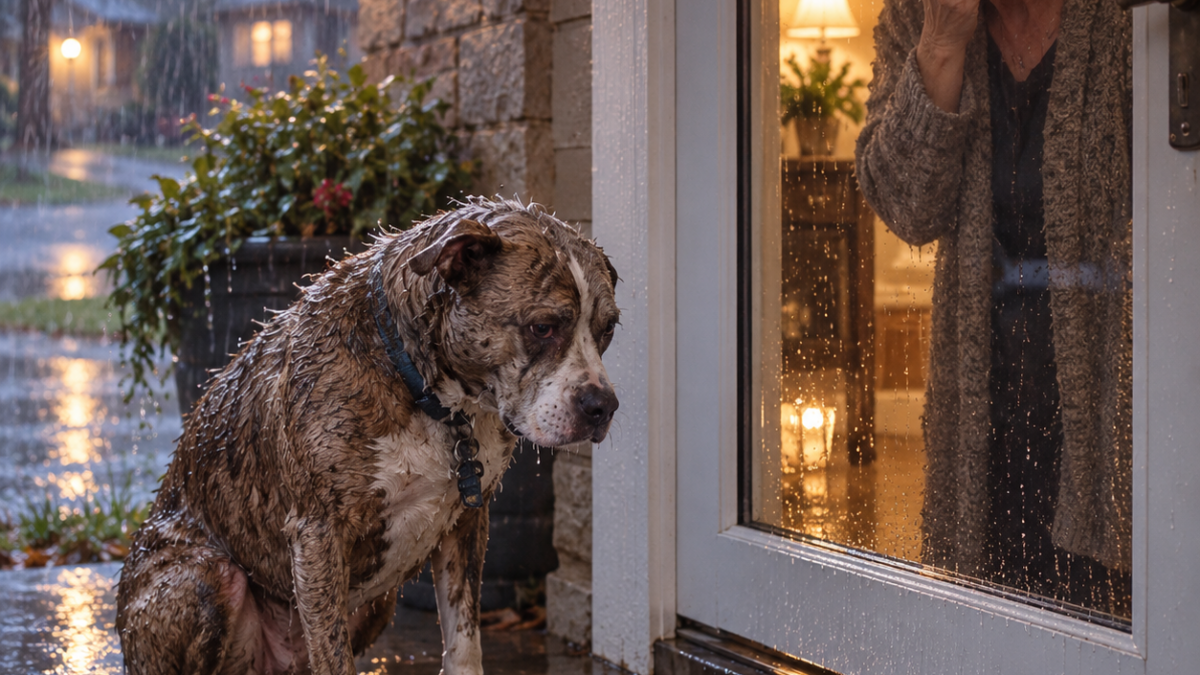
I had already made a bed for Molly beside my radiator, yet for three days I left her sleeping in the February rain because opening my front door frightened me more than the thought of losing her. She never barked, scratched, or begged to be let inside; every night she simply curled beneath my porch light with her nose resting on the blue leash of the last person who had walked away from her. On the third night, something happened on the other side of that locked glass door that forced me to face the room I had avoided for eleven months.
My name is Evelyn Moreau. I was sixty years old and living alone in a small house about twenty kilometers outside Tours.
Eleven months earlier, my only son, Damien, had died in a car accident.
He was thirty-two.
After that, I stopped opening doors.
Not only the front door.
I stopped answering most calls. I kept the shutters half closed. Invitations stayed unopened on the hall table. Damien’s bedroom remained almost exactly as he had left it because touching anything inside felt too much like agreeing he wasn’t coming back.
My younger brother Robert was the only person stubborn enough not to disappear.
Every Sunday he arrived anyway.
He knocked.
Left soup in a cooler.
Checked my gutters.
Then talked to me through the door as if grief were some frightened animal that might eventually approach if he stayed quiet long enough.
One rainy Sunday in February, he brought an actual frightened animal.
“Evie, come look outside.”
“I’m not opening the door.”
“I know.”
I moved the curtain just enough to see.
Beside Robert stood a stocky brindle dog with a broad white chest, one folded ear and a faint scar beneath her left eye.
A blue leash lay between her paws.
“What have you done?”
“She needs somewhere quiet.”
“Take her back.”
“She’s already been adopted twice and returned twice.”
“That isn’t my problem.”
Robert placed a canvas bag beneath the porch chair.
Then he looked directly at me through the glass.
“No. But closed doors seem to be something both of you understand.”
“Robert.”
He started toward his car.
I unlocked the inner wooden door but kept the glass storm door shut.
The dog looked at me.
She didn’t stand.
Didn’t wag.
Just watched rain gather on her whiskers.
“If you don’t want her,” Robert said, “call me.”
“You’re leaving her here?”
“I’m giving both of you time.”
“That’s cruel.”
His face tightened.
“So is watching my sister disappear while she’s still alive.”
Then he drove away.
For six hours, I expected the dog to follow his car.
She remained on my porch.
At dusk, I pushed a bowl of food through the narrow opening.
She waited until I closed the door before eating.
At midnight, I looked through the peephole.
She was curled beneath the porch light with her muzzle resting on that blue leash.
Rain was still falling.
The next morning, she was still there.
I placed an old towel under the chair.
She wouldn’t touch it until I went back inside.
That caution disturbed me more than barking would have.
It was the behavior of an animal that had learned accepting kindness too quickly could make someone take it away.
That afternoon, I finally opened the shelter folder Robert had left.
Her name was Molly.
Approximately five years old.
No bite history.
No major medical problems.
The first adoptive family had returned her because she “failed to bond.”
The second complained that she spent too much time lying near their front door and showed little interest in playing.
At the bottom of the assessment, someone had handwritten:
She attaches through quiet presence. She needs someone capable of understanding that simply staying beside you can already be love.
I looked toward the porch.
Molly was sitting with her back pressed against my door.
I had no idea then that she wasn’t waiting for me to rescue her.
Two nights later, she would force me to unlock a door I had kept closed since the morning police officers came to tell me my son was dead.
PART 2
The third evening, the temperature dropped.
I knew because my kitchen window had begun fogging at the corners and the weather report warned that the rain might turn to sleet overnight.
I also knew because every ten minutes I found myself looking toward the front porch.
Molly was still there.
She had moved beneath the chair, but the wind drove rain sideways beneath the roof.
Her brindle coat had darkened with water.
I stood behind the glass door with my hand on the lock.
Turn it.
That was all I had to do.
One small piece of brass.
A quarter turn.
Open the door.
Let the dog inside.
Instead, my hand stayed still.
It makes no sense until you understand what doors had become to me.
Eleven months earlier, two gendarmes had stood outside that same door.
One older.
One terribly young.
The older one had removed his cap before speaking.
“Madame Moreau?”
I had known before he finished saying my name.
There are tones of voice you recognize without ever hearing them before.
I had opened the door then.
And my life had divided into before and after.
Sometimes grief attaches itself to objects.
A song.
A shirt.
A street.
For me, it attached itself to the front door.
Nothing good had entered through it since.
People brought casseroles.
Flowers.
Condolences.
Forms.
Insurance documents.
Damien’s personal effects from the hospital.
Every knock carried something that confirmed he was gone.
So eventually I stopped answering.
Now Molly sat outside that same door.
Waiting.
I hated Robert for knowing exactly what he was doing.
At nine-thirty, I heated soup and did not eat it.
At ten, Molly stood.
For one hopeful second, I thought she was finally leaving.
Instead, she walked to the edge of the porch and looked toward the road.
She stayed that way for nearly five minutes.
Watching.
Waiting for a car.
Then she returned to the door and lay down.
That hurt me in a place I did not expect.
I knew what it was to keep expecting someone who had already left.
At eleven-fifteen, sleet began tapping the glass.
I stood.
“No.”
Molly lifted her head.
I realized I had spoken aloud.
“You cannot stay out there.”
She watched me.
“This is ridiculous.”
No response.
“You are a dog.”
Her ear moved.
“I am not doing this.”
She placed her chin back on the leash.
I turned away.
I lasted four minutes.
Then I returned and unlocked the glass door.
The sound of that lock turning was so small.
Yet my entire body reacted as if something enormous had broken.
I opened the door six inches.
Cold air rushed inside.
Molly immediately stood and backed away.
“Of course.”
I opened it wider.
“Come in.”
She stared.
“You’ve spent three days wanting this.”
Nothing.
I stepped backward.
Molly lowered her head.
The threshold was between us.
One step.
That was all.
But she would not cross it.
I suddenly remembered the shelter note.
Quiet presence.
I went into the living room and sat on the floor beside the radiator.
From there, I could see the doorway without facing her directly.
The folded mattress lay beside me.
Green camping blanket.
Metal bowl.
Unopened food.
All the things I had prepared before admitting I wanted her inside.
I waited.
Five minutes.
Ten.
Cold air filled the hallway.
I didn’t move.
Then I heard one toenail touch tile.
A pause.
Another.
Molly entered as though the floor might collapse beneath her.
She stopped just past the door.
I wanted to close it.
I didn’t.
She looked backward toward the porch.
Toward her leash.
Then at me.
“Bring it if you want.”
Obviously she could not understand.
Still, Molly turned.
Picked up the blue leash.
And carried it inside.
That almost broke me.
She walked three feet into the hallway.
Stopped.
Then lay down.
Not on the bed.
Not beside the radiator.
Beside the open front door.
I closed it slowly.
Molly flinched when the latch clicked.
Her body tightened.
I immediately opened it again.
“All right.”
She relaxed slightly.
So that first night, I left the door open three inches.
Cold air poured into the house.
My heating bill would have horrified Damien.
He used to lecture me about wasting electricity.
I could hear him.
Mom, you’re heating all of France.
The memory came so clearly that I nearly answered.
I sat on the floor.
Molly remained by the threshold.
Neither of us slept much.
At around two in the morning, she stood.
Her nails clicked down the hallway.
I watched.
She sniffed the kitchen.
Living room.
Bathroom door.
Then she reached the end of the corridor.
Damien’s bedroom.
The door was closed.
Molly stopped.
Everything inside me froze.
“No.”
She looked toward me.
“Not that one.”
She lowered her nose to the gap beneath the door.
“Come here.”
She didn’t.
“Molly.”
The name felt strange in my mouth.
She sat beside Damien’s door.
“No.”
My voice sharpened.
Molly lay down.
I stood.
My knees felt weak.
“Get away from there.”
She looked at me.
I took three steps.
Then stopped.
I had not stood that close to Damien’s door in almost two weeks.
There was nothing frightening behind it.
I knew that.
A bed.
Desk.
Books.
Clothes.
His old camping equipment.
A photograph of him at twelve holding a fish he had absolutely not caught himself.
Objects.
That was all.
Except grief turns objects into explosives.
Molly placed one paw against the bottom of the door.
I lost my temper.
“Stop!”
She jumped.
Immediately backed down the hall.
Her tail tucked.
The fear on her face made me ashamed before the word finished echoing.
I covered my mouth.
“Oh.”
Molly retreated to the front door.
I sat down where I stood.
“I’m sorry.”
She kept watching.
“I’m sorry.”
The house became silent again.
Then my phone rang.
At two in the morning.
I knew before answering that something was wrong.
It was Robert.
His voice sounded strained.
“Evie?”
“What happened?”
“I’m at the hospital.”
I stood so quickly the room shifted.
“What?”
“Don’t panic.”
“Then don’t say you’re at the hospital.”
“I slipped outside the house.”
“Are you hurt?”
“Broken wrist. They think. Maybe two ribs.”
I closed my eyes.
“You idiot.”
“Apparently.”
“Why didn’t you call earlier?”
“I did.”
I looked at my phone.
Three missed calls.
It had been upstairs on silent.
Robert continued.
“I’m fine.”
“Who is with you?”
“Nobody.”
“What do you mean nobody?”
“I drove myself.”
“You drove with a broken wrist?”
“I was committed to making several poor decisions in sequence.”
For the first time in months, a laugh tried to escape me.
It came out as something closer to a sob.
“Stay there.”
Silence.
“Evie?”
“I’m coming.”
There was another silence.
Longer.
“You’re coming?”
“Yes.”
“You don’t have to.”
“I know.”
I hung up.
Then reality arrived.
Coming meant leaving the house.
Driving at night.
Entering a hospital.
The last hospital I had entered was the place where I identified Damien’s body.
My hands began shaking.
“No.”
I sat down.
My coat hung by the door.
Keys on the table.
Molly watched me.
“I can’t.”
My chest tightened.
“I can’t do hospitals.”
Molly stood.
She approached slowly.
One step.
Two.
Then stopped several feet away.
“Robert needs me.”
She tilted her head.
“I know that.”
My breathing became shallow.
The hallway seemed narrower.
Molly came closer.
She did not touch me.
She sat.
Beside.
That was all.
I looked at her.
The shelter note returned.
Simply staying beside you can already be love.
I put my hand on the floor.
Molly looked at it.
After several seconds, she moved one paw forward.
Then another.
Her nose touched my fingers.
The contact lasted less than one second.
She pulled back.
But it was enough.
“Okay.”
I breathed in.
Then out.
“I’ll go.”
I put on my coat.
Molly followed me to the door.
I picked up my keys.
She pressed her nose against my thigh.
“You cannot come.”
Her ears lowered.
“I’ll be back.”
The moment I said those words, Molly froze.
I noticed.
I’ll be back.
For some dogs, maybe those words mean nothing.
For Molly, something changed.
She looked toward the door.
Then at me.
I crouched.
“I mean it.”
Molly remained still.
“I’m coming back.”
I left.
The drive to the hospital took thirty minutes.
I nearly turned around twice.
When the hospital sign appeared, my stomach cramped.
I parked.
Stayed in the car.
People came and went through automatic doors.
I remembered a nurse taking my hands and telling me Damien had not suffered.
I remembered thinking that was supposed to comfort me.
I remembered the plastic bag containing his wallet and watch.
I almost drove home.
Then Robert called.
“Where are you?”
“Parking lot.”
“You came?”
I shut my eyes.
“Yes.”
“I’ll meet you downstairs.”
“No.”
“What?”
“Stay where you are.”
I opened the car door.
“I’m coming in.”
Every step toward those doors hurt.
I walked through anyway.
Robert was sitting in an examination cubicle with his arm splinted and his shirt open while someone taped his ribs.
He saw me.
His face changed.
Not because of pain.
Because I was there.
“You came.”
“Stop saying that.”
“You came.”
“Robert.”
He started crying.
That made me angry.
“If you cry, I’m leaving.”
He laughed.
Then winced.
“Ribs.”
I sat beside him.
He looked at me carefully.
“What about Molly?”
“In my house.”
His eyebrows rose.
“Inside?”
“Do not make this bigger than it is.”
“Inside?”
“Yes.”
He smiled.
I pointed at him.
“You abandoned an animal on my porch in freezing rain.”
“She had shelter.”
“Barely.”
“You opened the door.”
“Because of the weather.”
“Of course.”
“I hate you.”
“I know.”
But I didn’t.
And he knew that too.
Robert was discharged shortly before sunrise.
I drove him home.
Helped him inside.
Put medication and water beside the couch.
He tried to thank me.
I ignored him.
Then I drove home.
As I turned into my road, fear hit me.
Not hospital fear.
Something different.
What if Molly had destroyed the house?
What if she had escaped?
What if I had left the front door imperfectly closed?
What if she had decided I was another person who said I would return and didn’t?
I parked too quickly.
Opened the door.
“Molly?”
Nothing.
My stomach dropped.
“Molly!”
Then I heard toenails.
She appeared at the end of the hallway.
For a second she stopped.
Then her tail moved.
Not much.
Two careful sweeps.
I started crying before she reached me.
Molly walked forward.
Slow.
Still cautious.
She came within inches.
Then pressed the side of her face against my knee.
That was our first real touch.
I lowered my hand to her shoulder.
Molly stiffened.
I stopped.
She stayed.
So I kept my hand exactly where it was.
No petting.
No squeezing.
Just contact.
“I came back.”
Her tail moved again.
That morning, Molly slept beside the radiator.
On the green blanket.
For the first time.
And I slept on the couch three feet away.
When I woke, sunlight was coming through the shutters.
Bright sunlight.
I had forgotten to close them halfway.
I almost got up to correct them.
Instead, I left them open.
That was the first door Molly made me open.
The others took longer.
For the next week, she remained near the front entrance most of the time.
If I went to the kitchen, she stayed in the hallway.
If I went upstairs, she waited below.
She never followed closely.
Never demanded affection.
Never barked when I ignored her.
She simply positioned herself where she could see whether I stayed.
That bothered me.
Because I recognized it.
I had spent eleven months doing the same thing with the world.
Watching from far enough away that nothing could reach me.
Robert visited the following Sunday with his wrist in a cast.
Molly saw him through the window.
She stood.
Tail wagged once.
Then she looked at me.
“She remembers you.”
“Of course she does.”
“You left her.”
Robert ignored that.
“Open the door.”
I hesitated.
He noticed.
“It’s me.”
“I know.”
“You came into a hospital for me.”
“That was different.”
“How?”
“You were hurt.”
“I’m hurt now.”
“You are manipulative.”
He held up his cast.
“I can barely make soup.”
“You never made soup before.”
“Exactly. Disability is devastating.”
I laughed.
Actually laughed.
Molly’s ears lifted.
Robert heard it too.
His expression softened.
I hated that.
I opened the door.
He stepped inside.
Molly backed away.
Robert did not approach her.
“Hello, Molly.”
She watched.
He sat at the kitchen table.
We drank coffee.
At one point, Molly moved from the hallway to the kitchen entrance.
Robert kept talking to me.
She came another foot.
Then another.
Finally she lay beneath the table.
Not touching anyone.
Just present.
Robert looked down.
Then at me.
Neither of us commented.
After he left, I found an envelope on the kitchen counter.
Inside was a photograph.
Damien.
Age twenty-three.
Robert and Damien on a camping trip.
Both filthy.
Both laughing.
Molly’s green blanket was folded in the corner of the photograph.
It had been Damien’s camping blanket.
I had forgotten.
That was why Robert chose it.
I wanted to be angry.
Instead, I sat at the kitchen table holding the picture.
Molly lay beneath me.
“Did he tell you?”
She slept.
“Of course not.”
I put the photograph in a drawer.
Then took it out again.
I left it on the table.
Another door.
Small.
But open.
Two weeks after Molly arrived, the shelter called.
A woman named Sarah introduced herself.
“I’m checking how things are going.”
“She is eating.”
“Good.”
“Sleeping.”
“Good.”
“She refuses to play.”
“That’s normal for Molly.”
“Why?”
Sarah paused.
“What did Robert tell you about her?”
“Two failed adoptions.”
“Did he tell you about before the shelter?”
“No.”
Something in her voice changed.
“Molly had an owner before us.”
I sat down.
“Who?”
“An elderly man named Henri.”
“And?”
“He died.”
I looked toward Molly.
She was by the front door.
Of course she was.
“How?”
“Stroke. At home.”
“Was Molly there?”
“Yes.”
My throat tightened.
“How long?”
“Neighbors estimate most of a day before anyone entered.”
I covered my mouth.
Sarah continued gently.
“Afterward, she stayed with Henri’s daughter for several weeks, but the daughter lived in an apartment that didn’t allow dogs. She surrendered Molly.”
“And then two families returned her.”
“Yes.”
“Because she waited at doors.”
“Yes.”
I stared at Molly.
Suddenly everything changed.
The leash.
The threshold.
Watching cars.
Waiting.
She wasn’t cold.
She wasn’t incapable of bonding.
She had bonded once.
And the person she loved disappeared through a door she could never understand.
“So those families said she didn’t attach?”
“They expected affection to look different.”
“What did it look like?”
“Following routines. Lying nearby. Waiting for people to come home.”
I could barely speak.
“Staying beside them.”
“Yes.”
Sarah was quiet for a moment.
“That’s why we wrote the note.”
After the call, I sat beside Molly.
Not touching.
Just near her.
“I understand.”
Her folded ear moved.
“I hate that I understand.”
She looked at me.
“You waited for him.”
Her eyes stayed on mine.
“And I’ve been waiting for someone too.”
I cried.
Molly did not climb into my lap.
Did not lick my face.
Did not behave like dogs in sentimental films.
She moved six inches closer.
That was all.
Exactly enough.
From that day, I stopped trying to make Molly behave like a rescued dog.
I stopped rolling toys toward her.
Stopped coaxing her away from the door.
Stopped interpreting distance as rejection.
Every morning, I said what I was doing.
“I’m going to the kitchen.”
“I’m going upstairs.”
“I’m getting the mail.”
“I’m leaving for twenty minutes.”
Then I came back.
Predictability.
That was what Sarah recommended.
Molly began following me.
Not immediately.
First to the kitchen doorway.
Then the bottom of the stairs.
Then upstairs.
The first time she entered my bedroom, she stood just inside and looked around.
I let her.
The second time, she lay on the rug.
The third, she slept there while I read.
Damien’s room remained closed.
Molly stopped waiting outside it.
For a while.
Then one afternoon, I heard scratching.
Not frantic.
One soft scrape.
I came upstairs.
Molly was beside Damien’s door.
My chest tightened.
“No.”
She looked at me.
The old reaction rose instantly.
Protect it.
Keep it closed.
Nothing changes if nothing moves.
Molly sat.
I put my hand on the knob.
Couldn’t turn it.
I took my hand away.
Molly stayed.
“You do this on purpose.”
Her tail moved once.
I touched the knob again.
Turned.
The door opened two inches.
The smell hit me first.
Not Damien.
Rooms do not preserve people that way.
Dust.
Wood.
Old fabric.
But memory added everything else.
His aftershave.
Laundry detergent.
Coffee.
The smell of his old car.
I pushed the door farther.
Molly did not enter.
Neither did I.
We stood together.
Five minutes.
Maybe ten.
Then I closed it.
But I did not lock it.
The next day, I opened it again.
Wider.
The day after that, I stepped inside.
Molly stayed at the threshold.
I touched Damien’s desk.
His chair.
A stack of technical magazines.
My fingers found dust.
I laughed once.
“He would be disgusted.”
Molly watched.
“Your Damien,” I said, because I had started speaking to her as if she knew him, “could not tolerate dust.”
I picked up a shirt from the chair.
Held it.
Then sat on the bed.
That was the first time I truly cried in Damien’s room.
Not the numb crying after his death.
Not the exhausted tears at three in the morning.
This was grief with shape.
I missed his laugh.
His terrible haircut at sixteen.
The way he called every Sunday whether he had anything to say or not.
The fact that he borrowed tools and returned them to the wrong drawer.
I missed the future too.
Things that had never happened.
Marriage perhaps.
Grandchildren maybe.
Ordinary arguments.
Christmas dinners.
Getting older together.
Molly finally entered.
She walked to me.
Placed her chin on the mattress near my knee.
I touched the folded ear.
She did not flinch.
“Okay.”
I cried harder.
“You can stay.”
We sat in Damien’s room until evening.
After that, I began sorting slowly.
Not erasing.
Sorting.
There is a difference.
I kept his watch.
Photographs.
Several shirts.
The ridiculous ceramic mug he had painted at school when he was eight.
I donated other clothes.
Robert helped.
The first afternoon we worked together, he held up Damien’s old red jacket.
“You remember this?”
“He wore it for five years.”
“He looked like a fire hydrant.”
I laughed.
Then cried.
Robert hugged me.
For eleven months, I had avoided hugs because people always seemed to use them to signal the end of grief.
A hug.
Then, eventually, you should be fine.
Robert didn’t let go until I did.
Molly lay beneath the desk.
Present.
Quiet.
Love.
Spring came.
For the first time since Damien died, I opened all the shutters.
Neighbors noticed.
Madame Lefèvre from across the lane appeared carrying a cake.
Normally I would have pretended not to be home.
Molly looked at the door.
Then at me.
I opened it.
Madame Lefèvre nearly dropped the cake.
“Evelyn.”
“Please don’t make a speech.”
She laughed.
Then cried anyway.
People began returning slowly.
Coffee with my neighbor.
Lunch at Robert’s.
A walk with Molly around the village.
At first, Molly froze whenever we passed parked cars.
She watched doors.
People exiting.
People returning.
Then she learned our route.
At the bakery, the owner gave her a biscuit.
At the pharmacy, she sat outside with me.
At the little park, she discovered pigeons.
For a dog who supposedly did not play, Molly had extremely strong feelings about pigeons.
She never chased far.
Three steps.
Stop.
Look back.
Always check that I was still there.
“I’m here.”
That became our phrase.
I’m here.
Some days I meant it for her.
Some days for myself.
Three months after Molly came inside, something unexpected happened.
The second family who had adopted and returned her contacted the shelter.
Their name was Bernard and Sylvie Lemaire.
Sarah called me.
“I want you to hear this from us.”
“What happened?”
“They saw a photo of Molly.”
“What photo?”
“Robert posted one from the charity walk.”
I closed my eyes.
Of course he had.
“Why?”
“They say they’re reconsidering.”
“Reconsidering what?”
“They asked whether Molly could come back.”
I felt cold.
“She was surrendered.”
“Yes.”
“Permanently.”
“Yes.”
“Then why are we discussing this?”
“We aren’t, really. I’m informing you.”
I looked at Molly.
She was asleep beside the open front door.
Not blocking it anymore.
Just enjoying sunlight.
“What do they want?”
“They say they didn’t understand her behavior at the time.”
“They returned her because she lay by a door.”
“Yes.”
“And now?”
“They saw photographs of her walking with you. They think maybe she’s ‘better.’”
The word made me furious.
“Better?”
“I know.”
“She was never defective.”
“I know.”
Sarah let me breathe.
“They have no legal claim. Their surrender was final.”
“Good.”
“But I thought you should know.”
I sat beside Molly after the call.
“They want you back.”
Her eyes opened.
“No.”
I put my hand on her shoulder.
“No one gets to decide you’re worth keeping only after somebody else teaches them how to see you.”
That anger surprised me.
It felt good.
Not because I wanted revenge.
Because for the first time since Damien died, I wanted to protect something in the future.
Molly.
Us.
A week later, the Lemaires contacted me directly.
I don’t know where they found my number.
Sylvie spoke first.
“We made a mistake.”
“Yes.”
The bluntness startled even me.
“We were grieving too,” she said.
I paused.
“How?”
“Our older dog had died before we adopted Molly.”
That softened something.
Not enough.
“We expected her to fill that space,” Sylvie continued. “She didn’t.”
“No dog should have to.”
“I know that now.”
I sat at the kitchen table.
Molly slept under it.
“Why call me?”
“We wanted to apologize.”
That I had not expected.
Sylvie’s voice shook.
“We said she didn’t love us.”
I looked down.
Molly’s paw rested against my shoe.
“She probably did.”
“I know.”
“She just didn’t perform it the way you wanted.”
“I know.”
Silence.
Then Sylvie said, “We don’t want to take her from you.”
I exhaled.
“Sarah said you asked.”
“My husband did. Before we talked properly. I told him no.”
I relaxed slightly.
“We wanted to tell you… if she’s happy, leave her there.”
“She is.”
“Good.”
Then she added, “Please tell her I’m sorry.”
I almost laughed.
“She won’t understand.”
“No.”
“But I will.”
After we hung up, I sat for a while.
Revenge would have been easy to imagine.
Tell them off.
Make them feel guilty.
Prove Molly had bonded beautifully with me.
But what I felt instead was stranger.
Relief.
They had been wrong.
Then they learned.
That was better than punishment.
Not everyone who fails you is cruel.
Sometimes they are simply unprepared.
I understood that too well.
I had left Molly in the rain for three days.
Love does not erase failure.
It gives you somewhere to go after admitting it.
That summer, I completed Molly’s adoption.
Robert came with me.
Sarah handed me the paperwork.
“Officially hers.”
I looked at Molly.
“Unfortunately.”
Her tail wagged.
Sarah smiled.
“Did you know Robert signed the emergency foster form before he brought her?”
I turned.
“What?”
Robert suddenly found the ceiling fascinating.
“You signed what?”
“He couldn’t legally just leave a shelter dog with you,” Sarah explained.
“I thought you kidnapped her.”
Robert shrugged.
“Technically I had paperwork.”
“You lied.”
“I omitted boring administrative details.”
“You are unbelievable.”
Molly pressed against my leg.
Robert smiled.
“She disagrees.”
I signed.
Molly Moreau.
The name looked ridiculous.
Perfect.
Afterward, Robert insisted on lunch.
Normally, I might have found an excuse.
Instead, we ate outside a small café.
Molly lay beneath the table.
People passed.
Cars.
Children.
Noise.
Life.
I watched all of it.
For eleven months, I had believed grief meant the world should stop because mine had.
It didn’t.
That felt insulting at first.
Then cruel.
Then, eventually, merciful.
Life kept moving until I was ready to step back into it.
Molly did not cure me.
I hate stories that say animals cure grief.
They don’t.
Damien stayed dead.
There were mornings I woke and forgot for three seconds, then lost him again.
Birthdays hurt.
Christmas hurt.
Seeing a young man his age laughing with his mother could ruin an afternoon.
Molly did not remove any of that.
She changed what happened next.
Before Molly, a painful morning meant closed shutters.
No calls.
No shower.
No food.
Hours disappearing.
After Molly, a painful morning still meant pain.
Then a wet nose against my hand.
A leash.
A walk.
Cold air.
The bakery.
A neighbor saying hello.
Breakfast when we returned.
Grief remained.
But it stopped being the only thing in the room.
The first anniversary of Damien’s death arrived in October.
I dreaded it for weeks.
Robert wanted to come.
I told him no.
Then changed my mind.
He arrived at ten.
We drove to the cemetery together.
Molly came.
I had not visited Damien’s grave in nearly four months.
Too difficult.
Too final.
The grass was wet.
I placed flowers.
Robert stood back.
Molly sat beside me.
I touched the stone.
Damien Moreau.
Thirty-two years compressed into two dates and a name.
“I’m angry with you,” I whispered.
Robert looked away.
Molly’s shoulder touched my leg.
“You’re not supposed to leave your mother first.”
My voice broke.
“You didn’t even give me anyone to blame.”
The accident had been exactly that.
An accident.
Wet road.
A truck ahead braking.
Damien swerved.
No drunk driver.
No criminal.
No villain.
For months, that had made grief harder.
Anger wants an address.
There was none.
So I aimed it inward.
I should have called that morning.
I should have convinced him to stay another night.
I should have told him not to drive in rain.
I should have somehow been powerful enough to stop chance.
Standing at his grave, I finally said what Robert had tried to tell me.
“I couldn’t save you.”
The words nearly destroyed me.
Molly leaned harder against me.
“And I’m sorry.”
A long silence.
Then I added, “But I don’t think you wanted me to die too.”
Robert began crying behind me.
I put my palm against Damien’s name.
“I’m going home.”
That sentence felt important.
Not leaving you.
Going home.
There was a difference.
We returned to my house.
I opened the shutters.
Made coffee.
Robert stayed for dinner.
Molly stole a piece of chicken.
I pretended not to see.
That night, she did something she had never done.
She left the front door.
Walked upstairs.
Entered my bedroom.
Jumped—badly—onto the bed.
And lay down beside me.
I stared.
“You have a bed.”
Molly curled tighter.
“A very expensive bed.”
Nothing.
“You are not sleeping here.”
Her tail tapped once.
I laughed.
She stayed.
Years passed.
Molly grew gray around the muzzle.
I did too.
Robert eventually stopped bringing soup because I started cooking again.
I joined a small bereavement group after resisting for almost two years.
The first meeting, I said nothing.
The second, almost nothing.
By the fourth, I told them about Damien.
Not how he died.
Who he had been.
That distinction mattered.
I talked about his awful singing.
His obsession with fixing appliances that did not need repair.
How he once drove three hours because I mentioned my refrigerator was making a noise.
For the first time, people heard Damien’s name and smiled.
That healed something.
I started volunteering at Molly’s shelter one morning a week.
Mostly laundry.
Cleaning.
Sitting with dogs who did not trust people.
Sarah once brought me to a kennel where a large brown dog stayed pressed against the rear wall.
“He won’t approach.”
“Then don’t make him.”
Sarah smiled.
“You sound familiar.”
I sat outside the kennel reading.
The dog never came over.
That was fine.
The next week, he came two feet closer.
The week after, he accepted a treat.
Molly had taught me something about love.
Presence before possession.
Patience before expectation.
Stay first.
Ask later.
On the fifth anniversary of Damien’s death, Robert and I planted a tree in my garden.
A maple.
Molly supervised badly.
She tried to lie directly in the hole.
Robert pushed her gently aside.
“You’re not the memorial.”
Molly returned.
“She disagrees,” I said.
We planted the tree near the porch.
Beside the place where Molly had waited in the rain.
That was intentional.
Damien’s green camping blanket had become too worn for daily use.
I folded it and placed it in a cedar box with several of his things.
Not hidden.
Stored.
Memory had stopped requiring everything to remain untouched.
That was another door.
Then Molly became ill.
It began with thirst.
She drank more.
Asked to go outside at night.
Lost a little weight.
The veterinarian found diabetes.
Manageable.
Insulin twice a day.
Diet.
Monitoring.
“You understand needles?” the veterinarian asked.
“I raised a boy who broke his arm twice and once put a fishing hook through his thumb. I’ll survive.”
Molly tolerated injections with dignity as long as cheese followed.
We adjusted.
She stabilized.
For nearly two more years, life remained ordinary.
Beautifully ordinary.
Then arthritis.
A ramp for the porch.
Medication.
Shorter walks.
The dog who had spent her early years waiting beside doors became slow enough that I started waiting for her.
Every morning, I stood beside the porch steps while Molly decided whether her legs were ready.
“No rush.”
She looked at me.
“Take your time.”
She always did.
I remembered the wet brindle dog outside my door.
How I had made her wait three days.
If Molly remembered, she never held it against me.
Dogs are unfairly generous that way.
One winter night, nearly eight years after Robert brought her, Molly stood at the front door.
Not asking to go out.
Just standing.
She had become confused occasionally in the evenings.
The veterinarian called it cognitive decline.
Molly looked at the glass.
Rain ran down the outside.
Exactly like the first night.
I walked beside her.
“What are you waiting for?”
She looked toward the driveway.
My heart hurt.
Maybe she remembered Henri.
Maybe Robert’s car.
Maybe nothing.
I sat on the floor.
Molly lowered herself beside me.
Her head rested on the blue leash.
Yes.
I still had it.
That old leash had moved with us through every year.
Faded now.
Chewed once.
Repaired.
I ran my fingers over it.
“You waited a long time for people.”
Molly’s breathing was slow.
“I’m sorry I made you wait too.”
Her eyes moved toward me.
“I was scared.”
I swallowed.
“You weren’t the only one afraid of doors.”
Molly placed one paw across my wrist.
We sat until the rain stopped.
Her final decline came in spring.
Kidneys.
Age.
Diabetes becoming harder to control.
Some mornings she ate.
Others she didn’t.
She stopped climbing upstairs.
I moved my bedroom downstairs.
Robert helped move furniture.
“Déjà vu,” he said while carrying a mattress.
“What?”
“You changing the house for someone you claim isn’t in charge.”
Molly slept through the insult.
One Sunday, she refused cheese.
I knew.
Anyone who loved an old dog knows certain signs before a veterinarian confirms them.
Robert knew too.
He arrived that afternoon.
Sat on the floor.
Molly lifted her head.
Her tail moved once.
Robert covered his face.
“Don’t.”
I sat beside him.
“You started this.”
He laughed through tears.
“I did.”
“You terrible man.”
“I know.”
“She ruined my rugs.”
“I know.”
“Cost me thousands.”
“I know.”
“Stole half my bed.”
“I know.”
Robert touched her paw.
“Worth it?”
I looked at Molly.
The dog I had left outside because I was more frightened of loving again than of watching her disappear.
“Yes.”
No hesitation.
“Every bit.”
The veterinarian came to the house the next morning.
I wanted Molly home.
Doors open.
Sunlight.
No clinic table.
Molly lay on Damien’s green blanket.
I had taken it from the cedar box.
It seemed right.
I sat beside her.
Robert sat on the other side.
For a while we talked.
Not solemnly.
About ridiculous things.
The time Molly stole an entire baguette.
The pigeon incident.
How she hated Robert’s red hat for reasons none of us understood.
Then the veterinarian asked if we were ready.
No one is ready.
I nodded anyway.
Before the first injection, I whispered into Molly’s ear.
“You don’t have to wait by the door anymore.”
Her eyes were half closed.
“I’m here.”
Her tail moved.
Barely.
The veterinarian gave the sedative.
Molly relaxed.
Her head became heavy in my lap.
I cried into her fur.
“You stayed with me.”
One breath.
“You stayed when I didn’t deserve it.”
Another.
“You got me out.”
Robert put his hand on my shoulder.
I looked at Molly.
“You can go now.”
The final medication went in.
Her breathing slowed.
Stopped.
The house felt enormous afterward.
For several days, I expected to hear her nails.
I stepped around invisible places where she used to sleep.
I woke reaching down beside my bed.
Nothing.
Grief returned.
Different.
Not easier.
But familiar.
This time I recognized the temptation.
Close shutters.
Ignore calls.
Stop opening doors.
On the third Sunday after Molly died, Robert knocked.
I sat in the kitchen.
Didn’t move.
He knocked again.
Old instinct.
Stay silent.
Let him leave soup.
Wait until the car disappears.
Then I looked toward the empty place beside the radiator.
Green blanket gone.
Metal bowl gone.
Molly gone.
I remembered three days of rain.
The glass door.
Her back pressed against it.
I stood.
Walked to the entrance.
Opened the door before Robert could knock again.
He froze.
I said, “Come in.”
That was Molly’s final lesson.
Loss does not mean the door was a mistake.
Loving her meant I eventually had to lose her.
Loving Damien had meant the same terrible bargain, though I never agreed to its timing.
For years, I believed grief proved I should never open another door.
Molly proved the opposite.
The pain existed because something worthy had entered.
Months later, the shelter held a memorial fundraiser.
Sarah asked if she could use Molly’s story.
“Yes.”
“But one condition.”
“What?”
“Don’t call me her rescuer.”
Sarah smiled.
“What should we call you?”
I thought about the porch.
Rain.
The old towel.
The food bowl pushed through the crack.
A woman terrified of attachment.
A dog terrified of abandonment.
“Say we waited for each other.”
That was the truth.
Molly waited outside my door.
Then inside it.
Then beside Damien’s room.
Beside my hospital fear.
Beside my grief.
Beside my bed.
Beside my life.
Until I finally learned how to stay too.
A year after Molly died, I adopted another dog.
Not because I had moved on.
I dislike that expression.
You don’t move on from love.
You move forward carrying it differently.
The new dog was an eight-year-old mutt named Rosie.
Gray face.
Bad hips.
Unimpressive adoption prospects.
Sarah brought me to her kennel.
Rosie remained on her bed.
Didn’t approach.
I smiled.
“Does she bond?”
Sarah understood the joke.
“Very slowly.”
“Good.”
I sat outside the kennel.
Rosie watched me.
I didn’t reach.
Didn’t call.
Didn’t promise.
I simply stayed.
After twenty minutes, she stood.
Walked halfway toward me.
Stopped.
“That’s enough,” I whispered.
Her tail moved.
That evening, Rosie entered my house.
The front door remained wide open behind us while she explored.
On the wall beside it hung a photograph.
Damien laughing in his red jacket.
Below it, another photograph.
Molly asleep on the green blanket, one folded ear over her eye.
For years, I had thought opening the door meant letting loss in.
I finally understood.
Loss never needed permission.
Love did.
And Molly, the dog I once left outside in the rain because I was terrified to need anyone again, spent the rest of her life teaching me the courage to let it enter.
I LEFT THE SHELTER DOG OUTSIDE IN THE RAIN FOR THREE DAYS—BECAUSE OPENING MY DOOR MEANT FACING THE LIFE I’D SHUT AWAY
[FACEBOOK CAPTION — 700–800 WORDS]
I had already made a bed for Molly beside my radiator, yet for three days I left her sleeping in the February rain because opening my front door frightened me more than the thought of losing her. She never barked, scratched, or begged to be let inside; every night she simply curled beneath my porch light with her nose resting on the blue leash of the last person who had walked away from her. On the third night, something happened on the other side of that locked glass door that forced me to face the room I had avoided for eleven months.
My name is Evelyn Moreau. I was sixty years old and living alone in a small house about twenty kilometers outside Tours.
Eleven months earlier, my only son, Damien, had died in a car accident.
He was thirty-two.
After that, I stopped opening doors.
Not only the front door.
I stopped answering most calls. I kept the shutters half closed. Invitations stayed unopened on the hall table. Damien’s bedroom remained almost exactly as he had left it because touching anything inside felt too much like agreeing he wasn’t coming back.
My younger brother Robert was the only person stubborn enough not to disappear.
Every Sunday he arrived anyway.
He knocked.
Left soup in a cooler.
Checked my gutters.
Then talked to me through the door as if grief were some frightened animal that might eventually approach if he stayed quiet long enough.
One rainy Sunday in February, he brought an actual frightened animal.
“Evie, come look outside.”
“I’m not opening the door.”
“I know.”
I moved the curtain just enough to see.
Beside Robert stood a stocky brindle dog with a broad white chest, one folded ear and a faint scar beneath her left eye.
A blue leash lay between her paws.
“What have you done?”
“She needs somewhere quiet.”
“Take her back.”
“She’s already been adopted twice and returned twice.”
“That isn’t my problem.”
Robert placed a canvas bag beneath the porch chair.
Then he looked directly at me through the glass.
“No. But closed doors seem to be something both of you understand.”
“Robert.”
He started toward his car.
I unlocked the inner wooden door but kept the glass storm door shut.
The dog looked at me.
She didn’t stand.
Didn’t wag.
Just watched rain gather on her whiskers.
“If you don’t want her,” Robert said, “call me.”
“You’re leaving her here?”
“I’m giving both of you time.”
“That’s cruel.”
His face tightened.
“So is watching my sister disappear while she’s still alive.”
Then he drove away.
For six hours, I expected the dog to follow his car.
She remained on my porch.
At dusk, I pushed a bowl of food through the narrow opening.
She waited until I closed the door before eating.
At midnight, I looked through the peephole.
She was curled beneath the porch light with her muzzle resting on that blue leash.
Rain was still falling.
The next morning, she was still there.
I placed an old towel under the chair.
She wouldn’t touch it until I went back inside.
That caution disturbed me more than barking would have.
It was the behavior of an animal that had learned accepting kindness too quickly could make someone take it away.
That afternoon, I finally opened the shelter folder Robert had left.
Her name was Molly.
Approximately five years old.
No bite history.
No major medical problems.
The first adoptive family had returned her because she “failed to bond.”
The second complained that she spent too much time lying near their front door and showed little interest in playing.
At the bottom of the assessment, someone had handwritten:
She attaches through quiet presence. She needs someone capable of understanding that simply staying beside you can already be love.
I looked toward the porch.
Molly was sitting with her back pressed against my door.
I had no idea then that she wasn’t waiting for me to rescue her.
Two nights later, she would force me to unlock a door I had kept closed since the morning police officers came to tell me my son was dead.
[END OF FACEBOOK CAPTION]
[FIRST COMMENT / FULL STORY CONTINUATION]
The third evening, the temperature dropped.
I knew because my kitchen window had begun fogging at the corners and the weather report warned that the rain might turn to sleet overnight.
I also knew because every ten minutes I found myself looking toward the front porch.
Molly was still there.
She had moved beneath the chair, but the wind drove rain sideways beneath the roof.
Her brindle coat had darkened with water.
I stood behind the glass door with my hand on the lock.
Turn it.
That was all I had to do.
One small piece of brass.
A quarter turn.
Open the door.
Let the dog inside.
Instead, my hand stayed still.
It makes no sense until you understand what doors had become to me.
Eleven months earlier, two gendarmes had stood outside that same door.
One older.
One terribly young.
The older one had removed his cap before speaking.
“Madame Moreau?”
I had known before he finished saying my name.
There are tones of voice you recognize without ever hearing them before.
I had opened the door then.
And my life had divided into before and after.
Sometimes grief attaches itself to objects.
A song.
A shirt.
A street.
For me, it attached itself to the front door.
Nothing good had entered through it since.
People brought casseroles.
Flowers.
Condolences.
Forms.
Insurance documents.
Damien’s personal effects from the hospital.
Every knock carried something that confirmed he was gone.
So eventually I stopped answering.
Now Molly sat outside that same door.
Waiting.
I hated Robert for knowing exactly what he was doing.
At nine-thirty, I heated soup and did not eat it.
At ten, Molly stood.
For one hopeful second, I thought she was finally leaving.
Instead, she walked to the edge of the porch and looked toward the road.
She stayed that way for nearly five minutes.
Watching.
Waiting for a car.
Then she returned to the door and lay down.
That hurt me in a place I did not expect.
I knew what it was to keep expecting someone who had already left.
At eleven-fifteen, sleet began tapping the glass.
I stood.
“No.”
Molly lifted her head.
I realized I had spoken aloud.
“You cannot stay out there.”
She watched me.
“This is ridiculous.”
No response.
“You are a dog.”
Her ear moved.
“I am not doing this.”
She placed her chin back on the leash.
I turned away.
I lasted four minutes.
Then I returned and unlocked the glass door.
The sound of that lock turning was so small.
Yet my entire body reacted as if something enormous had broken.
I opened the door six inches.
Cold air rushed inside.
Molly immediately stood and backed away.
“Of course.”
I opened it wider.
“Come in.”
She stared.
“You’ve spent three days wanting this.”
Nothing.
I stepped backward.
Molly lowered her head.
The threshold was between us.
One step.
That was all.
But she would not cross it.
I suddenly remembered the shelter note.
Quiet presence.
I went into the living room and sat on the floor beside the radiator.
From there, I could see the doorway without facing her directly.
The folded mattress lay beside me.
Green camping blanket.
Metal bowl.
Unopened food.
All the things I had prepared before admitting I wanted her inside.
I waited.
Five minutes.
Ten.
Cold air filled the hallway.
I didn’t move.
Then I heard one toenail touch tile.
A pause.
Another.
Molly entered as though the floor might collapse beneath her.
She stopped just past the door.
I wanted to close it.
I didn’t.
She looked backward toward the porch.
Toward her leash.
Then at me.
“Bring it if you want.”
Obviously she could not understand.
Still, Molly turned.
Picked up the blue leash.
And carried it inside.
That almost broke me.
She walked three feet into the hallway.
Stopped.
Then lay down.
Not on the bed.
Not beside the radiator.
Beside the open front door.
I closed it slowly.
Molly flinched when the latch clicked.
Her body tightened.
I immediately opened it again.
“All right.”
She relaxed slightly.
So that first night, I left the door open three inches.
Cold air poured into the house.
My heating bill would have horrified Damien.
He used to lecture me about wasting electricity.
I could hear him.
Mom, you’re heating all of France.
The memory came so clearly that I nearly answered.
I sat on the floor.
Molly remained by the threshold.
Neither of us slept much.
At around two in the morning, she stood.
Her nails clicked down the hallway.
I watched.
She sniffed the kitchen.
Living room.
Bathroom door.
Then she reached the end of the corridor.
Damien’s bedroom.
The door was closed.
Molly stopped.
Everything inside me froze.
“No.”
She looked toward me.
“Not that one.”
She lowered her nose to the gap beneath the door.
“Come here.”
She didn’t.
“Molly.”
The name felt strange in my mouth.
She sat beside Damien’s door.
“No.”
My voice sharpened.
Molly lay down.
I stood.
My knees felt weak.
“Get away from there.”
She looked at me.
I took three steps.
Then stopped.
I had not stood that close to Damien’s door in almost two weeks.
There was nothing frightening behind it.
I knew that.
A bed.
Desk.
Books.
Clothes.
His old camping equipment.
A photograph of him at twelve holding a fish he had absolutely not caught himself.
Objects.
That was all.
Except grief turns objects into explosives.
Molly placed one paw against the bottom of the door.
I lost my temper.
“Stop!”
She jumped.
Immediately backed down the hall.
Her tail tucked.
The fear on her face made me ashamed before the word finished echoing.
I covered my mouth.
“Oh.”
Molly retreated to the front door.
I sat down where I stood.
“I’m sorry.”
She kept watching.
“I’m sorry.”
The house became silent again.
Then my phone rang.
At two in the morning.
I knew before answering that something was wrong.
It was Robert.
His voice sounded strained.
“Evie?”
“What happened?”
“I’m at the hospital.”
I stood so quickly the room shifted.
“What?”
“Don’t panic.”
“Then don’t say you’re at the hospital.”
“I slipped outside the house.”
“Are you hurt?”
“Broken wrist. They think. Maybe two ribs.”
I closed my eyes.
“You idiot.”
“Apparently.”
“Why didn’t you call earlier?”
“I did.”
I looked at my phone.
Three missed calls.
It had been upstairs on silent.
Robert continued.
“I’m fine.”
“Who is with you?”
“Nobody.”
“What do you mean nobody?”
“I drove myself.”
“You drove with a broken wrist?”
“I was committed to making several poor decisions in sequence.”
For the first time in months, a laugh tried to escape me.
It came out as something closer to a sob.
“Stay there.”
Silence.
“Evie?”
“I’m coming.”
There was another silence.
Longer.
“You’re coming?”
“Yes.”
“You don’t have to.”
“I know.”
I hung up.
Then reality arrived.
Coming meant leaving the house.
Driving at night.
Entering a hospital.
The last hospital I had entered was the place where I identified Damien’s body.
My hands began shaking.
“No.”
I sat down.
My coat hung by the door.
Keys on the table.
Molly watched me.
“I can’t.”
My chest tightened.
“I can’t do hospitals.”
Molly stood.
She approached slowly.
One step.
Two.
Then stopped several feet away.
“Robert needs me.”
She tilted her head.
“I know that.”
My breathing became shallow.
The hallway seemed narrower.
Molly came closer.
She did not touch me.
She sat.
Beside.
That was all.
I looked at her.
The shelter note returned.
Simply staying beside you can already be love.
I put my hand on the floor.
Molly looked at it.
After several seconds, she moved one paw forward.
Then another.
Her nose touched my fingers.
The contact lasted less than one second.
She pulled back.
But it was enough.
“Okay.”
I breathed in.
Then out.
“I’ll go.”
I put on my coat.
Molly followed me to the door.
I picked up my keys.
She pressed her nose against my thigh.
“You cannot come.”
Her ears lowered.
“I’ll be back.”
The moment I said those words, Molly froze.
I noticed.
I’ll be back.
For some dogs, maybe those words mean nothing.
For Molly, something changed.
She looked toward the door.
Then at me.
I crouched.
“I mean it.”
Molly remained still.
“I’m coming back.”
I left.
The drive to the hospital took thirty minutes.
I nearly turned around twice.
When the hospital sign appeared, my stomach cramped.
I parked.
Stayed in the car.
People came and went through automatic doors.
I remembered a nurse taking my hands and telling me Damien had not suffered.
I remembered thinking that was supposed to comfort me.
I remembered the plastic bag containing his wallet and watch.
I almost drove home.
Then Robert called.
“Where are you?”
“Parking lot.”
“You came?”
I shut my eyes.
“Yes.”
“I’ll meet you downstairs.”
“No.”
“What?”
“Stay where you are.”
I opened the car door.
“I’m coming in.”
Every step toward those doors hurt.
I walked through anyway.
Robert was sitting in an examination cubicle with his arm splinted and his shirt open while someone taped his ribs.
He saw me.
His face changed.
Not because of pain.
Because I was there.
“You came.”
“Stop saying that.”
“You came.”
“Robert.”
He started crying.
That made me angry.
“If you cry, I’m leaving.”
He laughed.
Then winced.
“Ribs.”
I sat beside him.
He looked at me carefully.
“What about Molly?”
“In my house.”
His eyebrows rose.
“Inside?”
“Do not make this bigger than it is.”
“Inside?”
“Yes.”
He smiled.
I pointed at him.
“You abandoned an animal on my porch in freezing rain.”
“She had shelter.”
“Barely.”
“You opened the door.”
“Because of the weather.”
“Of course.”
“I hate you.”
“I know.”
But I didn’t.
And he knew that too.
Robert was discharged shortly before sunrise.
I drove him home.
Helped him inside.
Put medication and water beside the couch.
He tried to thank me.
I ignored him.
Then I drove home.
As I turned into my road, fear hit me.
Not hospital fear.
Something different.
What if Molly had destroyed the house?
What if she had escaped?
What if I had left the front door imperfectly closed?
What if she had decided I was another person who said I would return and didn’t?
I parked too quickly.
Opened the door.
“Molly?”
Nothing.
My stomach dropped.
“Molly!”
Then I heard toenails.
She appeared at the end of the hallway.
For a second she stopped.
Then her tail moved.
Not much.
Two careful sweeps.
I started crying before she reached me.
Molly walked forward.
Slow.
Still cautious.
She came within inches.
Then pressed the side of her face against my knee.
That was our first real touch.
I lowered my hand to her shoulder.
Molly stiffened.
I stopped.
She stayed.
So I kept my hand exactly where it was.
No petting.
No squeezing.
Just contact.
“I came back.”
Her tail moved again.
That morning, Molly slept beside the radiator.
On the green blanket.
For the first time.
And I slept on the couch three feet away.
When I woke, sunlight was coming through the shutters.
Bright sunlight.
I had forgotten to close them halfway.
I almost got up to correct them.
Instead, I left them open.
That was the first door Molly made me open.
The others took longer.
For the next week, she remained near the front entrance most of the time.
If I went to the kitchen, she stayed in the hallway.
If I went upstairs, she waited below.
She never followed closely.
Never demanded affection.
Never barked when I ignored her.
She simply positioned herself where she could see whether I stayed.
That bothered me.
Because I recognized it.
I had spent eleven months doing the same thing with the world.
Watching from far enough away that nothing could reach me.
Robert visited the following Sunday with his wrist in a cast.
Molly saw him through the window.
She stood.
Tail wagged once.
Then she looked at me.
“She remembers you.”
“Of course she does.”
“You left her.”
Robert ignored that.
“Open the door.”
I hesitated.
He noticed.
“It’s me.”
“I know.”
“You came into a hospital for me.”
“That was different.”
“How?”
“You were hurt.”
“I’m hurt now.”
“You are manipulative.”
He held up his cast.
“I can barely make soup.”
“You never made soup before.”
“Exactly. Disability is devastating.”
I laughed.
Actually laughed.
Molly’s ears lifted.
Robert heard it too.
His expression softened.
I hated that.
I opened the door.
He stepped inside.
Molly backed away.
Robert did not approach her.
“Hello, Molly.”
She watched.
He sat at the kitchen table.
We drank coffee.
At one point, Molly moved from the hallway to the kitchen entrance.
Robert kept talking to me.
She came another foot.
Then another.
Finally she lay beneath the table.
Not touching anyone.
Just present.
Robert looked down.
Then at me.
Neither of us commented.
After he left, I found an envelope on the kitchen counter.
Inside was a photograph.
Damien.
Age twenty-three.
Robert and Damien on a camping trip.
Both filthy.
Both laughing.
Molly’s green blanket was folded in the corner of the photograph.
It had been Damien’s camping blanket.
I had forgotten.
That was why Robert chose it.
I wanted to be angry.
Instead, I sat at the kitchen table holding the picture.
Molly lay beneath me.
“Did he tell you?”
She slept.
“Of course not.”
I put the photograph in a drawer.
Then took it out again.
I left it on the table.
Another door.
Small.
But open.
Two weeks after Molly arrived, the shelter called.
A woman named Sarah introduced herself.
“I’m checking how things are going.”
“She is eating.”
“Good.”
“Sleeping.”
“Good.”
“She refuses to play.”
“That’s normal for Molly.”
“Why?”
Sarah paused.
“What did Robert tell you about her?”
“Two failed adoptions.”
“Did he tell you about before the shelter?”
“No.”
Something in her voice changed.
“Molly had an owner before us.”
I sat down.
“Who?”
“An elderly man named Henri.”
“And?”
“He died.”
I looked toward Molly.
She was by the front door.
Of course she was.
“How?”
“Stroke. At home.”
“Was Molly there?”
“Yes.”
My throat tightened.
“How long?”
“Neighbors estimate most of a day before anyone entered.”
I covered my mouth.
Sarah continued gently.
“Afterward, she stayed with Henri’s daughter for several weeks, but the daughter lived in an apartment that didn’t allow dogs. She surrendered Molly.”
“And then two families returned her.”
“Yes.”
“Because she waited at doors.”
“Yes.”
I stared at Molly.
Suddenly everything changed.
The leash.
The threshold.
Watching cars.
Waiting.
She wasn’t cold.
She wasn’t incapable of bonding.
She had bonded once.
And the person she loved disappeared through a door she could never understand.
“So those families said she didn’t attach?”
“They expected affection to look different.”
“What did it look like?”
“Following routines. Lying nearby. Waiting for people to come home.”
I could barely speak.
“Staying beside them.”
“Yes.”
Sarah was quiet for a moment.
“That’s why we wrote the note.”
After the call, I sat beside Molly.
Not touching.
Just near her.
“I understand.”
Her folded ear moved.
“I hate that I understand.”
She looked at me.
“You waited for him.”
Her eyes stayed on mine.
“And I’ve been waiting for someone too.”
I cried.
Molly did not climb into my lap.
Did not lick my face.
Did not behave like dogs in sentimental films.
She moved six inches closer.
That was all.
Exactly enough.
From that day, I stopped trying to make Molly behave like a rescued dog.
I stopped rolling toys toward her.
Stopped coaxing her away from the door.
Stopped interpreting distance as rejection.
Every morning, I said what I was doing.
“I’m going to the kitchen.”
“I’m going upstairs.”
“I’m getting the mail.”
“I’m leaving for twenty minutes.”
Then I came back.
Predictability.
That was what Sarah recommended.
Molly began following me.
Not immediately.
First to the kitchen doorway.
Then the bottom of the stairs.
Then upstairs.
The first time she entered my bedroom, she stood just inside and looked around.
I let her.
The second time, she lay on the rug.
The third, she slept there while I read.
Damien’s room remained closed.
Molly stopped waiting outside it.
For a while.
Then one afternoon, I heard scratching.
Not frantic.
One soft scrape.
I came upstairs.
Molly was beside Damien’s door.
My chest tightened.
“No.”
She looked at me.
The old reaction rose instantly.
Protect it.
Keep it closed.
Nothing changes if nothing moves.
Molly sat.
I put my hand on the knob.
Couldn’t turn it.
I took my hand away.
Molly stayed.
“You do this on purpose.”
Her tail moved once.
I touched the knob again.
Turned.
The door opened two inches.
The smell hit me first.
Not Damien.
Rooms do not preserve people that way.
Dust.
Wood.
Old fabric.
But memory added everything else.
His aftershave.
Laundry detergent.
Coffee.
The smell of his old car.
I pushed the door farther.
Molly did not enter.
Neither did I.
We stood together.
Five minutes.
Maybe ten.
Then I closed it.
But I did not lock it.
The next day, I opened it again.
Wider.
The day after that, I stepped inside.
Molly stayed at the threshold.
I touched Damien’s desk.
His chair.
A stack of technical magazines.
My fingers found dust.
I laughed once.
“He would be disgusted.”
Molly watched.
“Your Damien,” I said, because I had started speaking to her as if she knew him, “could not tolerate dust.”
I picked up a shirt from the chair.
Held it.
Then sat on the bed.
That was the first time I truly cried in Damien’s room.
Not the numb crying after his death.
Not the exhausted tears at three in the morning.
This was grief with shape.
I missed his laugh.
His terrible haircut at sixteen.
The way he called every Sunday whether he had anything to say or not.
The fact that he borrowed tools and returned them to the wrong drawer.
I missed the future too.
Things that had never happened.
Marriage perhaps.
Grandchildren maybe.
Ordinary arguments.
Christmas dinners.
Getting older together.
Molly finally entered.
She walked to me.
Placed her chin on the mattress near my knee.
I touched the folded ear.
She did not flinch.
“Okay.”
I cried harder.
“You can stay.”
We sat in Damien’s room until evening.
After that, I began sorting slowly.
Not erasing.
Sorting.
There is a difference.
I kept his watch.
Photographs.
Several shirts.
The ridiculous ceramic mug he had painted at school when he was eight.
I donated other clothes.
Robert helped.
The first afternoon we worked together, he held up Damien’s old red jacket.
“You remember this?”
“He wore it for five years.”
“He looked like a fire hydrant.”
I laughed.
Then cried.
Robert hugged me.
For eleven months, I had avoided hugs because people always seemed to use them to signal the end of grief.
A hug.
Then, eventually, you should be fine.
Robert didn’t let go until I did.
Molly lay beneath the desk.
Present.
Quiet.
Love.
Spring came.
For the first time since Damien died, I opened all the shutters.
Neighbors noticed.
Madame Lefèvre from across the lane appeared carrying a cake.
Normally I would have pretended not to be home.
Molly looked at the door.
Then at me.
I opened it.
Madame Lefèvre nearly dropped the cake.
“Evelyn.”
“Please don’t make a speech.”
She laughed.
Then cried anyway.
People began returning slowly.
Coffee with my neighbor.
Lunch at Robert’s.
A walk with Molly around the village.
At first, Molly froze whenever we passed parked cars.
She watched doors.
People exiting.
People returning.
Then she learned our route.
At the bakery, the owner gave her a biscuit.
At the pharmacy, she sat outside with me.
At the little park, she discovered pigeons.
For a dog who supposedly did not play, Molly had extremely strong feelings about pigeons.
She never chased far.
Three steps.
Stop.
Look back.
Always check that I was still there.
“I’m here.”
That became our phrase.
I’m here.
Some days I meant it for her.
Some days for myself.
Three months after Molly came inside, something unexpected happened.
The second family who had adopted and returned her contacted the shelter.
Their name was Bernard and Sylvie Lemaire.
Sarah called me.
“I want you to hear this from us.”
“What happened?”
“They saw a photo of Molly.”
“What photo?”
“Robert posted one from the charity walk.”
I closed my eyes.
Of course he had.
“Why?”
“They say they’re reconsidering.”
“Reconsidering what?”
“They asked whether Molly could come back.”
I felt cold.
“She was surrendered.”
“Yes.”
“Permanently.”
“Yes.”
“Then why are we discussing this?”
“We aren’t, really. I’m informing you.”
I looked at Molly.
She was asleep beside the open front door.
Not blocking it anymore.
Just enjoying sunlight.
“What do they want?”
“They say they didn’t understand her behavior at the time.”
“They returned her because she lay by a door.”
“Yes.”
“And now?”
“They saw photographs of her walking with you. They think maybe she’s ‘better.’”
The word made me furious.
“Better?”
“I know.”
“She was never defective.”
“I know.”
Sarah let me breathe.
“They have no legal claim. Their surrender was final.”
“Good.”
“But I thought you should know.”
I sat beside Molly after the call.
“They want you back.”
Her eyes opened.
“No.”
I put my hand on her shoulder.
“No one gets to decide you’re worth keeping only after somebody else teaches them how to see you.”
That anger surprised me.
It felt good.
Not because I wanted revenge.
Because for the first time since Damien died, I wanted to protect something in the future.
Molly.
Us.
A week later, the Lemaires contacted me directly.
I don’t know where they found my number.
Sylvie spoke first.
“We made a mistake.”
“Yes.”
The bluntness startled even me.
“We were grieving too,” she said.
I paused.
“How?”
“Our older dog had died before we adopted Molly.”
That softened something.
Not enough.
“We expected her to fill that space,” Sylvie continued. “She didn’t.”
“No dog should have to.”
“I know that now.”
I sat at the kitchen table.
Molly slept under it.
“Why call me?”
“We wanted to apologize.”
That I had not expected.
Sylvie’s voice shook.
“We said she didn’t love us.”
I looked down.
Molly’s paw rested against my shoe.
“She probably did.”
“I know.”
“She just didn’t perform it the way you wanted.”
“I know.”
Silence.
Then Sylvie said, “We don’t want to take her from you.”
I exhaled.
“Sarah said you asked.”
“My husband did. Before we talked properly. I told him no.”
I relaxed slightly.
“We wanted to tell you… if she’s happy, leave her there.”
“She is.”
“Good.”
Then she added, “Please tell her I’m sorry.”
I almost laughed.
“She won’t understand.”
“No.”
“But I will.”
After we hung up, I sat for a while.
Revenge would have been easy to imagine.
Tell them off.
Make them feel guilty.
Prove Molly had bonded beautifully with me.
But what I felt instead was stranger.
Relief.
They had been wrong.
Then they learned.
That was better than punishment.
Not everyone who fails you is cruel.
Sometimes they are simply unprepared.
I understood that too well.
I had left Molly in the rain for three days.
Love does not erase failure.
It gives you somewhere to go after admitting it.
That summer, I completed Molly’s adoption.
Robert came with me.
Sarah handed me the paperwork.
“Officially hers.”
I looked at Molly.
“Unfortunately.”
Her tail wagged.
Sarah smiled.
“Did you know Robert signed the emergency foster form before he brought her?”
I turned.
“What?”
Robert suddenly found the ceiling fascinating.
“You signed what?”
“He couldn’t legally just leave a shelter dog with you,” Sarah explained.
“I thought you kidnapped her.”
Robert shrugged.
“Technically I had paperwork.”
“You lied.”
“I omitted boring administrative details.”
“You are unbelievable.”
Molly pressed against my leg.
Robert smiled.
“She disagrees.”
I signed.
Molly Moreau.
The name looked ridiculous.
Perfect.
Afterward, Robert insisted on lunch.
Normally, I might have found an excuse.
Instead, we ate outside a small café.
Molly lay beneath the table.
People passed.
Cars.
Children.
Noise.
Life.
I watched all of it.
For eleven months, I had believed grief meant the world should stop because mine had.
It didn’t.
That felt insulting at first.
Then cruel.
Then, eventually, merciful.
Life kept moving until I was ready to step back into it.
Molly did not cure me.
I hate stories that say animals cure grief.
They don’t.
Damien stayed dead.
There were mornings I woke and forgot for three seconds, then lost him again.
Birthdays hurt.
Christmas hurt.
Seeing a young man his age laughing with his mother could ruin an afternoon.
Molly did not remove any of that.
She changed what happened next.
Before Molly, a painful morning meant closed shutters.
No calls.
No shower.
No food.
Hours disappearing.
After Molly, a painful morning still meant pain.
Then a wet nose against my hand.
A leash.
A walk.
Cold air.
The bakery.
A neighbor saying hello.
Breakfast when we returned.
Grief remained.
But it stopped being the only thing in the room.
The first anniversary of Damien’s death arrived in October.
I dreaded it for weeks.
Robert wanted to come.
I told him no.
Then changed my mind.
He arrived at ten.
We drove to the cemetery together.
Molly came.
I had not visited Damien’s grave in nearly four months.
Too difficult.
Too final.
The grass was wet.
I placed flowers.
Robert stood back.
Molly sat beside me.
I touched the stone.
Damien Moreau.
Thirty-two years compressed into two dates and a name.
“I’m angry with you,” I whispered.
Robert looked away.
Molly’s shoulder touched my leg.
“You’re not supposed to leave your mother first.”
My voice broke.
“You didn’t even give me anyone to blame.”
The accident had been exactly that.
An accident.
Wet road.
A truck ahead braking.
Damien swerved.
No drunk driver.
No criminal.
No villain.
For months, that had made grief harder.
Anger wants an address.
There was none.
So I aimed it inward.
I should have called that morning.
I should have convinced him to stay another night.
I should have told him not to drive in rain.
I should have somehow been powerful enough to stop chance.
Standing at his grave, I finally said what Robert had tried to tell me.
“I couldn’t save you.”
The words nearly destroyed me.
Molly leaned harder against me.
“And I’m sorry.”
A long silence.
Then I added, “But I don’t think you wanted me to die too.”
Robert began crying behind me.
I put my palm against Damien’s name.
“I’m going home.”
That sentence felt important.
Not leaving you.
Going home.
There was a difference.
We returned to my house.
I opened the shutters.
Made coffee.
Robert stayed for dinner.
Molly stole a piece of chicken.
I pretended not to see.
That night, she did something she had never done.
She left the front door.
Walked upstairs.
Entered my bedroom.
Jumped—badly—onto the bed.
And lay down beside me.
I stared.
“You have a bed.”
Molly curled tighter.
“A very expensive bed.”
Nothing.
“You are not sleeping here.”
Her tail tapped once.
I laughed.
She stayed.
Years passed.
Molly grew gray around the muzzle.
I did too.
Robert eventually stopped bringing soup because I started cooking again.
I joined a small bereavement group after resisting for almost two years.
The first meeting, I said nothing.
The second, almost nothing.
By the fourth, I told them about Damien.
Not how he died.
Who he had been.
That distinction mattered.
I talked about his awful singing.
His obsession with fixing appliances that did not need repair.
How he once drove three hours because I mentioned my refrigerator was making a noise.
For the first time, people heard Damien’s name and smiled.
That healed something.
I started volunteering at Molly’s shelter one morning a week.
Mostly laundry.
Cleaning.
Sitting with dogs who did not trust people.
Sarah once brought me to a kennel where a large brown dog stayed pressed against the rear wall.
“He won’t approach.”
“Then don’t make him.”
Sarah smiled.
“You sound familiar.”
I sat outside the kennel reading.
The dog never came over.
That was fine.
The next week, he came two feet closer.
The week after, he accepted a treat.
Molly had taught me something about love.
Presence before possession.
Patience before expectation.
Stay first.
Ask later.
On the fifth anniversary of Damien’s death, Robert and I planted a tree in my garden.
A maple.
Molly supervised badly.
She tried to lie directly in the hole.
Robert pushed her gently aside.
“You’re not the memorial.”
Molly returned.
“She disagrees,” I said.
We planted the tree near the porch.
Beside the place where Molly had waited in the rain.
That was intentional.
Damien’s green camping blanket had become too worn for daily use.
I folded it and placed it in a cedar box with several of his things.
Not hidden.
Stored.
Memory had stopped requiring everything to remain untouched.
That was another door.
Then Molly became ill.
It began with thirst.
She drank more.
Asked to go outside at night.
Lost a little weight.
The veterinarian found diabetes.
Manageable.
Insulin twice a day.
Diet.
Monitoring.
“You understand needles?” the veterinarian asked.
“I raised a boy who broke his arm twice and once put a fishing hook through his thumb. I’ll survive.”
Molly tolerated injections with dignity as long as cheese followed.
We adjusted.
She stabilized.
For nearly two more years, life remained ordinary.
Beautifully ordinary.
Then arthritis.
A ramp for the porch.
Medication.
Shorter walks.
The dog who had spent her early years waiting beside doors became slow enough that I started waiting for her.
Every morning, I stood beside the porch steps while Molly decided whether her legs were ready.
“No rush.”
She looked at me.
“Take your time.”
She always did.
I remembered the wet brindle dog outside my door.
How I had made her wait three days.
If Molly remembered, she never held it against me.
Dogs are unfairly generous that way.
One winter night, nearly eight years after Robert brought her, Molly stood at the front door.
Not asking to go out.
Just standing.
She had become confused occasionally in the evenings.
The veterinarian called it cognitive decline.
Molly looked at the glass.
Rain ran down the outside.
Exactly like the first night.
I walked beside her.
“What are you waiting for?”
She looked toward the driveway.
My heart hurt.
Maybe she remembered Henri.
Maybe Robert’s car.
Maybe nothing.
I sat on the floor.
Molly lowered herself beside me.
Her head rested on the blue leash.
Yes.
I still had it.
That old leash had moved with us through every year.
Faded now.
Chewed once.
Repaired.
I ran my fingers over it.
“You waited a long time for people.”
Molly’s breathing was slow.
“I’m sorry I made you wait too.”
Her eyes moved toward me.
“I was scared.”
I swallowed.
“You weren’t the only one afraid of doors.”
Molly placed one paw across my wrist.
We sat until the rain stopped.
Her final decline came in spring.
Kidneys.
Age.
Diabetes becoming harder to control.
Some mornings she ate.
Others she didn’t.
She stopped climbing upstairs.
I moved my bedroom downstairs.
Robert helped move furniture.
“Déjà vu,” he said while carrying a mattress.
“What?”
“You changing the house for someone you claim isn’t in charge.”
Molly slept through the insult.
One Sunday, she refused cheese.
I knew.
Anyone who loved an old dog knows certain signs before a veterinarian confirms them.
Robert knew too.
He arrived that afternoon.
Sat on the floor.
Molly lifted her head.
Her tail moved once.
Robert covered his face.
“Don’t.”
I sat beside him.
“You started this.”
He laughed through tears.
“I did.”
“You terrible man.”
“I know.”
“She ruined my rugs.”
“I know.”
“Cost me thousands.”
“I know.”
“Stole half my bed.”
“I know.”
Robert touched her paw.
“Worth it?”
I looked at Molly.
The dog I had left outside because I was more frightened of loving again than of watching her disappear.
“Yes.”
No hesitation.
“Every bit.”
The veterinarian came to the house the next morning.
I wanted Molly home.
Doors open.
Sunlight.
No clinic table.
Molly lay on Damien’s green blanket.
I had taken it from the cedar box.
It seemed right.
I sat beside her.
Robert sat on the other side.
For a while we talked.
Not solemnly.
About ridiculous things.
The time Molly stole an entire baguette.
The pigeon incident.
How she hated Robert’s red hat for reasons none of us understood.
Then the veterinarian asked if we were ready.
No one is ready.
I nodded anyway.
Before the first injection, I whispered into Molly’s ear.
“You don’t have to wait by the door anymore.”
Her eyes were half closed.
“I’m here.”
Her tail moved.
Barely.
The veterinarian gave the sedative.
Molly relaxed.
Her head became heavy in my lap.
I cried into her fur.
“You stayed with me.”
One breath.
“You stayed when I didn’t deserve it.”
Another.
“You got me out.”
Robert put his hand on my shoulder.
I looked at Molly.
“You can go now.”
The final medication went in.
Her breathing slowed.
Stopped.
The house felt enormous afterward.
For several days, I expected to hear her nails.
I stepped around invisible places where she used to sleep.
I woke reaching down beside my bed.
Nothing.
Grief returned.
Different.
Not easier.
But familiar.
This time I recognized the temptation.
Close shutters.
Ignore calls.
Stop opening doors.
On the third Sunday after Molly died, Robert knocked.
I sat in the kitchen.
Didn’t move.
He knocked again.
Old instinct.
Stay silent.
Let him leave soup.
Wait until the car disappears.
Then I looked toward the empty place beside the radiator.
Green blanket gone.
Metal bowl gone.
Molly gone.
I remembered three days of rain.
The glass door.
Her back pressed against it.
I stood.
Walked to the entrance.
Opened the door before Robert could knock again.
He froze.
I said, “Come in.”
That was Molly’s final lesson.
Loss does not mean the door was a mistake.
Loving her meant I eventually had to lose her.
Loving Damien had meant the same terrible bargain, though I never agreed to its timing.
For years, I believed grief proved I should never open another door.
Molly proved the opposite.
The pain existed because something worthy had entered.
Months later, the shelter held a memorial fundraiser.
Sarah asked if she could use Molly’s story.
“Yes.”
“But one condition.”
“What?”
“Don’t call me her rescuer.”
Sarah smiled.
“What should we call you?”
I thought about the porch.
Rain.
The old towel.
The food bowl pushed through the crack.
A woman terrified of attachment.
A dog terrified of abandonment.
“Say we waited for each other.”
That was the truth.
Molly waited outside my door.
Then inside it.
Then beside Damien’s room.
Beside my hospital fear.
Beside my grief.
Beside my bed.
Beside my life.
Until I finally learned how to stay too.
A year after Molly died, I adopted another dog.
Not because I had moved on.
I dislike that expression.
You don’t move on from love.
You move forward carrying it differently.
The new dog was an eight-year-old mutt named Rosie.
Gray face.
Bad hips.
Unimpressive adoption prospects.
Sarah brought me to her kennel.
Rosie remained on her bed.
Didn’t approach.
I smiled.
“Does she bond?”
Sarah understood the joke.
“Very slowly.”
“Good.”
I sat outside the kennel.
Rosie watched me.
I didn’t reach.
Didn’t call.
Didn’t promise.
I simply stayed.
After twenty minutes, she stood.
Walked halfway toward me.
Stopped.
“That’s enough,” I whispered.
Her tail moved.
That evening, Rosie entered my house.
The front door remained wide open behind us while she explored.
On the wall beside it hung a photograph.
Damien laughing in his red jacket.
Below it, another photograph.
Molly asleep on the green blanket, one folded ear over her eye.
For years, I had thought opening the door meant letting loss in.
I finally understood.
Loss never needed permission.
Love did.
And Molly, the dog I once left outside in the rain because I was terrified to need anyone again, spent the rest of her life teaching me the courage to let it enter.