PART 2: HOA Cops Broke My Wife’s Classic Mustang — Karen Called 911, They PANICKED When They Saw Her
PART 2
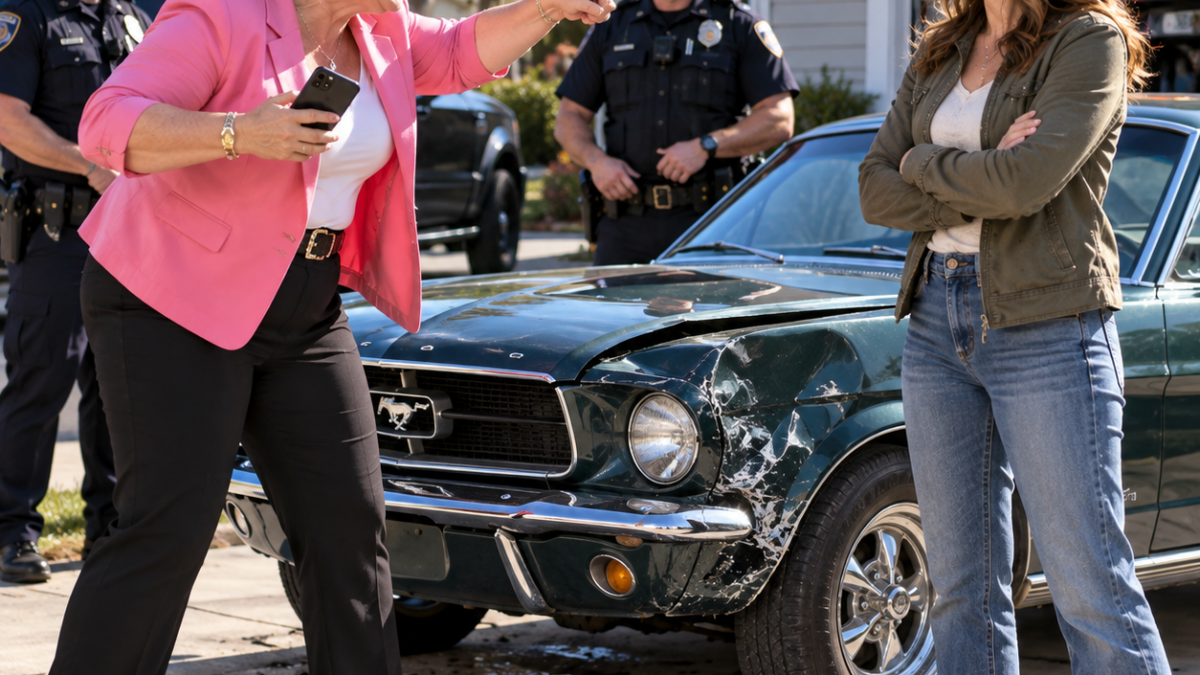
The police cruiser stopped behind Patricia’s golf cart.
Two officers got out.
Both looked young, probably late twenties, and both carried themselves with the careful alertness of men who had been told they were approaching a potentially violent confrontation.
That bothered me immediately.
Not because they were doing anything wrong.
Because Patricia had already shaped what they expected to see.
Before either officer had asked a question, she hurried toward them.
“Thank God you’re here.”
One officer lifted his hand.
“Ma’am, slow down. Who called?”
“I did.”
She pointed straight at me.
“This man became aggressive while we were conducting a lawful enforcement action.”
The word lawful hit me harder than it should have.
Behind Patricia, one of the security guards quietly pulled the crowbar away from the Mustang.
Too late.
The damage was already there.
The second officer looked toward me.
“Sir, stay where you are for a minute.”
I raised both hands slightly.
“I’m staying right here.”
Patricia immediately continued.
“We received repeated complaints regarding an abandoned nuisance vehicle. My security personnel were authorized by the HOA board to remove it. Mr. Crawford came charging out of the house, yelling and advancing toward them.”
“I never charged anybody.”
The officer held up a hand.
“Sir. I’ll talk to you in a second.”
That silenced me.
Not because I agreed.
Because I understood exactly how easily frustration could be used against me.
Patricia knew too.
She lowered her voice.
“I genuinely feared for our safety.”
One of the security guards nodded.
The other looked down.
The first officer turned to me.
“Did you approach them?”
“I walked toward my wife’s car because they were prying the door open.”
“Did you raise your voice?”
“I told them to stop damaging it.”
Patricia shook her head.
“That is not what happened.”
She pointed to the two guards.
“I have witnesses.”
They both nodded.
The officer looked at the Mustang.
Then at me.
Then at Patricia.
“Who owns the vehicle?”
“My wife.”
“Is it registered?”
“Yes.”
“Operational?”
“Yes.”
Patricia interrupted.
“That determination has already been made by the association.”
Rachel finally spoke.
“No.”
Everyone looked at her.
Her voice was quiet.
“You made a determination.”
Patricia’s mouth tightened.
“The board made a determination.”
Rachel nodded once.
“Then there should be a record.”
Patricia ignored the comment and looked back at the police.
“This is precisely what I’m talking about. We cannot enforce basic community standards if residents think rules don’t apply to them.”
By then, neighbors had begun gathering.
Not close.
Just close enough to hear.
The retired couple from across the street stood at the edge of their driveway.
A man who jogged every Saturday morning had stopped on the sidewalk.
Three houses down, a woman held her phone in front of her chest.
Patricia saw the audience.
Her shoulders straightened.
“This is why standards matter,” she said loudly. “If one homeowner refuses to cooperate, the entire community suffers.”
I felt heat rising in my face.
Three months.
We had lived there three months.
I barely knew these people.
Now they were watching Patricia turn me into an example.
One officer noticed the crowd.
“Everybody needs to give us some space.”
Nobody moved much.
The second officer looked at Rachel.
“Ma’am, you said you own the vehicle?”
“Yes.”
“Do you have paperwork?”
“Yes.”
Patricia sighed theatrically.
“The registration is irrelevant. This is an HOA compliance matter.”
Rachel looked at her.
“It becomes something else when you break into a vehicle.”
Patricia laughed.
“Break into?”
Rachel glanced toward the damaged door.
“What would you call it?”
The security guard with the crowbar shifted uncomfortably.
Patricia noticed.
She immediately said, “They were preparing the vehicle for lawful removal.”
Rachel looked at the officer.
“Are HOA security contractors authorized to forcibly enter privately owned vehicles parked on private residential property without a court order or the owner’s consent?”
The officer hesitated.
That was the first crack.
“I’d need to know more about the circumstances.”
“Of course.”
Rachel didn’t push.
That confused Patricia.
She had expected an argument.
Instead, Rachel returned to silence.
One of the officers squinted at her.
I saw it happen.
His eyes narrowed slightly, like he recognized her from somewhere.
Rachel noticed him noticing.
Neither said anything.
The first officer asked Patricia if she wanted to file a formal complaint against me.
“Yes.”
No hesitation.
“For threatening behavior.”
The officer began taking notes.
I could barely believe what I was hearing.
“You’re really doing this?”
Patricia looked straight at me.
“You need to understand there are consequences for intimidation.”
Rachel touched my arm.
Very lightly.
That was all it took.
I shut up.
Patricia saw that too.
She mistook it for surrender.
The officers eventually separated everyone.
They wrote statements.
They took names.
They gave me a case number.
But they didn’t arrest anyone.
They didn’t order the Mustang removed either.
That irritated Patricia.
I could see it.
Before leaving, the first officer walked toward me and handed me a card.
“If you want to supplement your statement, call this number.”
“What about my car?”
He looked toward the Mustang.
“If there’s property damage, document it.”
Rachel spoke from behind me.
“We will.”
Something about the way she said it made the officer look at her again.
This time he stared longer.
“Have we met?”
Rachel gave him a faint smile.
“I don’t think so.”
He nodded, unconvinced.
Then he and his partner left.
Patricia stood in the driveway watching the cruiser disappear.
She smiled.
Not openly.
Just enough that I saw it.
Then she turned toward Rachel.
“I don’t believe we’ve formally met.”
Rachel closed her laptop.
“I know who you are.”
Patricia’s smile faltered.
“Well, then you understand Ridgewood takes violations seriously.”
Rachel looked at the damaged Mustang.
“Yes.”
“I’ll be recommending a disciplinary hearing regarding your husband’s behavior.”
Rachel nodded.
“And the vehicle will need to be removed.”
Another nod.
“You may want to retain counsel.”
That almost made me laugh.
I glanced at Rachel.
She didn’t.
Patricia turned and walked toward her golf cart.
The guards followed.
One of them looked back at the Mustang before leaving.
Not proud anymore.
The neighbors dispersed.
Nobody came over.
Nobody asked if we were okay.
That hurt more than I expected.
The man across the street avoided eye contact.
The jogger started running again.
The woman with the phone went inside.
Within minutes, the street looked normal.
Except our Mustang was sitting there with the door bent and paint gouged down to bare metal.
Rachel walked toward it.
I followed.
She touched the damaged edge carefully.
The mirror hung by wiring.
The weather stripping had been torn.
The driver-side window no longer sat correctly.
For eighteen years, Rachel had maintained that car with a level of care I once teased her about.
She could tell by sound when the engine timing was slightly off.
She knew every restoration shop in Arizona that specialized in sixties Fords.
When she washed it, she used separate towels for chrome and paint.
Now she stood staring at damage caused in less than fifteen minutes.
I expected her to cry.
Instead, she took out her phone and started photographing.
“Rachel.”
No response.
“Rachel.”
“Don’t touch anything.”
“I wasn’t.”
“Good.”
She photographed the crowbar marks.
The frame.
The mirror.
The scratches.
Then the driveway.
The location of the security vehicle.
The curb.
The house numbers.
“What are you doing?”
“Preserving it.”
“For insurance?”
“For everything.”
Then she walked inside.
I followed her.
She went directly to the kitchen table.
Opened her laptop.
Created a folder.
Saturday — Ridgewood Incident.
Then she dragged files into it.
I stood behind her.
“What are those?”
“Doorbell camera.”
Another file.
“Laptop recording.”
Another.
“Phone audio.”
I stared.
“You recorded all of that?”
“Yes.”
“When?”
“The second I heard metal.”
“You knew what was happening?”
“No.”
“Then why were you recording?”
She stopped typing.
Rachel looked up at me.
“Because people behave differently when they think nobody is documenting them.”
I sat down.
She opened the doorbell footage.
It showed Patricia arriving.
The golf cart.
The guards approaching.
It showed Patricia pointing toward the Mustang.
One guard tried the handle.
Locked.
He looked at her.
Patricia said something we couldn’t hear clearly.
Then he retrieved the tool.
I felt sick.
The video continued.
Crowbar.
Metal bending.
Mirror struck.
Then me walking outside with coffee in my hand.
Not charging.
Not shouting.
Walking.
Patricia stepping back dramatically.
Patricia lifting the phone.
911.
Rachel paused the video.
“Timestamp.”
She wrote it down.
Then she opened the second recording.
Her laptop had been on a video call when the noise started.
The camera caught the driveway from a side angle through the front window.
More importantly, the microphone picked up Patricia’s voice.
“Hurry. He’s going to come out.”
I looked at Rachel.
“She knew I was inside.”
“Yes.”
“So she wanted them to finish before I stopped them.”
“Yes.”
The third recording came from Rachel’s phone.
Clear audio.
Patricia telling 911:
“The male resident is aggressive and threatening us.”
Then my voice:
“What are you doing?”
Nothing remotely threatening.
Rachel played it twice.
I looked at her.
“This is bad for her.”
“Yes.”
“How bad?”
“That depends on what else we can prove.”
“What else?”
Rachel closed the file.
Then she opened another folder.
RIDGEWOOD.
My stomach turned.
Inside were scanned complaints.
Emails.
Letters.
Photographs.
“Where did you get this?”
“My office.”
I looked at her.
“What?”
Rachel leaned back.
“Daniel, I need you to listen before you get angry.”
That is never a promising sentence in a marriage.
“You knew something about this HOA.”
“I knew there had been complaints.”
“How many?”
“Six households.”
I stared at her.
“For how long?”
“About eight months.”
“And you never told me?”
“The complaints were incomplete.”
“That doesn’t answer the question.”
“No.”
Her voice remained calm.
“I didn’t tell you.”
I stood.
“Rachel, we bought a house here.”
“I know.”
“You recognized Patricia’s name?”
“After we closed.”
“After?”
“Yes.”
I stopped.
That mattered.
We hadn’t intentionally moved there knowing.
Rachel continued.
“The complaints involved unauthorized towing, selective enforcement, questionable fines, private security intimidation. None of the residents had enough documentation for a criminal case.”
“You work for the county.”
“Yes.”
That was the part Patricia didn’t know.
Rachel wasn’t merely an attorney.
She was an assistant district attorney in Maricopa County.
Not famous.
Not powerful in the theatrical sense.
But experienced.
Careful.
And very familiar with what happened when authority crossed into intimidation and fraud.
“Why didn’t you investigate?”
“I flagged the pattern.”
“But?”
“But I had no direct evidence tying Patricia personally to criminal conduct.”
Rachel pointed at the screen.
“One family said an HOA security team towed their son’s car without notice. They paid over two thousand dollars to get it back.”
Another file.
“An elderly couple said their landscaping was destroyed after they disputed a fine.”
Another.
“A homeowner claimed violation notices were altered after he challenged the board.”
Another.
“But every case had gaps. Missing footage. Missing originals. No witnesses willing to testify. No clear intent.”
“And now?”
She looked toward the driveway.
“Now she did it to us.”
The realization settled slowly.
“You’re part of the case.”
“Yes.”
“You can’t prosecute it.”
“No.”
“You’ll have to recuse.”
“Yes.”
Rachel nodded.
“That is why everything has to be cleaner than usual.”
I sat again.
“What happens next?”
“First, the Mustang gets evaluated before anyone repairs it.”
“Okay.”
“Second, we request police body-camera footage.”
“Okay.”
“Third, we request every HOA record connected to the violation.”
“Patricia won’t cooperate.”
“Then the refusal becomes part of the record.”
Rachel closed one folder.
“Fourth, we say nothing publicly.”
That one bothered me.
“She’s already telling everyone I threatened her.”
“I know.”
“You want me to let that stand?”
“For now.”
“Why?”
“Because right now we have our footage.”
She held up one finger.
“She has her story.”
Second finger.
“The police have another recording.”
Third.
“The HOA will create documents.”
Fourth.
“Every time Patricia repeats a false version after knowing evidence contradicts her, she increases the amount of documentation showing intent.”
I understood the logic.
Emotionally, I hated it.
“So I just let her destroy my reputation?”
“For a little while.”
“How long?”
Rachel’s expression softened.
“Long enough for her to believe she got away with it.”
That evening, we had the Mustang transported to a restoration specialist in Phoenix.
Not towed by Ridgewood.
Transported by us.
The shop owner was named Ray Martinez.
He was in his sixties.
Vietnam-era veteran.
The moment Rachel explained the car belonged to her father, his expression changed.
“Your dad bring it back from overseas?”
“He bought it after his first tour.”
“What unit?”
Rachel told him.
Ray nodded.
“My brother was Army too.”
He examined the damage for almost an hour.
Door frame.
Mirror mount.
Paint.
Lock mechanism.
Window.
Weather stripping.
Then he wrote the estimate.
A little over eighteen thousand dollars.
I whistled.
Rachel didn’t.
Ray looked at her.
“We can fix it.”
“I know.”
“It’ll take time.”
“I know.”
“You want everything replaced?”
Rachel ran one finger along the gouged paint.
“Restore it correctly.”
He nodded.
“I will.”
Then he asked the question I knew hurt her.
“Your dad still around?”
“No.”
Ray looked at the car again.
“Then we’ll take care of it.”
Rachel’s face almost broke.
Almost.
She swallowed.
“Thank you.”
That was the first moment I understood how deeply Patricia had hurt her.
Not because the car was expensive.
Because William Torres had come home from war carrying things he rarely talked about.
The Mustang was one of the few stories he told happily.
He rebuilt it after long deployments.
Taught Rachel to change oil on it.
Taught her how to drive stick in an empty parking lot.
When cancer took him in 2019, his final request about the car had been simple.
Keep her running.
Rachel had done exactly that.
Patricia didn’t damage a nuisance vehicle.
She damaged one of the last living connections my wife had to her father.
And she did it while holding a clipboard.
The next morning, Patricia posted to the Ridgewood message board.
COMMUNITY SAFETY ALERT — INCIDENT INVOLVING NEW RESIDENT.
I found it at 7:12.
By then, more than eighty comments were already underneath.
Patricia’s post never named me.
It included our address.
She described “aggressive conduct.”
Threatening behavior.
Resistance to lawful HOA enforcement.
She claimed security personnel had felt unsafe.
Then she posted a photograph of the Mustang.
Caption:
Vehicle subject to ongoing nuisance enforcement after repeated resident complaints.
I stared at it.
“Repeated complaints?”
Rachel walked into the kitchen.
“What?”
I handed her the phone.
She read silently.
Her jaw tightened at the photo.
Then she handed it back.
“Screenshot everything.”
“That’s it?”
“Yes.”
“There are people calling me dangerous.”
“I know.”
One comment said the board should seek a restraining order.
Another suggested we had “brought the wrong attitude into Ridgewood.”
A woman I had never met wrote:
I knew something felt off when they moved in.
I laughed bitterly.
“She knows nothing about us.”
Rachel poured coffee.
“She doesn’t have to.”
“What does that mean?”
“People like certainty. Patricia is giving them certainty.”
“Based on lies.”
“Certainty and truth are not the same product.”
That was Rachel.
Even furious, she spoke like a closing argument.
By noon, more than two hundred comments existed.
I wanted to reply with the footage.
Rachel refused.
“No.”
“Rachel.”
“Not yet.”
“You keep saying that.”
“And I’ll keep saying it until the official evidence is secured.”
I slammed my palm lightly on the table.
“I’m the one they’re calling unstable.”
Rachel didn’t flinch.
That made me feel worse.
I sat down.
“I’m sorry.”
“I know.”
“I hate this.”
“I know.”
She reached across and took my hand.
“So do I.”
The cease-and-desist letter arrived the following morning.
Courier.
Heavy paper.
HOA attorney letterhead.
It accused me of intimidation, harassment, interference with association personnel, and threats toward contracted security staff.
I read it slowly.
Then again.
Not because it made sense.
Because I was looking for anything I had actually done.
Nothing.
Rachel read it once.
“Good.”
I stared.
“Good?”
“They’re formalizing Patricia’s version.”
“How is that good?”
“Because her attorney is relying on representations someone gave him.”
“You think she lied to her own lawyer?”
“I think lawyers write letters from client information.”
She placed the letter into a clear file sleeve.
“If Patricia told him things she knows are contradicted by the recordings, that matters.”
A security golf cart started circling our block that afternoon.
Every thirty minutes.
Sometimes Frank, one of the guards from Saturday.
Sometimes another contractor.
They didn’t stop.
They didn’t speak.
They just drove past.
Visible.
Slow.
Watching.
By evening, I understood the purpose.
The golf cart wasn’t security.
It was pressure.
You are watched.
You are isolated.
We control the street around you.
I recorded every pass.
Time.
Driver.
Direction.
Rachel approved.
“Don’t engage.”
“I know.”
“Don’t wave sarcastically.”
“I did that once.”
“Stop.”
“I was being friendly.”
“You were smiling like an idiot.”
That tiny argument was the first thing that made us laugh in days.
Then work started feeling different.
Two coworkers lived inside Ridgewood.
We had never been close, but one usually chatted with me before virtual meetings.
Now he joined silently.
Camera off.
The other sent a message.
Everything okay in the neighborhood?
I replied:
There’s an HOA dispute. We’re handling it.
He answered:
Hope it gets resolved.
Then nothing.
Patricia had made the accusation socially contagious.
No hearing.
No evidence.
Just suggestion.
Rachel came home late that evening.
She placed her work bag on the floor.
“She knows.”
“Knows what?”
“That I’m an attorney.”
“I’m surprised that took this long.”
“No.”
Rachel pulled out her phone.
“She knows where I work.”
Patricia had posted again.
It has come to my attention that the spouse of the resident involved in last week’s threatening incident is an attorney. Some individuals apparently believe legal credentials place them above community standards. Let me assure Ridgewood residents that this board will not be intimidated.
The comments turned vicious.
Typical lawyer.
Sue-happy people.
They think rules don’t apply to them.
Rachel read them without expression.
I watched her.
“Does this affect your job?”
“No.”
“Could it?”
“Anybody can complain.”
“What happens if Patricia does?”
Rachel almost smiled.
“She probably will.”
“You sound happy about that.”
“I’m not.”
“Then what?”
“I prefer predictable opponents.”
Two days later, Patricia delivered exactly what Rachel predicted.
She filed a complaint with the Arizona State Bar alleging unethical intimidation by Rachel.
The complaint had one major problem.
Rachel had not contacted Patricia professionally.
Had not represented me as counsel.
Had not threatened litigation.
Had barely spoken during the incident.
Still, the complaint existed.
Another document.
Another escalation.
Then police body-camera footage became available.
Rachel picked it up herself.
We watched it that evening.
Seeing the incident from the officers’ perspective made me angry all over again.
Patricia met them before they could assess anything.
She spoke first.
She pointed.
She framed.
I watched myself stand near the Mustang.
Hands visible.
Coffee cup still on the porch.
No charge.
No threatening posture.
No movement toward the guards after police arrived.
Then Rachel appeared in frame.
One officer looked at her twice.
The second time, his microphone picked up a quiet remark to his partner.
“Is that Crawford from the DA’s office?”
His partner whispered, “I think so.”
My eyes went to Rachel.
“They recognized you.”
“Eventually.”
“You knew.”
“I suspected.”
“What did you think?”
“That it didn’t matter.”
It mattered to me.
Not because I wanted special treatment.
Because Patricia had called police believing she controlled the story.
The officers themselves, once they realized who Rachel might be, became visibly more cautious about accepting her claims.
One asked the guard directly whether he had authorization to enter the Mustang.
The guard answered vaguely.
“HOA orders.”
The officer repeated:
“Do you have legal authorization to force entry?”
Silence.
That part never made it into Patricia’s community post.
Rachel stopped the video.
“Now we wait.”
“For what?”
“The board hearing.”
I groaned.
The emergency board meeting was scheduled for Thursday.
Patricia framed it as a community safety proceeding.
One hundred forty-seven residents signed in.
I counted because I needed something to do with my hands.
The community center had never been that full.
Rows of folding chairs.
People standing against walls.
Coffee urns.
Buzzing fluorescent lights.
A long table at the front.
Patricia in the center.
Two security guards beside her.
Four board members.
It looked like a tribunal.
Rachel and I sat in the back row.
“Remember,” she whispered.
“Say almost nothing.”
“Correct.”
“I hate this plan.”
“I know.”
“Everyone thinks we’re guilty.”
“Let them.”
“That is not comforting.”
“It isn’t meant to be.”
Patricia called the meeting to order.
She thanked everyone for attending.
Then she began.
Her version was smooth.
The Mustang had been an inoperable eyesore.
Complaints had accumulated.
The board had authorized enforcement.
Security personnel attempted routine removal.
I became aggressive.
I charged toward them.
Patricia feared for safety.
Police were required.
Everything she said sounded reasonable if you ignored what actually happened.
The first security guard testified.
“I believed Mr. Crawford intended to physically interfere.”
The second followed.
“He advanced rapidly.”
Patricia asked, “Did you feel threatened?”
“Yes.”
Not one mentioned the crowbar.
Not one mentioned the cracked frame.
Not one admitted they had begun damaging the vehicle before I came outside.
Then Harold Crenshaw, a board member, proposed penalties.
Five-thousand-dollar fine.
Thirty-day order to remove the Mustang.
Authority to tow at our expense if we failed.
I actually felt dizzy.
Five thousand dollars.
For stopping them from breaking our car.
Patricia folded her hands.
“This is a reasonable and measured response.”
Someone near the front raised a hand.
“What about the Crawfords?”
Patricia paused.
“What about them?”
“Do they get to speak?”
All heads turned toward us.
Patricia smiled.
“Of course.”
She looked at me.
“Mr. Crawford?”
Rachel didn’t move.
I stood.
Walked to the front.
My legs felt heavier with every step.
I handed one sheet to the secretary.
“This is a formal objection to the proceeding.”
Patricia stared.
“It cites sections of the HOA governing documents regarding notice, evidence review, conflict of interest, and hearing procedure.”
The secretary took it.
“I request that it be entered into the minutes.”
Then I turned around.
Patricia called after me.
“That’s all?”
I kept walking.
“You have nothing to say about the accusations?”
I sat beside Rachel.
Silence.
The room whispered.
Someone behind us said:
“If they had evidence, they’d show it.”
Another voice:
“Exactly.”
My jaw tightened.
Rachel put her hand over mine.
Patricia smiled.
She had gotten exactly the reaction she wanted.
“Very well.”
Then she turned toward Rachel.
“I’d also like the record to reflect Mrs. Crawford is an attorney.”
Rachel looked at her.
“One might expect someone in the legal profession to understand the importance of rules.”
Rachel remained silent.
“Instead, she has chosen to support threatening behavior.”
Nothing.
“I will personally be submitting a professional misconduct complaint.”
Still nothing.
Patricia’s voice sharpened.
“Frankly, I find her silence disgraceful.”
Rachel finally answered.
“Please put that in the minutes too.”
A few people laughed nervously.
Patricia’s face flashed red.
The board voted.
Seven to two.
Fine approved.
Removal order approved.
We had been judged.
No cross-examination.
No footage.
No evidence standards.
A room full of neighbors watched us lose.
As we walked toward the exit, an older man touched my arm.
I turned.
He was around seventy.
Tall.
Weathered face.
Gray hair.
“I know what they did.”
“What?”
“To your car.”
He leaned closer.
“They destroyed my wife’s garden three years ago.”
I looked at Rachel.
The man continued.
“Said it attracted rodents.”
“What happened?”
“We complained.”
He shook his head.
“Then the fines started.”
He pressed a USB drive into my palm.
“Photos. Letters. Emails.”
“What’s your name?”
“Walter Morrison.”
Rachel stepped closer.
“How long have you lived here?”
“Twenty years.”
“Why haven’t you used this?”
Walter looked toward Patricia.
“Same reason everybody else stayed quiet.”
Fear.
Again.
Different neighborhood conflict.
Same answer.
He looked at me.
“She thinks nobody remembers.”
Then he walked away.
Outside, I handed Rachel the USB drive.
She stared at it.
“That makes seven.”
“Seven what?”
“Documented households.”
She looked back at the community center.
“Seven families with substantially similar allegations.”
“When do we release everything?”
“Soon.”
“How soon?”
“After I recuse.”
The next morning, Rachel formally notified her office.
She had become a material witness and direct victim.
She would have no investigative or prosecutorial role.
An independent prosecutor was assigned.
David Brennan.
Not related to us.
No professional conflict.
Rachel handed over the evidence.
Doorbell video.
Laptop recording.
Phone audio.
Police body-camera footage.
Restoration estimate.
HOA notices.
Message-board posts.
State Bar complaint.
Walter’s USB.
Existing resident complaints.
Then she stepped away.
That was the hardest thing for her.
Rachel trusted evidence.
She trusted process.
But stepping away meant letting someone else control both.
One night, I found her sitting alone in the garage.
The Mustang was still at Ray’s shop, so the space looked empty.
She held an old photograph.
Her father.
1968.
Young.
Army uniform.
Standing beside the Mustang.
I sat next to her.
“You okay?”
“No.”
That answer surprised me.
Rachel rarely admitted that.
I waited.
She handed me the photograph.
“My dad used to say that car was the first thing he bought after realizing he’d actually made it home.”
I looked at William’s face.
He couldn’t have been older than twenty-three.
“He told me once that after Vietnam, people treated coming home like the end of the story.”
Rachel stared at the empty garage.
“But it wasn’t.”
She rubbed her eyes.
“He spent years learning how to sleep normally. How to be around crowds. How to stop checking exits.”
I said nothing.
“The Mustang gave him something simple. Something he could fix.”
Her voice cracked.
“Engine runs rough? Tune it. Brakes pull? Adjust them. Rust? Cut it out. Replace metal. Paint it.”
She looked at me.
“Problems with answers.”
I took her hand.
“And Patricia damaged that.”
Rachel shook her head.
“She damaged metal.”
“What’s the difference?”
“My father is not the car.”
She paused.
“But she had no right to touch either.”
The press conference happened on a Tuesday morning.
Maricopa County District Attorney’s Office.
I sat in the back.
Rachel sat along the side wall.
She wasn’t there as prosecutor.
She was a witness.
Patricia had been invited through counsel because the office intended to announce findings involving Ridgewood.
She arrived wearing navy blue.
Pearls.
Perfect hair.
Her attorney beside her.
She looked confident.
I think she expected some bureaucratic resolution.
Maybe a warning.
Maybe a statement about civil disputes.
David Brennan approached the podium at ten.
Reporters lifted cameras.
“Good morning.”
The room quieted.
“This office is announcing the results of an investigation into alleged fraud, property destruction, false reporting, intimidation, and abuse of authority connected to Ridgewood Estates Homeowners Association.”
Patricia’s smile remained.
Brennan continued.
“Over several years, residents submitted complaints alleging unauthorized towing, fabricated or retaliatory violation notices, and intimidation by association leadership and contractors.”
He paused.
“Until recently, those complaints lacked sufficient corroborating evidence.”
Patricia whispered to her lawyer.
“Four weeks ago, that changed.”
The screen behind Brennan turned on.
Police body-camera footage.
Patricia speaking first.
“This man became aggressive.”
The video showed me standing feet away.
Hands down.
No aggression.
The officers asking questions.
Patricia interrupting.
The security guards nodding.
Then the key exchange.
“Do you have legal authority to force entry into that vehicle?”
“We’re acting on HOA orders.”
“That’s not what I asked.”
Reporters started typing.
Next video.
Our doorbell camera.
Timestamp before Patricia called 911.
Security arrives.
Crowbar.
Door frame bends.
Patricia watches.
The footage had no dramatic music.
Didn’t need it.
Metal screamed loudly enough.
Then Patricia’s voice.
“Hurry. He’s going to come out.”
The room changed.
She stopped smiling.
Her lawyer leaned toward her.
Brennan played my appearance.
I stepped onto the porch.
Walked toward the driveway.
Asked:
“What are you doing?”
Patricia backed away.
Raised her phone.
Then the 911 audio.
“Aggressive male. Threatening us.”
The video showed the opposite.
Brennan stopped playback.
“For clarity, our investigators reviewed the unedited source files and verified the sequence.”
Patricia’s lawyer began writing something quickly.
Brennan advanced the slide.
The Mustang.
Before damage.
Then after.
“The vehicle is a fully operational 1967 Ford Mustang Fastback.”
Next image.
William Torres standing beside it.
“The car previously belonged to Master Sergeant William Torres, United States Army, who served two tours in Vietnam during a twenty-five-year military career.”
Rachel lowered her eyes.
“He left the vehicle to his daughter, Rachel Crawford, following his death in 2019.”
Patricia turned and looked at Rachel.
For the first time since this started, I saw panic.
Not because Rachel was an attorney.
Because Patricia realized the story had changed completely.
The “junk vehicle” she had publicly mocked had a history.
The woman she attacked had a role she had not understood.
The evidence wasn’t gossip anymore.
Brennan displayed Ray’s restoration assessment.
Then Walter’s records.
Then the six older files.
Seven families.
Unauthorized property actions.
Retaliatory fines.
Towing.
Threats.
Destruction.
One pattern.
Brennan did not dramatize it.
He didn’t need to.
Then came the announcement.
Patricia Henderson would face charges including filing a false police report and harassment, with fraud-related allegations proceeding based on the broader HOA investigation.
The two private security contractors faced charges associated with trespass and property destruction, and their conduct was under review for falsely presenting themselves as having governmental authority.
Additional board activity remained under investigation.
Patricia stood.
Her attorney reached for her arm.
She pulled away.
“This is a setup.”
Cameras pivoted.
Brennan remained silent.
Patricia pointed toward Rachel.
“That woman planned this.”
Rachel did not move.
“She works for this office!”
Brennan answered calmly.
“Assistant District Attorney Crawford formally recused herself.”
“She moved into my neighborhood to entrap me!”
I heard someone gasp.
Her lawyer whispered urgently.
Patricia ignored him.
“This is retaliation because I enforced rules against her family!”
Brennan looked toward the reporters.
“For the record, all charging decisions were made by prosecutors and investigators with no reporting relationship to Mrs. Crawford regarding this matter.”
Patricia kept going.
“I’ll sue.”
Her lawyer closed his eyes.
“I’ll sue the county. I’ll sue the Crawfords. I’ll sue every person involved.”
Then she pointed at me.
“You wanted this.”
I didn’t answer.
She was giving the cameras everything.
Anger.
Deflection.
Threats.
Rachel had predicted it.
Patricia could not imagine a room she didn’t control.
Brennan waited until she stopped.
“The defendants will be formally processed according to standard procedure.”
Then he left the podium.
Reporters erupted with questions.
Patricia’s attorney practically dragged her toward the exit.
I followed Rachel outside.
She stood near the parking lot.
Patricia passed twenty yards away surrounded by cameras.
One reporter shouted:
“Mrs. Henderson, why was the vehicle damaged before police were called?”
Another:
“Did the board authorize forced entry?”
Another:
“Were other homeowners targeted?”
Patricia entered a car without answering.
Rachel watched it leave.
“How do you feel?” I asked.
She didn’t answer immediately.
“Relieved.”
“Happy?”
“No.”
“I thought you would be.”
She looked at me.
“Charges aren’t an ending.”
“What is?”
“Consequences that prevent repetition.”
Three months later, Patricia accepted a plea agreement.
No dramatic jury trial.
No screaming courtroom confession.
The evidence made prolonged denial expensive.
She pleaded no contest to filing a false police report and harassment.
Other counts were resolved as part of the agreement.
Two years probation.
Two hundred hours community service.
Twenty-five-thousand-dollar fine.
Restriction on serving in HOA leadership during probation.
The security guards each received suspended jail exposure, restitution obligations, and termination.
Three board members resigned before the investigation reached a final stage.
An independent audit began.
The civil case brought by affected residents settled separately.
Seven families.
One hundred eighty thousand dollars total.
Our share was thirty-two thousand.
Enough to restore the Mustang.
Enough to cover related expenses.
But when the settlement attorney asked Rachel whether she felt the amount was adequate, she said something I never forgot.
“There is no number for being made afraid in your own driveway.”
The settlement required reforms.
No private enforcement action without documented authority.
No vehicle towing without notice, hearing procedures, and legally sufficient authorization.
No anonymous complaints used as the sole basis for penalties.
No security contractors pretending to possess police powers.
Meeting records preserved.
Complaints documented.
Independent compliance monitoring.
Patricia had weaponized ambiguity.
The new system removed as much ambiguity as possible.
The special election drew more residents than any election in Ridgewood history.
Walter Morrison became president.
The man who had whispered to us at the emergency meeting stood behind the same table Patricia once controlled.
He looked terrified.
That made me trust him immediately.
His speech lasted less than three minutes.
“I stayed quiet too long.”
The room was silent.
“My wife begged me to stop fighting after they destroyed her garden.”
Walter looked down.
“I listened because I thought protecting her meant avoiding conflict.”
His voice shook.
“But silence protected the wrong people.”
Several residents lowered their heads.
Walter continued.
“A community doesn’t become safe because nobody complains. It becomes safe when people can complain without being punished.”
Applause started.
Then grew.
Some people cried.
I looked at Rachel.
She wasn’t.
But her eyes were wet.
Apologies came afterward.
Slowly.
The retired couple across the street brought wine.
The husband stood on our porch.
“We believed her.”
I waited.
He looked embarrassed.
“We shouldn’t have.”
“No.”
“We watched them damage the car.”
“Yes.”
“And still thought maybe you had done something.”
That one hurt.
Rachel came to the door.
The woman looked at her.
“I’m sorry.”
Rachel nodded.
Then said:
“Next time, ask one question before choosing a side.”
The woman wiped her eyes.
“We will.”
A man who had called me dangerous on the message board came over two days later.
He looked like he wanted the driveway to swallow him.
“I deleted the comment.”
“Deleting it doesn’t mean you didn’t write it.”
“I know.”
“Why did you?”
He struggled.
“Patricia always knew what was happening.”
“That’s not an answer.”
He sighed.
“Because believing her was easier.”
That answer was honest.
I respected it more than an excuse.
“Do better.”
“I will.”
Not everyone apologized.
Some defended Patricia.
A small online group claimed the county had overreacted because Rachel worked there.
They ignored her recusal.
Ignored the videos.
Ignored the multiple families.
Evidence doesn’t convince everyone.
Sometimes identity matters more than facts.
Rachel taught me to stop chasing those people.
“Your job isn’t to force them to understand.”
“Then whose job is it?”
“No one’s.”
Months later, Patricia’s lawyer contacted Rachel through proper channels.
Patricia was considering making a public statement of remorse.
In exchange, she wanted Rachel to support early termination of probation.
I expected Rachel to refuse immediately.
She didn’t.
She thought for two days.
One night we sat on the porch.
The Mustang was still being restored.
The driveway looked strangely empty.
“What do you think?” she asked.
“About Patricia?”
“Yes.”
“I think part of me wants you to say no.”
“Part?”
“Most.”
Rachel smiled faintly.
“Why?”
“Because she doesn’t get to destroy your dad’s car, destroy our reputation, lie to police, attack your job, and then ask you to help make consequences disappear.”
Rachel looked toward the street.
“My father used to say something.”
“What?”
“The measure of a person isn’t what they do when they’re winning. It’s what they choose not to do.”
I leaned back.
“So you’re helping her?”
“No.”
I looked at her.
“I’m also not asking for more punishment.”
The letter Rachel eventually sent was short.
The court had imposed consequences based on independently reviewed evidence.
Rachel would not oppose Patricia completing probation according to law.
But she would not advocate for shortening obligations Patricia had not yet fulfilled.
No revenge.
No rescue.
Patricia served what the court ordered.
That was enough.
Six months after the press conference, the Mustang came home.
I heard it before I saw it.
That V8 rumble.
Deep.
Familiar.
I ran outside.
Ray turned into our street.
Rachel sat in the passenger seat.
He pulled into the driveway slowly.
The paint looked extraordinary.
Dark green reflecting the Arizona sun.
Chrome clean.
Mirror perfect.
Door aligned.
I walked around it twice.
Ray got out.
“She’s ready.”
Rachel slid behind the wheel.
Her hand moved across the dashboard.
Then she touched the repaired door frame.
I noticed something.
“You left that.”
A faint line remained beneath the restored paint.
Almost invisible.
Ray looked at Rachel.
“Her choice.”
I looked at my wife.
“Why?”
She ran her finger over it.
“Because my dad never restored this car by pretending it had never been damaged.”
I understood.
“He repaired it.”
“Yes.”
She looked at me.
“Those are different things.”
The neighborhood changed after that.
Not physically.
Same stucco houses.
Same desert landscaping.
Same ridiculous debates about trash cans.
But board meetings were recorded.
Complaints required evidence.
People asked questions.
Walter sometimes took too long answering them because he refused to bluff.
Someone would ask:
“Why did landscaping increase by nine percent?”
Walter would say:
“I don’t know.”
Then he would find out.
That phrase became one of the healthiest things in Ridgewood.
I don’t know.
Patricia had acted as if uncertainty weakened authority.
Walter understood pretending certainty was more dangerous.
Rachel eventually proposed something small.
A memorial bench by the lake inside the community park.
Not for the HOA case.
Not for us.
For her father.
The board approved it unanimously.
The plaque read:
IN MEMORY OF MASTER SERGEANT WILLIAM TORRES
SERVICE • SACRIFICE • HOME
The dedication happened on a mild Saturday.
A few neighbors attended.
Walter.
Ray.
Several veterans from the local VFW.
Rachel wore a blue dress her father used to like.
She didn’t give a speech.
That surprised everyone.
She simply stood beside the bench.
Touched the brass letters.
Then sat.
I sat next to her.
For a while, we looked at the water.
“What are you thinking?” I whispered.
She smiled.
“Driving lessons.”
“With the Mustang?”
“Dad took me to an empty supermarket lot.”
“How old?”
“Fifteen.”
“Illegal.”
“He said laws were flexible during educational emergencies.”
I laughed.
Rachel leaned back.
“I stalled thirteen times.”
“Sounds like you.”
“He never got mad.”
That surprised me.
William was patient in some ways and famously impatient in others.
“He just kept saying, ‘Again.’”
Rachel’s eyes filled.
“Again. Again. Again.”
She looked toward the plaque.
“That car was how he taught me failure didn’t mean stop.”
I took her hand.
We sat there until most people left.
The following Sunday, Rachel pulled the Mustang out.
“Get in.”
“Where are we going?”
“Nowhere.”
“That’s concerning.”
“Daniel.”
I got in.
We drove with the windows down.
No destination.
No legal strategy.
No files.
No cameras.
Just road.
We passed the community center.
The place where 147 neighbors had watched us sit silently while Patricia fined us five thousand dollars.
Rachel didn’t even turn her head.
We passed the corner where the security golf cart used to park.
Empty now.
We passed Walter watering his front shrubs.
He lifted the hose like a salute.
Rachel honked twice.
He laughed.
At the lake, she pulled over.
Cut the engine.
Silence settled.
I asked the question I had been carrying for months.
“Do you wish we had pushed harder?”
Rachel looked at me.
“Against Patricia?”
“Yes.”
“More charges? Bigger settlement? Jail?”
“I don’t know.”
She looked toward the water.
“Sometimes.”
That surprised me.
“I thought you were going to give me the noble answer.”
“I’m still human.”
She smiled.
“There were nights I wanted her to lose everything.”
“So did I.”
“But then I thought about Dad.”
She rested both hands on the steering wheel.
“He spent twenty-five years in the Army. He saw what happens when every conflict becomes total.”
I waited.
“Patricia wanted war.”
Rachel looked at me.
“I wanted consequences.”
“What’s the difference?”
“War keeps asking how much more you can destroy.”
She paused.
“Consequences ask what needs to stop.”
I looked toward the Mustang’s hood.
“She has to live with what she did.”
“Yes.”
“And we live with what we did.”
“Yes.”
Rachel smiled.
“I prefer our side.”
We drove home before sunset.
A year passed.
Ridgewood stopped being “the neighborhood where the HOA president got charged.”
That was good.
Life returned.
Garage sales.
Birthday parties.
Tree trimming.
Pool arguments.
Somebody complained Walter’s new transparency policy sent too many emails.
Walter replied:
You are free to delete them. You were not free to steal the information from everyone else by keeping it hidden.
That became a neighborhood joke.
Rachel’s career continued.
The State Bar dismissed Patricia’s complaint.
There had been no professional misconduct.
Rachel framed nothing.
I wanted to.
She threatened to throw it away if I did.
The Mustang stayed in the driveway more often.
Deliberately.
Not as defiance.
Rachel simply stopped hiding something she loved because somebody else had once called it undesirable.
One Saturday morning, almost exactly a year after the incident, I woke to the sound of metal.
My body reacted before my brain did.
I jumped out of bed.
Ran to the window.
A delivery truck had dropped a toolbox.
That was all.
Rachel found me standing there.
“You okay?”
“Yeah.”
“You thought—”
“Yeah.”
She hugged me from behind.
For a while, we watched the empty driveway.
The Mustang was at the lake with Rachel’s cousin.
I said, “Funny what sticks.”
Rachel nodded.
“Scars.”
I thought about the faint line in the Mustang’s door.
“Evidence?”
“Sometimes both.”
Later that afternoon, a new family moved into the house two doors down.
The father drove an older work van.
Commercial ladders on top.
HOA logo-free.
The kind of vehicle Patricia would have hated.
He looked nervous unloading it.
Walter walked over.
I watched from my driveway.
For one second, I wondered whether Ridgewood would repeat itself.
Then Walter extended his hand.
The man smiled.
They talked.
No clipboard.
No security.
No threat.
Rachel came outside holding two glasses of iced tea.
“What are you staring at?”
“Nothing.”
She handed me one.
“That’s a very emotional nothing.”
I pointed.
“New neighbor.”
She watched Walter help carry a box.
Then smiled.
“Looks boring.”
“Beautifully boring.”
The next annual meeting, Walter asked Rachel to speak about due process.
She refused three times.
He asked a fourth.
She agreed for five minutes.
She stood in front of the room where Patricia had once humiliated us.
No projector.
No legal jargon.
She said:
“Rules are supposed to tell people what happens before power is used against them.”
The room quieted.
“If a rule only works when people are afraid to challenge the person enforcing it, that isn’t governance.”
Someone wrote that down.
Rachel continued.
“Good procedures protect accused people, but they also protect honest boards. Evidence requirements are not obstacles. Transparency is not disrespect. Questions are not threats.”
Then she sat.
Five minutes.
Walter whispered to me:
“Your wife scares me.”
“She scares me too.”
Rachel heard us.
“Good.”
Years later, I think about that first Saturday differently.
At the time, I thought the story began when the crowbar touched the Mustang.
It didn’t.
It began years before.
With Walter staying quiet because he wanted peace.
With another family paying storage fees because fighting seemed too expensive.
With residents accepting anonymous complaints because challenging Patricia felt uncomfortable.
With board members approving what they did not examine.
With private guards putting on uniforms and slowly forgetting they were private citizens.
With Patricia receiving obedience so consistently that she eventually mistook it for authority.
The crowbar was just the moment the hidden system became visible.
And the Mustang?
That was the wrong car.
Not because Rachel was a prosecutor.
Not because her father was a veteran.
Not because we had cameras.
Those details exposed Patricia.
But what made Patricia wrong was simpler.
The car wasn’t hers.
The driveway wasn’t hers.
Our dignity wasn’t hers.
Our reputation wasn’t hers.
The law wasn’t hers.
She had spent so long controlling HOA rules that she forgot the boundary between managing a community and owning the people inside it.
That boundary cost her.
Not because we destroyed her.
Because evidence finally reached a place where she could not edit the story.
One evening, Rachel and I drove to the memorial bench.
We were older.
Not dramatically.
Just enough that I noticed silver starting near my temples.
The Mustang still ran beautifully.
Rachel parked near the lake.
We walked to William’s bench.
Someone had left a small American flag beside the plaque.
Rachel adjusted it.
Then sat.
“Dad would hate the attention.”
“He’d secretly love the Mustang part.”
She smiled.
“Definitely.”
A young boy rode past on a bicycle.
His father followed.
The park was quiet again.
Normal.
I looked at Rachel.
“Was it worth it?”
“What?”
“All of it.”
She knew what I meant.
The fight.
Isolation.
Court.
News cameras.
Money.
Months of stress.
Rachel took a long time answering.
“I wish the damage had never happened.”
“Me too.”
“I wish Walter hadn’t lost his wife’s garden.”
I nodded.
“I wish those families hadn’t paid fines they couldn’t afford.”
Another nod.
“I wish Patricia had chosen differently.”
She touched the plaque.
“But once she chose what she chose?”
Rachel looked at me.
“Yes.”
“It was worth refusing to pretend.”
That might be the best description of what we did.
We refused to pretend.
Pretend the Mustang was inoperable.
Pretend I threatened people.
Pretend private contractors were police.
Pretend anonymous complaints were evidence.
Pretend retaliation was enforcement.
Pretend silence meant everyone agreed.
Patricia’s power had always required pretending.
Documentation ended it.
When we returned home, Rachel parked the Mustang in the driveway.
She turned off the engine.
Neither of us moved.
The metal ticked softly as it cooled.
Then she ran her fingers across the repaired door.
The faint scar was still there.
“You ever want Ray to fix that completely?” I asked.
“No.”
“Never?”
“Never.”
“Why?”
She looked at the line.
“Because perfect isn’t the same as whole.”
I didn’t answer.
She smiled.
“You’re going to pretend that wasn’t profound?”
“I’m married to a prosecutor. I’ve learned not to reward speeches.”
“Get out of my car.”
I laughed.
We stepped into the warm evening.
Across the street, the older couple who had once watched silently were watering flowers.
The husband waved.
I waved back.
Walter’s new HOA bulletin hung near the mailbox cluster.
No warnings.
No “community safety alert.”
Just meeting date, pool hours, road repairs, and a reminder that residents could request records electronically.
Ordinary things.
The kind of things an HOA should be boring enough to handle.
Rachel walked toward the front door.
I stayed beside the Mustang.
For a moment, I could hear the old sounds.
Crowbar.
Patricia’s voice.
Siren.
Neighbors whispering.
Then they faded.
What remained was the engine cooling beneath the hood.
A house we still owned.
A neighborhood that had learned something.
A bench beside a lake carrying a good man’s name.
And my wife, standing at the blue-gray front door telling me dinner was getting cold.
I touched the roof of the Mustang once.
Then followed her inside.
Patricia Henderson once believed the most important part of power was making people afraid of what would happen if they challenged her.
She was wrong.
The most important part of power is knowing exactly where it ends.
She learned that boundary in the hardest possible way.
Rachel knew it from the beginning.
That was why she never used her position to threaten Patricia.
Never prosecuted her own case.
Never demanded special treatment.
Never asked the court for revenge.
She collected evidence.
Recused herself.
Let independent people decide.
And when Patricia finally faced consequences, Rachel didn’t celebrate.
She restored her father’s Mustang.
Helped change the rules.
Put his name on a bench.
And drove home.
That was the part Patricia never understood.
Winning was never about watching her fall.
It was about making sure the people she had pushed down could stand again.
Walter did.
The seven families did.
We did.
And the Mustang did too.
The last time Rachel’s father drove that car, months before he died, he had apparently told her something she didn’t repeat to me until years later.
They were sitting at a stoplight.
The engine was idling rough.
Rachel told him the carburetor probably needed adjustment.
William smiled.
“You hear everything wrong with this car.”
“That’s because you taught me.”
“No.”
He looked through the windshield.
“I taught you to listen.”
Then the light turned green.
Rachel told me that story while we drove across Arizona one spring afternoon.
The Mustang hummed beneath us.
She shifted smoothly into fourth.
I looked at the faint repair line along the driver-side frame.
Maybe William had been right about more than cars.
Patricia’s downfall didn’t begin because Rachel had more authority.
It began because Rachel listened.
To the crowbar.
To the lie.
To six families who had been ignored.
To Walter’s quiet voice outside the meeting room.
To evidence that other people dismissed because accepting it would have made life uncomfortable.
Sometimes the loudest person in a neighborhood gets mistaken for the person telling the truth.
Sometimes a polo shirt gets mistaken for authority.
Sometimes uniforms make private contractors look like police.
Sometimes a board vote makes abuse look official.
And sometimes all it takes to break that illusion is one person refusing to stop listening.
Rachel pulled off the highway at a scenic overlook.
We parked.
Desert stretched toward the horizon.
She killed the engine.
For a moment, neither of us spoke.
Then she looked at the Mustang.
“My father would have liked how this ended.”
“You told me that before.”
“I know.”
“Still think so?”
“Yes.”
“Why?”
Rachel smiled.
“Because Patricia wanted us to become angry enough to make a mistake.”
I thought about that first morning.
How close I came to grabbing the crowbar.
How badly I wanted to shove the guard away from the Mustang.
How desperately I wanted to post the footage immediately and destroy Patricia publicly.
Rachel continued.
“Dad used to say surviving the first fight doesn’t matter if anger chooses the second one.”
I looked toward the horizon.
“We didn’t give her the second fight.”
“No.”
“What did we give her?”
“Evidence.”
I laughed.
“That is the most prosecutor answer possible.”
She laughed too.
Then she started the Mustang.
The V8 came alive.
Strong.
Steady.
Alive.
We drove home with the windows down.
And every time the sunlight caught the faint scar on that repaired door, I stopped seeing the crowbar.
I saw William.
I saw Rachel.
I saw Walter finally speaking.
I saw seven families receiving letters acknowledging what had happened to them.
I saw a board room where homeowners could ask questions without being punished.
I saw a neighborhood that had once watched silently and eventually learned that silence has consequences too.
The Mustang had been repaired.
So had Ridgewood, as much as any place can be.
Neither was perfect.
Both carried scars.
Both kept moving.
And somewhere along that road I finally understood what Rachel meant.
Healing does not mean the damage never happened.
Justice does not mean you get to erase another person.
And winning does not mean hurting someone harder than they hurt you.
Sometimes winning is simpler.
You protect what mattered.
You tell the truth carefully enough that it survives every lie.
You refuse to become the person your enemy needs you to be.
Then, when the noise finally stops, you turn the key.
You put the car in gear.
And you go home.








