HOA Karen Called the Cops to My House—Then the Officers Saw Who Opened the Door and Her Entire Kingdom Began to Collapse
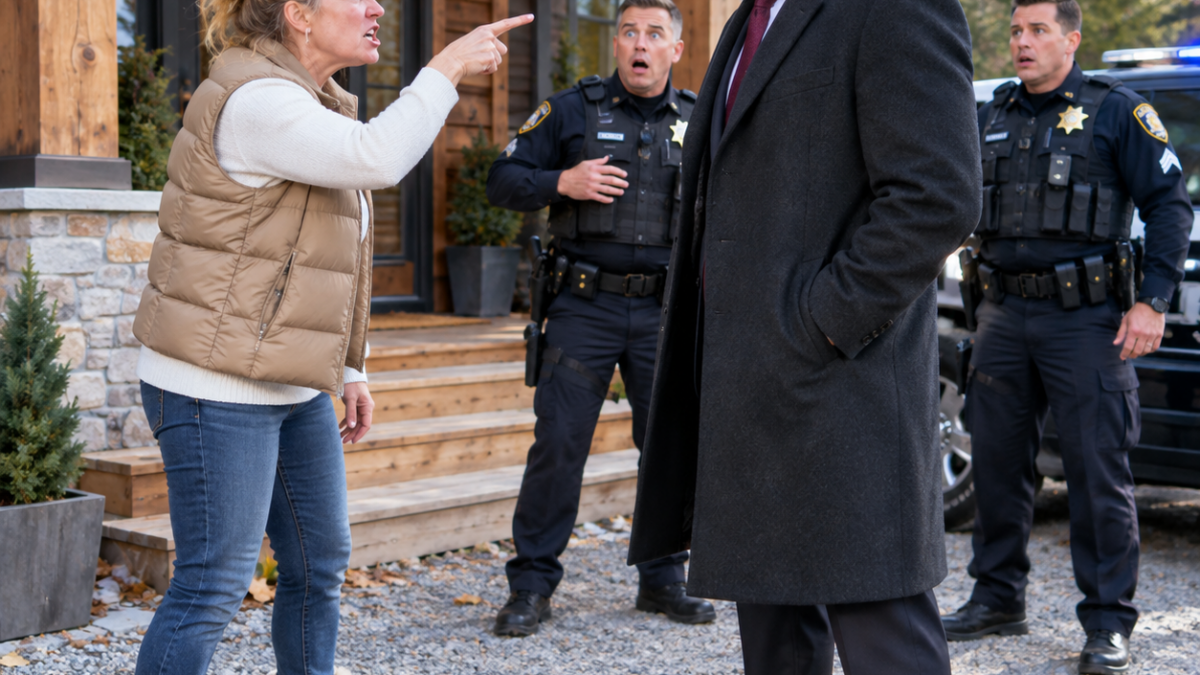
The HOA president stood behind two police officers on my front porch with a smile on her face, certain that by sunrise I would either be arrested or humiliated badly enough to leave the neighborhood.
Then one of the officers looked through my open doorway, recognized me, and the color drained from his face so fast that his partner stopped talking mid-sentence.
Patricia Vaughn thought she had finally found the perfect lie to get rid of me, but she had no idea how much evidence had already begun piling up against her.
My name is Steven Caldwell. I was sixty-seven years old when this happened, recently widowed, recently retired, and more interested in drinking coffee in peace than fighting another battle.
For thirty-five years, I had served in federal courtrooms where people lied under oath, corporations buried evidence, witnesses broke down, and powerful men discovered that authority meant very little once facts entered the room.
When I retired, I wanted none of that anymore.
After my wife died, the house we had shared became unbearable. Every room carried her absence. Her coffee mug remained in the cabinet. Her gardening gloves were still hanging beside the back door. Some mornings, I would wake up expecting to hear her moving downstairs before remembering there would never be footsteps again.
So I sold the house and moved to Willowbrook Estates.
I wanted quiet.
Patricia Vaughn wanted obedience.
At 7:03 on that Sunday morning, my doorbell rang.
I had just poured my first cup of coffee.
When I opened the door, two uniformed police officers were standing on my porch, body cameras blinking red.
Behind them stood Patricia.
Arms folded.
Chin lifted.
Smiling.
Officer Santos, the younger of the two, looked directly at me.
His expression changed.
Recognition came first.
Then disbelief.
Then alarm.
“Sir…” he said.
His partner glanced down at a notepad.
“Mr. Caldwell?”
“That’s me.”
“We received a complaint concerning an incident at an HOA meeting last Thursday.”
Behind them, Patricia’s smile widened.
The officer continued.
“The complainant alleges you threatened several board members and specifically threatened Mrs. Vaughn with physical harm.”
I looked past him.
Patricia stepped forward immediately.
“He didn’t just threaten me,” she said. “He intimidated everyone there. Multiple people heard him. I’m afraid of him.”
Officer Santos shifted slightly.
He knew me.
Five years earlier, he had testified in a civil-rights case in my courtroom. I remembered him because unlike several other witnesses, Santos had answered difficult questions without trying to protect his department.
Apparently, he remembered me too.
Patricia pointed toward me.
“I want him arrested.”
I said nothing.
Thirty-five years on the bench had taught me something about people who lie.
Silence frightens them.
They begin filling it.
And eventually, they usually say too much.
Patricia did.
“He told me I’d regret crossing him,” she continued. “He was aggressive. Dangerous.”
Officer Santos finally spoke.
“Mrs. Vaughn, we need to establish what actually happened.”
Then he turned toward me.
“Mr. Caldwell, were you at the HOA meeting Thursday night?”
I reached slowly into my pocket and took out my phone.
“No.”
Patricia laughed.
“Yes, he was.”
I opened my email.
“I was in Portland.”
The older officer looked up.
I showed them my boarding pass.
United Airlines Flight 472.
My return flight had landed at LAX Friday morning.
I had hotel receipts, credit-card records, and an airport parking receipt if they wanted those too.
For several seconds, nobody spoke.
Patricia’s smile disappeared.
“That’s impossible.”
I looked directly at her.
“Then tell the officers which witnesses saw me.”
Her mouth opened.
Nothing came out.
Officer Santos adjusted his body camera.
That tiny movement told me everything.
He understood what was happening.
The officers apologized for disturbing me and said they would verify the information.
Patricia remained on my walkway after they turned toward their patrol car.
She stared at me with a look I had seen hundreds of times from people who suddenly realized the facts were moving against them.
I stepped back inside.
My coffee had gone cold.
I poured it into the sink, made another cup, and carried it to the kitchen table.
Waiting there was a thick folder.
Garage-door violations.
Landscaping violations.
Trash-can violations.
Hedge-height violations.
Parking violations.
Fines.
Warnings.
Threats.
Every one of them signed by Patricia Vaughn.
For months, I had believed I was dealing with a controlling HOA president who enjoyed making residents miserable.
That morning, I finally understood.
She wasn’t enforcing rules.
She was trying to drive me out.
And by calling the police with a story that could be disproved in minutes, Patricia had just given me the first piece of evidence I needed to find out why.
PART 2
I did not confront Patricia that morning.
That surprised even me.
Twenty years earlier, I probably would have walked directly across the street to the HOA office, placed every violation notice on her desk, and demanded an explanation.
But age changes the way you understand conflict.
So does grief.
When you have watched the person you loved most in the world slowly disappear from your life, you stop wasting energy on arguments that accomplish nothing.
I carried my fresh coffee to the kitchen table and opened the folder.
There were twenty-seven separate communications from the HOA.
The first had arrived three weeks after I moved into Willowbrook.
According to Patricia, my garage door was the wrong shade of beige.
Not red.
Not purple.
Not covered in graffiti.
Beige.
The wrong beige.
I had actually laughed when I first received the notice.
My wife, Margaret, would have laughed harder.
She had been the person who could turn absurdity into comedy. Whenever bureaucracy became ridiculous, she would tilt her head, make that little face she made when she was trying not to smile, and say, “Well, Steven, democracy has survived worse.”
I had checked the HOA covenants myself.
The color of my garage door fell within the approved range.
I photographed it under several lighting conditions, obtained the original paint code from the previous owner, and mailed a polite response.
Two weeks later, I received a seventy-five-dollar fine.
No explanation.
Then came the landscaping complaint.
Then the trash-can warning.
Then the hedge citation.
Then an accusation that my vehicle had been improperly parked.
Inside my own garage.
At first, I assumed someone in the HOA office was simply incompetent.
Eventually, I realized the notices were too consistent.
Someone was watching my property.
Someone wanted a record showing that I was a “problem homeowner.”
And every letter carried the same signature.
Patricia Vaughn.
I had attended only one HOA meeting since moving to Willowbrook.
It was held on a Wednesday evening at the clubhouse.
Around forty residents sat in folding chairs while Patricia occupied the center seat behind a long table with four other board members.
The first thing I noticed was how quickly everything passed.
Motion.
Second.
Vote.
Approved.
Motion.
Second.
Vote.
Approved.
Almost nobody asked questions.
Those who did were treated politely enough to avoid open hostility, but dismissively enough to understand they were wasting everyone’s time.
An elderly man stood and asked why a drainage problem had been flooding his backyard for nearly two years.
Patricia smiled.
“Thank you for bringing that to our attention, Mr. Reynolds. We’ll investigate.”
The man remained standing.
“I’ve brought it to your attention six times.”
Her smile tightened.
“We’ve answered your question.”
“No, you haven’t.”
“Please sit down so other residents can speak.”
He slowly lowered himself into his chair.
Nobody defended him.
Nobody needed to.
The fear in that room explained everything.
I sat in the last row and watched.
Patricia noticed.
Across forty feet and three rows of residents, our eyes met.
She studied me for several seconds.
Then she wrote something on the legal pad in front of her.
I remember thinking it was strange.
Two weeks later, the violation notices increased.
I began asking quiet questions.
My next-door neighbor, Ted, initially told me I was overthinking it.
“Just pay the fines,” he said. “Everybody does.”
“Even when the violation didn’t occur?”
He gave me an uncomfortable look.
“It’s cheaper than fighting.”
That sentence stayed with me.
It’s cheaper than fighting.
I eventually learned why.
Patricia had served as HOA president for six consecutive terms.
Her husband, Gregory Vaughn, owned the property-management company contracted by Willowbrook Estates.
Patricia’s sister served as board secretary.
Her college roommate handled the treasury.
Another board member owed Patricia a personal favor.
Only Brenda Gray, a retired accountant, appeared genuinely independent, and Brenda almost never spoke during meetings.
Residents told me stories quietly.
One family had challenged selective enforcement and ended up spending tens of thousands of dollars on legal fees before finally selling their home.
A young attorney had questioned HOA financial records.
Within weeks, violation letters had begun arriving almost daily.
Eventually, he moved.
Patricia had also developed a close relationship with the local police through the neighborhood-watch program.
Officers attended Willowbrook events.
Patricia knew names.
Phone numbers.
Supervisors.
When she called, people responded.
Until that Sunday morning, I had considered all of this irritating but not necessarily criminal.
Then she told police I had threatened her at a meeting I had never attended.
That changed the equation.
Exactly one week after the officers came to my door, I found an envelope beneath my doormat.
No stamp.
No return address.
Inside was a handwritten note.
I have lived here twelve years.
No one beats her.
Last year our fees increased forty percent.
No one knows where the money went.
Be careful.
Behind the note was a photocopy of HOA meeting minutes.
One line caught my attention.
Reserve fund transfer: $127,000.
Purpose: infrastructure improvements.
I searched my memory.
Nothing significant had been improved since I arrived.
That alone proved nothing.
Projects could have happened before I moved in.
So I opened my computer and examined historical satellite photographs of the neighborhood.
Same streets.
Same sidewalks.
Same pool.
Same clubhouse.
Same common areas.
No obvious major infrastructure project.
I leaned back in my chair.
For the first time, I wondered whether Patricia’s effort to force residents into submission had anything to do with enforcing community standards at all.
Perhaps obedience served another purpose.
I spent the next three days doing absolutely nothing that Patricia could see.
I watered my garden.
Walked each afternoon.
Read in the evenings.
Waved to neighbors.
Patricia wanted a reaction.
I gave her none.
Behind the closed door of my study, however, I began building a case.
Not because I was a former federal judge.
Because I was a homeowner.
And I wanted every step I took to be available to any resident willing to make the same effort.
I reviewed the association rules.
I examined state provisions concerning HOA financial disclosures, meeting records, member inspection rights, election procedures, fines, contracts, and board responsibilities.
Then I drafted a formal records request.
Five years of budgets.
Reserve statements.
Vendor contracts.
Invoices.
Meeting minutes.
Management agreements.
Major expenditures.
I sent it certified mail to the HOA.
Another copy went to its registered agent.
A third went to Gregory Vaughn’s property-management company.
Then I requested the police incident report and body-camera recordings from the morning Patricia appeared at my house.
Afterward, I called Anthony King.
Anthony and I had met in law school.
He specialized in real-estate disputes while my career took me first into federal prosecution and eventually onto the bench.
When I finished explaining what had happened, he was silent.
Then he said, “Steven, please tell me you’re not planning to handle this alone because you’re bored in retirement.”
“I’m not bored.”
“You sound bored.”
“I’m angry.”
“That’s worse.”
I almost smiled.
He continued.
“You have enough experience and contacts to turn Patricia Vaughn’s month into a catastrophe.”
“I don’t want favors.”
“That wasn’t what I said.”
“I want the same process available to anybody else.”
Another silence.
Then Anthony said quietly, “Margaret would say that.”
Hearing my wife’s name stopped me.
“Yes.”
“She’d also tell you not to become obsessed.”
“Yes.”
“Are you going to listen?”
“Probably not.”
That finally made him laugh.
“Document everything,” he said. “And don’t show them your entire hand.”
So I documented everything.
Every notice.
Every photograph.
Every letter.
Every phone call.
Every date.
Every fine.
I created backups.
I photographed my property weekly so nobody could later claim some condition had existed that had not.
For the first time since Margaret’s death, I found myself waking in the morning with a purpose.
I hated admitting that.
I had moved to Willowbrook hoping never to need the instincts my career had sharpened.
Now those instincts were keeping me upright.
But Patricia was not waiting.
The following Sunday, my phone buzzed.
A post had appeared on the Willowbrook neighborhood message board.
WARNING: DANGEROUS INDIVIDUAL IN OUR COMMUNITY.
Underneath was my photograph.
It had been taken during the only HOA meeting I attended.
The image was enlarged and slightly blurred.
The text claimed I had threatened volunteers and been reported to police.
Residents were advised to remain vigilant.
Patricia signed the post personally.
Within an hour, dozens of neighbors had reacted.
Thank you for protecting us.
Why is he still here?
Should parents be worried?
Has anybody checked whether he owns weapons?
Call the police if you see anything suspicious.
I sat in my living room reading comments from people who had never spoken to me.
The experience was more painful than I expected.
For decades, my name had been attached to decisions.
Some people approved of those decisions.
Others despised them.
Criticism had never frightened me.
But this was different.
These were neighbors.
People who lived forty feet away.
People I passed while collecting my mail.
The cashier at the neighborhood grocery store.
The man who waved while walking his Labrador.
People were being told I was dangerous.
And they believed it because Patricia said it with confidence.
The next morning, Ted saw me outside.
Usually, he raised a hand.
This time, he looked down and walked inside.
Two days later, I entered the small market near Willowbrook.
The cashier who had spent months asking how retirement was treating me barely looked up.
I understood.
Fear is powerful.
People do not investigate every warning they receive.
That understanding did not make the isolation hurt less.
Five days later, I opened my garage and found red spray paint across the driver’s side of my car.
LEAVE.
Just one word.
I stood there holding my keys.
Something inside me went very still.
For a moment I imagined Margaret beside me.
She would have touched my arm before I did something stupid.
So I took photographs.
Close.
Wide.
License plate visible.
House number visible.
Timestamp preserved.
Then I called the police.
Not to accuse Patricia.
I had no evidence connecting her to the vandalism.
Facts mattered.
Even when I hated the person I suspected.
Especially then.
The responding officer took a report.
I added it to my folder.
Patricia escalated again.
A special HOA newsletter appeared in every mailbox.
My photograph was printed inside beneath a “Community Safety Alert.”
The wording was careful.
An individual had been reported to authorities.
The matter remained under investigation.
Residents should exercise caution.
No direct accusation.
Just enough language to poison the neighborhood without stating something her lawyer could easily regret.
At the bottom was an announcement.
EMERGENCY COMMUNITY SAFETY MEETING — SATURDAY.
I was not invited.
That night, I seriously considered leaving Willowbrook.
I walked through the house after midnight.
The rooms were quiet.
Margaret’s framed photograph sat on the bookshelf.
She was laughing in the picture.
We had been in Maine.
The wind had destroyed her hair, and she had complained for ten minutes before seeing the photograph and deciding it was her favorite picture ever taken.
I picked it up.
“Choose your battles,” I said aloud.
That had been one of her favorite phrases.
Not every wrong needs to be corrected by you.
I could sell the house.
Move somewhere else.
Start again.
But I remembered Mr. Reynolds asking about his flooded yard while everyone looked down.
I remembered Ted saying fighting was more expensive than surrendering.
I remembered the family who had spent forty thousand dollars just to leave.
If I walked away, Patricia would learn only one lesson.
Her system worked.
Saturday evening, while the “safety meeting” was taking place without me, something slid beneath my front door.
Another envelope.
Inside was a letter written in a trembling hand.
Mr. Caldwell,
I know she is lying.
I was at the meeting she claims you attended.
You were not there.
I’m afraid to speak publicly because I have seen what happens to people who challenge her.
If this ever reaches court, I will testify.
I’m sorry I cannot do more.
There was no signature.
But there was something else.
Invoices.
Dozens of pages.
Greenway Infrastructure Solutions.
Premier Community Services.
Apex Maintenance Group.
Eighteen thousand dollars.
Twenty-three thousand.
Thirty-one thousand.
Smaller payments.
Larger payments.
Altogether, the copies represented more than one hundred thousand dollars in HOA spending.
I began searching company names.
Almost nothing.
No credible websites.
No crews.
No visible business operations.
Addresses led to mailboxes, empty storefronts, storage facilities.
The companies existed on paper.
Apparently little else did.
At 10:54 that night, I called Anthony.
He answered groggily.
“Somebody better be dead.”
“I need a forensic accountant.”
Silence.
Then his voice changed.
“What did you find?”
“I don’t know yet.”
“That means you found something.”
“I found enough to ask better questions.”
Anthony gave me the name Sandra Chen.
Former financial-crimes investigator.
Private consultant.
Very expensive.
Worth every dollar, according to him.
I contacted her Monday morning.
Meanwhile, the deadline for my HOA records request passed.
No records arrived.
I sent another letter.
This one referenced the missed deadline and formally preserved my objections.
Copies went to additional oversight offices and association counsel.
Three days later, I received a telephone call from Robert Harding, the HOA’s attorney.
His voice had the polished warmth lawyers use when they hope tone will do the work evidence cannot.
“Mr. Caldwell, there appears to have been an administrative delay.”
“I see.”
“The association intends to cooperate.”
“I’m glad.”
“We should be able to produce a package shortly.”
“Complete records?”
“Some information may require redaction.”
“Then identify the legal basis for each redaction.”
Silence.
Harding’s friendliness disappeared.
“You’ve practiced law.”
“I have.”
“How long?”
“Long enough.”
“I’ll convey your position.”
He hung up.
I smiled for the first time all day.
The police body-camera footage arrived the following Monday.
I watched Officer Santos approach my door.
Patricia was already talking.
Then I heard something I had not fully processed that morning.
“He threatened me with a weapon,” Patricia told the officers before I opened the door.
My hand froze over the keyboard.
I rewound.
Played it again.
“At the meeting,” she said. “He told me he had a gun and would use it.”
I watched the clip three times.
That accusation transformed the entire incident in my mind.
She had not merely wanted police to warn me.
She had portrayed me as an armed threat.
Officers responding to reports involving weapons do not approach homes casually.
People die because of misunderstandings like that.
For the first time since this began, my anger frightened me.
I stopped the video.
Walked into the kitchen.
Placed both hands against the counter.
Margaret’s voice returned to me.
Facts first, Steven.
Always facts first.
So I returned to the computer, created multiple backups, and continued working.
Sandra Chen’s preliminary report arrived several days later.
All three vendors appeared to be shell companies.
They had legal registrations and bank accounts, but no meaningful operations she could identify.
Over approximately four years, Willowbrook reserve funds had transferred at least $270,000 through them.
Sandra was still tracing the final destination.
Then another crack appeared.
Janet Holloway, one of Patricia’s loyal board members, resigned suddenly.
“Personal reasons.”
No explanation.
At the community mailboxes, I overheard two residents discussing rising fees.
“Forty percent,” one woman said. “For what?”
The other whispered, “I asked for the annual report. They told me it wasn’t available.”
Fear was beginning to change direction.
Friday evening, Sandra called.
“Steven, are you sitting down?”
“I am now.”
“I traced the destination account.”
“Whose?”
“Vaughn Property Management LLC.”
I said nothing.
She continued.
“The registered owner is Gregory Vaughn.”
Patricia’s husband.
I looked through my kitchen window at the quiet street.
Children were riding bicycles near the corner.
Someone was washing a car.
A sprinkler clicked rhythmically across a lawn.
Normal life.
While hundreds of thousands of dollars belonging to those families appeared to have traveled through fake vendors into the management company owned by the HOA president’s husband.
I could have gone directly to Patricia.
I could have confronted Gregory.
I could have threatened them.
Instead, I called an investigative reporter.
Reginald Shaw had spent years reporting on municipal corruption and public contracting.
We met two towns away.
I laid out the documents.
Violation notices.
The false report.
My travel records.
The body-camera footage.
The anonymous invoices.
Sandra’s tracing analysis.
Reginald studied everything.
Then he looked at me.
“You’re holding back something.”
“What?”
“People don’t usually build evidence files like this.”
“I was a lawyer.”
“That isn’t the whole answer.”
I told him.
His eyes widened.
“You’re Judge Steven Caldwell?”
“Former Judge Steven Caldwell.”
He leaned back.
Then he laughed once, quietly.
“Patricia Vaughn called the police on a retired federal judge?”
“That part is less important than the money.”
“To you.”
“To everyone.”
He nodded.
That was why I liked him.
He understood.
The article appeared two weeks later.
The headline was restrained.
QUESTIONS MOUNT OVER WILLOWBROOK HOA FINANCES.
No sensational accusations.
No declaration that anyone had stolen anything.
Just facts.
Residents had requested records.
Those records had not been produced promptly.
Large payments had gone to vendors whose operations were difficult to verify.
Fees had increased.
A board member had resigned.
My name appeared once.
Resident Steven Caldwell had filed formal requests concerning HOA governance and records.
Patricia responded publicly.
She called the concerns “baseless attacks by a disgruntled homeowner.”
That sentence destroyed her far more effectively than silence would have.
Because now people began asking:
Why was one disgruntled homeowner able to find records the board refused to explain?
A petition circulated.
Two hundred signatures.
Then more.
The association bylaws required an emergency meeting.
For the first time in years, Patricia had no choice.
Saturday night, the clubhouse was packed.
I arrived early and took a chair in the back.
The same place I had sat months before.
But the atmosphere had changed.
Nobody looked down.
Nobody whispered apologies before asking questions.
Patricia entered with Robert Harding beside her.
Gregory was absent.
That told me something.
She struck the gavel.
“This meeting will come to order.”
Nobody quieted immediately.
She struck it again.
“We will maintain decorum.”
A man near the front shouted, “Where’s the reserve money?”
Applause broke out.
Patricia stiffened.
“We are arranging an independent review.”
“Why now?”
“Who owns Greenway?”
“What did Apex Maintenance do?”
“Why won’t you release the contracts?”
“Where’s Gregory?”
Questions came from every direction.
Patricia’s control vanished by inches.
Then a man halfway down the aisle stood.
“Mrs. Vaughn, I have a question about Steven Caldwell.”
The room became quieter.
Patricia’s eyes found me.
“What about him?”
The man held up his phone.
“You told everyone he threatened you.”
“He did.”
“You said police were investigating him.”
“They were.”
“You forgot to mention something.”
Patricia’s jaw tightened.
“I don’t know what you’re suggesting.”
“I looked him up.”
Nobody moved.
The man turned toward me.
“Is that Judge Steven Caldwell sitting in the back?”
Every face in the room followed his gaze.
I remained seated.
Patricia looked as though someone had removed all the air around her.
The man continued.
“Retired federal judge Steven Caldwell?”
A woman whispered, “What?”
Someone else said, “You’re kidding.”
Patricia grabbed the microphone.
“His former occupation is irrelevant.”
The man laughed incredulously.
“You called the police and claimed a retired federal judge threatened you with a gun at a meeting he wasn’t even attending?”
The room exploded.
Patricia slammed the gavel.
“Order!”
Nobody listened.
“You lied to us!”
“You put his picture in the newsletter!”
“You told us he was dangerous!”
“My kids were scared of that man!”
“Show us the police report!”
Patricia stood.
“This is exactly what he wants! He is using his connections to intimidate this board!”
I rose for the first time.
The room gradually quieted.
I did not raise my voice.
“I have used no special connection.”
Patricia pointed at me.
“You contacted newspapers!”
“I provided documents.”
“You contacted government agencies!”
“I submitted records requests and complaints available to every homeowner.”
“You hired investigators!”
“I hired a forensic accountant.”
“Because you wanted to destroy me!”
“No.”
I looked around the room.
“I wanted to know why you were trying to destroy me.”
Silence.
Patricia stared at me.
I continued.
“I attended one HOA meeting before tonight.”
A few residents nodded.
“It was not the meeting Mrs. Vaughn described to police.”
I held up my phone.
“On the night she claimed I threatened her, I was in Portland, Oregon.”
Patricia started speaking.
I raised one hand.
“Please let me finish.”
Something strange happened.
She stopped.
Perhaps nobody had spoken to her that way in years.
“I have airline records, hotel records, credit-card records, and airport records establishing my location.”
I paused.
“The police have already seen some of those records.”
Then I looked directly at Patricia.
“Mrs. Vaughn also told officers I threatened her with a firearm.”
Murmurs erupted.
“That’s false!” Patricia shouted.
I reached into my folder.
“The statement is recorded on police body-camera footage.”
The silence afterward was absolute.
Patricia’s sister left through a side door.
Her former college roommate followed thirty seconds later.
Susan Marshall, another board member, stood.
“I resign.”
Patricia turned.
“Susan, sit down.”
“No.”
“This is not the time.”
“It’s exactly the time.”
Susan walked away from the table.
Another board member resigned minutes later.
Patricia was left seated almost alone beneath the Willowbrook Estates seal.
Her kingdom did not collapse with screaming.
It collapsed with empty chairs.
When most residents had finally left, I walked toward her.
Robert Harding stepped between us.
“Any communications should go through counsel.”
“That is perfectly acceptable.”
I removed one sheet of paper from my folder.
“I assume this came through your office.”
His expression changed.
The document was an email obtained through discovery in the civil case I had filed several weeks earlier.
Patricia to Gregory.
Six months before.
The subject concerned a “new resident.”
Me.
The email described a plan to bury me in violations until I either stopped asking questions, paid whatever was demanded, or moved away.
One sentence suggested involving law enforcement if necessary to “make him understand who controls this neighborhood.”
The timestamp was two weeks before my first violation notice.
Patricia read the page.
For the first time since I had known her, she had nothing to say.
I did not gloat.
I did not threaten her.
I simply placed the paper on the table.
“Good evening, Mrs. Vaughn.”
Outside, dusk had turned the parking lot gold.
Officer Santos was leaning against a patrol vehicle.
“Judge Caldwell.”
“Officer.”
He approached.
“I wanted you to hear something directly.”
I waited.
“The department reviewed the recordings from the morning we came to your house.”
“I assumed they would.”
“We’ve referred the false statements for prosecutorial review.”
I nodded.
Then he lowered his voice.
“And there’s another matter.”
“The finances?”
His eyebrows lifted.
“You know?”
“I know enough.”
“Federal investigators have been notified.”
I looked back toward the clubhouse.
Through the windows, Patricia remained at the table.
For months, she had believed power meant being the loudest person in a small room.
Now much larger rooms were beginning to pay attention.
The following weeks transformed Willowbrook.
Investigators appeared.
Financial records were subpoenaed.
Reporters waited outside the clubhouse.
Residents who had spent years staying silent began talking.
Stories came out.
Selective fines.
Threatening letters.
Questionable contracts.
Homeowners pressured to withdraw complaints.
Gregory Vaughn hired a criminal-defense attorney.
Patricia resigned from the HOA.
Then came the audit.
The number was worse than anyone expected.
Years of questionable payments.
Inflated contracts.
Transactions involving companies that appeared to perform little or no actual work.
Sandra’s original $270,000 estimate became only part of the story.
The civil lawsuit moved forward too.
My lawyers obtained internal communications.
Some were ugly.
Patricia mocking elderly residents.
Patricia discussing whom to “make an example of.”
Patricia telling board members that residents were too frightened of legal bills to challenge her.
One email referred to Mr. Reynolds, the elderly man whose backyard kept flooding.
“Let him complain,” Patricia wrote. “He won’t sue. He can’t afford it.”
I printed that one.
Not for court.
For myself.
Whenever I felt tempted to abandon the case, I looked at it.
This had stopped being about my garage door months ago.
A special election replaced the old board.
For the first time in years, more people ran than there were seats.
Brenda Gray was elected treasurer.
Afterward, she came to my house.
I recognized her handwriting immediately.
“You sent the invoices.”
She looked embarrassed.
“And the first note.”
“Why anonymously?”
“Because I was scared.”
“You still helped.”
“Not soon enough.”
“There is no useful purpose in punishing yourself for surviving an environment designed to frighten people.”
She looked toward the floor.
“I should’ve stood up sooner.”
“Then stand up now.”
She did.
The new board commissioned a full independent audit.
Contracts became public.
Quarterly reports became mandatory.
Board term limits were adopted.
Residents obtained clearer access to association records.
Meetings changed too.
Mr. Reynolds attended the first meeting under the new board.
When drainage came up, Brenda looked directly at him.
“Mr. Reynolds, would you explain exactly what has been happening?”
He seemed startled.
Then he spoke for fifteen uninterrupted minutes.
Nobody told him to sit down.
The drainage repairs began the following month.
That mattered more to me than anything done on my behalf.
Patricia’s house went up for sale shortly after the investigations became public.
The sign appeared one morning.
I stood by my mailbox and stared at it.
Ted approached slowly.
For weeks he had avoided me.
“Steven?”
“Yes?”
“I owe you an apology.”
I waited.
“When Patricia posted that warning…I believed her.”
“I know.”
“I stopped talking to you.”
“I noticed.”
He winced.
“I was scared.”
“So were a lot of people.”
“That doesn’t excuse it.”
“No.”
He looked surprised by my answer.
I continued.
“But admitting it is more than some people will do.”
He nodded.
Then he held out his hand.
I shook it.
That was how Willowbrook began healing.
Not through grand speeches.
Through small moments when people decided fear would no longer make their decisions for them.
Months later, Patricia appeared in court concerning the false report she had made about me.
By then, the criminal and financial matters had split into different proceedings.
Gregory faced his own legal problems.
The civil litigation continued.
I had been asked to provide a victim-impact statement concerning Patricia’s conduct.
The night before the hearing, I sat at my kitchen table with a blank legal pad.
For most of my career, I had believed strongly in accountability.
I still did.
Patricia had knowingly told armed officers that I had threatened her with a gun.
That lie could have ended very differently.
If Officer Santos had not recognized me…
If I had opened the door too quickly…
If someone had misunderstood a movement…
I thought about those possibilities more often than I admitted.
I could have written a statement demanding the harshest possible punishment.
Part of me wanted to.
That part had grown stronger during the months Patricia tried to destroy my reputation.
Then I looked at Margaret’s photograph.
Justice is not revenge.
I could hear her voice.
I hated when memory argued with me.
“Easy for you to say,” I whispered.
Then I laughed because that was exactly the sort of thing I would have told her if she were alive.
I wrote for almost an hour.
The next morning, Patricia stood before a judge.
She looked smaller.
Not physically, exactly.
Power has a posture.
When it disappears, people occupy less space.
The prosecutor described the fabricated report.
My travel records.
The body-camera recording.
The danger created by falsely telling police an individual had threatened someone with a firearm.
Then the judge turned toward me.
“Mr. Caldwell, would you like to make a statement?”
I walked to the podium.
Patricia finally looked at me.
For months, I had imagined that moment.
I thought victory would feel warm.
It did not.
It felt heavy.
I unfolded my prepared statement.
Then folded it again.
“Your Honor, may I speak without reading?”
The judge nodded.
“What Mrs. Vaughn did was deliberate.”
I looked toward Patricia.
“She attempted to use law enforcement as a weapon in a private campaign against me. She damaged my reputation. She made my neighbors fear me. Her accusation created a situation that could have become dangerous.”
Patricia lowered her eyes.
“I believe in consequences.”
I paused.
“I also spent thirty-five years watching people come into courtrooms convinced that punishment and justice were the same thing.”
The judge listened silently.
“They are not always the same.”
Patricia looked up.
“I am not asking this court to ignore what she did.”
I took a breath.
“But I will not ask for punishment simply because suffering would satisfy my anger.”
Her attorney turned toward me.
I continued.
“Mrs. Vaughn has lost her position. Her reputation has collapsed. She faces civil consequences. Her family faces financial investigations. The system is already doing what systems are supposed to do.”
I looked directly at Patricia.
“The thing she valued most was control.”
Her face tightened.
“She no longer has it.”
Then I addressed the judge again.
“I ask only that whatever sentence this court imposes protects the public, acknowledges the seriousness of the conduct, and gives her an opportunity to become someone who does not need power over other people to feel powerful herself.”
I stepped away.
That was my revenge.
Not destroying Patricia.
Refusing to become her.
The court imposed probation, extensive community service, counseling requirements, financial restitution associated with the case, and restrictions designed to prevent her from immediately returning to positions of community authority.
The details mattered less to me than something else.
For the first time, Patricia had been forced to obey rules she did not write herself.
Three months later, I was repairing a section of fence when I saw someone walking along the opposite sidewalk wearing a community-service vest.
Patricia.
She carried a trash bag and a litter grabber.
When she noticed me, she stopped.
Twenty feet of asphalt separated us.
Months earlier, she would have crossed that distance simply to make sure I understood who controlled the neighborhood.
Now neither of us moved.
She looked exhausted.
I wondered whether she hated me.
Perhaps she did.
I wondered whether she blamed me.
Perhaps she always would.
Finally, Patricia gave a small nod.
I returned it.
Then she continued walking.
No speech.
No apology.
No final confrontation.
I realized I did not need one.
Some endings arrive quietly.
That evening, I sat on my porch with coffee.
The neighborhood sounded different.
Not literally.
The same dogs barked.
The same sprinklers clicked.
The same garage doors opened and closed.
But people stood talking near the mailboxes again.
Residents attended HOA meetings without whispering first.
Financial reports were posted online.
Contracts were visible.
Mr. Reynolds’s drainage problem had finally been repaired.
Ted waved whenever he saw me.
A young couple had purchased Patricia’s former house.
They had two children who left bicycles everywhere and once accidentally kicked a soccer ball into my roses.
Their father appeared horrified.
“I’m so sorry, Judge Caldwell.”
I picked up the ball and tossed it back.
“Steven.”
He blinked.
“Excuse me?”
“My name is Steven.”
The little boy caught the ball.
“Are the flowers okay?”
“They’ve survived worse.”
His father laughed.
So did I.
It was the first time in a long time that my yard felt like a home instead of evidence.
Several weeks later, I received a letter from a law school where I had once taught a seminar.
They were establishing a program focused on ethics, local governance, and the consequences of unchecked authority.
Would I consider teaching?
I read the letter twice.
Then placed it beside Margaret’s photograph.
“You’d tell me to do it, wouldn’t you?”
The photograph, predictably, offered no useful objection.
I accepted.
On my first day, I walked into a classroom filled with students expecting stories about dramatic federal cases.
Instead, I wrote four words on the board.
POWER REQUIRES ACCOUNTABILITY.
Then I told them about Willowbrook.
Not Patricia specifically.
Not at first.
I told them about ordinary systems.
Small boards.
Neighborhood associations.
School committees.
Volunteer organizations.
Places where authority seems too insignificant to matter.
“Never assume abuse requires enormous power,” I told them. “Sometimes all it requires is a small amount of power and a room full of people who believe resisting will cost too much.”
A student raised her hand.
“So what finally stops someone like that?”
I thought about the question.
Not judges.
Not police.
Not reporters.
Not lawyers.
All of those people had mattered.
But none had been the beginning.
The beginning had been an anonymous envelope beneath my door.
A frightened resident who decided fear would not completely silence them.
Then another.
Then Brenda.
Then the petition.
Then the packed clubhouse.
Then the resignations.
Then the truth becoming too large for one woman to control.
“Evidence helps,” I said.
The class laughed softly.
“But courage usually starts smaller than people imagine.”
When I returned to Willowbrook that afternoon, I parked in my garage.
The same garage door that Patricia once claimed was the wrong shade of beige lowered behind me.
Nobody had complained about its color in more than a year.
I stood there staring at it and suddenly began laughing.
Margaret would have appreciated the absurdity.
After everything—the police, the lies, the vandalism, the hidden invoices, the investigation, the packed clubhouse, the lawsuits, the financial scandal, the reporters, the courtroom—it had all begun with beige paint.
I walked into the house.
Her photograph still sat on the shelf.
I no longer avoided looking at it.
Grief had changed too.
For months after she died, every memory had felt like a wound.
Now some memories felt like company.
“I stayed,” I told her.
And that was the part Patricia never understood.
She believed winning meant forcing someone else out.
She believed authority meant nobody questioning her.
She believed fear was respect.
She believed the police officers on my porch would frighten me into surrender.
Instead, that morning exposed the first lie.
The first lie led to the records.
The records led to the money.
The money led to the shell companies.
The shell companies led to Gregory.
And the attempt to silence one homeowner gave hundreds of homeowners permission to finally speak.
Patricia called the police because she wanted me gone.
Instead, she destroyed the fear that had kept her in power.
I did not win because I had once been a federal judge.
I won because eventually the documents spoke louder than she did.
And the most satisfying moment was not watching her stand before a judge.
It was watching Mr. Reynolds stand at an HOA meeting months later with a folder in his hand and say, without hesitation:
“I have a question.”
Brenda looked at him from the president’s table.
“Go ahead, Mr. Reynolds.”
He did.
Nobody interrupted him.
Nobody threatened him.
Nobody fined him afterward.
And nobody looked at the floor.
That was when I knew Willowbrook Estates was finally free.
HOA Karen Called the Cops to My House—Then the Officers Saw Who Opened the Door and Her Entire Kingdom Began to Collapse
[FACEBOOK CAPTION — 700–800 WORDS]
The HOA president stood behind two police officers on my front porch with a smile on her face, certain that by sunrise I would either be arrested or humiliated badly enough to leave the neighborhood.
Then one of the officers looked through my open doorway, recognized me, and the color drained from his face so fast that his partner stopped talking mid-sentence.
Patricia Vaughn thought she had finally found the perfect lie to get rid of me, but she had no idea how much evidence had already begun piling up against her.
My name is Steven Caldwell. I was sixty-seven years old when this happened, recently widowed, recently retired, and more interested in drinking coffee in peace than fighting another battle.
For thirty-five years, I had served in federal courtrooms where people lied under oath, corporations buried evidence, witnesses broke down, and powerful men discovered that authority meant very little once facts entered the room.
When I retired, I wanted none of that anymore.
After my wife died, the house we had shared became unbearable. Every room carried her absence. Her coffee mug remained in the cabinet. Her gardening gloves were still hanging beside the back door. Some mornings, I would wake up expecting to hear her moving downstairs before remembering there would never be footsteps again.
So I sold the house and moved to Willowbrook Estates.
I wanted quiet.
Patricia Vaughn wanted obedience.
At 7:03 on that Sunday morning, my doorbell rang.
I had just poured my first cup of coffee.
When I opened the door, two uniformed police officers were standing on my porch, body cameras blinking red.
Behind them stood Patricia.
Arms folded.
Chin lifted.
Smiling.
Officer Santos, the younger of the two, looked directly at me.
His expression changed.
Recognition came first.
Then disbelief.
Then alarm.
“Sir…” he said.
His partner glanced down at a notepad.
“Mr. Caldwell?”
“That’s me.”
“We received a complaint concerning an incident at an HOA meeting last Thursday.”
Behind them, Patricia’s smile widened.
The officer continued.
“The complainant alleges you threatened several board members and specifically threatened Mrs. Vaughn with physical harm.”
I looked past him.
Patricia stepped forward immediately.
“He didn’t just threaten me,” she said. “He intimidated everyone there. Multiple people heard him. I’m afraid of him.”
Officer Santos shifted slightly.
He knew me.
Five years earlier, he had testified in a civil-rights case in my courtroom. I remembered him because unlike several other witnesses, Santos had answered difficult questions without trying to protect his department.
Apparently, he remembered me too.
Patricia pointed toward me.
“I want him arrested.”
I said nothing.
Thirty-five years on the bench had taught me something about people who lie.
Silence frightens them.
They begin filling it.
And eventually, they usually say too much.
Patricia did.
“He told me I’d regret crossing him,” she continued. “He was aggressive. Dangerous.”
Officer Santos finally spoke.
“Mrs. Vaughn, we need to establish what actually happened.”
Then he turned toward me.
“Mr. Caldwell, were you at the HOA meeting Thursday night?”
I reached slowly into my pocket and took out my phone.
“No.”
Patricia laughed.
“Yes, he was.”
I opened my email.
“I was in Portland.”
The older officer looked up.
I showed them my boarding pass.
United Airlines Flight 472.
My return flight had landed at LAX Friday morning.
I had hotel receipts, credit-card records, and an airport parking receipt if they wanted those too.
For several seconds, nobody spoke.
Patricia’s smile disappeared.
“That’s impossible.”
I looked directly at her.
“Then tell the officers which witnesses saw me.”
Her mouth opened.
Nothing came out.
Officer Santos adjusted his body camera.
That tiny movement told me everything.
He understood what was happening.
The officers apologized for disturbing me and said they would verify the information.
Patricia remained on my walkway after they turned toward their patrol car.
She stared at me with a look I had seen hundreds of times from people who suddenly realized the facts were moving against them.
I stepped back inside.
My coffee had gone cold.
I poured it into the sink, made another cup, and carried it to the kitchen table.
Waiting there was a thick folder.
Garage-door violations.
Landscaping violations.
Trash-can violations.
Hedge-height violations.
Parking violations.
Fines.
Warnings.
Threats.
Every one of them signed by Patricia Vaughn.
For months, I had believed I was dealing with a controlling HOA president who enjoyed making residents miserable.
That morning, I finally understood.
She wasn’t enforcing rules.
She was trying to drive me out.
And by calling the police with a story that could be disproved in minutes, Patricia had just given me the first piece of evidence I needed to find out why.
[END OF FACEBOOK CAPTION]
[FIRST COMMENT / FULL STORY CONTINUATION]
I did not confront Patricia that morning.
That surprised even me.
Twenty years earlier, I probably would have walked directly across the street to the HOA office, placed every violation notice on her desk, and demanded an explanation.
But age changes the way you understand conflict.
So does grief.
When you have watched the person you loved most in the world slowly disappear from your life, you stop wasting energy on arguments that accomplish nothing.
I carried my fresh coffee to the kitchen table and opened the folder.
There were twenty-seven separate communications from the HOA.
The first had arrived three weeks after I moved into Willowbrook.
According to Patricia, my garage door was the wrong shade of beige.
Not red.
Not purple.
Not covered in graffiti.
Beige.
The wrong beige.
I had actually laughed when I first received the notice.
My wife, Margaret, would have laughed harder.
She had been the person who could turn absurdity into comedy. Whenever bureaucracy became ridiculous, she would tilt her head, make that little face she made when she was trying not to smile, and say, “Well, Steven, democracy has survived worse.”
I had checked the HOA covenants myself.
The color of my garage door fell within the approved range.
I photographed it under several lighting conditions, obtained the original paint code from the previous owner, and mailed a polite response.
Two weeks later, I received a seventy-five-dollar fine.
No explanation.
Then came the landscaping complaint.
Then the trash-can warning.
Then the hedge citation.
Then an accusation that my vehicle had been improperly parked.
Inside my own garage.
At first, I assumed someone in the HOA office was simply incompetent.
Eventually, I realized the notices were too consistent.
Someone was watching my property.
Someone wanted a record showing that I was a “problem homeowner.”
And every letter carried the same signature.
Patricia Vaughn.
I had attended only one HOA meeting since moving to Willowbrook.
It was held on a Wednesday evening at the clubhouse.
Around forty residents sat in folding chairs while Patricia occupied the center seat behind a long table with four other board members.
The first thing I noticed was how quickly everything passed.
Motion.
Second.
Vote.
Approved.
Motion.
Second.
Vote.
Approved.
Almost nobody asked questions.
Those who did were treated politely enough to avoid open hostility, but dismissively enough to understand they were wasting everyone’s time.
An elderly man stood and asked why a drainage problem had been flooding his backyard for nearly two years.
Patricia smiled.
“Thank you for bringing that to our attention, Mr. Reynolds. We’ll investigate.”
The man remained standing.
“I’ve brought it to your attention six times.”
Her smile tightened.
“We’ve answered your question.”
“No, you haven’t.”
“Please sit down so other residents can speak.”
He slowly lowered himself into his chair.
Nobody defended him.
Nobody needed to.
The fear in that room explained everything.
I sat in the last row and watched.
Patricia noticed.
Across forty feet and three rows of residents, our eyes met.
She studied me for several seconds.
Then she wrote something on the legal pad in front of her.
I remember thinking it was strange.
Two weeks later, the violation notices increased.
I began asking quiet questions.
My next-door neighbor, Ted, initially told me I was overthinking it.
“Just pay the fines,” he said. “Everybody does.”
“Even when the violation didn’t occur?”
He gave me an uncomfortable look.
“It’s cheaper than fighting.”
That sentence stayed with me.
It’s cheaper than fighting.
I eventually learned why.
Patricia had served as HOA president for six consecutive terms.
Her husband, Gregory Vaughn, owned the property-management company contracted by Willowbrook Estates.
Patricia’s sister served as board secretary.
Her college roommate handled the treasury.
Another board member owed Patricia a personal favor.
Only Brenda Gray, a retired accountant, appeared genuinely independent, and Brenda almost never spoke during meetings.
Residents told me stories quietly.
One family had challenged selective enforcement and ended up spending tens of thousands of dollars on legal fees before finally selling their home.
A young attorney had questioned HOA financial records.
Within weeks, violation letters had begun arriving almost daily.
Eventually, he moved.
Patricia had also developed a close relationship with the local police through the neighborhood-watch program.
Officers attended Willowbrook events.
Patricia knew names.
Phone numbers.
Supervisors.
When she called, people responded.
Until that Sunday morning, I had considered all of this irritating but not necessarily criminal.
Then she told police I had threatened her at a meeting I had never attended.
That changed the equation.
Exactly one week after the officers came to my door, I found an envelope beneath my doormat.
No stamp.
No return address.
Inside was a handwritten note.
I have lived here twelve years.
No one beats her.
Last year our fees increased forty percent.
No one knows where the money went.
Be careful.
Behind the note was a photocopy of HOA meeting minutes.
One line caught my attention.
Reserve fund transfer: $127,000.
Purpose: infrastructure improvements.
I searched my memory.
Nothing significant had been improved since I arrived.
That alone proved nothing.
Projects could have happened before I moved in.
So I opened my computer and examined historical satellite photographs of the neighborhood.
Same streets.
Same sidewalks.
Same pool.
Same clubhouse.
Same common areas.
No obvious major infrastructure project.
I leaned back in my chair.
For the first time, I wondered whether Patricia’s effort to force residents into submission had anything to do with enforcing community standards at all.
Perhaps obedience served another purpose.
I spent the next three days doing absolutely nothing that Patricia could see.
I watered my garden.
Walked each afternoon.
Read in the evenings.
Waved to neighbors.
Patricia wanted a reaction.
I gave her none.
Behind the closed door of my study, however, I began building a case.
Not because I was a former federal judge.
Because I was a homeowner.
And I wanted every step I took to be available to any resident willing to make the same effort.
I reviewed the association rules.
I examined state provisions concerning HOA financial disclosures, meeting records, member inspection rights, election procedures, fines, contracts, and board responsibilities.
Then I drafted a formal records request.
Five years of budgets.
Reserve statements.
Vendor contracts.
Invoices.
Meeting minutes.
Management agreements.
Major expenditures.
I sent it certified mail to the HOA.
Another copy went to its registered agent.
A third went to Gregory Vaughn’s property-management company.
Then I requested the police incident report and body-camera recordings from the morning Patricia appeared at my house.
Afterward, I called Anthony King.
Anthony and I had met in law school.
He specialized in real-estate disputes while my career took me first into federal prosecution and eventually onto the bench.
When I finished explaining what had happened, he was silent.
Then he said, “Steven, please tell me you’re not planning to handle this alone because you’re bored in retirement.”
“I’m not bored.”
“You sound bored.”
“I’m angry.”
“That’s worse.”
I almost smiled.
He continued.
“You have enough experience and contacts to turn Patricia Vaughn’s month into a catastrophe.”
“I don’t want favors.”
“That wasn’t what I said.”
“I want the same process available to anybody else.”
Another silence.
Then Anthony said quietly, “Margaret would say that.”
Hearing my wife’s name stopped me.
“Yes.”
“She’d also tell you not to become obsessed.”
“Yes.”
“Are you going to listen?”
“Probably not.”
That finally made him laugh.
“Document everything,” he said. “And don’t show them your entire hand.”
So I documented everything.
Every notice.
Every photograph.
Every letter.
Every phone call.
Every date.
Every fine.
I created backups.
I photographed my property weekly so nobody could later claim some condition had existed that had not.
For the first time since Margaret’s death, I found myself waking in the morning with a purpose.
I hated admitting that.
I had moved to Willowbrook hoping never to need the instincts my career had sharpened.
Now those instincts were keeping me upright.
But Patricia was not waiting.
The following Sunday, my phone buzzed.
A post had appeared on the Willowbrook neighborhood message board.
WARNING: DANGEROUS INDIVIDUAL IN OUR COMMUNITY.
Underneath was my photograph.
It had been taken during the only HOA meeting I attended.
The image was enlarged and slightly blurred.
The text claimed I had threatened volunteers and been reported to police.
Residents were advised to remain vigilant.
Patricia signed the post personally.
Within an hour, dozens of neighbors had reacted.
Thank you for protecting us.
Why is he still here?
Should parents be worried?
Has anybody checked whether he owns weapons?
Call the police if you see anything suspicious.
I sat in my living room reading comments from people who had never spoken to me.
The experience was more painful than I expected.
For decades, my name had been attached to decisions.
Some people approved of those decisions.
Others despised them.
Criticism had never frightened me.
But this was different.
These were neighbors.
People who lived forty feet away.
People I passed while collecting my mail.
The cashier at the neighborhood grocery store.
The man who waved while walking his Labrador.
People were being told I was dangerous.
And they believed it because Patricia said it with confidence.
The next morning, Ted saw me outside.
Usually, he raised a hand.
This time, he looked down and walked inside.
Two days later, I entered the small market near Willowbrook.
The cashier who had spent months asking how retirement was treating me barely looked up.
I understood.
Fear is powerful.
People do not investigate every warning they receive.
That understanding did not make the isolation hurt less.
Five days later, I opened my garage and found red spray paint across the driver’s side of my car.
LEAVE.
Just one word.
I stood there holding my keys.
Something inside me went very still.
For a moment I imagined Margaret beside me.
She would have touched my arm before I did something stupid.
So I took photographs.
Close.
Wide.
License plate visible.
House number visible.
Timestamp preserved.
Then I called the police.
Not to accuse Patricia.
I had no evidence connecting her to the vandalism.
Facts mattered.
Even when I hated the person I suspected.
Especially then.
The responding officer took a report.
I added it to my folder.
Patricia escalated again.
A special HOA newsletter appeared in every mailbox.
My photograph was printed inside beneath a “Community Safety Alert.”
The wording was careful.
An individual had been reported to authorities.
The matter remained under investigation.
Residents should exercise caution.
No direct accusation.
Just enough language to poison the neighborhood without stating something her lawyer could easily regret.
At the bottom was an announcement.
EMERGENCY COMMUNITY SAFETY MEETING — SATURDAY.
I was not invited.
That night, I seriously considered leaving Willowbrook.
I walked through the house after midnight.
The rooms were quiet.
Margaret’s framed photograph sat on the bookshelf.
She was laughing in the picture.
We had been in Maine.
The wind had destroyed her hair, and she had complained for ten minutes before seeing the photograph and deciding it was her favorite picture ever taken.
I picked it up.
“Choose your battles,” I said aloud.
That had been one of her favorite phrases.
Not every wrong needs to be corrected by you.
I could sell the house.
Move somewhere else.
Start again.
But I remembered Mr. Reynolds asking about his flooded yard while everyone looked down.
I remembered Ted saying fighting was more expensive than surrendering.
I remembered the family who had spent forty thousand dollars just to leave.
If I walked away, Patricia would learn only one lesson.
Her system worked.
Saturday evening, while the “safety meeting” was taking place without me, something slid beneath my front door.
Another envelope.
Inside was a letter written in a trembling hand.
Mr. Caldwell,
I know she is lying.
I was at the meeting she claims you attended.
You were not there.
I’m afraid to speak publicly because I have seen what happens to people who challenge her.
If this ever reaches court, I will testify.
I’m sorry I cannot do more.
There was no signature.
But there was something else.
Invoices.
Dozens of pages.
Greenway Infrastructure Solutions.
Premier Community Services.
Apex Maintenance Group.
Eighteen thousand dollars.
Twenty-three thousand.
Thirty-one thousand.
Smaller payments.
Larger payments.
Altogether, the copies represented more than one hundred thousand dollars in HOA spending.
I began searching company names.
Almost nothing.
No credible websites.
No crews.
No visible business operations.
Addresses led to mailboxes, empty storefronts, storage facilities.
The companies existed on paper.
Apparently little else did.
At 10:54 that night, I called Anthony.
He answered groggily.
“Somebody better be dead.”
“I need a forensic accountant.”
Silence.
Then his voice changed.
“What did you find?”
“I don’t know yet.”
“That means you found something.”
“I found enough to ask better questions.”
Anthony gave me the name Sandra Chen.
Former financial-crimes investigator.
Private consultant.
Very expensive.
Worth every dollar, according to him.
I contacted her Monday morning.
Meanwhile, the deadline for my HOA records request passed.
No records arrived.
I sent another letter.
This one referenced the missed deadline and formally preserved my objections.
Copies went to additional oversight offices and association counsel.
Three days later, I received a telephone call from Robert Harding, the HOA’s attorney.
His voice had the polished warmth lawyers use when they hope tone will do the work evidence cannot.
“Mr. Caldwell, there appears to have been an administrative delay.”
“I see.”
“The association intends to cooperate.”
“I’m glad.”
“We should be able to produce a package shortly.”
“Complete records?”
“Some information may require redaction.”
“Then identify the legal basis for each redaction.”
Silence.
Harding’s friendliness disappeared.
“You’ve practiced law.”
“I have.”
“How long?”
“Long enough.”
“I’ll convey your position.”
He hung up.
I smiled for the first time all day.
The police body-camera footage arrived the following Monday.
I watched Officer Santos approach my door.
Patricia was already talking.
Then I heard something I had not fully processed that morning.
“He threatened me with a weapon,” Patricia told the officers before I opened the door.
My hand froze over the keyboard.
I rewound.
Played it again.
“At the meeting,” she said. “He told me he had a gun and would use it.”
I watched the clip three times.
That accusation transformed the entire incident in my mind.
She had not merely wanted police to warn me.
She had portrayed me as an armed threat.
Officers responding to reports involving weapons do not approach homes casually.
People die because of misunderstandings like that.
For the first time since this began, my anger frightened me.
I stopped the video.
Walked into the kitchen.
Placed both hands against the counter.
Margaret’s voice returned to me.
Facts first, Steven.
Always facts first.
So I returned to the computer, created multiple backups, and continued working.
Sandra Chen’s preliminary report arrived several days later.
All three vendors appeared to be shell companies.
They had legal registrations and bank accounts, but no meaningful operations she could identify.
Over approximately four years, Willowbrook reserve funds had transferred at least $270,000 through them.
Sandra was still tracing the final destination.
Then another crack appeared.
Janet Holloway, one of Patricia’s loyal board members, resigned suddenly.
“Personal reasons.”
No explanation.
At the community mailboxes, I overheard two residents discussing rising fees.
“Forty percent,” one woman said. “For what?”
The other whispered, “I asked for the annual report. They told me it wasn’t available.”
Fear was beginning to change direction.
Friday evening, Sandra called.
“Steven, are you sitting down?”
“I am now.”
“I traced the destination account.”
“Whose?”
“Vaughn Property Management LLC.”
I said nothing.
She continued.
“The registered owner is Gregory Vaughn.”
Patricia’s husband.
I looked through my kitchen window at the quiet street.
Children were riding bicycles near the corner.
Someone was washing a car.
A sprinkler clicked rhythmically across a lawn.
Normal life.
While hundreds of thousands of dollars belonging to those families appeared to have traveled through fake vendors into the management company owned by the HOA president’s husband.
I could have gone directly to Patricia.
I could have confronted Gregory.
I could have threatened them.
Instead, I called an investigative reporter.
Reginald Shaw had spent years reporting on municipal corruption and public contracting.
We met two towns away.
I laid out the documents.
Violation notices.
The false report.
My travel records.
The body-camera footage.
The anonymous invoices.
Sandra’s tracing analysis.
Reginald studied everything.
Then he looked at me.
“You’re holding back something.”
“What?”
“People don’t usually build evidence files like this.”
“I was a lawyer.”
“That isn’t the whole answer.”
I told him.
His eyes widened.
“You’re Judge Steven Caldwell?”
“Former Judge Steven Caldwell.”
He leaned back.
Then he laughed once, quietly.
“Patricia Vaughn called the police on a retired federal judge?”
“That part is less important than the money.”
“To you.”
“To everyone.”
He nodded.
That was why I liked him.
He understood.
The article appeared two weeks later.
The headline was restrained.
QUESTIONS MOUNT OVER WILLOWBROOK HOA FINANCES.
No sensational accusations.
No declaration that anyone had stolen anything.
Just facts.
Residents had requested records.
Those records had not been produced promptly.
Large payments had gone to vendors whose operations were difficult to verify.
Fees had increased.
A board member had resigned.
My name appeared once.
Resident Steven Caldwell had filed formal requests concerning HOA governance and records.
Patricia responded publicly.
She called the concerns “baseless attacks by a disgruntled homeowner.”
That sentence destroyed her far more effectively than silence would have.
Because now people began asking:
Why was one disgruntled homeowner able to find records the board refused to explain?
A petition circulated.
Two hundred signatures.
Then more.
The association bylaws required an emergency meeting.
For the first time in years, Patricia had no choice.
Saturday night, the clubhouse was packed.
I arrived early and took a chair in the back.
The same place I had sat months before.
But the atmosphere had changed.
Nobody looked down.
Nobody whispered apologies before asking questions.
Patricia entered with Robert Harding beside her.
Gregory was absent.
That told me something.
She struck the gavel.
“This meeting will come to order.”
Nobody quieted immediately.
She struck it again.
“We will maintain decorum.”
A man near the front shouted, “Where’s the reserve money?”
Applause broke out.
Patricia stiffened.
“We are arranging an independent review.”
“Why now?”
“Who owns Greenway?”
“What did Apex Maintenance do?”
“Why won’t you release the contracts?”
“Where’s Gregory?”
Questions came from every direction.
Patricia’s control vanished by inches.
Then a man halfway down the aisle stood.
“Mrs. Vaughn, I have a question about Steven Caldwell.”
The room became quieter.
Patricia’s eyes found me.
“What about him?”
The man held up his phone.
“You told everyone he threatened you.”
“He did.”
“You said police were investigating him.”
“They were.”
“You forgot to mention something.”
Patricia’s jaw tightened.
“I don’t know what you’re suggesting.”
“I looked him up.”
Nobody moved.
The man turned toward me.
“Is that Judge Steven Caldwell sitting in the back?”
Every face in the room followed his gaze.
I remained seated.
Patricia looked as though someone had removed all the air around her.
The man continued.
“Retired federal judge Steven Caldwell?”
A woman whispered, “What?”
Someone else said, “You’re kidding.”
Patricia grabbed the microphone.
“His former occupation is irrelevant.”
The man laughed incredulously.
“You called the police and claimed a retired federal judge threatened you with a gun at a meeting he wasn’t even attending?”
The room exploded.
Patricia slammed the gavel.
“Order!”
Nobody listened.
“You lied to us!”
“You put his picture in the newsletter!”
“You told us he was dangerous!”
“My kids were scared of that man!”
“Show us the police report!”
Patricia stood.
“This is exactly what he wants! He is using his connections to intimidate this board!”
I rose for the first time.
The room gradually quieted.
I did not raise my voice.
“I have used no special connection.”
Patricia pointed at me.
“You contacted newspapers!”
“I provided documents.”
“You contacted government agencies!”
“I submitted records requests and complaints available to every homeowner.”
“You hired investigators!”
“I hired a forensic accountant.”
“Because you wanted to destroy me!”
“No.”
I looked around the room.
“I wanted to know why you were trying to destroy me.”
Silence.
Patricia stared at me.
I continued.
“I attended one HOA meeting before tonight.”
A few residents nodded.
“It was not the meeting Mrs. Vaughn described to police.”
I held up my phone.
“On the night she claimed I threatened her, I was in Portland, Oregon.”
Patricia started speaking.
I raised one hand.
“Please let me finish.”
Something strange happened.
She stopped.
Perhaps nobody had spoken to her that way in years.
“I have airline records, hotel records, credit-card records, and airport records establishing my location.”
I paused.
“The police have already seen some of those records.”
Then I looked directly at Patricia.
“Mrs. Vaughn also told officers I threatened her with a firearm.”
Murmurs erupted.
“That’s false!” Patricia shouted.
I reached into my folder.
“The statement is recorded on police body-camera footage.”
The silence afterward was absolute.
Patricia’s sister left through a side door.
Her former college roommate followed thirty seconds later.
Susan Marshall, another board member, stood.
“I resign.”
Patricia turned.
“Susan, sit down.”
“No.”
“This is not the time.”
“It’s exactly the time.”
Susan walked away from the table.
Another board member resigned minutes later.
Patricia was left seated almost alone beneath the Willowbrook Estates seal.
Her kingdom did not collapse with screaming.
It collapsed with empty chairs.
When most residents had finally left, I walked toward her.
Robert Harding stepped between us.
“Any communications should go through counsel.”
“That is perfectly acceptable.”
I removed one sheet of paper from my folder.
“I assume this came through your office.”
His expression changed.
The document was an email obtained through discovery in the civil case I had filed several weeks earlier.
Patricia to Gregory.
Six months before.
The subject concerned a “new resident.”
Me.
The email described a plan to bury me in violations until I either stopped asking questions, paid whatever was demanded, or moved away.
One sentence suggested involving law enforcement if necessary to “make him understand who controls this neighborhood.”
The timestamp was two weeks before my first violation notice.
Patricia read the page.
For the first time since I had known her, she had nothing to say.
I did not gloat.
I did not threaten her.
I simply placed the paper on the table.
“Good evening, Mrs. Vaughn.”
Outside, dusk had turned the parking lot gold.
Officer Santos was leaning against a patrol vehicle.
“Judge Caldwell.”
“Officer.”
He approached.
“I wanted you to hear something directly.”
I waited.
“The department reviewed the recordings from the morning we came to your house.”
“I assumed they would.”
“We’ve referred the false statements for prosecutorial review.”
I nodded.
Then he lowered his voice.
“And there’s another matter.”
“The finances?”
His eyebrows lifted.
“You know?”
“I know enough.”
“Federal investigators have been notified.”
I looked back toward the clubhouse.
Through the windows, Patricia remained at the table.
For months, she had believed power meant being the loudest person in a small room.
Now much larger rooms were beginning to pay attention.
The following weeks transformed Willowbrook.
Investigators appeared.
Financial records were subpoenaed.
Reporters waited outside the clubhouse.
Residents who had spent years staying silent began talking.
Stories came out.
Selective fines.
Threatening letters.
Questionable contracts.
Homeowners pressured to withdraw complaints.
Gregory Vaughn hired a criminal-defense attorney.
Patricia resigned from the HOA.
Then came the audit.
The number was worse than anyone expected.
Years of questionable payments.
Inflated contracts.
Transactions involving companies that appeared to perform little or no actual work.
Sandra’s original $270,000 estimate became only part of the story.
The civil lawsuit moved forward too.
My lawyers obtained internal communications.
Some were ugly.
Patricia mocking elderly residents.
Patricia discussing whom to “make an example of.”
Patricia telling board members that residents were too frightened of legal bills to challenge her.
One email referred to Mr. Reynolds, the elderly man whose backyard kept flooding.
“Let him complain,” Patricia wrote. “He won’t sue. He can’t afford it.”
I printed that one.
Not for court.
For myself.
Whenever I felt tempted to abandon the case, I looked at it.
This had stopped being about my garage door months ago.
A special election replaced the old board.
For the first time in years, more people ran than there were seats.
Brenda Gray was elected treasurer.
Afterward, she came to my house.
I recognized her handwriting immediately.
“You sent the invoices.”
She looked embarrassed.
“And the first note.”
“Why anonymously?”
“Because I was scared.”
“You still helped.”
“Not soon enough.”
“There is no useful purpose in punishing yourself for surviving an environment designed to frighten people.”
She looked toward the floor.
“I should’ve stood up sooner.”
“Then stand up now.”
She did.
The new board commissioned a full independent audit.
Contracts became public.
Quarterly reports became mandatory.
Board term limits were adopted.
Residents obtained clearer access to association records.
Meetings changed too.
Mr. Reynolds attended the first meeting under the new board.
When drainage came up, Brenda looked directly at him.
“Mr. Reynolds, would you explain exactly what has been happening?”
He seemed startled.
Then he spoke for fifteen uninterrupted minutes.
Nobody told him to sit down.
The drainage repairs began the following month.
That mattered more to me than anything done on my behalf.
Patricia’s house went up for sale shortly after the investigations became public.
The sign appeared one morning.
I stood by my mailbox and stared at it.
Ted approached slowly.
For weeks he had avoided me.
“Steven?”
“Yes?”
“I owe you an apology.”
I waited.
“When Patricia posted that warning…I believed her.”
“I know.”
“I stopped talking to you.”
“I noticed.”
He winced.
“I was scared.”
“So were a lot of people.”
“That doesn’t excuse it.”
“No.”
He looked surprised by my answer.
I continued.
“But admitting it is more than some people will do.”
He nodded.
Then he held out his hand.
I shook it.
That was how Willowbrook began healing.
Not through grand speeches.
Through small moments when people decided fear would no longer make their decisions for them.
Months later, Patricia appeared in court concerning the false report she had made about me.
By then, the criminal and financial matters had split into different proceedings.
Gregory faced his own legal problems.
The civil litigation continued.
I had been asked to provide a victim-impact statement concerning Patricia’s conduct.
The night before the hearing, I sat at my kitchen table with a blank legal pad.
For most of my career, I had believed strongly in accountability.
I still did.
Patricia had knowingly told armed officers that I had threatened her with a gun.
That lie could have ended very differently.
If Officer Santos had not recognized me…
If I had opened the door too quickly…
If someone had misunderstood a movement…
I thought about those possibilities more often than I admitted.
I could have written a statement demanding the harshest possible punishment.
Part of me wanted to.
That part had grown stronger during the months Patricia tried to destroy my reputation.
Then I looked at Margaret’s photograph.
Justice is not revenge.
I could hear her voice.
I hated when memory argued with me.
“Easy for you to say,” I whispered.
Then I laughed because that was exactly the sort of thing I would have told her if she were alive.
I wrote for almost an hour.
The next morning, Patricia stood before a judge.
She looked smaller.
Not physically, exactly.
Power has a posture.
When it disappears, people occupy less space.
The prosecutor described the fabricated report.
My travel records.
The body-camera recording.
The danger created by falsely telling police an individual had threatened someone with a firearm.
Then the judge turned toward me.
“Mr. Caldwell, would you like to make a statement?”
I walked to the podium.
Patricia finally looked at me.
For months, I had imagined that moment.
I thought victory would feel warm.
It did not.
It felt heavy.
I unfolded my prepared statement.
Then folded it again.
“Your Honor, may I speak without reading?”
The judge nodded.
“What Mrs. Vaughn did was deliberate.”
I looked toward Patricia.
“She attempted to use law enforcement as a weapon in a private campaign against me. She damaged my reputation. She made my neighbors fear me. Her accusation created a situation that could have become dangerous.”
Patricia lowered her eyes.
“I believe in consequences.”
I paused.
“I also spent thirty-five years watching people come into courtrooms convinced that punishment and justice were the same thing.”
The judge listened silently.
“They are not always the same.”
Patricia looked up.
“I am not asking this court to ignore what she did.”
I took a breath.
“But I will not ask for punishment simply because suffering would satisfy my anger.”
Her attorney turned toward me.
I continued.
“Mrs. Vaughn has lost her position. Her reputation has collapsed. She faces civil consequences. Her family faces financial investigations. The system is already doing what systems are supposed to do.”
I looked directly at Patricia.
“The thing she valued most was control.”
Her face tightened.
“She no longer has it.”
Then I addressed the judge again.
“I ask only that whatever sentence this court imposes protects the public, acknowledges the seriousness of the conduct, and gives her an opportunity to become someone who does not need power over other people to feel powerful herself.”
I stepped away.
That was my revenge.
Not destroying Patricia.
Refusing to become her.
The court imposed probation, extensive community service, counseling requirements, financial restitution associated with the case, and restrictions designed to prevent her from immediately returning to positions of community authority.
The details mattered less to me than something else.
For the first time, Patricia had been forced to obey rules she did not write herself.
Three months later, I was repairing a section of fence when I saw someone walking along the opposite sidewalk wearing a community-service vest.
Patricia.
She carried a trash bag and a litter grabber.
When she noticed me, she stopped.
Twenty feet of asphalt separated us.
Months earlier, she would have crossed that distance simply to make sure I understood who controlled the neighborhood.
Now neither of us moved.
She looked exhausted.
I wondered whether she hated me.
Perhaps she did.
I wondered whether she blamed me.
Perhaps she always would.
Finally, Patricia gave a small nod.
I returned it.
Then she continued walking.
No speech.
No apology.
No final confrontation.
I realized I did not need one.
Some endings arrive quietly.
That evening, I sat on my porch with coffee.
The neighborhood sounded different.
Not literally.
The same dogs barked.
The same sprinklers clicked.
The same garage doors opened and closed.
But people stood talking near the mailboxes again.
Residents attended HOA meetings without whispering first.
Financial reports were posted online.
Contracts were visible.
Mr. Reynolds’s drainage problem had finally been repaired.
Ted waved whenever he saw me.
A young couple had purchased Patricia’s former house.
They had two children who left bicycles everywhere and once accidentally kicked a soccer ball into my roses.
Their father appeared horrified.
“I’m so sorry, Judge Caldwell.”
I picked up the ball and tossed it back.
“Steven.”
He blinked.
“Excuse me?”
“My name is Steven.”
The little boy caught the ball.
“Are the flowers okay?”
“They’ve survived worse.”
His father laughed.
So did I.
It was the first time in a long time that my yard felt like a home instead of evidence.
Several weeks later, I received a letter from a law school where I had once taught a seminar.
They were establishing a program focused on ethics, local governance, and the consequences of unchecked authority.
Would I consider teaching?
I read the letter twice.
Then placed it beside Margaret’s photograph.
“You’d tell me to do it, wouldn’t you?”
The photograph, predictably, offered no useful objection.
I accepted.
On my first day, I walked into a classroom filled with students expecting stories about dramatic federal cases.
Instead, I wrote four words on the board.
POWER REQUIRES ACCOUNTABILITY.
Then I told them about Willowbrook.
Not Patricia specifically.
Not at first.
I told them about ordinary systems.
Small boards.
Neighborhood associations.
School committees.
Volunteer organizations.
Places where authority seems too insignificant to matter.
“Never assume abuse requires enormous power,” I told them. “Sometimes all it requires is a small amount of power and a room full of people who believe resisting will cost too much.”
A student raised her hand.
“So what finally stops someone like that?”
I thought about the question.
Not judges.
Not police.
Not reporters.
Not lawyers.
All of those people had mattered.
But none had been the beginning.
The beginning had been an anonymous envelope beneath my door.
A frightened resident who decided fear would not completely silence them.
Then another.
Then Brenda.
Then the petition.
Then the packed clubhouse.
Then the resignations.
Then the truth becoming too large for one woman to control.
“Evidence helps,” I said.
The class laughed softly.
“But courage usually starts smaller than people imagine.”
When I returned to Willowbrook that afternoon, I parked in my garage.
The same garage door that Patricia once claimed was the wrong shade of beige lowered behind me.
Nobody had complained about its color in more than a year.
I stood there staring at it and suddenly began laughing.
Margaret would have appreciated the absurdity.
After everything—the police, the lies, the vandalism, the hidden invoices, the investigation, the packed clubhouse, the lawsuits, the financial scandal, the reporters, the courtroom—it had all begun with beige paint.
I walked into the house.
Her photograph still sat on the shelf.
I no longer avoided looking at it.
Grief had changed too.
For months after she died, every memory had felt like a wound.
Now some memories felt like company.
“I stayed,” I told her.
And that was the part Patricia never understood.
She believed winning meant forcing someone else out.
She believed authority meant nobody questioning her.
She believed fear was respect.
She believed the police officers on my porch would frighten me into surrender.
Instead, that morning exposed the first lie.
The first lie led to the records.
The records led to the money.
The money led to the shell companies.
The shell companies led to Gregory.
And the attempt to silence one homeowner gave hundreds of homeowners permission to finally speak.
Patricia called the police because she wanted me gone.
Instead, she destroyed the fear that had kept her in power.
I did not win because I had once been a federal judge.
I won because eventually the documents spoke louder than she did.
And the most satisfying moment was not watching her stand before a judge.
It was watching Mr. Reynolds stand at an HOA meeting months later with a folder in his hand and say, without hesitation:
“I have a question.”
Brenda looked at him from the president’s table.
“Go ahead, Mr. Reynolds.”
He did.
Nobody interrupted him.
Nobody threatened him.
Nobody fined him afterward.
And nobody looked at the floor.
That was when I knew Willowbrook Estates was finally free.








