When we finally cut the rusted chain from the abandoned Rottweiler’s neck, I expected him to bolt into the forest and never look back.
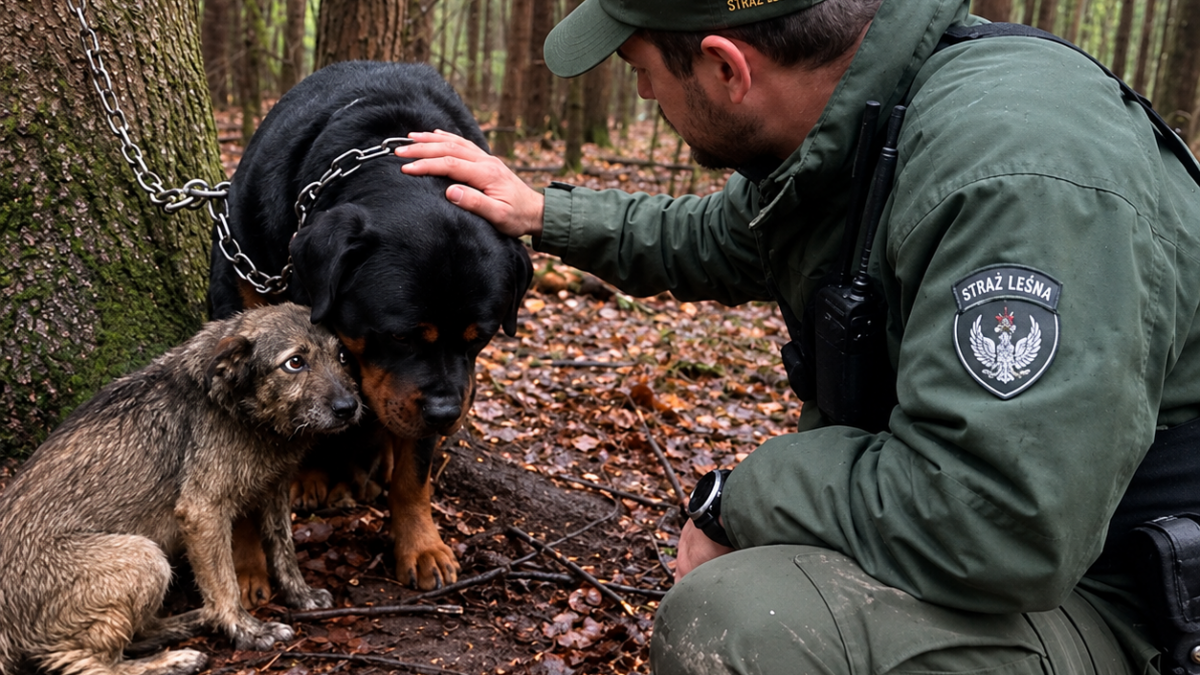
The broken chain hit the ground with a heavy metallic thud.
For several seconds, nobody moved.
Not Michaels.
Not me.
Not the stray.
Even the forest seemed to go still.
The Rottweiler stood beside the tree, his legs unsteady beneath him.
He was free.
Nothing held him anymore.
No chain.
No lock.
No human hand.
He could have disappeared between the pines in seconds.
Instead, he looked toward the small dog sitting beneath the brush.
The stray lowered his head.
His ears flattened.
Maybe he expected the larger dog to come for the remaining piece of meat.
Maybe he expected nothing at all.
The Rottweiler began walking.
Slowly.
One careful step after another.
Straight toward him.
“Michaels,” I whispered.
“I see it.”
Neither of us wanted to interfere.
The Rottweiler reached the stray.
The size difference between them was almost absurd.
The Rottweiler probably weighed seventy pounds even in his weakened condition.
The stray looked like he might weigh thirty.
They stood nose to nose.
The little dog trembled.
Then the Rottweiler lowered his head.
He licked the stray’s muzzle.
Once.
Then again.
The smaller dog’s eyes closed.
That was all.
No dramatic barking.
No jumping.
No great burst of excitement.
Just two quiet gestures.
But there are moments when you know you’re seeing something you’ll carry for the rest of your life.
That was one of mine.
Michaels lowered the bolt cutters.
“Well.”
His voice cracked slightly.
I looked at him.
“Don’t.”
“I’m not doing anything.”
“You look like you’re going to cry.”
“I’m allergic to pine trees.”
“There are pine trees around us every day.”
“Shut up.”
The Rottweiler stayed close to the stray.
I moved carefully toward them.
“Okay, boys.”
The stray immediately backed away.
The Rottweiler didn’t.
He stood between us for a moment.
Then looked toward the smaller dog.
I realized something.
The Rottweiler wasn’t afraid of humans the way the stray was.
He had probably lived with people.
Slept inside.
Been fed from a bowl.
Maybe ridden in a car.
Maybe once had a family.
Someone had made the deliberate decision to bring him into those woods and tie him where he couldn’t follow.
The stray was different.
Every part of him said human hands had never meant safety.
Or hadn’t meant safety for a very long time.
I held out my hand to the Rottweiler.
He sniffed it.
Then leaned forward.
His nose touched my fingers.
“Good boy.”
His tail moved.
Michaels sighed.
“He’s somebody’s pet.”
“Was.”
We both heard the bitterness in my voice.
The Rottweiler walked toward our pickup.
The stray stayed behind.
I opened the rear door.
The big dog looked inside.
Then, with less hesitation than I expected, climbed onto the back seat.
He turned twice and lowered himself.
Like he remembered vehicles.
Like maybe once car rides had meant parks, hikes, family trips.
Before one ride ended at a tree.
I looked back.
The stray was still sitting in the same spot.
“We can’t leave him,” I said.
Michaels nodded.
“I know.”
I crouched.
“Come on.”
The dog froze.
“It’s okay.”
No movement.
I reached into my pack and found part of a sandwich.
Turkey.
I tore off a piece.
His nose moved.
I placed it on the ground.
He didn’t approach.
The Rottweiler raised his head inside the truck.
I put another piece slightly closer.
“Come on, little man.”
The stray took one step.
Stopped.
His eyes never left me.
There was intelligence in them.
And calculation.
He was asking the question survival had probably taught him to ask every time a human offered something.
What’s the price?
I backed away.
The dog approached the first piece of turkey.
Grabbed it.
Retreated.
Ate.
“Good.”
He looked toward the truck.
The Rottweiler was watching through the open door.
Then something unexpected happened.
The big dog barked.
One deep sound.
Not aggressive.
Not warning.
An invitation.
The stray’s ears rose.
Another bark.
The little dog looked at me.
Looked at Michaels.
Then looked at his friend.
He walked toward the truck.
Each step seemed to require a decision.
When he reached the door, he stopped.
The Rottweiler shifted backward.
Making room.
The stray put his front paws on the running board.
Stopped again.
“Come on,” I whispered.
The Rottweiler gave a low whine.
The little dog jumped.
He landed on the seat beside him.
Immediately he pressed himself against the Rottweiler’s chest.
The big dog lowered one front leg over him.
As if the arrangement had existed forever.
Michaels closed the door carefully.
I stood there staring through the window.
The stray rested his head on the Rottweiler’s paw.
“Tell me you’re seeing this.”
“I’m seeing it.”
“What kind of dog gives away food when he’s starving himself?”
Michaels leaned against the truck.
“Apparently that one.”
We photographed the location before leaving.
The chain.
The tree.
Old tire tracks.
Food scraps.
Any evidence that might help identify whoever had abandoned the Rottweiler.
There wasn’t much.
No tag.
No collar identification.
No microchip scanner with us.
Just a rusted chain looped twice around a pine.
The lock looked weathered.
I couldn’t tell whether he’d been there five days or twenty.
What I did know was that no dog in that condition should have survived long without help.
And the help had apparently arrived on four skinny legs.
Our base had a small veterinary unit used mainly for injured wildlife and working dogs.
Margot ran it.
Margot could make grown patrol officers feel like irresponsible children with one look.
We carried the dogs inside.
Or tried.
The Rottweiler walked.
The stray refused.
The second his paws touched the ground outside the truck, he tried to retreat beneath it.
The Rottweiler turned.
The stray stopped.
Again.
Every decision went through the bigger dog.
Margot stood in the doorway.
“What did you bring me?”
Michaels said, “You’re going to need coffee.”
She looked from the Rottweiler to the stray.
“Both abandoned?”
“One chained.”
“And him?”
I looked at the little dog.
“We think he was living wild.”
Margot crouched.
The stray flattened himself.
“Don’t touch him yet,” I said.
“Wasn’t planning to.”
The Rottweiler walked into the treatment room.
The stray followed.
Margot raised an eyebrow.
“Bonded?”
“You have no idea.”
We told her.
At first, she stopped examining the Rottweiler.
“Wait.”
I repeated the part about the meat.
“The stray brought food to him?”
“Yes.”
“You’re certain he wasn’t just carrying it and dropped it because you scared him?”
“He walked straight to the Rottweiler and put it in front of him.”
Michaels added, “Then backed up and watched him eat.”
Margot looked toward the dogs.
The Rottweiler lay on a padded mat.
The stray pressed against his shoulder.
“I’ve seen dogs share.”
She spoke slowly.
“I’ve seen nursing females take in orphaned puppies. I’ve seen bonded animals refuse food when the other one is sick.”
“But?”
“I’ve never personally seen a free-roaming stray repeatedly bring food to an immobilized adult dog.”
“Repeatedly?”
She looked at me.
“You said the Rottweiler knew what was happening.”
“He did.”
“Then it wasn’t the first time.”
Exactly.
Margot examined the Rottweiler first.
He tolerated everything.
Ears.
Teeth.
Paws.
Temperature.
Blood draw.
He even lifted his foot when she checked his pads.
“Domestic dog,” Margot said.
“No question.”
“Age?”
“Four or five.”
“How bad?”
“Malnutrition. Mild dehydration. Parasites. Irritation beneath the collar. But considering what you described, he’s remarkably stable.”
“Because he had food.”
She looked toward the stray.
“Probably.”
We scanned him.
No chip.
I wasn’t surprised.
“What do we call him?” Margot asked.
Michaels shrugged.
“Rottweiler?”
“We need a name for the record.”
I studied him.
There was something solid about him.
Even weakened.
He had endured being tied to a tree without becoming frantic or aggressive.
He had accepted our help with a strange dignity.
“Brigg.”
Michaels looked at me.
“Brigg?”
“Sounds strong.”
“Sounds like a prison.”
“Do you have something better?”
“Nope.”
Margot typed it.
“Brigg it is.”
Then came the stray.
That was harder.
Margot stepped toward him.
He retreated behind Brigg.
She moved left.
He moved right.
Brigg stayed lying down, looking mildly inconvenienced.
“James.”
“What?”
“Come sit beside the Rottweiler.”
“Why?”
“Because the small one keeps watching you.”
I sat.
Brigg rested his chin on my thigh like we’d known each other longer than three hours.
The stray watched.
Margot approached slowly.
The little dog’s body shook.
Brigg lifted his head.
The stray touched him.
Then allowed Margot to put the stethoscope against his side.
“Heart fast.”
“Fear?”
“Fear. Malnutrition. Probably both.”
She worked slowly.
He was worse than Brigg physically.
Every vertebra visible.
Matted coat.
Small scars across his muzzle.
An older wound near his shoulder.
Ticks.
Fleas.
One torn ear.
But no life-threatening illness.
No broken bones.
No fever.
Nothing that explained how skeletal he looked except the simplest answer.
He had been surviving on almost nothing.
“And he gave food away,” Margot said.
Nobody answered.
We were all thinking the same thing.
Whatever he found in those woods, some of it had gone to Brigg.
“Name?” she asked.
I looked at him.
Small.
Alert.
Always ready to disappear.
“Sparrow.”
Michaels groaned.
“Now you’re naming dogs after birds?”
“He looks like a Sparrow.”
“He looks like a dirty mop.”
“Sparrow,” Margot said, entering it.
The name stuck.
We set up two beds.
Brigg took one.
Sparrow ignored the other and climbed into Brigg’s.
Margot stared.
“Of course.”
That first night I told myself I’d stay twenty minutes.
I stayed three hours.
Partly because we wanted someone monitoring them.
Mostly because I couldn’t leave.
Around nine, Michaels appeared in the doorway carrying two coffees.
“I thought you went home.”
“I did.”
“And came back?”
“My wife said I was talking about the dogs too much and should stop pretending I wasn’t worried.”
He handed me coffee.
We sat quietly.
Brigg slept.
Sparrow remained awake.
Every noise from the hallway made his head rise.
Every door closing tightened his body.
But whenever Brigg shifted, Sparrow relaxed.
Michaels whispered, “He kept him alive.”
“Maybe they kept each other alive.”
“Brigg was chained.”
“Exactly.”
Michaels looked at me.
“You think the little one needed him too?”
I watched Sparrow.
There are different kinds of hunger.
Food is only one.
Maybe Sparrow had spent months alone in those woods.
Maybe longer.
Then one day he’d found another dog.
A dog who couldn’t chase him away.
Couldn’t leave.
Maybe he approached out of curiosity.
Maybe Brigg shared something first.
Maybe none of it happened the way I imagined.
But somewhere between abandonment and rescue, they had become necessary to each other.
Brigg needed food.
Sparrow needed someone to return to.
I knew enough about loneliness to understand that arrangement.
The next morning, Sparrow wouldn’t let Margot within three feet unless Brigg was present.
If we walked Brigg outside, Sparrow cried.
Not barked.
Cried.
A thin sound that went directly through you.
So we changed the plan.
They went everywhere together.
When Brigg walked outside, Sparrow followed.
When Brigg ate, Sparrow ate.
When Brigg slept, Sparrow curled against him.
By the third day, I decided to try something.
I sat on the floor outside their enclosure.
No movement.
No eye contact.
Just me and a piece of cheese.
Sparrow stayed against the rear wall.
I waited.
Twenty minutes.
Thirty.
Forty-five.
My legs went numb.
Michaels walked past.
“What are you doing?”
“Building trust.”
“You look like an idiot.”
“Go away.”
He did.
One hour.
Sparrow moved.
Two inches.
Stopped.
Another inch.
His eyes fixed on the cheese.
Brigg lay on his bed watching.
Sparrow looked at him.
I swear it looked like he was asking permission.
Brigg yawned.
Sparrow approached.
His nose touched my fingers.
He took the cheese.
So delicately I barely felt his teeth.
Then he jumped backward.
Chewed.
Watched me.
And his tail moved.
Once.
A tiny motion.
But it felt like winning something enormous.
“Good boy.”
He didn’t run.
That night, I called Elizabeth.
My wife had been asking for a dog for eight years.
I’d always had reasons.
Our schedules were unpredictable.
Travel.
Long patrol days.
Expense.
Responsibility.
All logical.
All convenient.
“You’re calling late,” she said.
“I’m at the base.”
“Everything okay?”
“Yes.”
Pause.
“You found something.”
She knew me too well.
“Two dogs.”
“Two?”
I told her.
All of it.
Brigg.
The chain.
Sparrow.
The bone.
The way Brigg walked toward him after being freed.
Elizabeth stayed silent until I finished.
Then she asked, “Where are they going?”
“That’s the problem.”
“Why?”
“They can’t be separated.”
“I didn’t ask if they could.”
I rubbed my forehead.
“Elizabeth.”
“James.”
“We don’t have room for two dogs.”
“We have a house.”
“Small house.”
“Still a house.”
“Our yard isn’t huge.”
“It has a fence.”
“We both work.”
“I work from home three days a week.”
“Vet bills.”
“We’ll figure it out.”
I became quiet.
Elizabeth’s voice softened.
“You’ve already decided, haven’t you?”
“I don’t know.”
“You do.”
I looked through the glass.
Brigg was asleep.
Sparrow’s head rested across his neck.
“If I bring one home, I’m bringing both.”
“Obviously.”
“This is insane.”
“Probably.”
“You’re not helping.”
“I’m your wife, not your accountant.”
I laughed.
Then she said, “Bring them home when they’re ready.”
I didn’t answer.
“James?”
“Yeah.”
“Both.”
“Both.”
The next morning, I went to Harold’s office.
Harold was my supervisor.
Thirty years in forestry.
Face carved from stone.
He didn’t smile.
Nobody knew if he had ever smiled.
I explained everything.
He listened without interrupting.
When I finished, he leaned back.
“So let me understand.”
“Okay.”
“You deviated from route.”
“Slightly.”
“Found an illegally abandoned dog.”
“Yes.”
“Damaged private property.”
“A chain.”
“Technically evidence.”
“Michaels photographed it first.”
Harold stared at me.
“And now you want permission to keep two dogs at base longer than protocol allows.”
“Temporarily.”
“You’re adopting them.”
I blinked.
“What?”
He leaned forward.
“Hartford, I’ve supervised you twelve years. You’re adopting the dogs.”
“Maybe.”
“You’re already using names.”
“Records needed names.”
“Of course.”
I waited.
He looked toward the window.
“I’ve seen people do horrible things in these woods.”
His voice changed.
“Poaching. Dumping. Cruelty for no reason except nobody was watching.”
I didn’t speak.
“I’ve also seen animals do things I wouldn’t have believed if someone else told me.”
He looked back.
“A starving stray feeding a chained dog.”
“Yes.”
Harold nodded once.
“Keep them here until you’re ready.”
“Thank you.”
“And Hartford?”
“Yes?”
“Document everything.”
“I will.”
“Michaels has already written something about it.”
I closed my eyes.
“What?”
Harold turned his monitor toward me.
Our internal department network displayed a post.
THE GUARDIANS OF THE FOREST.
“Michaels.”
“He writes dramatically.”
“I am going to kill him.”
“After your shift.”
The story spread.
First among staff.
Then volunteers.
Then one of our communications officers asked permission to share a shortened version publicly.
I reluctantly agreed because we still hoped someone might identify Brigg.
Instead, people began offering help.
Food.
Blankets.
Veterinary donations.
Adoption applications.
One call mattered more.
A veterinarian named Catherine from a nearby town offered to examine both dogs without charge.
Margot knew her.
“She’s excellent.”
Catherine arrived on the fifth day.
She spent nearly two hours with them.
Brigg loved her immediately.
Sparrow did not.
Until Brigg walked toward Catherine.
Then Sparrow followed.
She watched them closely.
“They really are bonded.”
“That’s what we’ve been saying.”
“No.”
She shook her head.
“I’m not talking about two dogs who prefer being together.”
“What are you saying?”
“Look.”
Catherine asked me to call Brigg across the room.
I did.
Brigg stood and came.
Sparrow was asleep.
The moment Brigg moved six feet away, Sparrow woke.
His head snapped up.
He located Brigg.
Then followed.
Catherine moved Brigg into the hallway.
Sparrow whined immediately.
“We’re done,” I said.
She nodded.
Brigg came back.
Sparrow pressed his face against his chest.
Catherine sighed.
“Separating them would be cruel.”
“Thank you.”
“For what?”
“Confirming I’m not imagining it.”
She smiled.
“So who’s taking them?”
I hesitated.
Michaels, standing behind her, started grinning.
“Don’t.”
Catherine looked from him to me.
“Oh.”
“Nothing is decided.”
Michaels laughed.
“It was decided under the pine tree.”
“Go work.”
He walked away laughing.
Catherine studied me.
“Your home suitable?”
“Fenced yard.”
“Other animals?”
“No.”
“Children?”
“No.”
“Experience with dogs?”
I looked at Brigg.
“Five days.”
She laughed.
“You’ll learn.”
Elizabeth came to the base that evening.
I had told her about Sparrow’s fear.
“Don’t approach him.”
“I know.”
“No reaching over his head.”
“James.”
“And don’t corner—”
“I’m married to a forest officer, not incapable of reading.”
Fair.
Brigg met her first.
He walked straight toward Elizabeth.
She crouched.
He pushed his head against her chest.
“Oh.”
Her whole expression changed.
“Hello, handsome.”
I knew I was doomed.
Then Sparrow appeared.
He stood behind Brigg.
Elizabeth didn’t look directly at him.
Didn’t reach.
She sat on the floor.
After ten minutes, Sparrow stepped closer.
After twenty, he sniffed her boot.
She still didn’t move.
Thirty minutes.
She placed a small piece of chicken beside her leg.
Sparrow approached.
Took it.
Retreated.
Elizabeth looked at me.
Not triumphant.
Just emotional.
“He’s so scared.”
“Yes.”
She put another piece down.
This time Sparrow stayed closer.
An hour later, he lay three feet from her.
“Both,” Elizabeth whispered.
I knew exactly what she meant.
Both were coming home.
Paperwork took several more days.
We checked missing-dog reports.
No match for Brigg.
No reports for Sparrow.
No one claimed either dog.
Our investigation into Brigg’s abandonment produced almost nothing.
The tire tracks were too old.
No camera coverage.
No witnesses.
Someone had brought him deep enough into the forest that they clearly intended not to be seen.
That angered me.
But the dogs didn’t need my anger.
They needed what came next.
Home.
The first drive was quiet.
Brigg sat upright watching out the window.
Sparrow curled against him.
Elizabeth drove behind us.
When we reached the house, Brigg stepped out confidently.
Sparrow refused.
I waited.
Brigg walked toward the front door.
Sparrow watched.
Then jumped down.
Inside, Brigg immediately discovered the couch.
He sniffed it.
Climbed up.
Turned three times.
Collapsed.
Elizabeth stared.
“He knows couches.”
“Apparently.”
Sparrow stood beside the front door.
Every muscle rigid.
The ceiling fan frightened him.
The refrigerator compressor frightened him.
A car door outside made him flatten himself.
He didn’t understand smooth floors.
His paws slid on the hardwood and he panicked.
We placed rugs through the hall.
He stayed near the exit for nearly an hour.
Elizabeth sat ten feet away.
Chicken in hand.
No eye contact.
Same method.
Same patience.
Eventually Sparrow approached.
One piece.
Then another.
Two hours later, he lay near her feet.
Brigg snored on the couch.
Around midnight, Sparrow finally closed his eyes.
The change in his face was immediate.
Fear didn’t disappear.
But tension did.
For the first time since we’d found him, Sparrow slept without keeping his head raised.
Elizabeth whispered, “Look.”
“I see.”
“He’s safe.”
I looked at the little dog.
“No.”
“What?”
“He’s starting to believe he might be.”
That was different.
The first week wasn’t easy.
Sparrow feared everything.
Vacuum cleaner.
Television.
Microwave beep.
Doorbell.
A dropped spoon.
If something frightened him, he ran to Brigg.
Every time.
Brigg never seemed annoyed.
The big Rottweiler would simply reposition himself so Sparrow could hide behind him or press against his side.
The relationship had changed.
In the forest, Sparrow had been the provider.
Now Brigg became the shield.
Maybe that was why they worked.
Neither was always strong.
They took turns.
Sparrow’s appetite was another problem.
He ate too fast.
We used slow-feeder bowls.
Even then, he sometimes grabbed food and carried it away.
The first time, I followed.
He took several pieces of kibble to Brigg’s bed.
Dropped them beside him.
Then returned to his bowl.
I stood there stunned.
“Elizabeth.”
She came from the kitchen.
“What?”
I pointed.
Brigg sniffed the kibble.
Sparrow brought more.
Elizabeth’s eyes filled.
“He still feeds him.”
“He doesn’t have to.”
“I don’t think he knows that yet.”
That became part of Sparrow’s healing.
Teaching him there would always be more.
Full bowl.
Next meal.
Tomorrow.
At first, he hid treats beneath blankets.
Inside couch cushions.
Once inside my work boot.
I stepped on a piece of dried liver at five in the morning.
“Sparrow!”
He fled.
Brigg lifted his head.
I saw the fear in Sparrow’s face and immediately regretted shouting.
I crouched.
“Sorry.”
He stayed across the room.
I took the liver from my boot.
Put it beside his bowl.
“You’re not in trouble.”
He didn’t come.
I sat on the floor.
Eventually Brigg walked over and sat beside me.
Sparrow followed.
Trust sometimes grows through another creature.
That was true with him.
If Brigg believed we were safe, Sparrow was willing to consider it.
Weeks passed.
His ribs disappeared gradually.
The coat changed from dirty brown-gray to a mix of charcoal, cream, and tan.
Margot guessed there was shepherd somewhere in him.
Maybe terrier.
Maybe ten other things.
It didn’t matter.
He became beautiful.
Not in the polished purebred way Brigg was beautiful.
Sparrow had one torn ear, uneven fur, scars around his muzzle.
He looked like survival.
One evening, six weeks after bringing them home, I returned from patrol.
Brigg met me at the door.
Tail wagging.
Normal.
Then Sparrow appeared behind him.
He froze when he saw me.
I crouched.
“Hey, buddy.”
For weeks, our greetings had been cautious.
Sparrow approached after Brigg did.
Maybe allowed one touch.
Then retreated.
That night, something changed.
He ran.
Straight at me.
His tail moved so violently his whole back end swayed.
He jumped.
Front paws against my chest.
And licked my face.
I almost fell backward.
Elizabeth stood in the hallway laughing.
“What happened to my terrified forest dog?”
Sparrow jumped again.
“Okay!”
More licking.
Brigg sat on the rug watching.
Calm.
Almost dignified.
Elizabeth pointed at him.
“Look at Brigg.”
“What?”
“He’s proud.”
“He’s a dog.”
“Look at his face.”
I looked.
Maybe it was projection.
Maybe not.
Brigg’s tail struck the floor once.
Like the first time Sparrow brought him meat.
Like approval.
That night, Sparrow slept on our bedroom floor.
Not with Brigg.
That mattered.
Only for an hour.
Then he went back to Brigg’s bed.
But he’d made the choice himself.
Small steps.
Two months after the rescue, I returned to the forest.
Michaels came.
I didn’t bring the dogs.
Partly because I didn’t know how Sparrow would react.
Partly because I needed to see it alone.
The old trail looked exactly the same.
Pines.
Mud.
Shadows.
We found the tree.
The chain still lay where we’d left it after evidence photographs.
Rust covered part of it.
I stared at the loop.
“It’s smaller than I remember.”
Michaels said, “Everything is after.”
We walked around the area.
That’s when I found the hollow beneath a cluster of roots.
Small.
Hidden.
Inside were bones.
Bits of animal fur.
A length of rope.
And a torn piece of old fabric.
I crouched.
“Sparrow.”
Michaels came closer.
“What?”
“This was his place.”
The little hollow was maybe forty yards from Brigg’s tree.
Close enough to hear him.
Close enough to visit.
I imagined Sparrow sleeping there.
Cold nights.
Rain.
Hunger.
Then hearing another dog cry.
Finding him chained.
Maybe bringing him food once.
Then again.
Then making it part of every day.
I picked up the torn fabric.
Probably once a blanket.
Dirty.
Almost disintegrating.
Michaels watched.
“You’re taking that?”
“Yes.”
“Why?”
I folded it carefully.
“Because that’s what he had.”
Michaels looked toward the tree.
“And now?”
I smiled.
“Now he has a couch.”
He laughed.
The fabric went into a sealed box at home.
Elizabeth understood immediately.
We kept it.
Not as something sad.
As evidence.
Evidence of distance traveled.
The public story about Brigg and Sparrow continued spreading.
I didn’t particularly enjoy attention, but useful things happened because of it.
Our patrol division formally added an abandoned-animal response protocol.
Vehicles began carrying slip leads, collapsible bowls, blankets, and basic animal first-aid supplies.
Catherine started working with our department on emergency foster contacts.
One local rescue launched a bonded-pair adoption campaign after mentioning Brigg and Sparrow.
Months later, Catherine called.
“A brother and sister got adopted together today.”
“Okay.”
“They’d been waiting six months.”
“Good.”
“The family said they read about your dogs.”
I looked across the room.
Brigg lay on the rug.
Sparrow slept with his head across Brigg’s back.
“That’s good.”
“That’s all?”
“What do you want?”
“I thought you’d be emotional.”
“I am.”
“You’re terrible at showing it.”
Elizabeth, sitting nearby, shouted, “Correct.”
I covered the phone.
“Traitor.”
Catherine laughed.
Then she told me about a drawing.
A little girl had drawn two dogs.
One large and black.
One small and gray.
Underneath she’d written:
LOVE ISN’T MEASURED BY SIZE. IT’S MEASURED BY HEART.
Catherine brought it during her next visit.
We framed it.
It went on the living room wall above the old fabric from Sparrow’s forest shelter.
Months became a year.
Brigg recovered completely.
Muscle returned.
His coat shone.
He weighed nearly ninety pounds.
People who met him sometimes stepped back because of his size.
Then Brigg would lean his full body against their legs demanding scratches.
Intimidation lasted about five seconds.
Sparrow changed even more.
He became playful.
Actually playful.
He discovered tennis balls.
The first time Elizabeth threw one, Sparrow watched it bounce.
Looked at her.
Looked at the ball.
Then at Brigg.
Brigg trotted after it.
Sparrow followed.
Brigg picked it up.
Sparrow stole it.
That became their game.
Sparrow was faster.
Brigg was stronger.
Sparrow would race circles around the yard.
Brigg would wait.
Eventually Sparrow came close enough.
Brigg took the ball.
Then they’d repeat.
Seeing Sparrow run was almost surreal.
This was the same dog who had once approached us with his body low, every step filled with terror.
Now he ran because he could.
One evening, Elizabeth stood beside me on the porch.
Sparrow sprinted after a ball.
Brigg chased him.
“You were right,” I said.
She looked at me.
“About?”
“Both.”
She smiled.
“I usually am.”
“Don’t ruin the moment.”
Our marriage changed too.
Not dramatically.
Not because dogs magically solve human problems.
But we spent more time outside.
Walked together.
Talked more.
Brigg slept beside my side of the bed.
Sparrow preferred Elizabeth’s.
She claimed that proved who the better person was.
I claimed Sparrow simply liked stealing her blankets.
Both could be true.
My work changed.
Before Brigg and Sparrow, abandoned-animal calls were another item on a report.
After them, every call had a face.
A winter afternoon, Michaels and I found three puppies inside a taped cardboard box near a service road.
Alive.
Cold.
Months earlier, I might have simply followed protocol efficiently.
That day, I sat in the truck holding the box against the heater.
Michaels looked at me.
“What?”
“Nothing.”
“You have the face.”
“What face?”
“Brigg and Sparrow ruined you.”
“They improved my professional standards.”
“You baby-talk puppies now.”
“I do not.”
One puppy squeaked.
I looked down.
“You’re okay, little guy.”
Michaels grinned.
“I hate you.”
“Sure.”
The puppies survived.
All adopted.
That became another story.
Then another.
A hunting dog lost for eleven days.
An injured owl.
Two dumped rabbits.
A shepherd tied near an abandoned campground.
We couldn’t save everything.
That’s important.
Sometimes we arrived too late.
Those days hurt differently after Brigg and Sparrow.
Once you know what rescue can become, you feel more sharply when rescue doesn’t come in time.
Harold noticed.
After a particularly bad call, he sat beside me in the break room.
No speech.
Just coffee.
Then he said, “You can’t carry all of them home.”
“I know.”
“You say that.”
“I know.”
“You gave two dogs a life.”
I looked down.
“It doesn’t make the ones we lose easier.”
“No.”
He drank his coffee.
“But the ones we lose don’t erase the ones we save.”
Harold wasn’t known for wisdom.
I never told him that was wise.
He’d have denied it.
Three years passed.
Brigg became slower first.
Not old.
Just calmer.
Sparrow remained energetic.
But their relationship never changed.
Every morning, Sparrow checked where Brigg was.
Every meal, he sometimes carried one piece of kibble toward Brigg’s bowl.
Not every day anymore.
But often enough.
We stopped trying to discourage it.
It had become ritual.
A memory encoded as behavior.
One evening, Brigg became sick.
He refused dinner.
That alone scared us.
Brigg considered refusing food a violation of natural law.
By midnight, he was vomiting.
We took him to Catherine’s clinic.
Sparrow came.
No discussion.
Brigg was examined in the back.
Sparrow paced.
Whined.
Scratched the door.
I sat on the floor.
He couldn’t settle.
Finally Catherine allowed him into the treatment room.
Sparrow ran to Brigg.
Pressed himself against his chest.
Brigg’s tail moved.
The diagnosis was pancreatitis.
Painful.
Treatable.
Catherine wanted him hospitalized overnight.
Sparrow refused to leave.
Literally.
I tried guiding him toward the door.
He planted himself.
Elizabeth tried.
Nothing.
Catherine sighed.
“I’ll put another bed beside Brigg.”
“You allow that?”
“Tonight I do.”
We left Sparrow.
It felt strange driving home without either dog.
The house was silent.
Elizabeth sat at the kitchen table.
“This is terrible.”
“It’s one night.”
“I know.”
We lasted four hours.
At two in the morning, I called Catherine.
“How are they?”
She laughed.
“You know normal people sleep.”
“How is he?”
“Brigg is stable.”
“And Sparrow?”
“Asleep beside him.”
We went back at seven.
Brigg recovered.
Within days, he was home.
Sparrow watched him constantly.
When Brigg walked outside, Sparrow walked slowly beside him.
When he slept, Sparrow curled close.
The roles were familiar.
One needed help.
The other stayed.
Years passed.
Brigg’s muzzle gradually became gray.
Sparrow’s too.
Nobody knew Sparrow’s exact age.
Catherine estimated he might have been two or three when we found him.
Brigg slightly older.
They entered senior years together.
Walks shortened.
Running became trotting.
Tennis balls sometimes stayed untouched.
But the bond remained.
One winter, Brigg developed arthritis.
Stairs became difficult.
Sparrow started stopping at the top.
Waiting.
If Brigg struggled, Sparrow came down again.
Elizabeth once whispered, “He still won’t leave him.”
“No.”
“He never will.”
I knew.
One spring morning, I woke and found Sparrow beside Brigg’s bed.
He was licking the Rottweiler’s muzzle.
Slowly.
Repeatedly.
Brigg wasn’t standing.
My stomach dropped.
“Brigg.”
His eyes opened.
Tail moved.
Weakly.
We went to Catherine.
Blood tests.
Imaging.
More tests.
She came into the room and sat instead of standing.
I knew immediately that whatever she had to say wasn’t simple.
“His heart has changed.”
“What does that mean?”
“Cardiomyopathy.”
Elizabeth took my hand.
“Can you treat it?”
“Manage.”
“For how long?”
“I don’t know.”
The terrible answer.
Weeks.
Months.
Maybe longer.
Medicine doesn’t always give timelines.
Brigg came home.
Medication helped.
Good days returned.
We took shorter walks.
Let him sleep where he wanted.
Sparrow stayed close.
Always.
Six months later, we visited the forest together.
For the first time.
I wasn’t sure whether I was making a mistake.
But Brigg still enjoyed car rides.
Sparrow no longer feared the truck.
We drove along the old road.
As we got closer, Sparrow stood.
His entire body changed.
He knew.
I pulled over before the final trail.
We walked.
Slowly.
Brigg beside me.
Sparrow ahead.
Then he stopped.
The tree appeared.
The place where we’d found them.
The old chain was gone.
We’d eventually collected it as part of the completed case record, and after the case was closed, I’d kept one cut link with permission.
But the tree remained.
Sparrow approached first.
He sniffed the roots.
Went toward the hollow that had once been his shelter.
Stood there.
Brigg walked to him.
For a moment, the two old dogs stood in the exact place where their story with us had begun.
Elizabeth cried.
Michaels had joined us.
He looked away.
“Allergies?” I asked.
“Shut up.”
Sparrow walked toward the tree.
Then back to Brigg.
Brigg lowered himself beneath the pine.
Sparrow lay beside him.
I sat too.
We stayed for almost an hour.
No drama.
No fear.
Just sunlight moving through branches.
Birds.
Wind.
Two dogs who had once believed the forest was the whole world.
Then Elizabeth took out something she’d brought.
A piece of cooked chicken.
She handed it to Sparrow.
He ate half.
Then walked to Brigg.
Dropped the rest in front of him.
Every one of us stopped breathing.
Years had passed.
Unlimited food.
Warm beds.
Safety.
Yet somewhere inside Sparrow, that old act remained.
Brigg ate the chicken.
Then licked Sparrow’s face.
Once.
Twice.
Exactly as he had after the chain fell.
Michaels walked away.
“I’m done.”
Elizabeth laughed through tears.
I couldn’t speak.
If there were a perfect ending, maybe that would have been it.
But lives continue after perfect moments.
Brigg’s heart weakened.
The medication became less effective.
He started coughing at night.
Then fainting.
Catherine adjusted treatment.
More good days.
Then fewer.
Sparrow seemed to know before we did.
He stopped leaving Brigg alone.
No yard without him.
No wandering into another room.
He slept pressed against him.
One evening, Brigg couldn’t rise.
I helped.
He stood.
Took two steps.
Collapsed.
Elizabeth knelt.
“No.”
I called Catherine.
She came to the house.
After examining him, she sat beside us.
“He’s tired.”
I looked at Brigg.
Sparrow lay beside him.
“Can we fix this?”
Catherine’s eyes softened.
“No.”
That single word changed the room.
Elizabeth cried quietly.
I stared at the wall.
For twelve years of patrol before Brigg, I’d seen death.
Wildlife.
Accidents.
People.
I thought familiarity might help.
It didn’t.
Love always makes death new.
“Is he hurting?”
“He’s struggling to breathe.”
I nodded.
“What would you do?”
“I’d let him go before the struggle becomes fear.”
Sparrow looked at me.
I wanted to say no.
Another day.
Another medication.
Another chance.
Then Brigg coughed.
His whole body tightened.
Sparrow pressed closer.
I remembered the tree.
A chained dog unable to leave.
A starving stray bringing food.
Freedom had finally come.
I couldn’t turn love into another chain.
“Okay.”
We carried Brigg onto his favorite bed beside the patio doors.
The afternoon sun reached him there.
Sparrow climbed onto the bed.
Catherine prepared everything.
Elizabeth sat behind Brigg, stroking his chest.
I knelt near his head.
“You remember the forest?”
His eyes opened.
Tail moved.
Barely.
“Yeah.”
Sparrow licked him.
I put my hand on Brigg’s face.
“You were supposed to run.”
My voice broke.
“When we cut that chain.”
His eyes stayed on me.
“But you went to him.”
I looked at Sparrow.
“You chose him.”
Elizabeth whispered, “They chose each other.”
Catherine waited.
I rested my forehead against Brigg’s.
“You don’t have to fight anymore.”
Sparrow shifted.
One paw rested across Brigg’s leg.
The first injection relaxed him.
His breathing eased.
For the first time in days, his body was completely comfortable.
“Good boy.”
Elizabeth sobbed.
“Such a good boy.”
Sparrow’s eyes moved between us.
Then he placed his head against Brigg’s neck.
Catherine gave the final medication.
Brigg took several slow breaths.
One.
Another.
Then one last breath.
Stillness.
Sparrow didn’t move.
Neither did we.
For twenty minutes, he remained pressed against Brigg.
Then he stood.
Sniffed him.
Licked his muzzle.
Once.
Twice.
And lay back down.
The same gesture.
The same language.
Goodbye this time.
Sparrow grieved badly.
Worse than I expected.
He searched the house.
Brigg’s bed.
The couch.
The yard.
He waited near the door.
At mealtimes, he carried food toward the empty bed.
The first time, Elizabeth had to leave the room.
I sat on the floor.
“Sparrow.”
He looked at me.
I moved the food back.
“He’s not coming.”
Of course the words meant nothing.
But maybe tone did.
I held him.
For the first time, Sparrow let me pull him completely against my chest.
He trembled.
Not with fear.
Grief.
For weeks, we built a new routine.
He slept in our bedroom.
Walked between us.
Came to patrol headquarters occasionally.
Michaels spoiled him.
Harold, retired by then, visited once.
He sat on the porch.
Sparrow placed his head on Harold’s shoe.
Harold cleared his throat.
“Where’s his big bodyguard?”
I didn’t answer.
Harold understood.
He scratched Sparrow’s head.
“Guess it’s your turn now.”
I looked at him.
“What?”
“To guard him.”
He was right.
For years, Sparrow had guarded Brigg.
Then Brigg guarded Sparrow.
Now we guarded what remained.
Slowly, Sparrow returned to himself.
Not the same.
Grief changes everybody.
But he ate.
Played occasionally.
Started greeting us with his whole-body wag again.
One morning, months after Brigg died, Sparrow carried a piece of kibble from his bowl.
My heart stopped.
He walked toward Brigg’s old bed.
Paused.
Then turned.
Came to me.
Dropped the kibble at my feet.
I laughed.
Then cried.
“You trying to feed me now?”
He wagged.
I picked it up.
“Thanks. I’ll pass.”
He ate it himself.
That felt like permission.
Life could continue.
We planted a tree for Brigg.
A pine.
Of course.
In our backyard.
Beside it, I buried the cut link from his old chain.
Not as a symbol of what had been done to him.
As proof that chains can break.
Sparrow often slept beneath that tree.
Years later, when his own muzzle had turned almost completely white, that was still his favorite place.
He grew gentler with age.
Less afraid.
People visiting our house struggled to believe he had once been nearly feral.
He greeted children carefully.
Allowed strangers to pet him after a minute or two.
Still hated vacuum cleaners.
Some wounds apparently deserved lifelong grudges.
One afternoon, Catherine visited with her niece.
The girl was maybe eight.
She’d heard the story.
She sat beside Sparrow.
“Is this the dog who brought food?”
“Yes.”
“Why?”
I looked at Sparrow.
“I don’t know.”
“Because they were friends?”
“Probably.”
“Was he hungry too?”
“Very.”
She frowned.
“Then why didn’t he eat it?”
Children ask the hardest questions because they expect simple answers.
I sat beside her.
“Maybe he knew Brigg needed it more that day.”
She thought.
Then opened a snack bag.
She took one cracker.
Broke it in half.
Offered half to Sparrow.
He sniffed.
Ate it.
She ate the other.
“Like that.”
“Exactly.”
Catherine smiled.
Later, she told me the girl had drawn another picture.
Two dogs.
One piece of food between them.
The words underneath said:
HAVING A LITTLE DOESN’T MEAN YOU HAVE NOTHING TO GIVE.
We added that drawing to the wall.
The wall eventually became a collection.
Photos of Brigg.
Sparrow.
The forest.
Letters from people who’d adopted bonded dogs after hearing their story.
A photograph of the first pair adopted through Catherine’s campaign.
A note from a patrol officer who rescued an abandoned hound using the supplies our new protocol required.
Small ripples.
All because a starving dog once decided another starving dog shouldn’t eat alone.
Sparrow lived four more years after Brigg.
He slowed.
Hearing faded.
Eyes clouded.
But every morning, he walked to the pine tree.
Sat.
Sometimes rested there for hours.
I stopped trying to decide whether he understood Brigg was buried beneath it symbolically, or whether he simply liked the shade.
Not everything needs proof.
By then I was older too.
Michaels had transferred.
Harold had retired.
New officers knew me as the guy with the dog story.
I hated that description.
Then secretly liked it.
One spring afternoon, I took Sparrow back to the forest one final time.
Just us.
Elizabeth packed water.
Food.
A blanket.
“He can’t walk far.”
“I’ll carry him.”
Sparrow rode quietly.
When we reached the trail, I lifted him.
He hated that.
Still had pride.
I carried him anyway.
At the tree, I lowered him carefully.
He stood.
Shaky.
Old.
Then walked toward the hollow where he’d once slept.
He sniffed.
Looked around.
The woods hadn’t changed much.
Trees don’t care about our timelines.
Sparrow walked toward the spot where Brigg had been chained.
There was no chain.
No sign.
Just roots.
Needles.
Earth.
He lay down.
I sat beside him.
“Long time ago.”
His ear moved.
“You were crazy, you know.”
He looked at me.
“Starving and giving away food.”
Tail.
“Then you got me into all this.”
He rested his head on my leg.
We sat in silence.
After a while, I took out a piece of chicken.
I gave it to him.
Sparrow held it.
Didn’t eat.
My throat tightened.
“No.”
He stood slowly.
Walked two steps toward the old tree.
Placed the chicken on the ground.
Then returned.
I covered my face.
“He’s not here, buddy.”
Sparrow lay beside me.
The chicken remained beneath the tree.
Maybe I should have picked it up.
I didn’t.
We left it.
For Brigg.
For memory.
For the beginning.
Sparrow died the following winter.
At home.
Under the pine tree.
It was his choice, in a way.
He had become too weak to walk far, but one sunny afternoon he stood by the back door.
I opened it.
He went straight to Brigg’s tree.
Lay beneath it.
Elizabeth brought blankets.
Catherine came later.
There was no emergency.
No panic.
We knew.
Sparrow rested with his head in my lap.
I ran my fingers over the torn ear.
The same one I’d seen in the woods.
“You did good.”
His eyes opened.
“You know that?”
Tail.
One weak movement.
“You saved him.”
Elizabeth sat beside us.
“And then he saved you.”
Sparrow breathed slowly.
“And both of you did a number on us.”
Elizabeth laughed through tears.
Catherine listened to his heart.
Then looked at me.
I understood.
I leaned closer.
“Brigg’s waiting.”
Maybe that was sentimental.
I didn’t care.
“You don’t have to bring food this time.”
Elizabeth cried harder.
I smiled through my own tears.
“Just go find him.”
Sparrow exhaled.
His body relaxed beneath my hands.
When he died, his face was peaceful.
No fear.
That mattered more than almost anything.
The dog we’d first seen trembling ten yards away, unable to trust a human hand, left the world with two human hands holding him.
We buried Sparrow beneath the pine beside Brigg’s chain link.
Another marker.
Simple.
BRIGG & SPARROW
TOGETHER
That was enough.
People sometimes ask whether I think animals understand kindness.
I stopped trying to answer scientifically.
I’m a forest patrol officer, not a philosopher.
I only know what I saw.
A Rottweiler chained to a tree.
A stray so thin I could count his ribs.
A piece of old meat carried through the forest.
Food placed carefully in front of another dog.
The giver backing away.
Waiting.
Watching.
Then a chain breaking.
A dog receiving freedom.
And choosing, before anything else, to walk toward the friend who had kept him alive.
Maybe animals don’t define compassion the way we do.
Maybe Sparrow didn’t think, I will sacrifice my food because Brigg’s need is greater.
Maybe Brigg didn’t think, I owe this dog gratitude.
Maybe their minds worked entirely through instinct and association.
Fine.
The labels don’t change the act.
Sparrow had little.
He shared it.
Brigg became free.
He chose connection over escape.
Whatever word you want to use, I saw it.
And it changed me.
Before them, I thought helping was mostly about capacity.
Training.
Equipment.
Money.
Authority.
Resources.
Sparrow had none of those.
He owned nothing.
No house.
No bowl.
No human.
Not even reliable food.
Yet he still found something to give.
That humbles me.
We humans often wait to become generous.
When I have more time.
When money isn’t tight.
When work slows down.
When I’m less tired.
When it’s convenient.
Sparrow didn’t wait until he had enough.
He shared while hungry.
Not because suffering made him noble.
Suffering isn’t noble.
Hunger isn’t beautiful.
Abandonment isn’t a gift.
The beautiful part was that cruelty had not taught him cruelty.
Scarcity had not convinced him that another creature’s hunger was competition.
Somewhere inside that frightened body, there was still room for another life.
That’s what I remember.
The story people love most is the moment we cut Brigg’s chain.
I understand.
It’s visually simple.
Chain falls.
Dog becomes free.
But when I think about it now, that wasn’t the first rescue.
The first rescue happened before Michaels and I ever arrived.
It happened whenever Sparrow entered those woods carrying something he could have eaten himself.
A bone.
Meat.
Scraps.
Whatever he could find.
He kept returning to a tree.
Kept feeding a dog who couldn’t follow him.
Sparrow had already begun the rescue.
We just brought bolt cutters.
Years after both dogs were gone, the department replaced my old patrol truck.
While cleaning it out, I found something beneath the back seat.
A small piece of fabric.
Gray.
Frayed.
At first, I didn’t recognize it.
Then I remembered.
The torn blanket from Sparrow’s shelter.
I’d brought most of it home, but apparently a tiny piece had fallen from the box years earlier.
I sat in the empty truck holding it.
Michaels happened to walk past.
He’d returned for a training seminar.
He saw my face.
“What?”
I showed him.
He recognized it.
“No way.”
“Yeah.”
He sat beside me.
For a while, neither of us spoke.
Then Michaels said, “Do you ever think about what would’ve happened if we took the other road?”
I knew what he meant.
That morning, we’d almost changed routes because one trail looked too muddy.
Five minutes.
One decision.
If we’d turned.
If we’d arrived a day later.
If Sparrow hadn’t found food.
I shook my head.
“I try not to.”
“Me too.”
Then he smiled.
“But we didn’t.”
“No.”
We took the right trail.
At the right time.
And two dogs who had survived because they chose each other finally got the chance to stop surviving.
That’s enough.
I keep the small fabric scrap in my desk now.
Next to their photograph.
The photograph was taken three months after adoption.
Brigg sits in our yard.
Huge.
Healthy.
Sparrow beside him.
Smaller.
Bright-eyed.
Their shoulders touching.
If you didn’t know the story, you’d see two ordinary dogs.
I love that.
Ordinary was the victory.
Breakfast.
Walks.
Vet appointments.
Tennis balls.
Sleeping on couches.
Stealing chicken.
Growing old.
Dying loved.
Nothing dramatic.
Nothing viral.
Nothing miraculous.
Just life.
The life somebody tried to deny Brigg by tying him to a tree.
The life Sparrow nearly lost by sharing what little he had.
They got it anyway.
Both of them.
And on difficult days, when the job shows me another example of how careless people can be with things weaker than themselves, I look at that photograph.
Not because it makes me believe the world is always kind.
It isn’t.
Brigg and Sparrow are proof of that too.
I look because they remind me cruelty is never the only thing happening.
Somewhere, somebody is sharing.
Somebody is staying.
Somebody is carrying something precious through the dark for another creature.
Maybe nobody sees it.
Maybe nobody writes about it.
It still matters.
The day we found them, Michaels asked me a question.
What kind of starving dog gives away food?
I couldn’t answer then.
I can now.
A dog who had decided he wasn’t alone anymore.
That’s what Brigg became to Sparrow.
That’s what Sparrow became to Brigg.
And eventually, that’s what both became to us.
Family isn’t always who finds you first.
Sometimes it’s who refuses to leave you behind.
Sometimes it’s who brings you food when they are hungry too.
Sometimes it’s who stands between you and the thing you fear.
Sometimes it’s who waits patiently while you learn to trust.
And sometimes family begins in the deepest part of a forest, with one dog tied to a tree and another dog stepping from the shadows with a piece of meat between his teeth.
I thought Michaels and I were the rescuers that afternoon.
We had the truck.
The badges.
The bolt cutters.
But the truth had already been written before we arrived.
Sparrow had been rescuing Brigg for weeks.
Brigg, simply by being there, had given Sparrow something he hadn’t had in a long time.
Someone to return to.
We only broke the chain.
The two of them had already done the harder thing.
They had chosen each other.
And once they did, neither one ever had to face the forest alone again.








