“We’re here for the private showing.”
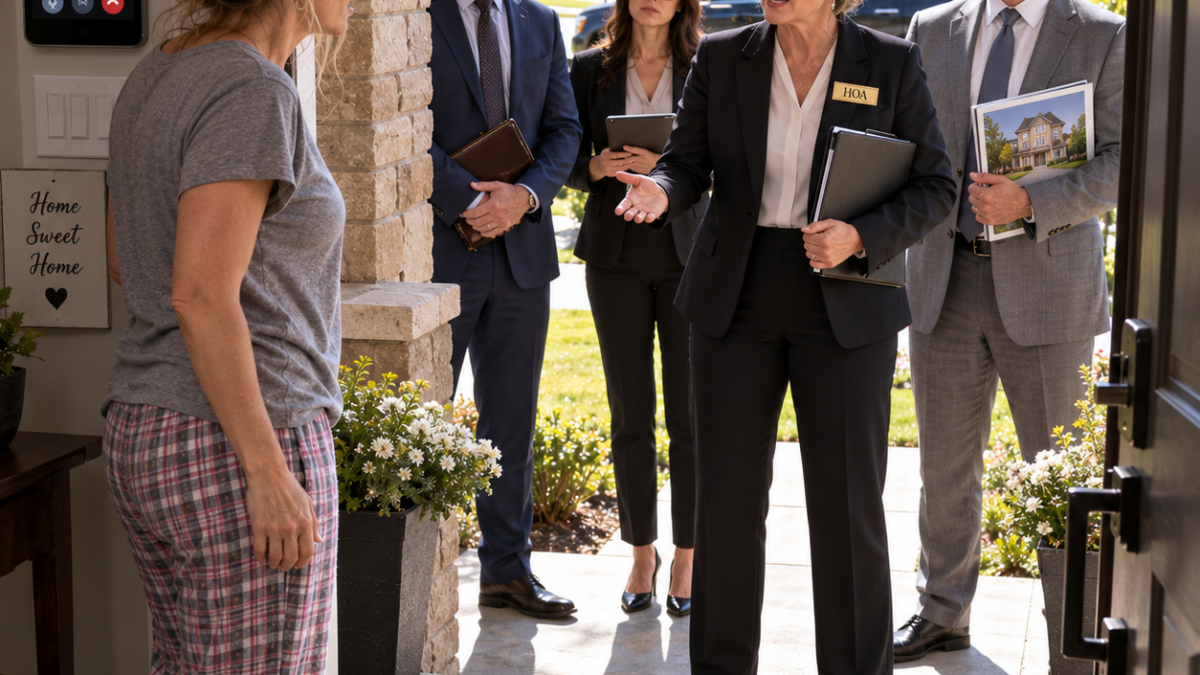
Blaine did not walk directly to my door.
That was the first thing I noticed.
He parked his charcoal SUV at the curb, stepped out in a tan field jacket, and stood beside the open driver’s door long enough for the neighbors to see him.
He was very good at arriving.
Some people enter a space.
Blaine arranged one.
Mrs. Fallon across the road had been trimming her roses.
She stopped.
Dale and Marcy Hinton came down their driveway with mail they had already collected twenty minutes earlier.
Blaine greeted them first.
Smiled.
Asked how they were.
Said something I could not hear.
Then all three looked toward my house.
That told me enough.
My phone buzzed.
June Acker, my neighbor on the left.
Seventy-two.
Widowed.
Quiet.
The sort of woman who would walk out of a church luncheon before participating in gossip.
Nora, are you okay?
A screenshot followed.
It came from a Cedar Glen group chat I was not part of.
Blaine says one homeowner on Whispering Pine is delaying the redevelopment review.
Another message:
If she waits too long, the group acquisition offer could change.
Then:
Is that Nora Whitaker?
And finally:
I heard she’s holding out for more money.
I read that one twice.
That morning, I had been a widow surprised by strangers on my porch.
By afternoon, I was greedy.
I typed back.
Thank you. Please preserve that thread.
June answered almost immediately.
Already did.
Something inside me unclenched.
Not everyone had accepted the story they were being given.
I walked to the front door and stepped onto the porch.
Blaine looked up.
His face changed just enough to tell me he had been waiting for me to come outside.
“Nora.”
“You can leave anything you need to say in writing.”
“I was hoping we could talk.”
“We are.”
He crossed the street slowly.
No clipboard.
No notice.
Just the leather folder beneath his arm.
That made him harder to dismiss.
He looked like a man delivering an opportunity, not pressure.
“I understand this morning was uncomfortable.”
“Unauthorized.”
He gave a small sympathetic smile.
“I think that word may be stronger than necessary.”
“It is the accurate word.”
He stopped at the edge of my walkway.
Not on it.
That detail told me he knew boundaries when they mattered to him.
“Cedar Glen is entering a phase that could benefit every owner.”
“My house is not part of Cedar Glen’s redevelopment parcel.”
“Your property is adjacent to an area under review.”
“That doesn’t make it available.”
“No one said it was available.”
I held up the tour sheet.
“Three people did.”
His eyes flicked toward it.
Barely.
“These early preview materials can be messy.”
“Were buyers sent here by you?”
“No.”
Too fast.
Not a lie I could prove yet.
But polished enough that I recognized the shape.
“Did you give my address to anyone connected with that preview?”
“I’m not going to discuss operational details in your driveway.”
“But you’ll discuss me with my neighbors at the curb?”
That landed.
He glanced toward Dale and Marcy.
They suddenly became interested in their envelopes.
“I was answering general questions about the redevelopment.”
“My home is not a general question.”
“The future access plan affects more than one owner.”
There it was.
Access plan.
Not acquisition interest.
Not market exploration.
Access.
Blaine heard himself say it.
So did Dale.
Mrs. Fallon stopped clipping roses entirely.
Blaine corrected course.
“What I mean is circulation, traffic, long-term planning, infrastructure—”
I held up my phone.
“The buyers sent me their screenshots.”
His eyes sharpened.
“They were given a private preview link.”
“Nora—”
“My lot was marked priority access.”
The warmth in his voice disappeared.
Not completely.
Just enough.
“I would be very careful circulating preliminary documents you may not understand.”
I looked at him.
“Is that a warning?”
“It’s advice.”
“About what?”
“People who create noise around unfinished planning materials often discover that the noise follows them.”
That was the first sentence he said that sounded like the man under the jacket.
Quiet.
Controlled.
Not loud enough for the neighbors to hear every word.
But unmistakable.
I looked at the concrete beneath his polished shoes.
Paul had patched that section after the freeze of 2018.
He hated the color difference.
Said it looked like the driveway had been wearing a bandage.
“I understand my front door,” I said. “And I understand consent. Nobody had mine.”
His jaw moved once.
Then the public smile returned.
“Of course. No one wants you to feel uncomfortable in your home.”
Feel.
Again.
As if the facts were merely my reaction to them.
He turned.
Walked back toward the SUV.
Gave Dale and Marcy a short nod.
Then paused before getting inside.
His eyes moved toward the side of my house.
To the narrow path leading to the gate.
Quick.
Almost nothing.
But I saw it.
After he left, I walked around the house.
The side gate was closed.
Dark green metal.
Paul had repainted it the summer before he got sick.
At first, nothing seemed different.
Then sunlight caught a fresh silver scratch near the latch.
Thin.
Bright.
New.
I touched it with one finger.
Something metal had rubbed against the paint.
Recently.
I took three photographs.
Then another wider one showing the entire gate.
I did not know what the mark meant.
So I did not invent meaning for it.
I simply saved it.
That night I barely slept.
Every ordinary house sound became somebody arriving.
Water heater.
Tree branch against the gutter.
Car slowing on the street.
At 5:41 the next morning, I gave up.
Pulled on a gray sweater.
Tied my hair back.
Made coffee in the dark kitchen.
Before turning on any lights, I checked the doorbell camera.
Nothing.
Then the side camera.
Paul had installed it after a package theft two winters earlier.
I had teased him.
“You’re turning the house into a bank.”
He pointed at the camera.
“You’ll thank me when somebody steals your miracle skin cream.”
“I don’t use miracle skin cream.”
“You will someday.”
I wish he had been there so I could tell him he had been right for the wrong reason.
The side-camera thumbnail showed a black rectangle hanging from the gate.
I enlarged it.
A realtor-style lockbox.
My breath stopped.
For several seconds, I did not move.
Then I screenshotted the image.
Started a screen recording of the live feed.
Saved the timestamp.
Only after that did I go outside.
The lockbox looked worse in person.
Brand sticker scraped away.
New black metal.
The shackle had left another bright rub mark above yesterday’s scratch.
I wanted to rip it off.
I did not.
That became the first rule of the morning.
Do not destroy evidence just because the evidence makes you angry.
I photographed the box.
Latch.
Gate.
Ground.
There was a narrow shoe print in damp soil near the hinge.
At 6:08, I called the non-emergency police line.
The dispatcher asked:
“Did anyone enter your property?”
“I don’t know.”
“Did you authorize the box?”
“No.”
“Do you have cameras?”
“Yes.”
“Stay inside if anyone returns before the officer arrives.”
I exported the previous night’s side-camera footage.
At 1:13 a.m., a hooded figure entered the edge of the frame.
Bent toward the gate.
Stayed less than thirty seconds.
Then left.
Before that clip, no lockbox.
After it, a lockbox.
I saved the original.
Made a second copy.
Uploaded both to a cloud folder.
At 7:02, headlights turned into my driveway.
My heart jumped.
Not police.
A silver sedan.
A man and woman stepped out.
Then Melissa, the Realtor from the day before.
I opened the front door before they reached the porch.
“No.”
All three stopped.
Melissa went pale.
“Mrs. Whitaker, I can explain.”
The man looked at his phone.
“This is the seven o’clock preview, right?”
“No.”
His wife stared at Melissa.
“We were told early exterior access was approved.”
“By who?”
The man frowned.
“We received a confirmation.”
I pointed toward the side gate.
“Were you given a lockbox code?”
Melissa’s mouth opened.
Closed.
The couple turned toward her.
“There’s a lockbox?” the husband asked.
“I didn’t place any lockbox,” Melissa said quickly.
“That is not what I asked.”
A car door closed behind them.
Blaine.
Same tan jacket.
Same folder.
Same calm walk.
He came up the driveway with a smile.
“Good morning. It appears we have another scheduling problem.”
I laughed once.
Not because anything was funny.
Because the sentence was so clean and so rotten at the same time.
“There is a lockbox on my gate.”
Blaine turned toward it.
Slowly.
“That shouldn’t be there.”
I watched his face.
Not shock.
Not confusion.
Annoyance.
That difference mattered.
Across the street, June had stepped onto her porch in a robe.
Her phone was raised.
Recording.
Blaine saw her.
“Let’s not turn this into a spectacle, Nora.”
“You brought the spectacle to my house.”
Then the police cruiser turned onto Whispering Pine Court.
No siren.
Just a slow roll.
It stopped at the end of my driveway.
Blaine’s expression shifted for less than a second.
Calculation.
Officer Mateo Reyes stepped out.
He looked at the buyers.
Melissa.
Blaine.
Me.
Then the gate.
“Who called about the lockbox?”
“I did.”
“This your property?”
“Yes.”
“You authorize the box?”
“No.”
“These people?”
“No.”
He turned toward Melissa.
“Who gave you access instructions?”
Her eyes flicked toward Blaine.
Half a second.
Maybe less.
But my doorbell camera was recording.
Side camera was recording.
June was recording.
For the first time since this began, Blaine was inside a scene he had not designed.
Officer Reyes took out a notebook.
“Okay. Then we start with names.”
He did not remove the lockbox.
That impressed me.
He photographed it first.
Then the scratches.
The shoe print.
The gate.
He asked for my camera footage.
I invited him into the kitchen.
I hated that part more than I expected.
Not because of Reyes.
Because the weekend had already pulled strangers onto my porch.
A developer into my driveway.
Now a police officer sat at the table where Paul and I used to drink coffee before sunrise.
Reyes watched the 1:13 a.m. clip twice.
“Export this.”
“I did.”
“Keep the original.”
“I will.”
“Don’t crop it.”
“I haven’t.”
“Save another copy somewhere separate.”
“Already done.”
He looked at me.
“You do this for work?”
“Medical billing audits. Thirty years.”
“That explains the folder.”
I almost smiled.
Then he asked about the front-door lock.
I showed him the smart-lock app.
No successful access.
But at 7:04 that morning, the keypad had activated three times.
No code entered.
No unlock.
Just wake events.
Exactly when Melissa and the second buyers were arriving.
Reyes wrote down the times.
Outside, Blaine’s voice drifted through the cracked kitchen window.
“This is being blown out of proportion.”
Officer Reyes did not react.
Sometimes silence is the only answer that does not give a manipulator something useful.
By the time Reyes finished, the lockbox remained attached.
But now it belonged to a police report.
Photographed.
Timestamped.
Witnessed.
At 11:26, my phone rang.
Unknown number.
I nearly ignored it.
Then answered.
“Mrs. Whitaker?”
“Yes.”
“My name is Claire Bell. I’m an assistant at Rowland Premier Realty.”
Her voice was low.
Nervous.
“I saw the police report number on Melissa’s intake notes.”
I sat down.
“Okay.”
“Please don’t tell Melissa I called.”
“I won’t promise anything I might later be required to disclose.”
Silence.
Then Claire exhaled.
“That’s fair.”
I waited.
“Your address should never have been on that preview route.”
“Who put it there?”
“The list came through Harper Vale.”
My pen stopped.
Harper Vale was the HOA management company.
“Who at Harper Vale?”
“I don’t know exactly. The original email had a redevelopment liaison copied.”
“Blaine Sutter?”
Another silence.
“Yes.”
I wrote it.
“There’s more,” Claire said.
I put the pen down.
“What?”
“Your lot wasn’t important because of your house.”
I looked toward the side gate.
“What does that mean?”
“The redevelopment file called it required access for a future private lane.”
Everything slowed.
The scratch.
The lockbox.
Blaine glancing toward the side yard.
Priority access lot.
Not the house.
The strip beside it.
Paul had planted ferns there because almost nothing else grew well in the shade.
The path ran from the street beside my house toward the old maintenance road behind the neighborhood.
“They weren’t trying to buy the house first,” I said quietly.
Claire did not answer.
“They needed the land beside it.”
“Yes.”
Her voice broke slightly.
“I can lose my job for this.”
“I’m not asking you to send me anything you’re not comfortable sending.”
“No.”
She took a breath.
“You asked why people were sent to your home without permission. That’s a fair question.”
I heard keyboard clicks.
“I can send screenshots. Not the whole file. They restricted it this morning.”
“What file?”
“Cedar Glen North Expansion Access Summary.”
“Buyer file?”
“No.”
She paused.
“Investor packet.”
Three images arrived.
The first was a map.
Most Cedar Glen lots were gray.
Several were pale yellow.
Mine was yellow.
A line ran along the side yard through my gate and toward the old maintenance road.
In the margin:
PREFERRED PRIVATE LANE ALIGNMENT.
The second screenshot was a spreadsheet.
Lot code:
WP14.
Status:
OWNER RESISTANT — WIDOW.
LIKELY PRESSURE WINDOW AFTER COMMUNITY APPROVAL.
I read it once.
Then again.
Widow.
Not Nora.
Not homeowner.
The most painful fact of my life reduced to a strategy category.
The third screenshot was colder.
Estimated acquisition range:
Below market recommended.
Rationale:
Owner emotionally attached. May resist early.
Then:
Social consensus pressure may improve cooperation.
I sat without moving.
Social consensus pressure.
Dale and Marcy.
The group chat.
The rumor that I wanted more money.
Blaine speaking to neighbors before approaching me.
It was not random.
It was a tactic.
“Is Blaine’s name on this packet?”
“First page.”
“Sutter Lane Development Partners?”
“Yes.”
Then Claire added:
“This may not be the first time.”
I closed my eyes.
“What do you mean?”
“One of the senior agents mentioned a project two counties over last year. Different community. Same general approach.”
“What approach?”
“Owners described as obstacles. Private previews before signed interest. Community-pressure meetings.”
My stomach tightened.
“Why are you telling me?”
Her breath caught.
“My mother lives alone.”
That changed her voice completely.
“If somebody put her house on a list and sent strangers to scare her into selling, I’d want someone to say something.”
For the first time that day, my throat tightened for a reason that wasn’t anger.
“Thank you.”
“There’s a group meeting tonight.”
“What meeting?”
“Pocket park. Six.”
“HOA meeting?”
“Blaine is calling it an owner conversation.”
I looked at the clock.
3:18.
“He’s telling people you’re holding up a group valuation.”
“He already started that yesterday.”
“He’ll do it publicly tonight.”
I spent the next two hours writing.
Not a speech.
A notice.
FORMAL NOTICE OF UNAUTHORIZED REAL ESTATE ACTIVITY AND PROPERTY ACCESS MISREPRESENTATION.
I listed facts.
Saturday, 8:17 a.m.
Uninvited private-preview group at residence.
Doorbell footage preserved.
Tour sheet preserved.
HOA clarification email.
Buyer appointment screenshots.
Sunday, 1:13 a.m.
Unknown person at side gate.
Unauthorized lockbox discovered.
Second buyer group arrives.
Police report created.
Then I attached the investor screenshots.
I sent the packet to Officer Reyes.
The state real estate licensing complaint intake.
My homeowner’s insurance agent.
Subject line:
POTENTIAL UNAUTHORIZED PROPERTY ACCESS LIABILITY.
At 5:42, I looked through my front window.
People were gathering at the pocket park.
Blaine stood beneath the oak tree.
Folder under one arm.
Tan jacket bright in the evening sun.
Dale.
Marcy.
Mrs. Fallon.
Three more neighbors.
June stepped onto her porch.
She lifted her phone slightly.
Not recording yet.
Just telling me she was there.
At 5:58, my email chimed.
State licensing office.
Complaint received.
Case number assigned.
At 6:00, another email.
My insurance agent.
Do not authorize any person associated with the preview route to enter the property.
Do not remove the lockbox until its placement and liability exposure are documented.
Preserve all evidence.
I printed both.
Picked up my folder.
Crossed Whispering Pine Court.
This time I did not wait for them to come to my home.
Blaine noticed me.
His smile became smaller.
“Nora. I’m glad you joined us.”
“I’m not joining anything.”
I stopped beneath the oak.
“I’m delivering notice.”
Neighbors shifted.
Marcy folded her arms.
Dale looked at my folder.
Mrs. Fallon still wore her gardening gloves.
I read the notice calmly.
Doorbell footage.
Private-preview route.
Buyer screenshots.
Lockbox.
Police report.
State licensing complaint number.
Insurance instruction.
Then:
“No individual connected with any redevelopment preview is authorized to enter or access my property.”
Silence.
Real silence this time.
Blaine tilted his head.
“You are turning preliminary planning into something unnecessarily adversarial.”
“No.”
I closed the folder.
“Someone turned my home into a buyer stop.”
“That lockbox should never have been placed there. We agree.”
“Who is we?”
He frowned.
“You keep saying we.”
Nobody moved.
“We agree. We’re exploring. We’re reviewing.”
I looked around at my neighbors.
“But whenever I ask who authorized the preview route, who labeled my lot, who gave the buyer appointments, who wrote ‘pressure window,’ suddenly the we disappears.”
June raised her phone.
Blaine saw it.
“I strongly recommend people not record fragments of an informal conversation.”
Mrs. Fallon looked at him.
“Why?”
One word.
It cracked something.
Blaine didn’t answer her.
His phone rang.
He stepped away from the group.
The conversation ended after that.
No shouting.
No confession.
People simply drifted home with the uncomfortable realization that they had been handed a version of the story missing several important pages.
That night, I slept four hours.
Longest stretch since Saturday morning.
At 8:12, Officer Reyes called.
“I forwarded the supplemental report.”
“To who?”
“Licensing intake requested confirmation. You may get a call.”
At 8:44, I did.
Marisol Grant.
State real estate regulatory investigator.
Her voice had none of the language I had spent the weekend fighting.
No opportunity.
No confusion.
No preliminary transition.
“I reviewed your intake. I need to verify the timeline, footage, documents, and every person who represented access to your property.”
“Does that mean you think a violation occurred?”
“It means there is enough to ask formal questions.”
I appreciated that answer.
At 10:30, Marisol sat at my kitchen table.
Officer Reyes beside her.
My insurance agent joined by video.
I laid everything out beneath Paul’s walnut paperweight.
Tour sheet.
HOA email.
Blaine’s email.
Doorbell screenshots.
Ethan and Paige’s appointment confirmation.
Private preview map.
Group-chat screenshots.
Lockbox photographs.
Side-camera export.
Smart-lock events.
Claire’s screenshots.
Marisol worked chronologically.
She paused the first doorbell video on Melissa’s folder.
“What can you read?”
I enlarged the image.
“Cedar Glen Private Preview Route.”
She wrote it down.
“Did you sign any listing agreement?”
“No.”
“Any showing authorization?”
“No.”
“Acquisition interest form?”
“No.”
“Redevelopment consent?”
“No.”
“Verbal consent?”
“No.”
“Did anyone ask before Saturday?”
“No.”
Then she reached the investor screenshot.
OWNER RESISTANT — WIDOW.
Her face did not change.
But her pen stopped for half a second.
Then:
LIKELY PRESSURE WINDOW AFTER COMMUNITY APPROVAL.
Then:
SOCIAL CONSENSUS PRESSURE MAY IMPROVE COOPERATION.
Marisol looked up.
“This will require records from Rowland Premier, Harper Vale, and Sutter Lane.”
She turned the screenshot toward Officer Reyes.
“And I want to compare this language with two older complaints.”
My chest tightened.
“Similar?”
“Potentially.”
“Same developer?”
“I am not confirming that yet.”
“Same pattern?”
She looked at me.
“Enough similarity to check.”
That was all she would say.
It was enough.
My phone buzzed.
Email from Dana Lark at Harper Vale.
Nora,
Before this becomes unnecessarily formal, Blaine and the board would like to offer a private conversation regarding your concerns.
My insurance agent’s voice came from the laptop.
“Do not respond.”
I almost smiled.
For the first time since someone smiled into my doorbell camera, I was not alone when the next polished message arrived.
Marisol closed her notebook.
“The original buyers. Ethan and Paige. Will they confirm what they were told?”
“I believe so.”
I messaged Ethan.
He replied within minutes.
Yes.
Paige too.
We saved everything. We had no idea your consent had not been obtained. We will confirm what we were told.
The strangers from my first morning had become witnesses.
Not because they took my side.
Because they knew the truth of what they had been told.
That distinction mattered.
At 4:02 that afternoon, Blaine returned.
This time Dana Lark came with him.
Black blazer.
White Harper Vale sedan.
The posture of someone managing exposure.
Blaine looked at the side gate.
Then the porch camera.
He did not smile at it.
Dana stopped on the walkway.
“We’re here to resolve this respectfully.”
“Then identify who installed the lockbox.”
Blaine answered.
“It appears to have been placed in error by a third-party vendor connected to preview logistics.”
“What vendor?”
“We’re determining that.”
A woman’s voice came from behind them.
“Good afternoon.”
Marisol walked up the sidewalk.
Blaine went still for exactly one second.
Then recovered.
“Ms. Grant. I didn’t realize the state needed to attend a neighborhood misunderstanding.”
“I’m here because a formal complaint was filed concerning unauthorized real estate activity and possible misrepresentation of property access.”
Before Blaine could reply, a dark blue minivan turned onto the street.
Ethan and Paige.
They parked at the curb.
Got out slowly.
Ethan carried a folder.
Paige held her phone.
Blaine’s expression sharpened.
“Mr. Hale, I don’t think your presence is necessary.”
Ethan looked at him.
“I do.”
The street went quiet.
Dale stepped onto his porch.
Marcy followed.
Mrs. Fallon came outside.
Ethan opened the folder.
“We were told this property was part of a preliminary acquisition preview.”
Paige held up her phone.
“We were told the owner had been contacted.”
Ethan added:
“And exterior viewing was cleared.”
Dana spoke quickly.
“That does not mean the HOA authorized property access.”
“No,” I said.
“But it means someone used the HOA redevelopment process to make it look authorized.”
Blaine looked at me.
“You’re drawing conclusions from fragments.”
Paige turned toward him.
“You told us at the information reception that some owners were already quietly transitioning.”
That sentence landed harder than mine could have.
Blaine blinked.
“I spoke generally.”
“No,” Ethan said.
“You pointed to Whispering Pine Court on the display map.”
I opened my doorbell video.
Played the first clip.
Ethan’s recorded voice:
“We’re here for the private showing.”
Then I paused on Melissa’s folder.
CG-RP-7A.
Paige held up her appointment screenshot.
Same route code.
CG-RP-7A.
My tour sheet.
Their appointment.
Same address.
Same code.
Blaine opened his leather folder.
Maybe looking for paperwork.
Maybe simply needing movement.
His fingers moved too quickly.
One sheet slipped out.
It landed face-up on my walkway.
Nobody touched it.
The highlighted lines were visible.
WP14.
OWNER RESISTANT.
PRIORITY ACCESS LOT.
PREFERRED PRIVATE LANE ALIGNMENT.
Blaine bent down.
“Mr. Sutter.”
Marisol’s voice stopped him.
“Leave that document where it is.”
His hand froze inches above the page.
Everything seemed to stop.
Traffic at the end of the street.
A sprinkler clicking somewhere behind June’s house.
Wind moving the hydrangeas.
For the first time since Blaine Sutter entered my life, he had nothing ready.
No opportunity language.
No helpful conversation.
No concern about misunderstanding.
Nothing.
The lockbox came off at 5:12 that evening.
A locksmith cut the shackle while Officer Reyes watched.
Rowland Premier’s broker, Thomas Greer, arrived twenty minutes earlier.
His collar looked too tight.
He apologized three times before reaching the gate.
I neither accepted nor rejected the apology.
“Please remove it without damaging the gate.”
“Of course.”
“The police already photographed everything.”
“Yes, ma’am.”
The cut shackle dropped into an evidence bag.
Small metallic sound.
For reasons I could not explain, I felt it in my chest.
Like a door unlocking.
Before Thomas left, Marisol asked:
“Did the preview route originate inside your brokerage?”
Thomas stared at the sidewalk.
“No.”
One word.
It didn’t solve the whole thing.
It pointed the next question toward the people who had built the route.
The following Monday, Harper Vale issued a community notice.
The language was entirely different from the first one.
All unauthorized property preview activity is suspended immediately.
No resident property may be represented, marketed, previewed, accessed, photographed, scheduled, or described as available without written owner consent.
I printed it.
Set it beside their first message.
The contrast almost made me angry all over again.
First message:
Opportunity.
Interest.
Transition.
Second:
Consent.
Authorization.
Access.
Liability has a way of improving vocabulary.
My insurance agent called.
“Harper Vale’s carrier has been notified.”
“What about Rowland Premier?”
“Broker is cooperating.”
“Blaine?”
A pause.
“Sutter Lane’s investor plan depended on a clean access corridor.”
“And now?”
“It isn’t clean.”
Three days later, June sent me another group-chat screenshot.
Dale:
Does anyone know if the North Expansion vote is still happening?
Someone:
Postponed.
Then Marcy:
I don’t think we were told everything.
Not an apology.
But pressure had begun moving in the opposite direction.
A week after the first doorbell alert, an attorney referred by Marisol sent formal civil-preservation and cease-contact demands to Harper Vale, Rowland Premier, and Sutter Lane Development Partners.
The demands were straightforward.
Preserve every record containing my address.
Preserve WP14.
Preserve “priority access lot.”
Preserve “owner resistant widow.”
Preserve “social consensus pressure.”
Written confirmation that my home would not appear in any future preview.
No access planning through my property.
Reimbursement for the gate damage and legal consultation.
All future communication through counsel.
Sutter Lane’s attorneys responded.
They denied wrongdoing.
Carefully.
They called the tour “an unfortunate routing error.”
The investor packet “preliminary planning material.”
The lockbox “an unauthorized act by a third-party logistics vendor.”
But they agreed to every practical restriction that mattered.
My property removed from all preview materials.
No direct approach by Blaine.
Gate repair paid.
No access alignment through my parcel without my written agreement.
Records preserved.
By the end of the month, the North Expansion presentation disappeared from Cedar Glen’s calendar.
No announcement.
No vote.
Just gone.
Money often retreats quietly when the paperwork becomes more expensive than the shortcut.
I saw Blaine once more.
Two weeks later.
Outside the Harper Vale office near the shopping center.
He stood beside his SUV with his phone against his ear.
Tan jacket folded over one arm.
Without my home behind him, he looked smaller.
He saw me through my windshield.
For one second, his face did the same thing it had done when the document fell onto my walkway.
Calculated.
I drove on.
The gate repair took fifty minutes.
A young technician sanded the scratches.
Matched the dark green paint.
Sealed the exposed metal.
When he finished, the damage was nearly invisible.
Nearly.
I could still see it if I stood close.
I decided I was glad.
Not every mark needs to disappear.
Sometimes knowing where the damage was reminds you what held.
That evening, I walked through the house room by room.
Kitchen.
Paul’s mug still at the back of the cabinet.
Dining room.
Tiny burn mark on the table from the Christmas candle he swore was not too close to the greenery.
Office.
His brass desk lamp.
Hallway.
Restored trim.
Stairs.
Third tread still creaked.
He had promised to fix it for eleven years.
I had never let anybody touch it afterward.
For days, other people had spoken about this place as though it were geometry.
Access corridor.
Acquisition range.
Priority parcel.
Private lane.
Below-market opportunity.
Pressure window.
But a home contains information maps cannot carry.
The spot where Paul leaned his shoulder while taking off muddy shoes.
The kitchen drawer that sticks in wet weather.
The faint pencil lines inside the pantry door where we measured our nieces and nephews every Thanksgiving.
The porch swing that squeaks because Paul installed one chain half an inch higher than the other and refused to admit it.
None of that appears in a development packet.
Maybe it shouldn’t.
Maybe that is why consent matters.
A house can be worth one number to an investor and an entirely different thing to the person who knows which floorboard sounds different at midnight.
I wrote one final letter.
Four sentences.
My home is not for sale.
My property is not available for preview, access, acquisition, redevelopment routing, or marketing without my written consent.
No representative, buyer, vendor, broker, developer, HOA agent, or contractor may enter or represent this property as available without written authorization.
Any future violation will be treated as intentional.
My attorney sent it.
I printed a copy.
Placed it in a folder labeled:
CEDAR GLEN — UNAUTHORIZED TOUR.
Then life did something I had almost forgotten it could do.
It became boring.
No strangers rang my bell.
No SUVs idled at the curb.
No new lockboxes appeared.
Saturday morning came.
I made coffee.
Sat on the porch.
June walked over carrying banana bread.
“You’re eating this.”
“I didn’t ask.”
“I know.”
She sat beside me.
For ten minutes we talked about everything except redevelopment.
Her grandson’s college.
The neighbor’s barking beagle.
Whether Cedar Glen would ever fix the sprinkler leaking near the mailboxes.
Then June looked toward the side gate.
“You okay?”
“I’m getting there.”
“I should’ve told you sooner about the group chat.”
“You told me when it mattered.”
“I saw people talking about you and thought it would pass.”
“That’s normal.”
“I don’t like normal very much anymore.”
I smiled.
Paul would have liked that line.
Dale came over later.
Alone.
He stood at the bottom of the porch steps.
“Nora?”
“Yes?”
He rubbed one hand against the back of his neck.
“I owe you something.”
“If it’s banana bread, June already got here.”
He almost smiled.
“An apology.”
I waited.
“I believed Blaine.”
“I know.”
“He made it sound like everybody had already agreed except you.”
“I know.”
“I repeated the money thing.”
“I know.”
That one made him look down.
“I shouldn’t have.”
“No.”
“I thought you were trying to squeeze the group deal.”
“There was no group deal for my house.”
“I know that now.”
We stood there quietly.
Then he looked toward the hydrangeas.
“My father lost his house once.”
I looked at him.
“Bank foreclosure. I was seventeen.”
He shook his head.
“You’d think I’d know better than to talk about somebody else’s home like a number.”
I did not rescue him from the discomfort.
Some apologies need space around them.
Finally I said:
“Thank you for saying it.”
He nodded.
Walked home.
The licensing investigation lasted longer.
Marisol called twice for supplemental questions.
Once about Claire.
Once about the investor packet.
I never learned every internal consequence.
Nor was I entitled to.
What I did learn was enough.
Rowland Premier updated its showing-verification procedure.
No private route generated from redevelopment leads without direct documented owner authorization.
No preview appointment accepted from a third-party liaison unless listing or showing consent was verified.
Melissa sent me a letter.
A real letter.
Not an email.
She wrote that she had relied on a route sheet that appeared legitimate, assumed consent had been obtained upstream, and should have verified before approaching my home.
She apologized without asking me to absolve her.
I respected that.
Ethan and Paige eventually bought a house three neighborhoods away.
They sent me a Christmas card that year.
A photograph of their two children sitting on front steps.
Paige wrote:
We never forgot your house or what happened. We verify everything now.
I kept the card.
Claire left Rowland Premier two months later.
She emailed once from a personal address.
No details about investigations.
Just:
My mother says I did the right thing.
I wrote back:
She’s right.
Cedar Glen changed too.
Not overnight.
HOAs rarely become wise because one document embarrasses them.
But the board adopted a property-contact rule.
No developer, consultant, broker, acquisition agent, or redevelopment partner could use resident property information for tours, previews, investor materials, access routes, or buyer communications without written owner permission.
Management access to owner data became logged.
Board approval was required before nonpublic owner information could be shared for redevelopment analysis.
The rule was dry.
Boring.
Excellent.
Dana Lark left Harper Vale the following spring.
I do not know whether it had anything to do with my case.
Blaine disappeared from Cedar Glen meetings much sooner.
His name stopped appearing on agendas.
The development company sent a different representative to discuss the remaining parcel behind the clubhouse.
This one began the first meeting by saying:
“We are not discussing private homes tonight.”
Everyone laughed nervously.
I did not.
But I appreciated the sentence.
The proposed private lane was redesigned through land Sutter Lane already controlled.
Longer.
More expensive.
Possible.
That part interested me.
For weeks, Blaine’s packet had treated my side yard as though using it was essential.
It wasn’t.
It was cheaper.
Convenience had been dressed up as necessity.
That may have been the ugliest part.
No one needed my home.
They wanted a smoother line on a map.
A shorter route.
Better investor numbers.
And somebody believed being widowed made me easier to pressure.
That thought stayed with me longer than the lockbox.
One evening, almost six months later, I opened the coat closet.
Paul’s old work boots were still there.
Dust on the toes.
One lace tucked inside.
I had planned to donate them dozens of times.
Never did.
I picked one up.
The leather was cracked where his foot bent.
Paint flecks along the sole from the year he repainted the bedrooms.
I remembered him on the porch installing the camera.
Me complaining.
Him laughing.
“A home should never go dark on your watch,” he had said about the porch light.
He meant electricity.
Bulbs.
Motion sensors.
But standing there holding his old boot, I understood it differently.
The camera he installed had not protected the house by stopping anyone physically.
It did something quieter.
It remembered.
It remembered Melissa’s folder.
Ethan’s face.
Paige’s uncertainty.
Blaine arriving.
His glance toward the gate.
The second group.
Melissa looking toward Blaine when the officer asked who provided access.
A camera cannot argue.
It cannot be embarrassed.
It cannot be pressured by a neighbor group.
It simply keeps the moment.
That turned out to be enough.
The following summer, the hydrangeas Paul planted for our twenty-fifth anniversary bloomed heavily.
Too heavily.
One branch bent almost to the porch.
June told me to cut it.
I refused.
“You’re sentimental about plants now?”
“I’m sentimental about being difficult.”
“That I believe.”
We were laughing when a black sedan slowed near the house.
I felt my whole body tighten.
The reaction came before thought.
The sedan stopped.
A young man got out.
He looked at a clipboard.
Then at the house.
I stood.
He saw me.
“Mrs. Whitaker?”
“Yes?”
“County appraisal office. We’re doing exterior reassessment photographs. I have identification and the mailed notice if you want to see it.”
For a second, neither of us moved.
Then he held up his badge from fifteen feet away.
Did not enter the yard.
Did not approach the porch.
Waited.
I felt my shoulders loosen.
“Yes,” I said. “Show me the notice first.”
He smiled.
“Absolutely.”
That was the difference.
Permission before assumption.
It was such a small thing.
It felt enormous.
Months later, Cedar Glen held its annual meeting in the clubhouse.
The redevelopment issue was one agenda item among twelve.
Sprinkler budget.
Pool contract.
Tree replacement.
North parcel planning.
When my street came up, the board president read the revised boundary map.
The access lane no longer touched my lot.
No debate.
No whispering.
No eyes turning toward me.
Just a line on a map that finally respected a line on the ground.
Afterward, Marcy approached me in the parking lot.
She held her purse with both hands.
“Nora.”
“Hi, Marcy.”
“I owe you an apology too.”
“You don’t have to do this because Dale did.”
“I’m not.”
She looked uncomfortable.
“I said something cruel.”
“Yes.”
“I said you were using Paul’s memory as leverage.”
I remembered.
Someone had sent me that screenshot later.
It had hurt too much to answer.
Marcy’s eyes filled.
“I didn’t know you’d seen it.”
“I did.”
“I am ashamed of that.”
I waited.
She wiped beneath one eye.
“Blaine told us you kept saying the house had sentimental value and that you wanted them to pay for it.”
I almost laughed.
“That is not how sentimental value works.”
“I know.”
“No one can pay me for Paul being here.”
She nodded.
“I know that now too.”
Her voice broke.
“My sister lost her husband last year.”
That explained the timing of her guilt.
Not the original behavior.
But something in her had changed.
“I’m sorry, Nora.”
This time, I said:
“I accept your apology.”
Not because what she had done stopped mattering.
Because she had finally named it without hiding behind what she had been told.
That mattered too.
The state investigation concluded the following winter.
Marisol could not share confidential disciplinary details.
She did tell me that multiple entities had received corrective directives concerning authorization, representation of property availability, and recordkeeping.
There were no dramatic handcuffs.
No televised scandal.
No one went to prison because strangers rang a doorbell.
That would have made a worse story because it would not have been true.
What changed was quieter.
Broker procedures.
HOA policy.
Developer access.
Insurance involvement.
A redesigned road.
A documented record that my property had been represented without consent.
Blaine never contacted me again.
I was satisfied with that.
The lockbox itself remained in evidence longer than I expected.
When Officer Reyes finally called to say it could be released, I told him I did not want it.
“Most people don’t.”
“What happens to it?”
“Depends. If nobody claims it, disposal.”
“Good.”
He paused.
“You doing all right?”
“Yes.”
Then I corrected myself.
“Most days.”
“That’s honest.”
He laughed.
A week later, someone from the department mailed me a copy of the final supplemental property report.
I filed it behind the doorbell screenshots.
Then I closed the folder.
Not because everything was forgotten.
Because everything was recorded.
There is a difference.
On the first anniversary of Paul’s death after all of this happened, I did something I had avoided.
I climbed the step stool in the front hall.
Not the ladder.
Paul would have approved.
I removed the porch-light cover.
Cleaned out two dead moths.
Replaced the bulb even though the old one still worked.
When I switched it back on, warm light spilled across the porch.
Blue ceramic planter.
Brass kick plate.
Porch swing.
Hydrangeas.
Doorbell camera.
Ordinary things.
Protected not by one device.
By ownership.
By records.
By people who finally listened.
By the fact that consent is not administrative clutter someone can clean up after a deal is already moving.
I carried a cup of coffee into the hallway that night.
Too late for coffee.
I did it anyway.
Paul’s work boots were still on the shelf.
I looked at them.
Then toward the front door.
For three days, people had spoken about this home as if my permission were a loose end.
A yellow parcel on a map.
A pressure window.
A lane alignment.
A transition opportunity.
But the house was quiet now.
No buyers.
No Realtor.
No developer at the curb.
No black box on the gate.
The third stair creaked upstairs as the house cooled.
A branch tapped the window.
The refrigerator hummed.
My home sounded like itself again.
I touched the deadbolt.
Locked it.
Then checked the camera feed.
Empty porch.
Empty walkway.
Side gate closed.
No notifications.
I looked at Paul’s boots one last time.
“You were right,” I said.
A home remembered the hands that cared for it.
But after everything that happened, I knew something else too.
Sometimes it remembers the people who tried to claim it before they had permission.
And if you are careful enough to preserve the record, everyone else can be made to remember too.








