We had just finished putting out a grass fire when a breathless runner stopped our engine and told us someone was crying for help beneath the street.
For half a second after I said those words, I didn’t think about what they meant.
I wasn’t talking about my house.
I wasn’t talking about adoption.
I wasn’t making a promise I had consciously decided to keep.
I meant only one thing.
This puppy was getting out of that drain.
But looking back, maybe some part of me already knew.
Maybe “home” had slipped out before my brain had time to understand what my heart was doing.
“Ready when you are,” Marcus called from above.
I adjusted the puppy against my chest.
He was so small that I could almost cover his entire body with one arm.
That scared me.
A healthy golden retriever puppy his age should have felt solid.
This little guy felt like wet fur wrapped around bones.
I could feel every breath.
Every tremor.
Every frantic heartbeat.
I hooked one arm through the safety line and called, “Take the slack.”
The rope tightened.
“Got you,” Marcus answered.
I started climbing.
Slowly.
The concrete walls were slick with moisture, and I was carrying a life that had just decided to trust me.
That trust felt heavier than anything I had ever carried.
I’d hauled people through smoke.
Dragged equipment up stairwells.
Carried injured strangers away from wrecked cars.
Those moments had adrenaline in them.
Noise.
Orders.
Urgency.
This was different.
The puppy wasn’t screaming anymore.
He wasn’t struggling.
He had tucked himself against me as though he had made one simple decision:
Whatever happened next, he was staying with the person holding him.
Halfway up, my boot slipped.
My body dropped several inches.
The puppy startled.
I immediately tightened my arm.
“You’re okay.”
Marcus’s voice came from above.
“You good?”
“Yeah.”
I found my footing.
“Keep tension.”
“I’ve got you.”
I climbed again.
When my head finally cleared the opening, sunlight hit my eyes so hard I had to blink.
Jessie was already reaching down.
“I can take him.”
“No.”
The answer came out sharper than I intended.
She froze.
I looked at her.
“Sorry. I’ve got him.”
Something changed in her expression.
She smiled.
“Yeah,” she said softly. “You do.”
Marcus grabbed my harness and helped pull me over the edge.
The moment both knees touched pavement, I sat down.
For the first time, the puppy lifted his head.
He squinted against the brightness.
The runner was still standing nearby.
I had almost forgotten about him.
He covered his mouth with one hand.
“Oh, man.”
Jessie crouched beside me.
“He’s tiny.”
Marcus looked him over without touching him.
“Any obvious injuries?”
“Scrapes on the feet. Cold. Dehydrated, probably.”
The puppy turned his face toward me.
And then something happened that none of us expected.
His tail moved.
Barely.
One uncertain sweep against my arm.
Jessie whispered, “Did you see that?”
I did.
The little tail moved again.
The puppy pushed his nose against my shirt.
Then he laid his head directly over my chest.
Right over my heart.
The crying stopped completely.
Marcus looked away for a second.
Marcus was a man who could watch almost anything without showing much on his face.
That morning, I saw his jaw tighten.
The runner’s eyes had filled with tears.
“I almost kept going,” he said.
I looked up at him.
“What?”
“When I first heard it.”
He pointed toward the sidewalk behind him.
“I thought it was a bird or something. I ran another fifty yards.”
His voice broke slightly.
“Then I stopped.”
He looked at the puppy.
“I don’t know why.”
“You came back,” Jessie said.
He nodded.
“I almost didn’t.”
I shifted the puppy higher against my chest.
“But you did.”
That young man kept staring at him.
“What would’ve happened if I hadn’t?”
Nobody answered.
There was no reason to.
We all knew.
It was warm outside already.
The temperature underground would have risen as the day went on.
If rain came through that system, the puppy could have drowned.
If nobody heard him again, he could have remained there until he was too weak to cry.
I looked at the runner.
“What’s your name?”
“Ethan.”
“Ethan, you heard him.”
He shook his head.
“I just happened to be there.”
“No.”
I said it more firmly.
“You heard him and you stopped.”
That mattered.
Sometimes rescue begins long before the person with the rope arrives.
Sometimes it begins with somebody deciding a faint sound is worth investigating.
Jessie brought a clean towel from the truck.
I wrapped the puppy in it.
He didn’t resist.
“Hey,” she said gently. “You’ve got some people coming to help you.”
The nearest animal rescue organization was called.
They told us someone could arrive in approximately twenty minutes.
Normally, twenty minutes wasn’t long.
Holding that puppy, it felt like an hour.
He kept shivering.
I sat on the rear step of the engine with him against my chest.
Marcus brought water.
“Small amounts.”
“I know.”
“I know you know.”
I dipped two fingers into the water and let the puppy lick them.
His tongue felt dry.
“Slow,” I whispered.
He licked again.
Jessie sat beside me.
“You think he fell in?”
“I don’t know.”
“There’s no way he opened that cover.”
“No.”
“Maybe he entered through one of the drainage pipes.”
“Possible.”
She studied him.
“Or someone put him there.”
I turned toward her.
“Don’t.”
“I’m just saying.”
“I know.”
I didn’t want that possibility inside my head.
Not while I was holding him.
There are questions you have to ask in rescue work.
How did this happen?
Who caused it?
Could it have been prevented?
But sometimes there’s a point where those questions can wait.
The creature in front of you comes first.
Jessie understood.
She touched one finger gently to the puppy’s head.
“Okay.”
He opened one eye.
She smiled.
“Hi.”
His tail moved again.
Marcus was putting equipment away when he said, “You realize he likes you.”
I looked at him.
“He’s terrified.”
“He still likes you.”
“He likes body heat.”
Marcus nodded seriously.
“Sure.”
“What?”
“Nothing.”
“You have that face.”
“What face?”
“The face you make when you think you know something.”
Marcus closed a compartment door.
“I know nothing.”
Jessie laughed.
I ignored both of them.
Twenty minutes later, an animal rescue van pulled up.
A woman named Carla stepped out carrying a small transport crate and medical bag.
She knelt in front of me.
“This our storm-drain baby?”
“Yeah.”
“Can I see him?”
I loosened the towel.
She checked his gums, eyes, paws, temperature, and breathing.
“He’s cold despite the weather.”
“He was soaked.”
“How long was he down there?”
“No idea.”
She checked his belly.
“Doesn’t look like he ate much recently.”
Something in my chest tightened again.
“Is he going to be okay?”
Carla looked at me.
“I think so.”
“Think?”
“I’m not a veterinarian.”
She smiled gently.
“But he’s alert. His breathing is good. No obvious fractures. Those are all positives.”
She reached for him.
My arms didn’t move.
Carla waited.
I realized what I was doing.
“Sorry.”
“It’s okay.”
I handed him over.
The moment his body left mine, the puppy started whining.
One sound.
Then another.
He twisted his head.
Looking for me.
Carla stopped.
“Oh.”
Jessie made a small sound behind me that was dangerously close to a laugh.
“Don’t,” I told her.
“I didn’t say anything.”
Carla looked from the puppy to me.
“Would you like to ride with us?”
I looked toward the engine.
Marcus answered for me.
“We’re still on duty.”
Right.
Of course we were.
For several minutes, I had forgotten.
The city hadn’t stopped needing firefighters because I had found a puppy.
I reached into the crate.
The puppy immediately pressed his nose into my palm.
“Hey.”
His whimpering stopped.
“They’re going to take care of you.”
His tongue touched my fingers.
“I’ll check on you later.”
Marcus glanced at me.
I saw it.
That look again.
I pointed at him.
“Not one word.”
“I didn’t say anything.”
Carla closed the crate.
The van drove away.
I watched until it turned the corner.
Jessie folded her arms.
“You are absolutely going to that clinic tonight.”
“I might call.”
“You’re going.”
“I have a family.”
“That doesn’t prevent driving.”
“We already have a dog.”
Marcus walked past us.
“Didn’t say you were adopting him.”
I looked at both of them.
“You two are unbearable.”
Marcus climbed into the engine.
Jessie followed.
I turned toward Ethan.
He was still standing there.
“You did good today.”
He looked embarrassed.
“I didn’t do anything.”
“You stopped.”
He glanced toward the storm drain.
“Is that enough?”
“Sometimes.”
I held out my hand.
He shook it.
Then we went back to work.
The rest of the shift should have distracted me.
It didn’t.
We responded to a medical assist around noon.
Later, a vehicle collision with no serious injuries.
We inspected equipment.
Filled out reports.
Ate lunch late.
Normal station life continued.
But every time things became quiet, I heard that whimper again.
Sometimes sounds follow you home from this job.
People imagine firefighters remember flames.
Usually we remember sounds.
A smoke alarm chirping after everything else has gone quiet.
Glass breaking inside a burning room.
Someone calling a name.
A child crying.
That day, I heard a puppy beneath concrete.
At four in the afternoon, Jessie caught me looking at my phone.
“You haven’t called yet?”
“I was waiting.”
“For what?”
“I don’t want to bother the clinic.”
She stared at me.
“You crawled ten feet underground for him, but you’re afraid to bother a receptionist?”
“That sounds different when you say it.”
Marcus was filling out paperwork at the table.
Without looking up, he said, “Call.”
I called.
The receptionist answered.
I explained who I was.
“Oh,” she said immediately. “The firefighter.”
I don’t know why that embarrassed me.
“Yes.”
“He’s stable.”
My shoulders dropped.
“Stable good or stable concerning?”
“Good. Dr. Keller is examining him now.”
“Can you tell me anything else?”
“Some dehydration, paw abrasions. They’re cleaning him up.”
“Has anyone reported him missing?”
“Not yet.”
I looked at the clock.
“Can I come by after my shift?”
“I’m sure that would be fine.”
I hung up.
Jessie was watching.
“Well?”
“He’s stable.”
She smiled.
Marcus nodded once.
That was Marcus’s version of celebration.
My shift ended that evening.
I should have gone home.
Alice expected me.
Our children expected me.
Barney expected dinner on a schedule he considered legally binding.
Instead, I sent Alice a message.
Running a little late. Need to check on something from work.
She replied almost immediately.
Everything okay?
Yes.
That was technically true.
Then another message appeared.
Animal or person?
I stared at the screen.
Fourteen years of marriage does that.
She knew me too well.
Animal.
Three dots appeared.
Then:
Of course.
I smiled.
The veterinary clinic was small and quiet compared with the station.
White walls.
Soft lighting.
A fish tank in the waiting room.
The receptionist looked at my uniform.
“You’re Jake?”
“Yes.”
“He’s in the back.”
“Can I see him?”
“Dr. Keller will come speak with you.”
I sat.
For the first time all day, there was nothing for me to do.
No hose to pack.
No report to finish.
No radio.
No emergency.
I looked at my hands.
There was still faint dirt beneath one fingernail from the drain.
I could still remember exactly how the puppy felt against my chest.
Too light.
Too cold.
Trusting anyway.
About twenty minutes later, a woman in dark blue scrubs stepped into the waiting room.
“Jake Carter?”
I stood.
“I’m Dr. Keller.”
“How is he?”
She smiled.
That smile told me most of what I needed to know before she spoke.
“Good news.”
I exhaled.
“Mild dehydration. A little underweight. Several superficial abrasions on his paws, probably from the concrete. No fractures. Lungs are clear. Heart sounds good.”
“He’s okay?”
“He’s going to be okay.”
I sat back down.
I hadn’t realized I needed the chair until that moment.
Dr. Keller smiled.
“You got attached quickly.”
“I carried him out.”
“That’ll do it.”
“Can I see him?”
“Absolutely.”
She led me through a door into the treatment area.
And there he was.
Clean.
Dry.
Wrapped in a soft blanket.
Small white bandages covered two paws.
He looked completely different without mud caked into his fur.
Golden.
Really golden.
His ears were darker than the rest of him.
His paws seemed too large for his body.
He was asleep.
I approached quietly.
Before I reached the table, his nose moved.
Then his eyes opened.
He looked at me.
For one second, there was no reaction.
Then—
Thump.
His tail hit the blanket.
Thump.
Again.
He tried to stand.
“Hey, hey.”
I put a hand against his chest.
“Stay down.”
His tail moved faster.
Dr. Keller stood behind me.
“He recognizes you.”
“I recognize him.”
I rubbed beneath his chin.
“You look better.”
He licked my thumb.
“Still doing that, huh?”
Dr. Keller checked the chart.
“No microchip.”
That bothered me.
“No collar either.”
“No.”
“Any missing-dog reports?”
“Not that match him.”
“How old?”
“Probably four to five months.”
I looked at him.
“How does a puppy end up ten feet underground?”
“I wish I could tell you.”
“Could he have entered through the drainage system?”
“Certainly possible.”
“Could somebody have put him there?”
Dr. Keller hesitated.
“Also possible.”
I hated hearing it said out loud.
She continued quickly.
“But we don’t know. And unless evidence turns up, guessing doesn’t help him.”
I nodded.
She was right.
I had given Jessie nearly the same answer earlier.
“What happens now?”
“The rescue group will handle the stray-hold process and continue trying to find an owner. He may stay here overnight.”
“And after that?”
“If no owner comes forward, eventually he’ll be available for adoption.”
I stared at him.
Dr. Keller watched me.
I could feel the next sentence coming.
“You interested?”
I laughed once.
“I have a wife.”
“That wasn’t my question.”
“Two children.”
“Still not my question.”
“And a ten-year-old Labrador.”
Dr. Keller smiled.
“I’ll ask again later.”
I stayed almost forty minutes.
Longer than necessary.
The puppy eventually fell asleep with his chin resting over my wrist.
I didn’t want to move.
Finally my phone buzzed.
Alice.
Are you coming home or did you join the animal clinic staff?
I smiled.
I gently slid my hand away.
The puppy woke.
His tail moved once.
“I’ll be back.”
That was the second promise I made before thinking through the consequences.
Outside the clinic, I sat in my truck and called Alice instead of driving immediately.
She answered.
“Well?”
“How did you know?”
“Jake.”
“Right.”
“Is it a dog?”
“A puppy.”
There was silence.
“What kind?”
“Golden retriever.”
Another silence.
“How old?”
“Four or five months.”
Alice knew exactly where this was going.
I knew because her voice changed.
“Tell me what happened.”
So I did.
The runner.
The drain.
The whimper.
The descent.
The mud.
The puppy licking my fingers.
His tail moving in the sunlight.
The clinic.
No chip.
No owner yet.
Alice listened without interrupting.
When I finished, I expected questions.
Instead, she asked one.
“What’s his name?”
“He doesn’t have one.”
“Well, you can’t keep calling him ‘the puppy.’”
“I’m not naming a dog that isn’t ours.”
Alice laughed.
“You already sound like he’s ours.”
“He might belong to somebody.”
“Then we hope they find him.”
“Exactly.”
“And if they don’t?”
I leaned back against the seat.
“Alice.”
“If they don’t?”
I closed my eyes.
The answer came instantly.
“Lucky.”
“What?”
“If I named him.”
“You just said you weren’t naming him.”
“I know.”
“Lucky?”
I looked through the windshield toward the clinic.
“Because somebody heard him.”
Alice was quiet.
“Because we were right across the street.”
I swallowed.
“Because we opened that cover before it got hotter. Because he wasn’t seriously hurt. Because…”
I stopped.
Alice finished for me.
“Because you found him.”
“Yeah.”
Then she said something that stayed with me.
“Sounds like you were lucky too.”
When I got home, Lily and Noah were waiting.
Lily was eight.
Noah was six.
They met me at the door with the energy of people who had clearly been told something incomplete by their mother.
“Dad!”
Lily grabbed my arm.
“Mom said you rescued a puppy from underground.”
“Hello to you too.”
“Is he okay?”
“Yes.”
“What color?”
“Golden.”
“How little?”
“Little.”
Noah stretched his hands about six inches apart.
“This little?”
“No.”
He widened them dramatically.
“This little?”
“Maybe.”
“Can we see him?”
“We’ll talk about it.”
Two children shouted at once.
Alice stood in the kitchen smiling.
Barney, our old black Labrador, lifted his head from his bed with an expression that suggested the entire conversation was interfering with his evening.
I looked at him.
“You’re the reasonable one here.”
Barney sighed and put his head back down.
After the children went to bed, Alice and I sat in the kitchen.
She placed a cup of coffee in front of me.
“You want him.”
I looked at the mug.
“I met him once.”
“You want him.”
“He could have an owner.”
“I know.”
“And Barney is ten.”
“I know.”
“And we both work.”
“I know.”
“Golden retriever puppies are insane.”
“I definitely know.”
I finally looked at her.
“You’re not helping.”
“I’m not trying to talk you into anything.”
“You sound like you are.”
Alice reached across the table.
“I’m asking what you want.”
I thought of the puppy’s head over my heart.
“I want him not to be alone again.”
Alice squeezed my hand.
“That isn’t exactly the same as adopting him.”
“No.”
“But it’s close.”
The next morning, Alice came with me to the clinic.
So did Lily and Noah.
I had intended to leave the children home.
Alice had looked at me as if I had suggested leaving them on the moon.
“They know there’s a puppy,” she said. “You cannot undo that information.”
She was right.
The moment we entered the treatment room, Lucky—because by then all four of us were privately calling him that—was awake.
His bandaged paws looked ridiculous beneath his little golden body.
Lily stopped at the doorway.
“Oh.”
It wasn’t squealing.
It wasn’t excitement.
It was softer.
Noah whispered, “He’s smaller than I thought.”
Lucky looked at us.
Then he saw me.
His tail started.
Lily looked up.
“Dad.”
“I see.”
“He knows you.”
“I know.”
I crouched.
Lucky walked toward me.
He was unsteady but determined.
Then he noticed the children.
He stopped.
Lily immediately sat on the floor.
She had grown up with Barney and knew not to rush strange animals.
“Hi, Lucky.”
I looked at Alice.
Alice looked at me.
Neither of us said anything about the fact that Lily had used the name.
The puppy sniffed her knee.
Then Noah’s shoe.
Noah remained unbelievably still.
That alone proved the seriousness of the moment.
Lucky sniffed his hand.
Then licked it.
Noah gasped.
“He kissed me.”
“He licked you.”
“Kissed.”
“Fine.”
Within ten minutes, Lucky was rolling between them.
Lily gently rubbed his stomach.
Noah pushed a small soft toy across the floor.
Lucky grabbed it.
For the first time, I saw him behave like a puppy instead of a survivor.
He pounced badly.
Fell sideways.
Recovered.
Shook the toy.
Lily laughed so hard she hiccupped.
Dr. Keller walked in.
“Well.”
Alice stood.
“Dr. Keller?”
“Yes.”
“I’m Alice.”
Dr. Keller shook her hand.
“Jake’s wife.”
“I’ve heard.”
I looked at her.
“What did I do?”
“Nothing.”
That meant something.
Marcus and Jessie arrived twenty minutes later.
Jessie carried a small stuffed bone.
“I know he probably has toys.”
“He has one toy,” Lily said seriously.
Jessie handed it over.
“Now he has two.”
Marcus stood near the door, arms crossed.
Lucky walked over.
Sniffed his boots.
Marcus crouched.
The puppy put both front paws against his knee.
Marcus scratched him behind the ears.
“He’s a good dog.”
Jessie looked at me.
I smiled.
From Marcus, that was practically a speech.
We had to wait through the required process.
The rescue posted Lucky’s photograph.
Local shelters were contacted.
Missing-pet notices were checked.
For several days, nobody claimed him.
I told myself I wanted his family to appear.
That was true.
If someone loved him and was looking for him, the right thing was obvious.
But each day that passed created another truth.
We were becoming attached.
Especially me.
I stopped at the clinic after every shift.
Sometimes for ten minutes.
Sometimes an hour.
Lucky always recognized me.
One evening, I arrived after a difficult call involving an elderly man who had collapsed alone at home.
We had done everything correctly.
It still hadn’t ended the way we wanted.
Those are the calls firefighters rarely talk about afterward.
I sat beside Lucky without saying much.
He climbed halfway into my lap.
Then he placed his head against my chest.
Same place as before.
I buried one hand in his fur.
“You don’t know anything about bad days, do you?”
Lucky sighed.
Actually sighed.
I laughed quietly.
“No. Maybe you do.”
He looked at me.
And for reasons I couldn’t explain, I felt some part of the day loosen its grip.
Dogs don’t solve grief.
They don’t erase what you’ve seen.
But sometimes they sit beside you long enough for your body to remember that not every story ends badly.
A week passed.
No owner.
Then another.
Still nobody.
The rescue coordinator called us.
“If your family remains interested, we can begin the adoption process.”
I looked at Alice across the kitchen.
She heard the conversation through the phone.
After I hung up, neither of us spoke.
Lily and Noah were upstairs.
Barney slept in the living room.
Alice leaned against the counter.
“Well?”
“This is different from visiting him.”
“Yes.”
“He’s a puppy.”
“Yes.”
“He’ll chew everything.”
“Yes.”
“He’ll annoy Barney.”
“Probably.”
“He’ll need training.”
“Yes.”
“Vet bills.”
“Yes.”
“Food.”
“Yes.”
“Alice, could you disagree with one thing?”
She smiled.
“We already bought a puppy gate.”
I stared at her.
“You what?”
“It was on sale.”
“You bought a gate?”
“Maybe.”
“When?”
“Yesterday.”
“You knew this would happen.”
“No.”
“You absolutely knew.”
She walked toward me.
“I knew you.”
That ended the argument.
Lucky came home three days later.
The first meeting with Barney was carefully controlled.
Barney stood in the backyard.
Lucky stood beside me on a leash, vibrating with excitement.
Old dogs recognize puppy energy from fifty feet away.
Barney looked at him.
Then looked at me.
His expression said:
You have betrayed me.
“Be nice,” I told him.
Barney sighed.
Lucky approached.
Sniffed Barney’s face.
Barney sniffed him.
Lucky bounced.
Barney stepped away.
Lucky bounced again.
Barney gave one deep warning woof.
Lucky sat down immediately.
I laughed.
“Well, that answers who’s in charge.”
Alice smiled.
Barney walked toward his bed.
Lucky followed.
Barney stopped.
Lucky stopped.
Barney continued.
Lucky continued.
This happened across the entire yard.
Finally, Barney lay down.
Lucky curled beside him.
Not touching.
Just close.
Barney gave me another look.
Then closed his eyes.
By the end of the week, Lucky slept with his head on Barney’s side.
Dogs can negotiate things humans turn into meetings.
Lucky’s first night in our house was quieter than I expected.
The children had gone to bed after approximately twenty-seven goodnight visits.
Alice and I put a dog bed beside our bedroom door.
Lucky sniffed it.
Turned in a circle.
Lay down.
I thought we had won.
At 1:13 in the morning, I woke because something touched my arm.
Lucky’s nose.
“Hey.”
He looked at me.
No whining.
No barking.
Just watching.
I lifted the blanket slightly.
“You cannot start this habit.”
Lucky put one paw on the mattress.
I sighed.
“Terrible idea.”
He climbed up.
He didn’t play.
He didn’t jump around.
He lay beside me, placed his head on the edge of my pillow, and closed his eyes.
Alice opened one eye.
“You lasted almost six hours.”
“Go back to sleep.”
“I predicted one night.”
“He was scared.”
“Of course.”
Lucky exhaled.
His body relaxed.
I looked at him.
I thought of the drain.
Cold concrete.
Darkness.
No voices.
No warmth.
I rested my hand on his back.
That first night, I let him stay.
The second night too.
By the third, nobody pretended it was temporary.
Lucky recovered quickly.
Within days, the quiet puppy from the clinic was replaced by something resembling a furry tornado.
He stole Noah’s socks.
Chewed one of Lily’s pencils.
Dug a hole beside Alice’s flower bed.
Dragged a roll of paper towels through the kitchen.
Discovered the toilet.
Fell into a laundry basket.
Barked at his own reflection.
Tried to carry Barney’s food bowl through a doorway and became confused when it wouldn’t fit.
Alice stood in the kitchen one afternoon looking at shredded cardboard.
“You saved this.”
Lucky sat beside me.
“Yes.”
“He did this in ninety seconds.”
“Yes.”
“He has no remorse.”
Lucky wagged.
“Clearly.”
Alice tried to remain serious.
Then laughed.
The children adored him.
Lily took training seriously.
“Sit.”
Lucky sat.
“Stay.”
Lucky stayed for approximately half a second.
“No.”
Lucky followed her.
“Stay.”
He followed again.
Noah had different training goals.
“Lucky, spin!”
Lucky stared at him.
“Lucky, be a dinosaur!”
I walked past.
“That is not a recognized command.”
“It should be.”
Barney became Lucky’s teacher.
If Lucky barked unnecessarily at the front door, Barney ignored him.
If Lucky became too rough, Barney corrected him.
If Lucky was nervous, Barney lay nearby.
The strangest bond developed during storms.
The first heavy rain after Lucky came home happened about a month later.
Thunder rolled across the neighborhood.
Lucky had been chewing a toy in the living room.
The moment rain began hitting the windows hard, he froze.
I noticed before anyone else.
“Lucky?”
His ears flattened.
Another thunderclap.
He ran.
Not toward the bedroom.
Not under a table.
Toward me.
He pressed against my legs.
I crouched.
“You’re okay.”
His body trembled.
Then I understood.
Rain.
Water.
Drainage.
Darkness.
Maybe he remembered more than I wanted him to.
Barney got up slowly.
He walked over and lay beside Lucky.
Lucky immediately pressed himself against the old dog.
Barney didn’t move.
I sat on the floor beside them until the storm passed.
That night, Lucky slept between the bed and the wall.
For the next several storms, we repeated the routine.
Eventually the trembling lessened.
Then disappeared.
Six months after the rescue, Lucky had nearly doubled in size.
His coat was thick and bright.
The little bandage-wrapped paws were now enormous.
His appetite seemed physically impossible.
Every evening when my truck turned into the driveway, Lucky heard it before anyone else.
Alice told me he could distinguish the engine from vehicles that sounded almost identical.
I didn’t believe her until one afternoon I parked down the street as a test.
Before I reached the house, Lucky was barking from inside.
Alice opened the door.
“Told you.”
Lucky exploded past her.
He ran directly to me.
His whole body wiggled.
“Hey!”
He jumped.
I caught him.
“You’re too big for this now.”
He didn’t care.
He pressed his head against my chest.
Always the same place.
Always my heart.
Marcus and Jessie visited often enough that Lucky considered them family.
Jessie spoiled him shamelessly.
Marcus claimed not to.
Then I discovered a bag of expensive dog treats in his truck.
“What’s that?”
“Nothing.”
“Those are treats.”
“For training.”
“You don’t own a dog.”
Marcus shut the compartment.
“Mind your business.”
At the station, Lucky became part of our conversations.
A few months after the rescue, Ethan—the runner who had heard him—stopped by.
I almost didn’t recognize him.
He carried a small package.
“Is Jake here?”
Jessie found me.
When I walked outside, Ethan smiled.
“How’s the puppy?”
“You have time?”
He did.
I called Alice.
Twenty minutes later, she arrived with Lucky.
The second Ethan saw him, his face changed.
“That’s him?”
“That’s him.”
Lucky trotted over and sniffed him.
Ethan knelt.
“Hey, little guy.”
Lucky licked his cheek.
Ethan laughed.
Then stopped laughing.
His eyes filled.
“I think about that morning.”
“So do I.”
“I still wonder what would’ve happened if I kept running.”
I sat beside him on the station steps.
“But you didn’t.”
“That was luck.”
“Maybe.”
I looked at Lucky.
“But you still had to stop.”
Ethan handed me the package.
Inside was a new collar.
Blue.
Small metal tag.
On one side:
LUCKY
On the other:
FOUND BECAUSE SOMEONE LISTENED.
I stared at it.
Ethan looked embarrassed.
“If it’s stupid—”
“It’s not.”
I swallowed.
“It’s perfect.”
Lucky wore that collar until he outgrew it.
I kept the tag.
I still have it.
People sometimes asked me why that rescue stayed with me.
I had participated in larger rescues.
More dangerous ones.
I had seen buildings collapse.
Wildfires jump roads.
Cars twisted beyond recognition.
I had crawled through smoke so thick my own hands disappeared.
Compared with those things, lowering myself into a storm drain for a puppy seemed small.
But that was precisely why it mattered.
Because worth isn’t measured by the size of the emergency.
Lucky didn’t know his rescue would never make a national headline.
He didn’t know he was “just a dog.”
In that drain, his fear filled his entire world.
His life was his entire life.
That should have been enough.
One evening, Lily asked me a question while Lucky slept beside her on the floor.
“Dad?”
“Yeah?”
“Were you scared going down there?”
“Not much.”
She gave me the look children give adults when they know adults are lying.
“Really?”
I smiled.
“A little.”
“But you’re a firefighter.”
“Firefighters get scared.”
“I thought you weren’t supposed to.”
“No.”
I leaned back.
“Being brave doesn’t mean you never get scared.”
“What does it mean?”
I thought about the answer.
“It means fear doesn’t always get the final vote.”
She looked toward Lucky.
“Was he brave?”
“Very.”
“But he was crying.”
“That doesn’t mean he wasn’t brave.”
Lucky opened one eye.
I scratched his head.
“He was alone in a dark place, and when somebody finally reached him, he still chose to trust.”
Lily thought about that.
“That’s brave.”
“Yeah.”
“It’s really brave.”
I agreed.
A year passed.
Lucky became a large dog.
People who saw photographs from the rescue struggled to believe the tiny muddy animal and the powerful golden retriever standing beside me were the same dog.
Barney aged.
His muzzle turned almost completely white.
He moved more slowly.
Lucky adjusted.
As a puppy, he had climbed all over Barney.
As an adult, he seemed to understand his old friend needed gentleness.
They slept together.
Walked together.
Lucky waited when Barney fell behind.
One winter morning, I watched them crossing the yard.
Lucky ran ahead.
Then realized Barney wasn’t beside him.
He stopped.
Turned.
Walked back.
Matched Barney’s pace.
I thought about the drain again.
About waiting.
About not leaving someone behind.
Maybe dogs learn the best things from each other.
Maybe we do too.
Fire service teaches you something uncomfortable about timing.
You arrive after things have already gone wrong.
After the crash.
After the flame begins.
After someone falls.
You rarely get to prevent the first terrible moment.
Your job is to arrive during what comes next.
For years, I struggled with that.
There were calls I replayed because we were two minutes too late.
Calls where I wondered whether another route, another decision, another thirty seconds could have changed everything.
Lucky’s rescue gave me a different memory to carry.
We weren’t late.
Ethan wasn’t late.
That morning, somehow, everyone arrived in time.
There are days when that matters more than I can explain.
Several years later, Barney’s health began to decline.
That was another story, and a painful one.
He had been with us for more than a decade.
When walking became difficult, Lucky stayed near him constantly.
On Barney’s final week, Lucky barely touched his toys.
He lay beside the old dog.
On Barney’s last morning at home, Lucky rested his head across his front paws.
We let them remain together for a long time.
After Barney was gone, Lucky searched every room.
That hurt almost as much as losing Barney.
For several nights, Lucky slept beside Barney’s empty bed.
I sat with him.
“Yeah,” I whispered.
“I miss him too.”
Eventually, Lucky carried one of Barney’s old toys into our bedroom.
He placed it beside my side of the bed.
Then climbed up.
Head on my chest.
The same puppy.
Older.
Bigger.
Still coming to the same place when the world felt uncertain.
We healed together.
Years kept moving.
Lily became a teenager.
Noah stopped asking dogs to become dinosaurs.
Jessie was no longer the new firefighter.
Marcus gained gray in his beard and denied it.
Alice still reminded me whenever I tried to save something that I could not save the entire world.
My answer remained the same.
“No.”
I’d look at Lucky.
“But I can save the one in front of me.”
One summer morning, our department received an invitation to speak at an elementary school about emergency safety.
Jessie suggested bringing Lucky.
“Why?”
“Because children will remember the dog better than you.”
“That’s insulting.”
“It’s accurate.”
She was right.
Lucky wore a department bandana and sat beside me while forty children stared at him instead of the firefighter giving the presentation.
I told them how a runner had heard a small sound and stopped.
How he told us.
How we opened the storm drain.
I didn’t dramatize it.
I didn’t need to.
At the end, a little boy raised his hand.
“So Mr. Ethan saved Lucky too?”
I smiled.
“Yes.”
“But he didn’t climb down.”
“No.”
“He just told you.”
“That’s right.”
The boy looked confused.
“Then how did he save him?”
“Because helping doesn’t always mean doing the dangerous part.”
I pointed toward Lucky.
“Sometimes helping means noticing.”
A girl raised her hand.
“Did Lucky know you were coming?”
“No.”
“Then why did he keep crying?”
The room became quiet.
I looked at Lucky.
He was resting against my boot.
“I don’t know.”
I thought about it.
“Maybe because somewhere inside him, he still believed somebody might hear.”
That answer stayed with me after the school visit.
Maybe that was what had moved me most from the beginning.
Lucky had cried until someone came.
He hadn’t gone silent.
He hadn’t stopped reaching outward.
That small sound traveled through concrete, through metal, through traffic noise, into the ears of one runner who chose to stop.
One sound changed an entire chain of events.
Ethan stopped.
We crossed the road.
The cover opened.
I climbed down.
Lucky came up.
A family changed.
Not because the world became dramatically different.
Because somebody listened.
Years after the rescue, I drove past that street with Lucky in the passenger seat.
The storm drain was still there.
A new cover had been installed.
The grass around it was green.
Traffic moved normally.
Nobody walking nearby would have known anything had happened.
I pulled over.
Lucky looked at me.
“You want to see something?”
We got out.
I kept him on a leash.
As we approached the storm drain, I watched closely.
I didn’t know whether he would react.
Maybe smell triggered memory.
Maybe sound.
Maybe nothing.
Lucky sniffed the grass.
Then sniffed the metal cover.
His tail stayed relaxed.
He looked at me.
That was all.
No fear.
No trembling.
No recognition I could see.
I was relieved.
I didn’t want him to remember.
Some places deserve to become meaningless.
I crouched beside him.
“This was it.”
Lucky sniffed my jacket.
“You have no idea.”
He wagged.
I laughed.
“Probably better.”
We walked back to the truck.
Before climbing in, Lucky turned toward the street.
For one second, sunlight caught his golden coat.
I saw the tiny muddy puppy again.
Not literally.
But in memory.
The terrified eyes.
The wet fur.
The lick against my fingers.
That hesitant first tail wag.
Then Lucky jumped into the truck.
The memory disappeared.
In its place stood a healthy dog impatient for the window to be opened.
That was better.
Much better.
As firefighters, people sometimes call us heroes.
I’ve never been comfortable with it.
Most of us aren’t.
We train.
We respond.
We rely on each other.
We do a job that sometimes puts us in moments other people spend their lives trying to avoid.
But Lucky’s story taught me something about heroism I prefer.
Ethan was running.
He could have continued.
Nobody would have blamed him.
He stopped.
Jessie could have dismissed the faint sound as impossible.
She listened harder.
Marcus could have told me the drain was too confined.
Instead, he checked my rope twice.
Carla could have treated Lucky like one more animal on a long rescue list.
She wrapped him carefully and spoke to him as if he mattered.
Dr. Keller could have examined him, written the chart, and gone home.
She noticed the bond forming before I was willing to admit it.
Alice could have reminded me we already had enough responsibility.
Instead, she bought a puppy gate before I had even made the decision.
Lily and Noah gave him a childhood.
Barney taught him how to be a dog in a home.
None of those things looked heroic by themselves.
Together they created a life.
Lucky is older now.
His face has begun to lighten around the muzzle.
He no longer launches himself across the yard with the same reckless speed.
He still tries.
His body simply negotiates the terms differently.
Every evening when I come home, though, the ritual remains.
My truck turns into the driveway.
Lucky hears it.
By the time I open the door, he is waiting.
His tail starts.
Then his entire body.
“Hey, buddy.”
I kneel even though my knees complain now too.
Lucky presses his head against my chest.
Right over my heart.
Always.
Sometimes I close my eyes.
And for a moment, I am thirty-six again.
Standing beside an open storm drain.
Mud on my uniform.
A tiny life in my arms.
Jessie whispering, “Did you see that?”
A tail moving for the first time.
I saw it.
I still see it.
One night, not long ago, Alice and I sat on the back porch.
Lucky slept at my feet.
The children were inside.
Lily was home from college for the weekend.
Noah, now tall enough to look me almost directly in the eyes, was arguing with her about a movie.
Alice held a mug between both hands.
“You know,” she said, “you really were only supposed to check on him at the clinic.”
I smiled.
“I did.”
“You came home with an adoption plan.”
“Not that night.”
“You named him that night.”
“Technically you asked.”
She laughed.
Lucky opened one eye.
“You hear her blaming me?”
His tail moved once.
Alice looked at him.
“I remember when you brought me to meet him.”
“Yeah.”
“You were trying so hard to act neutral.”
“I was neutral.”
“You introduced him to the kids and then stood three feet away looking like someone waiting for a marriage proposal.”
“That is completely inaccurate.”
She smiled.
“Jake.”
“Fine.”
We became quiet.
Crickets filled the yard.
Lucky shifted closer to my chair.
Alice looked toward him.
“Do you ever think about how unlikely it all was?”
“All the time.”
“The grass fire had to happen.”
“Yeah.”
“You had to finish when you did.”
“Yeah.”
“That runner had to take that street.”
“Yeah.”
“He had to stop.”
I nodded.
“You had to be there.”
I looked down at Lucky.
“There are too many pieces.”
Alice said, “Maybe life is mostly pieces.”
I turned toward her.
“That’s surprisingly philosophical.”
“Thank you.”
“You’ve been married to a firefighter too long.”
“Definitely.”
Lucky sighed.
I rested one foot against his side.
“He was the lucky one,” Alice said.
I shook my head.
“No.”
She waited.
“I used to think that.”
“And now?”
I looked through the window.
Lily and Noah were laughing about something.
On the wall behind them was a framed photograph from years earlier.
Lucky as a young dog.
Barney beside him.
Both children sitting in the grass.
Our family in one image.
I looked down again.
“Now I think the name got it backward.”
Alice smiled.
Lucky raised his head.
I reached down.
“Yeah, buddy.”
I scratched his ears.
“We were.”
A few weeks later, Ethan visited again.
He was older too.
Married now.
He brought his little daughter.
She was four.
Lucky approached her carefully.
Age had made him gentler.
The girl touched his head.
“This is the dog?”
Ethan smiled.
“This is him.”
“The hole dog?”
I laughed.
“The storm-drain dog.”
She crouched.
Lucky licked her face.
She squealed.
Ethan watched him for a while.
Then he looked at me.
“I still run that route.”
“You do?”
“Sometimes.”
“Still listening?”
He smiled.
“Always.”
Before he left, I retrieved Lucky’s old tag from a drawer.
The blue collar had disappeared years earlier, worn out by use.
The tag remained.
FOUND BECAUSE SOMEONE LISTENED.
I handed it to Ethan.
He frowned.
“What are you doing?”
“Take it.”
“No.”
“You should have it.”
“It belongs to Lucky.”
“Lucky doesn’t need it.”
Ethan looked at the tag.
“I didn’t rescue him.”
I thought about the elementary school child asking the same question.
“You started it.”
He shook his head.
“You climbed down.”
“Because you came back.”
We stood there for a moment.
Then he closed his fingers around the tag.
“Thank you.”
“No.”
I smiled.
“Thank you.”
When Lucky reached his later years, our walks became slower.
I didn’t mind.
A firefighter spends enough of life rushing.
Lucky had earned the right to take his time.
We walked through the neighborhood in the evenings.
He stopped at every tree.
Every mailbox.
Every patch of grass that apparently contained information too important to ignore.
One evening, we reached a storm grate.
Not the one where I found him.
Just another drain along our street.
Lucky sniffed near it.
I felt my chest tighten automatically.
He moved on.
I remained there for half a second.
Then followed.
That was the difference between us.
I carried the memory.
Lucky carried only the life that came afterward.
People say dogs live in the present.
I don’t know whether that’s scientifically accurate in the simple way we say it.
Dogs remember.
They certainly learn fear, places, people, routines.
But Lucky never seemed interested in turning old pain into an identity.
He didn’t become “the abandoned puppy.”
He became Lucky.
The dog who slept sideways across my bed.
The dog who worshiped cheese.
The dog who grew up beside my children.
The dog who learned gentleness from Barney.
The dog who knew Marcus carried treats.
The dog who could identify my truck from a block away.
The dog who once spent hours beneath a street and then spent years living in sunlight.
That is how I prefer to tell his story.
Not as a story about where he was trapped.
As a story about where he went afterward.
One morning, years after that first rescue, our department responded to another call involving an animal.
Different place.
Different circumstances.
A frightened dog had become trapped beneath a collapsed backyard shed.
Jessie—no longer new, now one of the most experienced members of our crew—crawled underneath while I managed the exterior.
Minutes later, she came out carrying the dog.
The animal shook against her.
Jessie looked at me.
“Remind you of anyone?”
I smiled.
“A little.”
The dog licked her hand.
Jessie froze.
Then looked down.
“Oh, no.”
I started laughing.
“What?”
“You know exactly what.”
Marcus, standing nearby, said, “Here we go.”
Jessie looked horrified.
“I already have two dogs.”
“Doesn’t matter,” I said.
“I live in an apartment.”
“Still doesn’t matter.”
“I’m not adopting him.”
Marcus nodded solemnly.
“Of course not.”
Jessie pointed at both of us.
“I hate you.”
The dog pressed against her.
I laughed harder.
Life has a sense of humor.
That dog did eventually go back to his owner.
Jessie pretended to be relieved.
I knew better.
On the drive back to the station, she asked me something.
“Did you know right away?”
“With Lucky?”
“Yeah.”
I thought about it.
“No.”
“But you named him that night.”
“That doesn’t mean I knew.”
“You said ‘he’s coming home’ while you were still underground.”
I looked at her.
“How do you remember that?”
“Marcus told me.”
“Marcus talks too much.”
From the front seat, Marcus said, “I’m sitting right here.”
Jessie smiled.
“So?”
I watched houses pass outside the window.
“I think sometimes your mouth says something before the rest of you is ready.”
“What does that mean?”
“It means maybe I knew before I knew.”
Jessie nodded.
“That makes absolutely no sense.”
“It will someday.”
Years later, when I retired from active firefighting, Lucky was already old.
He attended the small retirement gathering at the station.
Of course he did.
Someone put a ridiculous red bandana around his neck.
Marcus gave a speech.
Jessie cried.
I accused her of embarrassing everyone.
She accused me of being emotionally defective.
Lucky slept through most of it.
At one point, the current captain held up a photograph.
Me, years earlier.
Dirty uniform.
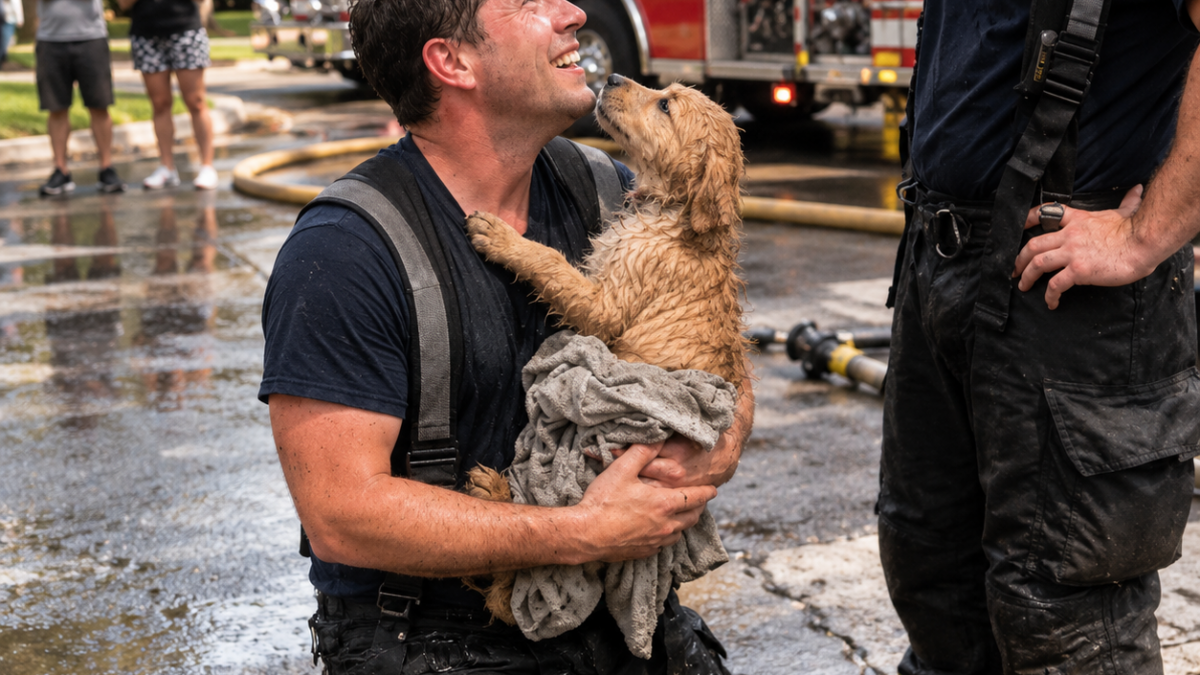
Kneeling near the engine.
A tiny golden puppy wrapped in a towel against my chest.
I hadn’t seen that photograph in a long time.
Apparently Ethan had taken it.
The room went quiet.
The captain said, “Fourteen years into his career, Jake responded to one of the smallest rescues of his life.”
People smiled.
I stared at the photograph.
“And somehow,” the captain continued, “it became the story everyone here knows best.”
I looked toward Lucky.
He was asleep beside Alice.
His muzzle almost completely white.
The captain finished.
“Maybe that tells us something about what this work is really for.”
There was applause.
I hated every second of being the center of attention.
Later, after most people left, I sat on the station floor beside Lucky.
I held the old photograph.
“You were ugly.”
Lucky opened one eye.
“Seriously. Wet rat.”
His tail tapped the floor.
Marcus sat beside me.
“You keeping that?”
“Yeah.”
He looked at it.
“Remember that day?”
“Every detail.”
“I told you he liked you.”
“You did.”
“You argued.”
“I was right to be cautious.”
“No, you weren’t.”
Lucky shifted his head onto my leg.
Marcus smiled.
“You never stood a chance.”
“No.”
For once, I didn’t argue.
Retirement changed my routine.
For the first time in decades, I wasn’t leaving the house before sunrise for twenty-four-hour shifts.
Lucky approved.
He followed me through the mornings.
Coffee on the porch.
Slow walk.
Breakfast.
Another nap.
I finally understood why old men and old dogs get along so well.
Neither sees any reason to hurry.
Sometimes we drove through town with no destination.
Lucky sat beside me.
Window cracked.
Nose working.
On one of those drives, I found myself near the old storm drain again.
I pulled over.
Not because Lucky needed to see it.
Because I did.
We walked to the curb.
The area had changed.
New sidewalk.
Freshly painted lines on the road.
Different businesses nearby.
But the drain remained.
I stood there.
Lucky sat beside me.
I imagined the cover lifting.
My younger hands holding the flashlight.
Marcus above.
Jessie’s voice.
The tiny whimper.
I imagined the moment my beam first reached that golden fur.
There are certain seconds your life divides around.
Before this.
After this.
I had gone into that drain as a firefighter finishing an ordinary call.
I came out carrying someone who would sleep beside my family for years.
Lucky nudged my hand.
I looked down.
“You ready?”
He stood.
We walked back.
That was the last time I visited the drain.
I didn’t need to go again.
The important part had never been underground.
The important part was everything after we climbed out.
Now, when people ask me about the most memorable rescue of my career, they expect fire.
They expect danger.
Maybe a burning house.
A highway collision.
A dramatic story involving smoke and ladders.
I have those stories.
Some I tell.
Some I don’t.
But sooner or later, I tell them about a quiet morning after a grass fire.
About a runner named Ethan.
About a rusty access cover.
About Marcus saying, “Careful.”
About Jessie hearing a puppy.
About a narrow concrete shaft.
About two terrified eyes in a flashlight beam.
And about one tiny animal deciding to lick the fingers of a stranger who had just appeared in his darkness.
That lick was the first thing Lucky gave me.
Trust.
Before food.
Before warmth.
Before a family.
Before he knew whether I deserved it.
Trust.
I have spent years thinking about that.
Human beings can spend decades protecting themselves after being hurt.
We construct walls.
We doubt intentions.
Sometimes for good reasons.
Lucky was alone in darkness, cold and frightened, and still capable of reaching toward a hand.
I’m not saying people should trust blindly.
That would be foolish.
I only know that watching that puppy taught me that surviving something painful doesn’t have to mean becoming incapable of hope.
Lucky survived the drain.
Then he accepted the sunlight.
That second part mattered just as much.
On his final years, whenever he fell asleep beside my chair, I would sometimes place a hand on his chest.
The heartbeat was slower than the frantic little rhythm I had felt underground.
Steady.
Familiar.
Home.
I would remember whispering:
“I’ve got you.”
At the time, I thought I was making a promise for the next ten minutes.
Carry him.
Climb.
Reach daylight.
I didn’t know I would spend years keeping it.
I didn’t know he would keep promises of his own.
Waiting at the door.
Walking beside my children.
Sitting with me after hard calls.
Making Alice laugh when she wanted to be angry.
Helping us through Barney’s death.
Turning an ordinary house into the place I most wanted to return to.
Rescue stories are usually told in one direction.
Person saves animal.
That’s clean.
Easy.
But life isn’t clean.
You can pull a puppy from a storm drain and still find yourself years later realizing how many times that same animal pulled you out of places nobody else could see.
A bad shift.
Grief.
Exhaustion.
The emotional distance firefighters sometimes carry home because we don’t know where else to put it.
Lucky never asked what happened.
He didn’t need an explanation.
He heard the truck.
Came to the door.
Put his head against my heart.
That was enough.
The morning everything began, I had looked at that grass fire and thought the day would be forgettable.
Twenty minutes.
Pack the hose.
Check the tools.
Go back to the station.
Instead, a runner crossed the street.
A sound rose from beneath the ground.
And the ordinary day opened.
That is what I remember most.
Life rarely announces the moment that will change you.
There is no music.
No warning.
Sometimes you are holding a coffee thermos.
Sometimes your gloves smell like smoke.
Sometimes you’re putting a hose away.
Then someone says:
“Please. There’s something over there.”
And you go.
You listen.
You lift the cover.
You descend.
You find a frightened little creature waiting in the dark.
And suddenly the life you expected to live is not quite the life that comes next.
Lucky couldn’t tell me how he ended up underground.
We never found out.
Maybe he wandered into the drainage system.
Maybe he fell.
Maybe someone left him.
I stopped needing the answer.
What mattered was where he ended up.
Not beneath concrete.
Not forgotten.
Not alone.
Home.
Years after his rescue, on a quiet evening, I was sitting on the porch with him when the sun began dropping behind the houses.
Lucky was old enough that standing required effort.
But when I moved my chair, he raised his head immediately.
“I’m not going anywhere.”
His tail moved once.
I smiled.
“You still don’t believe me?”
He put his head back down.
I looked at him.
The gold around his face had faded almost to white.
The puppy was nearly impossible to see now unless you knew where to look.
But I knew.
He was still there.
In the way Lucky watched my face.
In the way his ears lifted when my truck started.
In the way he pressed close during storms.
In the way he always found my heartbeat.
I leaned down.
“You know something?”
Lucky opened one eye.
“That morning, I thought I went down there because you needed somebody.”
His tail moved.
“And you did.”
I rubbed his ear.
“But I didn’t know we needed you too.”
He closed his eye.
I sat beside him until the porch light came on automatically.
Then Alice opened the door.
“Dinner.”
Lucky’s head lifted immediately.
I laughed.
“So much for the emotional moment.”
He struggled to stand.
I helped him.
He walked through the doorway.
Slowly now.
But still toward his family.
I followed him inside.
Sometimes, when I think about that morning, I still hear Ethan saying the words that started everything.
“There’s something down there. It’s alive.”
He was right.
Something was alive beneath that street.
Something small.
Cold.
Terrified.
Something still willing to cry loudly enough for the world to notice.
And maybe that is why Lucky’s story has stayed with me longer than fires, sirens, or any medal I was ever handed.
Because a rescue does not always begin with courage.
Sometimes it begins with a sound so quiet that everyone else keeps walking.
And one person stops.
It does not always require a dramatic act.
Sometimes somebody listens.
Somebody tells someone else.
Somebody opens the cover.
Somebody climbs down.
Somebody reaches out a hand.
And somewhere in the darkness, a frightened little life decides to trust that hand.
The morning I found Lucky, I whispered, “I came to take you home.”
At the time, I thought I meant getting him out of the drain.
I know better now.
I was talking about the next few feet.
Lucky was talking about the rest of our lives.
He came home with me.
He grew beside my children.
He loved Barney.
He won over Marcus.
He turned Jessie into the kind of firefighter who now stops for every frightened animal she sees.
He reminded Ethan that stopping mattered.
He taught my family that sometimes the things we never planned for become the things we cannot imagine living without.
And he taught me something I wish every person could understand before they pass one faint cry, one frightened animal, or one person who seems invisible.
You do not have to save the whole world.
Most of us never will.
You just have to notice the life in front of you.
And when you can help—
stop.
Listen.
Reach down.
Because sometimes, beneath an ordinary street on an ordinary morning, the smallest voice you almost didn’t hear is the one that changes your life forever.








