They said the Border Collie thrown from a speeding pickup had probably died somewhere deep in the woods.
My hands were shaking so badly that I nearly dropped the phone.
I called county animal rescue first.
No answer.
I called again.
Then the sheriff’s non-emergency number.
Then the county shelter.
While I waited to be transferred, I never took my eyes off the dog.
She never took hers off me.
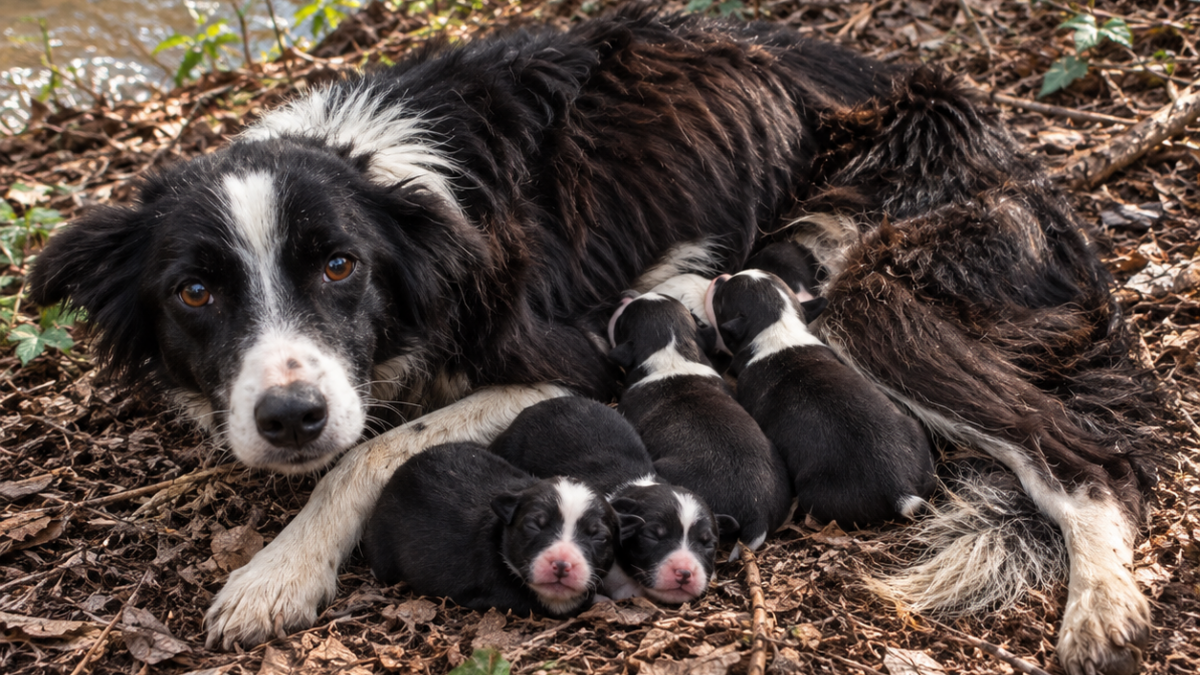
Four puppies remained pressed against her.
One of them struggled upward until its tiny nose found the warmth beneath her chest.
The mother shifted slightly despite the pain.
Making room.
Even then.
Even half-starved.
Even broken.
She was still taking care of them.
A woman finally answered at the county shelter.
I gave her my name.
“James McClintock. I’m near the north bend of Alder Creek, about two miles past the old logging access.”
“What’s the emergency?”
“I found a dog.”
There was a pause.
“Is she injured?”
“Badly.”
“Can you safely transport her?”
“No. She has puppies.”
Another pause.
“How many?”
“Four.”
The woman began asking routine questions.
Color.
Breed.
Approximate age.
Condition.
Then she asked, “Any identification?”
“I think I know who she is.”
“What do you mean?”
“The Border Collie from the newspaper.”
Silence.
“The one thrown from the pickup?”
“Yes.”
“Sir, that dog has been missing almost a month.”
“I know.”
“Are you certain?”
I looked at the injured hind leg.
The black-and-white coat.
The scar near her shoulder visible in one of the newspaper photos.
“Yes.”
The woman’s voice changed completely.
“Stay where you are.”
“I’m not leaving.”
“Do not try to move her unless she’s in immediate danger. We’re sending people.”
“How long?”
“Thirty to forty-five minutes.”
I stared at the dog.
That seemed like forever.
I called Margaret.
She answered on the second ring.
“James?”
Something in my voice must have frightened her because she sat up immediately.
“What happened?”
“I found her.”
“Found who?”
“The dog.”
“What dog?”
“The Border Collie from the newspaper.”
Silence.
“The one they were searching for?”
“Yes.”
“Oh my God.”
“Margaret, she’s alive.”
Another silence.
“But she’s hurt.”
“How badly?”
“Badly.”
I looked at the puppies.
“And she’s not alone.”
“What does that mean?”
“She has four puppies.”
“What?”
“They’re tiny. Maybe a few weeks old.”
Margaret didn’t ask another question.
“I’m coming.”
“Bring blankets.”
“Already thinking it.”
“Water too.”
“I’ll bring food.”
“Don’t bring Harold.”
Our Labrador was twelve years old, friendly but enormous, and the last thing this frightened mother needed was another dog approaching her babies.
“I won’t.”
“And Margaret?”
“Yes?”
“Drive carefully.”
“You too.”
“I’m not driving.”
“You know what I mean.”
She hung up.
I slipped my phone into my pocket and sat quietly.
For the first ten minutes, nothing changed.
The dog watched me.
I watched her.
The river moved behind us.
I tried talking.
Not because I believed she understood the words.
I just wanted her to hear a calm human voice.
“You’re safe here.”
Her eyes remained fixed on me.
“I know humans haven’t exactly given you reasons to believe that.”
One ear twitched.
“I’m sorry for what somebody did to you.”
Her breathing was shallow.
I could see the effort it took.
“I don’t know who they were.”
I swallowed.
“But they don’t get to decide what happens to you next.”
One puppy crawled away from her body.
Only six inches.
But the mother immediately became alert.
She tried to rise.
Her injured leg gave out.
A sound escaped her.
Not a bark.
A cry.
“Easy.”
I didn’t move toward her.
The puppy squeaked and crawled back.
Only when it touched her again did she lower her head.
That’s when I understood the terrible math of those twenty-seven days.
Every movement she made had cost something.
Every trip for water.
Every attempt to find food.
Every time she dragged herself away from the puppies and returned.
She had been spending her own body to keep theirs alive.
Margaret appeared through the trees twenty-two minutes after my call.
She was carrying more than I’d asked for.
Blankets.
A plastic storage tub lined with towels.
Bottled water.
Dog food.
A small bowl.
A first-aid kit.
“Where?”
I pointed.
Margaret stopped.
“Oh, James.”
Her hand rose to her mouth.
The mother dog raised her head.
“Slow.”
“I know.”
Margaret lowered herself beside me.
For thirty-two years of marriage, I had seen my wife cry at funerals, weddings, our daughter’s graduation, and once while watching an old movie she’d sworn she didn’t care about.
But the expression on her face now was different.
It was grief and wonder at the same time.
“Look at those babies.”
“I know.”
“How did she keep them alive?”
“I don’t know.”
Margaret looked at me.
“How did she keep herself alive?”
That was the harder question.
She opened the dog food.
“Should we feed her?”
“Small amount.”
We placed several pieces a few feet away.
The dog smelled them.
Her nose moved.
But she didn’t leave the puppies.
Margaret pushed the bowl closer with a long branch.
The Border Collie watched us.
Then slowly stretched her neck.
She ate one piece.
Then another.
She stopped after three.
Not because she was full.
Because lifting her head exhausted her.
Margaret looked away.
“She’s starving.”
“Yes.”
She poured water into another bowl.
This time the dog drank.
Slowly.
Her tongue moved weakly.
When she finished, Margaret whispered, “Good girl.”
The tail moved.
Barely.
One small sweep against the earth.
Margaret grabbed my arm.
“Did you see that?”
“Yeah.”
“She heard me.”
“Maybe she liked your cooking.”
Margaret laughed through tears.
“Idiot.”
The rescue team arrived about twenty minutes later.
A woman in her early thirties introduced herself as Emily.
The man with her was David.
Both wore county animal shelter jackets and carried equipment.
Emily stopped when she saw the dog.
She stared for several seconds.
“That’s her.”
“You recognize her?”
“I helped with the search.”
She crouched.
“We looked everywhere.”
The mother’s eyes followed her.
“We thought she was dead.”
David walked slowly around the area, studying tracks and the shelter beneath the rock.
“She chose this place for the water.”
I looked toward the river.
The rock created a natural hollow above the flood line.
Branches and tall grass concealed it from the trail.
Shade during the day.
Wind protection at night.
“She planned this.”
David nodded.
“Animals know more about survival than we give them credit for.”
Emily examined the dog from a distance first.
“She’s severely underweight.”
“Her leg?”
“Probably fractured.”
“Probably?”
“I can’t know without imaging.”
David pointed to her side.
“Those could be rib injuries too.”
I felt sick.
Emily looked at the puppies.
“They’re surprisingly healthy.”
“How?”
She looked at their mother.
“Her.”
That single word carried everything.
Emily approached slowly.
The dog became tense.
Her lips didn’t lift.
She didn’t growl.
But her body moved between Emily and the puppies.
“Nobody’s taking them,” Emily said softly.
She sat several feet away.
“My name’s Emily.”
Margaret glanced at me.
I knew what she was thinking.
Emily talked to animals exactly the way I did.
“You’re a good girl.”
The dog’s ears moved.
“We’re here to help.”
Still no movement.
“We found your babies.”
The dog looked toward them.
“They’re okay.”
Emily extended an empty hand but didn’t try to touch her.
“You don’t have to fight us.”
The Border Collie’s eyes began closing.
Then opening.
Closing.
Opening.
She was losing the battle against exhaustion.
Emily whispered, “You can rest.”
The tail moved.
Once.
Then again.
The dog’s head lowered onto her front paws.
Her eyes closed.
Margaret whispered, “She trusts you.”
Emily shook her head.
“No.”
She looked at me.
“She trusts him.”
“Me?”
“You were here first.”
I didn’t understand why that mattered.
Maybe the dog had already decided I wasn’t dangerous.
Maybe she was simply too tired to keep resisting.
Either way, we had to move.
The puppies came first.
Margaret lifted them one by one.
The first squealed.
The mother immediately opened her eyes.
“It’s okay,” Margaret said. “Look.”
She held the puppy where the dog could see it.
Then placed it into the towel-lined tub.
Three more followed.
Four black-and-white bodies.
Tiny.
Warm.
Alive.
The mother tracked every movement.
Emily and David positioned a soft stretcher beside her.
When they tried lifting her, the dog screamed.
I will never forget that sound.
It wasn’t loud.
That made it worse.
A short, broken cry.
Pain so severe there was no energy left for anything more.
Margaret covered her mouth.
I stepped backward.
Emily stopped.
“Give her a second.”
The mother panted.
The puppies cried from the tub.
Immediately she tried to raise her head.
Even in agony, she looked for them.
I carried the tub closer.
“Here.”
She saw them.
Her breathing slowed.
“You’re all together.”
I don’t know why I kept talking.
“You hear me? Nobody’s leaving anybody.”
Emily glanced at me.
“Keep doing that.”
They tried again.
The Border Collie whimpered.
I placed my hand near her head.
She sniffed my fingers.
Then, slowly, she rested her muzzle against them.
My throat closed.
“It’s okay.”
Her eyes met mine.
“Let them help you.”
For the first time, I touched her.
One finger against her forehead.
Then two.
Then my whole hand.
She didn’t flinch.
“That’s it.”
Emily and David lifted.
This time, she didn’t fight.
The transport van was parked near the trail.
Margaret carried the puppies.
I walked beside the stretcher.
Halfway there, the mother opened her eyes.
She searched.
I pointed toward Margaret.
“They’re there.”
She saw the box.
Her body relaxed again.
At the veterinary clinic, Dr. Laura Phillips took over.
She was in her early sixties, silver-haired, direct, and had apparently spent more than thirty years treating animals.
After examining the Border Collie, she came into the waiting room.
Margaret and I stood immediately.
“How bad?”
Dr. Phillips took off her glasses.
“Her hind leg is fractured in two places.”
Margaret closed her eyes.
“Three ribs are cracked.”
I gripped the back of a chair.
“She’s severely dehydrated. Severely malnourished. There’s an infected wound near the hip. Several smaller cuts are healing on their own.”
“Can you save her?”
Dr. Phillips looked toward the treatment room.
“Yes.”
The word hit me so hard I had to sit.
“But recovery won’t be easy.”
“Whatever it takes.”
She studied me.
“You’re the finder?”
“Yes.”
“She’s not your dog.”
“No.”
“Then animal control will technically handle authorization.”
“I don’t care who signs what. Just help her.”
Dr. Phillips smiled faintly.
“We are.”
“What about the puppies?”
“They’re doing remarkably well.”
“How?”
The veterinarian shook her head.
“Honestly? I don’t know.”
She sat across from us.
“If she has been out there twenty-seven days with injuries this severe, then medically she should have been conserving every calorie for herself.”
“But she wasn’t.”
“No.”
“She fed them.”
“Every bit she could.”
Dr. Phillips looked through the glass.
“That probably saved them and nearly killed her.”
Margaret squeezed my hand.
“She chose them.”
“Animals don’t think in exactly the same moral language we do,” Dr. Phillips said. “But yes. Her behavior prioritized the litter.”
“Can she nurse them now?”
“Not until she’s stabilized. We’ll supplement.”
The rescue staff needed names for the paperwork.
Someone asked whether she already had one.
Nobody knew.
The newspaper story had simply called her “the abandoned Border Collie.”
Emily looked at us.
“We need something better than that.”
Margaret stared through the glass.
“Hope.”
I turned.
“What?”
“Her name should be Hope.”
Emily smiled.
“Hope.”
Inside the treatment room, the Border Collie opened her eyes.
I don’t believe dogs understand when they’re named.
But something about that moment felt right.
Hope.
Not because she had been lucky.
Luck had nothing to do with twenty-seven days of suffering.
Hope because she kept moving when the logical outcome said she shouldn’t.
Hope because four puppies were breathing when nobody knew they existed.
Hope because after what people had done to her, she had allowed my hand to touch her head.
Hope underwent surgery the following morning.
Dr. Phillips repaired the leg with plates and screws.
The infected wound was cleaned.
Fluids went into her body around the clock.
Pain medication finally allowed her to sleep.
Really sleep.
When Margaret and I visited that afternoon, Hope was lying beneath blankets.
For a moment, she didn’t wake.
One of the technicians said, “She’s slept almost continuously.”
“Is that okay?”
“It’s exactly what she needs.”
I stood beside her.
The puppies were in a heated enclosure nearby.
I could hear tiny noises.
Hope’s ear twitched.
Even asleep, she heard them.
Margaret noticed.
“Still working.”
“She’s a mother.”
The four puppies needed names too.
Margaret chose them.
River.
Because of where I’d found them.
Stone.
For the rock that had sheltered them.
Willow.
For the trees above the water.
Fern.
For the smallest puppy, found curled against a patch of green beside her mother.
Two males.
Two females.
Four names attached to lives that had almost vanished without anyone knowing.
The first week became a ritual.
Margaret and I drove to the shelter every afternoon.
Hope remained frightened of almost everyone.
When technicians entered too quickly, she trembled.
When a metal tray fell in another room, she tried to hide.
When she heard a truck outside, the reaction was immediate.
Her eyes widened.
Her body flattened.
Once, despite the splint and stitches, she tried to crawl over her puppies.
Protecting them.
Emily stopped beside us.
“She remembers.”
I felt anger rise.
“Find the person who did it.”
“The sheriff is trying.”
“They threw a pregnant dog from a moving truck.”
“I know.”
“That’s not abandoning an animal. That’s trying to kill one.”
Emily’s expression hardened.
“I know.”
Margaret touched my arm.
“James.”
“What?”
“Hope doesn’t need your anger right now.”
I looked at the dog.
Margaret was right.
Hope didn’t care about revenge.
She cared whether the next hand reaching toward her was safe.
So I sat.
Every day.
Same chair.
Same distance.
Same voice.
“Hey, Hope.”
At first, she only watched.
Then one afternoon, her tail moved.
A week later, she took a treat from Margaret.
A few days after that, she rested her muzzle on my hand.
Small victories.
People imagine recovery as a straight line.
Injury.
Treatment.
Improvement.
Recovered.
It isn’t.
Not with bodies.
Definitely not with fear.
Some days Hope seemed almost normal.
The next day, a truck engine would rumble outside and she would become the terrified animal beneath the rock again.
Once, during a veterinary check, a man wearing a baseball cap walked into the room.
Hope panicked.
She pulled backward so violently that Emily had to stop her from hurting the repaired leg.
The man immediately left.
Nobody knew whether his appearance reminded her of someone.
Maybe it meant nothing.
Trauma doesn’t always announce the reason.
It only announces itself.
The puppies, meanwhile, grew.
River was bold.
He crawled toward anybody who opened the enclosure.
Stone preferred sleeping.
Willow seemed determined to climb anything taller than she was.
Fern was smaller than the others but louder.
Margaret laughed the first time Fern barked.
“That came out of that?”
Fern barked again.
Hope lifted her head.
Margaret apologized.
“Yes, Mom. I know.”
Hope’s tail moved.
By the fourth week, the local newspaper heard that the missing Border Collie had been found.
A reporter called.
Then another.
I didn’t want to talk.
Margaret convinced me.
“Maybe someone recognizes the truck.”
So I gave an interview.
I told them where I had found Hope.
How injured she was.
How four puppies had been hidden beside the river.
The story spread.
First locally.
Then farther.
Letters arrived at the shelter.
Donations too.
Offers to adopt the puppies flooded in.
People called Hope brave.
Miraculous.
A hero.
I understood why.
But every time I saw those words, I remembered the screaming when they lifted her onto the stretcher.
Heroism looked less romantic from five feet away.
It looked like exhaustion.
Fear.
Pain.
A mother too injured to stand still trying to move toward crying babies.
One afternoon, I asked Dr. Phillips something that had been bothering me.
“Could she really have hunted?”
“In that condition?”
“Yes.”
“Probably very little.”
“Then how did she eat?”
“Whatever she could find. Scraps. Small animals. Possibly fish remains near the river. Garbage.”
“With two fractures?”
“Adrenaline and necessity do extraordinary things.”
I stared at Hope.
“Wouldn’t the pain stop her?”
“It probably did many times.”
“But she kept going.”
Dr. Phillips nodded.
“She had four reasons.”
By the sixth week, the bone was healing.
Hope began physical rehabilitation.
First standing.
Then a few steps.
Then short controlled walks.
The first time she walked fifteen feet without assistance, Margaret applauded.
Hope stopped.
Looked at her.
Then wagged her tail.
“Don’t embarrass her,” I said.
Margaret wiped her eyes.
“I’ll embarrass whoever I want.”
The real challenge arrived after her body started healing.
Emily called one morning.
“We tried taking her across the parking lot.”
“And?”
“A car came around the corner.”
I already knew from her voice.
“What happened?”
“Hope collapsed.”
“Collapsed?”
“She flattened herself onto the pavement and shook.”
“Was she hurt?”
“No.”
“What did you do?”
“Waited.”
“For how long?”
“Twenty minutes.”
I sat at my kitchen table.
Harold, our old Labrador, was asleep near my feet.
Margaret stood across from me listening.
Emily continued.
“We’re going to have to desensitize her slowly.”
“Meaning?”
“Vehicles need to stop predicting danger.”
I hated that sentence.
Because a human being had taught her the opposite.
That afternoon, Margaret and I went to the shelter.
Hope walked toward us with a slight limp but increasing confidence.
I sat beside her.
“You don’t like trucks.”
She looked at me.
“Fair.”
Margaret scratched beneath her chin.
“We’ll take it slow.”
We did.
Day one, an unmoving car.
Hope wouldn’t approach.
We sat twelve feet away.
No pressure.
Treats.
Quiet voices.
Eventually she stopped trembling.
Day two, eight feet.
Day three, open car door.
Hope backed away.
We waited.
Eventually she sniffed the tire.
“Good girl.”
Week two, she placed her front paws inside.
Then jumped out.
Week three, she sat in the back seat with both doors open.
I sat beside her.
Margaret stood outside.
“You okay?”
Hope panted.
I gave her a treat.
“No pickup trucks today.”
Another treat.
“We’re civilized people. We drive a boring SUV.”
Margaret rolled her eyes.
“Keep talking. She likes your nonsense.”
Eventually, Margaret started the engine.
Hope froze.
I put my hand beside her.
Not on her.
Beside.
“Nothing’s happening.”
Her eyes fixed on mine.
“Engine. That’s all.”
Thirty seconds.
One minute.
Two.
Her muscles slowly relaxed.
We stopped.
That was enough.
The first actual ride was approximately fifty yards.
Hope shook the entire time.
The next one was around the parking lot.
Then down the road.
Then five minutes.
One afternoon, months after I had found her, I looked in the mirror.
Hope was sitting in the back seat.
Window slightly open.
Wind moving the fur around her ears.
Mouth open.
Tongue out.
Margaret looked at me.
“She’s smiling.”
“Dogs don’t smile.”
“Look.”
I looked again.
“Okay.”
Margaret grinned.
“Say it.”
“She looks happy.”
“Say she’s smiling.”
“I’m not giving you that satisfaction.”
Hope leaned toward the window.
I laughed.
“Fine. She’s smiling.”
Margaret won.
Again.
By then, the puppies were old enough for adoption.
That brought a new problem.
I had become attached to all four.
Margaret was worse.
“We cannot keep five Border Collies,” I said.
“Four.”
“Plus Hope.”
“Harold doesn’t count.”
I looked at the Labrador asleep across three quarters of the couch.
“He absolutely counts.”
“He’s furniture.”
Harold opened one eye.
“See? Furniture.”
We agreed that the puppies deserved individual families.
The shelter screened applicants carefully.
River left first.
A young couple with two boys adopted him.
Both children sat on the floor during the meeting and let River approach them.
Within ten minutes, he was climbing into their laps.
The youngest boy asked, “Was his mom really in the forest?”
“Yes,” I said.
“For twenty-seven days?”
“Yes.”
“Did she save him?”
I looked at Hope.
“She saved all of them.”
Before River left, Hope sniffed him carefully.
Licked his face.
Then stepped back.
I expected crying.
Searching.
Panic.
Instead, she watched.
The car pulled away.
Hope stood beside me.
Then she turned and walked toward Margaret.
“She knows,” Margaret whispered.
“How?”
“I don’t know.”
Stone went to an older couple who had recently lost their thirteen-year-old dog.
The husband knelt beside Stone and immediately began crying.
“I’m sorry,” he said.
His wife put a hand on his shoulder.
“Our house has been too quiet.”
I understood that.
Stone went home with them.
Willow was adopted by a woman named Claire who trained dogs for agility.
Willow had already demonstrated that fences were merely suggestions, so it was probably a perfect match.
Fern was last.
The smallest.
The loudest.
The one Margaret had secretly hoped nobody would adopt.
A woman named Meadow applied.
Yes, Meadow.
She lived on a working farm.
Large fenced acreage.
Other dogs.
She showed us photographs.
Fields.
A pond.
A barn.
“I want a dog who can run,” she said.
I looked at Fern.
Fern was trying to climb Meadow’s jeans.
“That won’t be a problem.”
When Fern left, Hope became the only one remaining.
I expected that to be painful for her.
Instead, she seemed calmer.
For months, every waking moment had revolved around the puppies.
Now she could sleep without one crawling across her face.
Eat without stopping to check them.
Walk without listening for squeaks.
Her work was finished.
Margaret and I had already made our decision.
We simply hadn’t said it aloud.
One evening we sat in the shelter courtyard.
Hope was beside my chair.
Her healed leg still carried a slight stiffness.
The autumn sun was low.
Almost a year earlier, I’d found her near a river under another autumn sky.
I looked at Margaret.
She nodded.
“Hope.”
The dog lifted her head.
“You’ve had a rough year.”
Tail movement.
“You’ve been in the woods.”
Another movement.
“You’ve been in surgery.”
Margaret whispered, “James.”
“I’m building up to it.”
Hope stared at me.
“You’ve raised four children.”
Margaret laughed.
“You sound like you’re proposing.”
“In a way, I am.”
I crouched.
“How would you feel about coming home with us?”
Hope stood.
Walked toward me.
Sat directly between my knees.
Then rested her head in my lap.
Margaret started crying.
“That’s a yes.”
“I think so.”
Hope came home the following afternoon.
Harold met her at the door.
Our Labrador had spent his entire life believing conflict was unnecessary unless someone threatened his dinner.
He sniffed Hope.
Hope sniffed him.
Harold walked to his bed.
Hope followed.
He stared at her.
Then moved over.
That was it.
No ceremony.
No argument.
He shared his bed.
Hope lay beside him.
Margaret looked at me.
“They’re friends.”
“It’s been thirty seconds.”
“Men always underestimate relationships.”
“I’m not touching that.”
The first night was harder.
Hope walked through every room.
Kitchen.
Living room.
Hallway.
Guest room.
Back to kitchen.
She inspected doors.
Windows.
Corners.
At first, Margaret thought she was searching for the puppies.
Maybe.
I thought she was searching for danger.
A new house could mean anything to a dog who had learned how abruptly safety could disappear.
At midnight, I found her standing near the front door.
I sat on the floor.
She looked at me.
“Nobody’s throwing you out.”
Her ears moved.
“This is home.”
She approached.
I touched her chest.
“Understand?”
Probably not.
But she stayed.
The second night, Hope climbed onto our bed.
Margaret laughed.
“We have created a monster.”
Hope circled twice.
Then lay between us.
Her head touched my pillow.
Within minutes, she was asleep.
Not the shallow, alert sleep I’d seen at the shelter.
Deep sleep.
Her legs twitched.
She dreamed.
I lay awake listening to her breathe.
Margaret whispered, “James?”
“What?”
“When you called me that morning, I thought you’d caught a fish.”
“I did catch something.”
“A hundred veterinary bills.”
“That too.”
She rested her hand on Hope’s back.
“You found a miracle.”
I looked at the dog.
“No.”
“What?”
“She found us.”
A year passed.
Hope became, for most of her days, simply a dog.
That sentence sounds unimportant.
It wasn’t.
Being simply a dog was something she had earned.
She chased birds.
Stole Harold’s toys.
Rolled in things so disgusting that Margaret threatened to move out.
Slept in sunlight.
Barked at squirrels.
Begged for chicken.
Snored.
Sometimes she woke frightened.
Sometimes a large truck passing the house made her freeze.
Once, during a thunderstorm, the crack of thunder sent her beneath the dining table.
I crawled under with her.
Margaret found us twenty minutes later.
“What are you doing?”
“Nothing.”
“You are under a table.”
“Hope’s scared.”
Margaret sat down beside us.
Hope leaned against both.
The next thunderclap came.
She shook.
But she didn’t run.
Progress isn’t becoming fearless.
Sometimes progress is being afraid somewhere safe.
We kept contact with all four puppies.
River grew into a huge, energetic dog who followed the two boys everywhere.
Their mother sent a photograph of all three asleep in a blanket fort.
Stone slept every night between the older couple who adopted him.
They bought a king-sized bed because, according to them, Stone “needed room.”
Willow began competing in agility.
She was fast.
Very fast.
Claire sent videos.
Hope watched one from my phone and tilted her head when Willow barked through the speaker.
Fern became queen of Meadow’s farm.
That dog ran.
Fields.
Pastures.
Around the barn.
Through sprinklers.
Every photograph showed her somewhere different.
Alive.
Healthy.
Free.
Sometimes Margaret printed the photos.
She kept them in a folder labeled “Hope’s Babies.”
“You’re ridiculous,” I told her.
She kissed me.
“Yes.”
Two years after the rescue, something unexpected happened.
The sheriff’s department called.
They believed they had identified the owner of the pickup.
My stomach tightened.
“How?”
A witness had come forward after seeing the newspaper story.
There had been enough information to reopen the investigation.
Vehicle description.
Time.
Location.
Additional evidence.
I listened while the deputy explained.
“Will there be charges?”
“We’re reviewing everything with the prosecutor.”
I looked across the yard.
Hope was asleep beside Harold.
“Does it matter?”
The deputy paused.
“You tell me.”
I thought about that.
For months after finding Hope, I had imagined confronting the person who threw her.
I wanted explanations.
I wanted punishment.
I wanted them to see the scars.
Then I looked at the dog sleeping in the grass.
She was not thinking about them.
She was thinking about nothing more complicated than sunshine.
“I want the law to handle it,” I said.
“That’s what we’re doing.”
“But I don’t want their name.”
“You sure?”
“Yes.”
After I hung up, Margaret asked why.
“Because I don’t want them living in my head.”
She nodded.
Hope had spent enough time defined by what someone did to her.
Her life was bigger now.
The story wasn’t “the dog who was thrown.”
It was the dog who survived.
The dog who gave birth beside a river.
The dog who kept four puppies alive.
The dog who learned that engines weren’t always followed by pain.
The dog who climbed into our bed and stole my pillow.
That was her story.
Not whoever hurt her.
Harold grew old.
He had already been a senior dog when Hope arrived.
Over time, his walks became shorter.
Then slower.
Hope changed around him.
Something familiar appeared.
The same attention she had given her puppies.
If Harold fell behind, Hope waited.
If he struggled to stand, she stayed beside him.
One afternoon, I watched her bring him a toy.
Harold looked at it.
Then at her.
He had never played much.
Hope dropped it between his paws.
Harold put his head on top of the toy and went to sleep.
Hope lay beside him.
“She’s taking care of him,” Margaret said.
“That’s what she does.”
Harold died peacefully at fourteen.
We were all with him.
Hope remained beside his bed afterward.
She sniffed him.
Then lay down.
Margaret cried into my shoulder.
I buried Harold beneath the maple tree behind the house.
Hope watched from the porch.
That night, she slept in his empty bed.
The next morning, she carried one of his old toys into our bedroom.
Animals grieve differently.
But they grieve.
For several weeks, Hope checked the rooms where Harold used to sleep.
Eventually she stopped.
But she continued sleeping in his bed.
We let her.
Three years became four.
My fishing routine changed.
Hope came with me.
The first time I brought her back to Alder Creek, I wasn’t sure what would happen.
We stopped near the trail.
She stiffened.
Her nose lifted.
I almost turned around.
Then Hope moved forward.
Slowly.
We reached the river.
The rock was still there.
Same angle.
Same shelter.
Same willows leaning toward the water.
I unclipped the leash.
Hope walked toward it.
She sniffed the ground.
Moved beneath the rock.
Stood completely still.
I stayed several yards away.
Margaret had wanted to come, but I told her I thought this needed to be Hope’s decision.
She sniffed again.
Then emerged.
Walked to the river.
Drank.
Looked at me.
I sat where I had sat years earlier.
Hope came over.
Lay beside me.
I put my hand on her back.
“We made it.”
She sighed.
That became our place.
I fished.
Hope slept.
Sometimes she chased butterflies.
Sometimes she stared at the water.
Sometimes I imagined she remembered.
Maybe she remembered every night.
Maybe she remembered none of it the way humans would.
What mattered was that the place where she had once fought desperately to survive became somewhere she could sleep peacefully.
I liked that.
I was sixty-one when Margaret asked me something I’d never seriously considered.
“Do you think finding Hope was the biggest thing you’ve ever done?”
We were sitting beside the river.
Hope was sprawled near my boots.
“No.”
Margaret seemed surprised.
“What was bigger?”
“Nothing I did.”
“What does that mean?”
I pointed at Hope.
“She did it.”
Margaret smiled.
“Still arguing that you didn’t save her?”
“We helped.”
“You found her.”
“She lasted twenty-seven days.”
“You called rescue.”
“She kept four newborns alive with a broken leg.”
“You adopted her.”
“She trusted people again.”
Margaret leaned against me.
“Maybe everybody saved everybody.”
I looked at my wife.
“That’s annoyingly wise.”
“I’ve been married to you thirty-six years. Wisdom was necessary.”
Hope opened one eye.
“You stay out of this.”
Her tail moved.
In the years after her rescue, Hope became part of several animal-welfare programs.
Not because we wanted attention.
Mostly because Emily asked.
Schools invited rescue workers to talk about responsible pet ownership.
Hope sometimes came along.
Children were drawn to her.
She had that Border Collie stare that made everyone feel individually noticed.
One little girl asked me, “Does she hate people?”
The question caught me off guard.
“No.”
“Even after somebody hurt her?”
“No.”
“Why?”
I looked at Hope.
“I don’t think she decided all people were the same.”
The girl petted Hope gently.
“That’s good.”
“Yeah.”
“It would be sad if one bad person made her miss all the good ones.”
I thought about that sentence for days.
Children occasionally say things adults spend decades trying to learn.
Hope grew older.
The black fur around her muzzle developed gray.
The injured leg became arthritic.
On cold mornings, she limped.
We managed it.
Medication.
Warm beds.
Shorter walks.
The same body that had carried her through twenty-seven impossible days was finally allowed to complain.
By then, River, Stone, Willow, and Fern were adult dogs.
One summer, Emily organized a reunion.
All four families came.
Margaret prepared like we were hosting grandchildren.
“These are dogs.”
“Don’t say that around me.”
“Margaret.”
“We need treats.”
“We have treats.”
“Not enough.”
“There are four.”
“Five with Hope.”
I gave up.
The reunion took place in a large fenced field behind the shelter.
Hope arrived first.
Then Stone.
Then River.
Then Willow.
Fern came last.
The gate opened.
Four black-and-white dogs entered.
Hope stood.
I watched carefully.
Would she recognize them?
I had no idea.
They approached.
Sniffing.
Circling.
River wagged.
Willow dropped into a play bow.
Fern rushed around everybody.
Stone leaned against his owner.
Hope sniffed each one.
When Fern came close, Hope licked her face.
The exact gesture she had used when the puppies were tiny.
Margaret started crying.
“Don’t.”
“I’m not doing anything.”
“You’re crying.”
“So are you.”
“I have allergies.”
“There isn’t a flower within fifty feet.”
“Dog allergies.”
“You live with Hope.”
“New allergy.”
She laughed.
Soon all five dogs were running.
Hope couldn’t keep up.
She didn’t try.
She stood near me, watching them.
There was something almost peaceful in her expression.
All four.
Healthy.
Loved.
Safe.
The task she’d once nearly died accomplishing had become visible around her.
River returned to his boys.
Stone to his older couple.
Willow to Claire.
Fern to Meadow.
Nobody left alone.
Afterward, Emily sat beside me.
“You know what I remember most?”
“What?”
“When we found her.”
“You mean when I found her.”
She smiled.
“Fine. When you found her and we arrived.”
“Better.”
“She didn’t trust us.”
“No.”
“But she looked at those puppies and let us take them.”
I nodded.
“She knew she was done.”
“What?”
“Not done living.”
Emily looked at Hope.
“Done doing it alone.”
That was exactly right.
For twenty-seven days, Hope had carried everything.
Pain.
Hunger.
Fear.
Motherhood.
Survival.
Then one morning, a fisherman walked toward her.
And finally she could transfer some of the weight.
That’s what rescue is, I think.
Not swooping in and becoming the hero of somebody else’s story.
Sometimes it’s simply saying:
You don’t have to carry all of this by yourself anymore.
Years later, Hope’s old injuries finally caught up with her.
The veterinarian showed us the X-rays.
Arthritis.
Bone changes.
Nothing unexpected.
“She’ll slow down.”
“She’s earned it,” Margaret said.
Hope stopped coming on long fishing trips.
We chose easier places.
A pond near home.
Then eventually the backyard.
I still went to Alder Creek occasionally alone.
But it felt different without her.
One morning, sitting beside the same rock where I’d found her, I realized how much my idea of strength had changed.
At fifty-seven, I thought strength meant enduring.
Hope taught me strength also meant trusting.
She had survived alone.
But survival wasn’t the end of her story.
Eventually, she allowed Emily to touch her.
Margaret to feed her.
Dr. Phillips to repair her leg.
Me to put her inside a car.
Harold to share his bed.
A family to love her.
Being loved requires vulnerability too.
Hope had every reason to reject people.
She didn’t.
That may have been the bravest thing she ever did after leaving the forest.
When Hope turned ten—or whatever age we estimated as ten—Margaret gave her a steak.
“A steak?”
“Birthday.”
“We don’t know her birthday.”
“We chose one.”
“Based on what?”
“The day James McClintock stopped being emotionally constipated.”
I stared at my wife.
Hope ate the steak.
“I hate this family.”
Margaret kissed me.
“No, you don’t.”
She was right.
Hope slept more in her final years.
Often with her head on Margaret’s feet.
Sometimes beside my chair.
Whenever I picked up my fishing gear, she still raised her head.
For as long as she could walk comfortably, she came.
Eventually, there was a morning when she tried to stand and couldn’t.
The sight transported me back decades in a second.
Rock.
River.
Broken leg.
Puppies.
“Easy.”
Hope looked embarrassed.
Dogs can look embarrassed.
I don’t care what anyone says.
I helped her upright.
She took several steps.
Then stopped.
I called the veterinarian.
Age.
Arthritis.
Weakness.
The vet adjusted medication.
We bought a support harness.
Hope gained more time.
A year.
Then another.
Margaret once asked whether it was difficult watching her age.
“Yes.”
“Would you rather not have found her?”
I looked at her.
“Never ask me that.”
Margaret smiled.
“I knew the answer.”
Because that is the bargain.
You save an animal knowing one day you may be the one who has to say goodbye.
You love them knowing their life may fit inside only part of yours.
That doesn’t make the love smaller.
It makes the days matter more.
Hope’s final summer was warm.
She spent most afternoons beneath the maple tree where Harold was buried.
I wondered whether that was coincidence.
Maybe shade is shade.
Maybe memory is more mysterious.
One evening, River’s family visited.
River was old too.
His muzzle had gone white.
The boy who had adopted him was now in college.
He sat on the grass beside Hope.
“You saved him,” he whispered.
I happened to hear.
Hope looked at him.
River lay down beside his mother.
For ten minutes, the two old Border Collies rested shoulder to shoulder.
Margaret stood at the kitchen window crying.
I joined her.
“Allergies?”
“Shut up.”
The following spring, Hope stopped eating normally.
The tests weren’t encouraging.
Kidneys.
Age.
Accumulated damage.
Dr. Phillips had retired years before, but Emily still worked with the shelter and kept in contact.
Our veterinarian explained the options.
We could manage symptoms.
Give her comfort.
But there would be no returning to the strong dog who once ran through fields.
“Is she suffering?”
“Not badly yet.”
“Tell us when she is.”
“We will.”
We took her home.
For several weeks, Hope still had good mornings.
She ate chicken.
Sat outside.
Walked slowly through the yard.
I carried her down the steps when needed.
Margaret slept near her on difficult nights.
Then one morning, Hope looked at me and I knew.
People say that often about old animals.
I used to think it sounded sentimental.
It isn’t.
When you’ve lived with a dog long enough, you know the difference between tired and finished.
Hope was tired.
Not afraid.
Not panicking.
Just tired.
I called the vet.
Then Emily.
Margaret called the puppy families.
Not because everyone could come.
Just because they deserved to know.
I had one final request.
“I want to take her to the river.”
Margaret hesitated.
“James.”
“Just once.”
“Can she handle it?”
“We’ll carry her.”
We drove to Alder Creek.
Hope lay on blankets in the back.
No trembling.
No fear of the vehicle anymore.
That alone felt like a victory.
At the trail, I carried her.
She was light.
Too light again.
Like the morning I’d found her.
Margaret carried the blanket.
Emily met us there.
We reached the rock.
The river moved exactly as it always had.
I set Hope down in the grass.
Her nose lifted.
She smelled the water.
The trees.
The earth.
Her eyes opened wider.
For a moment, I saw the younger dog.
The survivor.
The mother.
Margaret knelt.
“Do you remember?”
Hope’s tail moved.
Emily whispered, “I think she does.”
We stayed there for almost an hour.
Hope rested with her head in my lap.
I looked toward the spot where four puppies had once pressed against her body.
“River’s okay.”
Her ear moved.
“Stone too.”
Margaret started crying.
“Willow’s still crazy.”
Hope breathed slowly.
“Fern still runs the farm.”
I touched her face.
“All four made it.”
My voice broke.
“You did it.”
Hope’s eyes remained on me.
“Twenty-seven days.”
I shook my head.
“I still don’t know how.”
Emily sat nearby.
“She had a reason.”
I nodded.
“Yeah.”
Eventually we carried Hope home.
The veterinarian came that evening.
We put Hope’s bed near the window.
Margaret sat on one side.
I sat on the other.
The sun was lowering.
The room turned gold.
Hope’s breathing was slow.
I rested my hand on her chest.
That heart.
The heart that had kept beating after pavement.
After broken bones.
After starvation.
After childbirth.
After twenty-seven nights.
After fear.
After learning to trust again.
It had done enough.
Margaret kissed Hope’s forehead.
“You were such a good mother.”
Hope’s eyes moved toward her.
“The best.”
I leaned down.
“Remember what I told you the first day?”
Of course I hadn’t told her much that first day.
Mostly nonsense spoken by a frightened fisherman.
But I knew what I meant.
“You don’t have to fight anymore.”
Her body relaxed.
“Everybody’s safe.”
Her tail moved once against the blanket.
Margaret sobbed.
“Everybody’s safe, Hope.”
I pressed my forehead against hers.
“You can rest.”
The veterinarian gave the medication.
Hope exhaled.
Her breathing became slower.
Then peaceful.
Margaret held her paw.
I kept my hand against her head.
And the dog who had once spent twenty-seven days refusing to surrender finally let go only after there was nothing left she needed to protect.
We buried her near Harold.
Beneath the maple.
I placed a smooth river stone above her grave.
No long inscription.
Just one word.
HOPE.
The puppy families came later.
River.
Stone.
Willow.
Fern.
Four older dogs stood in our yard.
They didn’t understand ceremony.
They sniffed.
Walked around.
Lay in the grass.
Fern eventually rested beside the grave.
River sat near me.
Margaret brought out the old folder of photographs.
Hope under blankets at the shelter.
Hope learning to enter a car.
Hope beside Harold.
Hope at the river.
Hope with four grown puppies.
Hope asleep between Margaret and me.
A whole life after somebody had tried to throw it away.
That’s the part I think about now.
Someone once decided Hope’s life had no value.
They threw her from a moving vehicle.
Maybe they expected her to die beside the road.
Instead, she got up.
In pain.
Pregnant.
Terrified.
She entered the forest.
She found water.
Shelter.
She gave birth.
She kept four puppies alive.
Twenty-seven days later, she was still there.
Then she trusted people again.
She raised her children.
Watched them find homes.
Joined our family.
Learned to ride in a car without trembling.
Ran through fields.
Slept on a bed.
Grew gray.
Grew old.
Was loved.
Was mourned.
One act of cruelty had lasted seconds.
Hope’s life after it lasted years.
That’s what I remember.
Cruelty was part of her story.
It was never allowed to become the ending.
I still fish.
I’m older now.
My knees complain on the trail.
My casts aren’t as good as they once were.
Margaret says I’ve become stubborn.
I tell her that happened decades ago.
Sometimes I return to the exact spot where I found Hope.
The rock is still there.
The willow branches still lean toward the water.
The river continues moving.
Every now and then, someone asks whether I think I saved Hope.
My answer hasn’t changed.
No.
I found her.
We helped her.
But before I arrived, Hope had already done the impossible.
She saved four lives while her own body was breaking.
She survived because they needed her.
What Margaret, Emily, David, Dr. Phillips, and I did was give her something different.
We gave her permission to stop surviving.
To start living.
There’s a difference.
Survival is drinking from a river because tomorrow depends on it.
Living is drinking from a bowl in a warm kitchen while an old Labrador waits beside you.
Survival is dragging a broken leg through the woods.
Living is running across a field because running feels good.
Survival is sleeping with one eye open because four newborn lives depend on you.
Living is climbing between two people in bed and snoring until morning.
Hope earned the second life.
Every part of it.
I sometimes imagine those twenty-seven nights.
Rain.
Cold.
Predators moving through the trees.
Her broken leg throbbing.
Four hungry puppies crying.
Maybe there were moments when Hope lowered her head and thought she couldn’t take another step.
Then one puppy moved.
One cried.
One needed warmth.
And she stood again.
That’s not a romantic story when you’re living it.
It’s brutal.
But there is something worth remembering inside it.
Hope didn’t need to know she could survive twenty-seven days.
She only needed to survive the next moment.
Then another.
Then another.
Sometimes that is all courage is.
Not believing you are invincible.
Not knowing the ending.
Just refusing to quit while someone you love still needs you.
The last time I visited the river, I brought nothing but my fishing rod.
I sat on the bank.
Morning fog lifted.
A deer drank upstream.
Somewhere behind me, leaves moved.
For one second, I had that old feeling again.
That I wasn’t alone.
I turned.
Nothing was there.
Still, I smiled.
I could see her so clearly in memory.
Black-and-white coat.
Four puppies against her belly.
Exhausted eyes watching me.
Not knowing whether I was dangerous.
Not knowing whether trusting me would save her or hurt her again.
And then that tiny movement.
Her tail.
Once.
Twice.
The beginning of trust.
People like to say Hope taught us that love is stronger than pain.
Maybe.
I think she taught me something even more specific.
Love gives pain a reason not to be the final word.
Pain told Hope to stop.
Hunger told her to stop.
Broken bones told her to stop.
Fear told her never to trust a human again.
But four tiny lives kept answering louder.
So she continued.
And when those four no longer needed her to fight, she learned something new.
That she deserved saving too.
That might be my favorite part of her story.
Not the twenty-seven days.
Not the newspaper headlines.
Not even finding four living puppies where there should have been none.
My favorite part was watching Hope slowly understand that her value did not end when her puppies were safe.
She mattered too.
She deserved food even when nobody else needed feeding.
Rest even when nobody needed protecting.
Gentleness even when she had nothing to give in return.
A home simply because she was Hope.
She spent the beginning of her second life surviving for her babies.
She spent the rest of it learning that she was allowed to live for herself.
And she did.
Fully.
Beautifully.
Long enough to become gray.
Long enough to forget, at least sometimes, that a truck had ever hurt her.
Long enough to sleep through thunderstorms.
Long enough to watch four puppies grow old.
Long enough to turn a fisherman’s quiet river into the place where the most extraordinary story of his life began.
The river still flows.
It always will.
And somewhere beneath a maple tree near our house lies a smooth stone with one word carved into it.
HOPE.
But when I think of her, I don’t see a grave.
I see a Border Collie standing in an open field.
Four healed legs carrying her forward.
Wind moving through a shining black-and-white coat.
No truck behind her.
No broken bones.
No frightened puppies crying beneath a rock.
Just Hope running.
Free.
Safe.
Home.








