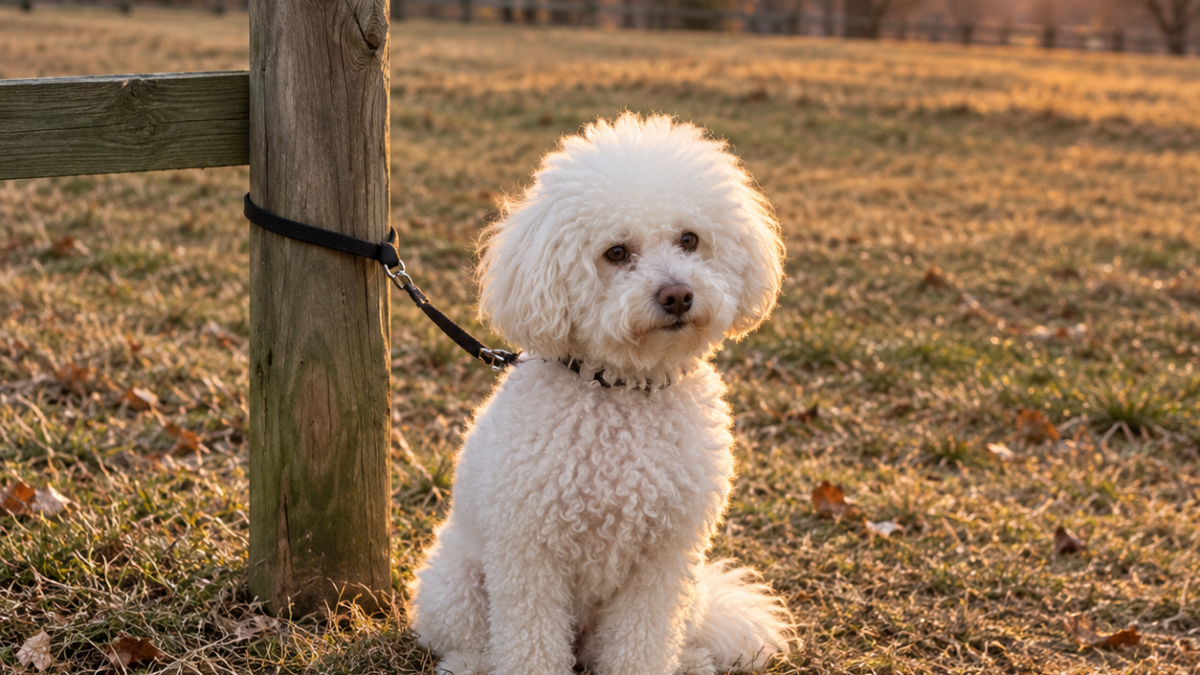
They loaded the last box into the truck, slammed the doors, and drove away while their little white dog sat tied to the fence waiting for his turn to leave with them.
I stood at the top of the stairs for several seconds and watched him.
Moonlight from the front window stretched across the living room floor.
Teddy sat inside it like a little white ghost.
His back was toward me.
His eyes were fixed on the door.
He was trembling.
Not violently.
Not from cold.
It was a strange, constant vibration that seemed to run through his entire body.
I had seen frightened dogs shake before.
This looked different.
This was waiting.
I descended the stairs quietly.
Teddy heard me.
One ear moved.
He didn’t turn around.
I could have picked him up.
Could have carried him back to the blanket I had made for him beside the couch.
Could have tried another piece of chicken.
Could have called his name repeatedly until he looked at me.
Instead, I remembered what Dr. Harrison had said.
You stay.
So I sat down.
Right there on the floor beside Teddy.
My back rested against the front door.
For a while, neither of us moved.
I didn’t touch him.
I didn’t talk.
The house made the quiet sounds houses make at night.
The refrigerator humming from the kitchen.
The heating system clicking.
A car passing somewhere several blocks away.
Teddy listened to every sound.
Each time tires moved along the street, his head lifted.
Each time they faded, something in his posture sank.
After about ten minutes, his trembling slowed.
Then stopped.
He remained sitting.
I remained sitting.
Finally, Teddy lowered himself onto the floor.
Not against me.
Not in my lap.
Just beside me.
Close enough that the fur along his back barely touched my leg.
I looked down.
His eyes were still on the door.
But for the first time since I carried him across the street, he had chosen to be near me.
I didn’t dare move.
We sat there until I must have fallen asleep.
When I opened my eyes, morning light was coming through the window.
My neck hurt.
My back hurt.
One foot had gone completely numb.
Teddy was asleep.
His head rested about two inches from my thigh.
I smiled.
“Good morning.”
His eyes opened.
He stared at me.
Then he looked at the door.
The moment was gone.
But not completely.
Something had happened during the night.
Something tiny.
And when you’re dealing with a broken heart, tiny things matter.
That morning I stopped trying to make Teddy like me.
That sounds strange.
Of course I wanted him to trust me.
Of course I wanted him to eat.
Play.
Wag his tail.
Stop waiting for people who had deliberately left him behind.
But until then, almost everything I had done contained an expectation.
Eat this.
Look at me.
Come here.
Sleep there.
Accept this new life.
I realized how unfair that was.
Teddy had lost everything he understood in a single afternoon.
His house.
His routine.
His people.
Their voices.
Their smells.
His place in the world.
And I expected him to reorganize his entire heart in three days because I gave him chicken.
So I changed the plan.
I made no plan.
The next morning, I brewed coffee and sat on the living room floor.
Teddy was near the door.
I pulled an old novel from a bookshelf.
It was about a fisherman.
I had started it years earlier and never finished.
I opened to the first page.
Then I began reading aloud.
Teddy didn’t react.
I kept reading.
I wasn’t trying to entertain him.
I simply wanted my voice in the room.
A steady sound.
Something predictable.
Something that would happen today and tomorrow and the day after.
When I stopped after half an hour, Teddy was still facing the door.
But one ear had turned toward me.
The next morning, I read again.
And the morning after that.
Newspaper articles.
Magazine stories.
The fisherman novel.
Instructions from a box of cereal once when I ran out of interesting material.
I talked about absolutely nothing.
The weather.
Traffic.
A leaking faucet.
How terrible I was at keeping plants alive.
Teddy didn’t need wisdom.
He needed repetition.
Every morning, I appeared.
Every evening, I returned.
Every night, the house sounded the same.
The fifth day after Dr. Harrison’s appointment, something changed.
I was reading when I felt it.
You know that sensation when someone is watching you?
I glanced sideways.
Teddy was looking at me.
Directly.
Not past me.
Not toward the door.
At me.
I almost stopped reading.
Instead, I forced myself to continue.
“…and the boat moved slowly beyond the harbor…”
My voice sounded strange because my throat had tightened.
Teddy held my eyes for perhaps three seconds.
Then he looked away.
Three seconds.
That was all.
But those three seconds felt like being handed something fragile.
I didn’t reach for more.
The next day, Teddy ate.
I had put down a bowl before going into the kitchen.
As usual, he ignored it.
I started washing dishes.
Then I saw movement reflected in the small mirror hanging near the doorway.
Teddy stood.
He approached the bowl.
Stopped.
Sniffed.
Looked toward the front door.
Then toward the kitchen.
I pretended not to notice.
He lowered his head.
One bite.
He stopped.
Another.
I gripped the edge of the sink.
Don’t turn around.
Another bite.
Then another.
Five minutes later, the bowl was empty.
I stood in the kitchen with tears in my eyes over a dog eating breakfast.
Teddy walked back to the door.
But something inside me had shifted.
He had chosen life.
At least for one meal.
That was enough.
When I called Dr. Harrison later that morning, he laughed.
“He ate?”
“Everything.”
“That’s good.”
“Really good?”
“Yes.”
“How good?”
There was a pause.
“Are you asking me to medically rank a bowl of dog food?”
“Yes.”
“Very good.”
I smiled.
“Thank you.”
“And you?”
“What about me?”
“Are you sleeping?”
I thought of the previous nights spent on the floor.
“Sort of.”
“Remember, you’re not useful to him if you collapse.”
“I’m fine.”
“People who say that are usually not fine.”
“I’ll sleep.”
“Teddy needs consistency, not martyrdom.”
That sentence annoyed me because it was correct.
So I adjusted.
I put a small mattress pad near the living room.
When Teddy sat by the door at night, I stayed nearby but not always directly beside him.
If he slept, I slept.
If he woke and looked toward the street, I let him.
I began to understand something.
I didn’t need to teach Teddy that his old family wasn’t returning.
Reality would teach him that.
My job was to teach him something else.
That when one person leaves, not everyone does.
At the beginning of the second week, I started talking to him instead of only reading.
“Work was terrible today.”
Teddy lay near the door.
“My boss scheduled a meeting that could’ve been an email.”
No reaction.
“You don’t understand how lucky you are not to have email.”
One ear moved.
“I’m serious. People pretend technology makes life easier. Mostly it means strangers can bother you faster.”
Teddy blinked.
I smiled.
“Finally, somebody agrees.”
At night, I told him about my childhood.
My grandmother had owned a gray cat named Oliver.
Oliver hated everyone.
Everyone except me.
As a boy, I had desperately wanted him to sit on my lap.
My grandmother stopped me.
“Don’t chase him,” she said.
“But I want him to like me.”
“Then stop asking him to prove it.”
I hadn’t understood.
So she taught me.
Put food down.
Sit nearby.
Read.
Ignore him.
Let him decide.
Weeks later, Oliver jumped onto my bed.
I remember lying perfectly still because I was afraid even breathing might make him leave.
That cat taught me my first lesson about trust.
You cannot demand it.
You cannot hurry it.
You can only behave in a way that makes trust increasingly reasonable.
I told Teddy that story.
“You’re basically a cat,” I said.
For the first time, I thought I saw something change in his expression.
“Don’t be offended.”
His chin returned to his paws.
Every day I left for work, Teddy watched me.
That part worried me.
The first morning I picked up my keys after he came home, he stood instantly.
His eyes widened.
I knelt.
“I have to go.”
He looked toward the door.
“I’ll come back.”
Of course, those words meant nothing to him.
Someone else had probably said them.
Maybe not aloud.
But every routine he knew had once promised the same thing.
Humans leave.
Humans return.
Until one day they don’t.
So I stopped expecting words to convince him.
I left.
Then I returned.
The next day, I did it again.
Leave.
Return.
Leave.
Return.
Every time I came home, Teddy was near the door.
Not greeting me.
Waiting.
At first, I couldn’t tell whether he was waiting for me or still waiting for them.
Maybe he didn’t know either.
Then came Tuesday of the third week.
I remember everything about that afternoon.
It had rained before lunch.
My shoes were damp.
Work had been ordinary.
I stopped for groceries on the way home.
Bread.
Coffee.
Milk.
Dog food Teddy now ate without being watched.
When I reached my front door, I put the key into the lock.
Nothing unusual.
I stepped inside.
Set the grocery bag down.
Removed my shoes.
Then I looked up.
Teddy was standing in the middle of the living room.
Not by the door.
In the middle of the room.
Watching me.
“Hey.”
His tail moved.
I stopped breathing.
One tiny sweep.
Then another.
“Teddy?”
The tail moved faster.
Suddenly his entire rear end began wiggling.
It looked almost awkward, as though he had forgotten how to coordinate happiness.
I dropped to my knees.
He took one step.
Stopped.
Another.
His tail kept moving.
I held out my hands but didn’t call him.
The decision had to be his.
Teddy crossed the remaining distance.
Then he pushed his small head between my palms.
Something inside me broke open.
I cried.
Not politely.
Not one cinematic tear.
I sat on my hallway floor holding a small white dog and cried hard enough that my shoulders shook.
Teddy stayed.
He pressed into me.
I whispered his name over and over.
“You waited for me.”
His tail hit the floor.
“You were waiting for me.”
That was the difference.
The first weeks, he waited for a car that would never turn back onto our street.
That afternoon, he waited for my key.
And I returned.
Exactly as I had every day.
The door Dr. Harrison said I couldn’t force open had finally moved.
Just an inch.
But light was coming through.
From that day forward, Teddy changed faster.
Not instantly.
Healing is rarely instant.
But he seemed to have crossed some internal line.
He started following me into the kitchen.
At first, he remained several feet away.
Then one evening I felt something touch my ankle.
I looked down.
Teddy was lying beside my chair.
“You know there’s an entire house, right?”
Tail thump.
“Fine.”
A few days later, I bought him toys.
I had avoided buying too many things because seeing unused toys scattered around the house would have felt depressing.
At the store, I found a small rubber hedgehog.
Ugly little thing.
Brown body.
Ridiculous face.
It squeaked.
I took it home.
Teddy sniffed it.
Walked away.
“Six dollars well spent.”
That evening, I heard squeaking from the living room.
I looked around the corner.
Teddy had the hedgehog.
He shook his head.
The toy squeaked.
Teddy froze.
He bit it again.
Squeak.
His ears lifted.
I laughed.
He looked at me.
Then he ran.
Not far.
One circle around the coffee table.
But he ran.
“Hoooold on.”
He came back.
Toy in his mouth.
I sat on the floor.
“Bring it.”
Teddy stopped three feet away.
“No?”
He walked closer.
Dropped the hedgehog near my knee.
I picked it up.
Squeak.
Teddy bounced.
Actually bounced.
For the next five minutes, I watched a dog who had spent weeks lying motionless by a door rediscover play.
He was clumsy.
Excited.
Confused by his own excitement.
I threw the hedgehog.
Teddy chased it.
His paws slid on the floor.
He crashed gently into the couch.
Stood.
Looked at me.
I laughed so hard I had to sit down.
Teddy barked.
It was the first time I had heard him bark.
One short sound.
Then another.
“Okay!”
I threw the toy again.
That rubber hedgehog became his most valuable possession.
He carried it from room to room.
Slept beside it.
Brought it to me in the morning.
Left it outside the bathroom door while I showered.
Sometimes I woke to find it on my pillow.
I chose to interpret that as generosity.
The alternative was that Teddy thought I was incompetent at hunting and needed help.
His first visit back to Dr. Harrison was six weeks after the rescue.
The veterinarian entered the exam room.
Teddy immediately moved behind my legs.
Dr. Harrison smiled.
“I remember you.”
Teddy did not return the enthusiasm.
“How’s he doing?”
“He eats.”
“Good.”
“Plays.”
“Good.”
“Sleeps.”
“Good.”
“He waits for me when I come home.”
Dr. Harrison’s eyes shifted toward me.
“That’s very good.”
I lifted Teddy onto the exam table.
He tolerated the examination.
Healthy weight.
Strong heart.
No physical concerns.
Then Dr. Harrison asked, “Does he still watch the door?”
“Sometimes.”
“When?”
“Cars slow down outside.”
“Anything else?”
“If I pack a bag.”
He nodded.
I had discovered that by accident.
One weekend, I pulled an old duffel bag from the closet because I needed to visit my sister overnight.
The moment Teddy saw clothing going into it, he changed.
He stopped playing.
His tail went down.
He walked to the front door.
I immediately unpacked everything.
My sister called.
“Where are you?”
“Something came up.”
“What?”
I looked at Teddy.
“Complicated.”
“You have the dog now, don’t you?”
“Yes.”
“Bring him.”
So I did.
Instead of leaving Teddy behind, I took him with me.
That first car trip was difficult.
When I placed him in the passenger seat, he trembled.
Of course.
The last important car ride he remembered might have been the one he was excluded from.
I clipped him into a safety harness.
Sat beside him for five minutes before starting the engine.
“We’re going together.”
Teddy watched me.
I started the car.
He remained tense.
At every stoplight, I touched his shoulder.
“You’re still here.”
When we arrived at my sister’s house, I opened the passenger door.
Teddy looked around.
Then at me.
“Come on.”
He jumped down.
We spent the night.
The next morning, he got back into the car without trembling.
Then we returned home.
Together.
That became another lesson.
Bags didn’t always mean abandonment.
Cars didn’t always mean disappearance.
Doors didn’t always close forever.
New experiences slowly rewrote old expectations.
I couldn’t erase the afternoon Teddy watched his family leave.
But I could surround that memory with hundreds of new ones.
Pack a bag.
Go together.
Drive away.
Return.
Close a door.
Open it again.
Leave for work.
Come back.
Say goodnight.
Appear in the morning.
Trust is sometimes built through astonishingly boring repetition.
That is what Teddy needed.
Proof.
Not speeches.
I started taking him on evening walks.
At first, he was nervous near the house where he had lived.
The old property remained empty for weeks.
Whenever we reached that section of sidewalk, Teddy slowed.
He looked toward the driveway.
I let him.
I never pulled him away.
Never said, “Forget them.”
How could I ask that?
Whatever they had done, Teddy had loved them.
That love had been real on his side.
One evening, he walked to the edge of their driveway.
The fence post was still there.
I stopped several feet behind him.
Teddy sniffed the grass.
Then the post.
His blue water bowl was gone.
The yard looked strange without furniture visible through the windows.
Empty.
Teddy stood there for almost a minute.
I waited.
Finally he turned.
He looked at me.
Then walked back.
We continued our walk.
He never stopped at that driveway again.
I don’t know what happened in his mind.
Dogs don’t narrate their healing for us.
Maybe nothing profound happened.
Maybe the place simply stopped smelling familiar.
Maybe he understood.
Maybe he didn’t.
But he turned away voluntarily.
That mattered to me.
A few months after I brought Teddy home, someone contacted me.
It was the woman who had lived in the house.
His former owner.
I recognized her voice immediately, even though we had rarely spoken as neighbors.
“I heard you have our dog.”
Our dog.
The phrase hit me like cold water.
I sat down.
“Yes.”
“We had to move suddenly.”
I said nothing.
“We couldn’t take animals where we were going.”
“You tied him to a fence.”
Silence.
“We thought someone would find him.”
“You didn’t call a shelter.”
“We were overwhelmed.”
“You didn’t knock on my door.”
Another silence.
“We knew the neighborhood would take care of him.”
I looked across the room.
Teddy was asleep with his rubber hedgehog under one paw.
“Why are you calling?”
“We’re in a different place now.”
My stomach tightened.
“Are you asking for him back?”
She hesitated.
“He was our dog for years.”
I closed my eyes.
For several seconds, I heard nothing except my own breathing.
Then I asked, “What’s his favorite toy?”
“What?”
“What was his favorite toy when he lived with you?”
“I don’t know.”
“What food did he eat?”
Another pause.
“Regular dog food.”
“What scares him?”
Silence.
“What does he do when he hears a car slow down outside?”
“I don’t understand why—”
“He stops whatever he’s doing and watches the door.”
I looked at Teddy.
“Do you know why?”
She didn’t answer.
“Because he spent hours watching your car disappear.”
Her voice became defensive.
“We didn’t have a choice.”
“There were dozens of choices.”
“We couldn’t keep him.”
“That isn’t the part I’m angry about.”
I heard my own voice changing and forced myself to lower it.
“Sometimes people genuinely can’t keep an animal. Housing changes. Illness happens. Money disappears. Life can become impossible. I understand that.”
She remained silent.
“But you could have handed him to someone.”
I swallowed.
“You could have said goodbye.”
Nothing.
“You could have made sure he knew somebody was coming for him.”
Teddy lifted his head at my voice.
I softened immediately.
“He stopped eating.”
“What?”
“For days.”
The line went quiet.
“He waited at my front door every night.”
I could hear her breathing.
“The vet said physically he was fine.”
I looked at Teddy’s dark eyes.
“But emotionally, he had shut down.”
She finally said, “I didn’t know.”
“No.”
I rubbed Teddy’s head.
“You didn’t stay long enough to know.”
There was another long silence.
Then she asked, much more quietly, “Is he happy?”
I looked around my living room.
The toy basket.
The dog bed he rarely used because he preferred the couch.
His bowl near the kitchen.
White fur on my dark sweater.
“Yes.”
“Does he… miss us?”
That question hurt.
Not because I wanted Teddy to hate them.
I didn’t.
Hatred wouldn’t heal him.
“I don’t know.”
That was the truth.
“He doesn’t wait at the door for you anymore.”
The woman started crying.
I heard it.
Part of me remained angry.
Another part understood that regret sometimes arrives after damage has already become permanent.
“I’m sorry,” she whispered.
I believed she meant it.
But apologies do not reverse abandonment.
“What happens now?” she asked.
“Teddy stays here.”
She didn’t argue.
Maybe she had known that before calling.
“Can I see him?”
I looked down.
Teddy had placed his chin over my foot.
“No.”
The answer came easily.
I wasn’t trying to punish her.
I was protecting him.
“He finally believes this is home.”
She cried quietly.
Then said, “Take care of him.”
“I will.”
“Please.”
“I already am.”
When the call ended, I sat there for a long time.
Teddy climbed onto the couch.
He placed the hedgehog in my lap.
I squeezed it.
Squeak.
His tail started.
I laughed despite everything.
“Your timing is incredible.”
He pushed the toy closer.
I threw it.
He chased it.
That was all Teddy cared about.
The past had called.
He preferred the hedgehog.
I learned something important that day.
Healing doesn’t require justice to happen exactly the way we imagine.
The people who abandoned Teddy did not come back begging on their knees.
There was no dramatic punishment.
No courtroom.
No public confrontation.
There was only a phone call.
Regret.
A boundary.
And a dog playing in a safe living room.
That was enough.
Teddy’s life kept expanding.
He discovered the backyard.
At first, I had kept him on a long line because I feared he might run.
Eventually, I opened the back door and let him into the fenced yard freely.
For several seconds, he stood on the porch.
Then he ran.
Really ran.
Across the grass.
Around the tree.
Behind the patio chair.
Back toward me.
His ears flew.
His white coat made him look like a small cloud moving far too fast.
I laughed.
“Go!”
He ran another circle.
Then another.
Finally Teddy collapsed in the grass, panting.
I sat beside him.
A few months earlier, this dog had refused food because the people he loved were gone.
Now he rolled onto his back in sunlight.
I rubbed his stomach.
“You’re doing okay, aren’t you?”
His paws curled.
I took that as yes.
Winter came.
Then spring.
Teddy developed routines.
At 6:45 every morning, he expected breakfast.
At 7:10, he expected a short walk.
When I picked up my keys for work, he followed me to the door.
The first months, he looked worried.
Eventually, his expression changed.
I would say, “I’ll be back.”
His tail would move.
Sometimes he even returned to the couch before I opened the door.
The first time that happened, I almost cried again.
I was offended by how often this dog made me emotional.
One evening, I realized I had forgotten my wallet.
I returned five minutes after leaving.
When the door opened, Teddy was asleep.
He lifted his head.
Looked at me.
Then looked almost annoyed.
“Well, excuse me.”
His tail thumped once.
“You’re supposed to be waiting dramatically.”
He put his head down.
That might have been one of the greatest victories of all.
Teddy no longer needed to supervise my return.
He expected it.
Trust had become boring.
Perfect.
A year after I rescued him, Dr. Harrison saw us for Teddy’s annual examination.
The doctor walked into the room.
Teddy wagged.
“Look at you.”
Teddy approached him.
Dr. Harrison scratched behind his ears.
“You remember the dog who wouldn’t look at anybody?”
“I remember.”
“He apparently doesn’t.”
“Good.”
Dr. Harrison listened to his heart.
“Strong.”
Checked his teeth.
“Good.”
His weight.
“Perfect.”
Then he looked at me.
“And how’s his heart?”
I smiled.
“You tell me. You’re the doctor.”
He shook his head.
“That one was never my department.”
Teddy looked toward me.
His tail moved.
Dr. Harrison smiled.
“Seems like somebody figured it out.”
“I didn’t fix him.”
“No?”
“No.”
I thought about those first nights.
“I stayed.”
Dr. Harrison nodded.
“Sometimes that’s the treatment.”
That phrase stayed with me.
Sometimes staying is the treatment.
We live in a world obsessed with doing.
Solve.
Fix.
Repair.
Improve.
But there are wounds that respond poorly to force.
Grief is one.
Betrayal is another.
Sometimes the most important action is almost invisible.
Sit.
Listen.
Return.
Repeat.
Teddy taught me that.
He also taught me something about abandonment I hadn’t understood.
People think being left means one moment.
The car drives away.
The door shuts.
The relationship ends.
But for the one being abandoned, the leaving happens repeatedly.
Every sound that might be the person returning.
Every evening they don’t.
Every morning you wake and remember.
Every key that belongs to somebody else.
Every passing car.
The loss keeps reintroducing itself.
That is why Teddy didn’t need one dramatic act of love from me.
He needed hundreds of ordinary ones.
One morning.
Another.
Then another.
One return.
Then another.
Until repetition worked in the opposite direction.
Instead of repeatedly proving he had been abandoned, life repeatedly proved he was safe.
I began thinking differently about promises.
“I’ll always be here” sounds beautiful.
But animals don’t understand always.
Maybe humans don’t either.
What Teddy understood was today.
I was here today.
Then tomorrow.
Then the next day.
Eventually “always” became the name for all those todays stacked together.
Two years passed.
Teddy became the unofficial mayor of our block.
Everyone knew him.
The mail carrier kept treats.
Children asked to pet him.
An elderly man named Mr. Bennett lived three houses down and sat on his porch most afternoons.
Teddy began stopping there during walks.
Mr. Bennett would say, “Well, here comes trouble.”
Teddy would sit.
A treat appeared.
I told Mr. Bennett, “You realize he only visits you for food.”
“Most of my relatives do too.”
Fair point.
One afternoon, Mr. Bennett asked about Teddy’s story.
I told him.
Not every detail.
Just enough.
He looked at Teddy for a long time.
“People are strange.”
“Yeah.”
“They threw away a dog who waits for people.”
“That’s one way to put it.”
Mr. Bennett scratched Teddy’s head.
“Being waited for is a gift.”
I looked at him.
He shrugged.
“When you get old, you learn that.”
From then on, I noticed something.
Teddy wasn’t only healing because I stayed.
He was becoming someone who stayed for others.
When Mr. Bennett’s wife died, Teddy somehow seemed to know.
We approached the porch one afternoon.
Mr. Bennett sat silently.
Normally, Teddy waited for permission before climbing the two steps.
That day, he walked directly up.
Sat against Mr. Bennett’s leg.
The older man placed his hand on Teddy’s back.
Neither moved.
After several minutes, Mr. Bennett whispered, “He knows.”
“Maybe.”
“No.”
His voice broke.
“He knows.”
We stayed almost an hour.
Teddy never asked for a treat.
That night I thought about the dog by the fence.
Waiting for people who had left him.
And now he had become the one who sat beside someone else when they were waiting for a life that would never return.
Maybe suffering doesn’t automatically make anyone kinder.
But sometimes, once healed, it makes us recognize pain more quickly.
Teddy recognized waiting.
I was sure of that.
When I became sick with the flu one winter, he refused to leave my bed.
I slept twelve hours.
Teddy slept nearby.
I stumbled to the bathroom.
He followed.
I returned.
He returned.
At one point I woke with his little rubber hedgehog on my chest.
“Teddy.”
He opened his eyes.
“You cannot cure influenza with this.”
Tail thump.
I squeezed it.
Squeak.
“Fine.”
Maybe medicine wasn’t his department either.
Years moved faster after that.
They always do when life becomes good.
Teddy’s coat stayed white, though cream coloring appeared around his ears.
His favorite hedgehog eventually split open.
I replaced it.
He rejected the replacement.
Apparently emotional attachment extended to damaged rubber toys.
So I repaired the original with a dog-safe patch.
He carried the ugly thing proudly.
I changed too.
Before Teddy, I thought of my house as quiet.
I liked that.
Or thought I did.
After Teddy, quiet felt incomplete.
There were nails clicking against flooring.
Tags jingling.
Tiny sneezes.
Occasional barking at suspicious squirrels.
The squeak of that ridiculous hedgehog.
The sound of Teddy jumping down from the couch when he heard my key.
Home developed a soundtrack.
One Friday, I had to travel overnight for work.
By then Teddy had been with me for years.
He trusted me.
I knew that.
Still, packing a suitcase made me nervous.
Not for myself.
For him.
Teddy watched from the bedroom doorway.
I folded clothes.
Placed them inside.
He remained calm.
I zipped the bag.
No trembling.
No retreat to the front door.
“Okay.”
He followed me downstairs.
My sister was staying at my house with him.
She arrived before I left.
Teddy loved her.
I knelt.
“I’ll be back tomorrow.”
He licked my hand.
I stood.
Picked up the suitcase.
Walked out.
From the driveway, I looked back.
Teddy stood behind the front window.
My chest tightened.
For a second, I nearly canceled.
Then his tail moved.
My sister appeared behind him.
Teddy turned toward her.
Walked away from the window.
I smiled.
That was trust.
Not believing I would never leave.
Believing leaving was not the same as abandonment.
When I returned the next day, Teddy greeted me like I had survived a war.
He ran in circles.
Jumped.
Brought the hedgehog.
Made sounds I had never heard before.
I knelt.
“I told you.”
Teddy pressed into me.
“I came back.”
That was the promise.
Not that I would never walk out the door.
That I would return.
One afternoon, years after the original family moved away, a moving truck appeared across the street again.
New occupants were leaving the same house.
I noticed from the kitchen.
Boxes.
Furniture.
Doors slamming.
Almost identical scene.
Then I saw Teddy.
He was sitting beside me.
He heard the truck.
His ears lifted.
I froze.
He walked to the window.
Looked outside.
My heart began beating faster.
Would he remember?
The truck started.
Pulled away.
Teddy watched it disappear.
Then he turned toward me.
His tail wagged.
He walked into the living room and picked up his hedgehog.
That was all.
I stood there with one hand against the kitchen counter.
For years, part of me had wondered whether that memory would always own some part of him.
Maybe it did.
But it no longer controlled him.
A moving truck was just a moving truck.
A disappearing car was just traffic.
His world no longer ended at the corner.
His world was here.
I followed him.
He dropped the toy at my feet.
I threw it.
He ran.
Years earlier, Teddy had watched one road because he believed everything he loved had disappeared down it.
Now he barely noticed.
Healing doesn’t always announce itself.
Sometimes you realize it happened because the thing that once destroyed you passes in front of the window and you choose to keep playing.
As Teddy got older, he slowed.
The puppy-like bursts through the backyard became shorter.
He still ran, but selectively.
Usually when food was involved.
His jumps onto the couch became careful.
Eventually I bought small pet stairs.
The first time I placed them beside the couch, Teddy stared at me as if insulted.
“You’re old.”
He sneezed.
“I’m old too.”
No response.
“Use the stairs.”
He jumped directly onto the couch.
“Excellent. Money well spent.”
Three months later, he quietly began using them when he thought I wasn’t watching.
Pride survives aging.
Dr. Harrison found mild arthritis during one examination.
Nothing alarming.
Medication when necessary.
Joint supplements.
Shorter walks.
Teddy remained happy.
By then, his entire face had softened.
When I looked at old photographs from the first week, I barely recognized him.
Same black eyes.
Same white coat.
Different expression.
The old Teddy looked as though every part of him was listening for loss.
The older Teddy looked as though he expected comfort.
There may be no clearer proof of healing than expectation.
One summer evening, Mr. Bennett died.
His daughter told me.
Teddy and I walked past the empty porch the next day.
Teddy stopped.
Looked toward the chair.
Waited.
My throat tightened.
“He’s not coming out, buddy.”
Teddy remained still.
For a moment I saw that old dog again.
Waiting.
I sat on Mr. Bennett’s steps.
Teddy came beside me.
We stayed.
I didn’t know whether dogs understand death.
I knew Teddy understood absence.
This time, I sat beside him through it.
The way he had once sat beside Mr. Bennett.
Maybe that is how love travels.
Someone stays with you.
Later, you learn to stay with someone else.
Another year passed.
Teddy developed a habit of sleeping at the foot of my bed.
Every night, he circled three times.
Lay down.
Sighed loudly.
If I moved too much, he looked offended.
Sometimes his paws twitched in dreams.
I imagined him running.
Not toward the road.
Not chasing an old car.
Running through grass.
Toward something.
Maybe me.
Maybe nothing at all.
I hoped dogs were allowed meaningless happy dreams.
One night, I woke around three.
The same hour I had found him at the front door years earlier.
For a second, I panicked because Teddy wasn’t at the foot of the bed.
I got up.
Walked downstairs.
The living room was empty.
Then I found him in the kitchen.
He was drinking water.
He looked at me.
I laughed quietly.
“You have any idea what time it is?”
Teddy finished.
Walked past me.
Started up the stairs.
No interest in the front door.
I stood in the dark smiling.
Years earlier, three in the morning meant waiting.
Now it meant being thirsty.
I followed him back to bed.
That ordinary moment meant more than anyone else could have understood.
The older Teddy became, the more I thought about the veterinarian’s first words.
His heart is broken.
At the time, I had imagined a broken heart like a broken bone.
Two pieces.
Repair them.
Set them correctly.
Wait.
But emotional wounds are different.
Teddy did not become exactly who he had been before that moving truck left.
I don’t think healing works like that.
He became someone new.
A dog who had been abandoned.
A dog who learned another person returned.
Both things were true.
One truth did not erase the other.
The second simply became larger.
That is what we sometimes misunderstand about recovery.
We think the goal is forgetting.
It isn’t.
The goal is reaching a point where memory no longer controls the direction you look.
Teddy once faced the road.
Then the door.
Eventually, he faced me.
Later, he faced the yard.
The neighborhood.
Mr. Bennett.
The world.
His life expanded every time he turned his head away from where someone had disappeared and toward what remained.
One afternoon, Dr. Harrison retired.
I brought Teddy to the small party the clinic held for him.
The doctor crouched with difficulty.
Teddy approached.
Dr. Harrison scratched his chest.
“You’re an old man now.”
I said, “Careful. He’s sensitive.”
The veterinarian smiled.
“How long has it been?”
“Almost nine years.”
He looked surprised.
“Really?”
“Yeah.”
He studied Teddy.
Then looked at me.
“I remember that first appointment.”
“So do I.”
“You looked terrified.”
“I was.”
“More terrified than he was, maybe.”
“Probably.”
Dr. Harrison rubbed Teddy’s ears.
“I told you it would take a lot of you.”
“It did.”
“Regret it?”
I looked down.
Teddy leaned against my leg.
“Not one second.”
Dr. Harrison nodded.
“I didn’t think so.”
I said, “You also told me medicine couldn’t fix his heart.”
“Did I?”
“You did.”
“Sounds dramatic.”
“It was very dramatic.”
He laughed.
Then his expression softened.
“I was right though.”
“Yes.”
He looked at Teddy.
“But maybe incomplete.”
“What do you mean?”
“Medicine couldn’t fix it.”
His hand rested on Teddy’s back.
“But somebody did.”
I shook my head.
“Teddy did most of it.”
“Maybe.”
Dr. Harrison smiled.
“But he needed somewhere safe to do it.”
That is another thing Teddy taught me.
Healing belongs to the wounded.
You cannot do it for them.
You can only create conditions where healing becomes possible.
Safety.
Patience.
Predictability.
Presence.
Then they decide.
Teddy decided to look at me.
Teddy decided to eat.
Teddy decided to walk away from the old driveway.
Teddy decided to wag when my key turned in the lock.
I simply made sure the choice remained available.
By Teddy’s tenth year with me, stairs became difficult.
I moved my bedroom downstairs.
Friends thought that was excessive.
I didn’t.
The guest room became mine.
Teddy’s bed went beside it.
His food moved closer.
Rugs covered the slippery hallway.
Nothing felt like sacrifice.
When someone you love has spent years changing their life around your presence, moving furniture seems small.
One cold morning, Teddy didn’t get up for breakfast.
That scared me.
Food had become one of his greatest passions.
I knelt beside him.
“Hey.”
He opened his eyes.
Tail moved.
But he didn’t stand.
I called the veterinarian who had taken over after Dr. Harrison retired.
She saw us immediately.
Arthritis flare.
Medication adjustment.
Rest.
Nothing catastrophic.
Still, driving home, I thought about time.
For years, I had celebrated every day Teddy became more alive.
Now I was confronting the fact that no rescue creates immortality.
Saving someone means eventually risking grief.
There is no way around that.
The alternative is never loving them enough to hurt later.
I had no interest in that bargain.
Teddy improved.
Slowly.
Within a week he was walking normally for his age.
The first morning he brought the old rubber hedgehog toward me again, I laughed.
The toy had survived almost as long as he had.
Barely.
One eye missing.
Squeaker long dead.
Several patches.
Teddy placed it at my foot.
I picked it up.
It made no sound.
He wagged anyway.
He didn’t need the squeak anymore.
The meaning remained.
I kept thinking about the first time he gave it to me.
You are here.
I am here.
We are together.
Maybe that was always what it meant.
On a mild spring afternoon, Teddy and I sat on the front porch.
He was too old for long walks by then.
We watched people move along the street.
A delivery truck.
Children on bicycles.
A woman jogging.
Cars.
Normal life.
Teddy rested against my foot.
Then a vehicle slowed near the corner.
For a fraction of a second, his ears lifted.
The old reflex.
Then he looked up at me.
I reached down.
“I’m here.”
His eyes softened.
He placed his head back down.
The car continued.
I realized something.
Teddy had never needed me to promise that nobody would leave him again.
That promise would have been impossible.
People leave.
Circumstances change.
Lives end.
What I had given him was smaller and more honest.
While I was here, I would stay.
When I left for the day, I would return.
When he was frightened, I would sit nearby.
When he was ready, I would meet him halfway.
And for years, that had been enough.
Maybe that is what love really is.
Not a guarantee against every loss.
A practice of presence.
The final chapter of Teddy’s life did not arrive suddenly.
There was no single dramatic collapse.
He aged gently.
His walks shortened.
His sleeping increased.
His appetite remained stubbornly impressive.
His eyes clouded slightly.
His hearing weakened.
But he always recognized my footsteps.
Even when he no longer heard the key well, he felt the door open.
His head would rise.
Tail.
Always the tail.
Sometimes barely moving.
Still moving.
I became obsessed with that tail.
The same tail that had remained motionless beside the fence.
The same tail that began wagging in my hallway three weeks later.
It became my measurement.
Are you still happy to see me?
Yes.
Good.
We have today.
One evening, I sat beside him on the living room floor.
I had begun spending more time there because he couldn’t climb onto the couch anymore.
The old fisherman novel was on the table.
I picked it up.
Teddy opened his eyes.
“You remember this?”
He probably didn’t.
I started reading.
Same book.
Same voice.
Different dog.
Years earlier, I had read because silence frightened him.
Now I read because the ritual belonged to us.
Halfway through a chapter, Teddy shifted.
He placed his head against my thigh.
I rested one hand on him.
The story no longer mattered.
I looked toward the front door.
He didn’t.
That may be the image I remember best.
Not the fence.
Not the truck disappearing.
Not the blue water bowl.
Teddy beside me, old and safe, while the door stood ten feet away and meant absolutely nothing.
That was victory.
Not dramatic.
Not visible to strangers.
But complete.
Teddy had spent the beginning of our life together staring at an exit.
He spent the rest of it looking toward the person who came back through it.
And I did come back.
Every day I could.
Every evening.
Every ordinary Tuesday.
Every rainy Thursday.
Every day after work.
Every grocery run.
Every overnight trip.
Again.
Again.
Again.
Until returning stopped being evidence and became expectation.
Until expectation became trust.
Until trust became home.
When people later asked how I saved Teddy, I corrected them.
“I untied him.”
That part took seconds.
“I carried him across the street.”
Maybe thirty seconds.
“That wasn’t the rescue.”
The rescue took years.
And Teddy did half of it himself.
He had to risk believing again.
Nobody talks enough about how courageous that is.
After betrayal, distrust is easy to understand.
Teddy had every reason to assume my door would eventually close behind me too.
Instead, little by little, he let himself hope.
Then believe.
Then love.
I admired that more than anything.
Because the brave part wasn’t surviving being left.
He had no choice about survival.
The brave part was opening his heart afterward.
Late one evening, many years after our first night together, Teddy fell asleep at my feet while I watched rain against the windows.
I looked down.
White fur.
Gray around the face.
The broken rubber hedgehog nearby.
I thought about the day his old family left.
Maybe they had told themselves someone would take him.
Maybe abandoning him felt easier because the neighborhood was safe.
Maybe regret had followed them.
I would never fully know.
But I knew this:
They left him beside a fence believing his story with them was ending.
They were right.
What they didn’t know was that a different story had already begun across the street.
I had been standing behind a kitchen window.
Watching.
Waiting.
Not yet understanding that Teddy’s entire future and a large part of mine were only a few yards apart.
He spent hours looking in the wrong direction.
Toward the road.
Toward the car.
Toward the past.
Meanwhile, his future was walking toward him from across the street.
Slowly.
Quietly.
Not demanding anything.
Just reaching for the leash.
Sometimes I think about that when life feels hopeless.
We stare at the place where something disappeared.
A person.
A relationship.
A version of ourselves.
We become convinced the only possible good future is the return of what left.
Teddy taught me otherwise.
Sometimes what left really is gone.
Sometimes the car does not come back.
Sometimes the door you desperately want to open stays closed forever.
And still, your story may not be over.
Something else may already be crossing the street toward you.
Something gentler.
Something patient.
Something you cannot see because you are still looking backward.
Teddy never got his old life back.
He got another life.
A better one.
Not because it erased what happened.
Because it gave him something new to believe in.
On our last evenings together, when he became tired easily, I would sit beside him and scratch the place behind his ears he had always loved.
“You know,” I told him once, “I thought I rescued you because I untied that leash.”
His eyes remained closed.
“I was very proud of myself.”
His tail moved faintly.
“But that wasn’t it, was it?”
I smiled.
“All I really did was stay long enough.”
Teddy opened his eyes.
Looked at me.
For several seconds, we simply watched each other.
Then he moved his paw until it touched my hand.
That was enough.
I didn’t need some grand sign.
I didn’t need to imagine he understood every word.
I understood.
The small dog who had once ignored me because his entire heart was fixed on people who left now reached for me without opening his eyes.
He knew where I was.
He expected me to be there.
And I was.
If there is one thing I wish I could give every abandoned animal, it isn’t a perfect house.
Not expensive toys.
Not endless treats.
It is certainty.
The quiet certainty Teddy finally developed.
Someone will notice if I hurt.
Someone will put food in my bowl tomorrow.
Someone will open the door and invite me inside.
Someone will know my favorite toy.
Someone will understand when I’m frightened.
Someone who leaves will return.
Someone is staying.
That certainty transformed Teddy more completely than anything else.
His body had never been the problem.
Dr. Harrison knew that from the beginning.
His heart needed evidence.
So we gave it evidence.
Day after day.
Year after year.
And eventually, the dog who once stared down an empty street stopped waiting for people who had chosen to leave.
He learned to wait for someone who always came back.
Me.
But here is the truth I understand now.
I waited for him too.
Every morning, for the little sound of his paws.
Every evening, for his ridiculous hedgehog.
Every time I entered the house, for that tail.
Somewhere along the way, the abandoned dog stopped being the one waiting for love.
We were simply two lives expecting each other.
Two lives that had built routines around the certainty that the other would be there.
Maybe that is what home is.
Not walls.
Not ownership papers.
Not an address.
Home is the place where your absence would be noticed.
The place where your return matters.
Teddy found that place.
So did I.
And whenever I remember him beside that fence, staring after the people who had driven away, I wish I could kneel beside that younger version of him and tell him what he could not possibly understand yet:
Don’t keep staring down that road, little guy.
They are not coming back.
I know that hurts.
I know you think everything good just disappeared around that corner.
But turn around.
Just once.
There is someone walking toward you.
You don’t know him yet.
You won’t trust him tomorrow.
Maybe not next week.
You may sit by his door and wait for the past until your whole body shakes.
That’s okay.
He will sit there too.
He will read stupid books aloud.
He will cook chicken you refuse to eat.
He will sleep on the floor because you’re afraid.
He will leave in the morning.
And then something strange will happen.
He will come back.
Again.
And again.
And again.
Until one afternoon you hear his key, and instead of watching the road, your tail will move.
You will walk toward him.
And from that moment, little by little, the world will begin again.
The people who left you will become a memory.
The door will become just a door.
The road will become just a road.
And you—
the little white dog someone thought they could leave tied to a fence—
will become the most important part of somebody’s home.
Not because he felt sorry for you.
Not because you needed saving.
Because he loved you.
And because, when your heart was finally ready, you loved him back.
They drove away believing they had left a dog behind.
What they actually left behind was a heart still capable of trusting someone better.
And I will always be grateful that I happened to be looking out my kitchen window when that heart was waiting for someone to stay.








