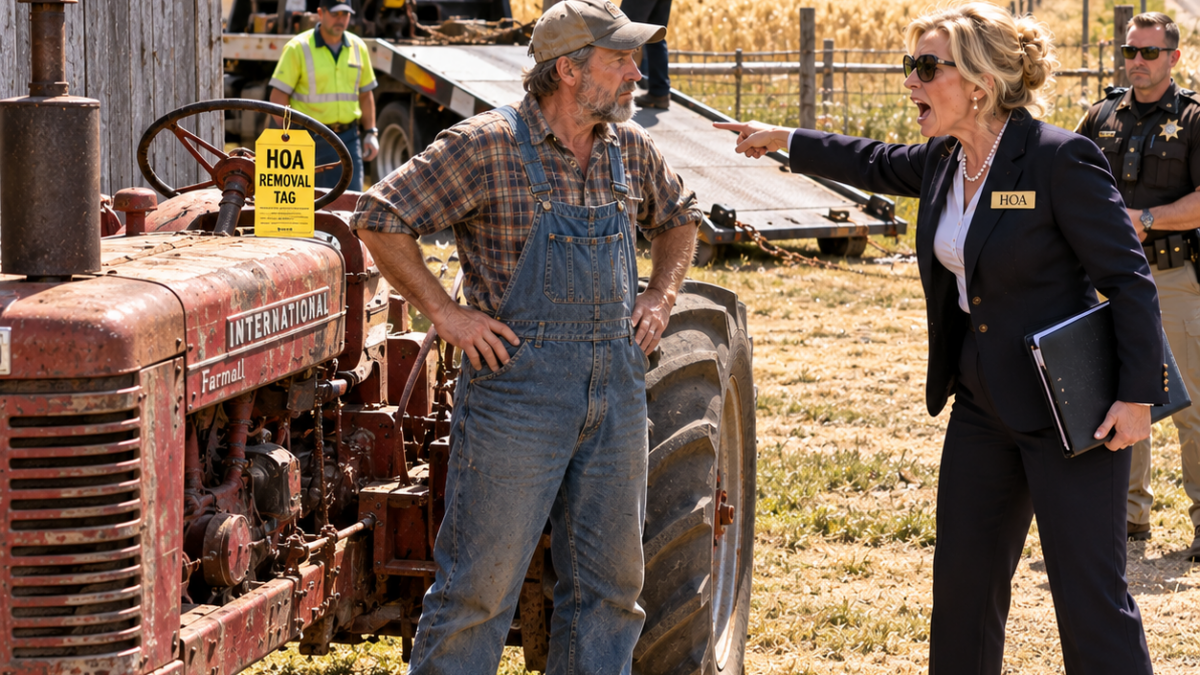
The tow truck was already backing toward my father’s faded red tractor when I walked into the side yard and saw the yellow HOA removal tag wired to the steering wheel.
The folder was brown, soft at the corners, and smelled faintly like dust and old paper.
Across the front, in my father’s block handwriting, were three words:
ASHBEND / FIRE / ROAD.
Dad labeled everything like he expected someone else to need it after he was gone.
At the time, I used to tease him about it.
“You know normal people just have filing cabinets.”
“Normal people spend half their lives looking for things.”
He had said it without looking up from whatever bolt or receipt was in his hand.
Now I sat at the same kitchen table, with Whitney Sloan’s forty-eight-hour notice beside me, and understood why the labels mattered.
Inside the box were old fuel receipts.
Tractor parts invoices.
Volunteer fire district newsletters.
Maps.
Lease papers from before Ashbend Meadows had renamed half the surrounding land “scenic agricultural open space.”
Then I found a folder marked:
FIREBREAK — SIGNED COPY.
My hands stopped.
The first page was eleven years old.
Agreement between Walt Carver, Ashbend Development LLC, and Ashbend Rural Fire District.
Annual discing along the south wheat boundary.
Seasonal equipment access from Carver Shed Lane.
Clearance before red-flag conditions.
Use of local equipment where practical.
My father’s signature was at the bottom.
The developer’s signature.
And Captain Lee Taggart from the fire district.
Clipped to the front was one of Dad’s notes.
NEW VERSION SENT TO HOA AFTER TURNOVER.
ASKED FOR FINAL COPY.
There was no final copy.
Just that note.
I read the agreement again.
Then I pulled Whitney’s violation notice closer.
ABANDONED AGRICULTURAL MACHINERY.
The tractor wasn’t simply something my father had chosen to park beside the shed.
It was tied to a firebreak operation that existed before most of the current houses.
And somewhere in the records inherited by Ashbend Meadows, there was supposed to be an updated version.
My phone rang.
ASHBEND MEADOWS HOA.
I looked at it until the third ring.
Then answered.
“Audrey Carver.”
Whitney didn’t bother with hello.
“I wanted to make sure you understood today’s notice.”
“I understand what it says.”
“There seems to be confusion regarding the word abandoned.”
“There isn’t. The tractor runs.”
“That isn’t the only factor.”
“No.”
I opened the governing documents again.
“The other factor is your own exemption for active agricultural maintenance, emergency access, and seasonal safety equipment.”
A pause.
Office noise murmured behind her.
Whitney came back smoother.
“That exemption is not intended to protect sentimental personal equipment.”
“It isn’t stored for sentimental reasons.”
“Audrey—”
I hated the way she said my name.
Patient.
Controlled.
Like I had dragged an old rocking horse into the common lawn because it reminded me of childhood.
“The tractor pulls the south-line disc,” I said. “That firebreak protects the wheat fields your association leases.”
“The fields are professionally managed.”
“No vendor cut that south line last summer.”
“My understanding is your father performed informal work.”
“My father’s work is in a signed agreement.”
Silence.
That was useful.
“What agreement?”
“The one between him, the original developer, and the fire district.”
“The developer no longer controls Ashbend Meadows.”
“But Ashbend Meadows inherited the open-space obligations.”
“That is your interpretation.”
“Then send me the current firebreak plan.”
She exhaled.
“The board has already reviewed this.”
“Great. Send me what they reviewed.”
“The violation speaks for itself.”
“Not if it misclassifies fire-mitigation equipment as abandoned machinery.”
Her tone sharpened.
“You are escalating this unnecessarily.”
“No. I’m asking everyone to use the correct noun before you tow something.”
“Audrey, this community cannot be held hostage by every old object to which a homeowner assigns emotional meaning.”
The sentence hung there.
Old object.
Emotional meaning.
I looked at Dad’s notebook.
April 18 — new battery cable.
May 3 — fuel filter.
May 29 — grease discs.
June 4 — started clean, ran 20 min.
SOUTH LINE BEFORE RED WIND.
I said, “I’m sending one written response. After that, communication stays in writing.”
“The forty-eight-hour deadline remains.”
Then she hung up.
I sat at the table for a long time.
My father wasn’t dead.
That almost made the whole thing harder.
He was still here.
Just not here in the same way.
Walt Carver lived twenty-three miles away in an assisted-living facility with a memory-care wing he did not always remember moving into.
Some mornings, he could tell me the year he bought the International.
Other mornings, he asked whether my mother would be home for supper.
Mom had been gone nine years.
His memory had started slipping in small places before we knew what it was.
A missed appointment.
A wrench put in the refrigerator.
A check written twice.
Then one morning he walked me into the shed and made me start the tractor.
“Fuel,” he said.
“On.”
“Throttle.”
“Set.”
“Clutch.”
“In.”
“Again.”
“Dad, I know how.”
“Again.”
I started it three times.
Finally I said, “Why are we doing this?”
He looked at me.
And for that moment, his eyes were perfectly clear.
“Because machines don’t care if you’re sad.”
I remember laughing.
He didn’t.
“They care if you remember fuel, spark, air.”
The tractor was diesel.
There was no spark plug.
But Dad had spent half a lifetime saying fuel, spark, air about everything mechanical.
The phrase meant fundamentals.
Know what makes something work.
Know what makes it fail.
I understood that now.
Whitney wanted to turn the tractor into a sentimental object.
If she succeeded, the discussion would become whether grief entitled me to violate community standards.
It did not.
But that wasn’t my argument.
My argument was that the machine had a job.
So I built the record around the job.
The next morning, I walked the south wheat line.
The heat was already coming up from the ground.
Ashbend’s field sat between County Road 16 and the houses.
It looked beautiful.
That was the problem.
Beauty could make people forget function.
The wheat was almost fully dry.
The roadside shoulder was brittle.
The old firebreak my father had cut every June was visible if you knew where to look.
A darker strip.
Compacted soil.
A shallow depression where the discs had run year after year.
I knelt.
Dry grass curled along the road edge.
One mower blade hitting stone wrong.
A hot bearing.
Dragging trailer chain.
Cigarette.
Electrical fault.
Fire didn’t care whether the source was dramatic.
It cared about fuel.
A pickup slowed on County Road 16.
Then turned onto the gravel apron.
Mina Greer climbed out.
She was sixty-eight.
Small.
Gray hair pinned back.
Phone already in her hand.
She lived three houses north of mine and had known Dad since before the first Ashbend foundation was poured.
“I heard about Whitney.”
“That was fast.”
“Whitney wanted it fast.”
She stood beside me.
Looked at the field.
“Your dad cut this every year.”
“I have the service notebook.”
“I have pictures.”
She turned her phone.
There he was.
Dad.
Four summers earlier.
White work shirt.
Old straw hat.
Sitting on the faded International.
Disc harrow behind him.
A fresh strip of turned earth along the wheat.
My throat closed.
Mina swiped.
Another photograph.
Then another.
Walt on the tractor.
Wheat gold beside him.
Black soil behind the discs.
“I took them because I liked how steady he was,” Mina said.
“He never hurried the line.”
“No.”
I smiled despite myself.
“He said fire punished people who hurried the wrong thing.”
Mina looked at me.
“Exactly.”
She sent the photographs.
By 10:30, the HOA posted a neighborhood notice.
COMMUNITY STANDARDS UPDATE.
It did not mention me.
Didn’t need to.
The association is addressing abandoned machinery visible from open-space frontage. Residents are reminded that obsolete equipment, sentimental property, and personal machinery may not be stored in designated view corridors.
Then the sentence that told me Whitney knew exactly what argument she was building:
Unauthorized machinery near agricultural open space may create insurance exposure.
Comments started.
Finally.
That tractor is ugly.
Buyers ask about it.
Rules are rules.
Someone wrote:
I thought old farm equipment was part of the rural character.
A reply appeared:
Charm doesn’t protect property values.
I closed the app.
Dad used to say never answer people while you are still composing the insult.
So I didn’t.
I wrote the formal response instead.
Tractor identification.
Make.
Model.
Location.
Function.
Service records.
Mina’s dated photographs.
Firebreak agreement.
HOA exemption clause.
Then one request:
Please provide the current firebreak maintenance agreement, open-space safety plan, risk memorandum, pre-incident map, vendor maintenance contract, or board minutes relied upon to classify this equipment as abandoned.
I read Dad’s agreement again.
Something near the bottom of page two caught my eye.
SEE RURAL FIRE DISTRICT PRE-INCIDENT MAP — SOUTH WHEAT LINE — ACCESS POINT C.
Access Point C.
I had never seen that map.
Dad’s note said the HOA had been sent an updated copy after turnover.
If that was true, Ashbend had it.
Or had once had it.
I sent my response by email.
Then certified mail.
At 2:14, the resident app updated again.
Whitney had posted:
Unauthorized machinery will be removed in accordance with association policy. Residents are discouraged from circulating inaccurate safety claims to delay enforcement.
I looked at the tractor through the kitchen window.
Then at the wheat.
Somewhere, I thought, there is a map with Access Point C on it.
And Whitney is acting like she hopes I never find it.
The compliance review was scheduled for Friday at four.
Whitney had chosen the time.
Late enough that the county office would be closing.
Late enough that the fire district administration might be gone.
Maybe that was coincidence.
By then, I had stopped giving coincidences the benefit of the doubt.
The HOA office sat beside the clubhouse.
Perfect landscaping.
Fresh mulch.
Pavement swept clean.
Inside the conference room, Whitney was already seated.
White binder.
Ashbend Meadows logo.
Tabs.
Russell Baines, the board president, sat to her left.
He was seventy.
Gray hair.
Quiet.
The sort of man who signed things because somebody had told him the issue was routine.
Douglas Peck sat farther down.
Sandy Morrow from the landscape committee beside him.
Behind the table hung a framed photograph of the south wheat field at sunset.
Golden.
Perfect.
No road shoulder.
No firebreak.
No tractor.
No shed.
The photographer had cropped out everything that made the landscape survivable.
Whitney gestured.
“Audrey. Thank you for coming.”
“My notice says I’m required to.”
Russell cleared his throat.
“We want this to be productive.”
“Then start with the firebreak agreement.”
Whitney folded her hands.
“Before we get lost in historical documents, the board wants you to understand the current community concern.”
“Which is?”
“The tractor is visible from the South Overlook Trail and the field path used during buyer tours.”
“Visibility is different from fire access.”
Douglas shifted.
“Nobody is saying firebreaks don’t matter.”
“Then why is towing scheduled before anyone verifies the safety plan?”
Russell looked toward Whitney.
“Towing?”
She answered without looking at him.
“The board authorized removal if the owner failed to comply.”
“When?”
“Forty-eight hours after final notice.”
Sandy frowned.
“That’s Monday.”
“Yes.”
“Before Golden Open Space Weekend.”
There it was.
A glossy flyer sat in front of Whitney.
I pulled it closer.
The same wheat field at sunset.
Headline:
LIVE BESIDE THE VIEW THAT BREATHES.
I looked at Whitney.
“This is what you’re protecting.”
“Community standards protect everyone.”
“You’re protecting a brochure photograph.”
Russell lifted a hand.
“Audrey.”
“I’m being accurate.”
Whitney opened her binder.
“The association’s insurance adviser has expressed concern regarding obsolete machinery near community agricultural land.”
“Who?”
She looked down.
“I don’t have the name in front of me.”
“Then don’t use an unnamed insurance adviser to call maintained equipment dangerous.”
Douglas said, “It is old.”
“So am I.”
Nobody laughed.
I continued.
“Age isn’t the test. Function is.”
I slid copies across the table.
Service log.
Photographs.
Agreement.
Exemption clause.
My request for Access Point C documentation.
Russell picked up the service log.
His eyes paused on Dad’s handwriting.
Whitney did not touch her copy.
“The agreement you provided is outdated.”
“Then show me the new one.”
“We’re not obligated to search every historical record to accommodate noncompliance.”
“Not every record. The firebreak file.”
Russell turned.
“Do we have one?”
Whitney answered him while looking at me.
“The present issue is visual compliance.”
“No.”
I leaned forward.
“The present issue is whether you’re towing the machine used to cut the only documented south-line firebreak before red-flag season.”
Sandy said quietly:
“The grass is worse this year.”
Whitney closed her binder.
“This is exactly why the board discourages alarmist claims.”
I looked at the framed wheat photograph behind her.
Perfect.
Golden.
Useless.
“The south line should already have been cut.”
Whitney’s jaw tightened.
“If the association hired a vendor, give me the contract.”
Nothing.
“If the fire district removed Dad’s tractor from the plan, give me the revision.”
Nothing.
“If an insurance adviser says a maintained disc tractor is a greater hazard than blocked firebreak access, give me that letter.”
She stood.
“Your forty-eight-hour deadline remains.”
Russell looked uncomfortable.
“Whitney, maybe we verify—”
“The deadline remains.”
Meeting over.
Because she said it was.
Outside, the wind had picked up.
I had almost reached my truck when someone called:
“Ms. Carver.”
The tow driver stood near the maintenance gate.
“Ben Arlo.”
He removed his cap.
“Arlo Recovery.”
“I remember.”
“I don’t want to get involved in board business.”
“Then don’t.”
He nodded.
“But I’m booked Monday at seven.”
“To tow the tractor.”
“Not just that.”
My stomach tightened.
“What does the work order say?”
“Clear equipment from shed lane for event access.”
I looked toward the wheat.
Then toward the shed.
“Can you show me?”
He hesitated.
Clubhouse doors opened behind us.
Whitney came out with Russell.
Ben lowered his voice.
“I’ll send the section tied to your address.”
My phone buzzed before I reached County Road 16.
Screenshot.
ARLO RECOVERY.
MONDAY 7:00 A.M.
REMOVE RED TRACTOR / ATTACHED IMPLEMENT.
CLEAR SHED LANE FOR OPEN SPACE EVENT ACCESS.
The last sentence changed everything.
They weren’t only trying to remove the tractor.
They were clearing the lane.
The lane Dad’s agreement called seasonal equipment access.
The lane referenced by Access Point C.
I didn’t drive home.
I went two miles down County Road 16 and parked beside the feed store.
Then called Ashbend Rural Fire District.
“Ashbend Rural Fire.”
“My name is Audrey Carver. I’m calling about the South Wheat Line at Ashbend Meadows. I need whoever handles pre-incident planning.”
A transfer.
Then:
“Captain Torres.”
His voice was calm.
“Carver?”
“Yes.”
“Walt Carver’s place?”
My hand tightened around the phone.
“Yes.”
“How’s your father?”
I looked out at dry grass flattened by wind.
“He’s in assisted living now. Good days and bad days.”
“I’m sorry.”
“Thank you.”
“He kept that south line honest for a long time.”
That sentence nearly got me.
Not sympathy.
Recognition.
I told him everything.
HOA notice.
Abandoned classification.
Tow order.
Shed-lane clearance.
Firebreak agreement.
Access Point C.
Captain Torres let me finish.
Then asked:
“Did they move the tractor?”
“No.”
“Disc still attached?”
“Yes.”
“Does it run?”
“Yes.”
“Then they need to stop.”
I closed my eyes.
“There’s an old agreement.”
“I know.”
“You know?”
“We have the map.”
The words hit hard.
“You have Access Point C?”
“Yes.”
I sat straighter.
Captain Torres asked for my email.
A minute later, a PDF arrived.
ASHBEND SOUTH WHEAT LINE — PRE-INCIDENT REFERENCE.
No marketing.
No sunset.
Roads.
Hydrants.
Field edges.
Access points.
A black arrow pointed at my shed lane.
ACCESS POINT C — CARVER SHED LANE.
Below it:
LOCAL DISC TRACTOR AVAILABLE.
My father’s tractor.
Listed on the fire map.
Not sentimental property.
Not obsolete machinery.
Available equipment.
“Was this sent to the HOA?”
“Multiple times.”
“Recently?”
Keyboard.
“May twenty-second. Preseason memo.”
“To who?”
“Ashbend board address. Management account.”
Pause.
“And Whitney Sloan directly.”
My heartbeat changed.
Whitney had tagged the tractor June eleventh.
“Anything after May twenty-second?”
“June sixth follow-up after county vegetation advisory.”
“What did it say?”
“I can send the public safety language.”
Another email.
I opened it.
Maintain South Wheat Line access.
Complete annual discing before red-flag conditions.
Avoid barriers or event structures at Access Point C.
Then:
Blocked field access may delay defensive line work during wind-driven roadside ignition.
I read it twice.
Roadside ignition.
That was the nightmare in dry country.
Hot mower bearing.
Dragging chain.
Spark.
Vehicle.
Anything.
“Captain, Ashbend is holding Golden Open Space Weekend.”
Silence.
“They’re clearing the lane for the event.”
“When?”
“Setup Monday. Preview Tuesday.”
“Send me the tow work order.”
“I can.”
“And notify the board in writing that you contacted us.”
“I was going to.”
“Good.”
Then his voice changed slightly.
“Do not cut locks. Do not move barriers yourself if they put them up.”
It sounded exactly like Dad.
“Don’t give them the mistake they want.”
“I won’t.”
“I’m logging this as a preseason access concern.”
After we hung up, I sat in the feed-store parking lot another five minutes.
Then printed everything when I got home.
Fire map.
Memo.
Email headers.
The message showing Whitney had received it.
A new HOA email arrived.
FINAL COURTESY REMINDER.
Continued interference with preparation for Golden Open Space Weekend may result in additional enforcement.
I looked through the window.
Tractor.
Wheat.
Shed lane.
Access Point C.
Whitney still called it event preparation.
The fire district called it access.
Monday morning, the chain went up before sunrise.
6:18.
Two temporary steel posts across the shed lane.
Light chain.
Laminated sign.
ACCESS TEMPORARILY RESTRICTED.
OPEN SPACE EVENT PREPARATION.
DO NOT REMOVE.
Behind it sat the tractor.
Disc attached.
Facing the lane.
Ben’s tow truck was not there.
That should have relieved me.
It didn’t.
They had simply changed methods.
Instead of towing equipment out of a fire lane, they blocked the lane.
The bolt cutters hung on the shed wall ten feet behind me.
I could have cut the chain in fifteen seconds.
Dad’s voice came back:
Don’t hand somebody the mistake they’re waiting for.
I did not touch it.
I photographed.
Road side.
Shed side.
Field side.
Then filmed a slow video.
Date.
Time.
Location.
Tractor visible.
Wheat visible.
County road visible.
Barrier visible.
At 6:24, I emailed Captain Torres.
ACCESS POINT C BLOCKED.
Copied:
HOA board.
Whitney.
Russell.
Management.
One paragraph.
This is notice that the Carver Shed Lane identified as Access Point C on Ashbend Rural Fire District’s pre-incident reference sheet has been physically restricted by Ashbend Meadows HOA. The tractor and disc harrow remain operational. I have not altered or removed the barrier.
At 6:42, a golf cart appeared.
Whitney driving.
Russell beside her.
She stopped across the chain.
Phone already up.
“Audrey, step away from the association barrier.”
“I haven’t touched it.”
“You are interfering with event preparation.”
“I’m documenting blocked fire access.”
“That is your characterization.”
“It’s on Captain Torres’s map.”
Russell rubbed his forehead.
“Whitney, did we receive that map?”
She ignored him.
“The map does not override association control of open-space frontage.”
“It identifies this lane as Access Point C.”
I pointed to her laminated sign.
“And your own notice says you blocked it for event preparation.”
Whitney pointed toward the tractor.
“The event requires a clean approach to the overlook.”
“That tractor is supposed to create a firebreak.”
“We have vendors.”
“Name the vendor cutting the south line.”
Pause.
I looked at Russell.
“You don’t have one.”
He stared at the wheat.
Sandy Morrow walked toward us from the trail.
Gardening gloves.
Sun visor.
She looked at the chain.
“I thought towing was canceled.”
“It changed,” I said.
Whitney turned sharply.
“Sandy, this isn’t a board discussion.”
“It is if we blocked a fire lane.”
“Firebreak access point,” Whitney corrected.
Then she realized what she had said.
Russell heard it.
So did I.
My phone buzzed.
Captain Torres.
RECEIVED.
LOGGED AS PRESEASON ACCESS CONCERN.
DO NOT ALTER BARRIER.
DISTRICT WILL CONTACT ASSOCIATION.
I showed Russell.
He swallowed.
Whitney said:
“The fire district cannot dictate aesthetic compliance.”
“No.”
I lowered the phone.
“But they can document when you make their job harder.”
That was when her polish cracked.
“This community has standards.”
Her voice sharpened.
“Your father may have had informal arrangements with old developers, but this board is not bound by every handshake from twenty years ago.”
“It’s signed.”
“By people no longer in control.”
“And referenced in safety documents your HOA inherited.”
She stepped toward the chain.
“If you remove this barrier, we will treat it as destruction of association property.”
“I’ve already said in writing I won’t.”
“Good.”
Relief.
Immediate.
That told me everything.
She wanted me to cut it.
She wanted a photograph.
ANGRY HOMEOWNER DESTROYS EVENT BARRIER.
Then the tractor and fire map would become background noise.
I looked at Russell.
“Preserve every email about this lane. The tractor classification. Fire-district memos. Tow order. Event preparation.”
Whitney laughed once.
“You’re not our attorney.”
“No.”
I looked toward the old International.
“I’m the person standing next to the equipment you’re trying not to understand.”
Sandy removed one glove.
“Russell, pause the event setup.”
Whitney snapped:
“We are not canceling a community showcase because of one homeowner’s fear campaign.”
In the distance, a mower started along County Road 16.
We all turned toward the sound.
No smoke.
Just metal.
Engine.
Dry grass.
Whitney climbed back into the golf cart.
“The barrier stays.”
Russell said nothing.
Tuesday morning, every phone in Ashbend received the weather alert.
7:03.
RED FLAG WARNING.
LOW HUMIDITY.
GUSTING SOUTHWEST WINDS.
EXTREME FIRE SPREAD POTENTIAL.
I was inside the equipment shed when it came.
Checking Dad’s tractor.
Not because I planned to move it without authorization.
I didn’t.
Restraint was not neglect.
Fuel cap.
Battery cable.
Hydraulic lines.
Disc pin.
Tire pressure.
I logged every check.
Outside, the chain remained.
At eight, Ashbend sent another message.
GOLDEN OPEN SPACE PREVIEW WILL PROCEED WITH MODIFIED SETUP.
Residents and registered guests should use the clubhouse path and South Overlook.
Please avoid unauthorized equipment and safety misinformation.
Safety misinformation.
By ten, white tents stood beside the wheat.
Glass water dispensers.
Brochures.
Ashbend logo cards.
A photographer posed couples with the field behind them.
Wind pushed hard from the southwest.
Table skirts flapped.
Wheat bent.
Banners snapped.
I stood behind the chain with Dad’s tractor key in my pocket.
Mina walked up carrying two water bottles.
“You staying here?”
“For now.”
“You look like Walt when he was deciding whether a noise was bearing or belt.”
“It’s the wind I’m listening to.”
She looked toward County Road 16.
“Fire district drove by.”
“I know. Torres emailed.”
A county mowing crew had started working the shoulder south of the field.
Normal.
Routine.
Bad timing.
The grass had gone weeks without rain.
Across the wheat, Whitney moved between residents and buyers wearing a charcoal blazer.
Russell followed her.
Sandy stood near the tents.
Not smiling.
Whitney saw me.
Walked down.
“Still building your case?”
“Still documenting the chain.”
“The fire district has not ordered us to cancel.”
“No.”
I looked at the barrier.
“They did tell you to keep Access Point C open.”
“You’re creating anxiety for guests.”
“The red-flag warning is doing that.”
A buyer looked our direction.
Whitney lowered her voice.
“Do not approach residents with unsupported safety claims.”
Then I noticed something.
The mower stopped.
Silence.
Not gradual.
One moment engine.
Next moment nothing.
Mina saw my face.
“Audrey?”
A thin gray line rose beyond the road shoulder.
At first, dust.
Maybe.
Then darker.
Whitney turned.
“It’s probably mowing dust.”
The gray line thickened.
Wind flattened it east.
Toward the wheat.
“That is smoke.”
People at the overlook turned.
One by one.
The photographer lowered his camera.
A child pointed.
Someone laughed.
Nervous.
Wrong.
Then the siren came over the hill.
Far away.
Rising.
Whitney grabbed her phone.
Russell hurried over.
“Should we move people?”
Sandy answered immediately.
“Yes.”
Whitney looked at her.
“Let’s not create panic.”
The smoke grew darker at the base.
My phone buzzed.
CAPTAIN TORRES.
I answered on speaker.
“Audrey. Roadside ignition south of Ashbend. Wind is pushing toward standing wheat. Is Access Point C still blocked?”
“Yes.”
“Tractor operational?”
“Yes.”
“Do not move it until I arrive. Keep clear.”
Whitney stepped closer.
“Captain, this is Whitney Sloan. We have guests on site—”
“I know who you are.”
His voice stayed calm.
“Move them away from the South Overlook now.”
The siren grew louder.
Across the road, orange flickered through grass.
Mina grabbed my arm.
The tractor waited behind the chain.
Faded.
Dented.
Tagged as abandoned two days earlier.
Now fire was moving toward the exact view Whitney had tried to protect from it.
The first engine came fast off County Road 16.
It crossed the gravel shoulder.
Bounced through the shallow ditch.
Stopped near the field edge.
Firefighters were out before the air brakes finished sighing.
Captain Torres came from the passenger side.
Yellow jacket.
Road dust.
Eyes moving everywhere.
Smoke.
Wind.
Wheat.
Chain.
He walked straight toward Access Point C.
“That’s it?”
“Yes.”
Whitney hurried down.
“Captain Torres, our guests are being moved. We need to coordinate through association leadership.”
He didn’t slow.
“You can coordinate by keeping people out of the field.”
Russell and Sandy were already pushing everyone toward the clubhouse.
Behind Torres, smoke rolled over the shoulder.
Grass fire.
Still low.
Moving fast.
He reached the chain.
Read the sign.
ACCESS TEMPORARILY RESTRICTED.
EVENT PREPARATION.
DO NOT REMOVE.
His jaw tightened.
“Who put this here?”
Whitney stepped forward.
“The association. Liability management during a controlled event.”
“During a red-flag warning?”
“The event was modified.”
“The lane was blocked.”
“It is association property.”
“It is on my pre-incident access point.”
That shut something down in her face.
A firefighter called:
“Captain! It’s taking the shoulder!”
Torres turned to me.
“Audrey. Tractor where the map says?”
“Yes.”
“Disc attached?”
“Yes.”
“Runs?”
That question.
Simple.
Practical.
Dad’s question.
Does it run?
I reached into my pocket.
Closed my hand around the key.
“Yes.”
Torres pointed at the chain.
“Cut it.”
Whitney raised her voice.
“That barrier is association property.”
Torres didn’t look at her.
“Then the association can watch us remove it under incident command.”
A firefighter pulled bolt cutters from the engine.
Snap.
Chain dropped.
Small sound.
Huge consequence.
Whitney flinched.
Torres looked at me.
“You operate the tractor?”
“I maintained it.”
“Can you run it safely?”
“Yes.”
“You go only where I direct. No closer to flame than I say. Stop means stop. Off means off.”
“Understood.”
Whitney stepped toward us.
“Captain, the association has not authorized a private homeowner to operate machinery on common agricultural frontage.”
Torres finally turned fully toward her.
“Mrs. Sloan, I have roadside ignition, wind toward standing wheat, blocked access, and a disc tractor listed on our fire plan.”
He pointed toward the field.
“Your authorization is not what I need right now.”
Russell heard it.
Sandy heard it.
Residents near the clubhouse heard it.
I stepped over the broken chain.
Walked toward the shed.
The tractor looked smaller with smoke behind it.
That surprised me.
In memory, it had always looked huge.
Because Dad had looked huge sitting on it.
Now it was just machinery.
Old iron.
Faded red.
Cracked seat.
Dust.
W. CARVER plate over the grille.
I climbed up.
Fuel on.
Throttle.
Clutch.
Key.
The engine coughed.
Once.
Twice.
Then caught.
Rough diesel rattle filled the shed.
People behind me made a sound.
Not applause.
Recognition.
The abandoned machine had started on the second turn.
I backed out.
Captain Torres walked beside the front wheel.
“South edge.”
I nodded.
“Stay inside field line. I’ll mark your pass.”
A firefighter ran ahead with orange flagging.
Another dragged hose toward the road.
Smoke hit me.
Burned grass.
Diesel.
Dry wheat.
Whitney stood by the broken chain.
Pale.
Her laminated event notice flapped from one loose end.
I drove past.
She said something.
Couldn’t hear it.
Didn’t matter.
Torres pointed toward Dad’s old line.
“Drop the disc on my signal.”
I drove toward the south wheat boundary.
Firefighters on either side.
Orange flame beyond the county road.
Disc blades shaking behind me.
Ahead, dry ground.
Waiting.
Torres dropped his hand.
I lowered the disc.
The tractor shuddered.
Engine loaded.
RPMs dropped.
For one second, I thought the ground might be too hard.
Then the rear tires caught.
The discs rolled.
Dry grass vanished beneath them.
Black earth opened behind me.
Metal through dirt.
Weight through old pins.
The same machine.
The same work.
“HOLD THAT LINE!” Torres shouted.
“SLOW!”
I nodded.
The fire was still mostly across the road.
But sparks were lifting.
Landing in roadside grass.
Small orange flashes.
Firefighters knocked them down.
Wheat bent toward the smoke.
Every stalk leaned like it wanted to help the wind.
I kept the tractor straight.
The disc chewed a dark strip beside the standing crop.
Not pretty.
Not scenic.
Useful.
At the far end, I raised the disc.
Turned.
Came back.
Second pass.
Smoke thickened.
Wrapped around the hood.
My eyes watered.
The cracked seat bounced under me.
A firefighter ran alongside.
“GOOD! KEEP THERE!”
Third pass.
Dad used to say the first pass showed you the ground.
The second showed you the machine.
The third showed you whether you had been lying to yourself about either.
The International kept pulling.
On the clubhouse side, residents gathered at a safe distance.
Phones.
Children.
Hands over mouths.
Russell had both hands on his head.
Sandy stood with one arm around Mina.
Whitney stood alone beside the broken chain.
I came around again.
Then the fire jumped the shallow roadside ditch.
Everything changed.
The flames were no longer theoretical.
They ran through grass between road and wheat.
Low.
Fast.
Orange line.
Wind-driven.
For one second, the whole field seemed to inhale.
“STOP THERE!” Torres shouted.
I raised the disc.
Idled just inside the dark soil.
A hose crew hit the near edge.
Water.
Steam.
Fire crawled forward.
Reached the fresh dirt.
Flared in dry stems.
Then lost fuel.
It licked across clods.
Found nothing upright enough to carry it.
The standing wheat beyond the strip did not ignite.
Not because Dad’s tractor was magic.
Not because I was brave.
Because a firebreak gave the firefighters a place where the fire had less to eat.
The hose crew pinned it.
Another engine arrived east.
Smoke rolled over the field.
But the wheat stayed gold behind the black line.
Torres looked at me.
Closed fist.
Stop.
I pressed the clutch.
Pulled back the throttle.
The tractor softened to a rough idle.
For the first time since the smoke started, I breathed all the way in.
Ash.
Diesel.
Sweat.
A firefighter helped me down.
My legs shook when my boots hit the ground.
I hated it for one second.
Then noticed everyone’s hands were shaking.
Even Whitney’s.
Captain Torres walked the entire line.
Slowly.
He knelt near the dirt.
Checked where the fire stopped.
Looked back toward the shed lane.
The broken chain.
The tractor.
Then he said:
“Photograph everything.”
A younger firefighter pulled out a department camera.
Not phones.
Report photographs.
Wide shot.
Road.
Burned shoulder.
Wheat.
Fresh mineral soil strip.
Tractor.
Disc.
Broken chain.
Event sign.
Whitney finally approached.
“Captain.”
Her voice was careful again.
“I think the incident record should reflect that the association cooperated during the emergency.”
Torres removed one glove.
Slowly.
“The record will reflect what happened.”
“We moved residents.”
“After ignition.”
She swallowed.
“We were managing a private event.”
“You blocked a mapped access point during red-flag conditions.”
Russell closed his eyes.
Whitney looked toward me.
Then away.
“We did not understand its operational significance.”
Torres looked at her.
“You received the memo.”
Mina was crying quietly.
Sandy held her.
Ben Arlo’s flatbed had arrived at some point.
It sat near the clubhouse entrance.
Unused.
I walked to the tractor.
Ash covered the hood.
The W. CARVER plate was almost black.
I wiped it with my thumb.
Warm metal.
Behind me, Captain Torres spoke into his radio.
Times.
Conditions.
Ignition origin.
Wind.
Resources.
Then:
“Include delayed access at Carver Shed Lane in incident notes.”
Whitney heard him.
So did I.
For the first time all week, nobody used the word abandoned.
The formal fire report was released three days later.
It was plain.
That made it powerful.
Roadside vegetation ignition.
Southwest gusts.
Standing wheat exposure.
Access Point C obstructed by temporary association barrier.
Barrier removed under incident command.
Local disc tractor used to establish defensive mineral-soil line.
Fire held at South Wheat boundary.
No dramatic language.
No accusations.
Attached photographs.
One showed the broken chain.
Another showed the tractor with the disc lowered.
Another showed the black line separating burned roadside grass from standing wheat.
Dad’s nameplate appeared in one photograph.
Half covered in ash.
I printed it.
Put it beside his service log.
Because he would have wanted the equipment record complete.
Friday morning, Ashbend Meadows posted a correction.
The association withdraws the abandoned-equipment notice issued to Audrey Carver.
The board recognizes the red International tractor and attached disc harrow as seasonal fire-mitigation equipment associated with Access Point C and South Wheat Line operations.
Whitney’s name wasn’t under it.
Russell Baines signed.
The board also suspended unilateral compliance action involving agricultural maintenance, emergency-access equipment, and seasonal safety machinery until policy review.
Meaning Whitney could not classify something like Dad’s tractor by herself again.
Mina called.
“Did she apologize?”
“No.”
“Does that bother you?”
I looked out the window.
The wheat still stood.
The south edge carried a dark line.
Beyond it, road shoulder burned gray.
“Less than I expected.”
An apology from Whitney would have been clean.
Nothing about that week was clean.
The better apologies came differently.
Arlo Recovery sent a zero-dollar invoice.
CANCELED BY HOA.
Ben added:
Glad it stayed.
Then Marcy Bellweather, the crop-insurance risk representative, sent the board a letter.
Material access concern.
The phrase appeared twice.
Whitney had used insurance as a costume when she wanted the tractor gone.
Marcy used it like a wrench.
Coverage renewal would require written fire-access procedures.
No event obstruction at mapped entry points.
Documented seasonal mitigation.
That got the board’s attention faster than embarrassment ever could.
Captain Torres came by the following Monday.
He parked beside the shed.
No lights.
No emergency.
Just a folder.
“Updated map.”
We walked the south line together.
Heat shimmered over the dirt.
He handed me the page.
ACCESS POINT C — CARVER SHED LANE.
KEEP CLEAR.
LOCAL DISC TRACTOR DESIGNATED SEASONAL MITIGATION EQUIPMENT.
I read it twice.
“Designated?”
“So nobody has to guess next time.”
I looked toward the tractor.
“That would’ve made Dad happy.”
Torres smiled.
“He taught half this district not to guess.”
Two weeks after the fire, the HOA held another board meeting.
I attended for one agenda item.
SOUTH WHEAT LINE FIRE MAINTENANCE.
Captain Torres spoke first.
Then Marcy.
Then Russell.
He looked smaller than before.
But more awake.
Annual firebreak review before June first.
No barriers at Access Point C during fire season.
No event structures in the lane.
No visual-nuisance classification of functional mitigation equipment without safety review.
No removal of agricultural equipment listed on the fire plan without district coordination.
Whitney sat at the far end.
No white binder.
No prepared slideshow.
When the vote passed, she didn’t look at me.
Fine.
I wasn’t there for her attention.
Afterward, Sandy caught me near the doors.
“I should’ve pushed harder sooner.”
My first instinct was to make it comfortable.
“It’s okay.”
The words almost came out.
They weren’t true.
So I said:
“Push sooner next time.”
She nodded.
“I will.”
That felt better.
By late July, Ashbend installed a small sign at the shed lane.
Nothing fancy.
No logo.
No slogan.
FIREBREAK ACCESS.
KEEP CLEAR.
The tractor got a new battery-box cover.
Better fuel cap.
I paid for those.
The HOA paid for a fire-district-approved gravel apron at Access Point C.
The yellow violation tag stayed with me.
Not on the steering wheel.
I filed it behind the fire report.
Records with records.
One afternoon, I drove to see Dad.
He was sitting near a window in the memory-care common room.
Television low.
Baseball game.
He looked at me.
For half a second, I didn’t know whether he knew who I was.
Then he said:
“You’re late.”
I laughed.
“For what?”
“South line.”
My throat closed.
Maybe he remembered.
Maybe he didn’t.
Maybe the phrase lived in a part of his mind deeper than dates.
I sat beside him.
“Dad.”
He looked toward the television.
“The tractor still running?”
I swallowed.
“Yes.”
“Good.”
I could have told him everything.
Whitney.
Tow truck.
Chain.
Fire.
Captain Torres.
The tractor starting second turn.
The dark strip holding.
But long stories confused him now.
So I kept it simple.
“We used it.”
He looked at me.
“For what?”
“The wheat line.”
He nodded.
Like that was obvious.
“Disc pull straight?”
“Yes.”
“Hydraulics leak?”
“No.”
“Fuel?”
“Full.”
He looked back at the game.
“Then leave it alone.”
I had to look away.
At sunset that evening, I went to the shed.
The tractor sat facing the lane.
Exactly where Dad always parked it.
I started it once.
Let it warm.
Listened.
Rough at first.
Then steady.
I drove it six feet forward.
Six feet back.
Shut it down.
Then opened the service notebook.
New entry.
JULY 28 — BATTERY COVER / FUEL CAP.
FIRE LINE RUN GOOD.
I stopped.
Then added:
ACCESS C CLEAR.
The last quiet evening of July, I stood near the south field.
The wheat had started to come down.
Combines had taken the upper acreage.
The black line from the fire was still visible.
One side burned gray.
One side cut dark.
Beyond that, stubble.
Nothing cinematic.
Nothing you’d put in a sales brochure.
Just evidence that preparation had worked.
Mina walked up beside me.
“Looks ugly.”
“Dad would approve.”
“He liked ugly things that worked.”
“He married my mother.”
Mina laughed so hard she had to put a hand against the fence post.
Mom would have approved of that joke too.
We stood there until the light lowered.
A pickup passed on County Road 16.
No sparks.
No smoke.
Just an ordinary evening.
That was what Dad’s tractor had always been trying to protect.
Not heroics.
Ordinary evenings.
Homes still standing.
Fields still standing.
People going inside for supper.
No sirens.
The HOA had seen an ugly machine beside a beautiful field.
Dad had seen something different.
Fuel.
Wind.
Road.
Access.
Disc.
Dark soil.
He had understood that protecting a place sometimes meant keeping the least photogenic thing in the picture.
A month earlier, Whitney Sloan had wired ABANDONED EQUIPMENT to the steering wheel.
Now Ashbend Meadows’ official fire plan listed that same tractor by function.
Seasonal mitigation equipment.
Local disc available.
Keep access clear.
I didn’t frame the document.
Dad would have hated that.
I filed it.
Then checked the tractor fuel.
Wiped dust from the W. CARVER plate.
Closed the shed door halfway.
Not hidden.
Not displayed.
Ready.
Because that was all my father had ever asked a machine to be.








