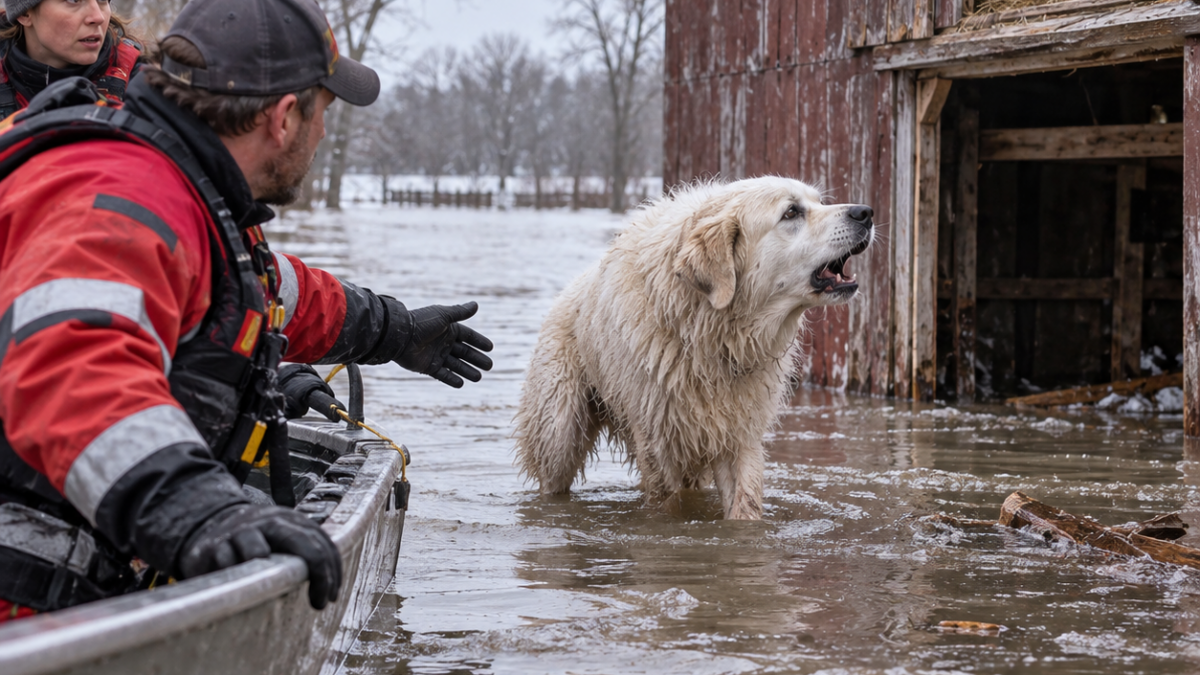
The three-legged Great Pyrenees was standing chest-deep in freezing floodwater when we reached him, but every time we opened the rescue boat, he turned away from us and barked at the half-submerged barn behind him.
“Marcus.”
He heard the change in my voice immediately.
“What?”
“There’s no floor under them.”
He brought the boat closer, but I held up one hand.
“Slow.”
The barn wall was old corrugated metal over wood framing, and the flood had turned everything beneath us into a hidden trap.
Fencing.
Tools.
Boards.
Fuel cans.
Maybe nails.
Maybe wire.
A rescue swimmer entering that water blindly could become entangled before anyone realized what had happened.
I used the long probing pole.
Down.
Resistance.
“Wire.”
Marcus adjusted left.
Down again.
Nothing.
“Open.”
The three-legged dog watched every movement from the fence.
Later, we learned his name was Amos.
At that moment, he was still just the dog who refused to leave.
I pushed the pole forward.
Hit something again.
A metal rail.
“Hold.”
Marcus stopped us.
Amos barked once.
I looked over.
He was staring directly at the pole.
I moved it left.
Clear water.
Amos followed our movement from his side of the submerged fence.
I remember thinking that he knew exactly where the dangerous places were.
Not rescue equipment.
Not boats.
Not procedure.
The farm.
This was his ground beneath our water.
We reached the barn wall.
The attic vent was barely large enough for the puppies’ heads.
Certainly not large enough for me in a flotation vest.
The wooden frame around it had swollen.
Rust covered the screws.
Marcus grabbed the tool kit.
“Can we cut it?”
“Not without knowing where the puppies are.”
One wrong cut and a piece of metal could fall inward.
Behind me, Amos barked again.
Then we heard another sound.
A weak bark from the mother.
I turned.
Her pallet had shifted.
The current had rotated one end away from the fence.
If it came free completely, she could be swept downstream.
“We’ve got two problems,” Marcus said.
“Seven.”
He looked at me.
“Six puppies and her.”
“Eight if you count the stubborn guy.”
Amos was fighting to remain upright.
The water struck his chest.
His one usable hind leg bent.
He recovered.
But not as quickly as before.
Our radio sounded.
“Rescue Two is nine minutes out.”
Nine minutes.
In ordinary life, nine minutes is nothing.
In moving floodwater, nine minutes can become the difference between a difficult rescue and a recovery operation.
I looked from the attic to the mother.
Which first?
The puppies were above water, technically.
The mother was already losing the ability to keep her head up.
Amos was still standing, but barely.
“Mother first,” I said.
Marcus nodded.
“We get Amos into the boat, second team takes her, then we come back for the puppies.”
We moved toward Amos.
Dispatch had finally reached the property owners.
Raymond and Helen Carter.
Older couple.
Evacuated shortly after midnight after Raymond developed chest pain.
The neighbor thought the dogs followed the Carters.
The Carters thought the neighbor had collected them.
Nobody had intentionally abandoned anyone.
Chaos had simply created one terrible misunderstanding.
Dispatch gave us the dogs’ names.
The three-legged male was Amos.
The mother was June.
I leaned over the side.
“Amos.”
His ears lifted.
That tiny reaction almost made me emotional.
Names matter during rescues.
Until you know the name, you’re just another stranger approaching with equipment.
“Amos.”
He looked at me.
“Come here.”
Marcus lowered the ramp.
Amos moved forward.
One paw.
Then the other.
Both front paws landed on the rubber surface.
His chest reached the edge of the boat.
“Good boy.”
Behind us, June barked.
Barely audible.
Amos froze.
His head snapped toward her.
“Amos.”
He backed down the ramp.
“Damn.”
Marcus exhaled.
“He’s not leaving while she’s out there.”
“No.”
The second boat appeared beyond the drowned driveway.
Two rescuers.
Daniel Price and Corey Mills.
I pointed them toward June.
They approached from downstream, using the current instead of fighting it.
Smart.
Engine off twenty feet away.
Paddles for the final distance.
June lifted her head when they came near.
Tried to stand.
Her legs folded.
I felt Amos move.
He was coming back toward our ramp.
Not because he wanted rescue.
Because from there, he could see her better.
I kept one hand near his collar.
I did not grab it.
“Stay.”
Daniel extended a padded control loop toward June.
No reaction.
No growl.
June turned her head toward the barn.
Then laid her chin back against the soaked pallet.
Daniel slipped the loop around her neck loosely.
Safety only.
Not for lifting.
Corey stabilized the pallet while Daniel worked a wide sling beneath her chest and abdomen.
The pallet rolled.
June’s head dropped.
Water washed across her muzzle.
“Head!”
Daniel caught her beneath the jaw.
Amos jerked backward.
“Easy.”
I kept my hand open near his collar.
“Easy, Amos.”
June disappeared briefly behind the second boat.
Amos retreated another step.
“She’s coming up.”
I don’t know why I said it.
He didn’t understand the sentence.
But maybe he understood the voice.
Daniel and Corey counted.
“One, two, three.”
They lifted.
June rose out of the water.
For a horrible second, the pallet tipped almost vertically.
Then she crossed the gunwale.
Daniel lowered her onto the rubber-lined deck.
Corey wrapped her in a thermal blanket immediately.
Only her head remained exposed.
Amos saw her.
His whole body changed.
He stopped backing away.
He stared.
June lifted her head.
Amos stepped forward again.
Front paws on our ramp.
Chest inside.
Then his remaining hind paw.
The stump stayed elevated.
Marcus reached beneath his chest.
I supported his hips.
“Heavy.”
“You wanted a small rescue dog?”
“Today would’ve been nice.”
Together we guided him aboard.
The moving deck defeated him almost immediately.
His three-legged balance worked on solid ground.
Not on a rocking aluminum floor.
His remaining hind leg slipped.
We rolled a blanket beside the missing paw so his pelvis would not tilt as badly.
“Lie down.”
He refused.
His first act inside the rescue boat was to turn toward the barn.
Six cries remained.
“Of course,” Marcus said.
Amos crawled toward the bow.
We attached two leash points for safety.
Then turned back.
June’s boat moved toward shallow water near the road where veterinary volunteers were waiting.
Amos watched until they disappeared behind the barn.
Then looked toward the attic.
“All right,” I said.
“Your turn to tell us where.”
The vent had to come off piece by piece.
Marcus held the boat against the wall while I removed the first rusted screw.
It fought me.
Second.
Third.
The wood creaked.
Inside, puppies cried.
Amos responded with a low sound from his chest.
Not barking.
A rumble.
Steady.
Deep.
The sort of sound livestock guardian dogs sometimes use around young animals.
The cries quieted.
I looked back at him.
“You know them.”
Of course he did.
He had probably been near those puppies from the moment they were born.
We learned later they were five weeks old.
June had delivered six.
For most of their lives, the barn had been their entire universe.
Until the flood changed gravity.
I removed another section of frame.
“Light.”
Marcus handed me the flashlight.
I aimed inside.
Six puppies.
Huddled together.
Except—
“Wait.”
“What?”
“One’s lower.”
The makeshift platform was worse than I thought.
Hay bales.
Two boards.
A torn feed sack spread across the top.
June had built it.
That was what the physical evidence later suggested.
Wet paw prints climbed the staircase.
Scratches marked the attic access.
A feed sack had been dragged upward.
She had carried the puppies one by one from their ground-floor pen as the water came in.
Then at some point, June escaped through a damaged side section.
Maybe looking for a route.
Maybe looking for Amos.
Maybe searching for the Carters.
She could not get back.
Water and fencing had divided the family.
The smallest puppy was on a lower board.
Each movement of the barn sent water washing over his paws.
I reached for the carrier tray.
“Let’s get him first.”
Marcus lined it with a towel.
I slid it through the opening.
The puppy backed away.
“Come on.”
He moved farther.
“Stop,” Marcus said.
I did.
Amos started that low rumble again.
The puppy froze.
His head turned.
Amos pressed his nose toward the opening.
The sound continued.
The puppy moved toward him.
One step.
Pause.
Another.
I kept the tray still.
“Come on.”
One more step.
His front paws entered the towel.
I lifted.
“Got him.”
The puppy came through.
Wet.
Cold.
Shivering.
Marcus received the tray.
“Towel.”
We dried him quickly.
Checked breathing.
No obvious injury.
Placed him inside the first secured crate.
Amos crawled toward it.
He smelled the door.
Then looked back at the attic.
Five.
We worked one at a time.
No rushing.
The platform could not handle sudden weight shifts.
Neither could our boat.
The second puppy came easily.
The third fought.
The fourth was frighteningly quiet.
Marcus rubbed her through the towel.
“Come on, little one.”
Nothing.
Then a squeak.
“There.”
My shoulders released.
“Three… four.”
The fifth crawled under a loose board.
We had to reposition the boat.
That cost us minutes we did not want to lose.
The barn groaned.
Not a metaphorical sound.
The entire structure groaned.
Metal against wood.
Wood against pressure.
Marcus looked up.
“We need to move.”
“I know.”
I reached farther.
“Almost.”
The fifth puppy bit the towel.
“Good.”
I pulled gently.
He came.
“Five.”
One remained.
At the rear.
The largest.
He was pressed against the wall where the hay platform sloped downward.
I extended the tray.
He moved away.
“No, no.”
Amos stood.
Or tried to.
His hind foot slid.
The leash caught him.
“Amos, down.”
He ignored me.
His nose pressed toward the attic.
The puppy looked at him.
I stretched farther.
My shoulder entered the opening.
The board beneath the puppy cracked.
Everyone froze.
A second crack.
The platform tilted.
“Leah!”
The puppy slid.
I shoved the tray beneath him.
Hay and feed sack collapsed.
Water surged over the board.
The puppy hit the towel.
I pulled backward.
“Got him!”
The board dropped into the water.
There had been less than a hand’s width between the last dry section and the flood.
Marcus grabbed my vest and helped pull me away from the opening.
The barn wall shook.
“Go!”
I passed the final puppy to him.
He wrapped it.
“Six!”
Amos smelled the towel.
The puppy squeaked.
Only then did the old guardian lower himself.
All six puppies were inside two secured crates.
Rolled towels separated them so they could not pile beneath each other.
Warm packs went outside the bedding layers.
Never directly against wet skin.
The temperature difference could be dangerous.
Amos lay between the crates.
He touched the first door with his nose.
Then the second.
Movement inside both.
His head finally lowered.
“Family count,” Marcus said quietly.
“Not yet.”
June.
We released the bow line.
Behind us, a section of barn siding tore loose and floated away.
Marcus paddled until we cleared the submerged fencing.
Only then did he lower the motor.
Amos flinched at the vibration.
I placed one hand near his harness.
He didn’t lean into it.
He didn’t need reassurance from me.
He just stopped trying to stand.
We approached the roadside staging area.
June lay beneath blankets in a heated animal-control van.
Her gums were pale.
Body temperature low.
Breathing shallow.
But she was alive.
Amos heard her before he saw her.
His head came up.
He struggled toward the side gate.
“Wait.”
He ignored me.
“Marcus, bring us parallel.”
Two rescuers positioned the wide ramp.
Amos tried to move down too fast.
His left hind leg buckled.
We caught him with the abdominal sling.
“Slow.”
He placed one front paw.
Second.
Then the remaining hind paw.
Step.
Pause.
Step.
June raised her head.
Amos reached her.
She smelled his muzzle.
His collar.
Then the wet fur above the missing paw.
He lowered his chest beside her.
Stayed.
When we brought the first puppy crate over, June tried to rise.
Daniel placed one hand gently against the blanket.
“No, Mama.”
We opened only the small inspection panel.
June pressed her nose against the mesh.
Her breathing changed.
Second crate.
Amos moved between them.
Smelled each.
Looked toward June.
One mother.
Six puppies.
One three-legged guardian.
The count was complete.
For the first time since 7:13 that morning, Amos stopped scanning the flood.
But the rescue was not over.
June needed warmed fluids.
The puppies needed controlled heat.
Amos needed a stable surface for his three-legged gait.
We used two veterinary vans.
June and the puppies in one.
Amos in another.
He refused to enter until the crates were positioned where he could see them through the open connecting doorway.
That was when a county truck arrived.
An older man stepped out.
His pants were wet to the ankles.
“Amos!”
The dog’s head lifted.
Raymond Carter.
The property owner.
He had spent part of the night in a hospital after chest pain during evacuation.
Doctors had ruled out a heart attack.
He had apparently argued with everyone until they allowed him to come as close to the property as the county vehicle could bring him.
Raymond walked toward Amos.
Then stopped.
His face changed.
Maybe because he finally saw the condition of the dog.
The soaked fur.
The shaking hind leg.
The missing paw resting on blankets.
“Amos.”
The dog did not stand.
He couldn’t.
Raymond crouched outside the van.
Put one hand against the crate frame.
“I thought you were with Helen.”
His voice broke.
I looked away.
This was not an abandonment story.
That mattered.
During evacuation, confusion had multiplied.
Raymond and Helen thought a neighbor had the dogs.
The neighbor thought they followed the evacuation truck.
The road disappeared before anyone could correct the assumption.
Sometimes disaster doesn’t require cruelty.
Sometimes it needs darkness, rain, fear, and one wrong belief.
“June?” Raymond asked.
“Alive.”
“The puppies?”
“All six.”
He closed his eyes.
Then covered his face.
For several seconds, the man did not make a sound.
Amos watched him.
Raymond lowered his hands.
“Can I go with them?”
“No, sir.”
I hated the answer.
“Medical transport only.”
“I need to—”
“We’ll give you the clinic information.”
He looked toward Amos.
The dog’s eyes were already shifting toward the other van.
“Take care of them.”
“We will.”
Helen had been taken to a temporary church shelter.
Their house was flooded.
The barn unstable.
They would not be going home soon.
Raymond stood in the water until both vans left.
The clinic was thirty-seven minutes away.
Blocked roads turned what should have been a shorter drive into a winding trip through higher ground.
I rode with Amos.
He did not sleep.
Whenever the van carrying June and the puppies disappeared around a turn, his head lifted.
When it reappeared, he lowered it.
Every single time.
“You trust nothing out of sight, do you?”
He looked at me.
No tail wag.
No response.
Fair.
At the clinic, June went inside first on a stretcher.
Amos whined.
First time I heard him do it.
He tried to follow.
Couldn’t.
A low cart with nonslip rubber matting arrived.
He refused to lie on it.
So two technicians supported his hips with a sling while his front paws rested on the cart.
They moved slowly enough that his remaining hind foot could stay balanced.
Inside, they placed June in one enclosure.
The puppies in another.
Amos between them.
He smelled June through the divider.
Then turned.
Listened.
Tiny movements.
Tiny cries.
He counted them his own way.
Only then did he close his eyes.
I stood outside the treatment area.
My clothes were soaked beneath the rescue gear.
My hands hurt.
I had mud beneath my fingernails.
Marcus handed me coffee from a machine.
It tasted terrible.
I drank it anyway.
“You good?”
“No.”
“Same.”
Through the glass, Amos slept.
For ten minutes.
Maybe fifteen.
Then Dr. Priya Shah began examining him.
His amputated hind paw was old.
Three years old, according to records.
Farm-equipment accident.
The stump itself looked healthy despite hours in dirty water.
The problem was the other hind leg.
It had carried almost everything.
Standing.
Fighting current.
Balancing against fencing.
The muscles were badly strained.
Paw pads softened from prolonged immersion.
Abrasions crossed his chest where he had leaned against submerged wire.
No fracture.
No new surgery needed.
Rest.
Pain management.
Drying.
Supported movement.
“The thing he needs most,” Dr. Shah said, “is permission to stop working.”
Marcus laughed without humor.
“Good luck.”
June worried us more.
Underweight from nursing.
Dehydrated.
Hypothermic.
Exhausted.
But no organ failure.
No major trauma.
Fluids began slowly.
Controlled feeding.
The puppies were mildly dehydrated and cold.
One—the smallest female—had inhaled floodwater.
Dr. Shah listened to her chest for a long time.
“What?”
“We watch.”
“Pneumonia?”
“Possible aspiration complications.”
“Is she going to make it?”
Dr. Shah looked at me.
“I didn’t say she wouldn’t.”
That is veterinary medicine.
Human medicine too.
People want guarantees.
Biology rarely offers them.
The puppy was placed under closer monitoring.
Amos noticed.
Of course he did.
His enclosure was arranged so he could see June and hear the puppy area.
Whenever staff pulled a curtain for procedures, he stood.
His hind leg shook.
They opened it again.
He wasn’t aggressive.
Didn’t try to escape.
He simply needed the count.
June breathing.
Six small movements.
Then rest.
At 2:10 the next morning, the smallest puppy’s oxygen level dropped.
Her name would later become Minnow.
At that moment, she was just Puppy Six.
They moved her into an oxygen-supported enclosure.
The door shut.
Amos stood immediately.
He could no longer see her.
He smelled beneath the divider.
Turned at every sound.
Refused water.
A technician took the towel Minnow had been lying on.
Placed it near Amos.
He smelled it.
His shoulders lowered.
But he did not lie down.
All night.
That dog had spent hours in moving floodwater on three paws.
Had strained the only rear leg he had.
Had been warmed, dried, medicated.
And still he waited.
By morning, Minnow responded to treatment.
Better oxygen.
More alert.
But she remained separated for twenty-four hours.
Amos stayed facing her enclosure.
When staff returned her to the group the next evening, she made one thin squeak.
Amos moved to the divider.
Nose against wire.
One.
Two.
Three.
Four.
Five.
Six.
Then June.
Only after that did he eat.
I wish I could tell you the Carters simply took everyone home.
They couldn’t.
The flood did not end when the rain stopped.
Their property remained inaccessible for ten days.
Even after crews reopened the road, the barn was condemned.
The house had water damage.
Newborn puppies could not safely return.
Neither could a dog whose only functional hind leg needed restricted movement.
A foster coordinator named Ruth Delgado found a temporary solution.
An equipment room on a working farm outside town.
Dry.
Heated.
Rubber floors.
Separate spaces for June and puppies.
No stairs.
Fenced yard directly outside.
Raymond and Helen visited before the transfer.
Helen entered first.
June saw her.
Tried to stand too quickly.
Then stopped.
Helen sat on the floor.
Did not call.
Did not reach.
June walked toward her slowly.
Stopped several feet away.
Then continued.
Helen put both hands over her mouth.
“Oh, June.”
The dog pressed her head into Helen’s lap.
I left the room.
Not every moment needs witnesses.
Raymond went to Amos.
Amos walked directly toward him.
His gait was shortened.
Uneven.
Raymond knelt.
Put both hands around the blue collar.
Then lowered his forehead between Amos’s ears.
No words.
None needed.
After several seconds, Amos turned.
Walked toward the puppy enclosure.
Raymond followed.
Amos smelled every sleeping body through the gate.
Paused at Minnow.
Raymond laughed through tears.
“He won’t leave until we look at all of them.”
So they did.
One by one.
Twelve days after the flood, the family moved to foster care.
June and the puppies traveled together.
Amos rode beside them on an orthopedic mat.
Ruth had placed a rolled support beneath the area where his missing paw would otherwise cause his hips to tilt.
He remained awake for all forty minutes.
At the foster barn, he inspected everything.
Floor.
Gate.
June’s bedding.
Puppy pen.
Door.
He tested the rubber matting with his left hind paw.
Then lay across the threshold.
No flood.
No moving water.
Still, he chose the place between his family and the exit.
That was Amos.
Recovery was not a straight line.
I think people need to hear that more often.
Rescue stories are usually compressed.
Before.
Emergency.
After.
But bodies and minds don’t heal in three acts.
Amos’s leg improved.
Then he overused it.
June moved into the yard.
He followed.
Puppy cried.
He stood.
Volunteer checked the pen.
He checked too.
Again.
Again.
Again.
The muscle strain would not recover if he refused to rest.
Dr. Shah changed the plan.
Short supported walks.
No unrestricted movement.
A low gate where Amos could see everything without physically responding to every sound.
He hated it.
He stood behind the gate.
Would not use the orthopedic bed.
Ruth tried blankets.
Nothing.
Finally, Raymond brought an old canvas work jacket.
The one he used around the farm.
Ruth placed it on Amos’s bed.
Amos smelled it.
Circled once.
Lay down facing the puppies.
That night he slept nearly seven hours.
First full night since the flood.
June recovered faster.
Weight returned.
Coat dried into thick cream waves.
Appetite came back with enthusiasm.
She remained protective but allowed Ruth to enter the puppy area.
Minnow finished antibiotics.
Her breathing normalized.
She stayed smaller than the others.
Not fragile.
Just small.
Three weeks after the rescue, another storm came.
Not a flood.
Just spring rain.
But the metal roof amplified everything.
Water rushed along the concrete outside the equipment-room door.
At 1:30 in the morning, Ruth woke and checked the dogs.
Amos was standing between the puppy pen and the door.
His hind leg shaking.
The threshold was dry.
Water remained outside.
But the sound had brought him back.
Ruth did something I admire to this day.
She didn’t drag him to bed.
Didn’t force him away from the door.
Didn’t say, “There’s nothing wrong.”
Because to Amos, something was wrong.
He remembered moving water.
Maybe not as a story.
But his body remembered.
Ruth checked the drain.
Opened the door enough for him to look.
Dry interior.
Water flowing away.
June with the puppies.
Everyone safe.
Then Ruth sat beside the orthopedic bed.
Waited.
Seventeen minutes.
That is how long it took.
Amos stepped backward.
Ruth touched the canvas jacket.
“Everybody’s here.”
He looked toward the puppies.
Then June.
Then the door.
Finally lay down.
After that, they turned it into a routine.
Rain begins.
Harness.
Door check.
Smell the air.
See the drainage.
See June.
See puppies.
Same words.
“Everybody’s here.”
At first, Amos needed twenty minutes.
Then ten.
Five.
Eventually, he checked once and returned to bed.
We like to say animals “get over” fear.
I don’t think that is always what happens.
Sometimes they learn what to do with it.
By week five, Amos’s left hind leg stopped shaking during normal walks.
He would never move like a four-legged dog.
His body carried history.
The missing right paw produced a permanent rise and fall through his gait.
But he regained endurance.
The Carters did not recover as easily.
The barn was condemned.
Repairs on the house exceeded what insurance would cover immediately.
They moved into a small rental.
Two adult dogs allowed.
Six growing livestock-guardian puppies?
Absolutely not.
Raymond came to the foster farm looking older than I remembered.
“We can’t take them.”
The sentence nearly broke him.
Ruth sat across from him.
“You don’t have to decide everything today.”
“They need homes.”
“Yes.”
“We failed them.”
“No.”
Raymond looked at her sharply.
“Our dogs almost drowned.”
“You evacuated your wife because you were having chest pain during a flash flood.”
He looked down.
“You made one wrong assumption in darkness.”
“They could’ve died.”
“So could you.”
Helen sat beside him.
“We can’t keep all six.”
“No,” Ruth said. “Probably not.”
That was reality.
Good rescue work requires living inside reality.
Not fantasy.
They decided the puppies would remain together until they were old enough and medically cleared.
Adopters would be screened.
Home checks.
Experience with large guardian breeds preferred.
Return agreements.
No impulse placements because people saw pictures from the flood and wanted a “hero puppy.”
Minnow drew the most attention.
Everyone loved the smallest survivor.
Raymond hated that.
“She’s going to be a huge dog.”
He wasn’t wrong.
“She’s not some little flood mascot.”
Ruth agreed.
The family eventually approved a couple with fenced acreage and experience with Great Pyrenees mixes.
The other puppies found equally careful homes.
One by one.
That created a new problem.
Amos.
The first puppy left on a Saturday.
The adopter arrived with a blanket carrying scents from their home.
Ruth let Amos smell it.
Then the puppy.
Then watched as the puppy walked calmly to the vehicle.
The car left.
Amos remained at the gate.
That night, he searched the puppy pen.
Every corner.
After the second puppy left, he carried an empty bedding cloth toward June.
Ruth called me.
“He’s not doing well with departures.”
I drove out the next morning.
Amos was lying beside the gate.
“You saved them,” I told him.
His ear moved.
“Now apparently you want to supervise adulthood too.”
Nothing.
Fair.
We adjusted.
Before each departure, Amos smelled the adopter’s blanket.
Met the family.
Watched the puppy enter the vehicle.
Then Ruth used the same phrase.
“Everybody’s safe.”
Did Amos understand?
Not the language.
Maybe the ritual.
After the third departure, he still watched the gate.
But he slept that night.
After the fourth, he searched the pen once.
Not five times.
After the fifth, he stood with June.
Minnow was last.
By then, she was strong.
Still slightly smaller.
Full of personality.
On departure morning, Amos stood at the gate.
Minnow walked to him.
Put her nose under his chin.
For one second, she became the tiny wet puppy from the attic again.
Then she turned.
Climbed into the carrier with help.
Door closed.
Amos smelled it.
Looked at Ruth.
“Everybody’s safe.”
The vehicle drove away.
Amos stayed at the gate.
One minute.
Maybe less.
Then turned.
Walked back to June.
That was the first time I saw him voluntarily leave a departure behind.
Two days later, Amos and June moved into the Carters’ rental.
A small house.
Temporary.
Not the farm.
Raymond installed a ramp over the porch steps.
Rubber runners across the kitchen for Amos’s remaining hind paw.
Orthopedic bed beside the back door.
Canvas jacket on top.
Helen sent me a photograph the first night.
June asleep near the kitchen.
Amos on the bed.
His head facing the door.
The caption:
ALL OF US HOME.
I saved it.
The first heavy rain at the rental came several weeks later.
Raymond told me what happened.
Amos stood.
Checked every room.
June.
Back door.
Kitchen.
Hallway.
Listened to the gutters.
No puppies.
No water inside.
Raymond rested one hand on his shoulder.
“Everybody’s safe.”
Amos returned to bed.
Six months after the flood, the Carters asked Ruth if they could organize something.
A reunion.
All six puppies.
At the dry foster farm.
I went.
I had to.
By then, the puppies barely looked like puppies.
Huge adolescents.
Long legs.
Thick coats.
Bodies still growing into themselves.
They arrived one by one.
Different families.
Different collars.
Different cars.
Amos stood near the gate.
The first vehicle turned into the drive.
His head lifted.
The window was still closed.
He couldn’t see inside clearly.
But his nose worked.
He barked.
One deep bark.
Every human stopped.
I felt the hair on my arms rise.
It was the same sound.
The flood bark.
The sound we had heard across the drowned pasture.
But there was no brown water now.
No barn beneath it.
No current.
The first young dog leaped from the vehicle.
Then another car arrived.
Then another.
Within twenty minutes, all six were there.
The gates opened.
The young dogs ran.
Straight toward Amos.
He stood on three paws as they crowded around him.
Sniffing.
Jumping.
Pushing.
Raymond laughed.
“Careful with the old man!”
Amos endured it.
June approached more slowly.
One puppy smelled her face.
Then another.
Helen counted under her breath.
“One.”
Second.
“Two.”
Third.
“Three.”
I heard Marcus beside me.
“Don’t.”
Helen kept going.
“Four.”
Five.
“Five.”
Minnow arrived last.
She had grown into a beautiful cream-and-white adolescent.
She walked toward June.
Then Amos.
Touched his nose.
Helen whispered:
“Six.”
The count was complete again.
Only for an afternoon.
But complete.
Raymond turned away.
I didn’t.
I wanted to remember his face.
People sometimes think rescuers become numb.
We don’t.
If we did, we’d stop doing it.
We simply learn how to keep moving while feeling everything.
The dogs spent the afternoon in the field.
Amos could not run with them.
His gait made that impossible.
But he walked.
The puppies circled him.
June watched from the shade.
Minnow repeatedly came back.
Toward evening, families began leaving.
First car.
Amos watched.
Second.
Watched.
Third.
No pacing.
Fourth.
He sat.
Fifth.
Stayed beside June.
Minnow left last.
Her family waved.
The vehicle disappeared.
Amos remained still for several seconds.
Then he turned away from the gate.
I walked beside him toward the old foster equipment room.
Rain from the previous night had left a shallow puddle outside the doorway.
Amos stopped.
Looked at it.
I watched his body.
No trembling.
No immediate retreat.
He considered the water.
Then stepped around it.
Walked toward Raymond.
That small act affected me more than the reunion.
The flood had not disappeared from him.
His missing paw certainly hadn’t.
The limp remained.
The habit of counting remained.
The alertness in heavy rain remained.
Healing had not erased history.
It had changed what history controlled.
We walked through the field.
Raymond crouched beside Amos.
The dog leaned against him.
I looked toward the doorway where Amos had once slept across the threshold.
Then back at the dog.
“You finally off duty?”
Raymond smiled.
“No chance.”
He scratched Amos beneath the collar.
“He checks the whole house every night.”
“Of course he does.”
Helen joined us.
June followed.
For a few minutes, nobody spoke.
The foster farm was dry.
Birds moved between fence posts.
Sun came through the clouds.
Ordinary afternoon.
That was the ending I wanted for them.
Not fame.
Not newspaper stories.
Ordinary.
Later, people asked me about Amos.
They wanted to know why he refused the boat.
Loyalty?
Instinct?
Training?
He had no formal rescue training.
He was a livestock guardian dog.
Protection was part of what generations of dogs like him had been bred to do.
But breeding alone does not explain a morning.
I cannot tell you exactly what Amos understood.
I can tell you what he did.
He stood in cold moving water on three paws.
He stayed between June and the barn.
He refused our first attempt to remove him while she remained stranded.
Once aboard, he crawled toward the puppies.
He listened while we removed them.
Smelled every towel.
Waited through Minnow’s medical crisis.
Refused food until the family count returned.
Followed departures until he learned departure did not always mean disappearance.
Those are facts.
They are enough.
The first time I met Amos, I assumed he was the victim.
A disabled dog trapped by floodwater.
That assumption was not insulting.
He needed rescue.
He absolutely did.
Without us, he would likely have become exhausted and been swept into fencing or deeper current.
But that was not how Amos saw himself.
He had work unfinished.
That changed the way I think about rescue.
We tend to simplify it.
Rescuer.
Victim.
Strong person.
Helpless animal.
But rescue is often cooperation.
Amos told us where the danger was.
Not with human language.
Behavior.
He redirected the boat.
Warned when the probing pole found fencing.
Led our attention to the barn.
Refused to leave before June was safe.
Calmed the separated puppy with his voice.
We had equipment.
Training.
Radios.
Boats.
He had knowledge of home.
We needed both.
Months after the reunion, I visited the Carters.
Their original house was still being repaired.
The old barn was gone.
Demolished.
Raymond hated watching it come down.
But there was no saving it.
The rental had become surprisingly comfortable.
Helen planted tomatoes in buckets.
Raymond built a covered area for June.
Amos had a wide ramp.
The blue livestock collar had been replaced.
The old one hung on a hook.
“Couldn’t throw it away,” Raymond said.
“I wouldn’t either.”
Amos walked out.
He had gained weight again.
The left hind leg looked strong.
His right stump remained tucked.
That same distinctive rise and fall.
He came toward me.
Stopped.
Sniffed.
I crouched.
“Remember me?”
He looked past me toward my truck.
I laughed.
“Apparently not.”
Then he came closer and pressed his chest against my shoulder.
I took that as enough.
June appeared behind him.
She had changed too.
Healthy coat.
Strong body.
No exhaustion in her face.
“Do they see the puppies?” I asked.
“Some.”
Raymond pulled out his phone.
Pictures.
Minnow beside a pond.
One puppy living with goats.
Another asleep beside a family’s back door.
Another nearly one hundred pounds already.
“They send everything.”
Helen smiled.
“Every birthday.”
I scrolled.
Six dogs.
Six homes.
Six lives that had once balanced above floodwater on hay bales and feed sacks.
I handed back the phone.
Raymond looked toward Amos.
“You know what bothers me?”
“What?”
“I keep thinking I left them.”
“You didn’t.”
“I did.”
“You evacuated because you thought they were accounted for.”
“I should’ve checked.”
“You were having chest pain.”
He looked at the ground.
I knew nothing I said could completely remove guilt.
Sometimes survivors prefer guilt to helplessness.
Guilt gives the illusion that if we had been better, smarter, faster, tragedy could always have been prevented.
Nature does not offer that bargain.
“You came back,” I said.
Raymond looked at me.
“So did they.”
Amos lay beside June.
“They waited.”
“That wasn’t your choice.”
“No.”
He nodded.
Maybe enough.
A year after the flood, another major storm was forecast.
Not the same scale.
But serious.
The county issued warnings early.
This time, the Carters prepared twenty-four hours ahead.
Vehicles fueled.
Dog crates ready.
Medications packed.
Contact list.
No assumptions.
Raymond sent me a photograph.
Amos and June sitting beside the truck.
Text beneath it:
EVERYBODY ACCOUNTED FOR.
I smiled.
Then replied:
GOOD. KEEP IT THAT WAY.
He sent back:
AMOS ALREADY CHECKED TWICE.
Of course he had.
I have been on other flood rescues since.
Some ended as well.
Some did not.
That is the part stories often leave out.
Water does not care whether a family is loved.
Whether an animal is heroic.
Whether rescuers try hard.
Sometimes conditions win.
That is why I resist turning Amos into some magical symbol who defeated nature through loyalty.
He didn’t.
He survived because a chain of things went right.
He stayed visible.
We reached him in time.
A second boat arrived.
June’s pallet held.
The barn platform stayed intact just long enough.
Minnow responded to treatment.
Veterinary teams were available.
Foster space existed.
Families stepped forward.
Raymond and Helen kept participating even after losing their barn and temporarily losing their home.
Rescue is rarely one heroic act.
It is dozens of people, animals, decisions, and pieces of luck lining up before time runs out.
Amos was one part.
A remarkable part.
I still think about the moment Marcus first opened the boat.
There was room for him.
Dry floor.
Safety.
He put one paw on the ramp.
Then refused.
At first, I was frustrated.
That is embarrassing to admit.
“Why won’t this dog let us help?”
Because I was asking the wrong question.
The better question was:
“What does he think still needs help?”
That question has followed me ever since.
Not only with animals.
People too.
Someone can be standing inside their own crisis while still pointing toward something they believe matters more.
A child.
A spouse.
Another patient.
A pet.
A responsibility.
Sometimes helping someone means understanding what they refuse to leave behind.
Not agreeing with every risk.
Not letting them endanger themselves unnecessarily.
But listening.
Amos could not tell me:
June is trapped.
The puppies are above the water.
The fence blocks me.
I tried.
I cannot leave.
So he used what he had.
Position.
Movement.
Barking.
Refusal.
We finally listened.
Years from now, I may forget the exact flood gauge.
The radio channels.
Which road closed first.
The model of the rescue boat.
But I will remember 7:13 a.m.
A huge white dog.
Tan patch over one ear.
Blue collar.
Three paws.
Brown water striking his chest.
A missing hind paw held above the current.
And that bark.
Not aimed at us.
Past us.
Toward the barn.
I will remember killing the engine.
Silence.
Then the first small whine above the water.
I will remember thinking:
Oh.
This isn’t about him.
Then discovering, eventually, that it was.
Amos needed saving too.
He just refused to believe his life could be separated from the others.
Maybe that is loyalty.
Maybe guardian instinct.
Maybe love.
I don’t need to decide.
The facts are enough.
Six months after the reunion, Raymond invited me over again.
The house repairs were finally far enough along that they had moved home.
Not everything was restored.
New flooring.
Fresh drywall.
Different barn.
Some trees gone.
The land carried marks of the flood.
So did Amos.
We walked toward Cypress Creek.
Not too close.
Water low.
Clear.
Ordinary.
Amos came with us.
At the bank, he stopped.
His ears lifted.
Raymond looked at me.
“He doesn’t like fast water anymore.”
“I don’t blame him.”
June stayed farther back.
Amos watched the creek.
One minute.
Then turned.
Walked toward the house.
No barking.
No panic.
Just choice.
Raymond smiled.
“That’s new.”
“What?”
“He used to stand there and watch forever.”
I looked at Amos’s uneven gait.
Three paws carrying him uphill.
“Maybe he checked enough.”
At the house, six photographs hung near the kitchen.
One for each puppy.
Names beneath them.
Minnow.
Bear.
Milo.
Sage.
Cloud.
Poppy.
Different families had chosen different names.
Raymond still remembered their birth order.
Helen still called them “June’s babies.”
Amos walked beneath the photographs.
Lay beside the back door.
His canvas jacket was still on the orthopedic bed.
Old.
Frayed.
Comfort mattered more than appearance.
Raymond made coffee.
We sat at the kitchen table.
Rain began lightly against the roof.
Amos’s head came up.
He listened.
No rushing.
No shaking.
He stood.
Walked to the back door.
Looked.
Then toward June.
She was asleep.
He looked toward Raymond.
“Everybody’s here,” Raymond said.
Amos returned to bed.
I stared.
Raymond shrugged.
“Works.”
Rain continued.
Amos slept.
That may be the most satisfying ending I can give you.
Not that Amos stopped caring.
Not that the flood stopped existing inside him.
Not that every puppy stayed forever beneath his watch.
Something quieter.
He learned that sometimes rain is only rain.
A closed door can mean safety.
A vehicle leaving can carry someone toward home instead of away from it.
Silence does not always mean someone is missing.
And a guardian is allowed to sleep.
My name is Leah Morgan.
I was thirty-eight when I met Amos standing in Cypress Creek.
I had gone there believing my job was to pull one trapped dog into a rescue boat.
Instead, that three-legged Great Pyrenees forced me to stop, listen, and understand that he had been trying to rescue seven lives before we ever arrived.
June.
Six puppies.
And, whether he knew it or not, himself.
The flood took a barn.
Damaged a house.
Scattered a family for weeks.
Left fear behind in an old dog whenever he heard moving water.
But it did not take them.
All six puppies grew.
June recovered.
Amos regained strength in the only hind leg he had left.
The Carters rebuilt.
And on one dry afternoon six months later, that same dog stood on three paws while six enormous young dogs ran back through a gate toward him.
One.
Two.
Three.
Four.
Five.
Six.
The count was complete.
Then they left again.
And this time Amos understood enough to turn away from the gate.
He walked inside beside June.
Lay down on his old canvas jacket.
And did not go back outside to search.
For the first time since I had seen him standing against the flood, Amos allowed the world to become quiet.
Because finally, everyone had reached safety.








