The starving Golden Retriever had somehow survived the interstate, but every time a red eighteen-wheeler appeared through the Texas haze, he forced his trembling body upright and searched the cab for someone who was never there.
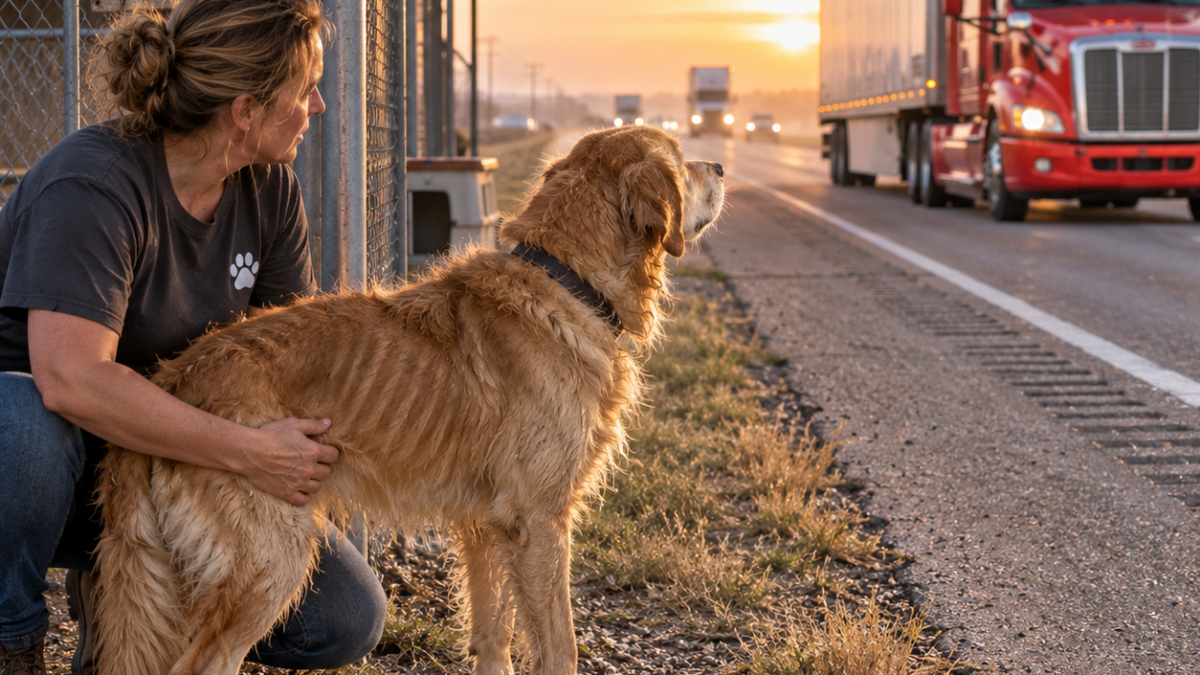
I did not open the gate.
That was the hardest part.
Cooper knew something.
Every muscle in his body told me that.
But shelters learn very quickly that emotion is not identification.
People claim animals that are not theirs.
Sometimes through honest mistakes.
Sometimes not.
During Cooper’s first two weeks, two different men had called claiming he belonged to them.
The first described a four-year-old female Golden Retriever.
Cooper was male.
Older.
Different markings.
The second man correctly guessed breed and approximate age but could not tell me the color of Cooper’s collar or the white marking beneath his lower lip.
After that, we tightened verification.
Photographs.
Veterinary records.
Microchip information.
Unique physical details.
Behavior.
No exceptions because someone cried.
No exceptions because a dog barked.
And certainly no exceptions because I wanted a beautiful ending.
So I kept Cooper behind the interior door while our director, Laura Bennett, went outside.
The man beside the red Freightliner looked nothing like I expected.
Not because I had imagined a villain.
I hadn’t.
But Cooper had been found half-starved beside an interstate.
Somewhere inside me, I had created a story.
Someone dumped him.
Someone drove away.
Someone never looked back.
The man outside did not fit that story.
He looked sick.
Thin in the way people look after hospitalization rather than hunger.
His face had the yellow-gray exhaustion of someone whose body had recently failed him.
He wore work boots, jeans, and a truck-company jacket hanging too loosely from his shoulders.
Another driver stood several feet behind him.
The first man did not approach the fence.
He simply looked toward the shelter doors.
“Joe Mercer?”
I asked through the intercom.
He nodded.
“That’s me.”
My chest tightened.
Mercer.
The name on Cooper’s chip had been Elaine Mercer.
I stepped outside, leaving Laura with Cooper.
“Who is Elaine?”
Joe looked down.
“My wife.”
“Where is she?”
He took several seconds to answer.
“She died four years ago.”
That explained the old chip registration.
Not enough.
I asked for identification.
He gave it.
Joseph Mercer.
Oklahoma address.
Commercial driver’s license.
Then he opened the plastic container.
Inside were old vaccination tags.
A worn metal identification tag.
And a photograph.
The photograph showed a younger version of Cooper stretched across the floor of a red Kenworth sleeper cab.
A woman sat beside him.
Dark hair.
Broad smile.
Her hand on Cooper’s neck.
Elaine.
Behind them lay the same faded green sleeping bag Joe had brought to the shelter.
I looked closely at the tag.
COOPER.
A broken metal loop remained attached.
I thought about the strange impressions beside the buckle on Cooper’s dark-red collar.
Pressure marks where something metal had once hung.
The shape matched.
Still not enough by itself.
“Microchip number?”
Joe handed me a veterinary record.
I read it.
Same number.
My throat tightened.
I asked one more question.
“What’s unusual about his left ear?”
Joe did not hesitate.
“Little notch on the outside edge. He tore it years ago climbing under a trailer.”
I looked through the glass door.
Cooper’s left ear.
Tiny notch.
Joe followed my eyes.
His face changed.
“Is he okay?”
The question came out so quietly I almost didn’t hear it.
“He’s recovering.”
“How bad?”
“When he came in, fifty-two pounds.”
Joe closed his eyes.
His jaw tightened.
“What should he weigh?”
“Probably around seventy-four.”
He turned away.
The other driver placed a hand on his shoulder.
Joe shrugged it off gently.
Not angry.
Trying to stand.
“I looked for him.”
I didn’t answer.
“I swear to you.”
“I’m listening.”
“I didn’t leave him.”
That sentence mattered.
Because now there were two stories in front of me.
The story we had built from what Cooper looked like.
And the one Joe had driven from Oklahoma to tell.
“Start from the beginning.”
Joe nodded.
Six weeks before Daniel Reed found Cooper beside Interstate 40, Joe had pulled his red Kenworth into a rest area near Groom, Texas.
He had been driving since dawn.
Joe lived with type 2 diabetes.
He carried medication.
Food.
Glucose tablets.
Emergency information.
Usually, he was careful.
That morning, illness had wrecked his routine.
He had barely eaten.
By the time another trucker saw him leaning against his fuel tank, Joe was confused and weak.
“Cooper was with me.”
“Outside?”
“Yes.”
“What did he do?”
Joe almost smiled.
“Got in everybody’s way.”
Paramedics approached.
Cooper stood between them and Joe.
Not attacking.
Not growling.
Blocking.
Joe managed one word.
“Bed.”
Cooper understood.
He climbed into the sleeper compartment.
Another trucker told Joe he would stay with the dog until he came back.
Everybody assumed Joe would return after being checked.
He didn’t.
The local emergency department transferred him to a larger hospital.
The Kenworth could not remain at the rest area.
It had to be moved.
During towing preparations, somebody opened the passenger door to inspect the cab.
Cooper jumped down.
“Why?”
Joe rubbed his face.
“I don’t know.”
Maybe noise.
Maybe strange people.
Maybe he thought Joe had returned.
Maybe he simply saw an open door.
Whatever the reason, Cooper ran between parked trailers.
Men followed.
Called.
Couldn’t catch him.
Security footage later showed Cooper returning to the parking space where Joe’s truck had been.
The Kenworth was gone.
After that, Cooper followed the access road.
Toward the interstate.
Joe did not learn his dog was missing until two days later.
His phone had been damaged.
His employer assumed the towing company had secured Cooper.
The towing company believed another driver had taken him.
The driver who originally promised to watch Cooper had left when Joe was transferred, thinking responsibility had passed to somebody else.
Responsibility had moved through too many hurried hands.
Nobody intended to lose him.
Everyone assumed someone else had him.
When Joe finally understood, he was still in the hospital.
His niece, Amanda, began calling shelters.
“She searched under my name.”
Joe looked at me.
“But the chip was Elaine.”
“Yes.”
“She handled all that stuff.”
Veterinary records.
Registration.
Appointments.
After Elaine died, Joe moved.
Changed telephone numbers.
Kept driving.
Never updated the microchip.
“I always thought…”
He stopped.
“What?”
“I thought if he got lost, he’d be with me.”
That is how mistakes happen.
Not always through carelessness.
Sometimes because the future we need to prepare for is a future we cannot imagine.
Joe had imagined a flat tire.
A medical emergency.
A delayed route.
He had never imagined waking up in a hospital and discovering that the dog who traveled beside him had vanished from a truck nobody knew was going to be moved.
Amanda posted photographs throughout Oklahoma and northern Texas.
Joe called highway patrol offices from his hospital bed.
Rest areas.
Truck stops.
Shelters.
He described Cooper over and over.
Ear notch.
White chin.
Red collar.
Green sleeping bag.
No match.
The search radius was too small.
Somehow, Cooper had traveled farther west than anyone expected.
Maybe following trucks.
Maybe moving through industrial lots.
Maybe briefly climbing into an open yard or trailer area.
Nobody could prove the path.
We only knew where it ended.
Behind a damaged guardrail near Amarillo.
Joe’s health improved.
But he needed rehabilitation.
Then came the call that almost ended his search.
A stranger told Amanda a Golden Retriever had been struck beside an interstate.
Description unclear.
For two days, Joe thought it might be Cooper.
It wasn’t.
After that, Joe stopped asking people to promise Cooper was alive.
He asked a different question.
“If you find anything of his, call me.”
“Anything?”
“Collar. Tag. That green bag.”
His voice broke.
“I just needed to know where my dog ended up.”
Then someone named Calvin Brooks saw our video.
I knew that part.
On Cooper’s seventeenth evening, I had posted a short clip.
No dramatic soundtrack.
No invented story.
Just Cooper hearing a truck and standing.
The caption said:
UNDERWEIGHT GOLDEN RETRIEVER FOUND NEAR EASTBOUND I-40. MICROCHIP INFORMATION OUTDATED. DOES ANYONE RECOGNIZE HIM?
A trucker in Albuquerque shared it.
Then another in Tulsa.
Calvin saw it in Oklahoma City.
He knew Joe casually.
Fuel stops.
Weather delays.
Long-haul drivers who repeatedly crossed the same routes.
He remembered Cooper for one reason.
The horn.
Two short notes.
Pause.
One long.
“What does it mean?” I asked Joe.
His face softened.
“Originally?”
“Yes.”
“Come up.”
He pointed toward the truck.
“When he was younger, I didn’t want him jumping out every time I stopped.”
“So you taught him the horn?”
“Sort of.”
Whenever Joe wanted Cooper to approach the truck safely, he used the pattern.
Two short.
One long.
Over years it changed meaning.
Come to the truck.
Door is open.
I’m here.
Then it became part of their evening routine.
Joe would close the curtains.
Settle Cooper on the green sleeping bag.
And say the same phrase.
“End of the road, partner.”
My eyes burned.
I hated that.
Shelter workers become experts at crying after work.
Not in front of people trying to hold themselves together.
“Calvin recognized him?”
“The ear.”
Joe nodded.
“And the collar.”
Calvin called Amanda.
Within an hour, we received old photographs.
Vet records.
Chip information.
Images of Cooper at different ages.
One photograph showed him sitting behind the passenger seat while Elaine laughed.
Another showed him beside Joe at a truck stop in Colorado.
Another showed the green bag.
Then I spoke to Joe by telephone.
I remembered that call.
His voice had remained careful.
Controlled.
Until I described Cooper’s white chin marking.
Then he stopped talking.
A long silence.
Finally:
“I thought I’d lost the last thing that still knew both of us.”
At the time, I had not fully understood.
Now I did.
Elaine was gone.
Cooper was the only living thing who had shared that earlier version of Joe’s life.
The truck.
Marriage.
Routes.
Motel rooms.
Breakfasts at rest stops.
Arguments.
Laughter.
Grief.
Four years after Elaine died, Joe still had one witness who remembered her scent.
Then Cooper vanished too.
That was the life taken from him.
Not the truck.
Not the collar.
Not even the sleeping bag.
Continuity.
I looked toward the shelter.
Cooper had stopped barking.
Laura was sitting with him behind the glass.
His eyes remained fixed on Joe.
“Can I see him?” Joe asked.
“Yes.”
He moved instantly.
I held up one hand.
“But we do this slowly.”
“Anything.”
“He’s been through prolonged hunger, stress, and separation.”
Joe nodded.
“He may recognize you and still behave differently.”
“All right.”
“Don’t grab him.”
“I won’t.”
“Don’t kneel over him.”
“Okay.”
“Let him decide.”
Joe swallowed.
“He can take all the time he needs.”
We used the enclosed meeting yard.
Joe entered first.
No truck.
No crowd.
No open gate.
He placed the faded green sleeping bag on the ground.
Then sat on a low bench.
Hands on his knees.
He did not call.
Did not whistle.
Did not say Cooper’s name.
I brought Cooper through the opposite gate.
At twenty feet, he stopped.
People imagine reunions are automatic.
Dog recognizes person.
Runs.
Jumps.
Music.
That is not always how animals work after stress.
Joe looked different.
Thinner.
His scent likely changed from medication, illness, hospitalization, rehabilitation.
Cooper smelled like antiseptic, shelter bedding, and new food.
Six weeks can become enormous in an animal’s life when every day has been uncertain.
Recognition and caution arrived together.
Joe turned his body sideways.
He did not stare.
Then he said quietly:
“End of the road, partner.”
Cooper’s ears lifted.
One step.
Stop.
Another.
He smelled the green sleeping bag.
His entire body stiffened.
Then he buried his nose into the folds.
Deep.
Breathing fast.
Joe did not move.
Cooper circled once.
Smelled the bag again.
Then moved toward Joe’s boots.
Right boot first.
Trouser leg.
Hands.
Jacket.
He was reconstructing someone.
Scent by scent.
Memory by memory.
Joe kept both hands still.
Cooper reached the bench.
Lifted his head.
Then pressed his forehead against Joe’s chest.
Joe’s mouth opened.
No sound.
One hand began shaking.
He lowered it slowly behind Cooper’s left ear.
The one with the notch.
“Hey, buddy.”
Cooper folded.
That is the word.
He did not jump.
Did not bark.
Did not spin.
His legs simply seemed to decide they had finished holding him upright.
He lowered himself between Joe’s feet.
His chin landed on Joe’s boot.
His eyes closed.
The vigilance left his body.
I had watched Cooper sleep for weeks.
This was different.
At the shelter, even resting, some part of him remained on duty.
Diesel sound.
Head up.
Red truck.
Stand.
Search.
Wait.
Now he slept.
Joe bowed his head.
His hand stayed behind Cooper’s ear.
Neither moved.
Laura stood beside me.
I heard her sniff.
I refused to look at her because then she would see me doing the same thing.
Five minutes.
Maybe more.
Finally Joe whispered:
“I’m sorry.”
Cooper remained asleep.
“I’m so sorry.”
That was when I stepped away.
Some reunions belong to the people—or animals—inside them.
But the reunion did not solve everything.
This is the part emotional stories often cut away.
Joe wanted Cooper in the truck that afternoon.
I knew he did.
He did not ask immediately because he had listened to us.
Dr. Samuel Price examined Cooper again.
Weight had improved.
Paw pads healed.
Hydration normal.
But he remained underweight and physically deconditioned.
His rear muscles had not fully returned.
Long travel that day was not ideal.
Joe’s health also mattered.
He was not cleared for long-haul work.
His employer had loaned the Freightliner for the trip because his own red Kenworth was still undergoing repair and inspection.
Another driver had accompanied him.
Joe could not simply take Cooper and drive hundreds of miles alone.
Dr. Price explained.
Joe listened.
No argument.
“What do we need?”
“A week.”
Joe nodded.
“Then I stay a week.”
That surprised me.
“Hotel?”
“I’ll find one.”
“Your employer?”
“Already gave me extra time.”
“What if it takes longer?”
“Then longer.”
Cooper opened his eyes.
Looked at Joe.
Joe smiled.
“He can have all the time.”
That became important the next morning.
Joe visited twice the first day.
He learned Cooper’s feeding schedule.
Small portions.
Measured.
No huge celebration meal.
No steak.
No “he deserves it.”
A starved dog’s recovery requires restraint.
Joe understood.
He sat beside Cooper.
Walked one short lap.
Then left for the motel.
Cooper stopped eating.
He went to the yard.
Searched for the Freightliner.
Paced.
When a red truck passed the road, he strained toward the fence.
My stomach dropped.
The reunion had not repaired the original trauma.
Maybe it had made it temporarily sharper.
Joe had returned.
Then disappeared again.
From Cooper’s perspective, the pattern was repeating.
We called Joe.
He came back.
“What do I do?”
“Make leaving predictable.”
“How?”
“Same routine.”
So we built one.
Joe arrived after breakfast.
Always after.
That mattered.
Cooper needed to eat before excitement.
Joe sat with him.
Short walk.
Quiet contact.
No overwhelming reunion every time.
Then before leaving, Joe said:
“End of the road, partner.”
He left a small piece of the green sleeping bag with us.
The first day, Cooper paced fifteen minutes.
Second, ten.
Third, five.
By day five, he watched Joe go and returned to the blanket.
Then finished his meal.
That was the real rebuilding.
Not the dramatic reunion.
Repetition.
Return.
Departure.
Return again.
Dogs learn safety through patterns.
People often do too.
On the seventh afternoon, Dr. Price cleared Cooper for travel.
Scheduled breaks.
Measured food.
Follow-up veterinary care.
No excessive exercise.
Amanda, Joe’s niece, drove down carrying a folding ramp and secured travel harness.
I liked her immediately.
Mostly because the first thing she said was:
“My uncle thinks loving a dog qualifies him to ignore medical instructions.”
Joe frowned.
“That is not—”
“Both his doctor’s and the dog’s.”
I smiled.
“We’re going to get along.”
The Freightliner waited outside.
Joe fastened the travel harness.
Ramp secured.
Cooper approached.
He put one paw on it.
Then stopped.
Looked at me.
My chest tightened.
Twenty-four days earlier, he had entered our shelter at fifty-two pounds.
No identification anyone could use.
No person.
No explanation.
Now his coat was cleaner.
His steps steadier.
His body still thin but healing.
I touched his shoulder.
“Go.”
Joe was inside the cab.
He did not call.
Instead—
Two short horn notes.
Pause.
One long.
Cooper looked up.
Then walked the ramp.
Into the red truck.
I cried after they left.
Not before.
Professional standards.
Mostly.
Joe did not return to long-haul driving immediately.
His physician restricted travel while his strength returned and medications were adjusted.
Cooper’s veterinarian required the same philosophy.
Gradual.
Measured.
No pretending recovery was complete because everyone desperately wanted normal life back.
They stayed temporarily with Amanda outside Oklahoma City.
Quiet house.
Fenced yard.
Guest room.
Cooper’s green sleeping bag on the floor.
A new orthopedic bed nearby.
He ignored the bed.
Slept beside Joe.
Every diesel engine in the distance woke him.
Red trucks still mattered.
In Amanda’s yard, Cooper watched them through the trees.
But now, when Joe stood nearby, he did not run to the gate.
His weight climbed.
Fifty-eight.
Sixty-two.
Sixty-seven.
Ribs softened beneath returning tissue.
Hind legs strengthened.
Dr. Price warned Joe not to confuse appetite with recovery.
Cooper wanted more activity before his muscles were ready.
He proved that by trying to jump into the bed of Amanda’s pickup.
He slipped backward.
Fortunately, no serious injury.
Sore hip.
Several days of reduced activity.
Amanda installed another ramp.
Joe stopped saying, “He used to do this fine.”
Used to is dangerous after illness.
Bodies change.
Dog bodies.
Human bodies.
Joe changed his own routine too.
Glucose tablets in several locations.
Medical alert device.
Scheduled check-ins.
Emergency information updated.
Most importantly, Cooper would never again be left informally in a cab while responsibility passed between strangers.
A written plan replaced assumptions.
Eight weeks after the reunion, Joe returned to limited regional work.
Short routes.
Frequent stops.
Veterinarian approved Cooper for brief travel.
The repaired red Kenworth waited in the company yard.
Joe sent me a video.
Cooper saw the truck.
Stopped.
For a moment, I worried.
The Kenworth had been home.
Then it had become disappearance.
Cooper walked around it.
Smelled each tire.
Passenger steps.
Door.
Joe lowered the ramp.
Cooper climbed halfway.
Backed down.
Joe did nothing.
No pulling.
No treats thrown into the cab.
No frustration.
They sat beside the truck for twenty minutes.
Then Cooper stood.
Placed one front paw on the ramp.
Second.
Climbed.
Inside, the green sleeping bag lay exactly where it had before.
Cooper entered the sleeper compartment.
Turned three times.
Lay down.
Joe waited outside until his breathing settled.
Only then did he get behind the wheel.
Their first trip:
Forty-six miles.
Not four hundred.
Forty-six.
At a fuel stop, Amanda helped them test another piece of Cooper’s fear.
She held the leash at a safe distance while Joe moved the Kenworth forward.
Cooper watched the red truck roll.
Immediately pulled toward it.
Joe stopped twenty feet away.
Horn.
Two short.
Pause.
One long.
Cooper relaxed.
Amanda walked him to the passenger side.
Joe lowered the ramp.
Cooper entered.
They repeated the exercise over several weeks.
Never near active interstate lanes.
Never making him chase.
Never letting fear become entertainment.
The signal changed meaning again.
Once, during the weeks he was lost, it meant:
Where are you?
Is that the truck?
Is he inside?
Then it became:
Come back.
The door is open.
I am staying.
Joe updated everything.
Microchip.
Current address.
Current phone.
Amanda’s contact.
Veterinarian.
Trucking company.
New photograph.
Cooper received a replacement tag.
Joe kept the broken original in his dashboard drawer beside Elaine’s photograph.
By spring, Cooper weighed seventy-one pounds.
His golden coat returned.
Muscle filled his hindquarters.
Not completely.
Dr. Price reminded everyone that severe malnutrition does not vanish because a scale reaches a good number.
But he looked like himself again.
Or perhaps a new version.
Nine months after Daniel Reed found Cooper behind that interstate guardrail, a red Kenworth pulled into Cedar Ridge County Animal Shelter.
Friday afternoon.
I was in intake.
Laura appeared in my doorway.
“You have a visitor.”
“Who?”
She smiled.
“Red truck.”
I stood so quickly my chair rolled backward.
Cooper entered through the lobby door wearing the same dark-red collar.
Now it fit.
That detail nearly broke me.
The collar that had once hung from his neck now sat where a collar should.
He was still cautious on the polished floor.
Some memories stay in the feet.
But his hind legs no longer trembled.
I stopped several feet away.
“Cooper.”
His nose lifted.
He smelled the air.
Then walked toward me.
No dramatic explosion.
He placed his chin against my hand.
One second.
Maybe two.
Then returned to Joe.
Perfect.
That was exactly how it should be.
Joe carried the green sleeping bag under one arm.
“I brought something.”
“You’re not leaving Cooper.”
“No.”
“Then what?”
He had washed the sleeping bag.
Repaired two torn seams.
Before bringing it, he had cut a small square from one damaged corner.
That piece remained inside the truck.
“Thought the shelter might use the rest.”
I hesitated.
“Only if Cooper’s okay with it.”
Joe smiled.
“That’s why we brought it.”
We placed the bag on a chair.
Cooper smelled it.
Then walked away.
No anxiety.
No searching.
No attempt to reclaim it.
We folded it and stored it in a cabinet used for frightened intake dogs.
Not magical.
Not a cure.
Just soft fabric carrying a familiar scent from a dog who had once needed exactly that.
Daniel Reed stopped by during his break.
Cooper studied the patrol uniform cautiously.
Smelled Daniel’s hand.
Then went back to Joe.
Daniel laughed.
“Fair enough.”
Before leaving, Joe parked the Kenworth outside our exercise yard.
I stood beside Cooper.
Joe climbed into the cab.
Engine started.
There it was.
A red eighteen-wheeler beyond the fence.
The exact shape that once pulled Cooper upright when his body barely had enough muscle to stand.
The shape he had searched through forty-one times.
The shape that had turned every afternoon into a question.
Joe pressed the horn.
Two short notes.
Pause.
One long.
Cooper’s ears lifted.
His tail moved immediately.
But he did not rush the fence.
Did not strain toward the road.
Did not search every mirror and window.
He knew where the sound came from.
More importantly, he knew what happened next.
Joe opened the passenger door.
Lowered the ramp.
Cooper crossed the yard at an easy walk.
Halfway there, he turned.
Looked back at me.
I know better than to claim animals say thank you in human language.
He looked.
That was enough.
Then he continued.
Up the ramp.
Into the Kenworth.
The dark-red collar disappeared through the doorway.
Joe rested one hand on Cooper’s shoulder.
Closed the door.
The green square of sleeping bag waited behind the passenger seat.
I watched the truck pull onto the road.
Red cab.
Golden head visible through the side window.
For twenty-four days, that color had meant absence.
Hope.
Disappointment.
Search.
Now Cooper was inside it.
That became the part I remember most.
Not the first reunion.
Not even the horn.
The fact that Cooper could watch the road from inside the truck instead of beside it.
There is an important difference.
State Trooper Daniel Reed once told me he kept thinking about the morning he found Cooper.
“How close was he to getting hit?”
I asked.
Daniel looked toward the highway.
“Too close.”
“He kept walking toward red trucks?”
“Only when they slowed enough.”
“Why do you think he stayed there?”
Daniel considered.
“I think he believed the answer would eventually drive past.”
That sentence stayed with me.
Animals do not understand interstate systems.
Hospital transfers.
Tow companies.
Microchip registries.
Area codes.
They understand patterns.
Scent.
Sound.
Place.
People.
Cooper knew his life had contained a red truck.
A man.
A green sleeping bag.
A horn.
Then one day all of it disappeared.
So he kept searching the shape of what remained.
Red cab.
Diesel.
Horn.
Again.
Again.
Again.
Hope can be dangerous when the place you are waiting is an interstate shoulder.
It can also be the reason someone keeps moving long enough to be found.
I don’t romanticize Cooper’s time lost.
He suffered.
He starved.
His body consumed itself.
His paws wore down.
His muscles weakened.
He experienced stress severe enough that even after reunion, Joe’s departures triggered panic.
That is not beautiful.
What happened afterward was.
Not because one horn magically healed him.
Because people changed what happened next.
Daniel closed a lane instead of chasing a frightened dog.
Marisol removed noisy keys when she saw they scared him.
She waited thirty-eight minutes.
We scanned the chip.
Kept searching when it failed.
Recorded Cooper’s behavior instead of dismissing it as random.
Truckers shared the video.
Calvin remembered an ear notch and a horn pattern.
Amanda kept looking.
Joe brought records instead of demanding we simply believe him.
He accepted medical restrictions.
He returned every day.
Then left predictably.
Then returned again.
That is what restored trust.
Not one reunion.
Reliability.
I think about that whenever people tell me, “Dogs forgive everything.”
I’m not sure they do.
I think animals learn from what happens repeatedly.
So do we.
Cooper learned that Joe could disappear.
Then he learned something new.
Joe comes back.
There is something powerful in the difference.
A year after Cooper’s reunion, Joe sent us a Christmas card.
Photograph on the front.
The repaired Kenworth parked beside a snowy Oklahoma rest area.
Joe standing near the passenger door.
Cooper sitting on the ramp.
Healthy.
Broad.
Golden.
The dark-red collar around his neck.
On the back Joe had written:
END OF THE ROAD, PARTNER.
BUT NEVER THE END OF HOME.
I kept the card.
It stayed pinned beside Cooper’s intake photograph for years.
The contrast was almost difficult to look at.
One picture:
Fifty-two pounds.
Dirty coat.
Hips sharp.
Eyes pointed toward every diesel engine.
The other:
Healthy.
Secure.
Waiting beside an open truck door.
People visiting the shelter sometimes asked about the photographs.
I told the story.
But I became careful about the lesson.
It is tempting to say:
The dog never gave up.
His person came back.
Love always finds a way.
Beautiful.
Not completely true.
Cooper survived because somebody saw him.
Many lost animals remain lost.
Many outdated microchips never reconnect.
Many people search for years without answers.
The moral cannot be that love guarantees reunion.
It doesn’t.
The lesson I took was more practical.
Update the chip.
Use multiple contacts.
Make written emergency plans.
Do not assume someone else has accepted responsibility.
Notice patterns.
Verify claims.
And if an animal is frightened, slow down enough to understand what fear is telling you.
Then there was the deeper lesson.
The one Cooper gave me accidentally.
For weeks, I thought he was obsessed with trucks.
He wasn’t.
He was attached to a life.
We mistake the symbol for the need all the time.
A dog stares at a truck.
A person refuses to throw away a coat.
Someone keeps an old voicemail.
An empty chair remains in the same place for years.
From outside, the behavior can look irrational.
But sometimes an object is the last doorway to a relationship that disappeared.
Joe understood that when Cooper vanished.
“I thought I’d lost the last thing that still knew both of us.”
Elaine had died four years earlier.
Cooper remembered her.
Not as biography.
Not as spoken history.
But scent.
Routine.
Voice.
The exact shape of life before grief changed everything.
That mattered to Joe.
The dog was not a replacement for his wife.
He was continuity.
That is why the green sleeping bag mattered.
Not because fabric is sacred.
Because Elaine had been there.
Cooper had been there.
Joe had been there.
A shared life had touched it.
Later, when Cooper no longer needed the whole bag, Joe gave most of it away.
I loved that too.
Some memories stay.
Some can become comfort for somebody else.
The square in the truck was enough.
Joe drove regional routes for a long time after his illness.
Eventually he stopped long-haul work.
Cooper aged.
His face became pale around the muzzle.
The truck ramp became permanent.
No more jumping.
More frequent breaks.
Shorter walks.
Joe updated Cooper’s information every year.
Amanda checked too.
Nobody trusted memory alone again.
Once, years later, Joe called the shelter.
“Got a question.”
“What?”
“What do you do with an old truck dog who thinks retirement means he gets breakfast twice?”
“Stop giving him breakfast twice.”
“He says you’re wrong.”
“I’m coordinator of an animal shelter.”
“He says he has more experience being Cooper.”
Fair.
“How is he?”
“Slow.”
Joe’s voice softened.
“Good slow.”
I understood.
There is bad slow.
Pain.
Illness.
Decline.
And good slow.
Age.
Sunlight.
Taking longer because nobody is chasing time anymore.
“Still rides?”
“Every chance.”
“Still watches red trucks?”
Joe laughed.
“From inside one.”
We talked for ten minutes.
Before hanging up, Joe said:
“Rachel?”
“Yes?”
“Thank you for making me prove he was mine.”
That surprised me.
“Most people are angry about that.”
“I was angry.”
“You hid it well.”
“I’ve had practice.”
“Why thank me now?”
“Because if somebody else had shown up before I did…”
He stopped.
“You protected him when he couldn’t tell you who belonged to him.”
That mattered.
Verification can feel cruel during emotional reunions.
But protecting the animal means slowing down.
Even when everybody wants the gate open.
Especially then.
Years after Cooper left, I still hear that horn in my memory.
Two short.
Pause.
One long.
It became a shelter legend.
New employees heard about “the truck dog.”
I always corrected the story when it drifted.
No, Cooper did not recognize Joe solely by truck color.
No, we did not open the gate instantly.
No, he did not leap ten feet into his arms.
No, the microchip did not magically give us a working phone number.
No, Joe had not abandoned him.
Reality was slower.
Messier.
And better.
A disabled contact number.
A dead wife’s registration.
A hospital emergency.
A misunderstanding at a rest area.
A dog following the place where home used to be.
An interstate.
A state trooper.
Thirty-eight minutes of patient coaxing.
Twenty-four days.
Forty-one red trucks.
Eleven false rushes to the fence.
One remembered horn.
Then records.
Verification.
A green sleeping bag.
A man sitting sideways on a bench.
A dog sniffing him piece by piece.
And finally—
A head against a chest.
That was the reunion.
Quiet.
Almost exhausted.
As though Cooper had finally located the end of a search he no longer had strength to continue.
Sometimes I wonder what he thought during those twenty-four days.
Of course I cannot know.
Maybe every red truck carried a possibility.
Maybe he simply learned that red trucks often accompanied a particular pattern of sound and scent.
Maybe his behavior was less emotional than it looked to us.
That possibility does not diminish it.
The facts remain.
Red trucks made him rise.
The wrong horn made him stop.
The right pattern made his tail move.
The green sleeping bag changed his breathing.
Joe’s phrase brought him forward.
The body remembers things the mind cannot explain.
Humans know that too.
The last photograph Joe ever sent me showed Cooper asleep in the passenger seat.
Old now.
Very gray.
Sunlight across his face.
The Kenworth was parked.
Joe’s hand appeared at the edge of the frame resting on Cooper’s shoulder.
No caption.
None needed.
I saved it beside the others.
Three versions of the same dog.
Lost.
Found.
Home.
That is how I remember Cooper.
Not as the starving Golden Retriever beside Interstate 40.
That was one chapter.
Not as the dog waiting at our fence.
Another chapter.
I remember the moment nine months later when Joe sounded the horn outside Cedar Ridge.
Two short notes.
A pause.
One long.
Cooper lifted his ears.
His tail moved.
But he did not run.
He did not panic.
He did not search.
Because now he knew where the sound came from.
He knew the person inside.
He knew the door would open.
And when Joe lowered the ramp, Cooper crossed the yard at an easy walk and climbed into the passenger side.
No trembling.
No desperate scan of the highway.
No body spending strength it did not have.
Just an old familiar signal.
Come up.
The door is open.
I’m here.
That red truck pulled away from the shelter and turned toward the highway.
For weeks, Cooper had stood outside traffic searching every passing cab for the life he had lost.
This time he was inside the cab.
The dark-red collar fit.
The green square of sleeping bag waited behind the seat.
Joe rested one hand on his shoulder.
And when that familiar horn sounded one final time near the shelter entrance, it no longer meant a missing dog should search for home.
It meant home was already carrying him with it.








