The old German Shepherd had lost his entire world in a single night, but nobody had found a way to explain that to him.
My name is Andrew Collins.
I had worked in emergency medicine for twenty-three years by the time Rex entered my life, and if there was one thing those years had taught me, it was that people rarely cry when you expect them to.
They don’t always cry when you tell them the diagnosis.
Sometimes they stare at you with dry eyes while you explain that the scan shows cancer.
They nod while you tell them their father didn’t make it.
They sign forms.
Ask practical questions.
Thank nurses.
Call relatives.
Then somebody offers them a cup of water.
Or touches their shoulder.
Or says, “You don’t have to be strong right now.”
And suddenly the whole structure collapses.
Grief waits for kindness.
That was something I had learned professionally.
Personally, I was much worse at it.
My wife, Katherine, used to tell me I stored emotions the way I stored surgical instruments.
“Sterile,” she would say. “Organized. Locked away. Clearly labeled.”
She meant it affectionately.
Mostly.
We had been married twenty-four years.
She knew my silence better than anyone.
She also knew there were names I carried home without speaking them.
Patients I could not save.
Children whose parents I had to face.
People whose last words had been spoken with my hand against their shoulder because nobody else arrived in time.
Medicine teaches you how to keep functioning.
It does not necessarily teach you how to feel without drowning.
So I became very good at functioning.
Then I met a dog who had no interest in functioning at all.
Rex had lost Walter.
And as far as Rex was concerned, the rest of the world had become irrelevant.
That first morning at the shelter, I sat outside his kennel for forty-three minutes.
I know because I checked my watch repeatedly.
Not because I was impatient with him.
Because I was uncomfortable with myself.
I didn’t know what I was doing there.
I wasn’t a dog rescuer.
We didn’t own a dog.
Katherine and I had talked about getting one years earlier, but work schedules always won.
There was always another overnight shift.
Another conference.
Another reason to wait.
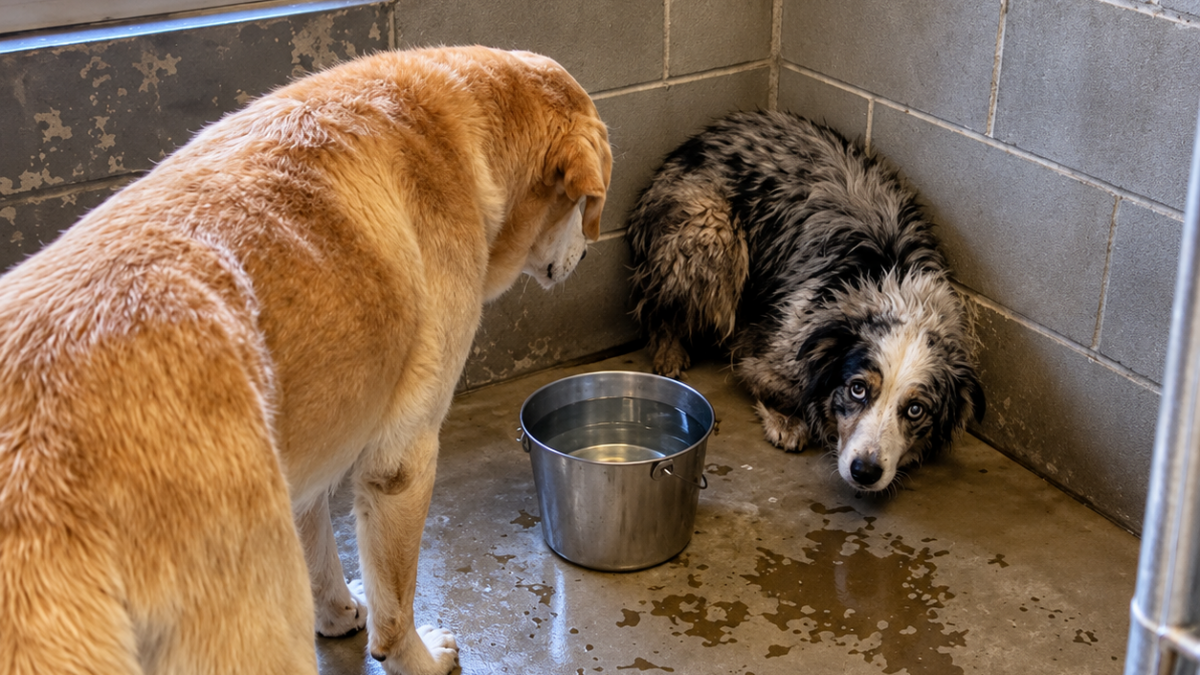
Yet there I was in a municipal shelter at seven in the morning, sitting across from an old German Shepherd who refused to acknowledge me.
“Good morning, Rex.”
Nothing.
“My name is Andrew.”
Nothing.
“We’ve technically met.”
His ear didn’t move.
“I was at the hospital.”
That word affected him.
Hospital.
His ears lifted slightly.
Then flattened again.
I immediately regretted saying it.
“Sorry.”
I leaned back in the chair.
The shelter was waking around us.
Metal bowls clattered.
Dogs barked from neighboring kennels.
A washing machine started somewhere down the hall.
An employee rolled a cart past.
Rex stayed against the wall.
I started talking.
Not because I thought he understood.
Because silence had already done enough damage.
“I’m supposed to be at work in an hour.”
No response.
“I’m a doctor.”
Nothing.
“That sounds impressive until you realize I spent five minutes yesterday looking for glasses that were on my face.”
One ear moved.
I smiled.
“There. You heard that.”
Rex remained still.
I told him about the hospital.
Not Walter.
I wasn’t ready.
I told him about the cafeteria coffee, which should have been illegal.
I told him about a nurse named Patricia who had worked with me for seventeen years and could intimidate surgeons with a single raised eyebrow.
I told him about Katherine.
“She’s better with people than I am.”
Rex breathed slowly.
“She says I don’t talk enough.”
I looked around the shelter.
“You may disagree after this.”
When I stood to leave, Rex didn’t look at me.
“See you tomorrow.”
I heard myself say it.
The words stopped me.
Tomorrow?
I hadn’t planned tomorrow.
But once spoken, they became a promise.
So I came back.
Seven o’clock.
Same chair.
Same dog.
“Morning.”
Rex’s eyes opened.
He didn’t lift his head.
But he knew I was there.
Day two, I told him about my first year as a resident.
How terrified I had been.
How I pretended not to be.
How one attending physician had told me that confidence was useful but certainty was dangerous.
“Good advice,” I said.
Rex stared at the wall.
“Especially for doctors.”
Day three, I brought coffee.
Not for Rex.
For myself.
I placed his untouched bowl of food several feet away.
The shelter employee from my first visit was named Megan.
She was twenty-six, exhausted, and had the remarkable ability to remember every animal’s medication schedule without consulting a chart.
“He still hasn’t eaten?”
I asked.
“Nothing meaningful.”
“How much water?”
“Very little.”
“Bloodwork?”
“Fine for his age.”
“Kidneys?”
“Fine.”
“Liver?”
“Fine.”
She looked at me.
“You’re doing the doctor thing.”
“What thing?”
“Trying to make grief show up on a lab result.”
I stared at her.
Megan shrugged.
“My mom’s a nurse.”
“That explains too much.”
She smiled sadly.
“His body isn’t the problem.”
“I know.”
“Do you?”
I looked at Rex.
“Yes.”
His body had simply started following his heart.
That terrified me.
I had seen humans do the same.
An elderly husband dies.
His wife stops eating.
Stops moving.
Three months later, she follows.
We call it decline.
Frailty.
Failure to thrive.
Medicine has elegant names for surrender.
But sitting there with Rex, I understood how inadequate those names were.
He had lost the reason he woke up.
The fourth morning, Rex still didn’t move.
I talked anyway.
That was also the morning Katherine confronted me.
For the previous three days, I had told her I was leaving early for work.
Technically, I was.
Eventually.
On the fourth day, she stood in our kitchen with her arms folded while I poured coffee into a travel mug.
“You’re having an affair.”
I nearly dropped the lid.
“What?”
She looked completely serious.
“I’ve considered all alternatives.”
“Katherine.”
“You leave an hour early every morning.”
“I’ve had things—”
“You are a terrible liar.”
“I’m not having an affair.”
“I know.”
“Then why would you say that?”
“To make the truth seem easier.”
I stared at her.
She waited.
That was one of Katherine’s talents.
She could let silence become so uncomfortable that confession felt like relief.
Finally I said, “There’s a dog.”
Her eyebrows lifted.
“A dog.”
“At the shelter.”
She unfolded her arms.
I told her everything.
Walter.
The stroke.
Rex chasing the ambulance.
The hospital doors.
Walter dying before morning.
Rex refusing food.
My visits.
When I finished, Katherine said nothing for several seconds.
Then:
“When can I meet him?”
That was it.
No accusation about lying.
No concern that I had become emotionally attached to a German Shepherd I barely knew.
Just:
When can I meet him?
“Not yet.”
“Why?”
“He doesn’t trust anyone.”
“You?”
“No.”
“But you keep going.”
“Yes.”
Katherine nodded.
“Then I’ll wait.”
That morning at the shelter, I told Rex about her.
“My wife wants to meet you.”
His ear twitched.
“She’s much nicer than me.”
Nothing.
“And she makes better coffee.”
Another twitch.
“You have excellent instincts.”
For the first four days, nothing happened.
At least, nothing visible.
Then came day five.
I had worked overnight.
A ten-year-old boy had arrived in severe respiratory distress.
Asthma.
His lips were turning blue.
His mother was screaming.
His father kept saying, “He was fine an hour ago.”
We stabilized him.
Nebulizers.
Steroids.
Oxygen.
For forty-five minutes, the room was organized panic.
Then his oxygen level climbed.
His breathing slowed.
He looked at me.
And smiled.
A weak little smile.
I had to turn away.
Not because we had done anything extraordinary.
Because sometimes the smallest success gets through the armor.
At seven that morning, I went straight to Rex.
I was still in scrubs beneath my coat.
“You know,” I said, sitting in my chair, “I almost skipped today.”
Rex lay facing the wall.
“I’m exhausted.”
Nothing.
“Then I thought you’d notice.”
His breathing changed.
Maybe imagination.
I continued.
“I had a kid last night.”
One ear moved.
Not a twitch.
A turn.
Toward me.
I stopped.
Rex’s ear was pointed directly at my voice.
I swallowed.
“Ten years old.”
I kept talking.
“He couldn’t breathe.”
Rex remained motionless except for that ear.
“We got him stable.”
My throat tightened.
“His mother hugged me.”
I laughed quietly.
“I hate when families hug me.”
Rex’s ear remained turned.
“It makes pretending I’m unaffected very difficult.”
I leaned forward.
“I think you understand that.”
For the first time, I talked to Rex about grief.
Not Walter specifically.
Mine.
“I’ve lost people too.”
His body remained still.
“I don’t mean patients.”
I looked at my hands.
“My father died when I was thirty-two.”
I rarely talked about him.
“He had pancreatic cancer.”
I swallowed.
“I was a doctor by then.”
Rex breathed.
“And I couldn’t do anything.”
My voice became quieter.
“I hated medicine for a while after that.”
The shelter sounds faded.
“I knew every drug. Every lab value. Every possible complication.”
I looked at Rex.
“And none of it mattered.”
His ear shifted again.
“I know what it feels like when the thing you’re trained to do becomes useless.”
I stayed another hour.
When I left, Rex still hadn’t looked at me.
But he had listened.
Day six.
I arrived at 6:52.
“Morning.”
Rex lifted his head.
Actually lifted it.
His eyes met mine.
Not the quick check he had given me outside the emergency room.
A real look.
Five seconds.
Maybe six.
Old, cloudy eyes studying me.
Who are you?
Why do you keep coming back?
I didn’t move.
“Hello, Rex.”
His gaze stayed.
I slowly extended my hand toward the kennel bars.
Palm up.
“I’m not asking you for anything.”
He didn’t approach.
He didn’t retreat.
“That’s okay.”
We sat like that.
The next day Megan stopped me before I reached Rex.
“We need to talk.”
My stomach tightened.
“What happened?”
“He’s dehydrated.”
“I thought he drank yesterday.”
“Not enough.”
“IV fluids?”
“If this continues.”
I looked down the hall.
“Can I go inside?”
Megan hesitated.
“Protocol says no.”
“Fine.”
I started walking.
“Andrew.”
I turned.
She exhaled.
“Give me ten minutes.”
When she returned, she opened the kennel.
“Sit near the door.”
“I understand.”
“Do not corner him.”
“I know.”
“And if he shows stress—”
“I leave.”
She nodded.
I entered.
Rex lifted his head.
For the first time, nothing stood between us.
No bars.
I sat on the concrete floor about three feet away.
The cold went through my pants immediately.
“Hello, Rex.”
His eyes held mine.
“I know you’re waiting.”
His ears moved.
I had promised myself I wouldn’t say Walter’s name.
Then I realized that was cowardice.
“Walter isn’t coming back.”
Rex’s head lowered.
My chest hurt.
“I wish he were.”
The words came slowly.
“God, Rex, I wish I could walk through that shelter door with him.”
Rex stared at the floor.
“But I can’t.”
I placed my hand flat between us.
“I cannot give you back the person you lost.”
His breathing was shallow.
“But I can sit here.”
Silence.
“I can come tomorrow.”
Rex looked at my hand.
“And the next day.”
He moved.
Barely.
A shift of weight.
Then one front paw slid forward.
Three inches.
It was the smallest movement imaginable.
It felt enormous.
“That’s it.”
My voice trembled.
Rex stopped.
I blinked hard.
“Good boy.”
Another inch.
“Good, good boy.”
I cried afterward.
Not there.
Not immediately.
I made it outside.
Sat in my car.
Closed the door.
Then put both hands over my face.
I had seen people survive trauma surgery.
I had watched hearts start beating again.
I had delivered a baby in an emergency department hallway.
Yet an old dog moving four inches toward me completely undid me.
That evening, Katherine found me in the garage pretending to organize tools.
“You cried.”
“No.”
“Your eyes are red.”
“Long shift.”
“Andrew.”
I sighed.
“He moved toward me.”
Katherine smiled.
“That’s good.”
“Four inches.”
“That’s four more than yesterday.”
I stared at her.
“How do you always know what to say?”
“I married someone who rarely does.”
Fair.
The following morning, Katherine handed me a folded blanket.
“Take this.”
It was an old wool blanket from our living room.
Lavender detergent.
A little dog-eared from years of use.
“This is your favorite.”
“It used to be.”
She smiled.
“Now it’s his.”
I brought it to the shelter.
Rex smelled the blanket for nearly five minutes.
Really smelled it.
Edges.
Center.
Corners.
My scent.
Katherine’s.
Our house.
Then he turned once and lowered himself onto it.
His eyes closed.
Not the exhausted collapse I had seen before.
Rest.
Actual rest.
I sat beside him.
“Apparently my wife has bribed you.”
One ear moved.
“Typical.”
That evening, I cried again.
This time in the shower.
Katherine never mentioned it.
By the end of the second week, Rex ate.
Only while I was there.
At first, six bites.
Then half a bowl.
Then almost all of it.
Megan stood outside the kennel one morning watching.
“I’ve never seen anything like this.”
I looked at Rex.
“He’s hungry.”
“No.”
She shook her head.
“He’s coming back.”
The phrase stayed with me.
Coming back.
Except Rex was still waiting.
Every time the shelter door opened, his head lifted.
If an elderly man spoke nearby, Rex stood.
Sometimes he limped to the front of the kennel.
Hope is beautiful until you know it is pointed toward something impossible.
Watching Rex continue to expect Walter hurt almost more than watching him shut down.
One afternoon, an older volunteer named Frank entered the corridor.
His voice was low.
Raspy.
“Morning, everybody.”
Rex shot upright.
His ears forward.
He hurried to the kennel door.
Frank approached.
Rex stared past him.
Searching.
Then he understood.
Walter was not there.
His body seemed to shrink.
I sat beside him.
“I know.”
Rex returned to the blanket.
“I know.”
That night I told Katherine I didn’t think I could do it anymore.
We were sitting at the kitchen table.
“Do what?”
“Watch him hope.”
She reached for my hand.
“Andrew.”
“Every door.”
“I know.”
“Every older man.”
“I know.”
“He thinks Walter is going to walk in.”
Katherine waited.
“I can’t explain death to him.”
“No.”
“I can’t make him understand.”
“No.”
I pulled my hand away and stood.
“This is pointless.”
Katherine watched me.
“Then stop going.”
I turned.
She wasn’t challenging me.
She was giving me the choice.
I thought about morning.
Rex looking up when I entered.
The blanket.
The food.
Those four inches.
“I can’t.”
“I know.”
The third week, Katherine came.
I had warned her repeatedly.
“Don’t reach for him.”
“I won’t.”
“Don’t stare.”
“I know.”
“He may not acknowledge you.”
“Andrew.”
“What?”
“I’ve met frightened patients.”
“He’s not a patient.”
“No.”
She took my hand.
“He’s Rex.”
We entered together.
Rex was on the blanket.
He saw me.
Then Katherine.
His expression changed.
Alert.
Not afraid.
Curious.
Katherine sat beside my chair.
Not close.
She didn’t speak to Rex.
She spoke to me.
“The roses are dying.”
“I told you they were.”
“You could pretend to be sympathetic.”
“I’m a realist.”
“You’re a terrible gardener.”
“I don’t garden.”
“Exactly.”
Rex watched her.
Katherine talked about a novel she was reading.
A neighbor’s broken sprinkler.
A ridiculous argument she had witnessed at the grocery store over avocados.
Her voice filled the kennel with warmth.
Rex stood.
I stopped breathing.
He took one stiff step.
Then another.
His arthritis made his hind legs move carefully.
Katherine did not react.
She kept talking.
Rex came within two feet.
Stopped.
Sniffed.
Katherine finally turned her palm upward.
“Hi, sweetheart.”
Rex took another step.
His nose touched her fingers.
Then—
one lick.
Katherine’s eyes filled instantly.
She kept smiling.
“Thank you.”
Rex returned to the blanket.
In the car afterward, Katherine said nothing for almost ten minutes.
Then:
“We’re taking him home.”
I looked at her.
“What?”
“You heard me.”
“Katherine—”
“He needs a home.”
“We both work.”
“You work. I reduced my hours last year.”
“He’s old.”
“I noticed.”
“Arthritis.”
“We have rugs.”
“He may have medical problems.”
“You’re literally a doctor.”
“Not for dogs.”
“We know veterinarians.”
“Katherine.”
She turned toward me.
“Andrew.”
That was the end of the debate.
I smiled.
“You already decided.”
“I decided when you lied about going to work early.”
“That was very early.”
“You were gone emotionally before you were gone physically.”
I looked out the windshield.
“He might never stop waiting for Walter.”
Katherine softened.
“Then we won’t ask him to.”
I looked at her.
“We’ll just give him somewhere safe to wait.”
That sentence decided everything.
The adoption process took another week.
They had to complete the legal stray period.
Walter had no reachable relatives willing to take Rex.
There were forms.
A veterinary examination.
Questions about our house.
Age.
Stairs.
Fencing.
Schedules.
I answered everything.
Yet the closer adoption day came, the more nervous I became.
One evening I told Megan:
“What if he doesn’t actually want me?”
She stared at me.
“You come here every morning.”
“That doesn’t answer the question.”
“He eats when you sit beside him.”
“Routine.”
“He sleeps on your wife’s blanket.”
“Comfort.”
“He watches the door after you leave.”
I stopped.
“What?”
Megan smiled.
“You didn’t know?”
“No.”
“He listens for your car too.”
“You can’t know that.”
“I work here.”
I looked toward Rex.
She added, “Stop making this about whether you deserve him.”
I looked at her.
“What?”
“You doctors are all the same.”
“How many doctors do you know?”
“Two.”
“That seems statistically weak.”
She laughed.
Then became serious.
“He lost Walter.”
“Yes.”
“You’re not replacing Walter.”
“I know.”
“Do you?”
I didn’t answer.
“You’re becoming Andrew.”
The adoption day arrived on a Friday morning.
Sunlight filled the shelter lobby.
I had brought a soft blue collar.
A matching leash.
Katherine’s blanket was already folded into the back seat.
Katherine waited outside because I asked her to.
I wanted the first moment to belong to Rex.
I entered the kennel room.
He was lying on the blanket.
“Morning.”
His head lifted.
Then something happened.
His tail moved.
Once.
Stopped.
Then again.
I froze.
In all those weeks, I had never seen Rex wag.
Not once.
“Hey.”
Another weak sweep.
My throat closed.
“I came to take you home.”
Rex looked toward the kennel door.
Then back at me.
He stood.
Slowly.
I opened the gate.
He could have walked past me.
Could have gone toward Megan.
Toward the hallway.
Toward the outside doors.
He walked to me.
Stopped at my knees.
Looked up.
I crouched.
And Rex placed his head in my lap.
I broke.
No attempt to hide it.
Tears fell onto his gray fur.
My hands held the sides of his face.
“Okay.”
Rex stayed.
“I’ve got you.”
His eyes closed.
“You don’t have to wait alone anymore.”
Behind me, I heard Megan sniff.
“I’m pretending not to watch.”
I laughed through tears.
“Thank you.”
Outside, Katherine stood beside the car.
Rex saw her.
His tail moved again.
She crouched.
“Ready?”
Rex approached.
Katherine kissed the top of his head.
“Let’s go home.”
The word home frightened me.
Not because I didn’t want him there.
Because Walter’s home had already existed.
Rex had already belonged somewhere.
Could he belong twice?
I would learn the answer.
The first thing Rex did in our living room was inspect everything.
Bookshelves.
Table legs.
Couch.
Fireplace.
Rug.
He moved carefully, smelling every corner.
Then he found Katherine’s blanket beside the fireplace.
He stood over it.
Looked at us.
Circled once.
Lay down.
Katherine whispered, “I think that’s his spot.”
I nodded.
Rex slept for almost four hours.
Deeply.
His legs twitched.
But he didn’t whimper.
That first night, we placed a bed in the hallway outside our bedroom.
At three in the morning, I woke with the sensation of being watched.
I opened my eyes.
Rex stood beside my bed.
Dark silhouette.
Cloudy eyes.
He wasn’t whining.
He wasn’t asking to go outside.
He was checking.
“Hey.”
His ears lifted.
“I’m here.”
Rex remained still.
“I’m not going anywhere.”
He lowered himself onto the floor.
Head on paws.
I watched him for a long time.
The next morning, I moved an old cushion beside my side of the bed.
Rex claimed it immediately.
That became his nighttime place.
Always close enough to see me.
For the first month, he checked constantly.
If I stood, Rex stood.
If I walked upstairs, he waited below.
If I closed the bathroom door, he lay outside.
If I went to work, Katherine said he sat near the front window for twenty minutes.
Then gradually less.
Fifteen.
Ten.
Five.
Eventually he stopped.
Not because he loved me less.
Because he trusted the return.
That was one of the most important things Rex taught me.
Trust is not believing nobody will ever leave.
Trust is believing leaving is not always forever.
Walter had left the house in an ambulance.
Never returned.
To Rex, absence had become catastrophe.
We could not erase that.
We could only create another pattern.
Door opens.
Andrew leaves.
Hours pass.
Door opens.
Andrew returns.
Again.
Again.
Again.
One ordinary day after another until expectation changed.
Rex began waiting differently.
Not desperately.
Confidently.
His life expanded.
He discovered our yard.
At first, he stood on the back patio and looked toward the gate.
Then he walked into the grass.
Katherine planted lavender along one fence.
Rex liked sleeping near it.
“He knows his blanket smells like this,” she said.
“Or he likes dirt.”
“You ruin everything.”
His arthritis was significant.
Our veterinarian, Dr. Lewis, prescribed medication and supplements.
We placed non-slip runners across the hardwood.
I installed a small ramp over the two steps leading into the yard.
Katherine watched me struggle with it for an entire Saturday.
“You know we could buy one.”
“I’m capable of building a ramp.”
The ramp leaned visibly to the left.
She raised an eyebrow.
“I’m a physician, not an engineer.”
“Clearly.”
Rex used it anyway.
That felt like loyalty.
Weeks became months.
Something else changed too.
Me.
I began sleeping better.
For years, difficult shifts followed me home.
I could shower off blood.
Smoke.
Antiseptic.
Not faces.
There are deaths doctors categorize professionally and carry personally.
The nineteen-year-old killed by a drunk driver.
The mother who collapsed after delivering her child.
The man who died alone because nobody knew he was sick.
I had become skilled at storing them.
Then Rex began sitting beside me after work.
No questions.
No expectation.
I would make tea.
Sit near the fireplace.
Rex would place his head on my knee.
And I started talking.
Exactly the way I had at the shelter.
“Lost one today.”
His ear moved.
“Seventy-two.”
I rubbed his neck.
“His daughter made it in time.”
Sometimes that was enough.
Other nights:
“Kid survived.”
Tail thump.
“Good one today.”
Rex knew no difference between a successful intubation and a failed resuscitation.
But he knew my voice.
He knew when I needed stillness.
Katherine noticed.
One evening she sat beside me.
Rex was asleep against my leg.
“You tell him things you don’t tell me.”
I looked at her.
There was no jealousy in her voice.
Only observation.
“I don’t know why.”
“Yes, you do.”
“I really don’t.”
“He doesn’t need you to be okay afterward.”
That stopped me.
Katherine leaned against my shoulder.
“When you tell me something terrible, part of you watches my reaction.”
I stared at Rex.
“With him, there’s nothing to manage.”
“Yes.”
I touched her hand.
“I’m sorry.”
“For what?”
“For making you wait twenty-four years for the dog to teach me that.”
She laughed.
Then kissed my cheek.
“I’ve waited for worse things.”
Rex eventually returned to the hospital.
Completely by accident.
Katherine had an appointment across town.
I had left a folder in my office that I needed before an afternoon meeting.
Rex was with me.
I expected to park, take him through the side entrance, leave him in my office for fifteen minutes, then go home.
We barely made it twenty yards.
A little girl was sitting in a wheelchair near the pediatric wing.
Maybe nine.
Bald from treatment.
Thin.
An IV pole beside her.
Her mother stood nearby talking to a nurse.
The girl saw Rex.
Everything in her face changed.
“A dog.”
She said it so softly I almost didn’t hear.
Rex stopped.
He looked at her.
Then at me.
I swear that happened.
I nodded.
“Go ahead.”
Rex walked toward her.
Slow.
Dignified.
Old hips.
Gray muzzle.
The girl reached one hand.
Rex sat beside the wheelchair.
Then licked her fingers.
She smiled.
Her mother turned.
Saw the smile.
Covered her mouth.
The nurse whispered to me later:
“She hasn’t smiled in three days.”
I looked at Rex.
He was leaning against the little girl’s chair.
A dog who had once sat outside those hospital doors because he wasn’t allowed through them.
Now inside.
Giving something no medication could.
After that, the hospital staff began asking whether Rex would come back.
At first, I resisted.
“He isn’t trained.”
Patricia looked at me.
“He sat beside a frightened child for twenty minutes without moving.”
“That doesn’t make him a therapy dog.”
“No.”
She folded her arms.
“It makes him Rex.”
Katherine found that hilarious.
We worked with administration.
Nothing formal or grand at first.
Short visits.
Controlled areas.
Two afternoons each week when I wasn’t overwhelmed.
Rex became known.
Nurses carried treats.
Security guards greeted him by name.
Families recognized him.
He walked the same corridors Walter had entered unconscious.
I thought about that constantly.
The first time we approached the automatic front doors from inside, Rex stopped.
The glass opened.
Cold air moved in.
His body froze.
I looked down.
“Rex?”
His eyes fixed on the parking lot.
For a second, I saw the dog from that night.
Waiting.
Believing.
My chest tightened.
“We can go another way.”
Rex remained still.
Then he stepped forward.
One paw.
Another.
Through the doors.
Onto the sidewalk.
He turned.
Looked back inside.
Then at me.
Tail.
One slow movement.
I crouched.
“That’s it.”
He leaned against my leg.
“You walked through them.”
It seemed absurd to make something so large out of automatic doors.
But grief attaches itself to places.
Healing sometimes requires walking through them from the opposite direction.
Rex began helping patients without being asked.
An elderly woman waiting for her husband’s surgery stroked him for almost an hour.
A teenage boy with a badly fractured leg refused to speak to anyone until Rex rested his chin on the bed.
One nurse coming off a devastating pediatric code sat on the floor beside him in an empty hallway.
Rex simply stayed.
That was his gift.
Staying.
Of course it was.
He had built his entire identity around staying for Walter.
When Walter disappeared, Rex nearly died from not knowing what to do with all that loyalty.
Now he gave it away.
Small portions.
A child.
A nurse.
A frightened husband.
Me.
Katherine.
Each person got a little of what Walter had once had completely.
One evening I asked Megan from the shelter whether she wanted to see him.
She came to the hospital.
Rex was lying near the nurses’ station.
The moment Megan saw him, she stopped.
“Oh, my God.”
Rex lifted his head.
She crouched.
“Hi, old man.”
His tail moved.
Megan cried.
“You jerk.”
I laughed.
“He remembers you.”
She hugged his neck carefully.
“You wouldn’t eat.”
Rex licked her chin.
“You made me lose sleep.”
Another lick.
She looked at me.
“He looks different.”
“He gained weight.”
“No.”
She touched his face.
“Here.”
Her fingers hovered near his eyes.
“He looks like he expects tomorrow.”
I never forgot that.
He expects tomorrow.
What a definition of recovery.
Not happiness every second.
Not forgetting Walter.
Not becoming young again.
Simply expecting tomorrow to be worth arriving for.
That was Rex.
We eventually learned more about Walter.
Not much.
Enough.
His full name was Walter Bennett.
Seventy-eight.
Widower.
Retired mechanic.
No children.
His closest living relative was a nephew several states away who hadn’t seen him in years.
A neighbor told us Walter and Rex had been together since Rex was a puppy.
Every morning, they walked the same route.
Every afternoon, Walter sat outside while Rex slept near his chair.
The neighbor said something I still think about.
“Walter talked to that dog more than he talked to any of us.”
I smiled.
“I understand.”
She gave me one old photograph.
Walter standing beside a pickup truck.
Rex younger, black and tan without gray, sitting against his leg.
I placed the photo on our fireplace mantel.
Katherine saw it.
“You sure?”
“Yes.”
“You don’t think it will upset Rex?”
“I don’t know.”
We showed him.
Rex approached.
Sniffed the frame.
His whole body became still.
Then he sat.
He looked at Walter’s face.
I did not pretend to know exactly what was happening in his mind.
But after a minute, Rex lowered himself beneath the mantel and slept.
We left the photograph there.
Walter remained part of the house.
I never wanted Rex to believe loving us required forgetting him.
Humans sometimes make love unnecessarily competitive.
New does not erase old.
Rex had loved Walter for nearly his entire life.
I was not entitled to replace that.
I became something else.
Not Walter.
Andrew.
And somehow that was enough.
Our first Christmas together proved it.
Katherine hung stockings.
One for me.
One for her.
Then one with REX badly embroidered by hand.
I looked at it.
“You did this?”
“Yes.”
“It’s crooked.”
“It has character.”
Rex sniffed the stocking.
“There are treats in there,” I said.
Katherine glared.
“You’re ruining Christmas.”
“He can smell them.”
Christmas morning, Rex carried a new stuffed fox around the living room for hours.
At one point, he placed it beneath Walter’s photograph.
Katherine looked at me.
“Did he mean to do that?”
“I don’t know.”
We left it there until he picked it up again.
Winter was hard on his joints.
Some mornings he struggled.
I would kneel, support his hips, help him stand.
“Easy.”
He hated assistance at first.
Pride isn’t exclusive to humans.
Eventually he accepted a rear-support harness.
Katherine called it his “elevator.”
Rex looked offended every time.
But once upright, he wanted to move.
Slowly.
Always.
I learned to walk at his speed.
For twenty-three years, my entire professional life had been measured in urgency.
STAT.
Now.
Move.
Clear.
Push.
Call respiratory.
We are losing pressure.
Medicine is speed sharpened into reflex.
Rex introduced me to another form of care.
Wait.
Let him stand.
Let him smell.
Let him decide.
One afternoon, he spent three full minutes investigating one patch of grass.
I checked my watch.
Then laughed at myself.
“Take your time.”
He did.
I started arriving early to places because Rex would not be hurried.
I became strangely grateful for that.
He made me practice a skill medicine had almost removed from me.
Patience.
There were setbacks.
Thunderstorms made him uneasy.
Ambulance sirens were worse.
The first time one passed our house with lights and siren active, Rex bolted upright from sleep.
He ran toward the front door.
Scratched once.
Panted.
I realized instantly.
Walter.
Ambulance.
Leaving.
Never returning.
I sat beside him.
“Not this one.”
Rex stared through the door.
“Not him.”
He paced.
I stayed.
Eventually he leaned against me.
The next ambulance siren weeks later produced less panic.
Months later, Rex only lifted his head.
Memory didn’t vanish.
It softened.
One night, after a particularly difficult shift, I came home at 1:30.
Katherine had gone to bed.
Rex waited in the hallway.
Not anxious.
Just awake.
“You should be sleeping.”
Tail.
“I’m serious.”
He approached.
I sat on the floor.
That day we had lost a young woman after a collision.
Twenty-seven.
Engaged.
Her fiancé arrived five minutes too late.
Five.
Minutes.
There are numbers you hate forever.
I told Rex.
“Five minutes.”
He placed his head on my thigh.
“I keep thinking if traffic had been lighter.”
His eyes closed.
“Or if we had called sooner.”
My hand moved along his fur.
“Or if…”
I stopped.
Rex breathed.
Walter’s story returned.
The ambulance.
The stroke.
The heart stopping.
Rex waiting.
Some endings are not altered by wanting.
I knew that medically.
Rex was teaching me emotionally.
“You can’t save everybody,” I whispered.
He stayed.
“But you can stay with the ones who are left.”
Rex opened his eyes.
That was when I cried openly in front of him for the first time.
Katherine found us asleep on the floor the next morning.
She placed a blanket over both of us and took a photograph.
She did not show me until months later.
In it, my hand rests on Rex’s shoulder.
His head lies against my chest.
We both look exhausted.
Katherine called it her favorite picture.
“Why?”
“Because neither of you is pretending.”
Years passed more quickly than I wanted.
Rex reached twelve.
Then beyond what we could estimate precisely.
His eyes grew cloudier.
His hind legs weakened.
His hospital visits became shorter.
But he still went twice a week when he felt well.
People knew him.
One teenage oncology patient made him a bandana.
A nurse bought him a small badge that read:
REX — GOOD LISTENER
I told them it was undignified.
Rex wore it happily.
A man awaiting heart surgery once asked me:
“Does he ever get scared in here?”
I looked at Rex.
“Yes.”
“Then why bring him?”
“Because courage isn’t lack of fear.”
The man considered that.
Rex rested against his chair.
I added, “Sometimes courage is coming back to the place where you were hurt and finding a new reason to stay.”
The man stroked Rex’s head.
“I could use some of that.”
“So could I.”
Katherine and I talked often about Walter.
Not mournfully.
With curiosity.
“What do you think he’d say?” she asked one evening as Rex slept near the fireplace.
“About what?”
“This.”
She gestured.
Rex.
Our home.
The hospital.
I thought.
“He’d probably ask why Rex is allowed on the couch.”
Katherine laughed.
“Seriously.”
I looked at Walter’s photograph.
“I hope he’d be relieved.”
“That Rex is loved?”
“Yes.”
She leaned against me.
“I think he’d know.”
I looked at her.
“How?”
“Because if I died tomorrow, I’d want somebody to understand what you needed without me there.”
I didn’t like the sentence.
“Katherine.”
“I’m serious.”
“No.”
“Andrew.”
“No hypothetical deaths before bed.”
She smiled.
“Fine.”
But her point stayed.
Loving someone includes wanting them to be loved when you cannot do it anymore.
That became the way I thought of Walter.
I wasn’t taking his dog.
I was continuing something he could no longer continue.
When Rex turned thirteen—or what we believed was thirteen—his arthritis worsened significantly.
Dr. Lewis changed medication.
We limited hospital visits.
Sometimes Rex stayed in my office while patients came to him.
People did.
Word traveled.
A nurse would whisper:
“Is Rex here today?”
Someone’s mother would sit with him.
A frightened resident doctor would rub his ears before a difficult procedure.
He became part of the emotional architecture of the emergency department.
No chart documented it.
No billing code existed.
No clinical trial measured it.
But I saw what he did.
Shoulders relaxed.
Breathing slowed.
People smiled.
Touch returned.
Hope sometimes begins physiologically before we name it.
I was a physician.
I believed in evidence.
Rex became the kind of evidence you could not graph and could not deny.
One afternoon, a man in his eighties entered the emergency department.
Rex happened to be lying near my desk.
The man’s voice resembled Walter’s age—not Walter himself, whom I had never consciously heard, but the kind of voice Rex still occasionally reacted to.
Low.
Weathered.
Rex’s head lifted.
For a second, my heart broke.
The man saw him.
“German Shepherd?”
“Yes.”
“Had one for sixteen years.”
He sat beside Rex.
“My wife died before the dog did.”
Rex leaned into his leg.
The man whispered, “Then he died too.”
I said nothing.
He stroked Rex.
“You know what’s strange, Doc?”
“What?”
“People told me to get another dog.”
He looked at me.
“As though love is replacing a tire.”
I nodded.
“It isn’t.”
“No.”
Rex put his head on the man’s shoe.
“But this helps.”
The man smiled.
“Yeah.”
Rex was never a replacement.
For Walter.
For anyone.
He was proof that the heart can make room without evicting the dead.
That lesson mattered to me more as I aged.
Eventually I reduced my hours.
Not entirely because of Rex.
But partly.
I had spent my adult life assuming there would always be another year.
Another shift.
Another chance to rest later.
Rex had lost Walter in a single night.
There was no later.
So I started coming home before dark more often.
Katherine and I ate dinner on the patio.
Rex slept in the fading sunlight.
We took short drives.
Visited parks.
Nothing dramatic.
The kind of ordinary life doctors often postpone while dealing with everyone else’s emergencies.
Rex taught me the importance of ordinary.
Breakfast.
A walk.
A warm floor.
Someone returning.
The things we barely notice until they disappear.
One spring afternoon, we drove past the hospital.
I wasn’t working.
Rex sat in the back seat.
At a red light near the emergency entrance, I looked toward the place where I had first seen him.
Same automatic doors.
Different security guard.
Same pavement.
I pulled over.
Katherine looked at me.
“What are you doing?”
“I don’t know.”
We got out.
Rex walked slowly with us.
We approached the spot.
He stopped.
I waited.
His nose moved.
Maybe there was no memory.
Seven years of smells had crossed that pavement.
Maybe his memory was somewhere deeper.
Rex looked at the doors.
Then at me.
Tail.
I crouched.
“This is where we met.”
Katherine stood beside us.
Rex leaned against my knee.
“I didn’t know you yet.”
He looked toward the doors.
“I didn’t know what you were going to do to my life.”
Katherine laughed softly.
Then I said something I had never said aloud.
“I’m sorry Walter didn’t come back.”
Rex remained still.
“I know I’m not him.”
His head moved toward me.
“And I never wanted to be.”
I rubbed his ear.
“But I’m glad you let me be next.”
Katherine wiped her eyes.
“You’re making me cry in a parking lot.”
“Sorry.”
“No, you’re not.”
We walked away.
Rex did not look back.
That mattered.
By then, his nighttime checking ritual had almost disappeared.
He no longer needed to stand beside the bed to make sure I existed.
He slept deeply.
Some nights he snored.
Loudly.
Katherine blamed me.
“That’s your snore.”
“That is biologically impossible.”
“You’ve taught him.”
“Also impossible.”
Rex snored again.
Katherine pointed.
“Identical.”
I laughed.
The joy of that sound still surprises me.
I had first known Rex as silence.
Then he filled our house with ordinary noise.
Nails clicking.
Water bowl.
Dreaming paws.
Sighs.
Occasional bark.
Snoring.
Home became audible.
One summer morning, Katherine found Rex unable to stand.
We knew the day would come.
Still, knowing did nothing.
I was already dressed for work.
She called from the bedroom.
“Andrew.”
Something in her voice stopped me.
Rex lay on his cushion.
He was awake.
Tail moved when he saw me.
But his hind legs wouldn’t cooperate.
I knelt.
“Hey.”
He tried.
“Don’t.”
He tried again.
I supported him.
His body was lighter than I expected.
Age had been taking him quietly.
We called Dr. Lewis.
She examined him.
Arthritis.
Severe muscle loss.
Neurological weakness.
No single catastrophe.
Just age.
We adjusted medication.
A support harness.
More rest.
I canceled my shift.
Patricia texted:
Everything okay?
I replied:
Rex.
Her answer:
Stay home.
So I did.
That became another full-circle moment.
Years earlier, I came to Rex every morning before work.
Now work waited while I sat beside him.
I read.
Talked.
Katherine brought coffee.
Rex slept.
He improved enough to continue.
Not dramatically.
We gained months.
Good months.
Slow months.
He retired from regular hospital visits.
The staff threw a tiny farewell party.
I hated the phrase retirement.
Rex liked the treats.
Patricia knelt beside him.
“You’ve listened to more nonsense in this hospital than any of us.”
Rex licked her hand.
Megan came from the shelter.
She brought the original intake photograph.
I had never seen it.
Rex in the kennel.
Facing the wall.
Head down.
I stared.
Then looked at the old dog beside us.
“Keep it,” Megan said.
“I don’t know if I want it.”
“You should.”
“Why?”
“Not to remember how broken he was.”
She smiled.
“To remember how far he came.”
I framed it.
Next to it, Katherine placed a photograph from one of Rex’s hospital visits.
He sat beside the little girl in the wheelchair.
Two versions of one life.
A dog who had stopped looking at the world.
A dog who later gave the world reason to smile.
That is not a miracle.
It is time.
Patience.
Care.
And a dog deciding to risk love twice.
As Rex aged, Walter’s photograph stayed above the fireplace.
Sometimes I would catch Rex looking toward it.
Maybe at the face.
Maybe nothing.
I stopped needing to interpret every gesture.
Love does not require translation to be real.
One evening, I sat in my chair.
Rex’s head rested on my knee.
Katherine was reading.
The room was warm.
Outside, rain tapped the windows.
I thought about Walter’s last night.
An ambulance.
Sirens.
Hospital.
Rex running behind.
Those automatic doors closing.
I wondered whether Walter knew Rex had followed.
Probably not.
He had been gravely ill.
But I found myself hoping something in him knew.
Somebody was coming.
Somebody loved him enough to chase the ambulance.
I whispered:
“You did your job.”
Katherine looked up.
“What?”
I touched Rex’s head.
“He stayed with Walter as far as the doors let him.”
Katherine closed her book.
“Yes.”
“And then he stayed outside.”
“Yes.”
I looked down.
“He thought he failed.”
“Andrew.”
“I know he’s a dog.”
“That wasn’t what I was going to say.”
“What?”
“Maybe you thought you failed too.”
The room went quiet.
I understood immediately.
My father.
Patients.
All those deaths I had carried as private evidence of insufficiency.
Medicine gives us immense power compared with previous generations.
That can create a dangerous illusion.
If you are skilled enough, fast enough, prepared enough, maybe nobody has to die.
Then death arrives anyway.
Rex waited for Walter because loyalty did not understand mortality.
I blamed myself for patients because training did not always understand mortality either.
We had both needed the same lesson.
Being present at the end is not the same as preventing the end.
Love is not measured only by rescue.
Sometimes it is measured by staying.
I bent down.
“Thank you.”
Rex’s eyes opened.
Katherine smiled.
“He has no idea what you mean.”
“I know.”
Tail.
“Maybe he does.”
Rex’s last year was gentle.
That was all I wanted.
Pain controlled.
Short walks.
Sunlight.
Katherine’s biscuits.
My voice.
Walter’s picture.
Our bed nearby.
Some mornings I had to help him into the yard.
He would stand in the grass and smell the air.
Then turn toward me.
Always checking.
I was there.
One autumn morning, while sunlight came through the kitchen, Rex managed something I had not seen in months.
He carried his old stuffed fox from the living room to my chair.
Slowly.
Dropped it at my feet.
I laughed.
“You want me to throw that?”
Tail.
“You cannot possibly chase it.”
Tail.
I tossed it about four feet.
Rex walked after it.
Picked it up.
Returned.
Katherine stood in the doorway crying.
I pretended not to notice.
Rex dropped it again.
We repeated the game three times.
Then he lay down.
It was enough.
Life is made of enough.
We forget that.
We chase extraordinary.
Rex was satisfied with enough.
Enough food.
Enough warmth.
Enough time outside.
Enough strength to reach me.
Enough people who returned.
Then came a winter evening when Rex did not eat.
Next morning, same.
Dr. Lewis visited our house.
She examined him near the fireplace.
Her face told me.
I had worn that face for families thousands of times.
Now I understood exactly what they saw.
“How long?”
I asked.
She sat beside me.
“Andrew…”
“How long?”
“Maybe days.”
Katherine took my hand.
Rex slept.
“What do we do?”
“Keep him comfortable.”
“And when?”
“You’ll know.”
I hated those words.
Families always ask:
How will I know?
Doctors answer:
You’ll know.
It sounds evasive until the moment arrives.
Then you do.
We had two good days.
Rex ate chicken from Katherine’s hand.
Sat in the yard.
Slept beside me.
On the third morning, he tried to stand and couldn’t.
He looked at me.
No panic.
No demand.
Only exhaustion.
I knew.
I called the hospital.
Patricia answered.
“I’m not coming in.”
A pause.
“Rex?”
“Yes.”
Another pause.
“I’ll handle it.”
“Thank you.”
“Andrew?”
“Yes?”
“Tell him thank you from us.”
My throat closed.
“I will.”
Katherine called Dr. Lewis.
We spent the morning together.
I brought Walter’s photograph down from the mantel.
Placed it near Rex.
Katherine brought the old lavender blanket.
The same one from the shelter.
Rex smelled it.
His tail moved faintly.
I sat on the floor.
Exactly like I had on day seven.
Same position.
Different home.
“Hello, Rex.”
His eyes opened.
I laughed softly.
“That’s how this started.”
Katherine sat on my other side.
Rex’s breathing was slow.
“I came every morning because I thought you needed me.”
His eyes stayed on mine.
“I was right.”
I stroked his gray muzzle.
“But I didn’t know I needed you too.”
Katherine was crying.
I continued.
“You waited for Walter.”
A breath.
“And when he didn’t come back, you thought the world was over.”
I swallowed.
“I’m sorry you had to learn otherwise.”
Rex blinked.
“But you did.”
Tail.
Barely.
“You came back.”
My voice broke.
“To food.”
Another breath.
“To walks.”
I touched the blanket.
“To Katherine.”
She kissed his head.
“To the hospital.”
I laughed through tears.
“You became more popular there than me.”
Katherine whispered, “Easily.”
I smiled.
“To life.”
Dr. Lewis arrived quietly.
She waited.
There was no rush.
That mattered.
I placed Walter’s photograph near Rex’s paws.
“You loved him first.”
My hand shook.
“You always will.”
I placed my forehead against his.
“And you loved us too.”
Rex exhaled.
“I need you to hear this.”
His cloudy eyes remained open.
“You never abandoned Walter.”
My voice collapsed.
“You followed him as far as you could.”
I cried openly.
“You waited longer than anyone had the right to ask.”
Katherine’s hand pressed against my back.
“You did everything right.”
Dr. Lewis prepared the medication.
I whispered:
“You can stop waiting now.”
Rex’s eyes softened.
“I’m here.”
That phrase.
The one I had repeated on his first night in our house.
I’m here.
“I’m here, Rex.”
Katherine touched him.
“We’re both here.”
The medicine entered.
Rex relaxed.
His head remained against my leg.
For a few seconds, he breathed.
Then less.
Then no more.
I kept my hand on him.
Nobody moved.
The room became silent.
But not empty.
That distinction mattered.
I had spent my career around death.
I knew the physiological moment.
Heart stops.
Respiration stops.
Neurological function ends.
But sitting there with Rex, death did not feel like a medical event.
It felt like the completion of a promise.
Walter left.
Rex waited.
I came back.
Again.
Again.
Again.
Until the final time, when he no longer had to check whether anyone was there.
We were.
Dr. Lewis left us as much time as we needed.
Afterward, Katherine and I sat on the floor beside the empty blanket.
She cried against my shoulder.
I stared at Walter’s photograph.
Finally I said:
“I hope he knew.”
Katherine understood.
“Walter?”
“Yes.”
She squeezed my hand.
“I think if there’s any part of us that gets to know what happens after we leave, he knows.”
I nodded.
I wanted that to be true.
Not because I needed Walter’s approval.
Because I wanted someone who had been loved so completely by Rex to know the rest of the story.
Your dog waited for you.
Your dog grieved you.
Your dog survived.
He loved again.
Not instead of you.
After you.
And he spent his final years teaching strangers the thing you taught him first:
Stay close.
Months after Rex died, I went back to the shelter.
Megan still worked there.
She saw me and immediately knew why I had come.
“You ready?”
“No.”
She nodded.
“Come in anyway.”
I sat beside an empty kennel.
Not Rex’s.
That kennel belonged to another frightened dog.
Young.
Brown.
Shaking.
I didn’t plan to adopt.
I wasn’t ready.
I simply sat.
The dog stayed in the corner.
Megan stood at the end of the hallway.
I smiled.
“Déjà vu.”
She smiled back.
I began talking.
Not because I believed every story needed to repeat itself.
Because Rex had taught me what presence could do.
I told the dog about my day.
The weather.
Katherine.
A book.
Nothing important.
After fifteen minutes, one ear turned toward me.
I laughed.
“Yeah.”
I looked down.
“I know that move.”
I did not adopt that dog.
A family did two weeks later.
That was fine.
Rex had never taught me to collect broken things.
He taught me to stop walking past them.
The hospital placed a small photograph of Rex near the staff lounge.
Not a plaque.
No grand memorial.
Just Rex sitting beside the little girl’s wheelchair.
Underneath, Patricia added one line:
HE WAITED. THEN HE TAUGHT US HOW TO STAY.
I pretended to object.
It made me cry every time.
Eventually I retired.
Not immediately.
But sooner than I once planned.
On my last day, I walked through the emergency-room doors at 6:03 in the evening.
Staff hugged me.
There were speeches.
Cake.
Too much attention.
I hated most of it.
Then I stepped outside.
Same parking lot.
Different hour.
I stood near the place where Rex had waited.
For a moment, I could see him.
Not literally.
Memory.
Old German Shepherd.
Gray muzzle.
Eyes fixed on the doors.
Waiting for Walter.
I wished I could cross time.
Walk toward him again.
Kneel.
And tell him:
The man you love will not come back.
I am so sorry.
But this is not where your story ends.
Three days from now, you will stop eating.
You will believe nothing matters.
Then a tired doctor will sit outside your kennel.
He won’t know what to say.
He will come back anyway.
Again.
Again.
His wife will bring you a blanket.
You will learn her voice.
You will sleep beside their bed.
You will walk through these hospital doors instead of waiting outside them.
Children will smile because of you.
Nurses will cry into your fur.
A doctor who has spent his life pretending grief is manageable will finally learn to admit when it hurts.
You will still miss Walter.
That will be allowed.
Nobody will ask you to forget him.
You will get old.
Very old.
And when your legs finally stop carrying you, you will not be alone.
Nobody will make you wait behind glass.
The people you chose after losing Walter will sit beside you.
They will stay.
Until you don’t need them anymore.
That is what I wish I could tell Rex from that first night.
Maybe, somehow, all those mornings I sat beside his shelter kennel, I did.
Not with words.
With repetition.
I came back.
There is a kind of love that announces itself dramatically.
Flowers.
Promises.
Declarations.
Then there is another kind.
Seven o’clock every morning.
A folding chair.
Coffee.
A familiar voice.
A blanket that smells like home.
A hand left open between two frightened beings.
That was the love Rex understood.
That was the love he gave back.
Today, Walter’s photograph sits on our mantel beside a photograph of Rex.
The blue collar hangs beneath it.
Katherine keeps the old lavender blanket folded in a wooden chest.
Sometimes I still find Rex’s fur on it.
Years later.
I never remove it.
On difficult mornings, I make coffee and sit by the fireplace.
For a moment, I still expect to hear his paws.
I don’t.
Grief remains.
But it is different now.
Rex taught me that grief and gratitude can occupy the same room.
You can miss someone and still be glad they existed.
You can love what came before and what came after.
You can lose your whole world in a single night and, with enough patience, discover that the world can become larger again.
Not the same world.
Never the same.
A new one.
Rex never stopped loving Walter.
I know that.
Every old man’s voice.
Every ambulance.
Every hospital door carried some echo of him.
But love did not trap Rex forever.
Eventually, he allowed it to lead him somewhere else.
To Katherine.
To me.
To patients.
To frightened children.
To exhausted nurses.
To a home where nobody asked him to replace the dead.
Only to stay.
And that is why, when people ask whether I saved Rex, I always say no.
I found him after he lost everything.
I sat beside him.
I came back.
That was all.
Rex did the impossible part.
He risked believing again.
He looked away from the wall.
He ate.
He stood.
He walked toward Katherine.
He walked toward me.
He entered a new house.
He crossed the same hospital doors where his old life had ended.
He let people touch him.
He gave comfort.
He loved.
Again.
There are surgeries more technically difficult than that.
There are resuscitations more dramatic.
There are medical recoveries that would fill journals.
But in twenty-three years of practicing medicine, I never witnessed anything stronger than an old dog deciding that losing one person he loved did not mean he had to stop loving forever.
The night I first saw Rex, I thought he was waiting for Walter.
I was right.
But years later, I realized he was also waiting for something neither of us understood yet.
Another morning.
Another person.
Another reason to stand.
I happened to arrive.
And every morning after that, until he was ready, I did the simplest thing I knew how to do.
I came back.








