The morning the HOA’s million-dollar entrance sprinklers coughed air instead of water, their treasurer marched across the road and demanded the keys to my well house.
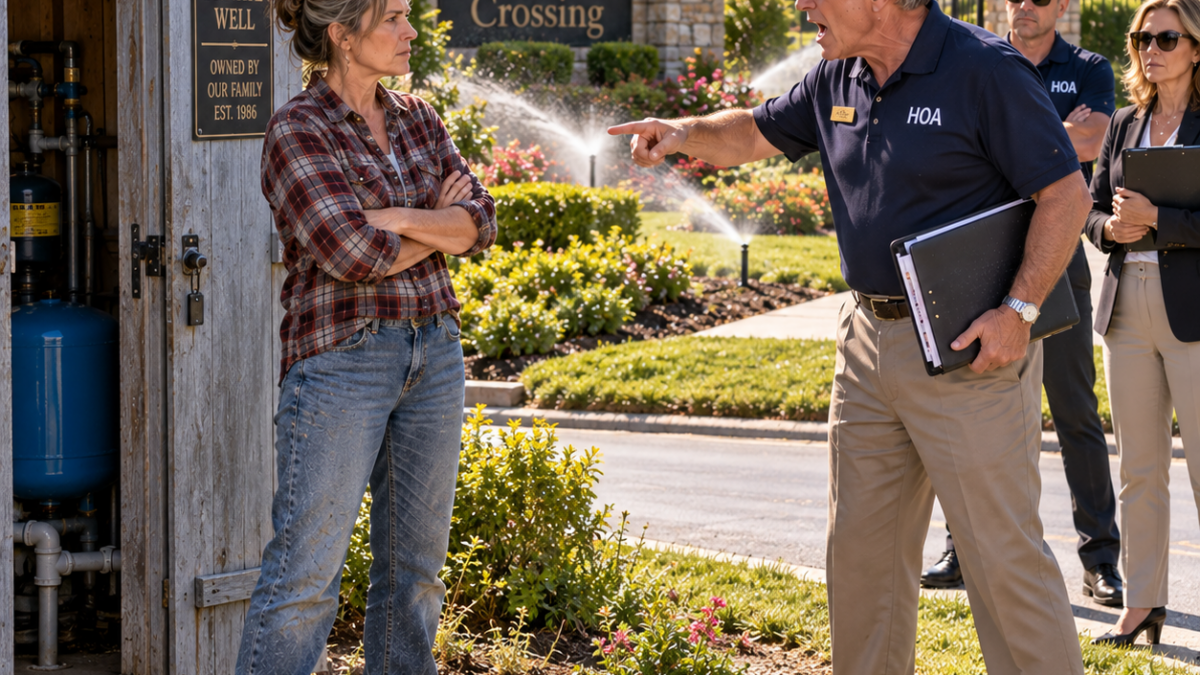
“No, this is the private well feed.”
The worker said it loudly enough for me to hear from across the strip of dead grass.
For a second, I thought I had misunderstood him.
Then Marcy Bell, who had stopped her SUV beside the entrance with her window down, turned toward me.
Her face had changed.
“Linda,” she whispered. “Did he just say private well?”
“Yes.”
The younger landscaper looked up.
Saw my phone.
Saw Marcy.
Then looked toward the older man standing near the controller.
Something passed between them.
Not guilt.
Not exactly fear.
Recognition.
The kind people show when they realize a sentence they use casually at work has become evidence in somebody else’s dispute.
The younger man closed the valve box.
Too fast.
The older man said something I could not hear.
Marcy looked at the dashboard of her SUV.
“My dash camera might have caught that.”
“Does it record audio?”
“When the window is down.”
“Please save it.”
She nodded slowly.
Grant Mercer had spent days telling residents that I was obstructing a community system.
Now one of the HOA’s own contractors had called the line exactly what I had suspected it was.
Private well feed.
At 8:14 that morning, Marcy sent me the video.
Her dash camera caught the sprinkler heads.
The landscaping crew.
My driveway in the background.
Then the worker’s voice.
Clear.
“No, this is the private well feed. The pressure isn’t holding.”
I saved the clip to my phone.
Then my computer.
Then a cloud folder.
Twenty-two years working county records had taught me another rule:
Anything important should exist in more than one place.
I printed my pump log.
Attached the transcript from Marcy’s video.
Then wrote another certified letter.
Based on observed pump activity, meter readings, synchronized irrigation cycles, and video evidence, I request immediate disclosure of any physical connection between Silverleaf Crossing common-area irrigation and the privately permitted well at 14 Old Cypress Road.
I sent it to Brightline Community Management.
Grant.
The HOA board president.
By late afternoon, Grant replied.
One sentence.
Your continued interference with association landscaping operations is being documented.
I stared at it.
Then the pump clicked on again behind the garage.
Broad daylight.
No shower running.
No sink.
No washing machine.
Across the road, two Ortega Landscape employees had reopened the green valve box.
I grabbed my notebook and walked to the edge of the median.
I stayed on my side.
The younger worker was kneeling beside the valve assembly.
His shirt said ORTEGA LANDSCAPE.
A stitched name above the pocket:
MIGUEL.
The older man near the controller had DALE stitched on his.
“Ma’am,” Miguel said, “you probably shouldn’t stand too close. We’re testing pressure.”
“I’m not touching anything.”
I held up my notebook.
“I’m documenting my pump.”
Dale turned around.
He looked at me.
Then past me toward the well house.
“You’re Mrs. Vail.”
“Yes.”
He exhaled.
“We’re just the landscaping contractor.”
“I know.”
“We don’t make board decisions.”
“I know that too.”
That seemed to matter.
I pointed toward the open box.
“When that zone starts, my pump starts.”
Dale looked at the line.
Then at the controller.
Then at me.
He did not deny it.
That silence was the first honest thing anyone connected to the HOA had given me.
“I’d have to check the schematic.”
“Do you have one?”
Miguel muttered without looking up:
“Not one they want us showing.”
Dale snapped his head toward him.
“Miguel.”
I did not move.
“I’m not trying to get either of you fired. I’m trying to understand why my private well is feeding HOA sprinklers while the board is telling me my private permit doesn’t exist.”
Dale’s face changed.
Just slightly.
Not surprise.
Recognition.
That mattered more.
“Permit?”
“Yes.”
“County permit?”
“W4178.”
He looked toward the entrance monument.
Then the houses.
Curtains moved.
People were watching.
Dale rubbed the back of his neck.
“We service whatever we’re contracted to service.”
“What does your contract call this line?”
He did not answer.
Miguel looked down into the valve box.
Then said quietly:
“Vail private well feed.”
Dale closed his eyes for half a second.
I wrote the phrase into my notebook.
VAIL PRIVATE WELL FEED.
The words looked small.
The implication did not.
Someone had known.
Maybe not Grant.
Maybe not Brightline.
Maybe an old contractor.
Maybe a developer from years ago.
But somebody had labeled that connection with our name and the word private.
Before I could ask another question, a dark sedan stopped hard at the curb.
Grant got out.
Pressed blue shirt.
Polished shoes.
No jacket because the temperature was already climbing.
“Dale.”
His voice carried across the median.
“I need you to stop discussing association infrastructure with unauthorized residents.”
Unauthorized residents.
Standing beside my own water.
Dale straightened.
“Mr. Mercer, she asked about the pressure problem.”
“The pressure issue is being handled internally.”
I looked at Grant.
“The line runs from your valve box toward my well.”
He gave me the same calm face he used at board meetings.
“Linda, this is exactly the interference I warned you about.”
“I’m asking your contractor why my pump starts when your sprinklers do.”
“You’re inserting yourself into a technical matter.”
“It’s my pump.”
His smile narrowed.
“That remains your position.”
Dale looked at him.
Quickly.
But I caught it.
Something had shifted.
My private permit had become “my position.”
Their missing documents had become “historical context.”
Their broken irrigation had become my interference.
I looked at Dale.
“Do your records identify this zone as connected to my well?”
Grant’s voice snapped.
“Do not answer that.”
Dale lifted both hands.
“I’m not answering anything.”
Then he looked toward the brown turf.
Tired.
Not angry.
Just tired.
Grant pointed toward the truck.
“Close the box. We’ll continue testing later.”
Miguel replaced the lid.
Dale gathered tools.
Before climbing into the truck, he stopped near me.
“Mrs. Vail?”
“Yes?”
“Old service notes aren’t always included in the current client packet.”
Grant turned.
“Dale.”
“I heard you.”
Then he left.
Grant stayed.
The entrance monument cast a sharp shadow across his shoes.
“You’re making this worse than it needs to be.”
“No.”
I looked at the crooked valve-box lid.
“I think I’m finding out how bad it already was.”
That evening, after sunset, I walked to the mailbox.
A folded sheet was inside.
No envelope.
No name.
Photocopy.
One corner stained with oil.
The top line read:
ENTRY MEDIAN — ZONE THREE.
Then:
VAIL PRIVATE WELL FEED.
Someone had circled those words with grease pencil.
I stood beside the mailbox until the light faded enough that I had to use my phone to read.
Ray would have noticed “feed.”
I noticed “Vail.”
Our family name had become an infrastructure label.
I scanned the sheet.
Photographed it.
Put one copy in the kitchen folder.
One in the fireproof box.
One online.
Then laid everything across the table.
Permit.
Inspection card.
Ray’s diagram.
Pump log.
Marcy’s dash-camera video.
Service note.
Grant’s emails.
Violation notices.
I had proof the line had been called private.
What I still did not have was the history.
Grant could say it was old shorthand.
He could say some technician labeled it incorrectly.
He could say a private well could still have shared-use rights.
I needed the service trail.
And eventually, the money trail.
The next morning, I called Ortega Landscape.
“Ortega Landscape, this is May.”
“My name is Linda Vail. I’m calling about Silverleaf Crossing entrance irrigation.”
Pause.
“Are you with the HOA?”
“No.”
Another pause.
“I own the well referenced in one of your service notes.”
Longer silence.
“I can take a message.”
“Please tell Dale I’m not asking him to violate client confidentiality. I’m asking whether your company has invoices or maintenance summaries identifying the water source for Entry Median Zone Three.”
May lowered her voice.
“Mrs. Vail, I really can’t discuss customer records.”
“I understand.”
I looked at the copied service note.
“Then tell him the HOA is claiming they have no record my well is private. If Ortega has serviced a line labeled as my private well feed, those records may be requested by the county.”
May stopped speaking.
Then:
“I’ll pass that along.”
Grant’s second violation notice arrived before Dale called.
NOTICE OF CONTINUED NON-COMPLIANCE AND DAMAGE EXPOSURE.
According to the board, my refusal to cooperate had caused stress damage to entrance turf, ornamental grasses, and seasonal plantings.
Silverleaf Crossing reserved the right to seek reimbursement for emergency water service.
Temporary irrigation repair.
Accelerated landscape replacement.
They were preparing to charge me for the lawn they had been watering with my well.
At the bottom Grant added:
Your personal disagreement with historical infrastructure practices cannot be allowed to harm the community.
Historical infrastructure practices.
I almost admired it.
A phrase big enough to hide twenty years of missing consent.
At 4:26, my phone rang.
“This is Dale Ortega.”
“Mr. Ortega.”
“I can’t send you our contract.”
“I understand.”
“I can’t give you confidential client records directly.”
“I understand that too.”
“But old invoice descriptions are billing history.”
I sat down.
Dale continued.
“And if invoices were copied to multiple board members over the years, they’re not exactly unknown inside Silverleaf.”
I reached for Ray’s old pen.
“I’m going to read you something.”
“Go ahead.”
“March 14. Three years ago. Service call. Entry Median Zone Three. Low pressure. Replaced cracked valve sleeve. Source listed as Vail Well Auxiliary Feed.”
I wrote every word.
“Next?”
“June 2. Seasonal startup. Tested controller zones one through six.”
Then he stopped.
“What?”
Dale’s voice lowered.
“Note says: confirm with Treasurer Mercer before mentioning private well source in homeowner packet.”
My pen froze.
“Say that again.”
He did.
Slowly.
“Confirm with Treasurer Mercer before mentioning private well source in homeowner packet.”
The kitchen felt smaller.
Grant had known.
Not inherited confusion.
Not an old map nobody understood.
Known.
“How long ago was that?”
“Last summer.”
“Was Grant treasurer?”
“Yes.”
“Anything else?”
Dale sighed.
“There was a backflow warning.”
My grip tightened.
“When?”
“Previous summer.”
“What did it recommend?”
“Either install proper metering and compliance protection for the private-well connection or disconnect the entrance irrigation from that feed.”
“Who received it?”
“Billing copy went to Brightline and Grant Mercer.”
I stopped writing.
For a moment, all I could hear was Ray’s wall clock.
Tick.
Tick.
Tick.
“Do you have this in writing?”
“Yes.”
“Can you send it?”
“I can’t directly.”
I closed my eyes.
“But if the county asks?”
“We produce it.”
That was enough.
Before hanging up, Dale said:
“Mrs. Vail?”
“Yes.”
“I told them last year this was going to become a problem.”
“Who is them?”
“The committee.”
Pause.
“Mostly Grant.”
After the call, I sat at the kitchen table with Ray’s pen in my hand.
The distinction was gone.
I was no longer dealing with an HOA that had lost an old permit.
I was dealing with a treasurer who had been told about the private source.
Told about compliance concerns.
Then threatened me when the system stopped working.
I opened the county environmental health website.
Formal request:
WELL USE AND BACKFLOW COMPLIANCE INSPECTION.
I attached everything.
Permit.
Inspection card.
Pump logs.
Marcy’s video.
Service note.
Violation notices.
Grant’s emails.
And Dale’s quoted invoice line.
Confirm with Treasurer Mercer before mentioning private well source in homeowner packet.
The pump started behind the garage while I was filling out the form.
I did not go outside.
I pressed SUBMIT.
The county confirmation came at 8:03 the next morning.
Inspection request received.
Assigned officer:
Daniel Hurst.
At 9:15, Daniel called.
“Mrs. Vail?”
“Yes.”
“This is Daniel Hurst, County Environmental Health.”
His voice was practical.
No fake friendliness.
No urgency.
“I’m reviewing what you submitted.”
I opened my notebook.
He asked for the permit number.
Parcel.
Address.
Whether the well served my home.
Whether I had ever signed a shared-use agreement.
“No.”
“Do you personally know there is a physical connection to HOA irrigation?”
“I know what I’ve documented.”
I listed it.
Pump cycles.
Meter readings.
Video.
Service note.
He was quiet.
Then asked:
“The HOA threatened to cap or transfer control of the well?”
“Yes.”
“Do not alter anything yourself.”
“I wasn’t planning to.”
“Don’t close valves. Don’t cut lines. Don’t remove fittings. Leave the physical condition as-is until we inspect.”
“I worked county records twenty-two years.”
He gave a short breath.
“Then you know why.”
“Yes.”
“Good.”
That afternoon I drove to the county building.
I had not been inside in almost three years.
Same beige walls.
Same automatic doors.
Same low shrubs outside.
For twenty-two years, I had been the person behind the counter.
Now I was the person carrying a folder.
It changed everything.
I had watched hundreds of residents clutch documents with both hands.
Had seen people’s voices shake because one file decided whether a septic system could be repaired, whether a well could be replaced, whether a property sale could close.
I had always tried to be patient.
That day, standing on the public side, I finally understood their hands.
Tanya was working the window.
She had started at Environmental Health during my last year.
“Linda?”
“Tanya.”
Her face softened.
“I heard about Ray. I’m sorry.”
“Thank you.”
She looked at the folder.
“Your well?”
“Yes.”
She nodded.
No gossip.
Just recognition.
County offices hear stories before the people arrive.
Daniel Hurst came out ten minutes later.
Forties.
Sun-browned hands.
County badge.
He led me to a small conference room.
I laid everything out.
He read slowly.
Permit first.
Ray’s inspection card.
Diagram.
Pump logs.
Photos.
Video transcript.
Grant’s emails.
Violation notices.
Service note.
When he reached the line about transfer of control, one eyebrow moved.
“That phrase concerns me.”
“It concerned me too.”
He opened the county database.
Typed W4178.
The screen populated.
14 Old Cypress Road.
Raymond and Linda Vail.
Private domestic well.
No ownership transfer.
No shared-use authorization.
No community irrigation approval.
Daniel turned the laptop slightly.
“This system does not identify Silverleaf Crossing HOA as owner, operator, or authorized shared user.”
I already knew it.
Still, seeing the county record made my chest loosen.
Tanya brought in a parcel-history printout.
“No infrastructure annexation either,” she said.
Daniel tapped the page.
“Field inspection still matters. If there’s a physical irrigation tie-in, we need to verify installation and backflow protection.”
“Because irrigation water could contaminate the well?”
“Potentially. Depending on configuration and pressure conditions.”
He said it simply.
That was what angered me most.
This did not have to become dramatic.
The rules existed for a reason.
He scheduled inspection for Tuesday morning.
Before I left, he handed me a stamped field-inspection notice.
I had barely reached my car when Grant emailed.
Linda, your decision to involve county regulators has escalated a manageable landscaping issue into a matter that may affect the entire community. Residents deserve to know who is responsible if the entrance continues to fail.
I read it twice.
Grant was preparing the audience.
By Friday, Silverleaf Crossing had a portal notice.
TEMPORARY IRRIGATION DISRUPTION UPDATE.
The board regretted the entrance landscaping stress.
The board was working with vendors.
The board was also dealing with “a private homeowner’s refusal to cooperate with infrastructure review.”
No name.
None needed.
Three cars slowed in front of my home before noon.
A woman I didn’t know stared at my well house.
A man walking a small white dog shook his head at me.
I said nothing.
The inspection was Tuesday.
Facts could wait four days.
Saturday morning, I walked my property with Ray’s old measuring wheel.
I wanted photographs before anything changed.
The strip between the HOA median and my side yard was dry.
Drought had bleached the ground.
But I could see a faint irregular line in the grass.
Ray always said trenches heal differently.
Compacted soil.
Different roots.
Slight settlement.
A buried pipe leaves a confession even after people forget where they put it.
I followed the discoloration from the green valve box.
Across the common strip.
Around a decorative boulder.
Toward my garage.
Marcy came outside carrying coffee.
“You finding it?”
“I’m finding where the ground thinks it is.”
She looked.
“My husband remembers when they installed something there.”
“When?”
“Eight years ago. Maybe nine.”
“Did they say what?”
“Irrigation upgrade.”
“Water source?”
“No.”
She frowned.
“They said it would save money.”
There it was.
Money before permission.
Marcy lowered her voice.
“Grant told residents this could mean a special assessment.”
“How much?”
“Twelve hundred per house.”
I looked at the entrance.
A thousand dollars has a way of making facts feel personal.
That afternoon, the anger finally walked across the street.
Todd Vance approached me while I was bringing my trash bin back.
His wife followed.
“Mrs. Vail, why are you doing this?”
“Doing what?”
“Letting the entrance die.”
“I’m not responsible for your entrance irrigation.”
“That isn’t what the board says.”
“The board left out my permit.”
His wife folded her arms.
“Our property values depend on that entrance.”
“I understand.”
“Do you?”
Todd sounded angrier.
“Some of us paid a premium because Silverleaf looked maintained.”
“And the HOA maintained that appearance using a private well without a legal agreement.”
“That is your claim.”
“That is what the county is inspecting Tuesday.”
His wife said:
“So dues go up because you refuse to share water?”
“No.”
I kept my voice level.
“Your dues go up if the HOA finally has to pay the real cost of its own landscaping.”
That landed.
Todd looked away.
Then Grant’s sedan appeared.
Allison Pike with him.
A third man stepped out carrying a tool bag.
They walked directly toward the green irrigation box.
My entire body tightened.
Marcy saw it.
“Linda.”
Grant did not approach me.
The contractor knelt and started opening the valve box.
I pulled out my phone.
Started recording.
Grant looked up.
“You need to stop filming association maintenance.”
“This is two days before a county inspection. What are you changing?”
Allison answered.
“We are preserving the site.”
“With a tool bag?”
The contractor froze.
Todd and his wife had stopped talking.
Marcy raised her phone.
Grant noticed the witnesses.
His tone softened.
“The association has a duty to mitigate further damage.”
“Then wait for Daniel Hurst.”
The contractor looked at Grant.
“You want me to close this?”
Grant did not answer immediately.
That silence did more damage than any accusation I could have made.
Finally:
“Close it.”
The man replaced the lid.
Grant walked away without looking at me.
Tuesday arrived hot and white.
At eight, the entrance grass looked like straw.
I had my folder.
Notebook.
Phone.
One bottle of water filled from my kitchen sink.
That detail mattered to me.
Nobody’s drinking water had failed.
Nobody’s home was dry.
No kitchen taps were off.
The only thing dying was ornamental landscaping.
Grant had spent a week pretending the neighborhood itself was thirsty.
Daniel arrived in a county truck.
A woman named Celia Morris came with him carrying a field tablet and orange flags.
Grant moved toward them before I could.
“Thank you for coming. This is a landscaping issue complicated by private concerns.”
Daniel looked at him.
“We’re here to inspect a possible unauthorized irrigation connection to a private permitted well.”
People heard.
Todd’s head turned.
Grant smiled tighter.
“I think once we clarify historical use—”
“We’ll start with the permit.”
That stopped him.
I handed Daniel the copy.
He checked it against his printout.
Then faced Grant.
“Please provide the water-use agreement authorizing HOA irrigation from this well.”
Grant lifted a folder.
“We are still gathering legacy records.”
“Do you have one today?”
“The association’s understanding—”
“Understanding is not an agreement.”
Silence.
Allison stepped forward.
“We’re not prepared to concede the well is private infrastructure.”
Daniel held up the permit.
“The county record identifies W4178 as a private domestic well attached to 14 Old Cypress Road.”
He looked at Grant.
“Transfer document?”
“Not with me.”
Daniel wrote.
“Shared-use authorization?”
Grant said nothing.
“Backflow compliance report?”
Dale Ortega shifted his weight.
Grant pointed toward him.
“Our landscape contractor should have technical records.”
Daniel turned.
“Mr. Ortega?”
Dale rubbed his jaw.
“We serviced the connection we were contracted to service.”
“Do you have a county-approved backflow report for the tie-in to Mrs. Vail’s well?”
“No.”
Someone behind me whispered:
“Tie-in?”
Celia opened the green valve box.
The fittings inside were old.
Sun-faded.
Not temporary.
She photographed everything.
Then asked Dale to identify the direction of the main feed.
He crouched.
Pointed.
Not toward the clubhouse.
Not toward the municipal service.
Toward my property.
Daniel looked at me.
“Mrs. Vail, may we inspect the well house?”
“Yes. For county inspection.”
I unlocked it myself.
Grant stayed outside.
That threshold mattered.
For days he had demanded control.
Now he stood beyond the door while the person with lawful authority entered with permission.
Inside, Daniel examined the pressure tank.
Permit tag.
Meter.
Pipe layout.
Ray’s diagram.
He read the brass plate.
“W4178.”
Same number Ray had polished every spring.
For a moment, I saw his hands.
Thumb rubbing the brass.
Telling me stamped numbers mattered because paint could peel and paper could be lost.
Back at the median, Daniel asked Dale to conduct a controlled pressure test.
No system alteration.
Normal valve operation only.
Dale opened the irrigation zone.
The response was immediate.
My well pump started.
The pressure gauge shifted.
The meter turned.
Across the road, sprinkler heads rose.
Coughed.
Spit weak brown mist.
Nobody had to explain anything.
Celia planted an orange flag beside the valve box.
Then another along the line toward my property.
She tied a temporary warning tag to the assembly.
Grant stepped forward.
“The connection predates current documentation.”
Daniel looked at him.
“Then provide the old documentation.”
“This is going to create substantial financial exposure.”
“That is not a water-quality defense.”
Todd spoke from the sidewalk.
“Wait.”
Everyone turned.
“Are you saying our entrance sprinklers have been using her well?”
Daniel did not answer for the HOA.
He looked at Grant.
For once, Grant had the whole neighborhood watching him and no prepared language.
Allison said:
“The association will review historical records.”
Daniel handed Grant a field notice.
“Preliminary finding: entrance irrigation appears physically connected to private permitted well W4178. No documentation has been provided showing authorized HOA use.”
Then he added:
“Operation of this connection is suspended pending review.”
Grant took the paper.
Daniel looked directly at him.
“Mr. Mercer, after being notified this well was privately permitted, who authorized continued operation of the connection?”
Grant opened his mouth.
Stopped.
Looked toward Allison.
Then the residents.
He said nothing.
Daniel wrote that down too.
Silence can be evidence when somebody has spent weeks speaking confidently.
The county truck left just before ten.
Residents stayed.
Nobody shouted.
That made it worse for Grant.
They spoke quietly.
Confused.
Embarrassed.
Angry in ways that had not yet chosen a target.
Marcy came toward me.
“Linda.”
“Yes?”
“I’m sorry.”
“You didn’t install the line.”
“No.”
She looked at the orange warning flags.
“But I believed the board update.”
That hurt more than I expected.
“I know.”
“I thought you were refusing water to us.”
“I know.”
She looked toward the brown grass.
“No houses were ever losing water.”
“No.”
“It was just this.”
“Yes.”
She shook her head.
“I feel stupid.”
“Don’t.”
“Why not?”
“Because somebody worked hard to make the story sound simple.”
For the next two weeks, Silverleaf looked exposed.
The entrance sign still stood.
Decorative lamps came on every evening.
But the grass went from brown-green to straw.
Sprinklers stayed down.
The illusion thinned.
Nobody lost drinking water.
Nobody’s shower stopped.
Nothing essential failed.
Only the unauthorized irrigation connection stopped.
Daniel’s preliminary report arrived fourteen days later.
I printed it.
Of course I did.
Entrance Median Zone Three physically tied to private domestic well W4178.
No shared-use agreement produced.
No authorized transfer.
No county-approved backflow documentation for HOA irrigation connection.
Association directed to discontinue use and submit related records.
The HOA withdrew both violation notices the next morning.
Brightline’s email said:
Prior notices were issued pending clarification of historical infrastructure records.
Pending clarification.
That was their apology.
I printed it anyway.
Then came the correction work.
Ortega Landscape had to physically disconnect the HOA side.
County wanted photographs.
Contractor notes.
Closeout inspection.
Dale knocked on my door before the work began.
“We won’t enter your well house unless inspection requires it.”
“I want to watch from my side.”
“Fair.”
Grant was not there.
Neither was Allison.
Two board members stood near the entrance wearing sunglasses.
The crew opened the valve box.
Traced the connection.
Cut the HOA irrigation line from the unauthorized feed.
Capped it on the common-area side.
Photographed every step.
Dale lifted the removed section for Celia’s inspection photo.
It was about three feet long.
Black plastic.
Mud stuck to one end.
After all those threats.
All those emails.
All those accusations.
Three feet of pipe.
Dale looked at it.
“Funny.”
“What?”
“How much trouble fits inside three feet of plastic.”
I almost laughed.
“Depends who pays for the water.”
He nodded.
“Fair.”
The financial review started next.
That was when Silverleaf residents learned why Grant had fought so hard.
The HOA’s entrance landscaping budget had assumed an extremely low water cost for years.
Because the community had not been paying the full price of irrigation.
It had been drawing from my well.
The landscaping invoices showed maintenance.
Controllers.
Valves.
Seasonal planting.
Repairs.
But water itself barely appeared as a cost.
Because Ray and I had unknowingly supplied it.
Not every day.
Not every zone.
But enough to make the million-dollar entrance cheaper to operate than it should have been.
The board had inherited a luxury feature with a hidden subsidy.
My pump.
My electricity.
My equipment wear.
My groundwater.
Grant had known enough to understand what would happen if the line disappeared.
The residents would finally see the real price.
That explained the threats.
It did not excuse them.
County requested Ortega’s old service records.
Dale produced them.
The notes were worse than what he had read to me.
One invoice from three years earlier:
Vail Well Auxiliary Feed — Entry Median Zone Three.
Another:
Private source pressure instability.
Then the note that mattered most:
Confirm with Treasurer Mercer before including private well reference in homeowner packet.
Another service recommendation:
Private well connection should be separately metered, legally authorized, protected by approved backflow device, or disconnected.
Distribution list:
Brightline Community Management.
Grant Mercer.
Facilities Committee.
That ended any argument that Grant had merely learned about the issue when I raised it.
He had known.
Brightline knew enough to have been copied.
Maybe not every manager.
Maybe not every board member.
But the information existed.
And someone had chosen not to put it in front of homeowners.
The board called an emergency meeting.
They held it in the clubhouse ballroom.
I did not want to go.
Marcy convinced me.
“You don’t have to speak.”
“I’ve spoken enough.”
“Then sit where people can see who they were talking about.”
I hated that reason.
It was also correct.
So I went.
The room was fuller than any HOA meeting I had ever seen.
Todd sat two rows ahead.
His wife beside him.
Marcy sat next to me.
Grant sat at the board table.
No polished blue shirt this time.
Gray jacket.
Water bottle.
Stack of paper.
The board president, Amelia Cross, opened the meeting.
“This session addresses the entrance irrigation compliance issue and related financial impacts.”
Related financial impacts.
Residents already knew what that meant.
Amelia read Daniel Hurst’s preliminary findings.
Private domestic well.
Unauthorized connection.
No shared-use agreement.
No backflow documentation.
Then she read the Ortega service history.
When she reached:
Confirm with Treasurer Mercer before mentioning private well source in homeowner packet,
the room changed.
A man near the back said:
“What?”
Grant leaned toward his microphone.
“That line is being taken out of context.”
Todd turned around in his chair.
“What context makes that sound better?”
A few residents murmured.
Amelia raised one hand.
“Please.”
Grant continued.
“There had been ongoing uncertainty about historical infrastructure rights. My concern was preventing residents from receiving incomplete technical information before the board understood it.”
I had heard that language before.
Context.
Historical uncertainty.
Incomplete information.
All words designed to turn knowledge into confusion.
Marcy raised her hand.
Amelia recognized her.
“Grant, did you know the contractor called it Linda’s private well?”
“We knew that was a historical vendor label.”
“Did you know the county permit showed it belonged to her parcel?”
“The management file did not contain that permit.”
I spoke before I intended to.
“The county file did.”
The whole room turned.
Grant looked at me.
I continued.
“You never asked the county.”
His jaw tightened.
Amelia looked toward me.
“Mrs. Vail, if you would like—”
“No.”
I shook my head.
“I don’t need a speech. I just want the timeline read correctly.”
Amelia nodded.
“Fair.”
So they read it.
Ray’s permit.
Twenty-two years old.
No transfer.
No shared-use agreement.
Ortega invoices.
Backflow warning.
Grant copied.
Brightline copied.
My first certified notice.
HOA response claiming no private permit in community file.
Access demand.
Violation notice.
Threat to cap or transfer the well house.
Pump logs.
County inspection.
Physical connection confirmed.
Every date made the room quieter.
Then came the financial estimate.
The HOA had two choices.
Install a lawful metered irrigation source.
Or redesign the entrance for drought-tolerant landscaping.
The metered connection cost was substantial.
So was annual water expense.
Someone behind me said:
“How much?”
Amelia read the estimate.
A resident whistled.
Todd leaned back.
His wife whispered something to him.
Grant took the microphone again.
“We were trying to avoid exactly this kind of cost escalation.”
That sentence ended him.
Not officially.
Not that night.
But socially.
Because everyone finally understood.
He had been protecting the budget by pretending my well belonged to them.
Todd stood.
“So when you told us Linda was refusing to help the community, what you meant was she was refusing to keep paying our water bill.”
Grant shook his head.
“That is an unfair characterization.”
“Is it?”
Todd looked around.
“No houses lost water.”
“No.”
“Just the grass?”
Amelia answered this time.
“Yes.”
“And her pump was paying for some of it?”
The board attorney leaned toward Amelia.
She spoke carefully.
“Pump-energy and maintenance-cost reimbursement are being evaluated.”
Todd laughed once.
Not humor.
Disbelief.
“My God.”
I looked at the floor.
I did not enjoy it.
That part surprised me.
For days I had imagined wanting Grant publicly exposed.
When it happened, it felt smaller than I expected.
Ray had always said the best correction was the one that made a problem stop.
Not the one that made somebody hurt.
At the end of the meeting, Amelia announced interim actions.
Grant removed from landscaping finance oversight.
No authority to communicate with contractors regarding the irrigation investigation.
Brightline required to preserve and produce all historical records.
Independent review of common-area utility sources.
No further enforcement against my well house.
The board attorney added:
“Mrs. Vail’s parcel is outside Silverleaf Crossing covenants. Future contact regarding the well will occur only through documented legal or regulatory channels.”
That sentence mattered.
My parcel.
Outside their covenants.
The same truth I had stated from the beginning.
The reimbursement agreement arrived the following week.
Not huge.
Not punitive.
I did not want a lottery ticket.
The HOA reimbursed part of the pump strain inspection.
Certified mail costs.
Professional inspection expenses.
A calculated portion of additional pump maintenance associated with the unauthorized irrigation draw.
They also paid for an electrical review because Daniel recommended verifying whether the years of cycling had shortened the pressure-switch life.
The electrician was a man named Scott Bell.
No relation to Marcy.
He spent forty minutes in the well house.
Then said:
“Your husband wired this?”
“Yes.”
“He knew what he was doing.”
“He’d like hearing that.”
Scott tapped the panel.
“Pressure switch is worn but not dangerous. I’d replace it.”
The HOA paid.
I made sure the invoice said why.
AUTHORIZED REPAIR FOLLOWING REMOVAL OF UNAUTHORIZED HOA IRRIGATION DRAW.
Specific words.
Specific history.
Then Silverleaf changed its entrance.
They removed the imported turf.
Residents complained.
For about two weeks.
Then crews brought gravel.
Native grasses.
Drought-resistant shrubs.
A row of low flowering plants.
They installed drip irrigation connected to a legal metered source.
The massive sprinkler heads disappeared.
So did the seasonal flower beds that required constant watering in August.
The entrance looked different.
Less like a resort.
More like where we actually lived.
Dry summers.
Hard sun.
Water worth respecting.
Marcy brought me a flat of lavender.
“Drought-friendly.”
I smiled.
“Ray would approve.”
“He liked lavender?”
“No idea.”
She laughed.
“He’d approve of the water use?”
“That part.”
Todd came by while I was planting.
He stood outside my fence.
“Mrs. Vail?”
“Linda is fine.”
He looked embarrassed.
“I owe you an apology.”
“You already apologized at the meeting.”
“No.”
He shook his head.
“I got angry at you before the inspection.”
“You were told I was causing a special assessment.”
“I should’ve asked.”
“Most people don’t.”
“That’s not an excuse.”
“No.”
He nodded.
Then looked across the road.
“The new landscaping actually looks better.”
“Don’t tell the old grass.”
He laughed.
It felt normal.
That mattered.
Grant stayed on the board for a while.
People expected some dramatic resignation.
There wasn’t one.
Real accountability rarely arrives with a slammed door.
First, Grant lost landscaping oversight.
Then finance signature authority related to utility projects.
Then the board required another officer on all vendor communications involving infrastructure.
At election time, he did not run again.
No farewell speech.
No confrontation.
His name simply disappeared from the agenda.
Brightline’s contract went through review.
They kept the account for another quarter.
Then Silverleaf hired a new management company.
The new manager, Simone Wade, sent me a letter before her first month ended.
Mrs. Vail,
Our records identify 14 Old Cypress Road as an external non-HOA parcel.
Private domestic well W4178 is not Silverleaf Crossing infrastructure.
No association employee, vendor, or representative is authorized to enter or operate the well house without owner permission or lawful regulatory authority.
Please retain this letter with your property records.
I laughed at that last sentence.
Retain this letter.
If Ray had been alive, he would have framed it just to annoy me.
I put it in the folder.
One evening near the end of summer, I decided to repaint the well house.
The old white paint had peeled around the doorframe.
Ray always bought the same shade.
Not bright white.
Just plain exterior white because he said pumps did not need curb appeal.
I scraped the loose paint.
Replaced the swollen door seal.
Cleaned the little window.
Then unscrewed the brass permit tag.
W4178.
Years of dust had dulled it.
I carried it to the workbench.
Polished it with the same rag Ray used to keep in the cabinet.
Slow circles.
Black residue coming off.
Numbers brightening.
There are objects that carry grief badly.
Wedding rings.
Hospital bracelets.
Certain photographs.
Then there are ordinary things that hold someone gently.
Ray’s red level.
The bent wrench.
A handwritten pressure reading.
That brass tag.
I screwed it back beside the tank.
W4178.
Private domestic well.
Raymond and Linda Vail.
No grand inscription.
No argument.
Just a number that had outlasted every HOA phrase thrown at it.
Marcy came over while I was cleaning brushes.
She brought lavender.
We planted it along the fence.
Across the road, the new low-water landscaping was settling in.
No fountains.
No huge wet turf strip.
No sprinkler mist drifting onto asphalt.
“Funny,” Marcy said.
“What?”
“Everybody thought the entrance would look cheap without the grass.”
“And?”
“It looks honest.”
I looked at her.
“That’s a strange word for landscaping.”
“It fits.”
We kept planting.
After she left, I turned on the little spigot beside my house.
Water ran over my hands.
Clear.
Cold.
My line.
For weeks, the sound of the pump had made my stomach tighten.
Every click felt like somebody using a key they did not own.
Now the pump cycled once.
Normal household demand.
Then stopped.
Quiet.
I stood beside the well house until sunset.
For the first time since Grant’s first demand, quiet did not feel like waiting for trouble.
A month later, Daniel Hurst returned for the county closeout.
He checked the capped HOA connection.
Reviewed Ortega’s photographs.
Looked inside the well house.
Confirmed no active tie.
Then signed his field form.
“Connection separation accepted.”
I smiled.
“Those might be my favorite three words this year.”
He almost smiled.
“Most people prefer ‘inspection passed.’”
“I’m retired county staff. We have strange tastes.”
He handed me the copy.
Then looked toward the entrance.
“New landscape seems sensible.”
“Less thirsty.”
“That usually helps.”
Before leaving, he paused beside the truck.
“Mrs. Vail?”
“Yes?”
“You did the right thing not shutting the valve yourself.”
“I knew better.”
“A lot of people wouldn’t.”
“If I had shut it, Grant could’ve said I broke the irrigation.”
Daniel nodded.
“Exactly.”
I had thought about that more than once.
How easily anger could have changed the record.
If I had cut the line.
Closed the valve.
Locked out an inspector.
Confronted the workers aggressively.
Grant would have had photographs of an angry widow interfering with infrastructure.
Instead, the pump told the story.
The meter told it.
The contractor records told it.
The permit told it.
That was enough.
Ray had understood that instinctively.
He used to say:
“Don’t fight a machine when you can watch what it does.”
I had thought he meant repairs.
Maybe he meant more.
The next summer was hotter.
Silverleaf issued drought restrictions early.
The native grasses near the entrance stayed green-gray instead of glossy green.
Lavender bloomed along my fence.
My well house stayed quiet except when my home asked it for water.
No HOA crews came near it.
No emails.
No violation notices.
One morning, I saw a new landscaping technician standing at the entrance with a tablet.
He looked across the road.
Then approached my driveway but stopped before stepping onto it.
“Mrs. Vail?”
“Yes?”
“I’m with the new contractor.”
“I figured.”
He held up the tablet.
“Our schematic shows your well as private and disconnected. I just wanted to verify the orange survey marker near the old line is supposed to stay.”
I looked at it.
“Yes.”
“Okay.”
He started to turn.
“That’s it?”
He smiled.
“That’s it.”
I almost laughed.
Permission.
Question.
Answer.
Done.
It should have been that simple from the beginning.
That evening, I opened Ray’s old folder one more time.
His maintenance notes were still there.
June 4 — pressure switch.
August 16 — clean filter housing.
Check seal before August heat.
Do not tie to common irrigation without separate meter and county approval.
I traced that sentence with one finger.
He had written it years before Grant ever threatened me.
Years before Silverleaf decided my well was “legacy infrastructure.”
Years before anybody called its water a community asset.
Ray had seen the problem in one temporary request.
What starts temporary becomes expected.
What becomes expected becomes claimed.
I finally understood why he had been so stubborn.
Ownership rarely disappears in one dramatic act.
Sometimes it disappears through convenience.
A borrowed line.
An old contractor note.
A bill nobody questions.
A board member saying, “It’s always been this way.”
Then one day the people benefiting from it forget there was ever an owner to ask.
I closed the folder.
Put it back in the metal cabinet.
The repaired violation notice stayed in a separate file.
So did Daniel’s report.
Simone’s letter.
Ortega’s closeout photographs.
The reimbursement agreement.
Not because I expected another fight.
Because records are how you keep convenience from becoming history.
Before locking the well house, I looked at the brass tag.
W4178 caught the last orange light through the little window.
For years, Silverleaf Crossing’s luxury entrance had treated my private water as if it belonged to whoever needed it most.
Then their sprinklers failed.
Their grass went brown.
Their paperwork fell apart.
And suddenly the well they had called unauthorized became the one thing they desperately wanted access to.
But in the end, the answer had never been complicated.
Ray built that well for this house.
The county permitted it to this parcel.
Nobody transferred it.
Nobody donated it.
Nobody signed it away.
I closed the door.
Turned the key.
Behind me, the new HOA landscaping rustled dryly in the evening breeze.
No hissing sprinklers.
No muddy spray.
No pump starting without my house asking for water.
Just quiet.
My house.
My line.
My well.
And after all those years, that was finally enough.








