The HOA tore down the only shade tent on our block while seven seniors stood beside it in 103-degree heat.
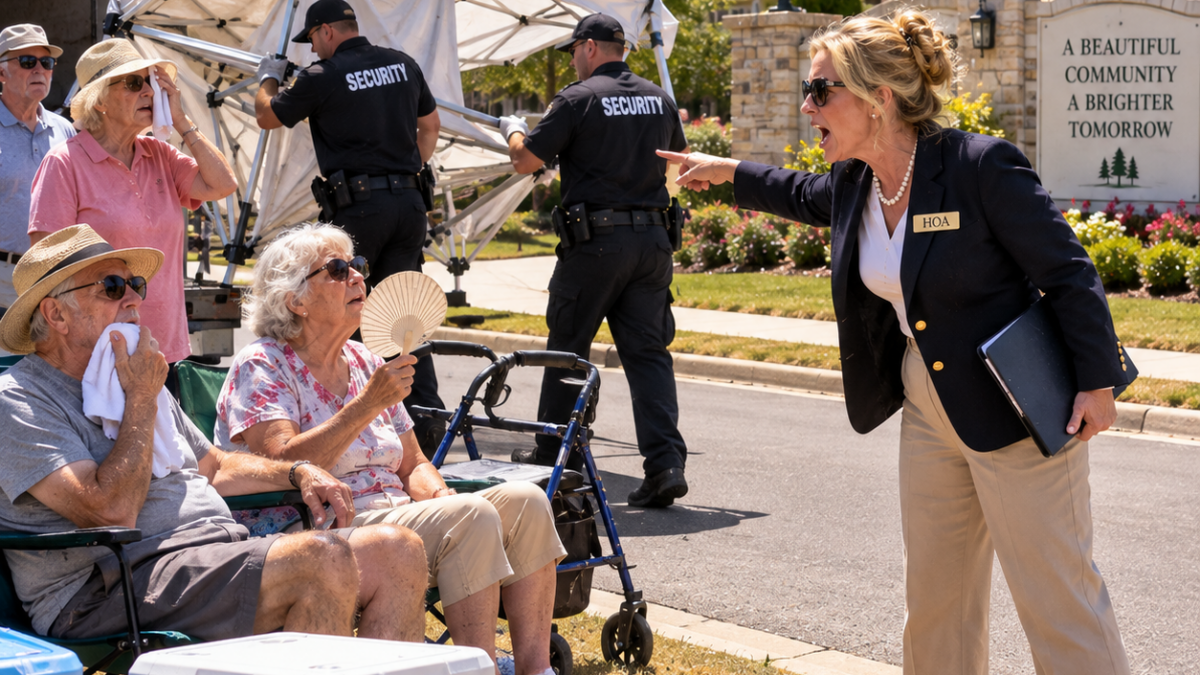
I did not answer immediately.
The woman on the phone introduced herself as Mavis Lane.
I knew the name.
Anyone who had lived in Sunbridge Villas longer than ten years knew Mavis, even if they had never spoken to her.
She had been board secretary back when the development was smaller, before the new clubhouse renovation, before the “Summer Villas lifestyle program,” before every emergency procedure somehow became an amenity package with a logo.
She was seventy-nine now.
Vera Ellis had given her my number.
“You remember Appendix C?” I asked.
“I typed part of it.”
I sat down at my kitchen table.
The broken battery fan lay beside the violation notice.
Marjorie’s fan.
I had retrieved it from the driveway after security left.
One corner was scratched now.
The blades still worked.
“Mavis,” I said, “management sent me the emergency heat protocol. Appendix C is listed in the index, but it isn’t in the packet.”
“I wondered if they would leave that one out.”
That sentence made me straighten.
“You expected it?”
“No.”
A pause.
“But I’m not surprised.”
I looked through the glass door toward my empty driveway.
The rectangle where the tent had stood was still visible because the concrete beneath it had not yet fully heated to the same color as everything around it.
“Tell me what Appendix C says.”
“Backup cooling points.”
“That’s all?”
“No.”
Her voice grew firmer.
“Locations.”
I waited.
“Three neighborhood points were designated after the blackout summer. Mesquite Court ramada. East Pool breezeway. Willow Palm curve.”
My pulse started climbing.
“Willow Palm curve where?”
“You know where.”
I did.
I still made her say it.
“Near your driveway.”
I closed my eyes.
Six years earlier, a transformer outage had knocked out part of the senior villas during a July heat advisory.
Marjorie was alive then.
She had carried cases of water from our garage to the curb and put up the same white canopy security had just broken.
Back then nobody complained.
Nobody called it unauthorized.
The HOA had thanked her.
“Mavis,” I said, “was my property formally listed?”
“The original map listed the location, not the homeowner. Safe curb access. Gentle grade. Closest point to the senior row without crossing the boulevard.”
“And later?”
“Marjorie’s name was handwritten into the working binder.”
My throat tightened.
Mavis continued more softly.
“She became the volunteer point because she was always there.”
I looked at the little fan.
Marjorie had died three years earlier from ovarian cancer.
The last summer she was healthy enough to help outside, she still insisted on setting the chairs facing away from the afternoon sun.
“Old people hate having everybody stare at them while they feel bad,” she once told me.
I had laughed.
She hadn’t.
“You still have the binder?” I asked.
“My secretary copy.”
“Can I see it?”
“Come tomorrow morning.”
“How early?”
“Before the heat turns ugly.”
I almost smiled.
“You sound like Marjorie.”
“That is because Marjorie and I were right about many of the same things.”
That was the first moment all day I laughed.
Small.
Unexpected.
Necessary.
Before we hung up, Mavis added something else.
“Tom.”
“Yes?”
“Brielle wasn’t on the board when we adopted the plan.”
“I know.”
“She may genuinely not know the history.”
“That would explain why she ordered the tent down.”
“Yes.”
“But it doesn’t explain why Appendix C is missing.”
Mavis was silent.
“No,” she said. “It does not.”
After the call, I opened the twenty-six-page packet again.
Emergency Heat Protocol.
Adopted August 14, six years earlier.
Appendix A: Heat Advisory Communication Template.
Appendix B: Clubhouse Cooling Room Setup.
Appendix C: Neighborhood Backup Cooling Stops.
Appendix D: Resident Wellness Call Script.
C was missing.
Not misnumbered.
Not renamed.
Missing.
I printed the index.
Then I laid it beside Brielle’s portal letter.
She had called my setup a “shadow amenity.”
A “medical-adjacent resident service point.”
I read those phrases again.
Then I looked at the missing appendix title.
If Mavis was right, my driveway hadn’t become a rogue cooling station because I put up a tent.
It had been incorporated into the HOA’s own emergency plan years before.
At 8:15 the next morning, I parked outside Mavis Lane’s house.
Her section of Sunbridge was older.
The houses had deeper eaves and actual covered porches.
Nobody had redesigned them yet to eliminate “visual clutter.”
Mavis opened the door before my second knock.
Silver hair pinned neatly behind her head.
Straight posture.
Reading glasses hanging from a chain.
“Come in.”
Her dining room looked like an archive.
Binders.
Folders.
Old board packets.
Sticky notes.
Printed maps.
She pointed at the kitchen.
“Coffee?”
“Water.”
“That is what I expected.”
She handed me a glass, then tapped one thick binder on the table.
HEAT RESPONSE — BLACKOUT YEAR.
“I kept paper copies because when Palmyra took over management, everyone acted like digital meant permanent.”
She opened the binder.
“Sometimes digital just means easier to lose.”
The first document was the board resolution.
Unanimous vote.
Emergency heat response protocol adopted after the transformer outage.
Below it were meeting minutes.
Mavis slid them toward me.
“Read that paragraph.”
I did.
The association shall maintain accessible cooling options during declared heat advisories, including primary clubhouse cooling-room access and neighborhood backup points when distance, mobility, access control, or equipment limitations interfere with safe resident use.
I read it again.
Distance.
Mobility.
Access control.
Equipment limitations.
Every problem we had encountered the previous morning.
“Mavis.”
“I know.”
She turned the tab.
Appendix C.
There it was.
A photocopied neighborhood map.
The senior villas shaded yellow.
Clubhouse circled blue.
Three backup points marked red.
MESQUITE COURT SHADE RAMADA.
EAST POOL BREEZEWAY.
WILLOW PALM LANE CURB POINT.
Beside the Willow Palm mark was a handwritten note.
Prescott driveway shade / safe curb access / volunteer water support if available.
I stared at Marjorie’s last name.
My last name.
For six years, I had thought what we did during heat waves was informal.
Neighborly.
Something Marjorie had started because she saw Mrs. Delgado and two other women struggling in the sun.
I hadn’t known the board had built it into the emergency plan.
Mavis watched my face.
“She always put the chairs facing away from the sun.”
I looked up.
“She said people shouldn’t have to squint while pretending they felt fine.”
Mavis smiled.
“That sounds like her.”
“It sounds exactly like her.”
Another page contained a volunteer list.
Halfway down:
Marjorie Prescott — Willow Palm.
Emergency water support.
Resident check-ins.
I turned my head toward Mavis’s window.
For a second, I could see Marjorie in our driveway.
White baseball cap.
Hair pulled through the back.
Dragging a cooler I had told her was too heavy.
“Stop treating me like I’m made of spun glass, Tom.”
That had been her answer.
Even during chemo, she hated being fussed over.
“Mavis,” I said, “was this appendix actually adopted or just discussed?”
“Adopted.”
“Board vote?”
“Yes.”
“Ever repealed?”
“Not while I was secretary.”
“Replaced?”
“If there is a replacement, management should have produced it.”
I photographed every page.
Then Mavis stopped me.
“Use my scanner.”
“Why?”
“Because photographs get accused of leaving out context.”
I looked at her.
“You’ve been through HOA disputes.”
“I was secretary for nine years.”
“Same thing.”
She smiled.
When the scan finished, she loaded everything onto a thumb drive.
Then she held it for a second before handing it over.
“You can say I retained the secretary’s copy.”
“Okay.”
“You can say Appendix C matches the adopted minutes.”
“Okay.”
“If anyone says I fabricated it, they can come ask me personally.”
“Are you sure?”
She looked offended.
“Tom, I am seventy-nine years old.”
I waited.
“If this HOA wants to frighten me with a committee chair in white pants, they should have tried before my second hip replacement.”
I laughed again.
Marjorie would have loved her.
Before I left, Mavis walked me to the porch.
“Your block was chosen for a reason.”
“I know.”
“No street crossing.”
“Right.”
“Wide curb cut.”
“Yes.”
“Gentle grade.”
“Yes.”
She nodded.
“Feelings matter. Records travel farther.”
At 9:06, I sent Palmyra Management a supplemental request.
Please produce Appendix C — Neighborhood Backup Cooling Stops, as referenced in the Emergency Heat Protocol and Summer Heat Comfort Guide.
Please explain why Appendix C was omitted from the July 18 production.
I attached only the index page.
Not Mavis’s full binder yet.
At 9:22, the portal showed RECEIVED.
At 9:31, my daily fine increased from $150 to $300.
At 9:37, Brielle posted a new neighborhood message.
Residents are reminded not to rely upon outdated volunteer materials or unauthorized homeowner interpretations of current association policy.
Outdated volunteer materials.
Interesting wording.
Not nonexistent.
Not fabricated.
Outdated.
I opened Mavis’s scan.
At the bottom of Appendix C, one line was underlined.
Backup points must remain accessible during declared heat advisories.
Outside my window, two senior residents had already stopped near the empty rectangle of concrete where the canopy had stood.
They looked around.
Then walked on.
I felt something cold settle in my stomach despite the heat.
Twelve minutes after I sent management the scanned Appendix C page, a new upload appeared.
SUPPLEMENTAL PRODUCTION — HEAT ADVISORY MATERIALS.
That told me what I needed to know.
They had the records.
They simply hadn’t planned to send them until I proved I knew they existed.
There were six files.
The first was the security work order.
REMOVE UNAPPROVED CANOPY AND ASSOCIATED GATHERING MATERIALS AT 417 WILLOW PALM LANE BEFORE PREVIEW TRAFFIC INCREASES.
Resident verbally advised.
Avoid discussion with other residents.
Photograph completion.
Authorized:
B. Ainsworth.
Timestamp:
9:52 a.m.
Fifty minutes before security reached my driveway.
I printed it.
The second file contained the entrance-camera footage.
I didn’t want to watch.
I watched anyway.
No sound.
The white canopy stood against the driveway.
Mrs. Delgado with her walker.
Walt beneath his ball cap.
Vera with Marjorie’s little fan.
Four other residents sitting or standing beneath the shade.
Brielle’s golf cart arrived.
Two guards stepped out.
The video was almost boring.
That was what made it painful.
No crowd.
No chaos.
No disorder.
Just seniors waiting in shade while two uniformed men dismantled it.
At 10:46, one guard folded the frame wrong.
The hinge snapped.
At 10:48, the canopy went onto the utility cart.
At 10:49, the seven residents shifted toward the thin strip of garage shade.
I wrote every timestamp.
The third file was an email chain.
Subject:
PREVIEW OPTICS / WILLOW PALM SETUP.
Sent by Brielle at 8:31 that morning.
We cannot have seniors lined up beneath a pop-up tent during the Summer Villas preview. It suggests the association has failed to provide adequate cooling resources. Please have the canopy and related materials removed before guest arrivals.
I read the first sentence once.
Then the second.
Then the third.
It suggests the association has failed.
That was the concern.
Not emergency access.
Not a blocked sidewalk.
Not fire clearance.
Not medical liability.
The seniors were visible.
Aaron Cheswick had replied at 8:44.
Do we have a formal violation basis?
Brielle responded five minutes later.
Temporary structure. Unapproved resident service point. Appearance standards. Liability exposure. Use all applicable language.
I leaned back.
Use all applicable language.
A rule had not created the decision.
A decision had gone searching for rules.
I made a timeline.
8:31 — Brielle: seniors under tent create bad optics.
8:49 — use all applicable violation language.
9:52 — security work order.
10:42 — removal begins.
10:48 — canopy loaded.
11:03 — cooling-room doors locked.
11:11 — HVAC limitation photographed.
12:18 — records request.
5:58 — daily fine issued.
Next morning — Appendix C discovered.
I laid Appendix C beside Brielle’s email.
Backup points must remain accessible.
Beside that, I placed a still image from security footage.
Seven seniors beneath the listed backup-point shade.
Then another still.
No tent.
Residents standing in the sun.
There are moments when a dispute stops being interpretive.
This was one of them.
I sent a preservation notice to Gloria Denton, the risk contact listed in the HOA’s annual insurance disclosure.
I copied Palmyra Management.
I attached the public protocol index, Appendix C excerpt, HVAC ticket, work-order timestamp, and Brielle’s preview email.
No accusations.
No legal threats.
No emotional language.
I asked only that all records be preserved concerning:
Heat exposure.
Cooling access.
Appendix C.
Clubhouse HVAC limitations.
Removal of the Willow Palm backup point.
At 11:06, Brielle called.
“Mr. Prescott.”
Her voice was perfectly controlled.
“You are escalating this beyond a neighborhood compliance matter.”
“It stopped being a compliance matter when you fined me for a location your own protocol listed.”
“That material is outdated.”
“Produce the document that replaced it.”
“The current board has discretion over active amenities.”
“Emergency protocols aren’t amenities.”
Silence.
“That kind of language is not productive.”
“Neither was medical-adjacent.”
“I am trying to protect the association.”
“From what?”
“Risk.”
“No.”
I stood at my garage doorway.
Heat shimmered above the empty driveway.
“You were trying to protect the association from looking like it had risk.”
Her voice sharpened.
“If you involve the carrier, you may create premium consequences for every homeowner.”
There it was.
The next pressure point.
If embarrassment didn’t work, money might.
“Then the board should have followed the protocol before it became a carrier matter.”
“You don’t understand board operations.”
“I understand prior notice.”
She went quiet.
Then polished again.
“Palmyra will respond formally.”
“I look forward to it.”
I ended the call.
At 11:38, Gloria Denton emailed.
Mr. Prescott,
I have reviewed your preservation request and attached records. Because the submitted materials indicate a potential conflict between an active heat-response protocol, known cooling limitations, and enforcement action during a declared heat advisory, I will conduct an on-site risk review tomorrow afternoon.
Please preserve all timestamped materials.
Management is requested to make personnel and relevant records available.
I read it twice.
Outside, Brielle’s golf cart sped toward the clubhouse.
For the first time since the canopy came down, she looked hurried.
By noon the next day, Sunbridge Villas looked remarkably compassionate.
The clubhouse doors were propped open.
Two cases of bottled water sat beside the lobby desk.
A folding sign announced:
COOLING ROOM OPEN TO RESIDENTS.
Pool umbrellas had been untied.
A box fan had appeared in the east room.
The preview banners were gone.
If Gloria arrived without context, it would look like a model heat-response program.
So at 12:20, I walked the route.
Senior villas to clubhouse.
Full sun.
Decorative palms producing almost no usable shade.
Long curb transitions.
A section of pavement radiating heat through my shoes.
Inside the east cooling room, the thermostat near the door read 76.
Near the resident chairs, my handheld thermometer read 83.
Not dangerous.
Not unusable.
But not the polished seventy-four-degree oasis the HOA brochure promised either.
Walt called the new setup “panic housekeeping.”
Vera called it “theater with bottled water.”
Mrs. Delgado didn’t comment.
At 12:40, she stood under my garage overhang again, waiting for her daughter.
That was the issue Brielle still didn’t understand.
Access was not simply whether a room existed.
It was whether a person could safely reach it.
I wanted to put the tent back.
I didn’t.
The broken frame sat in a bag against the wall.
I kept everything exactly as Gloria had asked.
At 1:06, Aaron Cheswick arrived alone.
He walked up my driveway with no tablet.
No golf cart.
Just himself.
“Tom.”
“Hello, Aaron.”
“The board authorized me to discuss a resolution.”
“That seems early.”
He gave a tired smile.
“Early is better than adversarial.”
“I agree.”
“The association will withdraw your daily fine and mark the matter resolved.”
I waited.
“Provided you agree not to operate any private cooling station, resident gathering point, or temporary shade structure during the remainder of this heat advisory.”
“No.”
He blinked.
“You haven’t heard the full offer.”
“I heard the condition.”
“Tom, I am trying to help.”
“No. You’re trying to close the file before Gloria gets here.”
“The cooling room is open.”
“Because Gloria is coming.”
“Because management responded to resident concerns.”
“Then put that in writing.”
His jaw tightened.
“If this continues, there may be consequences beyond your account.”
I nodded.
“There it is again.”
“What?”
“The part where everyone is supposed to fear consequences except the people who took down the listed backup point.”
Aaron looked at the pavement.
He was not Brielle.
That mattered.
He had repeated bad language.
Approved bad notices.
But he was also the person who had looked worried when he saw the yellow HVAC tag.
So I asked him something directly.
“Did you know Appendix C named Willow Palm before yesterday?”
“No.”
The answer came immediately.
No calculation.
“Did Brielle?”
Aaron’s eyes moved toward the clubhouse.
He said nothing.
That answer mattered too.
At 1:28, Brielle arrived.
Pale blue blouse instead of the slate blazer.
White pants again.
No sunglasses.
“Aaron, I can handle this.”
He stepped aside.
She faced me.
“Mr. Prescott, I understand you feel strongly.”
“I feel accurately.”
“We’re prepared to withdraw the fine as a courtesy.”
“No.”
Her expression tightened.
“You want the fine withdrawn in exchange for me agreeing not to use the canopy.”
“The canopy is the violation.”
“And Appendix C?”
“Outdated.”
“Then why did yesterday’s public heat guide tell residents to use backup cooling points?”
Her eyes flicked toward Aaron.
“Old materials circulate.”
“Old materials don’t authorize new security work orders.”
“You are turning this into a trap.”
“No. I’m turning it into a timeline.”
Mrs. Delgado stood beneath my garage overhang.
Vera beside her.
Mr. Ochoa came around the corner.
Walt approached from across the lane.
Brielle saw them.
Immediately, her professional smile returned.
“The clubhouse cooling room is now open.”
Vera tilted her head.
“Now?”
“The room is open.”
Mrs. Delgado looked down Willow Palm.
“My daughter is coming in ten minutes.”
“We can arrange a golf-cart escort.”
Walt tapped his cane once.
“Yesterday we were confusion.”
Nobody moved.
“Today we get valet service.”
Brielle looked at him.
Then at me.
Then at my clipboard.
“Must you document every conversation?”
“No.”
I wrote the time.
“Only the ones that keep changing.”
Her phone buzzed.
Aaron’s buzzed one second later.
Then mine.
Email from Gloria Denton.
I will arrive at 2:10 p.m. with Dina Hart, regional emergency management liaison, for site observation regarding heat-response access, designated backup-point status, and resident-route conditions.
Please leave all temporary materials as currently positioned until review is complete.
I looked up.
Brielle had already read it.
For once, she didn’t speak first.
At 2:10, a white sedan turned onto Willow Palm Lane.
Gloria stepped out with a folder under one arm.
Dina Hart exited the passenger side.
County emergency-management badge.
Work shoes.
No blazer.
No sunglasses.
By then, sixteen senior residents had gathered beside my garage.
Not because I summoned them.
Because word had spread that somebody was finally coming to look at the route.
Gloria stood at the curb for several seconds.
She looked toward the senior villas.
Then my driveway.
Then the clubhouse.
Dina did the same.
Risk people observe before they interview.
Brielle approached.
“Ms. Denton. Thank you for coming.”
Gloria nodded.
“We have reopened the cooling room and made bottled water available,” Brielle continued. “Unfortunately, this matter has been distorted by a homeowner compliance dispute.”
“We’ll get to compliance.”
Dina pointed down the lane.
“The senior villas begin at that bend?”
“Yes,” Aaron said.
“How far to the clubhouse entrance?”
He looked at his tablet.
“Approximately—”
“Quarter mile by sidewalk,” I said. “Longer if someone has to use every curb ramp.”
Dina looked at my driveway.
“This point?”
“Less than half the distance. Gentle slope. Wide curb cut. No road crossing.”
Brielle gave a small smile.
“This is private property, not an HOA amenity.”
Gloria opened her folder.
“Appendix C identifies it as a neighborhood backup cooling point.”
She laid two maps on the hood of her sedan.
Mavis’s secretary copy.
The version produced from Palmyra’s records.
They matched.
Gloria read aloud.
“Willow Palm Lane curb point. Prescott driveway shade. Safe curb access. Volunteer water support if available.”
Dina looked at the narrow garage shade where six residents stood.
“This is the current observed waiting location.”
“It is not authorized,” Brielle said.
“It is listed,” Gloria replied.
“Historically.”
Gloria looked at Aaron.
“Show me the document deactivating it.”
Aaron swallowed.
“We are reviewing historical records.”
“That was not my question.”
Brielle stepped in.
“The board maintains discretion over temporary structures and resident safety management.”
Gloria nodded.
“Then show me the board action removing this location from the emergency protocol before yesterday’s enforcement.”
Nobody spoke.
Dina started walking.
From my driveway toward the senior villas.
Then back toward the clubhouse.
She stopped beneath a palm.
Looked at the ground.
Kept walking.
When she returned, she asked:
“Is this the route residents were directed to use when the tent was removed?”
“Residents were directed to official amenities,” Brielle said.
“During what hours?”
“Posted resident cooling hours.”
I handed Gloria the photograph.
Cooling-room resident access:
12:00 p.m. to 2:00 p.m.
Tent removal:
10:42 a.m.
Mrs. Delgado spoke from behind me.
“My daughter picked me up at eleven-fifteen.”
Dina turned.
“You were waiting here?”
“Yes.”
“Why?”
“That is where I told her I would be.”
Brielle interrupted.
“We cannot build community policy around individual pickup preferences.”
Walt raised his cane.
“You built it around preview guests.”
Gloria turned toward him.
“Did you attempt clubhouse access?”
“Yes.”
“What happened?”
“Locked front door.”
“Side entrance?”
“Guest priority.”
Vera spoke.
“Pool umbrellas were closed too.”
Gloria opened the HVAC records.
“Zone two cooling limited. Recommend temporary fan support or reduced occupancy until service.”
She looked at Aaron.
“Was the insurer notified the designated primary cooling room had reduced performance during the active advisory?”
“I’d need to check.”
Brielle said, “The room is open today.”
Dina looked at her.
“Today is not yesterday.”
That sentence landed harder than anything I could have said.
Gloria asked to see the security video.
I opened it on my tablet.
No sound.
Brielle’s cart.
The guards.
The white tent.
Mrs. Delgado.
Vera.
Walt.
Seven seniors.
The hinge breaking.
The canopy leaving.
At 10:49, Mrs. Delgado shifted toward my garage.
Dina pointed at the screen.
“That’s the removed structure?”
“Yes,” Brielle said. “Unauthorized.”
Gloria tapped Appendix C.
“Backup-point shade support.”
“The appendix does not grant Mr. Prescott authority to operate a public station.”
“No,” Gloria said.
She looked at Brielle.
“But it establishes that the association previously identified this location as serving an emergency cooling function and had written reason to preserve access during declared advisories.”
The residents behind me went very quiet.
Not victorious.
Relieved.
There is a difference.
Then Gloria removed one more page.
Brielle’s email.
We cannot have seniors lined up beneath a pop-up tent during the Summer Villas preview. It suggests the association has failed to provide adequate cooling resources.
“Who wrote this?”
Brielle didn’t deny it.
“I did.”
“Was your concern that the residents were unsafe?”
Silence.
“Or that the residents were visible?”
Aaron looked toward the ground.
Brielle’s face did not move.
“We may want board counsel present,” Aaron finally said.
Gloria nodded.
“You may involve counsel.”
Then she closed the folder.
“From a risk perspective, this is no longer a basic appearance-standard violation.”
She counted on her fingers.
“Active heat protocol.”
“Known clubhouse cooling limitations.”
“Designated backup point.”
“Mobility-limited residents.”
“Delayed clubhouse access.”
“Security removal of shade.”
“Declared heat advisory.”
Dina added:
“And the route residents were directed toward was farther, hotter, and unavailable during part of the relevant period.”
Gloria looked at Aaron.
“Until review is complete, there will be no additional fines, removals, or cooling-access restrictions at this location without written risk approval.”
Aaron nodded immediately.
Brielle did not.
Dina looked at me.
“Can the canopy be reassembled?”
“Not safely. The frame is broken.”
Mrs. Delgado’s daughter pulled to the curb.
Air conditioning running.
Brake lights glowing.
Mrs. Delgado started toward the car, then stopped.
She turned toward Brielle.
Then Gloria.
Then the empty driveway.
Her voice was very soft.
“Where are we supposed to wait tomorrow?”
No one from Sunbridge answered.
Gloria wrote that down.
The correction notice appeared the next morning at 8:12.
It did not apologize.
HOAs rarely start there.
But it did something more useful.
The violation against Thomas Prescott concerning unauthorized temporary structures and associated resident-gathering materials is withdrawn.
All related daily fines are reversed.
Sunbridge Villas acknowledges that Willow Palm Lane was historically designated as a backup cooling location under prior emergency-response materials.
Emergency cooling procedures are under immediate review.
I printed three copies.
Mrs. Delgado did not use the portal.
Neither did Walt.
Walt knocked before nine.
He looked at the notice.
Then at the empty driveway.
“They wrote it like the paper made the mistake.”
“They withdrew the fine.”
“Bare minimum.”
“Bare minimum is still movement.”
Vera came twenty minutes later with two muffins wrapped in foil.
She had already marked the notice in red pen.
“Historically designated.”
“I saw it.”
“That’s their escape hatch.”
“Yes.”
“They are going to say it was old.”
“Probably.”
She handed me a muffin.
“Are you always this calm?”
“No.”
“You look calm.”
“That is because Marjorie trained me not to argue while chewing.”
Vera laughed.
The formal risk memo came five days later.
Gloria’s findings were direct.
Sunbridge had prior written heat-access obligations.
The clubhouse had documented HVAC limitations.
Willow Palm had not been formally removed as a backup point.
Security removed shade without a risk review.
Enforcement was initiated partly because the visible line of seniors created unfavorable preview optics.
Dina’s emergency-management letter added something I underlined twice.
Emergency cooling access must account for actual usability, including mobility, distance, shade continuity, access-control restrictions, and equipment condition.
Actual usability.
That was the phrase the HOA had missed.
A locked cooling room could exist on paper.
An elderly resident could still be unable to use it.
A quarter-mile walkway could look short on a community map.
It could still be too far at 103 degrees.
A water station could look unofficial.
It could still prevent someone from becoming confused, dehydrated, or frightened while waiting for a ride.
The board called a special meeting the next week.
Not a dramatic meeting.
No reporters.
No police.
No shouting.
That made it worse for Brielle.
Real accountability is often administrative.
Aaron read the agenda.
Item one:
Withdraw July 18 violation and fines.
Approved.
Item two:
Reimburse Thomas Prescott for damaged canopy components, water supplies removed from service, and replacement battery fan.
Approved.
I looked down when he said fan.
Marjorie’s little fan could have been replaced for fifteen dollars.
That wasn’t the point.
Item three:
Suspend Risk and Aesthetics Committee authority over emergency cooling access, water distribution, shade, resident welfare routes, and designated heat-response locations.
Approved.
Brielle sat at the far end of the table.
Navy blouse.
Hands folded.
No gold badge.
She did not lose her board seat.
Nobody humiliated her.
Nobody asked her to resign.
She lost something more useful.
Unilateral control.
Item four took almost an hour.
Emergency heat protocol revision.
The new rules were plain.
During a declared heat advisory, the clubhouse cooling room had to open within thirty minutes of alert activation.
It remained open through the high-risk period.
No preview event, private reservation, or marketing function could displace cooling access.
If HVAC limitations, mobility distance, access-control problems, or occupancy made the clubhouse inadequate, backup cooling points automatically activated.
Not at committee discretion.
Automatically.
Security vendors could not remove shade structures, water, fans, chairs, cooling towels, or route signs from an active backup point without written risk authorization.
Management had to maintain a current public heat-response map.
Every designated senior-area route had to be reviewed before summer.
I did not watch Brielle.
I watched Mrs. Delgado.
She sat two rows ahead beside her daughter.
Both hands resting calmly on her walker.
When the vote passed, she did not clap.
She simply nodded once.
Two weeks later, the permanent shade structure arrived.
Nothing about it looked luxurious.
That was what I liked most.
Steel canopy.
Two benches.
A wall-mounted water shelf.
Weatherproof cabinet containing cooling towels.
Battery fan.
Emergency contact card.
A plain map showing:
Clubhouse cooling room.
Willow Palm backup point.
East Pool breezeway.
And a sign.
No gold trim.
No lifestyle branding.
SUNBRIDGE HEAT ADVISORY COOLING POINT.
The installation crew finished before noon.
Walt came out with his cane.
Vera brought iced tea.
Mrs. Harlan walked down from Mesquite Court.
Mr. Ochoa stood with both hands in his pockets and criticized the bolt spacing like he had personally designed municipal bridges.
Mrs. Delgado arrived in her daughter’s car.
Her daughter opened the passenger door.
Mrs. Delgado waved her away.
“I can walk to a bench.”
She did.
Slowly.
With dignity.
When she sat beneath the new canopy, she closed her eyes for one second.
Not because she was weak.
Because relief has a way of showing up when you finally stop having to fight for something simple.
That was the image I kept.
Not Brielle losing authority.
Not the fines disappearing.
Not Gloria reading the email.
Mrs. Delgado sitting in shade nobody had to beg for.
After the crew left, I returned to my garage.
The old white canopy bag still leaned against the wall.
The broken hinge was wrapped in a paper sack.
I pulled out the fabric.
Folded it properly.
Corner to corner.
Marjorie had always hated when I stuffed tents into storage bags.
“You’re creating next year’s problem,” she used to say.
Then I picked up the old laminated sign.
COOLING STOP — WATER AND SHADE.
The edges had curled from years of heat.
The zip ties were still attached where security had cut them.
I carried it to the new shade station.
Vera saw me.
“You decorating?”
“No.”
I opened the weatherproof cabinet.
“Retiring evidence.”
I clipped the old sign behind the new protocol map.
Not on display.
Not hidden.
Just present.
Mrs. Delgado leaned closer.
Her finger touched the faded lettering.
“Cooling stop. Water and shade.”
She looked at me.
“This is Marjorie’s handwriting.”
I nodded.
For a few seconds, everything slowed.
Traffic near the entrance.
Air moving beneath the steel roof.
Plastic crackle of a water bottle settling onto the shelf.
Marjorie had written that sign six summers earlier.
She never knew anybody would one day call what she built a shadow amenity.
She never knew security would break the canopy.
She never knew sixteen seniors would line up beside my garage while an insurance reviewer compared her little handwritten system to the HOA’s own forgotten map.
But she knew something simpler.
People needed shade.
And sometimes the distance between needing help and getting help is only thirty feet of concrete.
Mrs. Delgado patted the empty part of the bench.
“You can sit down, Tom.”
I looked at her.
She smiled.
“It’s allowed now.”
So I sat.
The shade held.
The following summer was quieter.
The heat still came.
Arizona does not negotiate.
By June, the morning temperatures climbed early.
By July, the sidewalks shimmered again.
But now, when the county issued a heat advisory, the Sunbridge system activated before residents had to ask.
Text alerts.
Clubhouse open.
Backup points unlocked.
Water stocked.
Shade checked.
Volunteer calls.
No preview schedule could override it.
One Saturday morning, I walked past the new canopy and saw Brielle there.
That surprised me.
She stood near the map talking with Gloria Denton.
No blazer.
No badge.
Just a loose white shirt and dark pants.
I considered walking around them.
Brielle saw me first.
“Mr. Prescott.”
“Brielle.”
Gloria smiled faintly.
“We’re doing the annual heat-access review.”
“I see that.”
Brielle looked toward the senior villas.
“The distance feels different when you walk it at noon.”
I said nothing.
She continued.
“I had driven it.”
“I know.”
“I hadn’t walked it.”
“That matters.”
“Yes.”
Her eyes moved to the permanent shade station.
“I thought your tent made the community look unprepared.”
“It was unprepared.”
Her mouth tightened.
Then she nodded.
“I know.”
No apology.
Not exactly.
But it was the first time she had said those two words without a defense attached.
She looked at the weatherproof cabinet.
“Gloria showed me the old sign.”
“Marjorie’s?”
“Yes.”
“She built most of the first system.”
“I didn’t know.”
“No.”
“That isn’t an excuse.”
I looked at her.
“No.”
She absorbed that.
Then said, “I made a bad decision because I thought removing the visible problem would remove the perception of the problem.”
“That happens.”
“You sound like you’ve forgiven me.”
“I didn’t say that.”
For the first time, Brielle smiled.
A real one.
Small.
Fair.
“No,” she said. “You didn’t.”
Gloria checked her watch.
“We have two more route walks.”
Brielle nodded.
Then before leaving, she touched the edge of the bench.
“We added another station near Palm Hollow.”
“I heard.”
“The residents picked the location.”
“Good.”
She looked toward my driveway.
“We should have asked them before.”
“Yes.”
Then she walked away.
I stood beneath the canopy for another minute.
People sometimes expect justice to feel like victory.
It rarely does.
Usually it feels like less work the next time.
No one having to document the heat.
No senior explaining why thirty-three minutes in shade matters.
No old man standing between a broken tent and an HOA badge with a thermometer in his hand.
Just a system doing its job before somebody gets hurt.
That afternoon, Mrs. Delgado’s daughter arrived at 1:15.
Mrs. Delgado was already waiting beneath the steel canopy.
Bottle of water beside her.
Walker locked.
Vera across from her with the same little fan.
Walt half asleep on the other bench.
When the car pulled up, Mrs. Delgado stood.
Her daughter waved at me.
“Thank you, Tom.”
I shook my head.
“You don’t have to thank me anymore.”
Mrs. Delgado looked back at the sign.
“No.”
She smiled.
“That’s the good part.”
Then she got into the car.
I stayed on the bench.
The metal roof ticked softly as it expanded in the heat.
Inside the cabinet, behind the official printed map, Marjorie’s old handwritten sign remained.
Cooling stop.
Water and shade.
Nothing impressive.
Nothing polished.
Nothing designed for a brochure.
Just four words that had survived a blackout, a death, a broken tent, an HOA fine, and one very hot week.
The kind of words nobody notices when a community is working properly.
And that, finally, was exactly how it should be.








