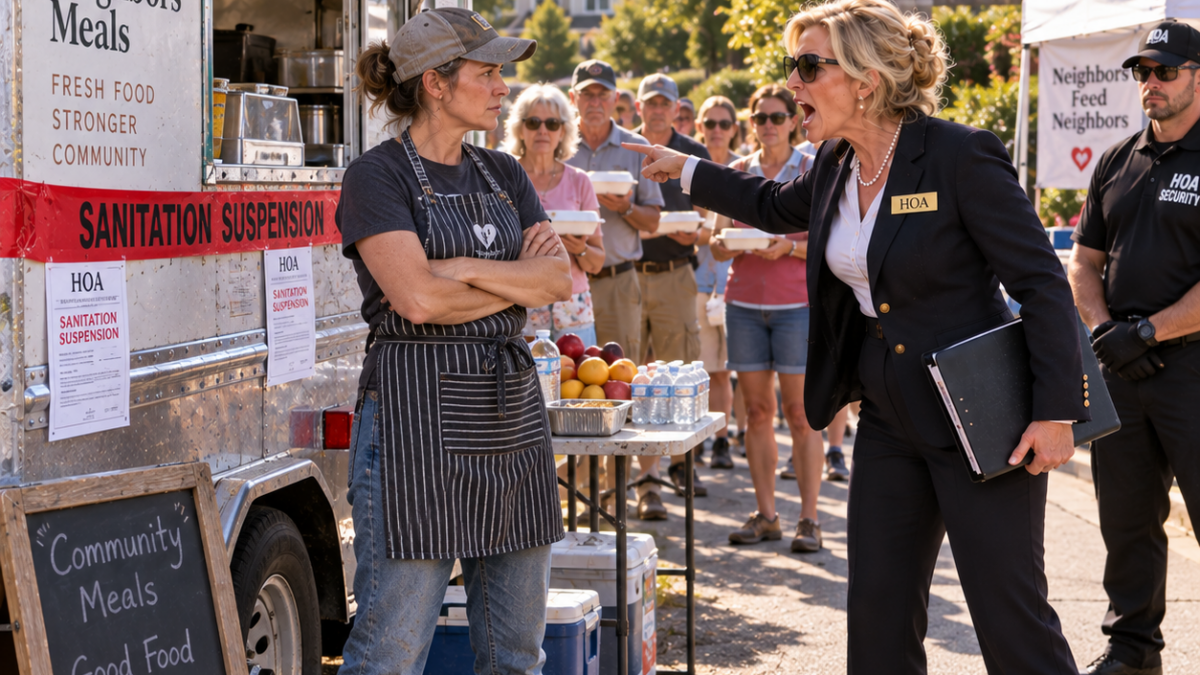
The HOA taped a red “sanitation suspension” across my charity food truck while thirty-one residents stood nearby pretending they hadn’t been waiting for dinner.
I sat in the county parking lot with the engine off and the permit summary on the passenger seat.
The afternoon sun had turned the windshield hot enough that the steering wheel felt warm under my palms.
On top of the county papers sat Preston’s suspension letter.
ALL FUTURE FOOD SERVICE MUST BE COORDINATED THROUGH THE OAKMERE CLUBHOUSE KITCHEN.
Underneath it:
COMMERCIAL FOOD PREPARATION NOT APPROVED WITHOUT TEMPORARY EVENT AUTHORIZATION OR UPDATED FACILITY PERMIT.
Those two sentences did not belong in the same story.
At least not honestly.
I called Lena.
She answered over the sound of metal pans.
“You still at the county?”
“Yes.”
“And?”
“The clubhouse kitchen is classified for limited residential amenity use.”
Silence.
“What does that mean?”
“Warming. Prepackaged food. Private noncommercial functions.”
“And their wine thing?”
“Forty-five dollars a ticket.”
Another silence.
Then Lena said, “Maya.”
“I know.”
“They shut down a licensed truck and told you to use a kitchen that may not be approved for what they’re doing.”
“I know.”
“You smiling?”
“No.”
“Good.”
That was Lena.
She had worked with me long enough to know the most dangerous moment in any dispute was when proof first started feeling satisfying.
The Second Plate had begun three years earlier with a freezer failure.
Not mine.
A grocery-store freezer.
A local market lost power overnight and called the pantry because they had forty pounds of chicken still safe but needing immediate cooking.
At the time, I had a small catering business.
Weddings.
Office lunches.
Church receptions.
Nothing glamorous.
I took the chicken, made stew, and served it from folding tables at Maple Street Church.
Ninety-three people came.
The next month, a bakery donated bread.
Then a farmer called with squash.
Then Oakmere residents started asking whether I could bring meals closer to the senior buildings.
The truck came later.
Bought used.
White.
Scratched.
Too expensive even after the discount.
Lena painted the little blue bowl on the side herself.
We called it The Second Plate because my grandmother used to say every kitchen should be ready for one more plate than expected.
Oakmere knew all of that.
The HOA had approved the Thursday service as a six-week pilot.
Then another six.
Then another.
No incidents.
No traffic collision.
No sanitation complaint.
No county warning.
Nothing changed until the clubhouse began increasing private events.
That thought bothered me.
I opened the county summary again.
Then I drove home.
My townhouse on Brier Court was small enough that if I stood in the kitchen I could see the front door and the lemon tree through the back glass at the same time.
I set the county record beside Oakmere’s suspension letter.
Then pulled out the association bylaws.
People assume a homeowner association has either unlimited authority or none.
Neither is true.
I wasn’t entitled to private resident records.
I couldn’t demand personnel files.
I had no right to barge into a kitchen and conduct my own inspection.
But as an owner, I did have inspection rights for many association records connected to operations, contracts, rules, common-area spending, and board actions.
So I wrote carefully.
Not:
Show me everything because I think Preston is a hypocrite.
Instead:
Please provide association records reasonably related to food-service standards, clubhouse-kitchen use, kitchen maintenance, paid event approvals, rental income, rules supporting the suspension of The Second Plate, and committee authority supporting the violation issued against my unit.
Then categories.
Current clubhouse kitchen food-service policy.
Permit and inspection records maintained by Oakmere.
Maintenance invoices for eighteen months.
Grease interceptor service.
Refrigeration service.
Any temperature or sanitation logs maintained for association food events.
Clubhouse rental summaries involving food.
Board or committee minutes adopting food-service rules.
Documents supporting my suspension.
Documents supporting my fine.
I added one final sentence.
Please preserve all communications and records relating to The Second Plate suspension, clubhouse food-service policy, paid kitchen events, notices, event approvals, and kitchen-use requirements.
Printed.
Signed.
Scanned.
Emailed to management.
Board secretary.
Preston.
Then certified mail.
His response took eleven minutes.
Maya,
Your request is overly broad and appears retaliatory. The clubhouse kitchen is unrelated to your unauthorized vendor activity. The committee will respond in due course.
Retaliatory.
I printed it.
By then I had a folder thick enough that Lena started calling it The Preston Binder.
“Don’t name evidence after people,” I told her.
“You named the truck after your grandmother’s saying.”
“That’s different.”
“Fine. The Soup Binder.”
“No.”
“The Premium Resident Experience Binder.”
I laughed despite myself.
That mattered.
Anger had been sitting too high in my chest since Thursday.
Laughter moved it down an inch.
The first association production arrived Friday at 8:13 a.m.
Seven PDFs.
The email came from Hartwell Community Management, Oakmere’s professional management company.
Please find documents responsive to your request as deemed relevant at this time.
As deemed relevant.
Whenever somebody gives you documents and emphasizes that they chose what mattered, you look first for the categories they decided did not.
I opened the clubhouse rental summary.
Twelve food-related rentals in six months.
Brunch social.
Realtor mixer.
Wine tasting.
Holiday appetizer evening.
Two entries labeled PREMIUM RESIDENT EXPERIENCE.
Every one had:
Rental charge.
Cleaning charge.
Kitchen-use fee.
Kitchen-use fee.
I wrote it in my notebook.
Next came maintenance invoices.
Paper products.
Sanitizer.
Disposable gloves.
Refrigerator repair.
Then:
GREASE INTERCEPTOR SERVICE.
OAKMERE COMMONS CLUBHOUSE.
Status:
DEFERRED AT CLIENT REQUEST.
Recommended service interval exceeded.
Follow-up recommended before heavy food-service use.
I read it slowly.
A deferred grease service did not automatically mean the kitchen was dangerous.
I knew better than to make that leap.
But it did mean the polished clubhouse had maintenance issues of its own.
And Preston had publicly implied my inspected truck was the sanitation concern.
The next file was worse for him.
TEMPORARY FOOD DISTRIBUTION GUIDELINE — DRAFT.
No adoption date.
No board vote.
No signature.
One paragraph read:
Outside vendor or charitable food distribution may be restricted near clubhouse amenities based on traffic flow, sanitation perception, resident experience, and community image.
I stopped at sanitation perception.
Not sanitation violation.
Perception.
The committee minutes included a Preston memo.
Suspend mobile distribution pending image review and transition approved meal activity to clubhouse-controlled food-service channels.
Image review.
There it was.
Then the final file.
Kitchen checklist sample.
Blank boxes.
Cold holding.
Hot holding.
Sanitizer.
Handwash.
Date.
Initial.
No completed copy.
I emailed Hartwell.
Please provide completed kitchen temperature and sanitation logs corresponding to the paid events listed in the rental summary, including the private tasting scheduled tonight.
Thirty-two minutes later:
Ms. Brooks,
The association does not maintain temperature logs for all private social events. The clubhouse kitchen is not operated as a commercial kitchen.
I sat completely still.
Lena was chopping celery across the commissary.
She looked up.
“What?”
I turned the laptop toward her.
She read.
Then looked at Preston’s letter pinned under my clipboard.
ALL FUTURE FOOD SERVICE MUST BE COORDINATED THROUGH THE OAKMERE CLUBHOUSE KITCHEN.
Lena whistled.
“That’s ugly.”
“It’s inconsistent.”
“You always ruin my good words.”
“Inconsistent is better.”
“For court?”
“For truth.”
I called Denise at the health department.
“If a facility says it isn’t operated as a commercial kitchen, but association records show paid food events and kitchen-use fees, is that something your office would review?”
She paused.
“Do you have documentation?”
“Yes.”
“Submit it through the complaint portal.”
“I’m not trying to shut down a clubhouse.”
“I didn’t say you were.”
“There’s a paid tasting tonight.”
“What time?”
“Six-thirty.”
Another pause.
“Include that.”
“What happens after I submit?”
“Our office reviews the complaint.”
“Will someone come?”
“I can’t promise that.”
“Understood.”
“Do not enter the kitchen yourself.”
“I won’t.”
“Do not photograph restricted prep areas.”
“I won’t.”
“Submit records, not conclusions.”
That was exactly how I wanted it.
I spent the next hour building the packet.
My mobile inspection report.
Current vendor license.
County public summary for Oakmere kitchen.
Clubhouse paid-rental report.
Deferred grease-service invoice.
Hartwell email saying temperature logs were not maintained.
Draft “sanitation perception” guideline.
Preston’s letter requiring food through the clubhouse kitchen.
Oakmere’s flyer:
SIGNATURE CULINARY EXPERIENCE.
PRIVATE TASTING MENU.
LIVE MUSIC.
$45 PER GUEST.
Friday 6:30 p.m.
In the complaint-description box, I wrote:
Oakmere Commons suspended a licensed mobile meal service citing sanitation concerns and directed future service through the Oakmere clubhouse kitchen. Public county records classify the clubhouse as limited residential amenity use. Association records show paid food events, kitchen-use fees, deferred grease-service maintenance, and no maintained temperature logs for all private events. A paid tasting is scheduled tonight at 6:30 p.m. This submission requests review of facility use and permit requirements.
No Preston rant.
No accusation of corruption.
No claim anyone had poisoned people.
Submit.
Receipt number.
Printed.
Filed.
At 12:06, Hartwell made a mistake.
Not a criminal mistake.
A reply-all mistake.
One of those quiet little errors that tells you more than hours of polished meetings.
Do not send Brooks anything that encourages the free-meal crowd to think this is a public-accommodation issue. The bigger problem is optics. If we let that truck stay, the clubhouse stops looking premium.
I read it.
Again.
Then once more.
The email had been written by Carla Wynn, Hartwell’s regional community manager.
“Free-meal crowd.”
“Optics.”
“Premium.”
I felt something inside me go very still.
Lena came over.
I turned the screen.
She read it.
Her mouth tightened.
“That’s what this is.”
“It looks like it.”
“No. Maya. That is what this is.”
I understood her anger.
But I kept myself precise.
One careless email did not explain every board member.
It did not prove every resident wanted us gone.
It did not erase legitimate questions an HOA might have about vehicle placement or common-area traffic.
What it did was explain why the association had chosen the language it chose.
Sanitation perception.
Image review.
Premium clubhouse.
Free-meal crowd.
They were not embarrassed by unsafe food.
They were embarrassed by visible need.
That hurt in a way the fine hadn’t.
Because I knew Oakmere.
I lived there.
The people coming to my truck weren’t strangers wandering in from some imaginary outside world Preston wanted residents to picture.
Mr. Alvarez paid dues.
Tasha paid dues.
The boys from Building F lived with their grandmother, who paid dues.
Some residents had jobs.
Some were retired.
Some had medical bills.
Some were helping adult children.
Some simply needed Thursday dinner because one bad month had stretched too far.
Hunger in a neighborhood like Oakmere rarely looked like hunger in movies.
It looked like a woman in scrubs asking if there were extra rolls because payday was tomorrow.
It looked like an old man taking two soups because his wife couldn’t stand at the stove after chemotherapy.
It looked like teenagers returning clean containers every week because their grandmother insisted charity was not permission to be careless.
Preston wanted those people invisible.
I printed Carla’s email.
Filed it.
At 1:00 p.m., Oakmere posted a new temporary policy.
Effective immediately.
All resident-facing food distribution, charitable meal activity, outside vendor service, and informal food pickup near clubhouse amenities required committee approval.
Requirements included:
Insurance.
Food-safety compliance.
Traffic review.
Sanitation perception.
Resident experience.
Coordination through approved clubhouse facilities.
They had transformed Preston’s Thursday decision into Friday policy.
That afternoon, I drove to Oakmere in my personal car.
I did not bring the truck.
Did not bring food.
Did not bring signs.
At the clubhouse bulletin board, the new policy was centered inside a clear plastic sleeve.
Beside it:
Tonight’s Signature Culinary Experience.
$45.
A man in golf shoes slowed behind me.
He read one.
Then the other.
“Is that about your truck?”
“Yes.”
He looked at the tasting flyer.
“They’re serving food tonight.”
“Yes.”
He looked back at the policy.
“That seems…”
He stopped.
I waited.
“Odd.”
“That’s a good word.”
He took a photo.
That was the first time the story moved without me.
At two, the committee held what Preston called an administrative review.
Small conference room.
Preston at the far end.
Carla beside him.
Three committee members.
One was a retired engineer named Evan Ross.
Quiet man.
I had spoken to him maybe twice before.
Preston didn’t invite me to sit until I was already pulling out the chair.
“This is not a hearing.”
“I understand.”
“We’re here to clarify expectations.”
“I requested records.”
“You requested records after receiving a violation.”
“I requested records after you told me all food service needed to go through a kitchen that the county classifies as limited residential amenity use.”
Carla stopped typing.
Preston’s face didn’t move.
“You are not qualified to interpret health classifications.”
“I’m not interpreting.”
I opened my folder.
“I’m reading.”
County summary.
Rental report.
Grease-service invoice.
Hartwell’s no-log email.
Preston glanced down but didn’t touch anything.
“These are unrelated matters.”
“You connected them.”
“How?”
“Your suspension letter.”
I slid it forward.
“All future food service must be coordinated through the Oakmere clubhouse kitchen.”
“The purpose was centralized oversight.”
“Then show me the oversight.”
He leaned back.
“Maya.”
“Temperature logs?”
“Not every private event requires them.”
“Kitchen authorization for ticketed service?”
“Private functions are different.”
“Why?”
“They are controlled.”
“By whom?”
“The committee.”
“What record shows the controls?”
His voice tightened.
“You are intentionally collapsing different categories.”
“And you intentionally used health language against my truck without a county complaint.”
“The HOA can impose standards beyond county minimums.”
“Yes.”
That was important.
I wasn’t going to claim otherwise.
“But then those standards need to exist before you punish me under them.”
Evan picked up the temporary policy.
“Preston.”
Preston turned.
“Did the board vote on this?”
“It was adopted under temporary standards authority.”
“Where is that authority?”
“It is consistent with event-management procedures.”
“That’s not what I asked.”
Preston stared at him.
Carla closed her laptop halfway.
“Maybe enforcement should be paused until the board reviews the kitchen coordination language.”
“That sends the wrong message,” Preston said.
“To whom?” I asked.
His eyes returned to me.
“To residents who expect common areas to be managed.”
“Residents like Mr. Alvarez?”
He looked away.
“Tasha?”
No answer.
“The boys from Building F?”
“Maya, this isn’t about individual recipients.”
“That’s convenient, because the recipients are the reason the service exists.”
The room stayed quiet.
I continued.
“They are not a crowd damaging the resident experience. They are residents.”
Preston folded his hands.
“Some recipients are not.”
“Then write a guest-access rule.”
No answer.
“Write a traffic rule.”
Nothing.
“Write a parking rule.”
Still nothing.
“But don’t write sanitation when you mean visibility.”
His face changed.
Only briefly.
But Evan saw it.
Carla saw it.
I did too.
The administrative review ended without decision.
The fine stayed pending.
The suspension remained.
The policy stayed posted.
But the room no longer belonged entirely to Preston.
Outside, two residents were photographing the bulletin board.
The man in golf shoes was one.
By 4:30, the resident app had seventeen comments under the food policy.
Why is free soup a sanitation concern while tonight’s paid tasting is still happening?
Is The Second Plate licensed?
Yes, current inspection is literally on the truck window.
Who approved the tasting?
Can residents see the clubhouse kitchen permit?
Why are we charging kitchen-use fees if the facility isn’t commercial?
Then one comment:
My mother gets Maya’s meals. Stop making elderly people feel ashamed for needing dinner.
I closed the app.
I wanted to thank that person.
I didn’t.
Preston had already accused me of disruption.
I wasn’t going to organize a resident revolt from my phone.
At 5:12, Oakmere sent the tasting reminder.
SIGNATURE CULINARY EXPERIENCE BEGINS AT 6:30.
KITCHEN PREP UNDERWAY.
I looked at the words.
Kitchen prep underway.
Then at my county complaint receipt.
At 5:18, I stopped thinking about the argument.
I thought about time.
Six-thirty.
I wrote one final letter.
To the full board.
Hartwell.
Preston.
Board secretary.
Subject:
REQUEST FOR IMMEDIATE CORRECTION, RECORD PRESERVATION, AND SUSPENSION OF ENFORCEMENT AGAINST THE SECOND PLATE.
I kept it clean.
Oakmere had publicly suggested my licensed mobile unit posed food-safety concerns despite no county restriction.
My records were current.
The association directed service through a clubhouse kitchen classified for limited residential amenity use.
Association documents showed paid food events, kitchen-use charges, deferred grease-service maintenance, and incomplete temperature documentation.
I requested:
Correction of the resident notice.
Withdrawal of my violation.
Preservation of all kitchen/event records.
Temporary suspension of paid on-site food preparation until facility authorization was clarified.
Reinstatement of the previously approved nonprofit meal service.
At 5:31, sent.
At 5:34, Hartwell auto-reply.
At 5:36, Preston:
Maya,
You are now interfering with a private association event. Any further attempt to disrupt tonight’s resident experience will be documented.
I printed it.
Then drove to Maple Street Church.
The Second Plate was parked where I had left it.
Lena arrived with clean containers.
“You serving?”
“Not at Oakmere.”
“Then why are we here?”
“Because they made the truck the accusation.”
She nodded toward the clubhouse lights through the trees.
“And the kitchen is the question.”
“Yes.”
We sat in the cab.
No soup service.
No protest.
No signs.
My permit binder lay on the passenger seat.
At 5:50, the resident app was moving faster than Oakmere could moderate.
Someone posted the county classification.
Someone else posted the tasting flyer.
Another resident posted a photo of my current inspection sticker.
Then came a comment from Tasha.
My daughter has eaten Maya’s food. I work at the hospital. I have seen her temperature-check soup while people complain she is taking too long. Stop using health language when there is no health violation.
Another:
My father is Mr. Alvarez. He has dialysis Thursdays. The meal truck is why my mother does not have to cook after helping him home.
Then:
Soup should not need better public relations than wine.
I knew exactly who wrote that.
I laughed.
At 6:03, cars began arriving.
People in clean shirts.
Dresses.
Wine bags.
The clubhouse windows glowed.
At 6:14, email.
County Health Department.
Your complaint and supporting documentation have been received.
Based on the active event time and facility-classification questions raised, an environmental-health representative may conduct an onsite review during the event window.
May.
Not will.
I didn’t forward it.
Didn’t screenshot it for the app.
Didn’t call Preston.
At 6:22, music began.
Soft piano.
At 6:26, I saw Preston outside the clubhouse entrance.
Clipboard.
Navy blazer.
Smile.
At 6:31, service was supposed to start.
At 6:34, a white county vehicle turned into Oakmere.
No siren.
No flashing light.
Just a small county seal.
My heart started beating so hard my fingers tingled.
Lena looked at me.
“Stay calm.”
“I am calm.”
“You’re holding the binder upside down.”
I turned it around.
Then got out.
I did not run.
Running would have made the moment about me.
I walked.
The county vehicle parked near the kitchen-service entrance.
A woman stepped out wearing a gray jacket and county badge.
Tablet under her arm.
Preston spotted her before he spotted me.
For one second, I saw his actual face.
No patient smile.
No disappointed-community-leader performance.
Just surprise.
Then the mask returned.
“Good evening. Can I help you?”
She showed her badge.
“Environmental Health. I’m conducting an onsite review of the clubhouse kitchen during the scheduled food event.”
“This is a private association event.”
“I understand.”
“We have established procedures.”
“That’s what I’m verifying.”
Then he saw me.
“Maya.”
The word came out low.
“This is exactly what I meant by interference.”
The inspector turned.
“Are you Ms. Brooks?”
“Yes.”
“Do you have copies of the documents referenced in your complaint?”
“I do.”
Preston raised one hand.
“I object to this becoming a public proceeding.”
The inspector looked at him.
“This is a facility review.”
She pointed toward the kitchen entrance.
“Please don’t interrupt while I verify records.”
I handed her the packet.
Not my whole Preston Binder.
Only what mattered.
County permit summary.
Rental summary.
Grease invoice.
Hartwell email.
Event flyer.
Preston’s suspension letter.
My truck inspection.
She scanned the first pages.
“Is food being prepared onsite tonight?”
Preston said, “There is some assembly.”
A man in a black chef coat appeared at the doorway carrying a tray of small cups.
He froze.
The inspector looked at him.
“Are you providing food service?”
“Yes, ma’am.”
“Business?”
“Fork & Vine Events.”
“Temporary event authorization?”
He looked at Preston.
Preston answered.
“We operate under the clubhouse facility procedures.”
The inspector looked at the caterer.
“Do you have a temporary authorization for this address?”
“I was told the association had everything.”
She typed.
“Food service pauses until I verify.”
Preston’s voice sharpened.
“The event has started.”
“Then pause service now.”
Inside, music lowered.
People turned toward the windows.
Preston stepped aside.
The inspector entered the kitchen.
I stayed outside.
Denise had been explicit.
Do not enter.
Do not interfere.
Preston stood beside the door.
“You think this helps your cause?”
“I think records help the truth.”
“This will embarrass the association.”
“You told people not to eat my food.”
“I issued a precaution.”
“You used food safety to hide an image decision.”
His jaw tightened.
“You have no idea what it takes to maintain a community like this.”
“I live here.”
“That is not what I mean.”
“I know.”
He stared.
I continued quietly.
“You mean the clubhouse has to look premium.”
His eyes moved toward me.
“Free-meal crowd.”
That did it.
He knew I had the email.
His face changed.
“Maya—”
The inspector came out.
She carried two sheets.
“I need the current authorization for paid food preparation tonight.”
Preston said, “We have always operated events under our clubhouse procedures.”
“That is not a permit.”
The caterer looked increasingly uncomfortable.
The inspector continued.
“The facility file shows limited residential amenity use.”
She checked the papers.
“The documents provided show paid rentals and kitchen-use charges. I do not see temporary event authorization for tonight in the county system.”
Preston said, “We are reviewing updated procedures.”
“Then paid food preparation should not occur tonight until that review is completed.”
She turned toward the caterer.
“Stop service. Cover and secure food. I need contact information for your company.”
“Yes, ma’am.”
Then she taped a white county notice to the kitchen door.
LIMITED USE NOTICE.
PAID FOOD PREPARATION / TICKETED SERVICE RESTRICTED PENDING COMPLIANCE REVIEW.
It wasn’t bright red.
It wasn’t dramatic.
But it had a county seal.
An inspector’s name.
A case number.
Actual authority.
Residents began coming outside.
Quietly.
Nobody cheered.
I was grateful for that.
This wasn’t a movie.
People had paid forty-five dollars.
A caterer had employees working.
Some board members probably had no idea the authorization was missing.
Humiliation was not the goal.
Tasha stood near the walkway.
Her daughter beside her now.
Mr. Alvarez leaned on his cane.
I had no idea how they knew to come.
Probably the app.
The inspector turned to me.
“Ms. Brooks.”
“Yes.”
“Based on the documents you provided and county records, your mobile unit is current.”
“Thank you.”
“This review does not identify a county restriction against The Second Plate.”
Preston immediately said, “That does not authorize the unit to operate on HOA property.”
“No,” she replied.
She looked at him.
“That is an association matter.”
Then:
“But the association should not represent county food-safety action where none exists.”
No one spoke.
I looked across the lawn.
The Second Plate was visible through the trees.
County inspection sticker in the serving window.
Exactly where it had been all week.
Then I looked at the clubhouse kitchen.
The notice had changed doors.
That could have felt like revenge.
It didn’t.
It felt like correction.
Monday at 7:42 a.m., Oakmere posted:
CLARIFICATION REGARDING FOOD SERVICE NOTICE.
The prior notice concerning The Second Plate did not reflect any county health department restriction on the mobile unit.
The association is reviewing its temporary food-distribution policy and clubhouse-kitchen procedures.
The pending violation has been placed on hold.
Placed on hold.
At 8:11, Hartwell emailed.
Oakmere Commons HOA is withdrawing the notice of violation issued for unauthorized vendor activity.
No fine will be assessed.
The association will provide updated food-service procedures following board and counsel review.
I read it twice.
Then replied:
Thank you. Please confirm the correction concerning The Second Plate will remain publicly visible for at least the same duration as the original sanitation notice.
Lena looked over my shoulder.
“That’s petty.”
“No.”
“It’s a little petty.”
“It’s proportional.”
She laughed.
The county review kept paid food preparation suspended at the clubhouse while Oakmere corrected its facility authorization, maintenance, and event procedures.
Limited self-service remained allowed.
Prepackaged foods.
Beverage service.
No ticketed tasting from that kitchen until compliance was sorted.
Tuesday afternoon, Carla found me near the mailbox.
No Preston.
No laptop.
Just a folder.
“I’m not here to argue.”
“Good.”
“The board met this morning.”
I waited.
“Preston no longer has unilateral authority over food-service approvals.”
I looked at her.
“All food events involving the clubhouse require management verification of permit status.”
“That seems basic.”
“It should have been.”
“Temperature records?”
“For events where required. Maintenance and access records go into a centralized compliance file.”
“Grease service?”
“Scheduled.”
“The temporary food policy?”
“Suspended.”
“And The Second Plate?”
She handed me a letter.
Board secretary signature.
THE SECOND PLATE IS APPROVED TO RESUME NONPROFIT MEAL SERVICE ON THE CLUBHOUSE VISITOR APRON UNDER THE ORIGINAL PILOT CONDITIONS, SUBJECT TO CURRENT MOBILE FOOD LICENSING, INSURANCE, AND AGREED PARKING HOURS.
I read it.
Again.
“No committee review?”
“Board-approved conditions.”
“No clubhouse kitchen?”
“No.”
“Preston wrote this?”
She almost smiled.
“No.”
“That explains why it’s clear.”
She looked away quickly, hiding a laugh.
Then became serious.
“Maya.”
“Yes?”
“The email.”
“Which one?”
She knew I knew.
The reply-all.
Her face changed.
“I shouldn’t have written that.”
“No.”
“I was talking about optics.”
“I know.”
“That sounds worse than I meant.”
“What did you mean?”
She opened her mouth.
Closed it.
I waited.
“That the visible line near the clubhouse was creating complaints during rentals.”
“Which complaints?”
“Some guests.”
“Residents?”
“Some residents.”
“About traffic?”
“About…appearance.”
I nodded.
“There it is.”
She looked tired.
“I should not have called anyone the free-meal crowd.”
“No.”
“I am sorry.”
I believed she was sorry she wrote it.
I wasn’t yet sure whether she was sorry she thought it.
But I accepted the apology for what it was.
“Thank you.”
She nodded.
Then left.
Thursday came.
At 4:35, I pulled The Second Plate into the same visitor apron.
No cones.
No red notice.
No Preston.
I parked.
Set the brake.
Checked the hot boxes.
Chicken vegetable soup.
164 degrees.
Rolls.
Baked apples.
Handwash station.
Sanitizer.
Gloves.
Thermometer.
Logbook.
The routines felt almost holy after a week of having them questioned.
Lena arrived with extra bread.
“You nervous?”
“No.”
“You checked the soup three times.”
“Quality control.”
“Anxiety.”
“Temperature verification.”
She laughed.
At 4:47, Mr. Alvarez arrived.
He looked directly at me this time.
No shoes.
No shame.
Me.
“Two?” I asked.
“Three.”
“Three?”
“My daughter’s coming after work.”
I smiled.
“Extra pepper?”
“For my wife.”
I stacked three containers.
Tasha came next.
Hospital badge.
Hair tied back.
Her daughter walking beside her.
“The correction is still posted.”
“For how long?”
“Since Monday.”
“Good.”
“You made them leave it up?”
“I asked.”
“That matters.”
I knew.
That was why I asked.
The boys from Building F arrived with their clean containers.
One held them out.
“My grandma washed them twice.”
“I would expect nothing less.”
At five, I opened the serving window.
The line formed.
Not huge.
Maybe twenty people at first.
But nobody looked down.
Nobody hid.
That alone felt like restoration.
Across the lawn, the clubhouse kitchen lights were off.
A maintenance van sat beside the service door.
The old tasting banner was gone.
In its place:
KITCHEN COMPLIANCE REVIEW IN PROGRESS.
NO PAID FOOD EVENTS UNTIL FURTHER NOTICE.
It wasn’t revenge.
Maintenance had finally caught up with image.
At 5:27, Preston came out the side entrance.
No blazer.
No laminated badge.
No clipboard.
Pale shirt.
Sleeves rolled once.
He stopped when he saw the line.
Mr. Alvarez noticed him.
Then did something so small it almost made me laugh.
He lifted his soup container.
Not a toast.
Not a challenge.
Just acknowledgment.
Dinner existed.
Preston looked away.
He crossed the parking lot without saying anything.
I did not call after him.
The last thing I wanted was a victory speech.
By six, every container was gone.
The final meal went to a woman from Building A.
I knew her face but not her name.
She waited until everyone else had left.
Then came to the window.
“One left?”
“One soup and two rolls.”
“One roll is enough.”
“Take both.”
She smiled weakly.
Then her eyes filled.
“I didn’t come last week.”
“I noticed.”
“I saw the notice.”
I waited.
“I thought everyone would think…”
Her voice broke.
She looked down.
There it was again.
The same posture Mr. Alvarez had the first Thursday.
Eyes on the ground.
Need becoming shame because someone with a clipboard decided appearance mattered.
I slid the soup toward her.
“You are not the person who should be embarrassed.”
She wiped one cheek quickly.
“I have a job.”
“I know.”
“My husband does too.”
“I didn’t ask.”
“Our furnace went out.”
“You don’t have to explain.”
She looked at me.
For a moment, she seemed startled.
Then nodded.
She took the food.
“Thank you.”
After she left, I closed the serving window.
Lena had already gone.
The parking lot grew quiet.
I wiped stainless steel.
Recorded final service temperature.
Counted remaining inventory.
Zero soups.
Zero apples.
Four rolls left.
Then I sat on the truck step.
The clubhouse stood behind me.
Big windows.
Stone columns.
Warm exterior lights.
Oakmere had spent years making that building look like proof that everyone inside the neighborhood was doing fine.
But neighborhoods aren’t brochures.
People lose jobs behind neat doors.
They get cancer.
They divorce.
They care for parents.
They pay deductibles.
They miss work.
They feed grandchildren.
They choose prescriptions over groceries.
Sometimes the people standing in line for free soup have nicer shoes than the volunteers serving it.
Hunger does not respect landscaping standards.
Neither does dignity.
That Friday, the board announced an independent review of clubhouse event operations.
Not because I demanded one.
Evan Ross did.
The quiet committee member who had asked whether Preston’s temporary policy was actually authorized.
He called me.
“I think the problem is larger than the kitchen permit.”
“How?”
“We’ve been letting committees create temporary rules and then enforcing them before board review.”
“I noticed.”
“There’s almost no separation between events and standards.”
“So Preston can host an event and then decide another food service hurts the event.”
“Yes.”
“That seems healthy.”
He sighed.
“I deserved that.”
I didn’t know Evan well.
He was a structural engineer before retirement.
His wife had died the year before.
We spoke for almost an hour.
He asked about the original pilot approval.
I sent it.
Six-week trial.
Visitor apron.
Thursdays.
5–6 p.m.
Proof of insurance.
Current county mobile permit.
No blocking emergency lanes.
Simple.
The trial had been renewed informally several times.
“That’s another problem,” Evan said.
“For me?”
“For the board.”
He explained.
The HOA had gotten comfortable letting good programs continue without updating the paperwork.
Then Preston used the lack of formal renewal as leverage when he wanted the service moved.
Technically, he could call it unauthorized.
Practically, Oakmere had allowed it for almost a year.
“That’s how ambiguity becomes power,” Evan said.
I wrote that down.
The board eventually converted the pilot into a formal community service agreement.
One page.
Renewed annually.
No committee discretion based on “image.”
Food safety tied to actual permit status.
Parking tied to actual traffic conditions.
Service cancellation required written reason.
Any health-related suspension had to distinguish clearly between county action and HOA policy.
That last sentence had my fingerprints all over it.
I was proud of that one.
The kitchen review got more complicated.
The county did not condemn the clubhouse.
That would have made the story simpler.
Reality was less dramatic.
The facility had been used beyond its registered classification.
Some events were legitimately private self-service.
Others crossed into paid prepared-food service requiring different authorization.
Records were inconsistent.
The grease interceptor had been serviced late but was not overflowing.
The refrigerator worked but had no routine event log.
Several caterers had assumed Oakmere held the correct facility approval.
Oakmere had assumed caterers carried what they needed.
Everybody assumed someone else owned the boring compliance detail.
That is how a lot of failures happen.
Not because someone wakes up planning fraud.
Because responsibility is passed around until nobody can point to where it stopped.
The county required Oakmere to choose.
Either keep the kitchen within limited residential use.
Or upgrade its permit and procedures for recurring ticketed service.
The board chose limited use for the remainder of the year.
Ticketed culinary events moved to licensed outside caterers operating under appropriate event permissions.
The kitchen could still warm prepackaged food.
Support meetings.
Coffee service.
Resident potlucks under applicable rules.
The world did not end.
Oakmere did not lose its property values.
Residents survived without truffle tasting nights for three months.
Preston hated the outcome.
I knew because at the next board meeting he called it “an overcorrection caused by a retaliatory complaint.”
That was the first meeting I attended after everything happened.
I sat in the fourth row.
Not front.
My folder stayed closed on my lap.
Preston spoke during owner comments.
He was no longer chairing the food-service review, but he still held a committee seat.
“This association has allowed one disagreement to become an attack on volunteer governance,” he said.
Nobody interrupted.
“We should be careful about rewarding members who use regulatory agencies as weapons against neighbors.”
I felt several people look toward me.
My stomach tightened.
For a second, I wanted to stand.
Evan leaned toward the microphone from the board table.
“Mr. Lyle.”
Preston stopped.
“Did Ms. Brooks submit false information to the county?”
“That isn’t my point.”
“Did she enter restricted kitchen areas?”
“No.”
“Did she fabricate association records?”
“No.”
“Was her mobile permit current?”
Preston’s jaw tightened.
“Yes.”
“Then please be precise when using the word weapon.”
The room went silent.
Preston looked toward me.
I did not smile.
Then Ken Wallace, another board member, spoke.
“The association’s own records created the compliance question.”
That mattered.
Not Maya versus Preston.
Association records.
Preston sat down.
When owner comments reached my name, I almost passed.
Then Mr. Alvarez turned around from two rows ahead.
He didn’t say anything.
He just looked at me.
So I stood.
“My name is Maya Brooks. Brier Court.”
Everyone knew.
I kept going anyway.
“The Second Plate serves Thursday meals under a nonprofit arrangement approved by this association.”
I paused.
“What happened should not become an argument about whether Oakmere is allowed to manage common property. It is.”
Preston looked up.
“It should not become an argument that county minimum standards are the only rules an HOA can have. They aren’t.”
Several board members nodded.
“The problem was simpler.”
I looked around the room.
“My truck was publicly associated with health concerns that did not exist in county records.”
Quiet.
“At the same time, the association required me to use a kitchen whose own operating records had not been reviewed.”
I took a breath.
“And people waiting for food were made to feel like they were lowering the quality of the neighborhood.”
That was the part my voice almost failed on.
I thought of the woman from Building A.
Mr. Alvarez’s shoes.
Tasha whispering did you do something wrong?
I continued.
“Oakmere doesn’t become less premium because a neighbor needs dinner.”
No applause.
I was glad.
Applause would have turned it into a speech.
I wanted it to remain a fact.
“The people coming to my window live here. They vote here. They pay dues here. And even the people who don’t live here deserve food that is safe and service that is dignified.”
I closed my folder.
“That’s all.”
I sat.
The board later voted to remove “sanitation perception” and “community image” from food-service approval criteria.
Traffic.
Actual sanitation compliance.
Insurance.
Hours.
Noise.
Parking.
Those could remain.
Image could not.
Preston voted against it.
Motion passed anyway.
Carla from Hartwell resigned from managing Oakmere’s account two months later.
Not because of my case specifically.
At least that was what Hartwell said.
A regional manager took over temporarily.
Before Carla left, she asked to meet me.
We sat at a coffee shop.
Neutral ground.
She looked exhausted.
“I keep thinking about that email.”
“So do I.”
“I’ve managed communities for fourteen years.”
“That sounds stressful.”
“It is.”
She stirred her coffee.
“We get pressure from boards to protect values. Protect presentation. Keep common spaces orderly.”
“I understand.”
“It becomes easy to speak like everything is branding.”
I waited.
She looked at me.
“People aren’t branding.”
“No.”
“I knew that.”
“But?”
“I forgot it in the moment.”
That was more honest than most apologies.
She continued.
“My mother used a food pantry when I was eleven.”
I didn’t expect that.
“She cleaned hotel rooms.”
Carla stared into her coffee.
“She would have been furious if somebody called her part of a free-meal crowd.”
“Yes.”
“I became exactly the person she hated asking for help from.”
There are apologies you accept because the speaker deserves relief.
And apologies you accept because they tell the truth about something larger.
I said, “Then don’t forget again.”
She nodded.
“I won’t.”
I believed her.
The Second Plate continued.
Thursday after Thursday.
Winter came.
We added chili.
Then lentil soup.
At Thanksgiving, Oakmere formally approved an additional service day.
That vote passed unanimously.
Preston was absent.
No one mentioned him.
In December, the clubhouse kitchen reopened under its limited-use rules after maintenance was completed.
A new sign went inside a cabinet door.
Not visible to residents.
Kitchen use categories.
Permit limits.
Event contacts.
Who was responsible for what.
Completed checklists were stored digitally.
Boring.
Wonderful.
Evan showed me the system once.
“You approve?”
“I’m not your inspector.”
“That’s not what I asked.”
“It looks better.”
He smiled.
“That is the nicest thing you’ve ever said about the clubhouse.”
“I like the chandeliers.”
He laughed.
In January, Mr. Alvarez stopped coming for three weeks.
I noticed immediately.
Tasha asked about him.
So did the boys.
I called his daughter.
He had been hospitalized.
Not emergency.
Complications after dialysis.
When he came back, he had lost weight.
He walked slower.
I had his soup ready.
“Two?”
He shook his head.
“One.”
I tried not to show concern.
“My wife died,” he said.
Everything inside me stopped.
I came around the truck.
No gloves.
No ladle.
Just me.
“I’m sorry.”
He nodded.
“She liked your pepper.”
I couldn’t answer.
He reached into his coat and handed me something.
A folded paper.
Inside was one of my old meal labels.
His wife had written on the back:
Tell soup lady thank you.
I read it.
Then again.
Mr. Alvarez looked toward the clubhouse.
“You know why I looked at my shoes that first day?”
I thought I did.
But I said, “Tell me.”
“Because my wife was sick.”
He gripped his cane.
“And I was standing there waiting for free dinner.”
His voice stayed even.
“I spent forty years working. Saved. Paid the house off. Thought I did everything right.”
He looked down.
“Then medicine got expensive.”
I waited.
“When that red paper went up, I felt like everybody could suddenly see I had failed.”
My throat tightened.
“You didn’t fail.”
“I know that now.”
He looked at me.
“But that afternoon I didn’t.”
I swallowed.
“I’m sorry.”
“You didn’t put up the paper.”
“No.”
“You took it down eventually.”
“I didn’t take it down.”
He smiled faintly.
“Records did.”
That sounded like something I would say.
I handed him the soup.
Then two rolls.
He looked at them.
“I only need one.”
“The second is for tomorrow.”
He nodded.
“Soup travels better than people.”
“Yes.”
He walked away.
That conversation stayed with me longer than every meeting.
Because in the end, the real damage had not been the $250 fine.
Not Preston’s policy.
Not the kitchen permit.
Those things were fixable with paper.
The dangerous part was the shame.
One bright red notice had convinced decent people that needing food made them part of a sanitation problem.
That took longer to repair.
So The Second Plate changed one thing.
We stopped calling Thursday “charity distribution.”
On our paperwork, yes.
Nonprofit meal service.
Required terminology.
But on the little dry-erase board beside the truck, Lena wrote:
THURSDAY SUPPER.
No “free meals.”
No “assistance.”
No “need-based.”
Just:
Chicken vegetable soup.
Rolls.
Baked apples.
5–6 p.m.
Neighbors welcome.
The first week, I stared at it.
“That’s sentimental.”
Lena smiled.
“You’ve become Preston.”
“Take that back.”
“Never.”
People liked the sign.
The woman from Building A came earlier now.
Sometimes she helped stack containers.
The boys began volunteering every second Thursday.
Tasha’s daughter drew pictures for the truck.
One was a bowl with steam coming out in the shape of a heart.
I told her hearts were difficult to paint on vehicles.
She told me that sounded like a me problem.
We taped it inside the service window.
Oakmere eventually upgraded the visitor apron.
Not because of The Second Plate alone.
The original setup had poor lighting and awkward pedestrian access.
New striping.
One accessible waiting space.
A bench.
A trash station.
Actual traffic management.
The kind Preston could have asked for from the beginning.
That part almost made me angry again.
So much conflict over problems that had reasonable solutions.
If he had said:
Maya, the line is blocking the clubhouse entrance. Can we move twenty feet east?
I would have moved.
If he had said:
We need your insurance updated in our file.
I would have emailed it.
If he had said:
Thursday overlaps with a rental. Can we adjust fifteen minutes?
We could have discussed it.
But once he decided the people were the problem, every operational issue became justification.
That was the lesson I kept.
Not some grand moral about HOAs.
Not every board member was cruel.
Kenji from Silverfin wasn’t in this story; this was Oakmere, and Oakmere had Evan, Carla, even board members who admitted they hadn’t understood what Preston was doing.
Systems matter because ordinary people get lazy inside them.
They assume the committee checked.
Management assumes the board approved.
The caterer assumes the kitchen is permitted.
Residents assume a red notice means someone official found danger.
And the person holding the clipboard learns that confidence fills every gap.
Until someone opens the records.
Spring came.
The lemon tree on my patio produced twelve lemons that year.
Only three grew larger than golf balls.
I considered that a miracle.
One Thursday in April, I parked at 4:40.
The oak trees had started leafing out.
Clubhouse windows were open.
A baby shower was scheduled inside.
Actual private event.
Prepackaged catering from a licensed bakery.
Everything boring and legal.
I opened the awning.
Checked soup.
Tomato basil that week.
Lena hated tomato basil.
Mr. Alvarez loved it.
At 4:58, Preston walked across the parking lot.
I hadn’t spoken to him in months.
He no longer served on Community Standards.
He had remained on the Events Committee in a non-chair role.
He looked older.
No clipboard.
No badge.
He stopped six feet from the window.
“Maya.”
“Preston.”
“Do you have a minute?”
“Before five.”
He nodded.
For several seconds he watched Lena arrange rolls.
“I owe you an apology.”
I said nothing.
“I handled the suspension badly.”
“That’s one way to say it.”
His mouth tightened.
Then relaxed.
“I thought the line near the clubhouse looked…”
He stopped.
“Say it.”
“Undignified.”
The word hurt even after all that time.
“Whose dignity?”
He looked at me.
That was the question he had never asked himself.
Finally:
“Mine, probably.”
I hadn’t expected that.
He looked toward the clubhouse.
“I had spent two years trying to reposition Oakmere events.”
“Reposition.”
“I know how it sounds.”
“It sounds like Carla’s email.”
He nodded.
“I wanted tours to look polished. Rentals. Community events.”
“So you saw people waiting for soup.”
“And I saw something I thought made the property look…”
He couldn’t finish.
“Poor?”
“Yes.”
Behind me, Lena stopped moving.
I glanced at her.
She resumed stacking rolls.
Preston continued.
“That was wrong.”
“Yes.”
“I told myself it was traffic and sanitation.”
“I know.”
“I thought if meals moved through the clubhouse, they’d look organized.”
“Hidden.”
He looked down.
“Maybe.”
“No. Not maybe.”
He took that.
“Hidden.”
We stood quietly.
Then he said, “My father would have stood in that line.”
That surprised me.
“He lost everything when I was twelve.”
I didn’t know what to say.
“Bankruptcy. Medical debt.”
He swallowed.
“We used church food boxes for almost a year.”
I stared at him.
“You knew exactly what that line was.”
“Yes.”
“Then why?”
His eyes were wet now.
Not crying.
Close.
“Because I spent the rest of my life trying to look like that never happened.”
There are answers that excuse nothing and explain almost everything.
That was one.
I looked toward the clubhouse.
Then the truck.
“Preston.”
“Yes?”
“Needing food wasn’t the shameful part of your childhood.”
“I know.”
“You made it shameful for other people.”
He closed his eyes briefly.
“I know that too.”
I didn’t tell him I forgave him.
I wasn’t sure forgiveness was mine to give on behalf of Mr. Alvarez, Tasha, or the woman from Building A.
I said:
“Do better.”
He nodded.
“I’m trying.”
At five, the first person arrived.
Preston stepped aside.
Mr. Alvarez came down the walkway.
He saw Preston.
Stopped.
For one uncomfortable second, nobody moved.
Then Preston opened the gate beside the apron.
Held it.
Mr. Alvarez walked through.
No speech.
No dramatic reconciliation.
Just one man holding a gate for another.
I served tomato basil soup.
“Two?”
Mr. Alvarez smiled.
“Still one.”
“Roll?”
“Two.”
“That’s progress.”
He laughed.
Preston left.
I watched him cross the lawn.
Then went back to work.
That evening, after the line cleared, I wiped the counter and opened my logbook.
Service temperature.
Containers distributed.
Location.
Time.
No incident.
For a moment, I thought about the red notice from months earlier.
I still had it.
Folded in the binder.
The painter’s tape had left pale blue marks across the corners.
I had considered throwing it away.
Never did.
Not because I wanted a trophy.
Because it reminded me how easy authority is to imitate.
Bright paper.
Bold letters.
A confident man.
A community logo.
Most people never stop to ask whether the person posting a warning has the evidence behind it.
That week taught me to ask.
Case number?
Inspection?
Policy?
Vote?
Permit?
Complaint?
Record?
Not because every rule is wrong.
Because real rules can survive being opened.
That was the difference.
My truck survived inspection.
The clubhouse kitchen survived review too, eventually.
What didn’t survive was the version of the story Preston had built around them.
By summer, Thursday supper had become so ordinary that nobody discussed its return.
That was my favorite part.
People came.
Ate.
Left.
Some volunteered.
Some donated anonymously.
A retired couple from Building D began paying for the baked apples every month.
Tasha organized a hospital food-drive box.
The boys from Building F graduated high school.
Their grandmother cried at the truck when she showed me their photos.
Oakmere never became a perfect neighborhood.
No neighborhood does.
Residents still fought about parking.
Pool furniture.
Dogs.
Holiday lights.
Whether the clubhouse thermostat should be seventy or seventy-two.
Normal arguments.
Human arguments.
The Second Plate kept coming Thursdays.
And every week at 4:52, when I turned into the visitor apron, I remembered the afternoon Mr. Alvarez stared at his shoes beneath a red suspension notice.
So before opening the serving window, I always checked one thing that had nothing to do with temperature.
I looked at the line.
Faces up.
Neighbors talking.
No one hiding.
Then I opened the window.
Because safe food mattered.
Permits mattered.
Records mattered.
But dignity mattered too.
And this time, Oakmere finally had the paperwork to prove it.








