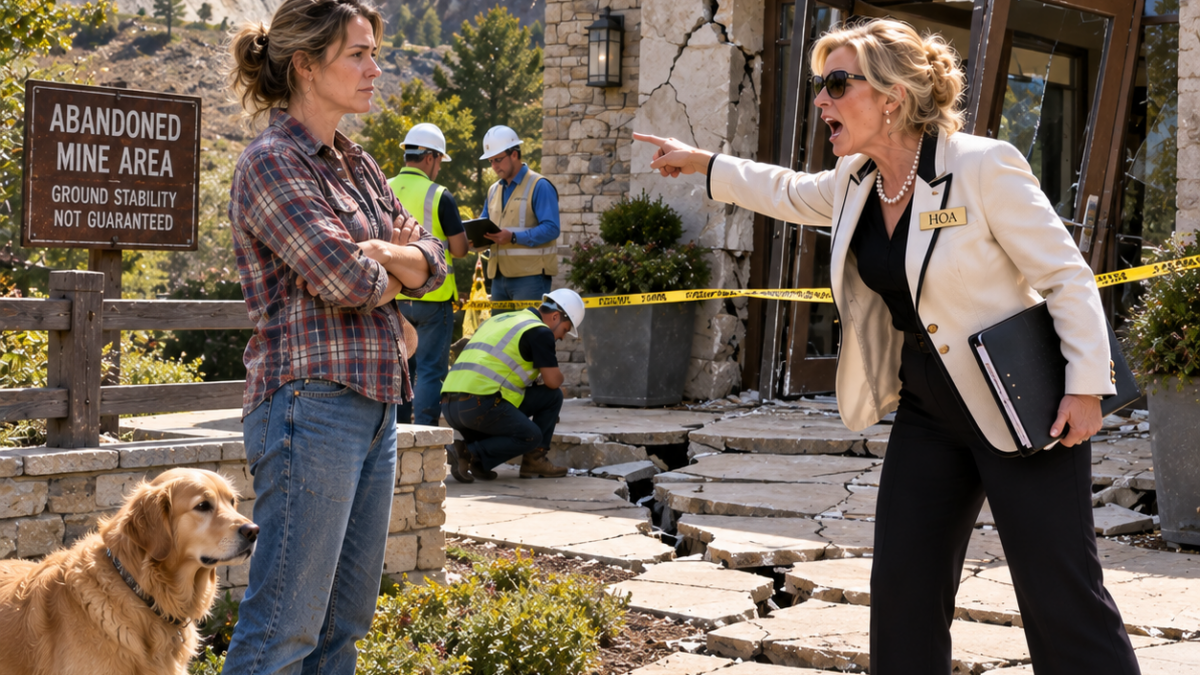
The HOA president laughed when I warned her that their seven-figure smart clubhouse was sitting too close to an abandoned mine bench.
I took screenshots before the screen could change.
That instinct had been trained into me long before smartphones existed.
When I worked mine-reclamation files, I learned that unstable ground was not the only thing capable of shifting.
Records shifted too.
A field note became a summary.
A summary became a memo.
A memo became “no significant concern.”
By the time someone stood in front of a cracked wall asking what happened, the first warning had sometimes been softened into something nobody remembered clearly.
So I photographed the BrightGate screen.
Then I photographed it again.
Exit Door Two — Service Review.
Tuesday, 7:14 p.m. — latch tolerance exceeded.
Tuesday, 7:22 p.m. — frame alignment check failed.
Wednesday, 6:03 a.m. — automatic close delay outside range.
Wednesday, 6:17 a.m. — manual reset performed.
Thursday, 8:09 a.m. — latch tolerance exceeded.
Thursday, 8:12 a.m. — frame alignment fault.
Thursday, 1:58 p.m. — Exit Door Two alignment outside tolerance.
I wrote the capture time on a yellow legal pad.
2:14 p.m.
Then I printed everything.
Not because paper was magical.
Because paper could not disappear when somebody changed permissions on an app.
I laid the screenshots beside the permit condition.
Visible settlement.
Slab displacement.
Exit-frame distortion.
Professional review before public occupancy.
It was so simple when the documents sat beside each other.
The complicated part came from everybody trying to keep them apart.
I opened a new email.
To Sylvia.
Caleb Rusk, our property manager.
The board distribution address.
The general management inbox.
Subject:
CLUBHOUSE EXIT DOOR TWO STATUS AND PRE-OCCUPANCY PERMIT CONDITION.
I wrote only what I could prove.
The resident access system currently shows Exit Door Two in service review with repeated frame-alignment and latch-tolerance faults.
The affected exit appears to be located in the southeast portion of the structure where visible threshold cracking has also been reported.
Please confirm whether a licensed geotechnical or structural professional has reviewed these conditions as required before tonight’s resident preview.
Then I added:
Please preserve all access-system logs, service tickets, calibration records, maintenance communications, settlement observations, and occupancy-readiness communications.
I stared at the last sentence.
Preserve.
That word changes conversations.
It tells people you are no longer asking them to persuade you.
You are asking them not to lose anything.
I sent the email at 2:18.
Caleb replied thirteen minutes later.
Clara,
BrightGate resident status labels are not intended for technical interpretation. The building remains in pre-event setup. Please refrain from circulating screenshots that may cause unnecessary concern.
No answer about the permit.
No answer about Exit Door Two.
No answer about professional review.
At 2:39, Sylvia sent me a private email.
You are misusing resident technology to interfere with an authorized HOA event. This will be addressed.
I read that sentence twice.
She did not say the screenshots were wrong.
That mattered.
At 3:05, someone knocked on my door.
Priya Mehta stood outside holding her phone.
She lived near the pocket park with her husband and two children.
Priya had served one year on the landscape committee before resigning after a six-week argument about whether a native shrub was “visually repetitive.”
She once told me plants were easier than boards because plants were honest about needing water.
“Is yours showing this?”
She held out her phone.
BrightGate.
Exit Door Two.
Temporarily offline.
Her digital resident pass above it still showed a green check mark.
AUTHORIZED.
She looked at me.
“My kids want to go tonight.”
“How old?”
“Eight and ten.”
I did not tell her what to do.
The moment you tell somebody what to do in a safety dispute, the argument becomes about whether you frightened them.
So I said, “Ask management which exits are available before you enter.”
Her eyebrows pulled together.
“That isn’t comforting.”
“It isn’t supposed to be.”
At 3:42, the BrightGate facility-status tab vanished.
Not changed.
Gone.
My clubhouse pass remained.
The green check remained.
The event schedule remained.
But the list of doors and faults disappeared from resident view.
Priya texted me one word.
Gone.
I replied:
Saved.
Then I sat at my kitchen table with the printed screenshots.
Tuesday.
Wednesday.
Thursday.
A building writing its own history one fault at a time.
For weeks Sylvia had called my mine map old information.
Historical material.
A ghost story.
Now their newest technology was pointing toward the same southeast corner.
At 3:50, I wrote the email I had been avoiding.
This time I copied the project engineer listed on the permit.
The insurance-risk contact printed in the clubhouse certificate packet.
Caleb.
Sylvia.
Management.
The board.
Subject:
FORMAL SAFETY NOTICE AND PRESERVATION REQUEST — CLUBHOUSE PUBLIC USE.
I wrote that the resident preview was scheduled for 6:00 p.m.
Then listed four facts.
Visible diagonal cracking at the southeast threshold.
Repeated latch-tolerance failures.
Exit Door Two frame-alignment failures.
Known historic mine workings mapped near the southeast clubhouse slope.
I quoted the permit requirement.
Then:
Please postpone public entry until a licensed structural or geotechnical professional confirms that the observed cracking, exit-frame distortion, and possible subsurface conditions do not affect safe occupancy.
I did not write collapse.
I did not write sinkhole.
I did not write people will get hurt.
Those were conclusions I could not make.
I asked for the people qualified to make them.
At the bottom I repeated the preservation request.
Then I attached everything.
Old mine overlay.
Permit excerpt.
Threshold photographs.
Tuesday service summary.
BrightGate screenshots.
Sylvia’s earlier “all systems ready” announcement.
Caleb’s responses.
I sent it at 3:58.
My phone rang two minutes later.
Sylvia.
I let it go to voicemail.
A text arrived.
ANSWER YOUR PHONE.
Then Caleb:
Please come to the clubhouse management table immediately.
I replied:
If the board has a response to the safety notice, please send it in writing.
Sylvia texted again.
You have escalated this beyond reason. Come down here now.
I looked through my kitchen window.
The clubhouse roofline was visible through the trees below Juniper Bend.
Bright.
New.
Expensive.
A line of dark clouds was forming behind the ridge.
I put my folder into a canvas tote.
Not because Sylvia ordered me down there.
Because residents were about to arrive.
At 4:27, the clubhouse driveway was crowded with event workers.
White catering tent.
Champagne glasses.
Printed programs.
A string quartet setting up beneath the covered patio.
The digital sign over the entrance had changed.
PREVIEW BEGINS AT 6:00.
Sylvia stood near the management table with Caleb and Gareth Drummond, the developer liaison.
Gareth was one of those men who could wear expensive shoes on muddy construction sites and somehow never get them dirty.
He smiled when he saw me.
“Ms. Navarro.”
“Mr. Drummond.”
“I understand you have a technical background.”
“I do.”
“Then you understand pre-opening systems generate nuisance faults.”
“Sometimes.”
“And calibration issues are not uncommon.”
“Correct.”
He smiled wider.
“So we agree.”
“No.”
The smile paused.
“Exit Door Two being outside frame tolerance is not simply proof that the software needs calibration.”
“That is not your determination.”
“I agree.”
That surprised him.
“That is why I’ve requested a professional review.”
Sylvia crossed her arms.
“You sent a preservation demand to our insurance contact.”
“I sent a safety notice.”
“You sent a packet designed to make a routine opening issue look catastrophic.”
“I sent your permit condition and your service history.”
“You are not the engineer of record,” Gareth said.
“And you are not the ground.”
The sentence came out quieter than I intended.
For one second nobody answered.
Then thunder rolled behind the ridge.
Caleb checked his phone.
“Storm cell is north. It should move through quickly.”
Rain started seven minutes later.
Hard.
Fast.
The kind of summer storm that made gutters overflow before people finished saying it had arrived.
Caterers ran beneath the tent.
Workers covered speakers.
Water ran across the courtyard concrete.
Then it gathered along the southeast edge of the clubhouse.
Exactly where I had photographed the dark damp patches that morning.
Water always finds low places.
That was one of the first things fieldwork teaches you.
Humans debate whether a slab has dropped.
Water simply goes there.
Sylvia saw the dark line.
So did Gareth.
Neither said anything.
The smart door clicked.
Inside, the lobby lights dimmed and brightened.
The digital sign kept glowing.
PREVIEW BEGINS AT 6:00.
At 5:12, Marty came outside carrying a towel.
He bent near the threshold.
The towel caught against the crack.
He stopped.
His shoulders changed before his face did.
That is another thing fieldwork teaches you.
Watch the people who maintain things.
They react before executives do.
Rainwater had entered the crack.
The line that had looked like pencil graphite that morning was now black.
It crossed the threshold and bent toward the side corridor.
Toward Exit Door Two.
Marty looked at Sylvia.
She gave one small shake of her head.
Almost nothing.
But I knew what it meant.
Do not react.
He wiped around the crack.
Not over it.
Residents began arriving at 5:30.
Priya came with her husband and children.
Don Albright arrived carrying an umbrella.
He saw me near the walkway.
“You really came.”
“Yes.”
“You happy now?”
“No.”
His face changed.
I looked at the crack.
“I’m trying to make sure nobody has to be sorry later.”
He did not answer.
At 5:43, the first resident approached the smart door.
Mrs. Keller from Cedar Lane.
Her app credential lit the reader green.
The lock clicked.
Nothing.
She smiled uncertainly.
“Fancy.”
A few people laughed.
The door clicked again.
Sylvia moved in front of it.
“We’re still in pre-entry mode. Refreshments are under the tent until six.”
At exactly six, the digital sign changed.
WELCOME RESIDENTS.
Soft jazz started through the lobby speakers.
The lights brightened.
Sylvia lifted a microphone.
“Good evening, Ridge Point.”
Applause.
“Tonight we welcome you into a clubhouse designed for the next generation of community living.”
More applause.
She continued.
“We know there has been some noise today.”
Noise.
That was what the mine map had become.
What the permit condition had become.
What the fault log had become.
Noise.
“But I want everyone to know that your board, management team, and project partners have worked hard to deliver a safe, beautiful, fully modernized amenity.”
Priya held her younger child’s hand.
Before looking at the coffee bar, she looked toward the side exit.
Good, I thought.
Not panic.
Awareness.
At 6:12, Sylvia announced the smart-access demonstration.
A young volunteer held his phone near the reader.
Green light.
Click.
The door stayed closed.
He tried again.
Green.
Click.
Nothing.
People chuckled.
The Axiom technician moved forward.
He pulled the handle gently.
Stopped.
Sylvia laughed into the microphone.
“That’s why they call it a demonstration. Technology likes a little drama.”
The crowd gave her the laugh she requested.
Then a side-exit alarm chirped.
Three quick tones.
Marty’s head snapped toward the southeast corridor.
The Axiom technician looked at his tablet.
Caleb walked closer.
“Can we mute that?”
The technician did not answer.
I looked through the glass.
A white trim seam near the southeast corridor had separated from the wall.
Maybe half an inch.
Priya followed my eyes.
She saw it.
Pulled both children back.
Sylvia saw her.
“We’re going to shift the demonstration to the west entrance for smoother flow.”
“No.”
The word left my mouth before I planned it.
Not loud.
But the people nearest me turned.
Sylvia’s smile disappeared.
“Clara.”
“If Exit Door Two is offline and the main door is failing to latch, who has confirmed safe occupancy?”
Gareth stepped forward.
“This is inappropriate.”
“So is allowing residents inside before the permit condition is satisfied.”
“You are not qualified to make that determination.”
“I’m asking for the qualified person.”
A low sound came from the lobby wall.
Pop.
Not an explosion.
Not breaking glass.
More like someone cracking a knuckle inside the building.
Every face turned.
The floor crack had extended beyond the entry mat.
Rainwater traced it across the polished concrete.
One champagne glass trembled on the welcome table.
Then stopped.
The jazz music continued for two seconds.
Then went silent.
Marty whispered:
“Shut it down.”
Caleb looked at him.
“What?”
Marty swallowed.
“Shut the access down.”
The Axiom technician tapped his tablet.
The main reader changed from green to red.
Someone under the tent asked:
“Are we going inside or not?”
No answer.
I looked at Sylvia.
“Call the fire marshal.”
Her expression hardened.
“You don’t give instructions here.”
“Then give the right one yourself.”
Gareth shook his head.
“This is cosmetic settlement made more visible by rain.”
Exit Door Two alarmed again.
Priya pulled out her phone.
“I’m calling non-emergency.”
Sylvia turned.
“Priya, that is unnecessary.”
Priya’s hand was shaking.
Her voice wasn’t.
“My kids are not going inside until somebody who isn’t on this board tells me the exits work.”
That was the moment the crowd changed.
Not dramatically.
Nobody screamed.
People simply stepped backward.
One person.
Then three.
Then ten.
Don Albright looked down at the crack.
At 6:34, a white city vehicle entered the lower drive.
No siren.
No lights.
FIRE MARSHAL printed on the door.
Ada Fielding stepped out wearing a navy rain jacket.
She moved slowly.
That reassured me more than urgency would have.
People who understand safety do not perform panic.
Sylvia reached her first.
“Marshal Fielding, thank you. We’re dealing with a minor access-control issue during a private resident preview.”
Fielding looked past her.
Red reader.
Wet crack.
Residents standing outside.
“Is the building occupied?”
“No,” Marty said.
Sylvia turned toward him.
“Nobody has entered beyond the lobby line,” he continued.
Fielding nodded.
“Good.”
One word.
Good.
She walked toward the entrance.
Studied the door without touching it.
Looked through the glass toward the side corridor.
“Which exit alarmed?”
“Exit Door Two,” the technician said.
“Operational?”
Sylvia answered.
“It is in temporary service review.”
Fielding looked at the technician.
He shifted his tablet.
“It’s currently offline in the access system. The door exists physically, but the frame alignment is outside tolerance.”
Fielding entered something into her tablet.
Gareth stepped forward.
“Marshal, we can route residents through the west entrance.”
“No public entry.”
The sentence was calm.
Gareth blinked.
“This isn’t a public event. It’s residents.”
“If they occupy the building, they require reliable egress.”
Sylvia’s face lost color.
Fielding looked at Caleb.
“Who certified occupancy readiness tonight?”
Caleb looked at Sylvia.
Sylvia looked at Gareth.
Gareth looked toward the clubhouse.
Fielding wrote something.
Then she crouched near the threshold.
Rainwater sat inside the crack.
She followed it with her eyes.
Then looked at the separated trim.
“Has a structural professional inspected this after the crack extended?”
Sylvia said, “Our project team has been monitoring normal settling.”
Fielding stood.
“That wasn’t my question.”
Caleb checked his phone.
“The engineer of record isn’t available tonight.”
Gareth said, “We can have him provide something Monday.”
“Then you don’t open tonight.”
Sylvia inhaled sharply.
“With respect, Marshal, this project has passed every appropriate stage.”
Fielding pointed at the main entrance.
“The stage I’m looking at is the one where the exit doesn’t work.”
Nobody laughed.
At 6:58, another pickup arrived.
HINES STRUCTURAL.
A man in a dark rain shell stepped out carrying a laser-level case.
Rafael Hines.
His name was familiar from the permit packet.
Not the engineer of record.
On-call structural reviewer.
Which meant somebody had already anticipated the possibility that a pre-occupancy condition might require immediate review.
He introduced himself to Fielding.
Then Caleb.
Then Sylvia.
When he reached me, he paused.
“You’re Clara Navarro?”
“Yes.”
“I received your preservation notice.”
Sylvia’s head turned sharply.
Rafael didn’t explain.
He began working.
Laser level.
Exterior slab edge.
Three readings.
Then southeast corner.
He crouched near the crack.
Touched the concrete beside it.
Not the crack itself.
Checked the doorframe.
Walked to the side exit.
The crowd stayed under the tent.
Rain tapped against the fabric.
Ten minutes later, Rafael closed his clipboard.
“I can’t recommend temporary occupancy tonight.”
Gareth crossed his arms.
“Based on ten minutes in the rain?”
“Based on visible displacement, active exit-frame tolerance failure, water migration along the crack, and unresolved subsurface concerns documented before occupancy.”
Sylvia said:
“Documented by Clara.”
Rafael looked at her.
“No.”
Silence.
“Documented by your access system, vendor service summary, visible conditions, and permit requirement.”
Then he nodded toward me.
“Her notice put the records in one place.”
Sylvia did not answer.
Fielding returned to her vehicle.
A minute later, she came back holding a printed notice inside a clear sleeve.
She taped it to the glass beside the red reader.
PUBLIC ENTRY SUSPENDED PENDING EGRESS AND STRUCTURAL REVIEW.
The ripping sound of tape against plastic ended the preview more effectively than any speech.
People began leaving.
Some angry.
Some embarrassed.
Some frightened.
Most quiet.
Don Albright stopped beside me.
“I thought you were trying to ruin it.”
I looked at the notice.
“So did they.”
He stared at me.
I realized how harsh that sounded.
“I didn’t want this, Don.”
He looked at the crack.
“I know that now.”
At 7:41, Caleb stood beneath the catering tent with his phone on speaker.
Sylvia and Gareth stood beside him.
Fielding had asked everyone holding relevant records to remain until the shutdown was documented.
A woman’s voice came through the phone.
“This is Maren Stovall, Property Risk Unit.”
Caleb’s face tightened.
“I have the preservation notice and maintenance summary. I need the board’s first date of notice for possible settlement, mine-related subsurface concern, or exit-frame distortion.”
Nobody spoke.
Maren repeated it.
“When did the board first receive notice?”
Caleb looked at Sylvia.
Sylvia looked at Gareth.
Gareth looked down.
Caleb finally said:
“We received several communications today from Ms. Navarro.”
“That isn’t what I asked.”
Maren’s tone stayed neutral.
That made everyone more uncomfortable.
Sylvia tightened her grip on her folder.
I stayed silent.
Then Marty spoke.
“Monday.”
Everyone turned toward him.
He swallowed.
“The southeast entry was called cosmetic settling on Monday.”
Sylvia said his name.
“Marty.”
He didn’t look at her.
“Tuesday was the first outside-tolerance ticket.”
Maren asked:
“And the mine-related subsurface concern?”
I opened my folder.
Pulled out the warning from three weeks earlier.
The one Sylvia had called a ghost story.
I handed it to Fielding first.
Because she was the authority physically present.
She read the date.
Passed it to Rafael.
He read the subject line.
OLD MINE MAP CONCERN AND REQUEST FOR PRE-OCCUPANCY GEOTECHNICAL REVIEW.
Then handed it to Caleb.
Caleb didn’t look down.
Maren’s voice came through the speaker.
“Please forward that document to our office tonight.”
No one called it a ghost story again.
By 8:15, crews were folding the preview tables.
At 8:40, untouched catering trays went back into the van.
The ceremonial ribbon remained uncut.
Rain beaded along its edge.
I walked home after nine.
My shoes were damp.
My knees hurt.
When I reached Juniper Bend, I turned back once.
The clubhouse glowed below the hill.
Empty.
Expensive.
A red access light beside the entrance.
Fire marshal notice on the glass.
The first thing I felt was not satisfaction.
It was exhaustion.
There is a strange loneliness in being taken seriously only after the thing you warned about becomes visible enough for everyone else.
At home, I hung my wet coat over a chair.
Made tea.
Did not drink it.
Then opened the metal map box one more time.
The 1978 mine sheet lay exactly where it had for nine years.
Contours.
Bench lines.
Abandoned drift entry approximate.
Old information.
That phrase bothered me.
People use old as if age weakens fact.
Sometimes old information is useless.
Sometimes it tells you what was buried before you arrived.
My first mine job had been in West Virginia.
I was twenty-six.
Fresh out of graduate school.
Too eager to prove that I understood ground movement because I could calculate it.
My field supervisor was a woman named Ruth Calder.
She had spent thirty years walking reclaimed mine land.
On my second week, I pointed at a depression near an abandoned haul road.
“Subsidence?”
She looked at it.
“Maybe.”
I started listing possibilities.
Void migration.
Poor compaction.
Drainage.
She stopped me.
“Clara, the ground does not care how many theories you can say before lunch.”
I shut up.
She pointed at the depression.
“Measure it.”
That became my career.
Measure.
Record.
Compare.
Do not make the ground more dramatic than it is.
Do not make it less dramatic because someone hates the answer.
Seventeen years before Ridge Point, I had flagged shallow cover beneath a municipal maintenance project.
A storage building was planned over old working.
I documented settlement in the gravel pad.
A supervisor called it over-interpretation.
A council member called it bureaucratic drag.
I softened my language.
Not because they forced me.
Because I wanted the recommendation accepted.
Six months later, one corner dropped five inches after heavy rain.
Nobody died.
Nobody was hurt.
That became everyone’s defense.
See?
Not dangerous.
But the lesson I carried was different.
The ground had warned them.
The people around it had simply negotiated the wording until the warning felt optional.
After that, I stopped negotiating with facts.
The next morning, Ridge Point sent an announcement at 9:06.
Due to unexpected technical and safety-review requirements, clubhouse access is temporarily paused pending further evaluation.
Temporarily paused.
Corporate language had an amazing ability to avoid simple words.
Closed.
The clubhouse was closed.
At 11:14, Maren Stovall’s office sent the board a reservation-of-rights letter.
I did not receive the full letter.
Residents got a summary during an emergency board session that afternoon.
The insurer was not denying every claim.
But it reserved coverage questions concerning costs connected to known pre-occupancy conditions, delayed reporting, and continued public-use planning after documented warning signs.
That mattered financially.
Very quickly.
Suddenly the ghost story had numbers attached to it.
Gareth’s developer team responded that unusual rainfall during final calibration had contributed to the visible cracking.
Rafael Hines disagreed.
He submitted photographs.
Laser measurements.
Door logs.
Permit conditions.
And one plain recommendation:
No temporary occupancy until a licensed geotechnical engineer evaluates potential subsurface movement and provides stabilization recommendations.
The rain had not created the Tuesday door ticket.
It had not written the old mine map.
It had not moved Exit Door Two out of tolerance three days earlier.
Rain had merely made something easier to see.
The board meeting that Thursday took place in the old pool house.
The building everybody had spent two years calling obsolete.
Low ceiling.
Brick walls.
Fluorescent lights.
Metal folding chairs.
Nobody joked about the irony.
Sylvia sat at the far end of the table.
Paper cup of water in front of her.
Untouched.
Caleb read the incident timeline because residents had demanded it become part of the minutes.
Three weeks earlier:
Mine-map concern submitted by Clara Navarro.
Monday:
Southeast entry condition internally described as cosmetic settling.
Tuesday:
Vendor ticket — doorframe outside tolerance.
Wednesday:
Repeated automatic-close problem.
Thursday morning:
Visible threshold crack documented.
Thursday afternoon:
BrightGate showed Exit Door Two in service review and then offline.
3:58 p.m.:
Formal safety notice and preservation request.
6:34 p.m.:
Fire marshal arrival.
6:58 p.m.:
Structural reviewer declined occupancy.
Every date made the room quieter.
When Caleb finished, Don Albright raised his hand.
“I owe Clara an apology.”
I looked at him.
He swallowed.
“I thought she wanted to stop the clubhouse because she didn’t like change.”
No one laughed.
“I repeated that. To people.”
He looked down.
“I was wrong.”
I did not know what to say.
So I nodded once.
“Thank you.”
Priya spoke next.
“I want a motion.”
Sylvia looked toward her.
Priya continued.
“No major capital facility should open for resident use without independent review if a permit-trigger condition appears.”
Someone seconded it before Sylvia could respond.
The motion passed six to one.
Sylvia voted no.
That was her last vote as facilities chair.
There was no dramatic removal.
No angry resignation.
No public confession.
The board reassigned clubhouse oversight to a temporary technical review committee.
No vendor, developer representative, or board member could certify their own disputed work.
Someone suggested I serve on the committee.
I declined.
Caleb looked surprised.
“Clara, you’re the person who identified this.”
“That is exactly why I’m declining.”
“I don’t understand.”
“I have spent enough of my life getting invited into rooms after the ground proves me right.”
I slid my document folder across the table.
“Hire professionals before residents have to become witnesses.”
The room went quiet again.
I gave them three names.
One geotechnical firm.
One mine-reclamation engineer.
One structural consultant.
Then I went home.
The first drilling rig arrived five days later.
Residents stood along the walking path watching crews mark bore locations.
Yellow paint.
Small flags.
A survey tripod.
The southeast corner was fenced.
The glass wall received temporary braces.
The threshold crack was covered and monitored.
I did not walk into the work zone.
I did not need to.
Two weeks later, the geotechnical preliminary report arrived.
The board released a summary.
The clubhouse had not been built directly over a large open cavern.
That was the good news.
The old drift had partially collapsed decades earlier.
However, historic workings and disturbed mine material existed closer to the southeast foundation zone than the simplified development mapping had assumed.
Localized settlement had occurred.
Water migration through disturbed material during recent storms had accelerated differential movement.
The clubhouse was repairable.
That was important.
No catastrophe.
No disappearing building.
No enormous sinkhole swallowing the coffee bar.
The reality was more ordinary.
And more believable.
The southeast slab and adjacent support zone needed stabilization.
Drainage had to be corrected.
Foundation loads redistributed in one area.
Doorframes reset after movement stopped.
Monitoring installed.
The project would cost money.
A lot of it.
But nobody had to be injured for the mistake to matter.
That point became important at the next board meeting.
One resident stood and said:
“So Clara was right. The clubhouse could have collapsed.”
I raised my hand.
“No.”
He looked disappointed.
“No?”
“That is not what the report says.”
“But there was mine subsidence.”
“There was localized settlement associated with disturbed historic mine material.”
“That sounds like the same thing.”
“It isn’t.”
Sylvia was not at that meeting.
I continued.
“The building showed enough movement that exits were going out of tolerance. That made opening it irresponsible without review. That is the issue.”
The resident frowned.
“So it wasn’t about collapse?”
“It was about not waiting for something worse before responding.”
That distinction mattered to me.
I had spent my career watching risk conversations get destroyed by exaggeration.
If you turn every warning into disaster language, people stop listening.
The cracked clubhouse did not need to fall into a mine to prove the warning mattered.
A door needed to remain square.
An exit needed to work.
A permit condition needed to be followed.
That was enough.
Three weeks after the cancelled preview, I walked past the clubhouse on my way to the mailbox.
The digital sign was off.
No jazz.
No ribbon.
Temporary braces stood against the southeast glass.
Drilling points dotted the slope behind it.
The old mine overlay I had kept in my pantry for nine years was now reproduced inside the official engineering packet.
I stood on the common walkway.
Exactly where Sylvia had told me not to diagnose the building.
I wasn’t happy.
That surprised some people.
Don found me there one evening.
He stood a few feet away.
“You don’t look satisfied.”
“I’m not.”
“You won.”
I looked at him.
“No one wins when a seven-figure building needs foundation work before anybody gets to use it.”
He shoved his hands into his jacket.
“You know what I mean.”
“Yes.”
I looked at the caution fence.
“But I didn’t want proof. I wanted review.”
He nodded slowly.
“I keep thinking about the first meeting.”
“The ghost-story meeting?”
He winced.
“I laughed.”
“I remember.”
“I thought Sylvia sounded reasonable.”
“She did.”
“That’s what bothers me.”
I looked at him.
Don stared toward the slope.
“She never yelled. Never said anything obviously crazy. She just made you sound unreasonable.”
“That is usually more effective.”
He nodded.
Then said:
“My father worked coal when I was a kid.”
I turned.
“You never mentioned that.”
“He hated talking about it.”
Don watched the drilling crew.
“He used to say the ground remembers every shortcut.”
I smiled faintly.
“Your father sounds like someone I would have liked.”
“Probably.”
He left after that.
The full engineering review took six weeks.
The clubhouse project eventually reopened under a different process.
Independent geotechnical sign-off.
Structural acceptance.
Fire marshal egress verification.
Access-system commissioning after the frames stabilized.
No ribbon until all three signatures existed.
Sylvia remained on the board but no longer controlled capital-project openings.
Some residents wanted her removed entirely.
I didn’t join that effort.
That confused Priya.
We were drinking coffee on her porch when she asked.
“You’re not angry?”
“I’m angry.”
“Then why not vote her out?”
“Because that is your decision as owners.”
“You’re an owner.”
“Yes.”
She waited.
I sighed.
“I care more about removing the authority that allowed the decision than removing one person.”
Priya considered that.
“She mocked you.”
“Yes.”
“She deleted your warning.”
“Management deleted it.”
“She threatened you.”
“Yes.”
“And you’re okay with her staying?”
“I didn’t say that.”
Priya laughed.
“You are impossible.”
“I have heard that.”
Then I explained.
“If Sylvia disappears but the process stays the same, somebody else can do exactly what she did.”
Priya stopped smiling.
“If the process changes, the next Sylvia has less room.”
That became the focus.
Resident safety posts could no longer be removed from community channels without an archived copy and written reason.
Permit-trigger questions had to receive written technical responses.
Major facilities required independent sign-off when settlement, egress, structural, or other listed safety conditions appeared.
Vendor fault records had to be retained through final acceptance.
No board chair could describe a building as “fully reviewed” without identifying what reviews had actually been completed.
Those changes were boring.
That was why I trusted them.
A dramatic apology lasts five minutes.
A dull procedure can prevent the next mistake for ten years.
The rebuilt opening happened in late October.
No champagne tower.
No giant preview banner.
A smaller ribbon.
Some coffee.
A few trays of pastries.
Ada Fielding, the fire marshal, walked the exits before residents entered.
Rafael checked the final structural report.
A geotechnical engineer named Dr. Lena Moss stood beside the southeast corner holding a tablet.
She had spent six weeks overseeing grouting and drainage corrections.
I met her for the first time that morning.
“You’re Navarro?”
“Yes.”
She smiled.
“I’ve been living with your overlay.”
“Sorry.”
“Don’t be.”
She tapped her tablet.
“Old maps are messy, but yours gave us the right place to start.”
“I didn’t make the map.”
“No.”
She looked toward the hill.
“You kept it.”
That sentence stayed with me.
Sylvia attended the reopening.
No microphone.
No gold scissors.
She stood near the back.
I expected her to avoid me.
Instead, she approached after the fire marshal completed the exit walk.
“Clara.”
“Sylvia.”
For a moment neither of us spoke.
The smart door opened smoothly behind her.
No click.
No hesitation.
“You were right to raise the issue,” she said.
The sentence sounded difficult for her.
I appreciated that.
“Thank you.”
She looked toward the southeast corner.
“I still think the way it escalated hurt the community.”
I almost laughed.
There she was.
Not changed completely.
People rarely are.
“The crack escalated it.”
“You copied the insurer.”
“After the board ignored the permit condition.”
“You embarrassed the project.”
“The project had an exit offline.”
Her mouth tightened.
Then relaxed.
“I suppose we will never agree on sequence.”
“We don’t need to.”
She looked at me.
“That sounds very final.”
“It is.”
She nodded.
Then surprised me.
“I read the 1978 map.”
“All of it?”
“Most of it.”
“That’s more than most people ever wanted to.”
“I did not understand what approximate drift entry meant.”
“It means the person who drew it knew something was there but wasn’t willing to pretend the location was exact.”
She looked toward the hill.
“I used the word ghost story because I thought the uncertainty made the map weak.”
“It made the map honest.”
That stopped her.
After a moment, she said:
“I see that now.”
It was not an apology for everything.
It did not need to be.
The residents began entering.
Priya’s children were first through the east-side walkway.
They scanned their BrightGate passes.
Green.
Click.
The door opened.
Priya looked back at me.
I gave her a small nod.
Don Albright went through behind them.
He paused at the threshold.
Looked down.
The repaired concrete had a slightly different finish where the crack had been removed and the slab work completed.
“You still see it?” he asked.
“Yes.”
“Even though it’s fixed?”
“Especially because it’s fixed.”
He smiled.
Inside, the clubhouse was beautiful.
I could admit that.
Glass walls.
Warm wood.
A fitness room overlooking the ridge.
Coffee bar.
Roof deck.
Motion lighting.
Climate sensors.
The future of Ridge Point living.
I stayed only twenty minutes.
Then went home.
My knees were tired.
At the kitchen table, I opened the metal file box.
For the first time in years, I took out the original photocopy of the 1978 mine map and considered giving it to the HOA archive.
Then I changed my mind.
They had their certified copy now.
This one was mine.
Old pencil marks.
Faded stamp.
Softened fold lines.
A piece of history people had laughed at until new technology started agreeing with it.
I put it back.
Months later, a facilities summary appeared in the annual report.
Clubhouse stabilization and drainage correction completed.
Independent structural and geotechnical acceptance received.
Emergency-egress verification complete.
Access system recommissioned.
No ongoing movement above monitoring thresholds.
That was the ending I wanted.
Not punishment.
Stable readings.
Doors opening.
Water draining where it should.
A building functioning normally.
The following spring, I walked past the clubhouse after a heavy overnight rain.
Old habit made me slow down.
The southeast corner was dry.
Drainage swales carried water away from the foundation.
The smart door opened for a resident carrying a yoga mat.
Closed.
Latched.
No clicking.
No fault tone.
No one noticed.
That was perfect.
Marty was near the service path replacing a landscape light.
He saw me watching the door.
“Still checking?”
“Always.”
He laughed.
“Frame’s holding.”
“I know.”
“You checking the app?”
“No.”
“Why not?”
“I trust independent instrumentation more than resident apps.”
“Fair.”
He tightened the light housing.
Then his face became serious.
“I should’ve said something sooner.”
“You did eventually.”
“After you cornered me at the mailbox.”
“I did not corner you.”
“You gave a speech about maintenance getting blamed.”
“That was not a speech.”
“It felt like one.”
I smiled.
Marty looked at the clubhouse.
“They told us Monday it was cosmetic.”
“I know.”
“I knew the door wasn’t right Tuesday.”
“I know.”
“I still let them call it calibration.”
I understood what he was asking without him saying it.
“People make compromises at work.”
“That doesn’t make it okay.”
“No.”
He looked at me.
“You’re not going to make me feel better?”
“No.”
Then I added:
“But you told me to ask for the Tuesday ticket.”
He nodded.
“That mattered.”
His shoulders eased.
“A little?”
“A lot.”
He went back to the landscape light.
I kept walking.
At the mailbox, I found a large envelope from Ridge Point Management.
Inside was a copy of the revised capital-project safety procedure.
Caleb had included a handwritten note.
Clara—
You asked that the record matter more than personalities. This is the final adopted version.
Thank you.
I read the first page standing beside the mailboxes.
Independent review requirements.
Permit-condition triggers.
Incident-record preservation.
Vendor fault retention.
Resident safety communication archive.
No facility opening when required egress remained in unresolved service status.
Dry.
Administrative.
Beautiful.
I carried it home.
Filed it behind the old mine map.
Not in front.
The new rule existed because the old ground did.
That night, rain started again.
Not hard.
Just enough to tap softly against the kitchen window.
I made tea and sat at the table.
For years, I had thought retirement meant I was finished with maps.
Finished with settlement seams.
Finished with people asking me to make uncertain ground sound more certain because a construction schedule needed certainty.
I had been wrong.
Retirement changed who paid me.
It did not change what I noticed.
The world beneath us is full of old decisions.
Mines.
Drains.
Fill.
Buried walls.
Forgotten foundations.
Roadbeds.
Things people built, removed, abandoned, or covered because the next project wanted a clean drawing.
Most of the time, nothing happens.
That is why people get comfortable.
Then a door misses its latch.
A floor cracks.
Water finds a low corner.
And suddenly history is not historical anymore.
The next morning, I walked down Juniper Bend.
The clubhouse lights were on.
Someone was using the fitness room.
A couple sat near the coffee bar.
The digital sign displayed upcoming events instead of promises about the future.
BOOK CLUB — TUESDAY.
YOGA — THURSDAY.
FAMILY MOVIE NIGHT — SATURDAY.
Ordinary things.
I stopped at the entrance.
The southeast threshold looked level.
The smart door sensed me.
The reader flashed green because my resident credential was still active.
The lock released.
The door opened cleanly.
I did not go inside.
I wasn’t there for coffee.
I looked down at the repaired concrete.
Then toward the hill behind the building.
Somewhere beneath that landscaping were disturbed mine materials placed there decades before Ridge Point existed.
Stabilized now.
Monitored.
Documented.
Respected.
The building had not betrayed anybody.
That was important.
Machines do not betray people.
Ground does not betray people.
A crack is not cruel.
A door fault is not disrespectful.
They are information.
The failure happens when people decide information is inconvenient.
I put my hands into my coat pockets.
For a moment I remembered Sylvia standing beneath the ribbon months earlier.
Gold scissors.
Perfect smile.
Ghost story under a hill.
Then I remembered the fire marshal’s tape on the glass.
The insurer asking for the first date of notice.
Marty saying Monday.
Rafael saying my warning only put their own records in one place.
Those were not triumphant memories.
They were reminders.
The ground had whispered first.
The smart clubhouse translated.
And eventually, after enough people stopped laughing, somebody finally listened.








