The HOA nailed an eviction threat to my barn door before sunrise and claimed I owed them twenty-one years of unpaid dues.
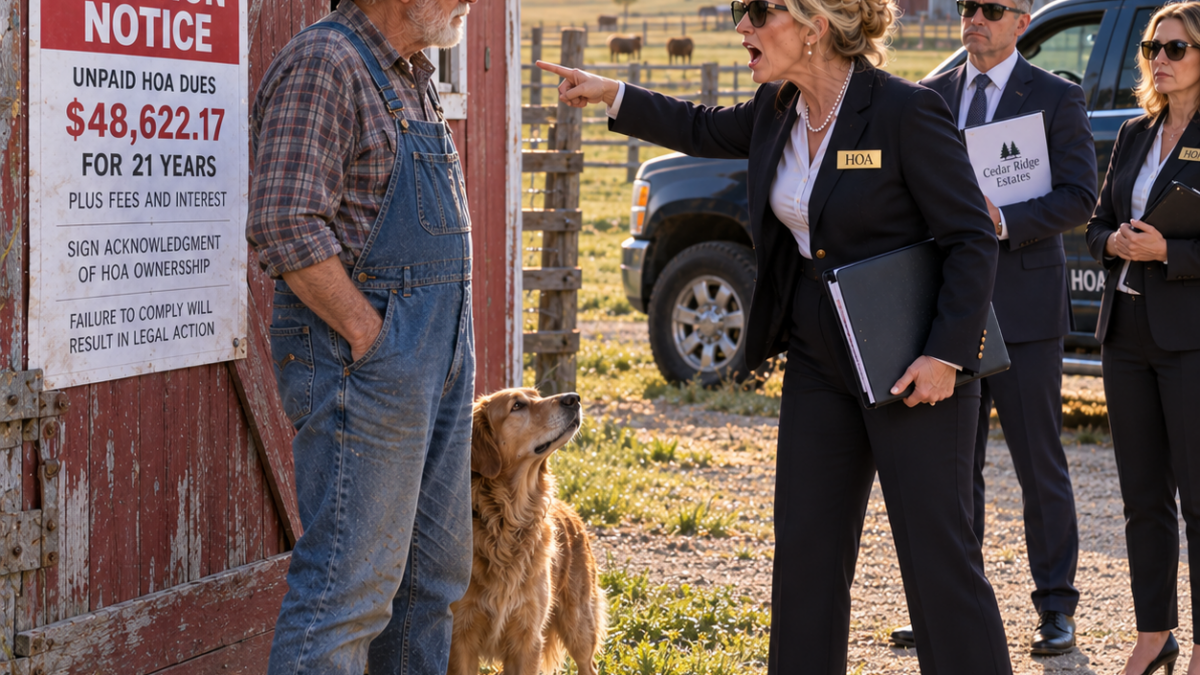
I carried Curtis Bell’s account history into the farmhouse and laid it on the kitchen table.
That was where Ruth and I had solved most serious problems for thirty years.
Not in boardrooms.
Not in lawyers’ offices.
At a pine table under a window overlooking the east pasture.
Ruth used to sit across from me with a pencil tucked behind her ear, checking seed invoices, insurance renewals, property tax statements, and anything else that came in an envelope looking too important to trust.
Her chair was empty now.
I put the HOA packet there anyway.
It felt right.
The top page showed my farm as account M001.
That alone bothered me.
Every legitimate HOA account on the statement carried a residential lot number.
Lot 12.
Lot 34.
Lot 61.
Mine had no lot number.
No street inside Whitcomb Ridge.
No voting unit.
No percentage share of common expenses.
Just:
M001 — Mercer Farm.
People think paperwork is powerful because it looks organized.
Most of the time the opposite is true.
The more serious the claim, the more exact the paperwork has to be.
A title defect does not become valid because someone puts it in a spreadsheet.
I opened Ruth’s old file again.
The declaration was twenty-one years old.
The county recorder’s seal had faded around the edges.
Inside the front cover Ruth had placed a yellow sticky note.
KEEP ORIGINAL — FARM NOT INCLUDED.
I stared at her handwriting.
Then turned to Exhibit B.
Lots 1 through 86.
Every parcel listed.
Every voting share.
Every assessment percentage.
Common Area A.
Common Area B.
Clubhouse tract.
Entrance landscaping parcel.
Then:
EXCLUDED AND RETAINED PARCELS.
Utility pump tract.
Mercer Farm.
Retained Agricultural Parcel Mercer Farm — not subject to residential assessments unless annexed by separate recorded amendment executed by owner of record.
There are some sentences you do not need a lawyer to explain.
I picked up Curtis’s statement.
Annual assessments.
Late charges.
Capital improvement assessments.
Legal review fee.
Agricultural parcel enforcement surcharge.
Then looked back at:
Not subject to residential assessments.
I made two columns on a legal pad.
THEIR CLAIM.
RECORDED DOCUMENT.
Under THEIR CLAIM:
Farm owes dues from formation.
Under RECORDED DOCUMENT:
Farm excluded unless annexed.
Then I pulled our title policy.
Ruth and I had refinanced years earlier after her first surgery.
The title company had listed every known exception affecting Mercer Farm.
Taxes.
Utility easement.
Old farm-equipment access reservation.
Nothing about Whitcomb Ridge assessments.
Nothing about HOA dues.
Nothing about membership.
That did not automatically settle everything.
But it told me where the next question had to go.
If the HOA claimed Mercer Farm had joined later, there had to be a recorded annexation.
Not a committee memo.
Not a budget note.
Not Marla’s opinion.
A recorded amendment signed by the owner.
Ruth had never signed one.
I had never signed one.
My father had never signed one.
And unless they had discovered a way for dead farmers to execute covenants, nobody before us had signed one either.
I called the county recorder.
A woman named Denise answered.
I gave her the parcel number.
Then the property name.
She searched.
“I see the Whitcomb Ridge declaration.”
“Yes.”
“Excluded parcel schedule.”
“Yes.”
“Later amendments for rental restrictions, landscaping standards, architectural provisions, and clubhouse parcel changes.”
I gripped my pen.
“Anything annexing Mercer Farm?”
Typing.
Then silence.
“No.”
“You’re sure?”
“I see no recorded annexation amendment under Mercer Farm or this parcel identification number.”
I closed my eyes.
“Can I order certified copies?”
“Yes.”
She gave me the request number.
When the call ended, I should have felt relieved.
Instead, I felt more uneasy.
Honest mistakes are usually messy.
This was not messy.
The claim went back exactly twenty-one years.
The ledger used formal account codes.
Fees had been layered year by year.
Somebody had built this debt slowly.
I looked again at the first year the charges appeared.
Prior exempt status under review.
No initials.
No resolution number.
No annexation instrument.
Just five words sitting there as though “under review” could transform legal status.
Two days later, another letter arrived.
No red paper.
No nails.
Just a clean white envelope from Harrow Lane Community Management.
FINAL DEMAND BEFORE LIEN RECORDATION.
The amount had grown.
$51,904.88.
Seven days.
They had added legal preparation fees.
Board enforcement review.
Parcel access compliance evaluation.
That last phrase bothered me.
Access compliance?
To what?
My farm had its own lane.
County road frontage.
Own gates.
Own utilities except for recorded easements.
There was no HOA access issue.
Unless they were already thinking beyond dues.
I was standing beside the mailbox reading it when Tom Kepler pulled up in his white pickup.
Tom lived inside Whitcomb Ridge.
Good man.
Retired dentist.
Believed almost anything printed on official letterhead.
“Bad news?”
“HOA’s busy.”
He gave an awkward smile.
“Marla posted a community update.”
“About me?”
“Not by name.”
“What did it say?”
He hesitated.
“That some legacy parcels have avoided assessments while benefiting from association infrastructure.”
I folded the letter.
“Did she mention the recorded exemption?”
His face went blank.
“What exemption?”
There it was.
Marla could spread one polished paragraph.
I would need ten documents to undo it.
I nearly started explaining.
Then stopped.
“Ask her for the document that makes my farm assessable.”
Tom frowned.
“I don’t want to get involved.”
“You already are. You just didn’t know it.”
He looked toward my barn.
The red notice had been removed and placed in a plastic sleeve.
The nail holes remained.
“My wife said if you owe it, maybe it’s better to work something out before they record a lien.”
That was the first honest concern I had heard from anyone inside Whitcomb Ridge.
A lien could hurt me even if the lien was eventually removed.
It could cloud title.
Scare lenders.
Complicate farm credit.
Make suppliers nervous.
“I don’t owe it.”
Tom nodded.
But he did not look convinced.
Then a Rusk Feed and Supply truck came up the lane.
Ben Hart had delivered grain to me for eighteen years.
He slowed.
Rolled down his window.
“Morning, Elias.”
“Morning.”
His eyes moved to the Harrow Lane envelope in my hand.
Then away too quickly.
“What did you hear?”
He rubbed his thumb along the steering wheel.
“Nothing I wanted to repeat.”
“Repeat it.”
He exhaled.
“Someone from Whitcomb Ridge called the shop.”
Tom stopped pretending not to listen.
“What did they want?”
“Asked whether we still extend farm credit on properties with pending liens.”
For one second, everything around me seemed too bright.
“Who called?”
“Woman. Didn’t give a name.”
“Exact words?”
Ben thought.
“Said Mercer Farm was under HOA collection action and might not remain under current ownership.”
Not might owe money.
Not might face a lien.
Might not remain under current ownership.
That was eviction language.
Pressure language.
They had started spreading the ending before filing the paper.
Ben leaned toward the open window.
“For what it’s worth, we’re not changing your credit line unless there’s a court order or recorded lien. You’ve paid us on time eighteen years.”
“Thank you.”
“But get ahead of it.”
“I’m trying.”
The truck rattled toward the barn.
Tom stood beside the mailbox looking sick.
“I didn’t know they were calling suppliers.”
“That’s the point.”
I walked back to the farmhouse.
At the kitchen table, I placed the final demand beside Curtis’s account history.
The amounts changed.
The years did not.
Twenty-one years.
Account M001.
Prior exempt status under review.
Then a sudden beginning balance.
I aligned the pages by year.
Years 1 through 12:
No dues charged.
Year 13:
Beginning balance adjustment.
No original invoice.
No legal explanation.
Just debt appearing.
At 3:42 that afternoon, Rusk Feed emailed me written confirmation of the phone call.
One sentence froze me.
Caller stated Mercer Farm is under HOA collection action and may not remain under current ownership.
I printed it.
Put it into a third stack on the kitchen table.
Stack one:
What the HOA claimed.
Stack two:
What the recorded documents said.
Stack three:
What I still needed.
The next morning I drove into town to see Helen Price.
Helen had been Whitcomb Ridge’s board secretary when the subdivision was new.
She was seventy-something now and lived outside the gates.
I found her gardening.
When she saw me, she removed one glove.
“Elias Mercer.”
“Helen.”
“I heard they’re circling your farm.”
“That what people call it?”
“That is what polite people call a hunt before admitting it’s a hunt.”
I showed her the account history.
The code M001.
The phrase PRIOR EXEMPT STATUS UNDER REVIEW.
She read in silence.
Then looked at me.
“Marla signed this?”
“She signed the barn notice.”
Helen’s mouth tightened.
“Of course.”
She opened her front door.
“Come in.”
Her living room looked like a retired accountant’s attic.
Binders.
Boxes.
Old HOA packets.
Meeting books.
Treasurer reports.
Helen had kept paper because, like Ruth, she did not trust electronic records to remain exactly what they once were.
She pulled three binders.
FINANCE BACKUP — YEARS 1 THROUGH 8.
ASSESSMENT ROLL.
LEGACY PARCELS.
She opened the assessment roll.
Lot 1.
Lot 2.
Lot 3.
Dues.
Voting interests.
Payment status.
Then a separate page.
NON-ASSESS REFERENCE PARCELS.
Utility pump tract.
Mercer Farm.
Future road reserve.
Beside Mercer Farm:
AGR-EXCL.
Agricultural excluded.
No voting unit.
No assessment share.
No dues.
No balance.
Helen tapped it.
“This is how the farm was originally carried.”
“Why list it at all?”
“Because it sat within the outer subdivision perimeter on some marketing maps. Residents asked what it was. We kept reference parcels listed so nobody mistook them for common land.”
“That makes sense.”
She turned pages.
Year two.
AGR-EXCL.
Year three.
AGR-EXCL.
Year five.
AGR-EXCL.
Year eight.
AGR-EXCL.
Then year nine.
The photocopy was crooked.
Somebody had crossed out AGR-EXCL.
In the margin:
REVIEW.
No initials.
No resolution.
Helen sighed.
“That was when the clubhouse financing started.”
I looked at her.
“What clubhouse financing?”
“The board expanded the pool. Added fitness rooms. Rebuilt the stone entrance. The bank wanted cleaner receivables and stronger projected revenue.”
“And they looked at my farm?”
“Some people looked at all legacy parcels.”
“Marla?”
Helen folded her hands.
“She wasn’t treasurer yet.”
“But?”
“Finance committee.”
We kept going.
Year ten.
Review.
Year eleven.
Review.
Year twelve.
No assessment amount.
Then year thirteen.
Mercer Farm had moved.
No longer in reference parcels.
Now under:
DELINQUENCY REPORT.
Account M001.
Beginning balance adjustment.
No original invoice history.
No residential lot.
No voting unit.
No assessment share.
Helen watched me.
“That’s Marla’s first year as treasurer.”
I did not like easy villains.
Real mistakes usually have more than one hand in them.
But the dates were the dates.
Same farm.
Same declaration.
No annexation.
Different accounting category.
New treasurer.
Helen reached into the back pocket of the binder.
“I argued about this.”
She unfolded a page.
Draft finance notes.
Not approved minutes.
But enough.
One line was underlined:
Mercer Farm status to remain under review pending revenue classification.
“Revenue classification?” I said.
Helen nodded.
“Not legal classification.”
“Not annexation.”
“No.”
“Can I copy this?”
“I wondered when someone would need it.”
I photographed every page.
Binder covers first.
Then each assessment roll.
Dates.
Codes.
Context.
When I drove home, Helen insisted I take the binders temporarily.
“You bring them back.”
“I will.”
“Ruth would haunt both of us if you lost them.”
I smiled.
“She would.”
At the farmhouse, I spread everything across the table.
Now the timeline had shape.
Years 1–8:
Excluded.
Year 9:
Under review.
Year 13:
Delinquent.
Same year Marla became treasurer.
This was no longer about whether Whitcomb Ridge had made a clerical mistake last month.
The status had been altered years earlier.
Two days after that, I went to Harrow Lane Community Management for a meeting.
Glass building.
Gray carpet.
Frosted conference room doors.
Wrapped mints in a bowl.
Marla was already seated.
Curtis beside her.
Between them:
Settlement agreement.
Payment plan.
Marla smiled when I entered.
“I’m glad you decided to be reasonable.”
“I decided to be documented.”
Curtis cleared his throat.
“This meeting is an opportunity to avoid escalating costs.”
“Good.”
I sat down.
“Show me the document that makes Mercer Farm assessable.”
Marla’s smile thinned.
“We’ve explained the association’s position.”
“I didn’t ask for a position.”
Curtis pushed the payment agreement toward me.
“The records show your farm as account M001.”
“The records also show it as AGR-EXCL.”
He stopped.
Marla looked at him.
I opened Ruth’s folder.
Placed Exhibit B on the table.
Highlighted paragraph.
“Retained agricultural parcel. Not subject to residential assessments unless annexed by separate recorded amendment executed by owner of record.”
Marla barely glanced down.
“That language predates later board action.”
“Show me the action.”
“There was a finance review.”
“Show me the recorded amendment.”
“The association determined legacy parcels benefiting from the community should contribute.”
“Benefit is not annexation.”
“That is your interpretation.”
“No.”
I placed the certified recorder search response beside the declaration.
“That is the county’s index.”
Curtis leaned forward.
Marla did not.
“There is no recorded annexation under my parcel.”
Marla folded her hands.
“Absence in a county index does not eliminate obligation.”
“That sounds good until you have to put a lien on somebody’s property.”
The room changed.
Just slightly.
I put down the old rolls.
Year one:
AGR-EXCL.
Year five:
AGR-EXCL.
Year eight:
AGR-EXCL.
Then year thirteen.
M001.
Delinquent.
Beginning balance adjustment.
“No original dues invoice.”
Silence.
“No lot number.”
Silence.
“No voting interest.”
Curtis shifted.
“No annexation reference.”
Marla lifted her chin.
“Accounting systems evolve.”
“Legal status doesn’t evolve because somebody changes an accounting label.”
I looked at Curtis.
“Who changed the code?”
He looked at Marla.
Marla looked at the pages.
“The board authorized a review of legacy parcels.”
“Review is not assessment authority.”
“That is your opinion.”
“No.”
I tapped the declaration.
“That’s your declaration.”
Curtis pulled the settlement packet back.
“If you continue taking this posture, the association may proceed with recording a lien. You can challenge it afterward.”
“And cloud my title first.”
“That is a consequence of unresolved debt.”
“It’s a consequence of false paperwork.”
Marla stood.
“You have until Friday.”
I remained seated.
“Before Friday, send me three things.”
She paused.
“The recorded annexation.”
Nothing.
“The board vote authorizing dues against Mercer Farm.”
Curtis looked down.
“And the original ledger page changing AGR-EXCL into delinquent M001.”
Marla picked up her tablet.
“We’ll review your request.”
“No.”
She looked at me.
“You’ll preserve the records.”
Her expression hardened.
“If one page disappears now, it will matter later.”
That was the first time Marla lost the polished smile completely.
She left.
Curtis followed.
I was putting my papers away when a young woman from the copy room stepped inside.
Her badge read NINA.
She placed a folded sheet beside the mint bowl.
“You left this.”
“I don’t think I did.”
Her hand trembled.
Then she whispered:
“Check the budget label.”
She left.
I did not open the page until I reached my truck.
It was a budget worksheet.
Clubhouse financing year.
Near the bottom:
PROJECTED RECOVERIES.
Then:
MERCER FARM ARREARS — RECOVERABLE RECEIVABLE.
I read it again.
Not dues.
Not annexed assessment.
Receivable.
A budget expected to collect it.
At the bottom of the page was the file name:
Clubhouse Expansion Loan Support — Receivables Draft.
That was when the fight changed.
They had not merely decided I owed them money.
Someone had used the imaginary debt as projected money.
I photographed the page through the windshield with Harrow Lane’s building in the background.
Then called Helen.
She answered on the third ring.
“Did Nina give you something?”
I sat very still.
“You know Nina?”
“My niece’s daughter.”
“She gave me a budget worksheet.”
Helen sighed.
“What does it say?”
“Mercer Farm arrears listed as recoverable receivable.”
Silence.
Then:
“They did it.”
“Who?”
“The finance committee.”
“You knew?”
“I suspected. I objected to counting exempt reference parcels as receivables.”
“Do you have records?”
“Come back.”
Rain had started by the time I reached her house.
This time, no coffee.
No small talk.
Helen placed a cardboard file on the table.
FINANCE COMMITTEE WORK SESSION.
Pool expansion.
Fitness addition.
Stone entrance upgrade.
Lender questions.
Then a section:
REVENUE STABILIZATION.
Special assessment increase.
Amenity fees.
Legacy parcel receivables.
Helen tapped the phrase.
“Marla’s wording.”
I turned the page.
Projected collections.
Then:
Mercer Farm projected recovery — $31,400.
Beside it:
Conservative estimate pending reclassification.
Reclassification.
Not annexation.
Not owner agreement.
Reclassification.
My jaw tightened.
Ruth and I had been worrying about medical bills during those same years.
Arguing over whether we could replace an irrigation pump.
Meanwhile, someone in a clubhouse finance meeting was turning our exempt farm into projected income.
“Did anyone ask counsel?” I said.
Helen nodded.
“The association attorney said a recorded amendment or voluntary agreement would be needed.”
“And they had neither.”
“No.”
“So they changed the words.”
Helen looked down.
“Potential recovery.”
Then:
“Receivable.”
Then:
“Delinquent.”
I looked at her.
“And now eviction.”
Helen slid one last page toward me.
An old email.
From Marla’s personal address.
Year twelve.
Subject:
MERCER FARM ACCOUNT TREATMENT.
The body read:
If Mercer refuses voluntary recognition, balance should remain carried as recoverable until enforcement path is available. Removing it now weakens our receivable position.
I read it twice.
Then once more.
Helen looked ashamed.
“I should have pushed harder.”
“You kept the records.”
“I let them clean the formal minutes.”
“But you kept the drafts.”
She looked at me.
“That might be the only reason I can prove anything.”
I drove home in heavy rain.
The stone entrance to Whitcomb Ridge glowed through the water.
At the barn office, I created a fourth stack.
Stack one:
What they claimed.
Stack two:
What the declaration said.
Stack three:
What I needed.
Stack four:
What they knew.
Then I called Andrea Pike.
Andrea had worked title law longer than I had worked title operations.
She once saved a family’s home sale because a bank release had been indexed under one wrong parcel digit.
She listened without interrupting.
When I finished, she said:
“Send everything.”
“Tonight?”
“Now.”
“Declaration?”
“Yes.”
“Ledger pages?”
“Yes.”
“Budget draft?”
“Yes.”
“Marla’s email?”
“Especially that.”
I looked outside at the rain.
“Do you think they’ll actually record the lien?”
Andrea paused.
“People who build fake receivables usually don’t enjoy admitting they’re fake.”
Then she added:
“Elias, if they record a lien after seeing what you have, they’re not making a mistake anymore.”
I looked at Ruth’s handwriting on the green folder.
Then at the red notice inside its plastic sleeve.
My scanner warmed up.
By nine the next morning, Andrea had drafted a demand letter.
Calm.
Precise.
No unnecessary accusations.
She told me:
“Never call something fraud before you need to. Make them explain the paper first.”
Her letter went to Whitcomb Ridge.
Harrow Lane.
Marla Voss.
Curtis Bell.
And Denise Roe, the lawyer listed on the final demand.
Subject:
MERCER FARM — DEMAND TO WITHDRAW COLLECTION ACTION AND PRESERVE RECORDS.
The letter laid out the history.
Mercer Farm was expressly excluded.
No annexation found.
Old assessment rolls showed AGR-EXCL.
Later ledgers moved the property into delinquency without any lot number, voting share, invoice history, or annexation instrument.
Budget documents classified supposed arrears as receivables during clubhouse financing.
Then Andrea wrote:
Any lien recorded against Mercer Farm based on these materials may constitute a knowingly defective encumbrance and expose responsible parties to claims including slander of title, damages, attorney fees, and injunctive relief.
I leaned back.
That was legal language for something I understood from years in title work.
False paper can injure land long before a judge decides it is false.
Andrea sent the letter by email.
Certified mail.
Courier.
“Three methods?”
“I want three delivery trails.”
Two hours later, Denise Roe called.
“Mr. Mercer.”
“Yes.”
“I represent Whitcomb Ridge.”
“I know.”
“I want to confirm my office received Ms. Pike’s letter.”
“Good.”
A pause.
“I did not draft the notice nailed to your barn.”
“I assumed you didn’t.”
“I also did not advise anyone to use the word eviction.”
“That was wise.”
Silence.
Then:
“The association represented to my office that Mercer Farm has a long-standing delinquent account.”
“They represented that to me too.”
“I’ve requested supporting documents from Ms. Voss and Harrow Lane.”
“Ask for all of them.”
“I intend to.”
“No.”
She paused.
“Ask for the complete historical assessment roll.”
Another pause.
“Every code change.”
Silence.
“Every finance packet in which my farm appears as a receivable.”
When Denise spoke again, her voice was less polished.
“Do you have reason to believe records were altered?”
“I have reason to believe the story was built over time.”
We ended the call.
I went back to work.
That is the strange thing about farms.
Legal threats do not stop cattle drinking.
Hinges still break.
Feed still needs moving.
Fence wire still sags.
At 4:18, Andrea called.
“They responded.”
“That fast?”
“Denise requested historical files. Marla sent a packet.”
“What’s in it?”
“Three ledger pages.”
My stomach dropped.
“Which ones?”
“Year thirteen. Current balance. Summary.”
“No years one through eight?”
“No.”
“No AGR-EXCL?”
“No.”
“No finance drafts?”
“No.”
“No budget worksheet?”
“No.”
“No email?”
“No.”
“She cut out the history.”
Andrea said:
“She cut out the part that explains why the current pages exist.”
I leaned against the workbench.
“What does the summary call my farm?”
“Residential-adjacent assessment account.”
I laughed once.
“That category isn’t in the declaration.”
“I know.”
“Can they record Friday?”
“They can try.”
“What do we do?”
“I file tomorrow morning for a temporary restraining order.”
“A hearing?”
“Yes.”
My throat tightened.
The fight was leaving letters.
That should have made me feel safer.
It didn’t.
That evening, Denise Roe emailed Andrea and me.
Please preserve all original documents in your possession.
Association counsel has concerns regarding inconsistent records produced by management.
I read that sentence three times.
Then forwarded it to Andrea.
My message:
They know the pages are missing.
Andrea replied:
Yes.
Tomorrow they explain why.
The courtroom was small.
Second floor of the county building.
No dramatic marble.
No cameras.
Just fluorescent lights, wood benches, and a judge named Albright who spoke softly enough that everybody listened harder.
Andrea sat beside me with three binders.
Across the aisle:
Denise Roe.
Marla Voss.
Curtis Bell.
Judge Albright looked at the file.
“We are here on a request to prevent recordation of an assessment lien against Mercer Farm.”
Andrea stood.
“Yes, Your Honor.”
Denise stood.
“The association has not yet recorded a lien. It maintains a good-faith basis to continue review of a long-standing delinquent account.”
Judge Albright looked over his glasses.
“Good faith generally benefits from complete history.”
Andrea began with the declaration.
Then Exhibit B.
She read the paragraph aloud.
Retained agricultural parcel Mercer Farm not subject to residential assessments unless annexed by separate recorded amendment executed by owner of record.
Then she presented the county recorder response.
No annexation found.
Judge Albright turned to Denise.
“Do you have an annexation instrument?”
Denise glanced at Marla.
Marla did not move.
“No, Your Honor. Not at this time.”
“At this time?”
His voice never rose.
“After threatening a lien?”
Denise tightened her jaw.
“The association relied on management records.”
Andrea moved to the assessment rolls.
Year one:
AGR-EXCL.
Year five:
AGR-EXCL.
Year eight:
AGR-EXCL.
No voting unit.
No assessment share.
Then year thirteen:
M001.
Beginning balance adjustment.
Delinquent.
Judge Albright leaned forward.
“Who authorized the classification change?”
Denise turned a page.
“The current production does not identify an authorizing resolution.”
Andrea looked toward Marla.
“Because the production begins after the exemption disappears.”
Judge Albright turned to Curtis.
“Mr. Bell, your company produced these records?”
Curtis half-stood.
“Yes, sir.”
“Were you asked for complete historical records?”
“Yes.”
“Did you produce them?”
Curtis swallowed.
“We produced what we believed most relevant to the current account.”
Andrea put Marla’s three-page packet on the courtroom screen.
Then Helen’s older copies.
Years one through eight.
Review notation.
Finance draft.
Delinquency reclassification.
The missing history sat beside the produced history.
You did not need a title degree to see the cut.
Judge Albright looked at Marla.
“Ms. Voss, were you aware older assessment rolls listed Mercer Farm as excluded?”
Marla lifted her chin.
“I was aware of historical uncertainty concerning legacy parcels.”
“Uncertainty is not assessment authority.”
Denise did not interrupt.
Andrea moved to the budget worksheet.
CLUBHOUSE EXPANSION LOAN SUPPORT — RECEIVABLES DRAFT.
Mercer Farm arrears — recoverable receivable.
She explained that the alleged farm debt appeared in budget support as projected revenue.
Then the finance work-session document.
Mercer Farm projected recovery.
Pending reclassification.
Judge Albright read it.
“Reclassification by whom?”
No answer.
Then Andrea displayed Marla’s year-twelve email.
If Mercer refuses voluntary recognition, balance should remain carried as recoverable until enforcement path is available. Removing it now weakens our receivable position.
The courtroom went very still.
Judge Albright read it twice.
Then looked at Marla.
“Ms. Voss, is this your email?”
She looked at Denise.
Denise did not speak.
Marla’s voice was smaller.
“It appears to be.”
“Did Mercer Farm sign a voluntary recognition agreement?”
“No.”
“Was Mercer Farm annexed?”
“The board later determined—”
“That was not my question.”
Her fingers tightened around the folder.
“No.”
Judge Albright waited.
Marla added:
“Not by recorded amendment.”
There it was.
No thunder.
No applause.
No dramatic confession.
One answer under fluorescent lights.
No recorded amendment.
For one second, I saw Ruth’s handwriting on that old green tab.
KEEP ORIGINAL — FARM NOT INCLUDED.
Andrea stood with both hands resting on the table.
“My client requests that the association be restrained from filing a lien it cannot presently support, that collection activity cease, that ownership-threatening statements stop, and that all records concerning creation of account M001 be preserved.”
Denise rose slowly.
“In light of the documents presented today, the association will agree not to record a lien pending complete historical review.”
Andrea did not sit.
“We also request ledger correction, withdrawal of the demand, and production of all finance records concerning Mercer Farm.”
Judge Albright nodded.
“Granted in part immediately.”
He dictated the order.
No lien against Mercer Farm until further order.
Collection demand suspended.
All records involving Mercer Farm, legacy parcel treatment, receivables, clubhouse financing, and account M001 preserved.
Production within ten days.
Then he looked at Marla.
“I also want documentation of every association budget in which this alleged farm receivable appeared.”
Marla’s face lost color.
That was the moment I realized the hearing had moved beyond protecting my title.
It had opened their books.
In the hallway, Denise Roe caught up with Marla.
I heard her say:
“Do not delete anything.”
Marla stopped.
Denise repeated:
“Not one email.”
Ten days later, the records came.
Not neatly.
Not willingly.
But they came.
The first document was the formal withdrawal of the collection demand.
The association hereby withdraws all current claims for unpaid assessments against Mercer Farm account M001 pending correction of historical classification.
Andrea called me.
“‘Pending’ is doing heroic work in that sentence.”
“Does it stop the lien?”
“Yes.”
“That’s enough today.”
“No. Today it’s enough to breathe. Then we clean the record.”
The second production contained old budget worksheets.
Finance emails.
Internal notes.
Seven separate budgets listed Mercer Farm as a receivable.
Not once as an annexed member parcel.
Not once with a voting unit.
Not once with an assessment percentage.
Not once with a recorded amendment.
Marla’s name appeared repeatedly.
Some records showed people questioning the treatment.
Others showed management simply carrying forward the balance because previous spreadsheets carried it.
That was the ugliest part in a way.
A lie does not always survive because everybody believes it.
Sometimes it survives because people inherit it.
Copy.
Paste.
Update interest.
Add late fee.
Move to the next year.
By the time somebody asks what the original authority was, the spreadsheet is older than the employee asking.
The third document mattered most.
CORRECTED ASSESSMENT ROLL.
Mercer Farm.
Non-member agricultural parcel.
Excluded from residential assessments.
No voting unit.
No assessment share.
No collection balance.
Account M001:
CLOSED.
I read CLOSED twice.
Then sat in Ruth’s chair.
For almost three weeks, I had lived with a strange sensation that my farm could be transformed into someone else’s number if enough official people repeated the number.
Now the record finally said what the land had always said.
Independent.
The settlement was not cinematic.
Most paper fights are not.
Whitcomb Ridge agreed to reimburse title expenses.
Certified-record fees.
Court filing costs.
Andrea’s initial attorney fees.
The board sent a written notice to residents.
Mercer Farm is not and has never been subject to Whitcomb Ridge residential assessments.
Prior communications may have created confusion.
Andrea called me after reading it.
“Confusion.”
“Yes.”
“Confusion nailed itself to your barn door?”
“Apparently.”
She laughed.
I did too.
For the first time in weeks, it didn’t feel forced.
Marla lost finance authority the following week.
The board called it internal restructuring.
Denise called it risk control.
Helen called me and said:
“They took away the checkbook.”
That was the version I liked.
Marla did not leave Whitcomb Ridge.
She remained a homeowner.
For a while she stayed on another committee.
People expected me to be furious.
I wasn’t interested in where she sat at monthly meetings.
I cared that she could no longer create accounts, direct collection, authorize finance classifications, or speak for the board on liens.
Harrow Lane Community Management did not survive the quarter.
Curtis left before the contract termination vote.
That told me more than any press release would have.
The replacement management company sent me a letter its first week.
Mr. Mercer,
Our records identify Mercer Farm as a non-member exempt agricultural parcel. No Whitcomb Ridge residential assessment obligation applies.
Please notify our office if future correspondence is received in error.
I pinned that letter inside the barn office cabinet.
Not because I trusted management companies forever.
Because some paperwork deserves to remain where you can see it.
Tom Kepler came by one afternoon.
Paper bag in his hand.
“My wife sent banana bread.”
“Walnuts?”
“No.”
“Then I’ll take it.”
He stood near the barn door.
Looked at the two nail holes.
“I should’ve asked before believing that HOA email.”
“Yes.”
He nodded.
“Fair.”
I could have made him stand there longer.
Ruth hated groveling.
Said apology should restore dignity, not transfer humiliation.
So I took the bag.
“Tell your wife thank you.”
Tom looked relieved.
Then embarrassed for looking relieved.
“I will.”
Ben from Rusk Feed came by the next day.
He leaned out the truck window.
“Heard the lien disappeared.”
“There never was a valid lien.”
“Good.”
“Your credit manager still nervous?”
“Not anymore.”
He smiled.
“We printed the board correction and stapled it to your account file.”
That made me laugh.
“You people keep paper too?”
“When people threaten farms, we do.”
Life slowly returned to normal.
Not completely.
People inside Whitcomb Ridge still slowed near my lane sometimes.
Some waved.
Some looked away.
One man I barely knew pulled over one morning and said:
“I honestly thought you were refusing to pay dues like everyone else.”
“I wasn’t everyone else.”
“I know that now.”
“That was the problem.”
He nodded and drove away.
The farm itself did not care.
Grass grew.
Chickens scratched.
The irrigation line leaked near the south row.
A heifer broke a gate chain because she believed every fence was a personal insult.
Normal problems felt almost luxurious.
One Saturday morning, Helen brought back one of her old binders.
We sat at the kitchen table.
She touched Ruth’s green folder.
“She kept everything.”
“Yes.”
“I remember your closing.”
“You were there?”
“Not inside the lawyer’s office. At the first subdivision transition meeting afterward.”
She smiled faintly.
“Ruth brought zucchini bread.”
“With walnuts.”
“Marla complained.”
“That sounds like her.”
Helen turned serious.
“I should have done more.”
“You objected.”
“I let them clean the minutes.”
“You kept drafts.”
“That feels small.”
“It stopped being small in court.”
She looked out the kitchen window.
“People think records are boring.”
“They are.”
“That’s why bad people underestimate them.”
I looked at her.
“Careful calling people bad.”
“You still defending Marla?”
“No.”
“But?”
“Bad decisions are enough. I don’t need to decide her whole soul.”
Helen smiled.
“Ruth would say that.”
“Ruth said worse things privately.”
“That I also remember.”
We laughed.
When Helen left, I opened the gray metal box.
Inside:
Recorded declaration.
Certified county search.
Corrected assessment roll.
Court order.
Settlement.
Management letter.
I added one more item.
A clean photograph of the barn door with the nail holes still visible.
Then I closed the lid.
The last thing I had left to deal with was the original red notice.
I took it out of the plastic sleeve one evening.
NOTICE OF HOA ENFORCEMENT.
INTENT TO RECORD LIEN.
POTENTIAL REMOVAL FROM ASSOCIATION CONTROLLED PROPERTY.
FAILURE TO CURE UNPAID ASSESSMENTS MAY RESULT IN EVICTION PROCEEDINGS.
It looked almost ridiculous now.
A red sheet of paper claiming an authority that had never existed.
But it had not felt ridiculous before sunrise that first morning.
Threats do not need to be valid to frighten you.
That is why records matter.
I carried the notice out to the barn.
Held it against the door where Marla had nailed it.
Two dark holes remained above the latch.
Ruth had painted those boards fifteen summers earlier.
I remembered that day.
July heat.
Old radio playing on the workbench.
She wore one of my shirts backward because she said it protected her clothes better.
By sunset she had red paint on both elbows.
One streak across her forehead.
I told her she looked like she had gone to war with a tomato.
She threw a rag at me.
Then stepped back and looked at the finished barn.
“It looks proud again.”
That was Ruth.
Buildings had feelings when she wanted them to.
I set the red notice on the workbench.
Took out fine sandpaper.
Worked the splintered nail holes slowly.
Not enough to erase them.
Just enough to smooth the edges.
The corrected assessment roll was folded in my shirt pocket.
Another copy sat in the metal box.
Andrea had one.
A settlement copy existed in the court record.
Twenty years from now, nobody should be able to look at a spreadsheet and pretend Mercer Farm had ever owed dues.
I ran my hand over the door.
Smooth wood.
Two faint marks.
Some scars do not need to disappear.
They only need to stop being wounds.
The sun dropped behind Whitcomb Ridge.
Its slate roofs caught orange light.
Sprinklers came on in perfect rows.
On my side of the fence:
Barn.
Pasture.
Wet grass.
Feed dust.
One crooked lane that had never belonged to their association.
I thought about Marla’s first sentence.
“You have benefited from our community.”
She had been right about one thing.
I had benefited from living near people.
Tom brought banana bread.
Helen kept records.
Ben refused to panic over rumors.
Andrea knew exactly where paper became dangerous.
Even Denise Roe, once she saw the missing history, chose her obligation over somebody else’s story.
Community existed.
But it was not the same thing as control.
Whitcomb Ridge had spent years confusing the two.
My farm could sit inside the shape of their neighborhood without belonging to their covenants.
My cows could be visible from their clubhouse without owing pool maintenance.
Their property values could rise beside my fields without giving them ownership of what created the view.
Proximity was not membership.
Benefit was not annexation.
A ledger was not a deed.
And an HOA letter was not law merely because someone had the confidence to hammer it into a barn before sunrise.
A month later, the board held an open meeting about finance controls.
I did not attend.
Tom asked why.
“They’re changing the rules because of your case.”
“Good.”
“Don’t you want to hear it?”
“No.”
He looked surprised.
“You fought all the way to court.”
“I fought to protect the farm.”
“That’s different?”
“Very.”
I went home and fixed fence instead.
Later, Helen emailed me the new policy.
Any account added to the assessment roll had to include:
Recorded covenant authority.
Parcel number.
Voting unit.
Assessment share.
Effective date.
Source instrument.
Legal review.
No “legacy parcel” could be moved from reference status into receivables without recorded documentation.
I printed the policy.
Put it in the gray box.
That mattered more to me than watching people apologize in a meeting.
Systems are harder to manipulate when they require boring evidence.
The following spring, Whitcomb Ridge replaced the stone sign at its north entrance.
A contractor accidentally parked a skid steer partly on my lane.
I walked out.
The operator saw me.
“Mr. Mercer?”
“Yes.”
“Sorry. I think we’re over your line.”
“You are.”
He moved immediately.
No committee chair.
No argument.
No speech about community benefit.
Just:
You’re over the line.
Okay.
Move.
That was what boundaries were supposed to feel like.
Ordinary.
Ruth’s barn door faded another shade that summer.
I thought about repainting it.
Then decided not yet.
The old red still looked good in evening light.
One day a young couple from Whitcomb Ridge stopped at the farm stand I had opened near the lane.
They had moved in after everything happened.
The woman bought tomatoes.
Her husband looked toward the subdivision.
“You’re the farm that doesn’t pay HOA dues, right?”
I looked at him.
He immediately turned red.
“I mean—sorry. That came out wrong.”
His wife elbowed him.
I handed her the tomatoes.
“Yes.”
He waited.
“Because I’m not in the HOA.”
“Oh.”
“That’s the whole story.”
He laughed awkwardly.
“I heard it was more complicated.”
“It became complicated.”
“But that’s the reason?”
“That’s the reason.”
The woman smiled.
“Good tomatoes.”
“Those are definitely mine.”
They left.
I watched them walk back toward Whitcomb Ridge.
For years, people had tried to make my status sound mysterious.
Legacy parcel.
Special account.
Agricultural assessment issue.
Historical uncertainty.
There had never been much mystery.
Mercer Farm was excluded.
Nobody annexed it.
Nobody got my signature.
Nobody had the authority to charge dues.
Everything after that had been language attempting to outrun a fact.
That evening, I locked the farm stand and walked back toward the barn.
The two nail marks above the latch caught the last light.
I ran my thumb across one.
Smooth now.
Inside the barn office, Ruth’s mug still sat on the shelf.
The corrected assessment roll was pinned inside the cabinet.
NON-MEMBER AGRICULTURAL PARCEL.
NO ASSESSMENT SHARE.
NO COLLECTION BALANCE.
ACCOUNT M001 CLOSED.
I read it once.
Then shut the cabinet.
Outside, Whitcomb Ridge’s sprinklers clicked on.
My side of the fence was quiet.
I locked the barn.
Not because I was worried somebody might nail another eviction notice to the door before morning.
Not because I feared another fake lien.
Not because I expected another black SUV to come up the lane.
I locked it because the day was over.
And for the first time since that red notice appeared, that ordinary reason was enough.








