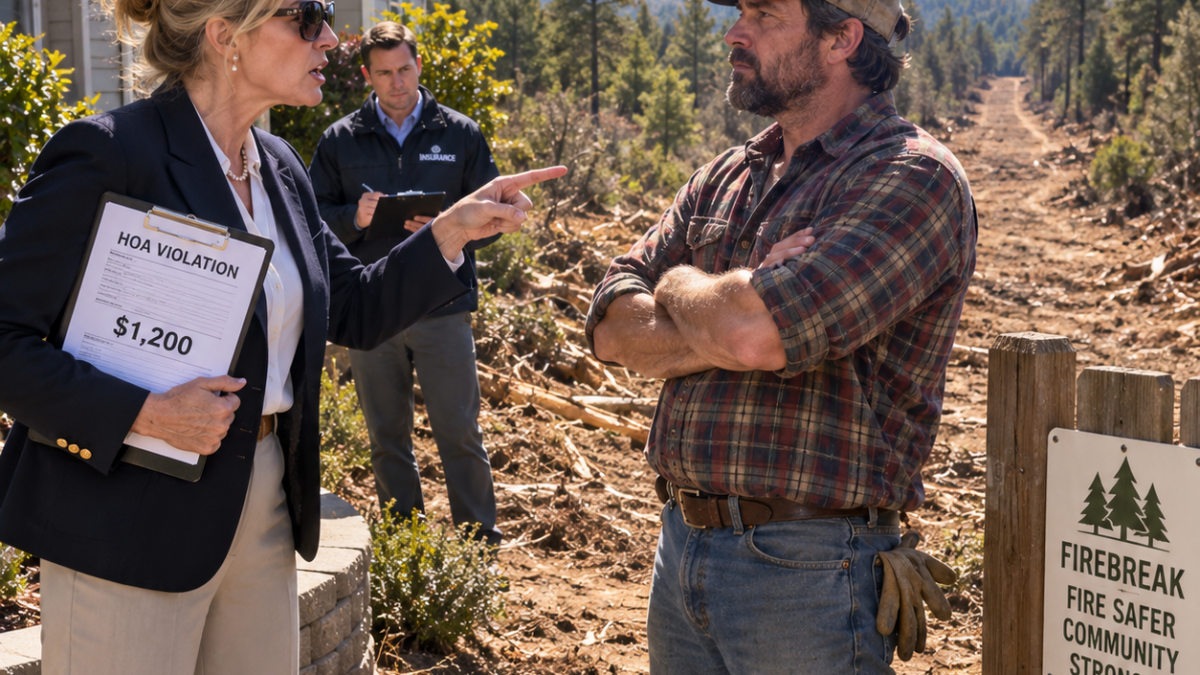
The HOA fined me $1,200 for clearing a thirty-foot firebreak behind my house.
The report had been sitting in their files for four months.
I read the first paragraph twice.
Then I printed it.
Carrier Slope Observation.
Canyon Crest Reserve Homeowners Association.
Loss Control Site Visit — Master Property Renewal Review.
Inspection date: March 14.
Location: Tract C, Juniper Ridge Court, rear exposure behind Lots 18 through 23.
My house was Lot 20.
The wording was careful.
Insurance language usually is.
But careful did not mean unclear.
Combustible vegetation accumulation observed along common slope below rear residential fence line.
Dry grass.
Dead brush.
Ladder fuels.
Reduction recommended before peak fire season.
I put both hands flat on my kitchen table.
For a few seconds, all I could hear was the air conditioner and the dry wind pushing against the windows.
The HOA had fined me for removing combustible vegetation from my own maintenance area.
Their insurance carrier had already told them combustible vegetation needed to be removed from the slope directly behind me.
I turned the page.
There were photographs.
Insurance photographs are rarely dramatic.
That is what makes them useful.
No dramatic angles.
No filters.
No red circles.
Just evidence.
Dry brush behind Dale Abernathy’s fence.
A thick pocket of dead rabbit brush below Gwen Hart’s lot.
Juniper litter stacked against an old split-rail section.
Tall cured grass bending into residential fence lines.
Then the recommendation box.
Obtain brush-abatement estimate for Tract C.
Prioritize Juniper Ridge Court rear exposure before July wind season.
Review potential conflicts between defensible-space objectives and existing landscape standards.
I stopped on that last line.
Read it again.
Their carrier had specifically warned them that their landscaping rules might conflict with wildfire mitigation.
And Constance had fined me under those same rules.
I flipped to the transmission page.
March 18.
Recipients:
Colin Ashford, senior community manager.
Garrett Bowman, board president.
Paula Strand, treasurer.
Landscape Standards Committee shared inbox.
And Constance Crowell.
Four months earlier.
Weeks before I hired my crew.
Before my own insurance company ever sent its warning.
Before Constance stood on my porch telling me I was creating fear.
She already knew.
Then I saw the email chain beneath the report.
Colin had written:
Do we want Arroyo to price the recommended zone or wait for reserve review?
Constance replied that afternoon.
Price it quietly. No owner messaging until we know impact.
Below that, Garrett Bowman had added:
Brush abatement estimate requested pending board review.
I leaned back.
A report could be ignored.
People ignored reports every day.
But an estimate meant the HOA had gone farther.
Somebody had asked a contractor to price the exact work their carrier recommended.
That meant labor hours.
Access requirements.
Disposal costs.
A total.
And a decision.
I opened a new email.
Colin,
Please produce the brush-abatement estimate referenced in the March 18 email chain for Tract C, Juniper Ridge Court.
No accusations.
No explanation.
Just the document.
His response arrived forty-six minutes later.
Ms. Callaway,
We are still determining whether additional operational materials are relevant to your pending compliance hearing.
I called him.
He answered with the resigned tone of a man who had already seen my number on the screen.
“Ms. Callaway.”
“Colin.”
“What can I do for you?”
“You produced the carrier report.”
“Yes.”
“The report recommends a brush-abatement estimate.”
“Yes.”
“The email says you requested one.”
“I understand.”
“So either it exists or it doesn’t.”
A pause.
“I’m not in a position to discuss internal board deliberations by phone.”
“You don’t have to discuss them.”
I looked at the report spread across my table.
“Produce the estimate.”
“Miriam, HOA governance has its own process.”
“So does loss control.”
Silence.
Not angry silence.
Calculating silence.
Finally he said, “I’ll confer with counsel and the board.”
At 5:22 that evening, another file appeared in my homeowner portal.
Supplemental Production 2.
The first page was an estimate from Arroyo Brush Control.
Not the company I had hired.
Similar name.
Different contractor.
Dated March 27.
PROJECT: TRACT C COMMON SLOPE VEGETATION REDUCTION.
Scope:
Remove accumulated dead brush.
Trim ladder fuels.
Clear dry grass from fence-contact areas.
Reduce combustible loading along rear residential fence line.
Dispose of cut material.
Priority:
Complete before July wind season.
Cost:
$18,740.
I almost laughed.
Not because eighteen thousand dollars was nothing.
It wasn’t.
But Canyon Crest had spent more than that the previous year replacing decorative seasonal flowers at the front gate and installing new landscape lighting around the clubhouse.
This was not a financially impossible project.
I turned to the second page.
There, beside the total, was a blue electronic notation.
Defer until next budget cycle.
Maintain native visual continuity for summer view season.
Initials:
C.C.
Constance Crowell.
I sat perfectly still.
There are documents that suggest negligence.
There are documents that leave room for misunderstanding.
And then there are documents that simply record a decision.
The next page was an executive-session summary from April.
Most of it was ordinary HOA business.
Pool heater.
Gate cameras.
Clubhouse flooring.
Then:
MASTER POLICY RENEWAL REVIEW — TRACT C.
Management reviewed carrier vegetation observations.
Brush-abatement estimate received.
Board discussed timing, reserve impact, and visual effect from Canyon Overlook path.
Landscape Standards Chair recommended deferral until next reserve cycle to avoid disruption before summer homes tour.
Motion to defer passed 4–1.
Four to one.
Someone had objected.
The minutes did not name the dissenter.
That was typical.
Minutes have a way of turning people into verbs.
Discussed.
Moved.
Approved.
Deferred.
But the decision was there.
They had received the carrier warning.
They had priced the work.
They had decided appearance and timing mattered more.
Then I reached the last email.
April 9.
From Constance to Colin.
If owners ask about orange flags, please refer to routine landscape assessment. We do not need slope-risk language circulating before the tour. Clearing now will invite owner demands and damage hillside identity from the overlook.
Hillside identity.
I stared at that phrase.
It sounded elegant until you placed it beside dry brush, ladder fuels, and a carrier warning.
Then it sounded like what it was.
A prettier phrase for fuel.
I built a timeline across my dining-room table.
March 14 — carrier inspection.
March 18 — report distributed to management, board, and Constance.
March 27 — $18,740 brush-abatement estimate.
April — board votes to defer.
June — my insurer warns about brush exposure.
Late June — I clear my maintenance area.
July — HOA fines me $1,200.
July — restoration order requires vegetation to be put back.
I stood over that table until the pattern became impossible to ignore.
They had known.
They had priced the remedy.
They had delayed it.
Then they punished the homeowner who actually did the work on her own side.
My phone rang.
Constance.
I let it go to voicemail.
Thirty seconds later, a portal message appeared.
Miriam,
It has come to my attention that you are circulating partial and confidential operational materials.
Your interpretation is incorrect and potentially harmful to the association.
I strongly suggest that you stop drawing conclusions from documents you do not understand.
I read the last sentence three times.
Then I opened the weather app.
A red banner stretched across the top.
RED FLAG WARNING.
Friday, 11:00 a.m. through Saturday, 8:00 p.m.
Low humidity.
Strong northeast winds.
Critical fire conditions.
My hearing was Friday at six.
I looked toward the hillside.
Constance wanted me to submit a replanting plan.
The carrier wanted brush removed.
And now the National Weather Service was warning that the canyon would be sitting under critical fire weather while the HOA held a hearing to decide whether I should put vegetation back.
Friday morning arrived hot and restless.
The wind started before sunrise.
Not the normal canyon breeze.
This wind slid under roof edges.
Pushed patio chairs.
Drove leaves into corners.
The windows clicked softly in their frames while my coffee brewed.
The hearing remained scheduled.
At 7:18, I sent a preservation notice.
To management.
Constance.
The board president.
Treasurer.
Full board inbox.
Please preserve all records concerning Tract C vegetation, carrier observations, brush-abatement estimates, board discussions, landscape enforcement, red-flag advisories, and the restoration requirement issued to Lot 20.
Then I wrote the sentence I knew they would hate.
I will not submit or perform any restoration plan requiring the reintroduction of combustible vegetation within my defensible-space area during an active red-flag warning.
I read it three times.
Sent it.
Then I walked my rear fence with my phone.
Photographed everything.
My cleared strip.
Fence line.
Dry brush beyond it.
Dead interior branches.
Grass touching association-side posts.
I did not cross the fence.
I did not cut one stem from HOA property.
That was difficult.
Every part of my professional instinct told me to reduce what I could see.
But discipline mattered now.
If I touched Tract C, Constance could turn the argument into unauthorized entry or destruction of common property.
At 9:02, Colin replied.
The association acknowledges your communication. Please be advised that unilateral refusal to comply with a duly issued restoration requirement may result in continued fines.
The hearing remains scheduled.
Nine-fifteen.
Constance posted under the community notice.
Canyon Crest maintains its standards consistently. Fear-based interpretations of landscape rules do not exempt owners from compliance.
Fear-based.
I printed it.
By late morning, the neighborhood felt brittle.
Garage doors opened and closed quickly.
People carried things inside that normally stayed on patios.
At the mailbox cluster, Gwen Hart stopped me.
She held her hat against the wind.
“Miriam, can I ask you something?”
“You can.”
“Are you trying to get the HOA’s insurance canceled?”
There it was.
A rumor designed perfectly for Canyon Crest.
Make the person identifying the risk look like the person causing the financial consequence.
“No.”
“People are saying premiums could increase if you keep escalating the brush issue.”
“Premiums can increase when risks are ignored.”
“That sounds like something a lawyer would say.”
“It’s something a former adjuster would say.”
Gwen looked toward Juniper Ridge.
“Constance says experts already reviewed the slope.”
“They did.”
That caught her.
“What?”
“The HOA’s carrier inspected it in March.”
She stared at me.
“They recommended brush removal.”
“Then why is everybody angry at you?”
I looked at the hillside.
“Because I’m the part they can fine.”
She had no answer.
The wind grabbed a receipt from someone’s recycling bin and sent it tumbling down the road.
At 2:00, management uploaded a revised hearing agenda.
Unauthorized slope alteration.
Failure to restore native continuity.
Owner escalation of insurance matter.
I almost admired the wording.
I had gone from homeowner to violation to escalation.
I put everything into one binder.
Fine notice.
Restoration order.
Landscape standards.
Property survey.
County parcel map.
Carrier report.
Brush estimate.
Board minutes.
Constance emails.
My insurer’s warning.
Portal screenshots.
Red-flag advisory.
Preservation notice.
One binder.
One slope.
One story they had spent months dividing into separate boxes.
At 4:12, Constance called again.
This time I answered.
“Miriam.”
No greeting.
“I’m asking you one final time to lower the temperature before tonight.”
I looked at the red-flag warning on my laptop.
“That’s an interesting phrase today.”
“You know exactly what I mean.”
“I know you are holding a vegetation compliance hearing during critical fire weather.”
“You are not being fined for weather.”
“I’m being fined for removing fuel.”
“You are being fined for unauthorized alteration.”
“From an area your carrier told you was exposed.”
“You are drawing conclusions from incomplete documents.”
“I’m reading documents management produced.”
“If you make defamatory claims tonight, the board will respond.”
“I plan to read the carrier’s own words.”
“You plan to embarrass volunteers.”
“No.”
I looked through the glass door at the rear slope.
“I plan to ask why you’re ordering me to replant brush during a red-flag warning.”
Wind struck the house.
For several seconds, neither of us spoke.
Then Constance said quietly, “Daily fines begin Monday if you don’t submit a restoration plan.”
The call ended.
At 5:30, I put the binder into a canvas bag.
Before leaving, I stood at my back window.
My firebreak looked plain.
Pale.
Almost ugly compared with the brush beyond it.
No ornamental softness.
No uninterrupted hillside texture.
Just reduced fuel.
Beyond the fence, Tract C moved in nervous waves of tan and gray.
I locked the rear door.
Checked the side gate.
Picked up my car keys.
Halfway down the driveway, I stopped.
Something had changed.
The wind still smelled like dust and hot stucco.
But beneath it was something sharper.
Smoke.
For one second, I tried to explain it away.
Barbecue.
Fireplace.
Somebody burning yard waste despite the warning.
Then the wind shifted.
Brush smoke.
I turned toward the canyon overlook.
A thin gray line was rising near the low landscape lights at the far bend.
My old professional instincts took over before my emotions did.
I did not run toward it.
People die doing that.
They see a small fire and think small.
Fire does not remain the size it was when you first noticed it.
I put my binder on the passenger seat and called 911.
The dispatcher already had multiple reports.
“Are you in immediate danger?”
“Not yet. Juniper Ridge Court, Lot 20. Smoke near Canyon Overlook. Red-flag conditions. HOA common slope behind the homes has heavy brush.”
“Are you evacuating?”
“Yes.”
“Do not approach the fire.”
“I won’t.”
I looked back at the house.
My cleared strip sat between the fence and the patio.
Nothing heroic.
Nothing dramatic.
Just less to burn.
Two houses down, Mr. Weston stepped onto his driveway.
He held his phone as if it had personally offended him.
I stopped.
“Mr. Weston, did you get the alert?”
“It made a noise.”
“Leave now.”
He looked toward the smoke.
“Is it close?”
“Close enough.”
That moved him.
By the time I reached the end of the street, the first emergency alert arrived.
EVACUATION WARNING — CANYON CREST EAST SLOPE.
Four minutes later, it changed.
EVACUATION ORDER — JUNIPER RIDGE COURT AND CANYON OVERLOOK.
LEAVE IMMEDIATELY.
Residents poured into the lower gate.
Dogs.
Laptop bags.
Medication.
Suitcases.
Children holding blankets.
Gwen’s SUV stopped beside me.
She looked toward my car.
Neither of us lowered our windows.
Smoke rolled over the ridge behind us.
I never reached the hearing.
Nobody did.
At 6:03, from a grocery-store parking lot outside the evacuation zone, my phone sent an automated reminder.
COMPLIANCE HEARING BEGINS IN 15 MINUTES.
I stared at it.
Then another notification arrived.
Tonight’s hearing is postponed due to emergency conditions.
Emergency conditions.
Not alarmism.
Not fear-based interpretation.
Not landscape disagreement.
Emergency conditions.
The fire did not destroy the neighborhood.
Later, people would use that fact to soften the memory.
Only brush burned.
No homes lost.
No hospitalizations.
No tragedy.
But from the evacuation lot, none of us knew that yet.
Updates came in fragments.
Fire moving below Canyon Overlook.
Juniper Ridge exposure threatened.
Overlook path closed.
Fire crews establishing line.
One photo showed orange light running low through the slope.
Fast.
Not towering flames.
Ground-driven fire moving through fine fuels.
I did not post.
I did not send Constance the carrier report.
I did not write “I told you so.”
I sat with both hands wrapped around my steering wheel.
At 9:40, the evacuation order downgraded to warning.
At 10:25, residents on Juniper Ridge were permitted to return cautiously.
I drove home slowly.
Ash moved across the road like dirty snow.
The bronze Canyon Crest sign was streaked with soot.
Emergency tape snapped in the wind near the overlook.
The air smelled of wet ash and burned sage.
When I turned onto Juniper Ridge Court, my headlights caught Tract C.
Black.
Not all of it.
But a ragged burned path stretched from the overlook bend through the common slope behind our fences.
I parked.
Walked to my side gate.
Stayed on my property.
Held up my phone.
Behind my house, blackened brush reached the edge of the cleared strip.
Then the heavy burn stopped.
Not perfectly.
Fire never draws with a ruler.
A few embers had landed inside the area.
Small black marks spotted the gravel.
But the continuous fuel path ended at the line I had cleared.
I stood there longer than I should have.
I did not feel victorious.
The hillside still smoked.
My neighbors were shaken.
Emergency crews were still working.
But I knew what I was looking at.
I had seen it in claims before.
Fuel break effect.
The next morning, Constance was already at the overlook.
So were Colin.
Garrett Bowman.
Dale.
Gwen.
Mr. Weston.
Several other residents.
Constance wore a navy jacket instead of her slate blazer.
No gold committee badge.
When she saw me, she raised her voice slightly.
“We need to be very careful about conclusions.”
I stopped behind the emergency tape.
She continued.
“Unauthorized clearing may have destabilized the slope and affected how the burn traveled.”
I looked at the black brush.
Then at the pale strip behind my fence.
Every visible fact pointed in the opposite direction.
But I said nothing.
Not yet.
A white pickup arrived before noon.
MARSTON RISK SERVICES.
The HOA’s insurer.
Not mine.
A woman stepped out wearing work pants, a gray field shirt, and boots.
She carried a covered clipboard.
A man followed from a dark sedan with a camera, measuring wheel, and evidence flags.
Constance immediately straightened.
“Priscilla. Thank you for coming so quickly.”
The woman nodded.
“Priscilla Leland. Carrier property-risk field review.”
She gestured toward the man.
“Owen Castellano. Fire-origin consultant.”
Owen barely acknowledged us.
His attention was already on the ground.
Colin stood beside Garrett with his phone clutched in both hands.
Constance began.
“There has been some homeowner confusion concerning private clearing and association slope management.”
Priscilla looked directly at her.
“We are here for the carrier’s renewal review of the burn path and prior recommendations.”
The phrase prior recommendations changed the entire gathering.
They had their own file.
Their own report.
Their own timeline.
Constance couldn’t explain it away as something I misunderstood because the author had arrived.
Priscilla turned toward me.
“You’re Miriam Callaway?”
“Yes.”
“You submitted pre- and post-fire photographs?”
“Yes.”
“I also have the documents management produced.”
Constance’s head moved sharply.
“Ms. Callaway has been drawing conclusions from incomplete materials.”
Priscilla did not turn.
“I will compare what is provided with our records.”
Our records.
I almost felt the atmosphere tighten.
Owen began at the overlook.
The first smoke report had come from near a low landscape light.
Its plastic lens was warped.
A conduit had loosened.
He placed a yellow flag.
“Reported origin vicinity?”
Colin checked his phone.
“Yes.”
Owen took photographs.
He did not call it the cause.
Good investigators don’t reward impatience.
We moved slowly along the tape.
Priscilla pointed toward the black slope.
“This is Tract C?”
Colin answered.
“HOA common property.”
“Owned and maintained by the association?”
“Yes.”
Constance added, “Managed as a native visual slope.”
Priscilla wrote that down.
Native visual slope.
The phrase sounded very different while standing in ash.
Owen followed the burn pattern.
It had moved unevenly.
Darker where brush was thick.
Lighter where spacing existed.
Behind Dale’s property, Priscilla stopped.
“Accumulated fine fuels at fence contact.”
Owen photographed them.
Behind Gwen’s lot:
“Dead interior brush.”
Another photo.
“Ladder material.”
Another.
Gwen’s face changed.
Then we reached mine.
The burn pattern broke.
Heavy blackened vegetation on the HOA side approached my fence.
At the cleared strip, continuity disappeared.
The line thinned into scattered ash.
Ground cover on my side was dirty but mostly intact.
Owen moved along the edge slowly.
Priscilla looked at her report.
Then my yard.
“Lot 20?”
“Yes,” Colin said.
Constance interrupted.
“The unauthorized cleared area.”
Priscilla finally looked at her.
“I asked what it is, not what the committee called it.”
Nobody spoke.
Colin cleared his throat.
“Yes. Lot 20 cleared area.”
Owen placed two flags near the edge.
“Fuel-break effect visible here.”
Constance inhaled sharply.
“Or the slope was destabilized.”
Owen looked up.
“Destabilization does not explain reduced fuel consumption.”
His voice was calm.
That made it final.
“The association’s concern,” Constance said, “is that uncoordinated clearing may have changed fire behavior.”
Priscilla turned a page on her clipboard.
“On March 14, our loss-control observation identified combustible vegetation accumulation along this common slope.”
Constance’s expression changed.
“On March 27, Arroyo Brush Control estimated removal of accumulated dead brush, dry grass at fence contact, and ladder fuels.”
Garrett looked at Colin.
Colin stared at the ground.
“That work was deferred,” Priscilla continued.
“Pending reserve review,” Constance said.
Priscilla looked at her.
“During fire season.”
No one corrected her.
She turned toward me.
“Ms. Callaway, did your contractor remove anything beyond the rear fence?”
“No.”
I handed her my receipt and pre-work photographs.
Owen examined them.
“Private-side treatment is consistent with defensible-space fuel reduction.”
He pointed toward Tract C.
“Common-slope fuel remained untreated.”
Gwen put one hand over her mouth.
Dale stood staring at the black ground behind my fence.
Constance’s voice sharpened.
“This remains a preliminary field review. We should avoid public conclusions.”
Priscilla clipped my receipt beneath her carrier report.
“Agreed.”
She paused.
“Preliminarily, however, the renewal review will remain open until the association explains why carrier-recommended mitigation was deferred and why enforcement action was taken against a homeowner performing comparable private-side fuel reduction.”
Silence.
No one moved.
For weeks, the HOA had forced me to explain myself.
Now their insurer was asking them the question.
Priscilla closed her clipboard.
“We will issue written findings.”
Then she looked directly at Constance.
“Until then, do not require combustible replanting along this exposure.”
Constance looked away.
Behind her, Tract C was black.
Behind me, my cleared line was pale.
The thing she had called a scar was suddenly the least confusing part of the hillside.
The formal report came four days later.
No dramatic language.
No accusation.
No outrage.
Carrier Field Review Summary — Tract C Slope Event.
The report reconstructed the sequence.
March 14 carrier observation.
March 27 abatement estimate.
April board deferral.
Active red-flag warning at time of incident.
Burn traveled through untreated common-slope vegetation.
Fuel-break effect observed adjacent to Lot 20.
No evidence Lot 20 clearing increased fire spread.
Then:
Immediate suspension recommended for combustible replanting requirements along Juniper Ridge exposure.
I printed it.
Placed it on the kitchen counter.
Exactly where the original fine had sat.
The next morning, Seabright sent another document.
Ms. Callaway,
The association withdraws violation CCR-1147 and the associated $1,200 fine.
The restoration demand issued to Lot 20 is rescinded.
No daily fines will accrue.
I read it once.
Then printed it.
I did not celebrate.
I placed it directly over the fine.
At 9:00, my portal status changed.
CCR-1147 — WITHDRAWN.
The community notice was updated.
Following carrier field review, Canyon Crest Reserve clarifies that approved defensible-space fuel reduction is not equivalent to prohibited slope damage.
Homeowners should not reintroduce combustible vegetation within designated defensible-space areas pending revised standards.
For once, the language did not point at me.
It pointed at the rule.
Gwen commented first.
I misunderstood the issue. Thank you for pushing for safety.
Dale posted nothing.
Around noon, I was pulling ash from the side gate when he crossed the street.
He stopped at the end of my driveway.
“Miriam.”
I looked up.
“I owe you an apology.”
I set down the broom.
“You were worried about your house.”
He shook his head.
“I was worried about the view.”
That was more honest than I expected.
“Constance made it sound like you were creating trouble.”
“Trouble was already there.”
“I know.”
He looked toward the slope.
“My fence is included in the new clearance zone.”
“Good.”
He almost smiled.
“Yeah.”
Then quieter:
“Good.”
The following week, Canyon Crest held a special board session.
The agenda contained one major item.
Tract C wildfire mitigation and landscape enforcement revision.
I attended.
Constance sat at the far end of the table wearing a navy blouse.
No gold badge.
Her tablet remained closed.
Colin sat beside her.
Priscilla did not attend, but her carrier requirements were read into the record.
Annual third-party slope inspection before peak fire season.
Completion of Tract C brush abatement before insurance renewal approval.
No combustible replanting requirements inside designated defensible-space zones.
Landscape standards revised to distinguish aesthetic alteration from wildfire mitigation.
Carrier risk-control review required before enforcement involving documented slope fire exposure.
That last rule mattered most.
Constance had not resigned.
No one demanded she move.
Nobody dragged her from the meeting.
Real accountability is usually less satisfying to watch than television.
It is also more useful.
Authority moved.
Rules changed.
One committee chair could no longer look at a photograph, decide a firebreak was ugly, and turn it into a fine without anybody asking what was actually growing behind the fence.
When public comment opened, Mr. Weston stood.
He gripped the back of a chair.
“I’m not good at meetings.”
A few people smiled.
He continued.
“But I’m good at living next to that hill.”
The room quieted.
He looked toward the board.
“The lady at Lot 20 did not make it dangerous.”
He pointed toward me without turning around.
“She noticed it was dangerous while the rest of us were admiring it.”
Then he sat down before anyone could respond.
The vote passed five to zero.
Constance raised her hand with the rest.
I noticed.
I didn’t know whether that meant she had changed her mind or simply understood the room had changed around her.
Either way, the result was the same.
By the end of the month, Arroyo Brush Control returned.
This time, there was nothing quiet about it.
Orange cones lined the overlook path.
Notices went to every homeowner.
The crew entered Tract C with brush cutters, hand tools, disposal trailers, and marked access plans.
They removed dead interior growth.
Cleared dry grass away from fence lines.
Cut ladder fuels.
Thinned dense brush.
They did not scrape the slope bare.
That had never been necessary.
Living shrubs remained.
Spacing improved.
Fuel continuity disappeared.
The hillside looked different afterward.
Not manicured.
Not sterile.
Not beautiful in the exact Canyon Crest brochure way.
Safer.
Markers were installed behind every affected lot.
A plain metal post behind each fence indicated the residential defensible-space boundary and the beginning of HOA-maintained common slope.
Mine sat a few feet beyond the place where Constance had once insisted “visual continuity” mattered more than what I called fuel.
One evening, I opened the binder.
The original fine was inside.
So was the insurance warning.
The carrier report.
The abatement estimate.
The board deferral.
The fire review.
And the letter withdrawing everything.
I held the $1,200 violation notice for a moment.
Months earlier, that number had made me furious.
Now it seemed strangely small.
Not because twelve hundred dollars was meaningless.
Because the real cost had never been my fine.
The real cost was what happens when people confuse appearance with safety long enough that the environment gets the final vote.
I put the papers back.
Slid the binder onto a shelf with my old claims files.
Then I walked to the rear window.
Small patches of green were beginning to return inside my cleared area.
Not brush.
Low ground cover.
The kind that held soil without building a wall of fuel.
Beyond my fence, Tract C had been trimmed and opened.
Wind still crossed the slope.
But now it passed between shrubs instead of dragging through one continuous mat of dry vegetation.
I thought about my brother.
Years before, after his cabin burned, he and I had stood where his porch used to be.
Black flakes moved across the dirt.
He never cried in front of me.
He stared at the empty space where his kitchen window had been.
Then he said one sentence.
“Somebody should’ve cut the brush before August.”
That sentence followed me through twenty-three years of insurance work.
Every burned subdivision.
Every claim file.
Every family trying to remember whether they had closed a window or cleared leaves from under a deck.
Somebody should have cut it.
At Canyon Crest, somebody finally had.
But the part that stayed with me wasn’t that my firebreak worked.
It was how close the community came to forcing me to undo it.
The next spring, the revised landscape standards arrived.
I expected twenty pages of committee language.
Instead, the most important section was only three paragraphs.
Defensible-space maintenance performed within designated owner maintenance areas may not be denied solely because it interrupts visual slope continuity.
Combustible vegetation may not be required as restoration where carrier, fire-safety, or qualified risk-control guidance recommends fuel reduction.
HOA common slopes must be inspected annually before peak fire season.
I read those lines slowly.
No names.
No blame.
No mention of Constance.
No mention of me.
That was better.
A good rule should outlive the argument that created it.
The following June, before the first serious heat wave, I heard equipment behind the house.
Brush crews.
Right on schedule.
Not because somebody complained.
Not because a carrier threatened nonrenewal.
Because the maintenance calendar now required it.
Dale appeared at his back fence.
He waved.
I waved back.
Gwen came outside carrying coffee.
Mr. Weston watched the crew from a patio chair and gave one approving nod whenever a pile disappeared.
The overlook path stayed open.
The hillside still looked like a hillside.
Just not one waiting for a spark.
Later that evening, the sun dropped behind the canyon and turned everything gold.
My cleared strip was no longer obvious from the overlook.
New low growth had softened the pale ground.
The HOA-maintained slope beyond it had safe spacing.
For the first time since the fight began, there was no sharp visual line between responsibility and neglect.
Only a maintained hillside.
A protected row of homes.
And one narrow marker behind my fence showing where my responsibility ended and theirs began.
I stood there until the wind cooled.
The original firebreak had once looked like a scar.
Constance had used that word more than once.
But scars are not always evidence that something has been damaged.
Sometimes they are proof that damage stopped there.
And when the summer wind moved across Juniper Ridge that night, the cleared line behind my house didn’t look ugly to me.
It looked like a promise someone had finally written into the rules.








