The first warning wasn’t a crack in the wall or a siren from the construction site—it was my late husband’s bedroom door quietly closing by itself.
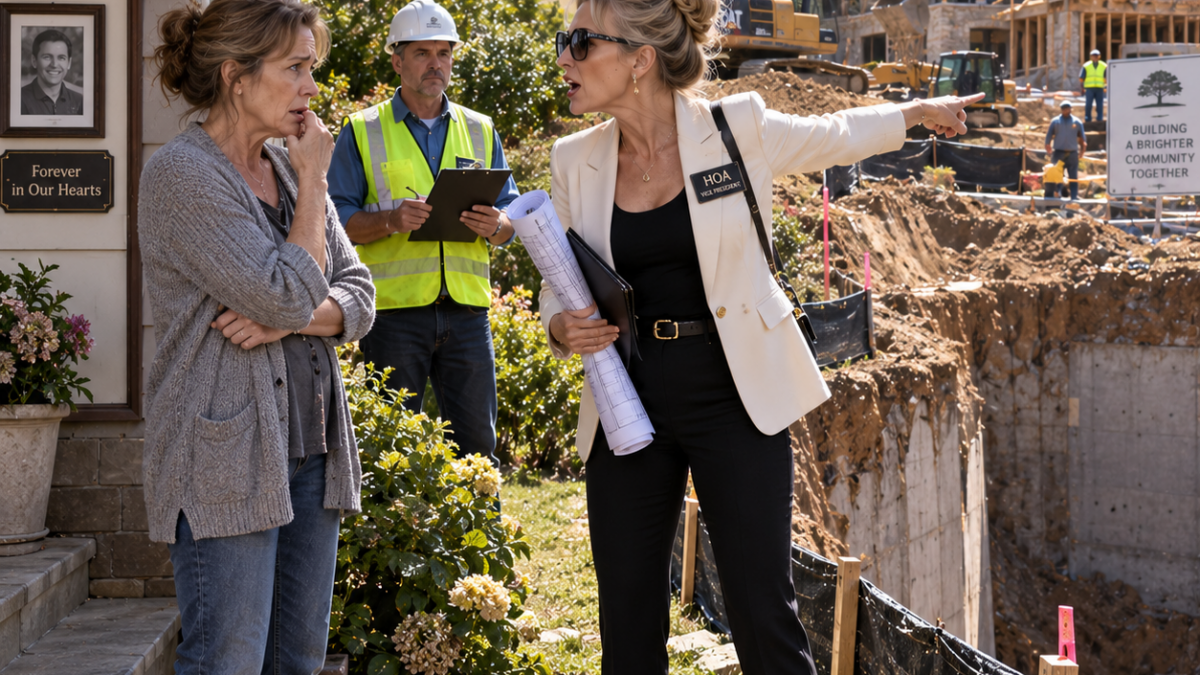
The contractor packed his level into the back of his truck.
Tori remained beside the orange fence.
She had removed her sunglasses now.
That somehow made her look less friendly.
“You need to be careful about creating alarm before anyone has facts,” she said.
The contractor closed his tailgate.
“I confirmed conditions inside the house. I did not determine cause.”
Tori gave him a short nod.
“Exactly.”
Then she looked at me.
“This is what Eric was trying to explain. Older hillside homes require maintenance.”
The contractor glanced at me.
“I also recommended a surveyor and a geotechnical engineer before repairs.”
Tori’s expression tightened.
“Why?”
“To determine whether movement is active.”
“My project has engineers.”
“I’m sure it does.”
Something in his tone made her stop.
She looked at me again.
“Judy, contractors talk. Neighbors talk. This project has permits, financing, and a critical schedule. I’m asking you not to turn ordinary maintenance into a neighborhood safety issue.”
“My house is moving.”
“You have an old door and a cracked grout line.”
“I have a floor that changed slope.”
“If you want to investigate your home, that’s your choice.”
She put her sunglasses back on.
“But don’t approach my workers. Don’t enter my construction area. And don’t represent this as a failure of my project.”
“I haven’t stepped onto your property.”
“Good.”
She walked away.
The contractor waited until she reached the trailer.
Then he looked at me.
“Get measurements.”
That was all.
No dramatic warning.
No accusation.
Just measurements.
After he left, I went inside and pulled out the folder from the preconstruction inspection four months earlier.
At the time, I had barely paid attention to it.
Tori’s lender had required a consultant to photograph the neighboring homes before excavation.
A man had taken pictures of my exterior walls.
My kitchen.
The bedroom doorway.
The crawl space.
He had measured a few locations and asked me to sign a limited access form.
Tori had called it a courtesy.
I remembered making coffee while the camera flashed against Thomas’s door frame.
Now I read every line of the form.
Near the bottom, in smaller print:
PROPERTY OWNER MAY REQUEST THE PORTION OF THE CONDITION REPORT RELATING TO HER RESIDENCE.
I circled it.
Then I went outside.
The late afternoon sun hit the east wall differently.
That was how I saw the gap.
It didn’t stop at the first path stone anymore.
A thin shadow continued beneath the next two.
I pulled up an old photograph on my phone.
Two weeks before excavation.
Thomas’s stones touched the brick.
No daylight.
Now I could see through the gap.
The surveyor arrived the next morning.
His name was Owen Hartwell.
He carried a tripod, a hard case, and the habit of looking at the ground before looking at the house.
He didn’t ask what I thought Tori had done.
He asked where my recorded property corners were.
I showed him the pins.
The orange fence.
The stone path.
Then the photographs from before construction.
Owen compared them without speaking.
“This one was taken when?”
“Two weeks before excavation.”
“And this?”
“Yesterday.”
He nodded.
Then he walked all the way to the curb.
“Why so far away?”
“Reference.”
He set his equipment over a point in the pavement.
“If I use something near the excavation as my control and the control moves, every other number becomes meaningless.”
I understood that immediately.
Court reporting had worked the same way.
If a word was uncertain, you didn’t guess everything around it.
You marked the uncertainty.
You went back to the record.
Owen established several fixed points around the house.
West foundation.
East foundation.
Stone path.
Brick wall.
Small reflective targets appeared where Thomas once snapped chalk lines.
At noon, Dr. Maya Sutherland arrived.
She wore work pants, a faded field shirt, and boots already stained with red clay.
She stood beside the orange fence for almost a minute.
“How close have you been to that edge?”
“No closer than here.”
“Keep it that way.”
I looked down at the excavation.
“What do you see?”
“I see an open cut.”
“That’s all?”
“That is all I’m comfortable saying before measurements.”
She pointed toward the nearly vertical wall.
“The concern with deep excavation beside an existing structure isn’t only settlement straight downward. Soil can also move laterally into the space you’ve removed.”
“Toward Tori’s house?”
“Toward the excavation.”
Inside, Maya watched the bedroom door swing.
She examined the grout crack.
She checked a kitchen cabinet door that had started drifting open.
Then she installed two transparent crack gauges.
Each had a small printed grid.
“If the two sides move,” she explained, “we’ll see direction and amount.”
Near the east wall, she fixed a compact tilt monitor in place.
“These don’t tell us who is responsible.”
“I understand.”
“They tell us whether the condition is changing.”
Owen came inside carrying his tablet.
“First elevation set is done.”
Maya looked at him.
“When do you repeat?”
“Tomorrow morning.”
“And again after that.”
I asked, “How soon will you know?”
Owen answered.
“When the numbers stop being isolated numbers.”
Tori appeared before they finished.
She stayed on her side of the fence but called loudly enough that everyone could hear.
“Judy.”
I stepped outside.
Maya came with me.
Tori looked at the targets on my wall.
“What are those?”
“Survey points.”
“For what purpose?”
“To find out whether my house is moving.”
Her gaze shifted to Maya.
“And you are?”
“Dr. Maya Sutherland.”
“Representing?”
“Mrs. Harland.”
The word representing bothered Tori.
I could see it.
She folded her arms.
“This is becoming unnecessarily public.”
“There are three people here.”
“Neighbors are asking why survey equipment is pointed at my project.”
From behind us, Owen said, “My instrument is pointed at my targets.”
Tori ignored him.
“You’re implying a fully approved project is unsafe.”
Maya answered.
“Monitoring is not an implication. It is measurement.”
“Until you have a conclusion, I expect professional restraint.”
“You’re speaking to the homeowner, not to my technical findings.”
Tori smiled tightly.
A concrete truck entered the street.
She glanced at it.
Then back at me.
“Eric will contact you.”
“Fine.”
“You also need to understand that creating a false safety narrative can affect contractors, financing, and property values throughout Crestfall Ridge.”
I looked at my house.
“My bedroom door closed by itself.”
“That is not evidence against my house.”
“No.”
I looked at the targets.
“That’s why they’re measuring mine.”
Tori walked away.
Maya watched her go.
“Write down exactly what she said.”
“I already have.”
For the rest of the day, I kept a log.
Time.
Weather.
Construction activity.
Excavator operation.
Door position.
Crack readings.
Sounds.
I wrote only what I could identify.
Every scrape from next door felt connected to the crack in the kitchen.
But feeling wasn’t proof.
The following morning Owen returned to the curb benchmark.
He checked the west side.
Then the east.
Then the west again.
Then the east twice.
He stared at the tablet.
“What?”
“Let me close the loop.”
He repeated the sequence.
Maya arrived before he finished.
Owen showed her the screen.
“The stable side repeats within tolerance.”
“And the east?”
“Doesn’t.”
“How?”
He looked toward Tori’s excavation.
“East and slightly down.”
My stomach tightened.
“How much?”
“Small.”
“Small meaning safe?”
“Small meaning small.”
Maya stepped closer.
“One change is not a trend.”
She looked at me.
“We measure tomorrow.”
That evening, one of the black lines on the kitchen crack gauge was no longer centered.
Not much.
But enough.
The house had moved again.
The HOA warning arrived before breakfast.
CONSTRUCTION INTERFERENCE NOTICE.
Eric Bramley, the Crestfall Ridge community manager, accused me of creating unnecessary concern among residents.
He said I had engaged project personnel without authorization.
He complained that visible monitoring equipment could cause confusion.
Then he described the movement inside my house as possible “age-related settlement.”
I read that phrase three times.
Age-related settlement.
It sounded official.
Which meant it could become official if nobody challenged it.
I replied with two questions.
What evidence supported the statement that my home had preexisting settlement?
And where was the complete architectural review file for Tori’s property?
Eric offered a meeting.
The management office occupied the front room of the clubhouse.
Tori was already sitting at the table when I arrived.
Of course she was.
Eric had placed a thin packet between them.
“This isn’t a disciplinary hearing,” he began.
“Then remove the word notice.”
His eyes dropped toward the paper.
“It is communication about boundaries.”
“I stayed on my property.”
“You interacted with a project contractor.”
“A contractor I hired.”
Tori leaned back.
“The larger concern is the narrative being created around my home.”
“My house is moving.”
“You have preliminary measurements.”
“I also have a new gap beside the foundation.”
“Older hillside homes move.”
“Mine was stable before you dug.”
“Can you prove that?”
The question came too quickly.
Maybe that was why I noticed it.
I looked at her.
Thomas’s notebook was in my bag.
I took it out.
After rehanging the bedroom door twelve years earlier, he had written his final measurements.
At the bottom:
Door square.
House quiet.
Tori glanced at it.
“Thomas repaired that side of the house.”
The use of his name changed something inside me.
“He repaired a door damaged by a storm.”
“That shows there were prior issues.”
“It shows there was a storm.”
Tori folded her hands.
“No one is questioning how much the house means to you. But emotional attachment can make ordinary aging feel more alarming.”
The clubhouse air conditioner hummed.
Eric looked at the table.
I looked directly at him.
“Is that the basis for the language in your notice?”
He shifted in his chair.
“The age of the home, prior repairs, and the absence of a causation report.”
“That isn’t evidence of settlement.”
“No one said it was final.”
“You wrote it in an official notice.”
Neither of them answered.
I pushed Thomas’s notebook toward the center of the table.
“If you have any document showing active foundation movement before Tori’s excavation, give it to me.”
Nothing.
Eric finally slid the architectural packet across the table.
“This is the material currently available.”
I opened it.
Presentation renderings.
Grading sheet.
Foundation section.
Approval conditions.
Then I noticed the numbering.
Attachment four.
Attachment seven.
“Where are five and six?”
Eric glanced at Tori.
“Some technical supplements may remain with the design team.”
“The approval references them.”
“They aren’t HOA records in the ordinary sense.”
Tori tapped the foundation drawing.
“The point is that the project was approved.”
I turned the sheet around.
The drawing showed the soil beside my property being removed in three descending steps.
Each one moved farther away from my house.
“That’s not what’s outside.”
“You’re comparing a simplified section to field conditions.”
“It says required excavation profile.”
“Field adjustments happen.”
“Who approved this one?”
Tori’s face hardened.
“The project engineer manages field conditions.”
“Then where is the revised drawing?”
Eric raised his hand.
“We are not going to litigate construction drawings.”
“I asked for evidence supporting your notice. You have none.”
I touched the packet.
“I asked for the complete approval file. You brought me one with missing attachments.”
Tori stood.
“You’re turning a private maintenance issue into an attack on the association.”
“No.”
I closed the packet.
“You used the association to tell me my house was already settling.”
She picked up her bag.
“I’m telling you again to stop interfering with my project.”
I left.
Not because I was finished.
Because anger makes people sloppy.
I had spent thirty years creating transcripts where one wrong word could change meaning.
I wasn’t going to give Tori a careless sentence she could use against me.
Owen arrived forty minutes later.
I showed him the approved foundation section.
He carried it along the property line.
The drawing showed the first excavation bench beginning below my yard.
Then another step back.
Then another.
Outside, the soil went almost straight down.
Owen set his instrument at the curb benchmark.
Then he sighted a painted elevation mark on a stake inside the construction lot.
“What’s that?”
“Approved bottom elevation for this section.”
He measured it.
Then measured the current excavation floor.
He did both again.
“How far apart?”
Owen stared into the cut.
“More than three feet.”
I thought I had misheard him.
“Three inches?”
“Feet.”
I looked at the excavator.
It was still digging.
“Could the stake have moved?”
“That’s why I repeated it.”
“Could the approved plan have changed?”
“Yes.”
“There would be paperwork.”
“There should be.”
Owen took a timestamped photograph from my side.
The excavator bucket dropped again.
Fresh soil came up.
Behind it, the painted elevation mark stood roughly three feet higher than where they were working.
Then a worker walked over.
Pulled the stake out.
And carried it toward the construction trailer.
That afternoon I met Iris Keen.
She was an attorney with a small office above a pharmacy.
No marble lobby.
No dramatic promises.
She opened a yellow legal pad.
“Tell me what you can prove without using the word because.”
That question changed how I told the story.
“The door moved.”
She wrote.
“The kitchen floor slopes east.”
She wrote.
“Two gauges changed.”
She wrote.
“Owen measured the east side moving down and toward the excavation.”
More writing.
“The approved drawing shows a stepped cut.”
She nodded.
“The current excavation is more than three feet below the marked approved elevation.”
Then she looked up.
“What can’t you prove yet?”
I thought.
“That Tori personally ordered the deeper cut.”
“Good.”
“That the excavation caused every movement in my house.”
“Good.”
“That no revised plan exists.”
Iris put down her pen.
“That distinction may save your credibility.”
She divided the legal pad into columns.
Property.
Construction.
HOA.
Evidence.
She didn’t say we were suing Tori.
She didn’t say we were going to destroy anyone.
She said something much more useful.
“The movement needs to be preserved as evidence. The records need to be preserved. And nobody should be allowed to erase today’s condition by rushing to tomorrow’s stage.”
That afternoon, preservation letters went out.
Tori.
Eric.
The contractor.
The architect.
The engineer.
The construction lender’s risk administrator.
They were told to preserve plans, messages, inspection records, site photographs, excavation logs, revised drawings, and temporary support documents.
Iris also requested Crestfall Ridge’s own records.
Architectural review communications.
Heavy truck logs.
Road impact records.
Any revised plan supplied to management.
Eric complained the request was disproportionate.
Then he produced the truck log.
Forty-six heavy vehicle entries during the first two weeks.
The neighborhood presentation had estimated twenty-eight.
Owen looked at the difference.
“If loads are remotely comparable, that isn’t trivial.”
Outside, the construction was moving into another stage.
Workers assembled concrete forms along the lower excavation.
A pump truck came twice to inspect access.
Near my boundary, an excavator trimmed the soil face.
The wall became cleaner.
Straighter.
More vertical.
Maya stood beside me beneath the dogwood.
“They’re preparing for the lower wall.”
“Will the wall stabilize it?”
“A properly designed permanent wall can be part of stabilization.”
“Can this one?”
“I haven’t seen the revised support design.”
She looked toward the excavation.
“The danger period is often before the permanent structure is carrying load.”
“What happens before?”
“More excavation. Equipment near the crest. Temporary support.”
A man in a reflective vest came up the construction lane.
Maya recognized him.
“Desmond Monroe. Superintendent.”
Iris had told me not to chase workers around the site.
I stayed beside my house.
Desmond saw us and came to the fence himself.
“Mrs. Harland.”
“Yes.”
“I received a letter from your attorney.”
“It asks you to preserve documents.”
“I know what it asks.”
He glanced at Maya.
Then at my survey targets.
“I can’t discuss confidential project records.”
“I’m not asking you to.”
That seemed to surprise him.
I held up the approved section.
“I want to know whether this is still the geometry being built.”
Desmond looked down into the excavation.
“The lower level changed during layout.”
“Before or after the deeper excavation?”
His jaw tightened.
“There were design coordination issues.”
Maya stepped slightly closer.
“Was temporary support revised before the additional cut?”
Desmond didn’t answer.
“The shoring team was working from updated field information.”
“That isn’t what she asked,” I said.
He looked at me.
“The revised support details were still being coordinated when part of the lower cut was opened.”
There it was.
The most careful sentence I had heard all week.
Maya didn’t react.
Neither did I.
Desmond added quickly, “Don’t make that sound like I said the site was unsafe.”
“I won’t make it sound like anything.”
He looked toward the concrete forms.
“There is a critical sequence coming. That’s all I can tell you.”
Then he walked away.
Iris wrote his sentence down exactly.
The revised support details were still being coordinated when part of the lower cut was opened.
Meanwhile, we kept pushing for the preconstruction survey.
The independent consultant eventually confirmed the inspection number.
They also confirmed the report had been commissioned through the project risk program.
Then an email arrived from Samuel Winfield, the lender’s risk consultant.
He said the baseline survey had been required for a reason.
The approved excavation was close enough to an occupied neighboring house to create a documented lateral-support risk.
That sentence made my hands cold.
So they had known the risk existed before digging.
The report arrived the next morning at 9:12.
Iris called before I opened it.
“Start with dates, not conclusions.”
I printed the section concerning my house.
Four months before excavation.
Timestamped photographs.
The east brick wall.
Thomas’s stone path tight against it.
Bedroom door open.
Even gap.
Kitchen grout intact.
Five baseline elevation points.
The east side had always been slightly lower than the west.
But the report called the readings consistent with a stable structure.
Then I reached the final page.
One sentence.
No evidence of active settlement was observed at the time of inspection.
I read it twice.
Beside the report lay Thomas’s notebook.
Door square.
House quiet.
Owen and Maya arrived before lunch.
Owen compared the baseline points with his measurements.
“Not identical equipment,” he said, “but compatible locations.”
His finger moved down the page.
“West side barely changed.”
Then east.
“This side moved.”
“How much?”
“Enough to measure repeatedly.”
“Enough to know where it ends?”
“No.”
Maya studied the monitoring chart.
“The direction matters.”
“Toward the excavation.”
“Yes.”
“So now you can say Tori caused it?”
She shook her head.
“We’re closer.”
That was the answer I wanted even when I hated it.
“We are not finished.”
Iris arrived with another document released from the lender’s excavation-risk file.
OWNER ACKNOWLEDGEMENT OF ADJACENT PROPERTY PROTECTION CONDITIONS.
Tori’s signature was on the last page.
The conditions were simple.
Follow the approved stepped excavation profile.
Install temporary support as excavation advances.
Any excavation below the approved elevation required revised geotechnical review.
Revised shoring details.
Written clearance before work continued.
I stared at Tori’s signature.
“She knew.”
Iris was careful.
“She knew these conditions existed.”
“That’s different.”
“Yes.”
“It doesn’t prove she ordered the deeper excavation.”
“Correct.”
“But it means she can’t pretend she didn’t know deeper excavation required additional review.”
“Correct.”
Outside, metal forms clanged below my property line.
Maya went to the window.
“They’re still moving toward the pour.”
Iris called Tori’s attorney.
She requested an immediate voluntary pause.
Twenty minutes later:
Denied.
Tori appeared at the fence after lunch.
Leather folder.
Perfect hair.
No hard hat this time.
“I understand you obtained private financing documents.”
“I obtained the report concerning my home and an acknowledgement concerning protection of it.”
“That document is being taken out of context.”
“It says deeper excavation requires revised review.”
“The project team handled revisions.”
“Then show us the written clearance.”
Tori’s eyes moved toward Iris.
“This has gone far beyond a neighbor complaint.”
“My house has moved farther than a neighbor complaint.”
She looked at the baseline report.
“That document does not say your house could never settle.”
“No.”
I held up the page.
“It says it wasn’t actively settling before you dug.”
“The movement you’re describing is minor.”
I stared at her.
“It was minor when you said it was imaginary.”
Iris stepped beside me.
“We’re requesting a temporary pause while current movement is reviewed against the actual excavation and support design.”
“The lower wall sequence is scheduled.”
“A schedule can change.”
“Delay creates risk too.”
Maya spoke from behind us.
“A completed wall can improve stability if it’s built in the right place, with correct temporary support, after the correct excavation sequence.”
Tori turned.
“And you’re saying mine won’t?”
“I’m saying I haven’t received a revised design explaining a cut more than three feet below the approved elevation.”
A concrete pump rolled into the street.
Tori watched it.
“The project is proceeding.”
At four that afternoon, Desmond circulated the work schedule.
Monday:
Final trimming near shared boundary.
Tuesday:
Pump setup.
Wall reinforcement.
Lower wall pour.
Maya read it twice.
“The concrete isn’t the first problem.”
“What is?”
“Monday.”
She pointed.
“They’re cutting more first.”
“Then what?”
“Heavy equipment near the crest.”
Owen returned that evening.
The east point had moved again.
Not dramatically.
But faster than the previous interval.
Iris closed the schedule.
“One more voluntary request.”
“And then?”
“If they refuse, we prepare emergency relief.”
Through the kitchen window, I could see the first wall form standing at the bottom of the excavation.
Directly below my bedroom.
Friday morning, we met beside the construction entrance.
Tori.
Her attorney.
Eric.
Desmond.
Iris.
Maya.
Owen.
Me.
Steel reinforcement lay at the bottom of the excavation.
Form panels leaned against temporary braces.
A flat pad had been cleared for concrete-pump outriggers.
Maya looked at the pump area first.
Iris opened.
“We request a seventy-two-hour pause for independent review of the deeper excavation and temporary support.”
Tori had a rolled plan under her arm.
“We decline.”
“Why?”
“Completing the wall is the safest way to close the excavation.”
Maya answered.
“A completed wall may help. But your sequence includes more trimming beside the boundary and heavy crest loading before that wall exists.”
Tori unrolled the plan across a pickup hood.
“This is the active field layout.”
Owen leaned over it.
“No revision stamp.”
“It’s a coordination drawing.”
Iris looked at Desmond.
“Was the deeper excavation opened before the temporary support was revised?”
He glanced at Tori’s attorney.
“The lower geometry evolved during field coordination.”
“That isn’t an answer.”
His eyes dropped.
“Some temporary-support details were finalized after part of the deeper cut was already open.”
Tori’s attorney immediately stepped forward.
“No one is conceding unsafe work.”
Maya didn’t change expression.
“No one asked for a concession.”
Tori pointed toward the forms.
“Once the wall is poured, this entire argument becomes theoretical.”
Maya shook her head.
“No. If the permanent wall is placed in the wrong geometry before proper stabilization, you can lock in the wrong condition and make corrective access harder.”
Wind lifted the corner of the drawing.
Tori pressed it down.
“This delay will cost hundreds of thousands of dollars.”
Iris answered.
“That doesn’t make Judy’s house stop moving.”
Tori turned toward me.
“You understand what your attorney is doing? You’re threatening a financed construction project over millimeters.”
I opened my notebook.
“Tuesday, bedroom door began closing by itself.”
She stared at me.
“Wednesday, path separated.”
“Judy—”
“Thursday, measurable movement east and down.”
“You’re reading a diary as though it’s engineering.”
“No.”
I looked toward Maya.
“She has the engineering.”
Then back at Tori.
“I have the dates.”
She stared at me.
“You’ve lived in that house thirty years. You cannot honestly believe nothing has ever moved.”
I held up the baseline report.
“I don’t have to believe it.”
The paper shook slightly in my hand.
“I have a survey saying it was stable before excavation.”
“That survey isn’t a warranty.”
“No.”
I folded it.
“It’s a record.”
For once, she had no fast answer.
Iris placed the pause agreement on the hood.
Tori never touched it.
“The project proceeds.”
Desmond quietly corrected her.
“Final trimming Monday. Pour Tuesday.”
She glanced at him.
“Fine. Tuesday.”
Maya folded her arms.
“If Judy’s east-wall movement crosses the threshold in my monitoring plan, I’ll recommend emergency stabilization.”
Tori gave a short laugh.
“You already have a contractor for that?”
“A specialty contractor is on standby.”
“You placed someone on standby before proving my project caused anything?”
“I placed someone on standby because her house is moving.”
The meeting ended.
No pause.
By Saturday morning, the bedroom door wouldn’t latch at all.
Owen repeated his readings twice.
West side stable.
East side moved again.
Maya marked the alert line on her monitoring sheet.
“What happens if it crosses?”
“We verify the reading.”
“And then?”
“Owen reshoots elevations.”
“And then?”
“I call Iris.”
The disputed work was scheduled for Tuesday.
Sunday evening, the construction site was quiet.
No trucks.
No machines.
At 8:41 p.m., I checked the kitchen gauge.
The black indicator had crossed Maya’s line.
I didn’t touch anything.
I called her.
She and Owen arrived twenty-five minutes later.
Owen set up beneath the streetlight.
Curb benchmark.
West side.
East side.
East again.
He stared at the numbers.
Maya called Iris.
“It crossed.”
I heard Iris through the phone.
“Trend?”
“Movement is accelerating toward the excavation.”
“Can you support emergency action?”
Maya looked toward my crooked bedroom doorway.
Then through the window at Tori’s wall forms.
“Yes.”
After they left, I went upstairs.
The bedroom door stood open.
It couldn’t close anymore.
Outside, the pump platform waited.
Tuesday was less than thirty-six hours away.
Iris filed at eight Monday morning.
At 8:13, the emergency motion was in my inbox.
It was surprisingly short.
No accusation of corruption.
No demand for revenge.
No claim that ultimate liability had already been proven.
Four requests.
Stop trimming near the property line.
Stop heavy equipment from loading the excavation crest.
Stop the lower wall pour.
Allow emergency stabilization.
Attached were Maya’s monitoring charts.
Owen’s elevation readings.
The preconstruction survey.
Tori’s signed protection conditions.
The approved stepped profile.
A current photograph of the nearly vertical cut.
Side by side, the last two looked like different projects.
At nine, Eric posted another notice through the Crestfall Ridge resident portal.
Construction remained authorized.
Residents should avoid spreading unverified safety claims.
I forwarded it to Iris.
She replied with four words.
Do not answer him.
At 10:30, equipment moved toward the excavation boundary.
I called Iris.
She called Tori’s attorney.
“If additional soil is removed before the hearing, we will update the court immediately.”
Twelve minutes later, the excavator stopped.
The emergency hearing began at three by video.
I sat beside Maya in Iris’s office.
Owen was behind us.
Tori appeared from a conference room with her attorney.
Eric sat at the far end.
The judge began with something important.
“This hearing is not determining final fault or damages.”
Iris agreed.
Tori’s lawyer argued that stopping work could create substantial financial loss.
He described the movement as small.
He disputed causation.
He argued that delaying completion of the wall might leave the excavation exposed longer.
The judge looked at Maya.
“Doctor, could completion of the permanent wall improve stability?”
“Yes.”
Tori’s attorney leaned back.
Then Maya continued.
“If it is placed in the correct location after adequate temporary support is established.”
The judge looked down at her papers.
“And your concern?”
“The current sequence includes additional trimming and crest loading before that condition exists.”
“Can the area be stabilized without resolving ultimate liability today?”
“Yes.”
“How?”
“Drilled soldier piles and lagging installed within the construction property. Internal bracing. Temporary support beneath the affected side of Mrs. Harland’s foundation.”
Tori’s attorney questioned Maya.
“Can you swear that my client’s excavation caused every crack in Mrs. Harland’s home?”
“No.”
He paused.
For a moment, he looked pleased.
Then Maya continued.
“I can state that the residence was documented as stable before excavation. Measurable movement developed afterward. The movement increases toward the open cut. The rate has accelerated and crossed our emergency threshold.”
The judge turned to Owen.
“Your control points are close to the excavation?”
“No.”
“Where?”
“Public curb.”
“Why?”
“Stable reference.”
“The west side?”
“Repeats within tolerance.”
“The east?”
“Does not.”
Then the judge looked at me.
“Mrs. Harland.”
“Yes.”
“Emergency stabilization may require temporary access beside and underneath portions of your home. Landscaping, paving, or portions of the foundation area may be disturbed.”
I thought of Thomas’s stone path.
The door.
The grout.
Everything I had tried to preserve exactly as he left it.
“Do you understand?”
“Yes.”
“Do you consent if the court authorizes emergency access?”
My first instinct was to ask them not to touch the stones.
That wasn’t the question.
I looked at Iris.
Then Maya.
Then the judge.
“Yes.”
My voice shook.
“I want the house held in place.”
The hearing lasted twenty-seven minutes.
The written order arrived at 6:40.
Iris called.
“We got the stabilization order.”
I sat down.
“What exactly?”
“All excavation, trimming, crest loading, and lower-wall work in the affected zone is suspended.”
I closed my eyes.
“Stabilization?”
“Authorized.”
It wasn’t a final judgment.
It didn’t say Tori was liable.
It didn’t award damages.
It did something more urgent.
It stopped the next cut.
Desmond canceled the concrete pump.
The lender placed the lower level under a risk hold.
Tori came to the fence after dark.
“You understand this doesn’t mean you won.”
“I understand the order.”
“You may have caused months of delay over movement nobody can even see.”
I looked at the gap beside Thomas’s path.
“I can see it.”
She followed my eyes.
For several seconds neither of us spoke.
Then she said something unexpected.
“That stabilization line will interfere with my lower level.”
I looked at her.
“It’s supposed to hold up my house.”
She turned away.
At 5:38 Tuesday morning, diesel engines woke the street.
A drilling rig arrived.
Then steel.
Maya stood beneath the dogwood with the stabilization plan.
The first soldier pile needed to be installed near Thomas’s path.
The superintendent pointed toward the stones.
“We’ll lift them.”
My stomach tightened.
He continued.
“We number each one. Photograph it. Palletize it. Nothing gets thrown away.”
The first stone came up at 6:14.
H1.
The second:
H2.
Thomas had laid that path himself.
String line.
Hand level.
Rubber mallet.
He would reset a stone three times if it rocked under his boot.
Watching strangers take it apart should have felt like another death.
Instead, I thought about the bedroom door.
A path could be rebuilt.
The house had to survive first.
The drilling rig moved into Tori’s lot.
First hole.
Steel section lowered.
Concrete placed around it.
Then another.
And another.
By late morning, a line of steel columns followed the excavation.
Timber lagging went between them.
Then diagonal braces ran inward across the area planned for Tori’s lower level.
Nothing extended under my property.
Another crew installed temporary supports beneath portions of my east foundation.
I watched from my kitchen.
Every vibration made me look at the gauges.
During the first drilling operation, one line moved.
Maya checked it.
“Vibration response.”
“Is that bad?”
“What matters is whether it returns or continues.”
It returned.
Then stopped.
Tori arrived before eleven.
She stood beside the trailer staring at the steel braces.
“What is that?”
The superintendent looked up.
“Internal raker bracing.”
“That is inside my theater.”
“It is inside the stabilization zone.”
She found Maya.
“How long does that stay?”
“Until permanent wall and slope support are redesigned and approved.”
“My lower level cannot be built with those braces there.”
“Correct.”
Tori turned toward Desmond.
“Move the wall farther out.”
He shook his head.
“There isn’t farther out.”
“Use anchors.”
Maya answered.
“Anchors beneath Judy’s property require her permission and separate design.”
Tori looked at me.
I said nothing.
Maya continued.
“This system stays entirely within your lot.”
“You intentionally designed the most disruptive option.”
“No.”
Maya’s voice remained calm.
“I designed the option we could install immediately without taking rights beneath your neighbor’s house.”
Samuel Winfield from the lender arrived later that morning.
He studied Tori’s lower-level rendering.
The theater.
Wine room.
Gym.
Then the stabilization layout.
He pointed at part of the drawing.
“This portion cannot remain as designed.”
Tori stared at him.
“You don’t design houses.”
“No.”
He looked directly at her.
“I control the lender risk hold.”
A representative from the excavation security program joined him.
Emergency stabilization costs would be paid first from those funds.
Construction could not resume until revised plans were accepted.
Tori opened the rendering on her tablet.
“You’re taking hundreds of square feet out of my house.”
Samuel answered quietly.
“The excavation removed support beside an occupied neighboring property.”
Nobody spoke.
“The redesign has to respect the line required to support that property.”
Across the street, a few neighbors had gathered.
Nobody cheered.
Nobody needed to.
For the first time since Thomas’s door had moved, nobody from Crestfall Ridge called it private maintenance.
By sunset, the last temporary pile was installed.
Owen had measured my house throughout the day.
Movement had slowed.
Maya refused to use the word stable.
“Emergency control first.”
“When do we call it stable?”
“When repeated measurements let us.”
The exposed soil under my yard was no longer open.
Steel.
Timber.
Braces.
Tori’s future theater looked smaller.
Much smaller.
At nine that night, Owen returned.
The east point hadn’t recovered.
But it had not moved farther since late afternoon.
“One interval,” Maya said.
“We need overnight.”
I went upstairs.
The bedroom door still hung crooked.
I pushed it toward the frame.
The latch missed by almost half an inch.
I left it open.
At 5:52 Wednesday morning, Maya and Owen were beneath the streetlight.
Curb benchmark.
West side.
East.
East again.
Owen looked at Maya.
Then me.
“No additional measurable displacement overnight.”
I didn’t smile.
Neither did Maya.
She checked the kitchen gauge.
No new movement.
For the first time in more than a week, my house had survived an entire night without sliding farther.
One night became two.
Then seven.
Owen came again and again.
Same curb benchmark.
Same points.
Same sequence.
At thirty days, there was still no new measurable displacement.
At sixty, Maya signed the closeout statement.
Immediate movement controlled.
Then permanent work began.
Micropiles were installed beneath the affected east side of my foundation.
Temporary cribbing was removed section by section.
Inside, the bedroom frame was reset.
Kitchen tiles repaired.
Cracked grout replaced.
Cabinet doors stopped drifting open.
I kept Thomas’s notebook on the counter the entire time.
The money took longer than the engineering.
Emergency stabilization was covered first through the excavation security funds.
During mediation, the contractor’s liability carrier and Tori’s owner-liability coverage agreed to fund the permanent underpinning and repairs.
Tori paid for redesigning her mansion.
The lender would not release the lower-level hold until the new plan respected the stabilization line.
The theater wall moved inward.
The wine room disappeared.
Part of the gym became structural backfill.
The mansion still rose above the valley.
It was still enormous.
Still expensive.
Still more house than I could imagine wanting.
But it no longer extended into the soil volume required to support mine.
Crestfall Ridge’s insurer reviewed Eric’s construction-interference warning and Tori’s role in the architectural review of her own property.
The association paid my documented monitoring costs and part of Iris’s fees.
The settlement did not call Tori a criminal.
It didn’t force her to sell.
She didn’t lose her home.
She didn’t even resign.
What changed was authority.
Tori was removed from every architectural review decision involving her own property, her contractors, or any business in which she had a financial interest.
Crestfall Ridge adopted a written recusal policy.
Major hillside excavation beside an occupied residence now required independent technical review.
Eric withdrew the construction-interference notice.
The correction appeared on the same resident portal.
No evidence supported the association’s earlier characterization that my home had been experiencing active settlement before the neighboring excavation.
I read it once.
Saved it.
Closed the portal.
Tori and I never became friends.
For months, we mostly saw each other through fencing.
One afternoon, after the permanent redesign was approved, workers began removing some temporary braces from what had once been her planned theater.
She stood beside the trailer.
I was outside with Maya.
“The project cost more than it should have,” Tori said.
I looked at the repaired side of my house.
“So did mine.”
Her eyes followed mine.
She didn’t apologize.
But she didn’t call the damage imaginary either.
“That lower level was the reason I bought the lot.”
I looked at her.
“The house was the reason I stayed.”
She held my eyes for a moment.
Then walked away.
That was our last argument.
Thomas’s stone path was restored in early fall.
The crew brought the pallet back.
H1.
H2.
H3.
Every stone returned according to photographs and numbers.
The superintendent used a hand level.
Tapped each one with a rubber mallet.
Reset one twice because it rocked beneath his boot.
I smiled.
Thomas would have liked him.
When they finished, the path didn’t look new.
That mattered.
It looked like itself.
Inside, a carpenter asked whether I wanted the bedroom door replaced.
The old slab had twisted slightly after weeks of hanging in a distorted frame.
“A new one would be easier.”
I ran my fingers across the edge Thomas had planed twelve years earlier.
“No.”
The carpenter waited.
“Keep this one if you can.”
He removed it.
Reset the hinges.
Worked the frame.
Trimmed the edge slowly.
I stood in the hallway while he opened it.
Closed it.
Opened it again.
The gap was even.
Then he left it halfway open.
We both waited.
The door stayed there.
After Thomas died, I thought protecting the house meant keeping everything exactly as he had left it.
Same stones.
Same door.
Same bowl.
Same marks in the workshop.
I eventually learned that wasn’t protection.
A house survives because people repair it.
They measure what moved.
They support what weakened.
They remove what can no longer carry weight.
And they preserve what still can.
On the final monitoring day, Owen removed the reflective survey targets from my brick.
Maya took down the kitchen crack gauge.
A small clean rectangle remained where sunlight hadn’t faded the paint.
I could have covered it.
I didn’t.
That evening, Tori’s construction site was quiet.
Her redesigned lower level had been enclosed.
The temporary steel support line was hidden behind the permanent wall.
I went to the kitchen.
Reached into the blue bowl.
Took out Thomas’s glass marble.
The same one I had placed on the tile the morning the bedroom door first closed.
I set it on the repaired floor.
For a moment, I kept my fingers around it.
Then I let go.
The marble stayed exactly where I placed it.








