The first thing the rain took wasn’t the million-dollar resort sign—it was the lie that the cracked dirt behind my house had stopped being a lakebed.
The maintenance man still had both hands around the hose.
For several seconds, nobody moved.
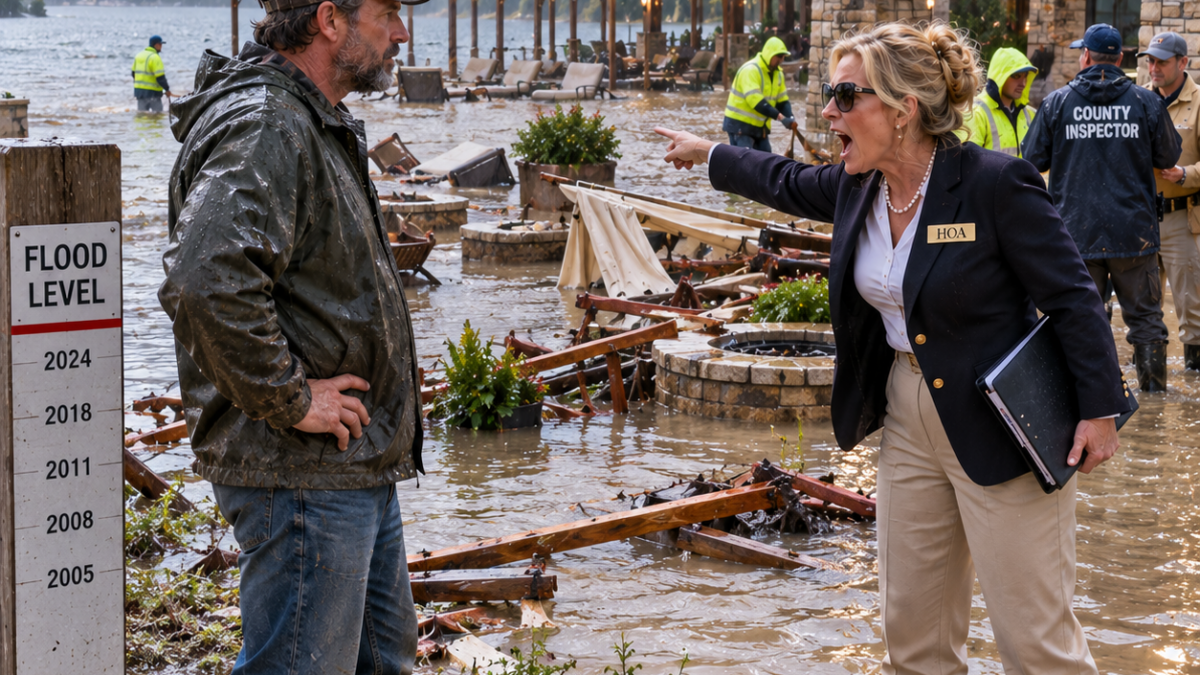
Rain hammered the white cabanas and bounced from the black stones inside the fire bowls. Water ran around Lorraine’s ankles, carrying thin veins of imported sand toward the old spillway grate.
The woman from the floodplain office didn’t rush into the basin.
That was the first thing I noticed about Nadia Quill.
Everyone else was moving too fast.
Lorraine was pointing.
Residents were backing uphill.
Beth was ordering workers away from the electrical lines.
One board member was trying to cover a box of printed programs with his jacket.
Nadia stood at the upper edge and looked.
Really looked.
At the water.
The marker.
The berm.
The deck.
The west ditch.
Then the pump hose.
She pulled two orange field flags from her vest.
“Set the hose down.”
The maintenance man looked toward Lorraine.
“On dry ground,” Nadia added.
Her voice never got louder.
It didn’t need to.
He dropped the hose.
Lorraine splashed toward the slope.
“Ms. Quill, I’m Lorraine Pemberton. Lifestyle Committee chair. This is an HOA event site, and we’re dealing with an unexpected weather condition.”
Nadia looked at her wet shoes.
“Who authorized pumping?”
“We were responding to an emergency.”
“Who authorized pumping?”
Lorraine hesitated.
Beth answered from near the deck.
“Nobody. I told him to stop.”
Nadia wrote that down.
Every stroke of her pencil seemed louder than the rain.
Lorraine turned.
“Beth.”
Beth didn’t look at her.
“The east swale goes toward Juniper Lane.”
“That’s why we would monitor discharge.”
“You don’t discharge a retention basin because your furniture is getting wet.”
The words were blunt enough to make several residents look away.
Lorraine’s face tightened.
“This is an amenity area.”
Nadia looked at the water spreading around the Lakebed Club sign.
“Not tonight.”
She began walking the perimeter.
Not through the deepest water.
Around it.
She stopped beside the old flood marker.
For nineteen years I had watched that rusty post stand in dry dirt most of the time.
Residents barely noticed it.
Children used to hang bicycle helmets on it.
Someone once tied a dog leash around it while throwing a tennis ball.
Lorraine had wrapped white string lights around it for the opening.
Now brown water had reached its base.
Nadia crouched.
She wiped mud from the lower number.
Read it.
Then looked up toward me.
“Mr. Caldwell?”
“Yes.”
“Your rain gauge is still on your property?”
“Yes.”
“Reading?”
I checked.
“Eight-tenths.”
She glanced at her watch.
“Photograph it. Include the basin behind it.”
I did.
Lorraine laughed once.
Not because anything was funny.
“Eight-tenths of an inch. This is excessive.”
Nadia stood.
“That’s why I’m interested.”
Lorraine stopped laughing.
Kenji Arata had come up beside my fence.
Rain ran down his glasses.
He was the youngest board member, maybe forty, quiet enough at meetings that people sometimes forgot he was there.
He had visited my porch earlier that week and asked the only useful question any board member had asked.
Can you prove the basin still fills?
Now he stared at the water.
“Leon.”
I looked at him.
“This isn’t even an inch?”
“No.”
He wiped his glasses with his shirt, accomplishing nothing.
“The old photographs you showed me…”
“Most were from two to three inches.”
His eyes went toward the cabanas.
The math was happening behind them.
If eight-tenths did this, what would three inches do?
Nadia reached the decorative berm.
Water had gathered behind it.
The imported soil was softening.
Small rivulets pushed through the river stones and carried pale sand into the retention low point.
She pointed.
“This fill was installed recently?”
Beth answered.
“This week.”
“Your crew?”
“Yes.”
“Design provided by?”
Beth hesitated.
Lorraine stepped closer.
“Approved association improvement plan.”
Nadia didn’t look at Lorraine.
She kept looking at Beth.
“Who gave you the grade instructions?”
“The committee packet came through Meridian Property Services.”
“Did it include the original civil drainage sheets?”
Beth’s shoulders sank slightly.
“No.”
Lorraine snapped, “They weren’t relevant to a temporary amenity installation.”
Nadia wrote again.
Beth continued before Lorraine could stop her.
“Mr. Caldwell raised the basin elevation Wednesday. I requested the civil sheet.”
“And?”
“I didn’t receive it.”
Lorraine stared at her.
“We discussed this.”
“We discussed schedule.”
“Beth.”
“We did.”
A silence moved through the people standing under umbrellas.
It was the first time something other than water had shifted that evening.
Beth had stopped protecting the client’s version.
Not because she suddenly became my ally.
Because she was protecting her company.
There is a moment in most preventable failures when people realize the story will eventually reach paper.
That was Beth’s moment.
Nadia pointed toward the berm.
“Water is entering from the west ditch, approaching the historic basin floor, and being slowed by imported fill.”
Lorraine folded her arms.
“That’s normal runoff.”
“No.”
Nadia’s answer was immediate.
“Normal runoff would spread into available storage.”
She pointed to the berm again.
“This grade change is redirecting it.”
“It’s aesthetic contouring.”
“In a mapped retention basin, aesthetic contouring is grade change.”
Kenji looked down.
I remembered Nadia from the seminar two years earlier.
A basin does not stop being infrastructure because people get bored looking at it.
She had said it casually then.
Like something she had needed to explain too many times.
Now I understood why.
Lorraine stepped closer.
“You keep saying mapped. We have been advised that this is an inactive visual basin.”
“By whom?”
“The project review process.”
“Name.”
Lorraine’s jaw tightened.
“Meridian coordinated approvals.”
“Floodplain clearance?”
“I would have to check.”
“Civil engineer?”
“I would have to check.”
“Ownership verification?”
“The association has maintained this area for years.”
“That was not my question.”
A few residents turned toward me.
I said nothing.
I had already said enough.
Nadia walked toward the cedar yoga deck.
Water was moving beneath it.
Not deep.
Maybe two inches at that point.
But two inches of moving water beneath freshly installed posts tells a different story than two inches across a sidewalk.
She crouched near one support.
The soil around it had darkened.
Beth came beside her.
“We set those according to the layout elevation.”
“Below the old marker.”
“Yes.”
“Did anyone provide a geotechnical or drainage note for wet-condition support?”
“No.”
Lorraine said, “These are temporary structures.”
Beth looked at her.
“The deck isn’t temporary.”
“You know what I mean.”
“I’m not sure I do anymore.”
That landed harder than any accusation I could have made.
Lorraine’s face flushed.
Behind them, one of the cabanas shifted.
Only an inch.
Maybe less.
A rear leg had sunk where the imported sand was washing into clay.
The white frame leaned.
A woman nearby grabbed her husband’s arm.
Nadia stood immediately.
“Everyone not involved in safety work goes uphill.”
Lorraine protested.
“There is no need to panic residents.”
“I didn’t say panic.”
Nadia pointed toward the slope.
“I said uphill.”
Kenji turned toward the crowd.
“You heard her.”
People began moving.
Wet programs dropped into trash bags.
A child cried because his shoes had filled with muddy water.
Someone left a purse under a bistro table and had to go back for it.
Nobody looked glamorous.
Luxury is fragile when everyone’s socks are wet.
Lorraine remained.
Nadia faced her.
“Until the recorded drainage documents and ownership status are reviewed, this area does not reopen.”
“You don’t have authority to close a private HOA amenity.”
“I have authority to prevent alteration of a mapped stormwater facility while it is active.”
“It isn’t active.”
Nadia looked down at the water moving around Lorraine’s ankles.
“This is what active means.”
Lorraine’s face went pale.
Not dramatic.
Just the slow loss of color from someone whose language had stopped working.
Nadia continued.
“No pumping.”
She counted with her pencil.
“No grading.”
“No additional fill.”
“No post removal.”
“No sand removal.”
“No attempt to redirect water.”
“Safety stabilization only with approval.”
Beth nodded.
“I’ll secure the electrical work from dry ground.”
“Good.”
Nadia looked at Kenji.
“Board representative?”
“Yes.”
“Notify your carrier tonight.”
“I will.”
“Preserve plans, emails, site instructions, revisions, elevation notes, contractor requests, and board approvals.”
Kenji glanced at Lorraine.
“I understand.”
Lorraine said, “We have already preserved appropriate records.”
Nadia looked at her.
“I’m not asking what you preserved.”
She closed the clipboard.
“I’m telling you what not to lose.”
The water stayed through Sunday.
That was almost worse for Lorraine than if it had flooded dramatically and disappeared.
There was no viral wall of water.
No collapsed buildings.
No emergency rescue.
Just enough brown water to make the entire Lakebed Club look exactly as foolish as it was.
The imported sand turned the color of oatmeal.
Cabanas stood in shallow reflections.
The cream opening ribbon wound itself around one brass post.
The gold sign remained tilted.
People drove slowly past the basin and stared.
By Sunday afternoon, photos were circulating through Silverfin.
Not my photos.
Residents’ photos.
That mattered.
For three weeks, Lorraine had been able to frame this as Leon Caldwell versus progress.
One retired public-works man.
One “old fear.”
One neighbor who couldn’t let go of drainage maps.
Now dozens of residents had their own photographs.
And water makes an excellent witness because everyone understands wet shoes.
Monday morning, real construction fencing went up.
Not Lorraine’s orange decorative mesh.
Tall safety fencing with warning signs.
Beth’s crew moved all equipment above the basin line and locked it.
At 8:20, Kenji called.
“Leon.”
“I’m here.”
“We got Nadia’s preliminary notice.”
“I assumed you would.”
“No work below basin elevation.”
“That sounds right.”
“She specifically identified the berm and imported fill for removal review.”
I looked through my kitchen window at the resort sign.
“Review is the polite word.”
Kenji sighed.
“Lorraine wants to redesign around seasonal water.”
“The basin already has a design.”
Silence.
Then:
“I know.”
Those two words were the first time I believed the board might actually understand what had happened.
Not Lorraine.
The board.
There’s a difference.
Kenji continued.
“Can I ask you something?”
“Yes.”
“Why didn’t you just file for an injunction before we built?”
I looked at the metal file box by the back door.
“Because I didn’t know how far the board would let her go.”
“We let her go too far.”
“Yes.”
He didn’t defend himself.
“I voted for the budget.”
“I know.”
“I thought we were approving an amenity on association-managed land.”
“That’s what the packet said.”
“You knew the floor was private.”
“I read my deed.”
“We didn’t.”
“No.”
His voice changed.
Not defensive.
Ashamed.
“That sounds worse when you say it.”
“It should.”
He was quiet.
Then he said, “The insurer is coming tomorrow.”
“Good.”
“Will you meet them?”
“If Nadia wants me there.”
“She does.”
Tuesday morning, Miles Carden arrived for the insurance carrier.
Dark rain shell.
Clean boots.
Small notebook.
He had the expression of a man who didn’t care whether anyone liked the answer as long as he understood the cost.
Nadia met him at the upper edge.
Beth came.
Kenji.
Two other board members.
Lorraine.
I stayed on my porch until Nadia waved me down.
“Mr. Caldwell can identify the fixed markers and camera position.”
Lorraine began, “I object to treating his private monitoring as—”
Miles interrupted.
“Was the camera on his property?”
Kenji answered.
“Yes.”
“Was it installed before the rainfall?”
“Yes.”
“Was written notice received before opening night?”
Kenji hesitated.
“Yes.”
Miles looked at him.
“By the board?”
“Yes.”
“Management?”
“Yes.”
Beth said, “And contractor.”
Miles wrote.
Lorraine stepped forward.
“The concern was disputed.”
Miles didn’t look up.
“Disputed isn’t the same as unknown.”
That was the only thing he said for almost a minute.
We walked the upper bank.
I showed him the rain gauge.
The flood marker.
The spillway grate.
The western low path.
My fixed camera location.
Then I gave him copies of three notebook pages.
Not nineteen years.
Just enough to establish prior behavior.
One storm at 1.9 inches.
One at 2.6.
One at 3.2.
Approximate water elevations.
Photographs.
Same marker.
Same basin.
No resort.
Miles looked at the pages.
“You created these contemporaneously?”
“Yes.”
“For what purpose?”
“Habit.”
He glanced up.
“Not a dispute?”
“There wasn’t one.”
“Why keep them?”
“I worked drainage for thirty-one years.”
He almost smiled.
“That explains it.”
Then Lorraine said the sentence I had expected.
“No one could have predicted this response from such modest rainfall.”
Miles looked at her.
“Was written warning received before the event?”
Kenji said yes.
Beth said yes.
I said nothing.
Miles wrote one line.
I never learned exactly what it said.
I didn’t need to.
Insurance people can create consequences with fewer adjectives than angry homeowners ever will.
Three days later, Silverfin posted an announcement.
LAKEBED CLUB PREVIEW SUSPENDED PENDING BASIN RESTORATION REVIEW.
No resort-level living.
No vision over fear.
No lifestyle transformation.
Instead:
Drainage compliance.
Ownership verification.
Independent review.
Temporary closure.
Expensive vocabulary.
Then the documents started surfacing.
Kenji came to my house Friday afternoon carrying a banker’s box.
“I shouldn’t take originals out of management.”
“So don’t.”
“These are copies.”
He set the box on my porch table.
“What is this?”
“The capital-project packet.”
“Why are you giving it to me?”
“I’m not.”
He pushed it toward me.
“I’m asking if you recognize the drainage exhibits they should have used.”
That distinction was probably important to him.
I opened the box.
Renderings.
Budget sheets.
Lifestyle surveys.
Vendor proposals.
Sand samples.
Furniture schedules.
Lighting layouts.
Insurance certificates.
One drainage page.
Not the original civil sheet.
A marketing-era landscape exhibit.
The basin was shaded pale green and labeled:
INACTIVE VISUAL DEPRESSION / FUTURE AMENITY OPPORTUNITY.
I stared at it.
“Where did this come from?”
“Meridian’s project file.”
“Who created it?”
“Lifestyle consultant.”
“No engineer?”
“No.”
“No survey stamp?”
“No.”
“No drainage approval?”
“No.”
I looked at Kenji.
“You approved nine hundred forty thousand dollars based on this?”
His face flushed.
“There were other documents.”
“Where’s the title review?”
He looked away.
“That’s part of the problem.”
“What does that mean?”
“The packet listed the basin as association-maintained common landscape.”
“Maintained.”
“Yes.”
“Not owned.”
“No.”
“Who changed that into construction authority?”
He rubbed his forehead.
“Lorraine says Meridian told her maintenance rights were sufficient for amenity installation.”
“Did Meridian put that in writing?”
“We’re looking.”
I understood immediately.
“You can’t find it.”
“Not yet.”
I opened another folder.
Meeting minutes.
The board had approved:
Phase One Lakebed Enhancement.
Not construction on Leon Caldwell’s privately owned seasonal retention floor.
Not fill inside a recorded basin.
Not modification of stormwater storage.
The language was broad enough for everyone to remember something different afterward.
I had seen that technique in public works.
Name a project beautifully.
Define it poorly.
Vote quickly.
Argue over responsibility later.
Then I found an email from Beth.
Sent nine days before installation.
REQUEST FOR CIVIL BASE / SUBGRADE INFORMATION.
She had asked Meridian for:
Basin elevation confirmation.
Wet-condition bearing information.
Existing drainage limitations.
Meridian had answered:
Installation to follow lifestyle plan elevations. Area treated as inactive amenity zone. No special civil constraints noted in current scope.
I looked at Kenji.
“Beth asked before construction.”
“Yes.”
“Meridian told her no special constraints.”
“Yes.”
“Who told Meridian that?”
He reached into the box.
Another email.
From Lorraine.
To Meridian project manager.
The seasonal basin designation is legacy language and has not been operationally relevant during current drought-cycle conditions. Please keep amenity review focused on visual-use improvement rather than obsolete drainage concerns that could unnecessarily delay implementation.
I read it again.
“Obsolete drainage concerns.”
Kenji nodded.
“She wrote that six weeks ago.”
“Before the board vote?”
“Four days before.”
“So she knew.”
“She knew the designation existed.”
“That’s what I said.”
He sat in Marcus’s old porch chair.
For a while, neither of us spoke.
Then he said, “My father would have hated this.”
I looked at him.
“I didn’t know your father.”
“He was an engineer.”
“Civil?”
“Structural.”
“Close enough to complain about everyone else.”
Kenji laughed.
“He used to say drawings are arguments with gravity.”
“That’s good.”
“He also used to say if somebody deletes a note from a package, ask why they were afraid of the note.”
I looked at the email again.
“Was the original civil sheet ever in the board packet?”
Kenji’s face tightened.
“That’s the next problem.”
Meridian’s document server had version history.
The first draft package contained an attachment.
EXHIBIT D — ORIGINAL DRAINAGE AND RETENTION RESTRICTIONS.
Two days later, Exhibit D disappeared from the board version.
Who removed it?
The metadata showed a Meridian project coordinator uploaded the revised file.
The instruction came by email.
From Lorraine.
PLEASE REMOVE OUTDATED TECHNICAL EXHIBITS FROM RESIDENT-FACING AND BOARD SUMMARY PACKAGE. THEY ARE CONFUSING THE AMENITY INTENT AND ARE NOT NECESSARY FOR PHASE-ONE AESTHETIC WORK.
I sat very still.
Kenji said, “She says she didn’t mean to hide anything.”
“What did she mean?”
“That the attachments were overwhelming.”
“To whom?”
“The board.”
“She chairs the committee asking the board for money.”
“I know.”
“And she decided the drainage record would overwhelm you.”
“I know.”
“Did anyone ask for it?”
“Apparently not.”
“That includes you.”
“Yes.”
He took that without flinching.
I respected him for that.
Not enough to excuse it.
Enough to keep listening.
“I voted yes because I thought the legal and technical review had already happened.”
“Who was supposed to do that?”
“Meridian.”
“Meridian says?”
“That the lifestyle committee represented the site as clear.”
“So everybody trusted the person who wanted the ribbon cutting.”
“Yes.”
That was the whole failure in one sentence.
Nobody had forged a dam permit.
Nobody had bribed a floodplain officer.
Nobody had staged a criminal conspiracy.
They had done something more ordinary.
They had trusted convenience.
One person wanted an amenity.
Management wanted a satisfied board.
The contractor wanted a complete site package.
The board wanted property values.
Residents wanted cabanas.
Each person assumed someone else had checked the boring part.
The boring part was the lakebed.
Removal started the following week.
The cabanas came first.
White frames lifted from wet sand.
Then the fire bowls.
Then bistro pads.
Then sections of the cedar deck.
Nadia required every post hole stabilized.
No yanking posts and leaving channels.
No pushing sand into depressions.
No pumping standing water out.
No “cleanup” that would erase how the basin had functioned.
Beth supervised.
She looked ten years older than she had during the first installation day.
On the second afternoon, she came to my fence.
Mud on her boots.
Hard hat under one arm.
“For what it’s worth,” she said, “I should have stopped.”
“You asked for the civil sheet.”
“Then I kept working without it.”
“You had a contract.”
“That doesn’t make it right.”
“No.”
She looked down.
“I’ve spent fifteen years telling younger supers that if the dirt doesn’t match the paper, stop.”
“And?”
“I didn’t follow my own rule.”
“Why?”
Her mouth tightened.
“Schedule.”
That word again.
Always schedule.
“Lorraine kept saying the board had reviewed everything.”
“And Meridian?”
“Same.”
“You believed them.”
“I wanted to.”
That was more honest.
“Because?”
She looked toward her crew.
“Seventy thousand dollars of labor scheduled. Rentals. Subs. Concrete slots. If I stopped over every owner objection…”
“This wasn’t every owner objection.”
“I know that now.”
“You knew the marker was real Wednesday.”
“Yes.”
“And you kept going.”
“Yes.”
The admission sat between us.
I didn’t rescue her from it.
She didn’t ask.
Then she said, “There’s something you should keep.”
She took a folded printout from her jacket.
Not handed over the fence.
She held it up.
“Meridian sent this after your certified notice.”
“What does it say?”
She read.
“Keep exterior momentum. Civil concern unresolved but not material to preview completion. Avoid scope expansion pending management review.”
I stared at her.
“Who sent it?”
“Project coordinator copied Lorraine.”
“Preserve it.”
“I already sent it to the carrier.”
“Good.”
“I’m sorry.”
I looked at her.
Not for the project.
For something else.
She nodded toward the old marker.
“I called it decorative the first morning because that’s what we were told.”
“You didn’t know.”
“I should have checked.”
“Yes.”
Then I softened.
A little.
“You did stop the pump.”
She nodded.
“That may have saved Juniper Lane.”
Neither of us knew for certain.
But Nadia later modeled the likely discharge if Lorraine had pumped toward the east swale at full capacity.
The swale did, in fact, drain toward Juniper Lane.
Not enough to destroy homes under that rainfall.
Enough to overwhelm two driveway culverts and send muddy water toward Elise Monroe’s garage.
A second bad decision had been one instruction away.
Elise learned that before I did.
She came to my house on Thursday.
No casserole.
No flowers.
No dramatic apology.
Just a raincoat and both hands in the pockets.
“I should have listened.”
I looked toward her driveway.
It was dry.
“I wish people listened before water has to explain.”
She nodded.
“I made that comment.”
“I remember.”
“My grandkids really would have loved the place.”
“I know.”
“That’s why I wanted it to be true.”
That sentence stayed with me.
Not “I wanted the resort.”
I wanted it to be true.
That the basin was inactive.
That my warnings were fear.
That beauty could replace function without cost.
People don’t always reject warnings because they hate the person giving them.
Sometimes they reject them because the warning threatens something they already pictured themselves enjoying.
“I liked the cabanas,” I admitted.
She smiled sadly.
“They were nice.”
“Just badly located.”
“Very badly.”
We both laughed.
Then she became serious.
“If Beth hadn’t stopped that pump…”
“Nadia would have.”
“She wasn’t there yet.”
“No.”
Elise looked at the west ditch.
“I keep thinking about that.”
“So do I.”
“I’m sorry, Leon.”
“Thank you.”
She started walking away.
Then turned.
“I’m glad you had the records.”
“So am I.”
The special board meeting filled the clubhouse the next Monday.
I sat in the second-to-last row.
Not front.
I had spent enough years sitting at tables where everyone looked at the person associated with the problem.
Kenji chaired.
Lorraine sat three seats down.
For once, not centered.
Meridian sent a regional director.
Miles attended by video.
Nadia was there for the first half only.
She gave no speech.
Just findings.
Mapped seasonal retention basin.
Active under ordinary seasonal rainfall.
Imported fill altered sheet-flow distribution.
Structures and grading installed below basin elevation.
Recorded drainage function required restoration.
Floodplain review had not occurred before work.
Ownership verification incomplete.
She finished.
Lorraine raised her hand.
“This makes the project sound reckless.”
Nadia looked at her.
“I am describing field conditions.”
“We operated under multiple years of dry conditions.”
“Dry period does not remove basin classification.”
“We were advised the technical language was legacy.”
“By a licensed floodplain professional?”
Lorraine didn’t answer.
Nadia closed her folder.
“That is all I have.”
She left.
The board moved to insurance.
Miles appeared on screen.
He explained what residents really cared about.
Money.
The Lakebed Club cost so far had passed $940,000 because removal, stabilization, and professional review were now added.
Some installed items could be salvaged.
Cabanas.
Furniture.
Lighting.
Possibly deck lumber.
Other costs were effectively gone.
Sand removal.
Berm installation and removal.
Post work.
Site restoration.
Event rentals.
Design revisions.
Professional fees.
The insurance carrier had not yet accepted full coverage.
There were questions about known conditions.
Prior written warning.
Scope representations.
Ownership.
Lorraine interrupted.
“Are you saying the policy might not cover the loss?”
Miles answered carefully.
“I’m saying coverage depends on the facts.”
Residents shifted in their chairs.
That was when the room stopped treating this as my eccentric drainage obsession.
A man in front whispered, “How much could dues go up?”
The treasurer answered.
“We don’t know.”
Lorraine looked toward me.
For a second, I saw anger.
Then something else.
Fear.
Not fear of me.
Fear of being the person everyone associated with a million-dollar hole.
I knew that feeling.
Fenwick Road came back so sharply I could smell the wet drywall.
Six garages.
A council room.
People who had ignored warnings looking at me because I was the drainage supervisor standing nearest the microphone.
I hated Lorraine’s decisions.
But I knew what it felt like when a whole room wanted one face.
Kenji moved to governance.
Motion one:
Capital-project approval removed from Lifestyle Committee control.
Independent technical review required for any project involving land alteration, drainage features, slopes, utility easements, retention areas, or mapped environmental constraints.
Approved.
Lorraine voted no.
Motion two:
Association acknowledges the Lakebed floor is private property owned by Leon Caldwell and subject to recorded seasonal retention function and limited HOA edge-maintenance rights.
Lorraine abstained.
Approved.
I didn’t feel victorious.
I felt tired.
Then Kenji introduced a third motion.
Independent review of Meridian’s project-management conduct and the removal of Exhibit D from the board packet.
The regional director stiffened.
Lorraine stared at Kenji.
“You’re implying misconduct.”
“I’m asking who made decisions.”
“We know who made decisions.”
“No,” Kenji said quietly. “We know who spoke the most.”
The room went still.
The motion passed.
Afterward, Lorraine found me near the coat rack.
Residents moved around us.
Nobody stopped.
She said, “You got what you wanted.”
I looked at her.
“What do you think I wanted?”
“The project destroyed.”
“I wanted it paused before it was built.”
“That’s convenient to say now.”
“I have certified receipts.”
Her face tightened.
“You enjoyed being right.”
That hit harder than I expected.
Because somewhere inside me, beneath the fear and exhaustion, there had been a dark little satisfaction when the first brown water reached the sign.
Not because people were endangered.
Because after Fenwick Road, after years of being the man whose warnings were remembered only after damage, I had finally watched the record survive intact.
I took a breath.
“For maybe thirty seconds.”
She seemed surprised.
“Then I watched children standing near sinking cabanas.”
Her eyes shifted.
“I didn’t want anyone hurt.”
“Neither did I.”
“You think I did?”
“No.”
That answer stopped her.
I continued.
“I think you wanted the resort badly enough to treat everything inconvenient as somebody else’s fear.”
She looked toward the meeting room.
“You don’t understand what residents expect.”
“I understand exactly.”
“They complain there is nothing special here. They compare us to Stonegate. Briar Summit. Clearwater Preserve. They ask why our dues don’t create amenities.”
“So you gave them one.”
“I was trying to give this neighborhood something beautiful.”
“I know.”
That was the first time I had said it.
Her face changed.
I looked toward the windows.
The restored basin was barely visible in the dark.
“You weren’t wrong to want something beautiful.”
She swallowed.
“You were wrong about where.”
For several seconds, neither of us spoke.
Then she said, “That lakebed has been empty for five years.”
“Yes.”
“How was I supposed to know?”
“You had the records.”
She closed her eyes.
Briefly.
“I thought they were outdated.”
“Because?”
“Because I needed them to be.”
There it was.
The most honest sentence Lorraine ever gave me.
Not a confession of evil.
Not an apology.
A human failure.
I needed them to be.
She wanted the project.
She had already shown renderings.
Promised residents.
Talked to donors.
Booked photographers.
Built a committee identity around transforming “dead” space.
Every step made stopping more expensive emotionally.
So each warning became an attack.
Each technical question became obstruction.
Each old document became outdated.
Not because she didn’t understand words.
Because understanding them would have meant stopping.
“I’m going home,” she said.
“All right.”
At the door, she stopped.
“Fenwick Road.”
My chest tightened.
I hadn’t told her that story.
She saw my face.
“Kenji mentioned your old public-works case.”
I looked away.
“He shouldn’t have.”
“He was trying to explain why you document everything.”
I didn’t answer.
Lorraine’s voice softened.
“Were you blamed?”
“Yes.”
“Even though you warned them?”
“Yes.”
She looked back toward the empty meeting room.
“Then you knew how this would feel.”
I met her eyes.
“Yes.”
That was all.
She left.
The independent review took five weeks.
It didn’t produce a cinematic scandal.
No one went to jail.
No hidden bank account.
No bribery.
What it found was worse in a quieter way.
A chain of avoidable assumptions.
The Lifestyle Committee labeled the basin inactive.
Meridian accepted that characterization without title or civil verification.
The board packet removed technical attachments Lorraine considered confusing.
The contractor asked for drainage information and was told none was material.
The board approved money based on a summary.
Nobody contacted the floodplain office.
Nobody verified ownership beyond the HOA’s edge-maintenance responsibility.
Nobody asked why an old flood marker stood in the middle of supposedly dead land.
Nobody asked why a spillway grate existed.
The review used one phrase repeatedly:
Failure of due diligence.
That phrase became Silverfin’s expensive new vocabulary.
Meridian refunded part of its project-management fee.
Its insurer entered negotiations.
The HOA carrier covered some emergency and restoration costs but disputed portions tied to known warnings.
Harlan Sitework absorbed certain remobilization expenses and received payment for properly performed removal work.
Lorraine lost authority over capital projects.
She remained on the board until her term ended.
I was glad they didn’t publicly destroy her.
A community that learns nothing because it finds one villain will repeat the same mistake under a nicer person.
The board created a technical review committee.
Kenji asked me to join.
I said no.
He asked again.
“No.”
Then Nadia called.
“You should join.”
“I’m retired.”
“So are half the people making these decisions.”
“I don’t want to spend Tuesdays discussing decorative lighting.”
“Then only attend when they’re about to put decorative lighting in a drainage basin.”
I laughed.
Eventually, I agreed to serve as an outside volunteer adviser for drainage-related projects only.
No vote.
No committee chair.
No lifestyle surveys.
Those were my terms.
Kenji accepted them immediately.
The basin restoration took longer than removal.
That was Nadia’s insistence.
“You don’t erase a bad grade change by making another fast grade change.”
The imported berm came out in layers.
The disturbed clay was scarified carefully.
Original low contours were reestablished using surveyed elevations.
The spillway grate was cleaned.
No new landscaping was planted until water paths were confirmed.
Temporary erosion matting went down.
Native reeds were reintroduced along damaged edges.
The old flood marker stayed exactly where it had always been.
No one wrapped lights around it.
I liked that.
One afternoon, Beth came back during final grading.
Her contract was nearly finished.
She stood beside the fence.
“Want to see something?”
“What?”
She held out a level rod.
“Nadia approved the restored west path elevation.”
“That sounds less exciting than you think.”
“Contractors have strange hobbies.”
I walked to my side of the fence.
She set the rod at the low point.
“Within a quarter inch of the original civil sheet.”
I looked toward the west ditch.
The basin floor had regained its shallow curve.
“You’ll sleep better?”
“I already do.”
She smiled.
Then looked serious.
“My company changed our intake procedure.”
“How?”
“If any site packet references basin, flood, drainage easement, swale, retention, seasonal water, or wetland, field supervisor gets the civil sheet before mobilization.”
“That’ll annoy project managers.”
“Good.”
“Expensive?”
“Less than doing a job twice.”
I nodded.
“That’s usually the equation.”
The Lakebed Club furniture went into storage.
Residents argued for months about what to do with it.
Some wanted to sell everything.
Some wanted to build the resort somewhere else.
Eventually, the board found higher ground near the clubhouse.
Not a million-dollar resort.
A smaller pavilion.
Four cabanas.
A deck.
No imported beach.
No fire bowls sitting in stormwater storage.
Lorraine attended the first design meeting but didn’t chair it.
The plans included a drainage review before anyone selected furniture.
I considered that progress.
Elise Monroe volunteered for the landscaping committee.
The first time we met after that, she pointed at a proposed berm beside the pavilion and said:
“Where does water go if we put this here?”
Everybody looked at me.
I smiled.
“Ask the engineer.”
She grinned.
“I learned.”
The next heavy rain came six weeks after restoration.
Two-point-four inches overnight.
I woke at 4:37 because old habits don’t care about retirement.
Rain hit the bedroom window.
I put on boots.
Yellow jacket.
Grabbed my flashlight and notebook.
The gauge read 2.1 when I first checked.
Water was already entering from the west ditch.
Thin sheet.
Exactly where it always had.
It spread across the low path.
No berm.
No cabanas.
No sand.
The basin filled from the bottom.
Quietly.
By 6:00, water reached the old marker.
By 6:40, it covered the rectangle of darker clay where the Lakebed Club sign once stood.
Not high enough to threaten Juniper Lane.
Because the basin had room.
That was the entire point.
Storage is invisible when it works.
Nobody photographs the garage that doesn’t flood.
Nobody celebrates the culvert that passes water.
Nobody posts glamorous pictures of empty capacity.
Public works is full of things people only notice when somebody gets them wrong.
I mounted my camera.
Took pictures.
Then sat under the porch overhang with coffee.
At seven, a car stopped.
Kenji.
He climbed out in a raincoat.
“You always do this?”
“Do what?”
“Sit and watch water?”
“Yes.”
“That’s depressing.”
“It’s cheaper than repairing garages.”
He came onto the porch.
I handed him coffee.
He looked down at the basin.
“It looks like a lake.”
“For a day.”
“Then where does it go?”
“Slow release. Infiltration. Overflow if necessary.”
He nodded.
“Lorraine used to say it looked wasted when dry.”
“Empty space is often doing a job.”
“That should be on a sign.”
“No more signs.”
He laughed.
We watched the water.
Around eight, Elise walked over carrying an umbrella.
Her driveway was dry.
She pointed toward it.
“I checked three times.”
“I figured.”
“I owe that ugly bowl an apology.”
“Don’t encourage it.”
She came under the porch.
Kenji moved over.
The three of us stood there watching what the neighborhood once called dead dirt hold thousands of gallons of rainwater.
Nobody clapped.
Nobody needed to.
By afternoon, the rain stopped.
The basin held.
The next morning, water had dropped several inches.
No mud in Elise’s garage.
No emergency pumps.
No board emails.
No blame.
That was how success looked.
Boring.
Months later, Silverfin installed a small informational marker on the upper public trail.
I fought the wording for three meetings.
The first draft said:
SEASONAL LAKE FEATURE.
“No.”
The second said:
NATURALIZED STORMWATER AREA.
“Closer.”
The final version read:
MARROW LAKE SEASONAL RETENTION BASIN.
Designed and preserved to temporarily store stormwater during heavy rainfall.
Please keep the basin floor free of fill, structures, or obstructions.
I approved that.
Not because my name was on it.
It wasn’t.
Because function was finally written before beauty.
One evening near the end of summer, Lorraine appeared at the trail.
I was resetting the rain gauge.
She had sold her white sunglasses, or maybe just stopped wearing them.
I almost didn’t recognize her without them.
She stood beside the new marker.
“They made it sound very official.”
“It is official.”
“I know.”
She looked down.
The basin was dry again.
Reeds.
Clay.
Grass.
Nothing spectacular.
“You know what bothers me?” she asked.
“I can guess several things.”
She almost smiled.
“That it looks exactly like it did before.”
“Mostly.”
“All that money.”
“Yes.”
“All that work.”
“Yes.”
“And the final result is dirt.”
I looked across the basin.
“No.”
“What?”
“Capacity.”
She stared.
“Capacity looks like dirt.”
“Most days.”
She shook her head.
“I still hate that.”
“I know.”
We stood in silence.
Then she asked, “Do you really think the resort could never have worked down there?”
“Not the way you built it.”
“What if it had been elevated?”
“Maybe.”
“Floating structures?”
“Maybe.”
“Different location inside the basin?”
“Maybe.”
She looked at me.
“You never said maybe before.”
“You never asked before.”
That stopped her.
She studied the dry floor.
“I thought you wanted nothing changed.”
“I wanted nothing stupid changed.”
She laughed.
A real laugh this time.
“Still charming.”
“I’m retired.”
“So you keep reminding everyone.”
She turned to leave.
Then looked back.
“I am sorry about one thing.”
“Only one?”
She rolled her eyes.
“The post.”
“What post?”
“When I wrote about fear-based objections.”
I didn’t answer.
She continued.
“I knew about Fenwick by then.”
My chest tightened.
“You knew?”
“Meridian sent background on your complaints.”
“Background.”
“They were trying to frame your warnings.”
“Of course.”
“I used it anyway.”
The confession landed differently than I expected.
She looked ashamed.
“I thought if residents saw you as someone haunted by an old flood, they’d stop listening to you.”
I stared at her.
“That was low.”
“Yes.”
For a moment, I was back in that council room years earlier.
Wet carpet samples.
Residents shouting.
A city attorney whispering behind his hand.
My warnings sitting in a file nobody wanted to discuss.
Old fear.
That phrase had cut deeper because it had been aimed.
Lorraine looked toward the basin.
“I’m sorry.”
I believed she meant it.
That did not erase it.
“Thank you.”
She nodded.
Then left.
A few weeks later, I drove to Fenwick.
I hadn’t been back in years.
The repaired culvert was larger now.
Concrete headwalls.
New debris rack.
Fresh pavement.
The six garages had been remodeled.
Different owners in two houses.
Life had moved on without asking whether I was ready.
I stood beside the road.
Water ran cleanly through the culvert after a small rain.
No backup.
No one knew who I was.
That felt surprisingly good.
For years, I had thought documenting Silverfin’s basin was about preventing another failure.
It was.
But it was also about proving to myself that the old one hadn’t made me irrational.
Warnings can become scars.
If people ignore you once and damage follows, the next warning carries every old voice with it.
You become afraid of being right.
And afraid of being dismissed.
That is a miserable combination.
Silverfin gave me something Fenwick never had.
The record before the rain.
Photos.
Certified letters.
Contractor questions.
Forecast.
Camera.
Gauge.
When the water came, nobody could rewrite the days before it.
That mattered more to me than Lorraine ever knew.
By early fall, frogs returned to the basin edge.
The first night I heard them, I carried my field notebook down to the fence.
The Lakebed Club sign was gone.
Its mounting holes had been filled.
The last patch of imported sand had been removed.
Reeds were growing beside the spillway grate.
The old marker leaned slightly east.
Same as always.
I wrote the date.
Rainfall total.
Waterline.
Then under NOTES, I started to write:
Resort removed.
I stopped.
That wasn’t the important fact.
The resort was temporary.
The basin wasn’t.
I crossed out the words.
Listened.
One frog.
Then another.
Then several.
I looked toward Juniper Lane.
Dry.
Toward the west ditch.
Clear.
Toward the basin floor.
Open.
Waiting.
That was its job.
Not to look useful every day.
To be ready on the day usefulness mattered.
I put the pencil back to paper.
Two words.
Basin held.
Then I closed the notebook and stood there until the light disappeared, listening to a place everyone had once mistaken for empty land quietly doing exactly what it had been built to do.








