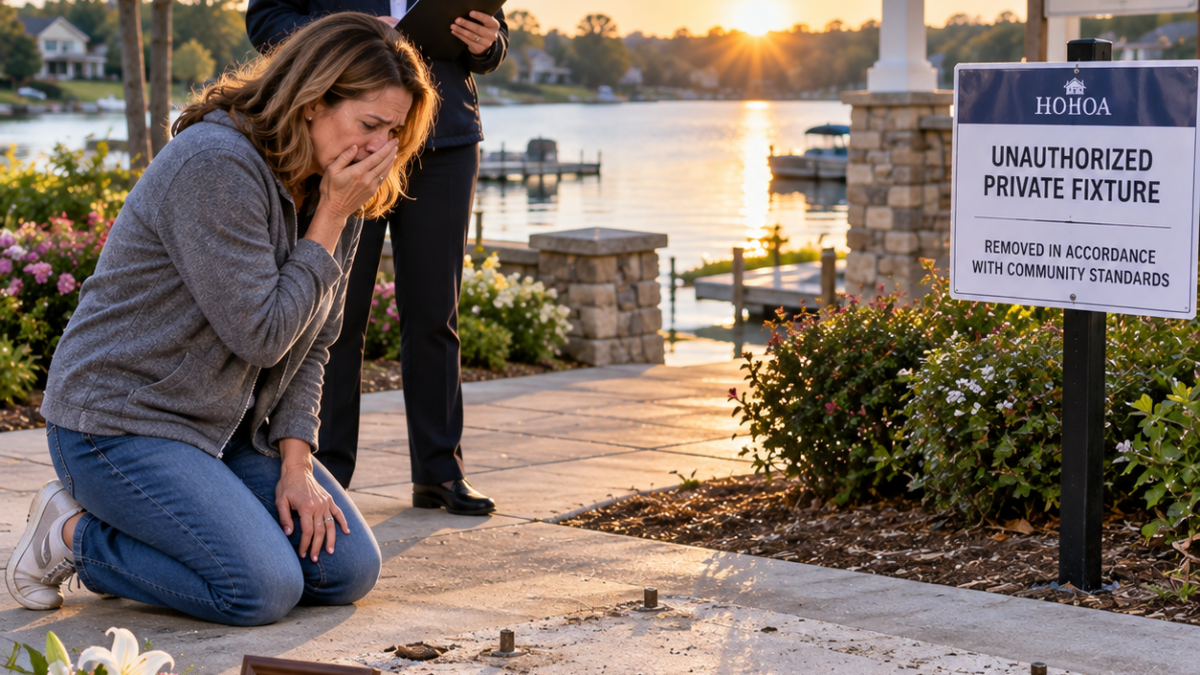
The first thing I saw was the empty concrete pad where my wife’s memorial bench had stood for eight years.
I pointed at the initials.
“Those are yours?”
Diane looked down at the page.
“They indicate that I participated in the project records review.”
“You approved this list?”
“I reviewed the records available to the association.”
“That isn’t what I asked.”
Her eyes came back to mine.
“I performed the records function assigned to me.”
It was the kind of answer that sounded complete until you actually listened to it.
I leaned over the page.
“Who decided this bench was private?”
“The classification resulted from the absence of an approval entry in the current memorial registry.”
“So nobody found Rebecca’s name in a spreadsheet, and that was enough to erase eight years?”
“No one erased anything.”
I almost laughed.
The words came out before I could stop them.
“There are four holes in the concrete where my wife’s bench used to be.”
Jenna looked away from her monitor.
Diane closed the folder halfway.
“Mr. Avery, I understand this is emotional.”
That sentence nearly ended the conversation.
Not because she raised her voice.
She didn’t.
That was the problem.
She said emotional the way people sometimes say irrational.
Like my grief was a contaminant that had wandered into an administrative matter.
I lowered my voice.
“You’re right. It is emotional. My wife died. Her friends and neighbors dedicated a bench to her. Your association put its crest over her name. Eight years later, you removed it without calling me, and now I’m standing here looking at a document that says it was never legitimate.”
Diane said nothing.
“So yes,” I continued. “I’m emotional. But I’m also asking a very simple question. Where is the bench?”
“The contractor handled removals.”
“Who?”
“Greenstone Grounds.”
“And where did they take it?”
“Management is confirming the disposition.”
“Today?”
“We will make the inquiry.”
“And the brass plate?”
“The same.”
I stared at her for another second.
Then I picked up the copy of the project sheet.
“I want this.”
“That is an internal working document.”
“It concerns my wife’s memorial.”
She hesitated.
Jenna quietly said, “I can make him a resident copy.”
Diane looked toward her.
The room remained still.
Finally, Diane nodded.
“Provide the pages relevant to the West Loop fixture.”
That phrase again.
Fixture.
Not memorial.
Not Rebecca.
Fixture.
While Jenna copied the documents, Diane placed another page in front of me.
It was titled CURRENT MEMORIAL REGISTRY.
Fourteen names appeared on it.
Trees.
Plaques.
Granite markers.
Five benches.
Rebecca wasn’t one of them.
I scanned the dates.
Two benches had been approved three years after hers.
Another had been installed only eighteen months earlier.
“Where is the older registry?”
Diane’s expression changed by half an inch.
“What older registry?”
“You said this is the current registry.”
“Yes.”
“So what did you use before this?”
“The association has had several management and filing systems.”
“Then where are those records?”
“Some are archived.”
“Did you check them?”
“We reviewed records available for the project.”
“That’s not the same answer.”
She folded her hands.
“Older association materials are not always indexed in a way that makes individual entries immediately retrievable.”
I looked at the sheet again.
“You removed the bench faster than you looked for the paperwork.”
“That is not a fair characterization.”
“Then give me a fair one.”
For the first time, irritation showed on her face.
“The board authorized a garden renewal. The current registry did not establish that the West Loop bench had formal memorial status. The fixture was therefore classified for removal pending disposition.”
“Pending disposition?”
“Yes.”
“So it may still exist.”
“We are confirming that.”
I stood.
“Please confirm it quickly.”
When I walked back through the garden, the daisies were still on the concrete.
A breeze had pushed two stems toward the edge.
I picked them up.
There was nowhere to leave them.
That felt worse than it should have.
Rebecca had never been sentimental about objects.
When we cleaned out her closet after she died, I had held up one of her old scarves and asked her sister, Ellen, whether I should save it.
Ellen had laughed through tears.
“Rebecca would tell you it’s a scarf, Michael. Not the Declaration of Independence.”
She was right.
Rebecca had cared about people.
Not things.
But the bench had never mattered because it was wood and metal.
It mattered because other people sat there.
That had been the point.
The inscription wasn’t about her death.
It was about how she had lived.
For the path she walked and the people she welcomed.
When I got home, I put the daisies in a drinking glass because I couldn’t find a vase.
Then I spread Jenna’s copies across the kitchen table.
Current registry.
Project review.
Contractor removal order.
The classification appeared twice.
UNVERIFIED PRIVATE FIXTURE.
I sat there until the afternoon light shifted across the table.
Rebecca’s coffee mug was still in the cabinet above the sink.
I had kept exactly one.
White ceramic with a faded blue lighthouse.
She bought it in Maine because she claimed every vacation required one useless souvenir.
Eight years after she died, I still used it on Sunday mornings.
That was grief, I had learned.
Not crying every day.
Not dramatic speeches.
Just a thousand small things that never stopped belonging to somebody who wasn’t coming back.
I opened a drawer.
Nothing.
Then another.
I didn’t have an archive.
I had a house Rebecca had organized according to rules no other human being could understand.
Tax receipts were in a proper file cabinet.
Warranty cards were in a shoebox labeled WARRANTIES.
But important sentimental papers?
Those could be anywhere.
Rebecca believed a safe place meant a place nobody would accidentally clean.
Which was how, two hours later, I found myself pulling cookbooks from a cabinet.
She had once told me, “Nobody throws away a cookbook, Michael. That makes it safer than your filing system.”
I found birthday cards tucked inside The Joy of Cooking.
A dentist reminder inside a casserole book.
A twenty-dollar bill between two pages of a baking guide.
Then I remembered the blue recipe binder.
I found it on the top shelf above the refrigerator.
It had started life as an organized collection of recipes.
Rebecca abandoned that project after six months.
After that, it became her paper universe.
I opened it at the kitchen table.
Chicken piccata.
A handwritten peach cobbler recipe.
A receipt from a garden nursery.
A thank-you card from the Saturday walking group.
Then a folded cream-colored program slipped onto the table.
I froze.
The front carried the Linden Grove crest.
Underneath it were the words:
MEMORIAL GARDEN DEDICATION.
The date was eight years earlier.
I unfolded it carefully.
Four names.
Thomas Reed.
Eleanor Moss.
Caroline Bennett.
Rebecca Avery.
Beside Rebecca’s name:
Memorial Bench — West Loop.
I sat down slowly.
The kitchen seemed to go very quiet.
The program wasn’t a legal document.
It didn’t say board resolution.
It didn’t have signatures.
But it was printed by Linden Grove.
It had their crest.
It named their memorial garden.
And Rebecca was right there.
I reached for my phone.
Nancy Linwood answered on the second ring.
Nancy had been one of Rebecca’s closest walking friends.
She was seventy-two now and still lived two streets over.
“Michael?”
“Do you remember Rebecca’s bench dedication?”
She didn’t hesitate.
“Of course I do.”
“You’re sure?”
There was a pause.
Then Nancy said, “I’m old, not dead.”
Despite everything, I laughed.
She continued.
“There were folding tables by the garden entrance. Lemonade cake. Those terrible dry cookies.”
“You remember the cookies?”
“Rebecca complained about them for fifteen minutes.”
That sounded exactly right.
I looked down at the program.
“Was the HOA involved?”
“Involved? Honey, it was their event.”
“Do you remember board members being there?”
“Diane was.”
I stopped.
“Diane Whitlock?”
“Yes.”
“You’re sure?”
“I remember because she had a clipboard and kept checking people off.”
I leaned back in my chair.
“Did she speak?”
“I don’t think so. Arthur Wendell did.”
Arthur had been board president then.
He had moved to Arizona several years earlier.
“Do you have photographs?”
“I might.”
“Would you look?”
“Give me ten minutes.”
She called back in six.
“I found two.”
A moment later, my phone buzzed.
The first photograph showed me beside Rebecca’s sister near the bench.
The second showed residents gathered beneath the maples.
In the background stood Diane.
Her hair was darker then, but it was her.
Clipboard in hand.
I enlarged the photograph.
The bench was partially visible.
So was the brass plate.
The lettering was too small to read.
But something appeared above it.
A symbol.
I went upstairs to the bedroom closet and pulled down the plastic box where Rebecca kept printed photographs.
She had refused to give them up even after smartphones made photo albums obsolete.
“Clouds disappear,” she once said.
I told her that wasn’t how digital storage worked.
She said, “Tell that to every computer you’ve ever yelled at.”
The box held Christmas mornings, cookouts, birthdays, our rainy Charleston trip, a wedding in Ohio, her last healthy summer.
I stopped when I found a photograph of her on the walking path.
She was half turned toward me with an annoyed smile because I had taken the picture without warning.
For several minutes, I forgot what I was searching for.
That happens sometimes with grief.
You go looking for evidence.
You find a face.
Everything else leaves the room.
I set the picture aside.
Near the bottom was an envelope marked LINDEN GROVE.
Inside were six photographs from the dedication.
My hands started shaking before I found the one I needed.
The bench filled most of the frame.
The brass nameplate was visible.
Rebecca’s name was too small to read clearly.
But the crest above it wasn’t.
Oval border.
Tree in the center.
Two branches beneath.
I walked downstairs and pulled up the latest HOA newsletter on my laptop.
Same crest.
Not similar.
Same.
I called Nancy again.
“Do you remember who ordered the plate?”
“The association did, didn’t they?”
“I don’t know.”
“You and Ellen chose the wording.”
“Yes.”
“But I don’t think you ordered the bench yourself.”
Neither did I.
I remembered writing a check.
I remembered signing something.
I remembered discussing the inscription with a woman from the memorial committee.
But eight years had turned details soft around the edges.
Memory was dangerous that way.
It could be completely honest and still incomplete.
So I stopped relying on mine.
The next morning, I emailed Jenna the dedication program and the photograph of the crest.
I asked for the Greenstone contact information.
She sent it within an hour.
Tobias Ruiz.
Project supervisor.
I called him.
“Greenstone Grounds.”
“My name is Michael Avery. Your crew removed a bench from Linden Grove Memorial Garden last week.”
“Which bench?”
“The West Loop bench. Brass plate. Rebecca Avery.”
Keyboard clicking sounded through the phone.
“Give me a minute.”
I waited.
“Okay. I have an item seventeen. West Loop bench.”
“Do you still have it?”
Another pause.
“I’d have to confirm yard inventory.”
“Please.”
“Mr. Avery, normally I’m supposed to route resident questions through the client.”
“I understand. I’m not asking you to discuss the HOA contract.”
“All right.”
“I’m asking whether my dead wife’s memorial bench was thrown away.”
The keyboard stopped.
His voice changed.
“Hold on.”
I heard muffled conversation.
Then Tobias returned.
“It’s here.”
I sat down.
“You have it?”
“Yes, sir. It’s in our storage yard.”
I closed my eyes.
For the first time in days, my chest loosened.
“Why wasn’t it disposed of?”
“The work order says hold pending disposition.”
“And the nameplate?”
“I’m not sure.”
“Can you check?”
“I can look at the intake photo.”
I heard more clicking.
Then silence.
“Tobias?”
“The plate isn’t attached in the storage photo.”
My relief vanished.
“Where is it?”
“I don’t know from this screen.”
“Can I come there?”
“I’ll need authorization.”
“Tobias—”
“I’m not trying to make this difficult. It’s an active work yard. If management authorizes a resident inspection, I’ll meet you personally.”
I thanked him.
Then I called the HOA office.
Diane called me back twenty minutes later.
“You contacted Greenstone directly.”
“Yes.”
“Management is coordinating contractor communications.”
“I wanted to know if the bench still existed.”
“That information was already being requested.”
“And now I know it does.”
A silence.
“The bench remains project property pending disposition.”
I stared at the kitchen wall.
“Project property?”
“Yes.”
“Two days ago, you called it an unauthorized private fixture.”
“I said it had been classified that way.”
“Now it’s association project property.”
“That isn’t a contradiction.”
“It feels like one from here.”
Diane exhaled.
“Mr. Avery, what exactly are you requesting?”
“I want to see the bench.”
“That is not standard.”
“Neither is removing a memorial and losing track of the nameplate.”
“We have not established that the plate is lost.”
“Then establish where it is.”
That afternoon Jenna sent me a five-page contractor inventory.
Most of it was ordinary debris.
Damaged edging.
Old planters.
A cracked sign frame.
Then item seventeen.
METAL/WOOD BENCH — WEST LOOP.
Source classification:
UNVERIFIED PRIVATE FIXTURE.
Disposition:
HOLD.
Underneath was a smaller note.
PERSONALIZED BRASS PLATE REMOVED BEFORE STACKING — BAGGED AND LOGGED SEPARATELY.
I read it three times.
They had removed Rebecca’s name before they stacked the bench.
Someone had held the plate in their hands.
Someone had bagged it.
Someone had written it into an inventory.
The next morning, I drove to Greenstone’s yard.
Tobias met me at the gate.
He was around forty, stocky, with a reflective vest over a gray work shirt.
“I want to be clear about something,” he said as we walked between equipment sheds. “My crew didn’t decide that bench was unauthorized.”
“I know.”
“We got a list.”
“With the classification already on it.”
“Yes.”
“From Linden Grove?”
“Yes.”
We reached a covered storage row.
Old signs leaned against one wall.
Planters sat on pallets.
Sections of decorative fence were stacked beside several benches.
Then I saw Rebecca’s.
I knew it from twenty feet away.
Scratch on the right armrest.
Dark knot in the third slat.
One back leg with a shallow scrape from the time a maintenance cart clipped it years earlier.
I walked toward it.
My hand rested on the top rail.
The metal was cool.
It was ridiculous how familiar it felt.
Like touching a doorknob in a childhood house.
Four tiny screw holes marked the place where the plate had been.
“Where is it?” I asked.
Tobias checked his clipboard.
“Small parts cabinet.”
We walked into a metal building.
He opened a gray cabinet.
Drawer seventeen was empty.
His face changed.
“What?”
“It should be here.”
My stomach dropped.
He checked another drawer.
Then a shelf.
Then the inventory sheet again.
“Wait.”
He pulled an overflow log from beneath the cabinet.
His finger moved down the page.
“Item seventeen. Personalized brass plate. Transferred to protected storage.”
“Where?”
He read the handwritten notation.
“Cabinet B. Envelope forty-two.”
Cabinet B stood against the far wall.
Locked.
Tobias opened it.
Padded envelopes sat upright in numbered rows.
Thirty-eight.
Thirty-nine.
Forty.
Forty-one.
Then forty-two.
He placed it on the worktable.
Neither of us said anything.
He opened the flap.
Brown packing paper appeared first.
Then brass.
I recognized the small dark mark near the lower right corner before he had fully unwrapped it.
I had cleaned around that mark every spring.
Tobias laid the plate flat.
Rebecca Avery.
For the path she walked and the people she welcomed.
My vision blurred.
I put one hand against the edge of the table.
Above her name sat the Linden Grove crest.
Exactly as I remembered.
But beneath the memorial wording was another line.
Smaller.
So small I had never noticed it while cleaning the plate.
I leaned closer.
LINDEN GROVE MEMORIAL PROGRAM ACCEPTANCE.
Then an identifier.
LG-MP-14-07.
I read it once.
Then again.
“Tobias.”
“Yeah?”
“Was this plate on the bench when your crew removed it?”
He looked at the inventory.
“Yes.”
“And the list still called the bench private?”
“We didn’t write the list.”
“I know.”
He watched me take out my phone.
I photographed the entire plate.
The crest.
Rebecca’s name.
The acceptance line.
Then Tobias placed envelope forty-two beside it, along with the inventory page.
One photograph showed everything.
The contractor paperwork calling the bench an unverified private fixture.
The plate calling it a Linden Grove Memorial Program acceptance.
Same object.
Same day.
Two completely different truths.
I expected to feel victorious.
Instead, I felt sick.
Because this wasn’t memory anymore.
It wasn’t Nancy’s recollection.
It wasn’t an old photograph.
It wasn’t grief making me stubborn.
The association’s own name was engraved on the evidence.
Tobias must have seen something in my face.
“For what it’s worth, sir, my crew removed the plate because they didn’t want it damaged.”
I nodded.
“I’m glad they did.”
He hesitated.
“What happens now?”
“I take this back to the people who said it wasn’t theirs.”
Diane was in the conference room when I arrived.
Jenna had apparently warned her I was coming.
I placed a printed photograph on the table.
Diane looked down.
Her eyes moved from Rebecca’s name to the crest.
Then to the acceptance number.
She didn’t speak.
“You told me there was no approval.”
“I said no formal approval record had been located.”
“You classified the bench as private.”
“The classification was based on the records available.”
I tapped the photograph.
“What is this?”
“A nameplate.”
“What does the top say?”
She looked at me.
“Mr. Avery—”
“Please.”
Her jaw tightened.
“Linden Grove Memorial Program.”
“And the bottom?”
She didn’t answer.
I read it myself.
“Acceptance. LG-MP-14-07.”
She folded her hands.
“An engraved identifier does not necessarily establish formal board authorization.”
For a second, I genuinely couldn’t speak.
Then I sat back.
“You think I made this?”
“I did not say that.”
“You think Rebecca’s sister made it?”
“No.”
“You think someone secretly manufactured a Linden Grove crest, created a memorial program number, bolted the plate to a bench in your memorial garden, held an HOA ceremony around it, and somehow nobody noticed for eight years?”
“You’re expanding my statement.”
“No, Diane. I’m following it.”
Her expression hardened.
“Historical programs did not always use the same documentation standards as current programs.”
I pushed the photograph closer.
“Then what does LG-MP-14-07 mean?”
“I would have to check older records.”
“You told me older records were difficult to retrieve.”
“They are.”
“You’re the records custodian.”
“I am the current records custodian.”
“You were also on the board eight years ago.”
“That does not mean I remember every filing identifier.”
“Do you recognize the format?”
Silence.
That silence told me more than her answer.
Finally she said, “It appears consistent with an older numbering format.”
I leaned forward.
“So you do recognize it.”
“I recognize the structure.”
“From what?”
“Prior association filing systems.”
My heart started beating harder.
“Then there should be a file.”
“If it was retained.”
“If?”
“Management companies change. Boxes are transferred. Records are sometimes incomplete.”
I stood.
“Look for it.”
“We are.”
“No. Look for that number.”
I pointed at the photograph.
“Not West Loop. Not private fixture. Not current registry. LG-MP-14-07.”
For the first time since this began, Diane looked unsettled.
Not frightened.
Not guilty.
Just unsettled.
Because now there was a number.
And numbers were harder to dismiss than widowers.
Two days later, Jenna called.
“We found an older record series.”
That was all she said.
I arrived at ten.
The conference table was covered with white archive boxes.
Diane sat at one end.
Mark Alderman, Linden Grove’s community manager, sat beside her.
Mark had only worked there two years.
I was grateful for that.
He didn’t look defensive.
He looked concerned.
“We located these in material transferred from the previous management company,” he said.
Diane added, “They were not incorporated into the current digital memorial registry.”
I stared at her.
“That’s becoming obvious.”
Mark opened a box labeled BOARD RECORDS — MEMORIAL PROGRAM — 2013–2016.
He pulled out a folder.
2014.
Inside was another folder.
MEMORIAL PROGRAM.
My hands turned cold.
Mark removed the first document.
The header read:
LINDEN GROVE COMMUNITY ASSOCIATION.
BOARD ACCEPTANCE RESOLUTION 2014-07.
Three memorials were listed.
Thomas Reed — tree.
Eleanor Moss — granite plaque.
Rebecca Avery — memorial bench, West Loop.
I read her name twice.
The resolution stated that the board accepted the memorial installations for placement in the Linden Grove Memorial Garden under the association memorial program.
I looked at Diane.
She looked at the paper.
Not me.
“This is formal approval.”
Mark nodded.
“Yes.”
No qualification.
No careful sentence.
Just yes.
Underneath the resolution was another document.
My own signature sat at the bottom.
REBECCA AVERY MEMORIAL DEDICATION AGREEMENT.
I remembered signing it only when I saw the handwriting.
Grief had swallowed that afternoon whole.
The agreement described the bench.
The approved wording.
The designated location.
West Loop.
Second maple.
Routine maintenance by the association grounds program.
Then Mark pointed to a paragraph midway down page two.
“If the memorial needs to be temporarily relocated due to repair, redesign, safety, or site conditions, the association will provide written notice to the listed donor contact when reasonably available.”
He continued.
“Permanent removal requires board authorization.”
I looked up.
“Was I sent written notice?”
Mark glanced at Diane.
Then at a separate file.
“Not that we’ve found.”
“Was there a vote approving permanent removal?”
“We have not found one specific to this memorial.”
Diane shifted in her chair.
“The board authorized the broader renewal project and fixture standardization.”
I looked at her.
“This agreement doesn’t say ‘unless the board later uses the words fixture standardization.’”
Mark raised a hand.
“Let’s keep the documents separate.”
His tone was calm.
“The first document establishes that the bench was formally accepted.”
He tapped the resolution.
“The second establishes specific conditions governing relocation or removal.”
He tapped the agreement.
I nodded.
“Then why was it classified as private?”
Mark pulled another sheet from the folder.
An old memorial registry.
Not a spreadsheet.
A typed page with handwritten notations along the margins.
And there she was.
REBECCA AVERY.
INSTALLATION: BENCH.
LOCATION: WEST LOOP — SECOND MAPLE.
ACCEPTANCE: LG-MP-14-07.
STATUS: ACTIVE.
I stared at it.
Everything was there.
Not just Rebecca’s name.
The exact location.
The exact number engraved on the plate.
The word active.
Then I saw the initials at the bottom.
DW.
Beside them:
TRANSFERRED TO ANNUAL BOARD RECORD — VERIFIED.
I looked at Diane.
“Are those yours?”
She was silent for several seconds.
“Yes.”
The room changed.
Not dramatically.
Nobody gasped.
No one slammed a folder.
But something changed.
Because for a week Diane had spoken about Rebecca’s bench as though it belonged to some vague, unverified past.
Now her own initials were underneath the record.
“You verified this.”
“I was assistant secretary that year.”
“You initialed Rebecca’s record.”
“Yes.”
“You knew it existed.”
“I knew it existed eight years ago.”
I stared at her.
“You told me there was no formal approval.”
“I told you no formal approval had been found in the current records.”
“And when I showed you the plate?”
“I agreed that further archive review was appropriate.”
“You kept defending the private classification.”
“I said the plate alone was not a board resolution.”
“And now we have the resolution.”
Mark closed the archive folder halfway.
“I think we should focus on what the documents establish.”
I looked at him.
“Please.”
He spoke carefully.
“Rebecca Avery’s bench was formally accepted under board resolution 2014-07. It was entered into the historical memorial registry as active. The memorial dedication agreement required notice for relocation when the donor contact was available and specific board authorization for permanent removal.”
“And none of that happened.”
“We have found no evidence of notice.”
“And no vote?”
“No separate vote regarding this bench.”
I leaned back.
The anger I expected didn’t come.
I was tired.
That was all.
Deeply, completely tired.
I looked at Diane.
“Why didn’t you just say you were wrong?”
She looked at me then.
“I did not remember the specific record.”
“I believe you.”
Her expression changed.
Maybe she hadn’t expected that.
I continued.
“I believe you didn’t remember. Eight years is a long time.”
She nodded once.
“But after I brought you the plate, the question changed.”
She said nothing.
“You recognized the numbering format. You knew there were older records. And you still kept telling me why the new spreadsheet mattered more than the thing engraved on the bench.”
“That is not how I would characterize it.”
“I know.”
I stood.
“That’s the problem.”
Mark sent me the garden-renewal authorization the next morning.
Two pages.
I read them at the kitchen table beside Rebecca’s old dedication agreement.
The renewal authorization approved new landscaping.
Irrigation work.
Path repairs.
Fixture standardization.
It did not mention Rebecca.
It did not mention the West Loop bench.
It contained no list of memorials approved for permanent removal.
So I called Mark.
“Where is the specific removal authorization?”
“I haven’t found one.”
“Then what did Greenstone act on?”
“The project removal list.”
“The one Diane helped prepare.”
“Yes.”
“And the project list called the bench private.”
“Yes.”
“Because the current registry was incomplete.”
“That appears to be what happened.”
I looked at Rebecca’s agreement.
“They have my address.”
“Yes.”
“My email.”
“Yes.”
“I get annual HOA notices.”
“Yes.”
“So nobody can say I wasn’t reasonably available.”
“No.”
“What happens now?”
Mark was quiet.
Then he said something that made my stomach tighten.
“Final hardscape work is scheduled Friday.”
“What does that mean?”
“They remove old anchor points, patch unused mounting locations, and complete the planting layout.”
I looked toward the window.
It was Wednesday.
“So the pad disappears.”
“If it isn’t reused, yes.”
I stood.
“Mark, if they patch those holes, they erase the place.”
“I understand.”
“No. I need you to understand exactly what I’m saying. The bench is in a storage yard. The plate is in an envelope. Your records proved the memorial was official. And now the last physical marks of where it stood are scheduled to be filled in forty-eight hours.”
“I understand.”
“What are you going to do?”
Another pause.
Then:
“I’m issuing an administrative hold.”
I closed my eyes.
“Thank you.”
“The board will still need to determine corrective action.”
“Fine.”
“But no irreversible work will occur on the West Loop pad until that review happens.”
That afternoon, I was asked to return to the office.
Diane was already there.
Four documents sat on the conference table.
The old resolution.
The dedication agreement.
The historical registry.
The current removal list.
Mark began.
“We need to separate two questions.”
He touched the resolution.
“Was the bench formally accepted?”
“Yes,” he answered himself.
Then the dedication agreement.
“Did the removal process follow the terms associated with that accepted memorial?”
He looked at Diane.
“We have not found written notice to Mr. Avery or specific board action approving permanent removal.”
Diane leaned back.
“The renewal motion granted implementation authority.”
“Implementation authority doesn’t invalidate an existing agreement,” Mark said.
“The board maintains broad authority over common areas.”
“Yes. But the board also adopted this memorial program.”
Diane looked toward me.
“This illustrates why historical records need to be integrated into modern systems.”
I stared at her.
There it was.
The shift.
The problem had become technology.
A database migration.
An old filing system.
Anything except a wrong decision.
“The missing record was a filing problem,” I said.
“Yes.”
“But removing the bench after I showed you evidence was a judgment problem.”
Diane’s eyes narrowed.
“The removal had already occurred before you provided the plate photograph.”
“The classification remained.”
“Because formal documentation had not yet been located.”
“And now?”
She paused.
I pushed the removal list toward her.
“Are you willing to correct this?”
She looked down at the words.
UNVERIFIED PRIVATE FIXTURE.
“That document reflected the information available during the review.”
“That isn’t what I asked.”
No answer.
“Is the classification wrong?”
Her mouth tightened.
“The current registry was incomplete.”
“Diane.”
She remained silent.
I looked at Mark.
And something inside me settled.
Until that moment, a part of me had still worried I was turning Rebecca’s memory into a fight she never would have wanted.
She hated public scenes.
She hated meetings that ran long.
She once refused to attend an HOA architectural committee hearing over our porch railing because she said, “I’d rather repaint it myself than spend two hours arguing about beige.”
But this wasn’t about embarrassing anybody.
It wasn’t about punishing Diane.
It was about refusing to let a false document become the official history because the person who created it wouldn’t correct a sentence.
“What happens to the pad tomorrow?” I asked.
Mark opened the contractor schedule.
“Site review at nine.”
“And Friday?”
“If the hold is lifted, Greenstone proceeds.”
Diane said, “The overall project cannot remain open indefinitely.”
“The bench was there eight years.”
“That isn’t what I mean.”
“I know.”
Mark looked between us.
“I’ve asked Greenstone to return the bench to the garden for identification tomorrow.”
I stared at him.
“Return it?”
“Not reinstall it yet.”
I nodded.
“But return it.”
“Yes.”
The next morning, Rebecca’s bench came back on a Greenstone flatbed.
I reached the garden at eight forty-five.
Tobias was already there.
Two crew members stood beside the truck.
The bench was strapped upright against a padded frame.
Without the plate, it looked strangely bare.
Almost embarrassed.
Mark arrived carrying a yellow folder.
Then Diane.
She stopped when she saw the bench.
At nine exactly, Mark said, “The West Loop site remains under administrative hold. No anchor removal. No patching. No planting over the existing pad.”
Tobias nodded.
“My crew has that instruction.”
Diane crossed her arms.
“And the board?”
“Laura Chen is coming.”
Laura was the current board president.
She arrived five minutes later with a tablet in one hand and coffee in the other.
Mark gave her a short version of what had happened.
She listened without interrupting.
Then she walked to the empty concrete pad.
Pale orange paint marked the edge of the planned new planting bed.
Little flags stood in the soil.
Laura pointed to the bolt holes.
“What happens tomorrow if this goes forward?”
Tobias answered.
“We remove the remaining anchors, patch the old mounting points, and finish grading the bed.”
“And afterward?”
“The old position is effectively gone.”
Laura looked toward the truck.
“And if the bench is restored?”
“We can reuse the existing anchor pattern.”
Tobias’s crew released the straps.
They lowered Rebecca’s bench onto padded blocks beside the concrete.
For the first time in more than a week, the bench and its old location were together.
Ten feet apart.
That was all.
Ten feet.
But the distance felt enormous.
Laura walked around it.
She looked at the scratch.
The empty plate holes.
The contractor tag beneath the seat.
Then Tobias carried out a plastic document case.
Inside was envelope forty-two.
“Personalized plate from item seventeen,” he said.
I watched Laura’s expression change.
She looked at Mark.
“You have the historical file?”
He opened the yellow folder.
She read the resolution.
Then the old registry.
Then the dedication agreement.
Finally the current removal sheet.
Her eyebrows pulled together.
“Who classified it as private?”
Mark didn’t answer immediately.
Diane did.
“The project records review.”
Laura turned.
“Meaning?”
“I prepared the status list using the current memorial registry and available project records.”
Laura looked back at the historical registry.
“And this wasn’t reviewed?”
“It was in archived material transferred from the former management company.”
Laura read the handwritten verification line.
Then she looked at the initials.
“DW.”
Diane’s voice went quieter.
“Yes.”
“Yours?”
“Yes.”
Laura nodded slowly.
“I see.”
No accusation.
No performance.
Just two words.
I almost felt sorry for Diane in that moment.
Almost.
Because there is a specific kind of humiliation in seeing your own handwriting become evidence against your certainty.
Laura walked toward the concrete pad again.
“What authority do we have today?”
Mark answered.
“I can maintain the administrative hold. As board president, you can direct that no irreversible site work proceed while corrective action is reviewed.”
Diane said, “The project has already been delayed.”
Laura turned toward her.
“So has the correction.”
Nobody spoke after that.
Tobias asked whether he should take the bench back to the yard.
Laura shook her head.
“No.”
Diane looked at her.
“No?”
“Secure it here.”
“Under whose custody?”
“Greenstone’s until we resolve the installation.”
Tobias said, “We can barrier the area and keep it under the maple.”
Laura nodded.
“Do that.”
The crew moved the bench beneath the red maple.
The same red maple.
Not onto the pad.
Not yet.
But close enough that the place suddenly looked recognizable again.
Before Tobias left, he asked, “Do you want us ready with restoration hardware tomorrow?”
Diane said, “Restoration has not been authorized.”
Laura looked at her.
Then back at Tobias.
“Bring it.”
Diane’s face tightened.
“You’re authorizing work before a decision.”
“No,” Laura said. “I’m authorizing us not to waste another day if the decision is to correct this.”
I liked her immediately.
The following morning, Tobias returned with drills, stainless anchor bolts, mounting hardware, and two crew members.
Rebecca’s bench remained behind the temporary barrier.
Envelope forty-two rested on a folding table.
Laura arrived first.
Then Mark.
Then Diane.
No crowd.
No reporters.
No angry residents holding phones.
I was grateful.
Rebecca would have hated becoming entertainment.
Mark opened the yellow folder.
“The board issued written corrective authorization last night.”
My heart jumped.
He continued.
“Restoration to the existing West Loop pad is authorized upon confirmation that the bench, plate, historical record, and removal inventory refer to the same memorial.”
Tobias stepped forward.
He showed Laura the contractor tag beneath the seat.
Item seventeen.
He opened envelope forty-two.
Then he held Rebecca’s plate against the center slat.
Four screw holes matched perfectly.
Mark placed the old memorial registry beside it.
LG-MP-14-07.
Same number as the plate.
Then the board resolution.
Rebecca Avery Memorial Bench.
West Loop.
Laura looked at Tobias.
“When Greenstone received the removal order, did your company independently decide this bench was private or unauthorized?”
“No.”
“Where did that classification come from?”
“The association removal list.”
Mark placed the page on the table.
UNVERIFIED PRIVATE FIXTURE.
Laura looked at Diane.
“You helped prepare this?”
“Yes.”
“Using the current registry?”
“And project records available at the time.”
Laura tapped the historical registry.
“This remained in association custody?”
Mark said, “Yes.”
Diane added, “In archived files that were not incorporated into the current system.”
Laura nodded.
“Was Mr. Avery notified before the bench was removed?”
Mark answered.
“No.”
“Was there a board action specifically authorizing permanent removal of this accepted memorial?”
“No.”
“Was it classified as private anyway?”
“Yes.”
Diane looked at me.
“I have never disputed that the bench carried personal significance for Mr. Avery.”
I shook my head.
“That was never the question.”
She stopped.
“The question,” I said, “was whether your association had accepted it.”
She looked at the plate.
“And now the documentation establishes that it did.”
“Not now.”
The words came out quietly.
Laura looked at me.
So did Mark.
I continued.
“The documentation didn’t make the bench official this week. Finding the box didn’t make it official. The plate didn’t make it official. It was official eight years ago.”
Nobody moved.
“The box only proved it.”
Laura looked down at the papers.
Then she pulled the current removal list toward herself.
She took a pen.
“I’m withdrawing the ‘unverified private fixture’ classification.”
Diane turned.
“Laura—”
“No.”
It wasn’t loud.
That made it final.
Laura drew a line through the classification.
“The bench was formally accepted under the memorial program. Notice required by the agreement was not provided. We have found no specific authorization for permanent removal. The classification is factually incorrect.”
Diane looked away.
Laura turned to Tobias.
“Restore it.”
Those two words almost broke me.
Tobias looked toward the pad.
“Same orientation?”
I stepped closer.
Rebecca’s bench had never sat perfectly square to the path.
She liked it angled slightly toward the curve so you could see people coming from either direction.
“Same orientation.”
Tobias nodded.
The crew moved the bench onto the concrete.
One man measured the mounting points.
Another checked the level.
The old holes aligned.
The first stainless bolt went in.
Then the second.
Third.
Fourth.
I stood with my hands in my jacket pockets because I didn’t know what else to do with them.
Finally Tobias picked up the brass plate.
“Mr. Avery?”
I looked at him.
“Do you want to check the placement?”
I walked over.
Rebecca’s name caught the morning light.
There was the little dark mark near the corner.
There were the words Ellen and I had chosen through tears eight years earlier.
For the path she walked and the people she welcomed.
“Center it where it was.”
He did.
Four screws.
That was all it took.
Four small screws.
Rebecca’s name was back.
Nobody clapped.
Thank God.
No one made a speech.
The crew started gathering tools.
Mark closed the folder.
Laura asked, “Is there anything else you need from us today?”
I looked at the bench.
Then at her.
“Three things.”
She waited.
“First, I want written confirmation that the private-fixture classification was wrong.”
“You’ll have it.”
“Second, I want Rebecca restored to the current memorial registry.”
“She will be.”
“Third…”
I looked at Diane.
“I don’t want the next widow or husband standing where I stood because somebody decided an old record didn’t count just because it wasn’t copied into a new spreadsheet.”
Diane said nothing for a moment.
Then her eyes went to the historical registry.
Her own initials.
When she finally spoke, her voice had changed.
“No.”
I waited.
She looked toward me.
“That should not happen again.”
It wasn’t an apology.
But it was the first sentence she had spoken since this began that didn’t try to make the truth smaller.
Laura stayed until the crew finished.
Then she left.
Mark followed.
Diane walked away alone.
Tobias packed his tools.
Before he left, he touched the bench lightly.
“I’m glad we kept that plate protected.”
“So am I.”
He smiled.
Then the Greenstone truck drove away.
I was alone beneath the red maple.
For several minutes, I didn’t sit.
I just looked.
Same bench.
Same scratch.
Same knot in the wood.
Same angle toward the path.
It should have felt like everything was fixed.
It didn’t.
Because somewhere during those eight days, I had understood something I hadn’t known before.
They hadn’t removed Rebecca from the garden first.
They had removed her from the record.
Once the spreadsheet said the bench wasn’t official, taking the bolts out became easy.
The paperwork had erased her before the contractor ever touched a wrench.
So I waited for the correction.
It arrived three days later.
Mark emailed it at 9:14 in the morning.
A signed paper copy came in the mail that afternoon.
One page.
No dramatic language.
No lawyerly apology.
Just facts.
Rebecca Avery’s Memorial Bench had been formally accepted by Linden Grove Community Association under Board Acceptance Resolution 2014-07.
The prior classification as an unverified private fixture was incorrect.
The memorial had been removed without the notice procedure described in the memorial dedication agreement.
The original memorial record had been restored to active status.
I read the page at the same kitchen table where I had spread out Diane’s removal list a week earlier.
Then I read Rebecca’s name again.
Not on an old photograph.
Not in a forgotten archive box.
Not on contractor inventory.
In the current record.
I made coffee.
Used the lighthouse mug.
Sat there until it went cold.
The board met the following Tuesday.
Laura invited me.
I declined.
“I appreciate it,” I told her. “But I’ve spent enough time turning Rebecca into an agenda item.”
She understood.
Mark sent me the outcome afterward.
The board adopted four policy changes.
Every memorial in the current registry would be reconciled against historical records.
No accepted memorial could be permanently removed without specific board authorization.
Written notice had to be provided to the donor contact whenever reasonably possible.
And no single board officer or records custodian could classify an older memorial as unauthorized without a second review.
Diane remained on the board.
That surprised a few neighbors when the meeting minutes circulated.
It didn’t bother me.
I never wanted her seat.
I wanted the lie corrected.
The board formally censured her for allowing the removal classification to stand after conflicting evidence appeared and before a complete historical review had been performed.
She also lost unilateral authority over memorial classifications.
Future removal decisions required management review and another board officer’s approval.
It wasn’t dramatic.
There was no resignation scene.
No police.
No lawsuit.
No shouting in a crowded clubhouse.
Just a boundary placed where one should have existed already.
A week later, an envelope arrived.
No Linden Grove letterhead.
Just my name in handwriting I recognized from years of HOA notices.
Inside was a short note.
Mr. Avery,
I should have corrected the classification when the nameplate identifier established that our current registry was incomplete.
I did not.
The bench was formally accepted, and the association record should always have reflected that.
Diane Whitlock.
I read it twice.
It wasn’t a perfect apology.
It didn’t need to be.
The sentence I had wanted from her had finally arrived.
The classification was wrong.
The record should have reflected the truth.
I took the note upstairs.
Then I stopped.
Rebecca would have laughed at me for even considering a proper file folder.
So I went into the kitchen.
Pulled down the blue recipe binder.
And tucked Diane’s note behind the memorial dedication program.
Nobody accidentally throws away a cookbook.
Rebecca was still right.
The Memorial Garden reopened that Saturday.
The landscaping looked good.
I could admit that.
Fresh mulch.
New lavender.
Repaired path edging.
Irrigation lines hidden beneath dark soil.
The redesign had changed a few things but preserved the old shape of the garden.
The stone sign remained.
The little bridge remained.
The red maples remained.
And Rebecca’s bench sat beneath the second one.
Same angle.
Same scratch.
Same dark knot.
The brass plate had been cleaned.
Not polished into something shiny and artificial.
Just cleaned enough that the words were easy to read.
I went early.
For once, I didn’t bring flowers.
I had spent enough mornings arriving with something in my hands.
I sat at the far end.
Rebecca’s end.
Leave the good shade for somebody else.
For a while, I watched Linden Grove wake up.
A man walked past with a small brown dog.
Two women carried coffee and argued cheerfully about whose turn it was to host book club.
A kid on a bicycle came down the path too fast.
His father called, “Slow down by the bridge, Mason.”
The boy slowed.
Nobody stopped to stare at me.
Nobody knew what had happened unless they had read the meeting minutes.
That was good.
The bench had never been meant to become a monument people approached with solemn faces.
Rebecca would have hated that.
It was meant to be used.
A place to sit when your knees hurt.
A place to tie your shoe.
A place to drink coffee.
A place to wait for somebody.
A place to leave enough room for a stranger.
I ran my thumb along the edge of the brass plate.
Rebecca Avery.
Eight years.
For eight days, Linden Grove had treated her memorial as though its history depended on the newest spreadsheet.
But the truth had been sitting beneath everyone’s hands the whole time.
In an old binder.
In a photograph.
In a contractor envelope.
In a brass number no one bothered to read until the bench was already gone.
The woman who had once verified Rebecca’s memorial had forgotten it.
Then she had trusted an incomplete system more than the evidence standing in front of her.
That was the part I understood least at first.
Eventually, I understood it too well.
People like clean records.
They like current files.
They like green check marks and neatly populated databases.
A missing entry feels easier to believe than a messy history.
But forgetting something doesn’t make it false.
Losing the paperwork doesn’t make the past disappear.
And an empty box on a spreadsheet doesn’t get the final word over something people actually lived.
A woman I didn’t recognize came down the path around nine.
Maybe sixty.
Gray sweatshirt.
Travel mug.
She slowed beside the bench.
“Mind if I sit?”
I moved closer to the end.
“Not at all.”
She sat beside me.
For a while, neither of us spoke.
The sunlight moved through the maple leaves.
A thin band of gold crossed Rebecca’s nameplate.
The woman eventually noticed it.
She leaned forward slightly.
“Rebecca Avery.”
I nodded.
“Your wife?”
“Yes.”
“She must’ve been loved.”
I looked toward the path.
Kids.
Dogs.
Coffee cups.
Ordinary Saturday morning.
“She liked people,” I said.
The woman smiled.
“That’s rare.”
I smiled back.
“She also complained about dry cookies.”
The woman laughed.
I could almost hear Rebecca laughing with her.
A few minutes later, the woman stood.
“Have a nice morning.”
“You too.”
She continued down the path.
I stayed where I was.
At the far end.
Leaving the better shade open.
The brass plate caught the light again.
Rebecca’s name was still there.
The acceptance number was still beneath it.
The HOA crest was still above it.
None of those things had changed while the bench was gone.
Only the official version of the truth had.
Now, finally, the record had caught up.








