The first thing I saw was $4,500 in red across our HOA portal, followed by six nighttime photographs they claimed proved my husband had repeatedly violated the neighborhood vehicle rules.
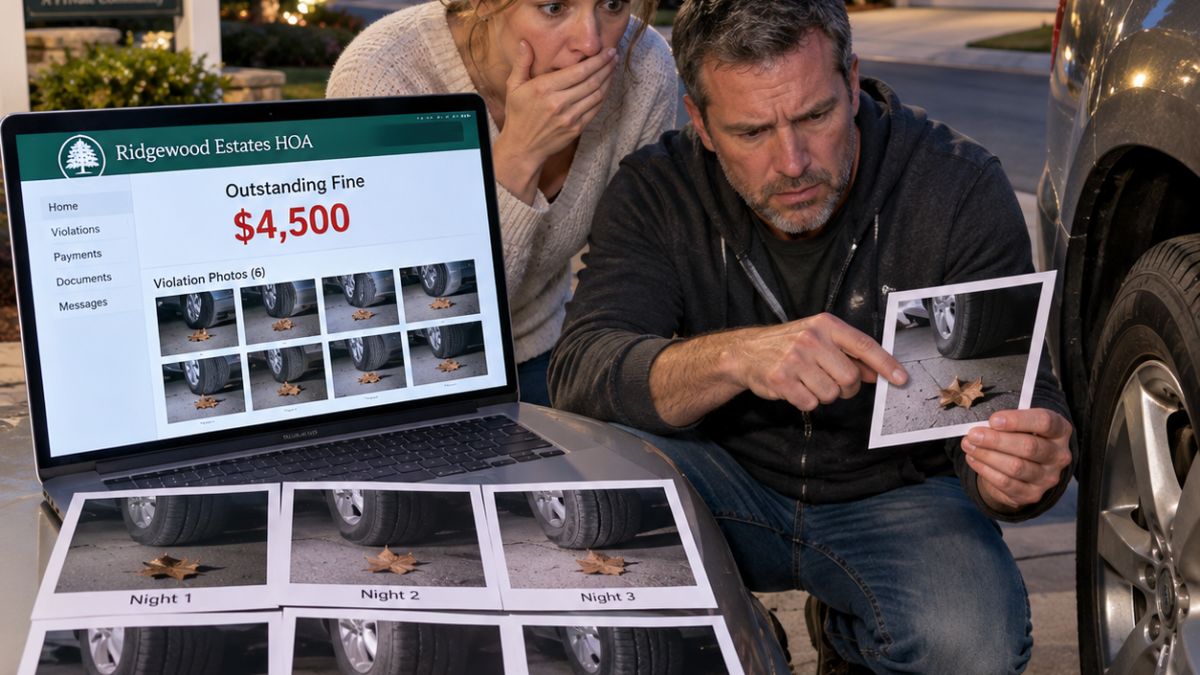
I wanted to call Belle immediately.
I wanted to ask how six photographs of an ordinary sedan had turned into a $4,500 collection balance.
I wanted to ask why one of those photographs had apparently arrived before the morning it supposedly documented.
Ryan stopped me before I reached for my phone.
“Not yet.”
“They’re threatening collections.”
“I know.”
“We can’t just sit here.”
“We’re not sitting.”
He pointed at the screen.
“We’re reading.”
There was no anger in his voice.
That was when I started paying attention to how Ryan handled things when the facts were incomplete.
At work, he had spent eleven years investigating financial crimes, property cases, identity theft, and enough neighborhood disputes to know that people often ruined good evidence by announcing conclusions too early.
At home, he almost never talked about cases.
But he had habits.
He saved original files.
He wrote times down.
He separated what someone believed from what they could prove.
Most of all, he disliked sentences beginning with “obviously.”
“Obviously they faked the photos,” I said.
He looked at me.
“Maybe.”
“Ryan.”
“One photograph appears impossible. Two look duplicated. That’s enough to challenge them.”
“You think Belle did this.”
“I think Belle signed the notice.”
“That’s not the same thing.”
“No.”
I hated that answer.
I also knew he was right.
Emily had already left for school.
Our younger son Jack was eating cereal at the counter, completely unaware that his parents were staring at a portal balance larger than our first used car had cost.
Ryan lowered his voice.
“Call management first.”
“And say what?”
“Ask how the fines were created. Ask where the prior notices went. Ask who took the pictures. Ask for original files.”
“Don’t tell them we found the timestamp issue?”
“Not yet.”
“Why?”
“Because I want to know what story they tell before they know which part doesn’t fit.”
That sounded less like my husband and more like Detective Pierce.
He must have seen something in my face because his expression softened.
“Lauren, this is still an HOA dispute.”
“Four thousand five hundred dollars doesn’t feel like one.”
“I know.”
He took my hand.
“We’re not paying today. We’re not accusing anyone today. We’re preserving everything today.”
That became the plan.
At 8:12, another portal message appeared.
Mrs. Pierce, your account has entered final compliance review. Payment or approved resolution must be received within ten business days to avoid collection processing. The association has verified photographic evidence of repeated non-compliance. Personal occupation or household employment status is not a basis for exemption.
Regards,
Belle Carter
I read the last sentence three times.
Personal occupation.
Household employment status.
Ryan’s job.
Belle had put it in writing.
I looked toward the driveway.
His sedan sat in sunlight.
No markings.
No equipment visible.
Nothing that would tell a stranger what he did for a living.
Yet somehow the HOA had decided the vehicle’s relationship to law enforcement mattered.
I called Thornfield Community Management.
The menu had six options.
None of them sounded like:
Press seven if your HOA has fined you using a photograph from the future.
Eventually a man answered.
“Thornfield Community Management compliance desk. Nate Wilks.”
“My name is Lauren Pierce. Crest Haven Glen. I’m calling about a $4,500 vehicle fine posted this morning.”
Keyboard.
Pause.
“Yes, Mrs. Pierce. Final compliance balance. Repeat prohibited-vehicle condition.”
“I need the dates the prior notices were delivered.”
“The portal shows delivery.”
“That isn’t what I asked.”
Another pause.
“The association uses electronic notice unless an owner has opted out.”
“We did not receive earlier notices.”
“I can note that you dispute receipt.”
“When were they sent?”
More typing.
“May sixth, May ninth, May twelfth.”
“To what email?”
He read mine.
I opened my inbox.
Nothing.
Spam.
Nothing.
Deleted folder.
Nothing.
“Can you send proof of delivery?”
“The portal record is generally considered proof.”
“Generally?”
“That is the association procedure.”
I wrote down the sentence.
Then asked:
“Who took the photographs?”
“The evidence was supplied through Clear View Compliance Services.”
I wrote that down too.
“Original files?”
“You have the violation images.”
“I have portal screenshots.”
“The images are processed for homeowner review.”
“What does processed mean?”
“Formatted and transmitted through the association compliance system.”
“Are the originals available?”
“Original capture material is maintained by the vendor.”
“Then I want those.”
“Homeowners typically receive the processed packet.”
“Nate, they’re supporting a $4,500 balance.”
“I understand.”
“Then the original photographs should not be difficult to produce.”
He stopped typing.
When he spoke again, his voice had changed.
Not rude.
More guarded.
“You may request a compliance hearing.”
“I am.”
“I’ll note it.”
“And collection needs to stop while we dispute the evidence.”
“That requires approval.”
“From whom?”
“The compliance chair.”
Of course.
Belle Carter had signed the fine.
Belle Carter controlled the pause.
Nate told me she held compliance office hours at the clubhouse from ten until noon.
Crest Haven Glen’s clubhouse was designed to make an HOA feel more important than it was.
White columns.
Blue-gray shutters.
Perfect planters.
Inside, there was a glass-covered bulletin board displaying approved paint colors, trash-can rules, pool hours, parking diagrams, and a laminated page titled:
GOOD NEIGHBORS KEEP CREST HAVEN BEAUTIFUL.
Belle stood beside it when I walked in.
Ivory blazer.
Tan heels.
Tablet tucked against one arm.
“Lauren.”
Her smile told me she had expected me.
“I thought we might hear from you.”
Not “I’m sorry this is confusing.”
Not “Let’s look at the account.”
I thought we might hear from you.
I held my folder tighter.
“I spoke with Nate. I’m requesting a hearing and a stay on collection.”
“That may be possible if the board sees a good-faith effort toward resolution.”
“What does resolution mean?”
“Compliance.”
“Payment?”
“Compliance.”
A woman carrying a yoga mat walked through the lobby.
She slowed.
Belle lowered her voice just enough to pretend the conversation was private.
“Your husband’s vehicle has been an ongoing concern.”
“It’s a sedan.”
“It’s a government-associated vehicle.”
“It has no markings.”
“The rule isn’t limited to decals.”
“What rule prohibits an unmarked sedan?”
“The issue is recurring overnight visibility and the perception of special treatment.”
Perception.
I almost missed the word because it sounded so ridiculous next to $4,500.
“My husband parks in our driveway.”
“Most residents don’t bring law-enforcement equipment into the streetscape.”
“There is no law-enforcement equipment in the driveway.”
Belle tapped her tablet.
One of our photos appeared.
“The association has documented the condition.”
“Then send me the originals.”
“You have the photographs.”
“I have processed images.”
“They are verified.”
“By Clear View?”
“Yes.”
“Then Clear View can produce the original files.”
Her smile thinned.
“Mrs. Pierce, challenging the technical format does not erase the underlying violation.”
“No.”
I looked directly at her.
“But fake evidence would.”
The air changed.
Belle glanced toward the hallway.
Then back at me.
Her voice became softer.
Which meant sharper.
“Allegations like that without authenticated supporting material tend to reflect poorly on the person making them.”
“I’m asking for authentication.”
“Your husband’s occupation does not place your household above the declaration.”
“His occupation has nothing to do with whether those photos are real.”
“The committee will review your hearing request.”
“And collections?”
“Balance remains active.”
I felt heat climb my neck.
She continued.
“If you want to avoid collection processing, you may submit payment while preserving your appeal rights.”
There it was.
Pay first.
Argue later.
“I’m not paying $4,500 for photographs you won’t authenticate.”
Belle looked toward the front windows.
“Then I hope your evidence is stronger than your tone.”
I left before I gave her a better sentence to quote.
In my car, I texted Ryan.
She says processed screenshots are enough.
His answer came thirty seconds later.
They never are.
He came home after six carrying takeout.
Emily was upstairs.
Jack had fallen asleep on the couch with one shoe still on.
I had spent the afternoon printing.
Fine notice.
Photo packet.
Belle’s portal message.
My notes from Nate.
Screenshots of every upload time.
Ryan set down the food.
“You started a case board.”
“I started a panic board.”
“That works too.”
We sat.
Six photos.
Same driveway.
Same general angle.
Same car.
Different alleged nights.
Ryan pulled out a legal pad.
“Timeline.”
I read the dates.
Tuesday — 11:46 p.m.
Friday — 12:18 a.m.
Sunday — 5:38 a.m.
Monday — 10:07 p.m.
Wednesday — 11:12 p.m.
Saturday — 12:44 a.m.
He circled Sunday.
“We already know that one’s impossible.”
I opened our driveway camera.
Sunday.
5:38.
Empty.
Then 5:39.
Sprinkler clicks on.
No sedan.
No photographer.
Ryan asked:
“Do we have proof the car was physically somewhere else?”
“Shared calendar.”
“That proves you were scheduled.”
“Training center entry?”
He nodded.
“I can request my own access record.”
“You can use department records?”
“For my personal dispute, I can request what any employee can request about themselves. Nothing investigative.”
That distinction mattered to him.
I appreciated it.
He would not turn his badge into a hammer.
He would use the same facts another homeowner could use.
Next we checked Tuesday.
HOA photograph:
Dry concrete.
Sharp porch shadow.
Our camera:
Steady rain.
Wet driveway.
Porch light reflected in water.
Ryan placed the images side by side.
“Same timestamp?”
“11:46.”
“HOA image dry?”
“Yes.”
“Your camera wet?”
“Yes.”
He nodded.
“Document it.”
Friday was less clear.
The sedan had been there around midnight.
But the camera angle in the HOA photograph looked like it came from across the court.
Near Mrs. Alden’s maple tree.
Possible.
Maybe.
We marked it UNKNOWN.
Ryan liked that word.
Not fake.
Not real.
Unknown.
Then I downloaded all six portal photographs.
File names:
violation_image_4431
4432
4433
No camera model.
No GPS.
No native capture date.
Only portal upload information.
Processed.
I checked the Sunday image again.
Upload:
Thursday, 3:42 p.m.
Violation timestamp:
Sunday, 5:38 a.m.
I stared.
Then refreshed.
Same thing.
“Ryan.”
He leaned over.
His face changed.
“Print it.”
I did.
Three copies.
One behind the Sunday footage.
One beside the HOA image.
One taped to the cabinet because I was already beginning to distrust my own eyes.
A photograph allegedly proving a future violation had entered the portal three days early.
Ryan folded his arms.
“Now we make the request.”
I opened a blank document.
Formal Notice of Dispute and Records Request.
Account number.
Violation IDs.
$4,500 balance.
Six images.
Then requests:
Original unedited source files.
Native capture timestamps.
Camera or device identifier.
Upload history.
Route or patrol log.
Clear View work order.
Board authorization for escalating fines.
Prior notice delivery proof.
Fine calculation ledger.
Any rule permitting processed screenshots to substitute for original evidence.
I wrote:
The evidence appears fabricated under the supervision of—
Ryan tapped the screen.
“Delete that.”
“I didn’t say Belle personally fabricated it.”
“You said under her supervision.”
“Which is true.”
“It’s a conclusion.”
“It feels like a very safe conclusion.”
“Still a conclusion.”
He looked at me.
“Ask them for the records. Let the records embarrass them.”
I deleted the sentence.
At 11:58, I emailed the request.
Nate.
Belle.
General compliance address.
The next morning, I mailed a certified copy.
At the post office, the woman in front of me was mailing a birthday present.
I was mailing a demand for original evidence because my neighborhood association had fined my family using a photograph from a day that had not happened yet.
Life can become ridiculous very quietly.
By noon, Nate replied.
Mrs. Pierce,
We acknowledge receipt. The association will provide documentation customarily available to homeowners. Vendor source files, proprietary routing data, upload logs, and management work product may not be subject to homeowner inspection.
The balance remains pending committee review.
Customarily available.
May not be subject.
Pending.
Every phrase felt like a door closing politely.
Then Belle emailed.
Lauren,
The volume and tone of your demands are concerning. Attempting to overwhelm volunteers and vendors with excessive records requests will not alter the documented condition of your driveway.
I stared at it.
Excessive.
Original photographs supporting $4,500 were excessive.
My phone rang.
Ryan.
“You saw it?”
“Yes.”
“She called my request excessive.”
“You asked for evidence.”
“She says it doesn’t alter the condition.”
“Then they can document the condition.”
I wrote that on a sticky note.
THEN THEY CAN DOCUMENT IT.
At 4:42, Nate sent what he called the violation packet.
It was twenty-one pages.
It contained the same six photographs.
Now pasted into a PDF template with the Crest Haven logo.
Each page said:
VERIFIED VEHICLE CONDITION
PROCESSED IMAGE SUPPLIED BY CLEAR VIEW COMPLIANCE SERVICES
No originals.
No metadata.
No patrol log.
No notice delivery proof.
No device information.
No work order.
Just the same screenshots wearing nicer clothes.
Ryan stood behind my chair.
“Print quality is worse.”
“That’s your takeaway?”
“It tells us they’re copying copies.”
He pointed.
The photograph was blurry from compression.
The red timestamp was crisp.
“See that?”
“The timestamp?”
“It’s much cleaner than the image.”
“Meaning?”
“Likely overlay added during processing.”
“Can you prove that?”
“No.”
That was Ryan again.
“But it’s another reason to ask for the original.”
He laid Tuesday beside Monday.
Then stopped.
“Wait.”
“What?”
He pointed near the driveway edge.
There was a thin crack in the concrete.
Fishhook shape.
It existed in both photographs.
That made sense.
Permanent crack.
Then Ryan covered the car with his hand.
“Look where the tire should be.”
In Tuesday’s photo, the front tire overlapped the crack.
Except part of the crack appeared visibly through the area that should have been blocked by rubber.
I leaned closer.
“No.”
“Look again.”
The crack continued.
Wrong.
Not compression.
Not blur.
Geometry.
My hands went cold.
“That’s edited.”
Ryan did not answer.
My phone buzzed.
HEARING SCHEDULED.
Thursday.
6:30 p.m.
Attendance required.
Balance remains collection eligible.
No mention of the evidence request.
No mention of the predated image.
No mention of originals.
Just attendance required.
Like I had been summoned to defend my family’s behavior instead of asking them to defend their evidence.
“They’re moving fast,” Ryan said.
“They want us scared.”
“They want you paying.”
The following morning, I took Jack to school.
I tried not to notice other parents looking at me.
That was probably unfair.
Most of them were thinking about forgotten homework and coffee.
But once your HOA puts you on a public compliance agenda, every glance feels informed.
I was putting Jack’s booster seat back into place when someone called softly.
“Lauren?”
Rosa Patel stood beside a silver minivan.
We knew each other in the HOA way.
Pool waves.
Potluck hellos.
Birthday-party small talk.
She held her phone tightly.
“Can we talk?”
“Sure.”
“Not here.”
Ten minutes later, we sat in a bakery.
Rosa ordered tea.
Didn’t drink it.
“I saw your name on the hearing agenda.”
My stomach dropped.
“It’s public?”
“Just the names and categories.”
She looked down.
“Belle posted a reminder about repeat vehicle violations and fairness last night.”
Of course she had.
No names needed.
Rosa opened a blue folder.
Her balance:
$1,200.
“They said my mother-in-law’s caregiver parked overnight in visitor spaces three times.”
“Did she?”
“Maybe once. Not three.”
“Prior notices?”
“They said two.”
“Did you get them?”
“No.”
The format was identical.
Same red timestamps.
Same processed-image language.
Same Clear View vendor.
“Did you dispute it?”
Rosa’s eyes filled with embarrassment.
“I tried.”
She showed me an email from Nate.
Amenity access may be restricted while account balances remain unresolved.
“Your pool key?”
“Disabled.”
“My mother-in-law swims because of her knees.”
Rosa looked at the tea.
“She thought she did something wrong.”
I hated that more than the money.
“So you paid?”
“Three hundred to start a payment plan.”
“Why?”
“Because they restored the key.”
Pay first.
Beg later.
Again.
“Can I see the photos?”
Four images.
Dark SUV.
White caregiver sedan.
Cropped plate.
One photograph had the same impossibly crisp red timestamp.
I felt something crawl up my spine.
“Original files?”
Rosa gave a tired laugh.
“They told me these were originals.”
“They’re screenshots.”
“That’s what my husband said.”
Then she added:
“Belle told him challenging verified evidence might increase review fees.”
I pulled our packet from my bag.
I had started carrying it everywhere.
We placed the pages together.
Same margins.
Same vendor language.
Same timestamp style.
Rosa’s voice dropped.
“You think mine are wrong too?”
“I don’t know.”
I heard Ryan in my own answer.
“But I think they should be authenticated.”
Rosa looked toward the bakery door.
“I shouldn’t have come.”
“Why?”
“If Belle finds out I showed you, she’ll say I’m interfering with another owner’s compliance matter.”
“Your own fine is your business.”
“She has a way of making everything sound like misconduct.”
I understood.
That was when I saw how effective the system was.
Not because it was powerful.
Because it made adults whisper over tea.
“Can I copy the packet?”
Rosa hesitated.
“I won’t use your name publicly.”
She nodded.
“But if this gets worse, I cannot be the face of it.”
“I understand.”
And I did.
At home, I scanned Rosa’s packet.
Then called Ryan.
“Can you come home for lunch?”
He arrived twenty minutes later.
I spread both sets across the kitchen.
He stood quietly.
Then picked up Rosa’s fourth photo.
Our third.
Held them under the light.
“What?”
He lined up the edges.
In our windshield was a pale vertical reflection from our porch column.
Broken near the top where the trim changed.
In Rosa’s picture, a different vehicle sat at a different location.
But in a dark glass edge near the frame was the same reflection.
Same width.
Same break.
Same angle.
Ryan lowered both pages.
“That should not be there.”
I felt my stomach drop.
“Same reflection?”
“Looks like it.”
“You’re sure?”
“I’m sure it deserves an explanation.”
He circled both with pencil.
Then checked file names.
Ours:
4431, 4432, 4433.
Rosa’s:
4437, 4438, 4439.
“Same batch?”
“Maybe.”
I sighed.
“You love that word.”
“It keeps people out of trouble.”
“Maybe.”
He almost smiled.
I texted two neighbors I trusted.
One was Carlos Navarro from Brier Court.
His son had been fined months earlier for an allegedly visible work truck.
My message was simple.
Did Clear View handle your vehicle violation? If so, would you be willing to compare photo format? I’m disputing a fine.
Carlos called seven minutes later.
“What did they do to you?”
Not surprise.
Recognition.
“$4,500.”
He swore.
“Clear View?”
“Yes.”
“They got us for eight hundred.”
“How many nights?”
“Three.”
“Was the truck there?”
“One.”
“You’re sure?”
“My son was at a baseball tournament for two of them.”
“Do you still have the packet?”
“My wife keeps everything.”
Of course she did.
Calm households often have very organized evidence.
Carlos came after dinner.
He parked two houses away.
Walked over carrying an envelope.
Before stepping onto our porch, he glanced toward Mrs. Alden’s windows.
That glance made me angrier than his fine.
Inside, we spread three packets across the table.
Pierce.
Patel.
Navarro.
Same vendor.
Same red stamp.
Same “processed image” wording.
Different fines.
Different streets.
Carlos’s packet had a small label near one image.
CV-NORTH — ROUTE B — NIGHT SWEEP.
Rosa’s second page had the same label cropped halfway off.
Our page had only a tiny visible fragment.
ROUTE B.
Carlos frowned.
“What does that mean?”
Ryan answered carefully.
“It may mean they were part of the same patrol batch.”
“But Juniper Court is by the pool,” Carlos said.
“Brier is behind the west gate.”
“And we’re north of the clubhouse,” I added.
We opened the neighborhood map.
According to the image timestamps, Clear View had documented multiple courts in a sequence that might have been physically possible.
Barely.
Then back to ours.
Then across to Willow Bend.
Then ours again.
Carlos stared.
“They’d have to cut through landscaping.”
“Or drive very fast.”
Ryan stayed quiet.
My phone buzzed.
Belle posted a community announcement.
Residents are reminded that spreading unverified allegations regarding association volunteers, vendors, or compliance procedures may itself constitute conduct detrimental to the community.
Owners should use official channels and refrain from interfering with matters involving other accounts.
Carlos read it over my shoulder.
“She knows.”
Thirty seconds later, Rosa texted.
Did you see Belle’s post?
Then an unknown number.
This is Francis from Willow Bend Court. Carlos said you’re comparing vehicle fines. Mine has Clear View photos too.
I stared.
One household can be error.
Two can be coincidence.
Three starts becoming something else.
Ryan picked up Carlos’s final page.
“Lauren.”
His finger rested on a billing note.
CLEAR VIEW COMPLIANCE SERVICES — VERIFIED IMAGE UPLOAD FEE APPLIED PER DOCUMENTED VIOLATION.
Carlos leaned closer.
“They charged the HOA per picture?”
Ryan shook his head.
“We don’t know exactly what the fee attaches to.”
“But they got paid for documented violations?”
“Looks like they got paid for documentation services.”
“Same thing.”
“Not legally.”
I gave him a look.
He shrugged.
“Words matter.”
Then he said:
“We need the contract.”
Carlos laughed.
“Good luck.”
He was right.
The next morning I sent another records request.
Clear View invoices for the relevant patrol period.
Route sheets.
Contract provisions governing processed-image fees.
Audit rights.
Source-file retention.
Board authorization for photo-based violation charges.
Fine ledger entries tied to our account.
No accusations.
No mention of Rosa or Carlos except where they had permitted comparison.
Nate replied two hours later.
Your supplemental request seeks confidential vendor billing materials and records concerning other owners. The association cannot disclose private account information or proprietary materials. Please confine your hearing presentation to your own alleged violations.
My own alleged violations.
That sentence was meant to isolate me.
Keep Rosa alone.
Carlos alone.
Francis alone.
Everyone scared in separate houses.
I opened the bylaws.
Not the homeowner handbook.
The actual bylaws.
Forty minutes later, I found it.
Association contracts, service invoices, and supporting records relating to member charges or fines were available for inspection subject to reasonable redaction.
I printed the page.
The printer jammed.
I pulled out the crumpled sheet and laughed so hard I nearly cried.
At 2:14, an email arrived from Marcus Marlow.
HOA treasurer.
Quiet man.
Always asked about budgets at annual meetings.
Mrs. Pierce,
I cannot provide private owner account information. However, I believe you are entitled to inspect contract terms and invoice descriptions supporting charges assessed against your account. Attached are limited redacted excerpts.
Nine pages.
That was all.
Nine pages changed everything.
Clear View contract.
AFTER-HOURS COMPLIANCE DOCUMENTATION.
Services included:
photo capture,
processing,
upload,
violation packet preparation,
hearing support.
Fee schedule:
night sweep base fee,
processed image upload,
verified documentation fee,
hearing support fee,
SOURCE FILE RETRIEVAL UPON AUDIT REQUEST.
I read the last one twice.
Source files existed.
Or were contractually supposed to.
Then came the invoice.
Service period:
May 3–May 9.
Route:
CV-NORTH / ROUTE B / NIGHT SWEEP.
Line items:
Pierce — six images.
Patel — four.
Navarro — three.
F. Whitcomb — five.
Twenty-nine verified vehicle images billed during one sweep period.
Ryan came home while I was still reading.
“They have an audit clause.”
He dropped his keys.
I pointed.
“Source-file retrieval.”
For once he didn’t tell me to slow down.
“That matters.”
Marcus had also included one heavily redacted route sheet.
Names blacked out.
Times visible.
9:12 — Juniper visitor row.
9:28 — Brier Court garage line.
9:42 — North Court driveway sweep.
9:54 — Willow Bend overflow.
10:03 — North Court follow-up.
Ryan tapped 9:42.
“That’s us.”
I opened the gate app.
Residents could see their household access events and vendor entries through our interior service arm.
That night:
8:17 p.m. irrigation vendor.
Then nothing.
No Clear View credential.
No patrol vehicle.
No visitor pass.
At 9:42, our driveway camera showed an empty street.
Mrs. Alden’s porch light.
A raccoon crossing near the curb.
No person taking pictures.
No patrol vehicle.
No flash.
Nothing.
“They billed for a photograph they couldn’t have taken from inside the court,” I said.
Ryan’s jaw tightened.
“Or they reused one they already had.”
My laptop chimed.
Nate.
The association has become aware that confidential documents may have been circulated outside intended context. Unauthorized distribution may affect the scope of your upcoming hearing.
Then Marcus emailed separately.
Lauren,
I am being asked why I provided the excerpts.
Preserve what I sent.
That was the first time my hands shook.
The hearing agenda arrived Wednesday morning.
PIERCE ACCOUNT REVIEW.
Repeated prohibited vehicle condition.
Scope:
Owner response to documented violations and proposed resolution of outstanding balance.
Proposed resolution.
Payment plan.
That was what they meant.
Ryan called.
“They’re narrowing the hearing.”
“I know.”
“They want it about your compliance, not authenticity.”
“I know.”
“That’s where they’ll try to make you sound unreasonable.”
“Because I want original evidence.”
“Because you’re asking the one question they haven’t answered.”
I built the hearing binder.
This time, not panic.
Structure.
Tab 1 — Fine.
Tab 2 — HOA images.
Tab 3 — Driveway camera.
Tab 4 — Portal uploads.
Tab 5 — Records requests.
Tab 6 — Patel comparison, permission documented.
Tab 7 — Navarro comparison, permission documented.
Tab 8 — Clear View contract excerpts.
Tab 9 — Route sheet and gate log.
Tab 10 — Collection stay.
Every page dated.
Every source labeled.
No insults.
No red pen.
Ryan looked at it.
“Good.”
“That’s all?”
“The cleaner it looks, the harder it is to call emotional.”
I sent one final email before the hearing.
Please have Clear View produce original unedited source files for the six Pierce photographs, including native capture timestamps, device identifiers, and upload history.
I requested collection stay.
Then added:
If source files are not produced, I will request review under the source-file retrieval and audit provisions of the Clear View contract provided by the association treasurer.
Belle replied.
Your attempt to expand a straightforward compliance hearing into a broad vendor investigation is inappropriate. The committee will not permit unrelated owner matters, confidential materials, or speculative claims to distract from repeated non-compliance.
Nate replied fifteen minutes later.
Clear View Compliance Services will attend. Proprietary source materials will not be produced absent board direction or formal audit request.
I printed both emails.
Emily came downstairs.
Saw the binder.
Stopped on the stairs.
“Is this about Dad’s car?”
“Yes.”
“People at school are saying Dad parked a police car in the driveway and got in trouble.”
My throat closed.
“It isn’t a police car.”
“I know.”
She looked away.
“Who said it?”
“Just people.”
That hurt more than Belle’s notice.
Children rarely invent neighborhood rumors.
They inherit them from kitchens.
Driveways.
Parents talking over wine.
Ryan walked in.
He saw Emily’s face.
Understood immediately.
“Your mom is handling it the right way.”
Emily looked at the binder.
“Why can’t you just tell them they’re wrong?”
Ryan set down his keys.
“Because telling people is easy.”
He looked at me.
“Proving it is better.”
Thursday evening came hot and bright.
At 5:40, I packed the binder.
Laptop.
USB drive.
Three copies of the stay request.
Ryan wore a plain blue shirt.
No badge.
No department jacket.
Nothing that could become another sentence about intimidation.
“You don’t have to speak.”
“I know.”
“I mean it.”
“It’s your dispute.”
“If they ask you?”
“I answer.”
That was why I loved him.
At 6:12, we entered the clubhouse.
Belle sat at the conference table.
Nate beside her.
Three compliance committee members.
At the far end sat a man in a Clear View polo shirt.
Phone in hand.
He looked bored.
Belle looked up.
“Lauren.”
Then:
“Before we begin, I want to make clear that tonight is not an audit.”
I set the binder down.
“Then I hope Clear View brought the originals.”
The man in the polo looked up.
First genuine surprise I had seen on their side.
“Darren Ashford. Clear View Compliance.”
Belle gestured toward the chairs.
“Let’s keep this efficient.”
I sat.
“The committee is reviewing repeated prohibited vehicle conditions.”
“There is a disputed balance based on disputed images.”
Nate opened his laptop.
“The documentation packet has been supplied.”
“The processed packet has.”
Belle looked toward Ryan.
“Detective Pierce, will you be speaking for your household?”
“No.”
One word.
“Lauren is.”
That answer bothered her.
Before she could continue, the conference-room door opened.
Marcus Marlow stepped in.
Behind him came a woman in a dark green jacket.
Belle’s posture changed.
“Marcus. This is a compliance hearing.”
“I know.”
He walked inside.
“Because the balance is collection eligible and vendor evidence has been challenged, I asked Adele Forsythe to attend as an independent risk reviewer.”
Darren’s bored expression disappeared.
Adele sat.
“I’m not here to decide your parking rule.”
She opened a notebook.
“I’m here to observe whether evidence supporting a collectible charge can be authenticated.”
Belle had no sentence ready.
I opened Tab 1.
“Fine notice.”
Copies went around.
“$4,500 built from six alleged violations.”
Tab 2.
“Processed HOA images.”
Tab 3.
“Our driveway camera.”
I connected the laptop.
Sunday image.
Ryan’s sedan.
5:38 a.m.
Red stamp.
Then our camera clip.
Same morning.
Same minute.
Empty driveway.
Porch light.
Moth.
Sprinkler turning on.
No sedan.
No photographer.
Adele wrote something.
Belle leaned forward.
“The committee cannot authenticate private homeowner footage.”
“Then authenticate Clear View’s original photograph.”
Darren cleared his throat.
“Processed images are the association delivery format.”
“That isn’t what your contract says.”
Tab 8.
I slid the contract excerpt.
“Source-file retrieval upon audit request.”
Darren looked at Nate.
Nate looked at Belle.
Belle said:
“This is not an audit.”
Adele raised one hand.
“A collection-eligible balance based on challenged images creates documentation risk. The question is appropriate.”
I turned to portal uploads.
“Sunday photograph.”
Upload date:
Thursday.
Three days earlier.
Nate frowned.
“That may reflect batch processing.”
Marcus spoke quietly.
“Processing before capture?”
Silence.
Tuesday image.
Dry driveway.
Timestamp:
11:46 p.m.
Our camera.
Same time.
Rain.
Wet concrete.
I displayed them side by side.
No speech needed.
Then Rosa’s comparison.
Carlos’s.
Only with their written permission.
I showed the pale reflection.
Our porch column in our photograph.
Same broken reflection in a different owner’s vehicle image.
Darren shifted.
“Compression can create artifacts.”
Ryan looked up.
Adele saw him.
“Detective Pierce, are you giving an official law-enforcement opinion?”
“No.”
His voice stayed calm.
“Only a homeowner observation.”
“Go ahead.”
Ryan stood beside his chair.
“Compression can blur edges, shift color, add blocking, and distort detail.”
He pointed to the images.
“It does not ordinarily create an identical structured reflection from one property in a different property scene.”
Darren said:
“You’d need the original files to establish that.”
Ryan sat.
“Exactly.”
I brought up the driveway crack.
Fishhook shape.
Visible where the tire should block it.
Darren leaned toward the monitor.
“That could be a PDF layering issue.”
“Then produce the source file.”
The room went quiet.
Adele turned to Darren.
“Can Clear View produce the original Pierce Sunday image?”
“Not here.”
“Remotely?”
“Our field devices upload to a processing system.”
“Can you retrieve the native capture file with metadata?”
He hesitated.
His vendor voice disappeared.
“Original field files may be overwritten after batch processing unless retrieval is requested within retention.”
Marcus opened the contract.
“You bill for source-file retrieval.”
Darren said nothing.
Adele looked at Nate.
“Was retrieval requested after Mrs. Pierce disputed authenticity?”
Nate’s mouth opened.
Closed.
I slid forward my certified request.
“Monday.”
Adele checked delivery.
Belle interrupted.
“Even if there is a technical retention problem, that doesn’t eliminate the underlying violation.”
Adele looked at her.
“No.”
Then:
“But it affects whether you can support a collection-eligible balance with authenticated evidence.”
Ryan rested his hand lightly against the back of my chair.
Not speaking.
Just there.
Adele wrote for several seconds.
Then she said:
“Based on the material presented tonight, I cannot recommend referral of the Pierce account to collections until the association receives original source files, upload history, route verification, and an explanation for the predated image.”
Belle stared.
Darren looked down.
Nate typed.
I finally breathed.
Then Adele added:
“And the review should not be limited to the Pierce account.”
Nobody applauded.
Nobody confessed.
The first thing that happened was a pause.
The machine stopped.
At 8:11 the next morning, I refreshed our portal.
COLLECTION ELIGIBLE disappeared.
UNDER REVIEW.
I stood in the kitchen holding coffee I had forgotten to drink.
Ryan came behind me.
“That’s the first door.”
“It’s not over.”
“No.”
“But it stopped.”
“For now.”
At noon, Marcus sent a board notice to affected homeowners.
All vehicle-related compliance balances generated from Clear View Route CV-NORTH / Route B Night Sweep were temporarily suspended pending source verification.
Rosa texted a screenshot.
POOL ACCESS RESTORED.
Nothing else.
Carlos called.
“They froze ours.”
Then he laughed.
“Belle deleted her post about residents interfering.”
I opened the portal.
Gone.
In its place:
The board is reviewing documentation related to recent vehicle compliance notices. Affected owners will receive account updates directly.
Please refrain from speculation.
I laughed.
For a week, they had allowed speculation to turn my husband’s sedan into a police vehicle rumor.
Now speculation was suddenly dangerous.
Three days later, the formal letter arrived.
Dear Mrs. Pierce,
Following preliminary review of documentation supporting vehicle compliance charges assessed to your account, the association is withdrawing the $4,500 balance pending further vendor review.
No collection activity will be initiated.
Account standing and amenity access are restored in full.
Regards,
Nate Wilks
Withdrawing.
Not apologizing.
Not admitting.
Withdrawing.
I printed it.
Placed it at the front of the binder.
The $4,500 red notice moved behind it.
The larger review lasted another month.
Adele never sent me confidential findings.
She shouldn’t have.
Marcus gave homeowners only what the board approved for release.
But eventually we learned enough.
Clear View could not produce native source files for multiple processed images from that route.
Several portal upload times did not correspond to claimed violation dates.
At least four packets contained visual inconsistencies that could not be explained satisfactorily through ordinary compression or PDF processing.
Route documentation did not match access records at multiple courts.
The board suspended every vehicle fine generated from that sweep.
Then came refunds.
Rosa got her $300 back.
Her mother-in-law’s pool access had already been restored.
Carlos’s entire balance disappeared.
Francis Whitcomb had paid almost nine hundred dollars, including late fees.
When the credit appeared, I found her sitting inside her car in the clubhouse parking lot.
She was crying.
Not loudly.
Just staring at the account screen.
“I’m refinancing my mortgage,” she said.
“I thought collections would ruin it.”
I sat beside the open passenger window.
“You’re clear now.”
“I know.”
She wiped her face.
“I paid because I was scared.”
“So did Rosa.”
“I should have fought.”
“No.”
I thought about every conversation Ryan and I had.
“You did what you thought protected your family.”
She looked at me.
“That doesn’t feel brave.”
“Not everything has to.”
Clear View’s contract was suspended.
Then terminated.
The board adopted a replacement evidence standard.
Plain language.
No photographic fine could be imposed, escalated, or referred to collections unless the association retained:
Original source file.
Native capture timestamp.
Upload history.
Reviewer identity.
Route record.
And authentication sufficient to connect the image to the alleged violation.
If originals were lost, the image could not support a collectible fine.
I read that rule twice.
Then emailed Marcus:
This should have been obvious.
He replied:
Most expensive policies begin as obvious things nobody wrote down.
I saved that.
Belle did not resign.
Some neighbors expected that to bother me.
It did for about two days.
Then I realized I did not need a dramatic ending.
She remained an elected director.
But she lost unilateral compliance authority.
Vehicle violations now required two-person evidence review.
Any balance eligible for collection required full board approval.
No compliance chair could approve her own evidence packet.
No vendor could submit processed images without source retention.
Belle stopped holding Saturday compliance office hours beside the cheerful bulletin board.
Nate continued working for Thornfield.
Marcus became chair of a new records-and-audit committee, which sounded like punishment until he told me he had volunteered.
“You volunteered for more HOA paperwork?”
He smiled.
“Someone has to read the invoices.”
The neighborhood took longer to heal than the accounts did.
That was the part nobody could fix with a board vote.
Emily came home one afternoon and dropped her backpack beside the stairs.
“People stopped talking about Dad’s car.”
She tried to sound casual.
I heard the relief anyway.
Ryan stood at the sink rinsing a plate.
He looked at me.
Then at her.
“Good.”
One word.
But after that month, one word felt like a porch light.
Jack understood almost none of it.
To him, Dad’s car had always just been Dad’s car.
One Saturday he climbed into the back seat and asked why there were papers everywhere in the garage.
“Mom had homework.”
I looked at Ryan.
“Homework?”
He shrugged.
“Long homework.”
I eventually moved the hearing binder into a plastic storage box.
The binder had become almost three inches thick.
Fine notices.
Photographs.
Records requests.
Camera stills.
Contracts.
Route sheets.
Refund notices.
Board corrections.
I labeled the box:
CREST HAVEN VEHICLE REVIEW.
Ryan read it.
“That’s very neutral.”
“I learned from you.”
“You wanted to write fake-photo disaster.”
“I still do.”
He smiled.
“Growth.”
That evening, his sedan sat in the driveway.
Sunset caught the windshield.
No red digital timestamp.
No violation number.
No processed overlay.
Just a car.
Mrs. Alden walked out for her mail.
For half a second, my shoulders tightened.
I had spent weeks feeling watched.
Then she lifted one hand.
Ordinary neighbor wave.
I waved back.
Ryan opened the garage behind me.
“You okay?”
I looked at the sedan.
Then at the storage box.
Then at the crack in the concrete near the front wheel.
The fishhook crack.
The same little line that had helped us see something was wrong.
“Almost.”
He nodded.
He understood the difference.
A few weeks later, Rosa invited me for coffee.
This time we didn’t whisper.
Her mother-in-law was back at the pool.
Carlos joined us later.
Then Francis.
Nobody called it a committee.
That would have ruined it.
We talked about normal things.
School.
Roof repairs.
Pool furniture.
Property taxes.
At some point, Carlos said:
“You know what still bothers me?”
“What?”
“If Lauren’s husband hadn’t been a detective, would any of us have caught it?”
Ryan wasn’t there.
I answered anyway.
“He noticed the first duplicate.”
Rosa nodded.
“He knew what to look for.”
“Yes.”
Then I thought about it.
“But after that, everything we used was homeowner stuff.”
They looked at me.
“My driveway camera. Portal timestamps. Our own records. Your packets. The bylaws. Marcus’s invoices. The vendor contract.”
Carlos leaned back.
“So we could have found it.”
“Maybe.”
I smiled.
There was Ryan’s favorite word again.
“But somebody had to compare.”
Rosa stirred her coffee.
“They designed it so we wouldn’t.”
That sentence stayed with me.
The fake photos were bad.
The money was worse.
But the most effective part of the whole system had been isolation.
Every person received a private notice.
Private fear.
Private deadline.
Private shame.
Pay before the neighbors know.
Appeal alone.
Do not discuss other accounts.
Do not question vendor methods.
Do not interfere.
The moment we compared papers, the machine stopped looking powerful.
It started looking sloppy.
A month after Clear View’s contract ended, the HOA hired a new compliance service.
Their first neighborhood notice explained the process.
Original images retained ninety days.
Every violation packet linked to capture metadata.
Owners could request native evidence without paying a fee.
Collection activity paused automatically during authentication disputes.
Ryan read the notice over my shoulder.
“Better.”
“Boring.”
“Boring is good.”
I thought about Sophie—
No.
That was another family’s story.
I laughed at myself.
Ryan looked at me.
“What?”
“Nothing.”
Life had contained too many HOA folders lately.
Then Emily came into the kitchen.
“Can I use Dad’s car Saturday?”
“No,” Ryan said.
She stopped.
“Why?”
“Because you’re thirteen.”
She rolled her eyes.
“I meant can you drive me to Maya’s?”
“Oh.”
He looked at me.
“Apparently the prohibited government vehicle has a social schedule.”
Emily groaned.
“Dad.”
I laughed for the first time in weeks without feeling anything tight underneath it.
The car remained in the driveway overnight.
No one photographed it.
Or if they did, no notice arrived.
One morning, I found a dry leaf beside the front tire.
Brown.
Curled.
Broken edge.
Almost like the one in the first two HOA photos.
I stared at it longer than any sane person should stare at a leaf.
Ryan came outside carrying coffee.
“You okay?”
I pointed.
He looked down.
Then at me.
“Evidence?”
“Don’t start.”
He nudged the leaf with his shoe.
It moved.
We both laughed.
That tiny movement mattered more than it should have.
For weeks, a leaf frozen in the same position had helped prove something was wrong.
Now this one moved because it was real.
The wind took it across the driveway.
The HOA had tried to turn my family into a number.
$4,500.
Collection eligible.
Repeat offender.
Special exemption.
They had tried to turn Ryan’s ordinary sedan into a threat because of what he did for work.
They had tried to make photographs look more trustworthy than the people receiving them.
In the end, none of the dramatic parts broke the system.
Not Belle’s attitude.
Not my anger.
Not Ryan’s badge.
Not even the hearing.
It was smaller things.
A leaf that did not move.
A car that wasn’t there.
Rain missing from a photograph.
A timestamp arriving before the date it claimed to document.
A porch reflection appearing at someone else’s house.
A driveway crack continuing through a tire.
An invoice.
A route sheet.
A contract clause requiring the one thing Clear View could not produce.
The original file.
That was what stayed with me.
Not that my detective husband had caught them.
He had noticed the first inconsistency.
But he had also done something more important.
Every time I wanted to announce what I knew, he made me separate certainty from suspicion.
Every time I wanted to call someone a liar, he asked what document would answer the question better.
He never walked into the clubhouse as Detective Pierce.
He went as Ryan.
My husband.
A homeowner.
A father whose daughter had heard rumors at school because adults had turned bad evidence into gossip.
And when Belle finally lost control of the compliance process, Ryan did not celebrate.
He came home.
Put his keys in the bowl.
Asked what we wanted for dinner.
Real life did not end with applause.
It ended with our daughter no longer hearing whispers.
With Rosa’s mother-in-law swimming again.
With Francis’s refinance moving forward.
With Carlos’s son parking his truck where the rules allowed.
With a new HOA policy boring enough to prevent the next family from needing a three-inch hearing binder.
And with an ordinary dark sedan sitting in our driveway overnight, exactly where it had been allowed to sit all along.
The first notice had called us repeat offenders.
The last board letter called our account corrected.
But every morning after that, when I stepped outside, I still looked once at the concrete seam near Ryan’s front tire.
The crack was there.
The driveway was ours.
And this time, nobody else got to manufacture what had happened on it.








