The first thing I saw through the wildfire smoke was a dog dragging something that should have been impossible for him to save. Every few feet he collapsed, got back up, and pulled again while the smoke and ash closed in behind him.
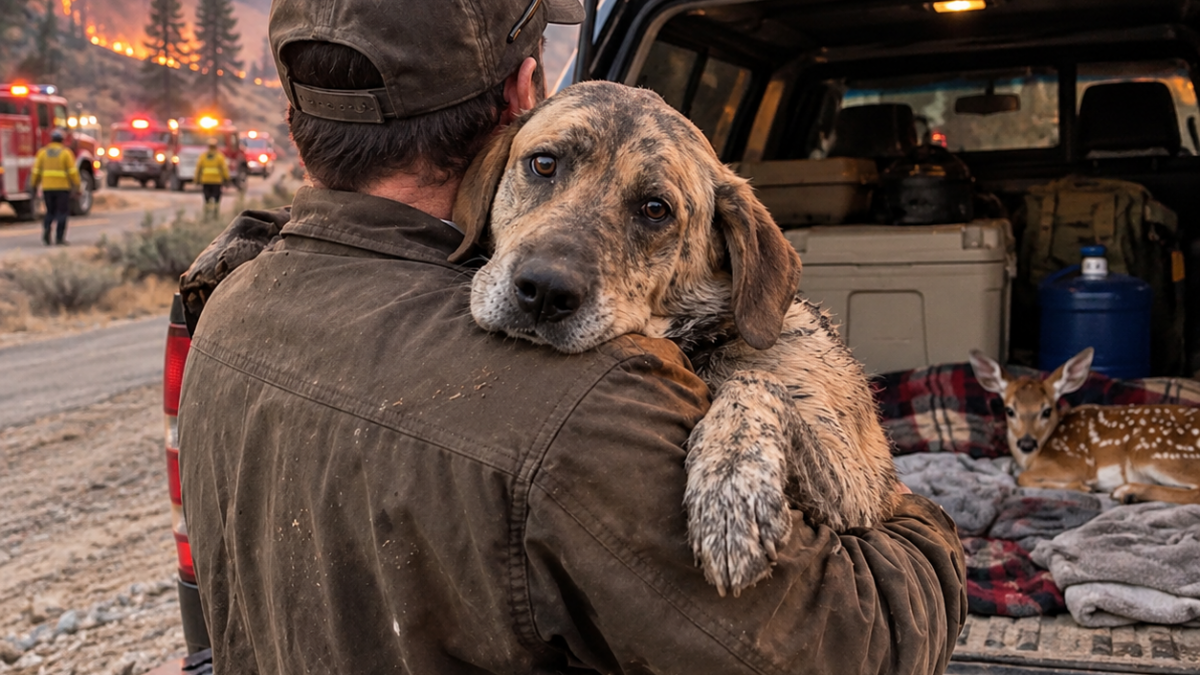
I stayed kneeling beside him.
For a few seconds, neither of us moved.
Around us, people shouted instructions, engines idled, radios crackled, and somewhere farther down the road another fire crew was preparing to go back into the forest.
But the dog seemed to hear none of it.
His paw remained curled around the front of my jacket.
His eyes stayed locked on mine.
Then his head turned.
He looked past me.
Toward the people carrying the fawn.
That was when I understood.
He wasn’t holding on because he needed reassurance that he was safe.
He was waiting to make sure the fawn was safe too.
“Okay,” I whispered. “I get it.”
His ears moved slightly.
I pointed toward the temporary animal-care area.
“They’ve got him.”
The dog looked in that direction again.
Then back at me.
“I’m not going anywhere yet.”
His paw loosened.
I sat beside him on the blanket.
A minute later, Daniel came walking over, his face streaked with soot.
He looked from the dog to me.
“Jack, he really doesn’t want to let you go.”
I gave a tired laugh.
“I noticed.”
Daniel crouched beside us.
The dog watched him carefully.
“How’s the fawn?” I asked.
“Alive. Dehydrated. Smoke exposure. Couple of scrapes. Wildlife team is looking at him now.”
The dog lifted his head as soon as Daniel said something about the fawn, though obviously he couldn’t have understood the words.
Daniel noticed too.
“You seeing that?”
“Yeah.”
“Think he knows?”
“I think he knows more than we give him credit for.”
Daniel studied him for a moment.
“Did you see a collar?”
I ran my fingers gently through the thick fur around the dog’s neck.
Nothing.
“No collar.”
“Tag?”
“No.”
“Maybe he lost it in the fire.”
“Maybe.”
The dog suddenly tried to stand again.
His legs nearly folded under him.
I caught him around the chest.
“Whoa. No. You’re done walking for today.”
He looked toward the fawn.
“I know,” I said. “You want to see him.”
Daniel stood.
“Wait here.”
A few minutes later, two members of the wildlife team brought the fawn closer on a padded carrier.
The dog’s entire expression changed.
Until then, exhaustion had made his face look dull and distant.
The second he saw that small spotted body, his eyes became alert.
He pushed himself upright.
I kept one arm around him.
“Easy.”
The fawn lifted its head.
The dog leaned forward.
Slowly, carefully, he touched his nose to the fawn’s face.
The little deer didn’t recoil.
For several seconds they simply stayed like that.
Nose to nose.
Two exhausted animals covered in ash.
One had no reason to trust a dog.
The other had no reason to risk his life for a deer.
Yet somehow they had come out of the forest together.
The dog gave the fawn one slow lick across the forehead.
Then he settled back onto the blanket.
Daniel looked at me.
“I wish somebody had gotten that on camera.”
“I don’t.”
He glanced at me.
I kept my hand on the dog’s back.
“Some things don’t need a camera.”
Daniel nodded.
“Fair enough.”
One of the wildlife volunteers knelt beside us.
“We’re transporting the fawn to the rehabilitation center. The dog should probably go to the veterinary triage clinic.”
I immediately felt the dog tense beneath my hand.
“I’ll take him.”
She looked at me.
“You know him?”
“No.”
That answer sounded strange even to me.
I had known him less than an hour.
But when I looked down at him, it didn’t feel like the complete truth.
The volunteer smiled slightly.
“Then I guess he knows you.”
We loaded him carefully into my truck.
I had spread several blankets across the passenger side and floor.
The moment I started to close the door, he lifted his head sharply.
“I’m coming around,” I told him.
He watched me through the windshield as I walked to the driver’s side.
Only when I climbed behind the wheel did he settle again.
Daniel leaned through the open window.
“You good?”
“Yeah.”
“They’re taking the fawn in the rescue van. You’ll be right behind them.”
I nodded.
Daniel tapped the side of the truck.
“See you there.”
As we pulled away, I glanced at the dog.
He was still watching the vehicle carrying the fawn.
I reached over and rested my hand on his shoulder.
“You did it.”
His eyes moved toward me.
“You got him out.”
I don’t know what happened before I found those two animals.
Maybe the dog had stumbled across the fawn after the fire started.
Maybe they had been trapped in the same section of woods.
Maybe the fawn’s mother had fled or been separated from it.
Maybe the dog had simply heard something crying and followed the sound.
I would never know.
What I did know was what I had witnessed with my own eyes.
That dog had been close enough to safety to save himself.
Instead, he had turned back for another animal.
Again.
And again.
And again.
Until he nearly had nothing left.
The veterinary clinic operating near the evacuation area was overflowing.
Dogs were barking.
Cats cried from carriers.
Volunteers rushed between tables carrying IV bags, towels, bowls, crates, medications.
The smell was a mixture of disinfectant, smoke, wet fur, and ash.
When I lifted the dog from the truck, his head dropped against my chest.
“You don’t have to walk,” I told him.
I carried him inside.
A veterinarian named Dr. Laura Benton met us.
“What do we have?”
“Male dog. Found inside the burn zone. Smoke exposure. Exhaustion. Possibly dehydrated.”
She touched his gums and listened to his chest.
“He yours?”
“No.”
The dog raised his head at the sound of my voice.
Dr. Benton noticed.
“Could have fooled me.”
“He found me about an hour ago.”
“What happened?”
I told her.
By the time I finished explaining about the fawn, two technicians had stopped what they were doing to listen.
One shook her head.
“He dragged a deer?”
“By the back leg.”
“How far?”
“I don’t know.”
Dr. Benton ran her hands gently over his paws.
“Long enough.”
Several pads were irritated and blistered.
Not catastrophic burns, but enough to tell us he had been crossing hot ground.
She listened to his lungs again.
“I want oxygen for a while. Fluids. We’ll clean the paws. Check for a chip. Probably chest imaging if his breathing doesn’t settle.”
I nodded.
She gave me a look.
“You understand you don’t have to stay.”
The dog lifted his head.
I looked at him.
“Yes, I do.”
A corner of her mouth turned upward.
“Okay.”
They placed him in a quiet treatment area.
The first time a technician tried to lead me away, the dog struggled to stand.
So they brought a chair.
I sat beside him while oxygen flowed near his face and fluids dripped slowly into his leg.
He watched me for nearly twenty minutes.
Eventually his eyelids lowered.
His breathing became slower.
I placed my palm gently against his shoulder.
“You can sleep.”
His eyes closed.
For the first time since I had found him, he stopped fighting to stay awake.
I remained beside him.
Hours passed.
Outside, evening turned the smoke above the parking lot a strange orange-gray.
People came and went.
Every so often someone gave me an update.
No microchip.
No identification.
Male.
Probably three or four years old.
Underweight, although not severely.
No major injuries.
His lungs sounded better after oxygen.
The burns on his paws were painful but superficial.
He was lucky.
Late that evening Daniel walked into the clinic carrying two cups of coffee.
“Thought you might still be here.”
“You guessed right.”
He handed me one.
“How’s our guy?”
“Sleeping.”
“The fawn made it to rehab.”
I looked up immediately.
“How bad?”
“They think he’s going to make it.”
I let out a breath I hadn’t realized I was holding.
Daniel smiled.
“Yeah.”
I looked at the sleeping dog.
“You hear that, buddy?”
One ear twitched.
Daniel pulled up another chair.
For a while we sat without talking.
Then he asked, “What are you going to do if nobody claims him?”
“I haven’t thought that far.”
Daniel gave me a sideways look.
“You’ve been sitting beside a strange dog for five hours.”
“I’m thinking about today.”
“Sure.”
“I am.”
“Jack.”
“What?”
He pointed at my hand.
At some point without realizing it, I had placed it over the dog’s paw.
“Looks pretty far beyond today to me.”
I pulled my hand back.
Daniel laughed.
“You’re annoying.”
“So I’ve been told.”
The clinic staff searched lost-pet reports that night.
Nothing matched him.
The next morning, photos were circulated through local rescue groups and evacuation pages.
No one came forward.
No frantic family called.
No one recognized the sandy-colored dog who had appeared out of a burning forest.
That bothered me more than I expected.
Somewhere, I thought, somebody had to be looking for him.
A dog didn’t just appear out of nowhere.
But every search led nowhere.
When I returned to the clinic the following morning, I had barely opened the treatment-room door before his tail started moving.
Slowly at first.
Then harder.
“Well, good morning to you too.”
He struggled upright.
Dr. Benton had warned me not to let him jump, so I sat on the floor.
He immediately came over and lowered his head onto my lap.
I scratched behind his ears.
“You were waiting?”
His tail thumped once against the floor.
I laughed.
“All right. Maybe you were.”
He smelled a lot better than he had the day before.
Most of the ash had been cleaned from his fur, revealing a warm golden-tan coat with a white patch beneath his chin.
He had brown eyes.
Not unusual eyes.
Not the kind people would describe as striking.
But there was something about the way he looked at you.
He didn’t glance.
He studied.
As if every person had to be understood before he could relax around them.
Dr. Benton walked in carrying a clipboard.
“Somebody looks better.”
“He does.”
“I meant you.”
I looked at her.
She smiled.
“You looked worse than the dog yesterday.”
“Thanks.”
“He ate breakfast.”
“That’s good.”
“Breathing is much better. Paws need treatment for a while, but nothing serious. I’d like another day of observation.”
“Okay.”
She flipped through the paperwork.
“We still need a name for the chart.”
I looked down at him.
Until then everyone had called him “the dog,” “the Lab mix,” or occasionally “your friend.”
He deserved better than that.
“Give me a minute.”
Dr. Benton nodded and left.
I rubbed his ear.
“What do you think?”
He stared at me.
“You dragged a deer through smoke. You nearly cooked your feet. You scared ten years off my life.”
His tail moved.
“And now I’m supposed to name you.”
He lowered his chin farther onto my leg.
I thought about the first moment I had seen him.
Everything behind him had been gray.
Smoke.
Ash.
Burned branches.
Then his shape had emerged from it.
Not dramatically.
Not like something out of a movie.
Just one exhausted animal refusing to stop.
A small piece of life moving through a landscape that seemed determined to swallow everything.
Daniel arrived later that morning.
He stood outside the treatment area.
“Name yet?”
“I think so.”
“What?”
I looked down at the dog.
“Ray.”
Daniel considered it.
“Ray?”
“Like a ray of light.”
He smiled.
“That’s disgustingly sentimental.”
“I can choose something else.”
“No, you can’t.”
He crouched.
“Hey, Ray.”
The dog looked at him.
Daniel nodded.
“Yeah. That works.”
And from that moment on, he had a name.
Ray.
The wildlife rehabilitation center allowed me to check on the fawn through their staff.
I couldn’t visit inside the main enclosure because they wanted to limit human contact, which made perfect sense.
The goal was always to return a wild animal to the wild.
But they sent updates.
The young deer had been dehydrated and exhausted.
There were small abrasions on one leg, probably from being dragged.
Ironically, the thing that had injured the leg a little was also the thing that had saved his life.
He began eating.
Then standing more steadily.
Then moving around the enclosure.
When I told Ray, he would tilt his head as though he understood every word.
“You know your friend is doing better?”
Tail thump.
“He’s eating.”
Tail thump.
“Probably already forgotten you.”
Ray would stare at me.
“Okay. Maybe not.”
The second evening, I received a photograph from the wildlife center.
The fawn was standing.
All four legs under him.
Head raised.
Alert.
I showed the phone to Ray.
“This is because of you.”
He sniffed the screen.
Then tried to lick it.
“That’s not helpful.”
He licked it anyway.
Three days after the fire, Ray was discharged from the clinic.
Technically, he could have gone to an animal shelter while they continued looking for an owner.
I volunteered to foster him.
At least that was the word I used.
Foster.
Temporary.
A few days, maybe a couple of weeks.
Until his family appeared.
Until somebody else adopted him.
Until we figured out what came next.
Dr. Benton looked at me over the paperwork.
“You understand fostering can become permanent.”
“So I’ve heard.”
“Especially when the foster animal already thinks he belongs to you.”
“He doesn’t think that.”
Ray was sitting directly on my foot.
Dr. Benton glanced down.
“Of course not.”
I signed the forms.
The drive home was quiet.
Ray sat beside me, watching trees, houses, cars and fences pass outside the window.
Every time I slowed down, his head turned toward me.
At one red light, I realized he was shaking.
Not badly.
Just enough for me to notice.
I rested my hand on his chest.
“We’re not taking you back.”
The shaking slowly stopped.
My house sat outside town on several acres, far enough away from traffic that nights were usually quiet.
I had a fenced backyard, an old detached garage and a covered porch that faced west.
Nothing fancy.
When I opened the truck door, Ray didn’t jump out.
He looked at me.
“It’s okay.”
Still nothing.
I stepped away.
“You can come down.”
He leaned forward.
Then backed up.
It occurred to me that he might have been moved from place to place before.
Truck.
Clinic.
Treatment room.
Maybe another vehicle before I ever met him.
There was no reason for him to assume this stop was different.
So I sat down on the running board.
“We’ve got time.”
For nearly five minutes, I waited.
Finally Ray put one paw onto the edge.
Then another.
He carefully stepped onto the ground.
His sore paws made him move cautiously.
He followed me toward the house.
At the door, he stopped again.
I opened it wide.
“This is the part where you go inside.”
He sniffed.
Nothing.
I walked in first.
He stayed outside.
I walked back.
“All right.”
I sat on the floor just inside the doorway.
“If you want to stay on the porch, we can stay on the porch.”
Ray watched me.
Then slowly crossed the threshold.
That first step mattered more than I understood at the time.
He explored every room as if conducting an inspection.
Kitchen.
Living room.
Hallway.
Bedroom.
Back to the kitchen.
He sniffed under tables and around doorframes.
Whenever he lost sight of me, he hurried until he found me again.
I put a water bowl near the kitchen.
He drank.
I placed a soft dog bed beside the couch.
He ignored it and lay on the floor beside my feet.
At dinner, I sat at the table.
Ray lay under my chair.
When I stood, he stood.
When I walked toward the sink, he followed.
When I went to the bathroom, he waited outside the door.
“You know,” I said through it, “this arrangement lacks privacy.”
His tail hit the wall.
That night I put his bed beside my own.
“Here.”
He sniffed it.
I turned off the light.
For several minutes I could hear him shifting.
Then everything became quiet.
Sometime after midnight, I woke.
Ray was standing beside the bed.
His nose was only inches from my face.
“Ray?”
He didn’t move.
“What is it?”
I reached down.
The instant my fingers touched his head, he exhaled.
Then he curled up on the floor beside my bed.
I understood.
He had only needed to know I was still there.
Over the next several days, that became a pattern.
If I left one room, Ray followed.
If I walked outside, he followed.
If I went into the garage, he waited in the doorway.
When I showered, he lay on the bathmat.
When I checked the mailbox, he stood behind the front window until I returned.
At first I thought it was devotion.
Then I realized it was fear.
Ray wasn’t following me because he believed I would always be there.
He was following me because he didn’t believe it yet.
There is a difference.
Trust isn’t the same thing as attachment.
Attachment can happen quickly, especially after trauma.
Trust takes time.
So I stopped making a big deal out of it.
I didn’t force him to stay in rooms alone.
I didn’t close doors unnecessarily.
I didn’t push him away when he pressed against my legs.
I simply let him discover, day after day, that I kept coming back.
Sometimes healing is less about what you do than what you refuse to do.
I refused to disappear.
About a week after he came home, someone dropped a metal pan at a hardware store while Ray and I were buying supplies.
The crash echoed through the aisle.
Ray hit the floor.
His entire body flattened.
I knelt beside him immediately.
“You’re okay.”
People turned to look.
His breathing became rapid.
For one terrible second, I could almost see the forest reflected in his eyes.
Noise.
Smoke.
Heat.
Something crashing nearby.
I kept one hand against his chest.
“Look at me.”
His eyes found mine.
“That’s it.”
I didn’t pull him.
I didn’t tell him to get up.
I waited.
Eventually he stood.
We left without buying anything.
In the truck, he pressed his shoulder against me.
“Yeah,” I said quietly. “We’ll try another day.”
That night he slept closer to the bed than usual.
A couple of days later, Daniel stopped by.
Ray greeted him at the door with cautious enthusiasm.
“Well, look at you,” Daniel said.
He crouched and scratched Ray’s neck.
“No ash. No smoke. Living like royalty.”
Ray leaned into him.
Daniel looked around.
“Where’s his bed?”
I pointed.
The brand-new dog bed sat untouched in the corner.
Ray was lying on one of my old sweatshirts.
Daniel laughed.
“You spent eighty dollars on that?”
“Don’t start.”
“He sleeps on your shirt?”
“He likes it.”
“Of course he likes it. Smells like you.”
“I was planning to wash that.”
“No, you weren’t.”
I threw a dish towel at him.
Daniel stayed for dinner.
We talked about the fire.
Several sections had finally been contained.
Crews were still watching hot spots.
Some homes had been lost.
Others had survived by distances that made no sense.
Wildlife officers had recovered injured animals for days.
Daniel told me one of the strangest things about disaster work was how random everything seemed afterward.
One tree blackened to the ground.
The next untouched.
One house destroyed.
The porch next door still holding a glass of water someone had abandoned during evacuation.
“You think about going back?” he asked.
“To the forest?”
“Yeah.”
“Eventually.”
He nodded toward Ray.
“How about him?”
I looked at the dog.
“I don’t know.”
There were certain things I didn’t want to test simply because I could.
Ray didn’t need to prove anything.
He had already proved enough.
Two weeks after the fire, no owner had been found.
We had checked shelters.
Lost-dog databases.
Social media groups.
Veterinary clinics.
Neighborhood pages.
Nothing.
A few people thought they recognized him.
None were correct.
One family drove nearly an hour because they had lost a yellow Lab during the evacuation.
The second they saw Ray, their faces fell.
Their dog had been female.
I watched them walk back toward their car.
Ray watched too.
I wished I could have given them better news.
That night, I sat on the porch with him.
“No one’s coming yet.”
He lay beside my chair.
I looked down.
“Maybe someone still will.”
Saying it hurt more than I expected.
Because part of me wanted somebody to appear.
If Ray had a family who loved him, he deserved to go home.
But another part of me had already begun imagining what the house would feel like if he left.
Quieter.
Emptier.
Wrong.
I hated that thought because it felt selfish.
Ray wasn’t something I had found and could keep simply because I wanted him.
If he belonged to someone else, that mattered.
So I kept searching.
Another week passed.
Then another.
No one came.
Meanwhile, Ray started changing.
The changes were small.
One morning I found him asleep in the living room while I was in the kitchen.
It took me a moment to understand why that mattered.
He had chosen to stay somewhere without me.
Only twenty feet away.
But still.
I stood quietly and watched him sleep.
He didn’t open his eyes.
A few days later, he remained in the yard while I stepped into the garage.
Then one afternoon he discovered a tennis ball.
I had bought several toys, most of which he ignored.
The tennis ball rolled beneath the porch table after I accidentally kicked it.
Ray chased it.
He grabbed it.
Then looked surprised by what he had done.
I laughed.
He stared at me.
“Bring it here.”
He did not bring it.
Instead he ran away with it.
“Oh, so that’s the game?”
His tail shot up.
I chased him.
That was probably what he wanted.
For the next ten minutes, Ray tore around the yard like a dog who had suddenly remembered he was young.
He ran circles around a maple tree.
Skidded through the grass.
Dropped the ball.
Grabbed it again.
At one point he stopped directly in front of me, ball in his mouth, eyes bright.
It was the first time I had seen pure joy on his face.
No fear.
No vigilance.
No checking the door.
No making sure I was still there.
Just joy.
I sat down in the grass.
Ray ran over and dropped the ball beside my knee.
“Again?”
His tail moved furiously.
I threw it.
He chased it.
That became our evening routine.
Every day, a little more of the dog he might have been before the fire appeared.
Or maybe it was the dog he had never had the chance to be.
I couldn’t know.
One afternoon, the wildlife center called.
The fawn was doing exceptionally well.
He had regained strength, was moving normally and was avoiding human contact exactly as they hoped.
If progress continued, release could happen soon.
“Can I be there?” I asked.
There was a pause.
“You helped rescue him, right?”
“Ray did most of it.”
“The dog?”
“Yeah.”
Another pause.
Then the woman laughed softly.
“We’ve heard about Ray.”
Apparently Daniel had told half the county.
She continued, “You can watch from a distance. We want the release to stay quiet.”
“Of course.”
I looked at Ray.
“Can he come?”
“That’s unusual.”
“I know.”
“If he’s leashed and stays well back.”
“He will.”
The morning of the release was clear.
For the first time in weeks, the sky above the forest was completely blue.
Driving back toward the burn area brought a tightness into my chest I hadn’t expected.
Some sections looked almost normal.
Others were black.
The road where I had parked my truck during the fire still showed tire marks from emergency vehicles.
Ray sat upright beside me.
As we got closer, his panting increased.
I slowed the truck.
“You remember?”
He looked out the windshield.
I almost turned around.
There was no reason to force him back into a place associated with terror.
Then his body relaxed.
He leaned forward and sniffed through the cracked window.
I pulled into the designated area.
Wildlife staff had positioned the transport crate near a quieter section bordering healthy woods.
Ray and I stayed almost fifty yards away.
He wore a leash, but I kept it loose.
A technician raised a hand.
I waved.
Then they opened the crate.
Nothing happened.
For several seconds, the fawn remained inside.
Ray froze.
His ears lifted.
I looked at him.
“You see him?”
The fawn stepped forward.
One leg.
Then another.
He stood at the entrance and looked toward the trees.
Ray made a sound deep in his throat.
Not a bark.
Not a whine.
The same kind of low, breathy sound I remembered hearing in the smoke.
The fawn turned his head.
For one extraordinary second, the two animals seemed to look directly at each other.
Maybe they did.
Maybe that was something I needed to believe.
Then the young deer stepped out.
He hesitated.
And ran.
Within seconds, he disappeared between the trees.
Ray took one step forward.
I held my breath.
He didn’t pull the leash.
He didn’t bark.
He simply watched.
The trees became still again.
I crouched beside him.
“He’s okay.”
Ray kept looking.
“He made it.”
Finally he turned toward me.
I scratched his chest.
“You can let him go.”
Ray looked once more toward the forest.
Then he sat beside me.
I don’t know how long we stayed there.
Maybe five minutes.
Maybe twenty.
Eventually Ray leaned against my leg.
I looked down at him.
“His place is out there.”
He raised his eyes.
“And yours?”
I had asked the question lightly.
But once the words left my mouth, they hit me harder than expected.
Because the answer had become obvious.
It had probably been obvious to everyone except me.
I had spent weeks telling myself I was fostering Ray.
I had filled out temporary paperwork.
I had continued checking lost-dog reports.
I had told people I was waiting.
But Ray had already made a decision.
Every night when he lay near my bed.
Every morning when he touched my hand.
Every time he waited for me beside the truck.
Every time he ran back with that ridiculous tennis ball.
He wasn’t waiting for a home.
He thought he had found one.
I sat on the ground beside him.
“Ray.”
His ears lifted.
“I think we need to stop pretending.”
His tail moved once.
“You’re not going anywhere.”
He stared at me.
“You’re staying with me.”
Ray stepped forward.
He placed one paw on my thigh.
Then he leaned his forehead against my chest.
I wrapped both arms around him.
This time there was no smoke.
No shouting.
No engines.
No frightened fawn being carried away.
Only the two of us beside a recovering forest.
“Yeah,” I whispered. “You’re home.”
When we returned to town, I completed the adoption paperwork.
The woman at the shelter desk read the forms and smiled.
“So the foster period didn’t work out?”
“Complete failure.”
She laughed.
“Those are our favorite kinds.”
I signed my name.
Then she pushed the final sheet toward me.
“Congratulations. Ray is officially yours.”
I looked down.
Ray had fallen asleep across my feet.
“I think I might be officially his.”
She smiled.
“That’s usually how it works.”
Life with Ray settled into a rhythm.
Morning walks.
Breakfast.
Truck rides whenever possible.
Evenings in the yard.
Tennis balls everywhere.
He learned that the refrigerator sometimes produced cheese.
He learned that squirrels were faster than they looked.
He learned that the mail carrier was not a threat, although he remained deeply suspicious of the vacuum cleaner.
He learned how to sleep upside down on the couch.
He learned which cabinet contained treats.
And, slowly, he learned that doors closing didn’t always mean someone was leaving forever.
The first time I went to the grocery store without him, I worried the entire drive.
I had left him in the living room with a chew toy and a camera so I could check on him.
For the first five minutes, he stood at the front door.
Then he walked to the window.
Then back to the door.
I nearly turned the truck around.
But after about fifteen minutes, Ray lay down.
When I came home, he met me at the door with so much enthusiasm that I nearly dropped the groceries.
“I was gone forty minutes.”
He jumped against me.
“Forty.”
His tail hammered the wall.
“You survived.”
He licked my chin.
“All right. I missed you too.”
After that, leaving became easier.
For both of us.
One rainy afternoon, a thunderstorm rolled through.
The first thunderclap made Ray run from the living room.
I found him squeezed between my bed and the wall.
I sat on the floor.
“Want company?”
He crawled toward me.
I leaned back against the bed.
Another crack of thunder shook the windows.
Ray pressed into my side.
I rubbed his chest.
“You know, I’ve heard worse.”
His ears moved.
“So have you.”
We stayed there until the storm passed.
Months went by.
His paws healed completely.
His coat became thicker and brighter.
He gained weight.
The constant tension around his eyes disappeared.
People who met him for the first time saw a happy dog.
Only those of us who had known him in the beginning noticed what had changed.
One evening Daniel came over for dinner.
Ray met him at the driveway carrying his tennis ball.
“Look at this guy,” Daniel said.
Ray shoved the ball against his knee.
“You want me to throw it?”
Ray stepped backward.
Daniel tossed it.
Ray exploded across the yard.
Daniel watched him go.
“Hard to believe that’s the same dog.”
“I think this is the dog he always was.”
Ray returned.
Daniel threw again.
After a while we sat on the porch.
The sun was dropping behind the trees.
Daniel drank from a bottle of water.
“You ever figure out where he came from?”
“No.”
“Nothing?”
“Nothing.”
“No previous owner?”
“No.”
“Strange.”
“Sometimes I still wonder.”
Daniel looked toward the yard.
Ray was lying in the grass with his ball between his paws.
“Maybe you’re never supposed to know.”
“That sounds like something people say when they’ve given up looking for answers.”
“Maybe.”
He smiled.
“Still true sometimes.”
I looked at Ray.
I had imagined his past a hundred different ways.
Maybe he had belonged to a family who escaped the fire and couldn’t find him.
Maybe he had lived loose near the woods.
Maybe someone had abandoned him before the disaster.
Maybe he had been surviving alone longer than anyone realized.
None of those possibilities changed who he was now.
A dog can’t explain the years before you meet.
All you can do is pay attention to the things they fear, the things they love and the things they slowly learn to trust.
Ray had told me his story that way.
In the way he panicked when he couldn’t find me.
In the way sudden crashes made him flatten himself against the ground.
In the way he guarded injured animals.
In the way he checked every doorway.
And eventually, in the way he stopped checking.
One morning I woke and realized Ray wasn’t beside the bed.
For a split second, panic shot through me.
“Ray?”
Nothing.
I walked into the hallway.
No dog.
Living room.
Empty.
Back door.
Closed.
Then I looked through the kitchen window.
Ray was stretched out in the middle of the backyard.
Alone.
Sleeping in a patch of sunlight.
I opened the door quietly.
He lifted his head.
His tail thumped once.
Then he put his head back down.
I stood there smiling like an idiot.
That moment meant something.
Ray no longer needed to know exactly where I was every second.
He knew I was somewhere nearby.
He believed I would still be there when he woke.
That was trust.
Nearly six months after the fire, county officials reopened several hiking areas near the forest.
New green growth had already begun pushing through some of the burned sections.
I thought about returning with Ray.
For several days, I went back and forth.
Maybe it would upset him.
Maybe it would be good for him.
Ultimately, I decided to drive there and let Ray decide.
If he showed fear, we would leave.
The morning we went back was cool and bright.
Ray rode beside me with the window cracked.
When I turned onto the forest road, he became alert.
I watched him closely.
His nose worked constantly.
But he didn’t tremble.
At the trailhead, I opened the door.
Ray jumped down.
He sniffed the ground.
Then looked at me.
“You sure?”
He started toward the trail.
I smiled.
“Guess so.”
We walked slowly.
The forest was different.
Some trunks remained black and bare.
Others had survived.
Young plants covered patches that months before had been nothing but ash.
Birds had returned.
I heard insects.
A woodpecker hammered somewhere in the distance.
Life hadn’t erased what happened.
It had simply begun growing around it.
Ray stayed close.
Sometimes he walked ahead.
Then he would stop and look back.
“I’m coming.”
He’d continue.
Eventually we reached a clearing.
Ray stopped so suddenly that I nearly walked into him.
“What?”
His body was rigid.
But not afraid.
His ears pointed forward.
I followed his gaze.
Between the trees stood several deer.
Three adults.
And one younger deer.
The smaller one was bigger than the fawn we had rescued, of course.
Months had passed.
Its spots were mostly gone.
It stood slightly behind one of the others.
Ray stared.
The deer stared back.
I couldn’t tell you whether it was the same animal.
No tag.
No marker.
Nothing that could confirm it.
Part of me wanted to believe.
Part of me knew better than to turn coincidence into certainty.
So I didn’t say, “That’s him.”
I only whispered, “Look, Ray.”
Ray remained still.
One of the deer moved deeper into the trees.
The others followed.
The younger animal lingered.
For perhaps two seconds, it looked in our direction.
Then it disappeared after the group.
Ray watched the empty space.
I waited.
He could have pulled.
He could have chased.
He didn’t.
Eventually he turned around.
And walked back to me.
I crouched.
Ray pressed his head against my shoulder.
I closed my eyes.
“No chasing deer, huh?”
His tail moved.
“Good decision.”
We stayed in the clearing for a while.
I thought about the day we met.
The smoke had been so thick that I couldn’t see the sky.
Ray had appeared like a shadow.
Head down.
Legs shaking.
Dragging an animal that wasn’t his responsibility.
That was the part I kept returning to.
Responsibility.
Nobody had told Ray to save that fawn.
There was no reward waiting for him.
No person cheering.
No camera.
No reason that made sense in the way humans usually measure things.
He simply found another living creature that couldn’t get out alone.
And decided not to leave it.
People use the word hero too easily.
We apply it to grand gestures and dramatic moments.
But Ray never knew anyone was watching.
That mattered to me.
Courage meant something different after I met him.
Sometimes courage was running toward danger.
Sometimes it was standing your ground.
Sometimes it was surviving.
And sometimes it was nothing more complicated than looking at someone weaker than yourself and deciding:
I’m not leaving you here.
We started walking toward the truck.
Halfway back, Ray found a stick.
Not an impressive stick.
Barely more than a branch.
He carried it proudly.
“You dragged a deer out of a wildfire and now this is your greatest treasure?”
He trotted ahead.
“I’m serious. We have better sticks at home.”
He ignored me.
At the parking area, he attempted to bring the branch into my truck.
“No.”
He looked at me.
“Absolutely not.”
He climbed in with the stick.
“Ray.”
He lay down.
The branch stretched across the entire passenger seat.
“You’re ridiculous.”
His tail thumped.
I broke the stick in half and let him keep part of it.
Compromise.
The drive home took about forty minutes.
Ray eventually fell asleep against the door.
I watched the road.
For the first time since the fire, the memory of that day didn’t feel entirely heavy.
I still remembered the fear.
The smoke.
The sounds.
Animals being carried from the forest.
But now another image came first.
Not Ray dragging the fawn.
Not the flames.
Not even the moment he clung to me beside the truck.
The image that came first was Ray asleep in my yard.
Safe enough to close his eyes when I wasn’t beside him.
That felt like the real ending.
Or at least I thought it was.
Because the truth is, animals rarely understand the stories we tell about them.
Ray didn’t know people thought what he had done was extraordinary.
He didn’t know Daniel called him “the wildfire dog.”
He didn’t understand why strangers sometimes recognized him from rescue volunteers’ stories and wanted to pet him.
He only understood simple things.
Breakfast.
Walks.
My truck.
His tennis ball.
A safe bed.
My hand resting on his head.
Being together.
And maybe that simplicity was exactly why I loved him.
One year after the fire, Daniel and several rescue volunteers organized a small gathering near the restored staging area.
Nothing elaborate.
Just the people who had worked those first chaotic days coming together.
I brought Ray.
The moment we arrived, Daniel shouted, “There he is!”
Ray’s tail exploded into motion.
He ran toward him.
Daniel knelt and wrapped his arms around Ray.
“You remember me?”
Ray covered his face with kisses.
“I’ll take that as a yes.”
Several people came over.
Some had been there the day we emerged from the forest.
One woman stared at Ray for a long moment.
“I remember carrying that fawn away.”
I recognized her.
“You were on the wildlife team.”
She nodded.
“He kept trying to follow us.”
“Yeah.”
“I remember thinking he was going to collapse.”
“He almost did.”
She crouched and rubbed Ray’s chest.
“You stubborn thing.”
Ray leaned into her hand.
She looked up at me.
“How’s he been?”
“Perfect.”
I paused.
“Mostly.”
Ray stole a sandwich from an unattended plate three minutes later.
The woman laughed.
“Definitely recovered.”
Later that afternoon, Daniel and I stood near the place where my truck had been parked a year earlier.
The forest beyond the road was green again.
Not the same.
But green.
Daniel folded his arms.
“Funny, isn’t it?”
“What?”
“One year.”
“Doesn’t feel like it.”
He nodded toward Ray, who was rolling on his back in the grass.
“You showed up with blankets and water because you figured you might help for a few hours.”
“Yeah.”
“You went home with a dog.”
“Eventually.”
“And the dog went home with you.”
I smiled.
“That too.”
Daniel became quiet.
Then he said, “Do you remember what you told him when we brought the fawn over?”
“No.”
“You said, ‘You did it.’”
I looked toward Ray.
“I probably did.”
“I remember because you sounded like you were talking to a person.”
“I talk to him all the time now.”
“Trust me. Everyone knows.”
I laughed.
Daniel looked toward the woods.
“You think that fawn is still out there?”
“I hope so.”
“Think Ray would recognize him?”
“I have no idea.”
“You?”
I thought about the young deer we had seen months earlier.
“Maybe I don’t need to.”
Daniel nodded.
We watched Ray get up and shake grass from his coat.
Then he looked around.
He spotted me.
Without hesitation, he ran straight over.
Not frantically.
Not because he feared I would disappear.
He simply wanted to be where I was.
He stopped beside me.
I rested my hand on his head.
“You ready?”
His tail moved.
On the drive home, I thought about how differently his story might have ended.
If the wind had shifted sooner.
If the rescue team hadn’t searched that section.
If I hadn’t heard his breathing.
If he had collapsed ten yards farther inside the smoke.
If the fawn had been too heavy.
If Ray had finally decided he had done enough and saved himself.
But lives are often changed by distances that small.
Ten yards.
One turn.
One sound.
One choice.
I found Ray because I stopped and listened.
Ray survived because he refused to stop pulling.
The fawn survived because a dog made a choice no one asked him to make.
And I gained a family member because after everything was over, that dog put his paws on my shoulders and refused to let me walk away.
That evening, Ray followed me into the backyard.
The sun was dropping low.
He found his tennis ball near the porch and brought it to me.
“You still have energy?”
He dropped it at my feet.
I threw it.
He ran.
He returned.
I threw it again.
We kept going until he finally collapsed in the grass beside me.
I sat down.
Ray rolled onto his side and rested his head across my leg.
For a while I listened to the evening sounds.
Crickets.
Birds.
A truck moving along the distant road.
Leaves rustling.
No sirens.
No fire.
No one calling for help.
I scratched behind Ray’s ear.
“You know what you did that day?”
He opened one eye.
“Probably not.”
His eye closed.
“You saved him.”
His breathing slowed.
“And maybe nobody ever told you that was your job.”
I looked toward the tree line behind my property.
“But you did it anyway.”
Ray shifted closer.
I smiled.
“You’re not a hero because people say you are.”
His ear moved beneath my fingers.
“You’re just a dog who refused to leave someone behind.”
I sat there a little longer.
Then I added, “Maybe that’s better.”
Another year passed.
Ray stopped sleeping beside my bed every night.
Sometimes he slept on the couch.
Sometimes on the rug near the kitchen.
During warm months, he occasionally chose his bed near the open back door.
The first few times he did that, I noticed.
Eventually I stopped noticing.
That was another kind of healing.
Something once remarkable became ordinary.
He no longer needed constant proof that he belonged.
He simply belonged.
When friends visited, Ray greeted them like they had arrived exclusively to see him.
When Daniel pulled into the driveway, Ray would recognize his truck before it stopped.
When Dr. Benton saw him for his yearly exam, she stared at the muscular, healthy dog standing on her scale.
“Seventy-one pounds.”
“Is that bad?”
“Not yet.”
Ray looked offended.
She rubbed his ears.
“You’ve come a long way, handsome.”
I looked at the white scar on one paw.
The only obvious physical reminder of the fire.
“Yeah.”
Dr. Benton checked his lungs.
“Perfect.”
His heart.
“Perfect.”
Eyes.
Ears.
Joints.
Everything looked good.
At the end, she gave him a treat.
Ray swallowed it without chewing.
“Still no manners,” she said.
“I’ve done my best.”
“I doubt that.”
On the way out, I passed the treatment room where I had sat beside him during those first hours.
For a moment I stopped.
Ray stopped too.
I remembered the IV line.
The oxygen.
His red eyes fighting sleep because he didn’t trust me enough to close them.
I looked at the dog beside me now.
“Come on.”
We walked outside.
He jumped into the truck before I could open the door fully.
By then, going home was something he expected.
That still meant everything to me.
Years later, people would sometimes ask why I kept the name Ray.
They assumed it was because of the sunshine-colored coat.
I would tell them the truth.
He had walked out of one of the darkest places I had ever seen and somehow brought something bright with him.
Not because he was fearless.
Ray was never fearless.
I saw him afraid plenty of times.
Fireworks terrified him.
Thunder bothered him.
Metal crashes could still make him jump.
For a long time, unfamiliar smoke sent him straight to my side.
Courage has nothing to do with having no fear.
I learned that from him too.
He had been terrified in that forest.
I knew because I had seen his eyes.
He saved the fawn anyway.
One fall afternoon, Ray and I returned to that forest again.
By then much of the burn scar had softened beneath new growth.
Young trees stood where blackened trunks once dominated the hillside.
We followed the same trail we had walked before.
Ray had slowed a little with age, though he still believed he was capable of chasing every squirrel in North America.
At the clearing, he stopped.
I waited beside him.
No deer appeared.
That was fine.
I had stopped looking for signs.
We didn’t need a reunion.
The fawn’s successful disappearance into the forest had always been the goal.
Wild animals weren’t supposed to stay in our lives just because we had helped them.
The best possible ending for that little deer was one in which he never needed us again.
Ray sat.
I sat beside him.
For a long time we watched the trees.
“I used to wonder whether you recognized him that day.”
Ray sniffed the air.
“I think I wanted some movie ending where he came running out of the woods and you two had this big reunion.”
Ray scratched his ear.
“Would’ve been ridiculous.”
He looked at me.
“Yeah, you’re right.”
I leaned back against a tree.
“The real ending was better.”
The fawn had gone free.
Ray had come home.
Nothing more was needed.
On our way back, Ray stopped near a shallow creek.
He drank.
Then he stood in the water until his paws were muddy.
“You’re getting in my truck like that?”
He looked at me.
“Absolutely not.”
He walked toward the truck anyway.
Some things never changed.
That night, after dinner, Ray fell asleep beside the fireplace.
I sat across from him with a book I wasn’t really reading.
His legs twitched occasionally while he dreamed.
I wondered what dogs dreamed about.
Food, probably.
Running.
Smells.
Maybe people.
Maybe other animals.
Maybe somewhere inside Ray’s dreams there was still a young deer moving through smoke.
I hoped not.
I hoped whatever remained of that day inside him had softened the same way the forest had.
Scars covered by new growth.
Fear replaced by familiar rooms.
Smoke replaced by sunlight.
The need to survive replaced by the expectation of tomorrow.
Ray opened his eyes.
He looked at me.
I smiled.
“I’m right here.”
He closed them again.
Several minutes later, I realized what I had said.
Those were almost the same words I had repeated during his first night in my house.
Back then, I had said them because Ray needed reassurance.
Now I said them out of habit.
Maybe I needed them too.
The truth was that rescuing Ray had changed me in ways I hadn’t expected.
Before him, home had been a place.
A building.
My kitchen.
My porch.
My truck in the driveway.
My things where I left them.
After Ray, home became something that moved.
It followed me through rooms.
Waited beside the door.
Sat in the passenger seat.
Dropped wet tennis balls into my lap.
Snored loudly enough to interrupt television.
Stole half a sandwich if I looked away for three seconds.
Home developed muddy paws.
And brown eyes.
And a white patch beneath its chin.
That was what I meant years later when I told Daniel something he never let me forget.
We were standing beside the truck one evening after a volunteer rescue event.
Ray had fallen asleep in the back seat.
Daniel looked at him.
“You know, Jack, you pulled that dog out of a wildfire.”
I shook my head.
“Not exactly.”
“What do you mean?”
“I helped him walk out.”
“Same difference.”
“No.”
I looked through the window at Ray.
“He was already coming out.”
Daniel shrugged.
“Fine. You helped him.”
I smiled.
“The strange part is, I used to think that meant I rescued him.”
“And now?”
I opened the driver’s door.
“Now I’m not so sure which one of us got rescued.”
Daniel groaned.
“That’s terrible.”
“What?”
“That line.”
“It’s true.”
“It sounds like something printed on a coffee mug.”
“Still true.”
He laughed.
I climbed into the truck.
Ray woke immediately.
His head appeared between the seats.
“Ready to go home?”
His tail hit the upholstery.
Daniel leaned through the window.
“Take care of your dramatic owner, Ray.”
Ray licked his face.
“Traitor,” I said.
We drove away.
Years after the wildfire, there was one final moment I still think about more than all the others.
It wasn’t dramatic.
That is probably why it matters.
I had been working in the garage on a Saturday morning.
The weather was mild, and the house door stood open.
Ray was somewhere outside.
I assumed he was sleeping in the grass.
After a while, I realized I hadn’t seen him.
“Ray?”
No response.
I stepped out.
Nothing near the porch.
Nothing by the fence.
For a second, that old instinctive fear returned.
Then I saw him.
He was at the far end of the yard near the tree line.
Standing completely still.
I walked toward him.
“What are you looking at?”
Then I saw it.
A young deer stood beyond the fence.
Not a fawn.
Not the same deer from years before.
Just another deer passing through.
Ray watched quietly.
The deer watched him.
Neither moved.
I stopped beside Ray.
His tail gave one slow sweep.
The deer eventually turned and walked into the woods.
Ray didn’t follow.
He looked up at me.
I scratched his head.
“You always did have a thing for deer.”
We walked back to the house together.
At the porch, I opened the door.
Ray entered first.
Years before, on his first day with me, he had stood outside that doorway afraid to cross the threshold.
Now he didn’t even slow down.
He walked through as if there had never been any question about whether he belonged on the other side.
That was when I remembered the moment after the wildfire.
Ray had clung to me beside my truck, his paws wrapped around my jacket.
At the time, I believed he was asking me not to leave.
Maybe he was.
But looking back, I think there was more to it.
Ray had spent every bit of strength he possessed trying to make sure another living creature reached safety.
Only after the fawn had been carried away did he finally allow himself to need someone.
That stayed with me.
Sometimes the strongest creatures are the ones who spend so much time protecting everyone else that nobody notices when they need protection themselves.
Ray had carried that fawn as far as he could.
Then, when his strength was gone, he leaned against me.
And I was lucky enough to be standing there.
That evening, we sat on the porch.
Ray rested beside my chair.
The sky beyond the yard turned orange and gold.
I looked toward the distant line of trees.
Somewhere beyond them stretched the same forest that had once disappeared behind smoke.
I thought about the fawn.
I hoped he had lived a long life.
I hoped he had never again needed a dog to drag him toward safety.
I hoped he had grown strong, followed other deer into valleys and meadows, and forgotten humans completely.
That would have been perfect.
Then I looked at Ray.
He was older now.
A little gray around the muzzle.
Still stubborn.
Still obsessed with tennis balls.
Still convinced that every package delivered to my house required personal inspection.
I reached down.
He lifted his head.
“You know something?”
Ray looked at me.
“That day, I thought two animals came out of the forest.”
His ears moved.
“One went back to his world.”
I rubbed the white patch beneath his chin.
“And the other became part of mine.”
Ray shifted closer.
“But I had it wrong.”
He rested his head against my leg.
“You didn’t just become part of my home.”
I looked through the open doorway behind us.
At his water bowl near the kitchen.
His leash hanging beside my coat.
His toys under the table.
The old sweatshirt he had refused to give up.
His bed beside the fireplace.
Every room held some evidence that Ray existed there.
I looked down again.
“You became home.”
He couldn’t understand the sentence.
At least not the words.
But his tail moved slowly across the porch boards.
Maybe words weren’t necessary.
The important things between us had never required many.
In the forest, I had said, “Come on.”
Beside the truck, I had said, “You’re safe.”
At the clinic, “You can sleep.”
At my doorway, “You can come in.”
At the fawn’s release, “You can let him go.”
And when I finally stopped pretending he was temporary:
“You’re staying with me.”
Those were enough.
The sun disappeared.
I stood and opened the screen door.
“Come on, Ray.”
He rose slowly and followed me.
Halfway through the doorway, he stopped and looked back toward the darkening yard.
For a moment I remembered the frightened dog who had once watched everything behind him.
Every road.
Every door.
Every person walking away.
Then Ray turned.
He stepped inside.
This time he didn’t look back.
I closed the door behind us.
And I understood something I had been learning since the day I saw him through the smoke.
Sometimes you rescue an animal and give him a home.
Sometimes you rescue an animal and eventually realize he has changed yours.
And once in a lifetime, if you are very lucky, you meet a creature who walked through fire for someone else—and somehow, without ever meaning to, becomes the safest place in your own life.








