The first thing I noticed wasn’t the five fresh stumps behind my fence—it was the sudden strip of sky where seventy years of black walnut shade had been the morning before.
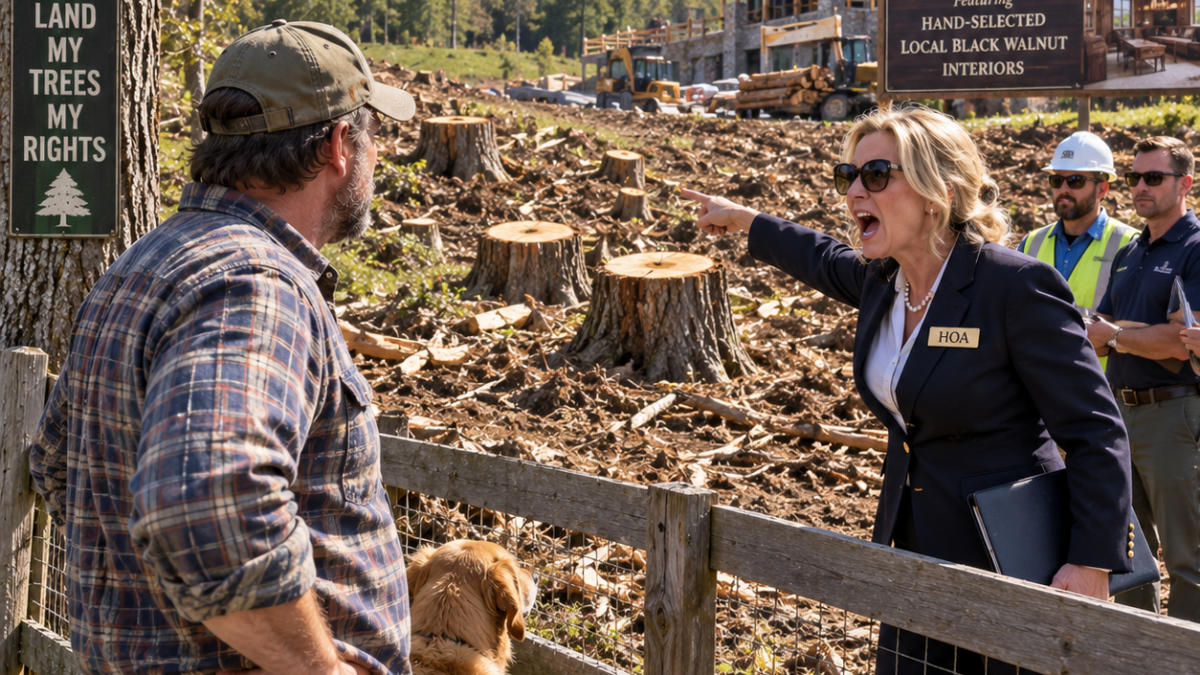
I didn’t walk toward the hallway.
That mattered.
The old version of me—the man who ran Marlo Custom Wood for almost three decades and once threw a warped hotel door back onto a contractor’s loading dock because he tried to blame my shop for storing it wrong—might have.
But I was sixty-four now.
My hands went numb if I held a drill too long.
My wife, Ellen, had been gone six years.
And I had learned that anger made people move faster than evidence.
So I stayed beside the walnut wall.
Garrett Bellamy folded his arms.
“You can’t identify lumber from a scar in an old photograph.”
“No,” I said. “Not by itself.”
Vivian exhaled as though I had finally become reasonable.
Then I added, “That’s why I want the source records.”
Her face tightened again.
Mrs. Daly from Juniper Bend had stopped near the fireplace.
She was holding the glossy lodge preview packet against her chest.
“Is he saying these panels came from his trees?”
Vivian turned toward her.
“Mr. Marlo is making a deeply personal interpretation of a design feature.”
I kept my eyes on the wall.
“No. I’m saying five mature black walnuts were cut from my property, hauled toward this construction site, and within days your lodge began advertising hand-selected local black walnut.”
A few more residents went quiet.
Garrett said, “Walnut is common throughout the region.”
“Thirty-inch black walnut logs aren’t common.”
“Still doesn’t prove this is yours.”
“You’re right.”
That seemed to frustrate him more than an accusation would have.
I opened my folder.
“Then preserve the source records.”
Vivian stared at me.
“Preserve?”
“The panels. The trim. The offcuts. Mill tickets. Intake records. Delivery slips. Layout sheets. Anything tied to this walnut.”
Garrett gave a short laugh.
“You’re issuing preservation instructions now?”
“I’m telling you what I’m asking for before anybody decides to sand away a mark or throw scrap in a dumpster.”
Vivian stepped closer.
“You are not authorized to interfere with lodge operations.”
“I’m not interfering.”
I pointed toward the wall.
“I’m identifying disputed material.”
That phrase landed differently.
Not stolen wood.
Not my trees on your wall.
Disputed material.
Clean.
Specific.
Harder to turn into a story about an emotional homeowner.
One of Garrett’s installers looked toward the hallway again.
I saw it.
So did Garrett.
He snapped, “Tyler, go check the back trim inventory.”
The worker disappeared.
Vivian moved between me and the hall.
“Enough.”
I took three photographs.
One wide photograph of the full walnut wall.
One closer photograph of the crescent grain and knot pattern.
And one with my old winter photograph held in the foreground while the wall remained visible behind it.
Vivian’s voice sharpened.
“Do not post those.”
“I haven’t posted anything.”
“Then keep it that way.”
“Why?”
“Because you are creating confusion before the association has completed its review.”
I looked at her.
“My trees have been gone four days.”
“We’re aware.”
“Your records request still says pending.”
“We have vendors to coordinate.”
“Funny. They coordinated fast enough to get the trees cut.”
She stared at me.
I put the photograph back into its sleeve.
Then I left.
Not because I was done.
Because I had seen enough to know the next answer wouldn’t come from Vivian.
It would come from the chain.
Wood has a chain.
People think logs become finished walls by magic because all they see are trees and then paneling.
But somebody cuts the tree.
Somebody loads the log.
Somebody transports it.
Somebody receives it.
Somebody measures the diameter.
Somebody scales the footage.
Somebody mills it.
Somebody dries it or verifies moisture.
Somebody marks the boards.
Somebody sells them.
Somebody lays them out.
Somebody installs them.
Every step leaves a mark.
Sometimes on paper.
Sometimes in the wood.
Back home, I spread everything across the kitchen table.
Five stump photographs.
Marcy Keller’s preliminary arborist memo.
The HOA site coordination sheet.
The glossy Ridge View Lodge packet.
The photo of the walnut sample.
The pictures from inside the lodge.
And the old ice-storm photograph.
My kitchen hadn’t looked that crowded since Ellen used to host Thanksgiving.
She had hated my habit of covering tables with shop drawings.
“You own a workshop,” she would say. “Why are your cabinet elevations beside the mashed potatoes?”
I could almost hear her.
For a second, the room hurt.
Then my phone rang.
Otto Dayne.
I answered.
“You see the wall?”
“I saw enough.”
“Don’t say that in writing.”
I smiled despite myself.
“I’m not writing anything yet.”
“Good.”
Otto had managed Branson Mill’s log yard back when my shop was buying walnut by the truckload.
He was seventy-one now, retired, and offended by almost every modern lumber trend.
I had called him the day after the trees disappeared.
He was the one who quietly told me Northbend Sawmill had taken in a walnut load marked HAWTHORNE RIDGE CLEARING.
“Got a name for you,” he said.
“Who?”
“Laya Brandt. Office clerk at Northbend.”
“Will she talk?”
“She won’t break rules.”
“That wasn’t my question.”
“She’ll tell you which rules matter.”
That was Otto.
I called Northbend.
A saw screamed somewhere behind the office when Laya answered.
“Northbend Sawmill.”
“My name is Evan Marlo. I’m trying to identify an intake record for black walnut received from Hawthorne Ridge Clearing.”
A pause.
“I can’t release customer records over the phone.”
“I understand.”
That softened her tone slightly.
“I’m the owner of the property where the trees were cut.”
Longer pause.
“I’m sorry, Mr. Marlo, but I still can’t release the ticket.”
“I’m not asking you to.”
I put a pencil to paper.
“If I were making a lawful records request, what would I ask for?”
The saw stopped behind her.
I heard paper move.
“Scale ticket.”
I wrote it.
“Intake source line.”
Wrote that too.
“Outbound job reference.”
“Does the intake ticket identify who delivered the logs?”
“Sometimes.”
“Does it identify the site?”
“Sometimes.”
“What if it was custom mill work?”
“Then the outbound job may reference the customer’s package code.”
I looked at the building permit submittal I had downloaded earlier that afternoon.
Bellamy Custom Millwork.
Main Room Walnut Cladding.
Layout Package B-17.
“Would something like B-17 be an outbound reference?”
Silence.
“I can’t confirm a specific ticket.”
“I understand.”
Then Laya said something I wrote down word for word.
“If an attorney becomes involved, have them request preservation before month-end consolidation.”
I stopped writing.
“Why?”
“I didn’t say anything specific is scheduled to disappear.”
“I know.”
“Records get reorganized. That’s all.”
“Thank you.”
I hung up.
Then I logged into the Hawthorne Ridge portal.
Supplemental records request.
Northbend scale ticket.
Intake source.
Outbound job reference.
Bellamy package B-17.
Any mill documentation connected to black walnut received from Hawthorne Ridge Clearing during the forty-eight hours after my trees were cut.
At 4:18 that afternoon, management answered my original request.
Not with documents.
With a delay notice.
DUE TO THE BREADTH OF THE REQUEST AND INVOLVEMENT OF VENDOR-PROTECTED PROJECT MATERIALS, ADDITIONAL REVIEW IS REQUIRED.
I read vendor-protected twice.
Then I printed it.
My trees had somehow become protected information after they stopped being trees.
The next useful record came from the county building portal.
Ridge View Lodge was a permitted structure.
Contractors had uploaded finish documentation for inspection.
Most of it meant nothing to me.
Fire ratings.
Adhesive specifications.
Fastener schedules.
Then I found Bellamy’s interior submittal.
MAIN ROOM WALNUT WALL CLADDING.
Material:
LOCALLY SOURCED BLACK WALNUT.
Book-matched vertical sequence.
Custom mill to Bellamy layout package B-17.
B-17 again.
I circled it.
At 7:03 that evening, the HOA portal chimed.
One attachment.
PARTIAL VENDOR INDEX.
Most lines were heavily redacted.
Black rectangles.
Vendor names.
Invoices.
Material categories.
Then near the bottom, one line remained exposed.
BELLAMY CUSTOM MILLWORK — LODGE INTERIOR CLADDING — SOURCE MATERIAL: ASSOCIATION CLEARED WALNUT — NB JOB REF B-17.
I sat perfectly still.
NB.
Northbend.
B-17.
Association cleared walnut.
No one had yet written my name.
No one had written private trees.
But the chain was tightening.
I downloaded the file.
Took a screenshot.
Printed two copies.
Then another email arrived.
From Vivian.
Mr. Marlo,
Your recent conduct at the Ridge View Lodge preview has caused concern. Continued vendor contact, unsupported allegations, or interference with association project operations may be considered a violation of community conduct standards.
I read it.
Then looked at the vendor index.
The first document they couldn’t explain had been followed by the first threat telling me to stop looking.
That was enough.
The next morning, I called Renata Cross.
Renata had represented my shop years earlier after a hotel contractor installed nineteen custom walnut doors, damaged six, then tried to reject all twenty because “finish inconsistency” sounded cheaper than admitting his crew stored them beside an open loading dock.
Renata had won that argument without raising her voice once.
She answered.
“Evan?”
“You still doing property and construction work?”
“What happened?”
“Five black walnut trees disappeared from my land.”
“That sounds simple.”
“They’re probably on an HOA lodge wall.”
“That sounds less simple.”
I sent her everything.
Forty minutes later, she called back.
“Do you understand what you have?”
“A wall that looks like my trees.”
“No.”
I waited.
“You have a chain-of-source problem attached to disputed timber.”
I leaned back.
“That’s why I called you.”
“Good.”
She paused.
“And stop calling vendors yourself.”
“I already talked to the mill clerk.”
“Did you pressure her?”
“No.”
“Did she give you confidential records?”
“No.”
“What did she give you?”
“The names of the records we should ask for.”
“That’s useful.”
By noon, Renata had sent preservation letters to four places.
Hawthorne Ridge.
Bellamy Custom Millwork.
The project insurer.
And the lender listed on the lodge permit.
She copied Ridgeline Site Services, the clearing contractor.
The subject line was plain.
PRESERVATION NOTICE AND TIMBER TRESPASS DEMAND — BLACK WALNUT MATERIAL INSTALLED AT RIDGE VIEW LODGE.
Renata read one paragraph to me before sending.
“Pending inspection and resolution of ownership and source documentation, you are directed to preserve all black walnut wall panels, trim boards, samples, offcuts, invoices, scale tickets, intake records, delivery slips, layout schedules, photographs, internal communications, vendor documents, and notes relating to walnut removed from Hawthorne Ridge South Edge or common edge clearing.”
I looked at the photograph of my largest tree.
“Will that stop them?”
“It should stop anyone smart.”
“And anyone else?”
“That’s why we copy the insurer.”
At 2:11, my portal request changed from PENDING to ADMINISTRATIVE REVIEW.
At 2:34, Hawthorne Ridge announced that the official ribbon preview would be moved forward four days.
Friday evening.
Vivian called it “an exciting acceleration made possible by strong vendor coordination.”
I stared at those words.
“They’re opening early.”
Renata was quiet.
“Maybe.”
“What do you mean maybe?”
“Do not go over there.”
“I wasn’t planning to.”
“Good.”
At 4:19, a Bellamy van pulled into the lodge site.
Before the trees were cut, I couldn’t see the service entrance from my kitchen.
Now I could.
Two men unloaded blue tape.
A sprayer case.
Sandpaper boxes.
Plastic buckets.
Drop cloth.
I photographed them from my own property.
Wide first.
Then closer.
Timestamp visible.
I called Renata.
“They’ve got finish supplies.”
“Do not cross the trail.”
“I know.”
“Send me the photos.”
Ten minutes later, every recipient of the preservation letter got another notice.
Any sanding, staining, sealing, removal, replacement, trimming, or alteration of the disputed walnut after receipt of preservation notice could constitute spoliation of evidence.
At 5:06, Garrett Bellamy emailed me directly.
Mr. Marlo,
Our scheduled punch-list work involves routine finishing and has no relationship to your personal claims. Do not interfere with our crew.
I forwarded it to Renata.
Her reply went out three minutes later.
Mr. Bellamy,
Please identify whether the scheduled work includes any black walnut panels, trim, samples, offcuts, or finish materials associated with Bellamy layout package B-17.
No response.
At 5:42, the Bellamy van left.
Buckets still inside.
That was the first moment all week when I felt the pressure shift.
Not victory.
Just resistance.
Like tightening a clamp until the warped board finally notices.
The next morning, an unfamiliar number called.
“This is Miles Carden. I handle project risk review for the carrier on Ridge View Lodge.”
I stood up from the stump where Marcy and I were working.
“Yes.”
“We received your attorney’s preservation notice.”
“I know.”
“I’m not determining ownership.”
“Understood.”
“But installed finish material with disputed source records creates exposure. We need to assess that before opening.”
I looked toward the lodge.
The cream ribbon had already been installed.
“What do you need?”
“Your documentation packet.”
“You’ll get it through Renata.”
“And access to inspect the installed panels before finish work changes anything.”
“Access from me?”
“From the association.”
I almost laughed.
“Good luck.”
He didn’t.
“We’ve requested Friday morning.”
“The same day as their preview.”
“Yes.”
Marcy looked at my face.
“What?”
I covered the phone.
“Insurance wants to inspect the wall.”
She nodded once.
That was all.
Friday morning came gray and still.
Renata arrived at my house at 8:15.
Marcy came five minutes later with her final valuation folder.
Behind her was Thomas Kline.
Independent millwork consultant.
Silver hair.
Square glasses.
Hands that looked like they had handled lumber longer than most people had held jobs.
He studied the stump photographs clipped to my board.
“If the panels are book-matched from these logs,” he said, “they’ll have habits.”
“Habits?”
“Logs repeat themselves.”
I liked him immediately.
We walked across the common trail.
Not onto the construction lot.
Renata had made the boundary rules painfully clear.
At the lodge entrance, Miles was already waiting.
Vivian stood beside him wearing a pale blue coat.
Garrett Bellamy was near the doors.
Two installers waited with tool bags.
Nobody looked happy.
Miles shook my hand.
“This is not a hearing.”
“I know.”
“I’m assessing unresolved project risk.”
Vivian gave a small laugh.
“The association is happy to demonstrate that the building meets all finish requirements.”
Renata answered.
“Finish compliance and lawful source are different questions.”
Garrett looked toward Thomas.
“And he is?”
“Independent millwork consultant.”
“This is unnecessary.”
Thomas looked past him through the open doors.
“Then it should be quick.”
We entered.
No residents.
No cider.
No music.
Without people, the lodge felt less like a celebration and more like a stage after the audience had gone home.
The main walnut wall dominated the room.
Miles stopped about ten feet away.
“Show me what you recognized.”
I opened the folder.
Stump line.
Marcy’s memo.
Winter photograph.
Preview packet.
Building submittal.
Vendor index.
Wall photograph.
Thomas studied the panels without touching them.
“Vertical sequence.”
Garrett said nothing.
Thomas pointed.
“Those three panels likely came from related boards.”
“Likely,” Garrett repeated.
“Yes.”
“You can’t say one tree.”
“No.”
Garrett smirked.
Then Thomas added, “Not yet.”
The smirk vanished.
Thomas traced the air near the crescent mineral line.
“The figure continues through the sequence.”
Garrett crossed his arms.
“Walnut mineral can repeat.”
Thomas nodded.
“Figure can.”
He pointed toward the knot cluster.
“Damage history is less polite.”
Marcy stepped forward.
She held my winter photograph beside the wall.
“The tree scar was above shoulder height.”
She looked at the panels.
“If the log was milled for broad cladding, this section could produce corresponding visual features.”
Vivian jumped on the word.
“Could.”
Marcy nodded.
“Correct.”
Her voice remained calm.
“That is why the source records matter.”
Miles wrote something.
I stayed quiet.
It was difficult.
I wanted to tell him about the scar.
About the ice storm.
About standing under that tree with Ellen while snow melted down the back of my collar.
About how she had wanted me to cut the damaged limb immediately and I insisted we wait for the arborist.
About how the wound slowly closed over eight winters.
But memories were not chain of custody.
So I said nothing.
Thomas crouched slightly.
“Who made the layout map?”
Garrett hesitated.
“My shop.”
“Do you have it?”
“It’s internal.”
Miles looked up.
“For this review, internal is not an answer.”
Vivian stepped in.
“We are cooperating while protecting proprietary vendor documents.”
Renata placed the partial index on the table.
“Your own production identifies Bellamy Custom Millwork, lodge interior cladding, association-cleared walnut, NB job reference B-17.”
She turned to Garrett.
“Does B-17 refer to this wall package?”
He didn’t answer.
Thomas looked at him.
Miles waited.
Vivian stared toward the ribbon outside.
Finally Garrett said, “Yes.”
The room changed.
Barely.
But it changed.
Miles wrote.
“Can you provide lawful source documentation for the walnut installed in B-17?”
Garrett’s mouth opened.
Closed.
He looked at Vivian.
She gave him nothing.
Finally:
“The material came through normal project channels.”
Miles wrote again.
“That is not source documentation.”
“It was provided under the Hawthorne Ridge package.”
“By whom?”
Garrett’s jaw shifted.
Renata pushed the vendor index closer.
“What does ‘association-cleared walnut’ mean?”
Vivian stepped forward.
“The association relied on vendor representations.”
Renata looked at her.
“You are the association.”
“We are not a lumber company.”
“No. You are the party whose project records describe disputed walnut as association-cleared.”
Miles held up one hand.
“I’m not determining ownership today.”
He looked at Vivian.
“I’m determining whether a lodge scheduled to open tonight contains disputed finish material with incomplete sourcing.”
That moved the focus exactly where Vivian had spent a week trying to keep it from going.
Not me.
Not my tone.
Not my conduct.
The wall.
Thomas asked again.
“Layout map?”
One Bellamy worker eventually returned from the hallway carrying a rolled sheet in a plastic sleeve.
Garrett took it too quickly.
Thomas held out his hand.
“May I?”
Garrett hesitated.
Then handed it over.
B-17 MAIN ROOM WALL SEQUENCE.
Panel numbers.
Arrows.
Matching groups.
Thomas laid it beside the winter photo.
“Panels twelve through fourteen.”
He looked at the wall.
Then the sheet.
“The mineral line crosses the sequence.”
Garrett said, “That doesn’t prove tree identity.”
“Correct.”
Thomas pointed toward the knot cluster.
“But the location relationship is consistent.”
Marcy opened her valuation report.
“The stump diameters are consistent with merchantable logs large enough to produce boards of this width.”
She laid the report on the table.
“Five mature black walnuts. Sound condition based on remaining stump evidence. No visible indication of emergency hazard removal.”
Vivian looked away from the wall.
Then toward the ribbon.
“We have hundreds of residents scheduled tonight.”
Miles closed Marcy’s report.
“Opening with disputed finish material creates coverage issues.”
“Coverage for what?”
“Preservation.”
He counted them almost casually.
“Potential removal. Replacement. Delay. Evidence disputes.”
Vivian’s voice lost its polish.
“You cannot cancel our event.”
“I can’t.”
She relaxed half an inch.
Then Miles continued.
“I can advise the carrier that proceeding creates unresolved exposure.”
The relaxation disappeared.
Garrett took out his phone.
“I can get you a supplier invoice.”
Renata asked, “For B-17?”
“For walnut.”
“That isn’t the same thing.”
Thomas tapped the layout sheet.
“We need intake source, scale ticket, outbound job reference, and transfer into B-17.”
Garrett lowered the phone.
Vivian turned toward him.
“Garrett.”
He stared at the wall.
Then said the sentence that ended the pretending.
“We received it as cleared site walnut.”
Nobody moved.
Miles looked up.
“From where?”
“Hawthorne Ridge clearing.”
“Which parcel?”
“I was told association-controlled edge material.”
“By whom?” Renata asked.
Garrett looked at Vivian.
He didn’t say her name.
He didn’t need to.
Vivian’s face hardened.
“I never authorized theft.”
That word had not been used once in the room.
Not by me.
Not by Renata.
Not by Miles.
Not by Marcy.
Vivian had introduced it herself.
Renata let one breath pass.
Then said:
“We are asking for records.”
Miles stood.
“The preview should not proceed.”
Vivian’s eyes flashed.
“This will create panic.”
“No.”
Miles gathered his notes.
“It will create delay.”
Through the tall windows, I saw a maintenance worker approach the entrance.
He looked inside.
Nobody spoke to him.
He unhooked the small sign beneath the cream ribbon.
RIBBON PREVIEW TONIGHT — 6 P.M.
The ribbon remained.
The sign didn’t.
I looked back at the walnut wall.
For a week, those trees had been renamed.
Hazards.
Cleared material.
Landscape features.
Association edge growth.
Vendor-protected product.
Regional design.
But wood does not care what people call it after the saw.
It keeps its grain.
It keeps its scars.
It keeps the evidence of weather.
That morning, the wall finally started answering for itself.
The ribbon preview did not happen.
Hawthorne Ridge announced a “short scheduling adjustment to allow final vendor coordination.”
Vivian posted that wording at 3:12 Friday afternoon.
By 3:20, Mrs. Daly had texted me a screenshot.
Underneath Vivian’s announcement, residents were already asking why a finished lodge required last-minute vendor coordination.
I didn’t answer.
Renata had forbidden me from becoming my own public-relations department.
“You’ve made it this far by keeping a clean record,” she told me. “Don’t ruin that because someone on Juniper Bend calls you a liar with a profile picture of a golden retriever.”
So I stayed off the forum.
Monday morning, the records started arriving.
Not because Vivian suddenly became generous.
Because Miles had asked.
The insurer had asked.
The lender had asked.
And once people with money at risk begin asking the same question, documents develop remarkable mobility.
First came the Northbend scale ticket.
Five black walnut logs.
Source:
HAWTHORNE RIDGE — SOUTH EDGE CLEARING.
The diameters were listed.
Twenty-six.
Twenty-eight.
Twenty-nine.
Thirty.
Thirty-one.
I put Marcy’s stump measurements beside them.
Close enough that I stopped breathing for a second.
Renata didn’t.
“Keep going.”
The Northbend outbound job reference:
B-17.
Customer:
Bellamy Custom Millwork.
Material:
Walnut cladding stock.
Then the delivery confirmation.
Bellamy package B-17.
Ridge View Lodge.
Then a Ridgeline Site Services field note.
Remove five marked hardwoods along South Edge clearing line.
Retain merchantable trunks per lodge committee instruction.
The field note had no parcel verification attached.
No owner signature.
No arborist report.
No survey reference.
The last document arrived Tuesday afternoon.
Email chain.
Vivian Sloan.
Lodge committee.
Ridgeline.
Bellamy copied later.
Two days before the trees were cut, Vivian had written:
If the South Edge walnuts are within project clearing, please retain usable material for lodge interior application. This will support the local sourcing narrative and reduce finish budget pressure.
I read it once.
Then again.
South Edge walnuts.
Retain usable material.
Local sourcing narrative.
Reduce finish budget pressure.
That was the closest thing to a motive anyone needed.
Renata called.
“You see it?”
“Yes.”
“What does it prove?”
“She wanted the trees.”
“It proves she wanted walnut within project clearing retained.”
I exhaled.
“You lawyers ruin everything.”
“No. I keep you from overstating the part they can attack.”
“Fine.”
“What’s still missing?”
“Authorization.”
“Exactly.”
Ridgeline tried first.
They said the trees had been flagged by Hawthorne Ridge personnel.
They supplied photographs of the flagging.
Blue tape on trunks.
Orange paint near the ground.
One picture included my old fence post.
My survey ribbon was visible three feet behind it.
Inside my property.
That photograph helped me more than them.
Bellamy tried next.
They said they accepted the material in good faith after receiving confirmation that it was association-cleared.
That was plausible.
Careless.
But plausible.
Vivian’s response came last.
She argued that “South Edge” had always referred to a common-area corridor.
Renata replied with one sentence.
Please provide the owner authorization for the five trees corresponding to Northbend scale ticket and B-17 cladding material.
No authorization appeared.
Because there wasn’t one.
The settlement discussions began the following week.
I hated them.
Not because Renata was bad at them.
Because everything alive became a number.
Timber value.
Canopy value.
Replacement value.
Restoration.
Loss of privacy.
Site repair.
Expert fees.
Legal fees.
Marcy’s valuation was careful.
She refused to pretend five saplings could replace five mature black walnuts.
“You can replace species,” she told the mediator. “You cannot purchase eighty years.”
That line ended up in my head for days.
The association’s attorney argued that the trees’ commercial timber value should offset some restoration assumptions because the wood remained in the community.
I nearly left the room.
Renata put one hand flat on the table.
“Do not answer that.”
I stared at her.
She stared back.
Then she answered for me.
“The fact that converted property remains useful to the party that wrongfully obtained it is not a discount.”
The mediator cleared his throat.
Nobody made that argument again.
At one point, Hawthorne Ridge offered to remove the walnut wall.
“No,” I said.
Everyone looked at me.
Even Renata.
Vivian’s attorney asked, “You don’t want the material returned?”
I looked at the photograph of the wall.
Returned as what?
Panels?
Boards with nail holes?
Finish?
Fire treatment?
The trees weren’t coming back.
Tearing the wall apart wouldn’t restore the shade.
It wouldn’t put the roots back in the ground.
And somewhere during those weeks, the wall had become something else.
Proof.
I said, “Leave it.”
Vivian’s attorney looked confused.
“You’re asserting ownership and asking us to leave it installed?”
“I’m asking for the source record to stay attached to what happened.”
Renata glanced at me.
I continued.
“If you rip it down, it becomes scrap. Then everybody gets to call it remediation and move on.”
“What do you want?”
“I want the record corrected.”
That became one of the hardest settlement terms.
Not money.
Words.
Hawthorne Ridge wanted to say trees “believed to be from private property.”
Renata said no.
They wanted “removed near the Marlo parcel.”
No.
They wanted “ownership was disputed.”
No.
Finally, the sentence became simple.
Hawthorne Ridge acknowledges that black walnut trees removed during Ridge View Lodge South Edge work were located on Evan Marlo’s private property and were incorporated into lodge wall-cladding package B-17 without documented owner authorization.
I read it.
“That one.”
Vivian did not attend the final mediation session.
I was glad.
I no longer needed to watch her explain anything.
The financial settlement covered timber restitution, restoration, arborist costs, millwork inspection, legal fees, and repair of the damaged slope where the loader crossed my ground.
Bellamy lost approved-vendor status with Hawthorne Ridge.
I didn’t push for that.
The board did after the insurer reviewed their sourcing controls.
Ridgeline was prohibited from cutting within twenty feet of private property in Hawthorne Ridge without parcel verification, written owner consent, and an arborist report.
The HOA adopted a full procedure for tree removal near lot boundaries.
Survey check.
Owner notice.
Arborist review.
Permit check where required.
Board authorization.
Material disposition record.
No useful hardwood could simply become “project material” because someone liked the color.
Vivian remained on the board.
That surprised a few residents.
She lost procurement authority.
She lost vendor-coordination authority.
She was removed from the lodge committee.
And she could no longer approve work involving property boundaries without another board officer and management signing off.
Some people wanted her gone completely.
I didn’t care.
I had never started this because I wanted Vivian punished.
I wanted the truth attached to the trees.
The public correction went out on Thursday at 4:06 p.m.
Same portal that had warned me about disruptive conduct.
Same email list that received the lodge preview announcements.
Hawthorne Ridge acknowledges that black walnut trees removed from the South Edge during Ridge View Lodge work were located on Mr. Evan Marlo’s private property and incorporated into Ridge View Lodge wall cladding without documented owner authorization.
The association has resolved the matter with Mr. Marlo and adopted revised tree removal and material-sourcing procedures.
I read it once.
Then turned my phone face down.
There are victories that don’t feel like winning.
They feel like carrying something heavy for weeks and finally realizing you can put it on the floor.
The lodge opened six weeks late.
The walnut wall stayed.
That was part of the agreement.
So was a small bronze plaque near the side entrance.
Not beside the main fireplace.
I didn’t want a shrine.
The plaque read:
BLACK WALNUT RESTORATION SUPPORTED THROUGH THE MARLO TREE TRUST.
Renata had come up with the wording.
Vivian’s attorney wanted something even more neutral.
I wanted something harsher.
Renata told both of us no.
The settlement funded restoration on my lot.
Marcy designed it.
Not ornamental trees selected because they looked good beside lodge architecture.
Black walnut.
Native understory.
Soil repair.
Erosion stabilization.
Watering plan.
Protection cages.
A forestry crew came instead of landscapers.
That distinction mattered to me.
The morning the trees arrived, Mrs. Daly walked down the trail carrying a paper bag.
“Muffins.”
“Bribery?”
“Apology.”
I took the bag.
“For what?”
She looked at the stumps.
“For believing you were just being difficult.”
I smiled.
“I was being difficult.”
She looked at me.
“Evan.”
“Just not wrong.”
She laughed once.
Then her eyes went back to the largest stump.
“I didn’t realize how big they were.”
“People rarely do after a tree is gone.”
The first sapling was barely taller than my shoulder.
Smooth bark.
Thin trunk.
Leaves moving in the wind.
Nothing about it resembled the old tree except the species.
I stood beside the hole holding the root ball.
Marcy said, “Set it two inches higher.”
“I know how to plant a tree.”
“You knew how to build cabinets too, and I’m guessing people still corrected you.”
“Mostly wrong people.”
“Two inches.”
I raised it.
She nodded.
“Perfect.”
I pressed soil around the roots.
My fingers hurt.
I didn’t care.
After the crew left, I stayed outside.
The afternoon sun reached places it hadn’t reached in seventeen years.
That was still hard.
My yard felt too open.
Ridge View Lodge sat beyond the common trail.
Through its glass, the walnut wall caught the lowering sun.
Dark stripes.
Purple-brown bands.
Pale sapwood.
Somewhere inside that wall, beneath finish and fasteners, was the scar from the ice storm.
I wondered what Ellen would have thought.
Probably that I had become impossible.
Then she would have brought coffee outside and asked whether impossible was working.
A month later, the largest stump started darkening around the edges.
Rain.
Sun.
Time.
I didn’t remove it.
Marcy asked if I wanted it ground out.
“No.”
“You’re sure?”
“Yes.”
One afternoon, Garrett Bellamy came by.
That surprised me.
He parked near the common trail and stayed on public ground.
No company van.
No embroidered shirt.
Just jeans and an old jacket.
I walked down.
“What do you need?”
He looked toward the lodge.
“Nothing.”
We stood there awkwardly.
Then he said, “I should have asked more questions.”
I waited.
“We were told the walnut was cleared material.”
“I know.”
“I had the scale ticket.”
“You had the source line.”
“Yes.”
“Hawthorne Ridge Clearing.”
“Yes.”
“Did you ask where South Edge was?”
“No.”
That was the first completely honest thing I had heard from him.
He looked at the stumps.
“I saw walnut. Good diameter. Rush project. Local material. The paperwork looked convenient.”
“Convenient isn’t clean.”
“I know.”
I looked at him.
“Now.”
He nodded.
“Now.”
He rubbed his hands together.
“I’m not asking you to forgive anything.”
“Good.”
“I wanted you to know I changed our intake rules.”
I said nothing.
“No reclaimed site hardwood without parcel source documentation. No HOA-cleared timber without owner or title confirmation. We photograph tags before milling.”
“That’ll slow jobs.”
“Yes.”
“Good.”
He laughed weakly.
“I figured you’d say that.”
He looked toward the new saplings.
“They’ll take a while.”
“Longer than either of us.”
He nodded.
“That wall is good work.”
The sentence surprised him when I said it.
He turned toward me.
“I can hate how you got the wood and still know the joinery is good.”
He looked almost embarrassed.
“Thomas did the layout.”
“Kline?”
“No. My foreman. Different Thomas.”
“The book match is clean.”
“Thank you.”
We stood quietly.
Then I said, “Never do it again.”
He nodded.
“I won’t.”
He left.
I believed him enough to stop thinking about it.
Not enough to forget.
By early fall, green growth covered the repaired loader ruts.
The five saplings had made it through the hottest part of summer.
The largest old stump had started throwing tiny fungal shelves along one side.
Life feeding on what was left.
I went to the lodge one morning when almost nobody was there.
Not for a board meeting.
Not for records.
Coffee.
That was all.
Mrs. Daly had told me they finally stocked decent coffee in the resident kitchen.
I wanted to see if she was lying.
Inside, the main room smelled different.
No fresh finish.
No construction adhesive.
Just coffee, stone, and the faint warmth of the fireplace.
A young father sat near the windows while his daughter colored at a low table.
Two retirees were arguing quietly about hiking trails.
Nobody was looking at the wall.
That pleased me.
I walked closer.
The bronze plaque was near the side entrance.
Small.
Easy to miss.
The walnut panels looked darker than they had during construction.
The crescent scar crossed panels twelve through fourteen.
I stood in front of it.
For years, that mark had been twelve feet above the ground outside my house.
I had watched snow collect inside the wound.
Watched cambium slowly thicken around it.
Watched the tree survive.
Now the same history lived under a clear finish.
I lifted my hand.
Stopped before touching the wall.
Then lowered it.
The little girl at the table looked at me.
“Is that your wall?”
Her father glanced up, embarrassed.
“Sorry.”
I smiled.
“No.”
The girl looked confused.
I looked at the walnut again.
“It used to be my tree.”
Her father went still.
He had probably read the correction.
Maybe not.
The girl asked, “How does a tree become a wall?”
That was a better question than most adults had asked.
“Slowly,” I said.
She considered that.
Then went back to coloring.
I carried my coffee outside.
Down the trail.
Across the repaired slope.
Back to the stump line.
The young walnuts moved in the breeze.
Their shadows were small.
Nothing like the canopy I remembered.
Not yet.
I sat on the largest stump.
The wood was weathered now.
But when I ran my palm over the cut surface, I could still feel the growth rings.
Eighty years reduced to circles.
That had been the part no settlement could fix.
Vivian could lose authority.
The HOA could pay restitution.
The wall could become evidence.
New trees could go into the ground.
But time was the one thing nobody could return.
For a while, that made the new saplings feel almost insulting.
Too thin.
Too small.
Too easy to break.
Then one evening a hard wind came off the ridge.
I went outside because I still worried about them.
The cages held.
The stakes bent slightly.
The leaves flattened and shook.
But the trunks stayed upright.
I remembered something Otto once told a customer who complained that walnut took too long to grow.
“Slow isn’t the same as weak.”
Black walnut invests downward first.
Roots.
Then height.
It builds what people cannot see before it gives them what they want to look at.
I stood beside the first sapling until the wind eased.
The shadow from the old stump stretched across the ground and touched its leaves.
Behind me, Ridge View Lodge caught the evening light.
The walnut wall glowed through the glass.
They had taken those trees because someone saw material.
Budget savings.
Regional character.
A luxury story.
They thought cutting them down would erase the part that mattered most.
Where they had grown.
Who owned them.
What weather they had survived.
But wood carries history differently than paper.
It stores stress in grain.
Branches become knots.
Minerals leave streaks.
Injury leaves scars.
And once you learn how to read it, a board can tell you more truth than the person selling it.
The HOA stole my black walnut trees for their luxury lodge.
They turned my shade into paneling.
They turned eighty years of growth into a marketing phrase.
But they could not turn those trees into strangers.
I found them because they still looked like themselves.
And when the first new walnut finally pushed fresh leaves above the protective cage the next spring, I stood between the old stump and the young tree and realized something that finally let me breathe.
The wall inside Ridge View Lodge would keep the record of what had been taken.
But the trees growing on my land would decide what came next.








