The first thing I noticed wasn’t the exposed beaver lodge or the fresh cut through the dam—it was the silence where twelve years of morning water sounds had disappeared overnight.
I walked to the kitchen window.
The sprinkler had started again.
Weakly.
A thin arc barely reached half the distance of the others before collapsing into the grass.
Then pressure recovered and the silver stream rose again.
For a moment I wondered if I had imagined it.
Delia was still on the phone.
“Isabel?”
“I’m here.”
“You said the creek continues from your pond toward their irrigation system?”
“Yes.”
“Do you know where their intake is?”
“Near the bend below the seventh fairway. Marcus knew exactly where it was.”
“Do you have maps?”
I looked at the green folder spread open on my table.
“Yes.”
“Good. Send me the buffer agreement, your pond-level records, and the original trail-camera file. Not a screen recording. The original.”
“I can do that.”
“And Isabel?”
“Yes?”
“Do not go looking for the beavers yourself tonight.”
I almost smiled.
“I’m sixty-seven years old.”
“That has never stopped anybody with rubber boots and a personal grievance.”
For the first time that morning, I laughed.
Only once.
Then I looked back at the exposed lodge and stopped.
“I heard tail slaps two nights ago.”
“Fresh feeding?”
“Yes. Willow cuttings on the east bank.”
“So the lodge was active recently.”
“Yes.”
“Then leave it exactly as it is.”
I ended the call and stood in the kitchen with Marcus’s notebook open beneath my hand.
He had taught high school earth science for nine years before taking a county watershed job.
I had taught biology for thirty-one.
Between us, we had spent most of our marriage correcting each other’s terminology.
He called tadpoles “larval frogs” when he wanted to annoy me.
I called every rock on his desk “a stone.”
He would point at my pond lesson plans and say, “Hydrology first.”
I would say, “Habitat first.”
Then we would make dinner.
The argument never really ended.
Now I wished he were there to have it again.
I opened his notebook.
Marcus had measured that pond for no reason other than he liked knowing what it was doing.
He had installed a metal staff gauge on a cedar post beside the dam.
Zero was an old flat stone just below the normal summer line.
I hadn’t recorded readings every week after he died.
But I had taken photographs.
The pond was part of how I remembered him.
Monday morning: fourteen inches.
Thursday before that: fourteen and a half.
Two weeks earlier: thirteen and three quarters.
Seasonally low.
Stable.
That morning the gauge stood almost completely in mud.
Minus eight.
Nearly twenty-two inches gone.
I printed those photographs.
Then the dam.
Then the exposed lodge.
Then the hose track.
Then the truck.
Then Maren’s notice.
Then the portal post.
I laid everything across the table.
Marcus used to say evidence became easier to understand when you forced it to share a table.
At noon, Delia called again.
“I’m opening an inquiry.”
“What does that mean?”
“It means I’m not issuing conclusions over the phone.”
“Marcus would have liked you.”
“I remember Marcus.”
I went still.
“You do?”
“He talked for twenty minutes about a muskrat burrow the last time I came out.”
“That sounds like him.”
“He gave me coffee.”
“That also sounds like him.”
Delia’s voice softened.
“I remember your pond, Isabel.”
That nearly broke me.
Not my house.
Not the golf course.
The pond.
I pressed two fingers against my eyes.
“Thank you.”
“Send the files.”
“I will.”
“And I’m serious. Don’t touch anything.”
I sent her every document with plain filenames.
2026-09-15_staff_gauge_0615.
2026-09-15_trailcam_original.
2026-09-15_dam_notch_wide.
No adjectives.
No “illegal.”
No “destroyed.”
No “HOA attack.”
Facts first.
Then I drove to Willomere Fairways.
I didn’t use the service opening near my property.
I took the public road.
That mattered to me.
If they were going to accuse me of interference, I wasn’t going to help.
The entrance looked like a resort.
Stacked stone pillars.
Brushed brass lettering.
White hydrangeas.
Below the main sign hung another banner.
MEMBER INVITATIONAL WEEKEND — 3 DAYS.
I parked beside the maintenance building instead of the clubhouse.
The clubhouse was where Willomere performed wealth.
The maintenance building was where the real neighborhood lived.
Water.
Fertilizer.
Fuel.
Mower blades.
Budgets.
Schedules.
Inside, the air smelled like rubber floor mats and coffee.
A young maintenance assistant looked up.
“Can I help you?”
“I’m Isabel Callahan. I need to speak with Maren Beckett.”
“Do you have an appointment?”
“No.”
His eyes moved to my folder.
“My pond was lowered twenty-two inches overnight by equipment carrying the Willomere logo.”
That got him out of his chair.
“One moment.”
While he disappeared through a side door, I studied the wall behind his counter.
There was an irrigation map.
Blue creek line.
Red circles showing intake points.
Yellow notes near holes six, seven, and eight.
LOW PRESSURE.
SOFT EDGE.
The seventh fairway.
I stepped closer without touching the map.
At the bottom corner someone had written:
WATCH POINT B DRAW.
Maren came out thirty seconds later.
White slacks.
Pale green blouse.
Gold bracelet.
She looked exactly like the kind of person who could stand beside a mud hole and call it a management issue.
“Mrs. Callahan.”
“Maren.”
“This isn’t the proper channel.”
“A proper channel would have been asking before entering my land.”
The young man suddenly became deeply interested in a box of sprinkler fittings.
Maren’s smile remained.
“My office.”
I followed.
Three maps covered one wall.
Drainage.
Irrigation zones.
Creek maintenance.
On a whiteboard beside them was a countdown.
INVITATIONAL.
Thursday mowing.
Friday bunker grooming.
Saturday hospitality staging.
Underlined twice:
CREEK STABILIZATION.
I stayed standing.
“I spoke with state wildlife.”
Maren’s eyes tightened.
Barely.
But I saw it.
“Mrs. Callahan, involving outside agencies before the association completes routine maintenance is premature.”
“Routine maintenance doesn’t expose an active beaver lodge.”
“We dispute that characterization.”
“I have pond-level records.”
“We were advised the dam was interfering with downstream flow.”
“By whom?”
“Our maintenance consultants.”
“Names?”
“You can request records through Alderton and Finch.”
“I already intend to.”
She sat.
I didn’t.
“But I’m asking you because you signed the notice.”
“The notice speaks for itself.”
“No. It hides behind words.”
Her bracelet clicked against the desk.
“The pond affects a community creek system.”
“And that creek system is protected by the buffer agreement.”
“The agreement was intended to stop development impacts, not emergency nuisance-wildlife correction.”
“Show me the emergency finding.”
She looked away.
“Show me the authorization.”
Her mouth tightened.
“That is not how association operations work.”
“It is when association operations happen on my property at four in the morning.”
She looked directly at me.
“You should be careful with that phrasing.”
“Which part?”
“Entry.”
“Would trespass feel more accurate?”
For the first time, the smile vanished.
Behind the glass wall, a maintenance cart beeped while reversing.
Maren lowered her voice.
“You need to understand the larger issue. Willow Creek supports course irrigation. Drainage. Property values. We have a responsibility to protect it.”
“My pond was protecting it.”
“That is a sentimental claim.”
“No. It’s a hydrological question.”
She leaned back.
“You’re a biology teacher, not a water engineer.”
“Retired biology teacher.”
“Then you understand ecosystems change.”
“Yes.”
I looked toward the irrigation map.
“Especially after people interfere with them.”
Her face hardened.
“We may need additional access.”
“You don’t have my consent.”
“If refusal causes course damage, the association will document that.”
“So will I.”
I opened Marcus’s folder and placed one page on her desk.
The buffer language.
No grading.
No trenching.
No dam cutting.
No pond-level alteration without review.
Marcus’s blue underline ran beneath it.
Maren glanced at the page.
“That agreement requires interpretation.”
“Good. Interpret it in writing.”
She looked toward the door.
“This meeting is over.”
I picked the paper back up.
“Then I’ll put everything else in writing too.”
I left her office.
At the side exit, I made the wrong turn.
That was how I saw the service-hall whiteboard.
Printed schedules covered most of it.
At the bottom, in green marker:
CREEK DRAW — STABILIZE BEFORE INVITATIONAL.
Underneath:
POND DOWN FIRST.
I stopped.
I didn’t photograph it.
That still bothers me.
My phone was in my hand.
But I was inside their building and suddenly didn’t know whether taking a photo would become a distraction.
So I did what court witnesses do when they can’t capture something.
I wrote it down immediately.
Exact words.
Location.
Time.
11:46 a.m.
Then I left.
In the parking lot, I sat in my car without starting it.
Golf carts moved past carrying fertilizer and folding chairs.
A maintenance worker hung another invitational banner.
Nothing at Willomere had slowed.
That told me something.
They weren’t treating what happened behind my house as a mistake.
They were treating it as a task completed.
I drove home and wrote my formal records request before making tea.
Board authorization.
Contractor scope.
Emergency determination.
Wildlife assessment.
Stream or water review.
Irrigation complaints.
Pump rental.
Vendor identity.
Emails.
Texts.
Work orders.
I added terms:
beaver.
dam.
pond.
drawdown.
obstruction.
creek.
stabilization.
irrigation.
invitational.
Then one final paragraph.
Please preserve all video, emails, texts, photographs, access records, invoices, work orders, and internal communications regarding entry near the Callahan Pond or Willow Creek corridor during the preceding thirty days.
I sent it to Alderton and Finch.
Then certified mail.
That evening Maren posted another update.
Responsible corrective measures have begun to restore predictable creek performance.
Then:
Residents are encouraged to avoid misinformation from parties emotionally attached to nuisance wildlife.
I read that sentence twice.
Emotionally attached.
I thought about replying.
I could have written that beavers are ecosystem engineers.
I could have linked studies.
Explained storage.
Base flow.
Sediment capture.
Groundwater recharge.
I had taught all of it.
Instead, I took a screenshot.
Then closed the portal.
The next morning, Alderton and Finch responded.
Not with records.
With limitations.
Attorney review.
Vendor strategy.
Internal deliberation.
Compliance confidentiality.
The letter sounded less like a response than a wall being constructed.
I answered with two sentences.
Please produce non-privileged records immediately.
For anything withheld, identify category, date, sender, recipient, and claimed basis.
At noon, they sent a packet.
Polished PDFs.
Creek Corridor Maintenance Summary.
Seasonal Water Management Overview.
Community Creek Stabilization Background.
No signatures.
No contractor.
No board vote.
No emergency declaration.
No permit.
No wildlife review.
Documents that looked like they had been written to explain yesterday rather than authorize it.
Then I opened an index.
vendor_index_back9_q3.pdf.
Most lines were boring.
Mower service.
Fertilizer.
Pump inspection.
Then:
Line 14 — Green Committee Field Note — Creek Obstruction Preliminary.
Line 15 — Pump Rental Quote — Temporary Drawdown.
Line 16 — Red Branch Site Services — Pond Lowering and Dam Notch.
Line 17 — Invitational Prep Irrigation Adjustment.
I stopped breathing.
Not because it proved everything.
Because it proved the records existed.
I replied immediately.
Your production identifies documents titled Pump Rental Quote — Temporary Drawdown and Red Branch Site Services — Pond Lowering and Dam Notch.
Please produce those referenced non-privileged documents.
I copied Delia Morales.
Twenty minutes later, my phone rang.
Unknown number.
“Mrs. Callahan?”
“Yes.”
“My name is Neil Riser. Red Branch Site Services.”
I picked up a pen.
“How can I help you?”
A long breath.
“I think your records follow-up got forwarded to me by mistake.”
“All right.”
“I probably shouldn’t be calling.”
“Then why are you?”
“Because I don’t like where this is going.”
I stopped writing.
“What do you mean?”
“The pond job.”
“What were you told?”
“That it was HOA-controlled water infrastructure.”
“It isn’t.”
“I know that now.”
“Did they tell you I approved access?”
“Yes.”
The word sat between us.
“Who?”
“The work request came through the Green Committee.”
“Contact?”
“Maren Beckett.”
I wrote her name.
“What did your written scope say?”
Neil was quiet.
Then:
“Temporary lowering eighteen to twenty-four inches.”
I wrote.
“Notch beaver obstruction enough to restart creek draw.”
Wrote.
“Before invitational prep.”
My pen stopped.
“That phrase is in the scope?”
“Yes.”
“Did you do a wildlife assessment?”
“No. Client responsibility.”
“Stream alteration review?”
“Client responsibility.”
“Did anyone tell you the lodge was active?”
“They called it nuisance debris.”
Outside the window, the beaver lodge sat exposed under midday sun.
I swallowed.
“Neil, preserve everything.”
“I expected you to say that.”
“Will you send me the scope?”
“I can’t without getting fired.”
“Then don’t destroy it.”
“I won’t.”
Before hanging up, he said:
“Check their intake by seven.”
“What?”
“The golf intake.”
“Why?”
“If they dropped your pond expecting steady downstream flow, they may not like where the beavers rebuild.”
My hand tightened around the pen.
“You think they moved?”
“I’m not a wildlife guy.”
“No.”
“But I do water jobs.”
He paused.
“If something living was maintaining that structure and we blew its house open, I wouldn’t expect it to keep working for us.”
Seven minutes after that call, Alderton and Finch emailed.
CORRECTED PRODUCTION — DISREGARD PRIOR INDEX.
Please disregard the prior vendor index, which was included in error and does not reflect a final authorized scope.
I printed it.
Then placed it directly behind the original.
People think evidence has to confess.
Sometimes it matters because someone tries to pull it back.
I forwarded both emails to Delia.
Her response came quickly.
Do not answer further today.
I am coming tomorrow morning.
Bring boots.
I barely slept.
At dawn, the pond looked worse.
The wet edge had begun drying into gray plates.
Gnats hovered around the exposed lodge.
The dam notch had almost no water passing through it now.
That struck me as strange.
If the HOA believed cutting the dam would restore creek flow, why was the outflow nearly gone?
I sat on Marcus’s bench.
His staff gauge stood twenty feet away in mud.
For the first time since his death, I wished the whole place looked less like him.
Every measurement.
Every cedar post.
Every stone.
It felt like someone had broken into a room containing his fingerprints.
Delia arrived at 7:18.
State truck.
Dust on the doors.
Field pants.
Old cap.
No performance.
She walked to the pond edge and stopped.
“Oh, Isabel.”
That was all.
My throat tightened.
She spent almost an hour photographing.
Lodge.
Dam notch.
Boot prints.
Hose drag.
Staff gauge.
Cattails.
Fresh cut willow.
She lifted one pale stem with a gloved hand.
“Recent feeding.”
“Yes.”
“Some before drawdown. Some possibly after.”
“So they were here.”
“They were here recently.”
“Are they still?”
Delia stood.
“Beavers don’t wait for homeowners’ associations to finish meetings.”
She looked north.
“Show me the upper branch.”
We followed an old deer trail uphill.
Willow Creek was really several waters joined together.
Two cold spring branches came from the wooded ridge.
Marcus called them North and West because no official map bothered naming them.
The North Branch normally split near a large granite rock.
Most flow entered the pond.
A smaller line continued around its edge and rejoined downstream.
Halfway up the trail, Delia stopped.
“Listen.”
At first I heard leaves.
Then water.
Not flowing freely.
Pushing.
Holding.
We stepped off the path.
Fresh wood chips appeared.
Bright.
Wet.
Then cut willow stems.
One.
Six.
More.
The ground softened.
Delia raised one hand.
“Stay.”
Ten yards ahead, the spring branch had widened into a pool.
There had never been a pool there before.
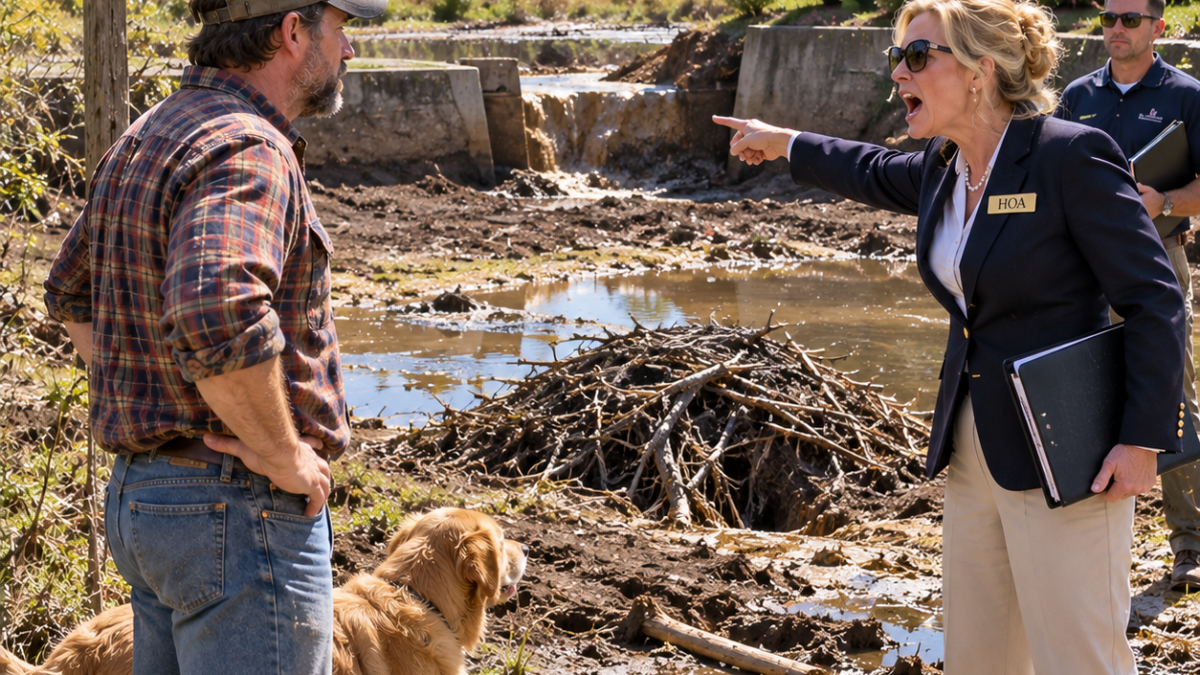
Across the narrowest part stood a new dam.
Small.
Fresh.
Packed with mud, peeled willow, grass, leaves.
A beaver surfaced near the far bank.
Brown head.
Dark eyes.
One second.
Then gone.
I covered my mouth.
“They moved.”
Delia’s face stayed serious.
“They were displaced.”
Displaced.
Not managed.
Not corrected.
Not nuisance debris.
Forced out of one home.
Building another.
Delia marked the location with GPS.
She photographed the new dam.
Then opened a field map.
“This branch used to split here?”
“Yes.”
I pointed.
“Most flow went south into the pond.”
“And then?”
“Out through the lower dam and toward Willomere.”
She studied the new pool.
“Now the animals have caught the water above the split.”
I followed the thin downstream channel with my eyes.
“So less reaches the pond.”
“Yes.”
“And less reaches their intake.”
“If their intake depends on base flow through the lower creek, yes.”
I stared at the water pooled behind the fresh dam.
“The pond wasn’t stealing the creek.”
“No.”
Delia looked at me.
“It was buffering it.”
Marcus would have loved that sentence.
Not because it was poetic.
Because it was accurate.
The pond slowed runoff after storms.
Stored water.
Released it gradually.
Raised local groundwater.
Created a stable wet corridor.
Willomere had looked at the dam and seen blockage.
They had not understood that slow water could mean reliable water.
Now the beavers had moved the slowing upstream.
Before the golf course.
We walked back down.
At the fence, the seventh-fairway sprinkler coughed.
Once.
Twice.
Stopped.
A second head clicked and dropped.
Then a third.
The line went still.
Delia looked at me.
“You have your folder?”
“In the house.”
“Get it.”
Across the fairway, maintenance workers were already reaching for radios.
By the time I returned, Maren Beckett had arrived in a golf cart.
Two board members followed.
Three residents had come over from the practice green.
Maren saw Delia first.
Then me.
“Officer Morales.”
“Ms. Beckett.”
“I wish we had known you were conducting a site visit.”
Delia glanced down at her boots.
“I’m standing on Mrs. Callahan’s property.”
Maren looked at me.
“Mrs. Callahan has been escalating this before our association can complete responsible work.”
I almost answered.
I didn’t.
One of the residents did.
A gray-haired golfer with a visor in his hand.
“You’re the pond owner?”
“Yes.”
“We were told you refused to let Willomere fix the beaver blockage.”
Maren remained perfectly still.
The portal post had prepared him.
I answered carefully.
“I refused additional access after a contractor lowered my pond without my permission or required review.”
His brow furrowed.
“That’s not what the update said.”
“I know.”
Maren stepped closer.
“We are still willing to resolve this cooperatively.”
She reached into the cart.
“I have an access form.”
I stared at it.
“Red Branch can finish stabilization today.”
“Red Branch already cut the dam.”
“They performed limited work based on association authority.”
“Authority over my land?”
“Authority over a creek system affecting community infrastructure.”
Delia opened her notebook.
“Maren, was a stream alteration review completed before the drawdown?”
Maren’s expression tightened.
“This was nuisance-debris management.”
“Was an active-lodge assessment completed?”
“We had no confirmed active lodge.”
I pulled out the trail-camera still.
4:12 a.m.
Truck.
Hose.
Lodge visible.
“Your truck was there before dawn.”
Maren didn’t take the photograph.
“The association is not litigating operational details on a cart path.”
“No one asked you to litigate,” Delia said. “I asked whether you had review.”
A radio crackled.
A maintenance worker turned away.
Too late.
“Pressure’s dropping at seven and eight. Intake level’s low. You want us to shut down the line?”
Silence.
Maren snapped:
“Take that to channel three.”
The worker fumbled with his radio.
Everyone had heard.
The visor golfer looked toward the creek.
“Intake level?”
Maren turned back to me.
“This is exactly why obstruction cannot continue.”
“No,” I said quietly. “This is why damage matters.”
Her eyes flashed.
“If Willowmere incurs loss because access is denied, we will document it.”
“So will the timeline.”
She held the clipboard toward me.
“Sign the access consent, Isabel.”
First name.
Pressure disguised as familiarity.
I looked at the form.
TEMPORARY CREEK ACCESS AND CORRECTIVE WILDLIFE OBSTRUCTION COMPLETION.
Boxes:
REMOVE OBSTRUCTION.
MODIFY DAM.
RESTORE FLOW.
Nothing about the active lodge.
Nothing about the habitat buffer.
Nothing about upstream relocation.
“No.”
“Think carefully.”
“I have.”
“You are standing in the way of a community asset.”
I looked past her.
The seventh fairway was already losing color in a low strip.
The creek below the cart bridge showed stones.
“I’m standing where my property begins.”
Delia closed her notebook.
“Ms. Beckett, I am advising you not to send anyone back to the pond or upper branch while this inquiry remains open.”
Maren laughed once.
“State wildlife doesn’t operate our golf course.”
“No.”
Delia’s voice stayed calm.
“But your golf course may now be part of a wildlife disturbance.”
Another radio transmission crackled.
“Main pump’s off. Losing draw.”
Nobody spoke.
The next morning, Willomere looked like a person smiling with a broken tooth.
Invitational banners still hung.
White tablecloths covered the clubhouse patio.
Golf carts stood in neat rows.
Catering vans unloaded trays.
But the seventh fairway was dulling.
Not dead.
Not ruined.
Just thirsty enough to become visible.
My phone buzzed.
NOTICE REGARDING FALSE AND DISRUPTIVE STATEMENTS.
The HOA directed me to stop spreading unsupported claims regarding creek management and golf-course operations.
Continued interference could result in legal costs.
I forwarded it to Delia.
One minute later:
Received. Calvin Norwood en route.
Calvin worked for the county water authority.
Delia had explained why that mattered.
Willomere didn’t own Willow Creek.
It held a conditional irrigation-withdrawal allowance.
When creek flow stayed above a certain level, the course could draw.
Below threshold, it had to stop.
The rule existed for drought.
Maren had created something similar without a cloudless month.
At 10:06, a county truck entered the maintenance lane.
Calvin stepped out.
Tan work shirt.
Clipboard.
Measuring rod.
No interest in drama.
Maren got to him first.
“Mr. Norwood.”
“Ms. Beckett.”
“We weren’t informed of a formal inspection.”
“This is a field check.”
“We have members arriving.”
“I can see that.”
“It would be helpful to avoid unnecessary alarm.”
Calvin looked toward the pale edge of the fairway.
“Then avoid unnecessary withdrawal.”
Her smile tightened.
Delia introduced me.
I gave Calvin copies.
Trail-camera still.
Staff readings.
Buffer agreement.
Vendor index.
Correction email.
My notes from Neil Riser’s call.
Delia’s GPS map of the new upstream dam.
Maren watched every page.
“That packet contains disputed information.”
Calvin didn’t look up.
“Most useful packets do.”
He walked to the intake.
A metal cage sat beside the creek bend.
Leaves and pale grass had collected around the screen.
A plate on the post read:
CONDITIONAL IRRIGATION WITHDRAWAL — POINT B.
He lowered the measuring rod.
Read it.
Read again.
Then looked toward the maintenance shed.
“Who restarted this line this morning?”
Maren blinked.
“I’m not sure what you mean.”
“Pump cycle at 8:42. Again at 9:10.”
“Maintenance may have tested pressure.”
“Testing draws water.”
She folded her arms.
“A limited diagnostic test is routine before an event.”
A maintenance worker approached.
Saw Maren.
Stopped.
Calvin waved him over.
“Did you run Point B this morning?”
The worker looked at Maren.
Then Calvin.
“Yes, sir.”
“Twice?”
“Yes.”
“Why?”
“Pressure check.”
“Were you told flow might be below threshold?”
The worker hesitated.
“Maren said the creek was being stabilized.”
Her head turned sharply.
Calvin lifted the measuring rod.
Water fell in thin lines.
“Current channel is below withdrawal threshold.”
The words passed through the people nearby.
A few residents had gathered under a live oak.
Maren’s expression changed.
Calculation.
“Below threshold because the obstruction hasn’t been removed,” she said.
Delia looked at her notes.
“The current upstream obstruction formed after disturbance at the lower lodge.”
Maren looked at me.
“That is one interpretation.”
“No,” Calvin said.
Everyone turned.
He wasn’t looking at us.
He was studying the creek.
“That’s why we measure.”
He clipped a yellow tag to the intake post.
Time.
Date.
Initials.
“This course should not draw from Point B right now.”
The clubhouse patio behind us became quiet.
Calvin’s yellow tag stayed all afternoon.
Golfers walked down to look at it.
Residents asked questions.
Maren answered fewer each time.
At 1:20, Calvin said:
“We walk the system.”
Maren straightened.
“What system?”
“Intake. Pond. Upper branch.”
“That crosses private property.”
“I gave them permission,” I said.
Maren looked at me.
“Not Willomere.”
Calvin addressed the residents.
“This isn’t a hearing. Stay on public or marked paths.”
We started at Point B.
Calvin measured again.
Delia photographed.
A maintenance worker named Daryl unlocked the pump panel.
The display confirmed two morning cycles.
Maren called them brief diagnostics.
Calvin wrote:
Draw after suspected low flow.
No commentary.
Then we moved along the path toward my pond.
From the Willomere side, the damage looked worse.
Maybe because I had gradually become used to it.
Residents hadn’t.
The lodge was completely exposed.
The pale waterline ring marked the old level.
Marcus’s staff gauge stood absurdly high in mud.
The dam notch looked like someone had taken a bite from the structure.
The visor golfer removed his cap.
No one told him to.
Delia pointed.
“Fresh cut.”
Then the gauge.
“Rapid drawdown.”
Then willow cuttings.
“Active-lodge indicators before disturbance.”
Maren folded her arms.
“Those are preliminary impressions.”
Delia stood.
“The final report will use formal terminology. This is what I’m observing.”
Calvin laid documents across Marcus’s bench.
Trail still.
Pond-level photographs.
Buffer language.
Vendor index.
Correction email.
Maren’s original notice.
He weighed the corners with creek stones.
Maren stepped closer.
“I object to unverified handwritten notes being displayed as evidence.”
Calvin looked toward the path.
“Mr. Riser is here.”
I turned.
Neil Riser stood holding his cap.
Maren’s face hardened.
“Neil. You should not participate without counsel.”
He swallowed.
“My company is named in a state inquiry.”
Calvin asked:
“Were you told the Callahan pond was HOA-controlled infrastructure?”
“Yes, sir.”
“Were you told owner approval existed?”
“Yes.”
“Were you told an active lodge was present?”
“No.”
“What did the scope say?”
Neil looked at Maren.
Then at me.
Then Calvin.
“Lower pond eighteen to twenty-four inches.”
The residents went silent.
“Notch beaver obstruction.”
Maren stepped forward.
“Neil—”
He continued.
“Restart creek draw before invitational prep.”
Nobody reacted loudly.
That made it worse.
Maren said, “You are oversimplifying a complex maintenance discussion.”
Neil shook his head.
“I’m reading the scope I got.”
Calvin gathered the pages.
“Upper branch.”
We walked through the willow stand.
Most residents couldn’t follow all the way.
They watched through the trees.
The new dam had grown since yesterday.
More branches.
More mud.
The pool behind it deeper.
The cold spring still entered steadily.
Below the dam, the branch toward my pond was thin.
Calvin stared for a long time.
Then Delia said:
“Fresh relocation structure. Consistent with activity following disturbance at the lower lodge.”
Maren seized the wording.
“Consistent is not proof.”
“No,” Calvin said.
He pointed upstream.
“But sequence matters.”
He counted calmly.
“Contractor lowers pond.”
“Active lodge is exposed.”
“Animals relocate.”
“New structure appears above the historic branch split.”
“Flow to lower pond decreases.”
“Golf intake falls below threshold.”
“And the course continues drawing.”
Maren opened her mouth.
Nothing came.
Back at Point B, Calvin removed the yellow tag.
He replaced it with red.
TEMPORARY WITHDRAWAL RESTRICTION.
He signed it.
“Effective immediately.”
A maintenance worker closed a valve.
Across the seventh fairway, sprinklers sank one by one.
The invitational banner snapped in the wind.
Maren stared at the creek.
Then the residents.
Then me.
For once, nobody asked me to explain the water.
The red tag stayed nine days.
Willomere still held the invitational.
That surprised some people.
It shouldn’t have.
A golf course can survive inconvenience.
They moved the main round to the front nine.
Shortened afternoon play.
Rented two water tanks.
Bought portable irrigation equipment for priority greens.
The neighborhood did not collapse.
No one lost a home.
Property values did not vanish.
The catastrophe Maren had described did not arrive.
What collapsed was her story.
On Monday, every homeowner received an email from Alderton and Finch.
The prior Course Creek Update contained incomplete information regarding the Callahan Pond and Willow Creek corridor.
The association withdraws its nuisance review notice pending completion of wildlife, water-authority, and restoration review.
I read “withdraws” twice.
Not apologizes.
Not admits.
Withdraws.
Sometimes legal language doesn’t need beauty.
It needs effect.
The portal post disappeared.
A correction replaced it.
No homeowner had been found responsible for the irrigation interruption.
No resident or vendor should alter any creek, pond, dam, spring branch, habitat buffer, or wildlife structure without written professional review.
I screenshotted it.
Delia’s preliminary memo arrived Wednesday.
Rapid drawdown.
Fresh dam disturbance.
Recent active-lodge indicators.
Upstream beaver relocation consistent with habitat disturbance.
Further intervention prohibited pending restoration planning.
Calvin’s notice came the same afternoon.
Point B would remain restricted until:
Minimum flow restored.
Three consecutive compliant readings.
Restoration plan accepted.
No more “looks good today.”
No more “we think it’s fine.”
Numbers.
Three readings.
Marcus would have loved that too.
I slept through the night for the first time in almost a week.
Thursday’s special board session was packed.
I sat in the back.
Marcus’s green folder on my lap.
People who had called my pond a swamp were suddenly using words like buffer.
Flow threshold.
Lateral habitat.
Withdrawal permit.
Maren sat at the board table.
She had not resigned.
I was glad.
That surprised me.
Stories want villains to leave.
Someone resigns.
Everyone applauds.
Problem solved.
But Willow Creek’s problem was not one woman.
It was a habit.
The belief that living systems were decorative until they interfered with a schedule.
That a creek existed to serve an irrigation pump.
That a beaver pond existed only as an obstruction.
That a homeowner asking questions was “emotionally attached.”
If Maren had resigned immediately, everyone else could have blamed one personality and kept the same system.
Instead, the board changed authority.
The Green Committee lost unilateral control over creek, irrigation, drainage, and habitat-adjacent projects.
Any work within the Willow Creek buffer required outside review.
Alderton and Finch had to maintain a compliance file containing:
Buffer agreements.
Water-withdrawal conditions.
Wildlife review.
Vendor scopes.
Property-access consents.
Permit status.
Red Branch was suspended from work in Willomere pending contractor review.
Not because Neil had lied.
In fact, his records showed the opposite.
He had followed a bad scope built on false assumptions.
The board also required landowner verification before any vendor crossed private property.
Then Maren read the correction.
Her voice was controlled.
“The association acknowledges that the Callahan Pond is not HOA-controlled infrastructure.”
She paused.
“The association further acknowledges that prior statements may have created confusion regarding homeowner responsibility for recent irrigation interruption.”
She never looked at me.
That was fine.
I hadn’t come for eye contact.
I had come to hear a pond described correctly in a public room.
Afterward, the visor golfer approached.
His name was Howard Merritt.
He held his cap in both hands.
“I owe you an apology.”
“You don’t owe me anything.”
“I commented on the portal.”
I remembered his name.
REMOVE THE BEAVERS BEFORE THEY RUIN ANOTHER FAIRWAY.
“I remember.”
He looked embarrassed.
“I thought the dam was just blocking water.”
“It was blocking some.”
He looked up.
“But holding more.”
“Yes.”
“Seems backward.”
“A lot of ecology does when you only look at one spot.”
He nodded.
“My grandson likes beavers.”
“That’s probably a better qualification than most committees had.”
He laughed.
Then became serious.
“I’m sorry.”
“Thank you.”
That was enough.
Restoration began the following week.
Not with excavators.
That mattered.
Orange buffer stakes went in first.
Then erosion-control fabric.
Temporary fencing.
A restoration ecologist named Dr. Maribel Chen arrived and stood by the pond for twenty minutes before speaking.
“Slow is good here.”
I liked her immediately.
Maren did not attend.
The dam notch was stabilized without sealing it completely.
The mud edges were protected.
Willow bundles went into damaged bank sections.
The staff gauge stayed.
Maribel wanted it preserved because the historic readings mattered.
For several days, nothing dramatic happened.
That was the point.
Water seeped.
Mud darkened.
The lower channel began moving again.
Frogs returned first.
Only a few.
Then dragonflies.
The upstream dam remained.
Delia said the beavers might maintain both.
Abandon the lower lodge.
Return.
Build another structure nobody predicted.
“They’re not contractors,” she said.
“The plan isn’t to make them follow our diagram.”
Maribel nodded.
“Finally, someone said it.”
On day four, Calvin measured Point B.
Still low.
Day five.
Closer.
Day six.
Above minimum.
“That’s one,” he said.
Willomere wanted irrigation restored immediately.
He refused.
“One is not three.”
Day seven stayed above.
Two.
Day eight dipped slightly.
Reset.
The course groaned.
I heard about it from Howard.
“People are losing their minds over greens.”
“The greens still green?”
“Yes.”
“Then they’ll survive.”
He smiled.
“You’re enjoying this a little.”
“No.”
I thought about it.
“Maybe the measuring part.”
On day nine, the creek held.
Then again the next morning.
And again.
Calvin removed the red restriction tag.
He replaced it with a white notice.
LIMITED WITHDRAWAL — MONITORED.
The pumps didn’t roar back.
They ran in scheduled windows.
Maintenance checked flow before each draw.
Willomere rented water for critical course areas rather than pretending Willow Creek owed them everything.
I watched from my side of the fence.
No one came to my door asking for signatures.
No one called the pond a nuisance.
The largest question remained the beavers.
For almost two weeks, I saw no animal near the old lodge.
Fresh willow disappeared from the lower bank.
The upper dam grew stronger.
I worried the old pond had been abandoned.
That hurt more than I expected.
Marcus had loved watching kits in spring.
He pretended not to name wildlife because naming wild animals was “biologically unserious.”
Then I found a page in his notebook:
Big one — Martha?
Small bold kit — Trouble.
So much for scientific rigor.
One evening, I carried his notebook to the bench.
The pond was still lower than before.
Maybe eight inches.
But water had returned around the lodge.
The cattails were damaged in places.
The shoreline looked raw.
I opened to a clean page.
Nothing happened.
No tail slap.
No beaver.
Just frogs.
Water.
Wind.
I wrote:
Restoration day 11.
Then closed the notebook.
A week later, Maren came to my house.
No golf cart.
No committee folder.
She walked down the public lane and stopped at my gate.
I saw her through the kitchen window.
For a moment I considered not going out.
Then I did.
She was wearing jeans.
That surprised me more than it should have.
“Isabel.”
“Maren.”
“I wanted to speak without management.”
“That sounds risky.”
She almost smiled.
Almost.
“I’m not here to argue.”
I waited.
She looked toward the pond.
From there, the water was visible through cottonwoods.
“I was wrong about the buffer agreement.”
“That’s a legal sentence.”
“Yes.”
She looked at me.
“And I was wrong about the pond.”
That was different.
I folded my arms.
“What did you think it was doing?”
“Restricting us.”
“You weren’t entirely wrong.”
She frowned.
I continued.
“The dam slowed water.”
“That’s what I mean.”
“But slowing isn’t the same as taking.”
She looked away.
“We were getting complaints about soft conditions in spring and low pressure in summer.”
“Those sound like opposite problems.”
“They are.”
“Did anyone ask why?”
“Our consultant believed removing the obstruction would normalize flow.”
“Which consultant?”
She hesitated.
“Course maintenance.”
“That’s not a hydrologist.”
“No.”
“Wildlife?”
“No.”
“Stream engineer?”
“No.”
She looked embarrassed.
“We had a tournament.”
I nodded.
There it was.
Not evil.
Not hatred of beavers.
Schedule.
Pressure.
Members.
People wanting a fast answer.
“What made you choose four in the morning?”
Her face tightened.
“I didn’t choose the time.”
“Red Branch did?”
“They wanted to finish before maintenance traffic.”
“And before I woke up.”
“I can see how it looks.”
“That’s not what I asked.”
She took a breath.
“I should have required direct owner contact first.”
“Yes.”
“I thought the notice was enough.”
“It arrived after.”
“I know.”
We stood quietly.
Then she said:
“I was afraid if we delayed, the invitational would become a mess.”
I looked at the pond.
“You made it bigger.”
“Yes.”
The word was so quiet I almost missed it.
For a second, I saw not the Green Committee chair.
Just a woman who had made a confident decision and watched the consequences spread farther than she understood.
I didn’t forgive her.
Not then.
Maybe not completely ever.
But I stopped needing her to be a monster.
“Why did you call me emotionally attached?”
She closed her eyes briefly.
“That was unfair.”
“It was useful.”
She looked confused.
“I screenshotted it.”
That actually made her laugh.
One short sound.
Then she nodded.
“I deserved that.”
Before leaving, she looked toward Marcus’s bench.
“Your husband built that?”
“Yes.”
“I remember him.”
“Most people do.”
“He argued with me once about ornamental riprap.”
“That sounds like Marcus.”
“He talked for twenty-five minutes.”
“Also Marcus.”
She smiled slightly.
Then left.
The final restoration agreement took another month.
Willomere funded damaged-bank restoration.
Wildlife monitoring.
Independent creek assessment.
My legal consultation.
Camera replacement after one trail unit was damaged during the contractor entry.
They also paid for a formal survey of the buffer boundary because nobody wanted “visual interpretations” again.
The golf course agreed to install a separate storage tank so emergency turf needs would not depend entirely on creek draw.
That part mattered more than any apology.
Less pressure on the creek meant less temptation to control everything upstream.
The board established a watershed advisory group.
I refused the first invitation.
Howard asked again.
“No.”
Maribel asked.
“No.”
Then Delia said:
“You’ll complain forever if they do it wrong.”
“That sounds manipulative.”
“It’s accurate.”
So I joined.
Not as chair.
Absolutely not.
One meeting every other month.
Outside consultant required.
No decisions without minutes.
I made those conditions.
They agreed.
At our first meeting, a maintenance supervisor put a large map on the table.
Blue lines.
Red intake points.
Wetlands.
Buffer areas.
He pointed at my pond.
“Callahan Reservoir.”
I stared at him.
“No.”
He blinked.
“That’s what the irrigation map calls it.”
“It is not a reservoir.”
“What should we call it?”
I thought about Marcus.
Then said:
“Callahan Beaver Pond.”
He wrote it.
No one argued.
That felt strangely important.
Autumn arrived slowly.
The seventh fairway recovered.
Willomere repaired the thin sections with overseeding and temporary water.
The invitational was forgotten within weeks.
Golfers moved on to complaints about bunker sand.
That was comforting.
Ordinary annoyance returning is an underrated form of peace.
My pond changed too.
The water never returned to exactly the old line.
Maribel said that might be good.
The system had been disturbed.
The beavers would decide some of its future.
The upper dam continued holding part of the North Branch.
Then in late October, fresh cut willow appeared beside the lower pond.
I found it at 6:20 one morning.
Pale chew marks.
Sharp.
New.
I stood there holding my coffee.
A ripple crossed near the lodge.
Then disappeared.
I called Delia.
“I think they’re back.”
“Pictures?”
“Yes.”
“Send them.”
“No celebration?”
“Isabel, they may just be feeding there.”
“Fine.”
“Don’t name them.”
“Marcus named them.”
“Marcus was a bad influence.”
The next evening, something repaired part of the old lodge.
Not much.
Fresh mud.
A new branch.
The trail camera caught one adult at 2:07 a.m.
Then another three nights later.
No kits.
No certainty they had fully returned.
But life had resumed negotiating with the place.
That was enough.
In November, Willomere held its annual budget meeting.
For the first time, “creek contingency” appeared as a real line item.
Storage.
Monitoring.
Habitat review.
I sat near the back.
Maren was still treasurer.
She presented the budget without drama.
When she reached the creek section, she said:
“We learned this year that stability is not the same as maximum flow.”
Several people looked at me.
I looked at the floor.
Afterward, Howard found me by the coat rack.
“Did you hear that?”
“I was in the room.”
“That was basically your sentence.”
“No.”
“Close enough.”
I smiled.
Outside, rain had started.
Not hard.
Just steady November rain.
I drove home slowly.
Water gathered along the road.
By the time I reached the kitchen, the pond was making noise again.
Not the exact old noise.
Water passed through the repaired lower dam differently.
More spread.
Less sharp.
I put on boots.
Carried Marcus’s notebook outside.
Rain tapped the cedar bench.
I sat anyway.
The pond reflected a gray sky.
Cattails bent under droplets.
Water moved around the lodge.
The staff gauge read eleven and a quarter inches.
I wrote it down.
Then beneath it:
First long rain after restoration.
I paused.
Marcus used to record only facts.
Mostly.
Except sometimes he wrote things like:
Heron annoyed.
Big frog victorious.
Isabel says this is not scientific.
I turned to one of those pages and laughed.
The sound carried over the water.
Months later, in early spring, Willomere’s board approved the final watershed plan.
The document described the beaver pond as:
A privately owned habitat feature contributing to flow attenuation, wetland storage, and downstream base-flow moderation within the Willow Creek corridor.
I read that sentence three times.
Then called Delia.
“They finally used attenuation.”
“I know.”
“You read it?”
“I helped edit it.”
“Traitor.”
“You wanted accurate terminology.”
“I wanted them to suffer a little longer.”
“That is not in our agency mission.”
“Missed opportunity.”
She laughed.
Then grew serious.
“How’s the pond?”
“High.”
“Lodge?”
“Active.”
“Good.”
“Golf course?”
“Still there.”
“Also good.”
That was something I had come to understand.
Justice didn’t require the golf course to fail.
I didn’t want the seventh fairway to die.
I didn’t want people to lose jobs.
I didn’t want residents punished for a decision they hadn’t made.
I wanted boundaries respected.
Water understood.
The living system treated as something more than plumbing nobody had to pay for.
The strongest outcome wasn’t that Willomere lost its creek forever.
It was that for nine days, they felt what the creek had been doing for them.
They watched sprinklers stop.
They rented tanks.
They measured flow.
They learned the difference between possession and dependence.
Then they rebuilt their operations around that truth.
In April, I found three beaver kits on the trail camera.
Three.
Tiny heads.
One climbed over a branch and fell backward into the water.
I watched that clip twelve times.
Marcus would have named that one immediately.
Probably Trouble II.
I printed one still.
Put it inside his green folder.
Then took the folder to the bench.
The pond was nearly full.
Not exactly where it had been.
But alive.
Willow Creek moved below the dam.
At the fence, the channel continued toward Willomere.
A golf-course maintenance cart passed slowly on the far side.
The driver lifted one hand.
I recognized Daryl.
I waved back.
No one entered my property.
No hose.
No contractor.
No notices.
Just water going where gravity and beavers and soil allowed it to go.
I opened Marcus’s notebook.
The final page he had written before he got sick contained a sketch of the pond.
Beside the outlet, he had written:
Pond holds storm.
Releases slow.
Creek steadier below.
Three lines.
That was all.
He had known.
Not because he was a genius.
Because he watched.
That was what Willomere had skipped.
Watching.
They had seen a dam.
They had seen delayed water.
They had decided obstruction.
They wanted the creek faster because faster sounded like more.
So they cut.
Drained.
Pumped.
And pushed the animals uphill.
The water followed.
Then the golf course discovered something the pond had been quietly proving for years.
A creek is not a pipe.
A pond is not a storage tank you can open whenever a tournament is scheduled.
And a beaver is not a maintenance employee who stays where you leave it.
I wrote the day’s reading.
Then one more line.
Pond holding again.
I closed the notebook.
Across the water, something moved near the far bank.
A beaver surfaced.
It floated there long enough for me to see its head.
Then disappeared.
A few seconds later came the sound I had missed most.
Flat.
Sharp.
A tail hitting water.
I sat on Marcus’s bench with the notebook in my lap while the creek slipped quietly toward Willomere.
The golf course still received water.
Just not on command.
And somehow that felt exactly right.








