The first luxury SUV sank before the gold open-house balloons had finished whipping loose from the HOA entrance sign.
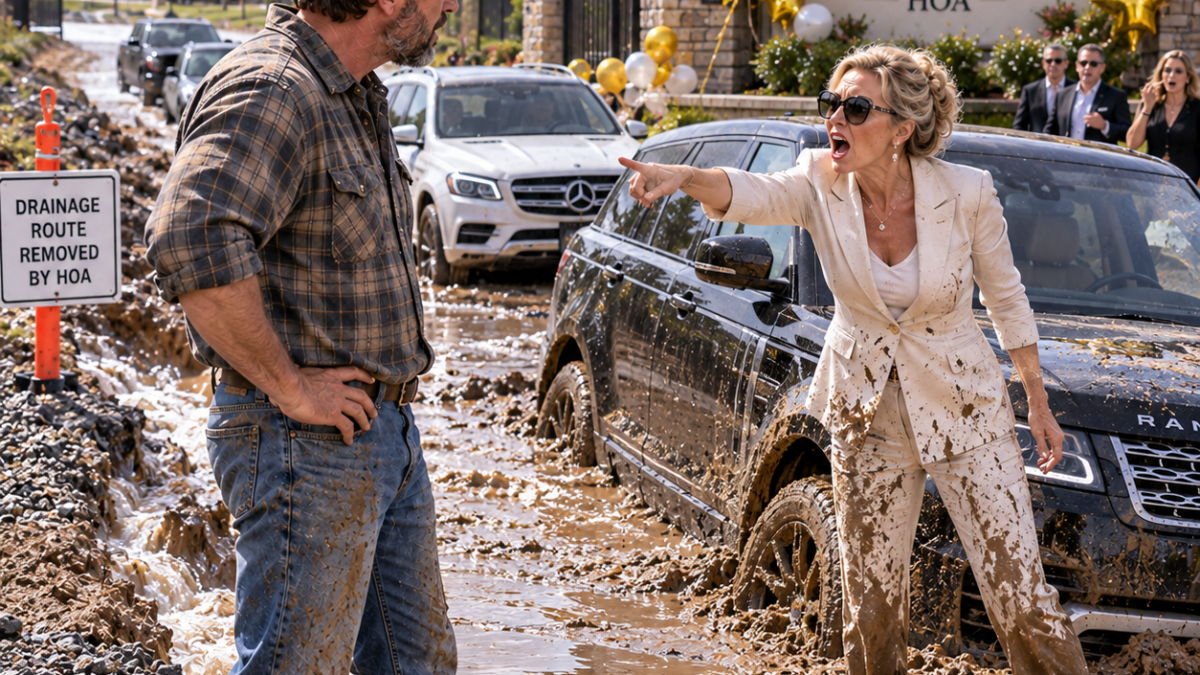
The silence lasted maybe three seconds.
It felt longer.
The Range Rover’s engine had been shut off, but the cooling metal clicked under the hood.
Mud dripped slowly from the front bumper.
Behind it, the Mercedes leaned toward the rut at an angle that made its driver keep looking back at it as though the car might continue sinking without permission.
The tow truck driver stayed crouched beside the exposed clay.
He rubbed the wet soil between his fingers.
“Somebody stripped this down to subgrade,” he said.
Joel Hartley, Brier Glen’s community manager, moved toward him.
“This is association frontage. We’re handling the situation.”
The tow driver stood.
“I asked who altered the road.”
Joel’s polished expression tightened.
Vanessa found her voice.
“There was no road here.”
I looked at her.
The tow driver looked at her.
Even the Range Rover owner looked at her.
Vanessa corrected herself.
“There was an old gravel strip.”
“That old gravel strip was my access easement,” I said.
She turned sharply.
“Mrs. Whitaker has been fighting reasonable entrance improvements for weeks.”
The man from the Range Rover held his muddy loafer in one hand.
“Wait.”
Everybody looked at him.
He pointed toward the brown strip beneath his vehicle.
“You’re saying this was gravel before?”
“Yes.”
“And someone removed it?”
Vanessa stepped forward.
“The association performed routine beautification.”
I said, “They scraped away the compacted surface and exposed the clay after I warned them in writing not to.”
Joel cut in.
“Those documents are disputed.”
The tow driver glanced at the mud.
“Ground isn’t.”
Then the Range Rover settled another fraction of an inch with a thick sucking sound.
The owner looked down.
Nobody spoke.
That sound did more than any argument could have done.
I had heard it before.
Not with luxury SUVs.
With county trucks.
Propane rigs.
Farm equipment.
Vehicles that looked perfectly safe until the ground underneath stopped behaving like road.
Daniel taught me to listen for it.
He used to come home from county road calls with mud dried to his boots and say, “Bad ground always tells you. People just hate listening.”
I wished he could have been there.
Not for the humiliation.
Daniel would have hated that part.
He would have stood beside the stuck vehicles and worried about damage before he ever said I told you so.
But he would have recognized the clay immediately.
The tow driver wiped his fingers on a rag.
“I’m not pulling either vehicle from this angle.”
Vanessa stared at him.
“We need them removed.”
“Then you need another recovery truck, boards, and a better pull line.”
“How long?”
He shrugged.
“As long as it takes not to rip the underside off a hundred-thousand-dollar SUV.”
The Range Rover owner’s head snapped toward him.
“Rip what off?”
“Sir, I’m not saying it’s damaged. I’m saying if we yank it wrong, it can be.”
Vanessa turned toward Joel.
“Call somebody else.”
The tow driver gave her a flat look.
“You can.”
Then he pointed toward the rut.
“They’re going to tell you the same thing.”
Joel stepped away, phone already at his ear.
I caught pieces of the conversation.
“Two vehicles.”
“No collision.”
“Ground failure.”
“Yes, guests.”
Then something quieter.
“Yes. Prior communications.”
The Range Rover owner heard that too.
He looked at me.
“Prior communications?”
Vanessa stepped between us.
“This is an ongoing dispute.”
He held up his muddy shoe.
“I’m beginning to notice.”
A few buyers laughed nervously.
Vanessa looked at them and they stopped.
The white event tent stood twenty yards away.
Gold ribbons moved in the breeze.
A portable speaker was still playing soft piano music because nobody had thought to turn it off.
The contrast would have been funny under different circumstances.
Brier Glen had spent days polishing its entrance into something that looked ready for a magazine.
Stone sign.
Imported flowers.
Clean white canopy.
Glossy brochures.
And now two expensive vehicles sat buried beside it because the road had been made prettier.
A listing agent named Grant came running from the sales office.
“What happened?”
Vanessa answered before anyone else.
“Unexpected ground conditions.”
I almost laughed.
The Range Rover owner did.
Not because it was funny.
Because he was furious.
“Unexpected?”
He pointed at me.
“She says she warned you.”
Vanessa’s face hardened.
“She has opposed every improvement we’ve attempted in this area.”
“That’s not what I asked.”
Grant looked from Vanessa to Joel.
Then toward the cars.
“Was there gravel here before?”
Joel lowered his phone.
“This isn’t the appropriate place to litigate easement history.”
The tow driver said, “Actually, it’s a pretty good place to figure out what I’m pulling against.”
That was when another SUV pulled up.
Not a guest.
Dark blue.
Plain.
A woman stepped out wearing a rain jacket and practical work boots.
She carried a tablet.
The first thing she looked at was the ground.
That made me trust her more than anyone from Brier Glen had earned.
“I’m Dana Marsh,” she said. “Field adjuster.”
Joel hurried toward her.
“Joel Hartley. Community management.”
Dana looked at the Range Rover.
Then the Mercedes.
Then the ruts.
Then the exposed fabric.
“Have either vehicles been moved?”
“No,” the tow driver said. “I’m not touching them until recovery conditions are set.”
“Good.”
She started typing.
“Who directed them onto this surface?”
Joel said, “There was an event traffic plan.”
Dana looked up.
“Who authorized the route?”
Vanessa stepped forward.
“The architectural committee approved temporary traffic-flow adjustments.”
Dana typed again.
“Was the surface evaluated for vehicle loading before use?”
Vanessa gave her the smile she used when she expected words to solve things.
“It was an existing frontage area.”
“It’s my recorded easement,” I said.
Dana turned.
“Your name?”
“Ellen Whitaker.”
“You own the land?”
“I own the property served by the easement. The entrance tract is association land, but the access rights are recorded.”
Vanessa muttered, “Her interpretation.”
Dana ignored her.
“Do you have documentation?”
“Yes.”
Joel said, “We dispute her characterization.”
Dana looked at him.
“You can dispute whatever you like. I asked whether she has documentation.”
That was the first moment all morning when I felt my shoulders drop.
Not because Dana had taken my side.
She hadn’t.
She was doing something simpler.
She was separating evidence from argument.
I walked to my truck.
My blue folder was on the passenger seat.
The same folder I had carried around for two weeks.
Easement.
Certified receipt.
Photos.
Marcus’s report.
HOA violation notice.
Emails.
Daniel had kept road invoices in old coffee cans.
I used labeled folders.
Different system.
Same instinct.
Keep the paper.
My hands stayed steady until I opened the truck door.
Then they trembled once.
I waited until they stopped.
When I came back, Dana was photographing the rut.
I gave her the recorded easement first.
She laid it on the hood of her SUV.
“This is the strip?”
“Yes.”
She photographed the map.
I pointed to the maintenance language.
“Surface grade, drainage, and base material can’t be altered in a way that interferes with reasonable access.”
Dana read it.
“Base material is specifically referenced.”
“Yes.”
Vanessa said, “That doesn’t mean Mrs. Whitaker controls HOA landscaping.”
Dana didn’t look up.
“I didn’t say it did.”
She highlighted the paragraph.
Next I handed her the certified letter.
“This was sent before the contractor came.”
She checked the delivery receipt.
“Received Monday.”
“Yes.”
Joel stepped closer.
“The association did not agree with her conclusions.”
Dana looked at him.
“I’m documenting notice, Mr. Hartley. Agreement comes later.”
Then I showed her the photographs.
Before.
Compacted gray gravel.
Shallow crown.
Orange edge posts.
Clean shoulders.
One photograph showed the narrow black line of geotextile fabric beneath the stone where the surface had thinned.
Then after.
Skid-steer bucket marks.
Gravel pushed aside.
Fabric torn.
Clay exposed.
Edge marker snapped.
Dana swiped back and forth several times.
“Who performed the removal?”
“Green Line Landscape Services.”
Joel shifted his weight.
Dana noticed.
“Do you have their work authorization?”
“Not with me.”
Vanessa said, “It was routine beautification.”
The tow driver laughed once.
Vanessa looked at him.
“You find something amusing?”
He pointed toward the Range Rover.
“I find it hard to call this routine.”
Dana looked at him.
“In your professional opinion, why is the vehicle stuck?”
He crouched again.
“The tire load is directly on wet clay. There’s no stone distributing it. Once the first tire breaks the surface, the clay pumps up and the rut deepens.”
“Can you tell whether there used to be base stone?”
He pointed to the remaining strip near my mailbox.
Then to the torn fabric.
“Sure looks like it.”
Dana typed.
The Range Rover owner folded his arms.
“Can this damage the vehicle?”
“Possible underbody contact. We’ll know when it’s recovered.”
His jaw tightened.
I gave Dana Marcus Aldis’s report.
She read the first paragraph.
Then the last.
Her eyes paused on one sentence.
EXPOSED CLAY SUBGRADE AND DISTURBED BASE NOT SUITABLE FOR REGULAR VEHICLE TRAFFIC UNDER WET CONDITIONS.
“When was this provided to the association?”
“Last night.”
Dana looked at Joel.
“You received this?”
He adjusted the tablet under his arm.
“We received correspondence.”
“That isn’t what I asked.”
Vanessa stepped in.
“We received hostile commentary from Mrs. Whitaker.”
I felt heat rise in my face.
Dana’s expression didn’t change.
“Was this assessment received before today’s event route was used?”
Joel looked toward the cars.
Then toward the tent.
Finally:
“Yes.”
The Range Rover owner swore.
Dana made another note.
“I need the contractor scope, invoice, event traffic plan, and committee authorization.”
Joel went very still.
“The invoice isn’t relevant.”
Vanessa said it quickly.
Dana looked at the torn road.
“It is now.”
That sentence changed the scene.
Until then, Vanessa still thought the problem was two stuck cars.
An embarrassing interruption.
A bad photo.
Something management could smooth out.
But paperwork is harder to tow away than an SUV.
Joel glanced at the crowd.
Several buyers were filming.
Grant, the listing agent, had stopped trying to usher people toward the model homes.
The Mercedes driver stood beside her car wearing one remaining heel.
The other was buried somewhere near the passenger side.
She looked exhausted.
“Can someone please explain why we were routed here?”
Nobody did.
Dana held out her hand.
“Mr. Hartley.”
Joel exhaled.
“Our vendor documents are in the management portal.”
“Open it.”
Vanessa moved closer.
“We don’t disclose internal project documents at public events.”
Dana said, “Then we can move ten feet away while I read them.”
Joel stared at his tablet.
Grant spoke quietly.
“Joel. Just pull it up.”
Vanessa looked at him.
“This is not your issue.”
Grant glanced at the Range Rover.
“It became everybody’s issue when buyers started sinking.”
That was the first visible break inside Brier Glen’s own side.
Joel opened the portal.
His thumb moved through several screens.
Dana stood beside him.
Nobody spoke.
Then she stopped him.
“That one.”
Joel tapped.
Her eyes moved across the page.
“What does it say?” the Range Rover owner asked.
Dana kept reading.
Finally:
“Green Line Landscape Services. Entrance enhancement and frontage blending.”
Vanessa said, “Exactly.”
Dana continued.
“Remove visible gravel from access strip. Grade smooth. Prepare for sod and decorative stone before Brier Glen luxury showcase.”
Nobody said anything.
The phrase moved through the group.
Remove visible gravel.
Not loose debris.
Not weeds.
Not failed material.
Gravel.
Vanessa’s face went pale.
“You’re reading that without context.”
Dana turned the tablet slightly toward the tow driver.
“Would that scope remove structural surface material?”
He glanced at it.
“If they scraped the gravel I’m looking at, yes.”
Joel stepped forward.
“It says visible gravel. It does not say structural gravel.”
Dana pointed toward the black fabric exposed along the rut.
“If the base wasn’t affected, why is the fabric showing?”
Joel didn’t answer.
Vanessa did.
“Because Ellen failed to maintain this strip for years.”
A voice came from behind the buyers.
“That isn’t true.”
I turned.
Carl Denning was walking toward us.
He lived three houses inside Brier Glen.
He had known Daniel.
He also remembered when this whole development was still pasture and construction stakes.
Vanessa’s face changed.
“Carl, this doesn’t concern you.”
He held up his phone.
“I photographed that lane Monday morning.”
Dana looked at him.
“Before the landscaping work?”
“Yes.”
“Can I see?”
Carl pulled up the pictures.
Gray gravel intact.
Orange markers upright.
Fabric covered.
No brown exposed lane.
Dana asked him to send them.
He did.
Vanessa crossed her arms.
“Carl has been sympathetic to Mrs. Whitaker’s complaints for years.”
Carl shook his head.
“I’ve disagreed with Ellen plenty.”
He looked at me.
“That true?”
“Unfortunately.”
A few people laughed.
He turned back to Vanessa.
“But the road was there Monday.”
Dana continued scrolling through the vendor file.
Then stopped again.
“Funding source.”
Joel’s eyes narrowed.
Vanessa said nothing.
“Entrance maintenance reserve,” Dana read.
That meant something to me.
The entrance maintenance reserve was tied partly to obligations that predated the finished development.
Drainage.
Access.
Practical frontage upkeep.
Because my easement crossed the tract, I received annual notice of certain expenses.
I had never paid much attention to them.
Dana looked at Joel.
“This was approved as maintenance?”
“It was part of a broader entrance refresh.”
“Was the charge made against the maintenance reserve?”
Joel hesitated.
“Yes.”
Vanessa interrupted.
“Visual maintenance is still maintenance.”
The tow driver looked at the buried Range Rover.
“That’s one way to look at it.”
Dana scrolled farther.
Then froze.
Her eyes moved toward Vanessa.
“There’s an email attached.”
Joel reached toward the screen.
“That may contain privileged internal discussion.”
Dana moved the tablet away.
“It’s attached to the vendor authorization.”
Vanessa said, “That doesn’t mean—”
Dana read.
“Please prioritize removal of the gray gravel along the Whitaker strip before Friday. It undermines the premium entrance presentation and will be visible to VIP traffic. We need the area blended before guests arrive.”
She looked up.
The email sender was Vanessa.
Nobody needed to ask.
For two weeks, Vanessa had called it safety.
Beautification.
Frontage maintenance.
Community standards.
Now her own words reduced the whole decision to one concern.
It looked bad.
The Range Rover owner stared at her.
“You did this because you didn’t like the color of the road?”
“That is not what the email says.”
Carl raised his eyebrows.
“It’s pretty close.”
Vanessa’s voice sharpened.
“The gravel was inconsistent with the entrance design.”
The Mercedes owner looked at her car.
“So you removed it.”
“We improved the frontage.”
“It’s in the mud.”
Vanessa looked at me.
Not embarrassed.
Angry.
As though I had somehow arranged for her own documents to exist.
Joel tried one last argument.
“This does not establish causation.”
Dana turned toward the lane.
“It establishes alteration.”
She held up my certified receipt.
“Prior notice.”
Marcus’s report.
“Additional safety warning.”
Then she pointed at the VIP route sign.
“And event use.”
She closed the vendor file.
“Causation will be part of the claim review.”
The Mercedes owner said, “How long will that take?”
“Longer than getting your car out.”
The tow driver nodded.
“I need recovery boards, a second truck, and nobody else driving across this.”
Grant turned to the parking attendant.
“Close the route.”
Vanessa stepped toward him.
“You don’t have authority to change the traffic plan.”
Grant stared at her.
“I’m not sending another client into that.”
The attendant grabbed the blue-arrow sign.
Vanessa said, “Put that back.”
He looked at Grant.
Grant shook his head.
The sign stayed down.
Vanessa turned toward me.
“You must be very pleased.”
I looked at the ruts.
The torn fabric.
Mud on the Range Rover.
The Mercedes owner’s missing heel.
Daniel’s orange marker lying bent beside imported flowers.
“No.”
She looked surprised.
“I would have been pleased if you’d read the first letter.”
The second tow truck arrived around eleven.
Recovery boards went down beneath the Range Rover.
The crews worked from the blacktop.
Slow tension.
No spinning tires.
No dramatic jerks.
The vehicle came free inch by inch.
When the front wheels finally climbed onto the boards, the mud underneath released with a sound so deep I felt it in my stomach.
The owner stood beside me.
“My name’s Nathan Cassidy.”
“Ellen.”
“I know.”
He looked embarrassed.
“I think everyone knows.”
He watched his Range Rover inch backward.
“I’m sorry.”
“For what?”
“I assumed this was your road problem when she pointed at you.”
I looked at Vanessa.
She was speaking rapidly to Joel beneath the tent.
“That’s why she pointed first.”
Nathan nodded.
“I suppose so.”
His vehicle reached pavement.
Mud hung from the undercarriage.
A technician crawled partly beneath it with a flashlight.
Nathan sighed.
“My wife wanted to see the model with the wine cellar.”
“That still available?”
He laughed.
“Not today.”
The Mercedes took another forty minutes.
Nobody clapped when it came out.
The showcase had changed.
Buyers who had arrived expecting polished kitchens and infinity pools were standing around discussing easements and insurance.
Grant eventually packed his brochures into a cardboard box.
The piano music had stopped.
The champagne disappeared.
The white tent looked less like an event structure and more like a marker over a scene nobody wanted photographed.
Dana kept working.
Before leaving, she came to me.
“Do not let anyone restore this surface yet.”
I almost smiled.
“Brier Glen fined me yesterday for not removing the remaining gravel.”
She looked at the piles.
“Leave them.”
“Seriously?”
“They may matter to establishing original material and depth.”
I thought of the violation notice.
REMOVE REMAINING GRAVEL FRAGMENTS.
Now the association’s own adjuster wanted them preserved.
Daniel would have appreciated that.
Evidence was ugly until somebody needed it.
Dana continued.
“If anyone proposes emergency access work, get the scope in writing first.”
“I will.”
“Do you have alternate access to your home?”
“There’s a narrow secondary drive from the north, but it isn’t suitable for every service vehicle.”
“Document that too.”
She closed her tablet.
“You kept a good record.”
“I worked dispatch for twenty-eight years.”
She smiled.
“That explains the timestamps.”
After she left, I stood beside the easement.
The damage looked worse without cars on it.
Two deep ruts.
Clay churned into thick ridges.
Fabric stretched where tires had caught it.
The last surviving gravel near my mailbox looked almost absurdly small.
Yet it was still firm.
I stepped onto it.
Crunch.
Not squish.
I could hear Daniel.
Good gravel talks back.
The first official insurance contact came three days later.
Brier Glen’s position was that the road had been “historically inconsistent” and that seasonal moisture contributed substantially to the failure.
Marcus read that language at my kitchen table.
He had brought rainfall records from a gauge less than a mile away.
“Less than a quarter inch.”
“That enough to cause mud?”
“Enough to expose bad ground.”
He pointed at his report.
“Not enough to turn a properly based access lane into that.”
“What if they say the gravel was already thin?”
“We have Carl’s photos.”
“And mine.”
“And the remaining profile.”
We walked outside.
At the cedar tree, Marcus carefully exposed a small untouched edge where the skid steer had missed.
He measured the layers.
Surface stone.
Finer aggregate.
Fabric.
Clay.
Then he measured the scraped section.
“Gone.”
He wrote it down.
Brier Glen tried a second explanation.
Green Line, they said, had exceeded the intended scope.
That lasted until Dana obtained the full work authorization.
Vanessa’s email.
Joel’s approved purchase order.
The instructions to remove visible gravel.
The before-and-after photographs.
The contractor’s invoice.
Green Line’s supervisor, Randy, gave a short written statement.
The crew had been directed to remove visible gray gravel, blend the frontage, and prepare for decorative treatment.
They had done exactly that.
I didn’t like Randy much.
But I didn’t blame him for everything.
He had questioned the exposed fabric when I confronted him.
I remembered the way he looked down at the clay.
He knew something was wrong.
He just kept working because the work order said to.
That was part of what bothered me most.
Every person involved had a small chance to stop.
Vanessa could have read the easement.
Joel could have reviewed the certified letter.
The board could have called Marcus.
Green Line could have paused when fabric appeared.
The event planners could have removed the VIP route after receiving the warning.
Nobody needed to become heroic.
They only needed one person to say, “Let’s check before we keep going.”
Instead, everybody trusted the person above them.
And the road disappeared one bucket at a time.
The third explanation was weather.
Unexpected rain.
Marcus sent the rainfall data.
Dana sent the site photographs.
The tow company documented the exposed clay.
That explanation faded too.
Seventeen days after the showcase, I received a letter from the insurer.
No dramatic admission.
No declaration that Vanessa was malicious.
Insurance letters don’t talk like people.
But the conclusion mattered.
The vehicle claims would proceed without contribution from me.
Brier Glen and its contractor would address allocation between themselves.
My violation notice was withdrawn.
The threatened fines vanished from my account.
The association agreed to restore the access surface according to a roadwork scope approved by a qualified contractor.
Marcus read the restoration paragraph twice.
“Not landscaping?”
“No.”
“Actual base?”
“Yes.”
“Fabric?”
“Yes.”
“Compaction?”
“Yes.”
He nodded.
“Good.”
I looked at him.
“That’s all?”
“What do you want me to do? Dance?”
“Would be memorable.”
“You couldn’t afford the surcharge.”
For the first time in weeks, I laughed in my kitchen.
The financial side of the dispute should have ended there.
It didn’t.
Because the insurance investigation exposed where the money had come from.
Entrance maintenance reserve.
Residents started asking questions.
The reserve existed for practical frontage obligations.
Drainage.
Road-edge work.
Safety.
Shared entrance maintenance.
Yet Vanessa had used it to fund luxury-showcase cosmetics.
Sod.
Decorative stone.
Ribbon installation.
Frontage blending.
And the removal of my gravel.
The HOA treasurer, Paul Fenton, had approved the expenditure.
Paul was not like Vanessa.
He was quiet.
Retired accountant.
Usually the man at board meetings who reminded everyone when a number didn’t match.
I knew him only enough to wave.
A week after the insurance decision, he stopped at my mailbox.
He didn’t get out of his car.
“Ellen.”
“Paul.”
“I wanted to ask something.”
“All right.”
“Did you receive annual reserve notices mentioning the entrance-access covenant?”
“Yes.”
He looked uncomfortable.
“I approved that invoice.”
“I know.”
He nodded.
“I thought it was entrance maintenance.”
“It said entrance enhancement.”
“I know that now.”
There wasn’t much to say.
He rubbed his forehead.
“Vanessa described it as correcting deteriorated frontage.”
I looked at the scraped lane.
“Did anyone inspect it?”
“No.”
“Did you read my certified letter?”
“Afterward.”
I almost snapped at him.
Then stopped.
He wasn’t asking me to excuse it.
He looked sick.
“I should have.”
“Yes.”
He nodded once.
“That’s fair.”
He drove away.
At the next board meeting, residents demanded an outside review of the maintenance reserve.
I didn’t attend.
Carl did.
So did Nathan Cassidy, the Range Rover owner.
To my surprise, the Mercedes owner came too.
Her name was Rebecca Sloan.
She brought photographs of the mud underneath her car and the towing invoice.
Nathan brought his dealership estimate.
Carl brought Monday’s photographs.
By then, almost everybody in Brier Glen had seen the images.
The clean gravel before.
The skid steer during.
The buried vehicles after.
Vanessa apparently tried to frame the meeting around “conflicting understandings of historical access rights.”
Nathan stood and said, “My vehicle did not sink because two neighbors interpreted a document differently.”
That line made it into the minutes.
Carl told me later Vanessa’s face had gone red.
Joel’s management company sent its regional director.
The director confirmed my first certified warning had been received before Green Line mobilized.
Then the second warning and Marcus’s road assessment had been received before the luxury event.
That removed the last useful ambiguity.
They knew before the gravel was removed.
They knew again before cars were routed across the clay.
By the end of the meeting, Vanessa was removed as chair of the architectural committee.
She remained on the board.
That surprised some people.
It didn’t bother me.
I wasn’t trying to make her homeless.
I wasn’t trying to humiliate her forever.
I wanted her unable to make that kind of unilateral decision again.
The new policy required board-level review before any common-area project altered a recorded easement.
Maintenance reserves could not be used for showcase beautification without separate accounting.
Projects affecting drainage, road base, or access required technical review.
Paul agreed to an independent reserve audit.
Joel’s management company received a formal performance warning.
Green Line revised its policy too.
Any job exposing geotextile, subsurface aggregate, drainage infrastructure, or road-base material required work to stop until the owner confirmed scope.
That last one meant more to me than I expected.
It was a small policy.
Probably one paragraph in somebody’s contractor manual.
But someday another worker might lift a bucket, see black fabric beneath gravel, and stop.
That was worth something.
Three weeks later, Marcus rebuilt my lane.
He refused to simply dump stone over the mud.
“Bad repair is how you get to do the same job twice,” he said.
First, his crew removed the churned clay where the tires had pumped water into it.
Then they reshaped the subgrade.
New fabric went down where the old layer had been torn.
Marcus knelt beside it and pulled the edge tight.
For one second, I stopped breathing.
Daniel had done the same thing decades earlier.
Same posture.
One knee in the dirt.
Gloved hand flattening black fabric.
The memory came so hard that I had to look away.
Marcus noticed.
He didn’t say anything.
That was kind.
The first layer of aggregate went down.
Then another.
Each was compacted separately.
Marcus watched the roller.
Listened.
Stopped it.
Checked depth.
Ran it again.
The crown returned slowly.
Higher through the center.
Shoulders shaped for runoff.
At the low spot beside the entrance, he added enough base to restore the load-bearing section Daniel had always worried about.
Then came the surface gravel.
Gray.
Ordinary.
Ugly, if you asked Vanessa.
Beautiful to me.
Finally, Marcus reset the orange edge markers.
He used Daniel’s old line.
I had saved the surviving marker with its chipped paint.
Marcus held it up.
“Want this reused?”
The bottom was bent.
The top was scratched.
“Yes.”
He straightened it as much as he could and drove it beside the cedar tree.
Not perfect.
Still recognizable.
The next morning, I walked the entire easement before driving it.
The gravel shifted lightly beneath my boots.
Crunch.
Settle.
Hold.
At the entrance sign, something new had appeared.
A small metal marker.
No decorative crest.
No gold lettering.
Just black text.
PRIVATE ACCESS EASEMENT.
NO ALTERATION WITHOUT WRITTEN CONSENT AND REVIEW.
I stood there longer than I expected.
Daniel would have thought the sign was unnecessary.
He believed people should know better without being told.
But Daniel had also believed in orange markers because knowing better and seeing the edge were not the same thing.
So I decided the sign could stay.
Vanessa drove past while I was standing beside it.
Her white Lexus slowed.
She looked at the sign.
Then at me.
Her jaw tightened.
I didn’t wave.
Neither did she.
That was fine.
A few days later, Nathan Cassidy came back.
Not in the Range Rover.
He drove an older pickup.
He stopped near the mailbox.
“I wanted to see the road.”
I smiled.
“You came back for gravel?”
“My wife says I’ve become strangely interested in subgrade.”
He stepped out.
Marcus’s work had settled nicely.
Nathan walked to the edge.
“So this is what should’ve been here.”
“This is what was here.”
He nodded.
His Range Rover had needed underbody shields replaced and one alignment correction.
Insurance handled it.
Rebecca Sloan’s Mercedes had escaped with mostly cosmetic damage and towing costs.
Nathan looked toward Brier Glen’s polished sign.
“I almost bought here.”
“Almost?”
He smiled.
“Turns out board minutes are part of due diligence now.”
I laughed.
He became serious.
“They blamed you immediately.”
“Yes.”
“That bothered me more afterward than the car.”
I looked at him.
“Why?”
“Because I believed them for about thirty seconds.”
“That’s how first stories work.”
He nodded.
“Your old job was dispatch, right?”
“Twenty-eight years.”
“You must have seen a lot.”
“Enough to know the first caller isn’t always the person who knows what happened.”
He looked down the lane.
“Glad you had pictures.”
“So am I.”
After he left, I drove to town.
The first time my truck crossed the restored easement, I went slower than necessary.
Blacktop.
Then gravel.
The sound rose through the floor.
Crunch.
The tires settled.
No slipping.
No hollow sucking sound.
No clay folding underneath.
At the cedar tree, I stopped.
The orange marker stood beside me.
Daniel’s marker.
Straight enough.
Beyond it, Brier Glen looked exactly like the kind of place Vanessa wanted.
Stone entrance.
Perfect shrubs.
Dark iron gate.
Brass lighting.
Fresh flowers.
From a distance, nothing about the luxury showcase disaster remained.
The white tent was gone.
The mud had been cleaned.
The Range Rover’s ruts had disappeared beneath rebuilt road base.
Even the decorative beds beside the sign had been restored.
But my lane was visible again.
That mattered.
For weeks, Vanessa had treated visibility as the problem.
She wanted the old gray gravel erased because it reminded buyers that something practical existed beneath the polish.
Maybe that was why the whole argument became so personal.
She thought appearance proved improvement.
Daniel thought performance did.
He had never cared whether a road photographed well.
He cared whether an ambulance could cross it in February.
Whether the propane truck could reach the tank.
Whether water had somewhere to go.
Whether the surface carried weight.
When he died, I kept the lane almost exactly as he left it.
For a while, I thought that was grief.
Maybe some of it was.
But standing beside that rebuilt road, I finally understood that keeping it wasn’t only about Daniel.
It was about respecting what worked.
Old did not automatically mean broken.
Rural did not mean careless.
Pretty did not mean safe.
And gravel did not become useless just because someone in a clean blazer decided it looked cheap.
I put the truck back in gear.
The tires rolled over the crown Marcus had rebuilt.
At the mailbox, I heard the familiar sound one more time.
Crunch.
Settle.
Hold.
Daniel used to say a road told the truth long before people did.
Vanessa had called my gravel ugly.
Joel had called it loose debris.
The HOA had called scraping it away routine maintenance.
Then the first heavy vehicles arrived after rain.
The clay answered for all of them.
It didn’t shout.
It didn’t argue.
It simply stopped pretending to be a road.








