The first cloud of dust crossed the HOA pool deck before Brent Ashmore could finish telling the photographer where to stand.
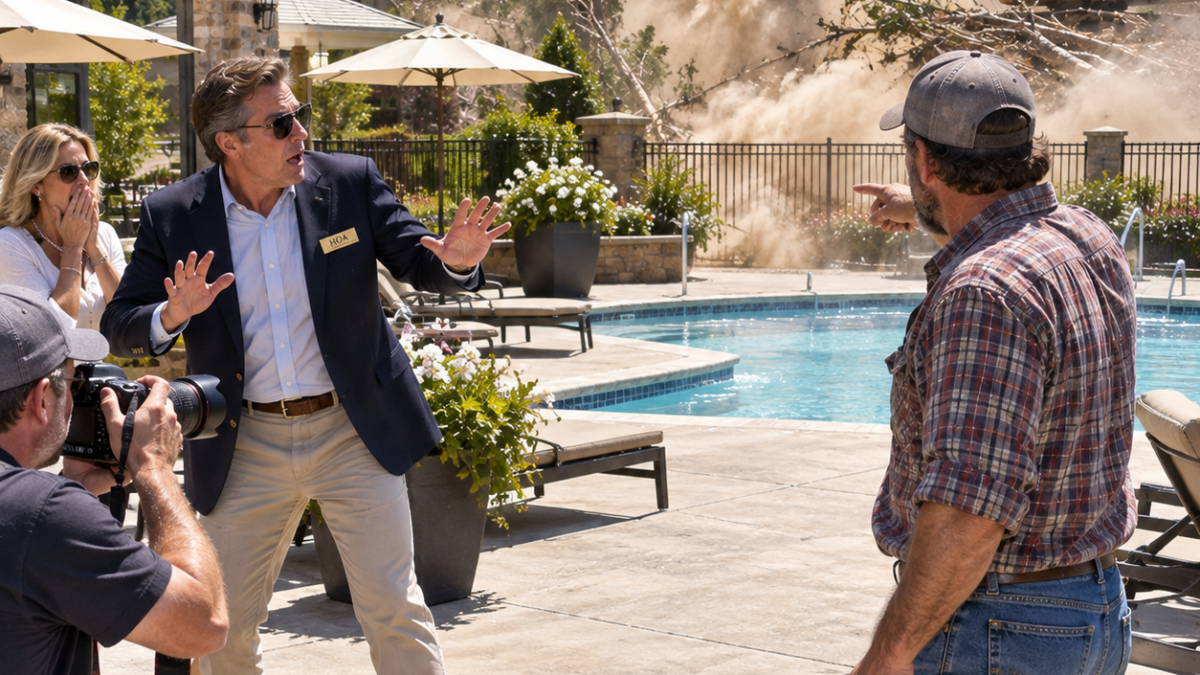
Three days before that photo shoot, I had been tying shade cloth over young serviceberries when I heard the first chainsaw.
The sound came from the east side of my windbreak.
That was wrong.
Juniper Mesa’s landscaping crews worked around the recreation parcel regularly. I was used to mowers, trimmers, blowers, and the occasional chipper near the pool.
But my nursery property sat outside the HOA-managed landscape zone.
There had never been confusion about that.
My father bought the parcel before the clubhouse expansion.
The survey pins were old but clear.
Juniper Mesa maintained the recreation lot.
I maintained Branum Wind and Shade Nursery.
The windbreak stood on my side.
I dropped the roll of shade cloth and walked toward the noise.
A Basin Line Landscape Services truck was parked near the western pool access.
Orange flags ran through the HOA’s planting bed.
Then I noticed a second line of flags.
Those continued across the property boundary.
Into my nursery.
Gus Sheldon stood beside a compact loader studying a laminated field packet.
I knew Gus.
Two winters earlier, he had bought thirty-five bare-root serviceberries from me for a restoration job near Spokane.
“Gus.”
He turned.
“Vincent.”
I pointed at the flags.
“What are those doing over here?”
He glanced down at the map.
“Western corridor.”
“That doesn’t answer my question.”
He hesitated, then handed me the packet.
The first page showed Juniper Mesa’s recreation parcel.
A blue shaded zone marked the HOA-managed landscape area around the pool.
The blue stopped exactly where it was supposed to.
At the parcel boundary.
My nursery sat outside it.
The windbreak sat outside it.
I tapped the blue line.
“Your work zone ends here.”
Gus rubbed his jaw.
“The base map does.”
“The base map?”
He flipped to the next page.
Someone had drawn a red field line extending beyond the blue HOA zone.
Straight through my trees.
Across the top, in large type, were the words:
OPEN WESTERN VIEW CORRIDOR.
Below that:
REMOVE VISUAL OBSTRUCTIONS TO HORIZON LINE.
I stared at it.
“That isn’t trimming.”
“I have a removal instruction.”
“You have a removal instruction for trees on my land.”
“I have a client field directive.”
“You also have a property map telling you the client doesn’t manage this land.”
One of Gus’s workers had a saw idling.
Gus lifted his hand.
The worker shut it off.
Suddenly the only sound left was the west wind moving through the poplar tops.
That windbreak wasn’t beautiful in the way neighborhood committees used the word.
My father had planted the upper row with fast-growing poplars.
Below them came Russian olives.
Below those were native plum, chokecherry, and whatever else Warren discovered could tolerate our winters and survive dry summers.
It looked irregular.
That was partly intentional.
Wind finds clean gaps.
My father used to say symmetry was something people wanted and wind exploited.
“Don’t cut them,” I told Gus.
He nodded.
“I’m reporting the conflict.”
He took photographs.
One of the blue boundary.
One of the red field mark.
One of the flags crossing onto my property.
Then he opened his project app and typed while I watched.
HOMEOWNER OBJECTION PRIOR TO REMOVAL.
PRIVATE NURSERY SHELTER ROW.
WINDBREAK FUNCTION CLAIMED.
BASE MAP CONFLICTS WITH REVISED FIELD SCOPE.
That last phrase mattered later.
At the time, I just wanted the crew gone.
Then Brent Ashmore arrived.
He came through the pool gate wearing dark sunglasses and carrying a tablet.
Brent chaired Juniper Mesa’s Pool and Views Committee.
He had lived there about five years.
Former commercial real estate marketing.
He liked words such as presentation, amenity, alignment, experience, and visual continuity.
My father would have lasted seven minutes in a committee meeting with him.
“What happened?” Brent asked.
I held up the map.
“Your project crossed the property line.”
He lowered his sunglasses.
“The committee approved sightline maintenance.”
“Inside the association zone.”
“We approved an open western corridor.”
“You’re standing on my property talking about my trees.”
He looked through the windbreak toward the ridge.
“Vincent, those trees interrupt the primary amenity view.”
I waited.
“The Sunset View event is eleven days away,” he continued. “We have photographers scheduled. The horizon has been visually broken for years by unmanaged vertical clutter.”
I looked up at the poplars.
“Those are windbreak trees.”
“They’re trees.”
“That’s like saying a roof is lumber.”
He removed his sunglasses completely.
“You’ve always viewed the nursery through your father’s operating philosophy.”
There it was.
Not an insult exactly.
Brent was too polished to insult people directly.
My father had been dead six years, and people still used him as a reference point whenever they thought I was being unreasonable.
Warren tracked wind in pencil notebooks.
He measured soil moisture manually.
He hung ribbons from fence posts to compare turbulence after planting changes.
He could spend forty minutes explaining why three shrubs were spaced incorrectly.
He was exhausting.
He was also usually paying attention to something the rest of us had missed.
Brent tilted his head.
“People used to say Warren saw a system behind every inconvenience.”
I felt my shoulders tighten.
“And sometimes,” Brent added, “a tree row is just a tree row.”
Gus’s phone buzzed.
He read the message.
His expression changed.
“What?”
“Project coordination says the client reaffirmed the directive.”
He showed me the log.
Proceed under revised western corridor field scope.
Client confirms corridor authority.
I pointed at the original map.
“That blue zone still ends over there.”
“I know.”
“And you documented my objection?”
“Yes.”
“Read it.”
Gus did.
“Private nursery shelter row. Windbreak function. Homeowner objection before removal.”
Brent exhaled.
“We are not turning a landscape project into a seminar on wind.”
“I’m not asking for a seminar.”
I looked at Gus.
“I’m asking you not to cut my trees.”
I could have blocked the loader.
I could have pulled out the flags.
I could have stood in front of the first poplar.
For about five seconds, I considered it.
Then I imagined Brent telling everyone I had interfered with an authorized contractor.
The property dispute would become a conduct dispute.
The trees might still come down.
And I would have helped him change the subject.
So I stepped back.
I took out my phone.
Not to yell.
To document.
I filmed the blue work-zone line.
The red field extension.
The survey marker.
The first flagged tree.
Then Gus asked his crew to proceed.
The saw started again.
I stood twenty feet away when the first poplar came down.
I had seen thousands of trees felled.
Nursery trees.
Storm-damaged trees.
Hazard trees.
Dead trees.
But I had never watched someone cut down one my father had planted while I was telling them to stop.
The top leaned east.
For one last second, the branches moved with the wind exactly as they had every year of my life.
Then the hinge gave.
The crown struck the ground.
Dust rose through the branches.
Nobody said anything.
The crew worked methodically.
Poplar.
Russian olive.
Plum.
Chokecherry.
Thirty-two years of layered shelter disappeared in sections.
Brent spent much of the afternoon standing near the pool railing.
Watching the ridge become visible.
By sunset, the horizon was clean.
That was the word he used.
Clean.
From the nursery, the western ground looked suddenly enormous.
Pale.
Loose.
Open.
I stood where the lower shrubs had been.
Wind moved through without changing speed.
My father’s old shed door rattled behind me.
I remember thinking that the place sounded wrong.
The next morning, the HOA pool deck had already begun turning tan.
Not enough for drama.
Dust settled in seams.
Along drains.
At the bottom of the railing posts.
Maintenance washed it away.
By two that afternoon, it was back.
I checked the community weather station.
West-southwest.
Exactly what I expected.
Still, I refused to call that proof.
My father taught me something useful by accident.
He could be so certain that sometimes I learned the value of saying, I don’t know yet.
So that became my rule.
I knew the trees had slowed wind.
I knew they were gone.
I knew dust was reaching the pool.
I did not yet know what that meant operationally.
That was why I started paying attention to the Clear Current Aquatics cart.
Petra Vellis was the operator I had seen during the photo shoot.
Dark work pants.
Black polo.
Hair usually tied up.
No patience for dramatic conclusions.
The day after the photo session, I found her kneeling outside the equipment room with a service case beside her.
A clear plastic sample jar sat on top.
A layer of fine tan material rested at the bottom.
I pointed at it.
“Pool?”
“Yes.”
“Dust?”
“Fine silt.”
“Difference?”
“To you?”
“Yes.”
“Paperwork.”
I smiled.
“To the filtration system?”
“Particle size matters.”
She closed the jar.
I nodded toward the equipment room.
“I heard the pump change pitch yesterday.”
“That could mean several things.”
“You say that a lot.”
“I say it whenever someone asks me for a diagnosis before I have one.”
I liked her immediately.
“So what do you have?”
“I have more fine particulate than I expect.”
“Since when?”
She gave me a look.
“I keep service records, Vincent.”
“I wasn’t accusing you.”
“You grow trees.”
“Yes.”
“That answer should help you understand why records matter.”
Fair.
She looked west.
The missing windbreak was impossible to ignore.
“Was that your shelter row?”
“Yes.”
“The one everyone is arguing about?”
“I’m not arguing with everyone.”
She almost smiled.
“Everybody else talks more.”
A swimmer named Thomas Farrow came through the pool gate with goggles around one wrist.
He saw Petra’s equipment and sighed.
“Again?”
“Service visit.”
Thomas looked at me.
“There it is.”
“What?”
“The tree dispute becoming a pool dispute.”
“I didn’t drive the service cart.”
“You requested records.”
“Not yet.”
“You will.”
That turned out to be accurate.
Thomas pointed toward the water.
“This pool gets dirty every summer.”
“True.”
“We live in dry country.”
“Also true.”
“So why is everybody acting like the sky is falling because some trees came down?”
I looked at the fine grit already collecting in the deck joints.
“The sky isn’t falling.”
“Good.”
“The ground is moving.”
Thomas rolled his eyes.
Brent arrived before we could improve the conversation.
He wore a charcoal polo with the Juniper Mesa logo.
“Thomas is right about one thing.”
I waited.
“Juniper Mesa has always had seasonal dust.”
He looked toward the deck.
“What changed is Vincent’s attention to it.”
There it was.
Cleaner than calling me obsessive.
Same purpose.
I looked at Petra.
“Are you servicing the system more often?”
Brent answered for her.
“Petra does not need to turn vendor scheduling into a neighborhood argument.”
I kept looking at her.
She rested one hand on the case.
“Yes.”
Brent turned.
Petra continued.
“I have been here more often.”
Thomas frowned.
“How much more?”
“I am not doing a six-month maintenance presentation beside the pool gate.”
“Is something wrong with the pool?”
Petra thought before answering.
“I am seeing unusually fine silt.”
Brent frowned.
“That doesn’t answer him.”
“It is the answer I have.”
“The event is in a week.”
“Eight days,” I said.
He looked at me.
“Thank you, Vincent.”
“I grow by calendar.”
Thomas asked if he could swim.
Petra nodded.
“The pool is open.”
That relaxed everyone.
Especially Brent.
He gave me the smallest possible smile.
“Operational.”
Petra picked up the sample jar.
“One dirty deck is cosmetic.”
Brent’s smile faded.
She nodded toward the equipment room.
“A system needing the same attention repeatedly is something else.”
Then she went back inside.
The next morning, the Clear Current cart returned.
Thomas noticed before I did.
“Four times?”
“I counted three.”
“Still too many.”
Petra stepped out carrying a clipboard.
I waited until she finished before asking, “Can I ask you one technical question?”
“One.”
“What does differential pressure mean?”
She stared at me.
“Who taught you that phrase?”
“I saw it in a maintenance index.”
“Who gave you the index?”
“Celia.”
Celia Stanton managed Juniper Mesa.
Petra sighed and pointed toward the equipment room.
“Simple version. Water enters the filtration system. Water exits. We measure pressure on both sides.”
“As material loads the filter, the difference rises?”
“Generally.”
“So higher means dirty?”
“Not exactly.”
“Of course not.”
She smiled.
“It means increased loading. How quickly it increases matters. The material matters. Service interval matters. One number by itself doesn’t tell you much.”
My father used to say one bent branch didn’t tell you the wind.
I kept that to myself.
“How fast is it increasing now?”
“That is a records question.”
So I went to Celia.
Her office sat beside the clubhouse.
She was surrounded by color-coded folders and two monitors.
I asked for six months of pool service summaries.
Then I asked for the landscaping project file.
She looked at me.
“Those are unrelated requests.”
“Maybe.”
“Vincent.”
“I’m not asking you to agree.”
“What are you asking?”
“For the records.”
“The landscape issue is already under review.”
“I want the project scope.”
“The pool is operational.”
“I want the service history.”
She leaned back.
“You’re trying to build a connection.”
“No. I’m trying to see if one exists.”
That answer helped.
Celia was procedural.
Not warm.
Not hostile.
Procedural people become very useful when everyone else is emotional.
“I can release owner-accessible facilities records and vendor service summaries,” she said. “Some contract material may require review.”
“That works.”
“And Clear Current interprets technical data.”
“Good.”
“And Brent will say you are turning a property dispute into a facilities investigation.”
“He has probably already printed that sentence.”
The corner of her mouth moved.
Almost a smile.
By four o’clock, six months of pool service summaries were in my inbox.
I printed them.
My nursery office is dusty on a good day.
I prefer paper when comparing records.
Before the windbreak removal, service entries had space between them.
Routine inspection.
Chemical check.
Scheduled backwash.
Then the dates tightened.
Two days after removal.
Return visit.
Two days later.
Fine silt observed.
Photo setup.
Backwash.
Return check.
Fine material noted again.
Elevated loading.
I was careful.
The pattern did not prove cause.
But it did show change.
The intervals between interventions had shortened.
Brent found me outside the aquatic gate that evening.
He noticed the folded pages in my hand.
“More records?”
“Service summaries.”
“The pool is maintained by professionals.”
“I know.”
“Then why are you auditing them?”
“I’m not.”
“You requested six months of history.”
“I compared dates.”
“That is an audit with less confidence.”
I unfolded the pages.
“How often did Clear Current come back between scheduled visits before the trees were removed?”
“Dry-weather maintenance varies.”
“Yes.”
“Pool use varies.”
“Yes.”
“Wind varies.”
“Yes.”
My agreement annoyed him.
I pointed at the dates.
“The interval changed after the west edge changed.”
“The west edge?”
“My windbreak.”
“There it is.”
“What?”
“The assumption.”
He folded his arms.
“You decided cutting the trees caused a pool problem. Now every maintenance visit becomes evidence.”
“I didn’t say caused.”
“You imply it.”
“I’m asking why the system started needing attention more frequently.”
“Because we live in a dry climate.”
“Then show me the comparable pattern from the previous dry period.”
His eyes dropped to the pages.
Only for a second.
A worker was rinsing tan grit toward a deck drain.
Brent watched him.
“Extra cleaning is a normal burden.”
“That’s deck cleaning.”
“It’s maintenance.”
“Petra told me the filtration system is loading faster.”
His face changed.
“Petra needs to be careful discussing vendor operations with homeowners.”
“She explained differential pressure.”
“You are not a pool operator.”
“I know.”
“Then stop acting like one.”
I folded the pages.
“Ask the certified pool operator why her service intervals are shrinking.”
For once, Brent had nothing ready.
That evening Celia sent another file.
Not exactly a file.
An archive index.
Thirty-two folders.
Electrical.
Pool mechanical.
Deck resurfacing.
Landscape irrigation.
Lighting.
Expansion review.
Near the bottom, one title stopped me.
RECREATION PARCEL WIND AND DUST CONTROLS.
I opened the archive request immediately.
Celia released the folder the next morning.
The first document was older than the current clubhouse.
Dust Mitigation and Wind Erosion Control Plan.
I read the title twice.
Then I found the site diagram.
Arrows came from the west.
Across exposed seasonal soil.
Toward the recreation parcel.
At the western boundary was a shaded strip.
The label beside it read:
Existing shelter row retained as primary near-ground dust control.
I stopped breathing for a second.
The line on that old plan matched my father’s windbreak.
Not approximately.
The same staggered row.
Poplar upper shelter.
Dense lower vegetation.
Open soil beyond.
I leaned back in my chair.
For thirty-two years my father had explained what those trees did.
For six years after his death, I had tried not to sound like him.
And now Juniper Mesa’s own development records were saying the same thing.
I pulled one of Warren’s field notebooks off the shelf.
Brown cover.
Bent corners.
Pencil handwriting slanting downhill even on ruled paper.
I found a spring entry from years earlier.
WEST BLOW.
LOW ROW TOO THIN.
WIND FOUND GAP.
I ran my thumb over the words.
Then I closed the notebook.
My father’s notes mattered to me.
They did not prove anything legally.
The HOA’s own file did.
I kept reading.
The plan did not say the shelter row could never be modified.
That would have been easier.
It said the recreation parcel’s dust-control assumptions depended on maintaining western shelter or an approved equivalent.
A material change required facilities review.
Replacement or alternate mitigation had to be documented.
Then I found the pool expansion approval from seven years earlier.
Larger deck.
Updated equipment.
New seating area.
The dust section contained one sentence:
Existing western mitigation conditions remain in effect.
I called Petra.
She answered on the fourth ring.
“Clear Current.”
“It’s Vincent.”
“I recognized the number.”
“I found something boring.”
“Those are usually the dangerous discoveries.”
I read her the relevant paragraphs.
She went quiet.
“I am not giving you a legal opinion.”
“I don’t want one.”
“You sounded like you were headed there.”
“I want to know whether this matters to pool operations.”
“That is a better question.”
I waited.
“If a facilities document identifies a landscape element as an operating dust control,” she said, “and repeated fine-silt loading begins after that element is removed, yes. I consider the document relevant.”
“Relevant means?”
“It means send it to me.”
“That was almost dramatic.”
“Do not get used to it.”
I emailed it.
Then I asked Celia for three specific things.
Original landscape project scope.
Field packet used by Basin Line.
Committee approval trail.
She called within five minutes.
“You’re expanding the request.”
“I’m narrowing it.”
“You asked for three new categories.”
“One project.”
“What changed?”
“The HOA’s original recreation approval calls my windbreak a primary dust control.”
Silence.
“That is your interpretation.”
“The phrase is printed beside the shelter row.”
I gave her the page number.
I heard her typing.
“I’m checking the cross-reference.”
“Okay.”
“Do not distribute that archive document yet.”
“I haven’t.”
“And Vincent?”
“Yes?”
“This still doesn’t tell us who expanded the contractor scope.”
“I know.”
For the first time, I was comfortable with how much I did not know.
The next morning, the project files arrived.
Original scope.
Field packet.
Approval trail.
The original scope was boring.
That made it useful.
Poolside landscape refresh.
Sightline maintenance within HOA-managed zones.
Trim shrubs.
Lift selected lower branches.
Remove dead material.
The blue work area stopped at the recreation parcel boundary.
Exactly where Gus had said.
Then I opened the contractor field packet.
Same project name.
Different language.
Open western view corridor.
Remove visual obstructions to horizon line.
The red field mark crossed the boundary.
Through my windbreak.
The third file answered the question.
An email from Brent.
Subject:
Western Sightline Completion.
Basin Line may treat remaining shelter vegetation as corridor obstruction where necessary to achieve continuous horizon visibility from the primary amenity deck.
I read it twice.
Then I found Gus’s field note.
10:18 a.m.
Homeowner objected prior to removal.
Identified row as private nursery shelter/windbreak.
Crew paused.
Office contacted.
10:31 a.m.
Committee confirmation received.
Proceed per western corridor field direction.
Below that was a facilities-review box.
Blank.
No initials.
No date.
Nothing.
Celia called.
“Christine wants a limited review at ten.”
Christine Holt was Juniper Mesa’s board president.
She had the kind of face that made weak explanations become uncomfortable very quickly.
The meeting happened in the small conference room behind management.
Christine sat at the head.
Celia beside her.
Brent across from me.
Gus joined by speakerphone.
Petra stood near the wall holding a Clear Current folder.
Christine began without ceremony.
“This is not a hearing. I want sequence.”
Celia projected the original scope.
Then the field packet.
Christine pointed to the red line.
“Where did the western corridor expansion originate?”
Brent folded his hands.
“Committee refinement.”
Christine waited.
Brent continued.
“I drafted field language after the photography consultant identified horizon interruption.”
“The approved scope says association-managed landscape zones.”
“The visual corridor extended beyond that.”
“The view extended beyond it,” Christine said. “Your authority did not.”
Brent’s jaw tightened.
“The shelter vegetation functioned visually as part of the recreation edge.”
I laughed once.
Christine looked at me.
I stopped.
She turned back to him.
“Visual function is not property authorization.”
Gus spoke through the phone.
“For what it’s worth, we stopped when Vincent objected.”
Christine asked, “And then?”
“I contacted dispatch. Dispatch contacted project coordination. We received confirmation to proceed under revised field direction.”
Celia projected Gus’s note.
Christine pointed at the empty box.
“Who completed facilities review before a referenced dust control was removed?”
Celia answered.
“I have no facilities signoff.”
Brent leaned back.
“This was a landscape project.”
Petra spoke from the wall.
“The pool does not care which committee named the project.”
Brent turned toward her.
“The pool is open.”
“Yes.”
“Water quality is acceptable.”
“At this moment.”
Christine looked at Petra.
“Can you establish whether tree removal caused the increased loading?”
“Not from what I have.”
That answer mattered.
Brent almost smiled.
Christine asked, “What would you need?”
“Operating trend after a clean baseline. Repeated service interval. Wind direction. Ideally directional particulate measurements near the aquatic edge.”
“We have a community weather station.”
“Useful for prevailing wind. Not enough to distinguish loading west versus east at the pool.”
Christine turned to Celia.
“Can we install temporary monitors?”
“Yes.”
“Do it.”
Brent leaned forward.
“For an event dust issue?”
Christine looked at him.
“For an operational review your field change made necessary.”
He turned toward me.
“This is exactly what I warned about. Vincent is converting a private-property dispute into a facilities investigation.”
I placed the original map beside the revised field packet.
“This is what your committee approved.”
I tapped the first one.
“This is what the crew used.”
I tapped the second.
“Which line gave your committee authority to redraw a work zone through a documented dust-control feature?”
“The committee has sightline authority.”
“Inside the approved zone.”
“The shelter row disrupted amenity presentation.”
“That still doesn’t answer the question.”
Christine raised one hand.
“Enough.”
She closed the project file.
“The Sunset View event remains scheduled for now.”
Brent smiled faintly.
Christine saw it.
“Do not misunderstand me. The board will not override the certified operator. Petra will evaluate the pool under the service agreement.”
She looked at Celia.
“Install the monitors. Preserve all service records. No additional western landscape work.”
Then Petra.
“If the pool is serviceable, say so.”
“It is currently serviceable.”
“And if conditions change?”
“I document that.”
Brent gathered his tablet.
“The pool will be ready.”
Nobody answered.
He repeated it.
“The pool will be ready.”
Petra turned another page in her folder.
She never looked up.
Three days before the event, Juniper Mesa installed two gray particulate monitors.
One near the western pool edge.
One on the east side near the clubhouse wall.
Then Brent installed six new event banners.
The contrast was almost impressive.
One banner read:
SUNSET VIEW.
Another:
NEW WESTERN HORIZON.
The irony had not arrived yet.
At least not visibly.
Celia sent me the owner-accessible portion of Clear Current’s service agreement.
I found the relevant paragraph.
Clear Current could issue an operational stop when recurring contamination or silt loading prevented the filtration system from maintaining serviceable conditions without repeated intervention.
I called Petra.
“I found the stop provision.”
“That sounds like you found my contract.”
“Celia released the section.”
“Good.”
“So that is where the pool closes.”
“No.”
I leaned back.
“That was efficient.”
“You started with your conclusion.”
“Then what does the section mean?”
“It means I determine whether the operational threshold is met.”
“You.”
“Yes.”
“Not Christine?”
“No.”
“Not Celia?”
“No.”
“Not me?”
“Very much not you.”
I laughed.
“If the threshold is met?”
“I issue the stop notice for public pool operation.”
“Can I ask you to?”
“You can ask anything.”
“That isn’t the same thing.”
“No.”
Then her tone changed.
“Vincent, do not use my contract as leverage in your property dispute.”
“I won’t.”
“I mean it.”
“So do I.”
“I will not close the pool to prove you were right about trees.”
“I understand.”
“I close it if the system cannot maintain normal service conditions.”
“Yes.”
This time I actually did understand.
By afternoon, somebody had posted the facilities-review notice in the resident group.
Within an hour, the story changed three times.
The pool might close.
Then I might close the pool.
Then I was threatening to close the pool unless the HOA replaced my trees.
None of those statements were true.
Thomas Farrow waited for me near the recreation gate with three residents.
A woman had her arms folded.
A man beside her looked irritated before I even stopped walking.
Thomas said, “Can we talk?”
“We are.”
“You know what I mean.”
The woman spoke.
“My grandkids are coming Saturday.”
The man added, “We paid for catering through the event assessment.”
I nodded.
“I didn’t schedule the event.”
Thomas looked frustrated.
“Are you asking Clear Current to shut the pool?”
“No.”
“Did you send Petra the dust-control plan?”
“Yes.”
“Did you request maintenance records?”
“Yes.”
“Did you raise the issue with the board?”
“Yes.”
He spread his hands.
“Then what do you call that?”
“Questions.”
Brent’s voice came from behind them.
“I think residents are asking about consequences, Vincent.”
He walked toward us wearing sunglasses and carrying his tablet.
Thomas turned.
“Is the pool closing?”
Brent sighed.
“The pool is under operational review because Mr. Branum has connected his private landscape dispute to aquatic facilities.”
I stared at him.
“Private landscape dispute?”
“That is where this began.”
“No. It began when your field packet crossed onto my property.”
The woman looked between us.
Brent lifted one hand.
“This escalation is exactly what I wanted to avoid.”
I almost admired him.
He had expanded the scope.
He had ignored the boundary.
He had ordered removal after my objection.
He had skipped facilities review.
Now escalation was something I had apparently carried in my pocket.
Thomas turned to me.
“What do you want?”
That question stopped me.
Because I did want things.
I wanted the trees restored.
I wanted the HOA to admit they were functional infrastructure.
I wanted Brent held accountable.
I wanted reimbursement.
I wanted the board to change the process.
But none of that made me the pool operator.
“For the pool?” I said.
“Yes.”
“I want Petra to do her job.”
Thomas frowned.
“That’s it?”
“That’s it.”
“And the trees?”
“Different problem.”
Brent stepped forward.
“You have spent all week arguing they are the same system.”
“No.”
I looked at him.
“I said one decision affected both systems.”
He stopped talking.
Only for a second.
But long enough.
I turned back to Thomas.
“If Petra says the pool is serviceable, it stays open. If she says it isn’t, I don’t get a vote.”
The woman slowly unfolded her arms.
“So you aren’t demanding a shutdown.”
“No.”
Brent looked annoyed.
He had lost the headline.
Not the argument.
Just the headline.
Petra walked out of the management office carrying her black folder.
Celia was behind her.
Everyone turned.
Thomas asked, “Will the pool be open Saturday?”
Petra stopped.
“I will conduct a final operational review on event day.”
Brent said, “Petra.”
She ignored him.
“I am not pre-approving the pool.”
A gust moved through the open corridor.
One of the Sunset View banners pulled hard against its base.
Nobody said anything.
Saturday morning looked perfect.
That was the problem.
At seven, the deck was white.
The water was blue.
Clear Current had serviced the filtration system before sunrise.
Petra recorded baseline pressures.
The west rail was clean.
The drains were clean.
The skimmers were clean.
Brent stood by the gate with coffee.
“Reset,” he said.
Petra did not look up.
“Serviced.”
“Same idea.”
“No.”
I stayed outside the pool gate.
I had no reason to hover.
The system was clean.
Now everyone had exactly what they needed.
A starting point.
At 8:15, almost no wind.
The western and eastern monitors showed little difference.
Catering tables rolled into the courtyard.
Florists brought low arrangements because tall arrangements blocked photographs.
That detail had Brent written all over it.
At 9:40, the first west breeze arrived.
Nothing dramatic.
A banner moved.
Dry leaves traveled east along the nursery lane.
Far beyond the missing shelter row, pale ground began lifting in tiny curls.
Petra stepped out of the equipment room.
She looked west.
Then at her watch.
By 10:15, the west monitor climbed above the east one.
Not by an alarming amount.
Enough to separate.
Brent saw Celia checking the display.
“Those are temporary monitors.”
“Yes.”
“They aren’t pool equipment.”
“No.”
“Then why are you watching them?”
“Because the board authorized directional monitoring.”
A faint tan line began forming along the western waterline.
At 11:07, a maintenance worker wiped it.
At 11:42, he wiped it again.
He caught me looking.
“Don’t start.”
“I didn’t say anything.”
“You have a face.”
“So do you.”
“Mine is working.”
He walked away carrying the dirty rag.
Around noon, the Clear Current cart moved twice between the equipment room and service shed.
The pump hum tightened.
I heard it from outside the fence.
Brent kept inspecting chairs.
At 1:30, he asked Celia whether Petra could finish the review early.
“No.”
“The event begins at 6:30.”
“I know.”
“We need certainty.”
Celia looked at the equipment-room door.
“Then you picked the wrong system.”
The wind strengthened gradually.
Dust did not arrive as a wall.
That would have made things easier.
It came in pale ribbons.
Low across the ground.
Through the open western corridor.
Over decorative gravel.
Across deck joints.
Into drains.
Onto the waterline.
Into skimmers.
Each ribbon looked insignificant.
Together, they kept delivering material.
The pool had been cleaned before sunrise.
The environment kept loading it again.
At 3:12, Petra came out of the equipment room.
Brent followed.
“The system was serviced this morning.”
“I know.”
“The deck is being maintained.”
“I know.”
“The water is visibly clear.”
“I know.”
“Then what are we waiting for?”
Petra stopped walking.
“For the system to demonstrate that it can maintain a normal operating interval.”
“It has been operating all day.”
“That isn’t the standard.”
She continued toward the west monitor.
Celia followed.
Brent stayed where he was.
At 4:20, event volunteers arrived with name badges.
Cars began filling the clubhouse parking row.
Catering staff uncovered trays.
Someone tested the sound system.
The west-southwest wind held steady.
The western monitor remained higher than the eastern control.
Fine grit returned after cleaning.
At 5:47, I could see Petra through the equipment-room doorway.
Her black folder was open.
One hand rested beside the gauge log.
She looked at the reading.
Then her watch.
Then the page.
Guests were already walking toward the pool.
The gate remained closed.
At 6:02, Brent finally went to Celia.
“Open the gate.”
She did not.
He looked at his watch.
“Twenty-eight minutes.”
“I know.”
“We have guests.”
“I can see them.”
“We cannot keep everyone standing outside because Petra wants another look at a gauge.”
The equipment-room door opened.
Petra came out carrying her black folder and one white page.
Christine Holt walked behind her.
Something in Brent’s posture changed.
He crossed the deck.
“Well?”
Petra looked at Celia first.
“I am issuing an operational stop notice for public pool use under the Clear Current agreement.”
Brent stared at her.
“No.”
Petra’s face did not move.
Celia held out her hand.
Petra gave her the page.
Celia read the first paragraph.
Then she turned to the gate staff.
“Keep the aquatic facility closed.”
Brent pointed toward Petra.
“She cannot close the deck.”
“Correct,” Celia said. “She suspended public pool operation. Management is closing facility access during the stop.”
The distinction made Brent even angrier.
“The water is clear.”
“Yes.”
“The pool was serviced this morning.”
“Yes.”
“The deck has been cleaned continuously.”
“Yes.”
“Then explain this.”
Petra opened the folder.
“After service, filtration pressure returned to baseline.”
“Exactly.”
“Then fine particulate loading increased.”
She turned a page.
“Differential pressure returned to the service threshold within hours.”
Brent glanced toward me.
I did not move.
Petra continued.
“That means the system did not maintain a normal service interval after intervention.”
“You can service it again.”
“We already did.”
“Then do it again.”
“That is repeated intervention.”
Brent stared at her.
“The pool looks fine.”
“My operating standard is not whether the water photographs blue.”
Thomas stood near the gate.
He looked at Brent.
Then me.
I gave him nothing.
This was not my decision.
Brent lowered his voice.
“You are disrupting a scheduled event over dust.”
“No,” Petra said. “I am stopping public pool operation because the filtration system cannot maintain serviceable conditions under the current loading pattern without repeated intervention.”
“The monitors are temporary.”
“The stop is not based on monitors alone.”
“The dust-control plan is thirty years old.”
“The stop is not based on that alone.”
“Vincent has been feeding you a theory.”
Petra looked toward me.
Then back at Brent.
“Vincent does not operate this pool.”
“I know that.”
“Then stop arguing with me like he signed the notice.”
Brent went very still.
That was the closest I had ever seen him come to losing composure.
Then the wind strengthened.
Not dramatically at first.
I felt grit along the side of my neck.
Guests near the gate began looking west.
For about ten seconds, the basalt ridge remained perfectly visible.
Then the pale ground below it started disappearing.
A tan band lifted.
Low.
Wide.
Horizontal.
It moved across the exact stretch where the windbreak had stood.
Brent turned.
So did everyone else.
The new western view began filling from the bottom.
Dust crossed the empty shelter line.
Passed over the gravel.
Reached the curb.
One event volunteer grabbed a stack of paper programs before the wind scattered them.
White lounge fabric snapped.
Dust streamed across the deck.
It collected in the joints.
At the drains.
Along the blue tile.
Around Brent’s shoes.
The banner behind him pulled tight.
NEW WESTERN HORIZON.
For a moment, there was no horizon.
I thought about my father’s notebook.
LOW ROW TOO THIN.
WEST WIND FOUND GAP.
I did not need to show anyone.
The wind was writing the same sentence across Juniper Mesa’s deck.
A maintenance worker came through the service gate holding clean white rags.
He stopped.
Looked across the deck.
Then lowered his arms.
There was too much surface to wipe.
Petra watched the dust reach the water.
Then she looked at Celia.
“Add this condition to the operating record.”
Celia nodded.
Brent turned toward her.
“You’re documenting a gust?”
“Current directional event during active review.”
“It’s dust.”
“Yes.”
“We live in a dry climate.”
“Yes.”
He looked offended by agreement.
The dust kept moving.
That was the thing Brent couldn’t negotiate with.
Nobody had sabotaged the pool.
Nobody had redirected the wind.
Nobody had dumped soil on the deck.
The filtration system had done exactly what it was designed to do.
It filtered what arrived.
The problem was how much kept arriving and how quickly.
Thomas came over to the nursery fence after the heaviest band passed.
Dust coated the brim of his Juniper Mesa cap.
He rubbed it with his thumb.
“I thought you were trying to close the pool.”
“I know.”
“But Petra closed it.”
“Petra stopped pool operation. Celia closed the facility.”
He looked at me.
“You really enjoy exact sentences.”
“I grow by calendar.”
He laughed.
Then another thin band of dust came through the gap.
Christine stood beside Petra and Celia.
She looked at the pool.
Then the open west edge.
She did not ask whether I felt vindicated.
She did not ask Brent why the view mattered.
She asked the only useful question.
“What has to change before normal operation can resume?”
Petra answered first.
“Stop feeding the system.”
Christine looked west.
“Meaning?”
“Temporary porous wind control immediately. Not a solid wall. Something that reduces near-ground flow without creating another turbulence problem.”
I nodded automatically.
Petra saw me.
“You have opinions.”
“I was being quiet.”
“You were nodding professionally.”
That almost made Christine smile.
We installed temporary wind mesh first.
Not the cheap solid privacy fabric people buy at hardware stores.
A porous agricultural shelter mesh.
Enough open area to bleed pressure.
Enough density to slow near-ground movement.
Petra did not design it.
I did not authorize it.
Facilities hired an environmental contractor.
That distinction mattered too.
Within two days, the directional monitor difference narrowed during west winds.
Dust still reached the pool.
Nobody promised magic.
But the loading trend slowed.
Clear Current serviced the system.
Then watched.
Twenty-four hours.
Forty-eight.
Three days.
Pressure rose normally.
Not racing back toward the intervention threshold.
Petra reopened the pool under temporary mitigation.
The Sunset View event had already been canceled.
Juniper Mesa rescheduled it for later in the season.
Brent hated the word canceled.
He preferred delayed.
Nobody argued.
The property issue came next.
My attorney could have turned it into a larger fight.
Trespass.
Unauthorized tree removal.
Loss of mature functional landscape.
Replacement value.
Business impact.
Those claims were real.
But I wanted the row restored more than I wanted a dramatic check.
The board’s insurer sent an arborist and land-use consultant.
They reviewed the original shelter design.
The recreation dust-control plan.
My nursery survey.
The contractor instructions.
The committee email.
Gus’s documented objection.
There was not much ambiguity left.
The row had been mine.
The HOA had approved a project inside its own zone.
Brent had expanded the working field scope beyond that zone.
He did not have authority to do that.
The board entered mediation.
Christine asked me directly what I wanted.
We met in the clubhouse conference room.
No audience.
No residents.
No cameras.
My attorney sat beside me.
The insurer’s representative sat across.
Brent was there too.
He looked tired.
Christine said, “Vincent, what outcome are you seeking?”
I had thought about the answer for a week.
“Restoration.”
The insurance representative asked, “Like-for-like replacement?”
“That’s impossible.”
She looked relieved that I understood.
“You cannot replace thirty-two-year-old shelter function in one season.”
“No.”
“So what does restoration mean?”
“A designed working system. Temporary control while plants establish. Irrigation. Monitoring. Replacement guarantee. And no committee field changes to functional landscape without facilities review.”
Brent shifted.
Christine asked, “Damages?”
“Yes.”
My attorney placed the nursery valuation on the table.
Mature trees do not become worthless because they are ugly.
The appraiser accounted for their function.
Shade.
Wind reduction.
Nursery microclimate.
Replacement labor.
Lost stock protection.
Not sentimental value.
My father’s history did not appear as a dollar line.
I was grateful for that.
The settlement ultimately covered restoration, temporary wind control, affected nursery operations, professional fees, and monitoring.
The amount was meaningful.
It was not a lottery ticket.
That felt right.
Then came the harder question.
What should replace the windbreak?
The old row had worked.
But it had never been perfect.
My father had planted some species I would never choose today.
Russian olive had become invasive in parts of the West.
Several poplars were near the end of their useful lives.
The lower layer had gaps.
So I resisted the temptation to rebuild my father’s exact design.
That surprised people.
Especially Brent.
During the restoration meeting, he pointed to the new concept.
“This isn’t what was removed.”
“No.”
He looked at me.
“I thought your position was that the original row was necessary.”
“My position was that shelter was necessary.”
“So the exact trees weren’t.”
“Function isn’t nostalgia.”
That silenced him.
The new design used staggered layers.
Taller shelter trees set back from the pool sightline.
Medium native shrubs in front.
Dense lower planting near ground level.
Species selected for drought tolerance, root behavior, fire considerations, and long-term maintenance.
The restoration designer also preserved framed openings toward the basalt ridge.
Brent noticed immediately.
“So the view remains.”
“Some of it.”
He looked at me.
“You agreed to that?”
“If the shelter function holds.”
“You spent weeks fighting the view corridor.”
“I fought removing a control without understanding what it controlled.”
He stared at the plan.
“Wind doesn’t care about your camera height,” I added.
That was probably the closest I came to gloating.
He let it pass.
Christine introduced a new facilities rule at the next board meeting.
Any proposed alteration to functional landscape required review before field work.
Shelter rows.
Drainage swales.
Erosion controls.
Fire buffers.
Stormwater planting.
The Pool and Views Committee could still discuss appearance.
It could still recommend pruning.
It could still propose sightlines.
It could not redraw the functional landscape in the field.
Brent remained committee chair.
That surprised some people.
Peter—the same resident who always wanted heads to roll—asked me afterward why the board had not removed him.
“Because they changed his authority,” I said.
“He cut down your trees.”
“He authorized the field expansion.”
“Same difference.”
“Not legally.”
Peter shook his head.
“There you go again.”
“Exact sentences.”
“You should be angrier.”
“I was.”
“What happened?”
“We fixed the part that matters.”
Brent lost unilateral field-change authority.
His committee had to present the restoration costs publicly.
That meeting was uncomfortable.
Christine put the expenditure summary on the screen.
Temporary wind control.
Additional pool service.
Environmental monitoring.
Restoration design.
Plant installation.
Irrigation.
Event delay.
Professional review.
Insurance costs.
Brent read each line.
No speech.
No resignation.
No grand apology.
Just the cost of a cleaner horizon.
One line at a time.
Later, outside the meeting room, he stopped me.
“Do you think I did this because I hated your father’s trees?”
“No.”
He looked surprised.
“I think you wanted the view.”
“I did.”
“And I think you believed appearance was the only thing those trees were doing.”
He was quiet.
“That sounds stupid now.”
“It sounded incomplete then.”
He looked through the clubhouse windows toward the temporary wind mesh.
“I genuinely thought it was clutter.”
“I know.”
“You could at least enjoy saying you warned me.”
“I did warn you.”
“That isn’t the same thing.”
“No.”
For the first time, he laughed.
Barely.
Then he looked serious again.
“I should have stopped when Gus showed me the base map.”
“Yes.”
“I should have sent the scope back for review.”
“Yes.”
“You are not going to make this easier for me.”
“You don’t need easier.”
He nodded.
Fair enough.
The first restoration planting went in that fall.
Young trees looked ridiculous beside the memory of mature ones.
Thin trunks.
Support stakes.
Visible irrigation emitters.
The shrubs had more mulch around them than branches.
I stood there with the restoration designer after installation.
“This will take years.”
“Yes.”
“I hate that.”
“I know.”
“Tell me something useful.”
She looked down the line.
“It doesn’t have to be mature to begin working.”
That helped.
The temporary mesh remained while the plants established.
During west winds, the monitors stayed in place.
Petra kept the pool-service data.
Not because we expected another shutdown.
Because the board wanted to know when temporary mitigation could safely come down.
That winter was wet.
The following spring, several lower shrubs failed.
The contractor replaced them under warranty.
I moved two emitters myself, then realized I technically shouldn’t be touching association-funded restoration infrastructure and called Celia.
She laughed.
“You complained for months about people touching functional landscaping without authorization.”
“I know.”
“And now?”
“I was adjusting two emitters.”
“Without authorization.”
There was a pause.
“I dislike the direction of this conversation.”
“So did Brent.”
I had no answer for that.
By the following October, the young shelter row had begun to look like something.
Not my father’s windbreak.
Something new.
The taller plants had filled out.
Lower shrubs had closed several gaps.
The staggered spacing was working.
Temporary mesh still stood behind it.
Facilities wanted one full dry season of acceptable monitoring before removal.
Petra agreed.
Brent complained that the mesh ruined photographs.
Nobody cared.
Not enough to change the procedure.
Then came the October review.
West winds for four days.
Dry ground.
No recent rain.
Exactly the kind of period we needed.
The west and east monitor trends remained within the accepted range.
Pool service intervals stayed normal.
Differential pressure increased gradually.
No emergency backwash.
No repeated intervention.
No fine-silt surge.
Petra reviewed the records.
Then signed the operating trend approval.
Facilities authorized removal of the temporary mesh.
I was there when the crew rolled it up.
Not because I needed to supervise.
Because I wanted to see what happened when the young row stood alone.
The west wind came across the plateau that afternoon.
Dry.
Steady.
I walked to the nursery edge.
Young branches bent east.
Lower leaves shook.
Beyond the property, dust lifted from the open ground.
I watched it move toward us.
For a second, I felt eighteen again.
Standing beside my father.
Waiting for him to explain something too long.
The dust reached the young shelter row.
It did not disappear.
That wasn’t the purpose.
It slowed.
Spread.
Dropped.
Some passed through.
Enough did not.
Beyond the leaves, I could still see the basalt ridge.
The sunset reached the pool.
The white deck stayed white.
I stood there longer than I meant to.
Warren would have hated two of the shrub placements.
Maybe three.
He would have complained about the tree spacing.
Then a year later, after taking measurements no one asked for, he might have admitted the designer had been right.
I could hear the entire imaginary argument.
That surprised me more than anything else.
For years after my father died, I had tried not to become him.
When someone mentioned wind, I shortened my answers.
When someone called a tree row “just landscaping,” I bit back the lecture.
When neighbors joked about Warren seeing systems behind everything, I smiled.
I thought being reasonable meant sounding less certain than he had.
The entire Juniper Mesa mess taught me something different.
I did not need to sound unlike my father.
I needed to do something he occasionally struggled with.
Be accurate about what I knew.
Be honest about what I did not.
I knew trees.
Petra knew pools.
Celia knew process.
Gus knew his contractor records.
Christine knew governance.
The failure happened when one committee acted as though seeing a horizon meant understanding the system in front of it.
The solution worked because nobody had to pretend to know everything.
The following summer, Juniper Mesa held another sunset event.
Smaller.
No giant banners.
No phrase about a “new western horizon.”
Brent still organized it.
I received an invitation.
I almost threw it away.
Then I went.
Mostly because Petra texted me:
You should see your extremely boring success.
The pool deck was crowded when I arrived.
Children were swimming.
Adults stood near the west rail with drinks.
The ridge glowed dark purple beneath the evening sun.
From the seated deck, the view remained open through the intentional breaks in the shelter planting.
The lower shrubs slowed near-ground air.
The taller trees framed the horizon without forming a wall.
Brent noticed me near the gate.
He walked over.
“No dust storm.”
“Dangerous thing to say out loud.”
He looked west.
“Fair.”
We stood quietly for a moment.
Then he said, “The view is better than before.”
I looked at him.
He raised both hands.
“I mean before we cut the old row.”
I studied the ridge.
“Probably.”
“You can admit that?”
“I never said your view was bad.”
He smiled.
“Just the method.”
“The property line, the process, the missing facilities review, and the removal of a thirty-two-year-old wind control.”
“So mostly the method.”
“Mostly.”
He laughed.
A breeze moved through the young trees.
The leaves shifted.
Nothing dramatic happened.
Nobody ran for a broom.
The pool pump kept its steady background hum.
Petra came out of the equipment room and saw us.
She pointed at me.
“No interpreting my gauges tonight.”
“I’m retired.”
“From what?”
“Pool operations.”
“You were never in pool operations.”
“Exactly. Clean retirement.”
She shook her head and walked away.
At the west rail, Thomas Farrow stood with his granddaughter.
He had his Juniper Mesa cap.
No dust on it.
He caught my eye.
Then rubbed the clean brim deliberately.
I laughed.
My father would have liked that.
Not the joke.
The result.
A system working quietly enough that nobody noticed it.
That was always the point.
The west wind never stopped.
We did not defeat it.
We did not wall it out.
We gave it something to move through.
Something that slowed it before loose ground became somebody else’s problem.
Beyond the young branches, the ridge stayed visible.
The sunset still reached the water.
And long after the argument about views, committees, property lines, pool filters, and my father’s “obsessive” tree row had faded, the simplest evidence remained right there in front of us.
The wind kept moving.
The new shelter row moved with it.
And the pool deck stayed white.








