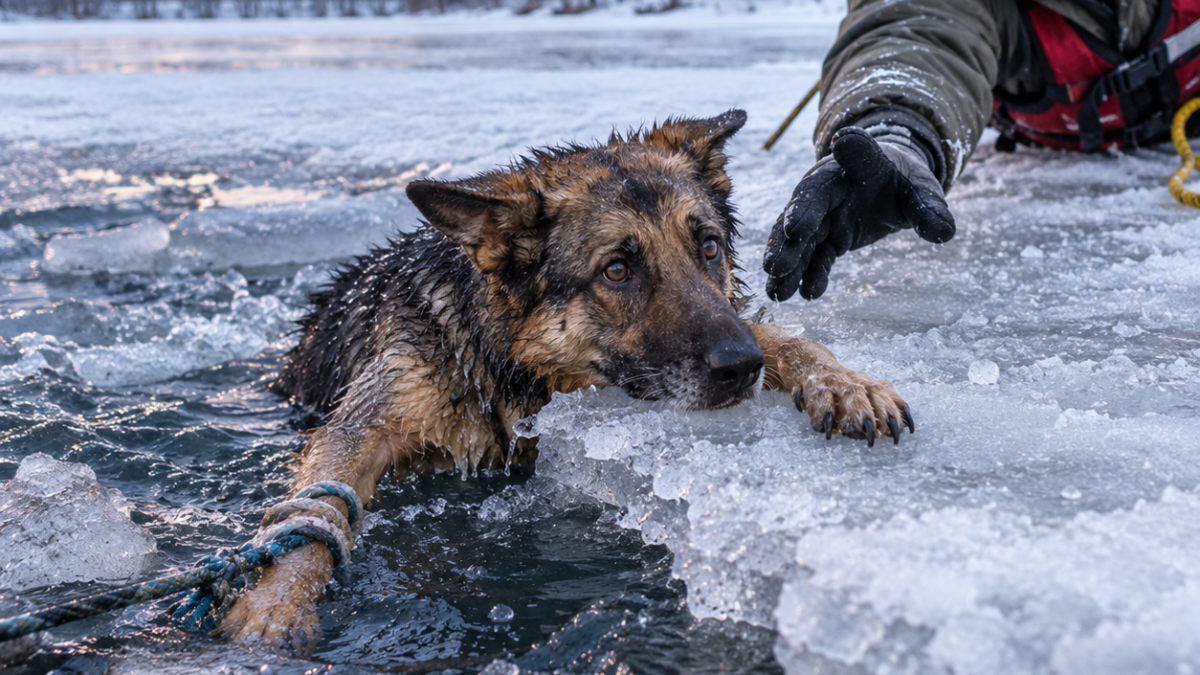
The emaciated German Shepherd could reach the broken edge of the ice, but every time she tried to climb out, something beneath the water pulled her right leg backward.
“Two puppies,” Lena repeated into the radio.
Her voice stayed calm.
Mine did not.
The Shepherd’s jaw rested in my left hand while her body floated awkwardly beneath the ice shelf.
Every small movement tightened the rope around her right foreleg.
The rope wasn’t simply tangled around a branch.
It led directly toward the crate.
That changed everything.
We needed the mother free.
We needed the crate stable.
And we needed both things to happen in the correct order.
I could feel almost nothing through my gloves anymore.
Cold water does that frighteningly fast.
Training doesn’t make you warmer.
Experience doesn’t improve circulation.
The body has rules.
Ignore them and eventually you lose.
Lena moved the light.
Once the beam stopped shaking, the underwater shape became clearer.
The crate rested against a shallow submerged ledge.
A fallen branch held one upper corner high enough to create a tiny air space.
The puppies had crowded into it.
Their noses touched the metal bars.
We had no idea how long they had been there.
The mother could not have survived completely submerged for hours.
She hadn’t.
There was just enough space beside the branch for her muzzle to reach air.
From shore, most of her body had been invisible below the ice line.
That single paw was the only thing I had seen.
The dog shifted.
The rope tightened.
Her ribs pressed against my sleeve.
She was not thrashing anymore.
That was not good.
Strong animals struggle.
She made only small, exhausted movements.
Lift nose.
Breathe.
Slip.
Try again.
I stopped thinking about lifting her.
Keeping her airway above the surface became the immediate goal.
Lena tested the crate’s position.
It moved.
Barely.
But enough.
The larger puppy climbed higher.
The smaller remained below it.
“Stop.”
We stopped.
That pause is the part I remember most clearly.
Not dramatic movement.
Not shouting.
Stillness.
Every instinct screaming move faster.
Training saying don’t.
Because uncontrolled speed could have rolled the crate.
Lena secured its frame first.
Only then did we work on the rope.
The line around the Shepherd’s foreleg was under tension, but not embedded deeply.
We freed it carefully.
The moment the rope released, the mother drifted toward me.
Almost weightless.
Not because she was small.
Because she had spent everything.
I understood then how much effort she had been using just to remain in position.
“Bring her up.”
Together we guided her chest onto the rescue sled.
Her front half came first.
Her rear legs followed without helping.
No kicking.
No push.
Nothing.
Her body was done.
A firefighter received her closer to shore.
As the sled began moving away, the Shepherd lifted her head.
She looked past the people.
Past the blankets.
Back toward the opening.
Back toward us.
Back toward the crate.
Her left paw slid along the sled edge before dropping.
“She’s watching.”
“I know,” Lena said.
There was no time to make more of it.
We turned back.
The second approach was for the crate.
Nobody dove beneath the ice.
Nobody improvised a heroic underwater grab.
We worked from the controlled opening.
Lena managed the secured frame.
I reached into the water from our supported position.
The cold bit through everything.
We lifted gradually.
One inch.
Another.
Keeping the air corner up.
Then the branch released.
The crate tilted.
Water swept through the highest corner.
The larger puppy moved.
The smaller vanished beneath him.
“Keep it coming.”
Everyone already was.
There was no faster speed that was also safe.
That truth feels cruel during emergencies.
Sometimes maximum effort is still slower than your fear wants.
The crate rose.
Water poured through the bars.
The larger puppy pressed against the door.
The smaller one lay still.
When the crate cleared the opening, it was transferred toward shore.
I followed on the next movement back.
My hands shook so hard I could barely tell whether it came from cold or adrenaline.
The mother lay wrapped near the ambulance.
She lifted her muzzle when the puppies arrived.
The larger one moved inside the towel.
The smaller one did not.
Until then, I had been measuring success by distance.
Out of water.
Across ice.
Onto shore.
Suddenly none of that meant enough.
The smaller puppy was not breathing normally.
A responder trained in animal resuscitation took over.
I moved back.
That was another lesson rescue work teaches repeatedly.
The useful person is the person with the right skill at that moment.
Not the person who arrived first.
Not the person who feels emotionally invested.
I had helped bring the puppy out.
Now I was in the way.
So I stepped aside.
The mother tried to raise herself when the smaller puppy was carried past.
A firefighter supported her.
The larger pup was brought close enough for her to see.
Dark brown.
White chin.
He moved weakly.
His nose pushed toward her chest.
She lowered her head until her muzzle touched his back.
For the first time since I’d seen her, she made a movement that had nothing to do with breathing or escape.
She rested her chin on him.
The smaller puppy was tan with one dark ear.
Everything around the resuscitation seemed painfully normal.
Truck idling.
Radio crackling.
Someone asking for another towel.
Wind moving through bare trees.
I watched the puppy’s side.
Nothing.
Then—
a breath.
Not recovery.
Just one breath.
Nobody cheered.
The responder kept working.
Another breath came.
Weak.
Irregular.
Then another.
The emergency veterinary hospital was already waiting.
All three dogs were transported as soon as they were stable enough to move.
I watched the vehicle disappear down the access road.
Only then did Lena say:
“Sit down.”
“I’m fine.”
“You can’t work your zipper.”
I looked down.
She was right.
My fingers had stopped cooperating.
“I want to go to the hospital.”
“You’re getting checked first.”
“I’m fine.”
“Mason.”
Anyone who has ever worked with Lena knows that tone.
Argument over.
Another officer took my preliminary notes while I warmed up.
I kept seeing the smaller puppy disappear beneath the larger one.
Again.
Again.
That is what adrenaline leaves you with afterward.
Looping images.
By the time I reached the veterinary hospital, the dogs were already receiving treatment.
The veterinarian was Dr. Priya Shah.
She spoke plainly.
I appreciated that immediately.
The mother was severely underweight.
Dangerously cold.
Exhausted.
The rope had caused an abrasion on the right foreleg, but that injury was not the biggest concern.
Her entire body had been operating with almost no reserve.
The puppies were being monitored for cold exposure and water inhalation.
The smaller one remained on respiratory support.
“Will he make it?”
Dr. Shah looked at me.
“I don’t know.”
I hated the answer.
I respected it.
“Surviving the first hour doesn’t guarantee the night.”
No false comfort.
Just what she knew.
A technician scanned the mother for a microchip.
Until then, I had been calling her Mama.
The scanner beeped.
A number appeared.
Registration information.
A name.
An old phone number.
The first call went unanswered.
The second time, a man picked up before the second ring.
The technician introduced herself.
There was a pause.
Then I heard his voice through the speaker.
“Do you have Wren?”
Not:
What kind of dog?
Not:
Where did you find her?
He said her name.
The technician confirmed the microchip.
The man immediately asked:
“White patch under her throat?”
“Yes.”
“Small notch near the tip of the left ear?”
“Yes.”
Silence.
So complete the technician checked the phone.
“Sir?”
“I’m here.”
His voice broke.
“My name is Peter Lawson.”
Wren had been missing fourteen weeks.
Fourteen.
Peter had reported her stolen.
Updated the microchip record.
Called shelters.
Expanded the search area.
Answered unknown numbers for months.
Because any one of them could have been the call.
This was the call.
Then Peter sent a photograph.
Wren beside him in a search-team harness.
Healthy.
Strong.
Thick coat.
Bright eyes.
Snow behind them.
I looked from the photograph to the dog under the hospital blanket.
Her ribs visible.
Right leg wrapped.
Eyes barely open.
The distance between those two images felt larger than the lake.
Peter reached the hospital that evening.
His daughter drove him.
He was in his early seventies.
Moved carefully with a cane.
Dr. Shah stopped him before he entered.
Explained Wren’s condition.
Asked him to keep the reunion quiet.
No excitement.
No pushing her to stand.
No emotional expectations.
Peter nodded.
Every word.
He entered.
Wren’s eyes were half closed.
He stopped several feet away.
“There you are, girl.”
One ear moved.
That was all.
Then her head lifted.
Slowly.
Painfully.
She turned toward his voice.
Recognition did not look like a sprint.
It did not look like television.
It looked like an exhausted dog spending the little energy she had left to face someone she knew.
Peter sat.
He placed one hand where she could reach.
Wren stretched her muzzle forward.
Nose against fingers.
Stayed there.
Peter didn’t pull her closer.
He rubbed the uninjured side of her face with his thumb.
“That’s my girl.”
His voice cracked.
Then he looked at Dr. Shah.
“Does staying help?”
That question told me almost everything I needed to know about him.
He wasn’t asking:
Can I hug her?
Can I make her stand?
Can someone take a picture?
He was asking what Wren needed.
Dr. Shah told him quiet presence was fine.
So he stayed.
Until then, I had known Wren only through danger.
Ice.
Rope.
Crate.
Cold.
Peter restored an ordinary dog to the room.
He told us she hated vacuum cleaners.
She loved cheese.
She slept upside down in warm weather.
Her treats were kept in the second kitchen drawer because she had learned to open the first one.
And then he told us something else.
Wren had worked with a volunteer search team.
Several years.
Missing-person searches.
Cold-weather operations.
Retired before she disappeared.
“She was steady,” Peter said.
“Persistent.”
He smiled weakly.
“But she was still a dog.”
I liked him even more for saying that.
People wanted to turn Wren into something superhuman the moment they heard her story.
Peter wouldn’t.
When I described the paw scratching at the ice, he listened.
I expected him to say it was a trained signal.
He didn’t.
“Could have been.”
He looked at Wren.
“Could have just been her trying to get purchase.”
Exactly.
We knew the scratching made me stop.
We knew it led us to her.
We did not know every intention behind it.
Truth did not need exaggeration.
The theft report changed another part of the story.
Wren had disappeared from Peter’s fenced property while he was at a medical appointment.
A neighbor had seen an unfamiliar vehicle.
Not enough to identify anyone.
Not then.
Now the microchip connected the lake rescue to that old report.
Investigators handled the rest.
Vehicle footage.
Witness statements.
The recovered crate.
The rope.
Records.
Eventually, evidence linked a suspect to Wren’s disappearance and supported allegations that she had been held for breeding before being abandoned with the puppies.
An arrest followed.
I don’t need the suspect’s name here.
An arrest is not a conviction.
And Wren’s story already belonged to too many choices made by other people.
I preferred to return it to her.
The smaller puppy survived the first night.
Then the second.
Improvement was uneven.
The larger pup began complaining loudly whenever someone changed his towel.
Peter laughed the first time he heard.
“That one’s going to be trouble.”
The clinic named him Rowan.
The smaller one became Kit.
Peter approved.
“They deserve names better than ‘big one’ and ‘little one.’”
Wren gradually became alert enough to check both.
Always both.
Peter visited whenever his health allowed.
When he couldn’t, his daughter brought voice recordings.
Wren reacted to them.
Ear.
Eyes.
Head toward the speaker.
But Peter’s own health had changed during the fourteen weeks she was missing.
That complicated the reunion everyone wanted.
He could not safely manage a recovering adult Shepherd and two puppies alone.
One afternoon, Peter sat beside Wren and said:
“I thought finding her meant bringing her home.”
He looked at me.
I knew what he meant.
Sometimes the right ending is not the ending we imagined.
My wife, Claire, had heard every detail by then.
I called her from the hospital parking lot the first night.
My explanation was terrible.
Ice.
Dog.
Rope.
Puppies.
Crate.
Search dog.
Stolen.
I probably sounded incoherent.
Claire waited until I stopped.
Then asked:
“What do they need tonight?”
That question grounded me.
Not:
What happens forever?
Not:
Are we keeping them?
Tonight.
At first, they needed the hospital.
Nothing more.
I visited around shifts.
Sometimes Wren lifted her head when I entered.
Sometimes she didn’t.
I had to learn not to interpret every quiet day as failure.
Claire visited that Saturday.
She brought nothing.
No toys.
No blanket.
No emotional expectation.
She sat near Wren’s enclosure and talked softly to the technician.
After several minutes, Wren smelled Claire’s shoe.
Then slept.
That was their introduction.
Enough.
When discharge planning eventually began, I offered to foster the family.
Offer.
Not decision.
That difference mattered.
I went home.
Claire and I discussed everything.
My work schedule.
Her schedule.
Veterinary appointments.
Costs.
Barriers.
Flooring.
Transportation.
Puppy care.
Wren’s leg.
A spare room is not a care plan.
Claire needed a real vote.
She had one.
Finally she said:
“Okay.”
“Okay?”
“We can foster.”
“You sure?”
“No.”
I laughed.
“Good.”
“But we can do it responsibly.”
That was enough.
We prepared the room beside our kitchen.
Washable bedding.
Secure barriers.
No stairs required.
Space for the puppies.
Supplies placed so we didn’t have to step repeatedly across Wren’s sleeping area.
Nothing improvised because it looked cute.
We followed the discharge instructions.
Wren came first.
Harness.
Slow steps.
Right foreleg protected.
Muscle loss obvious.
When Rowan made a sound inside his carrier, she stopped at the threshold.
Wouldn’t move.
I set the carrier where she could see it.
Wren lowered her nose to the door.
Then stepped inside.
Kit remained hospitalized longer.
When he finally came home, Wren had been resting.
The moment Claire carried the transport crate into the room, Wren stood faster than she had all week.
Too fast.
She wobbled.
Claire supported her.
Kit was placed where she could inspect him safely.
Wren smelled his face.
Neck.
Back.
Again.
Again.
Only then did she lie down.
Safety did not make the first nights peaceful.
Wren woke at every unfamiliar sound.
If one puppy disappeared behind our legs, her head came up immediately.
If we moved bedding, she watched.
So we changed how we moved.
Predictable.
Visible.
No puppy carried out of sight without letting Wren see where it was going.
That might sound excessive.
It worked.
Over time she stopped monitoring every second.
During the second week, she began favoring the injured foreleg again.
My first reaction was panic.
Something had failed.
Recovery was collapsing.
The veterinarian found irritation in the healing area.
Treatment changed.
Rest adjusted.
That was all.
Claire said:
“Hard day isn’t the same as going backward.”
I repeated that to myself many times afterward.
Peter visited Sundays.
The first time he entered our house, Wren stood at his voice.
Then settled beside him.
The puppies attacked his shoelaces.
He laughed harder than I had seen him laugh in the hospital.
Before leaving, he held Wren’s face gently.
Then spoke to Claire and me.
“When she’s ready, I want to talk about adoption.”
He said it carefully.
Not surrendering her.
Not giving her away.
Moving responsibility to people he trusted.
The decision cost him.
We could see that.
Months passed.
Wren recovered slowly.
Her coat thickened.
Ribs softened beneath it.
She stopped studying the floor before standing.
The right foreleg healed.
For months she still pulled it away when an unexpected hand moved toward it.
So nobody surprised her.
Trust didn’t need testing.
We did not prove she trusted us by violating the exact boundaries she had developed.
Trust showed itself elsewhere.
Sleeping while we crossed the room.
Eating without watching the door.
Leaving the puppies long enough to drink water.
Rowan became a thief.
Socks.
Towels.
Toys.
If it could be moved, Rowan believed moving it was a public service.
Kit was different.
He watched first.
Always.
New object?
Observe.
New surface?
Observe.
New person?
Observe.
Then decide.
People assumed both puppies would become search dogs because Wren had been one.
We refused to promise that.
They were puppies.
Not sequels.
Peter kept visiting.
Wren could love seeing him and still become comfortable with us.
That helped Peter.
I think he had been afraid that letting Wren build a new home meant losing his place in her life.
It didn’t.
Love is not a chair with only one seat.
Eventually the legal ownership arrangements and veterinary discussions were completed.
Claire and I adopted Wren.
Peter agreed.
Not happily.
Not sadly.
Both.
I promised updates.
Sustainable visits.
No sentimental promise that he could appear daily when his health made that impossible.
Wren’s old life remained part of the new one.
That mattered.
When she was medically ready, her former search team invited her to visit.
Peter brought Wren’s old harness.
Nobody put it on immediately.
We met on a quiet training field.
Firm ground.
No ice.
No dramatic recreation.
Wren stepped out.
Raised her nose.
People she knew approached one at a time.
Her body changed.
Not fear.
Recognition.
One retired handler knelt.
“Hey, Wren.”
Tail.
Slow.
Peter cried.
Nobody pretended not to see.
The team had prepared a small retirement acknowledgment.
Not “restoring” anything.
Wren had never lost her honor.
Someone had stolen her.
Used her.
Abandoned her.
None of that changed who she had been before.
Eventually she participated in short, easy demonstrations.
Sometimes she followed familiar cues happily.
Sometimes she remained beside Peter.
Both were accepted.
Recovery did not owe anyone productivity.
That became important to me.
People loved the idea that Wren returned to work.
I corrected them.
She returned to choice.
That was better.
Rowan and Kit eventually began basic training.
Nothing heroic.
Recall.
Object work.
Confidence.
Scent games.
Different surfaces.
Experienced handlers evaluated them as individuals.
Rowan approached every new problem like there might be a toy hidden inside it.
Kit examined everything first.
Their training reflected that.
As they matured, both showed enough aptitude to continue supervised search training.
Not ice rescue.
Not dangerous water.
Land work.
Scent.
Controlled shoreline environments.
They were candidates.
Not legends.
Wren often watched from a blanket near Peter’s chair.
Sometimes Rowan found a hidden handler and exploded into the reward game.
Wren’s head lifted.
Her tail moved.
Sometimes she stood.
When she wanted to participate, someone offered a simple familiar task.
If she chose not to, nobody cared.
That was retirement.
One afternoon someone asked me:
“Do you think Wren was signaling you from the ice because she remembered her search training?”
I answered the same way every time.
“I don’t know.”
“But the paw—”
“The paw made me stop.”
“You think she was asking for help?”
“Maybe.”
I looked at Wren.
“What I know is that I saw the paw. I stopped. She kept turning toward the crate. That led us to three dogs who needed help.”
The truth was strong enough.
The first winter after Wren came home, I still reacted to small sounds.
Her nail scraping the floor at night could put me back on that lake instantly.
Paw.
Ice.
Silence.
My body remembered before my mind did.
Wren was learning different sounds.
Claire opening the pantry.
My boots near the door.
Keys hitting the counter.
Peter’s daughter helping him inside.
Rowan knocking something over.
Kit complaining because Rowan stole it.
Wren developed a habit.
Every evening when I sat down to remove my boots, she lay beside my chair.
Not on top of me.
Close.
One front paw often rested against the edge of the floor mat.
Free.
No rope.
Nothing under tension.
If she wanted to move, she moved.
If I stood, she could follow.
Or stay asleep.
I began realizing how much safety lives inside the ability not to be forced.
Rowan and Kit grew.
Huge.
Too huge.
They occupied the floor like spilled furniture.
Their personalities became even clearer.
Rowan tried first.
Thought second.
Kit planned.
Then committed completely.
Neither was measured against the other.
On the anniversary of the rescue, people suggested returning to the lake for photographs.
No.
Absolutely not.
Wren did not need to stand beside broken ice so strangers could compare before and after images.
Lena came to our house instead.
She brought coffee for us.
Approved treats for the dogs.
Wren met her at the door.
Smelled her hand.
Then walked toward the kitchen.
Lena laughed.
“That’s it?”
“Apparently.”
We both watched her.
The dog who had once rested her frozen head in our hands now walked across a warm floor as though that was the only life worth discussing.
Good.
That was the outcome.
Peter arrived later with another photograph.
Not the heroic search-team photo.
Something ordinary.
Wren lying beside a vehicle.
Head resting on Peter’s boot.
No harness.
No dramatic setting.
Nothing important happening.
“My favorite,” Peter said.
I understood immediately.
We put it on a shelf.
Below it, Wren slept.
Rowan and Kit sprawled nearby.
One hind foot across another dog’s shoulder.
A tail twitching in a dream.
Months earlier, Wren would have woken if either puppy moved six inches away.
Now she slept through entire rooms of activity.
We never marked the exact day that changed.
One evening we simply realized:
She wasn’t checking anymore.
Not constantly.
That was healing.
The criminal case continued separately.
Hearings.
Evidence.
Procedures.
I gave statements about what I had personally seen.
Nothing more.
Some people wanted that legal process to become the ending.
Who did it?
What punishment?
Was there justice?
Those questions mattered.
But they were not where Wren’s life centered anymore.
Her life was Peter on Sundays.
Claire’s voice.
Meals.
Short walks.
Warm floors.
Two young dogs causing chaos.
Training days when she chose to participate.
Afternoons when she chose sleep.
Wren did not need to keep rescuing anyone to justify being rescued.
I think people forget that.
We love stories in which suffering produces usefulness.
The injured dog becomes a therapy dog.
The abandoned puppy becomes a search dog.
The survivor saves others.
Sometimes that happens.
Sometimes the happiest ending is that the survivor gets to be useless on a warm rug.
Wren earned that too.
One winter night, long after Claire had gone to bed, I sat in my chair reading.
Rowan slept near the doorway.
Kit was curled beside Wren’s bed.
Wren shifted.
One paw touched my ankle.
Left front paw.
The same one I had first seen rise through the broken ice.
For a moment, I saw both versions.
The paw scraping desperately at frozen lake.
The paw resting loosely across my boot.
Then Wren sighed.
Stretched.
Raised her head just enough to check the room.
Rowan.
Kit.
Me.
Everyone there.
I placed one hand on her shoulder.
“You’re good.”
Her eyes closed.
The paw remained on my foot.
Nothing held it there.
That was the difference.
No rope.
No crate sinking beneath her.
No two small faces struggling for air.
No frozen water.
No need to keep her own head above the surface while trying to stay close to someone else.
She could move whenever she wanted.
She simply chose not to.
Years later, that is still the image I return to.
Not the rescue sled.
Not the submerged crate.
Not the moment the puppy began breathing.
Wren asleep beside my chair.
One paw resting against me because she wanted it there.
People sometimes ask what the most frightening part was.
The crate shifting?
Yes.
Kit disappearing?
Yes.
Wren collapsing when the rope came free?
All of it.
But the thing I understood only afterward was this:
When I first saw Wren’s paw through the ice, I thought I was looking at the whole emergency.
A trapped dog.
Then I saw the rope.
I thought the rope explained it.
Then I saw the crate.
I thought the crate explained it.
Then I met Peter.
Learned she had been stolen.
Learned who she had been.
Learned about Rowan and Kit.
And I realized emergencies are often like that.
The first visible thing is almost never the whole story.
A paw.
A rope.
A dog.
A flooded crate.
Behind each thing is another part you have not seen yet.
That is why you slow down.
That is why you look.
That is why you don’t invent answers faster than evidence can give them.
On that frozen lake, Wren did not need us to understand everything.
She needed us to notice.
To secure what could shift.
To free what was trapped.
To move in the right order.
To keep breathing room above two small faces.
And then, when the danger had finally passed, she needed something much less dramatic.
Food.
Sleep.
Medical care.
Predictability.
People who did not grab the injured leg.
A home where puppies could leave the room without disappearing forever.
A former handler who could remain part of her life without controlling the next chapter.
A family willing to let her become ordinary.
Rowan and Kit grew strong.
Peter kept visiting.
Lena still jokes that Wren only remembers her because she brings better treats than I do.
She may be right.
The lake froze again the following winter.
We never took Wren back.
There was nothing there she needed.
No closure waiting in the ice.
No lesson she had to prove she learned.
Her life had moved forward without requiring a performance of the past.
And on cold mornings, when frost covers our yard and Wren steps carefully outside, I still watch her.
Not because I expect something terrible.
Because I remember how close the story came to ending beneath white ice.
She sniffs the air.
Looks toward the house.
Then turns back inside.
Rowan usually follows.
Kit usually stops to examine something first.
Claire complains about muddy paws.
I take off my boots.
Wren lies beside my chair.
And sometimes that free front paw touches my foot.
Every time it does, I remember the one small movement that made me stop on the access road.
One paw.
Across the ice.
Then silence.
At the time, I thought she was trying to save herself.
Maybe she was.
Maybe she was only trying to breathe.
Maybe she was trying to reach something solid.
I will never claim more than I know.
But I know what happened next.
We found the rope.
Then the crate.
Then two puppies.
And after Wren spent everything she had keeping herself beside them, she finally found something strong enough to hold all three.
Not the ice.
Us.








