The dump truck was already lifting its bed when I turned onto my father’s service lane, and by the time I slammed my door shut, three thousand pounds of somebody else’s trash were sliding onto the farm he had worked for fifty years.
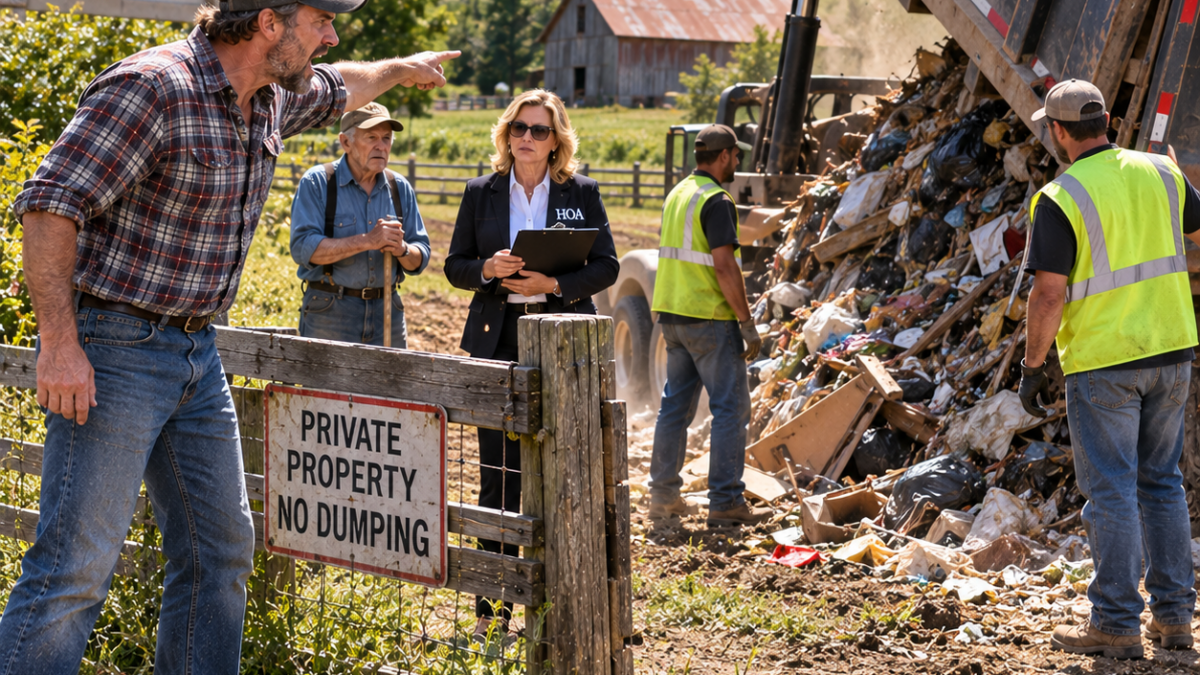
Daphne followed my eyes for half a second.
The green vinyl settled again.
She turned back toward Dad.
“The vendor-routing issue is under internal review.”
Dad nodded slowly.
“That means you’re not answering.”
“This conversation is becoming unproductive.”
“No,” he said. “It got simple.”
The truck driver stood beside his cab pretending not to listen.
Daphne looked toward him.
“Hold this route pending dispatcher confirmation.”
He nodded.
Then she turned to me.
“Westfield is not accepting responsibility for materials until their source and placement are verified.”
I looked past her at the piles.
A broken sign panel showed part of Westfield’s crest.
Disposable serving trays sat between decorative bark and foam.
Black plastic packaging carried a facilities inventory code.
“Then verify them.”
Daphne walked back toward her SUV.
Dad called after her.
“And keep the trucks off my farm.”
She didn’t answer.
The truck reversed up the service lane ten minutes later.
We watched until both vehicles disappeared beyond the bend.
Dad didn’t say anything.
He walked directly toward the older pile beside the fence.
I followed.
Near the bottom, wedged beneath mulch and gray board, was another section of dark green vinyl.
Dad hooked one finger under the edge but didn’t pull it free.
“Get your phone.”
I photographed it where it lay.
Dark green border.
Gold Westfield crest.
And a date.
The previous Saturday.
Underneath, enough words remained to read:
AUTUMN MEMBERS SOCIAL.
I looked downhill toward the clubhouse roof.
“You had an event last weekend.”
Dad snorted.
“They had an event.”
“You know what I mean.”
“I know exactly what you mean.”
Six days earlier, Westfield Terrace had hosted its annual autumn social.
Now part of the event signage was lying in my father’s field.
Daphne had stood twenty feet away and said the source needed to be verified.
The email arrived at 1:26 that afternoon.
Six attachments.
Kelly from management called it a “limited vendor routing production provided for clarification.”
Dad read the phrase over my shoulder at the kitchen table.
“Decoration with attachments.”
I opened the first file.
Westfield’s waste-hauling agreement.
Second file.
Facilities contact sheet.
Third.
Approved haul destinations.
I read the list twice.
County transfer station.
Green-waste yard.
Construction-debris facility twenty-eight miles south.
Reed Seed Farm was nowhere on it.
Dad put on his reading glasses.
“So they knew where their trucks were supposed to go.”
“Apparently.”
The fourth attachment was different.
WESTFIELD FACILITIES — TEMPORARY HAUL ADJUSTMENT.
Dated Monday.
One day before Dad had seen the first truck.
Reason:
TRANSFER STATION DELAY / EVENT CLEANOUT VOLUME.
Temporary location:
REED SEED FARM — LOWER SERVICE FIELD.
Dad leaned toward the screen.
“Who signed it?”
“No signature.”
There was only an operations code and a facilities contact reference.
D. WELLER.
Neither of us spoke.
I opened the next attachment.
A route update.
Wednesday.
4:37 p.m.
That was after Dad had called management.
After he had driven to Westfield himself.
After he had told them, face-to-face, that they had no permission.
The note said:
MAINTAIN CURRENT OVERFLOW SITE PENDING ALTERNATE HAUL CONFIRMATION.
Distribution:
Facilities chair.
Management routing.
Waste vendor dispatch.
Facilities contact:
D. WELLER.
Dad took off his glasses.
“So that’s who kept it active.”
I nodded.
The final attachment was a hold order.
Saturday.
7:31 a.m.
The truck we had stopped had entered Dad’s property at 7:08.
Twenty-three minutes earlier.
I pulled out a yellow legal pad.
Monday: farm added.
Tuesday 9:15: Dad calls Westfield.
Tuesday 10:42: truck enters.
Wednesday 4:37: maintain current overflow site.
Friday: another truck dumps while I’m there.
Saturday 6:41: certified no-dumping notice received.
Saturday 7:08: another truck enters.
Saturday 7:31: hold instruction finally issued.
Dad watched me write.
“This is why you wanted all the paper.”
“Yes.”
“I wanted one answer.”
“What answer?”
“Who kept sending them?”
I turned the legal pad toward him.
His finger stopped beside Daphne’s name.
I called her.
She answered quickly.
“Mason.”
Not Mr. Reed anymore.
I had apparently graduated.
“I received the routing files.”
“Good. Then you can see Westfield is reviewing the matter.”
“I can see the farm was added Monday.”
“Yes.”
“My father objected Tuesday.”
“I’m aware of his concerns.”
“And Wednesday your office told the vendor to maintain the overflow site.”
“The location was being used temporarily while alternate hauling capacity was confirmed.”
“My father said no.”
“Our understanding was that the vendor had already used the overflow placement location.”
“That sentence doesn’t make sense.”
“It makes operational sense.”
I looked at Dad.
“Was the farm active Wednesday?”
“It remained in the routing sequence temporarily.”
“After the owner objected?”
“The facilities team was clarifying site status.”
“Did you have his written authorization?”
“We did not have a permanent disposal agreement.”
Dad put down his coffee mug.
I closed my eyes.
There was that word.
Permanent.
I said, “That isn’t what I asked.”
“No permanent dump site was established.”
“There are multiple piles of waste in his field.”
“Temporary placement is not equivalent to permanent disposal.”
Dad held out his hand.
I gave him the phone.
He leaned toward it.
“If I leave a dead refrigerator on your porch for four days, is it furniture until Friday?”
I looked down at the table.
Silence came through the speaker.
Dad continued.
“You put waste on my farm. I told you to stop. You kept my farm on the truck route.”
“Mr. Reed, Westfield did not intend to establish a permanent—”
“Stop saying permanent.”
Daphne inhaled.
“We are arranging alternate hauling capacity.”
“Good.”
Dad handed me the phone.
“My father’s property is closed to all Westfield vendors,” I said. “We expect a written removal plan.”
“Management will respond.”
The call ended.
I looked at the waste piles through the kitchen window.
“I think we should have someone inspect it before anybody moves anything.”
Dad didn’t answer immediately.
Normally, that would have been the moment I told him what we were going to do.
That was part of our problem.
I had spent twenty years working regional agricultural supply.
Routes.
Delivery schedules.
Storage logistics.
Risk management.
I saw a problem and immediately started building a solution.
Dad saw me doing that and heard something else.
He heard a son who thought his father had become incapable of running his own farm.
So this time I stopped.
“What do you want to do?”
He looked at me.
The question genuinely surprised him.
“Get their garbage off my field.”
“Okay.”
“And I don’t want them pushing it into one corner and calling that removal.”
“Okay.”
He looked down at his mug.
Then said, “You know why I didn’t call you Tuesday?”
“You were busy.”
“That’s not why.”
I waited.
“Last time you were here, you looked at the west shed. Pipe rack. Lower acreage.”
I said nothing.
“You always make that list.”
“I notice things.”
“I know.”
His eyes moved toward the window.
“I figured you’d come down here, see this mess, and tell me this proved your point.”
“What point?”
“That the place was too much for me.”
The old argument.
Three years earlier, after Dad slipped off a tractor step and broke two ribs, I had tried to convince him to lease part of the acreage.
I used all the words people like me use when we’re pretending emotion is math.
Efficiency.
Reduced workload.
Capital preservation.
Long-term viability.
Dad used one word.
Farm.
And because neither of us knew how to say what we actually meant, we didn’t talk for almost a month.
He looked at me now.
“I didn’t need another person looking at my farm like a problem.”
For once, I didn’t defend myself.
Outside, the wind went still.
Dad noticed before I did.
He turned his head toward the western sky.
The light had changed.
Flat gray clouds stretched over the ridge.
“First real rain’s coming.”
I looked toward the lower field.
Then I noticed the old grass strip.
It began above the waste piles and bent gently through the lowest part of the field.
As a kid, I had hated that strip.
It turned soft before everything else.
When I was eleven, I lost a boot there during the first wet week of fall.
Dad made me walk home wearing one sock.
He still told that story.
I stared at the loose mulch and foam sitting uphill from it.
“Where does that low ground go?”
Dad shrugged.
“Downhill.”
“Dad.”
“That’s the technical explanation.”
I walked outside.
The grass strip curved toward a stand of oaks.
Beyond them was Westfield’s landscaped boundary.
Above the trees, I could see the clubhouse roof.
White stone.
Dark windows.
Wide rear terrace.
For the first time, I wondered what would happen when rain hit several tons of loose material sitting above that natural low ground.
By noon, I had found an environmental field consultant named Ren Adler.
She drove out in a dusty pickup with two plastic tubs, a camera, and boots that looked like they had never been anywhere clean.
Dad liked her immediately.
Mostly because she didn’t introduce herself with a string of credentials.
She stood beside the newest pile.
“Anybody moved anything?”
“No,” Dad said.
“Good.”
She crouched.
“Three things.”
I pulled out my phone.
Ren looked at me.
“You can write them down if it makes you feel useful.”
Dad made a small sound.
It might have been a laugh.
I put my phone away.
Ren pointed at the pile.
“First, don’t push mixed material somewhere else. Moving it fifty feet doesn’t make it less mixed.”
Dad nodded.
“Second, some of this appears to be ordinary haul-off material. Some should be separated before removal.”
She pointed toward the grass strip.
“Third, water matters.”
I waited.
She looked at me.
“I am not saying contamination. Don’t put words in my mouth.”
“I wasn’t.”
“You were about to.”
Dad definitely laughed that time.
Ren continued.
“You have loose material above low ground. Document the condition before weather changes.”
That was it.
No dramatic warning.
No claims about toxic waste.
No speeches.
She spent forty minutes photographing pile boundaries, tire ruts, packaging, and surface conditions.
At the lower field, she followed my gaze toward the clubhouse.
“That Westfield?”
“Yes.”
“Take a wide photo from here.”
I did.
“Harold, stay in the frame.”
Dad looked at her.
“Why?”
“Scale.”
He accepted that.
The photograph showed everything.
Waste piles above.
The old low grass line beneath.
Dad standing near the edge.
Clubhouse roof downhill.
No trench.
No excavated channel.
No new berm.
No altered ground.
Nothing Dad had done could reasonably be mistaken for rerouting water.
At the second pile, we found the Westfield event banner again.
Ren photographed the diagonal tear through the lower grommet.
“Keep that detail.”
“Why?”
“If something moves later, you want more than ‘green plastic.’”
I took another close photograph.
By three, Ren had written a short field note.
Existing mixed material.
Loose debris.
Unaltered low ground.
Controlled removal recommended.
Document pre-weather condition.
I sent it to Westfield.
Daphne responded twelve minutes later.
WESTFIELD IS PREPARED TO HAVE ITS VENDOR CONSOLIDATE MATERIAL PENDING FINAL SOURCE REVIEW.
I read it aloud.
Dad was filling a water jug.
“Consolidate means push it into one pile.”
“That’s what I think.”
“Tell her no.”
I did.
My phone rang thirty seconds later.
“Mason, your refusal is delaying resolution.”
“No. Your trucks created the problem.”
“Our vendor can consolidate the material immediately.”
“Not without a removal plan.”
“You are creating unnecessary process.”
I looked at Dad.
“My father wants to know where the material will go before anyone moves it.”
Daphne paused.
“I thought you were handling communication.”
There it was.
A tiny sentence.
But it hit harder than she intended.
Why was I asking Dad?
Because it was his farm.
I handed him the phone.
“My land,” he said.
Daphne started talking.
Dad held the phone away from his ear until she stopped.
“Send me a removal plan.”
Then he handed it back.
The conversation ended quickly.
Ren left before sunset.
Dad and I walked the service lane one more time.
Near the bend, I noticed two tire marks.
Fresh.
Deep.
The edges were sharp.
“These weren’t here earlier.”
Dad came back.
We looked toward the lower field.
Then we walked quickly.
Behind the second pile sat another mound.
Shredded bark.
Gray-stained plastic.
Contractor wrap.
Damp material underneath.
One more load.
After the certified notice.
After Daphne’s visit.
After the routing documents.
After Ren’s inspection.
Dad put both hands on his hips.
The western sky was darker now.
“They’re running out of dry days.”
The camera caught the truck.
Unit 418.
6:12 p.m.
The driver slowed at the NO DUMPING notice.
Then continued.
Dad watched the video once.
Not twice.
That was how I knew how angry he was.
The next morning, we photographed everything again.
Same angles.
Same fence post.
Same waste piles.
New pile added.
Same grass swale.
Dad walked with me.
When we reached the narrowest part of the low ground, he stopped.
“You remember losing your boot here?”
“I remember you making me walk home without it.”
“You didn’t listen.”
“You warned me after I stepped in.”
“I warned you before.”
“That is not how I remember it.”
“You were eleven.”
I smiled.
“I did not cry.”
“You cried at the porch.”
“I was eleven.”
“Still counts.”
I laughed.
The sound felt strange between us.
Not bad.
Just rusty.
Dad pointed toward the grass.
“Water always shows here first.”
I followed the curve.
“How long has it drained this way?”
He looked at me like I had asked how long gravity had been installed.
“Before you were born.”
I photographed the swale from another angle.
No cuts.
No ditch work.
No excavation.
No fresh soil.
Nothing.
When we went back inside, I emailed Westfield again.
This one was short.
Your vendors are to remain off Reed Seed Farm.
An additional load was placed after the most recent review.
Material remains in place pending controlled removal.
First seasonal rain is expected.
Immediate suspension of all hauling and a written removal plan are requested.
Dad read it.
“Too many words.”
“It says no once.”
“Progress.”
Thirty-eight minutes later, Daphne replied.
Her first sentence made me stop.
Mason, please do not alter drainage conditions or take any action that could affect association property while the facilities matter remains under review.
I read it again.
Then turned the laptop toward Dad.
He put on his glasses.
“What drainage conditions?”
“I think she’s worried about where the water goes.”
“We haven’t touched that low ground in years.”
“I know.”
Dad looked at me.
“You photographed it six times.”
“Seven.”
He stared.
“You counted?”
“No.”
He carried his mug to the sink.
I forwarded Daphne’s email to Ren.
Then I created a folder.
BEFORE WEATHER.
Dad came back.
“You naming folders now?”
“Yes.”
“Should I be worried?”
“Probably.”
For a while, neither of us spoke.
The farm had gone quiet in the way farms do before weather.
Not silent.
Never silent.
The seed cooler hummed behind the storage shed.
A loose hinge tapped against the west wall.
Somewhere on the county road, a truck shifted gears.
Dad looked toward the window.
“You remember the boot?”
“We just discussed the boot.”
“You never listened.”
“You enjoy this story too much.”
He took a drink.
“I had to raise you. I earned a few stories.”
Then the first drop hit the kitchen window.
One dark circle.
Then another.
By evening, the roof had started ticking.
Softly at first.
Dad checked the lower field before dark.
I went with him.
The piles hadn’t moved.
The low grass was darkening.
We touched nothing.
After sunset, I was checking the service-lane camera when the sound outside changed.
At first, I thought it was wind.
Then I recognized it.
Water moving through grass.
I stepped outside.
Dad was already standing beyond the equipment shed.
No raincoat.
Work jacket dark across the shoulders.
He was looking downhill.
The first real rain of the season had found the low ground.
We walked toward it.
The water was shallow.
An inch in some places.
Less in others.
Nothing dramatic.
No flash flood.
No roaring torrent.
Thin lines simply began joining where the ground dipped.
Dad pointed.
“Right there.”
The first runoff reached the bottom edge of the newest waste pile.
Gray material darkened.
Shredded mulch shifted.
Then a thin ribbon of dirty water emerged from underneath.
I took out my phone.
Not close.
From the upper edge.
One continuous recording.
Waste pile.
Grass.
Natural swale.
No cuts.
No edits.
No touching anything.
The loose bark moved first.
Then a piece of foam.
Then plastic film.
A torn food-service wrapper floated into the grass.
The heavier pieces stayed.
The pile didn’t collapse.
It didn’t need to.
The rain simply took what was light enough to carry.
Dad stood beside me getting soaked.
“No boot this time?”
“I eventually learned.”
“About time.”
Then he pointed.
A dark green piece of vinyl had entered the flow.
It turned once.
Twice.
Gold flashed across it.
I zoomed in.
Partial event date.
Diagonal tear through the lower grommet.
My stomach tightened.
“The banner.”
“I know.”
We had photographed that exact fragment while it was dry.
Ren had photographed it.
I had a close-up of the tear.
Now it was floating downhill.
The vinyl caught against grass.
Stopped.
The water rose slightly.
One edge lifted.
Then the fragment slipped loose.
Dad watched it go.
Neither of us smiled.
This wasn’t funny.
That runoff was crossing his farm.
His field.
His grass.
Carrying somebody else’s garbage through ground he had spent fifty years keeping useful.
The rain strengthened.
Still ordinary rain.
The kind farmers waited for.
Nothing unusual had to happen.
The ground only had to behave like ground.
We followed from the dry side.
Past the old fence post.
Past the place where I had lost my boot.
Toward the oaks.
The water moved faster where the swale narrowed.
Plastic wrap snagged behind us.
Foam floated ahead.
The green vinyl remained visible.
At the old boundary, Dad stopped.
“Far enough.”
Westfield property began on the other side.
We did not cross.
I called Ren.
“It started.”
“Did you touch the channel?”
“No.”
“Move debris?”
“No.”
“Good. Keep recording from your side.”
I sent her the clip.
Thirty seconds later, Kelly called.
“Mason, are you at the farm?”
“Yes.”
“We have a runoff issue at the clubhouse.”
Dad looked at me.
I put the phone on speaker.
“What kind of issue?”
“Dirty water and debris are entering the service terrace.”
“What debris?”
“I don’t have a full inventory.”
Dad muttered, “They like inventories now.”
Kelly continued.
“Daphne wants to know whether drainage work was performed on Reed property.”
There it was.
Exactly what Daphne’s email had prepared for.
“No drainage work was performed.”
“Was the swale altered?”
“No.”
“A ditch opened?”
“No.”
“A berm changed?”
“No.”
Another voice came onto the call.
Daphne.
“Mason, you were specifically instructed not to alter drainage conditions affecting association property.”
Dad stared at the phone.
“We didn’t alter anything.”
“Then explain why waste-laden runoff is reaching the clubhouse.”
“Your waste is uphill from the natural low ground.”
“That is an accusation.”
“No. That is geography.”
Her voice sharpened.
“We have residents on the terrace.”
“Then keep them away from the runoff.”
“This never happened before your involvement.”
Dad leaned toward the phone.
“The rain did.”
She ignored him.
“If you redirected flow toward Westfield property—”
“I have pre-rain photographs.”
Silence.
“Seven angles.”
Dad looked at me.
Even then.
Even soaked in the dark beside garbage-filled runoff.
He mouthed:
Seven?
I nodded.
Daphne finally said, “Do not leave the farm.”
“I wasn’t planning to.”
The call ended.
Dad stared downhill.
“You did count.”
“No.”
We drove to Westfield by the county road.
Not through the boundary.
Not across the swale.
Their public entrance.
By the time we arrived, clubhouse employees had blocked residents from the rear service terrace.
The clubhouse wasn’t flooding.
That mattered.
I wasn’t going to turn a dirty runoff problem into something it wasn’t.
A shallow sheet of gray-brown water crossed one edge of the stone service area.
Shredded bark had collected against a drain.
Foam was lodged beside a planter.
Plastic wrap hung from a hedge.
Daphne stood beneath the awning wearing a dark raincoat.
She saw us.
“You—”
Dad glanced over his shoulder.
“Still two Reeds.”
Then I saw the drain rail.
Dark green vinyl was caught against the black metal.
Gold crest.
Partial date.
Diagonal tear.
Same lower grommet.
The Westfield autumn social banner.
I had photographed it on Dad’s farm.
Ren had photographed it there.
I had recorded it entering the natural swale.
Now it hung from Westfield’s clubhouse drain.
Daphne followed my eyes.
Her face changed.
Barely.
But enough.
I photographed it.
She stepped toward me.
“Do not imply this material originated here.”
Dad looked at the banner.
“You hauled it uphill.”
Daphne turned toward him.
“Someone altered the drainage conditions.”
I opened the BEFORE WEATHER folder.
First photograph.
Waste piles.
Untouched grass swale.
Dad standing for scale.
Second photograph.
Same slope.
Same natural curve.
Third.
Fence post.
No ditch.
Fourth.
No excavation.
Fifth.
No berm.
Sixth.
No disturbed soil.
Seventh.
The wide view showing the clubhouse downhill.
Daphne looked through them.
Then back at me.
Behind her, Westfield’s own banner twisted in runoff against Westfield’s own drain.
“You did something up there.”
I put my phone away.
“Tomorrow you can explain what you think we changed.”
By eight the next morning, Westfield had stopped calling it a runoff issue.
The new phrase was “incident review.”
Kelly asked us to meet behind the clubhouse.
Dad wore his brown work jacket.
The same one he wore to repair gates.
I asked whether he wanted a clean jacket.
He looked at me.
That ended that conversation.
Ren was already there.
So was Saul Barlo, operations supervisor for the hauling company.
Daphne stood beside a stone table.
Kelly had a laptop open.
A phone rested on speaker.
“Tessa Lang and two directors are joining remotely,” Kelly said. “We have board quorum.”
Daphne frowned.
“This is an operational matter.”
Board president Tessa Lang’s voice came through the phone.
“Then operations should be able to answer it.”
Dad almost smiled.
Kelly asked Daphne to explain her concern.
Daphne opened a folder.
“The association has reason to believe drainage conditions on Reed property were altered before last night’s runoff event.”
Dad looked at me.
Same sentence.
Different audience.
I connected my phone to Kelly’s laptop.
The first image appeared.
Pre-rain.
Dad standing in the lower field.
Waste piles above him.
Low grass beneath.
Ren stepped closer.
“Fence post.”
She pointed.
“Same one visible in the runoff clip.”
Next image.
“Same bend.”
Next.
“Same surface.”
She looked at the group.
“I inspected this ground before rain. I observed no fresh excavation, new channel, opened berm, or recently altered drainage path.”
Daphne folded her arms.
“A photograph cannot document every possible intervention.”
Dad answered.
“Neither can an accusation.”
I opened the photo of our posted notice.
Then the certified receipt.
Kelly checked her management record.
“Received 6:41 Saturday morning.”
Saul placed a route sheet beside the computer.
“Unit 307.”
He pointed.
“Active overflow location. Reed Seed Farm lower service field.”
Tessa’s voice came through the phone.
“Who provided that routing location?”
Kelly opened the documents Westfield itself had sent us.
Monday.
TEMPORARY HAUL ADJUSTMENT.
Facilities contact:
D. WELLER.
Then Wednesday.
MAINTAIN CURRENT OVERFLOW SITE.
Facilities contact:
D. WELLER.
Daphne stepped forward.
“That did not authorize permanent disposal.”
Dad closed his eyes.
“There’s that word again.”
Tessa asked, “Did Mr. Reed authorize temporary placement?”
“No,” Dad said.
“Did facilities have written landowner authorization?”
Kelly searched.
“No.”
Daphne’s voice tightened.
“The site was being used under a temporary operational adjustment.”
Saul turned toward her.
“We were told it was active.”
“You were eventually told to hold placement.”
“At 7:31 Saturday.”
He tapped the route sheet.
“Unit 307 entered at 7:08.”
Twenty-three minutes.
No one needed me to explain what that meant.
I opened the photograph of the banner on the farm.
Dark green.
Gold crest.
Partial date.
Diagonal tear through the lower grommet.
Then the photograph from the clubhouse.
Same green.
Same crest.
Same date.
Same tear.
Saul leaned toward the screen.
“That came from the members-event cleanout.”
Daphne turned.
“You cannot establish that every item in the runoff originated with Westfield.”
“No.”
I switched back to the farm photograph.
“But I can establish where that one was before it got here.”
Ren placed her field note on the table.
“I inspected the piles before rainfall. The natural swale was unchanged. I specifically advised against moving mixed material until controlled removal could occur.”
Daphne looked at her.
“You are not the association’s consultant.”
Ren nodded toward the stained terrace.
“I was inspecting the farm.”
Silence.
Then Tessa spoke.
“Kelly, mute us for board discussion.”
Daphne immediately objected.
“You cannot take governance action based on an incomplete field review.”
Tessa answered calmly.
“We can suspend delegated authority while review continues.”
The phone muted.
Four minutes.
Nobody spoke.
A clubhouse employee swept shredded bark away from a drain.
Dad watched him.
I watched Daphne.
Her face had gone completely still.
Then the phone came alive again.
Tessa spoke.
“The board has voted to take emergency administrative action.”
Daphne lifted her chin.
“Effective immediately, facilities authority over waste-hauler routing, disposal-site selection, and access to non-association property is suspended from the facilities and clubhouse operations chair.”
Daphne stared at the phone.
“Management will control those functions pending formal review.”
“This is excessive.”
Dad spoke.
“No.”
Everybody looked at him.
He shrugged.
“It got simple this time.”
Daphne didn’t answer.
Saul cleared his throat.
“If removal scope is confirmed today, I can begin this afternoon.”
Ren nodded.
“I want the affected areas observed while material comes out.”
Kelly asked the question Dad cared about.
“Who is funding removal?”
Tessa didn’t hesitate.
“Westfield.”
Daphne turned toward the phone.
Tessa continued.
“Any allocation between the association and vendor can be addressed separately. Mr. Reed should not bear the cost.”
Dad looked at me.
That was the first sentence anyone from Westfield had said all week that sounded like an actual plan.
We were back at the farm before noon.
The rain had stopped.
The heavy debris remained in place.
The low field was wet.
At 1:18, a cleanup truck turned off the county road.
Dad instinctively stepped toward the lane.
Then stopped.
The truck slowed beside our NO DUMPING notice.
Behind it were empty roll-off containers.
A removal crew followed.
For the first time all week, my father watched a truck drive toward the lower field and didn’t tell it to leave.
The first full container left at 4:26.
Dad watched it all the way to the road.
I knew why.
For a week, every heavy truck had arrived full.
It took time to trust the sight of one leaving that way.
Saul kept his crew on the west track.
Exactly as Dad requested.
No turning near the pump line.
No driving over the north seed rows.
No pushing material into another corner.
The piles came apart slowly.
Foam separated.
Plastic separated.
Event debris separated.
Board fragments loaded for proper haul-off.
Decorative mulch went into its own container.
Ren walked the exposed ground as they worked.
By sunset, the first pile was gone.
What remained looked ugly.
Dark compressed soil.
Two deep ruts.
Shredded bark caught in the grass.
Dad stood beside me.
“Looks worse empty.”
“I know.”
He looked at the damaged surface.
“At least I can see what they did now.”
That was Dad.
He preferred an ugly fact he could see to a beautiful explanation he couldn’t trust.
The next morning, Ren returned.
She collected surface samples from the two places where the gray material had sat longest.
She refused to call the field contaminated.
Dad appreciated that.
“Affected,” she said.
Three days later, her written assessment came back.
Two small areas needed shallow surface removal.
Truck ruts required repair.
Grass cover needed reseeding.
Loose debris needed to be cleared from the swale.
The original drainage pattern should remain untouched.
I read that sentence aloud.
Dad nodded.
“Leave the low ground alone.”
“Apparently.”
“I told you that when you were eleven.”
“You told me not to lose my boot.”
“Same lesson.”
Westfield paid the cleanup invoices directly.
Assessment too.
Saul told us whatever reimbursement argument remained was between the hauling company and the HOA.
“For once,” I said, “somebody else’s route sheet is somebody else’s problem.”
Dad almost smiled.
Westfield also sent a written correction regarding the drainage allegation.
It wasn’t warm.
It wasn’t poetic.
Dad didn’t need either.
The letter stated:
WESTFIELD TERRACE HAS FOUND NO EVIDENCE THAT REED SEED FARM ALTERED EXISTING DRAINAGE CONDITIONS PRIOR TO THE RAINFALL EVENT.
Dad read it once.
Then slid it beneath the sugar bowl.
“You’re keeping it there?”
“Table wobbles.”
“It does not.”
“Might.”
I left it alone.
The governance changes came the following week.
Kelly forwarded the new policy.
Any waste staging or disposal location outside Westfield-owned property required documented landowner authorization before dispatch.
Management had to verify the authorization.
The hauling vendor had to receive a copy before routing.
No single facilities officer could approve access to neighboring private land.
Daphne remained facilities and clubhouse operations chair.
But waste routing, disposal-site selection, and access approval for non-association property were removed from her authority.
Dad read that twice.
“What?”
I asked.
“She still has a title.”
“Yes.”
He folded the paper.
“Good.”
“Good?”
He shrugged.
“She can oversee chairs and tablecloths.”
I laughed.
So did he.
Just once.
The full removal took six working days.
Rut repair took another.
A small grading crew restored the service track without touching the swale.
Ren returned for a final inspection.
She stood where the second pile had been.
Nothing interesting remained.
Fresh dirt.
Raked grass.
Repaired track.
The low ground curving gently downhill exactly as it had my entire childhood.
Ren put her hands in her jacket pockets.
“Looks boring.”
Dad nodded.
“Best thing you’ve said all month.”
By then, I had spent more days at the farm in two weeks than I had during the previous six months.
I noticed that one Thursday while carrying seed bags out of storage.
The west shed still had a lifted roof panel.
The pipe rack still leaned.
The weeds beside the fence were still too high.
I still saw the list.
I just stopped treating the list like a verdict.
That was harder than I expected.
When you spend your professional life fixing systems, you start believing every inefficient thing needs intervention.
Dad wasn’t a system.
The farm wasn’t a failed route.
And getting older wasn’t the same thing as becoming incompetent.
That afternoon, I found him beside the lower field with the broadcast spreader.
An open bag of cover seed sat beside him.
“What are you doing?”
He looked at the spreader.
“What does it look like?”
“Taking over the county.”
“Too many permits.”
I picked up the seed bag.
He didn’t tell me to put it down.
The repaired ruts were packed smooth.
The worst surface areas had been cleaned.
The places where the piles had sat were bare enough to show every pass of a rake.
The swale remained untouched.
Dad adjusted the spreader.
“Half rate first.”
“I know.”
He looked at me.
“You sell this stuff.”
“That’s what I keep telling you.”
“You sell it. I use it.”
There it was.
The old argument hiding inside a smaller one.
This time neither of us reached for it.
I filled the hopper.
Dad started down the first strip.
I followed with the bag.
When he turned at the end, he asked without looking at me,
“You staying for lunch?”
The question sounded casual.
Too casual.
I looked toward the farmhouse.
“Yeah.”
He nodded.
No speech.
No apology.
No dramatic reconciliation.
That wasn’t us.
We walked the next strip.
A week later, the first green appeared.
Thin.
Uneven.
Unimpressive.
Dad stood at the edge of the field looking at it.
The clubhouse roof was visible beyond the trees.
For days, I had expected him to say something about Daphne.
Or Westfield.
Or the rain carrying their own garbage back to the place it came from.
He never did.
That wasn’t the part he cared about anymore.
The trucks were gone.
The waste was gone.
The field was recovering.
The truth was documented.
And the farm was still his.
He looked across the new grass.
“Finally.”
“What?”
“Looks like work again.”
I handed him another bag of seed.
He took it.
We moved farther down the row.
Behind us, the old grass swale curved toward Westfield exactly where it always had.
Nobody had redirected it.
Nobody had weaponized the rain.
Nobody needed to.
The first storm had simply followed the land.
And for one very uncomfortable night, Westfield Terrace had been forced to stand on its own clubhouse patio and look at exactly what it had sent uphill.








