The dog was trapped on a burning bridge when he lifted both front paws, wrapped them around my neck, and held on like I was the last safe thing left in his world.
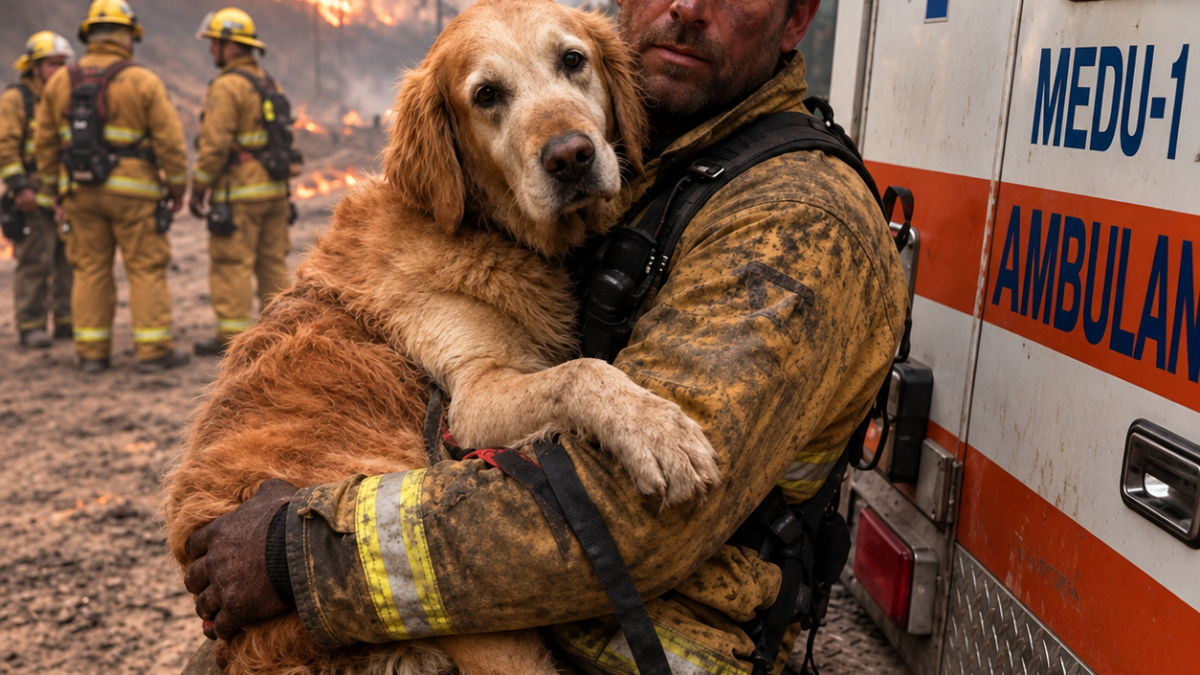
The veterinarian told me Benson was lucky.
I remember almost laughing when she said it.
Lucky.
The word didn’t fit a dog whose paws had been burned raw and whose coat still smelled faintly of smoke.
But Dr. Lewis had been working emergency animal medicine for almost twenty years, and she meant lucky in the clinical sense.
No major internal injuries.
No serious smoke damage.
Burns along his paws and left flank, painful but treatable.
Dehydration.
Exhaustion.
Stress.
But nothing she believed would kill him.
“He probably spent several days moving around inside the evacuation zone,” she said.
I stood beside the examination table while Benson lay with his head near my hand.
“Can you tell if somebody owned him?”
“No microchip.”
“Collar?”
“Nothing when you found him?”
I shook my head.
“Could’ve been lost during evacuation.”
“Could’ve been abandoned.”
Dr. Lewis didn’t say anything.
She didn’t need to.
People like me see a lot of strange things during disasters.
Most are understandable.
Panic makes people leave doors open.
Dogs slip collars.
Cats hide when families are trying to evacuate.
Livestock break fencing.
Not every animal left behind has been deliberately abandoned.
But some are.
I looked at Benson.
“How long do you think he was alone?”
“Hard to know.”
“He was trapped on that bridge.”
“Probably tried to cross after the fire cut off another route.”
“And waited?”
“Maybe.”
I touched the side of his head.
Benson opened his eyes.
“How long were you up there, old man?”
His tail moved weakly.
Dr. Lewis smiled.
“He likes you.”
“He almost strangled me.”
“That wasn’t aggression.”
“I noticed.”
“He was probably terrified.”
“Still is.”
“Probably.”
She wrapped one paw carefully.
Then the other.
Benson watched me the entire time.
Whenever I stepped away, his head followed.
Whenever I returned, his body relaxed.
I was used to frightened patients.
Humans.
Children.
People pulled from crashes.
People waking up in ambulances unsure where they were.
You learn to recognize when someone has mentally decided you’re safe.
Benson had done that with me.
And I didn’t like how much it affected me.
That’s important.
I didn’t dislike him.
It was the opposite.
I liked him too quickly.
That frightened me.
Dr. Lewis asked if I could foster him temporarily.
“The shelters are overloaded because of the fire.”
“I work fourteen-hour shifts.”
“He’ll need somebody who can monitor his medication.”
“I’ve never had a dog.”
She looked at Benson.
Benson looked at me.
“I think he’s already filed paperwork.”
“No.”
“Just until we locate an owner.”
“How long?”
“A few days.”
A few days.
Those words have ruined a lot of people’s lives.
I agreed.
Our department had temporarily relocated several of us into rental houses outside the evacuation zone.
Mine was a small place with two bedrooms and a yard barely large enough to call a yard.
I’d been living there alone for three weeks.
When I carried Benson through the front door that evening, he immediately froze.
I set him down.
“That’s it.”
He looked around.
“Nothing exciting.”
His paws were bandaged.
Walking hurt.
Still, he followed me.
Kitchen.
Hallway.
Living room.
When I went back to the kitchen, he followed again.
“Water.”
I filled a bowl.
He drank.
“Food.”
He ate carefully.
Then I walked toward the couch.
Benson followed.
I sat.
He lowered himself beside my feet.
Within minutes, he was asleep.
I watched him.
That was the first night.
The second night, he slept beside the couch.
The third, he followed me into the bedroom.
“No.”
He stared.
“Absolutely not.”
I pointed toward the dog bed Dr. Lewis had loaned me.
“That’s yours.”
He looked at it.
Then at my bed.
“Don’t even.”
He lay in the dog bed.
I turned off the light.
Around two in the morning, I woke up because something heavy landed beside me.
Benson.
“Seriously?”
He curled against my back.
I should have moved him.
Instead, I fell asleep.
By the end of the first week, he no longer waited for permission.
He followed me everywhere.
If I walked into the bathroom, he lay outside the door.
If I cooked, he sat behind me.
If I worked on reports, he rested his chin on my knee.
Every time I came home from shift, he acted as if I’d returned from war.
He didn’t simply wag.
He threw his entire body into me.
Front paws up.
Around my shoulders if I knelt.
The same embrace from the bridge.
At first, I laughed.
Then it started bothering me.
Not because Benson was doing anything wrong.
Because I could feel myself becoming important to him.
That was dangerous.
My entire adult life had been built around keeping importance temporary.
Coworkers.
Friends.
Women I dated.
Neighbors.
I was friendly.
Dependable.
Useful.
But never indispensable.
That was deliberate.
If nobody needed you too much, nobody could take too much with them when they left.
At thirty-four, I had perfected it.
Then Benson ruined the system in about eleven days.
The separation anxiety showed itself during the second week.
My shift began at six.
A neighbor agreed to check him around noon.
At seven fifteen that morning, she called me.
“Jake?”
I heard barking in the background.
“What happened?”
“He’s losing his mind.”
“What?”
“He’s scratching the door.”
I closed my eyes.
“Benson!”
Through the phone, I heard him bark.
“Did he get hurt?”
“Not yet, but he’s trying.”
I asked Mike to cover me for ten minutes.
Then I drove back.
When I opened the door, Benson launched himself at me.
Literally.
His paws hit my chest.
He made a sound somewhere between crying and barking.
“Hey.”
He pressed against me.
“Hey, hey.”
His whole body trembled.
I looked at the front door.
Deep scratches marked the wood.
The rug had been pulled halfway across the room.
“Buddy.”
He wouldn’t let me go.
That was the day I called my sister.
Katherine lived two states away with her husband, Daniel, and their kids, Emma and Caleb.
She was three years older than me.
And one of the last people who still knew how to talk to me without accepting my evasions.
I sat on the floor against the living room wall.
Benson rested his head on my thigh.
“Kath.”
“That tone usually means you’re injured or emotionally confused.”
“I’m serious.”
“So am I.”
I looked down.
“He’s attached to me.”
“The dog?”
“Yes.”
“Congratulations. That’s what dogs do.”
“No. This is different.”
“How?”
“He panics when I leave.”
She became quiet.
“He scratches doors. Howls. Won’t eat until I’m back.”
“He’s traumatized.”
“I know.”
“And you’re surprised that the first person who carried him out of a fire became his safe person?”
“I can’t give him what he needs.”
“Why?”
“I work.”
“Most people work.”
“I’m gone too much.”
“So find a dog sitter. Trainer. Day care.”
“It’s more than that.”
Katherine knew.
She didn’t say anything immediately.
I did.
“I found him a home.”
“What?”
“A family from another county.”
“Already?”
“Dr. Lewis knows them. Big yard. Two kids. One parent works from home.”
“And?”
“They want him.”
I felt Benson breathe against my leg.
Katherine asked, “Do you?”
“Do I what?”
“Want him.”
“That’s not the point.”
“It’s exactly the point.”
I hardened my voice.
“He deserves stability.”
“So do you.”
“Don’t.”
“Jake.”
“Kath.”
She went quiet.
Then said something I hated because it was true.
“Benson isn’t the problem.”
I didn’t answer.
“He’s a mirror.”
“Spare me.”
“You called me.”
I looked toward the window.
She continued.
“You’ve spent your entire adult life rescuing people.”
“It’s my job.”
“I know.”
“That’s not psychological. I’m literally a firefighter.”
“And when somebody tries to love you?”
“Here we go.”
“You leave.”
“That’s not fair.”
“Rachel?”
I shut my mouth.
Rachel had been my last serious relationship.
Three years earlier.
She wanted to move in.
I ended things two weeks later.
Katherine continued.
“Melissa?”
“Stop.”
“Mom, after Dad died?”
“Kath.”
“Me?”
That one hurt.
She knew it.
Her voice softened.
“You think if you leave first, you control the loss.”
I stared at Benson.
“He’s a dog.”
“Yes.”
“Not Dad.”
“I know.”
“Not Rachel.”
“I know.”
“I’m not doing this.”
“You’re already doing it.”
“What?”
“You’re finding Benson another home before he can become yours.”
I stood.
Benson immediately stood too.
“He’s already somebody else’s dog.”
“Is he?”
“The adoption isn’t final.”
“Jake.”
“I have to go back to work.”
“Then go.”
I almost hung up.
Then Katherine said, “Dad wouldn’t have wanted this for you.”
My hand stopped.
“Don’t use him.”
“I’m not.”
“Then leave Dad out of it.”
“I’m trying to get my brother back.”
I hung up.
I hated myself immediately.
Benson came closer.
He pressed his head against my hip.
I looked down.
“You don’t know when to leave things alone either.”
His tail moved.
The family who wanted him lived forty minutes away.
The Harrisons.
Tom and Laura.
Two kids.
Eight and eleven.
Beautiful house.
Fenced yard.
Laura worked from home.
Their previous Labrador had died the year before.
They had references from a veterinarian.
Everything about them was good.
That’s what made Saturday harder.
If they’d been careless people, I could have rejected them.
But they weren’t.
They were exactly the kind of family Benson deserved.
At least that’s what I kept telling myself.
I loaded his food, medication, bed, leash, and the ridiculous stuffed duck he’d started carrying around.
Benson climbed into the truck happily.
He loved riding with me by then.
Halfway there, he put his head on my shoulder.
I drove with one hand.
“You’re going somewhere good.”
His tail thumped against the seat.
“They have kids.”
Another thump.
“Big yard.”
He licked my ear.
“That’s disgusting.”
He sat back.
“You’ll like them.”
I didn’t realize until we pulled into their driveway that I was gripping the steering wheel hard enough to hurt my hands.
The Harrisons were waiting.
Their daughter, Lily, had made a sign.
WELCOME BENSON.
Laura came down the steps.
“Hey, handsome.”
Benson stayed beside my leg.
Tom shook my hand.
“We really appreciate this.”
“He’s a good dog.”
“I can tell.”
“He’s on antibiotics for three more days.”
Laura nodded.
“I wrote everything down.”
“Food twice a day.”
“Got it.”
“He doesn’t like being alone.”
“We’re prepared.”
“He may scratch the door.”
“We’ll work with him.”
“He—”
Tom smiled gently.
“Jake.”
“What?”
“We’ve got him.”
That was what I wanted.
Wasn’t it?
I crouched.
Benson immediately turned toward me.
“Okay, buddy.”
His ears moved.
“These are your people now.”
He stared.
I reached for the leash clip.
His front paws rose.
One hit my chest.
Then the other.
He leaned his body into me.
Around my shoulders.
The bridge.
That embrace.
Again.
Only this time, there was no fire.
No smoke.
No collapsing wood.
Just me leaving.
I froze.
“Benson.”
His body began trembling.
Laura looked concerned.
“He okay?”
“Yeah.”
I tried to lower his paws.
He put them back.
“Come on.”
He looked directly into my eyes.
I’ve been accused of giving dogs human emotions when I tell this story.
Maybe I do.
But if you’ve ever been chosen by an animal, you know looks can carry things words never could.
Why?
That was what I saw.
Not accusation.
Confusion.
I trusted you.
I found you.
Why are you leaving?
“Benson.”
My voice cracked.
Then he howled.
A deep, broken sound.
I had heard injured people scream.
Children cry.
Families sob beside ambulances.
But that sound went straight through me.
I stood.
“I have to go.”
Laura looked at Tom.
“Jake, maybe—”
“No.”
I handed her the leash.
“He’ll settle.”
Benson pulled toward me.
I walked away.
He barked.
I kept walking.
Another bark.
Then the howl again.
I opened my truck.
Benson struggled at the leash.
I got inside.
Do not look back.
I looked back.
He was sitting in the driveway.
Laura had both hands on his collar.
His body trembled.
His eyes were on my truck.
I started the engine.
Then I drove away.
I made it nine miles before pulling over.
I sat on the side of the road.
Hands on the wheel.
Breathing hard.
“This is stupid.”
I was furious.
At Benson.
At Katherine.
At myself.
“This is the right thing.”
I drove home.
The house was silent.
I’d forgotten how silent it had been before him.
I opened the door.
No nails on the floor.
No tail against the wall.
No seventy-pound body colliding with my knees.
His water bowl was gone.
I had packed it.
The stuffed duck was gone too.
I sat on the couch.
There was fur on my shirt.
I picked one strand away.
Then another.
My chest hurt.
I stood and walked to the bedroom.
The dog bed was gone.
Empty floor.
That was when the lie collapsed.
I hadn’t given Benson away because it was better for him.
I had given him away because I loved him.
And loving him meant there was something left in the world I could lose.
I sat on the edge of the bed.
For the first time in years, I thought about my father without stopping myself.
Dad died when I was twenty-four.
Cancer.
Fast.
Four months from diagnosis to funeral.
He had been fifty-six.
Strong.
Annoyingly optimistic.
The kind of father who called every Sunday even when I acted too busy.
During his last week, I barely spoke in the hospital.
I stood beside the bed.
Held his hand sometimes.
Fetched water.
Adjusted blankets.
Talked to nurses.
Did practical things.
Anything except admit he was dying.
The night before he died, he said, “Jake.”
“Yeah?”
“Look at me.”
I did.
“You’re allowed to be scared.”
“I’m fine.”
“No, you’re not.”
“I said I’m fine.”
He stared at me.
Then smiled sadly.
“You’ve always thought being strong means nobody gets to see you hurt.”
“I don’t.”
“You do.”
“I’ll be okay.”
“I know.”
He squeezed my hand.
“But don’t make okay the only thing you’re allowed to be.”
I didn’t understand.
Or didn’t want to.
The next morning, he died.
I didn’t cry at the hospital.
Didn’t cry at the funeral.
Didn’t cry when Mom handed me his watch.
Katherine cried enough for both of us.
I went back to work.
Then firefighter academy.
Then paramedic certification.
Then wildland rescue.
I saved people.
Maybe because I couldn’t save Dad.
Maybe because inside emergencies, feelings had instructions.
Assess.
Stabilize.
Move.
Treat.
Transport.
Grief didn’t.
Love didn’t.
Loss didn’t.
So I became excellent at emergencies.
And terrible at everything that happened when the emergency ended.
My phone rang.
Katherine.
I answered.
“He’s gone.”
Silence.
Then, “Benson?”
“I left him.”
Another silence.
“He screamed.”
“Jake.”
“I left anyway.”
“What happened?”
I told her.
Every detail.
The red collar Lily had bought.
The driveway.
The paws against my chest.
The howl.
The way Benson watched my truck leave.
By the end, I couldn’t speak properly.
Katherine waited.
“Jake?”
I covered my face.
“I can’t do this.”
“Do what?”
My chest collapsed.
“This.”
The first sob came out before I could stop it.
Then another.
Ten years.
Ten years of holding everything inside.
It didn’t come out neatly.
It came out ugly.
I cried for Benson.
For Dad.
For Rachel.
For my mother, who had spent years calling a son who always said he was busy.
For Christmases I had left early.
For Katherine’s children growing up while their uncle remained a guest.
For every time someone reached toward me and I stepped backward before they could become necessary.
“I miss him,” I said.
Katherine knew I didn’t only mean the dog.
“I know.”
“I should’ve said something.”
“To Dad?”
“Yes.”
“He knew.”
“No.”
“He knew you loved him.”
“I should’ve told him.”
“Then tell people now.”
I cried harder.
“Papa wouldn’t want you to live like this,” she whispered.
I didn’t answer.
“He would want you to love somebody.”
“I don’t know how.”
“You do.”
“No.”
“You ran across a burning bridge for a dog.”
“That’s different.”
“Why?”
“Because he needed me.”
Katherine’s voice softened.
“Maybe you needed him too.”
That sentence stayed in the room long after we ended the call.
I didn’t sleep.
Around midnight, I walked into the kitchen.
Benson wasn’t there.
At one, I sat on the couch.
At two, I opened the front door for no reason.
At three, I found a piece of gauze from one of his old paw bandages beneath the coffee table.
I picked it up.
At four, I finally understood what Katherine had meant about Dad.
I had built my life around preventing grief.
But grief hadn’t disappeared.
I’d just chosen loneliness in advance.
Loss was painful.
So I had removed attachment.
But removing attachment hadn’t produced peace.
It had produced emptiness.
I had mistaken emptiness for safety.
Near sunrise, I called Laura Harrison.
She answered sleepily.
“Hello?”
“It’s Jake.”
Immediately she was awake.
“Is everything okay?”
“How’s Benson?”
A pause.
“Not great.”
My stomach dropped.
“What happened?”
“He hasn’t slept.”
“What?”
“He stayed by the front door for hours.”
I closed my eyes.
“He wouldn’t eat dinner.”
“Did he drink?”
“A little.”
“I’m sorry.”
“Jake.”
“Yeah?”
“I don’t think he understands why you’re gone.”
My throat closed.
“I made a mistake.”
Laura was quiet.
Then, “I wondered if you might call.”
“You did?”
“He picked your shirt out of the bag.”
“What shirt?”
I had accidentally packed an old department T-shirt beneath his blanket.
“He’s sleeping on it.”
That nearly ended me.
“I want him back.”
Another pause.
“If that’s what you really want.”
“It is.”
“You sure?”
“For the first time in a long time.”
She exhaled.
“Come get your dog.”
I was in the truck before the sun cleared the hills.
The entire drive, my hands trembled.
Not because I feared Benson wouldn’t remember me.
Because I feared I had damaged something.
Trust.
That fragile thing he had given me on the bridge.
What if leaving had taught him I was no different from whatever had happened before?
When I turned onto the Harrisons’ road, I saw Laura outside.
Benson stood beside her.
He saw the truck.
His head lifted.
I stopped.
Opened the door.
“Benson.”
He ran.
I’d never seen him run like that.
Ten years old.
Burned paws still healing.
It didn’t matter.
He crossed the yard at full speed.
I dropped to my knees.
He hit me hard enough to knock me backward.
His paws wrapped around my neck.
His body trembled.
He made those low crying sounds dogs sometimes make when excitement is too big for their bodies.
“I know.”
He licked my face.
“I know, buddy.”
His paws tightened.
“I’m sorry.”
Laura turned away, giving me privacy I hadn’t earned.
I buried my face in Benson’s neck.
“You were right.”
His tail beat against the grass.
“I’m an idiot.”
More tail.
“I’m not leaving.”
He pressed closer.
“You hear me?”
I held his face.
“This is it.”
Brown eyes.
No confusion now.
“You’re mine.”
I laughed.
“And apparently I’m yours.”
Laura handed me the leash.
“You know we would’ve loved him.”
“I know.”
“But he already had a home.”
I looked at Benson.
“Yeah.”
“He just had to convince you.”
I smiled.
“He’s stubborn.”
“So are you.”
Fair.
Benson climbed into my truck.
When I sat behind the wheel, he immediately rested his head on my shoulder.
“Home?”
His tail moved.
“Let’s go home.”
That was the first time I called the rental house that.
Home.
The change wasn’t magical.
Benson still had separation anxiety.
Love does not erase trauma.
It gives trauma somewhere safe to heal.
Dr. Lewis referred us to a behavior specialist named Karen.
She explained what I had been doing wrong.
“You disappear for long shifts. From his perspective, loss is unpredictable.”
“So what do I do?”
“Teach him return.”
“How?”
“Small departures.”
The first exercise felt ridiculous.
I picked up my keys.
Benson stood.
I sat down.
We repeated that until keys no longer automatically meant panic.
Then I opened the door.
Closed it.
Stayed inside.
Then stepped outside for three seconds.
Returned.
Five seconds.
Ten.
Thirty.
Benson slowly learned.
I was learning too.
Leave.
Return.
Leave.
Return.
The pattern seemed designed for both of us.
When I returned from work, I stopped pretending his excitement embarrassed me.
I knelt.
He hugged.
Every time.
Sometimes coworkers witnessed it.
Mike never let me forget.
“Your boyfriend’s here.”
“Shut up.”
Benson jumped up.
Paws around my shoulders.
Mike laughed.
“I’ve never seen a Labrador emotionally dominate a grown firefighter.”
“Walk away.”
“Need privacy?”
“Mike.”
He loved Benson almost as much as I did.
So did the station.
After his burns healed, Benson occasionally came by.
He slept beneath the table in the break room.
Accepted pieces of chicken from everyone.
Ignored station rules.
Became unofficial morale officer.
Firefighters carry things.
Not just hoses.
Calls.
Faces.
Sometimes we talk.
Often we don’t.
Benson made talking easier.
One night after a bad accident, one of our youngest firefighters, Tyler, sat behind the station alone.
Benson walked over.
Sat beside him.
Then leaned his body against Tyler’s leg.
Tyler put an arm around him.
Didn’t say anything.
Didn’t need to.
Later he told me, “That dog knows.”
“Yeah.”
“He knows when somebody’s messed up.”
“Yeah.”
“How?”
“I don’t know.”
Maybe hurt recognizes hurt.
The wildfire season ended.
Rain finally came.
The hills stayed black for months.
Then spring arrived.
Tiny green shoots pushed through ash.
I started taking Benson hiking where the fires had burned.
At first, he was nervous around charred trees.
Smoke from distant controlled burns made him alert.
But eventually he relaxed.
We walked farther.
Sometimes I thought about the bridge.
The actual structure was gone.
County crews demolished what remained.
A replacement came later.
Steel and concrete.
Safer.
Less beautiful.
I avoided it for months.
Then one spring morning, I drove there with Benson.
We parked.
Walked to the new bridge.
Benson stopped.
His body became still.
“Yeah.”
I stood beside him.
“This is where we met.”
He sniffed the air.
A creek ran far below.
New grass covered parts of the burn scar.
I crouched.
“You remember?”
He looked at me.
Then raised one paw onto my chest.
I laughed.
“Of course.”
I hugged him.
No fire.
No urgency.
Just us.
Something in me had changed since the day I first carried him down.
I started calling Katherine regularly.
Not because there was a crisis.
That part mattered.
“Hey.”
“What’s wrong?”
“Nothing.”
“Then why are you calling?”
“You’re unbelievable.”
She laughed.
I visited that Thanksgiving.
Normally, I arrived Thursday morning and left Friday afternoon.
That year, I stayed until Sunday.
Benson came.
Emma was twelve.
Caleb nine.
Within twenty minutes, Benson belonged to them.
Emma brushed him.
Caleb tried to teach him tricks he absolutely already knew but pretended not to.
Daniel grilled steak and slipped Benson pieces until Katherine threatened divorce.
Saturday night, we sat around a fire pit.
Katherine looked at me.
“You’re still here.”
“I noticed.”
“Usually by now you’re halfway home.”
“Benson likes the kids.”
“Sure.”
“What?”
“Nothing.”
“Kath.”
She smiled.
“I’m glad.”
I looked toward Emma.
She was lying on the grass with her head against Benson’s side.
“I’m trying.”
“I know.”
That was enough.
The hardest conversation came later.
Katherine and I were washing dishes.
She handed me a plate.
“You know Dad was scared too.”
I stopped.
“What?”
“At the end.”
“I know.”
“No. I mean about you.”
“Me?”
“He worried you’d close yourself off.”
I stared at the sink.
“He told you that?”
“The week before he died.”
I couldn’t move.
“What exactly did he say?”
Katherine hesitated.
“Jake.”
“Tell me.”
She dried her hands.
“He said, ‘Your brother is going to try to turn grief into a job.'”
I laughed once.
It sounded terrible.
“What does that even mean?”
“You know exactly what it means.”
I did.
“He was proud of you becoming a firefighter.”
“I wasn’t one yet.”
“He knew you were applying.”
I stared through the kitchen window.
Benson lay outside with the kids.
Katherine continued.
“Dad said you’d spend your life trying to save everyone because you couldn’t stand being unable to save him.”
My eyes burned.
“He said that?”
“Yes.”
“Why didn’t you tell me?”
“Would you have listened ten years ago?”
No.
We both knew.
“What else?”
“He said he hoped someday somebody would teach you that being needed isn’t the same as being loved.”
I couldn’t speak.
Katherine looked outside.
“Maybe that somebody had four legs.”
I laughed through tears.
“Of course Dad gets the last word.”
“He’d enjoy that.”
That night I slept in Katherine’s guest room.
Benson lay beside me.
I kept thinking about Dad.
For the first time, the memories didn’t feel like a room I had to escape.
They hurt.
But pain and danger aren’t the same thing.
That was another lesson Benson taught me.
You can hurt and stay.
Grief rises.
You breathe.
It passes through.
The world remains.
Benson got older.
Not quickly.
At first, aging was almost funny.
Gray spread around his muzzle.
He became selective about stairs.
He learned that if he stared at me long enough, I would lift him into the truck.
“You’re perfectly capable.”
Stare.
“Manipulative.”
Stare.
“Fine.”
I lifted him.
At twelve, he still hugged me every day.
At thirteen, the hugs became slower.
He’d put his paws on my shoulders.
I’d support his back.
His head would rest beside mine.
Sometimes we stayed that way for a long time.
People joked about it.
I never did.
Those hugs had become something sacred.
Benson retired from long station visits.
Too much noise.
Too many hard floors.
Instead, firefighters came to see him.
Mike brought absurd treats.
Tyler brought a new dog bed.
Dr. Lewis still saw him twice a year.
“His arthritis is progressing.”
“I know.”
“Weight looks good.”
“He’s handsome.”
“Obviously.”
“Heart’s strong.”
“Like him.”
She smiled.
“You’ve changed.”
“I’ve gotten older.”
“That’s not what I meant.”
I pretended not to understand.
By then, I’d purchased a small house.
Not the temporary rental.
A real house.
Two bedrooms.
Backyard.
Porch.
Benson inspected it before closing.
The realtor thought I was joking when I said he had final approval.
I wasn’t.
The first night, I slept on a mattress on the floor because the furniture hadn’t arrived.
Benson lay beside me.
I looked around.
“Our house.”
His tail moved.
“Actually ours this time.”
I started dating again too.
Carefully.
Her name was Sarah.
She was an ER nurse.
She had met Benson before she really met me.
We’d crossed paths professionally several times, but one afternoon she came by the station to drop off paperwork.
Benson was there.
He walked directly to her.
She crouched.
“Who’s this?”
“Traitor.”
She scratched his ears.
“He likes me.”
“He likes everybody.”
Mike shouted from across the room.
“He does not.”
I glared.
Sarah laughed.
Benson leaned against her.
Months later, when Sarah asked why I sometimes became distant after good weekends together, I almost gave my usual answer.
Work.
Tired.
Busy.
Instead, I told the truth.
“Sometimes when something feels important, I want to leave before I can lose it.”
Sarah stayed quiet.
Then said, “Thank you for telling me.”
That was all.
She didn’t fix me.
Didn’t chase.
Didn’t demand promises.
She stayed.
I stayed too.
One year later, Katherine nearly cried when I brought Sarah to Christmas.
“Don’t make this weird.”
“I’m not.”
“You have the face.”
“What face?”
“The face Mom used to make.”
Katherine hugged Sarah.
I escaped outside.
Benson followed.
“Coward,” Katherine yelled.
“Correct.”
But I went back inside.
That’s the part that mattered.
Sarah never replaced Benson’s role.
Nobody could.
But Benson had opened a door.
Other people could enter afterward.
He had taught me return.
Eventually, I learned staying.
When Benson was fourteen, his health began changing faster.
Arthritis.
Hearing loss.
A heart murmur.
Nothing catastrophic.
Just age collecting its debts.
Our walks shortened.
One mile became half.
Half became around the block.
Around the block became to the end of the street.
Still, every evening around six, Benson stood by the leash.
“Optimistic.”
Tail wag.
We went.
At fifteen, I carried him down the porch steps.
He hated being carried except by me.
Sarah said that wasn’t true.
“He loves it.”
“He looks offended.”
“He looks spoiled.”
“Same thing.”
Benson lived long enough to see me marry her.
Small ceremony.
Katherine’s backyard.
Benson wore a blue bandana.
No tie.
I refused.
During the vows, he wandered between Sarah and me.
Everybody laughed.
I stopped.
“Come here.”
He sat.
Sarah scratched his head.
“You approve?”
Tail.
Katherine shouted, “That’s legally binding.”
Afterward, someone took a photograph.
Sarah and me sitting in the grass.
Benson between us.
My arm around Sarah.
My other hand on Benson.
For years, that picture sat on our mantel.
Still does.
A year after our wedding, Benson declined sharply.
He had good days.
Then more bad ones.
One morning, he couldn’t get up.
I found him beside the bed.
“Benson.”
He tried.
His back legs slipped.
“Easy.”
I lifted him.
He rested against my chest.
I felt how light he had become.
Dr. Lewis examined him that afternoon.
She had known him almost as long as I had.
Her expression told me before she spoke.
“His kidneys aren’t doing well.”
“Treatment?”
“We can support him.”
“For how long?”
“I can’t promise.”
“Pain?”
“Some. Manageable right now.”
I nodded.
“Then manage it.”
We took him home.
For several weeks, he improved.
Chicken and rice.
Medication.
Warm blankets.
Slow mornings.
I took leave from the department.
Mike offered to cover shifts.
“You sure?”
“I’m sure.”
Benson had spent years waiting for me to return.
He wasn’t going to spend his final days doing that.
Sarah understood.
Of course she did.
We moved a mattress into the living room because Benson struggled to reach the bedroom.
I slept beside him.
Sometimes I woke and found his eyes open.
“I’m here.”
Tail.
Barely.
But enough.
Katherine visited.
She knelt beside him.
“You’re the famous Benson.”
His tail moved.
“You know you saved my brother, right?”
“Katherine.”
“What?”
“Don’t.”
She looked at me.
“I’m telling him.”
Benson raised his head.
“He was impossible.”
“Still am.”
“True.”
She rubbed his ears.
“But you got through.”
I had to leave the room.
Some things still hurt too much to witness directly.
Progress isn’t perfection.
Benson’s final good day came in October.
Cool morning.
Clear sky.
He ate breakfast.
Walked into the yard on his own.
Then stood at the gate.
I knew what he wanted.
“No.”
He looked at me.
“No way.”
Stare.
“Benson, you’re fifteen.”
Tail.
I laughed.
“Fine.”
I helped him into the truck.
Sarah came too.
We drove to the bridge.
The replacement bridge.
The place where everything started.
No fires.
The forest had regrown.
Young trees covered the hillsides.
The gorge was green.
People who hadn’t seen the fire would never know how completely that place had once burned.
I lifted Benson down.
We walked slowly.
Very slowly.
Halfway across, he stopped.
I crouched.
“Too much?”
He turned toward me.
Then raised one front paw.
It landed against my shoulder.
The other followed.
I supported him.
His head rested against my neck.
There it was.
The hug.
Fifteen years old.
Weak legs.
Gray muzzle.
Same embrace.
My vision blurred.
“Okay.”
Sarah stood a few feet away crying.
I wrapped both arms around him.
“Okay, buddy.”
His heartbeat was slower now.
But still there.
“I remember.”
He leaned into me.
“I remember everything.”
The fire.
Smoke.
Burned paws.
The first night he climbed into my bed.
The scratches on the door.
The Harrison driveway.
His scream when I left.
His body crashing into mine when I came back.
Christmas with Katherine.
The station.
The house.
My wedding.
A whole life inside one embrace.
“You found me.”
His tail moved.
“That’s what happened, isn’t it?”
He looked at me.
“I thought I found you.”
We stayed until he pulled away.
Then Benson stood beside me looking into the gorge.
New life everywhere.
Green rising where fire had once erased everything.
Sarah put her hand in mine.
We drove home.
Two days later, Benson stopped eating.
Then drinking.
Dr. Lewis came to the house.
I knew why.
Still, I asked every question desperate people ask.
“Could we try fluids again?”
“We could.”
“New medication?”
“Jake.”
“What about—”
She put a hand on my arm.
“Jake.”
I stopped.
“He trusts you.”
I looked toward Benson.
He lay on his bed.
“You’ve spent years telling him you’ll come back.”
I nodded.
“Now he’s asking you to stay.”
That destroyed me.
Sarah sat beside Benson.
I called Katherine.
She cried immediately.
“I want to come.”
“You won’t make it.”
“I can drive.”
“It’s okay.”
“No.”
“Katherine.”
Silence.
Then, “Put me on speaker.”
I did.
She talked to Benson.
Told him about Emma starting college.
Caleb learning to drive.
Christmases.
Steaks he’d stolen.
The time he ate half a birthday cake.
Then she said, “Take care of Dad if you see him.”
I almost ended the call.
Instead, I let the sentence hurt.
Because I no longer ran from every painful thing.
After we disconnected, I lay beside Benson.
His eyes opened.
“Hey.”
His tail didn’t move.
That scared me more than anything.
I put my forehead against his.
“You remember the bridge?”
His breathing was shallow.
“I told you you were safe.”
Sarah knelt behind me.
“I didn’t know what safe meant back then.”
I stroked Benson’s face.
“I thought it meant getting you off the fire.”
His eyes stayed on mine.
“But you taught me something.”
I swallowed.
“Safe isn’t never losing anybody.”
Tears ran down my face.
“Safe is knowing someone will stay while it happens.”
Benson’s paw moved.
Slowly.
It touched my chest.
Exactly where it had touched at the Harrisons’ house.
Exactly where it had touched every time he hugged me.
I covered it with my hand.
“I’m here.”
Dr. Lewis prepared the medication.
“You ready?”
“No.”
She waited.
I laughed through tears.
“I’m never going to be ready.”
She nodded.
“That’s okay.”
I looked at Benson.
“You tired?”
His eyes closed briefly.
Opened.
“Yeah.”
I put my arm around him.
Sarah placed her hand on his back.
“I’m not leaving.”
The first injection relaxed him.
His breathing softened.
For the first time in days, the tension disappeared from his body.
“Good boy.”
His head rested against me.
“You were such a good boy.”
Sarah whispered, “The best.”
I thought about something Dad had told me.
Don’t make okay the only thing you’re allowed to be.
So I let myself be destroyed.
I cried.
Openly.
No turning away.
No pretending.
No leaving.
When Dr. Lewis gave the final medication, I held Benson exactly as he had held me on the bridge.
Arms around him.
Face beside his.
Heart against heart.
“I’ve got you.”
His breathing slowed.
“I’ve got you.”
One more breath.
Then another.
Then stillness.
I kept holding him.
Nobody told me to stop.
Sarah sat beside us.
Dr. Lewis left the room quietly.
I don’t know how long I stayed.
Maybe twenty minutes.
Maybe an hour.
Eventually Sarah whispered, “Jake.”
“I know.”
But I didn’t move.
Then something strange happened.
Not supernatural.
Nothing dramatic.
I realized I was surviving it.
The thing I had built my entire adult life to avoid.
Loss.
It was happening.
It was unbearable.
And I was still there.
Benson was gone.
I loved him completely.
The love had not protected me from grief.
It had given the grief meaning.
That was the part twenty-four-year-old me had never understood.
Pain is not proof you should never have loved.
Pain is proof something mattered.
We had Benson cremated.
I kept his collar.
His tag.
The old blue bandana from our wedding.
And one singed leather strap from the emergency gear used the day I carried him from the bridge.
Months later, the fire department asked permission to use Benson’s story during mental-health training.
At first I refused.
Then I thought about Tyler.
About firefighters sitting silently after terrible calls.
About all the people like me who knew how to rescue others but had no idea how to let anyone near their own wounds.
I agreed.
I started speaking occasionally.
Not as an expert.
I wasn’t one.
I told the truth.
“My dog taught me attachment.”
People laughed.
Then I told them about Dad.
About grief.
About leaving Benson.
About going back.
About the final day.
Nobody laughed then.
After one presentation, a firefighter approached.
Mid-forties.
Twenty years on the job.
He said, “I haven’t talked to my brother in six years.”
I nodded.
He looked embarrassed.
“Benson thing got me.”
“Call him.”
“What if he doesn’t answer?”
“Call anyway.”
Three months later, I saw him again.
“He answered.”
That was all he said.
It was enough.
Sarah and I eventually adopted another dog.
Not immediately.
I couldn’t.
For a year, I insisted no.
Then Katherine sent me a shelter picture.
An elderly mixed-breed dog named Murphy.
White face.
One ear up.
One down.
Caption:
OWNER DIED. NEEDS QUIET HOME.
I replied:
Absolutely not.
Katherine wrote:
Sure.
Sarah saw the message.
“We’re getting Murphy?”
“No.”
Two days later, Murphy was asleep on our couch.
He wasn’t Benson.
That mattered.
I didn’t want another Benson.
Love isn’t replacement.
Murphy was grumpy.
Hated rain.
Loved cheese.
Snored louder than any animal his size had a right to.
He never hugged me.
He leaned.
That was his thing.
If I sat down, Murphy pressed one shoulder against my leg.
“Different language,” Sarah said.
“What?”
“Same message.”
Maybe.
Years passed.
I became captain.
Mike retired.
Tyler became a lieutenant.
Katherine’s children grew up.
Emma got married.
Caleb became a teacher.
I stopped leaving family gatherings early.
That might sound like a small achievement.
For me, it wasn’t.
At Emma’s wedding, Katherine stood beside me.
“You stayed.”
“You’re obsessed with this.”
“I’m proud of you.”
“Don’t get sentimental.”
She smiled.
“Benson would be.”
I looked away.
Some names can still reach places nothing else can.
The forest recovered almost completely.
One July 17, years after Benson died, Sarah asked if I wanted to visit the bridge.
We brought Murphy.
Murphy hated walking.
He made that very clear.
Halfway across, he sat down.
Sarah laughed.
“Emotional moment ruined.”
“That’s his gift.”
I looked over the railing.
The gorge below was green.
Birds moved through the trees.
Water reflected sunlight.
No smoke.
No flames.
I closed my eyes.
For one second, I could feel Benson’s paws around my neck again.
Not literally.
Memory has weight.
Sometimes enough to feel physical.
I could hear myself saying:
I’ve got you.
But now I understood the truth.
He had me too.
From the first moment.
That’s the strange thing about rescue.
We draw simple lines around it.
Rescuer.
Victim.
Strong.
Weak.
Saved.
Saver.
Life rarely honors those categories.
I carried Benson off a burning bridge.
That’s true.
Without me, he may have died there.
But Benson carried me out of somewhere too.
Mine wasn’t visible.
No smoke.
No flames.
No emergency tape.
Just a ten-year-old wall built around grief.
Brick by brick.
Relationship by relationship.
Departure by departure.
Benson crossed it without asking permission.
He simply needed me.
Then loved me.
And refused to understand why those things should frighten me.
Dogs can be incredibly inconvenient that way.
They don’t respect the emotional architecture you’ve spent years constructing.
You say, “I’m fine alone.”
They put their head in your lap.
You say, “Don’t depend on me.”
They wait by the door.
You say, “This is temporary.”
They sleep beside you.
You give them away.
They scream.
And if you’re lucky—truly lucky—you finally hear what they’re trying to tell you.
Stay.
That’s what Benson taught me.
Not that people should never leave.
They do.
Sometimes by choice.
Sometimes by death.
Sometimes because life takes them somewhere we cannot follow.
Staying doesn’t mean forever.
Nothing living can promise forever.
Staying means being present for the part you are given.
My father stayed until he couldn’t.
Benson stayed until he couldn’t.
My job wasn’t to make either one immortal.
My job was to love them while they were here.
I know that now.
Sarah sometimes finds me outside near sunset.
Murphy beside me.
Or these days, another rescue dog named June.
There have been several dogs since Benson.
Every one different.
Every one loved.
None replacing him.
Sometimes Sarah asks what I’m thinking.
Usually I say, “Nothing.”
Old habits.
Then I correct myself.
“I’m thinking about Benson.”
She sits beside me.
We watch the hills.
I tell the story less often now.
Not because it matters less.
Because it has settled into me.
Like a scar that no longer hurts every day but remains part of the body.
There is one photograph from the day Benson was rescued.
Mike took it without telling me.
I’m sitting behind the ambulance.
Helmet off.
Face black with soot.
Benson beside me.
Bandages not yet on his paws.
His head is on my thigh.
One front paw rests against my chest.
I look exhausted.
He looks worse.
Neither of us knows what is coming.
The scratches on the door.
The Harrisons.
Katherine’s call.
Thanksgiving.
The house.
Sarah.
My wedding.
His final day.
None of it.
We’re just sitting there.
Two frightened creatures who have both survived something.
I keep that photograph near Dad’s watch.
That feels right.
Sometimes younger firefighters ask what the most dangerous rescue of my career was.
There are several candidates.
Collapsed building.
Flash flood.
Multi-car pileup.
That bridge.
But danger isn’t what makes the bridge the call I remember most.
It’s what happened after.
Firefighters are trained for the moment of rescue.
Get in.
Stabilize.
Extract.
Get out.
Nobody trains you for what happens when the thing you rescue follows you home and begins rearranging your life.
Benson did.
He rearranged everything.
My relationship with my sister.
My relationship with my father’s memory.
My ability to love Sarah.
My understanding of grief.
My idea of strength.
Even my definition of rescue.
Before Benson, strength meant carrying.
After Benson, strength also meant being carried.
Before Benson, courage meant moving toward danger.
After Benson, courage sometimes meant staying still when love made you want to run.
Before Benson, I thought independence meant needing nobody.
After him, I understood that being connected doesn’t make you less whole.
It makes your life larger than one person.
If I could speak to the man I was before July 17, I don’t know that he’d listen.
I’d probably find him after a shift.
Thirty-four years old.
Exhausted.
Living alone.
Phone calls unanswered.
Christmas invitations avoided.
Telling himself he was fine.
I’d want to say:
You’re not weak because you miss your father.
You’re not safer because nobody gets close.
You cannot prevent grief by refusing love.
You only create a different kind of grief.
And one day, on a burning bridge, an old golden dog is going to put his paws around your neck.
Don’t pull away.
Hold him.
And when he needs you afterward, don’t confuse your fear with what is best for him.
When you make the mistake anyway—and you will—go back.
Go back.
That may be the most important lesson Benson gave me.
You can go back.
Not always.
But more often than pride tells us.
You can call your sister.
Apologize.
Drive back to the house.
Knock on the door.
Ask for another chance.
You can tell somebody you miss them.
You can return after running.
You can change.
Benson didn’t need me to have never left.
He needed me to come back and prove leaving wasn’t the end.
For years afterward, whenever I grabbed my keys, he’d lift his head.
At first, he panicked.
Then gradually, trust replaced fear.
Eventually, I’d say, “I’ll be back.”
His tail would hit the floor once.
That’s all.
He knew.
That small tail movement meant more to me than almost anything.
Trust repaired.
Not perfect.
Repaired.
There is hope in that word.
Repair.
Burned forests repair.
Broken bones repair.
Relationships sometimes repair.
People can too.
Not by pretending the damage never happened.
By growing around it.
The hills where Benson and I met are green now.
There are young pines where black trunks once stood.
Wildflowers grow along the roads that were closed during the fire.
The bridge is concrete instead of wood.
Nothing looks the same.
But nothing had to stay ruined just because it had burned.
Neither did I.
So when people ask me why I still talk about an old Labrador all these years later, that’s why.
Because Benson wasn’t merely a dog I rescued.
He was evidence.
Evidence that something wounded can still trust.
That something abandoned can still attach.
That fear can become safety through repetition.
That grief can coexist with gratitude.
That loving deeply is not a mistake just because eventually you have to say goodbye.
And that sometimes the thing waiting for you on the other side of disaster isn’t another emergency.
Sometimes it’s your life.
I found mine on a burning bridge.
He was golden.
Ten years old.
Bleeding paws.
Smoke in his coat.
Terrified brown eyes.
And when I reached for him, Benson did something no patient I’d ever rescued had done.
He rescued me first.
He put both paws around my neck.
He held on.
And after spending most of my life believing strength meant never needing anyone, I finally learned the thing my father had tried to teach me before he died.
Sometimes strength is simply this:
You stop running.
You hold on too.
And when someone you love reaches for you, you let yourself be held.








