She had spent years chained to the same rusted post, but when I finally unclipped the chain, she didn’t run.
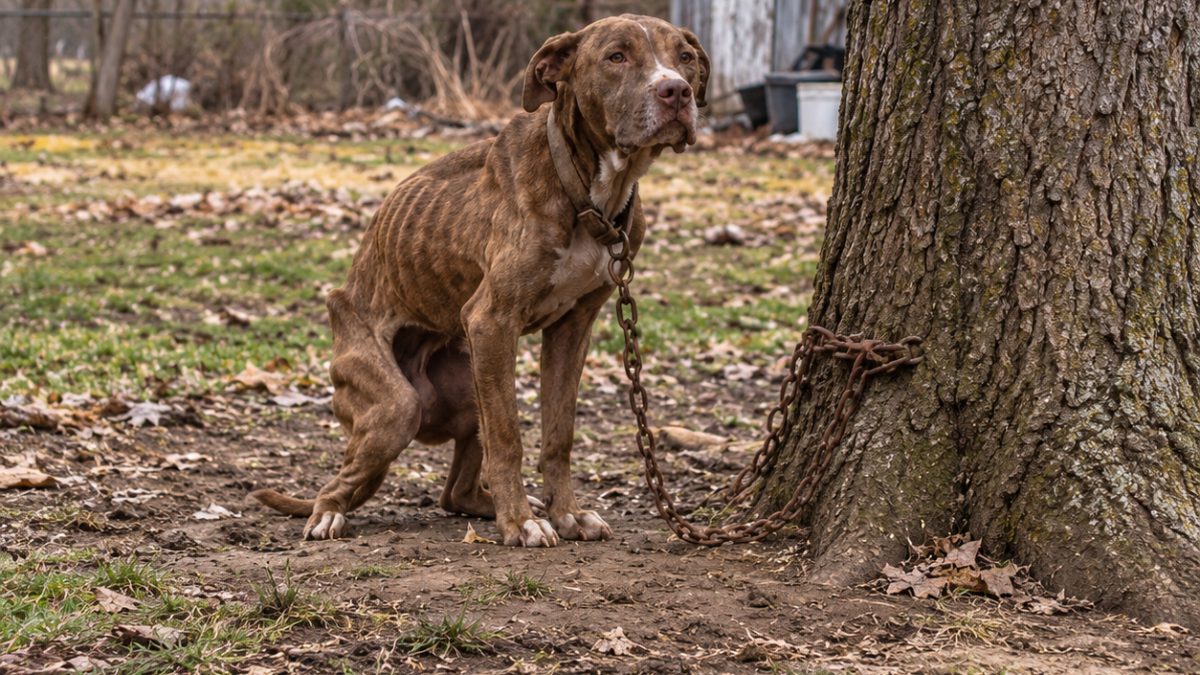
I followed Dr. Fletcher into his office and closed the door behind me.
He didn’t sit down right away.
That worried me.
Dr. Fletcher was one of those veterinarians who had spent so many years dealing with frightened people and suffering animals that he had learned how to deliver bad news calmly.
He never dramatized anything.
Never softened facts until they became meaningless.
But he also never let silence stretch longer than necessary.
That morning, he stood in front of the illuminated X-rays for several seconds before speaking.
I looked at the pale outlines of Rubie’s hips and knees and tried to understand what I was seeing.
I couldn’t.
All I knew was that the joints looked wrong.
“Tell me,” I said.
He turned toward me.
“Rubie has severe bilateral hip dysplasia.”
I swallowed.
“How severe?”
“Very.”
He pointed toward the films.
“The structure of both hip joints is badly compromised. This didn’t happen recently. It’s been developing for years.”
I stared at him.
“Years?”
“Yes.”
He indicated another area.
“And both knees show significant degeneration. There are arthritic changes as well.”
The words seemed clinical.
Too neat for what they meant.
I thought of the dirt circle around that metal post.
The chain.
The trembling legs.
“How long has she been hurting?”
Dr. Fletcher hesitated only briefly.
“Probably four or five years. Maybe longer.”
I sat down.
Rubie wasn’t an old dog.
We estimated she might have been six or seven.
That meant pain had been part of most of the life she could remember.
“Could this have been treated?”
“If someone had intervened early, we might be having a very different conversation.”
He pulled his chair closer.
“Genetics may have started the problem. But years of poor nutrition, restricted movement, lack of medical care, and living on that chain almost certainly made it worse.”
I looked again at the X-ray.
I imagined Rubie waking on cold mornings.
Hot afternoons.
Rain.
The chain dragging behind her.
Her body hurting each time she stood.
And nobody asking why.
“Can we fix it?”
He leaned back slightly.
“That depends on what you mean by fix.”
I hated that sentence.
He continued before I could answer.
“There are surgical options that might reduce some of the pain, depending on further evaluation. But surgery cannot give her completely normal hips again. Her knees are damaged too. She will likely always walk differently.”
“She’ll always limp?”
“Most likely.”
“Will she ever run?”
“Not normally.”
My eyes burned.
Dr. Fletcher lowered his voice.
“Evelyn.”
I looked at him.
“This isn’t the end of her life.”
I said nothing.
“We can manage the pain. Anti-inflammatory medication. Analgesics. Physical therapy. Weight management. Controlled exercise. An orthopedic bed. Possibly hydrotherapy. She can build muscle that will support those joints.”
“But she’ll always hurt.”
“There may be difficult days.”
That wasn’t the answer I wanted.
He must have seen it in my face.
“But difficult days are not the same as a life without joy.”
I looked back toward the treatment room.
“She spent years like that.”
“I know.”
“Nobody did anything.”
“I know.”
My hands tightened together.
“She just stood there every day in that yard.”
“Evelyn.”
“I should have gotten there sooner.”
Dr. Fletcher’s expression sharpened.
“You went when you knew she existed.”
I stared at the floor.
“That’s all any rescuer can do.”
It didn’t make me feel better.
Not then.
He continued.
“We cannot change what her joints look like. We cannot erase years of neglect.”
He tapped the X-ray gently.
“But we can decide what happens from today forward.”
I looked at him again.
He gave me a small nod.
“She can walk.”
“Yes.”
“She can have a normal lifespan?”
“Potentially.”
“She can play?”
“In her own way.”
“She can be happy?”
Dr. Fletcher smiled faintly.
“That part is not on the X-ray.”
I let out a breath that almost became a laugh.
Then he added, “But yes. I think she can.”
That evening, I sat on the floor beside Rubie’s bed.
She lay with her head resting between her front paws.
After pain medication, her face seemed softer.
I kept thinking about what Dr. Fletcher had said.
Four years.
Five years.
Maybe more.
I ran my fingers gently over the fur between her ears.
“I got some bad news about you today.”
Rubie looked up.
“I know. You’re shocked.”
Her ears twitched.
I tried to smile.
“They say your hips are a mess.”
Her tail didn’t move.
“Your knees too.”
I leaned against the wall.
“And apparently you’re going to be expensive.”
That got no reaction either.
“Still nothing?”
She blinked.
I laughed quietly.
“All right.”
The smile disappeared.
I looked at her paws.
“I’m sorry.”
Rubie lifted her head.
“I’m sorry nobody helped you when helping would have been easier.”
She watched me.
“I’m sorry you learned that pain was normal.”
My throat tightened.
“And I’m sorry I can’t give you new legs.”
Rubie pushed herself up slightly.
Slowly, she reached toward me.
Then her tongue touched the back of my hand.
Once.
Warm.
Gentle.
I stopped talking.
She licked my hand again.
I pressed my forehead against hers.
“Okay,” I whispered. “Then we work with the legs you have.”
That became our agreement.
The next morning, treatment began.
Medication first.
Then food designed to help her gain muscle without putting unnecessary weight on her joints.
Then very short controlled walks.
At first, “walk” was an optimistic description.
Rubie could manage only a few minutes.
She would take several careful steps, pause and shift her weight forward.
Her hind legs trembled.
Sometimes she sat suddenly because standing became too painful.
Whenever that happened, I sat too.
People visiting the shelter would occasionally see us in the grass.
A woman and a brown dog doing absolutely nothing.
But doing nothing was part of Rubie’s recovery.
She had spent years being forced to endure discomfort.
I wanted her to learn that stopping was allowed.
“You’re tired?”
I’d sit beside her.
“Then we stop.”
Some days we made it twenty feet.
Some days twelve.
Some days Rubie looked at the door and didn’t want to go outside at all.
On those days we stayed in.
Progress in rescue rarely looks like the videos people share online.
There is often no dramatic transformation.
No single moment where fear disappears or pain ends.
Usually it is repetition.
Breakfast.
Medication.
Five careful minutes outside.
Rest.
Another meal.
A gentle exercise.
Sleep.
Then the same thing tomorrow.
But repetition can build a life.
About a week into treatment, our physical therapist, Anna, started working with Rubie.
Anna had the patience of someone who understood that dogs couldn’t be reasoned into trusting uncomfortable exercises.
The first day, she sat on the floor and did almost nothing.
She let Rubie sniff her.
Gave her a tiny piece of chicken.
Touched one hip for two seconds.
Another piece of chicken.
Rubie looked at me suspiciously.
“This woman is bribing you,” I said.
Anna laughed.
“Correct.”
Over the following sessions, she began gentle range-of-motion work.
Rubie hated certain movements.
The moment Anna bent one hind leg too far, Rubie stiffened.
“Okay,” Anna whispered. “That’s enough.”
She never forced it.
That mattered.
Animals who have had every choice taken away need choices returned in small ways.
Would you like to stand?
Would you rather sit?
Can I touch this leg?
Are you finished?
Rubie began learning that humans could listen.
Two weeks after she arrived, I walked into the quiet room early one morning carrying breakfast.
Rubie was asleep.
“Good morning.”
Her eyes opened.
I put the bowl down.
Normally I would go to her.
That morning, Rubie stood before I reached the bed.
Her back legs trembled.
She paused.
Then she walked toward me.
One step.
Two.
Three.
Still limping.
Still slow.
But then I noticed something else.
Her tail moved.
Barely.
One small sweep.
Then another.
I froze.
“Rubie?”
Her tail moved faster.
I dropped to my knees.
She came straight into my arms.
“Oh, sweetheart.”
Her head pressed against my chest.
I could feel her heart beating.
I started laughing and crying at the same time.
“You’re wagging your tail.”
She licked my chin.
“You know you’re wagging?”
Another thump.
“You are.”
For anyone else, it might have looked like nothing.
A dog wagged her tail.
Dogs did that every day.
For Rubie, it meant something enormous.
The first days after her rescue, her tail had hung motionless.
Food didn’t move it.
Voices didn’t move it.
Petting didn’t move it.
She had accepted kindness, but she had not yet expected happiness.
That morning was different.
She had heard my voice and been glad I was there.
Not merely relieved.
Glad.
I found Dr. Fletcher ten minutes later.
“She wagged.”
He looked up from his paperwork.
“What?”
“Her tail.”
He smiled.
“Well, medically speaking, that’s a very promising tail.”
“Don’t make fun of me.”
“I’m not.”
“You are.”
“A little.”
I pointed toward Rubie’s room.
“She walked all the way to me.”
“How far?”
“Maybe eight feet.”
“Excellent.”
“And wagged.”
“Yes, Evelyn. I heard about the tail.”
“You’re impossible.”
He grinned.
“So I’m told.”
Those eight feet became twelve.
Twelve became twenty.
Then we made it to the far end of the shelter yard.
It took almost fifteen minutes.
A young volunteer named Cassie walked beside us that day.
When Rubie reached the fence, Cassie threw both hands into the air.
“She did it!”
Rubie startled.
Cassie immediately lowered her voice.
“Sorry.”
I laughed.
Rubie looked at us as though humans were deeply confusing creatures.
Then she smelled a patch of clover for nearly two minutes.
I let her.
To Rubie, the world had once been a circle defined by the length of a chain.
Now every smell was new.
Wet grass.
Flowers.
Trees.
Other dogs.
People.
Wind coming through an open doorway.
I started taking her into different sections of the shelter once she became strong enough.
She discovered the laundry room and decided warm towels were one of humanity’s greatest inventions.
She discovered peanut butter and lost all dignity.
She discovered that Dr. Fletcher usually carried treats in his coat pocket.
Within a month, she would limp directly toward him whenever he entered.
“You understand I’m the person who gives you injections?” he asked one afternoon.
Rubie stared at his pocket.
“She doesn’t care,” I said.
“Clearly.”
Then Gus arrived.
Gus was a large black Labrador, approximately eight years old and built like a sofa.
He had been surrendered after his owner entered assisted living.
Gus was not traumatized.
He was not frightened.
He was not particularly energetic.
His greatest ambition appeared to be finding whichever surface contained the most sunlight and lying on it until somebody offered food.
The first time Rubie met him, she approached carefully.
Gus looked up.
Rubie sniffed his nose.
Gus sighed.
Then went back to sleep.
Rubie stood there.
She seemed almost offended.
“Apparently you don’t impress him,” I said.
She looked at me.
Then, after a moment, she lowered herself beside him.
That was the beginning.
Gus became Rubie’s first real canine friend.
He never jumped on her.
Never collided with her.
Never demanded play when she was tired.
If she stopped during a walk, Gus stopped.
If she rested in the grass, he lay beside her.
I sometimes wondered whether he understood her limitations or whether he was simply too lazy to move faster.
Either way, it worked.
One afternoon I found them sharing the same bed.
Rubie’s head rested over Gus’s broad back.
Gus was snoring.
I took a photograph.
Anna looked over my shoulder.
“That’s going to destroy the internet.”
“I’m not putting it on the internet.”
“You should.”
“No.”
“Why?”
“Because not everything needs strangers commenting on it.”
She shrugged.
“Fair.”
I kept the picture.
It is still one of my favorites.
A few weeks later came another moment I will never forget.
Gus was standing in the yard with a soft rope toy hanging from his mouth.
Rubie wanted it.
I could see that immediately.
She approached.
Gus backed up.
Rubie followed.
Gus moved again.
Rubie made a frustrated little sound.
Then she did something I had never seen her do.
She bounced.
It wasn’t a graceful jump.
Her front feet lifted first.
For a fraction of a second, both back paws came off the ground.
She landed awkwardly and immediately froze.
So did I.
Gus dropped the toy.
Rubie looked at me.
Her eyes were wide.
“Did you just jump?”
Her tail began moving.
I covered my mouth.
“You jumped.”
Gus barked.
Rubie grabbed the toy.
For perhaps thirty seconds, they played.
Not roughly.
Not quickly.
But played.
I stood there with tears running down my face.
Cassie came outside.
“What happened?”
“She jumped.”
Cassie stared at Rubie.
“That?”
“Yes.”
“That tiny thing?”
“Yes.”
Cassie smiled.
“You’re crying.”
“Go clean kennels.”
She laughed.
Rubie looked proud of herself for the rest of the afternoon.
There were setbacks too.
I don’t want to pretend recovery moved only forward.
Some mornings cold weather made her joints noticeably stiffer.
She would rise slowly and stand without moving for several seconds.
Occasionally she cried when turning the wrong way.
Those sounds could ruin my entire day.
Dr. Fletcher adjusted medication.
Anna modified exercises.
We added warm compresses.
Later, when a nearby canine rehabilitation facility offered us discounted access to a hydrotherapy treadmill, Rubie began sessions in warm water.
She hated the first one.
She stared at me with an expression of personal betrayal.
“I know.”
The water rose around her legs.
Her paws began moving slowly on the underwater treadmill.
“You’re fine.”
Her eyes accused me.
Anna laughed.
“She will forgive you.”
“I’m not sure.”
Rubie eventually did.
By the fourth session, she no longer resisted.
The water supported her weight while allowing her weakened muscles to work.
Gradually her hindquarters strengthened.
Her walk remained uneven.
It always would.
But she no longer looked as though every step might be her last.
Three months after her rescue, Dr. Fletcher repeated some of her evaluation.
He watched Rubie cross the treatment room.
“She’s stronger.”
“I know.”
“She’s gained good muscle.”
“I know.”
“She’s at an excellent weight.”
“I know.”
He looked at me.
“You’re very pleasant today.”
“Can she keep improving?”
“Yes.”
“How much?”
“Evelyn.”
“I’m asking.”
“And I’m answering. There is no useful percentage.”
I sighed.
He crouched and rubbed Rubie’s chest.
“She is doing extremely well within the body she has.”
Within the body she has.
That sentence stayed with me.
So much of Rubie’s story had been about what her body couldn’t do.
She couldn’t run normally.
Couldn’t jump safely.
Couldn’t climb stairs without help.
Couldn’t walk miles.
But focusing only on limitations would have missed almost everything important about her.
She could greet me every morning with a wagging tail.
She could lie in sunlight with Gus.
She could steal treats from Anna’s pocket.
She could press her face into my hands.
She could play for thirty seconds and sleep happily afterward.
She could trust.
She could love.
She could be loved.
The medical report listed her limitations.
It did not list her life.
By that point, Rubie had been at the rescue long enough that we needed to talk seriously about adoption.
I hated that conversation.
Not because I believed she should stay in a shelter.
The opposite.
Rubie deserved a home.
A real one.
But finding that home was going to be harder than finding a home for a healthy young dog.
She needed daily medication.
Regular veterinary care.
Controlled exercise.
A home without steep stairs, or with ramps.
People patient enough to let her move slowly.
People who would not adopt her because her story made them emotional and then become frustrated when the practical reality remained.
I had seen that happen.
Compassion can be impulsive.
Commitment cannot.
So we wrote an adoption profile that was honest.
Rubie was affectionate.
Gentle.
House-trained after a little work.
Good with calm dogs.
Loved quiet companionship.
Had severe orthopedic disease.
Would require lifelong care.
Would probably never run normally.
We included photographs.
One of Rubie lying beside Gus.
One looking directly at the camera.
One standing in the yard.
Then we waited.
Several inquiries came.
One family had three young, extremely active children and wanted a dog who could hike with them.
Not Rubie.
A man called because he wanted an outdoor dog.
Absolutely not.
Someone else asked whether the medication was “really necessary.”
I ended that conversation quickly.
Weeks passed.
Every time the shelter phone rang, part of me hoped.
Part of me didn’t.
One evening, after everyone had gone home, I sat beside Rubie.
“You know what your problem is?”
She rested her chin on my thigh.
“You’re difficult to give away.”
Her tail moved.
“Don’t look pleased.”
She closed her eyes.
“You’re supposed to find a family.”
Nothing.
“A wonderful family.”
She sighed.
“One that isn’t me.”
Her eyes opened.
I looked away.
The truth was uncomfortable.
I loved her.
I had loved animals at the shelter before.
That was part of the work.
But Rubie had attached herself to a particular place in me.
Maybe because I had carried her away from the chain.
Maybe because I had watched her learn to wag.
Maybe because every tiny piece of progress felt like something we had done together.
I thought about adopting her myself.
More than once.
But I also knew my life.
Long rescue hours.
Emergency calls.
Animals constantly coming through my home when temporary placement was needed.
Rubie needed stability.
Someone whose schedule revolved less around emergencies.
I could give her love.
I wasn’t sure I could give her the best life.
That distinction hurt.
Then Margaret called.
She spoke softly.
“My husband and I saw Rubie’s profile.”
“Okay.”
“We’d like to meet her.”
I opened the standard questionnaire on my computer.
“Have you owned dogs before?”
A pause.
“No.”
That answer usually made me cautious with a medically complicated dog.
But Margaret continued.
“We’ve wanted one for years.”
“What stopped you?”
“Timing.”
She laughed slightly.
“My husband Thomas works at a library. I’m a teacher. For years we kept saying we’d adopt when things slowed down.”
“And did they?”
“No.”
I smiled despite myself.
“They never do.”
“That’s what we finally realized.”
She became quiet.
“Then I saw Rubie.”
“What about her?”
“The sentence saying she may never run normally.”
I waited.
Margaret said, “Everyone keeps talking about what dogs should do. Run. Hike. Fetch. Go everywhere. And I kept thinking… what if what she needs is simply somebody willing to walk slowly?”
I stopped typing.
“When would you like to visit?”
“Tomorrow?”
“Tomorrow works.”
Margaret and Thomas arrived fifteen minutes early.
Margaret was fifty-five, with graying brown hair and the kind of face that seemed warm even when she wasn’t smiling.
Thomas was a few years older.
Tall.
Quiet.
He held a folder.
I pointed at it.
“What’s that?”
He looked embarrassed.
“Questions.”
Margaret laughed.
“He made a list.”
“That’s good.”
“It’s three pages.”
“That’s even better.”
Thomas relaxed slightly.
“We want to understand everything before we make a decision.”
That sentence immediately put them ahead of most applicants.
I explained Rubie’s medical history first.
Medication.
Possible future changes.
Arthritis.
Exercise.
Weight.
Veterinary costs.
I did not make anything sound easier than it was.
Margaret listened carefully.
Thomas took notes.
“What happens on bad days?” he asked.
“We let her rest.”
“How can you tell the difference between stiffness and significant pain?”
I explained.
“What flooring is best?”
“Non-slip surfaces.”
“We have hardwood.”
“Rugs can help.”
Thomas wrote it down.
“Stairs?”
“Avoid them when possible.”
“We have three steps from the backyard.”
“A ramp would be better.”
Another note.
Margaret touched his arm.
“Thomas, we haven’t even met the dog.”
He looked at her.
“I know.”
“You’re designing the house already.”
“I’m preparing.”
I liked him immediately.
Then I brought them into the quiet room.
Rubie was on her orthopedic bed.
Gus lay beside her.
Margaret stopped in the doorway.
“Oh.”
Rubie raised her head.
I watched carefully.
New people could still make her cautious.
Margaret didn’t rush forward.
She sat on the floor about six feet away.
“Hi, Rubie.”
Rubie stared.
Margaret rested her hands in her lap.
“That’s okay. You don’t know me.”
Thomas took a chair.
He said nothing.
After about a minute, Rubie stood.
She walked slowly toward Margaret.
Three feet.
Stopped.
Sniffed.
Another step.
Margaret didn’t reach.
Rubie closed the distance herself.
Then she sniffed Margaret’s hand.
Margaret’s eyes filled with tears.
“She’s beautiful.”
I smiled.
“She knows.”
Margaret laughed softly.
Rubie looked toward Thomas.
He remained motionless.
After another minute, she walked over.
Thomas lowered one hand.
Rubie sniffed him.
Then returned to Margaret.
Her tail moved.
Just slightly.
I noticed.
So did Margaret.
“Was that…”
“Yes.”
“She wagged?”
“Yes.”
Margaret covered her mouth.
Thomas looked away quickly.
I pretended not to notice him wiping his eyes.
They stayed nearly two hours.
Most people meeting a potential dog spent much of the visit trying to make the dog interact.
Margaret and Thomas spent much of theirs simply existing beside Rubie.
They sat in the yard while she smelled the grass.
Thomas walked beside her at her pace.
When Rubie stopped, he stopped.
Not once did he tug the leash.
Margaret asked whether she liked being brushed.
I showed her.
Rubie leaned into the brush.
Before leaving, Margaret knelt.
“Can we come back?”
Rubie licked her fingers.
Margaret looked at me.
“I meant tomorrow.”
I laughed.
“Yes.”
They returned the next day.
And the next.
Then again on Saturday.
Soon Rubie recognized their car.
Her tail would begin wagging before they entered.
Thomas brought pieces of non-slip flooring so I could tell him whether they would work.
Margaret showed me photographs of their living room.
“We were thinking her bed could go here.”
She pointed beside a wide window.
“She’d get afternoon sun.”
“She’ll love that.”
“And another bed in our bedroom.”
I looked at her.
“Another?”
Margaret shrugged.
“I assume one bed is not enough.”
“Correct.”
Thomas had built the backyard ramp himself.
On their eighth visit, Rubie rested her head on Margaret’s lap and fell asleep.
Margaret didn’t move for almost forty minutes.
When Rubie finally woke, Margaret looked at me.
“She trusts me.”
“Yes.”
The words came out more quietly than I intended.
Margaret heard something in my voice.
“She trusts you too.”
“I know.”
“You’re going to miss her.”
I looked down at Rubie.
“Very much.”
Margaret stroked her ear.
“We’re not taking her away from you.”
I swallowed.
“I know.”
“You can visit.”
“I know.”
“She’ll always know you.”
That one broke through.
I blinked quickly.
“Margaret.”
“I’m sorry.”
“No. It’s okay.”
Rubie raised her head, sensing the change in our voices.
I scratched her cheek.
“Look what you’re doing to everybody.”
She licked my wrist.
The adoption was approved.
I spent the week before her departure telling myself I was happy.
And I was.
That was the problem.
You can be happy and heartbroken simultaneously.
Rescue teaches you that often.
The goal is goodbye.
If you do your job well, animals leave.
They go to families.
They stop needing you.
Success walks out the door.
On Rubie’s adoption morning, I arrived before sunrise.
She was still asleep.
I sat beside her.
“Big day.”
One eye opened.
“You don’t know what that means.”
Her tail moved.
“Margaret and Thomas are coming.”
Now both eyes opened.
I laughed.
“Oh, you know their names?”
She pushed herself upright.
I helped her with breakfast and medication.
Then I brushed her coat.
I packed a bag.
Medical records.
Medication.
Her favorite blanket.
A rope toy she occasionally shared with Gus.
Food.
Instructions.
Then I added the old blanket from the first night—the one she had slept on after I carried her from that yard.
I don’t know why.
Maybe because it smelled familiar.
Maybe because I needed some part of the beginning to go with her into what came next.
Gus seemed to know something was different.
He followed Rubie around all morning.
When Margaret and Thomas arrived, Gus stood beside her.
Margaret had tears in her eyes before she reached the door.
“This is ridiculous,” she said.
“You’re allowed.”
“I’m happy.”
“I know.”
Thomas took Rubie’s bag.
“We installed the ramp.”
“Of course you did.”
“And rugs.”
“Of course.”
“And her bed came yesterday.”
Margaret corrected him.
“Beds.”
Thomas nodded.
“Two.”
I laughed.
Rubie walked toward them.
Slowly.
Her gait would never be smooth.
One rear leg swung outward slightly.
The other remained stiff.
But she moved with purpose.
Margaret knelt.
“Ready to go home?”
Home.
The word struck me.
Rubie stopped.
Looked toward Margaret.
Then toward me.
For a second, I saw the dog from the dusty yard again.
Standing after the chain fell.
Unsure what freedom meant.
I crouched.
“It’s okay.”
Rubie came to me.
I wrapped my arms around her.
I tried very hard not to cry into her fur.
“Listen to me.”
She pressed against my chest.
“You don’t have to be brave anymore.”
My voice cracked.
“You don’t have to prove anything.”
She licked my cheek.
Margaret began crying behind me.
I laughed through tears.
“Great. Now everybody’s doing it.”
Thomas cleared his throat suspiciously.
I kissed Rubie between the ears.
“You go home.”
I released her.
Rubie stood.
Then she walked toward Margaret.
One slow step.
Another.
Another.
She couldn’t run toward freedom.
Her body would never let her.
But watching her cross those few yards toward the people who had chosen her, I realized running would have made the moment less powerful.
Every step carried the weight of everything she had survived.
Years on a chain.
Years of pain.
The quiet room.
Medication.
Therapy.
Grass beneath her paws.
Gus asleep beside her.
Her first tail wag.
Her first tiny jump.
Every step said the same thing.
Forward.
Margaret opened the car door.
They had installed a ramp there too.
Of course they had.
Rubie climbed slowly.
Halfway up, she stopped.
She turned her head.
Looked directly at me.
I raised one hand.
“Go on, sweetheart.”
Her tail moved.
Then she continued.
I stood in the parking lot until their car disappeared.
Cassie came beside me.
“You okay?”
“No.”
She waited.
“Yes.”
She looked confused.
I wiped my face.
“Both.”
Cassie nodded.
After working at the shelter long enough, she understood.
I walked back inside.
Rubie’s room felt enormous.
Her bed was gone.
Her bowls were gone.
The silence hurt.
Then I found Gus lying where her bed had been.
“Oh, buddy.”
He looked at me.
I sat beside him.
“You miss her too?”
Gus put his head on my leg.
We stayed there together.
That evening, Margaret sent the first photograph.
Rubie lay on a large orthopedic bed beside their living room window.
Sunlight covered half her body.
The caption said:
She found the sunny spot in seven minutes.
I laughed.
The next picture showed Thomas sitting in an armchair with a book.
Rubie slept beside his feet.
Then a photograph of the ramp.
Then the backyard.
Then Rubie lying on a rug in the kitchen while Margaret cooked.
I stared at that one the longest.
Nothing dramatic was happening.
Rubie was simply there.
That was everything.
Animals who have been neglected do not need every day of the rest of their lives to be extraordinary.
They need ordinary days that are safe.
Breakfast.
Medicine.
A person in the kitchen.
A bed near a window.
The certainty that water will be there tomorrow.
The certainty that nobody will attach a chain.
The certainty that if they hurt, someone will notice.
Margaret sent updates every few days.
Rubie quickly developed routines.
She followed Thomas into his small home office.
She waited near the kitchen when Margaret prepared breakfast.
She learned the sound of the medication bottle and apparently considered pills acceptable if wrapped in cheese.
She claimed the sunny part of the living room.
She barked once at a delivery driver and then seemed so surprised by her own voice that she walked away.
She learned that Thomas read every night.
That became her favorite time.
He sat in his chair.
Rubie lay beside him.
Margaret once sent me a picture of Thomas asleep with his book open on his chest while Rubie slept underneath his hand.
I made it the background on my phone.
A month after adoption, Margaret called.
“Is everything okay?” I asked immediately.
“Yes. Yes. She’s fine.”
My shoulders relaxed.
“Don’t start phone calls that way.”
“I’m sorry.”
“What happened?”
Margaret was laughing.
“Rubie stole Thomas’s sock.”
I waited.
“That’s the emergency?”
“You don’t understand.”
“Apparently not.”
“She stole it and carried it into the living room.”
“Okay.”
“Then Thomas tried to take it.”
“Oh no.”
“She walked away from him.”
I smiled.
“How fast?”
“Not fast at all. That was the funny part. She was limping away with this sock like she was making some grand escape, and Thomas had to pretend he couldn’t catch her.”
I started laughing.
“In the end, she took it to her bed.”
“Good.”
“Good?”
“She’s being naughty.”
Margaret became quiet.
“Oh.”
“You want that.”
“I never thought about it that way.”
“An animal who feels safe enough to break rules is an animal starting to believe the home is hers.”
There was silence.
Then Margaret said, “I’m going to let her steal more socks.”
“No. Don’t create a monster.”
Too late.
Rubie developed a mild sock obsession.
Thomas complained constantly while secretly leaving old socks where she could find them.
Her rehabilitation continued.
Margaret and Thomas drove her to therapy.
They followed medication schedules exactly.
They kept her weight healthy.
They bought rugs for nearly every slippery section of floor.
When the weather turned cold, Thomas built a small insulated step outside so Rubie would not have to stand directly on frozen ground.
Margaret sent me a picture.
I called her.
“Did he build a heated porch for the dog?”
“Only part of it.”
“Of course.”
“Do you think it’s too much?”
“No.”
I looked toward the shelter kennels.
“No such thing.”
There were hard days.
One morning, several months after adoption, Rubie woke unable to put much weight on her left hind leg.
Margaret called me crying.
“I think we did something wrong.”
“You didn’t.”
“She was fine yesterday.”
“Take her to Dr. Fletcher.”
“We’re already driving.”
I met them at the clinic.
Rubie was in the back seat.
When she saw me, her tail moved immediately.
“Hi, baby.”
I climbed in beside her.
Margaret stood outside the car.
“I don’t understand.”
“It could be a flare.”
“She cried this morning.”
I looked at her.
Fear filled her face.
This was the part of special-needs adoption people rarely posted about.
Loving an injured animal means living with the knowledge that pain may return.
You can do everything correctly and still have bad days.
Dr. Fletcher examined Rubie.
There was inflammation but no new major injury.
He adjusted medication and prescribed several days of strict rest.
Margaret exhaled in relief.
“I thought…”
“I know,” he said.
“Is this going to keep happening?”
“Occasionally.”
She looked devastated.
Dr. Fletcher pulled his stool closer.
“Margaret, chronic disease is managed. It is not defeated once and then forgotten.”
She nodded.
“She’s still doing well.”
“Yes.”
“Very well?”
“Yes.”
He smiled.
“Extremely well.”
Rubie licked his hand.
“She also knows I have treats.”
Margaret laughed weakly.
On the drive home, Rubie rested across the back seat while Margaret sat beside her.
Thomas drove.
I followed them to the house.
That was my first visit since the adoption.
The moment I stepped inside, I knew Rubie belonged there.
Not because of the beds.
Or ramps.
Or bowls.
It was the little things.
A dog blanket folded on the couch.
A jar of treats near Thomas’s books.
A tennis ball under a table even though Rubie barely played with balls.
Photographs on the refrigerator.
One showed Margaret kneeling beside Rubie in the backyard.
Another showed Thomas lying on the floor while Rubie slept against his shoulder.
Then I saw a framed picture on a bookshelf.
Rubie and Gus.
The photograph I had taken at the shelter.
I looked at Margaret.
“You printed that?”
“Thomas did.”
Thomas shrugged.
“They were friends.”
I swallowed.
“Yes.”
Rubie limped into the living room.
She walked directly to her bed.
Then stopped and looked at me.
I sat beside her.
“Show-off.”
Her tail moved.
I rubbed her ears.
“You found yourself a pretty good place.”
Margaret sat across from us.
“We found her.”
“No.”
I smiled.
“You found each other.”
After several days of rest, Rubie’s flare eased.
She resumed her short walks.
Then spring arrived.
Warm weather made movement easier.
Margaret began taking her into the backyard every morning.
They didn’t go far.
Sometimes they walked only from the porch to a large maple tree.
Then back.
Margaret told me she had stopped measuring distance.
“I measure good minutes now,” she said.
“What do you mean?”
“If she enjoys ten minutes, that’s a good walk. I don’t care how many feet we covered.”
I loved that.
People often mistake distance for progress.
Rubie had taught us otherwise.
One Saturday morning, my phone rang.
Margaret.
I answered.
“What did she steal?”
“No sock.”
Margaret sounded breathless.
“Evelyn.”
“What?”
“She ran.”
I stood up.
“What?”
“Almost.”
“Margaret, which is it?”
She laughed and cried at the same time.
“Thomas was at the other side of the yard.”
I didn’t speak.
“Rubie saw him.”
Another breath.
“She started toward him.”
“How?”
“Fast.”
“How fast?”
“Fast for her.”
I closed my eyes.
Margaret continued.
“It wasn’t really running. Not like another dog. Her back legs still moved unevenly. But Evelyn…”
Her voice broke.
“She tried.”
I pictured it.
Rubie crossing the grass.
Her hips imperfect.
Her knees damaged.
Her gait unbalanced.
But moving as quickly as love allowed.
“What did Thomas do?”
“He started crying.”
I laughed.
“He’ll deny it.”
“He already is.”
“And Rubie?”
“She got to him and nearly knocked herself over wagging.”
I sat down again.
For a moment I couldn’t answer.
“Evelyn?”
“I’m here.”
“I wish you had seen it.”
“So do I.”
A photograph arrived seconds after we hung up.
Thomas kneeling in the grass.
Rubie pressed against him.
Both of his hands around her face.
His eyes closed.
I stared at it for a long time.
When I first found Rubie, I thought freedom meant removing a chain.
I had been wrong.
Unclipping metal takes seconds.
Freedom can take months.
Sometimes years.
Freedom was Rubie sleeping deeply enough not to wake at every sound.
Freedom was stealing socks.
Freedom was trusting that food would come again.
Freedom was feeling pain and expecting someone to help.
Freedom was seeing someone you loved across a yard and believing you were allowed to hurry toward him.
By summer, Rubie’s life had become almost boring.
That is one of the highest compliments I can give a rescue story.
She woke.
Ate breakfast.
Took her medication.
Sat outside.
Napped.
Followed Thomas.
Supervised Margaret in the kitchen.
Had therapy appointments.
Slept.
Repeated.
No crisis.
No abandonment.
No chain.
Just life.
Meanwhile, rescue work continued.
There were other dogs.
Cats.
Emergency calls.
New addresses.
New yards I didn’t want to enter but did.
Every so often, I met an animal whose condition overwhelmed a new volunteer.
“How do you deal with knowing what happened to them?” someone once asked me.
I thought of Rubie.
“I try not to spend too much time asking why somebody did something terrible.”
“Why?”
“Because sometimes there isn’t an answer that helps.”
“So what do you think about?”
“What happens next.”
That was what Rubie had taught me.
The past mattered.
We shouldn’t erase it.
Neglect had permanently altered her body.
Pretending otherwise would have dishonored what she endured.
But the past did not deserve control over every day that came after it.
About nine months after adoption, I received a Christmas card.
The front showed Margaret, Thomas and Rubie sitting beside their fireplace.
Rubie wore a red bandana.
Thomas looked uncomfortable in a holiday sweater.
Margaret looked delighted.
Inside, Margaret had written:
She still limps.
She still needs medication.
She still steals Thomas’s socks.
And she is the happiest member of this household.
Thomas had added underneath:
Second happiest.
I laughed so hard Cassie came into the office.
“What?”
I handed her the card.
She read it.
“Oh my God.”
“I know.”
“Can we put it on the staff board?”
“Absolutely.”
The photograph stayed there all winter.
The following year, Gus was adopted too.
A retired man named Frank chose him after spending approximately four minutes together.
Frank sat beside Gus.
Gus put his head on Frank’s shoe.
Frank said, “This one.”
I asked, “Would you like to meet the others?”
“No.”
“Why?”
“He’s already comfortable.”
Gus went home that afternoon.
I sent Margaret a photograph.
She replied:
Tell Rubie her boyfriend finally moved out.
I looked at the picture of Rubie beside Gus from months before.
Two dogs who had needed different things.
Rubie needed to learn movement without fear.
Gus needed a quiet couch.
Both eventually got what they needed.
A year after Rubie’s rescue, I returned to the neighborhood where I had found her.
Not intentionally.
Another call came from only a few blocks away.
After finishing, I drove past the old house.
The metal post was still there.
No dog attached.
I pulled over.
For several seconds, I simply stared.
The dirt around it had grown over with weeds.
That surprised me.
When Rubie lived there, her movement around the chain had worn the soil bare in a circle.
Now green plants had returned.
I thought I would feel angry.
Instead, I felt something quieter.
That post looked smaller than I remembered.
On the day I first saw it, it had seemed like the center of Rubie’s entire world.
Now it was just a piece of rusted metal in an empty yard.
I took out my phone.
Then stopped.
I didn’t photograph it.
I didn’t need to remember Rubie there.
I already had better images.
Rubie in sunlight.
Rubie beside Gus.
Rubie stealing Thomas’s sock.
Rubie trying to run across the lawn.
I drove away.
Two years after her rescue, Dr. Fletcher called me.
“Don’t panic.”
“That is a terrible opening.”
“Rubie has an appointment tomorrow.”
“That’s normal.”
“Margaret said you might want to come.”
“Why?”
“Routine evaluation. They’re discussing a treatment adjustment.”
I went.
When I walked into the clinic, Rubie was in the waiting room.
She saw me.
Her ears lifted.
Then she rose.
Slowly.
Her muzzle had a little more gray than I remembered.
Her limp was still obvious.
But the second she recognized me, her entire rear end began moving.
“Rubie!”
She came toward me as quickly as she could.
I knelt.
She pressed her head against my chest.
Exactly as she had at the shelter.
Exactly as she had the day she left.
“Hi, sweetheart.”
I buried my face in her fur.
“You remembered me.”
Margaret laughed.
“Of course she remembered.”
Thomas stood nearby holding her leash.
“She knows your car too.”
“You saw me park?”
“The tail started before you entered.”
I looked into Rubie’s dark eyes.
In certain light, the reddish color still appeared.
The reason I had named her Rubie.
“You look good.”
She licked my chin.
“Still inappropriate.”
Her tail moved harder.
Dr. Fletcher came into the lobby.
“Family reunion?”
“Yes.”
He examined Rubie.
Arthritis had progressed somewhat.
That was expected.
Medication needed adjustment.
Nothing miraculous had happened inside those joints.
The damage remained.
But her muscle condition was still excellent.
Her weight was ideal.
Her heart was strong.
Dr. Fletcher stepped back.
“For a dog with these hips, she’s doing remarkably well.”
Margaret smiled.
“How much time do we have?”
The question changed the air.
Thomas looked down.
I looked at Dr. Fletcher.
He answered carefully.
“No one can give you a number.”
“I know.”
“She’s not showing signs that make me think we need to start counting days.”
Margaret exhaled.
“But?”
“But age and chronic orthopedic disease mean we keep watching quality of life.”
Margaret nodded.
“We already do.”
“I know.”
Rubie leaned against Thomas’s leg.
He bent and touched her head.
Dr. Fletcher smiled.
“She has a good team.”
After the appointment, we went back to their house.
Rubie led the way inside.
I noticed something immediately.
The house had changed around her.
There were more rugs.
A lower water bowl stand.
A wider ramp.
A small night-light near the hallway so she wouldn’t have to navigate darkness.
Thomas had even modified one doorway where Rubie sometimes slipped.
“You redesigned the entire house.”
He shrugged.
“Houses are easier to change than dogs.”
I smiled.
“That’s a good line.”
“I work in a library. Words are free.”
We sat in the backyard.
Rubie lay near my feet.
The afternoon sun warmed the grass.
Margaret brought iced tea.
For a while we talked about ordinary things.
Her school.
Thomas’s work.
Shelter news.
Then Margaret said, “Do you remember the first day we met her?”
“Yes.”
“I was terrified.”
“Of Rubie?”
“No.”
She looked at the dog.
“Of failing her.”
Thomas nodded.
“We’d never had a dog.”
“You asked better questions than most experienced owners.”
“That was fear.”
“It worked.”
Margaret smiled.
“I thought medical care would be the hardest part.”
“Wasn’t it?”
“No.”
“What was?”
She thought for a moment.
“Accepting that love couldn’t repair everything.”
I looked at her.
“At first I kept thinking, if we do the medication perfectly, if we do every exercise, if we build every ramp… maybe one day she’ll walk normally.”
She reached down and touched Rubie’s shoulder.
“Then I realized that was my goal. Not hers.”
I said nothing.
“Rubie never woke up disappointed because she couldn’t walk like another dog.”
Thomas added, “She woke up disappointed if breakfast was late.”
We laughed.
Margaret continued.
“She didn’t need us to make her normal.”
Her fingers moved gently through Rubie’s fur.
“She needed us to make her comfortable enough to be herself.”
That stayed with me.
Humans can become obsessed with restoration.
Fixing.
Returning things to what we imagine they should have been.
Sometimes that is possible.
Sometimes it isn’t.
Rubie would never have perfect hips.
She would never have a normal gait.
What we could restore was something else.
Choice.
Safety.
Comfort.
Trust.
Joy.
Those had been taken from her too.
And those we could give back.
A few weeks later, I visited again without any veterinary appointment attached.
Just to see her.
When my car turned into the driveway, Margaret and Thomas were standing near the front door.
Behind them, Rubie appeared.
She stopped.
Looked at my car.
Then began moving toward me.
Her tail whipped from side to side.
I got out.
“Rubie!”
She accelerated.
Not a run.
Not technically.
Her hind legs couldn’t coordinate that way.
But she moved faster than her normal walk.
I knelt.
She came directly into my arms.
I laughed.
“You’re going to hurt yourself.”
She licked me.
“You still don’t listen.”
Margaret smiled.
“She heard your car from inside.”
Rubie pressed her face against my chest.
For several seconds, I simply held her.
I remembered how light she had felt when I first carried her.
Bones beneath skin.
Body trembling.
A dog who had learned to expect nothing.
The animal in my arms now was solid.
Warm.
Healthy.
Loved.
Her damaged legs remained underneath her.
But they no longer told the whole story.
We spent the afternoon in the garden.
Rubie followed us slowly.
When she became tired, she lay beneath the shade.
Thomas brought her water without being asked.
Margaret adjusted a cushion beneath her hip.
Neither of them thought those gestures were special anymore.
That was what moved me most.
Care had become ordinary.
Rubie no longer lived inside a rescue story.
She lived inside a family.
As evening approached, I stood to leave.
Rubie got up too.
“You don’t have to escort me.”
She followed anyway.
At the door, she sat.
I crouched.
“Remember when you didn’t know how to walk through a doorway?”
Rubie stared at me.
“I do.”
I stroked her face.
“You were so scared.”
Her tongue touched my wrist.
“And stubborn.”
Tail thump.
“Very stubborn.”
Margaret stood behind us.
“She still is.”
“I know.”
I leaned closer to Rubie.
“I’m glad.”
When I stepped outside, Rubie remained at the threshold.
For a moment she watched me.
Then Thomas called from inside.
“Rubie, dinner.”
Her head snapped around.
I laughed.
“So much for our emotional goodbye.”
She turned immediately and limped toward the kitchen.
I looked at Margaret.
“Apparently I rank below dinner.”
“Everyone does.”
I drove away smiling.
Later that night, I kept thinking about Rubie’s first walk after the chain came off.
She had been free technically.
But her body hadn’t known what to do with freedom.
She stood in that dirt and waited.
Then she tried one step.
Then another.
She didn’t leap.
Didn’t sprint.
Didn’t explode joyfully across the yard the way people imagine rescued dogs should.
She walked.
Painfully.
Slowly.
That had once broken my heart.
Now I understood it differently.
Running is not the only evidence of freedom.
Sometimes freedom looks like taking one step when every step hurts.
Sometimes it looks like resting without being afraid.
Sometimes it looks like choosing which room to sleep in.
Sometimes it looks like stealing a sock.
Sometimes it looks like walking across a yard toward someone you trust.
Years passed.
Rubie aged.
Her face became grayer.
Her walks shortened.
Margaret and Thomas adapted again.
The backyard trips became slower.
Hydrotherapy sessions changed.
Medication changed.
Thomas built another ramp.
I told him he had missed his calling.
“Carpentry?”
“Dog architecture.”
He considered it.
“Retirement business.”
Rubie remained herself.
She still loved sunlight.
Still liked lying near Thomas while he read.
Still recognized my voice immediately.
Still searched Margaret’s hands for cheese.
One autumn afternoon, I visited while leaves were turning.
Rubie was resting on the porch.
I sat beside her.
She struggled slightly to stand.
“Don’t.”
I put one hand on her chest.
“You don’t need to get up for me.”
She ignored me.
Slowly, she rose.
Her legs shook.
Then she took two steps and leaned against my side.
I wrapped an arm around her.
“You really are stubborn.”
Her tail moved.
I looked toward Margaret.
“She always does this?”
“For people she loves.”
That sentence nearly undid me.
I lowered myself carefully so Rubie could lie beside me.
Her head came onto my lap.
We stayed there.
No one spoke for a while.
I watched leaves move across the yard.
Then I thought of the question people had asked me since Rubie’s rescue.
Was she healed?
The answer depended on what they meant.
Her hips?
No.
Her knees?
No.
Arthritis?
Worse with age.
Her walk?
Still uneven.
But if healing meant learning that hands could bring comfort instead of harm…
Yes.
If healing meant sleeping deeply because nobody could chain you again…
Yes.
If healing meant knowing where home was…
Absolutely.
Rubie lifted her head.
I looked into those dark reddish eyes.
“You know you changed how I think about rescue?”
Margaret smiled from the porch chair.
“She’s listening.”
“I’m serious.”
Rubie stared.
“I used to think success meant fixing things.”
Her ears shifted.
“Now I think sometimes success means helping someone live fully with what cannot be fixed.”
Rubie put her head down again.
Thomas turned a page in his book.
Margaret reached over and squeezed his hand.
Nothing dramatic happened.
And once again, that was perfect.
Rubie’s life had become a collection of quiet moments.
Moments nobody would have noticed if they didn’t know where she started.
The morning sun across her bed.
Thomas slowing his pace so she could walk beside him.
Margaret kneeling to give her medicine.
A soft rug beneath unstable paws.
A bowl of water always full.
A hand on her head when pain was worse.
Her family waiting without impatience when it took her thirty seconds to cross a room.
That is what love looked like for Rubie.
Not rescue in one dramatic act.
Accommodation repeated thousands of times.
A thousand ordinary decisions saying:
You matter enough for us to adjust.
One winter evening, Margaret sent me a video.
Rubie was standing at one end of the living room.
Thomas sat on the floor at the other.
“Come here, girl,” he said.
Rubie began walking.
Slow.
Uneven.
Determined.
Thomas didn’t repeat himself.
He waited.
Halfway across the room, Rubie stopped.
Rested.
Then continued.
When she finally reached him, Thomas opened his arms.
Rubie pressed into his chest.
Margaret laughed behind the camera.
The video lasted less than a minute.
I watched it five times.
Then I went into our shelter’s quiet room.
Another rescued dog was sleeping there.
Different story.
Different wounds.
I sat on the floor.
And I thought about how easy it is to celebrate speed.
Quick recovery.
Fast adoption.
Dramatic transformations.
Before-and-after photographs.
Rubie had taught me to respect slowness.
Slow trust.
Slow strength.
Slow healing.
Slow steps toward the people who love you.
There was more courage in some of Rubie’s slowest walks than in a hundred healthy dogs running across open fields.
Because every step was made in a body that had once taught her movement meant pain.
And she moved anyway.
One morning, years after I first found her, I received a photograph from Margaret.
Rubie was sleeping between Margaret and Thomas on the couch.
Gray around the muzzle.
One paw resting across Thomas’s leg.
Margaret had written only:
Still here. Still loved.
I saved it.
Those four words contained everything.
Not cured.
Not perfect.
Not running.
Still here.
Still loved.
That evening I pulled up the oldest photograph I had of Rubie.
It had been taken shortly after her rescue.
She was thin.
Her coat patchy.
Her posture guarded.
The chain wasn’t visible in the photograph, but I could almost hear it.
Then I placed Margaret’s newest image beside it.
Same dog.
Same eyes.
Same imperfect legs.
Completely different life.
People often talk about second chances as if the second life replaces the first.
It doesn’t.
Rubie carried evidence of neglect for the rest of her life.
Her body remembered.
Her joints remembered.
There were mornings when pain reminded everyone.
But the past became only one chapter.
Not the entire book.
The last time I left Margaret and Thomas’s house after one of those long visits, Rubie followed me toward the front door.
Her steps were slower than they had been a few years earlier.
I turned.
“You can stay.”
She kept coming.
“Rubie.”
Another step.
“You do not have to walk me out.”
She reached the threshold.
Sat.
And looked at me.
I crouched.
“All right.”
I kissed the top of her head.
“You win.”
Margaret stood behind her.
“She usually does.”
I smiled.
Then I looked at Rubie.
For an instant, I could see both dogs at once.
The one chained to the metal post.
And the one sitting inside this warm home.
The first had watched me as though she had forgotten that tomorrow could be different.
The second knew exactly where dinner would come from.
Where she would sleep.
Whose footsteps belonged to Margaret.
Which chair Thomas would use for reading.
Where sunlight crossed the living room floor.
Which drawer contained treats.
Which people belonged to her.
I whispered, “You made it.”
Rubie’s tail moved against the floor.
Maybe she didn’t understand.
Maybe she understood everything that mattered.
I stood.
“I’ll come back.”
She remained at the door while I walked to my car.
Then Thomas called her name.
Rubie turned.
And slowly walked back toward the living room.
Toward her bed.
Her toys.
Her family.
Her life.
I sat behind the steering wheel for a moment before starting the engine.
There had been a time when watching Rubie walk away from me would have hurt.
Now it felt exactly right.
Because she wasn’t walking away from me.
She was walking home.
I thought again about the day I unclipped that rusted chain.
I had expected freedom to look dramatic.
I imagined a dog realizing she could finally run.
But Rubie never ran from that yard.
She couldn’t.
Her body had been denied care for too long.
Instead, she took slow steps.
Painful ones.
And maybe that was why I remember them so clearly.
Freedom did not arrive for Rubie as speed.
It arrived as permission.
Permission to stop when she hurt.
Permission to sleep without guarding herself.
Permission to trust.
Permission to play badly.
Permission to love people again.
Permission to have limits and still be wanted.
Rubie never became the dog she might have been if someone had helped her years earlier.
That version of her was lost.
For a long time, that thought made me angry.
Eventually, Rubie taught me something better.
A life does not have to become what it might have been in order to become beautiful.
Her legs stayed damaged.
Her walk stayed crooked.
Her body carried consequences she never deserved.
And still, her days filled with warmth.
Friendship.
Routine.
Sunlight.
Books read beside her.
Hands that knew exactly where touching felt good.
A family that changed their house because changing Rubie was impossible and unnecessary.
Love did not make her legs perfect.
It made perfection irrelevant.
That is the lesson I carry into every rescue now.
When I approach a frightened animal, I no longer promise myself that we will erase everything.
Sometimes we can’t.
Sometimes scars remain.
Sometimes bones heal crooked.
Sometimes fear takes years to loosen.
Sometimes an animal will always need medication, ramps, patience or space.
That does not make the rescue incomplete.
Rubie taught me that a complete life can exist inside an imperfect body.
She taught me that strength is not always standing tall.
Sometimes strength is getting up slowly.
Sometimes courage is trusting the hand reaching toward you after other hands have failed you.
Sometimes victory is not running across an open field.
Sometimes it is walking eight feet toward someone because you are happy to see them.
And sometimes freedom is nothing more dramatic than this:
A dog waking in a warm house.
Her body aching a little.
The smell of breakfast coming from the kitchen.
Thomas turning a page in the next room.
Margaret calling her name.
Rubie standing.
Stretching carefully.
Taking one slow step.
Then another.
Not because she has to.
Not because a chain has reached its limit.
But because someone she loves is waiting for her.
She couldn’t run toward freedom.
But she walked toward it.
And in those slow, uneven steps, there was more strength than I had ever seen in a thousand perfect sprints.








