Seven years after my grandson died, the dog who disappeared on the day of his funeral walked back to my gate as if he had been following a road only he could see.
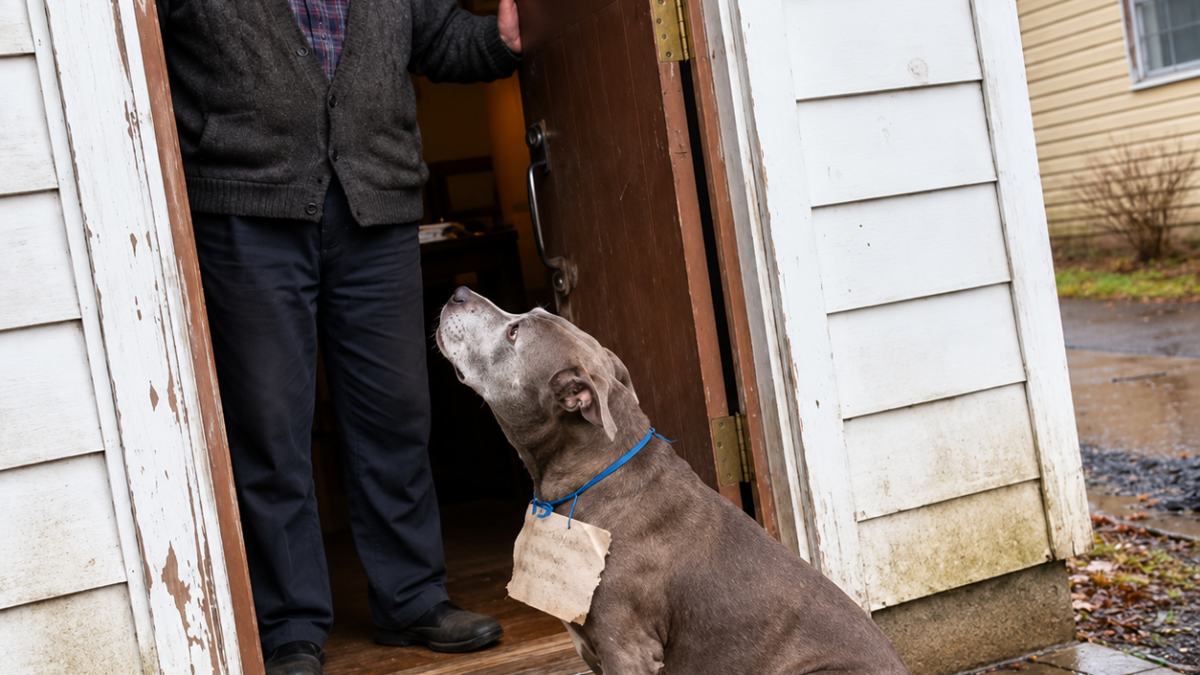
I remained on the floor beside Ethan’s chair for a long time.
Duke watched me.
His muzzle rested on his front paws, but his eyes never completely closed.
The note was still in my hand.
PLEASE FORGIVE ME.
I read the words again.
Then again.
They became less clear each time.
Not because of the rain.
Because my eyes were filling.
“Where have you been?”
Duke’s ears moved.
Seven years.
I tried to understand the number.
Seven winters.
Seven summers.
Seven birthdays Ethan never reached.
Seven Christmases with one less chair occupied at the table.
Seven years of opening closets and unexpectedly finding something that belonged to my grandson.
A baseball glove.
A drawing.
A paperback novel with his name written crookedly on the inside cover.
Seven years since Duke had disappeared during the chaos surrounding Ethan’s funeral.
And now this old dog had simply walked to my gate.
I reached forward.
Duke let me touch his head.
His fur felt coarse with age.
“You remember me?”
His tail moved once.
That nearly destroyed me.
“I looked for you.”
My voice cracked.
“I looked everywhere.”
Duke pushed his nose into my palm.
“I thought you were dead.”
Another small movement of his tail.
I laughed once through my tears.
“Apparently you had other plans.”
That evening I gave him water and a little food.
He drank slowly.
Ate less than I wanted.
Then returned to Ethan’s chair.
I had bought that chair at a yard sale years before Ethan was born.
By the time my grandson discovered it, the velvet was already faded.
He had called it “the reading throne.”
When Ethan visited, Duke would climb up beside him despite being told repeatedly that he was too large.
Ethan would push his feet into one corner.
Duke would curl against them.
Somehow they both fit.
After Ethan died, nobody sat there.
Not me.
Not visitors.
Nobody.
I told myself it was because the chair was uncomfortable.
That wasn’t true.
It had become sacred because grief makes ordinary objects dangerous.
Move the chair and you admit the person is not coming back to use it.
Wash the blanket and you lose a smell.
Pack the books away and the room becomes a room again.
I had not been ready for that.
Apparently Duke wasn’t either.
At nine that night, he was still in the same place.
I brought a blanket and laid it over him.
He opened his eyes.
“It’s cold.”
He let me tuck the blanket around his body.
Then his eyes closed.
I sat across the room.
I didn’t sleep.
Every few minutes, I looked at him to make sure he was breathing.
The house had not felt that alive in seven years.
At four in the morning, Duke began to whimper.
Softly.
Rhythmically.
His paws moved beneath the blanket.
Running in a dream.
I went to him.
“Duke.”
He didn’t wake.
The whimper came again.
His legs twitched harder.
“Easy.”
I placed my hand against his shoulder.
Duke woke suddenly.
For half a second, his eyes were wild.
Then he saw me.
His breathing slowed.
“You’re home.”
I didn’t know whether I was telling him or myself.
“You’re home.”
He rested his head again.
I kept my hand on him until he slept.
At seven, I called Dr. Campbell.
He had been our family veterinarian for decades.
He had treated Duke as a puppy.
More importantly, he had helped me search when Duke disappeared.
He answered with the voice of a man who had been awake for approximately thirty seconds.
“Campbell.”
“It’s Arthur.”
“Arthur?”
“Yes.”
“What happened?”
“Duke came back.”
Silence.
“Arthur.”
“I’m serious.”
Another silence.
Then his voice became fully awake.
“Ethan’s Duke?”
“Yes.”
“That’s impossible.”
“He’s sleeping in Ethan’s chair.”
Dr. Campbell exhaled.
“I’ll be there.”
“You don’t have to—”
“I’ll be there.”
He arrived twenty-five minutes later carrying his medical bag.
He entered the living room.
Stopped.
“My God.”
Duke lifted his head.
Dr. Campbell stared at him.
Then slowly smiled.
“Hello, old man.”
Duke’s tail moved.
Dr. Campbell knelt.
His hands were older too.
Everything was.
He examined Duke’s eyes.
Teeth.
Ears.
Heart.
Joints.
Then the scar.
His fingers paused over it.
“You remember this?”
I nodded.
Ethan had accidentally left the backyard gate unlatched.
Duke chased a car.
He came back with a deep wound along the right side of his neck.
Dr. Campbell had stitched it.
Ethan cried more than Duke did.
For the next week, the boy slept on the floor beside the dog.
“I remember.”
Dr. Campbell looked at me.
“This is him.”
I sat down heavily.
“I know.”
“He’s what? Seventeen now?”
“Close.”
“Maybe eighteen.”
Duke stood briefly.
His back legs shook.
Dr. Campbell touched his hips.
“Arthritis.”
“Bad?”
“Significant.”
He listened again to Duke’s heart.
“Age-related murmur too. Vision is reduced.”
I looked at Duke.
“How long?”
Dr. Campbell knew exactly what I meant.
He didn’t answer quickly.
“I can’t give you a number.”
“Months?”
“Arthur.”
“Please.”
He sat across from me.
“He’s very old.”
My throat tightened.
“Could be months. Could be longer. Could be less.”
I looked toward Ethan’s chair.
Duke had already curled back into it.
“He came home to die.”
Dr. Campbell didn’t say anything.
Sometimes silence is agreement with better manners.
I pulled the note from my pocket.
“This was on him.”
He read it.
His eyebrows narrowed.
“Please forgive me.”
“That’s all.”
“Who wrote it?”
“I was hoping you’d tell me.”
He studied the handwriting.
“Looks young.”
“How can you know?”
“I don’t. Just an impression.”
He turned the paper toward the window.
“The writing leans oddly.”
“What does that mean?”
“Possibly left-handed.”
“Possibly?”
“Arthur, I’m a veterinarian, not a forensic document examiner.”
Despite everything, I smiled.
He handed the note back.
“But someone cared enough to bring him here.”
“Or abandon him at my gate.”
“Maybe.”
Dr. Campbell looked at Duke.
“But look at him.”
“What?”
“His coat isn’t neglected.”
I hadn’t noticed.
“He’s thin because he’s old, but not starving.”
Dr. Campbell touched the leather collar.
“This is new.”
I frowned.
“It looks worn.”
“Soft leather. Quality work. Maybe weeks or months old, not years.”
Someone had cared for Duke.
That changed the mystery.
Maybe the four words were not an apology from someone who had hurt him.
Maybe they came from someone who loved him.
Over the next several days, Duke settled into my home as if seven years had been a long walk and nothing more.
He knew where the kitchen was.
He remembered the back door.
He remembered the sound of the cabinet where I used to keep treats.
The first time I opened it, he lifted his head from three rooms away.
I laughed.
“You remember that?”
He limped into the kitchen.
I found some dog biscuits Dr. Campbell had brought.
Duke took one carefully.
“Some memories survive anything.”
But other things were different.
Stairs were difficult.
Cold mornings made his legs stiff.
Sometimes he stood in the hallway as though he had forgotten what he intended to do.
At night, I heard his paws moving in dreams.
Always running.
Always somewhere I could not follow.
I bought him an orthopedic dog bed.
He ignored it.
I placed it beside Ethan’s chair.
Duke still chose the chair.
“Of course.”
I began leaving a blanket there permanently.
On the third morning after his return, I noticed a small stamp inside the collar.
GREENWOOD LEATHERWORKS.
Beneath it was the name of a town thirty minutes away.
I stared at the mark.
It was the first real clue.
“I’m going out.”
Duke watched from the chair.
“I’ll be back.”
The moment I said those words, something moved through me.
I’ll be back.
How many times had Ethan said that?
Running outside.
Going home after summer vacation.
Leaving for school.
Leaving my house for the last time.
I swallowed.
“I mean it.”
Duke closed his eyes.
Greenwood Leatherworks occupied a narrow storefront between a bakery and an old hardware store.
A brass bell rang when I entered.
The smell of leather filled the room.
Belts hung along one wall.
Wallets.
Harnesses.
Dog collars.
A woman emerged from the back.
“Morning.”
“Are you Mrs. Greenwood?”
“I am.”
I placed Duke’s collar on the counter.
“Do you recognize this?”
She picked it up.
Turned it over.
Her expression changed.
“I do.”
My pulse quickened.
“Who ordered it?”
“When?”
“Please.”
She studied me.
“This is important?”
“That collar came back yesterday on a dog who disappeared seven years ago.”
Her eyes widened.
“Oh.”
She opened a large ledger.
“We keep custom orders.”
She flipped pages.
“What color was the thread?”
“Blue.”
“Soft leather lining?”
“Yes.”
“Large dog?”
“Yes.”
Her finger stopped.
“Here.”
I leaned forward.
September 27.
CUSTOM SENIOR DOG COLLAR.
SOFT LINING.
Name: Amanda Clark.
“Amanda Clark.”
I had never heard the name.
“Do you remember her?”
Mrs. Greenwood leaned against the counter.
“Actually, yes.”
“What did she look like?”
“Very young. Maybe eighteen or nineteen.”
“Hair?”
“Brown.”
“Anything else?”
She thought.
“She looked tired.”
“Tired?”
“Not sleepy.”
Mrs. Greenwood’s expression softened.
“Sick, maybe.”
I felt cold.
“Did she say anything about the dog?”
“Yes.”
“What?”
“I asked whether she wanted his name stamped into the collar.”
“And?”
“She said no.”
Mrs. Greenwood paused.
“She said, ‘He already knows his name.’”
I stared at her.
“Anything else?”
“Yes.”
She had gone pale.
“I remember because it seemed strange.”
“What?”
“She said, ‘He’s going home soon.’”
I barely remember the drive back.
Amanda Clark.
Young.
Possibly sick.
Duke going home soon.
Who was she?
How had she found him?
Where had he been for four years before meeting her?
Why had she waited three years to return him?
And what was she apologizing for?
When I reached my house, Duke was standing behind the front window.
That surprised me.
He rarely stood unless necessary.
I opened the door.
“There you are.”
His tail moved.
“I found your collar maker.”
Duke sniffed my coat.
“Her name is Amanda.”
His head lifted.
I stopped.
“Amanda?”
Duke stared at me.
Maybe coincidence.
Maybe not.
I knelt and touched the collar.
That was when I felt it.
A hard bump beneath the leather lining.
“What is this?”
Duke remained still while I unclipped the collar.
I turned it over.
One section of the lining had been stitched by hand.
Recent stitches.
Different from the manufacturer’s.
My hands started shaking.
I went to the kitchen.
Found small scissors.
Carefully opened the seam.
Something was inside.
A folded piece of paper.
Dry.
Protected.
I unfolded it.
Same handwriting.
The first line read:
I know you don’t know me.
I sat down.
Duke came into the kitchen.
Slowly.
Painfully.
He rested near my feet while I read.
My name is Amanda.
I found Duke three years ago wandering through a grocery store parking lot.
He was in terrible condition.
His paws were bleeding.
He was thin.
He was frightened.
But he was carrying something in his mouth.
A photograph of a boy.
There was also an old identification locket around his neck.
Inside was the same photograph and an address.
Your address.
I stopped reading.
My hands trembled so hard the paper shook.
Duke looked up.
“Ethan?”
His ears moved.
I continued.
I didn’t know who the boy was.
I didn’t know how long Duke had been missing.
I tried the address once, but nobody answered.
I should have tried again.
This is what I need you to forgive.
I kept Duke.
My vision blurred.
I wiped my eyes.
At first I told myself I was only helping until I found his owner.
Then weeks became months.
Duke slept beside my bed.
He followed me everywhere.
He became my best friend.
But he never stopped loving whoever was in that photograph.
Every night he slept with it between his paws.
Sometimes he cried in his sleep.
I knew part of him was still waiting.
Three years.
Amanda had Duke for three years.
What about the four years before?
The letter continued.
Duke is very sick now.
So am I.
I’m going somewhere I cannot take him.
The doctors say I may have a long treatment ahead of me.
Duke has very little time.
I finally understood that loving him means letting him go where he has been trying to return all these years.
He deserves to die at home.
I am sorry I waited so long.
I am sorry I loved him enough to be selfish.
Please forgive me.
Please tell him I didn’t leave because I stopped loving him.
The number is on the back.
Amanda.
The paper fell into my lap.
I covered my face.
Duke rose.
He limped closer.
Then pushed his head under my hand.
I bent over him.
For several minutes, I cried into the fur of a dog who had outlived the boy who adored him and had somehow spent seven years carrying that love through a world neither of us would ever fully understand.
“You kept his picture?”
Duke leaned against me.
“You carried Ethan.”
His tail moved.
It occurred to me then that Duke had spent seven years doing what I had done.
Waiting.
Remembering.
Refusing to let go of the boy.
The difference was that I had remained in the same house.
Duke had wandered through an unknown life.
I turned the paper over.
A phone number.
I called immediately.
A woman answered.
“Hello?”
“May I speak to Amanda Clark?”
Silence.
“Who is this?”
“My name is Arthur Hale.”
Another pause.
“I believe I have Duke.”
The woman gasped.
“Oh.”
“You know him?”
“Yes.”
Her voice broke.
“I’m Amanda’s mother.”
“Is Amanda there?”
A long silence.
“She’s in the hospital.”
I sat down.
“Is she all right?”
“No.”
One word.
Quiet.
Honest.
“What happened?”
Her mother introduced herself as Diane.
Then she told me.
Amanda was nineteen.
She had been sick for more than a year.
A rare autoimmune condition had damaged several organs.
Treatment had become increasingly aggressive.
Hospital stays became longer.
Eventually doctors told Amanda she could no longer safely care for a large elderly dog.
“She fought us,” Diane said.
“About Duke?”
“She said he’d already been abandoned enough.”
My eyes closed.
“She refused to send him to a shelter.”
“So she brought him here.”
“Yes.”
“How?”
“A friend drove.”
“Why didn’t she call?”
“She wanted to.”
“Then why the note?”
Diane’s voice trembled.
“She was ashamed.”
“Of what?”
“Keeping him.”
I looked toward Duke.
He had returned to Ethan’s chair.
“She saved his life.”
“I told her that.”
“Then why apologize?”
“Because Amanda found the address almost immediately.”
I said nothing.
Diane continued.
“She came to your house once.”
“When?”
“Three years ago.”
I searched my memory.
I had traveled to my sister’s for a week around that time.
“She said nobody answered.”
“I may have been away.”
“She left.”
“And never came back.”
“No.”
Diane started crying.
“She loved him.”
“I believe you.”
“She was seventeen when she found him.”
That detail stopped me.
Seventeen.
A sick teenage girl had found an old injured pit bull in a parking lot.
She had carried him home.
Fed him.
Paid for veterinary care somehow.
Slept beside him.
And then blamed herself for loving him too much to give him away.
“There’s more,” Diane said.
“What?”
“Duke helped her survive.”
I looked at him.
“How?”
“When Amanda first got sick, she became severely depressed.”
Diane paused.
“She stopped seeing friends. Stopped going to school. She was angry at everybody.”
I understood anger at life better than I wanted to.
“Duke changed that?”
“He needed her.”
Diane’s voice softened.
“And she needed somebody who didn’t look at her like she was sick.”
I looked down.
“Dogs are good at that.”
“Yes.”
“She used to say Duke didn’t care how many hospital bracelets she wore.”
I smiled through tears.
“What did she mean when she said he had a mission?”
Diane became quiet.
“She believed he was supposed to return to the boy.”
“Ethan.”
“Yes.”
My throat tightened.
“She knew his name?”
“The locket had it written on the back.”
I pressed my hand against my face.
Diane continued.
“Amanda searched online eventually.”
My stomach tightened.
“She found the obituary.”
“Yes.”
The room seemed colder.
“So she knew Ethan was dead.”
“Yes.”
“Then why send Duke here?”
“Because she said Duke wasn’t searching for a person anymore.”
I stared toward the green chair.
“What was he searching for?”
“Home.”
I couldn’t speak.
Diane cried quietly.
“She said there was someone at that address who had loved the boy too.”
I looked at Duke.
“And maybe Duke still had something to give that person.”
I didn’t believe in signs.
At least, I hadn’t for most of my life.
I taught literature for nearly forty years.
I believed in language.
Evidence.
History.
Human choices.
Not destiny.
But sitting there with Ethan’s dog asleep in Ethan’s chair while a stranger’s mother told me that her dying daughter believed the dog had come back to save someone, certainty became less important.
“Can I speak to Amanda?”
“I’ll ask.”
“I want to thank her.”
“I think she needs that.”
A few hours later, Diane called again.
Amanda was awake.
She could speak briefly.
I sat beside Duke when the call came.
“Hello?”
A young voice answered.
Weak.
“Mr. Hale?”
“Yes.”
“This is Amanda.”
For a moment, I couldn’t say anything.
Then I whispered, “Thank you.”
She started crying.
Not loudly.
I could hear her trying to control it.
“I’m sorry.”
“No.”
“I should have brought him sooner.”
“No.”
“I knew where—”
“Amanda.”
She became silent.
“You saved Duke.”
“He saved me too.”
“I believe that.”
“He missed Ethan.”
The fact that she said my grandson’s name broke something open inside me.
“How do you know?”
“The picture.”
“Yes.”
“And when he slept.”
“What did he do?”
“He made a sound.”
I remembered the whimpering.
Amanda continued.
“Sometimes he would wake and look for the picture. If I put it beside him, he calmed down.”
I stroked Duke’s head.
“He still dreams.”
“Is he okay?”
“He’s old.”
“I know.”
“Dr. Campbell thinks he doesn’t have much time.”
Amanda inhaled unsteadily.
“That’s why I sent him.”
“You did the right thing.”
“Does he remember?”
I looked toward Ethan’s chair.
“He walked directly to Ethan’s spot.”
Amanda sobbed once.
Then tried to hide it.
“He did?”
“Yes.”
“He found it?”
“Yes.”
“I told my mom he would.”
Her voice contained joy and pain at the same time.
“Amanda.”
“Yes?”
“You asked me to forgive you.”
Silence.
“There is nothing to forgive.”
She cried again.
“You gave him three years.”
“He gave me three.”
“You loved him.”
“So much.”
“Then you belong in his story.”
That silenced her.
I continued.
“Not as the person who kept him away.”
My voice shook.
“As the person who kept him alive long enough to come home.”
For several seconds, all I heard was hospital equipment in the background.
Then Amanda whispered, “Can you tell him I love him?”
I looked at Duke.
“Yes.”
“And…”
She stopped.
“What?”
“Can you tell Ethan I’m sorry too?”
My eyes filled.
“For what?”
“For keeping his dog.”
I almost laughed through the tears.
“Amanda.”
“Yes?”
“If Ethan were here, he would thank you.”
She began crying harder.
“He loved Duke more than anything.”
“So did I.”
“That’s why he’d understand.”
Before the call ended, I promised to send photographs.
I took one immediately.
Duke asleep in the green chair.
Ethan’s old books still on the shelf behind him.
I sent it to Diane.
Her reply came minutes later.
Amanda is smiling.
That evening, I opened Ethan’s photo albums.
I had not done that in years.
Not properly.
Sometimes I opened one page and closed it again.
Grief had turned memory into a blade.
But Duke sat beside me.
So I kept turning.
Ethan at five with missing front teeth.
Ethan at seven holding a fish.
Ethan at ten with Duke.
There.
The first day.
Duke was all paws and ears.
Ethan sat on my back steps holding him.
They both looked ridiculous.
I laughed.
A real laugh.
The sound startled me.
Duke lifted his head.
“Look at you.”
I turned the album.
Another picture.
Ethan sleeping in the green chair.
Duke at his feet.
Duke came closer.
He lowered his head toward the photo.
His nose touched the page.
I stopped breathing.
He sniffed Ethan’s face.
Then looked at me.
“You remember.”
His tail moved.
I put my hand over my mouth.
For seven years, I had believed remembering Ethan meant reopening the wound.
Duke seemed to understand something I didn’t.
Memory could hurt.
And still be love.
That night, Duke slept without whining.
The next morning, he did something new.
Instead of remaining in Ethan’s chair when I drank coffee by the window, he got down.
Slowly.
Painfully.
He crossed the room.
Sat beside me.
I looked down.
“You joining me?”
Tail.
We watched the street together.
My ritual changed.
Coffee.
Window.
Duke.
For seven years, I had watched the world wake while feeling separate from it.
Now Duke watched too.
Some mornings he fell asleep against my foot.
Other mornings he stared outside.
But he no longer watched the door nervously.
He no longer dreamed as often.
He had arrived.
A week later, an envelope came from Diane.
Inside was an old metal locket.
Scratched.
Dented.
I opened it.
Ethan.
Ten years old.
Smiling into the camera.
My hands shook.
There was a folded note.
Amanda wanted you to have this.
Duke carried it when she found him.
We believe he had worn it for years.
I stared at the photograph.
How had Duke kept it?
Where had he been?
I would never know.
Perhaps people fed him.
Perhaps someone took him in for a while.
Maybe he escaped.
Maybe he kept searching.
The unknown years remained a dark corridor in his story.
But he had carried Ethan through them.
I placed the locket on the green chair.
Duke approached.
He smelled it.
His body went completely still.
Then he lay down.
His head settled beside the locket.
I sat on the floor.
“You kept him.”
Duke closed his eyes.
“You kept him all that time.”
I thought of the promise I had made when Ethan was ten.
Dogs always find their way home.
I had said it casually.
Adults say things to children because we want the world to feel safer than it is.
We promise forever.
We promise always.
We promise nothing bad will happen.
Then life proves us liars.
But this time—
after seven years—
somehow the promise had come true.
Duke had found his way home.
Not quickly.
Not cleanly.
Not without suffering.
But he had found it.
Winter deepened.
Duke weakened.
There is no gentle way to watch age take an animal.
Every week something became harder.
Standing.
Walking.
Eating.
Cold mornings.
Dr. Campbell visited often.
He adjusted medication.
Arthritis treatment.
Heart support.
Pain control.
“He’s comfortable?”
I asked that every time.
“Yes.”
“Are you sure?”
“Yes.”
“Tell me when he isn’t.”
“I will.”
That frightened me.
I knew what it meant.
But I had learned something after Ethan.
Avoiding the end does not stop it.
It only prevents you from being present while it approaches.
So I stayed present.
I cooked for Duke when his appetite declined.
Chicken.
Rice.
Broth.
Small pieces by hand.
I placed rugs across slippery floors.
I built a small ramp beside the back steps.
At seventy-one, my carpentry was embarrassing.
Duke didn’t judge.
When he could no longer climb into Ethan’s chair easily, I lifted him.
The first time I did, I whispered, “Don’t tell anyone.”
His tail moved.
Our mornings became precious.
Coffee.
Window.
Duke.
I began talking to him.
At first about Ethan.
Then about everything.
Teaching.
My late wife, Margaret.
The ridiculous things students used to write in essays.
The first car I owned.
My fear of dying alone.
That one surprised me when it came out.
I had not admitted it to myself.
Duke looked up.
“I suppose you know something about being alone.”
He put his head on my knee.
“Yes.”
I touched his ear.
“So maybe neither of us has to do it.”
Amanda remained in the hospital.
We exchanged messages through Diane.
Some days Amanda felt strong enough to respond.
Other days she did not.
I sent pictures.
Duke at the window.
Duke in the chair.
Duke wearing a ridiculous knitted scarf my neighbor made.
Duke asleep beside Ethan’s locket.
Amanda sent one photograph too.
Herself.
She was pale.
Very thin.
Brown hair cut short.
But smiling.
In her lap was an old picture of Duke from when he had lived with her.
I printed it.
Placed it on the shelf beside Ethan’s photographs.
Duke now had two families represented in my living room.
At first that felt strange.
Then it felt right.
Love is not a competition.
Amanda loving Duke did not subtract anything from Ethan.
Duke loving Amanda did not mean he forgot Ethan.
The heart is larger than grief allows us to believe.
One evening Diane called.
Her voice told me the news before the words did.
Amanda’s condition had worsened.
“How bad?”
“Very.”
I sat beside Duke.
“Can she talk?”
“Maybe tomorrow.”
I looked at him.
“Could I bring Duke?”
Silence.
“To the hospital?”
“If they allow it.”
There were policies.
Exceptions.
Phone calls.
Dr. Campbell wrote a letter explaining Duke’s condition and Amanda’s history with him.
A hospital social worker became involved.
Two days later, permission came.
I put Duke into the back seat of my car.
It was difficult for him.
He had not traveled since arriving.
I covered the seat with blankets.
“Ready?”
Duke looked at me.
“We’re going to see Amanda.”
His ears lifted.
I wondered whether he remembered the name.
The hospital was forty minutes away.
Duke watched the world through the window.
When we arrived, Diane met us outside.
I recognized her immediately from Amanda’s face.
She knelt.
“Duke.”
The old dog stopped.
Then his tail began moving.
Diane covered her mouth.
“He remembers.”
Duke pulled weakly toward her.
She hugged him.
“Oh, sweetheart.”
I turned away.
Some moments belong partly to strangers.
We were escorted through a side entrance.
Duke wore a clean therapy-style vest the hospital had requested.
His nails clicked softly against the floor.
People stared.
An old gray pit bull walking through a hospital.
Duke moved faster than I had seen him move in weeks.
Not fast.
But determined.
When we reached Amanda’s room, Diane opened the door.
Duke stopped.
Amanda was in bed.
Smaller than her photograph.
Machines nearby.
Lines.
Monitors.
Her eyes opened.
She saw him.
The expression on her face—
I will never forget it.
“Duke.”
His entire body changed.
Tail.
Ears.
Head.
He pulled toward the bed.
I released the leash.
Duke crossed the room.
Amanda reached down.
Her hand shook.
Duke placed his head beneath it.
She sobbed.
“My boy.”
Duke made a sound.
Low.
Almost a cry.
Amanda struggled to sit.
Nurses helped arrange pillows.
Duke rested his front paws against the side of the bed.
Amanda touched his face.
“You made it.”
I stood near the door.
Diane cried openly.
Amanda kissed Duke’s forehead.
“You’re home.”
Duke licked her wrist.
She laughed through tears.
“I missed you too.”
I had expected jealousy.
Not rationally.
But I had wondered how I would feel watching Duke with the person who had kept him for three years.
Instead, I felt gratitude.
Amanda had loved him exactly as Ethan would have wanted.
She noticed me.
“Mr. Hale.”
“Arthur.”
She smiled.
“Arthur.”
I approached.
“You look younger than I imagined.”
“I assure you, that is the medication talking.”
She laughed.
Duke remained between us.
Amanda looked at him.
“Is he happy?”
“Yes.”
“He sleeps in the chair?”
“Every night.”
She closed her eyes.
“Good.”
I sat.
“Amanda.”
“Yes?”
“I brought something.”
I handed her a photograph.
Ethan and Duke.
The first summer.
Amanda held it carefully.
“So that’s him.”
“That’s Ethan.”
She stared.
“I’ve seen the little locket picture so many times.”
“He was ten.”
“He looks kind.”
“He was.”
Amanda touched Duke.
“He chose a good boy.”
“They chose each other.”
She looked at me.
“Can I ask something?”
“Anything.”
“Were you angry with me?”
I thought before answering.
“When I first read the note?”
“Yes.”
“No.”
That surprised her.
“I was confused.”
“I should have brought him back.”
“You were seventeen.”
“I knew the address.”
“You were seventeen.”
Her eyes filled.
“I needed him.”
“I know.”
“That feels selfish.”
“No.”
I leaned forward.
“Needing someone is not the same as stealing them.”
She looked toward Duke.
“I kept thinking I had more time.”
“So did I.”
That sentence carried more than Duke.
Ethan.
Margaret.
Everyone.
Amanda understood.
“Yes.”
I continued.
“If Duke had come back three years earlier, maybe I would have loved him.”
I paused.
“But maybe I wasn’t ready.”
She watched me.
“I had turned this house into a museum of grief.”
My eyes stung.
“You kept him alive until both of us could come home.”
Amanda started crying.
So did I.
She reached for my hand.
I gave it.
For a while, an old man, a sick young woman, and a very old dog sat connected by a boy who had been dead seven years.
It should have felt tragic.
Instead, it felt strangely complete.
Before we left, Amanda whispered into Duke’s ear.
I didn’t hear everything.
Only the last words.
“…good boy.”
Duke licked her cheek.
She smiled.
Then looked at me.
“Take him home.”
“I will.”
“Promise?”
I thought about promises.
This time, I answered carefully.
“I’ll stay with him as long as he needs me.”
Amanda nodded.
“That’s better.”
She died twelve days later.
Diane called me in the morning.
I sat beside Duke.
He was sleeping.
“Amanda died last night.”
Diane cried.
“She was peaceful.”
I closed my eyes.
“Was she afraid?”
“No.”
“Good.”
“She had the picture of Duke beside her.”
I looked at the old dog.
“Thank you for telling me.”
“She wanted you to have something else.”
“You’ve already given me enough.”
“No.”
Diane’s voice softened.
“This matters.”
A week later, another package arrived.
Inside was a small rubber ball.
Old.
Blue.
Chewed almost beyond recognition.
A note from Diane:
This was Duke’s favorite toy at Amanda’s house.
She kept it beside her hospital bed after he left.
She said a home should contain evidence that someone lived there.
Please put it near Ethan’s chair.
I did.
Duke smelled the ball.
Then picked it up.
For a second, he looked younger.
He carried it to the chair.
Lay down.
Placed the ball between his paws.
Ethan’s locket beside him.
Amanda’s toy beneath his chin.
Both lives.
Both homes.
One dog.
I sat across from him.
“You carried all of us, didn’t you?”
His tail moved.
After Amanda died, Duke weakened rapidly.
Maybe coincidence.
Maybe age.
Maybe some animals hold themselves together until certain things are finished.
Dr. Campbell would have dismissed that idea medically.
As a friend, he didn’t.
One morning Duke couldn’t stand.
I called him.
He came immediately.
We helped Duke onto a thick blanket in the living room.
Dr. Campbell examined him quietly.
When he finished, he sat beside me.
I knew.
“Today?”
His face hurt.
“I think so.”
I stared at Duke.
“No.”
“Arthur.”
“He ate yesterday.”
“I know.”
“He was at the window.”
“I know.”
“He wagged his tail.”
“I know.”
My voice broke.
“I just got him back.”
Dr. Campbell put one hand on my shoulder.
“I know.”
Seven years.
I had waited seven years.
And now I had weeks.
It felt obscene.
Unfair.
I wanted to bargain.
Another month.
A year.
Anything.
Then Duke looked at me.
His eyes were tired.
I remembered Amanda’s words.
Take him home.
Home was not keeping him alive at any cost.
Home was safety.
Love.
Not forcing someone you love to stay because you are afraid of losing them.
Ethan had taught me that painfully.
Amanda had taught me through Duke.
Now Duke was asking me to understand.
I sat beside him.
“Can we wait until evening?”
Dr. Campbell nodded.
“As long as he’s comfortable.”
We spent the day together.
I opened Ethan’s albums.
Read aloud.
Duke slept.
At noon, I warmed chicken.
He ate two pieces from my hand.
At two, we sat by the window.
Rain began.
Just like the morning he returned.
I laughed softly.
“You really like dramatic weather.”
His tail tapped once.
At four, Diane called.
I told her.
She cried.
“Tell him Amanda is waiting.”
I couldn’t answer.
Maybe she was.
Maybe Ethan was.
Maybe nobody waits anywhere.
I didn’t know.
But for once, uncertainty didn’t frighten me.
At six, I lifted Duke into Ethan’s chair.
Dr. Campbell returned.
He arranged everything gently.
I put Ethan’s locket beside Duke.
Amanda’s blue ball between his paws.
Then I sat on the floor.
Exactly where I had sat his first night home.
Duke looked at me.
“Hey.”
His breathing was shallow.
“You did it.”
His ears moved.
“You found your way back.”
My voice cracked.
“And I’m sorry it took me so long to understand why.”
I touched his head.
“You weren’t coming back just because you needed a place to die.”
Duke’s eyes stayed on mine.
“You came back because I had forgotten how to live.”
Dr. Campbell looked away.
I kept speaking.
“For seven years, I thought loving Ethan meant staying sad enough to prove he mattered.”
Tears ran down my face.
“But you remembered him without stopping.”
I touched the locket.
“You carried him and kept walking.”
Duke breathed slowly.
“You loved Amanda too.”
His tail moved faintly.
“And somehow that didn’t betray Ethan.”
I laughed through tears.
“You knew more than I did.”
Dr. Campbell whispered, “Arthur.”
I nodded.
It was time.
I leaned closer.
“Duke.”
His eyes focused.
“Ethan loved you.”
A breath.
“Amanda loved you.”
Another.
“And I love you.”
My forehead touched his.
“You don’t have to find anybody anymore.”
The injection went in.
I kept talking.
“You’re home.”
Duke exhaled.
His body relaxed.
His eyes remained half-open.
I whispered the last words.
“You’re home.”
And then he was gone.
The silence returned.
But it was not the same silence.
That distinction saved me.
For seven years, the silence in my house had meant absence.
After Duke, silence contained memory.
Footsteps that had existed.
A tail against velvet.
Breathing beside my chair.
A dog’s nails on the hallway floor.
Amanda’s voice through a telephone.
Ethan laughing in photographs I could finally look at again.
Duke did not erase grief.
He changed its shape.
Dr. Campbell stayed until almost nine.
Before leaving, he looked at Ethan’s green chair.
“You going to move it?”
I considered the question.
“No.”
He nodded.
Then I added, “But I might sit in it.”
He smiled.
“That sounds healthy.”
The next morning, I made coffee at six.
Habit.
For seven years, I had sat by the window alone.
For several weeks, Duke had sat beside me.
Now his place was empty.
I stood in the doorway.
The old grief tried to return in its familiar form.
Close the room.
Don’t touch anything.
Preserve absence.
Instead, I walked to Ethan’s chair.
I sat.
For the first time in seven years.
The velvet was softer than I remembered.
I held my coffee.
Placed one hand where Duke used to rest his head.
And watched sunrise reach the houses across the street.
I cried.
But I stayed in the chair.
That mattered.
A month later, Diane visited.
We had never met in person.
She brought Amanda’s journal.
“I don’t expect you to read all of it.”
“Are you sure?”
“There are pages about Duke.”
We sat in the living room.
She immediately noticed the photographs.
Ethan.
Amanda.
Duke.
Together.
Diane touched her daughter’s picture.
“Thank you.”
“For what?”
“For not treating her like the villain.”
“She wasn’t.”
Diane cried.
“She thought she was.”
“She was a child who found a dog.”
“A sick child.”
“A brave one.”
We drank coffee.
Then she gave me the journal.
That night, I opened it.
Amanda’s handwriting filled the pages.
Some entries were short.
Some angry.
Some frightened.
Then I found Duke.
June 3.
Found an old dog today.
He followed me home.
Mom says we can’t keep him.
I think he disagrees.
June 7.
He sleeps with a picture of a boy.
I wish I knew who the boy is.
June 19.
His name is Duke.
Found it on the locket.
There’s an address.
I’m scared to call.
Why am I scared?
July 2.
Went to the address.
No one home.
Duke sat on the porch and cried.
I couldn’t leave him there.
That entry broke me.
Duke had reached my house three years earlier.
I had been gone.
He had been close.
So close.
Amanda continued.
July 3.
I brought him back with me.
I told myself tomorrow.
Then tomorrow became next week.
I know this is wrong.
But he sleeps beside me.
September 14.
Doctor says more tests.
I hate hospitals.
Duke doesn’t care what is wrong with me.
He only cares whether I share chicken.
October 8.
I searched Ethan.
He died.
Now I understand the picture.
Duke lost his boy.
Maybe that is why we understand each other.
November 21.
I don’t think Duke wants the boy.
I think he wants the place where the boy loved him.
I closed the journal.
Amanda had understood before any of us.
Home is sometimes not a person.
It is where love happened.
Her later entries became harder.
Hospital.
Treatment.
Pain.
Fear.
Then:
August 12.
I have to send Duke home before I can’t.
I hate this.
He will think I abandoned him.
September 27.
Bought his new collar.
Soft because his neck hurts.
The woman asked his name.
I couldn’t say it.
I almost cried in the store like an idiot.
October 15.
Wrote the letter.
Deleted it.
Wrote another.
Too long.
Maybe only four words.
Please forgive me.
November 30.
He is going home.
I keep telling myself that.
Not leaving.
Going home.
December 13.
Tomorrow.
I slept with him on the floor tonight.
He put the blue ball beside my hand.
I don’t know how to do this.
December 14.
The final entry.
Only one line.
Take him where love remembers him.
I sat with that sentence until sunrise.
Take him where love remembers him.
That was why Duke came back.
Not because my house was geographically home.
Not because walls remember.
Because I did.
And because I needed to learn that remembering could be more than suffering.
I wrote Diane a letter.
Your daughter brought Duke home twice.
Once to this house.
Once back into my life.
She answered with one sentence:
I think Duke did the same for her.
Spring came.
For the first time in years, I opened the curtains in Ethan’s old room.
Dust covered the desk.
His childhood books remained where I had left them.
I began sorting.
Not throwing everything away.
Not erasing.
Just touching.
Choosing.
Living.
I donated some books to the elementary school where I had once taught.
Inside each one, I placed a small label:
From Ethan’s Library.
I kept his favorites.
Especially the adventure book whose hero had given Duke his name.
At school, the librarian asked me to speak to a group of students about the donation.
I almost refused.
Then I remembered Amanda.
Duke.
Ethan.
So I went.
A little boy raised his hand after I told them the books had belonged to my grandson.
“Did he like dogs?”
I smiled.
“Very much.”
“What kind?”
“A pit bull.”
“What was his name?”
“Duke.”
I stopped.
My throat tightened.
But I continued.
“He was a very good dog.”
Afterward, I sat in my car and cried.
Not because I had failed.
Because I had said their names aloud in a room full of life.
That was new.
Summer arrived.
I planted flowers near my gate.
I had not cared about the yard in years.
Mrs. Donnelly from next door watched me.
“Arthur.”
“Yes?”
“You gardening?”
“Apparently.”
“You hate gardening.”
“I know.”
She looked suspicious.
“Are you ill?”
I laughed.
It felt good.
“No.”
I planted anyway.
Blue flowers.
Because of Amanda’s thread.
Because of Duke’s ball.
Because certain colors become memories.
On December 14, one year after Duke returned, I woke at six.
Made coffee.
Sat in Ethan’s chair.
Rain tapped the window.
I placed three things on the side table.
Ethan’s photograph.
Amanda’s photograph.
Duke’s collar.
The four-word note was framed now.
PLEASE FORGIVE ME.
For months, I had thought about replacing it with Amanda’s longer letter.
I didn’t.
Those four words contained the entire story.
Amanda thought she needed forgiveness.
I thought I needed answers.
Duke needed neither.
He needed to come home.
That morning, I wrote in a notebook.
I had not written anything personal since my wife died.
Teachers spend years correcting other people’s words and sometimes forget they have their own.
I wrote:
A boy loved a dog.
A girl found the dog.
The dog kept loving both.
And an old man finally understood that love does not become smaller when it survives more than one home.
I looked at the sentence.
Then kept writing.
That became the beginning of everything I am telling now.
People sometimes ask whether I believe Duke somehow knew he was dying and chose to return.
I don’t know.
Whether he understood addresses, distance, memory, or death in the way humans do is something I cannot prove.
I only know what happened.
He appeared at my gate.
He recognized Ethan’s chair.
He recognized photographs.
He recognized Dr. Campbell.
He responded to Amanda’s name.
And during the brief time he lived with me again, the old dog who had spent years carrying a boy’s picture finally stopped crying in his sleep.
That is enough for me.
I don’t need to turn it into a miracle.
Reality was already remarkable.
A dog vanished.
A teenage girl found him.
She cared for him while fighting for her own life.
Then, when keeping him became impossible, she chose his past over her need to hold on.
He returned to an old man who had spent seven years confusing grief with loyalty.
And somehow, in his final weeks, Duke gave each of us something.
Amanda learned that letting go could be love.
I learned that remembering could be love without becoming punishment.
And Duke—
I think Duke learned that the journey was over.
He didn’t need to keep carrying Ethan.
We could carry him together.
Years have passed since then.
I am older now.
The morning routine remains.
Coffee.
Window.
Books.
But not the same silence.
Photographs cover the wall now.
Ethan laughing.
Duke as a puppy.
Amanda holding Duke’s face between her hands.
Duke old and gray in the green chair.
People who visit sometimes ask why I keep photographs of a young woman who wasn’t related to me.
I tell them:
“She was family to someone I loved.”
That is enough.
Diane and I still speak.
Every December 14, we call each other.
Some years we talk about Amanda.
Some years Ethan.
Always Duke.
One year Diane laughed and said, “That dog created the strangest family.”
I answered, “He always was stubborn.”
We both cried afterward.
But there was laughter first.
That matters.
Ethan’s chair remains in my living room.
I sit there now.
Not every day.
Often enough.
The velvet has worn thinner.
There is still a slight depression where Duke used to curl.
Maybe imagined.
I don’t care.
Beside it is a small wooden box.
Inside:
Duke’s collar.
Amanda’s note.
The blue ball.
Ethan’s locket.
I used to believe objects kept grief alive.
Now I know objects can also keep gratitude alive.
The difference is not in the object.
It is in the hand holding it.
Sometimes on rainy mornings, I still remember Duke standing outside the gate.
Gray muzzle.
Old legs.
Four wet words hanging from his neck.
At the time, I thought somebody was asking forgiveness for returning my grandson’s dog too late.
Now I think the message belonged to all of us.
Amanda asked forgiveness for holding on.
I needed forgiveness for shutting down.
Maybe even Duke, in whatever way dogs understand guilt, had carried some burden from the day Ethan disappeared from his life.
But love had never been the offense.
Love was the thing that kept pulling all of us toward one another.
Seven years late.
Three years late.
A lifetime late.
Still arriving.
If I could speak to Amanda again, I would tell her not to apologize.
If I could speak to Ethan, I would tell him the promise I made when he was ten came true.
Duke found the way home.
If I could speak to Duke one more time, I wouldn’t ask where he had been.
That question once seemed so important.
Now it doesn’t.
I would simply put my hand on his old gray head and say:
You did enough.
You carried him far enough.
You carried Amanda too.
You carried me.
Rest.
You’re home.
And maybe that is what his return really meant.
Duke did not come back because he needed a final place to die.
He came back because there were three people separated by grief, distance, illness, and seven lost years who still belonged to the same story.
One of them was dead.
One was dying.
One had forgotten how to live.
And an old dog connected us.
No speech.
No explanation.
Just a scar.
A photograph.
A collar.
And four words written by a frightened nineteen-year-old girl who thought love required an apology.
It didn’t.
Love required courage.
Amanda had the courage to let Duke go.
Duke had the courage to keep searching.
And eventually I found the courage to open the door.
That is why, every December 14, when the morning is cold and the street outside my window is quiet, I still look toward the gate.
Not because I expect Duke to return again.
He already did.
I look because that gate reminds me that the things we believe are gone forever sometimes return in forms we do not recognize at first.
Not to give us the past back.
Nothing can do that.
They return to show us what the past left inside us.
Ethan left love.
Amanda left kindness.
Duke left proof that both could survive.
The last line I wrote in Amanda’s journal before returning it to Diane was placed beneath her final entry.
She had written:
Take him where love remembers him.
I added:
He came home. And because he did, so did I.








