Rocky had spent most of his life finding people everyone else had given up hope of finding, but the day his own legs stopped carrying him, he looked at me as if he were asking whether I would give up on him.
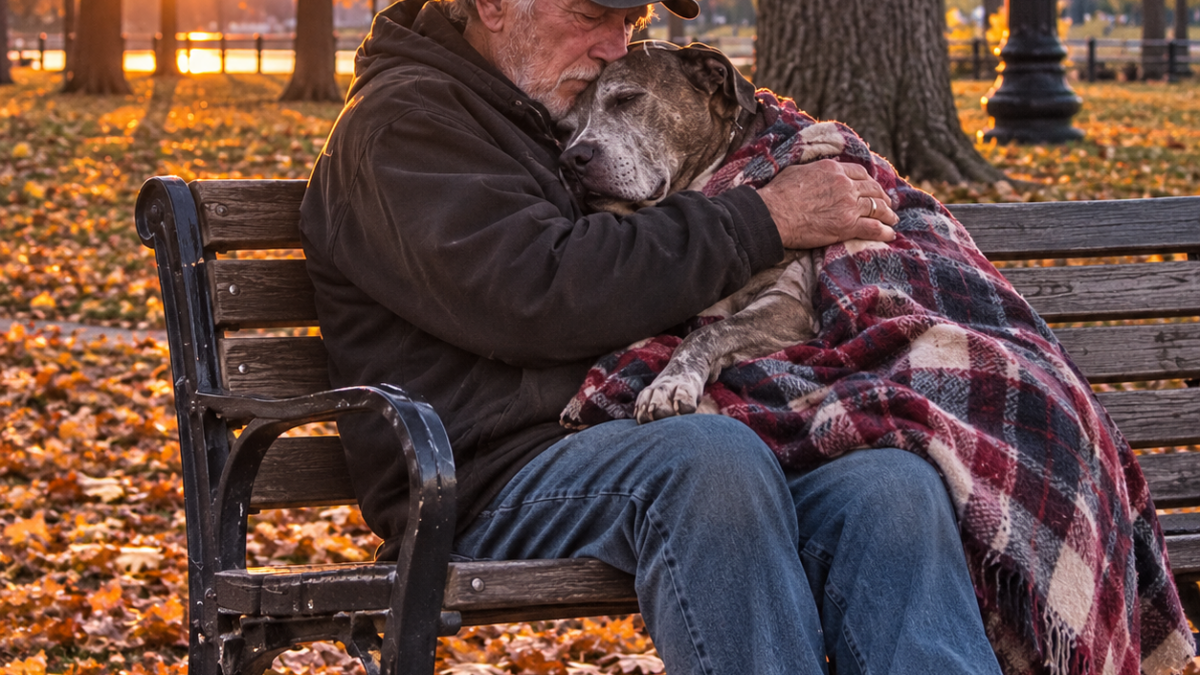
The first trip to the park nearly destroyed my back.
I’m not ashamed to admit that.
Love may make you determined, but determination does not magically turn a sixty-seven-year-old retired schoolteacher into a weightlifter.
By the time I reached the end of our street, my forearms were burning.
Rocky weighed close to sixty-five pounds, and unlike carrying a box, carrying an old dog meant constantly adjusting to keep pressure away from painful joints.
I had one arm beneath his chest and the other supporting his hindquarters.
Every twenty or thirty steps, I shifted him slightly.
“Don’t judge me,” I muttered.
Rocky turned his face toward mine.
“I’m out of practice.”
His nose brushed my cheek.
“I taught eighth graders for three decades. That should count as physical conditioning.”
He gave me no sympathy.
But when we reached the entrance to the park, something changed in him.
His head lifted.
The exhaustion in his eyes faded.
He smelled the grass.
The oak trees.
The damp earth near the pond.
A Labrador barked somewhere in the distance.
Two children rode bicycles down the path.
Rocky’s ears moved toward every sound.
For the first time since the veterinarian’s appointment, he looked like himself.
Not the retired rescue dog with failing legs.
Not the patient with arthritis.
Rocky.
I walked to our usual bench.
It stood beneath a maple tree overlooking a wide section of grass.
For years, I had sat there while Rocky sniffed every shrub within fifty yards as though gathering intelligence for national security.
That evening, I lowered him carefully onto the bench beside me.
He shifted once.
Then settled.
His front paws rested near the edge.
His back legs lay beneath the blanket I had carried under one arm.
The sky was pale gold.
Rocky lifted his muzzle into the breeze.
His eyes closed.
I watched him.
That was when the pain inside me changed shape.
Until then, I had been grieving what he had lost.
His speed.
His strength.
His ability to stand at the door impatiently while I tied my shoes.
But sitting beside him, I realized Rocky wasn’t thinking about any of that.
He was listening to birds.
Smelling grass.
Feeling evening air in his fur.
He wasn’t comparing this evening to five years ago.
I was.
Dogs have an advantage over us.
They don’t ruin the present by constantly measuring it against the past.
I put my hand on his shoulder.
“You’re better at this than I am.”
His eyes remained closed.
“You always have been.”
We stayed until the light faded.
Then I carried him home.
The following morning, every muscle in my body protested.
I stood in the kitchen with both hands gripping the counter while my back tightened.
“This,” I told Rocky, “is your fault.”
He was lying beside the table.
His tail moved once.
“Don’t act proud.”
I made coffee.
Then I called a physical therapist I knew from school.
Her name was Linda Carson. She had treated teachers with everything from torn shoulders to bad knees.
When I explained that I wanted to strengthen myself so I could safely carry a sixty-five-pound dog every evening, there was a pause.
“You want exercises for carrying a dog?”
“Yes.”
“How old are you, Michael?”
“You know how old I am.”
“That wasn’t the question.”
“Sixty-seven.”
“And the dog?”
“Older than me in dog years.”
Another pause.
Then she laughed.
“Come in tomorrow.”
Linda did not laugh once I arrived.
She showed me how easily I could injure my lower back if I twisted while lifting Rocky.
She taught me how to squat correctly.
How to brace my core.
How to use my legs instead of bending at the waist.
She gave me strengthening exercises.
“You understand,” she said, “that eventually you may need equipment.”
“I understand.”
“A support harness. Maybe a wagon.”
“I understand.”
“And you need to listen to your body.”
“I will.”
She gave me the look teachers give students when they know the student is lying.
“Michael.”
“I’ll try.”
That was apparently acceptable.
For the next several weeks, my life developed a new rhythm.
Morning medication.
Breakfast in smaller portions because Rocky was less active.
Gentle massage around his hips.
Short assisted trips into the yard.
My exercises.
Then sunset.
Sunset remained sacred.
At first, I carried him the entire way.
Then I bought a padded mobility harness that allowed me to support his rear half while his front legs did some of the work.
On good evenings, Rocky could manage part of the sidewalk himself.
He would take six or seven steps.
Rest.
Then continue.
I never rushed him.
We had spent years walking quickly.
Now we learned how to move slowly.
It turned out the world contained things I had never noticed at our old pace.
The smell of honeysuckle near Mrs. Delaney’s fence.
The way evening light turned the windows of the apartment building orange.
A little boy who practiced bouncing a basketball every day at almost exactly six thirty.
A cardinal that seemed to occupy the same branch near the park entrance.
Rocky noticed all of it.
Of course he did.
He had always noticed more than I did.
People began recognizing us.
At first, most saw only an old man carrying an old dog.
Then someone recognized Rocky.
It happened on a cool Thursday evening.
A woman in her forties was walking toward us with a teenage girl.
We were halfway to our bench.
Rocky was in my arms because his legs had been particularly bad that day.
The woman slowed.
She stared at him.
Then at me.
“Excuse me.”
I stopped.
“Is that Rocky?”
I was surprised.
“Yes.”
Her hand rose to her mouth.
The teenage girl looked confused.
The woman stepped closer.
“Search and rescue Rocky?”
“Yes.”
Her eyes immediately filled with tears.
“Oh my God.”
I looked at her.
“Did you know him?”
“Not exactly.”
She turned toward the girl.
“This is Emily.”
Emily gave me a shy smile.
The woman looked at Rocky again.
“He found her.”
For a second, I didn’t understand.
“Years ago,” she continued. “Emily was six. We were camping with my sister’s family. She wandered away while everyone was packing.”
Emily looked embarrassed by a story she probably had heard hundreds of times.
“They searched for seven hours.”
The woman’s voice broke.
“It got dark.”
Rocky had lifted his head.
The woman crouched slightly but did not touch him.
“They brought dogs in.”
She laughed through tears.
“This dog came out of those woods ahead of everyone else. He led a rescuer straight to my daughter.”
I looked down at Rocky.
I knew his records.
I knew the number seventeen.
I knew there had been missing children.
But names had never meant much on paper.
Now one of those seventeen was standing in front of me.
Sixteen or seventeen years old.
Alive.
Tall.
Healthy.
Her whole life stretching ahead of her.
Emily approached slowly.
“Can I pet him?”
“Of course.”
She touched Rocky’s forehead.
His tail moved.
The tiniest wag.
Emily smiled.
Her mother started crying harder.
“I never got to thank him.”
I didn’t know what to say.
So I said the only thing that felt true.
“You just did.”
The woman knelt on the sidewalk.
She put both hands gently around Rocky’s face.
“Thank you.”
Rocky licked one of her fingers.
The mother laughed.
Emily laughed.
I turned my face away for a moment because my own eyes had become useless.
That encounter changed something for me.
Until then, Rocky’s rescue career had felt like another life.
A chapter that belonged to the people who had trained him.
The team photographs.
The newspaper articles stored in a folder.
That evening, the number seventeen became human.
Seventeen breakfasts.
Seventeen birthdays.
Seventeen families.
Seventeen futures that continued because Rocky had followed a scent and refused to stop.
When we reached the bench that night, I looked at him differently.
“Show-off.”
He rested his head against me.
“You never told me about Emily.”
No response.
“Seventeen people, and you come home and act like locating the television remote is difficult.”
His eyes closed.
I smiled.
“Typical.”
A week later, Emily and her mother returned.
They brought an old newspaper clipping.
There he was.
Younger.
Dark gray coat gleaming.
Standing beside a rescue worker.
The headline mentioned the missing six-year-old recovered safely.
Emily had been wrapped in a blanket in the background.
I stared at the image.
“You were handsome.”
Rocky sniffed the paper.
“Were.”
Emily laughed.
Her mother asked whether they could photograph him.
“Of course.”
Emily sat beside Rocky on the bench.
Her hand rested on his shoulder.
The girl he had found as a child beside the old dog he had become.
I took the picture.
I still have a copy.
After that, more people learned that the dog I carried through the neighborhood every night had once served in search and rescue.
A retired firefighter stopped us.
A police officer recognized the unit name on Rocky’s old tag.
Someone from the local newspaper called.
I declined an interview at first.
Rocky did not need publicity.
Neither did I.
But when the reporter explained she wanted to write about retired working dogs and the responsibility people had toward them after service, I agreed.
The article appeared on a Sunday.
The photograph showed me carrying Rocky toward the park.
The headline made me uncomfortable.
LOCAL HERO NOW CARRIED BY THE MAN HE SAVED.
I told the reporter Rocky had never pulled me from a collapsed building.
She understood.
“He saved you differently.”
That was true.
When Catherine died, I had stopped participating in my own life.
That sounds dramatic.
It wasn’t.
Grief often isn’t dramatic.
It is repetitive.
Quiet.
You wake up.
There is no reason to make breakfast for two.
You make coffee anyway.
You notice the second mug still in the cabinet.
You avoid looking at it.
You walk through rooms containing furniture chosen together.
Every object becomes evidence of a life that no longer exists.
At school, I could function.
I had students.
Schedules.
Meetings.
Papers to grade.
Then I retired.
Suddenly, there was nothing between me and the silence.
Friends invited me places.
I declined.
My daughter called from Colorado.
I told her I was fine.
I was not fine.
I had not planned to harm myself.
But I had stopped caring whether life contained anything more than getting from one day to the next.
Then Rocky arrived.
He needed breakfast at seven.
That mattered.
He needed walking.
That mattered.
He needed medication for an old shoulder injury.
That mattered.
He waited by the door when I went grocery shopping.
Someone noticed when I returned.
That mattered.
One night, about three months after he came home with me, I woke around three in the morning.
Catherine had appeared in a dream.
In the dream, she was standing in our kitchen asking why I had moved the coffee.
Such an ordinary thing.
Then I woke.
The empty side of the bed hit me like a physical blow.
I went downstairs and sat in the living room.
I don’t know how long I sat there.
Rocky eventually walked in.
He didn’t nudge me.
Didn’t demand anything.
He simply put his head on my knees.
And stayed.
That was the night I cried for the first time since Catherine’s funeral.
Not polite tears.
Not the controlled grief you allow in front of other people.
I fell apart.
Rocky never moved.
That dog who had spent years searching for lost people had apparently found one more.
Me.
So when his legs failed, carrying him to the park never felt noble.
It felt fair.
He had carried me through nine years without using his arms.
Surely I could carry him for a few months using mine.
Summer became fall.
The evenings grew colder.
Rocky’s arthritis worsened.
Dr. Patel adjusted his medication.
We added supplements.
A heating pad became part of his bed.
I placed rugs over sections of hardwood flooring so his front paws wouldn’t slip.
I installed a low ramp near the back door, though eventually even that became difficult.
Friends suggested a dog wheelchair.
We tried one.
Rocky tolerated it for three days.
On the fourth evening, he looked at the device, looked at me, and put his head back down.
“You hate it?”
His eyes closed.
“That clear, huh?”
We stopped using it.
I wasn’t going to make his final months into a rehabilitation program he disliked merely because equipment existed.
The goal was not to make Rocky young again.
The goal was to let Rocky be Rocky with the body he had.
So I carried him.
In rain, I used an oversized umbrella.
I must have looked ridiculous.
One arm around Rocky, one hand attempting to control an umbrella large enough for patio furniture.
Wind turned the umbrella inside out twice.
Rocky looked offended by the weather.
“I don’t control this.”
He sneezed.
“File a complaint.”
Another sneeze.
“I’ll forward it.”
On cold evenings, I wrapped him in Catherine’s old wool blanket.
At first, using it hurt.
She had kept it on the back of the sofa every winter.
After she died, I couldn’t bring myself to throw it away or donate it.
Now Rocky rested inside it, gray fur against faded blue wool.
Something about that felt right.
As if two parts of my life had finally touched.
One December evening, snow began unexpectedly while we were at the park.
Not heavy snow.
Large quiet flakes.
Rocky watched them fall.
One landed on his nose.
He blinked.
Another landed between his ears.
I laughed.
“You’ve seen snow before.”
He licked his nose.
We stayed longer than we should have.
The park emptied.
Streetlights came on.
Snow gathered lightly across the grass.
Rocky lay beside me on the bench wrapped in Catherine’s blanket.
I told him stories.
Not because dogs need stories.
Because I did.
I told him how Catherine and I met.
How she had corrected my grammar on our second date even though I was the teacher.
How she burned our first Thanksgiving turkey.
How she insisted it was “smoked.”
How we once drove three hours in the wrong direction because neither of us wanted to admit we were lost.
Rocky listened.
He had a talent for that.
“You would have liked her.”
His ears moved.
“She would have spoiled you terribly.”
I paused.
“She would have said I spoil you terribly.”
Snow landed on the blanket.
“Maybe she’d be right.”
Rocky shifted his head onto my thigh.
For several minutes, we watched the snow together.
I remember thinking that if my life had to become small, I wanted it small like this.
A bench.
An old dog.
A blanket.
Snow.
Love does not always need a large stage.
Sometimes the smallest moments become the ones that survive everything else.
After Christmas, Rocky declined more quickly.
His appetite became unpredictable.
Some mornings he finished breakfast.
Other mornings he sniffed it and turned away.
Dr. Patel warned me what to watch for.
Persistent pain.
Loss of appetite.
Difficulty breathing.
Withdrawal.
Inability to settle.
“When those things become the majority of his days,” she said, “we need to talk honestly about quality of life.”
I hated the phrase.
Quality of life.
It sounded like something a committee measured on a chart.
But I knew why it mattered.
Loving Rocky meant I could not make his suffering continue merely because I was afraid of mine.
That was the hardest lesson.
At night, I began checking whether he was breathing.
I would wake at two.
Three.
Four.
Walk downstairs.
See his chest rise.
Relief.
Then guilt for feeling relieved because I knew one day I would need to let him go.
Rocky never seemed afraid.
Tired, yes.
Frustrated sometimes.
But afraid?
No.
He accepted each change.
First shorter walks.
Then the harness.
Then being carried.
Then needing help even to reposition himself.
There was dignity in that acceptance.
I wondered why humans fight reality so much harder.
One evening in February, I lifted him from his bed.
He felt different.
Not lighter exactly.
Softer.
His body no longer braced against mine the way it usually did.
“Ready?”
He looked at me.
And something in his eyes stopped me.
I had seen thousands of expressions from that dog.
Excitement.
Annoyance.
Curiosity.
Mischief.
Pain.
But this was different.
His eyes were calm.
Profoundly calm.
There was gratitude in them.
I know people will say I imagined that.
Maybe I did.
But there was also exhaustion.
Not the exhaustion of a difficult day.
The exhaustion of a long life nearing its natural edge.
I held him tighter.
“You know, don’t you?”
Rocky kept looking at me.
My eyes filled.
“No.”
My voice cracked.
“No, I’m not ready.”
His nose touched my chin.
That nearly ended me.
I carried him outside.
The evening was unusually mild.
We walked toward the park more slowly than ever.
Every step felt like memory.
Here was where Rocky used to pull toward the fire hydrant.
There was the corner where a squirrel once embarrassed him by escaping up a tree.
There was Emily’s house three streets over.
The basketball boy was older now.
The cardinal still occupied the park some evenings.
Everything continued.
That was the cruelty and mercy of the world.
Nothing stops for grief.
But because nothing stops, life eventually carries you forward whether you agree or not.
At the bench, I settled Rocky beside me.
He rested his head on my thigh immediately.
The sun was descending behind the trees.
I scratched behind his ears.
“You found seventeen.”
His eyes closed.
“Seventeen people.”
I swallowed.
“And one retired teacher.”
His tail moved once.
“I think that makes eighteen.”
A breeze moved through the branches.
Rocky lifted his nose slightly.
Then sighed.
I bent over him.
“You don’t owe me anything anymore.”
That sentence had been waiting inside me.
“You hear me?”
His eyes opened.
“You don’t have to keep fighting because I’m afraid.”
I could barely speak.
“You’ve done enough.”
Rocky watched me.
“When it’s time, you can rest.”
I kissed the top of his head.
“But until then, I’m here.”
We stayed until darkness.
I carried him home.
That night, he ate half his dinner.
Then he slept deeply.
The following weeks were quiet.
No dramatic emergency.
No sudden collapse.
Rocky simply moved farther away from the physical world day by day.
He slept more.
He ate less.
He still wanted the park.
That surprised me.
At sunset, his ears would move when I picked up my jacket.
So we went.
Every single evening.
Some evenings we stayed fifteen minutes.
Some thirty.
Once only five because the wind was too cold.
But we went.
I began to understand that our routine wasn’t really about the park anymore.
It was about continuity.
Rocky had spent his life following trails.
This was our last trail.
Home.
Sidewalk.
Park.
Bench.
Sunset.
Home.
Again.
Again.
Again.
Until one day it would stop.
On the final Saturday evening, the sky turned orange and violet.
Rocky seemed unusually alert.
He watched two children chase each other through the grass.
A young dog raced after a Frisbee.
Rocky followed it with his eyes.
I laughed softly.
“Don’t even think about it.”
His ears lifted.
“You haven’t caught a Frisbee in years.”
He looked offended.
“Facts are facts.”
The young dog ran past our bench.
For a second, Rocky’s front paws shifted as if he intended to stand.
His body remembered before reality corrected him.
I placed a hand on his shoulder.
“I know.”
The young dog stopped.
He was a golden retriever, perhaps a year old.
He approached Rocky.
His owner started apologizing.
“Sorry. He’s friendly but has no manners.”
“It’s okay.”
The young dog sniffed Rocky’s face.
Rocky sniffed back.
Then the retriever dropped his Frisbee at Rocky’s feet.
Everyone laughed.
Rocky stared at it.
I picked it up.
“This for him?”
The retriever wagged violently.
I placed the Frisbee beside Rocky.
He rested one paw on it.
For a moment, he looked ten years younger.
The retriever’s owner noticed Rocky’s rear legs.
“Oh.”
“He’s old.”
“He looks happy.”
I looked at Rocky.
“Yes.”
He did.
That was our last sunset together at the park.
I didn’t know it then.
Maybe part of me did.
But I didn’t allow the thought to become words.
Sunday morning arrived quietly.
No alarm.
No storm.
No emergency.
Sunlight was just beginning to appear behind the curtains when I came downstairs.
Rocky was on his favorite cushion.
His eyes were open.
“Morning.”
His tail didn’t move.
I knew immediately.
Not that he had died.
He hadn’t.
But something had changed.
I sat beside him.
He looked at me.
His breathing was slower than usual.
I touched his head.
“Hey, buddy.”
He exhaled.
I made no attempt to move him.
No rush to the veterinarian.
No frantic bargaining.
Dr. Patel had told me what peaceful dying could look like.
Rocky was not crying.
Not panting.
Not struggling.
He was comfortable.
So I sat.
I called Dr. Patel anyway.
I described his breathing.
His eyes.
His lack of interest in food.
She was quiet.
“Stay with him.”
“Do I bring him in?”
“If he becomes distressed, yes. But Michael?”
“Yes?”
“If he’s peaceful, moving him may not be kinder.”
I understood.
“Thank you.”
I hung up.
Then I sat beside my dog.
The world outside began waking.
A delivery truck passed.
Somebody’s garage door opened.
Birds gathered in the oak tree behind the house.
Normal Sunday sounds.
Rocky’s head rested beneath my hand.
“I guess we’re staying home this morning.”
His eyelids moved.
“That’s okay.”
I began talking.
I told him about the park.
Not yesterday’s park.
Every park.
The summer evenings when he walked beside me.
Autumn leaves crackling beneath his paws.
Rain.
Snow.
Catherine’s blanket.
Emily touching his head.
The young retriever leaving him a Frisbee.
I told him how many people remembered him.
How many lives continued because of him.
Then I told him something I had rarely said aloud.
I told him about Catherine.
“You never met her.”
My voice trembled.
“But you know her.”
I looked around the room.
“You know her chair.”
“You know the garden she planted.”
“You know the blanket.”
My fingers moved gently through his fur.
“When she died, I thought my life had ended too.”
Rocky breathed in.
Out.
“You walked into it anyway.”
Tears blurred my vision.
“You didn’t ask permission.”
A broken laugh escaped me.
“You just leaned against my leg and made yourself my problem.”
His ear twitched.
“And thank God you did.”
I told him about the night at three in the morning.
How he had placed his head on my knees.
How that had been the first night grief finally moved instead of sitting inside me like stone.
“You found me, Rocky.”
His breathing grew shallower.
“You found me when nobody even knew I was missing.”
I bent closer.
“So that makes eighteen.”
My tears fell into his fur.
“You saved eighteen people.”
For a while, I said nothing.
I listened.
Breath in.
Breath out.
Long pause.
Breath in.
I placed my forehead against his.
“I love you.”
His eyes opened slightly.
“I’m right here.”
Another breath.
“You don’t have to wait.”
His body relaxed.
I kept my hand on his head.
“Go find Catherine.”
I don’t know why I said it.
Maybe because I needed to imagine someone waiting.
“She’ll know who you are.”
My throat closed.
“Tell her Michael sent you.”
Rocky breathed out.
The room became very still.
I waited for the next breath.
It didn’t come.
I kept my hand where it was.
Some part of me expected panic.
Instead, I felt an enormous quiet.
The kind of quiet after snow.
The kind inside a church before anyone speaks.
Rocky had gone exactly as he had lived his final years.
At home.
Safe.
Loved.
With someone beside him.
I cried.
Of course I cried.
I cried until my chest hurt.
I lay beside him on the floor with one arm around his body.
I had spent months preparing for that moment.
Preparation meant nothing.
Grief does not care whether you knew it was coming.
Knowing a train is approaching does not make being hit by it painless.
But beneath the grief there was something else.
Gratitude.
That surprised me.
I had expected only absence.
Instead, I kept thinking:
He was mine.
I got nine years.
I got every sunset.
Every ridiculous argument with an animal who never answered.
Every wet nose.
Every three-in-the-morning visit.
Every evening at the bench.
I had been given something extraordinary.
Pain was simply the final cost of having received it.
Later that day, Dr. Patel came to the house.
She confirmed what I already knew.
She sat with me for almost an hour.
Not as a veterinarian.
As a person.
“You gave him a remarkable final chapter.”
I shook my head.
“He gave me one.”
She smiled.
“Probably both.”
I had already decided where Rocky would go.
Behind the garden stood an old oak tree.
Catherine loved that tree.
In summer, its shade reached nearly to the porch.
In fall, it covered the yard in leaves she always insisted were beautiful even while complaining about raking them.
I dug Rocky’s grave myself.
A neighbor offered to help.
I thanked him and declined.
I needed to do it.
Every shovel of soil felt like a prayer.
Every few minutes, I stopped because tears made it impossible to see.
When the grave was ready, I wrapped Rocky in Catherine’s blue blanket.
That was the hardest part.
I almost changed my mind.
Not about burying him.
About the blanket.
It was one of the last things of hers I still touched regularly.
Then I remembered all those evenings.
Rocky wrapped inside it.
The two of them had already shared it.
So I let it go.
I placed his old search-and-rescue tag beside him.
Not his collar.
I kept that.
Just the tag.
Seventeen documented rescues.
One unofficial.
I covered the grave slowly.
When I finished, the sun was low.
I planted a wild rose bush above him.
Catherine had loved wild roses.
I sat beneath the oak until darkness.
“Take care of each other,” I whispered.
The next evening was worse.
People imagine the worst moment of grief is the death.
Sometimes it isn’t.
Sometimes it is the first ordinary thing you do afterward.
At five thirty, I poured one scoop of dog food into Rocky’s bowl.
Habit.
I stood there staring at it.
Then I put it back in the container and cried.
At six fifteen, I looked toward the leash.
At six thirty, the light outside began changing.
Sunset.
Our time.
I sat in the living room.
Rocky’s cushion was empty.
The silence returned.
Not the old silence after Catherine.
A new silence.
It had Rocky’s shape.
I lasted maybe ten minutes.
Then something pulled at me.
Not literally.
I don’t claim anything supernatural.
I simply knew I could not remain in that room.
I put on my jacket.
Opened the door.
And walked toward the park.
Alone.
My arms felt strangely light.
I hated that.
For months, the walk had meant Rocky’s weight against my chest.
Now there was nothing.
I could move faster.
I deliberately didn’t.
I followed our pace.
Slow.
Step.
Step.
Step.
At the corner, I almost expected to hear his breathing beside my ear.
At the park entrance, I looked toward the grass.
Some foolish part of me expected him there.
He wasn’t.
Of course he wasn’t.
Our bench was empty.
I sat.
Then I placed my hand beside me where Rocky usually rested.
Cold wood.
That nearly broke me.
I closed my eyes.
The wind moved through the branches.
Birds were settling for the evening.
I heard distant laughter.
A bicycle bell.
Leaves moving.
All the sounds Rocky used to listen to.
And suddenly I understood why he loved that place.
Nothing demanded anything there.
The park simply existed.
Wind.
Grass.
Trees.
Sky.
For animals, maybe that is enough.
For humans, maybe it should be more often.
I spoke aloud.
“Thank you, Rocky.”
A man walking past glanced at me.
I did not care.
“Thank you for finding me.”
The wind moved again.
“Thank you for making me leave the house.”
My voice broke.
“For every evening.”
I looked toward the sky.
“For staying.”
The sun lowered.
Purple filled the edge of the clouds.
“I promised I wouldn’t abandon you.”
Tears ran down my face.
“You didn’t abandon me either.”
I sat there until dark.
Then I went home.
The next evening, I returned.
And the next.
At first, I thought I was continuing Rocky’s ritual.
Eventually, I realized I was continuing mine.
Every evening, I walked to the park.
I sat on the bench.
Some nights I spoke to him.
Some nights I didn’t.
Grief changed slowly.
Not disappeared.
Changed.
At first, every memory hurt because it ended with the realization that there would be no new memories.
Then something softened.
I could remember without collapsing.
I remembered Rocky stealing half a sandwich from the coffee table.
I laughed.
I remembered him refusing the wheelchair.
I smiled.
I remembered carrying him through rain beneath an umbrella that repeatedly turned inside out.
That became funny instead of tragic.
This is what nobody tells you about losing someone you love.
Grief and joy eventually learn to occupy the same memory.
You can cry because they are gone and smile because they existed.
Both feelings can be true at once.
Spring arrived.
The wild rose above Rocky’s grave produced its first small leaves.
I checked them every morning.
By May, it bloomed.
Three flowers.
Pink.
Catherine would have approved.
I sat beneath the oak.
“Show-off,” I told Rocky.
One afternoon, Emily visited.
She was preparing for college.
She brought the photograph we had taken at the park.
Her beside Rocky.
She had framed a copy for me.
At the bottom she had written:
HE FOUND ME TWICE—ONCE IN THE WOODS, AND ONCE WHEN I NEEDED TO REMEMBER WHAT COURAGE LOOKS LIKE.
I stared at those words.
“Emily…”
She hugged me.
“I wanted you to have it.”
We sat in the garden.
I told her about Rocky’s last morning.
She cried.
Then she walked to the wild rose.
“Is he here?”
“Yes.”
She knelt beside the grave.
“Thank you,” she whispered.
Seventeen lives.
I had always counted them as a number.
That day I realized rescue never ends at the moment someone is found.
Emily’s parents had lived differently because Rocky found her.
Emily had grown up.
Her friends existed because she existed.
Perhaps one day her children would exist.
One rescue spreads outward.
You can never calculate where it ends.
That summer, something unexpected happened.
A woman named Sarah approached me at the park.
She had seen me there many evenings.
“You’re Michael, right?”
“Yes.”
“You had Rocky?”
Past tense still hurt.
“Yes.”
She introduced herself.
She volunteered with a rescue organization.
“I’ve wanted to ask you something, but I didn’t know whether it would be too soon.”
I knew immediately.
“No.”
She looked surprised.
“I haven’t even asked.”
“You want me to adopt another dog.”
She smiled.
“Actually, no.”
“Oh.”
“There’s a dog at our shelter who doesn’t do well in kennels.”
I waited.
“He’s young. Maybe two. Terrified of loud sounds. Returned twice.”
My chest tightened.
“I’m not ready.”
“I know.”
“You don’t know me.”
“I read about Rocky.”
“That doesn’t mean—”
“I’m not asking you to replace him.”
That stopped me.
Sarah sat at the other end of the bench.
“Nothing replaces anyone.”
I looked toward the field.
She continued.
“I’m asking whether you might sit with this dog.”
“Sit?”
“That’s all.”
I should have refused.
Instead I heard myself ask, “What’s his name?”
“Finn.”
Two days later, I went to the shelter.
Finn was nothing like Rocky.
That mattered.
He was younger.
Tan and white.
Long-legged.
Nervous.
When I entered the quiet room, he moved to the farthest corner.
I sat on the floor.
“Hello.”
Finn stared.
“I’m Michael.”
No response.
“I had a dog once who was much better at introductions.”
Finn’s ears moved.
For thirty minutes, nothing happened.
I didn’t touch him.
Didn’t call him.
Didn’t offer treats.
I simply sat.
Eventually Finn lay down.
That was all.
I returned three days later.
Then again.
On the fifth visit, Finn took a treat from my hand.
On the seventh, he sat beside me.
On the tenth, he placed his head on my knee.
I stopped breathing.
For a moment, I was back at three in the morning with Rocky.
But Finn’s head felt different.
Smaller.
Lighter.
It was not Rocky.
Thank God.
That was when I understood something I had resisted.
Loving another dog would not reduce what Rocky had been.
Love is not a container with limited space.
Rocky had expanded mine.
Finn simply found room that Rocky had created.
I did not adopt him immediately.
I fostered him.
That distinction made me feel safer.
“Temporary,” I told Sarah.
“Of course.”
She smiled in a way I did not trust.
Finn came home on a Tuesday.
For the first hour, he stood in the hallway.
Then he investigated the kitchen.
Then the garden.
He stopped beneath the oak.
Sniffed around Rocky’s wild rose.
I stood at the back door.
“Be respectful.”
Finn looked at me.
“That gentleman outranks you.”
His tail moved.
That evening, sunset came.
Habit pulled me toward my jacket.
Finn saw the leash.
He froze.
I realized he might associate leashes with being returned.
I sat on the floor.
“It’s okay.”
He stayed near the hallway.
“We don’t have to go.”
I waited.
Eventually he approached.
I clipped the leash loosely.
Opened the door.
Finn stepped outside.
We walked toward the park.
Not slowly.
Finn had young legs.
He wanted to smell everything.
He pulled left.
Then right.
Wrapped the leash around a mailbox.
Nearly tripped me at the corner.
“Rocky would be embarrassed by your technique.”
Finn sneezed.
“Exactly.”
At the park, I approached our bench.
My chest tightened.
For months, that bench had belonged to Rocky and me.
Finn jumped onto it without ceremony.
Turned three times.
Sat.
I stared at him.
“You have no respect for history.”
His tail wagged.
I sat beside him.
The sun lowered.
Wind moved through the trees.
Finn became very still.
His nose lifted.
Exactly the way Rocky’s had.
Not because Rocky was somehow inside him.
Because dogs understand wind.
Because dogs understand sunsets in ways we complicate.
I put my hand on Finn’s back.
And for the first time, remembering Rocky did not feel like losing him again.
It felt like bringing something he taught me forward.
Three weeks later, Sarah called.
“We have an adopter interested in Finn.”
My stomach dropped.
“Oh.”
“You said temporary.”
“I did.”
“The family seems good.”
“Good.”
“They have another dog.”
“Good.”
“They want to meet him Saturday.”
“Fine.”
Silence.
Sarah said, “Michael?”
“Yes?”
“You don’t sound fine.”
“I’m fine.”
“You taught middle school for thirty-four years and that’s the best lie you have?”
I hated her.
Not really.
Saturday morning came.
I made Finn breakfast.
He finished it.
Then brought me one of Rocky’s old tennis balls.
I had left it in a basket without thinking.
Finn dropped it at my feet.
“No.”
He wagged.
“That belonged to somebody.”
Finn picked it up.
Dropped it again.
I stared at the ball.
Then at him.
“Fine.”
I threw it into the hallway.
Finn raced after it.
Something inside me settled.
When the prospective adopters arrived at the shelter, I was there.
Nice couple.
Kind voices.
Large yard.
Everything should have been easy.
Finn met them.
Accepted treats.
Then they tried to walk him toward another room.
Finn turned.
Looked at me.
Pulled backward.
The woman stopped.
“He wants you.”
I said nothing.
Sarah said nothing.
Finn crossed the room and sat against my leg.
Same interview Rocky had given me nine years earlier.
I laughed.
Then started crying.
“Apparently I’m very easy to hire.”
The couple understood.
They adopted another dog two weeks later.
Finn came home with me permanently.
I never called him my replacement dog.
Because replacement suggests one life can fill the exact outline left by another.
That isn’t how love works.
Rocky was Rocky.
Finn was Finn.
Rocky was disciplined, patient, noble.
Finn once ate half a cardboard box because I left it near the kitchen.
Rocky could track a person through miles of wilderness.
Finn lost sight of me behind a shower curtain and panicked.
Rocky had dignified gray fur.
Finn slept upside down with his tongue hanging out.
I loved him.
Differently.
Completely.
Our evening walks continued.
Every sunset, we went to the park.
Finn ran.
I sat.
Sometimes he chased balls with other dogs while I watched from the bench.
Eventually, he learned to return and sit beside me when the sun began dropping.
I never taught him that.
Maybe dogs notice routines we don’t realize we create.
One year after Rocky died, I brought Finn to the wild rose.
It was blooming heavily now.
I sat beneath the oak.
Finn lay beside me.
“Today’s the day.”
He looked up.
“A year.”
I touched the old search-and-rescue collar I had brought outside.
I still kept it in a drawer.
Seventeen official rescues.
One unofficial.
I placed the collar beneath the rose for a few minutes.
Then picked it up again.
I wasn’t ready to leave it.
Maybe I never would be.
“That’s okay,” I said aloud.
For years, I had believed moving forward required letting go.
Rocky taught me otherwise.
Sometimes moving forward means carrying something with you.
Not as a weight.
As a compass.
I began volunteering at the rescue with Sarah.
At first, I only walked older dogs.
I understood them.
Slow pace.
Bad hips.
Stubborn opinions.
Then I began sitting with frightened dogs like Finn.
Dogs nobody could touch.
Dogs who trembled in corners.
I never forced them.
I sat.
Sometimes for ten minutes.
Sometimes an hour.
There is great power in simply being present without demanding a response.
Rocky taught me that at three in the morning.
Years later, I was finally teaching it back.
One afternoon, Sarah brought a little girl into the shelter.
Maybe eight years old.
Her family was considering adoption.
The girl was shy.
She sat beside an elderly shepherd mix named Daisy.
Daisy had difficulty walking.
The girl stroked her head.
“Why doesn’t she stand up?”
“Her legs hurt.”
“Will they get better?”
“Probably not completely.”
The girl became sad.
“Then nobody will want her.”
I sat beside them.
“Can I tell you about a dog I knew?”
She nodded.
“His name was Rocky.”
I told her a little.
Not everything.
That would have taken hours.
I told her Rocky had saved people.
That he became old.
That his legs stopped working.
That we still went to the park.
“Did you carry him?”
“Every night.”
“Was he heavy?”
“Very.”
She laughed.
“Why?”
“Because he still wanted to smell the grass.”
The girl thought about that.
Then looked at Daisy.
A month later, Daisy was adopted by that family.
I received a photograph.
The little girl had made a wagon with blankets so Daisy could go around the neighborhood when her legs became tired.
I stared at the picture for a long time.
There it was again.
A rescue spreading outward.
Rocky had never met Daisy.
Never met that child.
And somehow, something he taught me had reached them anyway.
That is what I mean when I say love does not end.
I do not mean the person or animal remains physically present.
Rocky is not hiding in the wind.
I know that.
I am an old science teacher, not a mystic.
But his influence exists.
In the way I treat Finn.
In the older dogs I walk.
In the frightened animals I sit beside.
In Daisy’s wagon.
In Emily’s life.
In every evening I choose to leave my house instead of retreating into loneliness.
That is real.
Years passed.
My hair became thinner.
My knees became less cooperative.
Finn became calmer.
Not calm.
Let’s not exaggerate.
But calmer.
Every spring, Rocky’s wild rose bloomed beneath the oak.
Every year, I cut one flower and carried it to the park.
I placed it beside me on the bench.
Then brought it home.
A private ritual.
No audience.
No grand meaning required.
Just memory.
On what would have been Rocky’s birthday, Emily visited again.
She was no longer a teenager.
She had finished college.
She was engaged.
Her fiancé came with her.
They brought a small boy.
Her nephew.
Emily pointed toward the photograph on my wall.
“That’s Rocky.”
The boy looked at it.
“The hero dog?”
“Yes.”
“He saved you?”
Emily smiled.
“Yes.”
The child studied the photograph.
Then looked at Finn sleeping nearby.
“Did that dog save somebody?”
I laughed.
“Mostly me from having too much furniture.”
Finn had destroyed a chair cushion the previous month.
The boy giggled.
But later, after everyone left, I stood in front of Rocky’s photograph.
The hero dog.
I had once worried his life would shrink when his legs stopped working.
I had promised him his world would never become four walls.
I thought the promise meant carrying him outside.
I know better now.
The promise became larger.
His world did not shrink after death either.
His story continued through people.
Through choices.
Through kindness.
Through another scared dog.
Through an old man who learned to live again.
I’m Michael.
I taught children for thirty-four years.
I believed teachers were supposed to know the lessons.
Rocky proved otherwise.
My greatest teacher never spoke a word.
He taught me that usefulness is not what makes a life valuable.
When Rocky could search mountains, he mattered.
When Rocky could no longer stand, he mattered exactly the same.
He taught me that dignity is not independence.
Sometimes dignity means allowing someone who loves you to carry you.
He taught me that love is not a feeling you declare once.
Love is medicine at seven in the morning.
A blanket when it’s cold.
An umbrella in the rain.
Exercises to strengthen an aging back.
A sixty-five-pound dog in your arms.
Five slow minutes to a park.
A hand resting on an old head during a final breath.
And then, when the one you love is gone, love becomes something else.
It becomes remembering without refusing to live.
It becomes taking another frightened animal home.
It becomes sitting beside someone who is afraid.
It becomes telling a child that an old dog who cannot walk is still worth choosing.
People sometimes ask whether I still go to the bench.
Yes.
Almost every evening.
Finn comes with me.
He is older now too.
His muzzle has begun turning white.
He walks slower.
Time has a sense of humor.
Recently, I noticed Finn hesitate before climbing the porch steps.
My heart tightened.
I know this road.
I know where it eventually leads.
But Rocky prepared me.
Not for loss.
Nothing prepares you for loss.
He prepared me for love during decline.
So when Finn stopped halfway up the steps yesterday, I stood behind him.
“Take your time.”
He looked back.
I supported his hips gently.
He reached the porch.
That evening, we walked to the park more slowly.
I did not resent it.
I knew the privilege hidden inside that slow pace.
At the bench, Finn lay near my feet.
The sun lowered.
Wind moved through the trees.
I could almost feel sixty-five pounds against my old arms.
Not literally.
Memory has weight.
I closed my eyes.
I heard Rocky breathing.
I heard Catherine laughing.
I heard students running down school hallways thirty years ago.
I heard Finn sigh beneath the bench.
All my lives seemed to meet there.
Teacher.
Husband.
Widower.
Rocky’s person.
Finn’s person.
Old man.
Still here.
The sunset turned violet.
Exactly the color of Rocky’s final evening.
I put my hand on Finn’s head.
“Beautiful, isn’t it?”
Finn closed his eyes.
I smiled.
Rocky used to do that.
I no longer need to decide whether moments like that are coincidence.
Some things do not require explanation to have meaning.
Every evening, the sun sets.
Every evening, the world changes color for a few minutes and then lets go.
Maybe that is why Rocky loved it.
Maybe he understood before I did.
Nothing is meant to remain exactly as it is.
Strength changes.
Bodies fail.
People leave.
Dogs leave.
Grief changes.
Love changes too.
But changing is not the same as disappearing.
Rocky is gone.
I can say that now without feeling that the sentence betrays him.
He died on a quiet Sunday morning with my hand on his head.
That is true.
It is also true that a girl named Emily grew up because he found her.
It is true that an old teacher kept living because Rocky found him too.
It is true that Finn got a home because Rocky taught me there was room in my heart after grief.
It is true that Daisy got a blanket-lined wagon because a little girl heard how I carried Rocky to the park.
It is true that frightened shelter dogs have had someone sit quietly beside them because Rocky once sat quietly beside me at three in the morning.
Those things are also Rocky’s life.
Maybe they are the part of life we leave behind.
Not monuments.
Not newspaper clippings.
Not numbers.
Effects.
Ripples.
Small kindnesses passed from one living thing to another.
On the last anniversary of Rocky’s death, I sat beside his wild rose before going to the park.
Finn lay nearby.
The rose had grown tall.
Much taller than I expected when I planted it.
I touched one blossom.
“Catherine would say I finally learned gardening.”
Finn sneezed.
“Don’t ruin this.”
He wagged.
I looked at the ground beneath the rose.
“Rocky?”
I paused.
“You kept your promise too.”
The promise I had made was that his world would never shrink to four walls.
But Rocky had once made an unspoken promise to me.
The night he placed his head on my knees while I grieved Catherine, he had said something without language.
I’m here.
You’re not alone.
Keep going.
For nine years, he kept that promise.
Then he left it with me.
Now I pass it on whenever I can.
To Finn.
To shelter dogs.
To grieving people who stop me at the park because they recognize Rocky’s photograph.
To anyone who thinks losing someone means the love has nowhere left to go.
It does.
You give it somewhere else.
Not instead.
Because of.
That evening, Finn and I reached the park just before sunset.
I sat on our bench.
Our bench.
That phrase has changed owners several times.
First Rocky’s and mine.
Then mine alone.
Now Finn’s and mine.
Maybe one day someone else will sit there.
That is how places survive us.
Finn rested beside me.
I put one hand where Rocky used to sit.
The wood was warm from the day’s sunlight.
A breeze rose.
Leaves moved above us.
Birds began their evening calls.
For one second, everything felt exactly as it had years ago.
I could almost see Rocky lifting his gray muzzle.
Almost feel the heaviness of his body in my arms.
Almost hear that deep satisfied sigh when the evening air first touched his face.
I smiled.
Not through tears.
Just smiled.
“Thank you, buddy.”
Finn looked at me.
I scratched behind his ear.
“Not you.”
He leaned harder against me.
“All right. You too.”
The sun dropped lower.
And once again, I understood the greatest lesson Rocky ever taught me.
Heroes are not heroic because they remain strong forever.
They are heroic because they give what they have while they have it.
Rocky gave his nose.
His legs.
His courage.
His patience.
His presence.
When his legs no longer worked, he still gave love.
When his world became smaller, he still greeted every breeze as if the world were enormous.
And when his body finally stopped, what he had given did not.
So every evening, as long as my own legs will carry me, I walk to that bench.
One day, perhaps someone will have to carry me.
If that happens, I hope I remember Rocky.
I hope I lift my face toward the wind instead of mourning the distance I can no longer walk.
I hope I notice the birds.
I hope I watch the sunset.
I hope I understand that being loved is not a lesser life than being strong.
And when my own final morning eventually arrives, I hope it comes gently.
With someone I love nearby.
With sunlight appearing behind a window.
With no fear that I failed to live enough.
Because a dog named Rocky taught me how.
He spent ten years searching for people who were lost.
He brought seventeen of them home.
Then, after his working years were over, he found an old widower sitting quietly inside a life he no longer wanted.
He brought me home too.
So seventeen?
No.
I know the official record.
But the number will always be eighteen to me.
Seventeen people Rocky rescued in forests, storms, and darkness.
And one man he rescued without ever leaving the living room.
Me.
I carried him during his final months.
But the truth is simpler.
Rocky carried me much farther.
And he still does.
Every evening.
Every sunset.
Every gust of wind through the trees.
Every time I choose to love instead of hide from the possibility of loss.
I promised his world would never shrink to four walls.
I kept that promise.
What I didn’t understand then was that Rocky’s world had already become far larger than I could see.
It lived in every person he saved.
Every person who loved him.
Every lesson he left behind.
And in a quiet park, on an old wooden bench, when the sun drops behind the trees and the sky turns violet, part of that world is still waiting for me.
So I go.
And I sit.
And I remember.
Then I get up.
I take Finn’s leash.
And we keep walking.
Together.








