On my seventy-eighth birthday, I walked into an animal shelter looking for something—anything—that might make my empty house feel alive again.
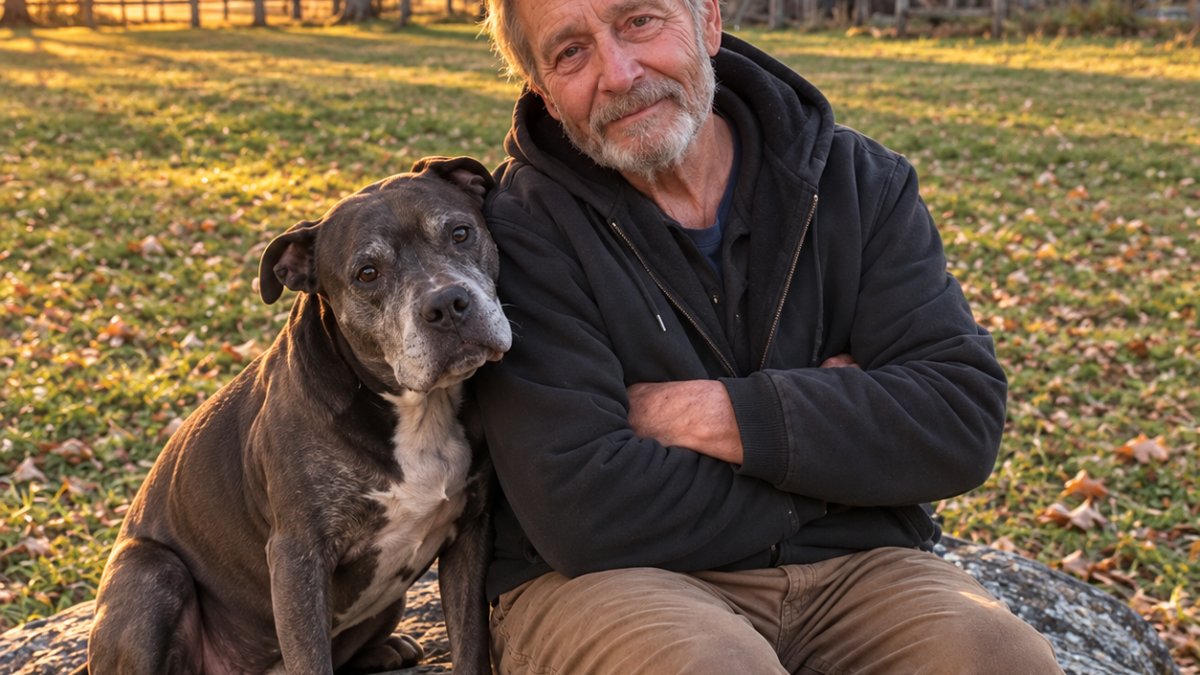
On my seventy-eighth birthday, I walked into an animal shelter looking for something—anything—that might make my empty house feel alive again.
I came home with a twelve-year-old pit bull whose family had surrendered him because they said he had become “too old.”
What happened after he leaned his gray muzzle against my leg made me realize that two abandoned old souls can sometimes recognize each other before either one understands why.
My name is George.
I’m a retired teacher, a widower, and until last year I was becoming very good at disappearing without actually going anywhere.
My wife, Margaret, died in 2015.
We had been married long enough that I had forgotten where my habits ended and hers began.
The basil beside the kitchen window was hers.
The blue coffee mug in the cabinet was hers.
The old vegetable garden behind our house was hers.
Even the silence after she died somehow felt like it belonged to her.
We had talked about getting a dog for years.
“Next year,” I always said.
“When I retire.”
“When things settle down.”
There is a cruelty in believing you have unlimited tomorrows.
Margaret never got her dog.
After she was gone, I stopped making plans that stretched very far into the future.
I maintained the garden because she had planted the first tomatoes there in the 1990s.
I repaired our old barn when boards came loose.
I pruned the fruit trees.
I made coffee every morning.
Then I waited.
For what, I couldn’t have told you.
A phone call.
A visitor.
Dinner.
Bedtime.
Another morning.
That was my life by seventy-eight.
On my birthday, I woke before sunrise and made one cup of coffee.
There had once been two.
I sat at the kitchen table and watched the first light appear behind the apple trees.
Then I said aloud to an empty room, “George, you’re almost eighty years old. When was the last time you did something because you actually wanted to?”
I couldn’t answer.
So I put on my jacket and drove into town.
I didn’t plan on going to the shelter.
At least that’s what I told myself.
But twenty minutes later, I was standing in a hallway filled with barking dogs while a young employee named Hannah asked what kind of dog I wanted.
“I don’t know.”
“Small? Large? Active?”
I almost laughed.
“At my age? Preferably one who understands naps.”
She smiled.
Then her expression changed.
“There might be someone.”
She led me past several kennels.
Puppies jumped against doors.
Young dogs barked and spun in circles.
Then we reached the last enclosure.
He didn’t bark.
He barely moved.
A dark brown pit bull lay on his side with his head resting on his paws.
His muzzle was silver.
There were gray hairs above his eyes.
He looked tired in the particular way old creatures sometimes do—not defeated, exactly, but as if they have stopped expecting surprises.
“This is Max,” Hannah said.
“How old?”
“Twelve.”
“What happened to him?”
Her hesitation told me I wasn’t going to like the answer.
“His family surrendered him three months ago.”
“Why?”
“They said he was getting too old and they couldn’t care for him anymore.”
I looked at Max again.
Too old.
Two words.
That was all it took.
I imagined someone saying them about me.
Too old to need company.
Too old to matter.
Too old to be worth rearranging a life for.
“Can I meet him?”
Hannah opened the gate to a small enclosed yard.
I walked inside and waited.
Max lifted his head.
For several seconds, we studied each other.
Then he stood.
Slowly.
His joints were stiff.
His legs took a moment to cooperate.
He crossed the yard without rushing.
No barking.
No jumping.
No excitement.
He simply walked straight toward me.
Then he stopped.
Looked into my eyes.
And leaned his entire body against my leg.
I felt his weight.
His warmth.
The slow rise and fall of his ribs.
My hand came down onto that gray head almost by instinct.
“Well,” I whispered.
Max closed his eyes.
Something inside my chest gave way.
Hannah stood behind us quietly.
After a while, she asked, “Would you like some time to think about it?”
I looked down at him.
For most of my life, I had postponed the things that frightened me.
The dog.
Retirement.
Trips with Margaret.
Anything that could supposedly wait until next year.
I wasn’t interested in next year anymore.
“No,” I said.
Hannah looked surprised.
“No?”
“I don’t need time.”
Max opened his eyes.
I scratched behind one silver ear.
“It’s my birthday.”
Hannah smiled.
“Happy birthday.”
I looked at the old dog leaning against me.
“Apparently I already got my present.”
That afternoon, Max left the shelter beside me.
I thought I was taking home a dog nobody else wanted.
I had no idea that, somewhere between that kennel and my empty house, Max had already begun rescuing me.
[END OF FACEBOOK CAPTION]
[FIRST COMMENT / FULL STORY CONTINUATION]
The drive home took twenty-three minutes.
I remember because I spent almost every second of it wondering whether I had made a terrible mistake.
Max sat in the back seat.
At first he remained upright, looking through one window and then the other as though he expected me to turn around.
His nails clicked softly against the upholstery every time the truck went around a curve.
“You can lie down,” I told him.
He looked toward me.
“I’m not taking you back.”
I don’t know why I said that.
Maybe because he needed to hear it.
Maybe because I did.
He continued watching me through the gap between the seats.
“You’re stuck with me now.”
His ears moved slightly.
“I should warn you, I snore.”
Nothing.
“And I talk to myself.”
Max lowered himself onto the seat.
“That may actually be why Margaret wanted a dog. Someone else to listen.”
When I said her name, the truck felt different.
It had been years, but Margaret’s name could still turn an ordinary moment into a room I had not prepared myself to enter.
I tightened my hands around the steering wheel.
Max rested his chin on the seat.
We drove the remainder of the way in silence.
When we reached the house, I parked near the porch and opened his door.
“Here we are.”
Max stared at the yard.
It wasn’t a grand property, though it probably looked enormous compared with a shelter kennel.
The house was white with green shutters Margaret had chosen twenty years earlier.
Behind it stood several apple and pear trees, the old barn, the vegetable garden, and enough lawn to ensure that my back and I remained enemies every autumn.
Max sniffed the air.
Then he looked at me.
“You coming?”
He climbed down slowly.
His front paws reached the ground first.
Then his rear legs followed with a little hesitation.
Twelve years had settled into his joints.
I recognized the feeling.
“You and I may have more in common than I realized.”
He sniffed the porch steps.
Then the railing.
Then a flowerpot.
We made it to the front door in about four minutes.
At that pace, a mile would have taken us until Christmas.
I didn’t care.
Inside, Max stopped just over the threshold.
The house was silent.
He sniffed.
Living room.
Hallway.
Kitchen.
Then he looked at me.
“Inspection?”
He moved forward.
I followed.
For the next twenty minutes, Max examined the house with greater concentration than any home inspector I had ever met.
He smelled the sofa.
The rug.
The bottom of Margaret’s old armchair.
That one made me stop.
He pressed his nose against the fabric for several seconds.
I wondered whether some faint trace of her still existed there beneath everything I could smell.
“That was hers,” I said.
Max looked at me.
“She would’ve liked you.”
His tail moved.
Once.
“Don’t get too confident. She had standards.”
He continued into the kitchen.
I had bought dog food, bowls, a leash, and a ridiculous number of treats after filling out the adoption paperwork.
Hannah had watched me place things into a basket at the small store near the shelter.
“You know you don’t need all of that today.”
“I’m seventy-eight. I don’t know how many shopping trips I have left.”
She stared at me.
“That was a joke.”
“I wasn’t sure.”
“Neither am I.”
Now I filled one bowl with water.
Max drank for a long time.
Then I gave him the amount of food Hannah recommended.
He ate slowly.
Not greedily.
Every few bites, he looked up to confirm I was still there.
That bothered me.
I sat at the table.
“I’m not leaving.”
He returned to the bowl.
A few minutes later, he looked again.
“Still here.”
Again.
“Max.”
He stopped eating.
“You don’t need to check.”
Those dark eyes stayed on mine.
My voice softened.
“You’re home.”
I hadn’t used that word in a meaningful way for a long time.
House.
Property.
Place.
Those words had become easier.
Home belonged to the years when Margaret’s coat hung near mine and two coffee cups sat in the sink.
But saying it to Max made the word return.
Home.
He finished eating.
Then he walked over and leaned against my knee.
Exactly as he had at the shelter.
I put my hand on his neck.
“All right.”
His tail touched the floor twice.
“You win.”
That first evening was awkward.
I had forgotten how strange it feels when another living creature suddenly shares your routines.
I turned around and nearly stepped on him twice because Max followed me everywhere.
Kitchen.
Hallway.
Living room.
Back door.
If I moved, he moved.
At first, I thought he wanted something.
“What?”
He stared.
“Outside?”
Nothing.
“Food?”
Nothing.
“Water?”
Nothing.
Finally I understood.
He simply wanted to know where I was.
I felt a pressure in my chest I didn’t want to examine too closely.
At ten o’clock, I prepared his sleeping area in the living room.
An old folded blanket.
Two cushions.
One of them was probably more expensive than my own pillow.
“There.”
Max inspected it.
“Five-star accommodations.”
He stepped onto the blanket.
Turned once.
Then stepped off.
“Seriously?”
He followed me upstairs.
“Max.”
He continued.
“You have a bed.”
He continued.
“You saw me make it.”
At the bedroom door, he stopped.
I went inside.
He remained on the threshold.
I took off my glasses.
He stood there.
I folded my sweater.
Still there.
Finally I looked at him.
His expression was not dramatic.
No whining.
No scratching.
No pleading.
Just an old dog standing in a doorway, apparently waiting to learn whether the new home he had been promised had boundaries he didn’t yet understand.
I looked at the end of my bed.
Then at him.
Then back at the bed.
Margaret would have laughed at me.
“Fine.”
Max’s ears lifted.
“But this is temporary.”
He entered.
I put a blanket across the foot of the bed.
Max climbed up with some difficulty.
I almost helped, but pride recognizes pride.
He managed.
Three slow circles.
Then he lay down with his head on his paws.
For a few minutes, he watched me.
That was exactly how he had looked in the shelter.
Same posture.
Same old face.
But gradually his eyes closed.
His breathing deepened.
The muscles around his shoulders relaxed.
For the first time since I met him, Max looked completely unguarded.
Safe.
The realization hit me harder than I expected.
Someone had once brought this dog home as a puppy.
Someone had known him young.
Someone had watched him run.
Someone had probably laughed when he chewed shoes or stole food.
For twelve years he had belonged somewhere.
Then one day, because time had changed his body, that belonging ended.
I lay awake listening to him breathe.
The house didn’t feel silent.
That was new.
There was the hum of the heater.
The occasional movement of tree branches against the roof.
And Max.
In.
Out.
In.
Out.
A slow breathing rhythm from the foot of my bed.
I hadn’t realized until then how long I had slept in a house so quiet that my own breathing sometimes frightened me.
That night, for the first time in years, I felt safe too.
Not protected.
Safe.
There is a difference.
Protected means something stands between you and danger.
Safe means you are not alone inside whatever happens.
I fell asleep before eleven.
The next morning, I woke at six thirteen.
Max was staring at me.
I nearly screamed.
“Good Lord.”
His tail thumped the mattress.
“You can’t do that.”
Another thump.
“You almost killed the elderly man who adopted you.”
He stood.
I sat up.
“My birthday was yesterday. You could at least give me twenty-four hours.”
Max walked toward the edge of the bed.
I helped him down.
“Bathroom?”
He headed for the door.
“I suppose that means yes.”
We went outside.
The air was crisp.
Early fall.
A thin layer of mist sat over the grass.
Max stood at the edge of the porch and sniffed.
Then, slowly, he walked into the yard.
I watched him move.
He investigated every tree.
Every corner.
Every section of fence.
He found Margaret’s garden.
That stopped him.
He stood beside the wooden border and smelled the soil.
Tomato plants were nearly finished for the season.
Basil had gone to flower.
The rosemary still looked strong.
Max stepped closer.
“Careful.”
He looked at me.
“That garden belonged to someone important.”
He smelled a tomato plant.
“She wouldn’t appreciate you using it as a restroom.”
He moved on.
“Thank you.”
I poured coffee and sat on the terrace.
Max came back fifteen minutes later.
He lowered himself into a patch of morning sunlight.
Margaret’s patch.
For years, she had sat in that exact place with coffee before work.
Even after retirement, she went there every morning the weather allowed.
I almost told Max to move.
The impulse surprised me.
That spot had become sacred because she had been there.
Then I remembered something Margaret once told me while I complained about replacing an old kitchen table.
“George, memories don’t live in furniture.”
At the time, I had rolled my eyes.
Now I wondered whether memories lived in sunny places either.
Max stretched his front paws.
Closed his eyes.
I took a sip of coffee.
“All right.”
He didn’t respond.
“You can have it.”
That became his morning spot.
The first week passed quietly.
Max learned where the water bowl was.
I learned that he did not like carrots.
He learned that I went into the garden after breakfast.
I learned that he snored louder than I did.
He learned that the kitchen door sometimes stuck.
I learned that when his right ear folded inside out, he apparently had no intention of correcting it himself.
Mostly, we learned each other.
There was nothing dramatic about those days.
That is important.
People imagine life-changing events arrive accompanied by music.
They often don’t.
Sometimes a life changes because a dog begins sleeping at the foot of a bed.
Because you fill a second bowl at breakfast.
Because another set of footsteps follows you through the hallway.
Because you start saying good morning aloud.
A week after Max came home, I went outside to rake leaves.
The yard was covered.
I had put the job off for several days because my lower back had been bothering me.
At seventy-eight, your body sends invoices for things you did at forty.
I raked for ten minutes.
Stopped.
Straightened slowly.
“Fantastic.”
Max lay on the terrace watching me.
“You could help.”
His tail moved.
“Yes, I know. Management.”
I bent for another pile.
Pain tightened across my back.
I stopped again.
Max stood.
I paid no attention at first.
He walked off the terrace.
Slowly approached.
A branch about two feet long had fallen near the apple tree.
Max stopped beside it.
Sniffed.
Then picked it up.
I leaned on the rake.
“What are you doing?”
He carried the branch toward me.
For one irrational second, I expected him to hand it to me.
Instead, he walked directly to the leaf pile.
Dropped the branch on top.
Then looked at me.
I stared.
Max stared back.
“You did not just do that.”
His tail wagged.
A real wag this time.
I laughed.
It escaped before I could stop it.
Not the polite chuckle I used when someone told me a joke at church.
Not the quiet breath through the nose that had passed for laughter after Margaret died.
I laughed out loud.
The sound startled me.
It echoed across the empty yard.
Max’s tail began moving harder.
That made me laugh again.
“You think you helped?”
He stepped toward another branch.
“No.”
He picked it up.
“Max.”
He carried it to the pile.
Now I was laughing so hard I had to sit down on the garden bench.
He came over immediately.
Pressed his shoulder against my knee.
I put a hand on his head.
“You ridiculous old man.”
His tongue appeared.
“You’re older than me, technically.”
He leaned harder.
For several minutes, I sat there laughing and crying at the same time.
I hadn’t laughed like that in months.
Maybe years.
After Margaret died, happiness made me feel guilty.
That is a strange thing about grief nobody warns you about.
The first time you enjoy something again, part of you believes you have betrayed the person who died.
How could I laugh when Margaret could not?
How could I enjoy a morning she would never see?
So you begin rationing happiness.
Then one day you look around and discover you have been punishing yourself for surviving.
Max didn’t know any of that.
He had found a stick.
I had laughed.
Simple.
Dogs are very good at simple truths.
From that morning onward, Max decided yard work was our shared occupation.
His contributions varied dramatically in usefulness.
Branches?
Excellent.
Small gardening tools?
Surprisingly good.
Leaves?
He mostly walked through the piles and destroyed them.
“Your performance review is declining.”
He wagged.
When I weeded the vegetable garden, he stayed nearby.
If I set down my hand trowel, he occasionally picked it up and brought it to me.
The first time he did it, I thought it was accidental.
The fourth time, I stopped underestimating him.
“You have prior landscaping experience?”
He sat.
“Were your former people farmers?”
His head tilted.
“No comment?”
He lay down beside the tomatoes.
When I watered Margaret’s roses, he followed.
He inspected each plant as though ensuring I had completed the work properly.
“Supervisor again.”
Tail wag.
“I knew it.”
Our evenings changed too.
Before Max, I ate dinner while watching television.
Not because I cared about the programs.
Noise helped.
With Max, I began eating on the terrace.
He would lie beside my chair.
The sunset turned the sky behind the orchard orange and pink.
Sometimes we stayed outside until the air became cold.
One evening I looked down at him.
His gray muzzle rested across my shoe.
Margaret’s voice came into my mind.
Life is mostly small moments, George. Pay attention or you’ll miss your whole life waiting for something big.
She used to say versions of that constantly.
I thought she meant vacations.
Anniversaries.
Graduations.
Important days.
Now I understood.
She meant coffee before sunrise.
A tomato warm from the garden.
A ridiculous dog carrying a stick.
A quiet old man sitting beside another quiet old creature while the sky changed color.
“Your mother would’ve liked this,” I told Max.
Then I froze.
Mother?
I looked at him.
“Don’t get used to that.”
He sighed.
“Fine.”
The weeks became months.
Something else began changing.
Me.
My mornings became easier.
I woke because Max needed me.
Not dramatically.
He wasn’t dependent.
But there were meals.
Medication for his arthritis.
Bathroom trips.
Walks around the property.
Someone expected me to get out of bed.
Purpose is an interesting thing.
When you are young, people speak about it as if purpose needs to be impressive.
Career.
Achievement.
Legacy.
At seventy-eight, purpose can be filling a dog bowl at seven in the morning.
And sometimes that is enough to pull an entire life forward.
I started walking again because of Max.
For years, I had walked to the mailbox every morning.
It was not far, maybe a quarter mile round trip.
After Margaret died, I stopped.
Why walk?
For exercise?
To live longer?
That argument had lost some of its force.
But Max needed movement.
Older dogs stiffen if they don’t use their bodies.
At least that’s what the veterinarian told me.
So one morning I clipped the leash to his collar.
“Adventure?”
Max stood.
His tail moved.
“We’re going to the mailbox.”
He looked disappointed.
“You’re twelve. Adjust expectations.”
We started down the driveway.
Slowly.
Max sniffed every ten feet.
I checked my watch once.
Then laughed.
Where exactly did I need to be?
Nowhere.
For the first time in years, nowhere felt like freedom instead of loneliness.
We reached the mailbox.
I pulled out three envelopes.
Electric bill.
Advertisement.
Letter from an insurance company.
Max sniffed each.
“Nothing for you.”
He looked at me.
“You haven’t established credit.”
We turned back.
My legs felt tired.
So did his.
By the time we reached the porch, both of us were moving slower.
I sat.
Max lay beside me.
“Not bad.”
His tail tapped the floor.
The next morning, we did it again.
Then again.
After two weeks, we went beyond the mailbox.
At first, just another hundred yards.
Then to the corner.
Then around the block.
Our neighborhood had changed while I was busy being alone.
New families had moved in.
Children I remembered as toddlers were driving cars.
The Henderson boy had grown a beard.
Mrs. Carter had replaced her fence.
I had lived there the entire time.
Somehow, I had stopped being part of it.
Max changed that.
Dogs are social permission slips.
People who had nodded at me for years suddenly stopped.
“Morning, George.”
“Morning.”
“Who’s this?”
“Max.”
“How old is he?”
“Twelve.”
“Beautiful dog.”
“He knows.”
Max would lean into their hands.
People asked where he came from.
I told them.
Some reacted with anger when they heard why he had been surrendered.
I learned to say, “He’s home now.”
That was enough.
One morning, a neighbor named Carol came out carrying a cup of coffee.
She lived three houses down.
I had known her husband before he died.
“George, is that your dog?”
“No. I’m stealing him very slowly.”
She laughed.
I realized I hadn’t spoken to Carol in almost two years.
She knelt beside Max.
“Oh, look at that face.”
Max leaned into her.
“Traitor.”
Carol looked up.
“How have you been?”
The truthful answer was complicated.
“Better.”
She looked at Max.
“I can see that.”
We talked for fifteen minutes.
Not about grief.
Not about age.
Tomatoes.
Weather.
Her grandson.
Max’s arthritis.
Ordinary things.
When I walked away, I felt oddly lighter.
That became common.
Mr. Alvarez stopped us near the corner.
He told me about the German shepherd he had as a child.
A young mother named Denise introduced Max to her six-year-old son, Caleb, who had been afraid of pit bulls because of something he had seen online.
“Can I touch him?” Caleb asked.
“If Max agrees.”
The boy approached slowly.
Max sat.
Caleb touched the top of his head.
Max’s tail moved.
The boy smiled.
“He’s soft.”
“Don’t tell him. He has a reputation.”
From that day on, Caleb watched for us.
Sometimes he brought Max a biscuit.
Sometimes he walked beside us for half the block while telling me things six-year-olds consider urgent.
Dinosaurs.
A missing pencil.
A girl in his class who could whistle louder than anyone.
Without noticing, I became Mr. George again.
Not the widower in the white house.
Not the old man who rarely came outside.
Mr. George.
Max had built a bridge between me and the world.
All he had done was walk.
By December, our routine was fixed.
Wake up.
Coffee.
Breakfast for Max.
Medication hidden inside cheese.
Morning walk.
Garden or barn work.
Lunch.
Nap, supposedly for Max but frequently for both of us.
Evening outside.
Television.
Bed.
Simple.
Wonderful.
One cold morning, Max did not get up.
I called him from the kitchen.
Nothing.
“Max?”
I found him beside the bed.
He was awake.
But when he attempted to stand, his back legs shook.
My stomach dropped.
“Easy.”
I knelt.
He tried again.
Failed.
Fear arrived so quickly that I could taste it.
Three months earlier, this had been a dog I barely knew.
Now the idea of losing him felt unbearable.
“Stay.”
I called the veterinarian.
They told me to bring him immediately.
Getting a twelve-year-old sixty-pound pit bull into a truck when his legs hurt is more difficult than it sounds.
I found an old blanket, slid it beneath him, and supported most of his weight.
He looked embarrassed.
“Yes, yes. Your dignity.”
I lifted.
My back complained.
“Mine too.”
At the clinic, the veterinarian examined him.
I sat in the waiting room with my hands clasped.
A young couple entered carrying a puppy.
The puppy bounced.
Chewed its leash.
Climbed onto the man’s lap.
Everyone smiled.
I watched.
For one second, I understood why shelters struggle to find homes for old dogs.
Young animals look like possibility.
Old ones remind us of endings.
But that morning I would not have traded Max for every puppy in the building.
Because what I loved about him was precisely what age had made him.
His patience.
His calm.
The way he noticed moods.
The way he had learned not to waste energy pretending things were more complicated than they were.
The veterinarian came out.
“George?”
I stood too quickly.
My knee nearly gave out.
“Is he all right?”
“He’s all right.”
I exhaled.
“Sheer arthritis flare. Probably cold weather made it worse.”
“So he’s not…”
“No.”
I nodded.
She understood what I had been unable to say.
“He’s an old dog,” she continued gently. “There will be difficult days. We’ll adjust his medication. Keep him warm. Shorter walks when it’s cold.”
“I can do that.”
“I know.”
When Max came out, he was moving carefully.
He walked straight toward me.
Then leaned against my leg.
That same gesture.
Shelter.
Home.
Now veterinarian.
Whenever the world became uncertain, apparently Max’s solution was to press himself against me.
I knelt and held his face.
“You frightened me.”
His tongue touched my chin.
“That doesn’t fix it.”
Another lick.
“Stop negotiating.”
The technician laughed.
The incident changed me.
Until then, I had allowed myself to pretend Max would simply continue.
Old, yes.
Slow, yes.
But there.
The veterinarian forced me to remember that adopting a senior dog meant accepting the ending from the beginning.
Friends mentioned it too.
Carol said one morning, “I don’t know if I could do what you did.”
“What?”
“Adopt a twelve-year-old.”
“Why?”
“You know.”
I did.
“He may not have much time.”
She looked embarrassed.
“I didn’t mean—”
“It’s true.”
We walked a few steps.
Max sniffed a mailbox.
Carol said, “Doesn’t that scare you?”
“Yes.”
“Then why?”
I stopped.
I looked at Max.
He had moved to a patch of winter sunlight.
His eyes were half closed.
“Because he was already twelve whether I adopted him or not.”
Carol said nothing.
“If I had walked past him because I was afraid of losing him, he still would’ve gotten older. He still would’ve died someday. The only difference is where he would spend the time in between.”
Carol looked at me.
I shrugged.
“I spent enough years afraid of endings.”
Max moved toward us.
“I’m trying to pay attention to the middle.”
That night, I thought about what I had said.
The middle.
Margaret and I had forty-three years of middle.
Yet after she died, I let the ending rewrite everything that came before it.
I looked around our house and saw absence.
Not the Christmas mornings.
Not burnt dinners.
Not arguments over directions.
Not the summer she painted the bathroom yellow and I told her it looked like mustard.
Not dancing in the kitchen when both of us were terrible dancers.
I had allowed death to become larger than life.
Max did not know he was teaching me anything.
He simply wanted a piece of chicken.
But somehow, loving an old dog was teaching me how to remember my wife differently.
I started speaking about Margaret more.
That surprised my daughter, Susan.
She lived two states away.
We talked every Sunday.
For years, our conversations avoided the deepest parts of grief.
“How’s the garden?”
“Fine.”
“How are you?”
“Fine.”
“How’s your back?”
“Fine.”
Then one Sunday she asked about Max.
I told her about the branch.
She laughed.
“He sounds like Mom.”
“How?”
“Supervising your yard work.”
I laughed.
“She absolutely would’ve trained him to report mistakes.”
There was silence.
Then Susan said softly, “I miss hearing you laugh about her.”
That hit me.
“What do you mean?”
“For a long time, anytime Mom came up, you got quiet.”
I stared at Max sleeping beside my chair.
“I suppose I did.”
“I stopped mentioning things because I thought it hurt you.”
“It did.”
“I know.”
I swallowed.
“But not mentioning her hurt too.”
Susan’s voice changed.
“Max helping?”
I scratched his ear.
“Yes.”
“Good.”
A month later, Susan visited.
The moment she entered, Max walked toward her.
She dropped her bag.
“So this is the famous man.”
“Careful. His ego.”
She crouched.
Max leaned into her.
Susan laughed.
“Dad.”
“What?”
“He really does this.”
“Does what?”
“This leaning thing.”
“Yes.”
She wrapped both arms around him.
“You chose well.”
“He chose me.”
“I can believe that.”
That weekend, the house became noisy.
Susan cooked.
I complained about how she organized my refrigerator.
She ignored me.
Max moved between us, clearly delighted that his staff had doubled.
On Saturday morning, Susan found me in the garden.
Max was carrying my glove.
“He helps?”
“That word is generous.”
Max delivered the glove.
Susan stared.
“Oh my God.”
“Don’t encourage him.”
She took out her phone.
Max immediately dropped the glove.
“See?”
Susan laughed.
“Mom would have adored him.”
I nodded.
This time, hearing it did not destroy me.
“I know.”
We planted lettuce.
Susan talked about work.
Her daughter, my granddaughter, was applying to colleges.
Life kept moving.
For years, I had resented that.
Now I watched Susan kneel in Margaret’s garden while Max lay in the sun.
And for once, continuity felt beautiful.
Spring arrived.
Max became more energetic in warmer weather.
So did I.
We extended our morning route.
Half a mile.
Then almost a mile on good days.
Never quickly.
We stopped constantly.
Sometimes because Max wanted to smell something.
Sometimes because I needed to rest.
Neither of us mentioned whose idea it was.
People began timing their mornings around us.
Carol joined twice a week.
Mr. Alvarez occasionally walked with us.
Caleb came on Saturdays with his mother.
Some mornings there were five or six people.
It became an unofficial neighborhood procession led by the slowest dog in the county.
One morning I looked behind us.
Carol.
Mr. Alvarez.
Denise and Caleb.
A younger couple from the next street.
I laughed.
“What?” Carol asked.
“Nothing.”
“George.”
“I adopted one dog.”
“So?”
“I appear to have acquired a walking club.”
Max wagged.
“This is your fault.”
Within another month, someone had named it.
Max’s Morning Mile.
We did not always walk a mile.
Nobody cared.
The point was going outside.
Talking.
Moving.
Max greeted everyone.
I began keeping extra water near the porch.
Carol started bringing coffee.
One Saturday, twenty people appeared.
“Why are there so many people?”
Carol smiled.
“Word got around.”
“About what?”
“That you have coffee.”
“I do not have coffee for twenty people.”
“You do now.”
She opened the trunk of her car and removed two large containers.
I stared.
“This is getting out of hand.”
Max sat beside her.
“Don’t side with her.”
The strangest part was that I loved it.
My yard, silent for years, filled with voices.
People stayed after walks.
Someone brought muffins.
Caleb played fetch with Max, though “fetch” mostly involved throwing a ball six feet and waiting for Max to decide whether retrieval was worth the effort.
Susan called during one of those mornings.
“What is that noise?”
“People.”
“At your house?”
“Yes.”
“Voluntarily?”
“Very funny.”
I told her about the walking group.
She was quiet for several seconds.
“Dad.”
“What?”
“I’m proud of you.”
I almost rejected the compliment.
Old habits.
Then I looked across the yard.
Max was surrounded by neighbors.
“Thank Max.”
“I will.”
That summer, I returned to the shelter.
Not because I needed another dog.
Max had strong opinions about being an only child.
I went because Hannah had called.
“We’re doing a senior-dog adoption event.”
“And?”
“And I wondered whether you’d bring Max.”
“Why?”
“People remember stories.”
“I’m not a story.”
“George.”
“I hate when young people say my name like that.”
“Will you come?”
Max and I arrived Saturday morning.
The shelter had set up chairs outside.
Several older dogs rested in pens beneath shade tents.
People walked past them on the way to puppies.
I understood.
Puppies were irresistible.
But then Max walked beside me.
Gray muzzle.
Slow steps.
Tail moving.
People noticed.
A woman approached.
“Is he available?”
“No.”
Max leaned against her anyway.
She laughed.
Hannah pointed at me.
“George adopted Max here last year.”
“Really?”
“How old is he?”
“Thirteen now.”
The woman looked surprised.
“You adopted him at twelve?”
“Yes.”
“Weren’t you worried?”
“Constantly.”
She laughed.
I told her the truth.
About loneliness.
About mornings.
About walks.
About the way a dog nobody wanted because he was old had somehow made an old man participate in his own life again.
I did not give a speech.
I simply talked.
By the end of the afternoon, three senior dogs had adoption applications.
One was a fifteen-year-old beagle named Lucy.
A woman in her sixties adopted her.
Before leaving, she came over.
“I kept thinking what you said.”
“What?”
“That they’re already old whether we love them or not.”
I looked at Lucy sleeping against her leg.
“That sounds smarter than I usually am.”
She smiled.
“Thank you.”
“No.”
I nodded toward the dog.
“Thank her later.”
Driving home, Max slept in the passenger seat.
I looked at him at a red light.
“You know, you’re causing trouble.”
One eye opened.
“People are adopting dogs because of you.”
Eye closed.
“No humility.”
That evening, we sat on the terrace.
The sun disappeared behind the trees.
I thought about his former family.
I tried not to judge them.
That was difficult.
How do you leave a dog after twelve years?
But life is complicated.
Financial problems.
Illness.
Housing.
Caregiving.
Fear.
I did not know their story.
Maybe saying Max was “too old” had been easier than explaining something painful to a stranger.
Maybe they had failed him.
Maybe they believed surrendering him was better than what they could provide.
I couldn’t know.
What I did know was that their goodbye had become my beginning.
Two empty places had met.
Max had lost a family.
I had lost Margaret.
Neither loss cancelled the other.
But somehow, when Max leaned against my leg, the spaces fit.
That realization frightened me because it felt almost like gratitude for something that had hurt him.
So I said aloud, “I wish you hadn’t needed me.”
Max lifted his head.
“I wish nobody had left you.”
He watched me.
“But I’m glad I found you.”
He stood.
Walked over.
Leaning.
Again.
Always leaning.
I wrapped an arm around his shoulders.
“I know.”
Late summer brought a difficult week.
Max stopped eating normally.
At first, he skipped breakfast.
Then dinner.
The next morning, he ate only a few bites.
I tried chicken.
Rice.
Egg.
He sniffed everything.
Turned away.
The fear I had been carrying quietly all year stepped into the room.
I called the clinic.
Blood tests.
Exam.
Waiting.
I sat beside Max on the floor.
He rested his head on my thigh.
The veterinarian returned.
“His kidneys are showing some age-related changes.”
My stomach tightened.
“How bad?”
“Not as bad as I think you’re imagining.”
I exhaled.
She explained diet changes.
Medication.
More frequent monitoring.
Hydration.
“This isn’t necessarily the end, George.”
“I know.”
I did not know.
“But he is thirteen.”
“I know.”
“And our goal is comfort and good days.”
I looked at Max.
“How many?”
She shook her head.
“Nobody can answer that.”
That night, I couldn’t sleep.
Max lay at the foot of the bed.
I watched him breathe.
In the dark, I remembered Margaret’s final year.
Appointments.
Numbers.
Tests.
Every conversation becoming a calculation of how much time remained.
I had promised myself I would never live like that again.
Yet there I was.
Counting Max’s breaths.
At two in the morning, I sat up.
Max opened his eyes.
“I’m doing it again.”
He waited.
“I’m turning time into a threat.”
Max’s tail moved once.
I climbed out of bed.
Sat beside him.
“Margaret hated that.”
His head rested on my knee.
“She used to say I was so busy worrying about losing the day that I forgot to live it.”
I rubbed his gray face.
“I did it with her.”
My throat tightened.
“I won’t do it with you.”
That became another promise.
Not that Max wouldn’t die.
He would.
So would I.
The promise was that death would not be allowed to enter every room before it arrived.
The next morning, Max ate half his breakfast.
I celebrated.
Two days later, he ate all of it.
By the following week, his energy improved.
The tests still mattered.
The medications still mattered.
But we went back to our walks.
Shorter.
Slower.
Better.
Autumn approached again.
Almost one year since I had entered the shelter.
My seventy-ninth birthday appeared on the calendar.
Susan asked what I wanted.
“Nothing.”
“Dad.”
“I have everything.”
“That is an annoying answer.”
“It’s also true.”
She insisted on visiting.
Fine.
Then Carol learned.
That was my mistake.
“Your birthday?”
“No.”
“You just said Susan’s coming because it’s your birthday.”
“I misspoke.”
“How old?”
“Forty-two.”
She stared.
“Seventy-nine.”
“I knew it.”
“You seem happy about this.”
“We’re doing something.”
“We are not.”
“We absolutely are.”
I looked at Max.
“Help.”
He went to Carol.
Leaning.
“You are useless.”
Apparently, a party was organized without my consent.
But before that day arrived, I found something in Margaret’s old desk.
I had been searching for stamps.
One drawer stuck.
I pulled harder.
Inside were greeting cards.
Receipts.
Photographs.
Then an envelope with my name.
George.
Margaret’s handwriting.
My hands began shaking.
I sat down before opening it.
The letter was not written near her death.
It was dated years earlier.
Probably something she intended for an anniversary and forgot.
Or perhaps she had hidden it deliberately.
The paper smelled like nothing.
I wanted it to smell like her.
It didn’t.
But the handwriting was enough.
George,
If you found this because you were searching through my things, please put everything back where it belongs because you never organize anything correctly.
I laughed immediately.
Of course.
Then I kept reading.
She wrote about ordinary years.
The house.
Susan.
The garden.
Retirement.
Near the end, there was one paragraph that stopped me.
I still think we should get a dog someday. You keep saying later. You always say later when something might change our routines. One day you’re going to learn that routines are meant to be interrupted. I hope when that happens, whatever interrupts yours has four paws and enough patience to teach you.
I lowered the letter.
Max was asleep beside the desk.
For several minutes, I could not move.
Then I started laughing.
And crying.
“You planned this?”
Max opened one eye.
“Did she send you?”
He yawned.
“That is not an answer.”
I read the paragraph again.
Four paws.
Enough patience.
“Margaret.”
I said her name aloud.
I pictured her somewhere laughing at me.
Not because I believe I know what comes after death.
I don’t.
But if there was any possibility that Margaret had arranged for a twelve-year-old pit bull to invade my retirement from beyond the grave, it would be completely consistent with her personality.
I placed the letter in my shirt pocket.
That evening, Max and I went outside.
The first orange leaves had begun falling.
We sat in Margaret’s favorite spot.
I read the letter aloud.
Max listened with his head on my shoe.
When I finished, I looked toward the garden.
“I’m sorry.”
The words surprised me.
I had apologized to Margaret many times in my head.
For things said.
Things unsaid.
The dog we never got.
The trips postponed.
But this apology was different.
“I spent so many years believing loving you meant staying sad.”
Wind moved through the tomato vines.
“I thought moving forward meant leaving you behind.”
Max shifted closer.
“I was wrong.”
I touched his head.
“This guy helped.”
Tail.
“I think you’d be pleased with yourself.”
The sun lowered.
For the first time since Margaret died, I did not feel as though I were talking to absence.
I was talking to memory.
There is a difference.
Absence takes.
Memory can give back.
My seventy-ninth birthday arrived on a Saturday.
I woke at six thirteen.
Max was staring at me.
Exactly as he had on our first morning.
I opened my eyes.
“No.”
Tail thump.
“Absolutely not.”
More thumping.
“You have learned nothing about birthday etiquette.”
He stood.
I sat up.
“Fine.”
We went downstairs.
Susan was sleeping in the guest room.
I expected quiet.
Instead, when I opened the kitchen door, I found Carol on my terrace.
“What are you doing here?”
“Happy birthday.”
“It’s six forty-five.”
“I know.”
“Why?”
She held up coffee.
I reconsidered my objection.
Max greeted her.
“You planned this?”
“I planned nothing.”
This was a lie.
By eight, people began arriving.
Mr. Alvarez.
Denise and Caleb.
Neighbors from our walking group.
Hannah from the shelter.
The veterinarian and one of her technicians.
Even the woman who had adopted Lucy the elderly beagle.
Lucy came too.
My yard filled with old dogs and people who loved them.
I stared at Carol.
“What did you do?”
She shrugged.
“It’s your birthday.”
“This is excessive.”
Susan walked up behind me.
“No, Dad.”
I turned.
She was smiling.
“This is your life.”
Those words stopped me.
My life.
I looked around.
A year earlier, I had sat alone at my kitchen table with one cup of coffee.
Now there were folding chairs beneath the trees.
Dogs drinking from bowls.
Caleb throwing a ball.
Carol arguing with Mr. Alvarez about muffins.
Hannah scratching Max behind the ears.
People laughing.
My life.
Max walked toward me.
Slowly.
Age had made his gait stiffer again.
He stopped.
Leaned against my leg.
I put my hand on his back.
“You did this.”
His tail moved.
Susan heard me.
“Yes, he did.”
We took a group walk.
Max’s Morning Mile.
Though that day, for Max’s sake, it was maybe a third of a mile.
Nobody complained.
Max led.
I walked beside him.
People followed.
At the mailbox, I stopped.
Exactly where our first walk had ended.
For a moment, everything layered together.
The lonely man.
The new dog.
The first uncertain steps.
Then the year between.
Thousands of footsteps.
Hundreds of mornings.
New friends.
Old memories becoming gentle.
I looked down at Max.
“Not bad for two old men.”
He looked up.
We continued.
After lunch, Hannah approached.
“I brought something.”
She handed me a photograph.
It was Max’s shelter intake picture.
I almost didn’t recognize him.
He was lying in that kennel.
Head on paws.
Gray muzzle.
Eyes open.
Waiting.
On the back, Hannah had written the date.
Exactly one year before.
I looked toward the yard.
Max was lying beneath the apple tree while Caleb sat beside him.
Same dog.
Not the same expression.
In the photograph, his eyes looked resigned.
Now they looked peaceful.
“You kept this?”
“We photograph every intake.”
I stared at it.
“He looks so lonely.”
“He was.”
My chest tightened.
Hannah said, “So were you.”
I looked at her.
She smiled gently.
“I remember.”
“Was it that obvious?”
“George, you told me you wanted a dog who understood naps.”
“That was reasonable.”
“You barely smiled until Max leaned on you.”
I looked back at him.
“Did you know?”
“Know what?”
“That I’d take him?”
“No.”
“Really?”
“I hoped.”
“Why?”
She considered.
“Because you both looked like you were waiting for someone to tell you there was still time.”
I had no answer.
She squeezed my shoulder and walked away.
Still time.
That afternoon, after everyone left, the yard became quiet again.
Not empty.
Quiet.
There is a difference there too.
Susan washed dishes.
I sat on the terrace with Max.
He was exhausted.
He slept with his head on my foot.
The sunset was turning the clouds pink.
I thought about the previous year.
I had believed I was performing a good deed.
Old man adopts old dog.
Nice story.
That wasn’t what happened.
Max gave me mornings.
He gave me walks.
He gave me neighbors.
He gave me laughter.
He gave me back Margaret without bringing back the pain in the same way.
He gave me responsibility.
He gave me movement.
He gave me someone to say good morning to.
Someone who noticed if I stayed in bed too long.
Someone who waited at the door.
Someone who needed nothing from me except that I be there.
I had rescued him from a kennel.
He had rescued me from waiting to die.
Susan stepped outside.
“Cake?”
“Later.”
She sat beside me.
Max did not wake.
“Good day?”
I nodded.
“Too many people.”
“You loved it.”
“I tolerated it.”
“Liar.”
I smiled.
We sat silently.
Then Susan said, “You know what Mom would say.”
“I found her letter.”
Susan turned.
“What letter?”
I took it from my pocket.
I had started carrying it with me.
She read it.
When she reached the line about the dog, she covered her mouth.
Then laughed.
“Oh, Mom.”
“I know.”
“She absolutely did this.”
“You think?”
“Dad, if there’s any way to manipulate people after death, Mom found it within twenty-four hours.”
I laughed.
Susan wiped her eyes.
“She worried about you.”
“I know.”
“She made me promise I wouldn’t let you disappear.”
I looked at her.
“You never told me that.”
“You wouldn’t have listened.”
Probably true.
Susan looked at Max.
“I think he found a better strategy.”
“Yes.”
No arguments.
No pleading.
No lectures.
Just leaning.
Eventually Susan went inside.
Max woke.
He stood slowly.
Walked to the edge of the terrace.
Looked toward the garden.
I joined him.
“You tired?”
His tail moved.
“Me too.”
We walked into the yard.
The evening air smelled like soil and leaves.
Max stopped beside the first tomato bed.
The same place he had inspected on his first morning.
I knelt.
My knees complained.
“Do you remember?”
He smelled the dirt.
“That’s where I warned you about Margaret’s garden.”
He moved toward me.
Leaning.
Always.
I put my forehead against his.
“Happy anniversary, old friend.”
His breathing was slow.
Steady.
I thought about what people had said.
He won’t live long.
You’ll only get hurt.
Why adopt an old dog?
I understood those questions.
I was afraid too.
Every gray hair on Max’s face was a reminder that time would win.
But here is what age had finally taught me:
Time wins regardless.
You cannot defeat loss by refusing love.
You only make sure there is less to lose because there was less to have.
A year with Max had not been “only” a year.
It contained hundreds of mornings.
Hundreds of meals.
Walks.
Sunsets.
Conversations he pretended to understand.
Branches carried to leaf piles.
Neighbors becoming friends.
My daughter hearing me laugh again.
A letter from Margaret finally making sense.
How could that be measured as “only”?
Love does not become worthless because you know it will end.
Maybe knowing makes it more valuable.
That night, Max climbed onto the foot of my bed.
Slower than the first night.
I supported his back legs.
He settled.
Three circles had become one.
He lowered his head.
I turned off the lamp.
Then I heard his tail tap the mattress.
Once.
Twice.
I smiled in the dark.
“Good night.”
Silence.
“Thank you.”
His tail moved again.
My seventy-ninth year began the next morning.
Coffee.
Medicine hidden in cheese.
Garden.
Walk.
Nothing miraculous.
Everything miraculous.
Winter came again.
Our walks shortened.
Max wore a ridiculous red coat Carol bought him.
I protested.
Max loved it.
Betrayal.
Caleb said it made him look “cool.”
I informed Caleb that nobody wearing a red fleece coat looked cool.
Max disagreed.
The walking group continued.
On very cold mornings, we met in my kitchen instead.
Coffee for people.
Treats for dogs.
The house that once felt too large sometimes felt too small.
I loved that problem.
In January, I began volunteering at the shelter once a week.
Hannah asked whether I wanted to help with senior dogs.
“No.”
She looked surprised.
“I want the ones nobody is visiting.”
Sometimes those were seniors.
Sometimes shy dogs.
Sometimes large dogs people found intimidating.
I sat outside their kennels.
Read newspapers.
Talked.
Waited.
I had learned from Max that being chosen starts with being seen.
One afternoon, I sat beside a ten-year-old hound named Walter.
A man walked past with his teenage daughter.
The girl stopped.
“Dad, look.”
The father glanced.
“He’s old.”
I almost said something.
Then I stopped myself.
People need to make their own discoveries.
The girl crouched.
Walter walked over.
He pressed his nose through the gate.
She touched it.
“Dad.”
The man returned.
Twenty minutes later, they were in the meet-and-greet yard.
Walter leaned against the father’s leg.
I smiled.
There it was.
The move.
Max’s move.
I whispered, “Good technique.”
Walter went home three days later.
I told Max.
He seemed unimpressed.
“You inspired that.”
Max slept.
“Your humility remains astonishing.”
Spring came.
Margaret’s wildflowers bloomed along the fence.
I planted more tomatoes.
Max supervised.
He could no longer carry tools as often.
His teeth bothered him.
So I made him assistant foreman.
Promotion.
Less physical labor.
Same salary.
Chicken.
One morning, I dropped the trowel.
Max looked at it.
Then at me.
“Don’t.”
He stood.
Walked slowly toward it.
Picked it up.
Carried it three steps.
Dropped it at my feet.
Then sat.
I stared at him.
“You stubborn old thing.”
His tail moved.
I crouched and hugged him.
There are photographs of that morning.
Carol had been walking past.
In one, I am kneeling in garden soil with my arms around Max.
My hair is white.
His muzzle is gray.
The tomato plants are behind us.
Neither of us looks heroic.
We look old.
Happy.
Alive.
It may be my favorite photograph.
People still ask why I chose a senior dog.
Sometimes I give the practical answer.
Older dogs are often calmer.
Their personalities are established.
Many already know basic manners.
But that is not the real answer.
The real answer is that I saw myself in Max.
Not because we were old.
Because we had both been left behind by a life that moved forward without asking permission.
His family had disappeared.
Margaret had died.
Different causes.
Same silence afterward.
We both knew what it meant to wake up and discover that the person who had defined home was gone.
Maybe that is why he leaned against me.
Maybe I smelled like loneliness.
Maybe he did too.
Whatever happened in that shelter yard, it was recognition.
Not rescue.
Recognition.
Two old creatures saying:
You too?
Yes.
Me too.
All right.
Let’s go home.
Max is beside me now while I write this.
His breathing is slow.
Sometimes his paws move in dreams.
I like to imagine he’s running.
Not because I believe he is unhappy in his old body.
He isn’t.
But I remember what it felt like when my own body could run without negotiation.
I imagine Max remembers too.
Fields.
Young legs.
Wind.
No arthritis.
Then he wakes.
Looks at me.
Gets up slowly.
And follows me into the kitchen.
Dreams are wonderful.
Breakfast is better.
My eightieth birthday is no longer an abstract idea.
I used to think reaching eighty would feel like standing near the edge of something.
Now I don’t think that way.
Age is not an edge.
It is a place.
You live there like you lived everywhere else.
There are mornings.
Bills.
Back pain.
Tomatoes.
Laughter.
Dogs.
People.
Loss.
New beginnings.
Some days are hard.
Some are ordinary.
Some surprise you.
Max taught me that.
Twelve was not the end of his story.
Seventy-eight was not the end of mine.
Those were simply the ages at which our stories met.
One evening, nearly two years after I adopted him, I sat on the terrace.
Max rested beside me.
The sunset was unusually bright.
Orange melting into pink.
I had Margaret’s letter in my pocket.
I still carried it sometimes.
I looked at Max.
“You know what I thought that first day?”
His ear moved.
“I thought I saved you.”
Max lifted his head.
“Very arrogant.”
His tail tapped.
“I signed some papers and bought dog food, so naturally I thought I was a hero.”
He put his chin back down.
“But look what you did.”
I gestured toward the yard.
The garden.
The extra chairs left from our walking group.
A ball Caleb had forgotten.
A water bowl for visiting dogs.
The old barn I had finally repaired because Max liked sleeping near it while I worked.
“I was disappearing.”
My voice became quieter.
“Nobody meant to let that happen. Not Susan. Not the neighbors. Not me.”
Max looked at me again.
“I just stopped reaching.”
He stood.
Walked the two steps between us.
Leaning.
I laughed softly.
“There it is.”
I wrapped my arm around him.
“You never asked me to be younger.”
His body was warm against mine.
“You never asked me to stop missing Margaret.”
His breathing slowed.
“You didn’t ask me to be cheerful.”
I scratched beneath his collar.
“You just kept showing up.”
Maybe that is what salvation looks like most of the time.
Not someone dragging you dramatically from danger.
Someone showing up.
Again.
Tomorrow.
The next day.
A quiet presence that makes disappearing slightly more difficult.
People use the word rescue as though it has a clear direction.
One rescuer.
One rescued.
I no longer believe that.
Sometimes both walk out together.
One carrying adoption papers.
The other wearing a collar.
Neither understanding yet what happened.
If Max had remained at the shelter, I don’t know what his life would have been.
I refuse to imagine too much.
But I know mine.
I would have kept drinking coffee alone.
Tending Margaret’s garden alone.
Walking nowhere.
Speaking to fewer people each year.
Waiting.
That is the word I keep returning to.
Waiting.
Not dying.
Not living fully either.
Just waiting.
Max interrupted that.
He needed breakfast.
Then a walk.
Then another morning.
Then another.
And eventually, without announcing itself, my life stopped being something I waited to finish.
It became something I was living again.
That is why when people tell me I gave Max a second chance, I correct them.
“We gave each other one.”
They usually smile.
Some think I’m being sentimental.
At seventy-nine, I no longer care.
Age removes many useful things.
Speed.
Balance.
Hair.
But if you are lucky, it also removes your interest in pretending you do not feel deeply.
I love my dog.
I miss my wife.
I am grateful for my neighbors.
I cry more easily.
I laugh more loudly.
I talk to Max as though he understands English.
Maybe he does.
And every morning, I am glad I woke up.
That sentence matters most.
Glad I woke up.
Before Max, I would never have said I wanted to die.
That would not be accurate.
I simply did not care very much about tomorrow.
Now tomorrow has a shape.
It is Max standing beside the bed.
Coffee on the terrace.
Caleb waiting at the corner.
Tomatoes needing water.
A shelter dog needing someone to sit nearby.
Small things.
Margaret was right.
Life is made from them.
You stack enough small moments together and suddenly you have a life again.
Tonight, Max is asleep beside my chair.
His gray face is older than when I first saw him.
So is mine.
His veterinarian says we take things one visit at a time.
So we do.
No predictions.
No countdown.
Medicine.
Comfort.
Good food.
Slow walks.
Sunlight.
That is enough.
When the day eventually comes that I have to say goodbye, it will hurt.
I know that.
I have lost enough to understand exactly what grief costs.
But fear of that future does not deserve to steal this evening.
Max is here.
I am here.
Outside, the garden is settling into dusk.
The last light is passing through the apple trees.
Soon I will stand.
Max will stand more slowly.
We will go outside.
I will sit on the terrace.
He will lower himself beside me.
Maybe he will lean against my leg.
Most likely.
And I will watch another sunset I almost missed because once, years ago, I thought the meaningful part of my life had already happened.
I was wrong.
At seventy-eight, I walked into a shelter thinking I was doing one decent thing before another quiet birthday ended.
I found a twelve-year-old pit bull with a silver muzzle.
Nobody was gathered around his kennel.
He did not perform.
He did not bark for my attention.
He simply stood.
Walked toward me.
And leaned.
That was all.
But in that small act, something opened.
I gave him a home.
He gave the home back to me.
I gave him food.
He gave me appetite for life.
I gave him walks.
He gave me a neighborhood.
I gave him a bed.
He gave me peaceful sleep.
I gave him a second chance.
He taught me that I had one too.
So when people ask what I received for my seventy-eighth birthday, I could say a dog.
That would be technically correct.
But not true enough.
I received mornings.
I received laughter in my garden.
I received neighbors whose names I knew again.
I received phone calls with my daughter that ended in stories instead of silence.
I received Margaret’s memory without only the pain attached to it.
I received a reason to lace my shoes.
A reason to open the door.
A reason to come home.
And all of it came wrapped in dark brown fur, stiff joints, a silver muzzle, and two eyes that seemed to know before I did that neither of us was finished yet.
Max moves in his sleep.
His paws twitch.
I smile.
“Running?”
One ear moves.
I imagine an enormous field.
No shelter walls.
No aching joints.
No clocks.
Then I stop myself.
That field can wait.
Today, Max has our garden.
Our street.
Our terrace.
My bed he was supposedly never going to sleep on.
And me.
Today, I have him.
That is enough.
More than enough.
It is everything.
Tomorrow morning, if I’m fortunate, I will wake and find an old pit bull staring at me from the foot of the bed.
I will pretend to be annoyed.
He will wag his tail.
I will complain that seventy-nine-year-old men deserve to sleep later.
He will ignore me.
We will go downstairs.
I will make coffee.
He will wait for breakfast.
Then we will step outside together and see what kind of day the world has given us.
Not next year.
Not someday.
Today.
Margaret tried to teach me that for more than forty years.
It took Max to make me understand.
I thought I rescued him.
The truth is, he found an old man who had forgotten how to expect anything from tomorrow.
Then he leaned against my leg and refused to let me disappear.
My name is George.
I’m seventy-nine years old now.
I’m still a widower.
I’m still gray.
My back still hurts.
Max is still old.
His muzzle is almost completely silver.
Neither of us has become younger.
But every morning, when he follows me toward Margaret’s garden and the first sunlight reaches the terrace, I feel something I thought age and grief had taken from me permanently.
I feel lucky.
And sometimes, before anyone else in the neighborhood is awake, I sit beside my old friend and whisper the same words.
“Thank you for waiting for me.”
Max usually opens one eye.
Then he leans closer.
And I know exactly what he means.
He was waiting.
So was I.
We just didn’t know for whom.








