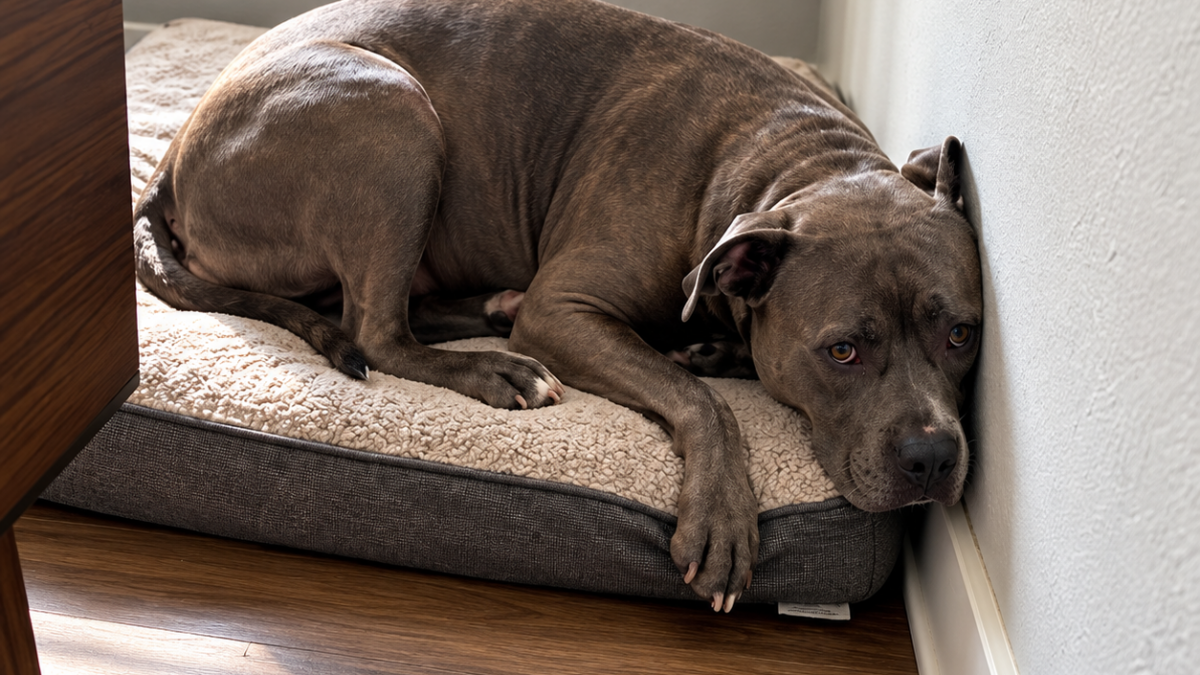
My neighbor moved away without warning and took his Golden Retriever with him, and within days my ninety-pound pit bull stopped eating, stopped playing, and began spending every evening beside an empty fence.
I left before sunrise the following morning.
That sounds more decisive than it actually felt.
The truth was that I spent almost the entire night questioning whether I had lost my mind.
Five hundred miles.
For a dog.
Not even my dog.
For my dog’s dog.
That was how ridiculous it sounded when I tried to explain it logically.
I stood in my kitchen at 4:30 in the morning with a travel mug of coffee in one hand and the old envelope in the other.
The return address had been written by someone whose name I didn’t recognize.
It wasn’t even proof.
The envelope could have belonged to a relative.
A business contact.
Someone my neighbor had never visited.
I could drive nine hours and find absolutely nothing.
Ruby appeared in the doorway.
He stood there staring at me.
He didn’t wag.
He had stopped doing that much.
“Don’t look at me like that.”
His ears shifted.
“This could be stupid.”
Ruby took two slow steps forward.
I crouched.
“We might not find him.”
He placed his chin on my knee.
That settled it.
“Okay.”
I scratched behind his ears.
“Let’s go find your boyfriend.”
Ruby’s tail moved.
Twice.
It was the most enthusiasm I’d seen from him in nearly two weeks.
I packed water, dog food, bowls, a blanket, Ruby’s medication for allergies, a first-aid kit, and enough snacks for me to survive an apocalypse.
Ruby climbed into the back seat.
Normally, car rides made him ecstatic.
He’d push his nose toward the cracked window, trying to inhale the entire world.
That morning, he curled up on the blanket and rested his head against the door.
The highway stretched ahead of us.
The first two hours passed in darkness.
I drove north while the sky slowly changed from black to deep blue.
Every hour or so I’d look in the mirror.
Ruby was awake.
Just watching.
“You’re making this emotionally exhausting.”
His eyebrows lifted.
“At least pretend you’re excited.”
No response.
I sighed.
“You better appreciate this.”
His tail tapped once.
“That’s not nearly enough gratitude.”
By eight, the sun was up.
At a gas station, Ruby finally ate half a breakfast biscuit I’d brought.
I celebrated like he’d won a championship.
“Yes!”
The cashier walking past my car looked at me strangely.
“I have a depressed dog,” I explained.
That didn’t help.
We kept going.
The landscape changed.
Familiar roads became unfamiliar.
Flat stretches gave way to wooded hills.
Small towns appeared and vanished.
I started wondering about Marley.
Was he grieving too?
That possibility had been sitting quietly in my mind since the veterinarian mentioned separation grief, but I had tried not to imagine it.
What if Marley had already adjusted?
What if he didn’t care?
Would seeing him help Ruby or make things worse?
And what exactly was I planning to do when I found the house?
Knock on a stranger’s door and say:
Hello. We barely knew each other, but my dog is emotionally devastated because your dog disappeared, so I drove five hundred miles to your new house.
Normal.
Completely normal.
Around noon, I pulled into a roadside rest area.
Ruby got out.
He sniffed the grass.
For the first time all trip, he showed genuine interest in something.
Then he caught a scent on the wind and looked toward the parking lot.
His body became alert.
For half a second, I thought he recognized something.
He didn’t.
A Golden Retriever climbed out of an SUV.
Ruby froze.
The Golden wasn’t Marley.
Different face.
Different size.
Ruby watched him anyway.
The other dog’s owner smiled.
“Friendly?”
“Very.”
The Golden approached.
Ruby sniffed him.
Then stepped away.
He looked disappointed.
My heart hurt.
“Come on.”
Ruby climbed back into the car.
I sat behind the wheel without starting the engine.
“We’re going to find him.”
Ruby looked at me.
“I hope.”
That was the truth.
By mid-afternoon, we reached the town printed on the envelope.
It looked almost too perfect.
Large maple trees lined the streets.
Small houses had front porches.
A white church steeple rose above everything.
There was a hardware store that looked fifty years old and a library with flower boxes under the windows.
I drove slowly.
The return address on the envelope led to a small office building.
Not a house.
My stomach dropped.
“No.”
Ruby lifted his head.
I parked.
The office was closed.
A sign beside the entrance identified it as a property-management company.
I stared through the glass.
“Great.”
So the address wasn’t my neighbor’s.
Ruby watched me through the windshield.
“I know.”
I walked back to the car.
For the first time all day, I considered giving up.
I’d followed my one clue.
It was wrong.
Or incomplete.
Same result.
Then I saw the café.
Across the street.
CHEZ ELIZA.
It was the kind of place where everyone probably knew everybody.
And when you’re searching a tiny town for one man with a Golden Retriever, a local café seemed as good a place as any.
I left the windows cracked for Ruby and went inside.
A bell rang above the door.
The café was almost empty.
An older woman with silver-gray hair was wiping a table.
“Afternoon.”
“Hi.”
She smiled.
“What can I get you?”
“Actually, I’m looking for someone.”
Her smile became cautious.
I held up the envelope.
“I know this sounds strange.”
“Usually means it’s going to be interesting.”
“I lived next door to a man who recently moved here.”
“Name?”
I gave it.
She shook her head.
“He has a Golden Retriever named Marley.”
That changed something.
Her hand stopped moving.
“Marley?”
“Yes.”
She looked toward the window.
Ruby sat in the car staring at the café.
“That’s your dog?”
“Ruby.”
She studied him.
Then studied me.
“You drove here because of a dog.”
It wasn’t a question.
I felt suddenly embarrassed.
“Yes.”
“How far?”
“About five hundred miles.”
The woman stared.
Then slowly put down the rag.
“Good Lord.”
“I know how it sounds.”
“No.”
Her expression softened.
“I think I understand.”
“You know Marley?”
“I’ve seen him.”
Every muscle in my body tightened.
“He’s here?”
“Golden Retriever? Older man? Moved into the Miller house a couple weeks ago?”
“Yes.”
“I assume so.”
I almost grabbed her.
“Where?”
She pointed.
“Oak Street. Two blocks over, turn left. White house with blue shutters at the end.”
My knees actually weakened.
“Thank you.”
“Wait.”
I stopped.
She looked toward Ruby again.
“That Golden’s been miserable.”
“What?”
“I’ve seen them walking.”
She shook her head.
“The dog barely walks. Owner has to coax him.”
My chest tightened.
“He misses Ruby.”
She glanced at me.
“You think so?”
“I know so.”
I moved toward the door.
She called after me.
“One more thing.”
I turned.
“That man keeps to himself.”
“I know.”
“He may not appreciate someone appearing without warning.”
“I didn’t drive five hundred miles for him.”
The woman smiled.
“No.”
Her eyes shifted toward Ruby.
“I suppose you didn’t.”
I thanked her again and ran to the car.
“Ruby.”
His head lifted.
“I think we found him.”
That dog transformed.
Maybe it was my voice.
Maybe he smelled something.
Maybe dogs know more than we understand.
He stood.
Tail moving.
Not fully.
But moving.
“Oak Street.”
I started the engine.
“Let’s go.”
The street was short.
Maybe eight houses.
I drove slowly.
Ruby was standing now.
Nose near the window.
House one.
Nothing.
House two.
Nothing.
Then his ears snapped forward.
His nose lifted.
His body began trembling.
“What?”
Ruby whined.
A sound I hadn’t heard in weeks.
Then I saw the white house.
Blue shutters.
Large oak in front.
And beneath it, lying in the grass, was a Golden Retriever.
“Marley.”
Ruby barked.
The sound exploded through the car.
Marley’s head came up.
Ruby barked again.
He scratched at the window.
“Wait!”
I pulled over.
Before I’d fully stopped, Ruby was crying.
Not barking now.
Crying.
I opened the door.
He launched himself out.
“Ruby!”
He ran toward the fence.
Marley stood.
For one frozen second, the two dogs simply stared.
I saw recognition happen.
Marley’s tail moved.
Once.
Twice.
Then violently.
His whole body came alive.
He ran.
Ruby reached the fence.
Marley reached the other side.
Their noses slammed together through the wire.
Ruby whined.
Marley made a high-pitched sound I’d never heard from a Golden Retriever.
They pushed against the fence.
Licking.
Sniffing.
Trying to reach each other through gaps too small.
I stood several feet away.
Crying.
Completely.
Unashamedly.
“Hey, buddy.”
Marley glanced at me.
Then immediately returned to Ruby.
Ruby pressed his forehead against the wire.
Marley pressed his against the other side.
Exactly like before.
Home.
That was what it looked like.
Two dogs had traveled nowhere emotionally.
They had simply been waiting for the world to put them back where they belonged.
The front door opened.
A man stepped onto the porch.
My former neighbor.
David.
I didn’t know his first name until later.
He looked older than I remembered.
Tired.
Shoulders slightly bent.
He saw me.
Then the dogs.
Confusion crossed his face.
“What—”
“I can explain.”
He walked toward us.
Then stopped.
Marley was trembling.
Ruby too.
David stared.
“You drove here?”
“Yes.”
“From—”
“Yes.”
“Why?”
I laughed through tears.
“Look at them.”
He did.
For a while, nobody spoke.
Ruby and Marley continued trying to touch each other through the fence.
Finally I said, “Ruby stopped eating.”
David looked at me.
“What?”
“Since you left.”
His face changed.
“He stopped playing. Barely goes outside except to wait by the fence.”
David looked toward Marley.
“He hasn’t been eating either.”
I swallowed.
“What?”
“I thought it was the move.”
His voice dropped.
“He’s barely touched his food.”
We stared at each other.
Two adults who had lived side by side for years and barely spoken.
Yet our dogs had apparently built a relationship deeper than either of us understood.
David shook his head.
“I didn’t know.”
“Neither did I.”
He walked toward the gate.
His hands trembled slightly as he opened it.
Ruby looked at me.
“Go.”
He didn’t need a second invitation.
He entered the yard.
Marley rushed toward him.
I expected chaos.
Running.
Wrestling.
Barking.
Instead, the dogs stopped.
They sniffed each other slowly.
Almost carefully.
Marley touched Ruby’s shoulder.
Ruby leaned into him.
Then both dogs lay down in the grass.
Side by side.
Marley rested his head across Ruby’s back.
Ruby closed his eyes.
Like exhausted travelers who had finally reached home.
David stood beside me.
His eyes were wet.
“I feel like an idiot.”
“Don’t.”
“I thought he’d forget.”
I looked at the dogs.
“Some don’t.”
“I should’ve said something before moving.”
“Probably.”
He gave a surprised laugh.
I smiled.
“Sorry. I’m tired.”
“No.”
He shook his head.
“You’re right.”
He looked at Marley.
“My company transferred me. Everything happened fast. House sold faster than expected. I don’t know anybody here.”
He paused.
“I don’t really know anybody anywhere.”
There was something in that sentence.
Something I recognized.
Loneliness.
Not dramatic loneliness.
The quieter kind.
The kind you learn to arrange your life around.
“I didn’t think anyone next door cared that I was leaving.”
“I barely knew your name.”
“Exactly.”
“And yet here we are.”
He laughed.
“Here we are.”
We stood awkwardly.
Then David asked, “Do you want coffee?”
I looked at Ruby.
He was still lying beside Marley.
“I don’t think I’m going anywhere.”
David smiled faintly.
“Neither do I.”
His porch overlooked the backyard.
He made coffee.
I sat across from him while Ruby and Marley eventually stood and began exploring the yard together.
Ruby was different already.
Tail high.
Movement lighter.
He picked up a stick.
Marley chased him.
Then Ruby chased Marley.
Within fifteen minutes, both were running.
Running.
My dog.
The dog who had barely left his bed three days earlier.
I covered my mouth.
David looked toward me.
“He’s really been that bad?”
“You have no idea.”
He became quiet.
“Marley too.”
“Tell me.”
“The first night here, he sat by the front door until morning.”
My chest tightened.
“After that, he kept trying to go outside.”
“Maybe looking for Ruby.”
“I thought he wanted the old house.”
“Maybe both.”
David stared into his coffee.
“The second week, I took him to the vet.”
“So did I.”
We looked at each other.
Then laughed.
It wasn’t funny exactly.
But it was absurd.
Two people.
Two veterinarians.
Two depressed dogs.
Five hundred miles.
All because neither human had understood what was happening.
“I asked the vet if dogs could get depressed,” David said.
“What did they say?”
“Yes.”
“Mine too.”
He watched Marley tackle Ruby gently near the oak.
“I thought he was lonely.”
“He was.”
David nodded.
“I guess I didn’t understand who he was lonely for.”
We talked for hours.
At first, mostly about the dogs.
Ruby had come from a shelter five years earlier.
He’d been underweight, anxious around men, terrified of loud noises.
The first month I owned him, he slept beside the laundry room door instead of in the expensive bed I’d bought.
Trust had come gradually.
Marley had been with David since puppyhood.
“Got him after my divorce,” David said.
“Bad?”
“The divorce?”
“Yes.”
He smiled without humor.
“Depends who you ask.”
“You?”
“I was difficult.”
“That’s honest.”
“I’ve had time.”
He looked toward Marley.
“He’s why I got out of bed some mornings.”
I understood.
Ruby had become that for me after my mother died.
Not because I couldn’t function.
I could.
That’s the dangerous thing about loneliness.
You function.
You work.
Shop.
Pay bills.
Answer messages.
From the outside, everything looks normal.
But the world becomes smaller.
Ruby had expanded mine.
Apparently Marley had done the same for David.
“So why didn’t you say goodbye?” I asked.
David stared toward the yard.
“To you?”
“Anyone.”
He shrugged.
“I didn’t think anybody cared.”
That answer stayed between us.
Eventually the sun started dropping.
Golden light stretched across the yard.
Ruby and Marley lay together beneath the oak.
“How long are you staying?” David asked.
“I wasn’t planning on staying.”
“You drove today?”
“Yes.”
“You can’t drive back tonight.”
“I’ve done worse.”
“No.”
He looked genuinely concerned.
“Stay here.”
I hesitated.
“There’s a guest room.”
“David—”
“You crossed five hundred miles because your dog was heartbroken.”
He gestured toward Ruby.
“The least I can do is make sure you don’t fall asleep at the wheel.”
He had a point.
“I don’t want to impose.”
“You’ve already invaded my yard.”
“True.”
“And brought my dog back to life.”
I looked toward Marley.
He was lying with his chin across Ruby’s paws.
“One night.”
“One.”
The guest room was small.
Clean.
Almost too clean.
David gave me fresh towels.
I put my bag beside the bed.
Ruby followed.
Then looked toward the hallway.
Marley stood there.
“Go.”
Ruby went.
The two dogs slept in the hallway between our bedrooms.
Side by side.
No fence.
No whining.
No waiting.
I lay awake for a while listening to their breathing.
Then I heard the back door open softly.
I got up.
David was sitting on the porch.
I stepped outside.
“Can’t sleep?”
He looked up.
“New house.”
I sat.
For several minutes, we said nothing.
The town was quiet.
Stars above us.
Marley and Ruby eventually joined us.
Ruby lay near my feet.
Marley near David.
Then, slowly, the dogs moved until they were touching in the middle.
David laughed.
“They’re ridiculous.”
“Completely.”
“Five hundred miles.”
“Don’t remind me.”
“You actually did that.”
“For him.”
“Of course.”
His tone made me look at him.
“What?”
“Nothing.”
“You said that strangely.”
“No.”
“David.”
He smiled.
“I was going to say I’m not sure many people would’ve done it.”
“I think they would.”
“I don’t.”
I looked at Ruby.
“I couldn’t keep watching him disappear.”
David’s expression softened.
“You’re lucky.”
“Why?”
“To have something you love enough to do something crazy for.”
That was the first time I looked at him differently.
Not romantically.
Not yet.
Just more carefully.
He wasn’t unfriendly.
He wasn’t cold.
He was lonely.
There is a difference.
The next morning, Ruby ate an entire bowl of food.
I stood over him like a proud parent.
“Look at you!”
David came into the kitchen.
“What’s happening?”
“He ate.”
David smiled.
“Marley too.”
Both dogs had finished breakfast.
Then immediately started playing.
The solution had been embarrassingly simple.
Each other.
Before I left, David stood beside my car.
Marley sat near him.
Ruby sat beside me.
The dogs knew something was happening.
Ruby’s tail lowered.
Marley whined.
“Oh no,” I said.
David rubbed his forehead.
“We can’t do this every time.”
“I know.”
“What if…”
He stopped.
“What?”
“I work from home.”
“Okay.”
“And I can travel.”
“Okay.”
He looked uncomfortable.
“Maybe once a month.”
I understood immediately.
“Visits.”
“For them.”
“For them.”
“One weekend here. Next month maybe I drive back.”
I looked at Ruby.
Then Marley.
“Once a month.”
David smiled.
“Maybe more if needed.”
There was something almost shy in his expression.
“Maybe.”
The first goodbye was awful.
Ruby didn’t collapse this time.
But he stared out the rear window until the house disappeared.
I talked to him most of the drive.
“We’re coming back.”
He watched me through the mirror.
“I mean it.”
At home, Ruby immediately ran to the fence.
The neighboring yard was still empty.
He stopped.
But this time he didn’t lie down.
He sniffed the old gap.
Then came inside.
That mattered.
He ate dinner.
Played with his rope.
Slept beside my bed.
Something had changed.
He knew Marley existed somewhere.
Maybe dogs understand promises through repetition.
Or maybe that one reunion had been enough to restore something.
A month later, David drove down.
Ruby recognized his truck before it reached the driveway.
He started barking inside the house.
“What?”
Then I heard another bark.
Marley.
Ruby exploded.
I opened the door.
The reunion was even louder than the first.
Running.
Circling.
Whining.
David climbed out laughing.
“This is insane.”
“Your idea.”
“I regret nothing.”
He stayed the weekend.
That became the rhythm.
One month, I drove north.
The next, he came south.
Sometimes weather changed plans.
Sometimes work did.
But we always rescheduled.
The dogs learned.
And somewhere during those months, something else happened.
David and I became friends.
At first, our communication was practical.
Marley ate breakfast.
Ruby misses him.
Weather bad this weekend?
Vet says Marley needs less food.
Then it became:
How was work?
Did your presentation go okay?
You sounded tired yesterday.
Call me when you get home.
Then photographs.
Ruby sleeping upside down.
Marley wearing a ridiculous raincoat.
Coffee.
Sunsets.
Daily things.
The kinds of things you don’t send someone unless they’ve quietly become part of your life.
Eliza noticed before I did.
On one trip north, I stopped at the café.
She looked past me.
“Where’s David?”
“At home.”
“Shame.”
“Why?”
She smiled.
“Nothing.”
“I hate when people say nothing like that.”
She poured coffee.
“You’re here a lot.”
“For Ruby.”
“Of course.”
“And Marley.”
“Naturally.”
I stared.
“Don’t.”
“I didn’t say anything.”
“You’re thinking loudly.”
Eliza laughed.
“Fifty years married taught me things.”
“I’m not dating David.”
“I know.”
“Good.”
“Yet.”
I nearly choked on my coffee.
“Eliza.”
She walked away smiling.
I told David.
He laughed harder than necessary.
“She said that?”
“Yes.”
“About us?”
“Don’t sound so pleased.”
“I’m not.”
“You are.”
“I’m amused.”
“You’re impossible.”
“Still coming over for dinner?”
I hesitated.
“Yes.”
That dinner changed things.
Not dramatically.
No candlelight.
No confession.
David made pasta.
Burned the garlic bread.
Ruby and Marley slept beneath the table.
We drank wine on the porch.
The conversation turned to relationships.
Mine had ended four years earlier.
He’d been a good man.
We simply wanted different lives.
Afterward, I told myself I was happy alone.
Mostly true.
David told me more about his divorce.
“I shut down when things got difficult.”
“That sounds familiar.”
“You too?”
“Different version.”
We sat quietly.
Then he said, “Do you know the weird thing?”
“What?”
“If Marley hadn’t known Ruby, I would’ve moved and never spoken to you again.”
“That’s slightly insulting.”
“You know what I mean.”
“I do.”
“Two years next door.”
“Approximately.”
“And we knew nothing about each other.”
“Your dog had better social skills.”
“Clearly.”
I smiled.
David looked toward the yard.
“Maybe we were the ones behind the fence.”
That sentence stayed with me.
Ruby and Marley had spent years separated by wire but constantly reaching toward each other.
David and I hadn’t had a physical barrier.
We’d simply been two lonely adults living fifteen yards apart, saying hello and continuing inside.
The dogs had known better.
The first kiss happened three months later.
I wish there were a dramatic story.
There isn’t.
David was visiting.
Rain started.
We ran from the yard.
I slipped on the porch.
He caught me.
I laughed.
He laughed.
We stopped.
Too close.
“Well,” I said.
“Yeah.”
Then he kissed me.
Softly.
Then immediately stepped back.
“I’m sorry.”
“Why?”
“I don’t know.”
“That was stupid.”
“What?”
“Apologizing.”
“Oh.”
I kissed him again.
From inside, Ruby barked.
Marley joined him.
We pulled apart laughing.
“Apparently we have chaperones.”
“Judgmental ones.”
Dating someone five hundred miles away wasn’t easy.
Gas.
Schedules.
Phone calls.
Missing each other.
But we already knew how to make the road.
We’d been driving it for months.
The dogs didn’t care about definitions.
They just knew visits became longer.
Goodbyes shorter.
Eventually, David stayed at my house for two weeks.
Then I stayed at his for three.
The white house with blue shutters began feeling familiar.
Eliza stopped pretending surprise when I entered the café.
“Morning.”
“Don’t.”
“I said morning.”
“You have a face.”
“I was born with one.”
David thought our arguments were hilarious.
Our relationship wasn’t perfect.
Real ones aren’t.
Sometimes David withdrew.
Sometimes I interpreted silence as rejection.
Sometimes I tried solving things alone.
Sometimes he did.
But we had an unusual advantage.
Two dogs who had already demonstrated what happened when separation became easier than communication.
Whenever we started emotionally retreating, one of us would eventually say:
“Fence.”
That became our word.
Fence meant:
We’re doing it again.
Standing on separate sides when there’s probably a gate somewhere.
The first time David said it during an argument, I nearly threw a pillow at him.
We had been discussing where to live.
He wanted me to move north.
I wanted him to consider coming back.
“I’m not uprooting everything again,” I said.
“I just got settled.”
“And I have a job.”
“I have one too.”
“I work remotely.”
“Exactly.”
“That doesn’t mean it’s disposable.”
“I didn’t say disposable.”
“You implied it.”
“No.”
“Yes.”
David became quiet.
That silence.
His old retreat.
I crossed my arms.
“Fine.”
He looked away.
“Fine.”
Ten minutes.
Then he said, “Fence.”
I stared.
“Don’t.”
“Fence.”
“I’m still angry.”
“So am I.”
“Good.”
“But we’re lying on opposite sides of the same problem.”
I hated how correct that was.
We talked.
Really talked.
Eventually we decided nothing immediately.
That was also progress.
Not every conflict needs instant resolution.
Sometimes staying in the conversation is enough.
The decision arrived months later.
My company offered a remote role.
Unexpected.
Flexible.
I could work anywhere.
I stared at the email.
Then toward Ruby.
He was asleep with Marley’s old tennis ball beside him.
David and Marley were at their house.
I called.
“Hey.”
“What’s wrong?”
“Why does everyone ask me that?”
“Because you start serious calls with ‘hey.'”
“I can work remotely.”
Silence.
“Anywhere?”
“Apparently.”
Longer silence.
“Are you thinking what I think you’re thinking?”
“I don’t know.”
“Say it.”
I looked around my house.
Five years.
Memories.
Ruby’s first home.
The fence.
The little hole beneath it.
Moving scared me.
Not because I disliked David’s town.
Because choosing something permanent meant risking permanent loss.
It meant admitting I had built a life with someone.
Ruby entered the room.
He stood beside me.
“Yes,” I said.
“Yes what?”
“I’m thinking about moving.”
David exhaled.
“You don’t have to.”
“I know.”
“I don’t want you doing it for the dogs.”
I smiled.
“I started this for the dogs.”
“And now?”
I looked at Ruby.
“Now I think they’re ahead of us again.”
We decided to try six months.
Not sell my house immediately.
Rent it.
Move north.
See what happened.
Ruby seemed to understand the moment our furniture started disappearing.
But unlike the first time Marley moved, he wasn’t depressed.
Because this time he came.
When we arrived at the white house, Marley was in the yard.
Ruby jumped from the car.
They ran toward each other.
No fence.
No waiting.
No monthly goodbye.
David stood beside me.
“You okay?”
I looked at the house.
“Terrified.”
“Good.”
I laughed.
“That’s your response?”
“I’m terrified too.”
“Better.”
He took my hand.
That mattered.
Not absence of fear.
Company inside it.
Living together was messy.
Two adults used to solitude.
Two large dogs.
Different routines.
David loaded the dishwasher incorrectly.
He insists that isn’t a real thing.
It is.
I left coffee cups everywhere.
Ruby stole Marley’s bed.
Marley stole Ruby’s toys.
The dogs occasionally looked at us during arguments as if embarrassed by our species.
But mostly, it worked.
Not because love automatically solves incompatibility.
Because we kept choosing to repair.
Our first Christmas together, Katherine—my sister—visited.
She watched Ruby and Marley asleep beneath the tree.
Then looked at David and me cooking.
“All this because Ruby stopped eating?”
“Pretty much.”
She laughed.
“That dog is a better matchmaker than anyone I’ve ever met.”
Ruby lifted his head when he heard his name.
“Don’t encourage him.”
He wagged.
David said, “He knows.”
Two years after the first drive, we returned to my old neighborhood.
My house was between tenants.
I wanted to check repairs.
Ruby and Marley came.
The moment we entered the backyard, both dogs ran toward the old fence.
The tiny opening was still there.
Marley went to one side by habit.
Ruby stopped.
They stared at each other.
Then Ruby walked through the open gate.
Marley followed.
I laughed.
David stood beside me.
“They don’t need it anymore.”
“No.”
The fence suddenly felt symbolic in a way that would’ve embarrassed me years earlier.
A barrier once necessary.
Then familiar.
Then unnecessary.
David put his hand around mine.
“Neither do we.”
“That was painfully sentimental.”
“I learned from you.”
“Liar.”
We sold my old house the following spring.
That hurt.
Ruby’s shelter adoption photo had been taken there.
My mother had visited there.
I had built a life there.
But leaving wasn’t always abandonment.
Sometimes leaving meant moving toward something.
That distinction had become important to me.
The proposal happened another year later.
David did not plan it well.
He claims he did.
He lies.
We were in the backyard.
Ruby and Marley were lying nearby.
David asked if I wanted wine.
I said no.
He became weirdly nervous.
Then disappeared inside.
Returned.
Dropped something.
Swore.
Ruby immediately investigated.
“Ruby, no!”
I knew.
“Oh my God.”
David stared at the grass.
“Give me one second.”
I started laughing.
“This is not happening.”
“It was supposed to.”
Marley stood and joined the search.
Now both dogs were sniffing the grass.
“Stop helping!”
David found the ring.
Covered in dirt.
He wiped it on his shirt.
“Perfect.”
I was crying from laughter before he even knelt.
“You’re ruining this.”
“You’re ruining this.”
“Can I talk?”
“Please.”
He took my hand.
His face became serious.
Not polished.
Not rehearsed.
David wasn’t good at polished emotion.
That was part of why I trusted it.
“I spent a lot of years thinking being alone was easier.”
My laughter faded.
“Then I moved here.”
He looked toward Marley.
“I thought I was starting over alone.”
Then toward Ruby.
“Apparently Marley had other plans.”
I smiled through tears.
“You drove five hundred miles because your dog couldn’t live without mine.”
“Romantic.”
“I’m getting there.”
“Sorry.”
He squeezed my hand.
“Somewhere between those monthly drives, I realized I didn’t want Marley to be the only reason you came.”
My throat tightened.
“And somewhere after that, I realized I didn’t want you to leave.”
Ruby walked over.
Sat beside David.
Of course.
David laughed.
“Can I finish?”
Ruby wagged.
“He’s approving.”
David looked at me again.
“I don’t know what forever looks like.”
“Neither do I.”
“But I know what home feels like now.”
That was the line.
That one broke me.
He opened the little box.
“Will you marry me?”
I looked at Ruby.
Then Marley.
Both sitting beside him.
Two dogs who had once slept on opposite sides of a fence.
Two dogs who had gone into mourning when someone decided distance was just distance.
And somehow their refusal to forget each other had changed four lives.
“Yes.”
David stood.
I kissed him.
Ruby started barking.
Marley joined in.
Neighbors probably thought something terrible had happened.
Something had.
To my old life.
It was gone.
And I didn’t miss it.
We married the following autumn.
Small ceremony.
Eliza attended.
Obviously.
She took full credit.
“I gave you directions.”
“You did.”
“Therefore, without me, no wedding.”
David said, “Technically true.”
I glared at both.
Ruby and Marley were part of the ceremony.
Ruby wore a blue bow tie.
Marley wore green.
Both looked deeply offended.
The wedding photographer captured one picture I still love more than almost any other.
David and I are standing beneath the oak tree.
Ruby sits beside me.
Marley beside David.
But both dogs are leaning toward each other.
Shoulders touching.
Of course.
The dogs aged.
That’s the part nobody wants when telling a love story.
But time doesn’t care whether you’re ready.
Ruby’s muzzle went gray first.
Then Marley’s.
Their running slowed.
Eventually backyard races became walks.
Walks became lying in the grass together.
But every morning, Ruby still looked for Marley.
Every morning Marley checked where Ruby was.
Sometimes I woke before sunrise and found them sleeping nose to nose.
No fence.
Years after the separation, the bond remained.
Marley developed arthritis.
Ruby slowed down for him.
That surprised nobody.
If Marley stopped on a walk, Ruby stopped.
If Marley struggled with the steps, Ruby waited at the top.
We installed a ramp.
David built it himself.
Poorly.
I made him redo it.
“I followed instructions.”
“No, you approximated instructions.”
“Marley doesn’t care.”
“Marley’s safety code isn’t authoritative.”
Eventually the ramp worked.
Marley loved it.
Ruby refused to use it on principle.
Their personalities remained intact.
When Marley turned twelve, his health began declining more seriously.
Kidneys.
Medication.
Diet changes.
More veterinarian visits.
David took it hard.
Marley had been with him through his divorce.
The move.
Loneliness.
Me.
Everything.
One night after a bad appointment, David sat on the porch.
I joined him.
“He’s getting old.”
“I know.”
“I don’t know how to do this.”
I took his hand.
“You don’t have to know yet.”
“I almost lost him once.”
“When you moved?”
He nodded.
“I didn’t understand what he needed.”
“You came back to it.”
“No. You came.”
I looked toward the yard.
Ruby lay beside Marley.
“We all came back.”
The next year was quieter.
Marley had good months.
Then bad weeks.
Ruby rarely left him.
The veterinarian eventually said the phrase nobody wants.
Quality of life.
David stared at the table.
I watched his face close.
Old habit.
Fence.
I reached for his hand.
He didn’t take it.
Not immediately.
“David.”
“I’m fine.”
“No.”
“I said I’m fine.”
“Fence.”
He looked at me.
Tears filled his eyes.
Then he took my hand.
We made the decision together.
Not that day.
Marley still enjoyed food.
Sunlight.
Short walks.
Ruby.
When those things began disappearing, we knew.
Marley’s final morning was warm.
He lay beneath the oak.
Ruby beside him.
The veterinarian came to the house.
David knelt in the grass.
Marley rested his head on his lap.
I sat beside Ruby.
Ruby seemed to understand.
He kept licking Marley’s face.
“Buddy.”
David’s voice broke.
“I don’t know who I am without you.”
I touched his shoulder.
Marley’s tail moved.
Once.
David laughed through tears.
“Still taking care of me.”
We let Marley go beneath the tree.
Safe.
Home.
Ruby stayed beside him afterward.
For nearly an hour.
Then he lay where Marley had been.
That terrified me.
I remembered the first separation.
The bed.
The fence.
The refusal to eat.
“No.”
I knelt.
“Ruby.”
His eyes looked tired.
“You don’t get to disappear too.”
Of course grief doesn’t respond to instructions.
For several days, Ruby barely ate.
He searched rooms.
Sniffed Marley’s bed.
Waited near the back door.
David and I stayed close.
But this grief was different from the first.
Before, Marley had vanished without explanation.
This time Ruby had been there.
He knew something had changed.
Maybe not death as humans understand it.
But absence with an ending.
He didn’t wait at a fence.
He grieved.
Then slowly returned.
The first day he ate a full meal, David cried.
The first time Ruby carried a toy outside, I called it a miracle.
He lived another eighteen months.
Old.
Gray.
Spoiled beyond reason.
David became his person as much as I was.
Sometimes I would find Ruby sleeping with his head on David’s foot.
“Traitor.”
Ruby’s tail moved.
When his own health failed, the decline was gentler.
His heart.
His joints.
Age.
I hated every second.
But I also knew what grief had taught me.
Love’s ending isn’t evidence that love was a mistake.
Ruby’s last day was in the same yard.
Same oak.
Marley’s ashes were buried beneath it.
I laid Ruby beside me.
David sat on the other side.
“You did a lot, buddy.”
Ruby looked at me.
“You know that?”
Tail.
Weak.
“You made me drive five hundred miles.”
David laughed through tears.
“Best thing he ever did.”
I touched Ruby’s gray face.
“You found Marley.”
His breathing slowed.
“And you found David.”
David took my hand.
“Show-off.”
Ruby closed his eyes.
I whispered, “Go find him.”
That sentence almost destroyed me.
But it also felt right.
“You waited once.”
I kissed his forehead.
“You don’t have to wait this time.”
Ruby died with my hand on his heart.
David holding me.
No fence.
No distance.
We buried his ashes beside Marley’s.
Under the oak.
We placed one stone there.
Not two.
One.
RUBY & MARLEY
TOGETHER AGAIN
For weeks, the yard felt enormous.
Too quiet.
No nails across the porch.
No barking at squirrels.
No ridiculous bodies blocking doorways.
David and I grieved differently.
He became quiet.
I talked too much.
Sometimes we annoyed each other.
Sometimes one of us wanted memories and the other couldn’t bear them.
But we stayed.
That was the gift the dogs had left us.
Stay.
Stay when grief makes distance feel safer.
Stay when conversation is uncomfortable.
Stay when love stops being joyful for a while.
Stay.
One evening, months after Ruby died, we found the old photograph from the neighborhood.
I’d taken it years earlier.
Ruby on one side of the fence.
Marley on the other.
Both lying down.
Noses touching beneath the tiny gap.
David stared at it.
“This was before we really knew each other.”
“Way before.”
“Our dogs had a relationship before us.”
“Much healthier one.”
He laughed.
Then his eyes filled.
“Do you ever think about what would’ve happened if you hadn’t found that envelope?”
“Don’t.”
“I do.”
I looked at the photo.
Maybe Ruby would’ve eventually adjusted.
Maybe Marley too.
Maybe David and I would never have spoken again.
Maybe he would’ve lived alone in the white house.
I would’ve remained hundreds of miles away.
Two complete lives.
Perfectly functional.
Never intersecting.
“I found it,” I said.
“That’s the only version we get.”
He nodded.
Years later, we’re still in that white house with blue shutters.
The oak is larger.
Eliza retired.
Her daughter runs the café now.
David still works from home.
So do I most days.
There are two new dogs in our yard.
Not replacements.
Never replacements.
A senior Golden mix named Arthur.
And a blocky gray rescue named Poppy.
David laughed when he first saw Poppy.
“What?”
“She looks like Ruby.”
“She does not.”
“She absolutely does.”
Poppy is smaller.
Female.
More chaotic.
Arthur is afraid of thunderstorms.
They became friends immediately.
Of course they did.
The first time they lay together beneath the oak, David came inside and found me crying.
“Hey.”
“I’m fine.”
“Fence.”
I laughed.
Then let him hold me.
That’s our word still.
Maybe always.
Sometimes people hear our story and focus on the romance.
The woman who drove hundreds of miles for her grieving pit bull and ended up marrying the Golden Retriever’s owner.
I understand.
It sounds like a movie.
But that’s not the part I think about most.
I think about the first Tuesday morning.
Ruby refusing to leave his bed.
That one heavy sigh.
The empty house next door.
How easy it would’ve been to say:
He’s a dog.
He’ll adjust.
Give it time.
Maybe he would have.
But grief isn’t meaningless because the one experiencing it can’t explain it.
Love doesn’t become smaller because it belongs to an animal.
Ruby knew Marley was gone.
Marley knew Ruby was gone.
Their bodies showed us before we understood.
They ate less.
Played less.
Waited.
That was love’s evidence.
Not sentimental fantasy.
Behavior.
Connection.
Loss.
And when they saw each other again, they came alive.
So did we.
I used to think that five-hundred-mile drive was the craziest thing I’d ever done.
Now I think it was one of the clearest decisions of my life.
Not because I knew it would end with marriage.
I didn’t.
I went because someone I loved was suffering.
And I had one possibility of helping.
That’s enough reason sometimes.
You don’t need to know what waits at the end of the road.
You only need to know someone you love is asking you to move.
Ruby never said:
Find Marley.
He couldn’t.
He just lay by the fence.
Waited.
Stopped eating.
Looked at me with eyes I’d known for five years.
And I listened.
That decision gave him years beside his best friend.
It gave Marley the same.
It gave David and me each other.
It gave four lonely lives a family.
All because I stopped treating the distance between two hearts as something that couldn’t be crossed.
People talk about love finding a way.
I used to think that was a cliché.
Now I know love doesn’t always “find” a way by itself.
Sometimes it needs somebody to drive.
Sometimes it needs a forwarding address.
A café owner.
An open gate.
Sometimes love needs five hundred miles of highway and a woman talking to a depressed pit bull in the rearview mirror.
Sometimes it needs courage from people who don’t realize they’re lonely yet.
Ruby and Marley had no problem understanding what mattered.
We were the slow ones.
They knew from the beginning.
Stay close.
Wait when necessary.
Celebrate the return.
Don’t waste the time you’re given.
And when there is a fence, find the hole beneath it.
Or open the gate.
The stone beneath our oak is weathered now.
Ruby’s name.
Marley’s name.
Together.
Sometimes David and I sit there in the evening.
Arthur asleep nearby.
Poppy chasing something she will never catch.
The house lights behind us.
The life ahead of us quieter than it once was, but full.
David occasionally asks the same question.
“Would you really have driven all that way if you knew nothing about me?”
I always give him the same answer.
“I didn’t.”
“Exactly.”
“I went for Ruby.”
He pretends to be offended.
“Romantic.”
“You benefited.”
“Eventually.”
I lean against him.
Then I look at the stone.
At the yard.
At everything that came afterward.
And I think about two dogs separated by five hundred miles who refused, in the only ways they knew, to pretend separation meant forgetting.
Ruby mourned.
Marley mourned.
So I drove.
And at the end of that road, I found Marley beneath an oak tree.
I found my dog again.
And, without knowing I was looking for him, I found David too.
Ruby and Marley spent their first friendship with a fence between them.
They spent the rest of their lives without one.
Maybe that is the best thing I can say about love.
When it’s real, distance can hurt it.
Time can test it.
Loss can change its shape.
But barriers don’t get the final word.
Not if somebody is willing to open the gate.
Not if somebody is willing to make the drive.
And sometimes the road you take to save the heart of a dog becomes the road that leads you home.








