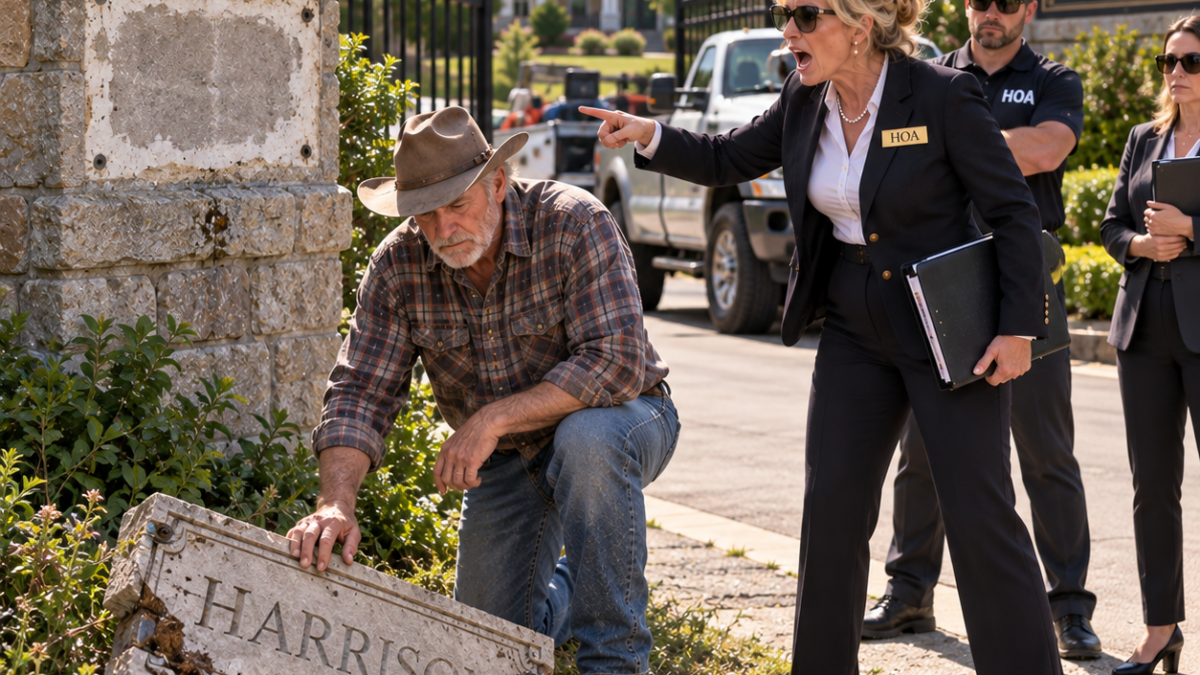
My family name was already lying face-down in the weeds when I reached the entrance, ripped from the stone gate where it had hung for nearly sixty years.
By the time I reached home, the bronze W had left a dusty outline on the passenger seat.
I carried it inside with both hands.
It should have felt like metal.
Instead, it felt like every ride home with my father.
Every time he slowed beneath the arch.
Every time he tapped those two fingers against the steering wheel.
Every time I rolled my eyes as a teenager because I thought old men became sentimental about strange things.
I set the W on my kitchen table.
My phone buzzed almost immediately.
HARBOR POINT COMMUNITY ASSOCIATION.
NOTICE OF INTERFERENCE WITH APPROVED COMMON AREA IMPROVEMENT.
I opened it.
According to the notice, I had:
Disrupted authorized vendor work.
Removed association property from an active project site.
Made unverified ownership claims regarding a common-area entrance monument.
And created unnecessary concern among residents.
I read that last one twice.
Unnecessary concern.
They had torn my last name off a stone gate with pry bars before breakfast.
I had photographed them doing it.
Apparently my camera was the alarming part.
At the bottom:
Continued interference may result in a formal compliance hearing and monetary assessment.
I did what my father always did before allowing himself to get angry.
I printed it.
He had believed paper changed the temperature of a disagreement.
People could deny conversations.
They could soften memories.
They could say, “That isn’t what I meant.”
Paper was less cooperative.
So I printed the email.
Attachment.
Timestamp.
Recipient list.
Photograph.
Then I started a folder.
Twenty minutes later, Veronica emailed me directly.
Miss Whitfield,
For clarity, the entrance monument and surrounding landscaped area are treated as common property of Harbor Point and therefore subject to approved architectural modernization.
Your emotional attachment to prior signage is understood, but it does not create ownership rights.
Please return the removed letter to the contractor or management office no later than 5:00 p.m.
Veronica Hail
Architectural Review Chair
I looked at the W on my kitchen table.
Association property.
That was what she was calling my name now.
I replied with one sentence.
Please provide the recorded document showing Harbor Point owns the stone pillars, iron arch, and Whitfield name marker.
Send.
Then silence.
Nearly an hour.
No answer.
Finally, my phone rang.
Grant Keller.
Harbor Point’s management representative.
His voice had the professionally calm sound of someone who wanted me to feel unreasonable before he had to say anything specific.
“Miss Whitfield, I’m hoping we can lower the temperature.”
“The temperature was fine until a contractor pried my family name off a gate.”
Pause.
“I understand that’s your perspective.”
“It isn’t a perspective. I am physically holding the W.”
Another pause.
“The entrance improvement was approved through the association’s community presentation plan.”
“Who owns the gate?”
“The entrance serves the association.”
“That wasn’t my question.”
“The area has long been maintained as part of the common frontage.”
“Who owns the pillars?”
This pause lasted longer.
“I don’t have the entire chain of documents in front of me.”
“Then why did you authorize someone to drill into them?”
“I did not personally authorize removal. The board approved the project.”
That sentence mattered.
Grant was already stepping sideways from the decision.
“Send me the project scope.”
“That may contain board material.”
“It contains instructions to remove something from a structure you claim belongs to Harbor Point.”
I leaned against the counter.
“Send me the scope and whatever ownership record you relied on.”
He exhaled.
“I’ll see what I can provide.”
“No.”
My voice stayed calm.
“Please provide what the board relied on before the work started.”
He didn’t answer that.
After we hung up, I drove back to the entrance.
The workers were gone.
So were the tools.
The bronze letters had been collected except the W in my kitchen.
The gate stood bare.
Pale scars across the limestone marked where WHITFIELD had protected the surface from rain and sun for nearly six decades.
Veronica was still there.
She stood beside the wrapped Harbor Point sign with her phone against her ear.
When she saw me photographing the gate, she ended the call.
“Miss Whitfield.”
“Veronica.”
“I thought management had addressed this.”
“They addressed it by refusing to provide ownership.”
Her face tightened.
“You are creating unnecessary hostility.”
“I’m creating a record.”
“Of a routine signage update.”
I pointed upward.
“Of that.”
Cars slowed as they passed.
People noticed.
The bare gate.
The wrapped new sign.
Me taking photographs.
Veronica standing beside the project.
Her voice lowered.
“I would be careful.”
“About what?”
“When homeowners make ownership claims they cannot establish, disputes can become expensive.”
My fingers tightened around my phone.
Not because she frightened me.
Because for the first time, I heard uncertainty underneath her threat.
“Good,” I said.
“Then we should both be very interested in the original paperwork.”
She didn’t answer.
That silence followed me home.
And into my father’s closet.
I had avoided that room for eleven months.
People said grief came in waves.
Sometimes.
Other times it was a doorknob you could not turn because you knew exactly what was still hanging on the other side.
Dad’s winter coats were there.
Brown canvas.
Dark wool.
The old green jacket he wore every Thanksgiving whether it was cold or not.
When I opened the closet, the cedar-block smell came out with something else.
Old leather.
Dust.
Peppermint.
My father kept peppermint candies in every coat pocket.
I reached into one without thinking.
My fingers found a wrapped candy.
For a second, I had to close my eyes.
Then I saw the box.
Back against the wall.
Cedar.
Brass corners.
Dust on the latch.
A strip of yellowed tape crossed the top.
My grandmother’s handwriting:
PROPERTY — GATE — ORIGINAL PAPERS.
I carried it to the bed.
The brass latch resisted.
Then opened with a small wooden groan.
Inside were decades.
Tax envelopes.
Hardware receipts.
Insurance papers.
Survey sketches.
Letters tied with cotton string.
A black-and-white photograph slid free.
I picked it up.
The gate.
New.
Limestone pale.
Iron arch freshly painted.
My grandfather stood beside the left pillar wearing work trousers and a white shirt.
His hand rested on the stone.
Under the arch stood my father.
Eight years old, maybe.
Grinning.
Above him:
WHITFIELD.
I turned the photograph over.
My grandmother had written:
Gate finished.
August 1964.
Whitfield entrance.
I sat on the edge of the bed.
The bronze W was downstairs.
The same W.
Nearly sixty years later.
I kept digging.
1983 mortar repair.
Paid by Henry Whitfield.
1989 electrical work for pillar lamps.
Paid by Henry Whitfield.
1998 ice storm repair.
Paid by Robert Whitfield.
My father.
I remembered that winter.
A live oak limb crashed across part of the arch.
Dad spent three weekends outside in a canvas coat repairing lantern brackets and chipped mortar.
I thought it was pride.
Now I wondered whether it had been responsibility.
My phone buzzed.
Another portal notice.
PENDING VIOLATION HEARING.
They accused me of removing association property.
Making unsubstantiated ownership assertions.
Causing resident concern by photographing contractors.
Hearing:
Thursday.
6:30 p.m.
I printed that too.
New folder.
Label:
GATE.
For the next hour, I sorted.
Anything saying:
entrance.
pillar.
gate.
road.
reservation.
ownership.
maintenance.
Then I found a letter.
Law office stationery.
Older than me.
Addressed to my grandfather.
The paper had browned at the edges.
It referenced the original subdivision conveyance.
One sentence stopped me.
The roadway dedication shall not include the existing stone entrance pillars, iron arch, family marker, or decorative lighting unless separately conveyed by written instrument.
I read it three times.
Then out loud.
The room seemed less empty.
But I knew enough not to get ahead of myself.
A lawyer’s letter wasn’t a deed.
Repair bills weren’t title.
An old photograph wasn’t ownership.
They were clues.
Strong ones.
But clues.
I kept searching.
Headlights swept across the bedroom wall.
A vehicle stopped outside.
I moved to the blinds.
Silver SUV.
Veronica.
She sat behind the wheel for several seconds.
Phone light on her face.
Watching my house.
Then she opened the door.
I looked back at the bed.
Papers everywhere.
Dad’s handwriting.
My grandfather’s photograph.
And at the bottom of the cedar box, underneath a cracked leather folder, one envelope I hadn’t seen.
My grandmother’s handwriting.
ORIGINAL ENTRANCE RESERVATION.
Veronica knocked.
Twice.
Controlled.
Not loud.
Somebody pounding wants to intimidate you.
Someone knocking gently at eight o’clock at night wants you to understand that they think they belong there.
I slid the envelope back beneath the leather folder.
I wasn’t opening the most important document in my family’s history with an HOA chair waiting outside like a collection agent.
When I opened the front door, Veronica held a thin folder against her side.
“Miss Whitfield.”
“Eight o’clock is unusual for architectural review.”
“I thought an in-person conversation would be more productive.”
“About my violation hearing?”
“This doesn’t need to become a neighborhood spectacle.”
“You removed a name from the neighborhood entrance with power tools.”
Her eyes moved past me.
Down the hall.
Toward my bedroom.
She could see papers.
Photographs.
The open cedar box.
“If you have historical material,” she said, “the board is willing to review it through the proper process.”
“The proper process removed the name first.”
She pulled out one page.
“Courtesy copy of the project approval.”
I took it.
ENTRANCE MODERNIZATION.
MONUMENT UPDATE.
LANDSCAPE REFRESH.
REMOVAL OF EXISTING NAME MARKER.
INSTALLATION OF ASSOCIATION MONUMENT PANEL.
No title reference.
No deed number.
No ownership confirmation.
“Who verified that Harbor Point owns the structure?”
“The board approved the scope.”
“That isn’t what I asked.”
Her jaw tightened.
“You keep separating the physical gate from the community entrance.”
“Because they may not be the same property.”
She stared at me.
There.
Again.
That tiny moment when the person who had sounded certain realized I might be asking a question she had never asked herself.
Then her voice went colder.
“If this becomes a formal dispute, every document you rely on will be examined.”
“Good.”
I folded the project sheet.
“Then stop work until somebody examines yours.”
“We are not suspending a funded community improvement because one homeowner has strong feelings about historic signage.”
There it was.
Feelings.
Again.
She turned and walked back toward her SUV.
I closed the door.
Waited until the headlights disappeared.
Then went to the cedar box.
The envelope sat exactly where I left it.
Original entrance reservation.
I carried it to the kitchen.
Placed it beside the bronze W.
Made coffee.
Didn’t drink it.
Washed my hands.
Dried them twice.
Then loosened the old tape with a butter knife because I could hear Dad’s voice:
“Don’t tear original paper because you’re impatient.”
Inside were three items.
A plat.
A typed maintenance understanding.
And the deed.
Thick cream paper.
Soft along the folds.
Ink faded brown.
I expected old legal language that required three attorneys and a translator.
Most of it probably did.
But the sentence that mattered was simple.
The grantor reserves ownership and control of the existing stone entrance pillars, iron arch, Whitfield family-name marker, and decorative lighting, none of which shall pass with the roadway dedication unless transferred by separate written instrument.
I stopped breathing.
Read it again.
Then a third time.
Road.
One thing.
Gate.
Another.
Harbor Point could own or maintain the road.
It could landscape beside it.
It could regulate community property.
But my grandfather had expressly reserved:
The pillars.
The arch.
The family marker.
The lighting.
Unless a later written conveyance existed.
My hands started shaking.
Not triumph.
Something heavier.
My grandfather had known.
He had sat across from somebody decades ago and insisted those words remain.
My grandmother had labeled the envelope.
My father had saved it.
Three generations had carried one paragraph forward until the morning somebody showed up with a pry bar.
I scanned everything.
Front.
Back.
Plat.
Reservation page.
Deed.
Three digital locations.
One external drive.
One cloud folder.
One email to myself.
Then I called the real-estate attorney Dad had used.
Retired.
His daughter now ran the practice.
“Whitfield?”
“Yes.”
“Harbor Point Whitfield?”
I straightened.
“You know the gate?”
She laughed softly.
“My father used to talk about your grandfather.”
“What did he say?”
“That Henry Whitfield was the only farmer he knew who read every line before signing.”
My throat tightened.
“The HOA removed the family name.”
Pause.
“Removed how?”
“Contractor. Pry bar. They’re trying to replace it with a Harbor Point sign.”
Another pause.
“Send me the deed.”
I did.
By morning, she emailed.
Not a full title opinion.
A preliminary observation.
The recorded language appears to reserve the entrance structure and exclude it from the roadway dedication. No alteration should proceed without determining whether a later conveyance transferred that reserved interest.
I forwarded it.
Grant.
Veronica.
Management.
Board secretary.
Attached the deed.
Then waited.
At 10:14, Veronica replied.
Older documents can be difficult to interpret without full association context.
The board does not accept your characterization of the entrance monument as privately owned.
Please refrain from distributing incomplete materials to residents or vendors.
I actually laughed.
The original deed was now “incomplete material.”
Grant answered an hour later.
Management is reviewing.
Please refrain from contacting project vendors directly.
That email told me more than he intended.
Daniel from Marwick Sign and Stone had probably called him.
And Grant had read the deed.
I reopened the original project notice.
This time, I studied the budget language.
Funded through reserve allocation and supplemental entrance enhancement.
Reserve allocation.
Association money.
I searched the prior month’s board packet.
Fifteen minutes later:
ENTRANCE REBRAND PACKAGE.
DESIGN.
REMOVAL.
FABRICATION.
INSTALLATION.
$18,740.
I sat back.
Now the problem was bigger than me.
The HOA had spent homeowner money altering a structure whose ownership it apparently had never verified.
My phone rang.
Grant.
His voice was different.
No polished softness.
“We need to discuss the documents.”
“Send me the separate conveyance.”
“We’re searching historical files.”
“So you don’t have one.”
“I didn’t say that.”
“You also didn’t say you have one.”
Silence.
Then:
“Until the review is complete, I would prefer that you not circulate the deed among homeowners.”
“Why?”
“It could create confusion.”
I looked at the bare W on my table.
“No.”
I opened the budget packet.
“I think it explains the confusion.”
That evening, the HOA posted:
SPECIAL BOARD SESSION.
ENTRANCE PROJECT REVIEW.
Agenda:
OWNER CLAIM DISCUSSION.
Not ownership review.
Not title issue.
Owner claim.
As if I had wandered in carrying a rumor.
I arrived ten minutes early.
Gate folder under my arm.
The bronze W wrapped in an old dish towel inside my tote.
Veronica sat at the middle of the table.
Grant stood near the coffee machine.
Marlene Price, the board secretary, sat with a legal pad.
Two homeowners were allowed as observers.
Mrs. Alvarez from Brier Lane.
And Tom Brackett, retired accountant and professional enemy of unexplained budget lines.
Mrs. Alvarez spoke before the meeting started.
“Is it true we paid eighteen thousand dollars for the new sign?”
Grant stepped in immediately.
“Let’s keep the discussion organized.”
Tom leaned back.
“I pay assessments.”
He folded his arms.
“I observe very carefully.”
Marlene called the meeting to order.
Grant gave the summary.
“A historical question has arisen concerning certain language relating to the entrance monument.”
Historical question.
Certain language.
Entrance monument.
He managed to describe an ownership dispute without using ownership.
Tom interrupted.
“So you don’t know whether we own it.”
“That is not what I said.”
“It’s what I heard.”
Veronica leaned forward.
“The entrance has been treated as association frontage for decades.”
I opened my folder.
“Practice isn’t title.”
Her eyes moved to me.
“No one disputes your family’s historical relationship—”
“You removed the historical relationship.”
Mrs. Alvarez looked down.
Grant pushed a project packet toward me.
“Modernization was approved under reserve authority.”
I read the detailed scope.
Then saw the line I had missed.
DISPOSAL OF OBSOLETE MARKER.
I reached into my tote.
Unwrapped the dish towel.
Set the W on the table.
Heavy bronze hit wood with a dull sound.
Nobody spoke.
Mrs. Alvarez put one hand over her mouth.
Tom leaned close.
“That was going to be thrown away?”
Veronica flushed.
“The contractor was instructed to dispose of outdated material according to scope.”
“My last name isn’t waste material.”
Marlene looked at Grant.
“Was ownership verified before approval?”
Grant adjusted the packet.
“The project relied on historical maintenance practice.”
“That’s not verification.”
Marlene said it plainly.
Someone on their side.
Finally.
I passed copies around.
Deed sentence.
Attorney letter.
1964 photograph.
Repair receipts.
The room went quiet.
No speech from me.
They read.
Mrs. Alvarez stopped at the photograph.
“That’s your father?”
“As a boy.”
“And your grandfather?”
“Beside the pillar.”
She looked at the bronze W.
“They should’ve asked.”
Veronica closed her tablet.
“We’re not conceding ownership tonight.”
Tom looked at her.
“What are you conceding?”
Grant answered.
“That additional review is appropriate.”
“Then what about the eighteen thousand seven hundred forty dollars?”
Marlene looked at the budget.
“If the entrance structure isn’t association property, we may have an expenditure authority problem.”
That was the moment the issue changed.
Not heritage.
Not feelings.
Authority.
Veronica leaned back.
“This is premature.”
“Then pull the title chain,” I said.
Grant looked at her.
“We should.”
“Grant.”
His voice stayed low.
“If this deed is valid, the project has a title problem.”
The bronze W sat in the middle of the table.
Scratched.
Heavy.
No longer alone.
The next morning, Grant emailed before sunrise.
ENTRANCE MONUMENT DOCUMENTATION REVIEW.
All installation activity paused pending preliminary title review.
Paused.
Not canceled.
Not apologized for.
But paused was the first word they had used that did not treat me like an emotional homeowner.
At 8:30, Daniel from Marwick Sign and Stone called.
“We’re removing our equipment.”
“Grant told you to?”
“He told us to pause.”
Daniel hesitated.
“My insurance guy told us to stop.”
That was different.
“We drill into monuments all the time,” he said. “But if this structure is privately reserved and we continue after notice, that becomes a claim.”
A claim.
Forms.
Adjusters.
Photographs.
Liability.
Not feelings.
At noon, Elaine Porter from Northstar Title called.
Grant had requested a preliminary chain review.
Her voice was calm.
Exact.
No side-taking.
“Your deed language is central.”
“I’ll send everything.”
“Please do.”
“Photographs too?”
“Yes.”
“I also have one of the original bronze letters.”
Silence.
“The HOA removed it before title review?”
“Yes.”
“Photograph it from all sides.”
I placed the W on a white towel.
Front.
Back.
Scratches.
Bent attachment point.
Pry marks.
Then photographed the empty place on the gate.
The wrapped Harbor Point sign.
The drill equipment gone.
A paper notice now taped to a cone:
WORK SUSPENDED PENDING OWNERSHIP CLARIFICATION.
Residents stopped to read it.
Mrs. Alvarez stood there with her terrier.
“They told us the entrance update would increase property values.”
“I remember.”
“They never said your family might still own it.”
“They may not have known.”
She studied me.
“You believe that?”
I looked at the stripped limestone.
“I believe they didn’t want to ask.”
Elaine called that afternoon.
“I located the first transfer after the Whitfield conveyance.”
My hand tightened around the phone.
“And?”
“The roadway dedication is clear.”
Pause.
“The entrance structure is not included in the road language.”
I sat down.
“I’m not giving legal advice,” she continued. “But from a title-examination standpoint, the distinction you raised is real.”
“Road and gate.”
“Yes.”
“Have you found any later transfer to Harbor Point?”
“Not yet.”
Not yet.
Honest.
No victory speech.
Just the record being allowed to become the record.
An hour later, Marlene emailed me.
CLAIRE — I REQUESTED THE ORIGINAL DEVELOPER TURNOVER ARCHIVE. YOU NEED TO SEE THIS.
Attached:
Developer legal memo.
Three years before the HOA transitioned from developer control.
Subject:
ENTRANCE STRUCTURE EXCLUSION.
The Whitfield stone pillars, ironwork, name marker, and decorative lights were identified as legacy improvements excluded from association asset transfer.
Future aesthetic alteration required written consent from the reserved owner or lawful successor.
I printed it.
Some pages deserve physical weight.
My phone rang.
Veronica.
Her voice was tight.
“Marlene had no authority to send internal files.”
“She sent me a document about my gate.”
“It is not legally established as yours.”
“Then why does the developer memo say it wasn’t transferred to Harbor Point?”
Silence.
Pure silence.
No professional language.
No branding phrase.
No “common frontage.”
Finally:
“You need to understand that pushing this could jeopardize an improvement the community approved.”
I looked at the developer memo.
“No.”
My voice was quiet.
“The board jeopardized the project when it approved alterations to something it didn’t own.”
She hung up.
Then Daniel emailed.
Marwick Sign and Stone will not perform additional work on the entrance pillars, arch, marker, or lighting until ownership and written authorization are resolved.
Please preserve all removed materials.
I read the last line twice.
The W was no longer association property I was supposed to return by five.
It was evidence.
Grant requested a private resolution meeting.
Three o’clock.
Management office.
His message said:
Historical recognition may be available subject to mutual release and confidentiality.
Historical recognition.
Not restoration.
Not ownership.
Recognition.
I nearly declined.
Then I remembered Dad.
People who talk around the truth eventually run out of room if you let them keep talking.
So I went.
Grant sat at one end.
Veronica beside him.
Marlene across.
Association counsel David Lynn on speakerphone.
I set my folder down.
Then placed the bronze W on top.
Veronica looked away first.
Grant cleared his throat.
“Claire, we appreciate you coming.”
He had never called me Claire.
That told me the meeting had changed.
“The board recognizes the sentimental importance of the entrance.”
“Recorded importance.”
Counsel spoke through the speaker.
“We’re not here to litigate title.”
“Good.”
I looked at Grant.
“Then we can discuss putting the gate back.”
He slid a document toward me.
PROPOSED RESOLUTION FRAMEWORK.
Return of removed marker component.
Commemorative plaque.
No admission of liability.
Mutual release.
Confidentiality.
Non-disparagement.
I stopped at:
Plaque location to be mutually selected within landscaped entrance area.
I looked up.
“You want to move my family name into a flower bed.”
“That’s not a fair characterization,” Veronica said.
“It’s the exact proposal.”
Grant leaned forward.
“The board is prepared to acknowledge the Whitfield family’s historical contribution in a tasteful manner.”
“The name was already on the gate.”
Veronica’s voice sharpened.
“The existing placement creates confusion about whether the entrance is privately controlled.”
“It is privately owned.”
“That remains disputed.”
“Then why are you asking me to sign a release?”
Nobody answered immediately.
Counsel finally said:
“Those are standard settlement provisions.”
“You removed the name before verifying ownership.”
I pushed the proposed settlement back.
“Now you want confidentiality before finishing the title review.”
Veronica leaned toward me.
“Litigation can become extremely expensive.”
There.
Just enough.
Not a threat.
A reminder that resistance costs money.
I opened my folder.
Put down the developer memo.
“Your own transfer records say aesthetic alteration required written consent from the reserved owner.”
Grant read it again.
Marlene already knew every line.
“Until you produce a separate conveyance, this is my minimum.”
I listed it.
“The Whitfield name returns to its original location.”
“The Harbor Point sign does not attach to the pillars or arch.”
“My violation is withdrawn.”
“The project record is corrected.”
“Restoration is paid by the association.”
“And future maintenance and alteration rights are documented in a recorded agreement.”
Veronica gave a short laugh.
“You came with demands.”
“No.”
I looked at her.
“I came with the minimum.”
Counsel said:
“A recorded agreement may be premature.”
“So was removing the name.”
Grant looked toward Veronica.
“We probably need a formal title opinion.”
“Grant.”
“We do.”
His voice stayed low.
Veronica’s face hardened.
“We are not turning an entrance modernization into a title dispute over one legacy marker.”
Marlene spoke quietly.
“It already is a title dispute.”
Nobody answered.
I stood.
Grant half-rose.
“Claire, wait.”
Then:
“At least leave the W so we can inventory removed components.”
I wrapped it in the towel.
“Your contractor told me to preserve evidence.”
“That is association property,” Veronica said.
But there was no force behind it now.
I looked at her.
“That is the one thing this meeting failed to prove.”
When I got home, Tom Brackett had emailed.
CHECK THIS.
Attached:
A glossy Harbor Point resale brochure from the previous spring.
Cover photograph:
The entrance gate.
Beautifully lit.
Bronze WHITFIELD name centered beneath the arch.
Headline:
TIMELESS ENTRANCE.
MODERN LIVING.
I stared.
They had used my family name to market the neighborhood.
Then called it obsolete.
Tom didn’t send the brochure only to me.
By morning, half the neighborhood had it.
Someone posted:
If Whitfield Gate was obsolete, why was it on the brochure they used to sell our homes?
Comments multiplied.
Mrs. Alvarez:
That gate existed before the HOA.
Another homeowner:
Why did we spend $18,740 altering something nobody verified we owned?
Another:
Were the old letters really going in the trash?
At 9:06, Grant sent a community notice.
Routine document review.
Routine lasted thirteen minutes.
Marlene replied using her personal account.
For transparency, the board has received documentation indicating the entrance structure may have been excluded from association asset transfer. I have requested no additional funds be spent until title is clarified.
By noon, residents gathered near the gate.
Not a mob.
Just homeowners.
Reading.
Looking at the bare limestone differently now.
Daniel was there.
Truck parked away from the pillars.
Grant arrived.
Then Veronica.
Gray sky.
Sunglasses anyway.
“Why are residents gathering?”
Tom answered.
“Because we paid for this.”
“The project followed approved budget procedures.”
“For something we may not own?”
She looked toward me.
“This is exactly why incomplete documents should not be publicly circulated.”
Daniel raised his hand.
“I need to state Marwick’s position.”
Everyone turned.
“We will not install, drill, mount, remove, dispose of, or modify anything attached to these pillars until written authorization comes from the confirmed owner.”
Veronica stared.
“The association hired you.”
“Yes.”
Daniel nodded.
“For work it may not have had authority to authorize.”
Grant looked like he wanted the earth to open.
Then his phone rang.
Elaine Porter.
Speakerphone.
“I’m issuing the preliminary chain letter now.”
Everyone quieted.
“I reviewed the roadway dedication, developer transfer, and association asset schedule.”
Pause.
“The roadway and landscaped frontage appear in association records.”
Another pause.
“The stone pillars, iron arch, Whitfield family marker, and associated decorative lighting do not appear to have been transferred to the association.”
No one moved.
“The original reservation remains material.”
Veronica said:
“A preliminary review does not conclusively decide ownership.”
“Correct,” Elaine replied.
“It identifies title risk.”
Another pause.
“And the risk here is significant.”
Significant.
That word changed the sidewalk.
Tom pointed toward the wrapped Harbor Point sign.
“So why did we pay for that?”
No answer.
Mrs. Alvarez looked at Veronica.
“You said the Whitfield name made the entrance outdated.”
“I said the community needed a cohesive identity.”
“You used Whitfield Gate in the brochure.”
I pulled the glossy page from my folder.
Held it up.
TIMELESS ENTRANCE.
MODERN LIVING.
The bronze letters in the photograph practically glowed.
Sold as charm in spring.
Called obsolete by summer.
Marlene arrived carrying another file.
“I found the marketing authorization.”
Veronica’s voice sharpened.
“Marlene, this is not the venue.”
“No.”
Marlene looked toward the gate.
“The venue would have been before we approved removal.”
That landed harder than yelling.
Daniel lifted the wrapped Harbor Point sign.
Started carrying it toward his truck.
Veronica turned.
“What are you doing?”
“Storing it.”
“You’re removing association materials from the project site.”
Daniel stopped.
Then said:
“I’ll store them until the paying party tells me what they legally want installed somewhere they legally control.”
He loaded the sign.
For the first time since the name came down, nothing waited beside the gate to replace it.
Just bare stone.
Grant looked at me.
“We need to discuss restoration.”
“No.”
His expression changed.
“Restoration is step one.”
I pointed toward the gate.
“I want recorded protection.”
Veronica crossed her arms.
“You cannot expect Harbor Point to surrender all control of the community entrance.”
“I expect Harbor Point to stop claiming control it cannot prove.”
Tom added:
“And I expect an accounting of the eighteen thousand seven hundred forty dollars.”
Several residents nodded.
Quietly.
Grant looked around.
The residents.
The contractor.
The title letter.
The empty stone.
The old brochure.
Then he said the first completely honest thing management had said from the beginning.
“The project as approved cannot proceed.”
Veronica stared at him.
He didn’t look back.
The restoration agreement took twelve days.
Not because the core issue was complicated.
Because every word required the HOA to stop pretending assumptions were ownership.
First draft:
Association agrees to consider reasonable historical display options.
Rejected.
My response:
The Whitfield family marker returns to its original location.
Second draft:
Substantially similar placement.
Rejected.
My response:
The original stone already shows the exact placement.
Nothing is “substantially similar” about pry marks.
Third draft finally said what mattered.
Existing Whitfield entrance structure.
Reserved family marker.
No alteration without written authorization of the reserved owner or lawful successor.
Restoration by preservation-qualified mason.
Association pays.
Violation withdrawn.
New Harbor Point panel prohibited from attachment to the Whitfield pillars, arch, or lighting without consent.
Entrance enhancement budget frozen pending independent review.
Agreement recorded.
I signed at the title office.
Beige carpet.
No dramatic conference room.
Copier running in the background.
Grant signed for management.
Marlene signed as secretary.
Veronica did not attend.
I saw her signature later on the board consent.
Small.
Sharp.
Still valid.
One week later, Daniel returned.
This time, he brought a preservation mason named Leo.
Leo didn’t start with a drill.
He ran his fingers over the limestone.
Examined chips.
Fastener holes.
Stone discoloration.
Pry damage.
Like a doctor examining an injury.
“Good thing you kept the letters.”
“They wanted the W returned.”
He glanced at me.
“I bet they did.”
The other letters had been recovered from the vendor storage.
Scratched.
But usable.
Residents came and went during the restoration.
Mrs. Alvarez brought coffee.
Tom arrived carrying a corrected budget notice.
“They reversed part of the entrance expenditure.”
“How much?”
“Enough to admit there’s a problem.”
“The rest?”
“Independent review.”
He smiled.
“Management contract too.”
Grant’s messages changed after that.
Every email came with attachments.
Every decision cited authority.
No more “long-standing practice” as if repetition created title.
Veronica stayed on the board.
She lost control of the entrance rebrand.
The architectural committee’s authority was revised.
Any project touching a legacy structure now required recorded-ownership verification before approval.
That mattered more to me than watching someone resign.
Public humiliation changes a person.
Limits change a system.
Leo and Daniel restored the name one letter at a time.
They started from the far end.
D.
L.
E.
Spacing.
Alignment.
Old anchor locations.
I stood near my car holding the original deed folder.
The same photograph of my grandfather was inside.
Daniel lifted the W last.
Then stopped.
“You want to help with this one?”
My first instinct was no.
Stay out of the physical work.
Stay clean.
Let professionals do it.
Then I remembered Dad.
Two fingers against the wheel.
My grandfather in the photograph.
My grandmother labeling an envelope decades before anyone knew it would matter.
I stepped forward.
“Yes.”
The W felt cooler than it had on the morning I picked it out of the dust.
Daniel held the top.
I supported the bottom.
Leo guided the original fastener position.
Slowly.
Carefully.
No pry bar.
No shouting.
The screws tightened.
One turn at a time.
Then I stepped back.
WHITFIELD.
Whole again.
Not redesigned.
Not modernized.
Not rebranded.
Restored.
The gate looked older than Harbor Point.
Because it was.
It looked like something that had survived rain, ice storms, changing boards, marketing campaigns, and people who confused maintenance with ownership.
Marlene came near the end.
She carried a copy of the recorded agreement.
“I’m sorry.”
Small voice.
No speech.
I believed her.
“Thank you for finding the developer memo.”
She looked at the restored letters.
“We should’ve read our own records before touching yours.”
That was the closest anybody came to saying exactly what justice looked like.
That evening, I drove through the entrance.
Slowly.
No reason to hurry.
The lanterns weren’t on yet.
Late sunlight caught the bronze letters.
Made them warm.
Almost alive.
My hands were on the steering wheel when I reached the arch.
And without planning it, I tapped two fingers against the wheel.
Once.
Twice.
Exactly the way Dad had.
My throat tightened.
Not because the fight was over.
Because the name was where he had left it.
Harbor Point could still plant flowers.
Maintain the grass.
Repair the road.
Put its own welcome sign somewhere it actually owned.
Hold meetings.
Argue budgets.
Send annoying emails about trash cans.
None of that bothered me.
What mattered was simpler.
They could no longer pretend the gate began when the HOA did.
At home, I opened the cedar box.
Put in the recorded agreement.
Restoration invoice.
Elaine Porter’s title letter.
The corrected budget notice.
Then the old black-and-white photograph of my grandfather beside the new gate in 1964.
I added one more photograph.
Taken that afternoon.
Same gate.
Same stone.
Same bronze name.
Restored.
Before closing the lid, I created a new folder.
On the tab, I wrote:
WHITFIELD GATE — RECORDED OWNERSHIP.
Then underneath, because my father would have appreciated the lack of elegance:
DO NOT LET THEM CALL IT OBSOLETE.
I closed the cedar box.
Fastened the brass latch.
And for the first time since his funeral, putting something back into my father’s closet did not feel like sealing away another part of him.
It felt like keeping one promise he had never needed to ask me to make.








