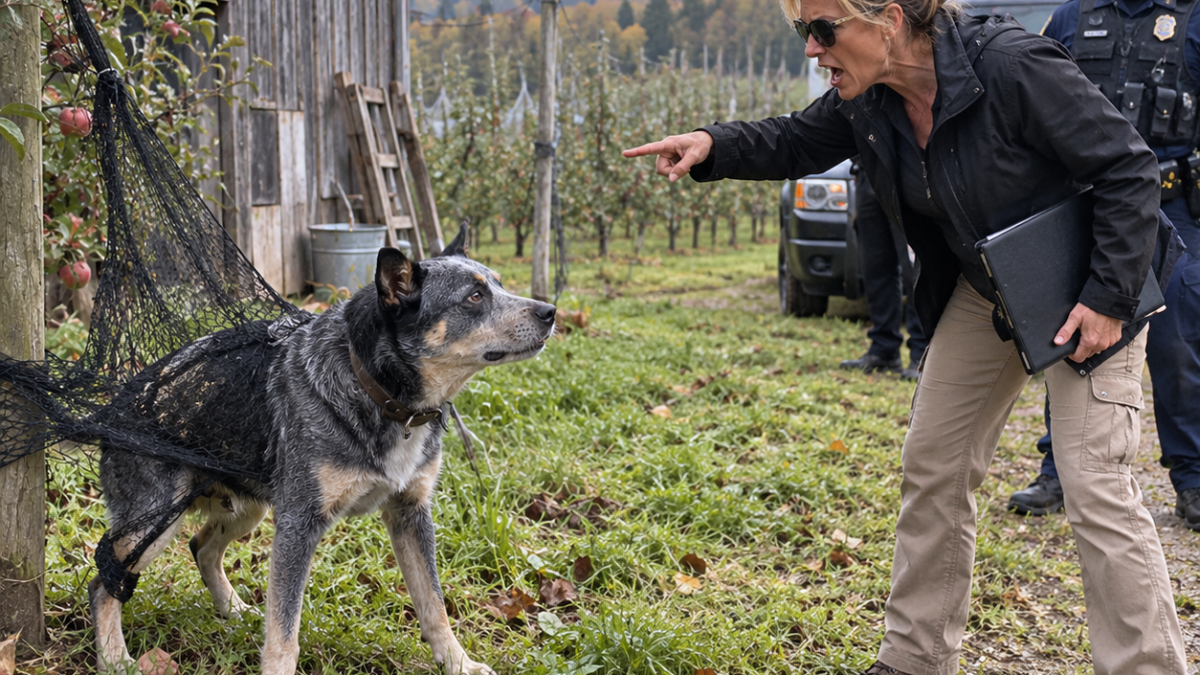
My brother and I climbed an old man’s fence to steal apples, but before we could take a single one, we found his dog suspended in bird netting with one swollen hind leg trapped above the ground.
I thought my mother would say no.
She had every reason to.
We had climbed a fence onto private property.
We had carried a knife, even if it was a small folding blade meant for slicing fruit.
We had planned to take something that did not belong to us.
Finding Blue had not erased any of that.
The fact that we had eventually done the right thing did not magically transform the reason we were there.
My mother was very clear about that.
But first, Blue needed a veterinarian.
Dana loaded him carefully into the animal-control vehicle.
Elias stood beside the open door, one hand on Blue’s neck.
The dog was panting.
Not aggressively.
Painfully.
Every time someone touched the swollen rear leg, his ears moved backward and his body tightened.
Dana respected that.
“He’s hurting,” she told us. “A dog in pain can react differently than he normally would, so everyone gives him room.”
Elias nodded.
Then Dana realized he had missed part of what she said.
She faced him directly and repeated it more slowly.
When that wasn’t enough, she took out a small notebook.
PAIN CAN CHANGE BEHAVIOR. WE WILL HANDLE HIM CAREFULLY.
Elias read it.
Then nodded.
That moment stayed with me.
Earlier that morning, I had assumed Elias was rude because he did not respond when people called from the road.
Dana did not make the same mistake.
She noticed a communication problem and changed how she communicated.
That sounds obvious to me now.
At twelve, it was a revelation.
My mother drove Caleb and me behind the animal-control vehicle.
Elias rode with Dana because Blue became calmer when he could see him.
The veterinarian’s office was twenty minutes away.
Nobody talked much in our car.
Finally Mom said, “You understand we still need to discuss why you were there.”
“Yes.”
Caleb stared at his knees.
“We didn’t take any.”
“That is not the point.”
“I know.”
Mom looked at me in the rearview mirror.
“You had the knife?”
“Yes.”
“And you didn’t cut the net?”
“No.”
“Why?”
“I didn’t know which pieces were holding him.”
Mom nodded.
That small nod meant more to me than praise would have.
I had made at least one sensible choice.
“You did the right thing by stopping.”
Then she added, “After doing several wrong things first.”
There she was.
My mother.
At the veterinary clinic, Elias sat with Blue’s leash looped around his wrist.
The recovered hearing aid rested inside a clean plastic container Ruth had provided.
Nobody tried putting it back into Elias’s ear.
It had been outside for three weeks.
Rain.
Dirt.
Moisture.
Finding it did not mean it suddenly worked.
That part of the story became exaggerated later.
People in town liked to say Blue “found the old man’s hearing again.”
He didn’t.
He found an object.
An important object.
But hearing loss is not solved by wiping mud from an electronic device and placing it back in someone’s ear.
Elias’s hearing-care provider would assess it later, and arrangements for more reliable amplification were already underway.
At the clinic, the more urgent issue was Blue.
Dr. Patel examined his leg.
She shaved a small area to see where the net had rubbed the skin.
The pressure had caused swelling and abrasions, but circulation remained present.
She moved the leg gently.
Blue looked back at her.
His mouth closed.
His whole body became still.
Dr. Patel stopped.
“Okay.”
She gave him a moment.
Then continued differently.
I remember that too.
Adults sometimes imagine courage means forcing through pain.
Dr. Patel treated Blue’s warning as information.
Not disobedience.
Not bad behavior.
Information.
She checked for deeper injury.
Nothing suggested a fracture.
The swelling was serious enough to require monitoring, rest, pain control, and restricted activity.
Elias had been watching her face closely.
When she finished, he asked the question that had been waiting behind his eyes since the orchard.
“Leg?”
Dr. Patel moved where he could see her clearly.
“We expect him to keep it.”
Elias closed his eyes.
His shoulders dropped.
Caleb whispered, “Good.”
I hadn’t realized until then that my brother had been holding his breath.
Blue would need rest.
He would need follow-up.
If swelling worsened, if the paw became cold, if he stopped using the limb entirely, Elias needed to call.
Dr. Patel wrote the instructions as well as explaining them.
Once Elias had a way to receive the information, he asked precise questions.
“When can he walk orchard?”
“Short supervised trips after we see how the swelling responds.”
“Net injury infection?”
“Possible. Watch these areas.”
“Tonight?”
“Keep him quiet.”
He absorbed everything.
I felt embarrassed remembering how casually we had assumed he simply did not want to speak to people.
While we waited for medication, Elias pointed to the container holding the hearing aid.
Then he told us the story.
Three weeks earlier, he had taken off his hat beneath one of the orchard trees.
He believed the hearing aid must have come loose then.
He didn’t notice until he reached the house.
He searched with a flashlight that night.
Grass.
Roots.
Leaves.
Nothing.
The next day he searched again.
Blue followed.
For several days afterward, Blue kept returning to that row.
Sometimes he brought things back.
Elias took a scrap of paper from his pocket.
He wrote:
GLOVE.
Then:
RAG.
Then:
PLASTIC CAP.
He paused.
Pointed to the hearing aid container.
NOT THIS.
Caleb smiled.
“So Blue kept looking?”
Elias watched his lips.
My mother repeated the question facing him.
Elias considered.
“Maybe.”
He looked at Blue.
“He knew I wanted it.”
That was how he always described it.
Not that Blue understood hearing aids.
Not that he knew exactly what the device did.
Only that Blue had watched his person search for something important and kept returning to the place.
Dogs follow scent.
They investigate familiar disturbances.
They repeat behaviors that have mattered before.
Maybe the hearing aid had remained hidden under wet leaves until Blue disturbed it that morning.
We never knew.
What I know is what I saw.
An injured dog moved toward that tree.
Picked up the object.
Brought it back.
Elias recognized it.
Sometimes the facts are enough.
Then Elias told us Blue had disappeared the previous evening.
He had realized near dusk that the dog had not followed him home.
He checked the orchard.
The sheds.
The packing area.
The fading light made searching difficult.
He contacted neighbors.
He called animal services with help.
At the clinic, he wrote something on the paper.
SOMEONE TOOK HIM.
Then stared at it.
He crossed out the words.
OR HE COULDN’T HEAR ME CALLING.
He smiled.
Not because it was funny.
Because he had just noticed the painful reversal.
He could not hear us.
Blue could not answer him.
My mother moved her chair so Elias could see her face.
“He knows you.”
Elias looked toward the treatment-room door.
When Blue eventually came out, bandaged and slightly drowsy from medication, he walked straight to Elias.
No hesitation.
He pressed himself against the old man’s knees.
Elias placed both hands on Blue’s speckled neck.
The hearing aid container sat forgotten on the chair beside him.
For three weeks, Elias had wanted that tiny device back.
For one night, he had feared losing his dog.
Now the device was beside him.
Blue was beneath his hands.
I think Elias knew which recovery mattered more.
We returned to the orchard that afternoon.
By then, the rain had stopped.
Everything smelled like wet soil.
Blue was settled on a blanket beneath the kitchen window.
His leg had been positioned comfortably.
Every time anyone stood, his head lifted.
Elias made tea for Mom.
Caleb and I sat at the kitchen table.
It was time.
My mother folded her arms.
“Tell him.”
I looked at Elias.
He waited.
“We climbed your fence.”
No reaction.
“We came to take apples.”
Caleb interrupted.
“Three.”
I looked at him.
“What?”
“Three apples.”
Why that mattered to him, I don’t know.
Perhaps ten-year-olds believe confession becomes more honorable when mathematically precise.
Elias looked from Caleb to me.
Then at our mother.
Then he reached for his writing pad.
He wrote:
NEXT TIME, USE THE GATE.
I looked at Mom.
She did not smile.
Elias flipped the page.
ASK FIRST.
Mom nodded.
“That part we can manage.”
I thought the conversation was finished.
It wasn’t.
Blue needed restricted activity for several weeks.
The damaged net had to be removed and the orchard’s protection system inspected.
Elias could handle much of his work, but caring for an injured dog complicated everything.
There were safe jobs children could do.
Sorting fallen apples.
Sweeping the packing shed.
Breaking down empty boxes.
Picking debris from paths.
Nothing involving machinery.
Nothing involving ladders.
Nothing unsupervised.
Elias asked Mom if we could return the following Saturday.
She did not answer immediately.
Adults discussed it properly.
How many hours?
What jobs?
Who would supervise?
Would we be paid?
School came first.
What if Blue needed veterinary care?
By the time the conversation ended, it felt less like punishment and more like a small employment contract.
That frightened me more.
Punishment ends.
Responsibility expects you to return.
The following Saturday, Mom drove us to the gate.
The gate.
Not the fence.
Elias was waiting.
So was Blue.
His leg was still swollen but better.
He wore no dramatic cast.
Just the treatment Dr. Patel had prescribed and a schedule that involved far less activity than he preferred.
Blue walked toward us.
Slowly.
Caleb crouched.
“Hi, Blue.”
The dog sniffed him.
Then looked toward the orchard.
“Not today,” Elias said.
Blue looked offended.
Our first job was fallen apples.
Good apples went into one crate.
Rotten fruit into another container for disposal.
Elias demonstrated how to check each one.
Soft spots.
Insect damage.
Splits.
Bruises.
I had never considered how much judgment could go into looking at an apple.
For us, apples had been objects behind a fence.
Now they were work.
Crop.
Income.
Food.
A year of weather and pruning and waiting.
We worked four hours.
Near the end, Elias brought sandwiches.
Three.
He ate with us beside the packing shed.
Blue lay on his blanket near the doorway.
When the afternoon ended, Elias placed folded bills on the table.
Then a bag of apples.
Caleb stared.
“All of this?”
Elias understood his expression before the words.
“All.”
Caleb looked at Mom.
She shrugged.
“You worked.”
That moment changed something in me.
A week earlier, we had entered the orchard wanting something for nothing.
Now the same man we planned to steal from trusted us enough to pay us and let us return.
Trust made the place look different.
I began seeing hazards.
A broken crate handle that might cut someone.
A section of path covered in slippery fruit.
Loose boards near the packing shed.
Caleb started removing fallen apples from Blue’s usual route because he worried the injured leg might slip.
We closed the gate every time.
Nobody reminded us.
Blue’s recovery took weeks.
There was a setback.
One Saturday, someone arrived at the gate and Blue became excited.
He tried moving too quickly.
The limp returned more strongly.
Elias did not simply wait and hope.
He called Dr. Patel.
The activity plan changed.
For a while, our most important job was sitting with Blue so Elias could work elsewhere.
That might have been the best job I ever had.
We sat on the kitchen floor.
Played cards.
Blue rested between us.
Caleb cheated constantly.
Blue knew.
I cannot prove this.
I remain certain.
The hearing aid went to Elias’s provider.
It was examined properly.
The system he later used was not a fairy-tale restoration of perfect hearing.
He still needed people to face him.
Speak clearly.
Get his attention first.
Sometimes write things down.
The important change was ours.
We stopped believing communication meant shouting louder.
If Elias didn’t understand, we tried another method.
One afternoon I called from behind him three times.
No answer.
Old me would have thought he was ignoring me.
Instead, I walked into his field of vision.
Touched the edge of the table.
Waited until he looked.
Then spoke.
Simple.
By winter, the old man we once considered unfriendly had become difficult to stop talking to.
He told us about the orchard.
The trees.
Weather.
His wife.
Blue.
The town as it had looked when he was young.
Sometimes Mom arrived to collect us and stood beside her car for fifteen minutes because Elias was still finishing a story.
“You boys created this problem,” she said once.
Caleb smiled.
“You’re welcome.”
Elias had no children.
His wife had died years earlier.
Most relatives lived far away.
He knew people.
But knowing people is not the same as having them routinely inside your life.
Fuel delivery.
Feed store.
Doctor.
Hearing appointment.
Those had become most of his human interactions.
Blue filled the rest.
The dog knew which chair caught afternoon sun.
Which orchard row Elias checked first.
Where he dropped his gloves.
When it was nearly lunchtime.
Blue always lay beside the chair near the packing shed.
He never asked whether he belonged there.
Over time, neither did we.
Spring came.
We learned blossom buds.
Elias showed us how a cold night at the wrong time could threaten an entire season.
Summer taught us irrigation.
He never let us touch machinery we were not trained to use.
If something needed an adult operator, an adult operated it.
This irritated me.
At thirteen, I considered myself nearly qualified to run every machine on earth.
Elias disagreed.
He won.
By our second autumn, Caleb and I were more useful.
Not perfect.
That distinction matters.
Stories like this often pretend one dramatic event transformed two troublesome children into flawless young men.
That did not happen.
I lied once about finishing a row.
Elias asked if I had removed the empty containers.
“Yes.”
I hadn’t.
Blue followed Elias into the row later.
The containers were still there.
Elias brought me back.
No dramatic speech.
No yelling.
He pointed.
I picked them up.
Then he faced me.
“I can work with mistakes.”
I waited.
“I need know what they are.”
That was all.
It hurt worse than punishment.
But it also gave me something important.
A way back.
If mistakes could be admitted and repaired, being wrong did not have to become an identity.
Caleb broke a small windowpane in the shed with a broom.
He immediately wanted to claim the glass had already been cracked.
Mom heard about it.
That ended quickly.
She helped arrange a fair contribution toward the repair.
Elias showed Caleb how the damaged pane was replaced.
Blue supervised from the doorway.
We still joke that he was management.
Blue’s leg healed well.
The damaged section of netting never returned.
The orchard’s protective system was repaired with better support and regular checks.
Inspecting it became part of the routine.
Not because every net is inherently dangerous.
Because neglected equipment becomes dangerous.
We had seen what assumption could do.
Someone probably checked it.
Someone probably will.
Probably is a bad safety plan.
Years began stacking quietly.
I turned fourteen.
Then fifteen.
Caleb became thirteen.
Elias turned eighty-one.
Blue was nine.
Gray appeared around the tan markings on his muzzle.
He still met us at the gate on Saturdays.
He had stopped pretending not to be excited.
That winter, Elias became ill.
I won’t turn his illness into dramatic details he never wanted shared.
Even then, some things belonged to him.
What we knew was enough.
He tired more easily.
Appointments multiplied.
Some Saturdays moved from the orchard to his kitchen.
Mom gradually became one of the people helping him coordinate practical things.
Always with permission.
Professionals handled professional matters.
Attorney.
Doctors.
Financial adviser.
Hearing specialist.
Mom did not step into his life and start making decisions because he was old.
That distinction became extremely important later.
The first plan Elias discussed with us concerned Blue.
We were eating soup at his kitchen table.
Blue lay beneath the window.
Elias pushed a folder toward Mom.
Inside were instructions.
Food.
Veterinarian.
Medications.
Routines.
Emergency contacts.
If Elias needed hospital care, Blue would temporarily stay at our house.
My mother read everything.
Then asked questions.
She did not look at Caleb and me until she understood what accepting the responsibility meant.
A week later, Blue came for a trial visit.
He inspected our entire house.
Kitchen.
Hallway.
Backyard.
Then our vacuum cleaner turned on.
Blue decided the vacuum was evil.
He retreated to the living-room rug.
From there, he watched it with deep distrust.
When Mom sent Elias a photograph of Blue sleeping beneath our front window, Elias studied the screen.
“He found his chair.”
A few weeks later, Elias asked Mom to attend a meeting with his attorney.
Caleb and I were not there.
We were children.
Nobody turned serious estate planning into a dramatic surprise where an old man signed away property in gratitude because two boys once called for help.
I am grateful for that.
Elias had independent advice.
He understood what he was doing.
He had time.
The arrangement was completed properly.
Only afterward did he explain it to us.
He wanted the orchard preserved through a managed arrangement until we were older.
Not dumped into our hands as teenagers.
There would be a trustee.
Adults responsible for expenses.
Professional management where needed.
Property obligations.
Taxes.
Maintenance.
And separately, funds and instructions for Blue’s care.
Caleb cried immediately.
I didn’t.
Not because I was tougher.
Because my brain got stuck on one question.
“Why us?”
Elias looked toward the orchard.
Then back at us.
He spoke slowly.
“You came wrong.”
I swallowed.
“You stayed right.”
I have remembered those five words my entire life.
You came wrong.
You stayed right.
He did not pretend what we had planned was innocent.
He also did not freeze us forever inside the worst reason we had entered his property.
He had watched what came afterward.
Saturday after Saturday.
Rain.
Heat.
School.
Mistakes.
Repairs.
Apologies.
Work.
Trust is not built in one dramatic morning.
The morning only opens a door.
The rest happens afterward.
Elias’s personal request was simpler than the legal documents.
“Keep Blue with people who know him.”
Caleb wiped his face.
“We will.”
Elias shook his head.
“Your mother decides too.”
That was Elias.
Even near the end, promises had to survive reality.
So we talked.
Veterinary costs.
Old dogs.
School.
Future work.
What if I eventually moved?
What if Caleb did?
What if Blue needed more help than two young adults could provide?
Mom refused any plan that depended on children remaining children forever.
The final arrangement included her responsibility too.
We promised Blue would never become the price we paid for receiving the orchard.
Even if the land disappeared tomorrow, Blue was family.
Elias seemed satisfied by that.
He died that spring.
Blue was at our house.
I remember the phone call.
Mom answered.
Said almost nothing.
Sat down.
The room changed before Caleb or I understood why.
Blue noticed too.
His head lifted from the rug.
Mom lowered the phone.
“Boys.”
You can hear your life divide into before and after inside one word.
Caleb sat beside Blue.
Didn’t speak.
For once, neither did I.
Blue could not understand death the way we did.
But he understood absence.
He understood people behaving differently.
He pressed himself against Caleb’s side.
My brother put a hand on his chest.
And stayed.
The orchard did not become ours the next morning.
Real life is not like that.
There were months of administration.
Documents.
Meetings.
Maintenance plans.
Adults explaining things we were not yet old enough to manage.
But Blue’s bowl was already in our kitchen.
His bed already beneath the window.
That part required no paperwork.
He waited at our gate now.
When we went to the orchard, he came with us.
At first, every visit felt wrong.
Elias’s chair remained near the packing shed.
Nobody sat in it.
Blue still lay beside it.
The first time I saw that, I had to walk away.
Caleb found me near the lower trees.
“You okay?”
“No.”
“Me neither.”
That was enough.
Grief was allowed to be simple.
We kept working.
Not because work erased grief.
Because orchards do not pause.
Trees require things on days when your heart is broken.
Weather does not wait.
Fruit keeps ripening.
Blue needed breakfast.
Life’s refusal to stop can feel cruel.
Eventually, it becomes the thing that carries you.
Years passed.
I’m twenty-four now.
Caleb is twenty-two.
The orchard is still there.
Not exactly as Elias left it.
That would have been impossible.
Some trees reached the end of their productive lives.
Some storm damage required removal.
We planted replacements.
Professionals helped with decisions beyond our knowledge.
We kept records.
Budgets.
Repairs.
Taxes.
Schedules.
The orchard became less magical the more responsibility we inherited.
And more meaningful.
A gift is not made smaller because it comes with bills.
Sometimes responsibility is what makes the gift real.
Blue lived to fourteen.
His final years became slower.
Shorter walks.
Softer bedding.
More veterinary appointments.
Help when his back legs became stiff.
Medication when needed.
We placed water where he could reach it without crossing slippery flooring.
Caleb built a low ramp at one doorway.
Blue hated it for approximately two days.
Then decided it had always been his idea.
There were inconvenient days.
I want to say that clearly.
Promises about animals become romantic when told afterward.
Living them means ordinary Tuesday mornings.
You oversleep.
Dog needs medication.
Plans change.
Vet bill is larger than expected.
Rain starts.
You still need to help him outside.
Caleb missed evenings with friends because Blue needed monitoring.
I got up earlier than I wanted.
Nobody resented him.
Those inconveniences did not weaken our promise.
They were the promise.
When Blue could no longer comfortably walk the longer orchard rows, we drove him to the packing shed.
We set up bedding beneath the overhang.
Near Elias’s old chair.
Blue loved it.
He could smell the fruit.
Soil.
Grass.
Wooden crates.
People working.
Sometimes an apple rolled across the ground.
Blue followed it with his eyes.
Young Blue would have investigated.
Old Blue had developed wisdom.
He let somebody else get it.
His right hind leg—the one that had been trapped in the net all those years earlier—carried no visible emotional significance to him.
Dogs do not build biographies from scars the way humans do.
To us, though, that leg always brought back the morning.
Because of it, we inspected every loose support more carefully.
Every piece of netting.
Every damaged fence.
Every place where equipment could become a trap.
Blue’s accident had become procedure.
Memory transformed into prevention.
During his final illness, Dr. Patel—yes, the same veterinarian—helped us make decisions.
Blue had known her most of his life by then.
She had more gray hair.
So did he.
So did I, according to Caleb, although I deny this.
The last decision was the hardest.
There came a point when keeping Blue alive longer would have served us more than him.
Elias had taught us responsibility.
Blue taught us the final version of it.
Gratitude is not a reason to demand suffering.
Because an animal changed your life does not mean he owes you extra painful days so you can postpone goodbye.
On Blue’s last morning, Caleb lay beside him on the living-room rug.
I sat near his head.
Mom sat in the chair.
Blue’s breathing became quieter.
He could smell my hand.
I rested it near his nose.
No speeches.
I had imagined I would tell him everything.
The net.
The apples.
Elias.
The orchard.
All the years.
But when the moment came, the words felt unnecessary.
He knew our voices.
Our smells.
Our routines.
He knew we stayed.
That was enough.
His head rested exactly where he had chosen.
His body relaxed.
We stayed beside him until his breathing stopped.
Then longer.
The orchard felt different afterward.
Every tree remained.
The gate made the same metal sound.
Packing shed smelled like wood, dust, fruit.
Jobs waited.
But something had vanished from every place at once.
For months, I looked toward Elias’s chair expecting Blue.
Caleb kept Blue’s brown collar in a small wooden box.
Beside it, a photograph of Elias.
Not beside the property paperwork.
That distinction mattered.
The orchard documents represented ownership and responsibility.
The collar and photograph represented family.
A few months after Blue died, I was repairing a crate near the packing shed when Caleb called from the gate.
“Hey.”
Two kids stood outside the fence.
Bicycles beside them.
Younger than we had been.
Maybe nine and eleven.
They were looking at the apples.
Then pretending they weren’t.
Caleb and I looked at each other.
I knew exactly what he was thinking.
He opened the gate.
“Want a few?”
The children froze.
One said, “Are you sure?”
I looked down the orchard rows.
For a moment, I was twelve again.
Wet grass.
A paper bag.
Something moving between trees.
The sound of netting tightening.
Blue’s front paws scraping earth.
The little knife in my pocket.
Our mother saying, Do not cut anything.
Elias behind the screen door pointing toward his ear.
The phone screen.
YOUR DOG IS CAUGHT IN THE NET.
Then Blue lowering his nose beneath a tree.
A hearing aid beside Caleb’s shoe.
NEXT TIME, USE THE GATE.
ASK FIRST.
Every important thing that followed had begun because two boys entered through the wrong place and, when confronted with something harder than getting caught, chose not to run.
We had come wanting apples nobody had given us permission to take.
We left that first day with something much larger we had not earned yet.
A chance.
Elias gave us years to earn it afterward.
I walked toward the two children.
“Yes,” I said. “We’re sure.”
Caleb handed them a paper bag.
Not enormous.
Enough.
He showed them which row.
“Stay where we can see you.”
They nodded.
“Don’t climb anything.”
Another nod.
“And if you want to come back another time…”
Caleb looked at me.
I smiled.
“Use the gate.”
The older child grinned.
They walked inside.
I stood there watching them.
The gate remained open behind them.
When Caleb returned, he leaned against the fence.
“You know they might be little criminals.”
“We were.”
“You were. I was influenced.”
“You carried the bag.”
“I was ten.”
“You provided logistical support.”
He laughed.
For a second, I heard Elias laughing too.
Memory does that.
It puts voices back where silence has settled.
The children picked three apples each.
Exactly three.
Caleb noticed.
“See?”
“What?”
“Three.”
I laughed.
Maybe ten-year-old arithmetic is universal.
Before they left, the younger child pointed toward the packing shed.
“Was that your dog in the picture?”
A framed photograph of Blue hung near the doorway.
Blue sitting beside Elias.
Both facing the orchard.
“Yes.”
“What happened to him?”
“He got old.”
“Is he dead?”
Children go straight to questions adults spend paragraphs avoiding.
“Yes.”
The child looked sad.
“Was he a good dog?”
I glanced at Caleb.
He was smiling.
“The best.”
The boy nodded as though that settled something important.
Then they rode away.
Caleb closed the gate.
We stood in the orchard.
No Blue.
No Elias.
Yet somehow both of them everywhere.
I used to believe the morning we found Blue was important because we saved a dog.
That isn’t quite true.
Adults saved Blue.
Dana.
Ruth.
Our mother.
Dr. Patel.
Caleb and I did something important, but it was smaller.
We stopped.
We called.
We didn’t use a knife where we lacked the knowledge to use it safely.
We stayed out of the way when staying out of the way became the helpful thing.
That morning taught me that sometimes doing the right thing is not heroic.
It is knowing where your ability ends.
It is calling someone who knows more.
It is admitting why you were there.
It is staying long enough to see the consequences after the exciting part is over.
Blue did not fall from the net into our arms.
No dramatic movie rescue happened.
He was supported.
Freed carefully.
Lowered.
Taken to a veterinarian.
Monitored.
Rehabilitated.
Reality had more people in it.
More patience.
More knowledge.
And in many ways, that made it better.
I also used to think the hearing aid was the miracle.
That part made the story famous around town for a while.
DOG FINDS OWNER’S LOST HEARING AID AFTER RESCUE.
People loved it.
So did I.
But the hearing aid was not the most important thing Blue found.
He found us trespassing in an orchard.
Or perhaps we found him.
Either way, Elias found two boys who needed someone to expect them back the following Saturday.
We found an old man we had mistaken for someone who did not care.
Our mother found another person she eventually considered family.
And Blue?
Blue got his person back.
Then, when that person could no longer stay, he got us.
Maybe that is the real story.
Not about stealing.
Not about inheritance.
Not even about a dog trapped in netting.
It is about what people do after they are given a way back from being wrong.
Elias could have called the police.
He could have told us never to return.
He had that right.
Instead, he gave us consequences without humiliation.
Work.
Rules.
The gate.
Ask first.
Show up.
Tell the truth when you make mistakes.
Take care of what trusts you.
Years later, when he became ill, he did not hand us an orchard because we had rescued his dog once.
He made plans because he had watched us grow.
There is an important difference.
Trust is not payment for one good deed.
Trust is accumulated evidence.
Saturday after Saturday.
Season after season.
Blue’s injury healed.
So did things in the rest of us that I did not know were damaged.
Caleb became the better orchard manager.
He understands trees instinctively.
He can look at a branch and see next year.
I became more interested in equipment and operations.
Elias noticed that early and connected me with people who could teach me safely when I was old enough.
I studied agricultural mechanics.
I came back.
Not because the orchard trapped me.
Because it gave me somewhere worth returning to.
Caleb did too.
Mom still visits constantly.
She still corrects us.
Some systems never change.
We kept Elias’s chair near the packing shed.
It is weathered now.
We repaired it twice.
Caleb says eventually we should replace it.
I know he’s right.
Wood does not become sacred because someone sat on it.
Elias himself would probably call that foolish.
Still, neither of us has replaced it yet.
Some decisions can wait.
On certain afternoons, when sunlight reaches beneath the overhang at the same angle it did years ago, I sit there.
I remember Blue beside my feet.
Elias with his notepad.
Caleb pretending he wasn’t cheating at cards.
Mom arriving late because work ran long.
The life we had no idea we were building.
Sometimes people ask whether I regret climbing the fence.
That is a complicated question.
If I say no, it sounds like I believe the wrongdoing was necessary.
It wasn’t.
Blue would still have deserved rescue if two honest children had found him from the road.
Elias would still have deserved companionship.
We did not need to plan a theft to make the good things possible.
So yes.
I regret what we intended.
But I do not regret what we chose once we saw Blue.
Those are different decisions.
A life can turn on the second one.
I have learned that lesson repeatedly.
You cannot always choose how you arrive at a difficult moment.
Sometimes you arrive having already made mistakes.
You can still choose what you do next.
Run.
Hide.
Lie.
Or stay.
Call.
Tell the truth.
Return Saturday.
Blue lived fourteen years.
Elias lived long enough to see us stop being the boys who climbed his fence and become young men he trusted with what he had spent a lifetime building.
Neither stayed as long as we wanted.
Nobody does.
But they stayed long enough.
That is something I understand now.
When Blue died, we did not bury his collar with him.
Caleb wanted to keep it.
I agreed.
The brown leather was cracked.
The metal buckle scratched.
A little blue-speckled fur remained caught around the inside seam.
It is in the box beside Elias’s photograph.
Sometimes Caleb opens it.
I usually don’t.
I don’t need to.
The memory I carry most clearly is not Blue dying.
It is that first morning.
Wet grass.
The dropped apple bag.
A dog struggling between the trees.
And one specific moment.
I had my hand around the apple knife.
For half a second, I thought being useful meant doing something immediately.
Cutting.
Acting.
Being brave.
Then I looked at the net.
I realized I did not know enough.
And I closed the blade.
That may have been the first adult decision I ever made.
Not because I knew what to do.
Because I knew what not to do.
Call someone.
Stay.
Wait.
Help without making the damage worse.
Years later, that principle became part of how we run the orchard.
When we don’t understand a problem, we ask.
Agronomist.
Veterinarian.
Mechanic.
Attorney.
Accountant.
We don’t pretend responsibility means knowing everything.
Elias knew that.
Dana knew that.
Dr. Patel knew that.
Twelve-year-old me had to learn it.
Caleb and I still argue about whose fault the apple theft idea originally was.
He says mine.
I say collective conspiracy.
Mom says both of us.
Mom is probably right.
But there is one thing we never argue about.
Blue changed us.
Not because he meant to.
Dogs rarely give lessons intentionally.
He needed help.
We happened to be there.
Then he spent the rest of his life simply being himself.
Following Elias.
Following us.
Waiting at gates.
Watching cards.
Sleeping near chairs.
A dog.
That was enough.
Last fall, the two children who came through the gate returned.
This time with a parent.
They asked first.
Caleb found age-appropriate jobs for them during harvest.
Nothing dangerous.
Sorting boxes.
Picking up fallen fruit.
Their mother stayed nearby at first.
At the end of the afternoon, Caleb paid them.
Then handed them apples.
The younger one stared.
“Both?”
Caleb looked at me.
I almost laughed before he answered.
“All of it.”
There are moments when a life folds back on itself so neatly it feels invented.
But the best part is never that history repeats exactly.
It doesn’t.
We changed it slightly.
They did not need to climb.
They did not need to steal.
No dog had to suffer for a door to open.
The gate was already open.
That is progress.
I’m twenty-four now.
When I walk the orchard, I still check the net supports.
Every one.
I know which row Blue was trapped in.
I know the tree where the hearing aid lay.
We never marked it.
No plaque.
No sign.
People sometimes suggest we should.
Caleb and I always say no.
The orchard is not a museum.
It is alive.
That tree still produces fruit.
Workers still pass it.
Rain still falls.
Grass grows over the place where the paper apple bag landed.
That feels right.
Blue’s story is not trapped there.
Neither is Elias’s.
They are in the way we run the place.
The way we speak to people who communicate differently.
The way we inspect equipment instead of assuming.
The way we treat mistakes as something to identify and repair.
The way we plan for animals before emergencies happen.
The way we make children use the gate.
The way we pay them fairly.
The way we ask them to return.
Sometimes inheritance is land.
Sometimes it is procedure.
Sometimes it is a sentence.
I can work with mistakes. I need to know what they are.
Sometimes it is two words written on a page.
ASK FIRST.
And sometimes it is a dog collar in a wooden box beside a photograph of an old man who once looked at two frightened boys, understood exactly why they had entered his orchard, and decided that what mattered most was what they might become if someone gave them somewhere worth coming back to.
We went through that fence to take three apples.
We left without them.
A week later, we came back through the gate.
We kept coming back for years.
And I suppose, in every way that matters, we never really stopped.








