I saw the chains before I saw the lake.
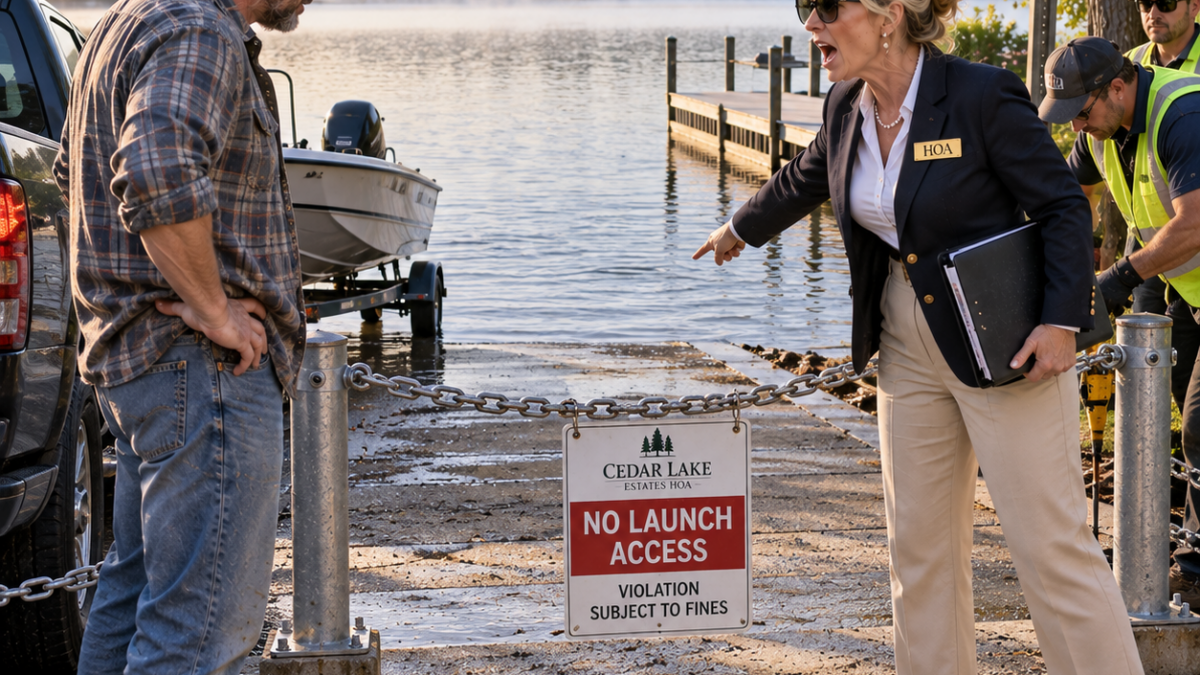
My father still lived ten minutes up the lake road.
Seventy-eight years old.
Sharp enough to catch you using the wrong socket size from across a garage.
Slow getting out of chairs now, but still carrying a six-inch level in his pickup because, according to him, “the day you stop checking square is the day the world gets crooked.”
I found him on the porch.
Coffee beside him.
Crossword folded in half.
He looked at me before I had even shut the truck door.
“You look like a man who slept badly.”
“Somebody chained the ramp.”
He stopped moving.
“Our ramp?”
“Yes.”
He set the crossword down.
Not dramatically.
Dad had never been dramatic.
That was one of the reasons people underestimated him.
“Who?”
“Harbor Point.”
“Board?”
“New guy named Russell Pruitt. Calls himself Lakefront Development Liaison.”
Dad’s mouth tightened.
“What does that mean?”
“He’s brokering a marina deal.”
“With whose lake?”
“Their shoreline.”
“With whose ramp?”
“Apparently mine.”
Dad leaned back.
There was a long pause.
Then:
“Get the box.”
“What box?”
He stared at me.
“The blue property box.”
“I have it.”
“Good.”
“I haven’t opened it in years.”
“That doesn’t mean you haven’t needed it.”
We went inside.
Dad’s kitchen hadn’t changed much since my mother died.
Same oak table.
Same clock above the pantry.
Same shallow scratch near the edge from the year I dropped a carburetor on it at sixteen.
I set the blue box down.
He opened it carefully.
Recorded covenant.
Lake commission permits.
Maintenance invoices.
Old survey pages.
Letters from Harbor Point property managers.
Dad handled paper the way some men handled tools.
No wasted motion.
He pulled out one reimbursement letter.
“This one.”
I read it.
Harbor Point Property Management acknowledged use of Reed Ramp for debris-removal equipment following storm damage.
The HOA had reimbursed us for surface wear.
Another letter thanked Dad for allowing access when the main marina launch was closed.
Dad tapped the paper.
“They paid you to use it.”
“They reimbursed repairs.”
“Same point.”
He looked at me.
“If they owned it, why were they thanking you for permission?”
I sat back.
“That’s exactly what I thought.”
“No.”
Dad shook his head.
“You thought ownership. I’m talking admission.”
He tapped the letter again.
“That’s not nostalgia. That’s somebody on their side writing down that they knew.”
I smiled.
“Still like paperwork?”
“I like paper better than people when money gets involved.”
Then he asked:
“Who was managing Harbor Point when this was written?”
“Curtis Vale.”
Dad’s face changed slightly.
“Curtis is still around.”
“You sure?”
“Thursday cards at the Lake Diner.”
I looked at the clock.
It was Thursday.
Dad smiled.
“Some things work out because people refuse to get hobbies.”
Curtis Vale was exactly where Dad said.
Counter seat.
Coffee.
Newspaper open but barely read.
He looked older than I remembered.
White hair.
Suspenders.
Hands still thick from a life that had probably involved more physical work than his management job suggested.
“Reed.”
He smiled.
“Your dad still beating everybody at gin?”
“Depends who you ask.”
“He cheats.”
“He says probability isn’t cheating.”
Curtis laughed.
Then I told him why I was there.
The smile disappeared.
“Pruitt.”
“You know him?”
“Never worked under him. Retired before he came in.”
He folded the newspaper.
“But I’ve heard enough.”
“What have you heard?”
“Marina expansion. North Cove. He’s trying to package every shoreline access point into one development bundle.”
“He says they control my ramp.”
Curtis shook his head before I finished.
“No.”
“You sure?”
“I managed Harbor Point for ten years.”
He leaned closer.
“That ramp was never ours.”
“Did the HOA ever have general access?”
“No.”
“Emergency use?”
“With your family’s permission.”
“Maintenance?”
“Permission.”
“Storm cleanup?”
“Permission.”
“Anything recorded differently?”
“No.”
He sat back.
“Your father was easy to work with. We asked. He usually said yes if we didn’t tear up the concrete.”
“That was it?”
“That was it.”
I put the old reimbursement letter on the counter.
Curtis smiled.
“I wrote that.”
“You remember?”
“I remember because your dad called me three times about the rut our trailer left.”
“That sounds like him.”
Curtis took out his glasses.
Read the letter.
Then looked at me.
“I can write a statement.”
“I’d appreciate it.”
“I’ll do better. I’ll put the years I managed Harbor Point and list examples.”
Then his expression changed.
“Graham.”
“What?”
“If Pruitt is telling a marina company he controls this access before he does, that’s different.”
“How?”
“Because then he’s not negotiating.”
Curtis stirred his coffee.
“He’s promising.”
I thought about Russell’s rendering.
Controlled access corridor.
No competing private launch.
Exclusive shoreline.
“What should I look for?”
“Drafts.”
“Drafts of what?”
“Letter of intent. Term sheet. Development memo.”
Curtis shrugged.
“People promise things in drafts they won’t say at a board meeting.”
Twenty minutes into coffee, a retired property manager had given me a better direction than anything Russell said in his office.
I left the diner and drove to the county recorder.
I wanted a current certified copy of the covenant.
Not the one in Dad’s box.
Fresh seal.
Fresh date.
The clerk typed the parcel number.
Then looked up.
“Blue Heron Lake Commission permit too?”
“Yes.”
She smiled faintly.
“People usually pull both.”
Then:
“You’re the second request on that parcel this month.”
I stopped.
“Second?”
She turned the monitor slightly.
“Someone from property management pulled the plat about three weeks ago.”
“Who?”
“Organization only.”
She printed the log.
BELLWETHER COMMUNITY MANAGEMENT.
ATTN: LAKEFRONT DEVELOPMENT OFFICE.
Three weeks before the chain.
Before Russell spoke to me.
Before any alleged “safety closure.”
His office had researched my parcel.
But they had not pulled the lake permit.
Only the plat.
That told me something.
They weren’t trying to understand the history.
They were trying to understand where the line was.
I paid for the copies.
Carried them to the truck.
Sat behind the wheel.
Russell hadn’t stumbled into my ramp.
He had located it.
Studied it.
Then chained it.
That evening, I went into the spare bedroom where I kept old dispatch notebooks.
Twenty-six years with Lake Patrol dispatch gives a person strange habits.
Mine was keeping logs.
I didn’t keep confidential files.
I kept my own work notes.
Dates.
Launch locations.
Major incidents.
The county purged a lot of old records after retention periods ended.
I never trusted my memory enough to purge everything.
I went looking for Reed Ramp.
There were more entries than I expected.
Drought year.
Main marina launch unusable because of silt.
North-end emergency boats launched from Reed access for six weeks.
Spring flood.
Pontoon capsized in North Cove.
Rescue boat launched from Reed Ramp.
Night storm.
Teenager in water near Harbor Point dock.
Marina lighting out.
Main launch partially blocked.
Rescue boat backed down Reed Ramp.
I remembered that night.
I had been on dispatch.
Dad had been awake.
He opened the ramp gate before the first unit arrived.
Nobody discussed deeds.
Nobody discussed HOA branding.
Somebody was in the water.
The ramp existed.
It worked.
That was enough.
I copied the relevant logs.
Then I placed them behind the covenant.
Russell had described my ramp as an inconvenience to his marina deal.
I wanted his glossy rendering sitting beside nights when forty feet of concrete had mattered more than the entire marina lawn.
My email pinged.
HARBOR POINT HOA.
NOTICE OF RAMP VIOLATION REVIEW.
Unauthorized access attempt — $250.
Interference with temporary safety equipment — $500.
Failure to comply with lakefront facility closure — $1,000.
Total potential assessment:
$1,750.
Signed:
RUSSELL PRUITT.
LAKEFRONT DEVELOPMENT LIAISON.
I laughed once.
Not because it was funny.
Because he was fining me for approaching my own ramp while his own office called it Reed Ramp in public records.
Twenty minutes later, Curtis emailed his statement through his granddaughter’s account.
He apparently did not trust attachments.
His letter was three paragraphs.
Plain language.
During my tenure as Harbor Point property manager from 2009 through 2019, the Reed family launch in North Cove was never owned, controlled, or operated as an HOA amenity.
All association use occurred through direct permission from the Reed family.
Repairs caused by association use were reimbursed to the Reeds.
Curtis added:
I am available to confirm this in person.
One letter tried to fine me for standing on my ramp.
Another from their former manager said they had never controlled it.
I drove down that afternoon.
No boat.
No trailer.
Just my truck.
I didn’t want anybody saying I had attempted to force a launch.
The security truck was still there.
Victor Martin stood near the chain.
Young guy.
Mid-twenties.
Sunglasses.
He looked like the last person who wanted to be part of a forty-year property dispute.
“Mr. Reed.”
“Victor.”
“Ramp’s still closed.”
“I can see that.”
“I’ve been instructed to log everyone who approaches.”
“Log me.”
I held up my folder.
“I’m here to deliver a copy of the covenant and request removal of hardware.”
“I’m not authorized to accept legal documents.”
“That’s fine.”
I pointed at the concrete.
“Are you authorized to stand on this ramp and tell me I can’t use it?”
His face changed slightly.
“I’m authorized to enforce the closure.”
“By who?”
“Harbor Point.”
“Who specifically?”
Pause.
“Mr. Pruitt’s office.”
Not board.
Not committee.
Not management counsel.
Russell.
I photographed the chain again.
The bolts.
The dust.
The sign screwed over my marker.
Then drove home and called Northline Security’s regional office.
Owen Briggs called back within an hour.
“Mr. Reed.”
“Mr. Briggs.”
“I supervise Northline’s lake accounts.”
“I’m calling about your crew at Reed Ramp.”
He paused.
“You called it Reed Ramp.”
“That’s what it’s labeled internally.”
I wrote that down.
“Who ordered the chain?”
“I need to be careful here.”
“Be as careful as you need.”
Paper moved.
“We received a work order through Mr. Pruitt’s office.”
“Board?”
“His office.”
“Does the work order identify ownership?”
“No.”
“Site name?”
“Reed Ramp. North Cove access.”
“Has it always been labeled that?”
“As far as our system shows.”
“Did anybody ask you to change the designation?”
“No.”
That was almost funny.
Russell hadn’t even bothered renaming the site.
He just ordered a chain installed and started calling it HOA-controlled afterward.
Owen sighed.
“I want to make something clear.”
“I’m listening.”
“We installed what the client requested. Northline did not perform a property survey.”
“I understand.”
“If law enforcement asks, I’m not having my guard pretend the closure came from us.”
“Good.”
Then Owen went quiet.
I waited.
Finally:
“I looked into Lakeshore Marina Group.”
My pen stopped.
“Why?”
“Because weekend coverage on a private ramp is unusual, and I wanted to understand what our staff was standing in the middle of.”
“What did you find?”
“They’re not a large marina company.”
“How large?”
“Three principals.”
Pause.
“One is Russell Pruitt’s brother-in-law.”
I didn’t speak.
“You’re sure?”
“Public corporate filing.”
I stared at the wall.
“What’s Russell’s connection?”
“I can’t tell you beyond what’s public.”
Owen’s voice flattened.
“But he’s not just helping Harbor Point negotiate with strangers.”
“His family benefits.”
“Looks that way.”
That changed the flavor of everything.
The finder’s fee.
The rush.
The chain before negotiation.
The plat request.
The pressure.
Owen added:
“Weekend coverage was ordered too.”
“For when?”
“Saturday and Sunday.”
“By?”
“Pruitt’s office.”
“Why?”
“No explanation.”
Another pause.
“A safety closure usually doesn’t require two full days of private guards unless somebody expects trouble.”
I thanked him.
Before hanging up, he said:
“Mr. Reed.”
“Yes?”
“If you go down there, don’t get into it with Victor.”
“I won’t.”
“He’s twenty-four. Community college. He’s doing what he was assigned.”
“I know.”
Two days later, Owen came to my house.
Personal pickup.
No uniform.
He stood at the bottom of the driveway.
“I’m not supposed to be here.”
“Then why are you?”
He looked at the boat.
“Because I’ve been doing access control for thirty years.”
He took off his cap.
“I’ve installed legitimate closures.”
“Transformers. Sinkholes. Storm damage.”
He nodded toward the lake.
“This wasn’t one.”
“You knew?”
“The morning the work order came in, I thought it was wrong.”
“Why install it?”
“It wasn’t my job to ask.”
He rubbed one hand over his jaw.
“That’s what I told myself.”
Then:
“And now two employees are standing on somebody else’s concrete protecting a real-estate negotiation they knew nothing about.”
“What do you want from me?”
“Nothing.”
He looked embarrassed.
“I just wanted to say it out loud.”
Owen left before I could offer coffee.
That evening, a neighbor named Ellis texted screenshots from the Harbor Point resident page.
Apparently the chain had become popular.
FINALLY GETTING THIS SORTED OUT.
LONG OVERDUE.
Comments:
Is this the old fishing boat guy?
He thinks he owns everything down there.
Heard there’s a major marina deal if certain people stop fighting progress.
I looked through the kitchen window.
My boat sat in the driveway.
Sixteen feet of scratched aluminum.
Bench seat patched with gray vinyl.
Outboard that needed choke even in July.
Hardly the symbol of private-lake aristocracy.
But a villain only needs enough shape for people to recognize from a distance.
I saved the screenshots.
Not because they proved ownership.
Because they showed how quickly Russell had changed the story.
My phone rang the next morning.
Unknown number.
“Mr. Reed?”
“Yes.”
“This is Priya Desai. I’m on the Harbor Point board.”
I knew the name.
Annual meetings.
Sharp questions.
Rarely satisfied with vague answers.
“I’m not calling to take sides.”
“That sentence usually means somebody is about to.”
She almost laughed.
“I asked Russell three questions at the development subcommittee meeting.”
“What questions?”
“Whether Lakeshore Marina Group requested anything in writing.”
“Okay.”
“Whether the full board approved representing any shoreline access as settled.”
“And?”
“Whether your family had been contacted before negotiations advanced.”
“What did he say?”
“Yes. No. Yes.”
She paused.
“I’ve since learned at least one answer was false.”
“Which?”
“I’m still confirming.”
She breathed out.
“I don’t make accusations I can’t put my name on.”
I liked her immediately.
“Why tell me?”
“Because Russell has been presenting you as an irrational holdout.”
“I haven’t been offered anything except a vague number.”
“That’s part of what bothered me.”
She continued.
“You’re not alone in asking questions.”
Three days later, Priya emailed again.
One attachment.
A draft letter of intent.
LAKESHORE MARINA GROUP.
North Cove development concept.
Unsigned by the board.
But initialed by:
R. PRUITT.
The line that mattered was halfway down page one.
Existing Reed access point shall be brought under exclusive Harbor Point control as a condition precedent to closing.
Another paragraph:
Harbor Point representatives affirm that said access has been or will be secured for association use prior to final execution.
I read it twice.
Then a third time.
Russell had promised something he didn’t own.
And the chain made the promise look true.
I called Priya.
“Does the board know about this?”
“No.”
“Was Russell authorized to sign?”
“Not by vote.”
“He told me he was just negotiating.”
“That’s what he told us.”
“Will you put that in writing?”
“I already did.”
She paused.
“I’m sending this to the board chair tonight.”
“Why send it to me first?”
“Because if it disappears from the development file, I want someone else holding a copy.”
That night, I drafted certified letters.
Russell.
Harbor Point board.
Bellwether Community Management.
Northline Security.
Plain language.
The Reed Ramp was tied to my parcel.
Recorded covenant.
Lake commission permit.
Historical HOA acknowledgments.
Curtis Vale statement.
Security work order identifying the site as Reed Ramp.
No board authorization for obstruction.
No court order.
No ownership transfer.
And:
Harbor Point’s Lakefront Development Liaison had represented exclusive control of the access point to a third-party marina company before any such control existed.
I did not call Russell dishonest.
I did not have to.
His initials were on the letter.
The next morning, I went to the sheriff’s office.
Low brown building.
Same fluorescent lights I had seen during hundreds of shift changes over the years.
Same burnt coffee smell.
The deputy at the front asked:
“What can we help you with?”
“I need to request a civil standby involving blocked documented access.”
“Property dispute?”
“Yes.”
“Any threats?”
“No.”
“Weapons?”
“No.”
“Court orders?”
“None that I know of.”
He took my information.
Ten minutes later, Deputy Cole walked into the lobby.
Sleeves rolled.
Legal pad.
Steady face.
We sat in a small interview room.
“Graham?”
“Fine.”
“Walk me through it.”
I had told enough callers over the years not to start with the loudest moment.
So I didn’t.
Recorded covenant.
Lake permit.
Prior HOA-use letters.
Curtis statement.
Security work order.
Incident logs.
Then the letter of intent.
Cole read that one twice.
Finally:
“That’s not a safety closure.”
“No.”
“That’s somebody promising access he doesn’t control.”
“That’s how I read it.”
He leaned back.
“I need to be clear about my role.”
“I know.”
“I’m not adjudicating ownership.”
“I understand.”
“I’m not interpreting deed language like a judge.”
“I understand.”
“If Harbor Point produces a court order, recorded right, or credible competing document, we don’t settle that roadside.”
“Fair.”
“But.”
He tapped the covenant.
“If your paperwork checks out on scene and they can’t produce authority for blocking the access, then we deal with the physical obstruction.”
“How?”
“Preferably whoever installed it removes it.”
“And if Russell refuses?”
“We document the refusal and take the next lawful step.”
He looked at me.
“You do not cut it yourself.”
“I haven’t.”
“You don’t argue with security.”
“I haven’t.”
“Good.”
Cole closed his notepad.
“Pick a time.”
“Saturday?”
“Morning.”
“Nine?”
“Works.”
Then he said:
“Do it when the lake is awake.”
I smiled.
“Witnesses?”
“People are usually better behaved when the audience isn’t on payroll.”
Dad was on the porch when I got home.
“Sheriff’s coming Saturday.”
“Good.”
He thought about it.
“You want me there.”
“You don’t have to be.”
“I didn’t ask if I had to.”
“Dad.”
“I poured the ramp.”
He looked toward the lake.
“I’m not letting you stand there alone when somebody finally has to explain why they drilled into it.”
I knew better than to argue.
Then he added:
“Sleep Friday.”
“I’ll try.”
“No.”
He pointed at me.
“Actually sleep.”
“I know.”
“Pruitt’s type will keep poking until you snap in front of somebody with a phone.”
“I know.”
“I know you know.”
Dad leaned back.
“That’s what fathers are for.”
Saturday morning came clear.
By 8:30, Blue Heron Lake was already alive.
Boat motors coughing across the cove.
Dock ropes tapping aluminum poles.
Coffee cups on porches.
Pontoon radios.
And people pretending they weren’t watching the ramp.
Dad rode with me.
Folder between us.
Boat stayed home.
I wanted the ramp documented before I launched anything.
Russell was already there.
Board shorts.
Polo.
No quarter-zip.
He looked like a man planning to deal with a nuisance before golf.
Victor stood by the chain.
Owen stood near his truck.
Not beside Russell.
That detail mattered.
Residents lined the upper path.
More than I expected.
Two teenagers sat on the seawall with phones.
A woman in a sun hat held coffee with both hands.
A dog barked at a gull.
Nobody told it to stop.
Dad got out slowly.
Crossed his arms.
Russell looked at me.
“Morning, Graham.”
“Russell.”
“You really want to do this publicly?”
“I wanted to do it in your office.”
He glanced at Dad.
“Brought reinforcements?”
Dad answered before I could.
“I brought forty years of memory.”
Russell’s smile tightened.
I held up the letter of intent.
“Show them this.”
His face changed.
“What letter?”
“The one where you promised Lakeshore Marina Group that Reed Ramp would be under association control.”
Silence.
Priya was standing farther up the path.
Russell saw her.
“That document is preliminary.”
“It’s initialed.”
“Draft negotiations.”
“By you.”
He shifted.
“On behalf of Harbor Point representatives.”
A man near the dock said:
“Wait.”
Everyone looked.
“He already promised somebody else the ramp?”
That question changed the mood.
Not yelling.
Arithmetic.
Residents trying to reconcile the story they had been told with the document in my hand.
Russell lifted both palms.
“This is a business matter that has been mischaracterized.”
Priya stepped down the path.
“It concerns the board if you told another company you represented us.”
Russell’s eyes hardened.
Before he could answer, a sheriff’s cruiser came slowly down the gravel lane.
No siren.
Just tires over stone.
Deputy Cole parked.
Got out.
Looked around.
Chain.
Security.
Russell.
Dad.
Me.
Crowd.
“Mr. Pruitt?”
Russell nodded.
“I understand you represent Harbor Point regarding this closure.”
“I do.”
“Do you have a court order authorizing obstruction of this ramp?”
“No court order is necessary for a temporary community safety measure.”
Cole didn’t move.
“Do you have a recorded document authorizing obstruction?”
“The board created a Lakefront Development Office.”
“That’s not my question.”
Russell’s posture shifted.
“We are in active shoreline negotiations.”
Cole held up the letter of intent.
“Active negotiations usually don’t include representing that disputed access is already under your control.”
Russell looked at Priya.
Cole asked:
“Does the full board know about this letter?”
Priya stepped forward.
“I’m a board member.”
She looked directly at Cole.
“No.”
“Did the board authorize Mr. Pruitt to promise control of Reed Ramp?”
“No.”
“Did the board authorize installation of this chain?”
“Not by vote.”
Cole turned toward Owen.
“Mr. Briggs?”
“Yes.”
“Northline installed the chain?”
“Yes.”
“Who directed the work?”
“Mr. Pruitt’s office.”
“Work order available?”
Owen lifted a tablet.
“Yes.”
“Site description?”
“Reed Ramp, North Cove Access.”
“Not Harbor Point Community Ramp?”
“No.”
Russell cut in.
“The site designation is historical shorthand.”
Owen looked at him.
“It’s what every service order has called it.”
Cole turned toward Victor.
“Did you personally install the chain?”
“Assisted.”
“Under Northline direction?”
“Yes.”
Cole looked again at Russell.
“So we have a private access point identified by the security vendor as Reed Ramp, chain installation ordered by your office, no court order, no recorded document presented, no board vote, and a development letter where you represented the same access as something Harbor Point would control.”
Russell said:
“You’re oversimplifying a complex development matter.”
Cole nodded.
“I’m simplifying the part I’m responsible for.”
Then:
“This chain.”
He looked at Owen.
“Remove it.”
Russell stepped forward.
“No.”
Everybody went quiet.
“Victor, that equipment stays until association counsel reviews the situation.”
Victor looked at Russell.
Then Owen.
Owen didn’t raise his voice.
“Victor.”
“Yes, sir.”
“You work for me.”
Victor nodded.
“Northline is not maintaining an obstruction after law enforcement has documented disputed authority and our client can’t produce an order.”
Russell said:
“I’m the client.”
Owen looked at him.
“Harbor Point is the client.”
That landed.
Then Owen said:
“Cut the lock.”
Victor walked to the truck.
For three seconds, nobody said anything.
He returned with keys and bolt cutters.
The first padlock opened.
Clean.
The second didn’t.
Victor positioned the cutter.
Metal groaned.
Then snapped.
The chain dropped against the concrete.
Heavy.
Final.
The sound echoed more than it should have.
The ramp was open.
Not repaired.
Not legally settled forever.
Not magically restored.
Open.
Dad walked down slowly.
He crouched beside one of the new anchor plates.
Ran his thumb across the drill dust.
“Whoever installed this doesn’t understand ramps.”
Owen came closer.
“What do you mean?”
“Concrete moves.”
Dad pointed toward the old expansion joint.
“You drill too close to a working edge and lock stress into it, you’ll chase a crack.”
Owen frowned.
“You think it’s damaged?”
“Maybe.”
Dad looked at me.
“Document first.”
Deputy Cole heard him.
He smiled slightly.
“Your father would’ve made a decent evidence tech.”
Dad stood.
“I’d have hated the paperwork.”
Cole photographed everything.
Chain.
Locks.
Posts.
Anchor holes.
HOA sign.
My old depth marker.
Fresh concrete dust.
Then:
“Graham.”
“Yes?”
“You planning to launch today?”
I looked at Dad.
He nodded once.
“Yes.”
“But I want the ramp damage documented before any trailer goes over it.”
Cole nodded.
“Reasonable.”
Russell was already walking uphill.
Phone against his ear.
Talking fast.
The crowd parted around him.
No applause.
I was grateful for that.
Applause would have made it feel like a performance.
It wasn’t.
It was procedure catching up with a bad decision.
The chain came off Saturday.
The consequences took weeks.
Cole’s incident summary was plain.
That was exactly what I wanted.
Obstruction installed at direction of Lakefront Development Office.
No board authorization presented.
No court order presented.
Third-party development agreement referenced control of access not held by association.
Northline Security removed obstruction during civil standby.
Ramp damage documented.
I printed it.
Filed it behind the covenant.
Wednesday, Harbor Point called a special board meeting.
I didn’t attend.
Priya did.
She called afterward.
“He tried the same explanation.”
“Preliminary draft?”
“Yes.”
“Taken out of context?”
“Exactly.”
“What happened?”
“Someone asked him to read the exclusive-control sentence aloud.”
I smiled.
“And?”
“Ten seconds of silence.”
Then Priya’s voice changed.
“He resigned as Lakefront Development Liaison.”
“From the board?”
“No.”
“Figures.”
“Effective immediately.”
“What reason?”
“He said he didn’t want to become a distraction.”
Priya made a dry sound.
“Nobody corrected his vocabulary.”
“And the marina deal?”
“Dead.”
“Officially?”
“Close enough.”
“What happened?”
“Lakeshore wanted the board to sign off on access control.”
“And?”
“After Saturday, nobody was willing to.”
I sat at the kitchen table.
“What about the brother-in-law?”
“Legal counsel is reviewing disclosure requirements.”
That was enough for me.
I wasn’t trying to turn the whole subdivision inside out.
I wanted the ramp open.
The repair contractor came Monday.
Dad insisted on being there.
The man looked at the anchor holes.
Then the old expansion joint.
He crouched.
“Got a hairline crack starting here.”
Dad looked at me.
Didn’t smile.
Didn’t need to.
The contractor said:
“Whoever drilled this didn’t account for movement.”
Dad folded his arms.
“Concrete needs to breathe.”
The contractor nodded.
“Exactly.”
For Dad, that was practically a standing ovation.
The HOA’s correction notice arrived five days later.
It went to every resident.
The North Cove Reed Ramp is not a general Harbor Point amenity.
No future restriction involving property outside association ownership may be installed without:
Board authorization.
Counsel review.
Written confirmation of affected property rights.
Or a lawful order.
Russell’s name was nowhere on it.
Northline sent its own letter.
Owen signed personally.
Northline would not install any gate, chain, lock, access-control device, or security post at Reed Ramp without written authorization from me or lawful process.
They also agreed to cover half the repair.
Not kindness.
Risk management.
I accepted it.
Concrete does not care why somebody writes the check.
Harbor Point paid the other half.
Lakeshore Marina Group never closed its deal.
Without exclusive control of Reed Ramp, the numbers apparently stopped working.
That amused Dad.
“Whole marina plan depended on forty feet of concrete?”
“Looks like it.”
“Bad plan.”
“Apparently.”
Curtis Vale found me at the diner the following Thursday.
Dad wasn’t there.
Doctor appointment.
Curtis slid onto the stool beside me.
“Heard it went your way.”
“Ramp’s open.”
“Good.”
He stirred coffee.
“Your dad tell you I dealt with three Pruitts before Pruitt was old enough to shave?”
“No.”
“Different names.”
He smiled.
“Same arithmetic.”
“What arithmetic?”
“They always think the ramp is the obstacle.”
I looked at him.
“And?”
“Ramp’s never the obstacle.”
He took a sip.
“It’s just the first thing they can put a chain on.”
That sentence stayed with me.
The repaired ramp needed a new marker.
Dad and I chose simple lettering.
No heron.
No marina branding.
No argument.
REED RAMP.
PRIVATE LAUNCH ACCESS.
NO CLOSURE OR BARRIER WITHOUT WRITTEN AUTHORIZATION OR LAWFUL ORDER.
The contractor bolted it beside the depth marker.
Dad stood with his hands in his jacket pockets.
“Forty years.”
“What?”
“We poured this forty years ago.”
He looked down the ramp.
“The only thing that ever threatened it was somebody who’d never used it.”
I laughed.
“That’s probably most trouble in the world.”
Dad turned.
“Don’t get philosophical.”
He pointed at the cooler.
“Help me.”
The first launch after repair happened early evening.
Not because I planned it that way.
Because Dad moved slowly now.
By the time we loaded rods, fuel, life jackets, and the cooler he insisted was too heavy for me to carry correctly, the sun had started lowering.
Blue Heron Lake turned bronze near the far bank.
Dock lights came on one by one.
The cove was quiet.
Trailer tires rolled down the repaired concrete.
No chain.
No security truck.
No laminated HOA warning.
Halfway down, I stopped.
Dad looked at me.
“What?”
“Nothing.”
“Then why’d you stop?”
I looked through the mirror.
Clear concrete behind us.
Clear water ahead.
“No reason.”
Dad smiled.
“That’s a good reason.”
I backed the rest of the way.
Set the brake.
Got out.
Dad walked to the repaired section.
Crouched carefully.
Ran his palm across the patch.
Same gesture he had used forty years earlier when the concrete was wet.
I barely remembered that day.
He did.
“You mixed it too wet.”
“You’ve been saying that since Reagan was president.”
“Still true.”
“It held.”
“Because I fixed it.”
“Of course.”
Dad stood slowly.
Looked down the ramp.
“Looks the same.”
“It is the same.”
I followed his eyes toward the lake.
“That was the whole fight.”
He nodded.
Then:
“You did this part right.”
“What part?”
“The part where you didn’t need to be the loudest man at the ramp.”
He looked at me.
“Just the most accurate.”
I smiled.
“Learned that somewhere.”
“Good.”
He walked toward the boat.
“I was starting to wonder if it took.”
I released the winch.
The aluminum hull slid backward.
Touched water.
Floated free.
The bow line tightened in my hand.
Small ripples moved across the cove.
No crowd.
No deputy.
No Russell.
No phones.
Just Dad.
The boat.
Water.
Concrete.
The same things that had existed before somebody decided a chain could rewrite ownership.
We tied up beside the ramp.
Dad stood at the water’s edge.
I looked up toward Harbor Point.
From there, the clubhouse lights were beginning to glow.
You could still see the marina.
Nothing about it looked defeated.
Nothing needed to.
That was one thing I had learned from years of dispatch work.
Most endings don’t announce themselves.
The ambulance clears.
The patrol unit returns to service.
The radio gets quiet.
Somebody goes home.
That’s enough.
Russell stayed on the Harbor Point board for a while.
He no longer handled lake development.
The management company required board signatures on shoreline work orders.
Priya became chair of a small property-and-access review committee.
She hated the name.
I told her that probably made her qualified.
Victor Martin stayed with Northline.
A few months later, I saw him at the gas station.
He recognized me first.
“Ramp guy.”
“Security guy.”
He laughed.
“Still open?”
“Still open.”
“Good.”
Then he hesitated.
“I’m sorry about that morning.”
“You were doing your job.”
“Yeah.”
He looked toward his truck.
“But I’m more careful now about whose job I’m doing.”
That was enough.
The old HOA sign that had been screwed over my depth marker stayed in my garage.
Dad wanted to throw it away.
I kept it.
Not as a trophy.
As a reminder.
HARBOR POINT RESIDENTS ONLY.
NO LAUNCHING WITHOUT HOA AUTHORIZATION.
All those words.
All that authority.
Two screws.
And none of it made the claim true.
Paperwork did not win because paperwork was magical.
The sheriff did not arrive like a movie hero and declare me king of the lake.
Deputy Cole had been careful about that.
He said exactly what he could do.
And exactly what he could not.
He did not decide the deed.
He did not rewrite the covenant.
He did not threaten anybody for disagreeing.
He asked one question Russell could never answer:
What gives you the right to block this access?
That was the whole dispute in one sentence.
Russell had money.
Plans.
Renderings.
A title.
Security.
A shiny new chain.
He had everything except the answer.
And when the moment came, that was what mattered.
Not who looked more official.
Not who had the bigger development proposal.
Not who had posted the sign first.
Authority had to come from somewhere.
His didn’t.
A few weeks after the repair, Dad and I went fishing.
Nothing special.
We launched before sunrise.
Fog sat over the water almost exactly the way it had the morning I found the chain.
Dad stood beside the boat while I parked the truck.
When I came back, he was staring at the ramp.
“What?”
He shook his head.
“Just thinking.”
“That’s dangerous.”
“You were funnier when you were eighteen.”
“I had better material.”
We climbed into the boat.
I started the old outboard.
It coughed twice.
Dad frowned.
“Choke.”
“I know.”
“Doesn’t sound like it.”
I pulled the choke.
The engine caught.
We eased away from the ramp.
At twenty yards out, I looked back.
Fresh repair visible near the edge.
New sign.
Old depth marker.
Dad beside me.
Lake behind us.
The chain was gone.
The security truck was gone.
Russell’s marina rendering was probably sitting in somebody’s deleted files.
But the ramp remained.
Not because I had shouted louder.
Not because I had threatened anyone.
Not because I had cut the lock myself at five in the morning when I easily could have.
It remained because ownership had a record.
Permission had a record.
Prior use had a record.
Russell’s promise had a record.
His work order had a record.
And when all those records finally sat on the same table, the story became very difficult to twist.
Dad looked toward shore.
“Still looks the same.”
“Yeah.”
“That’s usually how you know you saved the right thing.”
I glanced at him.
He was watching the ramp, not me.
“What does that mean?”
“It means some victories are supposed to look boring.”
Then he pointed toward the north point.
“Fish there.”
“Why?”
“Because I said so.”
“I own the boat.”
“And I taught you the lake.”
He had me there.
I turned the bow north.
Behind us, Reed Ramp disappeared slowly into the morning fog.
No chain.
No HOA sign.
No guard.
Just forty feet of concrete leading into Blue Heron Lake exactly the way my father and I had intended when we poured it all those years ago.
Open.








