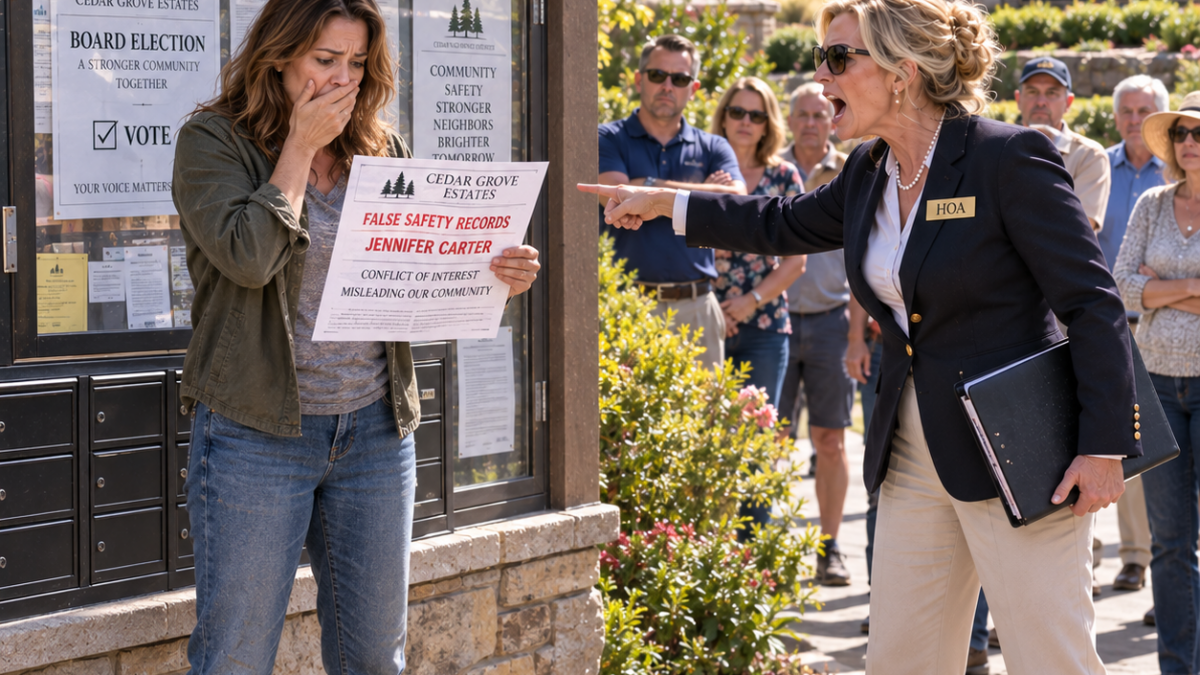
I saw my name printed in red behind the glass of our HOA mail kiosk before I understood what the rest of the flyer was accusing me of.
I took the headphones off.
For a few seconds, my kitchen became completely ordinary again.
The refrigerator hummed.
A car rolled past outside.
Somebody’s dog barked once behind the row of cedars separating our yards.
The clock above the stove clicked forward.
Nothing in the room looked different.
But I was.
I put the headphones back on.
Rewound ten seconds.
A man’s voice asked, “Do we have the complaint yet?”
Conrad answered, “Not in writing. But we will have resident concern by Wednesday.”
Again.
I played it one more time.
Same words.
Same voice.
Same calm tone.
Not angry.
Not rushed.
That almost made it worse.
Then the recording continued.
“The issue is timing,” Conrad said. “If this gets circulated too early, she has time to turn herself into the victim.”
A woman asked, “Through the portal?”
“Through the election committee.”
Then Conrad:
“It cannot look like campaign material.”
Somebody laughed softly.
Not a cruel laugh.
A comfortable one.
The kind of small social laugh people make when they are sitting around a table with coffee and believe the consequences belong to someone outside the room.
My hand tightened around the edge of the kitchen table.
I had spent all day trying not to react like the person they wanted me to become.
Angry.
Unstable.
Difficult.
Procedural.
The recording told me they had designed those labels before I ever objected.
I opened another file in Folder 03.
CANDIDATE CONCERN LANGUAGE.
There they were.
Candidate integrity concern.
Fitness to serve.
Potential undisclosed family connection.
Stability of the community.
The document had been created Monday night.
The supposed resident complaint was dated Wednesday morning.
I opened the spreadsheet labeled PORTAL SCHEDULE.
Tuesday:
Integrity notice draft prepared.
Tuesday afternoon:
Committee review.
Thursday, 5:58 a.m.:
Final approval.
The complaint summary claimed the concern had first been received Wednesday at 9:30 a.m.
The wording existed before the complaint.
The distribution plan existed before the complaint.
The recording discussed the complaint before the complaint.
It was not an accusation that triggered an investigation.
It was a plan waiting for something they could call an accusation.
I sat back.
My first instinct was to call Conrad.
That frightened me.
Not because I was afraid of him.
Because I suddenly understood how badly he wanted me emotional.
Every message he had sent pushed toward the same result.
Do not inflame residents.
Do not weaponize paperwork.
Do not disrupt the election.
Do not turn this into a spectacle.
He needed my reaction more than he needed the facts.
So I did not call.
I copied the recording to an external drive.
Then another.
I printed the file properties.
Created Monday, 7:14 p.m.
Modified Monday, 8:02 p.m.
Uploaded by election committee admin.
I took screenshots showing the file path inside the HOA records folder.
Then I wrote every date down by hand.
That was something my father had taught me.
Not about HOAs.
About panic.
Dad had been a paramedic for twenty-seven years.
Whenever something went wrong in our house, he slowed down.
Leaking pipe.
Car accident.
My mother fainting at church once.
He would say:
“First, tell me what happened. Then tell me when.”
The when mattered.
Because time gave facts a spine.
I made a timeline.
MONDAY — 7:14 p.m. election prep recording created.
MONDAY — Conrad discusses framing Walker as liability.
MONDAY — “We will have resident concern by Wednesday.”
TUESDAY — integrity-notice language prepared.
WEDNESDAY — alleged resident complaint received.
THURSDAY — 5:58 a.m. Conrad approves distribution.
THURSDAY — before sunrise flyer appears.
THURSDAY — 6:42 a.m. Conrad warns me not to inflame concerns.
THURSDAY — official portal message reaches homeowners.
I stared at the sequence.
The complaint had not created the smear.
The smear had been created first.
Then given a complaint to wear.
At 9:03 that night, Maya Ortiz called.
Her voice was thinner than it had been earlier.
“Erin?”
“Yes.”
“I wanted to confirm you received the supplemental records.”
“I did.”
A pause.
“I also need to state that North Star Community Management did not create the content of the committee discussion.”
“I heard you on the recording.”
“The recording system is automatic.”
“You facilitated the meeting.”
“I handled logistics.”
“Maya, did you know there was no written complaint yet?”
Silence.
Not long.
Enough.
“I cannot interpret association records for you.”
“I didn’t ask you to.”
She inhaled softly.
“What can you tell me?”
Another pause.
Then:
“The audio file is an official association record.”
“Stored where?”
“In the election committee folder.”
“Produced in response to my records request?”
“Yes.”
“Unedited?”
“As maintained by North Star.”
That was enough.
Before she hung up, she said:
“Erin.”
“Yes?”
“Keep copies.”
My chest tightened.
“You think something might happen to them?”
“I did not say that.”
“No.”
I looked at the external drive beside my laptop.
“You didn’t.”
After the call, I opened the recording one final time.
Near the end, Conrad said:
“Send it close enough to the vote that she won’t have time to recover.”
That sentence stayed with me all night.
Not because it proved he disliked me.
I already knew that.
It proved the harm was not accidental.
Timing had been part of the strategy.
The next morning, I was awake before six.
Talia came downstairs in pajama pants and found me at the kitchen table.
“You didn’t sleep.”
“Some.”
“That means no.”
I smiled.
She opened the refrigerator.
Then looked at the papers covering the table.
“Did you find something?”
“Yes.”
“Good?”
I thought about that.
“It’s true.”
“That isn’t what I asked.”
She was sixteen.
Too smart for comfortable answers.
“No,” I said. “It isn’t good.”
She poured orange juice.
Then sat across from me.
“Did they lie?”
“Yes.”
“Can you prove it?”
I looked at the laptop.
“Yes.”
Her face changed.
Not relief.
Something more cautious.
“What happens now?”
“I don’t know.”
“You always tell me if you know the rule, you know what happens.”
“I tell you rules create a process.”
“That sounds like teacher language.”
“It is.”
She smiled faintly.
“Are you going to win?”
“I don’t know.”
That surprised her.
“The election?”
“Yes.”
“But they cheated.”
“That doesn’t mean I automatically win.”
“What does it mean?”
“It means the election has a problem.”
Talia stared at the table.
“Then why would anyone vote before they fix it?”
That question was better than half the emails I had received.
I opened the election rules again.
Ballot certification.
Challenges.
Candidate response.
Inspector authority.
Then I found something I had skipped earlier.
Candidate objections had to be raised before certification.
Once certification occurred, challenging the result required a much more formal board process.
Conrad knew that.
Of course he knew that.
At 8:19 a.m., a new HOA portal message went out.
ELECTION INTEGRITY REMINDER.
It did not name me in the first paragraph.
It talked about “last-minute procedural attacks.”
“Outside noise.”
“Intimidation.”
Then the sentence aimed directly at me:
Candidates who attempt to disrupt certification after concerns have been raised should ask whether they are serving the community or serving themselves.
I sat there and almost admired the construction.
If I defended myself, I was unstable.
If I requested records, I weaponized paperwork.
If I challenged the election, I was selfish.
If I stayed quiet, their version became the only version.
Every exit led back into the same room.
I printed the message.
Added it to the timeline.
Then called Maya.
“I need the ballot packet index.”
“It was included.”
“The complete version.”
A pause.
“What are you looking for?”
“The order of materials included before mailing.”
“I understand.”
“And print authorization.”
“That may be with the election vendor.”
“Then request it.”
“Erin, the board is concerned about the volume of your records requests.”
The sentence irritated me more than it should have.
“The board should be more concerned about the volume of its records.”
Silence.
I closed my eyes.
“That was sharper than I intended.”
Maya surprised me.
“It was accurate.”
Neither of us spoke for a moment.
Then she said:
“I’ll look.”
At 9:02, two PDFs arrived.
BALLOT_PACKET_INDEX_FINAL.
PRINT_AUTHORIZATION_CEDAR_GROVE_SEAT3.
I opened the index.
Required materials:
Ballot.
Return envelope.
Voting instructions.
Candidate statements.
Forum notice.
Then page two.
SUPPLEMENTAL ELECTION MATERIAL.
Candidate integrity notice — Seat 3.
Approved for inclusion.
Printed immediately after candidate statements.
My stomach dropped.
I opened the print authorization.
Approved by:
C. BLAKE.
Instruction:
Insert supplemental integrity notice directly following Erin Walker candidate statement.
That changed the case.
The flyer mattered.
The portal email mattered.
But ballot packets were different.
A homeowner would open the envelope.
Read my statement about budget transparency, street lighting, and timely committee records.
Then turn one page.
And see an official-looking warning questioning my honesty.
It wasn’t rumor near the election.
It was inside the election.
I took out my legal pad.
Wrote:
ELECTION CHALLENGE ELEMENTS.
1. Official HOA communication channel used for candidate-specific accusation.
2. No equal response opportunity.
3. Notice language prepared before supposed complaint.
4. Incumbent candidate overseeing election approved notice about opponent.
5. Notice inserted into ballot packets.
6. Official recording documents timing strategy.
7. Certification approaching before correction.
The list changed what I was doing.
I was no longer trying to prove I was innocent.
The board’s own minutes already proved I had never falsified safety committee records.
My brother lived in Oregon.
His company had never bid on anything at Cedar Grove.
The allegations were weak.
But even false allegations can influence a vote if distributed with enough authority.
The question was now whether the voting process itself had been contaminated.
At 10:11, Conrad sent a message to all candidates.
Due to heightened tension and misinformation, the election committee is considering accelerated certification to preserve community confidence.
I stared at the phrase.
Accelerated certification.
He was running out the clock.
At 10:38, the official notice appeared.
Certification had originally been scheduled for Monday.
Now:
Friday.
6:00 p.m.
Tomorrow.
Reason:
Reduce speculation and preserve confidence.
Candidates could attend.
Public comment would be limited.
Certification.
Then argument afterward.
I called Maya immediately.
“Yes,” she said before I finished. “I saw it.”
“Can he move certification?”
“The committee has authority over logistics.”
“That isn’t what I asked.”
“I know.”
“Maya, if certification happens tomorrow, what changes?”
Her voice lowered.
“Undoing a certified result becomes more complicated.”
“So he knows exactly what he’s doing.”
“I cannot say that.”
“You don’t have to.”
A pause.
Then she said:
“If you intend to object, make it formal.”
I picked up a pen.
“Formal how?”
“Written election challenge.”
I wrote.
“Specific rule violations.”
Wrote.
“Specific records.”
Wrote.
“Specific relief requested.”
“What relief?”
“That is your decision.”
“I’m asking what process exists.”
“Ballot preservation.”
I stopped.
“Preserve unopened ballots?”
“All election materials.”
“Can they certify while a timely objection is pending?”
“I cannot give legal advice.”
“Maya.”
Her silence changed.
Then:
“The election inspector should receive a timely objection before signing certification.”
“Who is the inspector?”
“Frank Danner.”
I knew Frank.
Retired accountant.
Birch Court.
Quiet at meetings.
He had served as neutral ballot observer twice.
“Does Conrad control him?”
“I do not believe so.”
Not exactly reassurance.
Enough.
After we hung up, I walked to the clubhouse.
The accelerated-certification notice was taped to the glass door.
Friday.
6:00 p.m.
Candidate attendance permitted.
PUBLIC DISRUPTION PROHIBITED.
Someone had underlined the last line in blue pen.
A woman came out carrying a tennis bag.
Donna Keene.
She saw me reading.
“I hope you’re not planning to make tomorrow difficult.”
“Did you get the ballot packet?”
“Yes.”
“Was the integrity notice directly behind my statement?”
She tightened her grip on the bag.
“I think people deserve to know if there are concerns.”
“Before or after I’m allowed to answer them?”
“Conrad said the committee handled it.”
“Conrad is running for the same seat.”
Donna looked toward the parking lot.
No answer.
“That,” I said, “is the problem.”
At home, I divided everything into three piles.
WHAT THEY SENT.
WHAT THEY WITHHELD.
WHAT THEY CONTRADICTED.
Pile one:
Portal notice.
Flyer.
Candidate packet.
Ballot packet index.
Print authorization.
Pile two:
Folder 03.
The recording.
Prep materials.
Pile three:
Conrad’s words.
Resident concerns are not campaign attacks.
We frame her as a liability.
Not in writing, but we will have resident concern by Wednesday.
Hesitation is enough.
It cannot look like campaign material.
Send it close enough to the vote that she won’t have time to recover.
I opened a blank document.
FORMAL ELECTION CHALLENGE AND BALLOT PRESERVATION DEMAND.
I typed slowly.
Candidate:
Erin Walker.
Seat:
Three.
Opposing incumbent:
Conrad Blake.
Board President.
Election Committee Chair.
Then the rules.
Equal access.
Candidate communications.
Records.
Certification procedure.
Then relief.
Suspend certification pending review.
Preserve all ballots.
Return envelopes.
Sign-in sheets.
Packet versions.
Vendor print orders.
Portal logs.
Recordings.
Approval records.
Allow the election inspector to hear the objection before certification.
Provide equal response access through every channel used for the accusation.
Review whether an incumbent may authorize official communications concerning an opponent.
I avoided the word fraud.
That was intentional.
Fraud was something people could argue over.
Process was harder to escape.
At 4:12, Conrad emailed all candidates.
Tomorrow’s certification is administrative, not a campaign forum. Attempts to introduce unrelated grievances will be ruled out of order.
I printed it.
Added Exhibit J.
At 11:47 that night, my challenge was finished.
Forty-two pages.
Exhibits A through J.
The audio file on two separate drives.
A transcript excerpt with timestamps.
Talia appeared in the kitchen doorway.
Old school sweatshirt.
Hair pulled up badly.
“You’re still awake.”
“So are you.”
“I heard the printer.”
“Sorry.”
She came closer.
“Are you scared?”
I looked at her.
“Yes.”
She seemed surprised by the answer.
“Are you going anyway?”
“Yes.”
“Why?”
I put the preservation demand into an envelope.
“Because tomorrow they aren’t counting rumors.”
I sealed it.
“They’re counting ballots.”
At 8:03 Friday morning, I walked into North Star’s local office carrying three envelopes.
Management.
Board.
Election inspector.
I asked for stamped receipt copies.
The receptionist saw my name.
Then the thickness of the packets.
“I can accept management correspondence.”
“Please stamp that one and note the others were left for pickup.”
Maya came from a side office.
“I’ll sign for all three.”
She took the stamp.
8:06 a.m.
Every page.
Every cover sheet.
Her hand stayed steady.
Then she said:
“Frank Danner has been notified.”
“Will he get the complete packet before tonight?”
“Yes.”
“What about the ballots?”
“I issued preservation instructions this morning.”
I looked at her.
“No ballot materials are to be opened, moved, altered, discarded, or certified before the inspector addresses the objection.”
That was the most direct thing she had said all week.
“Thank you.”
She nodded.
“Tonight will be tense.”
“It became tense when my name went into ballot envelopes.”
She accepted that without defending anyone.
By afternoon, Cedar Grove felt different.
No weather.
Still a storm.
Cars slowed near my house.
The online board filled with arguments.
Some homeowners called me brave.
Others called me vindictive.
One wrote:
If Erin really cared about the neighborhood, she would accept the election result.
There was no result yet.
That was the point.
At 5:20, I drove to the clubhouse.
Parking lot nearly full.
Through the windows, I saw rows of folding chairs.
Front table.
Three sealed ballot boxes.
Laptop.
Clipboards.
Small speaker.
The boxes were labeled:
SEAT 3.
RETURN ENVELOPES.
CHALLENGED / PROVISIONAL.
My mouth went dry.
Conrad stood near the front.
Same navy blazer.
Same calm posture.
Mason Tully, the third candidate, sat against the wall.
Mason had barely spoken all week.
He had not defended me.
He had not joined Conrad either.
I still didn’t know what that silence meant.
Frank Danner sat at the center table.
Silver hair.
Reading glasses.
My challenge packet open in front of him.
He was making notes in pencil.
Teacher habit made me notice.
Pencil meant review.
Not conclusion.
At 5:52, Conrad approached me.
“Erin.”
“Conrad.”
“I understand you submitted a packet.”
“A formal challenge.”
“This is certification. Not litigation.”
“It’s certification with a timely objection.”
His smile stayed.
“You’ve made your point.”
“No.”
I looked toward Frank.
“I preserved the record.”
Conrad glanced at the homeowners filling the chairs.
“If you turn this into campaign theater, people will remember that.”
“They already received campaign theater inside their ballots.”
His jaw moved.
Before he could respond, Jamal Reed entered.
Manila envelope.
Jamal lived in Birch Court.
He rarely spoke at meetings.
When he did, he asked one question and waited until someone answered the actual question.
He came directly to me.
“Erin.”
“Jamal.”
“I was a ballot observer Wednesday.”
“I know.”
He opened the envelope.
“I kept the sample packet.”
My heartbeat shifted.
“I thought every candidate got the same packet.”
He turned pages.
Ballot.
Instructions.
Candidate statements.
Mine.
Then one more page.
The integrity notice.
Directly behind my statement.
“I checked after your challenge went out.”
He handed me the packet.
“I told Frank.”
“Thank you.”
Jamal looked across the room toward Conrad.
“I should’ve noticed Wednesday.”
“You noticed now.”
At 6:00 exactly, Frank tapped the microphone.
“This is the Cedar Grove Estates election certification session for Seat Three.”
The room quieted.
“I have received a timely written objection from candidate Erin Walker. Because that objection concerns official association communications and materials included in the ballot packet, I will hear the objection before signing certification.”
Conrad stood.
“Point of order.”
Frank looked over his glasses.
“State it.”
“This proceeding was noticed as administrative certification. Ms. Walker’s allegations concern campaign disputes and unrelated grievances. They should not delay ballot counting.”
Frank opened my packet.
“The objection concerns ballot packet content, candidate communication rules, and official distribution channels.”
He looked at Conrad.
“Those are election issues.”
Conrad’s face tightened.
“This is an attempt to delegitimize an election she expects to lose.”
I stood.
Did not face Conrad.
I faced Frank.
“I am not asking you to declare me the winner.”
The room was so quiet I could hear the air conditioner.
“I’m asking you not to certify until you determine whether the voting process followed the same rules every candidate was given.”
Frank nodded once.
“Mr. Reed will provide his observer statement first.”
Jamal walked to the microphone.
For the first time, somebody besides me carried part of the truth in public.
“This is the observer sample from Wednesday’s vendor packet run.”
He opened it.
“My copy was retained unchanged.”
He showed the order.
Candidate statements.
My statement.
Then the integrity notice.
He turned it toward the room.
The paper looked smaller than the damage it had caused.
Frank asked:
“Did this sample come from the packet run you observed?”
“Yes.”
“Was this the mailing order?”
“Yes.”
“Did you alter it?”
“No.”
Conrad stood.
“The packet order does not establish intent.”
Frank looked at him.
“I did not ask about intent.”
A few people shifted in their chairs.
That was when the room understood what kind of evening this would be.
Frank wasn’t managing feelings.
He was checking facts.
He marked the sample with a yellow tab.
Then looked at me.
“Ms. Walker.”
I walked to the front.
“My challenge has four main parts.”
I took one breath.
“First, Cedar Grove used an official communication channel to distribute a candidate-specific warning about me.”
I placed Exhibit A down.
“Second, I was denied equal access to respond before ballots were cast.”
Exhibit C.
“Third, the warning was inserted into mailed ballot packets directly after my candidate statement.”
Exhibit E.
“Fourth, association records show the warning language was planned before the complaint it supposedly responded to.”
The room shifted.
I continued.
“Exhibit A is the mail-kiosk flyer.”
“Exhibit B is the portal distribution.”
“Exhibit C is Section 4C of the election rules.”
“Exhibit D is the candidate packet note.”
“Exhibit E is the final ballot packet index.”
“Exhibit F is the print authorization approved by C. Blake.”
Frank reviewed.
Then:
“Your packet references an audio file.”
“Yes.”
Conrad stood immediately.
“I object to any private recording being played in an association proceeding.”
Frank looked at my exhibit list.
“The file is identified as an association record produced by management.”
“It was an informal prep call.”
Frank turned toward Maya.
She sat beside the wall with a laptop.
“Ms. Ortiz.”
“Yes.”
“Was the file produced in response to Ms. Walker’s records request?”
“Yes.”
“Was it stored in Cedar Grove’s election records?”
“Yes.”
“Created by North Star’s automatic recording system during an election committee call?”
“Yes.”
Conrad said:
“That does not make every conversation official action.”
Frank nodded.
“I did not say it did.”
Then:
“I will hear the cited section.”
My hands were cold.
But steady.
I connected my laptop to the small speaker.
ELECTION_COMPLIANCE_REHEARSAL.mp3.
The waveform appeared.
I had changed nothing.
“I will play from eleven minutes forty-two seconds to thirteen minutes eight seconds.”
Frank checked the transcript.
“Proceed.”
I pressed play.
Chair scrape.
A distant laugh.
Then:
“What about Walker?”
Conrad’s recorded voice:
“We frame her as a liability.”
Nobody moved.
A woman’s voice:
“Based on what?”
Conrad:
“Process concerns. Safety committee minutes, potential family connection, her pattern of challenging board procedure.”
Another voice:
“Do we have the complaint yet?”
Then the sentence.
“Not in writing. But we will have resident concern by Wednesday.”
Frank’s pencil stopped.
The entire room knew the complaint had been dated Wednesday.
The recording was Monday.
I let it continue.
“The issue is timing.”
Conrad’s voice filled the clubhouse.
“If this gets circulated too early, she has time to turn herself into the victim.”
A voice:
“Through the portal?”
“Through the election committee.”
Then:
“It cannot look like campaign material.”
My stomach tightened even though I had heard it a dozen times.
Then the final part.
“If it goes out close enough to the vote, people will hesitate.”
Pause.
“Hesitation is enough.”
I stopped the recording.
The speaker gave a faint hiss.
For several seconds, nobody spoke.
Conrad stood perfectly straight.
Then:
“That is out of context.”
Frank removed his glasses.
“Then provide the context.”
Conrad looked at Maya.
She looked at her laptop.
He looked back at Frank.
“The committee had received verbal concerns about Ms. Walker before the written complaint.”
Frank asked:
“From whom?”
Conrad hesitated.
“Multiple residents.”
“Names?”
“I don’t think it is appropriate to identify private complainants.”
“Dates?”
“Over the course of the campaign.”
“Any record?”
“The written complaint summarizes—”
“The written complaint is dated Wednesday.”
Frank opened my file-properties exhibit.
“This recording is Monday.”
Conrad’s voice hardened.
“You’re allowing a procedural technicality to overshadow legitimate concerns.”
I spoke before I meant to.
“Which concern?”
Frank looked at me.
I stopped.
Then he nodded.
“One question.”
I looked at Conrad.
“Which concern was true?”
His face changed.
“The committee had reason to review your fitness.”
“That wasn’t my question.”
“Ms. Walker—”
“Did I falsify safety committee minutes?”
He said nothing.
“Did my brother’s company bid on Cedar Grove safety work?”
Nothing.
“My brother lives in Oregon.”
A few people murmured.
Frank raised one hand.
“Let us stay with the election issue.”
He put the file-properties sheet beside the complaint summary.
Monday.
Wednesday.
Then he opened the ballot packet index.
Thursday mailing.
Then the portal log.
Approved 5:58 a.m.
Frank looked directly at Conrad.
“I cannot certify this election tonight.”
The room changed.
Conrad stepped forward.
“You do not have authority to overturn the election.”
“I am not overturning it.”
Frank’s voice remained level.
“I am declining to certify it.”
“You’re delaying the homeowners’ vote based on one candidate’s accusations.”
“No.”
Frank tapped the documents.
“I’m delaying certification because candidate-specific warning material was distributed through association channels, included in ballot packets, and supported by a complaint summary that appears to postdate recorded planning of that warning.”
He turned to Maya.
“All ballot materials remain sealed.”
Then to the room:
“Return envelopes, sign-in sheets, packet versions, print orders, portal logs, and the audio record will be preserved pending independent election review.”
Conrad stared at the ballot boxes.
For the first time all week, he was not looking at me.
He was looking at something he could no longer control.
Frank initialed preservation tape.
One strip across each ballot box.
Then Maya signed beside him.
Jamal signed as observer.
Mason Tully stood.
“I’ll sign too.”
Conrad turned.
“You’re a candidate.”
“So is Erin.”
Mason looked at Frank.
“If candidate signatures are inappropriate, fine. But I want the record to show I support preservation.”
That was the first position he had taken all week.
Frank nodded.
“Noted.”
At 6:47, the meeting ended without a certified result.
Outside, people gathered in clusters.
Nobody knew what to say to me.
Some avoided me.
Some stared.
Leslie came close.
“Erin.”
I stopped.
“I heard the recording.”
“So did everyone else.”
“I’m sorry.”
Her eyes filled.
“I believed the email because it came through the HOA.”
That sentence mattered.
Not because it absolved her.
Because it named the real damage.
“I think a lot of people did.”
“I should have asked you.”
“Yes.”
She nodded.
No argument.
Then she walked away.
Conrad came through the clubhouse doors five minutes later.
Alone.
He saw me near my car.
Stopped.
For a second I wondered whether he would approach.
He did.
“You understand what you’ve done.”
I looked at him.
“Yes.”
“You’ve damaged confidence in the board.”
“No.”
He flinched slightly.
“I showed people what damaged it.”
His face hardened.
“This review will not be the victory you think it is.”
“I didn’t ask Frank to declare me the winner.”
“You want this seat.”
“I wanted a fair election.”
“You expect people to believe that?”
I thought about Talia.
Leslie.
The flyer.
“Hesitation is enough.”
I looked directly at him.
“That was your strategy, Conrad. Not mine.”
He said nothing.
Then walked to his car.
The ballots remained sealed for nine days.
That was the part nobody could spin.
Conrad could argue context.
He could say committee discussions were exploratory.
He could claim the recording reflected concerns rather than conclusions.
But he could not certify the vote.
White boxes sat inside North Star’s secured records room.
Preservation tape.
Frank’s initials.
Jamal’s initials.
Every day the boxes remained closed, the neighborhood learned another piece.
Monday morning brought an HOA notice.
ELECTION CERTIFICATION SUSPENDED PENDING INDEPENDENT REVIEW.
No names.
The wording was careful.
Candidate-specific materials were distributed through association channels and included in ballot packets without equal candidate response access.
That sentence did more to change the neighborhood than anything I posted.
Because I didn’t post anything.
I stopped campaigning entirely.
No lawn signs.
No message-board defense.
No victory laps.
I went to work.
I helped Talia with a school presentation.
I bought groceries.
I watered Leslie’s porch plants once because she was away overnight helping her husband at a follow-up appointment.
That surprised her when she found out.
It surprised me too.
But anger did not need every available job.
Thursday brought the correction.
This time, Cedar Grove sent it through every channel they had used against me.
Portal.
Email.
Mail kiosk.
Printed attachment.
CORRECTION REGARDING CANDIDATE INTEGRITY NOTICE.
It stated:
The prior notice regarding Erin Walker was not supported by a verified written complaint at the time the notice was drafted.
No association record supported the allegation that I had falsified safety committee minutes.
No evidence supported an undisclosed family business conflict.
I had not been provided equal opportunity to respond before distribution.
The notice should not have been included in ballot packets.
It stopped short of saying:
We lied.
It didn’t matter.
A correction should be factual before it is emotional.
I printed it.
Placed it beside the original flyer.
Same logo.
Same official voice.
Different truth.
That evening, Talia read it at the kitchen table.
“They don’t say sorry.”
“No.”
“Does that make you mad?”
“A little.”
“What makes you less mad?”
“They sent it to everyone.”
She nodded.
“So people know?”
“Yes.”
She looked at me.
“Then why do you still look sad?”
Teenagers.
Always finding the sentence adults hope to avoid.
“Because correcting a lie doesn’t make people forget hearing it.”
She thought about that.
“That’s unfair.”
“Yes.”
“Do you still want to be on the board?”
That question was harder.
“I don’t know.”
“You’re still running.”
“If there’s a new election.”
“But do you want it?”
I looked at the stacks of paper.
Before that week, I had wanted the seat because Cedar Grove needed boring improvements.
Streetlights.
Transparent budgets.
Minutes posted on time.
Simple things.
Now the seat felt tied to something uglier.
“I want the reason I ran before this happened.”
“What reason?”
“To make things work better.”
She smiled.
“That sounds very civics-teacher.”
“It probably is.”
The independent review summary came the following Wednesday.
Frank read it at a special open meeting.
The first election would not be certified.
A new vote would be held fourteen days later.
North Star could print and mail ballots.
But candidate communications would be administered by a temporary independent election panel.
Frank.
Jamal Reed.
One homeowner selected by Mason.
One selected by me.
Conrad was barred from approving any Seat Three material.
The board would also revise election rules before the revote.
Conrad did not resign.
People expected me to demand it.
I didn’t.
I wanted the process corrected first.
Removal could become another election someday.
At the special board meeting, Frank proposed new procedures.
Candidate statements distributed exactly as submitted.
Any candidate-specific complaint had to be signed.
Dated.
Documented.
Provided to the named candidate before broad distribution.
No incumbent candidate could approve official communications about an opposing candidate.
All election communications required archived timestamps and reviewer identities.
Corrections had to use every channel used by the original statement.
No candidate-specific supplemental material could be inserted into ballot packets without equal response access.
Frank finished.
The room was quiet.
Conrad sat at the far end.
When the vote was called, he said:
“I abstain.”
Frank looked over his glasses.
“You are not voting on the certification matter, Mr. Blake.”
Conrad’s fingers tightened around his pen.
“This is election policy.”
Pause.
Then:
“Aye.”
Small word.
Useful word.
The revote felt almost boring.
That was the best compliment I could give it.
Ballot.
Instructions.
Candidate statements.
Nothing else.
My statement appeared exactly as I had written it.
Budget transparency.
Crosswalk lighting.
Timely minutes.
Respectful enforcement.
No warning behind it.
No gray border.
No suspicion.
I did not campaign harder.
I answered questions.
At the candidate forum, a homeowner asked:
“Why should we trust you not to use this incident against people you disagree with?”
Fair question.
I stood at the microphone.
“Because the problem wasn’t that the board disagreed with me.”
I looked toward Conrad.
Then back at the audience.
“The problem was that the process was used to distribute an accusation without giving the named candidate equal access to answer it.”
A man in the second row said:
“But you won the challenge.”
“No.”
I shook my head.
“The process won the challenge.”
Somebody laughed lightly.
Not mockingly.
I continued.
“If the rules only protect people I like, they aren’t rules.”
That was the teacher in me.
Couldn’t help it.
Mason came over afterward.
“I should’ve spoken sooner.”
“Yes.”
He nodded.
“You’re right.”
I appreciated that more than an excuse.
Leslie came the next morning.
She held an envelope.
Her original ballot.
VOID stamped across it by the election panel.
“I voted before the correction.”
I looked at the envelope.
She looked embarrassed.
“I cannot fix that.”
“No.”
“But I voted again.”
“You don’t have to tell me how.”
“I know.”
She took a breath.
“I believed something because it came from the HOA.”
“I know.”
“I’m sorry, Erin.”
This time, it sounded complete.
Not because it erased anything.
Because she didn’t defend herself afterward.
On revote night, I stayed home until the public count.
Talia wanted to come.
“Are you sure?”
“Yes.”
“You have school.”
“It’s Friday.”
“That is annoyingly correct.”
She smiled.
We walked to the clubhouse together.
Frank sat at the center.
Jamal observed.
Two temporary panel members checked envelopes.
Maya managed logistics.
No Conrad at the front table.
No candidate controlled the process.
The count took forty-one minutes.
Nobody talked during the last ten.
Frank added the final column twice.
Then handed the sheet to Jamal.
Jamal checked it.
Then Frank went to the microphone.
“Seat Three.”
My hands were cold.
“Erin Walker: 214.”
Pause.
“Mason Tully: 195.”
Nineteen votes.
That was all.
Nineteen.
Not a landslide.
Not some dramatic neighborhood uprising.
Enough.
Talia grabbed my hand.
Hard.
I heard applause.
Not everyone.
Some people did not clap.
That was fine.
A fair vote did not require universal happiness.
Frank continued.
“The result is certified.”
This time the word did not scare me.
Afterward, people came over.
Some congratulated me.
Some apologized.
Some avoided me.
Conrad waited until almost everyone had left.
Then he walked over.
“Congratulations.”
“Thank you.”
His expression was unreadable.
“I assume your first motion will be about me.”
“No.”
That surprised him.
“What will it be?”
“Election records.”
His mouth tightened.
I continued.
“I want Frank’s policy adopted permanently.”
“That is already under review.”
“I know.”
“I would hope you can separate governance from what happened personally.”
I almost laughed.
“Conrad, that’s exactly what I’m doing.”
He looked at me for a long second.
Then left.
My first official board meeting was two weeks later.
I sat at the table where Conrad had sat for years.
That felt stranger than winning.
Mason attended from the audience.
Leslie sat near the back.
Jamal had a notebook.
Talia was at home studying for an exam.
When new business began, I made one motion.
Not censure.
Not removal.
Not litigation.
“I move that Cedar Grove adopt the independent election policy as permanent procedure and publish a complete election archive after every certification, with personal information redacted where required.”
Jamal, who was now serving as resident election liaison, called from the audience:
“Good motion.”
People laughed.
Another board member seconded it.
Discussion began.
Conrad stared at the papers in front of him.
When the vote came:
“Aye.”
“Aye.”
“Aye.”
My turn.
“Aye.”
Then Conrad.
He waited three seconds.
“Aye.”
Motion passed.
Afterward, Maya caught me near the door.
“Congratulations.”
“Thank you.”
“You made my month very difficult.”
“I know.”
She smiled faintly.
“You were right to request Folder 03.”
“Was it really accidentally omitted?”
She looked at me.
Long enough.
Then:
“The records are complete now.”
That was the answer I expected.
I didn’t press.
Some truths matter because they change the next decision.
Others only satisfy anger.
A week later, I walked back to the mail kiosk.
Morning.
Same sprinklers.
Same sunlight through the glass.
I could still see faint tape marks where the original flyer had been.
But the smear was gone.
In its place were two pages.
CORRECTION REGARDING CANDIDATE INTEGRITY NOTICE.
And beneath it:
CERTIFIED SEAT THREE REVOTE RESULT.
ERIN WALKER — ELECTED.
I stood there with my mailbox key.
For a second, the whole first morning came back.
The silver SUV.
Leslie avoiding my eyes.
Talia asking why neighbors thought I lied.
The red letters.
UNFIT FOR THE BOARD.
A car slowed beside the curb.
Silver SUV.
Same one, I thought.
The driver looked toward me.
Then lifted two fingers from the steering wheel.
A wave.
Nothing dramatic.
I waved back.
Opened my mailbox.
Grocery circular.
Water bill.
A coupon I would never use.
Normal mail.
Normal morning.
Before leaving, I looked one more time through the glass.
My name was still there.
That surprised me emotionally more than I expected.
For days, I had wanted the HOA to stop using my name.
Stop printing it.
Stop emailing it.
Stop attaching suspicion to it.
Now it was printed again.
But this time beside something verifiable.
Certified result.
Correction.
Public record.
Truth did not erase the week before.
Leslie had still doubted me.
Talia had still heard people talking.
Neighbors had still voted with a lie tucked behind my candidate statement.
No election rerun could make those moments unhappen.
But the recording had done something more important than embarrass Conrad.
It had forced the system to admit the accusation had not arrived honestly.
Their own file had preserved the strategy.
Their own timestamps had exposed the sequence.
Their own rules had stopped certification.
And their own recording had captured the sentence that explained everything:
“Hesitation is enough.”
That was all they had wanted.
Not certainty.
Not proof.
Hesitation.
A neighbor looking at me differently.
A voter pausing before filling a circle.
A friend reading an official email and deciding maybe she didn’t know me as well as she thought.
That was why I never thought of the final nineteen votes as revenge.
They weren’t.
The most important result came before anybody counted the second ballot.
It came when Cedar Grove adopted a rule that made manufactured hesitation harder to hide.
After that, every candidate would receive the same access.
Every accusation would need a source.
Every communication would leave a record.
Every correction would have to travel as far as the original harm.
And no person running for office could quietly use the HOA’s authority to make an opponent look dangerous before voters heard her answer.
I unlocked the kiosk one last time to check whether I had missed anything.
Empty.
Closed it.
Turned toward home.
The sprinklers kept ticking across the lawn.
Cars rolled through the entrance.
Somewhere a garage door opened.
A dog barked.
Nothing about Cedar Grove looked transformed.
That was fine.
Good systems rarely look dramatic when they are working.
They simply make it harder for someone powerful to put a lie behind glass and call it official.
My name had been there twice.
The first time under an accusation.
The second time under the truth.
This time, nobody had to hesitate about the difference.








