I had spent eleven years in emergency medicine believing that when a patient was dying, there was no room for negotiation.
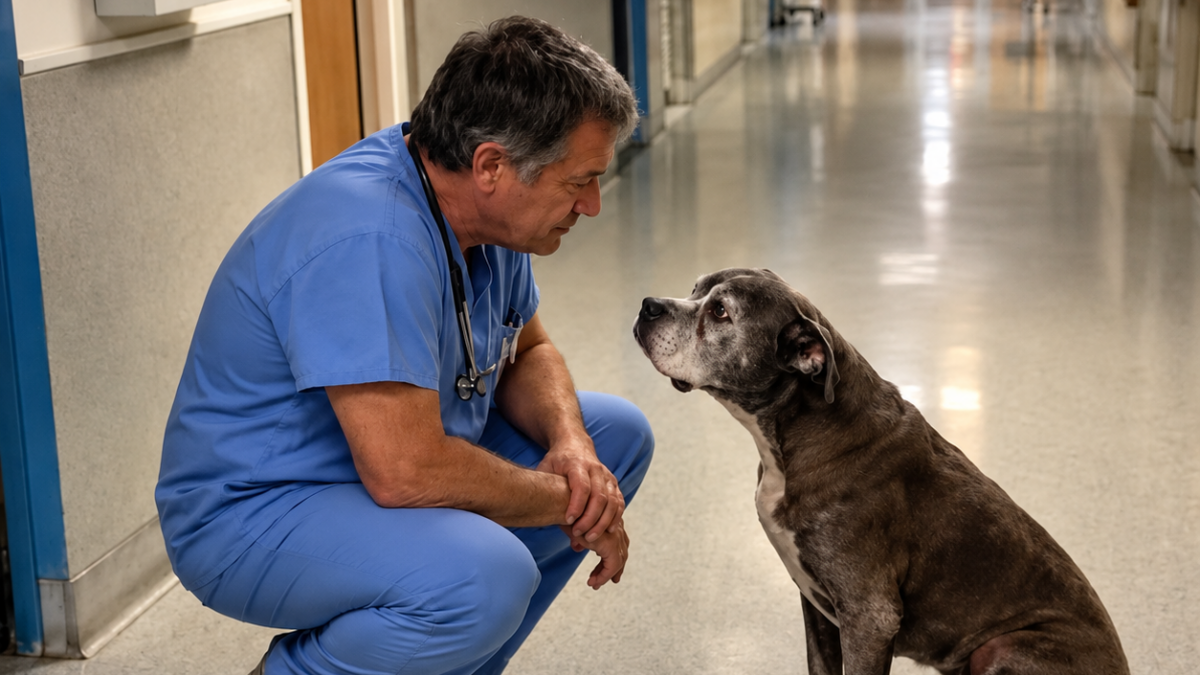
Luna stopped at the threshold.
That is the first detail I remember.
Not the monitor.
Not Eleanor’s breathing.
Not Hannah standing rigidly beside the stretcher.
The dog.
A medium-sized pit bull, dark-coated once, though age had dusted her muzzle and eyebrows with gray.
She stood just inside the doorway as though she understood that whatever room she had entered was different from any place she knew.
Hospitals have their own language.
Wheels against polished floors.
Electronic alarms.
Rubber soles.
Announcements overhead.
Metal carts.
People speaking too quickly.
For a dog who had spent fourteen years inside one quiet home, it must have been overwhelming.
Yet Luna made no noise.
Margaret loosened the leash.
“Go on.”
Luna looked at her.
Then at Eleanor.
Everything in the dog’s body changed.
Her ears lowered.
Her tail moved once.
Slowly.
Then again.
Eleanor lifted one trembling hand.
“Baby.”
It was barely audible.
Luna walked.
No pulling.
No jumping.
Just a careful, deliberate approach.
I had expected excitement.
Dogs reunited with owners often show it physically.
Jumping.
Whining.
Spinning.
But Luna seemed to understand that Eleanor could not handle excitement.
She reached the stretcher.
Sniffed Eleanor’s hand.
Then placed her muzzle across it.
Eleanor’s eyes closed.
Her shoulders dropped.
Just a fraction.
But I saw it.
Everyone did.
“Oh, Luna.”
The dog remained still.
Eleanor moved her fingers weakly through the fur between Luna’s ears.
“You waited.”
Luna’s tail touched the floor.
Once.
Twice.
“I’m sorry.”
That word surprised me.
I had assumed Eleanor wanted to say goodbye.
But listening to her, I realized something else.
She wasn’t saying goodbye.
She was apologizing.
She believed Luna might interpret her sudden disappearance as abandonment.
After fourteen years of the same morning.
The same voice.
The same person opening the back door.
The same hand placing food in the same bowl.
Then suddenly—
Nothing.
No explanation.
No return.
Eleanor needed to repair that possibility before allowing us to take her away.
“I didn’t leave you,” she whispered.
Luna pushed her head farther into Eleanor’s palm.
“I got sick.”
Eleanor’s breathing was still poor.
The oxygen level remained dangerously low.
Nothing supernatural had happened.
But her panic had changed.
That mattered.
Hannah saw it first on the monitor.
“Heart rate’s coming down.”
I looked.
It was.
Still elevated.
Still concerning.
But no longer accelerating.
Blood pressure stabilized enough that the downward trend stopped.
Hannah looked at me.
Then at Luna.
“How?”
“Stress response,” I said automatically.
It was the physician answer.
Catecholamines.
Sympathetic activation.
Fear worsening tachycardia.
Calming the patient reducing physiologic demand.
All true.
None of it felt sufficient to describe the room.
Eleanor rested her forehead as close to Luna as the oxygen equipment allowed.
“Good girl.”
Luna closed her eyes.
“Mommy’s coming back.”
I noticed Margaret turn her face away.
She had worked emergency nursing longer than I had practiced medicine.
Almost nothing made Margaret emotional in front of patients.
Eleanor breathed.
“In.”
Pause.
“Out.”
The breathing remained difficult, but less frantic.
I stepped closer.
“Mrs. Miller.”
She looked at me.
“We need to start now.”
She glanced at Luna.
Then back at me.
I waited.
This time she nodded.
“I’m ready.”
No resistance.
No argument.
She looked down.
“Wait for me.”
Luna’s tail moved.
Eleanor whispered again.
“Wait.”
Then she released the dog’s head.
“Take me.”
We moved immediately.
Everything became medicine again.
Stretcher rolling.
Doors swinging.
Monitor connected.
IV access.
Arterial blood gas.
Chest imaging.
Respiratory support escalated.
Hannah called results as they appeared.
Margaret stayed with Luna.
I entered the resuscitation bay beside Eleanor.
Within minutes, the quiet reunion existed in another world.
“Pressure?”
“Ninety-four systolic.”
“Repeat.”
“Respiratory rate thirty-six.”
“Prepare BiPAP.”
“Dr. Hart, gas is back.”
I read the values.
Not good.
Eleanor had severe respiratory compromise.
We were dealing with a combination of pneumonia and underlying cardiopulmonary disease that had tipped her body into crisis.
She was exhausted.
People often imagine respiratory failure as simply being unable to get enough air.
It is more brutal than that.
Breathing is supposed to happen without thought.
Your body handles it in the background.
But when every breath becomes labor, the body begins spending everything it has just to continue doing the one thing it must never stop doing.
Eleanor had probably been fighting for hours before calling for help.
Her muscles were tiring.
Her oxygen was poor.
Her heart was working harder.
I stood beside her.
“Mrs. Miller, this mask is going to help push air into your lungs.”
She nodded.
“Luna?”
“She’s safe.”
That was the first question.
Not what is happening?
Not am I dying?
Luna?
“She’s with Margaret.”
Eleanor closed her eyes.
“Good.”
We fitted the mask.
She initially fought it.
Many patients do.
Positive pressure across your face can feel claustrophobic, especially when you already feel unable to breathe.
I put my hand on her shoulder.
“Look at me.”
Her eyes opened.
“Remember what you told Luna.”
She stared.
“You’re coming back.”
Something changed.
She nodded.
Then stopped fighting the mask.
“Good.”
We adjusted settings.
Watched.
Waited.
Her oxygen saturation climbed.
Slowly.
Seventy-eight.
Eighty-one.
Eighty-four.
Still bad.
But moving.
“Come on,” Hannah whispered.
Eighty-six.
Eighty-eight.
I exhaled.
We were not safe.
But we had bought time.
For the next hour, Eleanor remained on noninvasive respiratory support while we treated the underlying infection and fluid balance.
Antibiotics.
Careful diuresis.
Repeated blood gases.
Cardiac monitoring.
The entire resuscitation room functioned the way it had been designed to function.
Fast.
Precise.
Controlled.
But I kept thinking about five minutes outside protocol.
Five minutes that, under other circumstances, I might have dismissed as dangerous sentiment.
I wondered whether I had been reckless.
Doctors replay decisions constantly.
We rarely admit how much uncertainty exists even when we sound confident.
Medicine is not guessing.
But it is also not mathematics.
There are moments when several correct priorities collide.
Preserve oxygen.
Respect autonomy.
Avoid delay.
Reduce panic.
Treat the person.
Treat the disease.
Which comes first?
Usually, the answer is clear.
That night it wasn’t.
At 9:18 p.m., Eleanor’s saturation finally held above ninety with support.
Her heart rate had fallen into a range I disliked less.
Her blood pressure remained acceptable.
Hannah stood beside me reviewing results.
“Do you think seeing the dog actually changed anything physiologically?”
I knew what she was asking.
“Probably.”
“How much?”
“No way to quantify it.”
“The numbers changed.”
“They changed after we increased oxygen too.”
“Before that.”
“Yes.”
She looked toward the hallway.
“So the dog helped?”
“Hannah.”
“I’m serious.”
“So am I.”
I removed my gloves.
“Stress matters. Anxiety increases oxygen demand. Fear increases heart rate. Calming someone can absolutely help.”
“But?”
I looked at her.
“But we didn’t treat pneumonia with a pit bull.”
She smiled.
“Obviously.”
“I’m saying don’t turn one meaningful moment into bad science.”
Her expression changed.
“Right.”
Then I added, “And don’t use science as an excuse to pretend the meaningful moment didn’t matter.”
That silenced both of us.
At 10:06 p.m., Eleanor’s son called.
His name was David.
He was in Arizona.
Margaret had found his number in Eleanor’s phone.
I took the call.
“This is Dr. Samuel Hart at St. Matthew’s Medical Center. Your mother is here.”
Long silence.
Then—
“My mother?”
“Yes.”
“What happened?”
I explained.
Severe respiratory failure.
Pneumonia.
Significant hypoxemia.
Currently stabilized but critically ill.
“Is she going to die?”
People often ask physicians questions no honest physician can answer.
“We are treating her aggressively. She is responding, but she is still very sick.”
“I should come?”
“Yes.”
That answer I could give.
Another pause.
“I talked to her in October.”
October.
It was December.
I thought of Eleanor saying twice a year.
David heard something in my silence.
“I know.”
I didn’t respond.
He said, “We’re not close.”
“I understand.”
“No, you don’t.”
He sounded defensive.
Tired.
Maybe ashamed.
“I’m not judging you.”
That was true.
Emergency medicine teaches you that families are complicated beyond what can be understood in one phone call.
There are good children who live far away.
Bad parents who become old.
Old conflicts.
Money.
Addiction.
Estrangement.
Trauma.
Mental illness.
Sometimes absence is cruelty.
Sometimes absence is self-protection.
I had no right to invent David’s story.
He cleared his throat.
“She has a dog.”
“Yes.”
“Luna.”
“You know her?”
“She’s had that dog forever.”
“Luna is here.”
“What?”
“Your mother insisted on seeing her before treatment.”
David made a sound that was half laugh, half sigh.
“That sounds like Mom.”
Then, more softly:
“She loves that dog more than she loves most people.”
“I got that impression.”
“No offense.”
“None taken.”
He was quiet again.
“I’ll get a flight.”
“Good.”
Before hanging up, he said, “Doctor?”
“Yes?”
“Don’t let anyone take Luna to a shelter.”
I stopped.
“I’m sorry?”
“If something happens to Mom.”
Something.
The word sat between us.
“I can’t take the dog. My building doesn’t allow her breed.”
There was no accusation in his voice.
Just fact.
“I understand.”
“Please.”
“We’ll involve social work.”
“Thank you.”
I ended the call.
For the first time that night, I understood another layer of Eleanor’s fear.
If she died, Luna would not merely lose her person.
She might lose her home.
At 11:30, Eleanor deteriorated.
Her breathing became more labored despite support.
Her blood gas worsened.
Hannah looked at me.
“We may need to intubate.”
“I know.”
We had discussed this possibility with Eleanor earlier.
She had been clear.
She wanted treatment.
She wanted us to fight.
I stood beside the bed.
“Mrs. Miller.”
Her eyes opened.
The mask made conversation difficult.
I leaned closer.
“You’re getting tired.”
She nodded.
“We may need to put a breathing tube in and use a ventilator for a while.”
Fear appeared.
Not confusion.
Fear.
I continued.
“You told Luna you were coming back.”
Tears gathered in her eyes.
I hated myself for using the promise.
But I needed to know what she wanted.
She lifted one hand.
Pointed toward herself.
Then gave a small thumbs-up.
“You want us to proceed?”
Nod.
We prepared.
The room tightened.
Intubation in an eighty-two-year-old patient with severe respiratory compromise is not casual.
Sedation can drop blood pressure.
The airway can be difficult.
The body may not tolerate even brief instability.
I explained as much as she could process.
Eleanor listened.
Then she lifted her hand toward me again.
I took it.
Her fingers moved against my palm.
She could not speak through the mask.
But I understood.
“Luna is safe.”
Her hand relaxed.
We intubated at 11:48 p.m.
It went smoothly.
Tube confirmed.
Ventilation initiated.
Blood pressure dipped.
Medications corrected it.
Oxygen improved.
Then came the strange silence that follows successful emergency procedures.
The room remains busy.
But the crisis changes tone.
The patient who had been fighting visibly is now still.
Machines breathe.
Numbers stabilize.
People step back.
I looked at Eleanor.
Sedated.
Small.
Almost peaceful.
Hannah removed her face shield.
“ICU has a bed.”
“Good.”
Margaret appeared at the doorway.
“Luna hasn’t slept.”
I glanced at the clock.
Midnight.
“Where is she?”
“Family room three.”
“With?”
“Me, mostly. Security checked in twice.”
“Any problems?”
Margaret gave me a look.
“She’s better behaved than half the families we see.”
Fair.
I finished the ICU handoff.
At 12:37 a.m., Eleanor was transported upstairs.
I could have returned immediately to the emergency department.
There were twelve patients waiting.
A teenager with abdominal pain.
A man with chest pressure.
A child with fever.
An older woman after a fall.
Emergency departments do not pause for revelation.
But before going back, I walked to family room three.
Luna sat facing the door.
Margaret had placed a blanket on the floor.
Water bowl near the wall.
Some food in a paper tray.
The food looked untouched.
Luna heard me enter.
She turned her head.
That was all.
“Hi.”
I felt ridiculous talking to her.
Then I remembered Eleanor speaking to her as though conversation required no shared language.
I sat in one of the chairs.
Luna looked back toward the door.
“She’s upstairs.”
No response.
“She’s very sick.”
Luna’s ears moved.
“We’re helping her breathe.”
I leaned forward.
“I don’t know why I’m explaining this to you.”
She turned.
Our eyes met.
I had never been especially sentimental about animals.
I liked dogs.
Had one as a child.
That was about it.
But Luna’s expression unsettled me.
Humans like to project meaning onto animal faces.
I knew that.
Still, the dog looked like every family member I had ever seen waiting outside a resuscitation room.
Not understanding the medicine.
Understanding perfectly that the person they loved had disappeared through a door.
I held out my hand.
Luna did not approach.
“That’s fine.”
I sat back.
“She told you she’d come back.”
The dog remained still.
“She meant it.”
My voice cracked slightly.
That irritated me.
I was tired.
That was all.
“I’m going to do my best to make sure she keeps that promise.”
Luna stood.
Walked toward me.
Stopped.
Then rested her chin on my knee.
I did not move.
Her head was heavier than I expected.
Warm.
Gray hairs around her muzzle.
I placed one hand gently over her skull.
“All right.”
She sighed.
And for several minutes, an emergency physician and a fourteen-year-old pit bull sat together in a hospital family room waiting for the same woman.
I returned to work.
At 2:15 a.m., I checked Eleanor’s ICU chart.
Stable.
At 3:02.
Stable.
At 4:17, I called the ICU fellow.
“How’s Miller?”
“Actually improving.”
“How much?”
“Vent requirements down. Pressure good.”
I closed my eyes.
“Good.”
“You know her?”
“ED patient.”
There was a pause.
“Is this the dog lady?”
News travels.
“Yes.”
“ICU nurses are asking if the dog can visit later.”
I smiled despite myself.
“Good luck with infection control.”
“We’re working on it.”
At 4:30, I went back to Luna.
She was exactly where I had left her.
Facing the door.
Margaret sat nearby completing documentation.
“She ate?”
“Two bites.”
“Water?”
“A little.”
“Bathroom?”
“One of the techs took her outside.”
I sat.
Luna looked at me.
“She’s still here.”
The dog stood.
I scratched her head.
“She’s still fighting.”
Margaret watched me.
“You’re different tonight.”
“Sleep deprivation.”
“No.”
I looked at her.
Margaret had the irritating habit of seeing through people.
“What?”
“You usually treat the chart first and the person second.”
That was harsher than I expected.
“I treat everyone.”
“I didn’t say you don’t.”
“Then what are you saying?”
She folded her arms.
“I’m saying you are very good at emergencies.”
“That’s my job.”
“You’re less good at whatever happens around the emergency.”
I stared at her.
“Family. Fear. Why someone is afraid. What they think they’re losing.”
“That’s not always ours to solve.”
“No.”
Margaret looked at Luna.
“But sometimes it matters.”
I almost became defensive.
Then I remembered Eleanor’s heart rate slowing beneath Luna’s muzzle.
“I know.”
Margaret smiled.
“Good.”
That irritated me more.
At 6:45 a.m., my shift ended.
I should have gone home.
Instead, I went upstairs.
The ICU was quieter than the emergency department.
Dim lighting.
Machines.
Sleeping families folded into chairs.
Eleanor lay in bed, sedated but stable.
Her nurse, Julia, reviewed the night.
“Urine output improved.”
“Pressors?”
“Never needed much. Off now.”
“Vent?”
“Coming down.”
“Good.”
Julia smiled.
“You brought the dog?”
“Technically Margaret did.”
“Administration is having an existential crisis.”
“I can imagine.”
“Infection control approved a controlled visit once she’s extubated and moved out of ICU.”
“Seriously?”
“Old dog. Vaccinated. Clean. No open wounds. Private room. Apparently somebody called somebody.”
I suspected Margaret.
“Will Eleanor be awake soon?”
“If she continues like this.”
I looked at her.
The woman who had refused to cross one doorway until she saw her dog now lay beneath a web of tubing and wires.
I whispered, mostly to myself:
“You’d better come back.”
Then I went home.
I slept four hours.
When I woke, the first thing I thought was Luna.
Not Eleanor.
Luna.
That surprised me.
I checked the hospital system from home.
Eleanor was stable.
I considered calling.
Then stopped.
Boundaries.
You cannot make every patient personal.
That way lies exhaustion.
Burnout.
Bad judgment.
I had seen young physicians destroy themselves by believing caring meant carrying every person home emotionally.
You need distance.
But distance and indifference are not the same.
I was beginning to suspect I had confused them.
That evening, before my next shift, Hannah texted.
SHE’S AWAKE.
Then another message.
FIRST WORD WAS “LUNA.”
I laughed.
Actually laughed.
My wife, Claire, looked up from the kitchen.
“What?”
“Patient.”
“That narrows it down.”
I told her.
Eighty-two.
Respiratory failure.
Fourteen-year-old pit bull.
Refused treatment until she saw the dog.
Claire listened.
When I finished, she stared at me.
“You let a dog into the ED before stabilizing a critically hypoxic patient?”
There it was.
The question I had been asking myself.
“For five minutes.”
“Sam.”
“I know.”
“Was she competent?”
“Yes.”
“Were you treating her while waiting?”
“Yes.”
“Then why do you sound guilty?”
I sat.
“Because if she had crashed…”
“You would’ve blamed yourself.”
“Yes.”
Claire poured coffee.
“But she didn’t.”
“No.”
“And maybe those five minutes mattered.”
“Yes.”
Claire handed me the cup.
“You sound like you already know what you think.”
“I think there’s a dangerous line between respecting the person and delaying care.”
“Of course.”
“I don’t want to romanticize this.”
“Then don’t.”
She sat opposite me.
“Just learn the thing you actually learned.”
“What’s that?”
“You tell me.”
I thought about Eleanor.
About Luna.
About the way the old woman’s face changed when the dog arrived.
“I had everything important about her medically within ninety seconds.”
Claire waited.
“I knew almost nothing important about why she wanted to live.”
“There you go.”
I hated when my wife sounded like Margaret.
The hospital called while I was driving in.
Eleanor had been extubated.
She was awake.
Talking.
I went upstairs before starting my shift.
Technically, I had no reason to.
She was no longer my patient.
I went anyway.
Eleanor looked smaller without the breathing tube.
She wore a nasal cannula.
Color back in her lips.
Still exhausted.
Her eyes opened when I entered.
“Doctor.”
Her voice was hoarse.
“Mrs. Miller.”
“You kept your promise.”
“So did you.”
She smiled weakly.
“Where is she?”
“Luna is being cared for.”
“I know.”
She looked toward the door.
“Can I see her?”
“They’re arranging it.”
“When?”
“Soon.”
She narrowed her eyes.
There was the woman from the ambulance bay.
“I am eighty-two. ‘Soon’ is not a useful measurement.”
I laughed.
That hurt her chest.
She coughed.
“Don’t make me laugh.”
“Sorry.”
“When?”
“I’ll find out.”
“Thank you.”
I turned to leave.
“Doctor?”
“Yes?”
“Did I cause trouble?”
I looked back.
“What kind?”
“With Luna.”
“Considerable.”
Her face fell.
I smiled.
“But the useful kind.”
She relaxed.
“I thought you might think I was foolish.”
“I didn’t.”
“That’s not what I asked.”
I stopped.
She was sharp.
Even after respiratory failure.
“No.”
I pulled a chair closer.
“At first I thought low oxygen might be confusing you.”
“That’s fair.”
“Then I realized you knew exactly what you wanted.”
“I did.”
“Why was it so important?”
She looked toward the window.
The afternoon light fell across her hands.
“For fourteen years, she has never woken up without me unless I was in another room.”
I listened.
“My husband, Frank, died nine years ago.”
The original ambulance story had made me assume fourteen years alone.
Life was more nuanced.
Luna had known Frank too.
“He loved her?”
“More than he admitted.”
Eleanor smiled.
“He said pit bulls had no business on furniture. Within three months she slept in his recliner.”
“Of course.”
“After Frank died, Luna waited by the front door every evening for almost six months.”
Her voice became quieter.
“Same time he used to come home.”
That image hit me.
“I watched her wait for a man who was never coming through that door again.”
Eleanor swallowed.
“When the ambulance came for me, she saw strangers take me away.”
“So you thought—”
“I thought she’d wait again.”
Her eyes filled.
“I couldn’t do that to her.”
I said nothing.
“She’s old.”
“How old exactly?”
“Fourteen years, four months.”
“You know the months?”
“Of course.”
I smiled.
Eleanor continued.
“She sleeps more now. Her hips hurt. She doesn’t hear the refrigerator door from the bedroom anymore.”
A tear moved down her cheek.
“I didn’t know whether I was coming back.”
My throat tightened.
“I needed her to see me. Smell me. Hear my voice.”
“So she would know you didn’t choose to disappear.”
“Yes.”
She closed her eyes.
“You understood.”
“I think I do now.”
“No.”
She looked at me.
“You understood then.”
That stopped me.
“You sent someone.”
I looked down.
“Maybe.”
“No maybe.”
She reached over.
Her thin hand touched mine.
“Thank you.”
I had been thanked by patients before.
For saving lives.
For explaining bad news.
For staying late.
For calling families.
This felt different.
I nodded.
“You’re welcome.”
The Luna visit happened that afternoon.
I missed the beginning because I was in the emergency department with a stroke patient.
By the time I reached Eleanor’s floor, half the nursing station was watching through the window of her private room.
“This legal?” I asked.
Julia shrugged.
“Probably.”
Inside, Eleanor sat upright.
Luna stood beside the bed.
Her front paws were not on the mattress.
She simply pressed her body against the side.
Eleanor had one hand on her head.
Both were asleep.
Or nearly.
The room was silent.
I stood outside.
Hannah came beside me.
“You know what’s weird?”
“What?”
“She’s eating better.”
“Eleanor?”
“Luna.”
I looked at her.
“Margaret said she barely ate while Eleanor was in ICU.”
“And now?”
“Finished everything.”
“That’s not weird.”
“You’re becoming soft.”
“Careful.”
We watched.
After a moment, Eleanor opened her eyes and saw us.
She waved weakly.
I entered.
Luna lifted her head.
Then settled again.
“You kept her waiting too long,” Eleanor said.
“I personally control hospital policy.”
“I knew it.”
“How do you feel?”
“Like someone put a truck on my chest.”
“That’s an improvement.”
She smiled.
Luna looked at me.
“I told you she’d come back,” I said.
Eleanor raised an eyebrow.
“You talked to my dog?”
“Against my better judgment.”
“Did she listen?”
“Better than most patients.”
Eleanor laughed.
This time carefully.
The next several days were not cinematic.
Recovery rarely is.
Eleanor had pneumonia.
She was weak after critical illness.
She needed oxygen.
Physical therapy.
Breathing exercises.
Medication adjustments.
The first time she stood, her knees almost buckled.
Luna was not present.
Hospital policy only allowed limited supervised visits.
Eleanor complained.
We compromised.
Margaret brought videos.
Luna walking outside.
Luna sleeping on Eleanor’s coat.
Luna refusing a new dog bed and choosing the old one.
Each video made Eleanor more determined.
On day three after extubation, physical therapy wanted her to walk to the doorway.
“I’m tired.”
“You’ve been in bed.”
“That makes people tired.”
The therapist smiled.
“Door.”
Eleanor looked at me because I had stopped by.
“Doctor?”
“Don’t involve me.”
“You let a pit bull into the hospital. Surely you can overrule physical therapy.”
“Absolutely not.”
“Coward.”
“Correct.”
The therapist placed the walker.
Eleanor stood.
Shaky.
One step.
Then another.
She stopped.
“What do I get if I reach the door?”
I said, “Luna visit tomorrow.”
The therapist looked at me.
“Can you promise that?”
“No.”
Eleanor glared.
“Doctor.”
“All right. I’ll advocate strongly.”
“Better.”
She walked.
Ten steps.
Twelve.
At the doorway, she stopped.
“Tell Luna.”
“I’ll tell her.”
“She understands more than you think.”
“I’m learning.”
By the fifth day, Eleanor no longer required continuous oxygen support at the same level.
Her lungs still sounded rough.
But she was safe enough for discharge planning.
That was when the hardest conversation shifted from survival to home.
Social worker.
Medication.
Follow-up.
Home health visits.
Transportation.
And Luna.
David had arrived on day two.
I met him in the hallway.
He was fifty-three.
Tall.
Gray at the temples.
Tired.
He looked like Eleanor around the eyes.
“Dr. Hart?”
“Yes.”
“I’m David Miller.”
We shook hands.
“Your mother has been asking when you’ll get here.”
His face tightened.
“I know.”
He went into the room.
I left.
That was not my conversation.
Later, I passed again.
Voices were raised.
Not screaming.
But sharp enough to carry.
“You could have called more.”
“I called.”
“Twice this year.”
“I have a life, Mom.”
“So did I.”
“Every call becomes guilt.”
“Because you feel guilty.”
I kept walking.
None of my business.
A few hours later, David found me near the nurses’ station.
“She told you about me?”
“Some.”
“She makes it sound like I abandoned her.”
“I don’t think she used that word.”
“She didn’t have to.”
He rubbed his face.
“My father and I didn’t get along.”
I waited.
“After he died, Mom acted like none of that mattered.”
“I’m sorry.”
“Frank was a good husband to her. Not a good father to me.”
There it was.
The missing story.
David continued.
“I moved away for a reason.”
“I understand.”
“No, but thank you for saying it.”
I almost smiled.
“Do you want advice?”
“No.”
“Good.”
That surprised him.
I continued.
“I don’t know enough to give it.”
David leaned against the wall.
“What I do know is your mother almost died.”
He looked down.
“And she still asks about you.”
His eyes filled slightly.
“I don’t know what to do with that.”
“Neither do I.”
He laughed quietly.
“Great doctor.”
“I treat lungs.”
“That’s probably safer.”
Before leaving, he said, “I’m taking Luna while Mom recovers.”
“I thought your building didn’t allow her.”
“I spoke to them.”
“And?”
“I may be moving.”
That was all.
The next morning, Eleanor told me David had agreed to stay two weeks.
She sounded casual.
Too casual.
“Good.”
“He’s complaining about my thermostat.”
“Family healing.”
“He keeps changing it.”
“War.”
She smiled.
“Luna likes seventy-four.”
“Then seventy-four.”
“Exactly.”
Discharge day arrived five days after Eleanor had entered the emergency department.
It felt too soon emotionally.
Medically, it was appropriate.
She would continue treatment at home with support.
David had arranged equipment.
Follow-up appointments.
Home nursing.
He had also cleaned the house.
Eleanor was furious about that.
“He threw away yogurt.”
“It expired last month.”
“It was sealed.”
“Mrs. Miller.”
“Wasteful.”
Some things survive respiratory failure intact.
That morning, I personally signed part of her discharge paperwork because I had inserted myself into her case far beyond what was necessary.
Hannah noticed.
“You know hospitalists exist.”
“I’m aware.”
“You’re sentimental.”
“Get back to work.”
Eleanor sat in a wheelchair near the main entrance.
Coat over her shoulders.
Hair brushed.
Still pale.
But alive.
She looked toward the doors every few seconds.
“You nervous?”
“No.”
“Liar.”
“She’s coming.”
“I know.”
Margaret had gone outside.
Just like the first night.
Same nurse.
Same dog.
Different circumstances.
The automatic doors opened.
Luna entered.
This time she did not walk slowly.
The old dog saw Eleanor.
Her entire body came alive.
She pulled.
Margaret released more leash.
“Go.”
Luna ran.
Not fast by young-dog standards.
Fast for fourteen.
Her nails scrambled against the polished floor.
People turned.
Security watched and decided not to become involved.
Luna reached Eleanor.
She tried to climb directly into the wheelchair.
“Luna!”
Eleanor laughed and cried at the same time.
David caught the dog before the chair tipped.
“Easy!”
Luna ignored him.
She placed both front paws carefully on Eleanor’s legs.
Eleanor wrapped her arms around her neck.
“I told you.”
Her face disappeared into Luna’s gray fur.
“I told you Mommy would come back.”
The lobby became silent.
Not perfectly.
Hospitals are never silent.
Phones rang.
Elevator opened.
Somebody pushed a cart past.
But everyone near them stopped.
Luna licked Eleanor’s cheek.
Eleanor laughed.
“I know.”
Luna did it again.
“I missed you too.”
David stood behind them.
His face broke.
He looked away.
Margaret wiped her eyes.
Hannah did not even pretend not to cry.
I stood several feet away.
Eleanor saw me.
“Doctor.”
I walked over.
She took my hand.
“You didn’t judge me.”
“No.”
“At the beginning.”
“No.”
That was not completely true.
I had initially assessed whether she was confused.
That is not judgment.
But maybe I had judged the request.
For a few seconds, yes.
I had seen it as obstruction.
A delay.
A nonmedical demand.
So I corrected myself.
“I didn’t understand you at first.”
She nodded.
“That’s different.”
“Yes.”
“Now?”
I looked at Luna.
The dog’s head rested across Eleanor’s lap.
“Now I understand.”
Eleanor smiled.
“You’re young.”
“Thirty-six.”
“Exactly.”
I laughed.
“You’ll learn.”
“I’m trying.”
She squeezed my hand.
“Ask people what they’re fighting for.”
That sentence followed me long after Eleanor went home.
Ask people what they’re fighting for.
It sounds simple.
In emergency medicine, simplicity is dangerous.
We do not have unlimited time.
I cannot sit at every bedside for an hour learning entire lives.
When three ambulances arrive together, compassion cannot replace triage.
But efficiency had become an excuse I used too often.
I had trained myself to ask:
When did the pain start?
Where does it radiate?
Any allergies?
Do you smoke?
What medications?
Do you live alone?
That last question was usually administrative.
Disposition.
Can this person safely go home?
After Eleanor, I began asking it differently.
“Who’s at home with you?”
The answers were remarkable.
“My sister.”
“My husband.”
“My daughter.”
“Two cats.”
“No one.”
“My neighbor checks.”
“My church friend.”
“My grandson.”
“My dog.”
“My plants.”
People laughed sometimes.
I did not.
Whatever makes someone orient toward tomorrow matters.
Not necessarily as medicine.
But as human context.
Three weeks after Eleanor’s discharge, a card arrived in the emergency department.
On the front was a photograph.
Eleanor on her porch.
Blanket across her knees.
Luna sitting beside her.
Both gray.
Both looking directly at the camera.
Inside, Eleanor had written:
Dr. Hart,
Luna woke me at 6:12 this morning, exactly as she has almost every morning for fourteen years.
I complained.
She ignored me.
We are back to normal.
Thank you for understanding that I could not fight to return to her if I believed she thought I had left her.
You treated my lungs.
But you also treated my fear.
Both mattered.
— Eleanor Miller
P.S. Luna still does not like hospitals.
I read it twice.
Then gave it to Margaret.
She read it.
“Frame it.”
“I’m not framing patient mail.”
Margaret framed it.
It went into the break room.
For months, people stopped and read it.
Some rolled their eyes at first.
Then read the whole thing anyway.
Hannah took a picture of the card.
“Why?”
“For the days I forget.”
“Forget what?”
“That the person in the bed had a life before the room.”
I nodded.
That was it.
Exactly.
Months passed.
Winter ended.
The ED remained the ED.
Blood.
Vomiting.
Chest pain.
Psychiatric crises.
Car crashes.
Fevers.
Overdoses.
Broken bones.
Fear.
Nothing became poetic.
That is important.
I did not suddenly transform emergency medicine into something gentle.
Sometimes you have to intubate first and explain later.
Sometimes there is no family.
Sometimes the patient is unconscious.
Sometimes the dog cannot come inside.
Sometimes emotional needs conflict with medical safety and medical safety wins.
But Eleanor had taught me that protocol is a map.
It is not the person.
Six months later, I treated a seventy-year-old man named Richard after a heart attack.
He kept trying to remove his oxygen.
“Sir, stop.”
“My wife.”
“She’s outside.”
“She doesn’t drive at night.”
“She’s here.”
“How?”
“Your neighbor brought her.”
He relaxed immediately.
Old me might have seen the behavior as agitation.
New me asked:
“You were worried she was alone?”
He nodded.
“Tell her I’m alive.”
So I did.
Thirty seconds.
He stopped pulling at the tubing.
Another night, a young woman with severe abdominal pain kept refusing surgery until someone found her sister.
Not because she doubted us.
Because her sister had developmental disabilities and was waiting alone in their apartment.
Social work found a solution.
The patient consented.
Another man recovering from an overdose asked for his mother.
She had not spoken to him in two years.
We called.
She came.
Not every reunion was beautiful.
Some families remained broken.
Some people had nobody.
That became painful in a different way.
When I asked one elderly man who waited for him at home, he said:
“No one.”
I stood there longer than I normally would have.
Then he added:
“My bird.”
“What kind?”
“Cockatiel.”
“Name?”
“Frank.”
“Who has Frank?”
“Neighbor.”
He smiled.
That was enough.
One night, Hannah—now almost finished with residency—said:
“You know this started with the dog.”
“What did?”
“You asking everybody what’s at home.”
“I don’t ask everybody.”
“You do.”
“That sounds inefficient.”
“It is.”
I smiled.
She became serious.
“I think it makes you better.”
“That sounds dangerous.”
“Why?”
“Doctors who think they’ve become better usually become unbearable.”
“You were already unbearable.”
“Good point.”
Nearly one year after Eleanor’s admission, December 14 approached again.
I noticed the date because the weather turned cold.
The memory returned with unusual clarity.
The stretcher.
Blue lips.
“Luna.”
The five-minute argument in my own head.
The gray muzzle crossing the hallway.
I wondered about them.
Patient privacy rules meant I could not casually search someone’s chart for personal curiosity.
I did not.
But on December 12, a receptionist called me.
“There’s someone here asking for you.”
“Who?”
“Eleanor Miller.”
I stood.
“Seriously?”
“And a dog.”
I was already walking.
Eleanor sat in the waiting area wearing a red wool coat.
A cane rested beside her.
She looked older.
Also stronger.
Luna lay at her feet.
Her muzzle had become almost completely white.
I smiled.
“Mrs. Miller.”
“Doctor.”
“You know this is an emergency department, right?”
“Yes.”
“You’re not allowed to visit socially.”
“Nonsense.”
Luna stood.
She remembered me.
At least I chose to believe she did.
She approached.
Sniffed my hand.
Then leaned against my leg.
“There.”
Eleanor smiled.
“You’re approved.”
“High honor.”
I sat beside her.
“How are you?”
“Alive.”
“Specific.”
“My lungs are behaving.”
“Good.”
“My son calls every Sunday.”
That surprised me.
“How’s that going?”
“We argue.”
“Healthy.”
“He visited in June.”
“Really?”
“He stayed eleven days.”
“Eleven?”
“Twelve would’ve been excessive.”
I laughed.
Eleanor looked at Luna.
“She’s slower.”
I knew immediately what that meant.
“Fourteen?”
“Fifteen now.”
Luna lowered herself carefully.
“Hips?”
“Yes.”
“Eating?”
“Like a thief.”
“Good.”
Eleanor’s hand rested on Luna’s back.
“I wanted to thank you again.”
“You already did.”
“I know.”
She reached into her bag.
Pulled out a small photograph.
“I wanted you to have this.”
It showed Eleanor asleep in a recliner.
Luna asleep across her feet.
Someone—probably David—had taken it.
On the back:
WE BOTH KEPT OUR PROMISE.
I stared.
Eleanor said, “She waited.”
“You came back.”
“Yes.”
We sat quietly.
Then Eleanor asked me a question.
“Do you still remember that night?”
“Very clearly.”
“Do you regret letting me see her?”
I thought carefully.
“No.”
“Even with the risk?”
“Yes.”
“No regret?”
“No.”
I paused.
“But I understand why it was risky.”
She nodded.
“I was difficult.”
“You were dying.”
“I can be both.”
Fair.
“I don’t think every patient request can override urgent care.”
“Of course not.”
“But you weren’t refusing care because you didn’t understand.”
“No.”
“You were asking for something you needed so you could accept it.”
“Yes.”
I looked at Luna.
“I didn’t understand that immediately.”
“You didn’t need to.”
“I think I did.”
Eleanor studied me.
Then smiled.
“Maybe you learned something.”
“Dangerous possibility.”
When she left, I stood at the hospital entrance and watched them move toward David’s car.
Eleanor with her cane.
Luna walking beside her.
Same pace.
Two old bodies adjusting to time.
David opened the passenger door.
He saw me.
Raised a hand.
I waved.
Before getting into the car, Eleanor turned.
“Doctor!”
“Yes?”
“Ask them.”
“Ask who?”
“Your patients.”
She pointed at me with the cane.
“What they’re fighting for.”
Then she got into the car.
That became her final lesson to me.
Not because I never saw her again.
I did.
Once.
Almost eighteen months later.
But by then Luna was gone.
Eleanor called the hospital and asked whether she could speak with me.
The message said only:
Luna passed peacefully at home.
I called her during my lunch break.
She answered after three rings.
“Doctor.”
“Eleanor.”
For several seconds, neither of us spoke.
“I’m sorry.”
“She was sixteen.”
“That’s a long life.”
“Not long enough.”
“No.”
“She stopped eating two days ago.”
I closed my eyes.
“Was she comfortable?”
“Yes.”
“She was beside me.”
Eleanor’s voice cracked.
“I kept my hand on her head.”
I thought of the first night.
Luna’s head across Eleanor’s hand.
Now reversed.
“She wasn’t afraid,” Eleanor said.
“I believe you.”
“I told her thank you.”
Her crying became audible.
I let her.
Doctors have a habit of trying to fill silence.
Sometimes silence is what grief needs.
After a while she said:
“I kept my promise.”
“You did.”
“I came back to her.”
“Yes.”
“She waited.”
“Yes.”
“We got another year and a half.”
“That matters.”
“It does.”
She breathed.
“David was here.”
I smiled.
“That matters too.”
“Yes.”
Then Eleanor said something I have never forgotten.
“Doctor, everybody talks about how dogs teach us unconditional love.”
I waited.
“I think they teach us something harder.”
“What?”
“How to love something when we know we’ll lose it.”
I wrote that sentence down after we hung up.
Not in her chart.
On a piece of paper.
I kept it in my wallet for years.
How to love something when we know we’ll lose it.
That is medicine too, in a way.
Not clinical medicine.
Human medicine.
Every patient will eventually be lost.
Not necessarily today.
Not necessarily in our hospital.
But mortality is the one diagnosis shared by every person who enters.
Our job is not to defeat death forever.
We cannot.
Our job is to protect life while it is here.
And life is not merely lungs exchanging oxygen.
A heart producing output.
Kidneys filtering blood.
Those things are essential.
But life, as people actually experience it, is also:
A son who finally calls every Sunday.
A husband whose recliner nobody has moved.
A dog waiting in a car.
A promise whispered beneath an oxygen mask.
A reason to tolerate another painful breath.
Years have passed since Eleanor Miller entered my emergency department.
I am older now.
More gray around the temples.
Hannah is an attending physician herself.
Margaret retired.
At her farewell party, someone gave her a photograph of Luna.
She cried and blamed allergies.
The framed card from Eleanor disappeared from the old break room when the department was renovated.
I thought it had been thrown away.
Then I found it hanging in the new staff lounge.
Someone had moved it.
No label.
No explanation.
Just the photograph.
Eleanor.
Luna.
Porch.
Morning light.
Younger nurses sometimes ask:
“Who is that?”
Margaret’s replacement once answered before I could.
“Ask Hart.”
So I tell the story.
Not as a miracle.
Not as proof that dogs cure respiratory failure.
They don’t.
Eleanor survived because paramedics brought her quickly, nurses moved fast, respiratory therapists supported her breathing, antibiotics treated infection, ICU care protected her failing lungs, and her own body fought hard.
But Luna mattered.
She mattered because Eleanor mattered.
And what Eleanor loved was part of who Eleanor was.
That night taught me a distinction I wish someone had taught me earlier.
Treating the disease is not always the same as treating the patient.
A disease is pneumonia.
Respiratory failure.
Hypoxemia.
A patient is an eighty-two-year-old widow terrified that the one creature she loves will think she disappeared.
Both truths can exist simultaneously.
One does not make the other less medical.
Years later, when residents rotate with me, I give them the same talk.
“You need to know the dangerous diagnoses.”
They nod.
“You need to recognize shock.”
Nod.
“Respiratory failure.”
Nod.
“Sepsis.”
Nod.
“You need to move quickly.”
Nod.
“Then once you know what can kill the patient, ask one more question.”
Someone always asks:
“What?”
“What matters enough to them that they want to survive?”
They usually look confused.
That is fine.
So was I.
Sometimes the answer is family.
Sometimes faith.
Sometimes unfinished work.
Sometimes fear of leaving children behind.
Sometimes a wedding in two weeks.
Sometimes tomatoes in a garden.
Sometimes nobody knows.
And sometimes the answer is a fourteen-year-old pit bull waiting in a parking lot.
If Eleanor taught me anything, it is that those answers are not decorations around medicine.
They are not sentimental extras.
They are part of the person whose body we are trying to keep alive.
I still remember 7:43 p.m.
I remember the stretcher entering.
The blue around Eleanor’s lips.
The alarm.
Hannah saying we had no time.
I remember Eleanor lifting one hand.
Weak.
Determined.
“No.”
I remember almost overriding her.
Then listening.
I remember Margaret running.
Five minutes.
The longest five minutes of my career.
Then Luna appearing at the doorway.
Gray muzzle.
Soft ears.
No barking.
That dog did not rush into the room like a hero.
She simply recognized her person.
Walked over.
Put her head down.
Stayed.
And Eleanor changed.
Not cured.
Changed.
Fear loosened.
Her heart slowed.
Her body stopped fighting us long enough to let us help.
Then came the sentence:
“Mommy’s coming back.”
Eleanor kept that promise.
Not forever.
Nobody keeps any promise forever.
But long enough.
Long enough for another Christmas.
Another spring.
Another year of mornings.
Long enough for David to come home.
Long enough for Luna to grow older beside the person she had spent fourteen years loving.
Long enough for Eleanor to hold that gray head at the end and say the goodbye she had feared she would never be allowed to give.
Sometimes that is what saving a life really means.
Not immortality.
More time.
Enough time.
Enough time to return home.
Enough time to repair something.
Enough time to sit beside the creature that waited.
Enough time to keep one promise.
My name is Samuel Hart.
I am still an emergency physician.
I still watch monitors.
Still count respirations.
Still make fast decisions.
Still interrupt people when seconds matter.
Still believe protocols save lives.
But now, when circumstances allow, I look beyond the monitor.
I look at the wedding ring.
The photograph beside the bed.
The name written on the emergency contact form.
The old man asking about his bird.
The mother asking who picked up her child.
The woman asking whether somebody fed her cat.
And I ask:
“Who’s waiting for you?”
Because sometimes that question tells me something the lab never will.
Not what disease they have.
Not how sick they are.
Something else.
Why they are willing to fight.
And every time I ask it, somewhere in the back of my mind I see a quiet hospital room.
An eighty-two-year-old woman struggling for air.
A gray-muzzled pit bull placing her head on a trembling hand.
And a promise.
Wait for me.
I’m coming back.
For Eleanor Miller, that promise was not medicine.
But it gave medicine somewhere to take her.
And I have never forgotten the difference.








