I had seen almost everything people were willing to throw away, but I had never seen four starving dogs standing guard over a friend who looked like he had already given up on living.
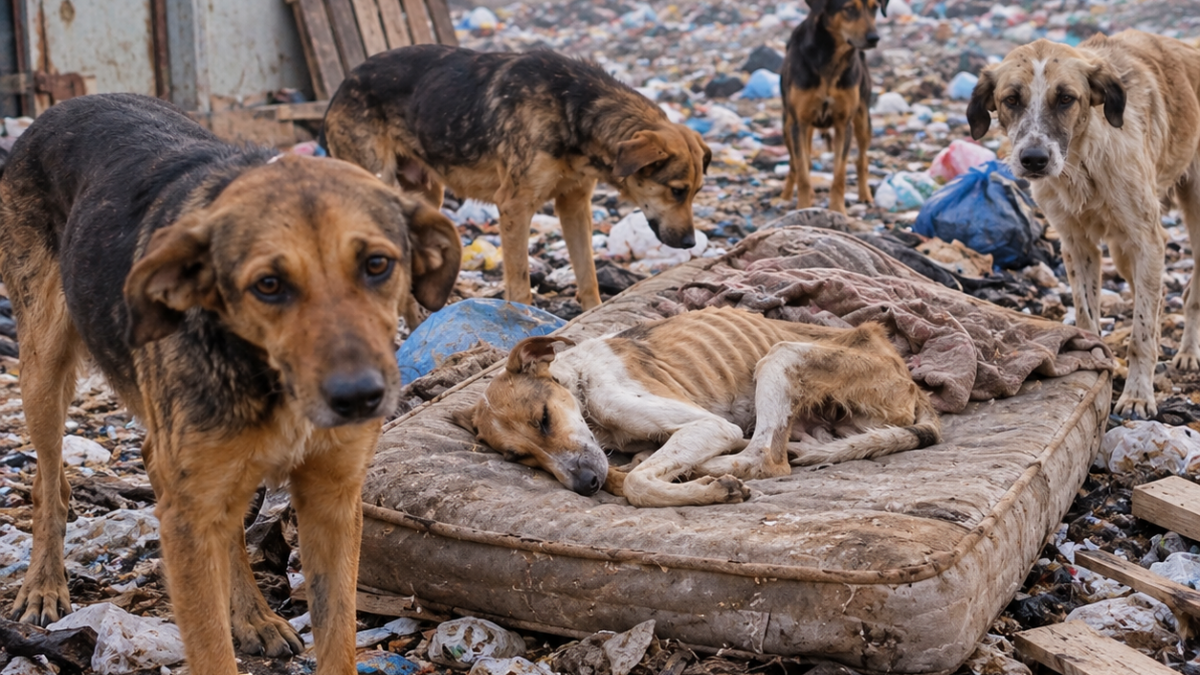
I stood there holding one corner of that makeshift stretcher, staring back at them.
The sick dog weighed almost nothing.
That should have made carrying him easier.
It didn’t.
Every step felt heavier because four dogs were watching.
They didn’t know where we were taking him.
They didn’t know what a veterinary clinic was.
They didn’t know that the phone call Ray had just made might be the difference between their friend living and dying.
All they knew was that two strangers had arrived, lifted the weakest member of their little family off the mattress, and were carrying him away.
The smallest of the four took two steps toward us.
He was brown with a white patch on his chest, though most of his coat was hidden under dirt.
He whimpered.
I stopped.
“Jackson,” Ray said carefully, still holding the other end of the fabric. “We need to keep moving.”
“I know.”
The dog came one step closer.
Behind him, the other three remained beside the mattress.
They looked exhausted.
Hungry.
Confused.
But not one of them ran.
I looked toward the truck, then back at the dogs.
“Ray, we can’t leave them.”
He closed his eyes for a second.
“I know.”
“There has to be a way.”
“Our truck isn’t built to carry five loose dogs, and this one needs the clinic now.”
“I’m not saying we leave him.”
“I know what you’re saying.”
There was frustration in his voice, but it wasn’t directed at me.
Ray had worked beside me for years. I knew the sound of him being angry at a broken hydraulic line, a bad route assignment, or somebody who had dumped construction waste where they shouldn’t.
This was different.
He was angry because the choice in front of us felt cruel no matter what we did.
The sick dog made a faint sound.
That settled it.
Ray nodded toward the truck.
“We take him first.”
“And come straight back.”
“Straight back.”
I looked at the four dogs.
“I don’t know if you understand me,” I said, “but we’re coming back.”
The brown dog tilted his head.
“We’re coming back for all of you.”
I said it like a promise.
Maybe it was ridiculous.
Maybe they understood nothing except the tone of my voice.
But promises matter most when nobody can force you to keep them.
Ray and I continued toward the truck.
The ground was uneven, littered with broken wood and sunken sections of dirt. Every few steps we had to adjust our grip.
The sick dog whimpered whenever the fabric shifted beneath him.
“Easy,” I kept saying. “Easy, buddy. Almost there.”
We reached the truck.
Ray opened the rear passenger door while I kept the stretcher steady.
Together, we slid the fabric across the seat.
The dog’s eyes remained closed.
For one terrifying moment I couldn’t see his chest moving.
I put two fingers gently against his side.
There.
A breath.
Shallow, but there.
I climbed in beside him.
Ray shut the door.
The four dogs had followed us part of the way.
Now they stood about twenty feet away.
The brown one was closest.
I lowered the window.
“I mean it,” I called. “We’ll be back.”
The truck started moving.
The dogs remained where they were.
The last thing I saw before we rounded the first pile of debris was the four of them standing together, watching their friend disappear.
I have carried that image with me ever since.
During the drive, I kept one hand on the dog.
The road out of the dumping area was rough, and every pothole made his body shake.
Ray drove slower than I had ever seen him drive that truck.
“Still breathing?” he asked.
“Yeah.”
A minute later:
“Still?”
“Yes.”
Then again.
“Jackson?”
“He’s still with us.”
I understood why he kept asking.
Ray could see us in the mirror, but he couldn’t see the dog’s chest clearly.
Neither of us wanted to say what we were both thinking.
What if we were too late?
I rubbed the dog behind one ear.
“You didn’t wait this long just to quit now,” I whispered.
His eyelids fluttered.
“That’s right. Stay with me.”
His head was resting partly against my thigh.
At some point, he shifted.
It was barely noticeable.
Then, slowly, he lowered his head completely into my lap.
I froze.
Ray glanced at me through the mirror.
“What?”
“Nothing.”
“What happened?”
“He put his head on me.”
Ray looked forward again.
His jaw tightened.
“That’s good.”
I don’t know if it was.
Maybe the dog was simply too weak to hold his head anywhere else.
But I chose to believe it meant something.
I continued talking to him.
I told him we were taking him somewhere warm.
I told him there would be water.
Food, eventually.
A soft place to sleep.
People who knew how to make the shaking stop.
I told him things I had no right to guarantee.
“You’re safe now,” I said.
Those words almost caught in my throat.
Because safe was not something he had been for a very long time.
His paws were scarred.
His coat was matted against his skin.
He smelled like dirt, rain, and neglect.
There was no way of knowing how long those five dogs had been living among the trash.
Days?
Weeks?
Longer?
I wondered how they had found one another.
Had they been abandoned together?
Had they belonged to one person?
Had they gathered one by one because animals without homes sometimes recognize the same loneliness in each other?
I would never know.
But I knew what I had seen.
When the weakest one could no longer walk, the others had stayed.
That fact followed me all the way to the clinic.
The veterinary staff were waiting outside when we arrived.
A woman in navy scrubs ran toward the truck with another technician.
“Is this him?”
“Yes.”
“How long has he been unresponsive?”
“He opens his eyes sometimes. He tried to move his tail.”
They brought a padded stretcher.
When they lifted him away from me, his head rolled slightly to one side.
I instinctively reached after him.
The veterinarian noticed.
“We’ve got him,” she said.
Her voice was calm, but she was moving quickly.
“We’re going to stabilize him first.”
“He has four others with him.”
“Other dogs?”
“Back at the site.”
“Same condition?”
“Thin. Hungry. But walking.”
“Bring them.”
“We are.”
She nodded.
“Good.”
Then the doors closed behind her.
That was it.
No dramatic speech.
No guarantee.
Just good.
Ray and I stood in the parking lot.
For the first time that morning, neither of us had a dog in front of us.
The silence felt wrong.
Ray rubbed both hands over his face.
“We need to go back.”
“Yeah.”
We climbed into the truck.
I had expected leaving the clinic to be the difficult part.
It wasn’t.
The difficult part was wondering whether the four dogs would still be there.
Neither of us said it aloud.
But the fear grew stronger with every mile.
“What if they followed the truck?” I asked.
“They couldn’t have.”
“They might have tried.”
“They were exhausted.”
“What if they scattered?”
“We’ll find them.”
“What if—”
“Jackson.”
I looked at him.
“We’re going back,” Ray said. “That’s what we can do.”
So I stopped talking.
When we turned onto the service road, I leaned forward.
The old mattress was still there.
For one second, that was all I could see.
Then four shapes rose from it.
“They’re there.”
Ray exhaled hard.
They were all there.
Waiting.
The brown dog stood first.
Then the tall black-and-tan one.
Then a white dog with gray ears.
The fourth, a reddish female with a narrow face, climbed slowly from the mattress.
They stared at the approaching truck.
Then something changed.
The brown dog’s tail started moving.
Not much.
Then faster.
The others followed.
By the time Ray stopped, all four were making those strange little whining sounds again.
Except this time the sound felt different.
Hope had become recognition.
I climbed out.
“You waited.”
The brown dog came toward me.
He stopped several feet away.
I crouched.
“Come on.”
He sniffed the air.
Then he closed the distance.
His nose touched the back of my hand.
That was all.
But after everything those dogs had apparently survived, it felt like a handshake.
Ray had found an old length of rope and some spare straps in the truck.
We didn’t want to risk four frightened dogs loose in the cab, so we worked slowly, one at a time.
The black-and-tan dog hesitated the longest.
The red female wouldn’t climb into the truck until the white dog went first.
The brown one kept looking toward the mattress.
Toward the empty place where his friend had been.
“He’s not there anymore,” I said. “He’s at the clinic.”
The dog looked at me.
“Come on. We’ll take you to him.”
He climbed in.
That was when I understood that the hardest part of rescue is not always catching an animal.
Sometimes it is asking a creature that has every reason not to trust people to trust you anyway.
We made the second trip more slowly.
The dogs shifted nervously at every turn.
The white one crouched low.
The black-and-tan dog remained pressed against the door.
The red female trembled.
The brown dog stayed as close to me as he could.
None snapped.
None growled.
Mostly they looked tired.
At the clinic, the staff were ready.
One by one, the dogs were taken inside.
The brown dog resisted for a second at the doorway.
Then he heard a faint sound from somewhere deeper in the building.
A whine.
He became completely still.
Another whine followed.
His ears lifted.
“That him?” I asked.
The technician smiled.
“Probably.”
The brown dog pulled toward the sound.
The other three reacted too.
Suddenly the clinic hallway was full of weak tails moving.
The veterinarian came out a few minutes later.
“He’s critical,” she said.
There was no point pretending she meant anything else.
“What’s wrong with him?”
“Severe dehydration and malnutrition are the immediate problems. His blood sugar is low. His body temperature is down. He’s anemic. We’re checking for parasites and infection.”
“Is he going to live?”
She paused.
That pause frightened me more than any answer could have.
“He has a chance.”
“A good chance?”
“He has a chance,” she repeated gently.
I looked through the narrow window in the treatment-room door.
He was lying under a blanket.
A line ran to one of his front legs.
The sight of it hurt.
Maybe because he looked even smaller surrounded by clean equipment.
At the dump, he had been part of the landscape of neglect.
Here, against white towels and stainless steel, you could see exactly how badly life had treated him.
“What can we do?”
“Right now? Let us work. And make sure the others get examined.”
“They won’t separate from him.”
“I noticed.”
She looked toward the four dogs waiting with the technicians.
“We’ll keep them close.”
The next hours moved strangely.
Ray called our supervisor and explained what had happened.
I expected anger.
Instead, after a long silence, our supervisor said, “Finish dealing with the dogs. We’ll cover what we can.”
That was all.
Sometimes decency sounds ordinary.
The four healthier dogs were examined.
They were underweight.
All were dehydrated to different degrees.
They had fleas and intestinal parasites.
One had an infected cut on a hind leg.
Another had worn paw pads.
But they could stand.
They could eat.
And, most importantly, they could recover.
The staff began giving them small amounts of food.
I watched the brown dog eat too fast.
A technician gently pulled the bowl away.
“Slow,” she said. “You’ll get more.”
He stared at the bowl.
His whole body was focused on it.
That kind of hunger is difficult to witness.
People say “starving” casually.
“I’m starving.”
“I haven’t eaten since breakfast.”
But real starvation changes the way an animal looks at food.
It is not appetite.
It is fear.
The fear that the meal might disappear.
The fear that there will never be another one.
When the technician returned the bowl, the brown dog ate slightly slower.
The others did the same.
Afterward, something surprised me.
Instead of lying down where they were, they all moved toward the treatment-room door.
The door behind which their sick friend was being treated.
The red female curled beside it.
The white dog lay beside her.
The black-and-tan dog lowered himself against the wall.
The brown one remained sitting.
Waiting.
“You weren’t kidding,” the technician said.
“About what?”
“They really don’t leave him.”
“No.”
She looked at the dogs for a long moment.
“Animals remember who stayed.”
That sentence stayed with me.
Late that afternoon, Ray finally convinced me to go home.
“You can’t help him by passing out in the waiting room.”
“I’m not going to pass out.”
“You’ve had coffee and half a vending-machine cracker all day.”
“So?”
“So go home.”
“What if something happens?”
“They have your number.”
I knew he was right.
But I hated leaving.
Before I went, the veterinarian allowed me to stand beside the sick dog for a few minutes.
He was warmer now.
Still weak.
Still frighteningly thin.
But his breathing looked steadier.
I touched his head.
“Your friends are right outside.”
His eyes remained closed.
“They waited for you.”
One ear moved.
I smiled despite myself.
“And we came back for them. I told you we would.”
As I turned to leave, his tail moved under the blanket.
A tiny motion.
But this time I knew I hadn’t imagined it.
The next morning, I went to the clinic before work.
Ray was already there.
“You’re supposed to be sleeping,” I told him.
“So are you.”
The receptionist smiled when she saw us.
“He ate.”
I stopped walking.
“What?”
“Not much. But he ate a little on his own.”
Ray slapped my shoulder.
I laughed.
I hadn’t realized how badly I needed to hear that.
When we saw him, he looked almost exactly the same.
Recovery doesn’t always look dramatic.
There was no sudden transformation.
No miraculous jump to his feet.
He was still lying down.
Still thin.
Still connected to fluids.
But the food dish beside him had been touched.
To me, it looked like victory.
“Good morning,” I said.
His eyes opened.
This time, he kept them open longer.
The brown dog was allowed into the room briefly.
The reaction was immediate.
The sick dog tried to lift his head.
The brown dog walked slowly to him, sniffed his face, and then did something so gentle that everyone in the room went quiet.
He pressed his forehead against his friend’s forehead.
No barking.
No excitement.
Just contact.
The sick dog’s tail moved.
The brown dog lay down beside the treatment bed.
“He can stay for a few minutes,” the veterinarian said.
Those few minutes became part of the routine.
Every day, one or two of the dogs were allowed to sit near him while he recovered.
And every day, I visited.
At first, I told myself I was checking on them.
By the fourth day, I knew that wasn’t the whole truth.
I needed to see them.
I needed proof that the image I had carried from the dump was changing.
On the first day, I had seen five animals at the edge of survival.
By the third, the four stronger dogs had begun noticing the world around them.
The white dog discovered a rubber ball.
At first, she stared at it as though she had no idea what such a thing was for.
A technician rolled it gently across the floor.
She followed it with her eyes.
The ball stopped.
She looked at the technician.
The technician rolled it again.
This time the dog stood.
She walked after it.
By the fifth roll, she touched it with her paw.
We all reacted as though she had won a championship.
The red female began seeking affection.
She would lean against anybody who sat beside her.
The black-and-tan dog remained cautious, but he stopped flinching when someone reached toward him.
The brown one was the most social.
But every few minutes, no matter what he was doing, he looked toward the room where his friend rested.
The sick dog improved more slowly.
The veterinarian warned us not to expect a straight line.
Some mornings he seemed stronger.
Some afternoons he slept almost constantly.
His body had been deprived for too long.
Feeding him too quickly could create new problems.
Everything had to be measured.
Fluids.
Calories.
Medication.
Rest.
Patience.
Especially patience.
On the fourth evening, I sat beside him after work.
“You know,” I said, “you’ve caused a lot of trouble.”
His eyes moved toward me.
“Stopped a garbage truck. Ruined our route. Made Ray emotional.”
From the other side of the room, Ray said, “I am not emotional.”
“You cried yesterday.”
“I had something in my eye.”
“Inside a veterinary clinic?”
“Dust.”
I looked at the dog.
“See what I deal with?”
His mouth opened slightly.
For one absurd second, it looked like he was smiling.
Ray pointed.
“He agrees with me.”
“No, he doesn’t.”
“Definitely does.”
We laughed.
It felt strange to laugh in that room.
But maybe that was when I first began to believe he might truly survive.
Two days later, the veterinarian called me while I was at work.
My stomach dropped when I saw the clinic number.
I answered immediately.
“Hello?”
“Jackson?”
“Yes.”
“This is Dr. Harris.”
“What happened?”
“Nothing bad.”
I leaned against the truck.
“You can’t start a phone call like that.”
She laughed softly.
“Sorry. I thought you’d want to know he stood up.”
I stopped breathing for a second.
“He what?”
“Only for a few seconds. His legs were shaky, and we supported him. But he stood.”
I covered my eyes with one hand.
Ray, across the road, saw my face.
He hurried toward me.
“What?”
I held up a finger.
“Did he walk?”
“Not yet.”
“But he stood?”
“He stood.”
“Thank you.”
When I ended the call, Ray stared at me.
“Well?”
“He stood up.”
Ray grinned.
For a man who claimed not to be emotional, he looked suspiciously close to tears again.
That evening, we arrived together.
The sick dog was lying on a padded mat instead of the treatment table.
The four others were nearby.
When he saw us, his tail moved several times.
Not the weak twitch from the dump.
A real wag.
“There it is,” Ray said.
I crouched.
“You showing off now?”
The dog tried to push himself upward.
His front legs straightened.
His back legs trembled.
He almost made it.
Then dropped gently onto the mat.
“Easy,” I said.
But something in his expression had changed.
The hopelessness was disappearing.
That may sound like something I imagined because I wanted to see it.
Maybe it was.
But there are moments when the body is still injured and the spirit has already begun to recover.
He looked interested in the world again.
He watched people move.
He sniffed food before eating.
He responded to the other dogs.
He lifted his head when someone entered.
Those were small things.
Small things were everything.
A week after we found them, all five dogs were moved into a larger recovery room together.
The staff arranged separate beds.
The dogs ignored most of them.
That first night, the sick one lay on the largest bed.
The brown dog curled against his back.
The red female slept near his paws.
The white dog pressed against his side.
The black-and-tan dog settled beside the bed with his chin resting on the edge.
The technician sent me a photograph.
I stared at it for a long time.
The first time I had seen them lying together, they had been surrounded by garbage.
Now they were lying on clean blankets.
Same family.
Different world.
I saved the photo.
I still have it.
The clinic began receiving questions about the dogs.
Staff members knew people who might foster one.
Someone offered to take two.
Another person asked about the white dog.
That should have been good news.
Five homeless dogs needed homes.
Finding even one safe placement was something to celebrate.
But every time separation was discussed, the dogs reacted.
If the brown dog was taken too far down the hall, the others became restless.
If the red female disappeared for treatment, the sick dog searched for her.
The black-and-tan dog refused to eat once until the white dog returned from an examination.
“They’re unusually bonded,” Dr. Harris told me.
“What happens if they’re separated?”
“They might adapt.”
“Might?”
“They probably would, eventually. Dogs can be resilient.”
I looked through the glass.
All five were asleep within touching distance of one another.
“But?”
She sighed.
“But if there’s any realistic way to keep bonded animals together, that’s what I prefer.”
“All five?”
She gave me a look.
“You know how difficult that is.”
I did.
One dog could be adopted.
Two was harder.
Five was a commitment.
Food.
Vet bills.
Space.
Time.
Training.
Who was going to walk into a clinic and say, Sure, I’ll take five rescued dogs?
I didn’t know.
And for the first time since the rescue, a new fear entered the story.
We might save their lives only to break apart the family that had helped them survive.
I thought about it constantly.
At work, I pictured the mattress.
The circle they had formed around their sick companion.
They had chosen not to abandon him when abandoning him might have made survival easier.
While he was lying there, they could have wandered farther in search of food.
They could have left.
They didn’t.
And now that humans had taken control of their future, we were discussing dividing them because keeping them together was inconvenient.
I understood the reality.
I did.
But understanding it didn’t make it feel right.
Ray felt the same way.
“One home,” he said.
We were sitting in the truck during lunch.
“For five dogs?”
“One home.”
“You know somebody?”
“No.”
“Then why do you sound so certain?”
“Because I’m tired of looking at impossible things and deciding they’re impossible before trying.”
I laughed.
“That sounded smarter than you normally sound.”
“Write it down.”
“What do we do?”
“We ask.”
So we asked.
The clinic asked.
A local rescue volunteer who had heard about the dogs asked.
Friends asked friends.
People shared the story privately.
Not with dramatic claims.
Not with promises.
Just the truth.
Five dogs had survived together.
One had nearly died.
The others had refused to leave him.
They needed space.
And if possible, they needed each other.
Several people responded.
Most loved the story but couldn’t take five dogs.
One family had room for two.
Another offered temporary foster care for three.
A woman with a small house wanted the brown dog.
Every offer was kind.
None kept them together.
Meanwhile, the sick dog kept improving.
The first time I saw him walk more than a few steps, I nearly missed it.
I had arrived after work.
Ray was parking.
I entered the recovery room and found all five dogs awake.
The brown one rushed toward me.
The white dog followed.
Then the red female.
The black-and-tan dog remained near the back.
And behind them, the dog who had once been unable to lift his head was standing.
No technician holding him.
No sling.
Standing.
“Well, look at you.”
His tail moved.
He took one step.
Then another.
His legs were still too thin, but they held him.
I crouched.
“Come here.”
He walked toward me.
Slowly.
One paw at a time.
Halfway across the room he stopped.
I could see the effort.
“Take your time.”
He looked at me.
Then continued.
When he reached me, he pressed his head against my chest.
I wrapped both arms around him.
I had been trying not to cry.
I failed.
“You stubborn little thing,” I whispered.
His tail thumped softly against the floor.
Ray walked in behind us.
He stopped.
“Is he—”
“Yeah.”
“He walked?”
“All the way over.”
Ray crouched beside us.
The dog lifted one paw and placed it awkwardly on Ray’s knee.
Ray looked at me.
“Dust,” he said.
“There is no dust.”
“A lot of dust in here.”
“You’re crying.”
“So are you.”
That ended the argument.
The five dogs recovered visibly after that.
Their coats began to change.
With bathing, medication, and nutrition, the dull fur became softer.
The brown dog’s white chest appeared bright beneath the grime.
The black-and-tan dog gained enough weight that his hip bones no longer looked sharp.
The red female became playful.
The white dog decided tennis balls were the greatest invention humanity had ever produced.
And the dog from the mattress began acting younger than I expected.
That surprised us.
His body had made him look old.
Once strength returned, his behavior revealed that he was probably still young.
He bounced awkwardly.
He chased the others for short distances.
He stole a towel once and dragged it across the room while three technicians followed him laughing.
“He has personality,” Dr. Harris said.
“He always did.”
“You met him unconscious.”
“He tried to wag his tail.”
“That’s true.”
The day came when the veterinarian told us he was medically ready to leave the clinic.
I had imagined hearing those words since the first morning.
I expected nothing but relief.
Instead, I felt nervous.
“Where does he go?”
Dr. Harris hesitated.
“That depends on what happens with the group.”
“So we still don’t have a home.”
“We may have something.”
I looked at her.
“What?”
“There’s a woman coming tomorrow.”
“For all five?”
“She wants to meet them.”
“That wasn’t my question.”
Dr. Harris smiled.
“She has property outside town. Fenced acreage. She’s had rescue dogs before.”
“All five?”
“She hasn’t promised.”
My hope rose and immediately tried to protect itself.
“Don’t tell Ray yet.”
“Why?”
“He’ll start planning a celebration.”
“You’re the one crying every time this dog walks.”
“That’s different.”
“Of course.”
The next afternoon, I arranged to be at the clinic.
So did Ray.
We tried to pretend we weren’t nervous.
At two fifteen, a dark SUV pulled into the parking lot.
A woman in her late fifties got out.
She wore jeans, old boots, and a faded blue shirt.
That made me trust her immediately more than if she had arrived dressed like she was there for an interview.
She introduced herself as Ellen.
Dr. Harris brought her into the recovery room.
The dogs reacted cautiously.
Brown approached first.
Of course he did.
Ellen sat on the floor.
She didn’t reach for him.
She simply let him sniff her.
Then the white dog came over carrying the tennis ball.
Ellen smiled.
“Is that yours?”
The dog dropped it.
Ellen rolled it.
The dog chased it.
The red female leaned against Ellen’s shoulder.
Within ten minutes, three dogs had accepted her.
The black-and-tan dog remained across the room.
Ellen did not force him.
“What about him?” she asked.
“Slow to trust,” I said.
“Good.”
“Good?”
“He should be.”
That answer mattered to me.
She looked toward the dog who had been sick.
He was lying near the window.
“Is that the one from the mattress?”
“Yes.”
She moved several feet closer but stopped.
He watched her.
She sat again.
For nearly a minute, nothing happened.
Then he stood.
Walked toward her.
Stopped.
Sniffed her hand.
And placed his chin on her knee.
Ellen’s eyes filled.
“Oh, sweetheart.”
The other dogs gathered around.
For a moment, all five were touching her in some way.
Brown beside her hip.
Red leaning against her.
White at her feet.
Black-and-tan finally close enough to sniff the back of her shoulder.
And the recovering dog resting against her knee.
Ellen looked up at Dr. Harris.
“You said they’ve been together the whole time?”
“As far as we know.”
“And the four stayed with him?”
“Yes.”
“When he couldn’t walk?”
“Yes.”
She looked down at them.
Then she asked the question I had been afraid to hear.
“Which ones are you planning to separate?”
Dr. Harris answered carefully.
“We’re trying not to.”
“Good.”
Ellen scratched the brown dog gently beneath his chin.
“My last two dogs died within a year of each other,” she said. “Old age. One was sixteen. The other nearly fifteen.”
“I’m sorry,” I said.
“Thank you.”
She looked around the room.
“The house has been too quiet.”
My heart began beating harder.
But I still refused to assume anything.
Ellen spent almost two hours with the dogs.
She asked practical questions.
Weights.
Approximate ages.
Medical needs.
Temperaments.
Food.
Fencing.
She asked whether they had shown aggression toward people.
They hadn’t.
She asked how they behaved together.
Like family.
She asked what would happen if nobody took all five.
Silence filled the room.
Finally Dr. Harris said, “We would probably place them in the best combinations we could.”
Ellen nodded slowly.
Then she stood.
The dogs watched her.
“I need to go home and check one thing.”
My hope fell.
Of course.
It had been too perfect.
Ray must have felt it too because he stopped smiling.
Ellen looked at us.
“I want to make sure the back gate latch is still solid. I haven’t used that run in a while.”
I stared at her.
She smiled.
“If I’m bringing home five dogs, I’d rather not spend the first night chasing them across forty acres.”
Ray made a sound somewhere between a laugh and a cough.
“All five?” I asked.
Ellen looked down at the dogs.
“I came here thinking I might be able to take three.”
My chest tightened.
“Then I saw the way they look for one another.”
The dog from the mattress had moved beside the brown one.
Their shoulders touched.
Ellen shook her head.
“I’m not taking three.”
She paused.
“I’m taking the family.”
Ray turned away.
“Dust?” I asked.
“Shut up.”
I didn’t do any better.
Ellen still had to complete the adoption process.
Her property had to be confirmed suitable.
The clinic and rescue volunteers helped make arrangements.
There were practical details.
Food.
Crates for transport.
Medical records.
Medication.
Follow-up visits.
But after so much uncertainty, those details felt wonderful.
They were problems with solutions.
A few days later, I drove out to Ellen’s property with Ray.
She had a modest house surrounded by open land and mature trees.
Behind it was a large fenced yard.
There was grass.
Actual grass.
Shade.
Clean water bowls.
A covered porch.
Several dog beds inside.
Ray looked at me.
“Think they’ll approve?”
“I don’t know. Needs more garbage.”
“Definitely. Maybe a broken refrigerator.”
“Old mattress.”
We both became quiet.
The joke landed too close to the memory.
Ellen noticed.
“You still think about where you found them?”
“Every day,” I said.
“So do I, and I wasn’t even there.”
She opened the back door.
“I don’t know what their lives were before that place.”
“Neither do we.”
“But I know what they’ll be after.”
That was enough.
The day they left the clinic felt almost ceremonial.
Nobody planned it that way.
The technicians simply had become attached to them.
People kept finding reasons to walk past the lobby.
One person brought new collars.
Another packed their medicine.
Someone else brought the white dog’s tennis ball.
Dr. Harris checked the recovering dog one final time.
“He’s still underweight,” she told Ellen. “Continue the feeding plan. Increase exercise gradually. Call if his appetite changes.”
“I will.”
“And the others have follow-up medication schedules in the folder.”
“I’ve got everything.”
The black-and-tan dog climbed into Ellen’s vehicle first.
That surprised everyone.
The white dog followed.
Then red.
Then brown.
The dog who had almost died remained beside me.
I crouched.
“So this is it.”
He wagged his tail.
A strong wag now.
The kind that moved his whole back end.
“You know, you didn’t make this easy.”
He licked my chin.
Ray laughed.
“There goes your dignity.”
“I work in garbage. I didn’t have much.”
I put my hand against the dog’s face.
For a second, the clinic disappeared.
I was back beside the old mattress.
His eyes half closed.
His body trembling.
That tiny failed attempt to move his tail.
I remembered thinking he might die before we reached the truck.
Now he was standing in front of me.
Clean.
Fed.
Safe.
Loved.
“I told you things were going to get better,” I whispered.
He licked my hand.
Then Ellen called him gently.
He turned.
The four dogs inside the vehicle were watching him.
Waiting.
Of course they were.
He walked toward them.
No hesitation.
Ellen helped him climb inside.
The moment he entered, the brown dog pressed close to him.
White sat beside them.
Red curled near the door.
Black-and-tan looked out through the window.
Five dogs.
Together.
Still.
The clinic staff gathered outside.
Ellen closed the door.
Before getting behind the wheel, she came over and hugged me.
Then Ray.
“You two stopped,” she said.
That sentence hit harder than I expected.
“What?”
“You could have driven past.”
“We couldn’t.”
“You could have.”
I thought about that.
Maybe she was right.
The world is full of suffering we don’t see.
And sometimes suffering we do see becomes somebody else’s problem because stopping would make our day harder.
It would interrupt the schedule.
Create paperwork.
Cost money.
Take time.
Ray had stopped the truck.
That was the first rescue.
Everything after came because of that one decision.
We watched Ellen drive away.
Five faces appeared at different windows.
I waved.
Ray waved.
When the SUV disappeared around the corner, neither of us moved.
The parking lot felt strangely empty.
“You okay?” Ray asked.
“No.”
“Me neither.”
We laughed.
Then I cried again.
I visited them two weeks later.
Ellen met me at the gate.
Before I even reached the house, barking erupted from the yard.
Five dogs appeared.
For half a second, I couldn’t tell which one was which.
They looked different already.
Health changes an animal’s shape.
Their coats shone.
Their movements were faster.
Their bodies were filling out.
The dog who had been sick ran toward me.
Ran.
Not quickly compared with the others.
But he ran.
I dropped to my knees.
He collided with me hard enough to push me backward.
“Hey!”
Brown arrived next.
Then white.
Then red.
Even black-and-tan came close enough to bump my shoulder.
I sat in the grass surrounded by them.
Ellen stood on the porch laughing.
“I think they remember you.”
“Maybe they think I brought food.”
“That too.”
The former sick dog climbed halfway into my lap.
He was too big for it.
He didn’t care.
I looked at his face.
“You look good.”
His ears lifted.
“Really good.”
Ellen told me about their routine.
They slept inside.
All five.
Even though she had bought separate beds, three usually shared one giant cushion and the others slept beside it.
The white dog carried her tennis ball everywhere.
The red female followed Ellen from room to room.
The black-and-tan dog had decided the porch was his observation station.
The brown dog loved everyone.
And the dog from the mattress?
“He checks where the others are before he settles,” Ellen said.
“What do you mean?”
“Every night. He walks through the rooms. Looks at each one. Then he lies down.”
I stared at him.
“Still keeping track of everybody?”
Ellen smiled.
“Apparently.”
I visited again a month later.
Then again.
I didn’t go constantly.
They were Ellen’s dogs now.
They had a life.
But she told me I could visit whenever I wanted.
Sometimes Ray came.
Sometimes we went separately.
Every visit showed another small change.
The dogs gained weight.
Their fear faded.
The black-and-tan one eventually allowed me to scratch his chest without hesitation.
The red female learned to steal gardening gloves.
Brown discovered that if he sat near the kitchen long enough, somebody might drop something.
White continued her lifelong commitment to tennis balls.
And the dog we had once carried on a dirty sheet became almost impossible to recognize as the same animal.
His legs were strong.
His coat was thick.
His eyes were bright.
But there was one thing he never lost.
Whenever another dog was upset, he went to them.
Thunderstorm?
He stayed beside the nervous one.
Veterinary visit?
He waited near the door.
One of the others limped after running too hard once?
He followed her around until she was fine.
Maybe I was putting human meaning onto animal behavior.
I understood that possibility.
But I had also watched four starving dogs choose companionship over self-preservation.
I had watched them stand around a dying friend in a place where there was almost nothing to eat.
I had seen them wait on an abandoned mattress after we carried him away.
You can call that instinct if you want.
You can call it pack behavior.
You can call it bonding.
I call it loyalty.
Months passed.
One Saturday, Ellen invited Ray and me for lunch.
We sat on her porch while the dogs wandered across the yard.
The weather was warm.
The grass moved in the breeze.
There was no smell of garbage.
No machinery.
No piles of discarded things.
Just open land and five dogs who looked as though they had always belonged there.
Ray watched them.
“You ever think about that morning?”
“Every time I see them.”
“I almost didn’t stop.”
I turned toward him.
“What?”
He kept looking at the yard.
“I saw movement. Thought it was probably birds or something.”
“But you stopped.”
“Yeah.”
“Why?”
He shrugged.
“I don’t know.”
That answer bothered him.
I could tell.
Finally he said, “Maybe because something looked wrong.”
The recovering dog trotted across the yard.
Brown chased him.
White chased both.
Within seconds, all five were running.
Ray smiled.
“Five seconds.”
“What?”
“That’s what I keep thinking. If I’d looked away five seconds earlier, maybe I wouldn’t have seen them.”
I had thought about things like that too.
What if our route had changed?
What if we had arrived an hour earlier?
What if the dogs had been deeper among the debris?
What if rain had been falling?
What if Ray had simply kept driving?
People like to imagine life-changing moments as something dramatic.
A loud crash.
A phone call.
A door opening.
Sometimes they are smaller.
Sometimes they are a foot moving from accelerator to brake.
Sometimes they are one person saying, “Look over there.”
Sometimes a life changes because somebody notices.
Ellen brought lemonade to the porch.
“You two are quiet.”
“Thinking,” Ray said.
“Dangerous.”
“Exactly what I told him.”
The dog from the mattress climbed the steps.
He placed his head on my knee.
I rubbed behind his ear.
There was healthy muscle there now.
No sharp bone.
No trembling.
“You know,” Ellen said, “people keep asking which one is the leader.”
“What do you tell them?”
“That I don’t think it works like that.”
She watched the five dogs.
“They all saved each other in different ways.”
I looked down at the dog beside me.
That felt true.
The four had stayed with him when he was dying.
But maybe he had given them something too.
A reason to stay together.
A focus beyond hunger.
Something to protect.
Something worth waiting for.
People often think rescue stories are about humans saving animals.
That is the simplest version.
But it isn’t always the whole truth.
Those dogs changed something in me.
Before that day, I thought of kindness as a feeling.
Something warm.
Something you carried inside.
Afterward, I understood kindness differently.
Kindness is an action.
It costs something.
Time.
Convenience.
Money.
Effort.
Sometimes sleep.
Sometimes tears.
Feeling bad for those dogs would have done nothing.
Stopping the truck mattered.
Calling the clinic mattered.
Going back mattered.
The veterinary staff staying late mattered.
People offering food mattered.
Ellen opening her home mattered.
And long before any of us arrived, four starving dogs deciding not to walk away from a fifth dog mattered.
They had almost nothing.
Still, they gave him what they had.
Their presence.
I think about that often.
Years of working around discarded things had taught me something cynical without my noticing.
I had started believing that people throw away almost anything once it becomes inconvenient.
Furniture.
Appliances.
Clothes.
Animals.
Sometimes relationships.
Sometimes responsibilities.
Then I found five dogs in the middle of all that waste who behaved as though the opposite were true.
One of them had become a burden.
He couldn’t walk.
He couldn’t search for food.
He couldn’t protect himself.
The others could have left.
Nobody would have blamed animals for following hunger.
Instead, they stayed.
They surrounded him.
They waited.
They cried when strangers lifted him away.
And when we returned, they were still there.
Every time I tell that part, people ask me the same thing.
“How did the dogs know you were helping?”
I don’t know.
Maybe they didn’t.
Maybe they simply had no other choice.
Maybe exhaustion overcame fear.
But I remember the way they stepped back from the mattress.
The way they watched my hands.
The way the brown dog followed us.
I remember the sound they made when we lifted their friend.
And I believe they understood one thing.
Something was changing.
Years later, the exact details of many workdays have disappeared from my memory.
I don’t remember what addresses we serviced the week before that rescue.
I don’t remember what the weather was the following Tuesday.
I don’t remember how late we finished our route.
But I remember that mattress.
I remember kneeling.
I remember touching the dog’s head.
I remember his eyes opening.
And I remember the tiny movement of his tail.
That almost-wag.
That was the moment.
Not the clinic.
Not the adoption.
Not the first time he ran.
That tiny movement was where the story changed for me.
Because here was an animal with almost no strength left, and somewhere inside him there was still enough hope to respond to a gentle hand.
I have wondered whether I would have had that much hope.
I don’t know.
I hope so.
One winter afternoon, months after the rescue, Ellen sent me a photograph.
Snow had covered part of her yard.
The five dogs were inside near the fireplace.
They were asleep in a pile.
Brown’s head was resting across the white dog’s back.
Red was curled against black-and-tan.
And in the center was the dog from the mattress.
The others surrounded him.
Almost exactly the way they had when I first saw them.
But everything around them had changed.
Instead of garbage, there was a warm home.
Instead of a ruined mattress, there were clean blankets.
Instead of starvation, full food bowls waited in the kitchen.
Instead of fear, there was safety.
I stared at that picture until my eyes blurred.
Then I sent it to Ray.
He replied almost immediately.
Same formation.
I wrote back:
Different ending.
That, more than anything, is what I wanted for them.
Not to erase what happened.
You can’t erase it.
The scars were real.
The hunger was real.
The abandoned mattress was real.
But pain does not have to be the last chapter simply because it was the first chapter someone happened to witness.
Those dogs got another chapter.
Then another.
And another.
They learned ordinary things.
The sound of a food container opening.
The comfort of a couch.
The annoyance of bath time.
The excitement of a car ride that didn’t end in abandonment.
The smell of summer grass.
The pleasure of lying in sunlight with nothing to fear.
Those things sound small until you remember that there was once a morning when one of them could not raise his head.
I visited Ellen on the anniversary of the rescue.
I didn’t tell anyone why I had chosen that day.
I wasn’t even sure Ellen remembered the exact date.
But I did.
Ray came too.
He brought five cheap dog toys.
“You bought the noisiest ones possible,” I told him.
“That’s what friendship looks like.”
“That’s what revenge looks like. Ellen has to live with them.”
The dogs exploded into the yard when they saw us.
The white one immediately grabbed two toys.
Brown chose a squeaking duck.
Red stole a rope.
Black-and-tan ignored everything until Ray tossed a ball.
And the dog from the mattress came straight to me.
I sat on the grass.
He leaned against my shoulder.
His weight nearly knocked me sideways.
I laughed.
“You’re a lot heavier than the first time I carried you.”
He wagged his tail.
Ellen came outside.
“I think he still remembers.”
“Do dogs remember that long?”
“They remember people. Places. Feelings. Who knows exactly how they store it?”
I scratched his chest.
“I hope he forgot the dump.”
Ellen was quiet.
“Maybe forgetting isn’t necessary.”
I looked at her.
“Maybe knowing you’re safe now is enough.”
I thought about that for a long time.
The dogs played until they were tired.
Eventually they gathered beneath a shade tree.
All five.
Close together.
Ray sat beside me.
Neither of us spoke.
There was nothing left to say.
The answer was right in front of us.
When I went home that evening, I drove past the road that led toward the dumping site.
For a moment, I considered turning.
I hadn’t been back to the exact place since work had taken us there again months before.
But I kept driving.
I didn’t need to see the mattress.
It was probably gone.
Buried.
Moved.
Destroyed.
That place had already taken enough space in my memory.
I preferred the yard.
The porch.
The photograph by the fireplace.
The sound of five dogs racing through grass.
People sometimes ask why this story means so much to me.
After all, I didn’t perform surgery.
I didn’t provide months of veterinary care.
I didn’t adopt them.
I happened to be sitting in a truck when Ray noticed movement in the distance.
That is true.
But maybe that is exactly why the story matters.
You do not have to be the person capable of solving everything.
Sometimes you only have to be the person willing to stop.
Then call somebody who can help.
Then do the next thing.
And the next.
We could not treat the sick dog.
So we transported him.
We could not safely transport all five at once.
So we promised to return.
We could not offer them a permanent home.
So we kept asking until someone could.
Nobody had to do everything.
But everybody had to do something.
That is how five dogs left a dump alive.
One step at a time.
One person at a time.
One decision at a time.
My name is Jackson.
I still work around things people no longer want.
I still see discarded furniture, broken appliances, bags split open in the rain.
But I don’t look at those places the same way anymore.
Because once, among mountains of trash, I found something nobody had thrown away.
Loyalty.
Four hungry dogs had almost nothing left to give.
No food.
No shelter.
No strength to spare.
But when their friend collapsed, they gave him the one thing they still had.
They stayed.
And when help finally arrived, they trusted us just enough to let us carry him away.
We came back.
That part matters to me.
We promised them we would.
And we did.
Years from now, I may forget a lot of things.
I may forget routes.
Names.
Addresses.
Whole weeks of ordinary life.
But I will never forget those four dogs standing around that old mattress.
I will never forget the fifth dog trying to wag a tail he was too weak to move.
And I will never forget seeing all five of them later, running through Ellen’s yard beneath an open sky.
The first time I saw them, they were surrounded by things the world had thrown away.
The last time I stood at that fence and watched them run, not one of them looked abandoned anymore.
Brown raced across the grass.
White followed with her ball.
Red cut between them.
Black-and-tan barked from the porch.
And the dog we once carried out on a dirty piece of fabric stopped halfway across the yard.
He turned.
Looked back at the others.
Waited until they caught up.
Then all five ran on together.
Exactly as they always had.
Together.








