I found the cut in my ranch fence before sunrise, three clean snips in silver wire twenty yards from timber where wolves had been moving all winter.
I sat at the kitchen table with the green return receipt in my hand until the words around it blurred.
Tessa had not misunderstood.
She had not been uninformed.
She had not inherited some half-finished trail plan from a previous committee and made an innocent assumption about where the property line fell.
She had signed for the warning herself.
Four months earlier.
The letter had been plain because plain language matters when livestock, dogs, hikers, and wolves can all end up in the same place.
The north fence at Blacktail Draw was not to be climbed, opened, cut, removed, marked, rerouted, or used for trail access during the seasonal wildlife advisory.
I had attached the state wildlife advisory.
A boundary map.
A photograph of the yellow sign.
And the diagram identifying Caleb’s cedar post as Control Point B.
Tessa had signed the receipt.
Now her committee was advertising that same point as a neighborhood shortcut.
June pushed her nose against my knee.
I looked down.
“You knew she was lying before I did.”
June blinked.
Dogs are unbearable that way.
I photographed the certified receipt.
Then scanned every page of the 2021 wildlife plan.
The scanner complained as it pulled the older sheets through one at a time.
Some pages had Caleb’s pencil notes along the margins.
NO DOGS.
NO HIKERS.
NO GAPS.
He wrote like that when something mattered.
Block letters.
No room for interpretation.
Caleb had never hated wolves.
That was one of the things I loved most about him.
He respected animals too much to turn them into villains.
“A wolf follows hunger,” he used to say. “A sheep follows fear. Our job is to keep the line clear enough that neither animal has to make a bad decision.”
The north fence was part of that line.
After wolves began moving through Blacktail Draw several winters earlier, Ranger Holt had helped us reinforce the lower wire and close casual foot traffic during the advisory season.
No dramatic shootouts.
No trapping.
No hysteria.
Fence.
Signs.
Dogs controlled.
Sheep inside.
People on approved paths.
Simple separation.
It worked.
Until Ridgeview decided a trail map looked prettier if the green line didn’t stop at my ranch.
I created a folder on my laptop.
BLACKTAIL DRAW — RANGER EVIDENCE.
Inside went:
Game-camera clips.
Cut-wire photographs.
Missing-sign photographs.
Trail ribbons.
HOA laminated marker.
The public kiosk map.
The resident email.
Gary’s printed expansion map.
The sheriff incident number.
The 2021 separation plan.
My certified warning.
Tessa’s signed receipt.
Then I emailed Ranger Holt.
Subject:
CONTROL POINT B — COMPLETE DOCUMENTS.
I added only one sentence.
Tessa Vale personally signed for the attached warning four months ago.
His reply came seven minutes later.
Received. Preserve originals. Livestock status?
Lower lot secured.
Interior gate locked.
June with flock.
North breach untouched.
I hit send.
Then another email appeared.
From Tessa.
Willa,
We are aware you have been contacting outside agencies and alarming residents regarding the North Ridge access project. The association expects you to remove unauthorized warning materials and stop interfering with approved community trail access. Continued obstruction may result in legal action regarding disruption of community amenities.
I read unauthorized warning materials twice.
She meant the state wildlife sign.
The sign her volunteers had apparently removed from my post.
I forwarded her email to Holt.
No commentary.
I had learned something during the two years after Caleb died.
If someone wants you to become emotional evidence against yourself, give them boring documentation instead.
Tessa wanted me shouting.
She wanted me standing at the Ridgeview clubhouse waving wire cutters over my head while residents recorded me.
Then the story could become:
Angry ranch widow threatens community trail users.
That was easier than:
HOA recreation committee knowingly promoted a route through a private livestock boundary during a wildlife advisory.
So I stayed boring.
At 3:47 that afternoon, boring became difficult.
A white Ridgeview Pines maintenance truck turned onto my lower road.
Two men got out.
One carried a hammer.
The other lifted a bundle of orange stakes from the bed.
Each stake had a laminated arrow stapled near the top.
NORTH RIDGE WALK THIS WAY.
I stood on the porch.
June stood beside me.
One worker drove the first stake into the shoulder beside my lower gate.
Not the north fence anymore.
The lower gate.
A second access point.
They were creating alternatives.
I didn’t run.
Every ranch instinct I had told me to move fast.
Instead, I walked.
Phone recording.
June tight at my left knee.
When I reached them, the hammer man had driven the stake halfway into the ground.
“This is private ranch property,” I said. “State your names and who sent you.”
He straightened.
“We’re just marking the event route.”
“That isn’t what I asked.”
The second man looked uncomfortable.
“Ridgeview maintenance asked us to help.”
“Who authorized the stakes?”
The first man said nothing.
The second man said, “Tessa.”
The first man glared at him.
I kept filming.
“You are installing trail markers at my ranch gate after I reported a cut fence and wildlife safety incident.”
“We were told the corridor was approved.”
“It isn’t a corridor.”
“That’s what the work order says.”
I lowered the phone slightly.
“Show me.”
He hesitated.
Then went to the truck.
Maybe he decided Ridgeview didn’t pay him enough to become the man holding secret paperwork during a ranger investigation.
He brought back a clipboard.
RIDGEVIEW PINES.
Location:
RANCH CORRIDOR — ALTERNATE ENTRY LOWER GATE.
Instructions:
PLACE TEMPORARY DIRECTIONAL STAKES BEFORE FRIDAY MORNING ACCESS WINDOW.
Friday.
Not Saturday.
I took three photographs.
“You moved the walk.”
The worker shrugged.
“We just do what we’re told.”
“Then tell whoever told you that state wildlife officers are already investigating the north breach.”
Both men looked toward Blacktail Draw.
The second one stopped holding the stakes like event decorations.
He set them back in the truck.
The first man pulled the half-driven marker from the ground.
They left.
I photographed the tire marks.
The stake hole.
Two orange plastic scraps near the ditch.
Then I checked my phone.
Three messages.
Sheriff incident number.
Ranger Holt asking for the work-order photos.
And Tessa.
Willa,
Your continued interference has caused confusion among residents. To reduce disruption, the Recreation Committee has adjusted the trail walk to Friday morning. Please do not approach residents, volunteers, or contractors. Any attempt to block community access may be documented and referred to counsel.
Adjusted.
They had moved the walk earlier.
Before the scheduled ranger inspection.
I forwarded the message to Holt.
Then I finally wrote directly to Tessa.
Tessa,
You signed for my certified warning letter four months ago.
The cut north fence is Control Point B in the 2021 Blacktail Draw wolf-season livestock separation plan.
You are promoting organized public access through an unrepaired wildlife safety breach.
Cancel the walk.
Attachments:
Signed receipt.
Control Point B map.
Camera still.
Work-order photograph.
I read it twice.
Sent.
Eleven minutes later:
The association does not recognize your private interpretation of advisory materials. The fence issue appears unrelated to the community trail. Please stop escalating.
Private interpretation.
I laughed once.
June looked at me.
“That one was funny.”
She didn’t agree.
At 5:18, Gary forwarded the newest Ridgeview email.
NORTH RIDGE OPENING WALK — UPDATED TIME.
Friday.
7:00 a.m.
The stated reason:
A quieter nature experience and avoidance of unnecessary conflict caused by misinformation.
Residents were told to keep dogs leashed and remain on marked access points.
Marked access points.
Plural.
I stood at the kitchen table.
Caleb’s yellow folder lay open.
NO DOGS.
NO HIKERS.
NO GAPS.
The wind came up outside.
June lifted her head.
I checked the sheep.
All seventy-three were pressed into a tighter bunch than normal.
Sheep will group for weather.
Predators.
Noise.
Anything that puts uncertainty into the pasture.
Their bodies pointed toward the timber.
I swept my flashlight along the fence.
Nothing.
That didn’t mean nothing was there.
At 9:18, Ranger Holt called.
“We have the packet.”
“Can you stop them?”
“We saw the updated event notice.”
“They moved it earlier.”
“Yes.”
“So?”
There was paper movement on his end.
“If they attempt organized access through Control Point B before corrective inspection, we have enough to intervene.”
Enough.
I sat down.
“What does enough mean?”
“It means preserve what you have. Do not repair tonight. Do not confront participants tomorrow.”
“What if they enter?”
“We’ll be there.”
“You promise?”
Holt was quiet for half a second.
“I don’t use that word professionally.”
I appreciated that.
Then:
“But we’ll be there.”
I slept in jeans and a sweatshirt on the couch.
Boots beside the door.
June on the rug facing the window.
At 5:46, headlights swept across the ceiling.
June stood before I did.
A dark green state truck climbed my drive.
Ranger Holt stepped out.
Gray beard.
Green jacket.
Coffee in one hand.
A younger ranger got out carrying a field case, camera, measuring tools, and evidence flags.
Holt looked at me.
“Willa.”
“Holt.”
“You sleep?”
“Enough.”
His eyes moved toward the pasture.
“Sheep?”
“Still tight.”
“Show us.”
We walked down before sunrise.
Frost silvered the grass.
The flock stood around the lower hay rack, every head turned toward Blacktail Draw.
The younger ranger noticed.
“They’ve been holding like that long?”
“Since yesterday.”
He wrote it down.
At the north fence, Holt stopped ten feet short of the breach.
That mattered to me.
He didn’t walk straight toward the obvious damage.
He looked at the whole scene.
Slope.
Timber.
Old service path.
Cut wire.
Footprints.
Orange ribbons.
Empty signpost.
People who understand land look at relationships before objects.
“Stay behind me.”
I did.
The younger ranger placed a yellow evidence marker beside one boot print.
Holt crouched near Caleb’s cedar post.
“Clean cuts.”
“Bolt cutters are on camera.”
“I saw the stills.”
He inspected the empty screw holes.
“Sign was removed recently.”
“How can you tell?”
“Fresh wood exposure.”
He stood.
“Markers?”
I pointed.
“First ribbon there. More through the brush.”
“You left them?”
“Yes.”
“Good.”
One word.
Good.
I hadn’t realized how badly I needed to hear it.
Not because the situation was good.
Because every ranch instinct had screamed at me to repair the fence, remove the trail ribbons, restore the sign, make the land safe.
Instead, I had left the ugly evidence in place.
For once, not fixing something had been the correct work.
We followed the fence east.
June stayed close.
Halfway toward the draw, she stopped.
Rigid.
Holt noticed.
“Dog alert?”
“She’s done that since yesterday morning.”
He stepped toward a damp patch beneath two pines.
Crouched.
Angled his flashlight.
Then put down another evidence marker.
“What?”
“Canine track.”
I felt the muscles in my back tighten.
“Wolf?”
“Large enough to document.”
“Holt.”
“We measure first.”
Ranger language.
Calm.
Precise.
Infuriating when you want an answer.
He measured the track.
Photographed it.
Found another partial print five feet away.
The direction ran parallel to the fence.
Not through the cut.
Near it.
Near enough.
Holt stood.
“This is why the control point exists.”
“Tessa says the advisory isn’t a closure.”
“Tessa Vale does not get to interpret a seasonal wildlife separation plan into trail access.”
The younger ranger looked up at that.
I handed Holt the yellow folder.
He opened the 2021 plan beside the fence.
Control Point B.
Maintain closure during advisory period.
Avoid casual foot traffic.
Domestic dogs excluded from livestock-wildlife interface zone.
Livestock separation required.
Then my certified warning.
Then the signed receipt.
Then the HOA trail map.
Holt looked at the public kiosk photograph.
TEMPORARY ACCESS PROVIDED COURTESY OF NEIGHBORING RANCH CORRIDOR.
His mouth tightened.
“That matters.”
“Why?”
“Because property damage is one issue.”
He pointed to the map.
“Promoting organized public access through the damaged control point is another.”
Voices drifted through the trees.
Laughter.
Trekking poles clicking against frozen ground.
Then a dog barked.
The younger ranger looked at his watch.
6:31.
“They’re early.”
I said, “They’re always early when they think nobody can stop them.”
Holt closed the folder.
The voices grew louder.
Then Tessa’s voice carried through the timber.
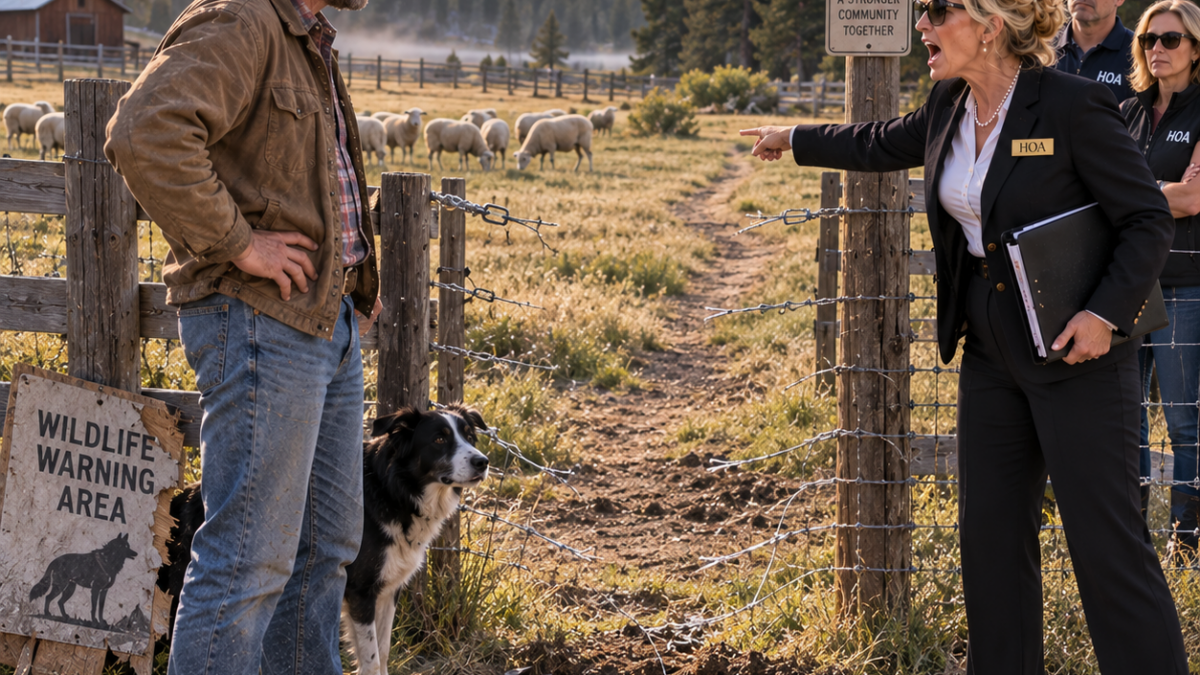
Bright.
Practiced.
“Stay together, everyone. The ranch corridor is just ahead.”
Holt looked at the younger ranger.
“Body camera.”
A small red light came on.
For the first time since I found the fence, I stepped behind someone else.
Tessa rounded the bend.
White fleece vest.
Black leggings.
Clipboard.
Behind her came about twenty residents.
Travel mugs.
Trekking poles.
Backpacks.
A father with a baby strapped against his chest.
Two children near the rear.
And three dogs.
One Labrador.
One golden retriever.
One little mixed-breed dog pulling so hard at the leash its front paws barely touched the ground.
My stomach dropped.
Holt stepped forward.
“Stop there.”
Not loud.
Everyone heard.
The group slowed.
A few walked another step before the younger ranger raised his hand.
“Do not cross that line.”
Tessa’s smile stayed fixed.
“Good morning.”
Holt showed his badge.
“State Wildlife Division.”
The smile weakened.
“We’re conducting a scheduled Ridgeview Pines community wellness walk.”
“This route is not open.”
A murmur moved through the group.
Tessa looked past Holt.
Saw me.
June sat beside my boot.
I didn’t speak.
“There appears to be some confusion,” she said. “This is the North Ridge Wellness Trail.”
“You are approaching a damaged livestock control point under active investigation.”
“The HOA was advised access had been handled.”
“By whom?”
“Our board.”
“Who authorized passage through this fence?”
“The trail corridor is approved.”
Holt repeated:
“Who authorized passage through this fence?”
Tessa shifted the clipboard.
“I don’t carry all internal records on trail walks.”
Holt nodded toward the dogs.
“All dogs back.”
A woman in a purple jacket pulled her Labrador closer.
“Why? They’re leashed.”
“This is an active wolf-season livestock boundary adjacent to a documented wildlife movement area.”
The woman looked at Tessa.
“You told us that was exaggerated.”
Tessa didn’t answer her.
Instead:
“We have made reasonable accommodations. Residents were instructed to keep dogs leashed.”
“Who installed the route markers?”
“Our volunteers.”
“Before or after the fence was cut?”
Silence.
Holt pointed toward the wire.
“This fence was cut.”
People leaned to see.
“A seasonal wildlife warning sign was removed.”
More murmuring.
“Trail markers were installed through the opening.”
The golden retriever’s owner shortened the leash.
“This is not an approved public route.”
Tessa laughed softly.
“I think we should be careful about relying entirely on one neighboring owner’s interpretation. Willa has been very emotional about this.”
There it was.
The word she had wanted attached to me all along.
Emotional.
Several residents looked toward me.
I stayed still.
Holt answered for me.
“Ms. Ellison photographed the scene before disturbance, secured her livestock, filed a property-damage report, preserved game-camera footage, retained original communications, and provided historic control-point documentation.”
He looked directly at Tessa.
“That is appropriate incident preservation.”
The silence changed.
Gary stood near the rear with his children.
He looked down at the printed map in his hand.
Tessa tried again.
“Residents were promised trail connectivity.”
“By whom?”
“The association.”
“Using what authority?”
“The route is on our map.”
“Your map is part of the investigation.”
That removed what remained of her smile.
The younger ranger photographed the group.
Dogs.
Residents.
Cut fence.
Trail ribbons.
Missing signpost.
HOA route sign.
A little boy asked his father:
“Are we in trouble?”
“No.”
Holt heard.
“You’re not being cited. Stay where you are.”
Then Tessa stepped closer.
“Can we speak privately?”
“No.”
Her face hardened.
“This is humiliating residents who did nothing wrong.”
Holt said:
“Then they should not have been led here.”
Nobody knew what to do with that sentence.
A man near the front raised his phone.
“Is the trail closed?”
“Access through this breach is stopped pending inspection and corrective work.”
“So yes?”
“It means turn around.”
Tessa’s shoulders tightened.
“This isn’t a breach. It’s a connection point.”
Holt held out his hand.
“Show me the document that calls it that.”
She hesitated.
Then opened her clipboard.
The full-color Ridgeview map.
APPROVED TRAIL EXPANSION.
Solid green line.
Straight across my fence.
Holt unfolded it slowly.
Body camera facing him.
Residents watching.
“You distributed this?”
“The committee did.”
He turned the map.
“Your approved trail expansion crosses an unrepaired breach at Control Point B.”
Tessa said nothing.
He pointed at the printed line.
Then at the cut wire.
“Who approved passage through this private livestock boundary?”
“The board understood there was historic access.”
“That is not authorization.”
“Our records reference a corridor.”
“Your records are not here.”
He held up the map.
“This is.”
Someone behind Tessa said:
“What exactly happened?”
Holt answered.
“This control point is identified in a seasonal livestock-wildlife separation plan. The fence was cut. The warning sign was removed. Trail markers were placed through the opening. The association then promoted resident access through the same location with dogs.”
A woman whispered:
“Tessa.”
Tessa raised one hand.
Holt continued.
“This is now an active wildlife safety incident.”
The younger ranger opened his field case.
Pulled out a white official sign.
STATE WILDLIFE DIVISION.
TRAIL ACCESS CLOSED.
WILDLIFE SAFETY INSPECTION.
DO NOT ENTER.
The words hit harder than anything I could have yelled at a board meeting.
Holt addressed the group.
“Return to Ridgeview using the route you came in on.”
“Do not follow orange markers.”
“Do not approach the ranch fence.”
“Keep dogs controlled until you are inside the HOA trail boundary.”
The man with the phone asked:
“Are we being cited?”
“Not at this time.”
The father with the baby asked:
“Was there actually a wolf here?”
Holt chose his words.
“We documented large canine tracks near this control point this morning. Species confirmation will be included in the field report if supported.”
That was enough.
Every dog owner shortened a leash.
Tessa’s face went rigid.
“You’re creating unnecessary alarm.”
Holt looked at her.
“The warning sign that communicated this risk was removed.”
Gary’s daughter looked at her father.
“You said Mrs. Ellison put the sign up.”
Gary closed his eyes.
“No. I was wrong.”
Tessa spoke quickly.
“The sign was visually alarming and residents had concerns.”
The woman with the Labrador stared at her.
“So someone took it down?”
“No one was authorized to remove state signage.”
“Then who did?”
Tessa didn’t answer.
The younger ranger fixed the closure notice to a temporary stake several feet in front of my fence.
Not my cedar post.
Not my wire.
Their side.
That mattered.
For two days, every Ridgeview arrow had pointed toward my ranch.
Now the first official sign pointed people back.
Then he stretched orange closure tape between two temporary posts.
It snapped in the cold breeze.
Tessa stared at it.
Holt handed her a written field notice.
“The marked route is discontinued immediately.”
“All temporary access markers toward the Ellison ranch boundary are to be removed under supervision.”
“The HOA will issue a correction stating there is no authorized ranch-corridor access.”
Tessa’s voice dropped.
“You cannot order our communications.”
“I can order closure associated with an unsafe wildlife control point. If your communications continue directing residents toward that control point, they become part of the corrective record.”
Her fingers tightened around the notice.
“This creates liability for Ridgeview.”
Holt looked at my fence.
“The liability began before we arrived.”
Then she turned toward me.
“You could have repaired it.”
Every face moved to mine.
My throat tightened.
For the first time all morning, I spoke.
“I was ordered to preserve the breach for inspection.”
“Convenient.”
“No.”
Holt stepped between us verbally before I had to.
“Ms. Ellison preserved the evidence correctly.”
Tessa looked away.
Residents began walking back.
No shouting.
No grand confrontation.
Just the awkward shuffle of people discovering the morning they thought would be a wellness outing had been built around somebody else’s damaged property.
Gary stayed behind until his children were twenty yards away.
Then he looked at me.
“I’m sorry.”
I nodded.
I wasn’t ready to tell him it was fine.
It wasn’t.
But Gary hadn’t cut the fence.
He had believed a map.
People trust maps.
That is why drawing a false one matters.
Tessa remained until the last resident disappeared through the timber.
“What about the event?”
Holt looked toward the empty trail.
“It’s over.”
Nobody clapped.
The woods didn’t care.
When the path finally went quiet, Holt turned toward me.
“Now we talk removal, repair, and incident report.”
Those words felt better than victory.
Repair.
Something practical.
Something ranchers understand.
Holt wrote three words on his clipboard.
REMOVE.
REPAIR.
CORRECT.
“Markers come down today.”
“Can I remove the ones inside my side?”
“No.”
I almost objected.
He held up a hand.
“Not yet. We document before removal.”
“All right.”
“Fence gets wildlife-rated repair to the 2021 standard.”
“I’ll call Mercer Fence.”
“They know this line?”
“Paul helped Caleb install the reinforcement.”
“Good.”
“I invoice Ridgeview?”
“Have Mercer invoice them. Copy us.”
“They’ll fight it.”
“They can argue after the control point is secure.”
That was one of the most useful sentences anybody said all week.
Responsibility could be argued.
Safety could not wait.
By noon, Ridgeview Pines emailed every resident.
CORRECTION REGARDING NORTH RIDGE TRAIL ACCESS.
It was not an apology.
I didn’t expect one.
But it said:
There is no authorized ranch-corridor access through neighboring private property.
The North Ridge Wellness Trail opening walk is postponed.
Maps depicting a connection through neighboring ranch property are withdrawn.
Residents are instructed not to follow temporary markers, enter pasture areas, approach the wildlife closure point, or use unofficial access routes.
Future trail projects adjacent to ranch boundaries or wildlife corridors will require outside review prior to resident promotion.
Outside review.
Meaning not Tessa.
Not a lifestyle committee.
Not a logo and a printer.
An hour later, two Ridgeview maintenance workers returned with the younger ranger.
They removed every orange marker.
Photograph first.
Then removal.
Photograph.
Removal.
One by one, the fake trail disappeared from the brush.
No one called it a wellness corridor.
No one called it a connection point.
It became what it had always been.
Brush beside a fence.
At 3:07, Mercer Fence pulled in.
Old Paul Mercer climbed from the cab.
He had worked with Caleb for twenty years.
He looked at the clipped strands.
Then at me.
“Somebody got stupid.”
“That your professional assessment?”
“That’s the polite version.”
I laughed.
First real laugh in three days.
Paul crouched beside Caleb’s cedar post.
“He set this one.”
“Yes.”
“Deep too.”
“He said the freeze line moved here.”
“He said a lot of things.”
“Usually twice.”
Paul smiled.
Then he became serious.
“They cut the brace.”
“I know.”
“Not somebody stepping through.”
“No.”
“Deliberate.”
“Yes.”
He shook his head.
“Your husband hated shortcuts.”
“He hated bad ones.”
“This one qualifies.”
They replaced the top strand.
Bottom strand.
Brace wire.
Retensioned the mesh.
Checked every post eighty yards in both directions.
Paul refused to patch only what could be seen.
“If one strand got yanked hard, I check the whole pull.”
That was Caleb’s way too.
The rangers supplied two new warning plates.
The original yellow wildlife notice went back up.
Below it:
CONTROL POINT B.
SEASONAL CLOSURE ACTIVE.
NO UNAUTHORIZED ACCESS.
The younger ranger photographed the finished repair.
Paul handed me the invoice.
Under BILL TO:
RIDGEVIEW PINES HOA.
I stared at the logo-free sheet.
For two days, Ridgeview’s name had been printed on trail maps, maintenance trucks, orange arrows, and false statements of permission.
Now it appeared somewhere more appropriate.
Repair cost.
I slept that night.
Not well.
But enough.
The next morning, June ate without stopping every thirty seconds to look toward the timber.
The sheep spread out.
That was my first sign the ranch had exhaled.
At 10:40, Ranger Holt called.
“The track measurements came back consistent with wolf.”
I sat down.
“Confirmed?”
“Field classification. We have enough measurements and regional activity to call it probable wolf presence in the incident summary.”
“How recent?”
“Likely within twenty-four hours of inspection.”
I looked toward the north fence.
“So while they were planning the walk…”
“Yes.”
I closed my eyes.
Three dogs.
Children.
Seventy-three sheep.
A cut fence.
People think wildlife danger looks dramatic.
A wolf standing in the trail.
Teeth.
Growling.
Usually it looks like probability.
One bad overlap.
One dog running twenty yards farther than its owner intended.
One ewe panicking through an opening.
One parent chasing a child.
One predator following instinct.
No evil required.
Holt continued.
“Your flock was never breached.”
“No.”
“No confirmed livestock loss.”
“No.”
“That matters.”
“I know.”
“And nobody crossed during the organized event.”
“Because you were there.”
“Because you preserved the control point and notified us.”
That sounded almost like praise.
I didn’t know what to do with it.
A week later, the formal incident summary arrived.
Nine pages.
Boring language.
I loved every word.
Confirmed fence damage.
Warning sign removal.
Unauthorized route marking.
Organized resident-access promotion.
Private ranch boundary.
Active seasonal advisory.
Probable wolf activity near the inspected control point.
And one line that traveled through Ridgeview faster than anything else:
The Ridgeview Pines Recreation Committee possessed no authority to represent private working ranch land as approved recreational trail access.
Gary sent me a screenshot from the community app.
People were furious.
Not at me anymore.
At the board.
Who approved that map?
Why were we told the rancher agreed?
Why did the email say courtesy access?
Why were families invited toward a wildlife closure?
Who removed the sign?
The board announced a special meeting.
I almost didn’t go.
Then Holt said:
“Your property is being discussed. Be in the room.”
So I went.
Ridgeview’s clubhouse meeting room had large windows facing the mountains.
The kind of room designed to make every argument feel tasteful.
About sixty residents showed up.
Tessa sat at the board table.
Not center.
The president, Martin Bell, opened with something about community trust.
Then legal counsel spoke.
Then their insurance representative.
Then Tessa.
She said the Recreation Committee had relied on “historic access assumptions.”
A woman in the second row interrupted.
“You told us Willa approved it.”
Martin asked for order.
Tessa continued.
“Temporary access had been discussed as part of long-term connectivity.”
Gary raised his hand.
Martin called on him.
“I have the map you gave me.”
The room shifted.
Gary stood.
“It says authorized.”
Tessa looked at him.
“The map was conceptual.”
“You told me it was approved.”
“It reflected anticipated access.”
“Through her fence?”
“That’s not fair.”
Gary’s face changed.
“No. Taking my kids there wasn’t fair.”
He sat.
I didn’t smile.
Gary had been wrong when he first accepted Tessa’s story.
But public correction costs something.
He was paying that cost.
Then Martin asked if I wanted to speak.
I stood.
“My name is Willa Ellison.”
Everyone knew.
I said it anyway.
“My husband and I have operated the ranch beside Blacktail Draw for twenty-six years.”
I held up one sheet.
“This is the 2021 seasonal livestock-wildlife separation plan.”
Another.
“This is my certified warning.”
Another.
“This is Tessa Vale’s signed receipt.”
No flourish.
No emotion in my voice if I could help it.
“The fence was not an argument about whether Ridgeview residents deserve trails.”
I looked toward the room.
“It was a livestock boundary beside a wildlife corridor.”
A man near the back asked:
“Could the trail ever connect someday?”
“Yes.”
That surprised people.
I continued.
“If there is a legal easement.”
“Owner agreement.”
“Wildlife review.”
“Livestock separation.”
“Safe route design.”
“Maybe.”
Tessa looked at me.
I could tell she hadn’t expected maybe.
“But you cannot create permission with orange ribbon.”
The room went quiet.
“And you cannot erase risk by removing the warning sign.”
I sat down.
No applause.
Good.
The board moved into governance.
The Recreation Committee lost authority to publish new trail maps without board approval.
Any route near private land required title review.
Any route near Blacktail Draw required wildlife review.
Volunteer workdays could not alter fences, gates, signs, or markers outside HOA-owned property.
Contractors needed written property verification before installing route markers.
The North Ridge shortcut was removed from every official map.
Then came Tessa.
The board called it a “temporary restructuring.”
Everyone understood.
She was removed as Recreation Committee chair.
She stayed on the board.
Some residents wanted her expelled immediately.
I didn’t.
That surprised them.
It even surprised me a little.
But I had watched too many institutions solve a system problem by sacrificing one person and keeping the system.
Tessa had made terrible choices.
But Ridgeview had let one committee publish access maps with no title verification.
Management had sent those maps.
Maintenance had installed markers based on them.
Residents had been told “approved” without seeing proof.
That needed changing whether Tessa stayed or left.
After the meeting, she caught me near the coat room.
“Are you happy?”
“No.”
She seemed almost offended.
“You got the trail closed.”
“I got my fence repaired.”
“You embarrassed me in front of the neighborhood.”
“You signed for the warning.”
She looked away.
“You keep saying that.”
“Because it matters.”
Her voice lowered.
“I thought you were using wolves to block access.”
“Why?”
“Because every time the committee proposed connection, you said no.”
“Yes.”
“Exactly.”
I stared at her.
“Tessa, no is an answer.”
She folded her arms.
“Not when one property controls an entire trail network.”
“My property doesn’t control your trail network.”
“The best overlook requires passing the ranch edge.”
“Then your trail network was designed around land you didn’t own.”
That stopped her.
She looked through the clubhouse windows toward the ridge.
“I was trying to create something people wanted.”
“I know.”
“You always make it sound like I wanted someone hurt.”
“I never said that.”
Her eyes came back to mine.
“I think you wanted the trail badly enough that every warning became an obstacle.”
She swallowed.
“That’s different.”
“Yes.”
“Worse?”
“More ordinary.”
For some reason, that seemed to hit harder.
She looked down.
“I didn’t cut the fence.”
I believed her.
“You didn’t have to.”
Her head snapped up.
“What does that mean?”
“You told people it was illegal.”
“You called the warning sign alarmist.”
“You published the connection.”
“You signed for the warning and still told volunteers the route was approved.”
“You made the cut useful before somebody made the cut.”
Her face went pale.
“That’s not the same as ordering it.”
“No.”
I kept my voice level.
“It isn’t.”
That mattered.
I wasn’t going to accuse her of a crime I couldn’t prove.
The game-camera footage showed jackets.
Tools.
Logo.
It did not clearly show faces.
The sheriff’s report remained open while Ridgeview investigated which volunteers had participated.
Two weeks later, the board identified the people.
One was a maintenance volunteer named Eric Sloan.
The other was a resident trail captain, Dana Reeves.
They admitted cutting the wire.
Their explanation was almost worse than denial.
They said they believed the fence was an “unauthorized obstruction” and that Tessa had told the volunteer group the trail connection was already approved.
Tessa denied telling anyone to cut wire.
Both volunteers agreed she never used the words cut the fence.
What she had said in the meeting, according to three people, was:
“The old barrier needs to stop preventing access before opening day.”
That sentence became the entire problem in miniature.
Vague enough to protect the speaker.
Clear enough for eager people to act.
The sheriff handled the property-damage portion.
I did not ask for anyone to be arrested dramatically.
There was restitution.
Fence costs.
Sign replacement.
Camera-damage reimbursement.
Written trespass warnings.
The HOA insurer covered the repair first and pursued internal responsibility separately.
Eric and Dana lost volunteer trail privileges.
Dana sent me a letter.
Three pages.
I read it once.
Then again a week later.
She wrote:
I believed the fence had been placed illegally to block an HOA trail. I should have checked. I should not have touched it. I am sorry that my decision put your animals and our residents at risk.
That apology I believed.
Because it named the action.
Not confusion.
Not feelings.
The decision.
I wrote back.
One paragraph.
Thank you for saying it plainly. Do not cross ranch boundaries without written permission. The separation line exists for livestock, wildlife, and people.
That was enough.
Gary came by two Saturdays later with his children.
They stopped at the main gate.
Didn’t open it.
Didn’t call from the driveway.
Stayed outside.
I walked down.
His daughter held a paper bag.
“We brought something.”
Inside were three heavy gate clips.
Brand new.
I almost laughed.
Gary shrugged.
“My son said fences probably need these.”
His boy looked embarrassed.
“They do,” I said.
The girl looked toward Blacktail Draw.
“We didn’t know.”
“I know.”
“Are there wolves right now?”
“Probably somewhere.”
She moved closer to her dad.
I smiled slightly.
“They don’t spend their day waiting behind trees to eat hikers.”
She looked relieved.
“So why close the trail?”
“Because good wildlife safety isn’t about making animals scary.”
I pointed toward the timber.
“It’s about not putting people, dogs, sheep, and predators into the same narrow place.”
She thought about that.
“So the fence is for the wolves too?”
I looked at her.
“Yes.”
Gary smiled.
“That’s not how Tessa explained it.”
“No.”
The boy asked:
“Can we ever hike near here?”
“On the approved trail.”
“Not through the ranch?”
“Not without permission.”
He nodded.
Children often understand property boundaries faster than committees.
As they left, Gary said:
“I was one of the people who commented about you.”
“I know.”
“I said you were afraid of change.”
“I remember.”
“I’m sorry.”
“Thank you.”
I could have made him feel worse.
For a second, part of me wanted to.
Then I looked at his kids.
Not everyone who follows a bad map is a bad neighbor.
Someone drew the map.
Someone printed it.
Someone put “approved” across the top.
That doesn’t erase responsibility.
But it places it correctly.
Winter deepened.
Snow came hard in December.
The north fence disappeared halfway under drifts.
Control Point B remained shut.
Rangers added a seasonal barrier on the Ridgeview side before the first deep snow.
No one touched it.
The new HOA map stopped well inside their property.
The green route curved toward a different overlook.
Not as dramatic.
Still beautiful.
Funny how many “essential” trail features become optional after a lawyer sees the parcel line.
June relaxed.
The sheep returned to their usual irritating independence.
They spread along the feed line instead of bunching.
One ewe discovered how to open a loose grain-room latch with her nose.
That became my new crisis.
Ordinary ranch trouble felt wonderful.
In January, Holt came by for a follow-up.
He stood at the north post.
Snow to his calves.
“Looks good.”
“Paul Mercer will be insulted you sound surprised.”
“I’m never surprised by Mercer.”
June sniffed his gloves.
He scratched behind her ears.
“What happens next season?” I asked.
“Same advisory review.”
“Ridgeview?”
“They’ll get notice.”
“Will Tessa?”
“The board gets notice.”
I understood.
No personalities.
Procedure.
That was better.
Before leaving, Holt looked at Caleb’s cedar post.
“He built that?”
“Yes.”
“Still straight.”
“He overbuilt everything.”
“Good trait in fencing.”
“Terrible trait in kitchen shelves.”
Holt smiled.
Then said:
“You handled this correctly.”
I looked away.
Compliments still felt uncomfortable without Caleb there to make a joke.
“I wanted to fix it the first morning.”
“I know.”
“Leaving it open felt irresponsible.”
“You secured the livestock.”
“Yes.”
“You preserved the site.”
“Yes.”
“That was the work.”
I nodded.
After his truck left, I stayed beside the post.
Snow softened the timber edge.
No wolf tracks that morning.
No hikers.
No orange ribbon.
Just wire.
For months, Tessa had talked about access as if a line on a map naturally became a right on the ground.
But land is full of lines people don’t see until they matter.
Property lines.
Fence lines.
Grazing lines.
Wildlife corridors.
Seasonal closures.
The line between a warning and fearmongering.
The line between promoting access and creating danger.
Caleb understood lines.
Maybe because ranching is mostly the art of knowing which boundaries matter and which ones don’t.
Animals don’t care about property deeds.
Water doesn’t care about subdivision maps.
Wolves don’t care about HOA newsletters.
That is why humans have to build the right boundaries in the right places.
Not because nature obeys them.
Because people can.
By March, the wildlife advisory began easing.
One afternoon, I received an email from Ridgeview.
Not Tessa.
Board secretary.
SUBJECT: PROPOSED NORTH RIDGE ALTERNATE ROUTE REVIEW.
My stomach tightened before I opened it.
Then I read.
The HOA had hired a licensed surveyor and trail consultant.
The proposed route stayed entirely within Ridgeview property.
It shifted southeast.
Avoided Blacktail Draw.
No ranch crossing.
No dogs during seasonal advisory periods on the upper segment.
Wildlife office review requested before publication.
At the bottom:
For informational purposes only. No access across Ellison Ranch is requested or implied.
I read that sentence twice.
Then laughed.
June looked up from the floor.
“That’s what progress looks like.”
She went back to sleep.
I sent the plans to Holt.
His reply:
Much better.
Two words.
Probably the highest praise he gave anybody.
The new trail opened in late spring.
No fanfare.
No speeches about conquering fear.
No “future connection point.”
Just a modest wooden sign.
NORTH RIDGE LOOP.
STAY ON MARKED TRAIL.
DOG RESTRICTIONS MAY APPLY SEASONALLY.
I could see hikers from the far pasture sometimes.
Distant.
Inside their boundary.
A few waved.
I waved back.
That was all I had wanted.
Not an empty mountain.
Not a private kingdom.
Just the line respected.
Tessa’s board term ended in June.
She did not run again.
The final time I saw her was at the mailbox cluster on the county road.
She was loading envelopes into her car.
I almost kept driving.
Then she waved.
So I stopped.
“Willa.”
“Tessa.”
She looked older without the committee badge.
Or maybe just less armored.
“I heard the new trail is working.”
“It seems to be.”
“No complaints?”
“Not from me.”
She nodded.
Then:
“I went up there last weekend.”
“The new overlook?”
“Yes.”
“It’s not as good.”
I almost smiled.
“Tragedy.”
That surprised a laugh out of her.
Then she became serious.
“I still think Ridgeview should have better trail connectivity.”
“Probably.”
Her eyebrows lifted.
“You agree?”
“I never opposed trails.”
“You opposed every route I proposed.”
“Because they crossed my ranch.”
She looked down.
“Right.”
We stood beside our vehicles.
A truck passed.
Dust lifted.
Then she said:
“I convinced myself you hated us.”
“I don’t.”
“I needed that to be true.”
That phrase stopped me.
“Why?”
“Because if you were just stubborn, I didn’t have to consider that the map was wrong.”
I didn’t answer.
She continued.
“I kept thinking if enough people wanted the route, eventually you would have to accommodate it.”
“That isn’t how ownership works.”
“I know.”
“Now.”
“Yes.”
She looked toward the mountains.
“I should have stopped the project when your certified letter came.”
“Yes.”
“I didn’t order anyone to cut the fence.”
“I know.”
“But I made it sound like the fence shouldn’t be there.”
“Yes.”
Her eyes came back to mine.
“I’m sorry.”
I nodded.
“Thank you.”
That was enough.
I didn’t need her humiliated.
I needed her to understand.
When I got home, June met me at the porch.
We walked the north line before dinner.
Habit.
The spring grass had come in bright beneath the old cedar post.
The repaired wire still held tight.
The seasonal closure notice had been removed according to Holt’s schedule, leaving the permanent livestock-boundary sign.
No wolf warning now.
No emergency tape.
Just:
PRIVATE WORKING RANCH.
LIVESTOCK AREA.
NO TRAIL ACCESS.
Simple.
I put my hand on the notch Caleb had carved into the cedar.
He had cut it with his pocketknife the day we set the post.
Just one short line.
I once asked why.
“So we know which one is ours.”
As if there were any chance I would forget.
Below me, sheep grazed loosely across the pasture.
June sat beside my boot.
From the Ridgeview side, I could hear hikers talking on the new trail.
Far enough away that I couldn’t understand words.
A dog barked once.
Then the sound moved farther east.
Away from the fence.
The timber beyond Blacktail Draw was dark beneath the pines.
Wild.
Not threatening.
There is a difference.
Fear wants wild things destroyed.
Respect gives them room.
The same is true of boundaries.
A fence isn’t always hostility.
Sometimes it is what lets two different worlds exist beside each other without forcing either one to become the other.
Ranch.
Neighborhood.
Sheep.
Wolves.
Hikers.
Dogs.
All of them could share that mountain.
But only if people stopped pretending sharing meant taking whatever route was most convenient.
I stood beside Caleb’s cedar post until evening moved into the draw.
The repaired wire caught the last light.
Tight.
Straight.
Unbroken.
Then June and I turned toward the house.
Behind us, the fence stayed exactly where it belonged.








