For three nights, two dogs barked behind the fence of an abandoned farm, and every night their voices grew weaker.
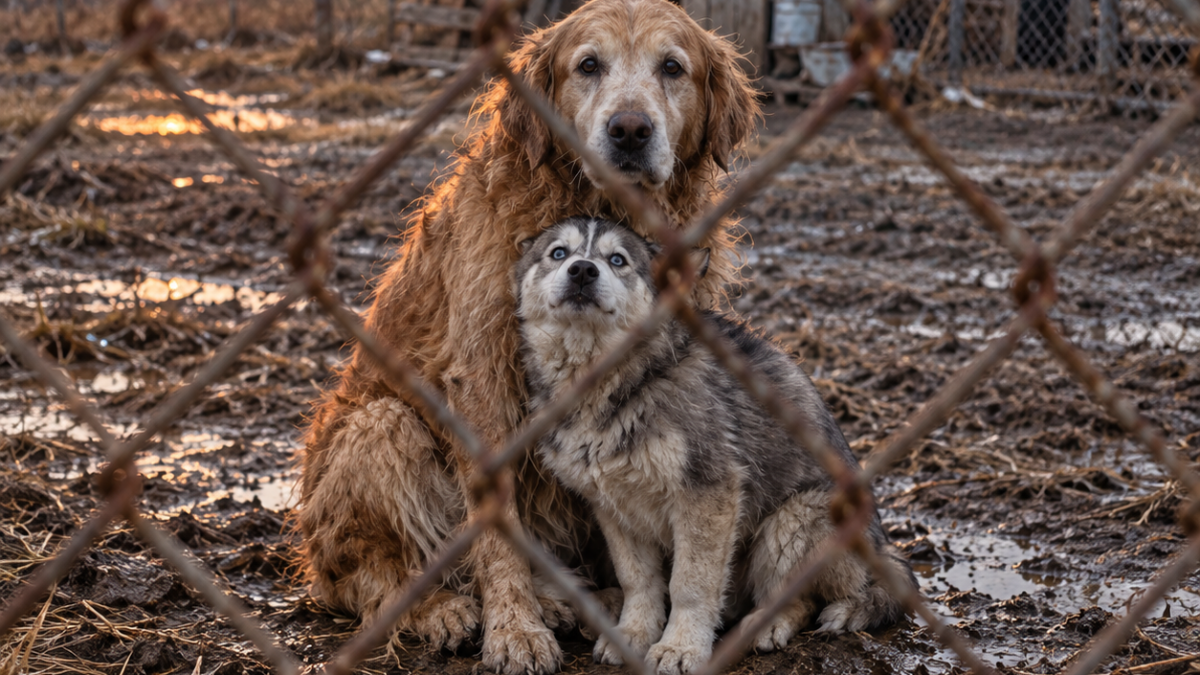
Mrs. Clark was seventy-one years old and about five feet three on a generous day, but she had the kind of presence that made people twice her size move when she told them to.
She held two old blankets under one arm and a gallon jug of water in the other.
“What do we have?” she asked.
“Two dogs.”
“I can see that.”
“The Golden’s bad.”
Her expression changed.
She walked toward the opening I had made in the fence.
The Husky immediately stiffened.
Mrs. Clark stopped.
“All right, sweetheart,” she said softly. “Nobody’s coming any closer than you want.”
She lowered the blankets onto the ground.
I poured water into the least disgusting container I could find nearby, an old metal pan lying upside down beside the barn.
The Husky watched me place it inside the opening.
He didn’t move toward it.
Instead, he looked at the Golden.
The older dog tried to raise his head.
Couldn’t.
The Husky stepped backward, touched his nose to the Golden’s face, then finally approached the water.
He drank twice.
Stopped.
Returned to the Golden.
Then came back and drank again.
Mrs. Clark noticed what I noticed.
“He doesn’t want to leave him.”
“No.”
I widened the opening.
“Think he’ll bite?”
Mrs. Clark gave me a sideways look.
“Would you blame him?”
“No.”
“Then move slowly.”
I crawled through first.
The Husky came toward me.
My whole body tightened.
He was thin, but still a good-sized dog.
If he decided I was a threat, I would lose.
I crouched.
“It’s okay.”
He came within three feet.
Stopped.
His blue eyes searched my face.
Behind him, the Golden released a weak breath.
The Husky immediately turned his head.
That was when I understood.
He wasn’t guarding the property.
He was guarding his friend.
“I’m going to help him.”
Obviously, he couldn’t understand every word.
But tone matters.
Intent matters.
Sometimes fear recognizes gentleness before the mind does.
I took one step.
The Husky moved sideways.
Another.
He stayed between us.
Then the Golden lifted his head.
He looked at me.
His tail dragged once across the dirt.
The Husky looked back at him.
Something changed.
He stepped aside.
I still remember that moment.
The young dog had no reason to trust me.
Humans were the reason he was trapped there.
Humans had driven away.
Humans had left the gate locked.
Yet somehow, after three nights of hunger and thirst, he made a decision.
He let me pass.
I knelt beside the Golden.
Up close, he looked worse.
His gums were pale.
His coat was dirty and matted.
When I placed my hand against his side, I could feel every rib.
“Hey, old man.”
His eyes opened.
Brown.
Cloudy with age.
Tired beyond anything I’d ever seen.
“You’ve had a terrible week, huh?”
His tail moved.
Mrs. Clark crouched outside the fence.
“Can he stand?”
“I don’t know.”
I slipped my arms beneath his chest and tried to help him up.
His front legs straightened.
His back legs didn’t.
He collapsed.
The Husky rushed toward us.
“Easy.”
He sniffed the Golden frantically.
Mrs. Clark said, “We’re carrying him.”
“Yeah.”
“Truck’s closer than your car.”
“I called animal control. They said morning.”
She looked at the old dog.
“We’re not waiting until morning.”
That was Mrs. Clark.
No speech.
No debate.
Just reality.
We wrapped the Golden in a blanket.
I lifted his front half while Mrs. Clark took his rear.
The Husky followed so close that his nose repeatedly touched the blanket.
We reached the truck.
Mrs. Clark opened the rear passenger door.
“I’ll drive.”
I climbed into the back with the Golden.
The Husky jumped in before anyone invited him.
He pressed himself against the older dog’s side.
Mrs. Clark got behind the wheel.
“Clinic?”
“Closest emergency vet is about thirty miles.”
“I know.”
She started driving.
It was close to four in the morning.
The road ahead was completely black except for the headlights.
I sat with the Golden’s head in my lap.
His breathing frightened me.
Every inhale seemed to take effort.
The Husky remained pressed against me, one paw resting on the edge of the blanket.
I ran my hand over the Golden’s head.
“Stay with me.”
His eyes opened slightly.
“You hear me? Stay.”
The Husky looked at me.
I don’t know why I said what I said next.
Maybe because I was scared.
Maybe because promises are what people offer when they have nothing else.
“Neither of you is going to be alone again.”
Mrs. Clark looked at me through the rearview mirror.
I kept my eyes on the dogs.
“I don’t know what’s going to happen,” I whispered. “But you’re not going back there.”
The Golden’s tail moved against the seat.
A little stronger this time.
The emergency clinic appeared just before five.
White fluorescent light spilled across the parking lot.
Mrs. Clark pulled directly to the entrance.
I carried the Golden inside.
The Husky came beside me on a makeshift leash Mrs. Clark had found in her truck.
The veterinarian took one look and called for help.
They moved the Golden through a set of swinging doors.
The Husky tried to follow.
A technician stopped him.
He pulled once.
Then sat.
And stared at the door.
His ears remained forward.
His entire body became still.
Mrs. Clark and I sat in the waiting room.
The Husky lay at my feet.
Minutes became an hour.
Then another.
I had never spent much time in hospitals of any kind.
I hated waiting rooms.
They made you feel helpless.
Everything important was happening behind a wall where you couldn’t see it.
Mrs. Clark handed me a vending-machine coffee.
“You look terrible.”
“Thanks.”
“You’re welcome.”
I drank it anyway.
After a while, she said, “You did the right thing.”
“We don’t know that yet.”
“Yes, we do.”
“What if he’s too far gone?”
“Then he wouldn’t have died alone behind a fence.”
I looked at her.
She stared straight ahead.
Her husband, Harold, had died three years earlier.
I knew that much.
I suddenly wondered how many hospital waiting rooms she had sat in before this one.
The veterinarian appeared shortly after sunrise.
I stood so quickly that the Husky jumped up too.
“How is he?”
She looked tired, but she smiled.
“He’s going to live.”
The breath left my lungs.
Behind me, Mrs. Clark whispered, “Thank God.”
The Husky’s tail moved.
The veterinarian crouched toward him.
“Your buddy is tougher than he looks.”
I laughed once, though my eyes were burning.
She explained that the Golden was severely dehydrated and malnourished, but his heart was surprisingly strong.
There was no obvious organ failure.
No catastrophic infection.
He needed fluids, careful nutrition, rest, and follow-up blood work.
“But barring complications,” she said, “I think he has more time.”
“How much?”
She smiled.
“Let’s not count his days for him.”
That sentence stayed with me.
They let the Husky see him.
We walked into the treatment room.
The Golden lay beneath a blanket with an IV line attached.
The Husky stopped in the doorway.
His whole expression changed.
He walked forward very slowly.
Then touched his nose to the Golden’s muzzle.
Once.
Twice.
The old dog opened his eyes.
His tail tapped against the table.
The Husky licked his face.
I turned away.
Mrs. Clark didn’t.
She took my hand.
That surprised me.
“You see?” she whispered.
“They’re family.”
And they were.
Not because they shared blood.
Not because someone had placed them in the same yard.
They were family because one had refused to abandon the other when abandonment was exactly what the world had shown them.
The veterinarian asked if I knew their names.
“No.”
“Owners?”
“The farm belonged to the Millers.”
She wrote something down.
“We’ll report the condition they were found in.”
“What happens to them now?”
That question came out faster than I’d intended.
She looked at me.
“Animal control will need documentation. If the owners legally surrendered the property but left animals behind, there could be an investigation.”
“Can they take the dogs back?”
“Possibly, depending on circumstances.”
My stomach tightened.
She saw it.
“But right now, the Golden needs medical care. And neither dog is leaving with anyone until animal control sorts out ownership.”
Mrs. Clark said, “Good.”
The vet glanced at her.
Mrs. Clark folded her arms.
“Anybody who leaves dogs chained behind an empty farm shouldn’t be allowed to reclaim a houseplant.”
The veterinarian wisely chose not to argue.
The Husky was also examined.
He was underweight and dehydrated, but young enough that his body had handled the ordeal better.
No serious illness.
No major injuries.
Maybe two or three years old.
The Golden was probably nine or ten.
I sat beside the Husky while we waited.
At one point, he placed his head on my knee.
That was it.
Just his chin resting on denim.
But I felt something shift inside me.
I had spent years building a life where nothing could demand too much.
Working from home helped.
Living alone helped.
I didn’t hate people.
I just liked distance.
Distance was safe.
You couldn’t disappoint someone who didn’t depend on you.
You couldn’t lose something you never allowed yourself to need.
Then a half-starved Husky rested his head on my knee, and suddenly all those clever little defenses felt embarrassingly obvious.
By late morning, animal control arrived.
The officer took photographs.
He documented the fence, bowls, condition of the dogs, and my statement.
I admitted cutting the fence.
“I know I technically trespassed.”
He looked at me.
“You called us first?”
“Yes.”
“You believed the animal was in immediate danger?”
“Yes.”
“You got him veterinary care?”
I pointed toward the treatment room.
“Then I think we have bigger issues than your fence repair.”
Mrs. Clark muttered, “Damn right.”
The officer almost smiled.
He told us the Miller property had recently entered foreclosure proceedings.
The family had apparently moved suddenly.
Nobody had reported dogs remaining on-site.
“Could they really forget two dogs?” I asked.
The officer looked at me.
“People don’t always forget.”
That was all he said.
It was enough.
The veterinarian wanted to keep the Golden several more hours.
I should have gone home.
I had been awake all night.
Instead, I stayed.
At noon, my manager messaged asking whether I was logging in.
I stared at my phone.
I typed:
Emergency. Need the day.
He replied:
Everything okay?
I looked at the Husky asleep beside my chair.
Not yet.
I wrote:
Getting there.
Around three that afternoon, the clinic released both dogs into temporary foster care pending the animal-control case.
I expected they would go to a shelter.
Instead, the officer looked at me.
“Any chance you can keep them for a few days?”
I actually laughed.
“Me?”
“They already know you.”
“I’ve never owned a dog.”
Mrs. Clark said, “He has a fenced yard.”
I looked at her.
“Whose side are you on?”
“The dogs’.”
The officer continued.
“The shelter is overcrowded. The older one will recover better somewhere quiet.”
I looked toward the Golden.
He was standing now.
Barely.
But standing.
The Husky was beside him.
I remembered my promise in the truck.
You won’t be alone again.
“A few days?”
“Probably.”
Mrs. Clark coughed.
I ignored her.
“Okay.”
That was how I left an emergency clinic with two dogs.
I named the Golden Gus.
I couldn’t explain why.
He simply looked like a Gus.
Old.
Patient.
A little dignified even when he was drooling on my rug.
The Husky became Scout because within thirty minutes of arriving at my house, he had inspected every accessible room, every window, every chair, the laundry basket, the bathtub, and one deeply suspicious cardboard box beside my desk.
“Scout,” I said after finding him with his head behind the shower curtain. “That’s you.”
He sneezed.
“Glad we agree.”
Mrs. Clark helped me turn the living room into something resembling a recovery ward.
Blankets.
Water.
Food.
Medication schedule.
She had owned dogs most of her life.
I knew nothing.
“How much do I feed them?”
She showed me.
“How often?”
She showed me.
“What if he throws up?”
“Call the vet.”
“What if he won’t drink?”
“Call the vet.”
“What if—”
“Jake.”
“What?”
“He’s going to survive you.”
I looked at Gus.
“I’m less confident about Scout.”
Scout was attempting to steal a sock.
The first week was chaos.
My mornings had previously started with coffee and spreadsheets.
Now they started with Scout standing beside the bed at six thirty, breathing directly into my face.
The first time it happened, I opened my eyes and screamed.
Scout jumped backward.
Gus, sleeping near the doorway, raised his head as if disappointed in both of us.
“Don’t do that!”
Scout wagged his tail.
“I’m serious.”
His tail wagged harder.
Apparently boundaries were going to require negotiation.
Gus mostly slept.
His recovery was slow.
I kept his medication beside the kitchen sink.
Three meals a day, small portions.
Fresh water constantly.
Short walks.
No stress.
The vet had given me a list.
I followed it like a military order.
The first morning Gus finished an entire bowl of food, I called Mrs. Clark.
“He ate everything.”
“Congratulations.”
“Is that good?”
“Generally, yes, Jake. Dogs eating is considered positive.”
“I know that.”
“Apparently you needed confirmation.”
She laughed and hung up.
Scout recovered much faster.
Within days, his energy returned.
The half-starved guardian from the farm became a lunatic with blue eyes.
He chased leaves.
He barked at the mail carrier.
He discovered that the refrigerator contained food and began treating its opening like a religious event.
Yet around Gus, he changed.
Always gentle.
Always watchful.
Before eating, Scout checked where Gus was.
When we went outside, he looked back if Gus lagged behind.
At night, he slept beside Gus’s bed.
Sometimes I woke around two in the morning and walked into the living room.
Scout’s body would be curled against Gus’s back.
Two dogs.
Breathing together.
Safe.
The first time I saw it, I stood in the doorway for several minutes.
I wondered what those three nights at the farm had been like.
Had Scout barked the entire time?
Had Gus tried to stand?
Had the younger dog waited beside that empty bowl, confused because the humans who normally filled it never returned?
How long before he understood nobody was coming?
That question bothered me.
Dogs don’t understand foreclosure.
Moving vans.
Financial problems.
Broken marriages.
They understand routines.
Doors opening.
Bowls being filled.
A voice calling their name.
Then one day the voice is gone.
The door stays closed.
The bowl stays empty.
What explanation can an animal invent for that?
During the second week, animal control called.
The Millers had been located.
My stomach tightened when I heard that.
“What do they want?”
The officer paused.
“They signed surrender papers.”
I sat down.
“They don’t want them back?”
“No.”
I should have been relieved.
I was.
But anger arrived first.
“Did they explain why they left them?”
“Jake.”
“I want to know.”
“There were family and financial issues. That’s all I can tell you.”
“They left them without water.”
“I know.”
“Gus almost died.”
“I know.”
“Scout stayed with him.”
The officer was quiet.
Then he said, “People make decisions that are difficult to understand from the outside.”
I stared at the dogs.
Scout was lying beside Gus.
“I don’t need to understand it.”
“What matters is the dogs are legally surrendered. They’ll enter the adoption system once medically cleared.”
Adoption.
That word landed strangely.
Of course that had always been the plan.
Temporary foster.
Recovery.
Permanent home.
Simple.
I looked at Scout.
He looked at me.
“What happens if I keep fostering them until they’re adopted?”
“We’d appreciate it.”
“Together?”
“We can mark them as a bonded pair.”
“Good.”
“That can make placement harder.”
I frowned.
“Why?”
“Two dogs are more expensive than one. Especially when one is older.”
My hand tightened around the phone.
“They stay together.”
“We’ll try.”
“No.”
I heard my own voice sharpen.
“They stay together.”
A pause.
“Okay.”
I softened.
“Sorry.”
“No need.”
After the call, I sat on the floor.
Scout immediately came over.
Gus lifted his head.
“So you’re officially homeless.”
Scout licked my cheek.
“Don’t get emotional. We’re finding you people.”
Gus’s tail moved.
“Responsible people.”
Scout leaned against my shoulder.
“People who know what they’re doing.”
Gus slowly stood.
He walked over.
Then, for the first time since arriving, climbed onto the couch without help.
It took effort.
One paw.
Pause.
Another.
He pulled himself onto the cushion.
Then laid his head across my thigh.
Scout jumped onto the other side.
I ended up trapped between them.
My laptop sat on the table beyond reach.
“Great.”
Scout closed his eyes.
“I have work.”
No response.
Gus sighed.
“You two are freeloaders.”
Gus’s tail tapped the couch.
And then I remembered the truck.
Neither of you will ever be alone again.
The promise had seemed simple when I believed the dangerous part was one night.
What if the promise lasted longer?
Mrs. Clark visited nearly every day.
Sometimes she brought dog treats.
Sometimes soup.
Sometimes nothing.
She would sit at my kitchen table while Scout wandered around and Gus slept near her feet.
One afternoon she looked around the room.
Dog beds.
Leashes.
Toys.
Medication bottles.
A bag of expensive senior-dog food.
“Temporary going well?”
“I hate you.”
She smiled.
“You haven’t listed them for adoption yet.”
“The shelter is handling that.”
“Uh-huh.”
“They need the right home.”
“Certainly.”
“Together.”
“Of course.”
“Somebody with a yard.”
“Naturally.”
“And preferably somebody home a lot.”
She took a sip of coffee.
“Do you know anyone like that?”
I stared at her.
She smiled innocently.
“Don’t.”
“I didn’t say anything.”
“You didn’t have to.”
The truth was, I wasn’t ready to admit what was happening.
Before the dogs, I could go an entire weekend without speaking to another human being.
I told myself I liked it.
Maybe I had.
But my house had been painfully quiet in ways I hadn’t recognized until that quiet disappeared.
Now I heard Scout’s nails on the hallway floor.
Gus snoring beneath my desk.
The shake of a collar.
The thump of a tail.
The soft exhale of another living creature nearby.
I started going outside every morning.
Really outside.
Not from my front door to the car.
We walked the edge of my property at sunrise.
Scout raced ahead until the leash stopped him.
Gus moved slowly beside me.
Sometimes we’d stop near the field.
Sunlight would stretch over the old Miller farm.
Scout always looked toward it.
His body became tense.
Gus did too.
The first few times, I turned us around.
Then one morning, I crouched.
“That’s not home anymore.”
Scout looked at me.
I pointed toward my house.
“Home is there.”
Gus pressed his shoulder against my leg.
I wish I could say dogs understand sentences.
Maybe they don’t.
But they understand consistency.
Every night they went inside my house.
Every morning I was still there.
Every bowl got filled.
Every door reopened.
Trust isn’t built from one rescue.
It’s built from what happens afterward.
By the third week, Gus was gaining weight.
His coat had improved.
He followed me from room to room.
Scout had become my shadow.
If I went to the bathroom, Scout waited outside.
If I worked, he slept beneath my desk.
If I cooked, he supervised.
If I sat on the porch, he sat beside me.
I began talking to them constantly.
“Market’s ugly today.”
Scout tilted his head.
“Exactly.”
Gus slept.
“Thank you for your input.”
I hadn’t realized how much I had to say until somebody was always there to hear it.
Then one afternoon, everything changed again.
I was in my office on a video call when Scout began pacing outside the door.
At first, I ignored him.
He whined.
“One second.”
I muted myself.
“What?”
Scout ran toward the kitchen.
Then came back.
“Scout, I’m working.”
He barked.
Once.
Sharp.
Urgent.
Something about it took me instantly back to the Miller farm.
I ended the meeting without explanation.
I followed him.
Gus was lying on the kitchen floor.
His breathing was heavy.
His eyes were half closed.
“Gus?”
No response.
“Gus.”
I dropped beside him.
Scout paced around us.
My hands began shaking.
Three weeks earlier, I would have panicked.
This time, I knew the clinic number by memory.
They told me to bring him in.
I lifted Gus.
Scout ran toward the door.
“You stay.”
He stared at me.
“Scout.”
He didn’t move.
Then I understood how stupid the command was.
“Fine.”
He jumped into the back seat before I finished opening the door.
The drive took twenty-three minutes.
I know because I watched every second on the dashboard.
Scout lay against Gus.
Exactly as he had the first night.
I drove with one hand on the wheel and one reaching backward whenever traffic allowed.
“Stay with me.”
The same words.
The same fear.
But this time something else was mixed into it.
Love.
I loved the old dog.
The realization was so sudden it hurt.
Not liked.
Not felt sorry for.
Not responsible for.
Loved.
I loved Gus.
I loved Scout.
And the possibility of losing either one terrified me.
The veterinarian examined Gus.
Blood work.
X-rays.
Waiting.
Again.
Scout beside me.
Again.
Finally the vet returned.
“He’s fine.”
I stared.
“What?”
“Mild gastrointestinal problem. Probably ate something he shouldn’t have.”
I nearly sat down on the floor.
“That’s it?”
“That’s it.”
I looked at Scout.
Scout sneezed.
“You nearly killed me.”
The veterinarian laughed.
“Welcome to having dogs.”
On the drive home, I kept thinking about those words.
Having dogs.
Not fostering.
Not temporarily housing.
Having.
At home, I sat on the kitchen floor.
Gus approached slowly.
Scout sat beside him.
I looked at both.
“All right.”
Scout’s ears lifted.
“This is ridiculous.”
Gus’s tail moved.
“I’ve been pretending you’re leaving.”
Scout came closer.
“But I’m apparently unable to handle a twenty-minute stomachache without having an emotional breakdown.”
Gus placed a paw near my knee.
“So here’s the deal.”
My throat tightened.
I felt stupid talking to them.
I kept going anyway.
“You stay.”
Scout froze.
“Both of you.”
His tail started moving.
“This is your house now.”
Gus walked forward.
“And I’m…”
I laughed.
“I guess I’m your person.”
Scout lunged.
He licked my face.
I pushed him away.
“Okay. That’s enough.”
He came back.
Gus’s tail beat against the floor.
I put one hand on Gus’s neck and the other around Scout.
For thirty-two years, I had believed family was mostly something you were born into.
Something that could disappoint you.
Break apart.
Stop calling.
My father and I had barely spoken in years.
My mother had died when I was twenty-five.
I’d become very good at not needing anybody.
And there I was on my kitchen floor crying because two abandoned dogs had just accepted my offer to become their human.
I called animal control the next morning.
“I want to adopt them.”
The officer laughed.
“What?”
“Nothing.”
“You knew?”
“We had a pool going.”
I stared at the phone.
“Seriously?”
“No.”
He paused.
“Mostly.”
The adoption paperwork took less time than I expected.
When the forms were finished, the shelter employee asked if I wanted their names officially listed as Gus and Scout.
“Yes.”
“Address?”
I gave mine.
“Owner?”
I hesitated.
“Jake Morrison.”
The word owner felt wrong.
But I let it stand.
When I walked outside, Mrs. Clark was waiting beside her truck.
“You told her.”
“Told who?”
“Don’t play dumb.”
“You’re becoming unpleasant.”
She hugged me.
Mrs. Clark didn’t hug often.
I stood stiffly for half a second.
Then hugged her back.
“I’m proud of you,” she said.
“For signing dog paperwork?”
“For letting something need you.”
That sentence hit harder than she intended.
Or maybe exactly as hard as she intended.
My relationship with my father had fallen apart gradually.
No dramatic fight.
No betrayal.
Just years of things unsaid.
After Mom died, he withdrew.
So did I.
He wanted me to visit.
I was always busy.
I wanted him to call.
He believed I should.
Weeks became months.
Months became years.
We sent birthday texts.
Christmas texts.
Polite messages between two men too stubborn to say they missed each other.
The hunting knife I’d carried to the Miller farm was the last real gift he’d given me.
One afternoon, I found it on the workbench.
The blade was scratched from cutting wire.
I ran my thumb across the handle.
Scout sat beside me.
“You wouldn’t understand complicated family relationships.”
He stared.
“You’re right. Yours are simpler.”
Gus entered slowly.
Scout immediately checked him.
I watched them.
The younger dog had remained beside an old dog for three nights without food or water.
He hadn’t calculated fairness.
He hadn’t kept score.
He hadn’t waited for Gus to make the first move.
He had simply stayed.
That evening I called my father.
He answered after four rings.
“Jake?”
“Hey, Dad.”
Silence.
“You okay?”
“Yeah.”
“Something happen?”
“No.”
Another silence.
I looked at Scout.
He looked back.
“I got dogs.”
My father paused.
“Dogs?”
“Two.”
“I thought you didn’t like dogs.”
“I never said that.”
“You said pets tied people down.”
“Apparently I was an idiot.”
My father laughed.
It was the first time I’d heard him laugh in months.
“What kind?”
We talked for forty minutes.
Mostly about Gus and Scout.
Nothing was magically repaired.
Real relationships don’t work like that.
But it was a start.
A month later, Dad visited.
Scout barked when his truck pulled in.
Gus stood beside me.
My father climbed out carrying two absurdly expensive bags of dog treats.
“Bribery?” I asked.
“Strategy.”
Scout loved him in four minutes.
Gus took longer.
Dad sat quietly on the porch.
Eventually Gus walked over and rested his chin on Dad’s knee.
My father looked down.
His face changed.
“Good boy.”
I hadn’t heard that tenderness in his voice since I was a kid.
That night, Dad and I sat outside while the dogs slept nearby.
He looked toward the Miller farm.
“You cut through that fence with the knife I gave you?”
“Partly.”
“You ruined the blade.”
“I saved a dog.”
He nodded.
“Fair trade.”
We didn’t discuss everything.
We didn’t need to.
Some relationships restart with apologies.
Others restart with a conversation about dog food.
Life became fuller.
Messier.
More expensive.
Scout destroyed three pairs of shoes during his first six months.
Gus developed an obsession with sleeping exactly where I needed to walk.
My car permanently smelled faintly of dog.
I learned which vacuum cleaners handled Husky hair and which were lying.
Mrs. Clark came every Sunday.
She brought apple pie.
Scout worshiped her.
Gus preferred sitting at her feet while she talked.
She told me stories about Harold.
How he’d proposed at a gas station after his car broke down.
How they’d spent forty-four years arguing over whether chili should contain beans.
How he had wanted another dog near the end of his life but they’d decided they were too old.
One Sunday, Mrs. Clark became quiet while petting Gus.
“I miss having this.”
I watched her.
“You can borrow mine.”
“Scout would destroy my curtains.”
“Almost certainly.”
She smiled.
Months later, she adopted a small senior terrier from the same shelter.
His name was Toby.
He had one cloudy eye and hated rain.
She claimed I was responsible.
I claimed innocence.
A year passed.
The abandoned Miller farm was eventually sold.
A young couple purchased it.
The first time I saw contractors repairing the fence where I’d cut through, I felt strange.
That rusted opening had become sacred in my memory.
To them, it was simply damaged wire.
Scout watched from our yard.
He didn’t bark.
Gus sat beside him.
They no longer looked afraid.
That mattered more than preserving a broken fence.
By then, Gus had changed completely.
His ribs were hidden beneath a healthy coat.
His eyes were brighter.
His walk was still slow because age was age.
But he had become playful in small ways.
He would steal Scout’s toy and then act innocent.
He learned that if he stared at Mrs. Clark during Sunday lunch, chicken sometimes fell mysteriously from her plate.
Scout remained his guardian.
Every morning, Scout checked him.
Every night, he slept close.
If Gus coughed, Scout raised his head.
If Gus fell behind during a walk, Scout waited.
Sometimes I wondered what Gus had been to him before I found them.
Maybe they had lived together for years.
Maybe Gus had helped raise Scout from a puppy.
Maybe Scout had simply decided the old dog was his responsibility.
Whatever the history, their bond needed no explanation.
Then one autumn evening, I sat on the porch with coffee.
Gus rested against my leg.
Scout chased something imaginary along the fence.
Mrs. Clark sat across from me.
“It’s been a year,” she said.
“Almost.”
“Do you remember what you told me?”
“When?”
“The first morning.”
I smiled.
“Temporary.”
She laughed.
“I knew.”
“No, you didn’t.”
“Jake, you carried that Golden into my truck like he was your child.”
“He was dying.”
“And you talked to the Husky the entire way.”
“I was stressed.”
“You promised them they would never be alone.”
I looked at Gus.
He was asleep.
“You heard that?”
“I hear everything.”
“That’s terrifying.”
She smiled.
Then her expression softened.
“You kept it.”
“What?”
“Your promise.”
Scout stopped running and came toward us.
He sat beside Gus.
His body touched the old dog’s shoulder.
I watched them.
“No,” I said.
Mrs. Clark raised an eyebrow.
“They kept it too.”
She understood.
I wasn’t alone anymore.
Not because there were bodies occupying my house.
Loneliness isn’t the absence of noise.
It’s the absence of connection.
Before Gus and Scout, I had conversations.
Coworkers.
Neighbors.
Cashiers.
My father, occasionally.
But very little in my life required emotional risk.
Dogs don’t allow that distance.
They meet you at the door like your return matters.
They notice when you’re sick.
They wait outside rooms.
They trust routines you didn’t realize you’d created.
They make your absence significant.
And eventually their absence becomes unimaginable.
Two years after the rescue, Gus began slowing down.
At first, it was subtle.
He took longer to stand.
He stopped climbing onto the couch.
Walks became shorter.
The veterinarian said arthritis.
Normal aging.
Medication helped.
I bought ramps.
Orthopedic beds.
Joint supplements more expensive than some meals I bought for myself.
Scout adapted instinctively.
He stopped running so far ahead.
On walks, he matched Gus’s pace.
That broke my heart more than if Scout had been sad.
Because love was visible in the adjustment.
One winter night, snow covered the yard.
Scout loved snow.
He exploded through the back door, jumping like a puppy.
Gus stood at the threshold.
He couldn’t navigate the deep snow anymore.
Scout ran twenty yards.
Stopped.
Looked back.
Gus stayed beside me.
Scout stared at the untouched field.
Then at Gus.
He returned.
Instead of playing alone, Scout lay down in the snow beside the porch.
Gus stepped outside.
They touched noses.
I stood there freezing without a coat because I couldn’t bring myself to interrupt them.
Later that night, I called my father.
“Gus is getting old.”
Dad was quiet.
“That’s the deal, son.”
“I hate the deal.”
“So does everybody who loves a dog.”
“What am I supposed to do?”
“The same thing he did for you.”
“What?”
“Stay.”
Again, dogs were teaching us things we should have known already.
The following spring, Gus had a bad morning.
He couldn’t stand.
I found him lying beside his bed.
Scout was beside him.
Not barking.
Just waiting.
I knelt.
“Hey, old man.”
Gus lifted his head.
His tail moved.
That tail.
Years earlier, behind the Miller fence, it had been the only part of him strong enough to move.
Now it did the same thing.
I helped him upright.
He stood after several attempts.
The vet adjusted his medication.
He improved.
We got more time.
Months.
Then another year.
Gus reached an age nobody could confirm exactly.
Eleven.
Maybe twelve.
Possibly thirteen.
Whatever the number, every additional season felt borrowed.
I stopped thinking of borrowed time as something sad.
Borrowed doesn’t mean worthless.
It means you know enough to notice it.
I noticed Gus sleeping in sunbeams.
I noticed Scout waiting beside him.
I noticed Mrs. Clark slipping treats under the table.
I noticed my father visiting more often.
I noticed myself closing my laptop at five instead of working until eight because two dogs were waiting by the door.
The rescue didn’t make me a different person overnight.
It changed my priorities through repetition.
One walk.
One vet visit.
One bowl.
One Sunday.
One phone call to Dad.
One ordinary day stacked on another until the life I had once protected from responsibility became a life built around it.
Four years after I cut through the fence, Mrs. Clark called one morning.
Her voice sounded wrong.
“Toby died.”
I went straight to her house.
She sat at her kitchen table.
The little dog bed near the window was empty.
“I’m sorry.”
“He was old.”
“I know.”
“Seven good months.”
“That’s seven months he wouldn’t have had.”
She nodded.
Then started crying.
I sat beside her.
For once, she was the one who needed somebody to stay.
Scout rested his head in her lap.
Gus lay beside her chair.
She stroked both.
“This is the terrible part.”
“Yeah.”
“Would you do it again?”
She looked toward Toby’s empty bed.
“Tomorrow.”
That answered a question I hadn’t asked.
Someday Gus would leave.
Someday Scout would too.
Loving them guaranteed pain.
But avoiding love because of the ending would have meant leaving them behind that fence forever.
No ending could make that the better choice.
Gus’s last year was gentle.
That’s the best word I have.
Gentle.
His world became smaller.
The yard instead of long walks.
The porch instead of trails.
My office rug instead of following me from room to room.
But his life didn’t become less important because it became quieter.
Scout still checked him every morning.
I still sat beside him every evening.
My father built Gus a low wooden ramp for the porch.
Mrs. Clark brought him pieces of roast chicken.
The veterinarian knew him by name.
He was surrounded by people who would have thought nothing of him if I’d obeyed a voice on the phone years earlier and waited until morning.
One October afternoon, Gus stopped eating.
Not completely.
Just enough that I knew.
The vet ran tests.
Age.
Kidneys.
Heart.
Nothing dramatic enough to fight.
Everything tired at once.
“How much time?”
I hated myself for asking.
The veterinarian sat beside me.
“Days to weeks. Maybe longer. Let him tell you.”
I drove home with Gus lying on a blanket behind me.
Scout pressed against him.
Exactly like that first night.
At a red light, I looked in the mirror.
For a second, the years disappeared.
Two abandoned dogs.
A frightened man.
A promise.
You won’t be alone again.
“Still keeping it,” I said.
Gus looked toward me.
That evening, Dad came over.
Then Mrs. Clark.
Nobody needed inviting.
We sat outside.
Gus lay on his favorite blanket.
Scout beside him.
The sunset stretched orange across the field.
The old Miller farm had new fencing now.
Children’s bicycles leaned against the porch.
A horse grazed near the barn.
Life had replaced abandonment.
Mrs. Clark whispered, “Funny how places change.”
“People too.”
She looked at me.
“Especially people.”
Gus lasted twelve more days.
The final morning was clear.
He couldn’t stand.
Scout refused breakfast.
He lay beside Gus.
I called the veterinarian.
Then my father.
Then Mrs. Clark.
We all knew.
The veterinarian offered to come to the house.
I was grateful.
I didn’t want Gus’s final memory to be another clinic.
He had known enough sterile rooms.
He deserved sunlight.
We carried his bed onto the porch.
He could see the yard.
Scout lay against him.
Mrs. Clark sat nearby.
Dad stood behind me with his hand on my shoulder.
The veterinarian explained everything.
I heard almost none of it.
I knelt beside Gus.
His brown eyes looked at me.
Still gentle.
Still trusting.
I rubbed the white fur around his muzzle.
“You remember me?”
His tail moved.
Once.
I laughed through tears.
“Yeah. Me too.”
Scout pressed his nose against Gus’s face.
I swallowed.
“You saved him, you know.”
Scout looked at me.
“You stayed with him.”
Then I looked at Gus.
“And you saved him too.”
Maybe Gus had protected Scout before they were abandoned.
Maybe Scout had learned loyalty from him.
I’d never know.
I touched my forehead to Gus’s.
“You changed everything.”
His breathing was slow.
“I thought I was saving you.”
My voice broke.
“I had no idea.”
The veterinarian gave the medication.
Gus relaxed.
No fear.
No struggle.
Scout stayed touching him.
So did I.
“You’re not alone,” I whispered.
The same promise.
The final one.
“Nobody left.”
His tail moved one last time.
Then he was still.
Scout remained beside him.
For nearly an hour.
He sniffed Gus.
Licked his ear.
Lay down.
Waited.
Eventually Scout stood.
He looked at me.
Then rested his head against my chest.
I wrapped both arms around him.
“I know.”
We buried Gus beneath the oak tree at the edge of my property.
Dad built a simple wooden marker.
No dramatic inscription.
Just:
GUS
GOOD DOG
BELOVED FRIEND
Scout slept beside my bed for the first time that night.
Until then, he had always slept with Gus.
I woke around three.
Scout was standing beside me.
Blue eyes shining in the darkness.
I moved over.
“Come on.”
He climbed onto the bed.
He slept with his back pressed against mine.
The next morning, he checked Gus’s empty bed.
Then the kitchen.
Then the porch.
That continued for days.
Grief isn’t uniquely human.
Anyone who has watched one animal search for another knows that.
I couldn’t explain death to him.
I could only do what he had once done.
Stay.
Months passed.
Scout adjusted.
So did I.
The house was quieter without Gus.
Not empty.
Never empty again.
My father visited every Sunday now, often at the same time as Mrs. Clark.
Neither acknowledged they’d developed a friendship.
They argued constantly.
Mostly about politics, cooking, and whether Scout was overweight.
He wasn’t.
Probably.
One Sunday, Mrs. Clark looked at the oak tree.
“Do you regret stopping that night?”
I almost laughed.
“Not for one second.”
“Even knowing how it ended?”
I looked at Scout.
He was asleep in the grass.
“That wasn’t the ending.”
She smiled.
She knew what I meant.
The story hadn’t ended when Gus died.
It continued in Scout.
In me.
In my father coming back into my life.
In Mrs. Clark no longer eating every Sunday alone.
In the old Golden who had spent his final years sleeping on a couch instead of dying behind a locked fence.
That mattered.
Years have passed now.
Scout’s face has begun to show white around the muzzle.
Not as much as Gus had.
But enough.
He still has those blue eyes.
He still watches the front door.
He still checks every room when he wakes up.
He sleeps beside my bed now.
Sometimes on it when he successfully convinces me that rules are meaningless.
Mrs. Clark is older.
Dad is older.
So am I.
The old Miller farm no longer feels haunted.
The family living there knows the story.
They once offered to replace the small section of original rusted fence that remains near the barn.
I told them not to.
They left it.
Once a year, usually around the anniversary of the rescue, I walk there with Scout.
The current owners don’t mind.
We stand beside that fence.
Scout always becomes quiet.
Does he remember?
I think so.
Not the way humans remember dates or narratives.
But somewhere inside him, that ground means something.
One year, he walked toward the exact spot where Gus had been lying.
He sniffed the dirt.
Then looked at me.
I knelt.
“Yeah.”
I rested my hand against his neck.
“I remember too.”
I sometimes think about the person I was before that third night.
Thirty-two.
Alone.
Proud of needing nobody.
I thought independence meant eliminating obligations.
I had confused isolation with freedom.
Gus and Scout taught me the difference.
Responsibility isn’t always a chain.
Sometimes it’s a connection.
Sometimes the reason you get out of bed is waiting at the door.
Sometimes love looks like vet bills and muddy floors.
Sometimes family enters your life through a hole you cut in somebody else’s fence at three in the morning.
I don’t pretend every rescue story ends well.
They don’t.
I don’t pretend every abandoned animal can be saved.
They can’t.
But Gus and Scout were there for three nights.
Three nights.
Cars passed on the road.
Lights went on and off in distant houses.
People slept.
The dogs barked.
Maybe somebody else heard them.
Maybe not.
I nearly ignored them too.
That’s the part I think about most.
The first night, I assumed coyotes.
The second, I assumed strays.
I had explanations ready because explanations are easier than involvement.
By the third night, the sound became impossible to rationalize.
So I walked over.
That’s all.
I walked over.
People later called what I did heroic.
It wasn’t.
Heroic suggests bravery without fear.
I was terrified.
I was afraid the Golden would die.
Afraid the Husky would bite.
Afraid I’d get arrested for damaging the fence.
Afraid I had no idea what I was doing.
What mattered was that fear didn’t send me home.
Mrs. Clark once told me courage is often just refusing to leave while something still needs you.
Scout understood that before I did.
For three nights, he could have abandoned Gus.
The fence was damaged in several places.
A younger, stronger dog might eventually have escaped.
He didn’t.
He stayed.
He barked.
He guarded.
He waited.
When I finally arrived, he didn’t run through the opening.
He stood over Gus.
As if saying, “Him first.”
I have never forgotten that.
Maybe that’s why, when people ask which dog rescued whom, I refuse to answer.
I cut the fence.
Mrs. Clark drove.
The veterinarian saved Gus’s body.
But Scout kept him alive long enough for us to matter.
Gus taught Scout loyalty.
Both dogs pulled me out of a life I didn’t realize had become too small.
Mrs. Clark found family beyond her empty house.
My father and I found our way back to each other.
Nobody in that story was only the rescuer.
Nobody was only the rescued.
That’s the truth I’ve carried with me.
One cold morning not long ago, I woke before sunrise.
Scout wasn’t beside the bed.
That frightened me now because he’s older.
I found him on the porch.
He was sitting near the steps.
The sky was turning pale.
I sat beside him.
He leaned against me.
For a while, neither of us moved.
Then he looked toward the oak tree.
Toward Gus.
I followed his gaze.
“I miss him too.”
Scout lowered his head onto my knee.
The sunrise broke across the field.
I thought about the first morning after their rescue.
Gus barely standing.
Scout refusing to leave him.
Me telling Mrs. Clark everything was temporary.
I smiled.
Nothing important about that night turned out to be temporary.
Not the promise.
Not the lesson.
Not the love.
Even Gus, in a way, remained.
He remained every time Scout waited instead of rushing ahead.
Every time my father visited.
Every time Mrs. Clark sat at my table.
Every time I heard barking somewhere and stopped to listen.
And every time I looked around my once-silent house and remembered that I had spent years believing being needed was a burden.
Now I know better.
Being needed can frighten you.
It can inconvenience you.
It can break your heart.
But sometimes being needed is exactly what brings you back to life.
I was thirty-two years old the night I crossed those two acres.
I thought I was going toward an abandoned farm.
I was actually walking toward my family.
They were waiting behind a rusted fence.
One young Husky standing guard.
One exhausted Golden lying in the dirt.
No food.
No water.
Almost no hope.
I opened the fence because I couldn’t stand the thought of them dying alone.
I had no idea that years later, when Gus took his final breath, he would be surrounded by people who loved him.
I had no idea Scout would grow old beside me.
I had no idea Mrs. Clark would become family.
I had no idea my father would sit on my porch again.
I had no idea my empty house would become home.
That night, on the drive to the emergency clinic, I put my hand on Gus’s head and made two abandoned dogs a promise.
“You will never be alone again.”
For years, I thought that was a promise I had made to them.
I understand it differently now.
Somehow, without words, they made the same promise to me.
And they kept it.








