For three days, Luna refused to drink a single drop of water, and by the third morning I had begun wondering whether we were watching a frightened dog quietly give up on living.
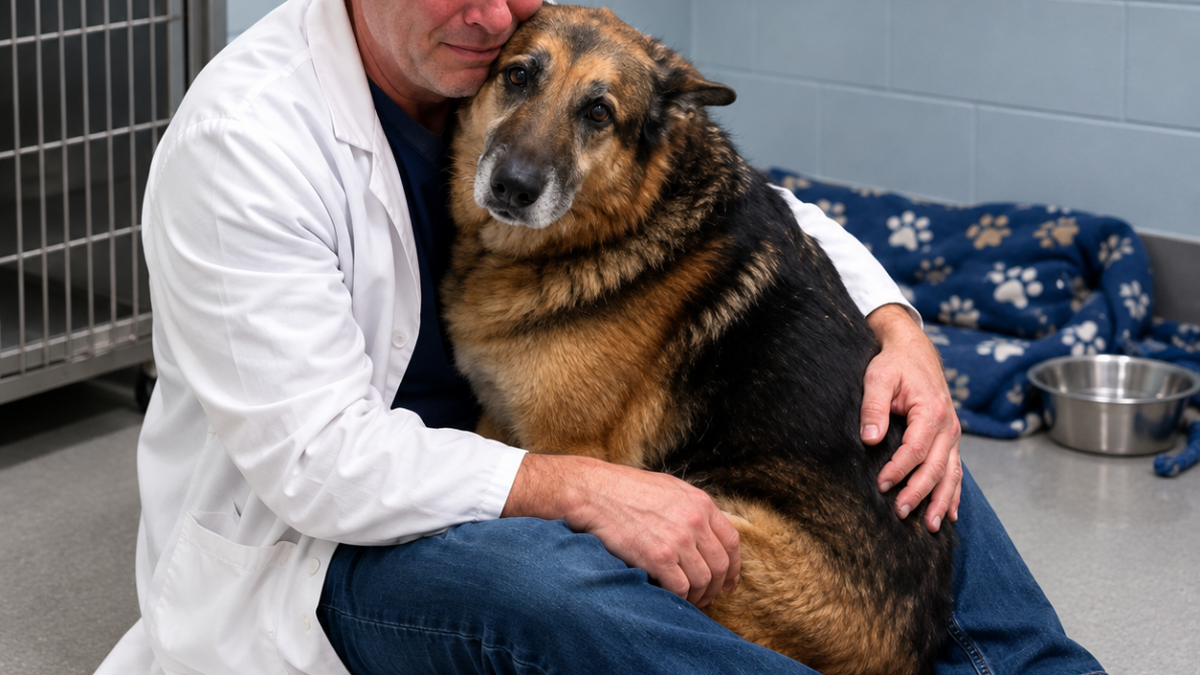
Sam walked slowly back toward his bed.
Each step looked heavier than the last.
At eleven years old, with arthritis beginning in his hips, dragging a full metal water bucket across concrete had taken far more out of him than I initially realized.
When he reached his blanket, he turned once and lowered himself carefully.
His sides rose and fell rapidly.
I crouched beside him.
“You stubborn old gentleman.”
Sam glanced toward me.
His tail moved once.
Then his eyes shifted past me.
Toward Luna.
He had not done it for praise.
I knew dogs well enough not to turn every behavior into a human story.
Sam could not explain motive.
Neither could I.
Maybe he associated water with comfort.
Maybe he had simply noticed Luna would not approach it.
Maybe it was coincidence shaped by my own desperate need to see meaning.
I was willing to consider all of that.
Then I looked at Luna.
Her ears had changed.
Until that moment, she had kept them pinned flat against her skull.
Now one had lifted slightly.
Her eyes were no longer staring through the wall.
They were fixed on the bucket.
I remained perfectly still.
“Come on,” I whispered.
Then immediately regretted speaking.
Luna’s eyes flicked toward me.
Her body tightened.
I lowered my gaze.
“All right.”
No pressure.
That was the first rule with frightened animals.
Give them choices.
Abuse steals choice.
Healing has to return it.
So I sat on the floor several feet away and pretended not to watch.
Thirty seconds passed.
Then a minute.
The shelter continued around us.
Dogs barking down the corridor.
A stainless-steel bowl hitting the floor.
Rachel talking to a volunteer near intake.
A washing machine humming in the back room.
But inside kennel seven, time felt suspended.
Luna looked at the water.
Then Sam.
Sam appeared asleep.
He wasn’t.
One ear remained turned toward her.
Luna shifted one front paw.
Stopped.
Her whole body trembled.
Another paw moved.
Barely an inch.
My throat tightened.
“That’s it,” I almost said.
I bit down on the words.
She moved again.
Not standing.
Crawling.
Her belly remained close to the floor.
The bucket was now less than a foot from her face.
She paused.
Looked at Sam.
His eyes were closed.
That ear was still listening.
Luna stretched her neck.
Her nose touched the water.
She jerked backward.
I thought we had lost the moment.
Her eyes widened.
Her breathing quickened.
But she did not retreat to the corner.
She stayed.
Then she leaned forward again.
Her tongue touched the surface.
Once.
The water rippled.
Luna froze.
Then another lick.
Another.
And suddenly she began drinking.
Small, cautious laps at first.
Then faster.
Much faster.
Water spilled from both sides of her mouth.
Her tongue moved desperately.
She drank as though she had just remembered thirst existed.
I covered my mouth.
“Easy, sweetheart.”
This time my voice did not stop her.
I moved slowly toward the gate.
Dr. Harris had warned us not to allow her to take in too much too quickly given her condition.
I needed to monitor her.
But I also did not want to interrupt the first decision she had made for herself since arriving.
Luna drank.
Stopped.
Breathed.
Drank again.
Then lifted her head.
Water ran from her gray-and-white muzzle onto the concrete.
Her eyes went to Sam.
The old Labrador opened his.
They looked at one another.
I know what people want me to say.
That Sam smiled.
That Luna thanked him.
That some silent conversation passed between them.
I cannot prove any of that.
I can only tell you what I saw.
Luna looked at Sam longer than she had looked directly at any living thing in three days.
Sam held her gaze.
Then his tail tapped his blanket once.
Luna lowered herself onto the floor.
But not in the corner.
She lay beside the bucket.
Front legs extended.
Head resting between them.
Her eyes slowly closed.
She slept.
Really slept.
Not the tense half-conscious state she had been in since arriving.
Her breathing became deep.
Even.
Something inside me collapsed.
I was crying before I realized it.
Rachel appeared at the entrance.
“Lise?”
I wiped my face quickly.
“What?”
She looked from me to Luna.
Then toward the bucket.
“She drank?”
I nodded.
“Finally.”
“Oh, thank God.”
Rachel smiled.
“Maybe she was just thirsty enough.”
I looked at Sam.
He had his chin resting on his paws again.
“Maybe.”
I didn’t explain.
Not yet.
Some moments are too fragile when they first happen.
Putting them into words makes them smaller.
That afternoon, Dr. Harris checked Luna again.
Her hydration was still poor, of course.
One drinking session could not undo several days.
We continued supportive care.
Small amounts frequently.
Careful nutrition.
Blood work.
Parasite treatment.
Everything medically appropriate.
But something had shifted beyond the numbers.
Whenever Sam drank, Luna watched.
When he approached food, she looked toward her own bowl.
That evening, I placed both meals down at the same time.
Sam began eating immediately.
Luna remained still.
Sam chewed slowly.
Old dogs rarely rush unless food is exceptionally good.
Luna’s nose moved.
I saw it.
One small sniff.
Then another.
The smell of chicken and rice filled the kennel.
Luna looked toward Sam.
He kept eating.
She stretched her neck toward her bowl.
Stopped.
Backed away.
“It’s okay.”
She stared at me.
I left.
That was difficult.
Every part of me wanted to remain and encourage her.
But sometimes the greatest kindness you can give a traumatized animal is absence.
I walked around the corner.
Waited.
Five minutes later, I returned quietly.
Luna’s bowl had moved.
Not much.
But several bites were gone.
I smiled so hard my face hurt.
Sam was asleep.
Luna was licking a small piece of chicken from the concrete.
“Good girl.”
She stopped.
Looked at me.
Then, for the first time, she did not shrink backward when I spoke.
That was day three.
Day four began before sunrise.
I arrived almost an hour earlier than my shift.
Rachel’s car wasn’t there.
The front office lights were off.
The shelter smelled like disinfectant, dog food, and that strange warm animal scent every shelter employee eventually stops noticing.
I unlocked the kennel corridor.
Immediately, barking erupted.
“Good morning, everybody.”
More barking.
“You’ve all clearly survived the night.”
I reached kennel seven.
Sam was asleep.
Luna wasn’t.
She was lying in the center.
Not the corner.
Her head came up when she saw me.
I stopped outside.
“Morning.”
Her ears moved.
No retreat.
I opened the gate slowly.
Luna watched my hand.
I changed the water.
She tracked every movement.
Then I sat.
Five minutes.
Ten.
Neither of us moved.
Finally, Luna lowered her head.
Not asleep.
Relaxed.
It was the first time she had rested with a human inside the kennel.
I looked at Sam.
“Your work is apparently contagious.”
Sam snored.
Over the next week, we changed everything about Luna’s routine around one simple principle.
Sam came first.
Not because he was more important.
Because he was her map.
If Sam walked out through a doorway, Luna eventually followed.
If Sam accepted a leash, Luna tolerated one.
If Sam ate a treat from Rachel’s hand, Luna watched carefully.
If Sam lay down in the yard while volunteers moved around him, Luna settled nearby.
She trusted nothing about the world.
But somehow she trusted his judgment.
The first walk was almost a failure.
I clipped Sam’s leash first.
He stood beside the kennel door.
Luna flattened herself.
I placed her leash on the floor.
Waited.
She stared at it.
I wondered what history leashes represented to her.
Control?
Punishment?
Being dragged?
I didn’t know.
The old scars told me enough to be careful with assumptions.
I left the leash nearby for half an hour.
Later, I picked it up.
Touched it gently to her shoulder.
She flinched.
Sam turned.
He walked toward Luna.
Sniffed the leash.
Then sat beside her.
I tried again.
Luna trembled but stayed.
Clip.
One tiny sound.
Done.
“Good.”
We opened the kennel.
Sam walked out.
Luna remained.
Sam turned.
Looked back.
She stood.
One step.
Then another.
And followed him.
Outside, sunlight hit her face.
She stopped.
Her eyes closed.
Just for a second.
I wondered how long it had been since sunlight felt safe.
Sam walked onto the grass.
He immediately found a patch near the fence and began investigating it with the dedication of a detective.
Luna watched.
Then stepped onto the grass.
Her feet seemed confused by it.
She lifted one paw.
Put it down.
Lifted another.
Then she smelled the ground.
That ordinary dog behavior nearly made me cry again.
She smelled grass.
Not danger.
Not doors.
Not hands.
Grass.
Sam moved toward the shade.
Luna followed.
They lay six feet apart.
The next day, four feet.
By the end of the week, two.
We did not force proximity.
That was what made it meaningful.
Luna chose.
On day nine, I saw her tail move.
I almost missed it.
Sam was rolling in the grass.
It was one of the least dignified things he did.
He turned onto his back, legs waving, old Labrador belly exposed to the sky.
Rachel laughed.
“Sam, please have some self-respect.”
Luna stood nearby.
She watched him.
Sam rolled again.
A small patch of grass stuck to his ear.
Luna’s tail moved.
One side.
Then back.
Rachel grabbed my arm.
“Did you see that?”
“Don’t react.”
“Sorry.”
We both looked away immediately.
Luna’s tail moved again.
That night, I called Mrs. Clark.
I did it every Thursday.
The nursing home staff usually transferred me to her room.
“Hello?”
“Mrs. Clark? It’s Lise from the shelter.”
“Oh, honey.”
Her voice was weaker than it had been six months earlier.
“How’s my Sammy?”
I looked through the office window.
Sam was sleeping beside Luna.
“He’s good.”
“Is he eating?”
“Very well.”
“His hip?”
“Some stiffness. The medication helps.”
“Any families?”
That question came every week.
“Not yet.”
Silence.
Then:
“He’s such a good boy.”
“I know.”
“No, Lise. Truly. That dog…”
Her voice broke.
I waited.
“My husband died when Sam was two.”
I had heard pieces before.
“He slept with his head on my feet for months. Wouldn’t leave me.”
I looked at the old Labrador.
“I believe it.”
Mrs. Clark sniffed.
“Tell him Mama loves him.”
“I will.”
“And tell him I’m sorry.”
“Mrs. Clark.”
“I promised I’d keep him.”
“You didn’t choose this.”
“I know.”
She didn’t sound convinced.
“Listen to me. Sam is okay.”
I hesitated.
“He has a friend.”
“A friend?”
“Her name is Luna.”
I told her.
Not everything.
Just enough.
Young Australian Shepherd.
Very frightened.
Wouldn’t drink.
Sam stayed near her.
Helped her settle.
Mrs. Clark became quiet.
Then laughed softly.
“Of course he did.”
“You’re not surprised?”
“Sam always notices sadness.”
That sentence lodged somewhere inside me.
“Always?”
“When my sister had chemotherapy, he would sit by her chair every time she visited. Never did that otherwise.”
I looked again toward kennel seven.
Luna had shifted closer in her sleep.
Her back nearly touched Sam’s front paws.
“He notices sadness,” Mrs. Clark repeated.
“Yes.”
I swallowed.
“He does.”
The following Monday, Luna ate breakfast before Sam.
That may sound insignificant.
For us, it was enormous.
I placed both bowls down.
Luna approached hers.
No waiting.
No watching.
Ate.
I leaned against the kennel gate.
“There you are.”
Sam was still stretching.
He finally reached his bowl.
Luna continued eating.
Independence.
That became the next phase.
We did not want Luna to require Sam forever.
Safety should become a foundation.
Not a cage.
So gradually, carefully, we introduced experiences without him.
Five minutes with Rachel.
A short walk to the end of the corridor.
A veterinary check while Sam waited outside.
The first attempts were difficult.
Luna would search for him.
Whine.
Freeze.
Then Sam would return and she would settle.
But each separation became slightly easier.
Ten minutes.
Fifteen.
Half an hour.
One afternoon, Rachel took Luna alone into the play yard.
I watched through the window.
Luna stood near the gate for two minutes.
Then sniffed a bush.
Then another.
A volunteer tossed a tennis ball.
Luna ignored it.
The ball rolled near her feet.
She sniffed.
Then nudged it.
Rachel looked toward me through the glass.
Neither of us dared react.
The volunteer rolled it again.
Luna followed.
Not playing exactly.
Interested.
Curiosity.
That was enough.
A month after arrival, Luna allowed me to touch her face.
Not because I tried.
Because she asked.
I was cleaning the kennel.
Sam had gone for a veterinary check.
Luna was lying on her blanket.
I sat nearby to update her chart.
After several minutes, I felt something against my elbow.
I froze.
Luna’s nose.
She sniffed my sleeve.
Then my hand.
I left it motionless on the floor.
She sniffed my fingers.
My heart pounded harder than it had on my wedding day.
Yes, I was married once.
No, it didn’t last.
That’s another story.
Luna’s nose touched my palm.
Then she lowered her head onto my hand.
The entire weight of it.
I stopped breathing.
“You sure?”
Her eyes closed.
I moved one finger.
Slowly.
Across her cheek.
No flinch.
Another.
Then my whole hand.
I stroked the side of her face.
Luna sighed.
That sound destroyed me.
Not because it was dramatic.
Because it was ordinary.
Dogs sigh when they’re comfortable.
Comfort had once seemed impossible for her.
Now here she was.
Head in my hand.
Trusting enough to close her eyes.
Sam returned ten minutes later.
Luna got up and greeted him.
Her tail wagged visibly.
He sniffed her.
Then me.
Then walked to his bed.
“Your student is graduating,” I told him.
Sam drank water.
Of course.
His answer to everything was water, food, or sleep.
We began posting about them.
At first separately.
SAM — 11-year-old Labrador. Gentle senior. Calm home preferred.
LUNA — approximately 4-year-old Australian Shepherd. Needs patient experienced adopter. Fearful but improving.
People asked about Sam.
Then learned his age.
Interest disappeared.
People asked about Luna.
Then learned she was frightened.
Interest disappeared.
That is the reality of shelter work.
People mean well.
But adoption has preferences.
Young.
Healthy.
Friendly.
Easy.
No medical issues.
No fear.
No history.
The dogs who need the most patience are often the dogs who receive the fewest applications.
Then one day I watched Luna refuse to leave the adoption room because Sam had been taken back to his kennel.
She stood at the doorway until he returned.
Rachel crossed her arms.
“We can’t split them.”
I knew.
“We may have to eventually.”
“No.”
“Rachel.”
“Look at them.”
I did.
Sam had entered.
Luna immediately relaxed.
He walked beside her.
They moved down the corridor together.
Old dog.
Young dog.
Different histories.
Same pace.
I exhaled.
“All right.”
Rachel smiled.
“Bonded pair?”
“Bonded pair.”
“That’s harder.”
“I know.”
“You just argued against yourself.”
“I know.”
We updated the listing.
SAM & LUNA — ADOPT TOGETHER.
An older gentleman and the young dog learning the world through him.
Applications became almost nonexistent.
I did not regret it.
Weeks passed.
Then months.
Luna became stronger.
Her ribs disappeared beneath healthy weight.
Her coat changed.
Nutrition brought out color and shine we hadn’t seen when she arrived.
Her pale blue eyes remained striking.
But the emptiness was gone.
Not completely.
Fear leaves shadows.
Sudden noises still made her crouch.
A raised male voice from another room could freeze her.
Brooms terrified her.
Leather belts were worse.
We never investigated the meaning too deeply.
We did not need to.
Trauma does not require a complete autobiography to deserve gentleness.
Sam aged beside her.
His arthritis worsened.
Some mornings, he needed longer to stand.
I began giving his medication with breakfast.
Luna waited until he rose before going outside.
Every morning.
No exception.
Once, Sam refused to get up because it was raining.
Luna stood beside him for fifteen minutes.
Rachel opened the door.
“Luna, come on.”
Nothing.
Sam looked toward the rain.
Then toward his bed.
Decision made.
“Sam,” I said.
Tail.
“You’re a terrible influence.”
Eventually, both stayed inside.
By month three, something beautiful and difficult became clear.
Sam was teaching Luna how to live.
Luna was giving Sam a reason to keep participating in life.
Before Luna, Sam spent most of his days sleeping.
He ate.
Walked.
Accepted affection.
Then returned to his blanket.
After Luna arrived, he watched her.
Followed her.
Sometimes even initiated play.
Once, he stole a rope toy from her.
Luna stared in shock.
Sam walked away with it.
Luna followed.
He dropped it.
She picked it up.
He took the other end.
A game.
Ten seconds.
Then Sam became tired and lay down.
Luna remained beside him with the rope between her paws.
I took a photograph.
It became the image we used on the shelter website.
The caption read:
HE BROUGHT HER WATER. SHE BROUGHT HIM BACK TO LIFE.
I worried that was too sentimental.
Rachel disagreed.
“It’s true.”
Maybe.
The story spread locally.
Not viral.
Not national.
Just enough.
People commented.
Donations arrived.
Someone sent Sam an orthopedic bed.
Another person sent Luna a blue blanket.
Mrs. Clark called after seeing the story on a tablet at her care facility.
“A nurse showed me.”
“You saw it?”
“My Sammy’s famous.”
“Locally.”
“He always deserved fame.”
I smiled.
“Mrs. Clark, Luna loves him.”
“I know.”
“She really does.”
“Good.”
Her voice weakened.
“I worried he thought I left him.”
There it was again.
The same fear so many owners carried when illness separated them from animals.
“He doesn’t.”
“How do you know?”
I looked at Sam.
“I tell him every Thursday.”
Mrs. Clark laughed through tears.
“You think he understands?”
“I think he understands more than either of us can prove.”
“Thank you, Lise.”
A month later, Mrs. Clark stopped calling.
Thursday came.
No call.
I waited until Friday.
Then contacted the care facility.
A nurse transferred me to social services.
Mrs. Clark had died Wednesday night.
Peacefully.
In her sleep.
I sat at my desk for a long time.
Rachel came in.
“What?”
I couldn’t answer immediately.
Then:
“Sam’s mom.”
Her face changed.
“Oh.”
We went to kennel seven.
Sam was asleep.
Luna beside him.
I knelt.
“Hey, old man.”
Sam opened his eyes.
His tail moved.
I sat on the floor.
Rachel sat beside me.
“How do you tell a dog?”
She whispered.
“You don’t.”
I touched Sam’s head.
But I tried anyway.
“Your mama loved you.”
Sam watched me.
“She never stopped.”
My voice broke.
“She asked about you every week.”
Luna moved closer.
Sam rested his head across my knee.
“She wanted you to know.”
I cried into his fur.
Rachel cried beside me.
Luna pressed against Sam’s side.
That afternoon, Sam slept longer than usual.
Did he understand?
I do not know.
Please understand how important that sentence is.
We often want animal stories to become magic because magic hurts less.
I cannot tell you Sam knew Mrs. Clark had died.
I can tell you that for several days after I told him, he became quieter.
And Luna stayed closer.
Maybe she noticed sadness.
Maybe Sam had taught her that too.
The following month, Julia walked through our front doors.
Thursday.
2:17 p.m.
I remember because intake had been unusually slow.
Julia looked like someone who had come straight from a garden.
Jeans.
Work boots.
Simple green sweater.
Dirt beneath her fingernails.
Mid-fifties.
She stood in the lobby reading the adoption board.
Then she walked toward kennel seven.
And stopped.
Most potential adopters look at several dogs.
Julia looked only at two.
I approached.
“Hi.”
She didn’t turn immediately.
“Those are Sam and Luna?”
“Yes.”
“The water-bucket dogs?”
I smiled.
“That’s one description.”
She finally looked at me.
“I read their story.”
“Online?”
She nodded.
Inside the kennel, Sam slept.
Luna sat several feet away watching Julia.
Not hiding.
That alone would have been unimaginable three months earlier.
“They have to go together?”
“Yes.”
“No exceptions?”
“No.”
Julia looked relieved.
“Good.”
I studied her.
“Good?”
“If you’d said they could be separated, I was going to argue.”
That got my attention.
“You interested in adopting?”
Her eyes stayed on the dogs.
“My husband died fourteen months ago.”
I waited.
People often tell shelter workers more than they intend.
Animals create strange honesty.
“We were married thirty-one years.”
“I’m sorry.”
“Thank you.”
Julia rubbed her hands together.
“I have a house outside town. About three acres. Fenced backyard. No other pets.”
Sam opened his eyes.
“I wasn’t looking for dogs.”
She laughed weakly.
“I wasn’t looking for anything, really.”
Luna watched.
“I read about Sam moving that water.”
Julia swallowed.
“And something about it…”
She stopped.
No pressure.
I had learned patience from the dogs.
“I’ve felt thirsty,” she finally said.
I understood she didn’t mean water.
“For what?”
“That’s the problem.”
Her eyes filled.
“I didn’t know.”
She looked through the gate.
“Company. Purpose. Compassion. Something.”
Sam stood.
Slowly.
Julia’s face softened.
“He’s old.”
“Eleven.”
“How bad is the arthritis?”
“Manageable right now. It will progress.”
“Luna?”
“Physically healthy. Emotionally still healing.”
“She afraid of women?”
“Less than men.”
“Visitors?”
“Depends.”
“Children?”
“Unknown enough that I’d recommend an adult home.”
“I don’t have children at home.”
“Work?”
“From home three days a week. My sister lives next door.”
She had done research.
That mattered.
“Would you like to meet them?”
“Yes.”
We started with Sam.
Of course.
Sam walked into the meet-and-greet room.
Julia sat on the floor.
No calling.
No clapping.
No baby voice.
I noticed.
Sam approached.
Sniffed her hands.
Then placed his head directly in her lap.
Julia froze.
“Oh.”
I smiled.
“That’s Sam.”
Her hands moved over his ears.
Her face folded.
Tears.
She whispered:
“Hi, sweetheart.”
Sam sighed.
Within minutes, he was nearly asleep against her.
Then Luna entered.
She stopped at the doorway.
Julia did not look directly at her.
Perfect.
She continued petting Sam.
Luna watched.
One minute.
Three.
Five.
She came closer.
Stopped.
Julia remained still.
Ten feet.
Eight.
Five.
Luna sniffed Sam.
Then Julia’s shoe.
Julia’s hand trembled slightly.
She kept it on Sam.
Luna stepped back.
That was enough for day one.
Julia returned the next afternoon.
Then Saturday.
Then Monday.
Every visit followed Luna’s pace.
Sometimes progress.
Sometimes regression.
One day, Luna approached within arm’s reach.
The next, she hid behind Sam.
Julia never complained.
Never asked, “When will she trust me?”
That question often tells me someone is not ready for a traumatized animal.
Trust is not owed because a human has good intentions.
Trust is built.
Julia seemed to understand.
On her sixth visit, she brought a book.
“What’s that?”
“I thought I’d sit.”
“For how long?”
“As long as they’ll let me.”
She sat inside the kennel and read.
Sam slept beside her.
Luna lay across the room.
An hour passed.
Then Luna stood.
Walked forward.
Julia kept reading.
Three feet.
Two.
One.
Luna sat in front of her.
Julia stopped turning pages.
Didn’t raise her head.
Luna sniffed her knee.
Then, slowly, lowered her head onto Julia’s lap beside Sam’s.
Julia closed her eyes.
The book fell from her hand.
“Oh.”
That one sound.
Rachel was behind me.
She gripped my arm.
“Don’t cry.”
“You’re crying.”
“I know.”
Julia touched Luna’s head.
One gentle stroke.
Luna stayed.
Second.
Stayed.
Third.
Then Luna closed her eyes.
There it was.
The decision.
Not ours.
Hers.
Adoption paperwork took another week.
Home check.
Veterinary plan.
Discussion of Sam’s age.
Discussion of Luna’s fears.
Julia listened to everything.
No romantic fantasies.
No “love fixes everything.”
That mattered.
Love helps.
Routine helps.
Safety helps.
Sometimes medication helps.
Professional behavior support helps.
Healing is work.
Julia was willing.
Friday morning, she arrived with a large SUV.
Two orthopedic beds in the back.
Two blue collars.
Blankets.
Water bowls.
A ramp for Sam.
“You installed a ramp already?”
“I know old knees.”
“You don’t have old knees.”
Julia looked at me.
“Excuse me?”
I laughed.
“Sorry.”
She smiled.
“Fifty-seven is not twenty.”
Fair.
I brought Sam out first.
He wore his new collar.
Dark blue.
He looked handsome.
Luna’s was lighter blue.
She stepped through the shelter door behind him.
Then stopped.
Sam stopped too.
He turned.
Looked toward her.
Luna walked forward.
We reached the parking lot.
Sam paused beside the SUV.
He looked back at the building.
Six months.
That shelter had become his world after he lost Mrs. Clark.
Six months of waiting.
Then Luna.
I crouched beside him.
“You ready?”
His tail moved.
I kissed his forehead.
“Your mama would like her.”
Julia looked confused.
“Mrs. Clark.”
I had told her.
Julia’s eyes filled.
“She’d like you too.”
That did it.
I started crying.
Again.
Shelter workers cry more than people think.
Not because we are fragile.
Because our job requires caring deeply and then letting go repeatedly.
Sam climbed the ramp.
Slow.
One step at a time.
Luna followed.
No hesitation.
Inside, she settled beside him.
Julia closed the rear door.
Then hugged me.
“Thank you.”
“No.”
I looked through the window.
“Thank them.”
Julia smiled.
She drove away.
I stood in the parking lot until the SUV disappeared.
Rachel came beside me.
“You okay?”
“No.”
“Me neither.”
We went back inside.
Kennel seven was empty.
That emptiness hit harder than expected.
Two blankets removed.
Bowls gone.
No old Labrador in the corner.
No blue-eyed dog watching from the middle.
I stood at the gate.
Rachel touched my shoulder.
“Good empty.”
I nodded.
“Good empty.”
The first photograph arrived that evening.
Sam asleep on Julia’s couch.
Luna on the floor directly below him.
Caption:
HE HAS ALREADY IGNORED THE EXPENSIVE BED.
I laughed.
The next morning:
Luna ate breakfast.
Then:
Sam discovered the garden.
Then:
Luna followed him through the dog door.
Then a video.
Julia’s backyard was large.
Grass.
Trees.
Garden beds.
Sam walked slowly along a path.
Luna followed three feet behind.
He stopped near a water bowl.
Drank.
Luna waited.
Then drank after him.
I watched the video four times.
A week later, Julia called.
“Everything okay?”
“Yes.”
“You sound worried.”
“I’m always worried.”
Fair.
“Luna won’t go into my bedroom.”
I thought.
“Where does Sam sleep?”
“My bedroom.”
“Where does Luna sleep?”
“Hallway outside.”
“Door open?”
“Yes.”
“Let her.”
“You don’t think I should encourage—”
“No.”
Silence.
Then:
“Okay.”
Three nights later, Julia texted a photograph.
Sam on a bed beside hers.
Luna sleeping halfway through the doorway.
Progress.
A week later:
Both inside.
A month later:
Luna on Julia’s rug.
Two months later:
Luna with her head on Julia’s foot.
Healing measured in inches.
Sam’s health became our quiet concern.
His arthritis worsened during winter.
Julia took him to her veterinarian.
Medication adjustment.
Joint supplements.
Warm bed.
Short walks.
No stairs.
Luna adapted.
She stopped racing ahead in the yard.
Instead, she matched his pace.
Julia sent a video one snowy afternoon.
Sam walked slowly.
Luna beside him.
He stumbled slightly.
She stopped.
Waited.
Then continued when he did.
I watched it at my desk.
A volunteer named Maya looked over.
“Why are you crying?”
“Allergies.”
“In January?”
“Very aggressive allergies.”
Sam had dragged water to Luna when she could not move toward it.
Now Luna adjusted her entire world to the speed his old legs could manage.
That was their relationship.
Help did not travel one direction forever.
Sometimes the one rescued becomes the one who waits.
In spring, Julia brought them to visit.
The moment Sam entered the shelter, every employee reacted.
“Sam!”
He wagged.
Luna stayed close.
But she did not freeze.
That was the difference.
She remembered the building.
I could see it.
Her body tightened.
Then she looked at Sam.
He walked forward.
So did she.
I knelt.
“Luna.”
She came to me.
No hesitation.
Placed her head against my chest.
I wrapped my arms around her.
She tolerated it for exactly three seconds, then stepped away.
Fair.
Sam found Rachel.
Put his head in her lap.
Nothing about him had changed.
Except the gray.
More around his muzzle.
Julia watched us.
“They saved me.”
I looked at her.
She shrugged.
“I know that sounds dramatic.”
“No.”
“My house…”
She looked down.
“After Daniel died, every room became something I avoided.”
She smiled at Sam.
“Then these two arrived and suddenly everything had a purpose.”
“Kitchen because food.”
“Exactly.”
“Yard because walks.”
“Couch because Sam.”
“Bed because eventually Luna.”
Julia laughed.
“Exactly.”
She became serious.
“I thought adopting them would be me doing something generous.”
“That mistake is common.”
“They don’t let you keep that illusion long.”
“No.”
Before leaving, Julia handed me a folded note.
“Read later.”
I put it in my pocket.
That night, after closing, I opened it.
Lise,
Thank you for trusting me with Sam and Luna.
When I read the story about the bucket, I kept thinking about thirst.
Luna was physically thirsty but too afraid to move toward what she needed.
I realized grief had done something similar to me.
I wanted connection, but I had become afraid of reaching toward it because loving anything meant risking another loss.
Then Sam moved the bucket.
Such a tiny distance.
Such an enormous act.
These dogs have taught me that sometimes we cannot walk all the way toward what saves us.
Sometimes someone has to move it closer.
Thank you for moving them closer to me.
— Julia
I taped the note inside my desk drawer.
Not on the wall.
Some things are private.
Months passed.
Then six months.
Julia sent pictures regularly.
Sam sleeping in sunlight.
Luna beside him.
Luna chasing butterflies badly.
Sam watching with an expression that looked judgmental.
Julia gardening while both dogs lay nearby.
One photograph showed a full water bucket between them.
Caption:
SOME TRADITIONS REMAIN.
I printed that one.
On a Thursday afternoon almost exactly six months after the adoption, Julia called.
Her voice told me before the words did.
“Lise.”
“What happened?”
“It’s Sam.”
I sat.
“Tell me.”
“He didn’t get up this morning.”
My eyes closed.
“Vet?”
“We’re here.”
“What did they say?”
Long pause.
“His heart.”
Sam had been diagnosed with age-related cardiac disease several months earlier.
Stable.
Until it wasn’t.
Julia breathed shakily.
“They can admit him. Maybe oxygen, medication. Maybe a few days.”
“Maybe?”
“They said…”
Her voice broke.
“They said I need to ask whether those days are for him or for me.”
No shelter worker can answer that over the phone.
That decision belongs to the person in the room with the animal and the veterinarian who can assess suffering.
“Is he hurting?”
“They think he’s struggling to breathe.”
I swallowed.
“Luna?”
“With me.”
“Can she see him?”
“Yes.”
“Good.”
Silence.
Then:
“I’m not ready.”
“I know.”
“He saved her.”
“I know.”
“He saved me.”
“I know.”
“What am I supposed to do?”
The hardest truth.
“Whatever keeps him from suffering.”
Julia cried.
So did I.
Two hours later, another call.
Sam died with Julia’s hands on him and Luna lying against his side.
They did not hospitalize him.
His condition had worsened quickly.
The veterinarian gave medication to keep him comfortable.
Julia stayed.
Luna stayed.
Sam’s breathing slowed.
Then stopped.
No drama.
No struggle.
The old gentleman who had spent his life quietly noticing sadness left quietly too.
I drove to Julia’s house that evening.
Maybe I crossed a professional line.
I didn’t care.
She opened the door.
Her face was swollen from crying.
Luna stood behind her.
For a second, I feared seeing that old emptiness again.
It wasn’t there.
Grief was.
That was different.
Luna approached me.
Pressed against my legs.
I crouched.
“Where’s your old man?”
My voice broke.
Luna sniffed my face.
Julia cried behind me.
We sat on the floor.
All three of us.
There was an empty orthopedic bed near the fireplace.
Sam’s blue collar rested on it.
His water bowl remained full.
Of course.
I stared at it.
Julia noticed.
“He drank this morning.”
I nodded.
Neither of us could say more.
Luna walked to the bowl.
She smelled it.
Then drank.
For several seconds.
When she finished, she turned.
Looked toward Sam’s empty bed.
Then came to Julia.
Laid her head on Julia’s lap.
That was when I understood the final thing Sam had taught her.
The first time I met Luna, she could not move toward water without him.
Now Sam was gone.
The grief was real.
But Luna drank.
Then she went to someone she trusted.
She did not return to the corner.
Sam had not merely become her crutch.
He had shown her the way out.
And she had learned it.
Julia touched her face.
“You’re staying with me, okay?”
Luna closed her eyes.
“I’m staying too.”
I looked away.
That night, before I left, Julia gave me Sam’s old blue collar.
“I think you should have it.”
“No.”
“You loved him.”
“So did you.”
“I have his tag.”
She pressed the collar into my hands.
“And Mrs. Clark?”
I thought about Sam’s first mother.
“She loved him most.”
Julia nodded.
“Then maybe keep it where both homes can be remembered.”
At the shelter, I hung Sam’s collar inside the staff room.
Not public.
Not an exhibit.
Just us.
Above it, Rachel printed one small sentence:
HE NOTICED SADNESS.
That was all.
Luna changed after Sam’s death.
For several weeks, she searched for him.
Especially mornings.
Julia said she would wake, walk toward his bed, sniff it, then stand.
But she ate.
Drank.
Walked.
Stayed near Julia.
Her fear did not return in full.
That mattered.
Then one morning, something remarkable happened.
Julia sent a video.
She had adopted no other dog.
Not yet.
But a neighbor had brought over an elderly beagle named Murphy.
Murphy was shy.
Newly rescued.
Afraid of Julia’s yard.
In the video, Luna walked outside.
Murphy stayed near the doorway.
Luna stopped.
Turned.
Waited.
Murphy took one step.
Then another.
Luna walked forward.
Murphy followed.
I watched with tears running down my face.
Rachel leaned over.
“What?”
I showed her.
She covered her mouth.
“Oh.”
The lesson had moved again.
Sam to Luna.
Luna to Murphy.
Maybe that is what kindness actually does.
Not end at the recipient.
Continue.
Months later, Julia adopted Murphy.
Different shelter.
Different story.
Luna accepted him carefully.
No instant friendship.
Real dogs are not movie scripts.
But she tolerated him.
Then trusted him.
Eventually, they slept in the same room.
One evening, Julia sent me a photograph.
Murphy stood several feet away from a water bowl.
Apparently he had become nervous after a thunderstorm.
Luna stood beside the bowl.
She looked at him.
Then stepped away.
Murphy approached.
Drank.
No bucket dragging.
No dramatic act.
She had simply shown him it was safe.
I printed that photograph too.
Years have passed since the morning Sam moved the water.
Kennel seven has held dozens of dogs since.
A young beagle.
A mastiff mix.
Two bonded terriers.
A deaf cattle dog.
A puppy that ate part of the wall.
Life inside shelters moves forward whether your heart is ready or not.
That is both difficult and merciful.
You cannot stay forever in one rescue.
Another animal needs the space.
Another frightened face appears.
Another bowl needs filling.
Another dog waits.
But sometimes when I pass kennel seven, I still hear that sound.
Metal scraping across concrete.
Sam’s old jaws gripping the handle.
His paws bracing.
Water spilling.
One inch.
Then another.
It is strange that fifteen years in rescue can become distilled into one small moment.
Not a dramatic surgery.
Not a huge adoption event.
Not a dog being pulled from a burning building.
An old Labrador moving water three feet.
That is the image I remember.
People have asked why Luna would not drink.
I don’t know.
Fear.
Trauma.
Shutdown.
Illness.
A combination.
I refuse to pretend certainty where there is none.
But I know what changed the first time she did.
Distance.
Sam reduced the distance.
That became a lesson I began seeing everywhere.
Some animals cannot cross the whole distance toward safety.
So you shorten it.
Food closer.
Door wider.
Voice softer.
Hand lower.
Expectation smaller.
Some people are the same.
Grief.
Depression.
Trauma.
Loneliness.
We tell them:
Come all the way back.
Ask for help.
Trust again.
Love again.
Sometimes they can’t.
Maybe the kinder question is:
What can I move closer?
A chair.
A meal.
A phone call.
A little patience.
A bucket of water.
Sam never demanded Luna become brave enough to cross the kennel.
He simply brought what she needed within reach.
Then waited.
That part matters most.
He waited.
He did not shove her face toward the water.
Did not bark.
Did not force.
He gave.
Then allowed her choice.
That is what good rescue tries to do too.
Not control.
Create conditions in which choosing life becomes possible again.
On the anniversary of Sam’s death, Julia visited.
Luna was with her.
Older now.
Gray beginning around her own muzzle.
I almost laughed when I saw it.
“Look at you.”
Luna came straight to me.
Head against my hand.
“Who gave you permission to age?”
Julia smiled.
“You.”
“Absolutely not.”
Murphy waited outside with Julia’s sister.
Luna entered the shelter calmly.
No freezing.
No shaking.
She walked to kennel seven.
I don’t know whether she remembered it specifically.
Again, I will not manufacture certainty.
But she stopped.
Sniffed.
Looked toward the corner where Sam once slept.
Julia put a hand over her mouth.
I knelt.
“Your old friend lived here.”
Luna looked at me.
Then toward the center.
Where the bucket had been.
My chest hurt.
Julia whispered:
“He gave her everything.”
“No.”
I shook my head.
“He gave her water.”
Julia looked confused.
I stroked Luna’s neck.
“She did the rest.”
That was important.
We often give rescuers too much credit.
Human or animal.
Sam opened a door.
Luna walked through.
Again and again.
She ate.
Trusted.
Allowed touch.
Entered Julia’s car.
Survived grief.
Loved again.
That was Luna’s work.
Sam helped.
Julia helped.
We helped.
But Luna chose life.
That deserves recognition.
Before Julia left, she handed me an envelope.
Inside was a photograph.
Sam and Luna during his final summer.
They were lying beneath a maple tree.
Sam asleep.
Luna awake beside him.
Between them sat a blue water bowl.
On the back, Julia had written:
HE BROUGHT HER WATER ONCE.
AFTER THAT, HE TAUGHT HER WHERE TO FIND IT.
I placed the photograph beneath Sam’s collar in the staff room.
It is still there.
New employees ask about him.
I tell them.
Not the sentimental version.
The whole version.
Old Labrador.
Lost his owner.
Waited six months.
Traumatized Australian Shepherd.
Wouldn’t drink.
Moved the bucket.
Bonded.
Adopted together.
Lived in a garden.
Died loved.
Left the younger dog capable of continuing.
That is enough.
One new volunteer once asked:
“Do you think Sam knew what he was doing?”
I smiled.
“I think he knew Luna needed something.”
“But did he understand dehydration?”
“No.”
“Trauma?”
“No.”
“So how—”
“He didn’t need the vocabulary.”
The volunteer considered that.
I pointed toward a nervous dog in another kennel.
“You don’t need to understand every wound to notice somebody is hurting.”
That volunteer stayed with us.
Two years now.
She’s very good.
Especially with fearful dogs.
Sometimes lessons travel in unexpected ways.
I still work at the shelter.
People keep asking when I’ll retire.
Maybe soon.
Fifteen years became sixteen.
Then seventeen.
My knees complain.
My back complains.
Rachel says I am becoming Sam.
I take that as a compliment.
I have seen hundreds of dogs come through those doors.
Some stories ended beautifully.
Some didn’t.
That is the truth people outside rescue rarely want.
We cannot save everything.
Love is not always enough.
Medicine is not always enough.
Time is not always enough.
But sometimes one small act changes the direction of a life.
Sam gave me proof.
A bucket of water.
Three feet.
Maybe less.
That distance separated Luna from something necessary.
To anyone else, three feet was nothing.
To her, it was impossible.
Sam made it possible.
I think about that whenever I feel frustrated with an animal who “should” be progressing faster.
Should trust.
Should eat.
Should walk through the door.
Should allow the leash.
Should.
Should.
Should.
There are no shoulds inside trauma.
There is only the distance an individual can cross today.
Our job is to meet them there.
Last month, Julia sent one more picture.
Luna is older now.
Much older.
Her face is almost half gray.
She lies in the same sunny garden where Sam once slept.
Murphy rests beside her.
Julia wrote:
Luna has arthritis now. Some mornings she takes a while to stand. Murphy waits for her. He won’t go outside until she gets up.
I read that sentence three times.
Murphy waits for her.
Sam waited for Luna.
Luna waited for Sam.
Now Murphy waits for Luna.
A chain.
Not of rescue.
Of patience.
Julia added:
The water bowl is still in the same place.
I smiled.
Of course it is.
There is something comforting about imagining it.
Sunlight.
Grass.
Old dogs.
A bowl full of water.
No fear around it.
No metal scraping against concrete.
No desperate need to make the impossible distance smaller.
Just water.
Available.
Safe.
Ordinary.
Maybe that is the true ending.
Not Luna becoming fearless.
She never did.
She became brave despite fear.
There is a difference.
Not Sam living forever.
He didn’t.
He lived long enough to change another life.
Not Julia ceasing to grieve her husband.
She still misses him.
She learned that grief and love can occupy the same house.
The ending is ordinary.
Breakfast.
Garden.
Water.
Sleep.
Trust.
That is what rescue is supposed to make possible.
Ordinary life.
People often want spectacular endings.
I have come to appreciate quiet ones.
A frightened dog sleeping with her belly exposed.
An old dog dying in a home instead of a shelter.
A widow laughing again in her garden.
A water bowl nobody is afraid to approach.
Those things are enough.
More than enough.
Yesterday, I walked past kennel seven again.
There is a young dog named Charlie there now.
Energetic.
Loud.
Tail like a weapon.
He knocked his water bowl over twice before noon.
I walked in to replace it.
“Sam would be disappointed in you.”
Charlie jumped.
Water went everywhere.
I laughed.
Then, without meaning to, I looked toward the corner.
For one second, I could see him.
Not literally.
Memory.
Sam lying there.
Gray muzzle across his paws.
Watching.
Waiting.
Then the moment passed.
Charlie barked.
I filled the bowl.
Before leaving, I moved it slightly closer to his bed.
Habit.
Maybe.
Or maybe Sam changed me too.
I am Lise.
I have worked in rescue long enough to know there are things animals do that we can explain.
And things we should be careful not to over-explain.
I do not know precisely what Sam thought the morning he stood.
I do not know whether he understood Luna had gone three days without drinking.
I do not know whether dragging that bucket was compassion in the human sense of the word.
I only know what happened.
He looked at her.
He looked at the water.
He stood on painful old legs.
He took the handle in his mouth.
And he moved the water to where she could reach it.
Then he stepped away.
Luna drank.
Sometimes facts are beautiful enough without embellishment.
Sam never received a medal.
No television crew came.
No plaque went up outside kennel seven.
He did not need any of that.
Mrs. Clark had already told me who he was.
“The gentlest dog you’ll ever meet.”
She was right.
After everything I have seen, I think gentleness is one of the most underestimated forms of strength.
Anyone can make noise.
Anyone can force.
Gentleness requires noticing.
Patience.
Restraint.
Knowing when to approach and when to step back.
Sam knew.
Perhaps because someone had loved him gently first.
Maybe Mrs. Clark spent eleven years teaching him that.
Then, when Luna needed it, he passed it on.
And Luna passed it on.
And Julia.
And Murphy.
And me.
That may be the part I love most.
Kindness travels.
Not always dramatically.
Not always visibly.
But it travels.
One old woman loved a yellow Labrador.
That Labrador helped a frightened shepherd.
That shepherd helped a grieving woman.
That woman gave two dogs a home.
That shepherd later helped another rescue dog.
And a shelter worker who thought she already understood patience learned something new after fifteen years.
All because one morning, an old dog looked across a kennel and noticed someone could not reach the water.
Sometimes that is love.
Not fixing everything.
Not knowing the entire story.
Not demanding someone cross an impossible distance.
Sometimes love is looking at what another living thing needs, moving it a little closer, and saying without words:
You don’t have to come all the way.
I’ll meet you here.
Sam did.
And Luna drank.








